






Abstract
The censorship and surveillance practices imposed on samba schools, musical performances, and compositions in Rio de Janeiro during the period of the military dictatorship (1964–1985) targeted black political organization at large and musical perspectives on black history and culture. Interviews with samba musicians and analyses of political police documents underscore the military government’s control of discourses and suppression of archives, demonstrating that censorship and surveillance in music and the arts continued after 1985.
As práticas de censura e vigilância impostas às escolas de samba, performances e composições musicais no Rio de Janeiro durante o período da ditadura militar (1964-1985) cercearam a organização política negra em geral e as perspectivas musicais sobre a história e a cultura negras. Entrevistas com sambistas e análises de documentos policiais ilustram o controle governamental de discursos e o apagamento de arquivos, demonstrando que a censura e a vigilância na música e nas artes continuaram após 1985.
Censorship will never come to an end because it has a historical function, which is to protect our people. That protection is the duty of the entire government, independent of its political orientations.
—Brazilian Minister of Justice Ibrahim Abi-ackel, 1981
In December 2016, a collection of over 8,700 unpublished historic documents housed at Rio de Janeiro’s National Archive became available to the public. Among them, stacks of censored lyrics from the 1960s to the 1980s emerged, raising new questions on the relationship between government surveillance and popular music during the military dictatorship (1964–1985). The emergence of these documents is a milestone in Brazilian popular music studies, for while it is common to speak of song censorship during the Estado Novo [New State] (1937–1945), “there exist next to no trustworthy qualitative records of such, nor is there a single archive in Brazil that may have recovered the precious documents from the DIP [Departamento de Imprensa e Propaganda], in part due to the destruction of documents” (Paranhos, 2015: 108). 1
Drawing on these newly available documents, interviews, police intelligence files, and handbooks, among other sources, I explore the repression of samba music and samba schools as black territories during the military dictatorship. As early as the mid-1930s, the Departamento Geral de Investigações Especiais (Department of Special Investigations—DGIE) viewed samba schools as preferential sites of communist elements. During the 1970s and 1980s, as black activist organizations blossomed around Brazil, the DGIE, among other intelligence units, perceived soul dances and samba schools as dynamic black spaces capable of resignifying identities and spurring a racial movement and therefore decided to infiltrate them. From the late 1960s until the mid-1980s, there was police repression of musical performances, the monitoring of samba school rehearsal spaces, and the enforcement of ideological guidelines in sambas-enredo 2 by police intelligence units, the Empresa de Turismo do Município do Rio de Janeiro (Municipal Tourist Board of Rio de Janeiro—Riotur), and the Associação das Escolas de Samba do Rio de Janeiro (Samba School Association of Rio de Janeiro—AERCJ). Contrary to dominant narratives that contend that censorship of music had ceased to exist by the 1980s, I demonstrate that it endured in samba music and the arts even after 1985.
I go on to build on the notion of police surveillance and ideological standardization in sambas-enredo by examining lyrics from artists such as Elton Medeiros, Cristóvão Bastos, Antonio Valente, Nei Lopes, Reginaldo Bessa, and Joaquim Teodoro that were censored in the early 1970s for their treatment of slavery and civil rights, and the valuing of black aesthetics. Similar to the soul dances in Rio that threatened venerated narratives of Brazilian national identity, these lyrics were found by the censors to collide with the deep-seated ideology of “racial democracy” that samba music had helped shape since the 1920s. Already prefigured in past evaluations of master-slave relations such as the trope of the kind slave master and the gentle and humane treatment of slaves, the ideology of “racial democracy” advances the fallacious view that Brazil is free of racial prejudice and discrimination and that, consequently, blacks and whites are afforded equal social and economic opportunities (Hasenbalg, 1979: 242). My interviews with sambistas and analyses of censored lyrics highlight the extent to which the military government upheld national discourses on Brazilianness and explicitly undermined the expression of black perspectives. This understanding is particularly valuable upon considering that many of the run-ins that sambistas had with the Departamento de Ordem Política e Social (Department of Political and Social Order—DOPS) in samba schools and musical performances were left unrecorded.
Samba School Surveillance and Censorship during Military Rule
During the period of the military dictatorship, “there was almost no one,” notes the Afro-Brazilian samba composer, civil rights activist, and writer Martinho da Vila, “who was not censored in Brazil” (interview, Rio de Janeiro, July 19, 2016). All songs that were slated to be released commercially during the military dictatorship had to be submitted to and evaluated by the censors. To defy the dicta of the military government was to risk one’s life (see, e.g., Moura, 2019). A sense of paranoia afflicted many Brazilians, who worried that, under surveillance, they could be arrested at any moment. For Afro-Brazilians the stakes were higher than for others. As da Vila explained with a cynical grin, “it was more dangerous to partake in the black movement than to belong to the communist party because as a participant of the black movement you were already labeled a communist. You were doubly guilty” (interview, Rio de Janeiro, July 18, 2012). Censorship in music and the arts was also prevalent in other Latin American countries during this period (e.g., Chile’s Nueva Canción and Canto Nuevo [Morris, 1986; Jordán, 2009], Nueva Canción Uruguaya [Donas and Milstein, 2003], and Cuban music [D’Rivera, 1998; Moore, 2006]).
Active from 1933 to 1983, the political police in Brazil received diverse denominations and attributions, transitioning from a headquarters connected to the Civil Police of the old Federal District to the Departamento Geral (General Department), the center of many divisions, sections, and services that received increased autonomy (Guimarães, 2009: 182). From the onset of Brazil’s military dictatorship, the armed forces developed increasingly into political super police that sought to combat and terminate internal enemies, individuals, or groups identified as antagonistic to the military regime—a reality that would have not materialized with such efficacy without U.S. intervention (see, e.g., Tavares, 2012; Motta, 2021: 73–96). In the early 1960s, the United States contributed to the creation of Latin American bureaucratic-authoritarian states through military assistance and police aid. Established in 1963 under the Agency for International Development (AID), the International Police Academy (IPA)—a sort of West Point for police of the noncommunist world—acted as a mechanism for the CIA to recruit middle- and upper-level police informants and operatives that could eventually create new intelligence units and train paramilitary and other special police organizations and units (Huggins, 1998: 108). In support of Brazil’s military government, the United States helped create three new police organizations under the direction of the Office of Public Safety (OPS): a new Departamento Federal de Segurança Pública (Federal Department of Public Safety—DFSP) that was modeled after the U.S. Federal Bureau of Investigation (FBI), its ancillary organization the Instituto Nacional de Identificação (National Institute of Identification—INI), and the Serviço Nacional de Informações (National Information Service—SNI).
The military regime’s first president, General Humberto Castello Branco, represented the so-called grupo da Sorbonne (a snarky reference to the distinguished education level of many of its members), which held that the dictatorship would be short-lived and that the government would resort to violence against its adversaries with parsimony. After serving in office from 1964 to 1967, Castello Branco was replaced by General Artur da Costa e Silva, who embodied a longer-term strategy and ethos geared toward political surveillance and repression known as the ala dos duros (tough wing). Costa e Silva sought to reinforce the structure of the secret service through the army, navy, and air force with the objective of transforming them into central organizations of repression (Figueiredo, 2015: 15). In 1967, only several months after taking office, he created the Centro de Informações do Exército (Army Intelligence Center—CIE)—a new secret service of ground forces. Although he was removed from the presidency in 1969 following a stroke from which he soon died, another general and adherent of the tough wing, Emílio Garrastazu Médici, took over. In 1970 Médici, who, like General João Batista Figueiredo, served as director of the SNI before assuming the presidency, gave continuity to the reformulation of the secret service in the military by rebaptizing the air force the Centro de Informações de Segurança da Aeronáutica (Air Force Security Intelligence Service—CISA) and by updating the navy, the Centro de Informações da Marinha (Naval Intelligence Service—CENIMAR). Perhaps best understood as an organization focused on the collection, analysis, and dissemination of information for the president and the secret service branches of the military, the SNI, which employed 200,000 people by the late 1970s, was the mainstay of Brazil’s information system during the military dictatorship (Huggins, 1998: 127; Figueiredo, 2015: 18).
Concurrent with these governmental surveillance efforts, several organizations emerged in the 1970s in the struggle against racial discrimination and inequality. A report from the CISA determined the Instituto de Pesquisa das Culturas Negras (Research Institute of Black Cultures—IPCN) to be the coordinating organ of black resistance activities in Rio de Janeiro (Caldas et al., 2015: 129). Founded in 1975, the IPCN constituted a network of cultural associations such as the Sociedade de Intercâmbio Brasil-África (Society for Brazilian-African Exchange—SINBA), the Grupo de Trabalho André Rebouças (André Rebouças Working Group), the Centro de Estudos Brasil-África (Brazil-Africa Study Center—CEBA), the Câmara de Comércio Brasil-África (Brazil-Africa Chamber of Commerce), the Museu de Arte & Folclore do Rio de Janeiro (Folklore Museum of Rio de Janeiro), the Centro de Estudos Afro-Asiáticos (Center for Afro-Asian Studies—CEAA), the Grêmio Recreativo de Arte Negra Escola de Samba Quilombo (Quilombo Recreational Guild of Black Arts and Samba School— G.R.A.N.E.S. Quilombo), and Afoxé Filhos de Gandhi (Afoxé Children of Gandhi). The efforts of these organizations would culminate in the creation of the Movimento Negro Unificado (Unified Black Movement—MNU) in 1978 (see, e.g., Pereira, 2013).
Before the DGIE investigated Black Rio 3 in April of 1975, the secret police had tracked black organizations like the Frente Negra (Black Front) of the early 1930s and the Teatro Experimental do Negro (Black Experimental Theater—TEN) of the 1940s and 1950s on an ad hoc basis, as there was no formal category for black activism on the police’s lists (Alberto, 2009: 10). During military rule, the political police closely monitored the soul phenomenon and any organization, individual, or event that was considered a threat to official discourses of Brazilian identity on issues ranging from sex, class struggle, blackness, and drugs to emancipation, authority, militarism, and the Serviço de Assistência ao Menor (Assistance Service for Minors—SAM). By the late 1960s, as American funk and soul music arrived in Rio, black soul gatherings and dances began to take place in Rio’s working-class North and West Zones and the Baixada Fluminense. Paulina L. Alberto (2009) has detailed how DGIE agents’ new concerns with racial movements, antiwhite “racial discrimination,” and foreign operatives, pushed them to infiltrate soul dances delivered by music groups such as Black Power and Soul Grand Prix in Rio during the mid-1970s. After a soul dance (baile black) that was held at the Cascadura Tennis Club in late April of 1976, the police distinguished between partygoers in general and those they saw as instigators of racially organized styles and identities (blacks) imported from the United States (Alberto, 2009: 11–12). Citing a 1976 interview with the soul DJ Santos dos Santos, Bryan McCann (2002: 51) has observed that many soul enthusiasts embraced black pride while upholding the rhetoric of racial democracy. For him this phenomenon seems to be less an attempt to conceal black militancy than a sincere affirmation of a national ideal, partly because the rejection of the rhetoric of racial democracy can lead to one’s being labeled a racist and anti-Brazilian.
The military government was particularly vigilant of individuals like the Afro-Brazilian scholar, artist, politician, and Pan-African activist Abdias do Nascimento. In a document published on October 9, 1978, titled “Abdias do Nascimento: Racismo negro no Brasil” (Abdias do Nascimento: Black Racism in Brazil), the CISA responded to the ironic article “A coisa tá branca!” (Things Are White!), which had been published a month earlier by the weekly satirical newspaper Pasquim. In the article, the journalists Orlando Fernandes and Ana Angélica dos Santos interview Nascimento on the situation of blacks in Brazil. Breaking down each of Nascimento’s arguments, the CISA declares that “Abdias do Nascimento is, at present, the figure of greatest projection of the racist black movement in Brazil” (SIAN, 1978: 1). 4 It goes on to stress its concern about Nascimento’s ideas: “Politically organized, the ‘Afro-Brazilian’ man will be able to constitute himself as an influential political force, able to present an original political project for the country” (Figure 1).
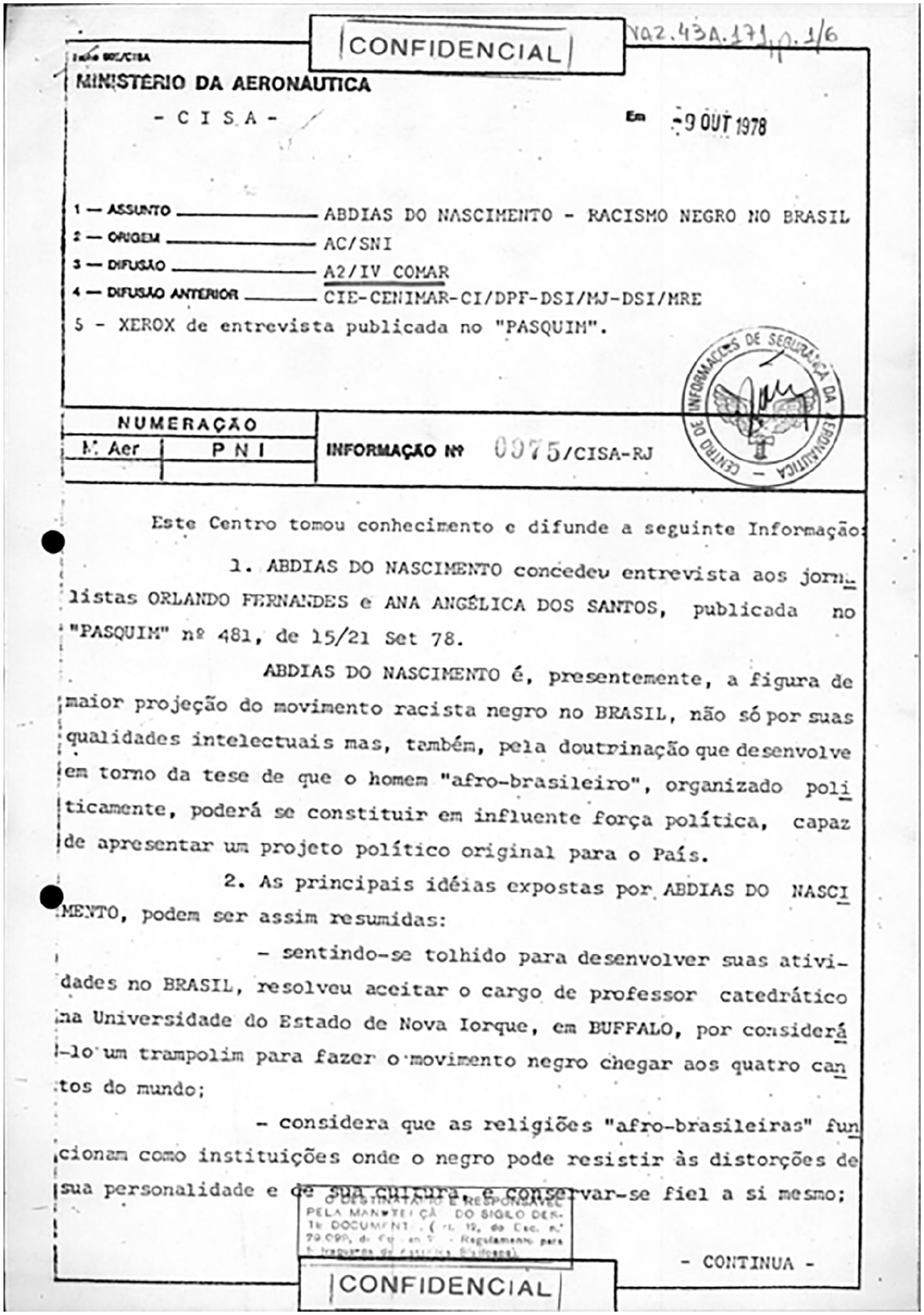
A 1978 police intelligence file from the Centro de Informações de Segurança da Aeronáutica titled “Abdias do Nascimento—Racismo negro no Brasil” (courtesy of the Sistema de Informações do Arquivo Nacional, reprinted with permission).
Researchers of the Comissão da Verdade do Rio (Truth Commission of Rio de Janeiro—CEV-Rio) did not succeed in obtaining interviews or in identifying documents that illustrated specific violence carried out by the state against black territories such as quilombos, terreiros, and samba schools and argued the urgency of exploration of these topics in future research (Caldas et al., 2015: 133). Drawing on 25 police intelligence files that targeted two samba composers, a samba school president, and two carnavalescos, 5 Tamara Paola dos Santos Cruz (2010) reports that the political police investigated Arlindo Rodrigues, Fernando Pamplona, Martinho da Vila, Nelson de Andrade, and Silas de Oliveira.
The police files present biographical information and political and criminal records of these sambistas—some dating to well before 1964—that outline the military regime’s investigations into potential connections between samba schools and left-wing political parties and movements in opposition to the military government (Cruz, 2010: 67–72). That these sparse police files do not associate sambistas with the black movement should come as no surprise. Although it is incontestable that samba has been identified as a practice mostly cultivated by blacks over the past century (Trotta, 2011: 75) and in most cases a low-income predominantly black constituency is at the root of samba schools in Rio (Araújo, 2021: 88), sambistas were generally not perceived by the military regime as race renegades like soul music adherents (Giacomini, 2006) even when they treated black history and politics in their music.
Police intelligence handbooks dispel any potential doubts regarding government, public, and private restrictions for samba schools. From 1965 on, the military regime regulated manifestations of popular culture such as samba by controlling the use of banners, props, allegories, costumes, and musical productions and by censoring samba compositions—sambas-enredo and marchas carnavalescas 6 among them. Samba school processions and numerous other collective public demonstrations, whether Carnival-related or not, had to adhere to the norms of the political police and public and private organizations such as Riotur and the AERCJ to receive authorization to perform around the city (Cruz, 2010: 80).
As we have seen, by 1975 the CISA had recognized the IPCN as a coordinating organ of black resistance activities in Rio de Janeiro. Before then, in 1960, the carnavalesco and fine arts professor Fernando Pamplona had rehistoricized Zumbi—a national hero of black struggle for freedom and leader of the largest American maroon state in the seventeenth century—in Salgueiro’s samba-enredo “Quilombo dos Palmares.” Although a few Afro-Brazilian themes had existed in sambas-enredo before the 1960s, including Unidos da Tijuca’s 1948 “Lei áurea” (Golden Law) and Salgueiro’s 1957 “Navio negreiro” (Slave Ship), the number grew exponentially in the 1960s and more than doubled by the 1970s (see Augras, 1998; Bocskay, 2012; and Simas and Fabato, 2015). It stands to reason, then, that the regulations for Rio’s Carnival became more stringent from 1977 to 1985 (Cruz, 2010: 98). Sambas-enredo had to be submitted and stamped for approval first by the DGIE, the DOPS, the Serviço de Censura de Diversões Públicas (Censorship Service of Public Affairs—SCDP), or some other governmental censorship branch and then by Riotur. Contrary to the dominant narratives on the periodization of censorship in music, numerous enredos from carnival street ensembles (blocos carnavalescos) and samba schools in the Sistema de Informações do Arquivo Nacional (Information Database of the National Archive—SIAN) were being reviewed by the SCDP around this time, among them Unidos do Rio Comprido’s “Martinho da Vila: um palco iluminado”(Martinho da Vila: An Illuminated Stage) (SIAN, 1985), Unidos da Galeria’s “O amigo da madrugada” (Dawn’s Friend) (SIAN, 1984), and Dragão de Camará’s “O negro na cultura brasileira” (Blacks in Brazilian Culture) (SIAN, 1983). This last enredo received approval for Rio’s Carnival in 1983 but was denied authorization for recording (Figure 2).
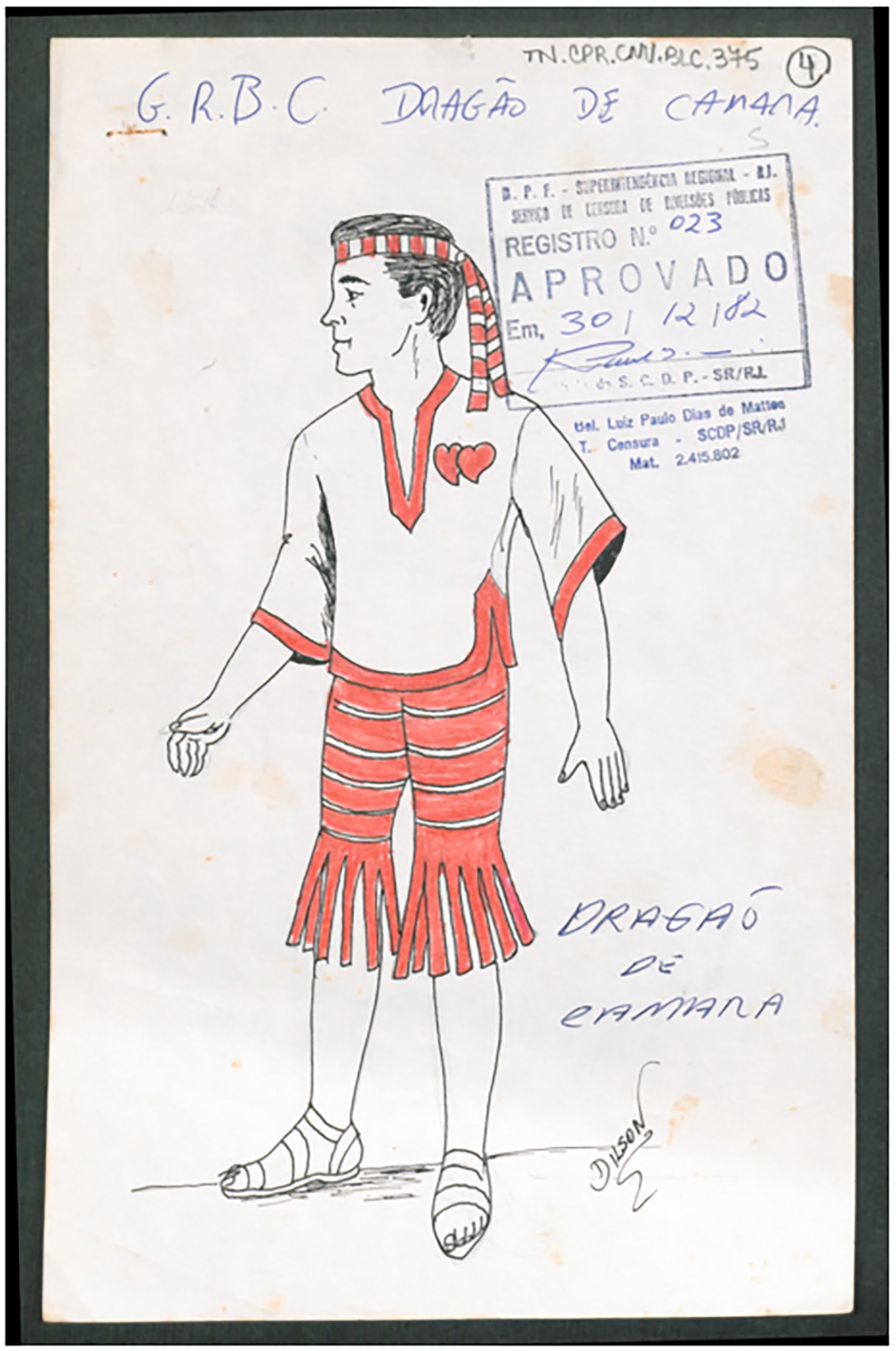
A 1983 police intelligence file from the Serviço de Censura de Diversões Públicas in reference to G.R.B.C. Dragão de Camará’s enredo “O negro na cultura brasileira” (courtesy of the Sistema de Informações do Arquivo Nacional, reprinted with permission).
Failure to comply with the regulations resulted in the denial of permission to parade. In a 1977 document the president of Riotur, Victor de Oliveira Pinheiro (1975–1979), obliged samba schools intending to parade to deliver their enredos to Riotur at least six months before Carnival for approval after censor evaluation; samba school enredos had to be based exclusively on national themes that were devoid of commercial intent; and samba schools were to parade only on the condition that the lyrics of their musical compositions had been approved by the censors (Cruz, 2010: 98–99). Because of ideological control, samba composers who wanted to participate in Carnival were often obliged to modify verses.
Given the millions of insufficiently analyzed documents (Rodrigues, 2017: 164) and the unreliability of archives and institutional memory, I will not attempt to establish whether censorship of samba was more or less intense than that of Brazilian popular music (música popular brasileira) or other musical genres during a particular time, nor do I argue that censorship of music and the arts did not abound during Médici’s administration (1969–1974) despite the fact that not a single researcher has proved that surveillance and censorship peaked during those years. It is important to stress, however, that many researchers of Brazilian music have not recognized that censorship and surveillance continued throughout the military dictatorship and even beyond Figueiredo’s presidency (1979–1985).
The idea that censorship in music and elsewhere had petered out by the 1980s has unambiguously been repeated in numerous scholarly works—often in the form of omission. Citing Alberto Moby Ribeiro da Silva’s book, whose very title, Sinal fechado: A música popular brasileira sob censura (Red Light: Brazilian Popular Music under Censorship) (1937–45/1969–78), illustrates this point, Christopher Dunn (2001: 161) states that “more than thirty films and nearly a hundred plays were prohibited from exhibition between 1969 and 1971. Popular music was also a target for censors, who interdicted hundreds of songs annually during the early 1970s.” Similarly, Marc Hertzman (2013: 227–228) contends that “under the administration of Ernesto Geisel (1974–1979), the military altered its approach to music and focused less on censorship.” Waldenyr Caldas (2005: 172), in turn, asserts that the greatest surveillance and cultural persecution occurred between 1969 and 1976. Caldas’s perspective corroborates that of Charles Perrone (1988: 167), who in the late 1980s had argued that government surveillance of music persisted for most of the 1970s and that music censorship had become less frequent in the months preceding the December 1978 official revocation of Institutional Act 5. Marcos Napolitano (2004: 108), who researched the topic in Rio de Janeiro and São Paulo’s Public Archive, arrived at a more accurate diagnosis than these other writers, claiming that state repression of music ran from 1967 to 1982.
Recognizing the difficulty of establishing a chronology of events such as the beginning and end of censorship practices during the Brazilian military dictatorship, Beatriz Kushnir (2001) notes that in July of 1984, Attorney General Fernando Lyra swore that “censorship was extinct.” Then, in early February of 1986, President José Sarney ordered the prohibition of Jean-Luc Godard’s film Je vous salue, Marie (Hail, Mary), which was remembered as the last act of censorship (Kushnir, 2001: 144; see also, e.g., Fico, 2002). In a May 1986 interview with the Pasquim journalist Jaguar (Sérgio Jaguaribe), the samba legend Zé Keti confirmed that even during the redemocratization process he was not allowed to perform his new samba “Manchete de jornais” (Newspaper Headlines), in which the lyrical voice ironically portrays his death as a rhetorical strategy for criticizing the police as merrymakers of murder (Pasquim, 1986). Written by the iconic rock group Legião Urbana in 1980, “Conexão amazônica” (Amazonian Connection) was banned by the censors until 1987 because of its references to cocaine (Rochedo, 2014: 154).
In my view, the incorrect periodization of censorship in music stems from three main issues. The first corresponds to governmental control of the archives and the difficulty of public access to them; the second is that many researchers have not themselves conducted interviews with musicians or consulted sufficient documents on censorship in archives or even in newspapers or magazines of the alternative press, thereby reproducing the (mis)information from other books; and the third concerns the lack of research specifically on censorship in Brazilian music genres and styles other than Brazilian popular music. As Paulo Cesar de Araújo (2010) has pointed out, brega and cafona 7 singers and composers were excluded from music historiography despite the fact that many of them, between 1968 and 1978, topped the charts for record sales and radio play. By analyzing the social construction of memory, according to the late brega singer Waldik Soriano (quoted in Araújo, 2010: 16), “it is possible to identify how a specific memory of music history in Brazil materialized; one that privileges the works of a group of singers and composers, preferred by the dominant classes, in detriment to those of popular artists.”
Before 1968, there were only isolated cases of verifiable musical censorship. For example, Chico Buarque’s song “Tamandaré” (Admiral Tamandaré) was censored by the navy in 1966, and so was Martinho da Vila’s partido alto 8 “Menina moça” (Big Girl), even though it had already qualified for TV Record’s third festival of Brazilian popular music in 1967 and become a hit among the general public. In 1966, Geraldo Vandré and Theo de Barros’s protest song “Disparada” (Stampede) tied for first place with Buarque’s “A banda” (The Band) at the Festival de Música Popular Brasileira. Though not censored, “Disparada” set off a wave of censorship and surveillance that would affect musical performance, composition, and the arts in general until government-regulated censorship signaled its end with the promulgation of the new constitution and the closure of the Divisão de Censura de Diversões Públicas (Censorship Division of Public Affairs—DCDP) in 1988. The creation of the Sistema de Classificação Indicativa Brasileiro (Brazilian Advisory Rating System, Classind) in 1990, however, made it clear that censorship, though not as frequent as before, was here to stay. During the 1990s, and even as recently as 2019, the band Planet Hemp encountered various forms of censorship, ranging from canceled shows and removal of its CDs from stores to television and radio airplay restrictions, because of its embrace of marijuana use (Pimentel and McGill, 2021: 287–297).
Censorship in music came into being as an institutional reality only on December 13, 1968, with the decree of the Institutional Act 5 by General Artur da Costa e Silva. It is precisely for this reason that the arts, even after the military coup, remained largely untouched by censorship between 1964 and 1968. In 1967, the Salgueiro samba school presented the samba-enredo “História da liberdade no Brasil” (History of Freedom in Brazil), which was inspired by the publications of Viriato Correia, a writer and politician from the state of Maranhão. Officials from the DOPS approached Fernando Pamplona on several occasions due to his protagonism in Salgueiro and asked him to explain the enredo’s content. In Salgueiro’s rehearsal space, the lights would sometimes go out unexpectedly and take hours to come back on, often putting an end to rehearsals. “The DOPS officials,” explains Haroldo Costa (2003: 101), “had a reserved table not because it was offered to them but rather because the agents did not miss rehearsals, perhaps expecting that they would turn into a rally. Lots of people were betting that the censors would bar the enredo at the last minute. But that didn’t happen.”
In 1969, just a couple of months after the enactment of Institutional Act 5, the censors began to intervene more systematically in the samba schools after Império Serrano made a stir with the samba-enredo “Heróis da liberdade” (Freedom’s Heroes). Composed by members of the Império Serrano samba school Silas de Oliveira, Mano Décio da Viola, and Manoel Ferreira, “Heróis da liberdade” came under scrutiny by the political police as a potential protest against the regime for its use of the word liberdade, despite the fact that many enredos in previous years had treated freedom struggles (Vila, 2014: 37–38). What stands out in particular is the enredo’s narration of black struggle regarding the abolition of slavery. Subsequently, the DOPS ordered Silas de Oliveira to submit to interrogation. When the song was later approved, the composers had to change the word revolução (revolution) to evolução (evolution) in the verse “It is the revolution in its legitimate reason” (É a revolução em sua legítima razão).
The military police also repeatedly harassed the samba composer and member of Império Serrano Aluísio Machado in nightclubs and during the intervals of the roda de samba
9
“Samba, feijão e mulata” (Samba, Beans and Mulatta). Indeed, the poignant lyrics of Aluísio’s sambas, particularly those contained within “Efeitos de evolução” (Effects of Evolution), “A humanidade” (Humanity), and “Artifício” (Artifice), raised concern. As Aluísio was singing in the nightclub Sarro, in Tijuca, Rio de Janeiro, on the evening of September 4, 1969, the Brazilian army invaded the premises and terminated the show because it associated Aluísio with the Ação Libertadora Nacional (Action for National Liberation—ALN) and the Movimento Revolucionário 8 de Outubro (Revolutionary Movement of October 8—MR-8). Members of these groups had kidnapped U.S. ambassador Charles Burke Elbrick earlier that day in protest against the U.S. government’s support for the Brazilian military regime. Additionally, they also demanded the release of 15 political prisoners and the presentation of MR-8’s manifesto on national television networks (Leitão, 2015: 170–176). While many sambistas were unaware of police surveillance and censorship protocols in samba schools (Cruz, 2010: 70) or simply did not recall experiences with censors there, Martinho da Vila had had some of his sambas-enredo censored by the DOPS. He recalls an experience from 1976 in the Unidos de Vila Isabel samba school (interview, Rio de Janeiro, July 19, 2016; see also, e.g., da Vila, 2014: 36): A samba school is trying out two or three sambas-enredo, one of which goes to the parade to win the competition. Then they [the DOPS] would enter the school’s rehearsal space and say that this samba here can’t win. Nobody can say anything about it. Period. If you do, you will have big problems; and everybody was afraid of the dictatorship. Like so, the samba school board removed the samba, and the composer would get annoyed. The censors visited the samba schools. For example, the censors didn’t approve the verse “Take care of your beleaguered people” (Toma conta do seu povo sofredor) of my samba-enredo “Iemanjá desperta” (Iemanjá Awakens). It was not recorded, and I ended up arguing with the director of the school because that samba was my favorite.
Around 1974, during a live performance in Rio de Janeiro, a police officer ordered Noca da Portela to stop singing his samba “País dos sem” (Country of Have-Nots). This samba was recorded and commercially released for the first time only on the 1998 CD Samba verdadeiro for lack of financial resources (interview, Rio de Janeiro, March 1, 2019). Noca’s 1978 samba “Virada” (Turnaround), coauthored with his son Noquinha (Gilmar Vilela Pereira), was also recorded by Aroldo Santos and the group Som Sete in that same year; by Beth Carvalho on her 1981 record Na fonte; and by Alcione Dias Nazareth in 1982, 1983, and 2003 on LP/CD. Because of Alcione’s early recordings of this samba, it also became part of the soundtrack in one of TV Globo’s telenovelas in the early 1980s (Braz, 2018: 296–300). The DOPS summoned Noca for interrogation after Beth Carvalho launched “Virada.” By 1984, “Virada” had become one of the anthems of the Diretas Já civic movement for free elections in Brazil. As Noca explained (interviews, Rio de Janeiro, September 22, 2016, and February 10, 2020), The political police knew everything about me. Looking like a beggar but working as a spy for the DOPS, a guy would appear and soak up every detail. In the general barracks of the Central Station, the colonel asked me to explain my samba “Virada.” He knew my name and my whole file; where I live, what I did, and what I was doing. Then I asked him: “How do you know this?” [and he answered] “It’s a secret. Do you want me to call you Noca or Osvaldo Alves Pereira?”
The editor of Rio, Samba e Carnaval when he founded Portela’s Ala dos Estudantes (Students’ Wing) Maurício Mattos and his wife, Tânia Mattos, were investigated by the CISA in the early 1970s (SIAN, 1973b). Valéria Lima Guimarães (2009: 199–200) notes that the DOPS prohibited Portela’s Ala dos Estudantes from parading around this time. Though it is true that the DOPS found the students’ objectives to be politically subversive, different from those common to revelers, the military government’s concerns were not limited to the spread of communism. Referencing Guimarães (2009), Thula Rafaela de Oliveira Pires (2015) deflates the one-sided narrative that the government surveilled and censored carnival activities in some samba schools because of linkages with the Brazilian Communist Party. This perspective, following Pires (2015: 47), ignores “the repression mobilized against samba schools as black territories, which represents an important chapter in the relation between the dictatorship and racism.”
In 1988, for example, the CIE elaborated on the classified file Relatório Periódico Mensal (Monthly Periodical Report) with a subsection titled “Abolição da escravatura: a distorção de um fato histórico” (Abolition of Slavery: The Distortion of a Historical Fact), which identified the who, what, when, and where of celebrations surrounding the centenary of the abolition of slavery in Brazil. The file describes Martinho da Vila’s samba-enredo “Kizomba, festa da raça” (Kizomba, the Celebration of a Race)—winner of Rio’s Carnival that year—as “a black revolutionary manifestation against whites” while defining Martinho’s ex-wife, Ruça (Lícia Maria Caniné), as “a communist and president of the Unidos de Vila Isabel samba school” (SIAN, 1988: 148–153). Aware of Rio de Janeiro’s large black population and the rise of black activism in the United States, the Caribbean, and Africa, the military government also censored lyrics from musicians that could be taken as a threat to hegemonic narratives on Brazilian national identity.
Opening the Archive: Silencing Black Perspectives in Rio’s Samba Community
Having established that samba musicians were censored or surveilled in and outside of Rio’s samba schools at least until the late 1980s, I will now examine a few lyrics composed by popular artists from the early 1970s that were censored for their perspectives on black history and culture in Brazil. One of the differences between the Vargas regime and the military dictatorship is that the censorship organs of the latter safeguarded the documents of most, if not all, musical genres. Serving the censors as guidelines, the Doutrina de Segurança Nacional (National Security Doctrine—DSN), censorial legislation, and Coriolano de Loyola Cabral Fagundes’s 1975 book Censura e liberdade de expressão: Tudo sobre a censura aos meios de comunicação no Brasil e no mundo (Censorship and Freedom of Expression: Everything About Media Censorship in Brazil and the World) are just some of the many sources used to delineate ideological parameters and detect potential “enemies of the state” (Carocha, 2007: 93–94; Heredia, 2015: 99). At the same time, the reasons behind the censorship should not be viewed as stringent obedience to a coherent logic (Carneiro, 2013: 53–54; also see Pimentel and McGill, 2021: 73–82, on bribery and censorship).
In Brazil, most collections were transferred to archive-friendly institutions such as public archives and university documentation centers between 1990 and 2005 as the result of a national campaign by human rights organizations and associations made up of relatives of those persecuted by the military regime. Before these initiatives, collections were housed in abandoned police headquarters or DOPS that had been safeguarded by the respective secretaries of public safety (Secretaria de Segurança Pública—SSP) in federation states (Rodrigues, 2017: 165–166). Vicente Arruda Câmara Rodrigues (2017), who has researched the censorship mechanisms during the period of the military dictatorship extensively, recognizes the existence of a “silent dispute” concerning both the physical possession of the archives and the control of the narrative that transpired from 1964 to 1985. Following this scholar (Rodrigues, 2017: 159), two pendular movements occurred simultaneously: a “search for truth” and the right to memory and truth and a set of strategies for preventing documentation from becoming widely accessible such as the destruction of archives and the selective arrangement of groups of public documents.
While it is clear that there are millions of documents that have not been analyzed in detail and that no single study is sufficient to take into account the complexity of events that occurred in Brazil, there is still much that can be learned regarding lyrics that were censored during military rule. As a point of departure, it is important to observe that artists who put forth black perspectives, regardless of their race, were generally censored. Such was the case of the brothers Marcos and Paulo Sérgio Valle, whose blues song “Black Is Beautiful” was censored by Odette Martins Lanziotti on November 5, 1970, but approved on July 7, 1971, after the composers had made significant lyrical adjustments (for the two versions, see SIAN, 1970 and 1971a).
In 1973, Elton Medeiros, Cristóvão Bastos, and Antonio Valente composed the samba “Flor negra” (Black Flower) in homage to the iconic choro and samba musician Pixinguinha, who had died in February of that same year at the age of 75. The samba’s lyrics speak to the painful legacy of slavery while covertly associating it with Pixinguinha and, hence, more broadly, with the samba world: “Carry the pain of slavery/transformed as a flower in the heart/as a black flower, of the same color/of darkness/where without being seen/the sunlight rose.” Later that same year, in September of 1973, the lyrics of “Flor negra” were censored for possessing “content that allows one to remember the social situation of blacks in our history” (SIAN, 1973a). The censors’ evaluation of “Flor negra” also reinforces the ideas of highly influential writers in Brazil such as Sérgio Buarque de Holanda, who asserted in his 1936 oeuvre Raízes do Brasil (Roots of Brazil) that “life seems to have been here incomparably more gentle and receptive of social, racial, and moral dissonances” (Buarque de Holanda, 1963: 30). Unaware or perhaps unable to recall that “Flor negra” had been censored until I reported my findings to him, Elton Medeiros, who passed away in 2019, responded rhetorically: “I can’t talk about slavery, dammit? Slavery did not occur in Brazil?” (interview, Rio de Janeiro, March 29, 2017).
Nei Lopes and Reginaldo Bessa also faced such opposition. Censored in 1971, “Tributo a Cassius Clay” (Tribute to Cassius Clay) would become “Muhammad Ali” in 1974 and would be sung most notably by Sonia Santos on the Globo television network program Fantástico a few years later. This musical composition was not a samba but a soul piece that reflected Lopes’s engagement, however fleeting, with the wave of U.S. black music and culture in 1970s Brazil. Both Giacomini (2006) and Dunn (2016) have observed correctly that samba and soul coexisted in Rio de Janeiro. The samba luminaries Antônio Candeia Filho and Nei Lopes, however, were not particularly “wary of soul music as an important fad that betrayed cultural tradition” (Dunn, 2016: 171–172). Lopes composed soul music, but his reasons for prioritizing samba over soul were related to his image as a sambista and his long-standing desire to consolidate his position as a respected samba composer (interview, Rio de Janeiro, August 1, 2020). While Candeia wrote the 1977 partido-alto “Sou mais o samba” (I Prefer Samba), which symbolized “the protest of sambistas against the invasion of soul” (Candeia Filho, 1977), he had also included U.S. soul music in his 1971 samba album Raiz (Root), as Bernardo Oliveira (2015) and I (Bocskay, 2017) have shown. Candeia also collaborated with the Projeto Brafro in 1977. Their mission, following the project’s mentor Dom Filó (Asfilófio de Oliveira Filho), was to “show the union of black culture in Rio de Janeiro represented by samba and soul” (interview, Rio de Janeiro, February 14, 2020). In “Tributo a Cassius Clay,” the censor Odette Martins Lanziotti underlined the verse “It’s a fist, black hand” and provided the following justification based on all the lyrics: “The censorship body finds that the lyrics at hand intend to disseminate racist ideas by inviting ‘other blacks to take the path of aggression’ (in this case, other Brazilian blacks) in a pro-black struggle; a problem that fortunately is not ours: we are all equal, enjoy the same rights, and have the same duties” (SIAN, 1971c; for black perspectives, see Bulbul, 1988; Nascimento, 1992). It is critical that the other censored songs mentioned in this section were also barred for their overall lyrical content, of which the censors did not underline any individual verse.
In the early 1970s, Quim Negro (Joaquim Theodoro) provoked racism from the censors for reasons not limited to his artistic name. Between 1971 and 1972, Negro submitted 108 lyrics for review of which 10 were censored. The censors cracked down on many of Negro’s lyrics because of his elaborate development of Afro-Brazilian themes. He criticized the police, exalted the beauty of Afro-Brazilians, and spoke about Candomblé and Umbanda, Macumba and capoeira, sorcerers, malandragem, 10 and Africans dancing in the “big city.” In 1971 the censors banned Negro’s “Salve êles” (Hail Them), which makes constant laudatory references to Umbanda, a Brazilian religion of African origin that assimilated diverse elements from the Bantu cult of ancestry worship and that of the Jeje-Yoruban orixás (Lopes and Simas, 2015: 293). Upon analyzing “Salve êles,” the censors concluded that “the lyrics in question aren’t convincing as either ‘afro’ or ‘bumpkin.’ Such expressions should come in parentheses as part of a correct language” (SIAN, 1971b). In this instance, “correct language” serves as a euphemism for “whiteness” that has come to represent progress, development, culture, civilization, and “humanity” over the centuries. In his landmark book The Souls of Black Folk (1994 [1903]: 2), the brilliant historian and Pan-Africanist W. E. B. Du Bois referred to this phenomenon as “double consciousness,” a duality of warring ideals in black bodies that long to merge in a better and truer self. As the Martinican political philosopher and psychiatrist Frantz Fanon (2008: 77) put it several decades later, alterity for the black man is not the black but the white man. To be black, then, is to incarnate the white subject and deny or invalidate the presence of the black. Motivated by the absence of studies on the emotional life of blacks, and with an interest in locating a discourse by and about them in Brazil, Neusa Santos Souza (1983: 17, 34) asked in the early 1980s, “How can they construct the ideal of the ego?”
In the 1970s, Nei Lopes, Antônio Candeia Filho, Martinho da Vila, and Leci Brandão, among other musicians, engaged with aesthetic or intellectual currents related to black emancipation in the United States, the Caribbean, and Africa. Nevertheless, as I have pointed out elsewhere (Bocskay, 2012; 2017), it is simply untrue that “black causes” were uncommon in Brazil before the 1970s (Fernandes, 2014: 133). Founded by members of the Frente Negra Brasileira, which was dissolved in 1937, only six years after its birth, as Vargas closed down electoral politics (Andrews, 1991: 238), the weekly Afro-Brazilian newspaper from São Paulo A Voz da Raça (The Voice of Race) forged the slogan “Racial Prejudice in Brazil Only We Blacks Can Feel.” Operating from 1933 until 1937, the newspaper published a short manifesto in its inaugural March 1933 issue, titled A Voz da Raça, in which its editors announced that the newspaper “appears at a time in which we need to make known, at present, tomorrow, and always, the interests and communion of the ideas of race, because other newspapers, long-established ones, out of political disdain, have abandoned such interests.”
Likewise, Quilombo, a weekly world-class newspaper produced by the TEN, which published 10 issues from December 1948 to July 1950, was built on the participation of highly acclaimed white and black national and international collaborators (see, e.g., Domingues, 2008; Alberto, 2011). The journal explored issues of the black diaspora around the world and sought to unite the greatest minds in the Brazilian arts and sciences, whites and blacks, and to launch an original project of resistance against racism in Brazil (Nascimento, 2003: 11). That the samba “Flor negra” was censored in the 1970s for discussing the pains of slavery and other lyrics such as “Salve êles” and “Tributo a Cassius Clay” were targeted for the use of “incorrect” language and the affirmation of a transnational black identity complement Carlos Sandroni’s (2010: 138) observations on how sambas and marchinhas de carnaval of the 1930s and 1940s endorsed mestiço 11 identity and evaded the painful topic of slavery. McCann (2004) reminds us that, as the dominant station in Rio and a trendsetter for the entire country by the early 1940s, Rádio Nacional broadcast several styles of samba yet embraced a single narrative on the nature and meaning of the genre. This approach, following McCann (2004: 43), “perpetuated a reductive understanding of samba that profoundly influenced perceptions of the music both within Brazil and internationally, and lent credence to a rhetoric of racial democracy which pointed to esteem for Afro-Brazilian culture as evidence that racism did not exist in Brazil.”
Although Candeia spearheaded the G.R.A.N.E.S. Quilombo in 1975 along with other samba musicians, journalists, and black organizations, most samba composers, even Nei Lopes, one of G.R.A.N.E.S. Quilombo’s founding members, were neither black activists nor members of black political organizations during the 1970s. Lopes recalls that some of the most radical adherents of the black movement in Brazil were critical of what they called the “party culture” (cultura da festa), in which they included samba (interview, Rio de Janeiro, August 1, 2020). In contrast to samba culture, Black Rio allowed Afro-Brazilian youth to bolster their self-esteem and identity and recreate ways of being black and Brazilian through transnational identifications with U.S. black cultural expression including funk and soul music. As Giacomini (2006: 216) has noted, the new group of directors in the 1970s of Rio’s Renascença Clube—a multifaceted recreational and cultural space—became indignant about the way samba and samba culture sidestepped racial questions and encouraged middle-class whites to fetishize Afro-Brazilian women. In this light, part of the G.R.A.N.E.S. Quilombo’s reason for being was to emphasize the importance to the formation of Brazilian culture of black arts that had been losing ground to corrosive external influences in Rio’s samba schools since the 1960s (Vargens, 2008: 64–94).
In contrast with most prior scholarship, I have shown that censorship and surveillance in music and the arts carried on after 1985. The DOPS, in collaboration with other intelligence units, surveilled black activists and sambistas and infiltrated soul dances, samba schools, and musical performances as a means of social control against unwelcome expressions of being Brazilian and left-wing political mobilization from the late 1960s into the 1980s. Attending to the military regime’s demands for social control, public and private organizations such as Riotur and the AERCJ enforced ideological standardization and national themes in sambas-enredo.
Even beyond Rio’s samba schools and Carnival, the work of recording artists such as Elton Medeiros, Marcos and Paulo Sérgio Valle, Cristóvão Bastos, Antonio Valente, Nei Lopes, Reginaldo Bessa, and Joaquim Teodoro was censored for treating slavery and civil rights and for valuing black aesthetics. Whereas the run-ins that sambistas had with the DOPS in samba schools and musical performances have largely been left unrecorded, my interviews with sambistas and analyses of censored lyrics underscore the degree to which the military government defended national discourses and explicitly undermined the expression of Afro-diasporic identity and consciousness. Naturally, all this makes one wonder what the archives of Vargas’s Estado Novo would have revealed about black perspectives in music had they not been destroyed.
Footnotes
Notes
Stephen Bocskay is a visiting assistant professor of Portuguese and Brazilian studies at the University at Albany, State University of New York. His areas of research are (black) Brazilian cultural studies and intellectual history, popular music, film and media studies, comparative twentieth-century literature, and translation studies and practices. This essay is the result of conversations both formal and informal and extensive archival research and field interviews conducted with numerous sambistas, cultural workers, and black intellectuals over the better part of a decade in Brazil. The author is particularly grateful to Martinho da Vila, Noca da Portela, Elton Medeiros, Nei Lopes, and Dom Filó for sharing their experiences and knowledge of samba and black culture in Brazil on multiple occasions. He is also indebted to Paul Sneed and LAP’s three readers for their valuable suggestions and to Mariana Filgueiras for introducing him to the new collections in Rio’s National Archive before they became available to the public, which resulted in the publication of four articles on music and censorship in O Globo, from March 26 to 29, 2017. He dedicates this essay to the late Anani Dzidzienyo (1941–2020), whose spiritual and intellectual mentorship has greatly impacted his life and work.