






Abstract
In October 2019, Chile experienced one of the largest mass protests in its recent history. This article examines the socio-psychological mechanisms underlying the Estallido Social, arguing that growing perceptions of injustice—rather than worsening economic conditions—were central to mobilization. Drawing on Relative Deprivation Theory and Social Justice Theory, the study uses data from the 2009 and 2019 waves of the International Social Survey Programme (ISSP). The findings show that although Chileans perceived slightly lower economic inequality in 2019 than a decade earlier, their tolerance for inequality declined significantly, widening the gap between perceived and fair levels of inequality. This gap intensified feelings of deprivation, particularly among women and lower socioeconomic groups, who were more likely to report dissatisfaction with inequality. These results challenge the idea that the protests stemmed from rising perceptions of inequality and instead point to a crisis of legitimacy driven by unmet expectations and the growing perception that economic inequality is no longer the fair or justified outcome of the country’s income distribution system.
En octubre de 2019, Chile experimentó una de las mayores movilizaciones de protesta de masas de su historia reciente. Este artículo examina los mecanismos sociopsicológicos subyacentes al Estallido Social y sostiene que el creciente sentimiento de injusticia —más que un deterioro de las condiciones económicas— fue un factor central de la movilización. Basándose en la Teoría de la Privación Relativa y la Teoría de la Justicia Social, el estudio utiliza datos de las encuestas del International Social Survey Programme (ISSP) correspondientes a 2009 y 2019. Los hallazgos muestran que, aunque los chilenos percibían niveles ligeramente menores de desigualdad económica en 2019 que una década antes, su tolerancia hacia la desigualdad disminuyó de manera significativa, ampliando la brecha entre los niveles de desigualdad percibidos y aquellos considerados justos. Esta brecha intensificó los sentimientos de privación, particularmente entre las mujeres y los sectores socioeconómicos más bajos, quienes mostraron una mayor propensión a expresar insatisfacción con la desigualdad existente. Estos resultados cuestionan la idea de que las protestas fueron consecuencia de un aumento en la percepción de la desigualdad y, en cambio, apuntan a una crisis de legitimidad impulsada por expectativas insatisfechas y por la creciente percepción de que la desigualdad económica ya no constituye un resultado justo o legítimo del sistema de distribución del ingreso del país.
Keywords
In October 2019, Chile witnessed an unprecedented wave of mass demonstrations that challenged the foundations of its political and economic system. What began as a protest against a small increase in Santiago’s public transportation fares rapidly escalated into a broad social movement demanding structural reform and questioning the socio-political model built over decades of economic liberalism, institutional mistrust, and persistent inequality (Mayol, 2012). The widespread slogan “It’s not thirty pesos, it’s thirty years” captures the depth of these accumulated grievances. The intensity and scale of the mobilization indicate that the protests were not merely a reaction to a specific policy measure but a response to longstanding social, economic, and political dissatisfaction.
This article examines the socio-psychological foundations of the 2019 Chilean “Estallido Social” through the lenses of Relative Deprivation (RD) and Social Justice Theory. Moving beyond purely material explanations, it explores how subjective perceptions of unfairness and economic inequality shaped dissatisfaction and contributed to collective mobilization. Using data from the International Social Survey Programme (ISSP) collected in Chile in 2009 and 2019, the analysis traces changing perceptions of income inequality and merit-based justice, illustrating how shifts in evaluations of fairness, entitlement, and legitimacy fostered growing discontent.
Understanding these protests requires situating them within Chile’s broader political and historical context. For decades, the country had been hailed as a neoliberal success story in Latin America—a transformation initiated during Augusto Pinochet’s dictatorship and maintained through the democratic transition. Market-oriented reforms such as privatization, deregulation, and trade liberalization produced strong macroeconomic indicators: poverty fell, GDP grew steadily, and Chile earned international recognition as a model of economic modernization. Yet this apparent success concealed profound inequalities in income, wealth, social services, and access to opportunity. Essential goods such as healthcare, education, and pensions became increasingly commodified, generating a highly stratified society where life chances were largely determined by the ability to pay (Mayol, 2012).
Although macroeconomic conditions improved, many Chileans felt excluded from the country’s prosperity, perceiving a widening gap between effort and reward. This sense of unfairness—believing that one deserved more than one received—contributed to a growing collective feeling of injustice. Relative Deprivation (RD) theory provides a useful framework for understanding this dynamic, emphasizing how individuals evaluate their situations through social comparisons and expectations. RD emerges when people perceive a gap between expected and actual outcomes, generating resentment and frustration. In Chile, the persistent tension between the rhetoric of meritocracy and the lived realities of exclusion, inequality, and limited mobility created fertile ground for such perceptions.
Social Justice Theory complements this perspective by focusing on normative evaluations of fairness. Individuals assess social arrangements against principles such as equity, need, and equality of opportunity. When merit does not determine outcomes or when privilege systematically shapes access to resources, perceptions of injustice intensify. In Chile, elites and media frequently invoked meritocratic ideals, promising upward mobility through effort; however, these promises remained unfulfilled for many citizens, deepening frustration and eroding trust in institutions.
To empirically examine these psychosocial mechanisms, this article analyzes ISSP data from 2009 and 2019. These years bracket a decade marked by political continuity and recurrent waves of social mobilization, including student and pensioner protests. The comparison reveals that although perceptions of income inequality remained consistently high, by 2019 Chileans’ tolerance for economic inequality had notably decreased. Earlier attitudes had accepted some level of inequality when framed as merit-based, but by 2019 a broader rejection of the perceived fairness of the system had emerged. This shift—a declining legitimacy of persistent inequality—was central to the scale and intensity of the 2019 protests.
The “Estallido Social” thus represents the culmination of a longstanding contradiction between meritocratic discourse and entrenched social stratification. The mobilizations did not arise solely from the visibility of inequality, which had been evident for years, but rather from a marked decline in its acceptance as legitimate. This imbalance between perceived unfairness and tolerated inequality generated widespread feelings of deprivation and helped mobilize millions of citizens.
The article is organized into seven sections. Following this introduction, the second section outlines the main events of the “Estallido Social.” The third presents the theoretical framework and research problem, focusing on Relative Deprivation and Social Justice Theory. The fourth describes the data and methodology. The fifth presents the empirical findings, the sixth provides an explanation for why Chileans felt more deprived in 2019 than in 2009, and the final section summarizes the main conclusions, limitations, and contributions of the study.
The Chilean Mass Demonstrations Of October 2019
In October 2019, Chile experienced one of its most significant episodes of social unrest, known as the “Estallido Social.” What began as coordinated fare evasions by secondary students—protesting a thirty-peso increase in Santiago’s subway fare—quickly escalated into a nationwide uprising against long-standing social inequalities and perceived injustices. For nearly two weeks the demonstrations remained peaceful, but the situation changed when police repression intensified on October 16 and 17. Widely broadcast images of violence generated public outrage, expanding support for the students. By October 18 the protests had spread across the country, prompting the government to declare a state of emergency and grant extraordinary powers to police and military forces. President Piñera’s assertion that “we are at war against a powerful enemy” further inflamed tensions (Navarro and Tromben, 2019).
The mobilization then reached unprecedented scale: more than one million people gathered in Santiago within a week, and nearly 20% of the population participated nationwide (Dulci and Sadivia, 2021). At least thirty major demonstrations emerged across cities and rural areas, marked by mass gatherings, clashes with security forces, economic disruption, and documented human rights violations. The unrest also forced the cancellation of major international events, including COP25, APEC, and the Copa Libertadores final.
These protests were not a reaction to the fare increase itself but the culmination of frustration with Chile’s post-dictatorship development model. Despite decades of growth, poverty reduction, and expanded access to education, many Chileans felt excluded from the country’s wealth, especially regarding pensions, healthcare, education, and labor protections (Mayol, 2019; 2012). The sense of unfairness stemmed from the perception that the benefits of growth were concentrated among economic and political elites while everyday insecurity remained widespread.
Since the early 1990s, Chile had combined macroeconomic expansion with persistent inequality (Larrañaga, 2016; 2014). While household incomes rose and social indicators improved, income concentration remained high, a legacy of the aggressive market reforms implemented during the 1980s dictatorship. As growth slowed in the 2000s, inequality became more visible (Cociña, 2017). 1 Redistributive policies gained importance, yet indicators such as the Palma ratio continued to show that the richest 10% earned at least three times more than the poorest 40%. Even modest declines in inequality after 2000—driven partly by wage-gap reductions and targeted transfers—were insufficient to offset the broader perception of structural unfairness (Cociña, 2017; Larrañaga, 2016).
These structural disparities shaped everyday life. Urban segregation, unequal access to healthcare and education, and the concentration of political and economic power created a disconnect between Chile’s image of success and the lived experiences of citizens. The 2017 Encuesta de Caracterización Socioeconómica Nacional (National Socioeconomic Characterization Survey, CASEN) even showed a slight rise in inequality—the first increase since 2000—reinforcing concerns that progress had stalled. 2 As a result, public discourse increasingly framed inequality not merely as a distributional issue but as a form of injustice, questioning whether the rules governing opportunity and reward were fair.
The 2019 mass demonstrations gradually de-escalated when political leaders agreed to hold a plebiscite on replacing the 1980 constitution inherited from the dictatorship. 3 Initially scheduled for April 2020 but postponed due to the COVID-19 pandemic, the vote took place on October 25, 2020. Turnout reached historic levels, with 78% supporting the drafting of a new constitution and 79% favoring a fully elected Constitutional Convention (Dulci and Sadivia, 2021). Yet almost five years later, Chile remained politically unsettled. Two constitutional drafts presented in 2022 and 2023 were rejected, leaving the 1980 constitution in place. Although Gabriel Boric’s 2021 election initially seemed to channel the demands of the Estallido, his administration quickly faced declining approval, signaling the closure of the 2019 cycle without resolving its underlying causes. Cortés (2022) highlights three main outcomes of the Estallido: a crisis of legitimacy for Chile’s neoliberal model; increased political engagement accompanied by deep institutional distrust; and the absence of a collective project capable of addressing social demands. The post-2019 years were marked by uncertainty, weakened institutions, and persistent inequality.
In sum, the Estallido Social illustrates how perceptions of inequality and distributive injustice rather than material deprivation alone can motivate large-scale mobilization. While students initiated the protests, participation soon expanded to workers, unions, feminist movements, Indigenous groups, and environmental organizations, reflecting the widespread sense that the distribution of opportunities and rewards in Chile was fundamentally unfair.
Theoretical Discussion: Understanding Perceived Economic Inequality Through Relative Deprivation, Social Justice, and Justice Evaluation
The central claim of this article is that people’s responses to economic inequality are driven by the gap between what they perceive to be the existing level of inequality and the level they consider fair, tolerable, or ideal. In other words, it is the discrepancy between perceived reality and internalized standards of justice that shapes feelings of deprivation, resentment, and the propensity to engage in collective action. Relative Deprivation (RD) theory provides a foundational framework for understanding the emotional and motivational consequences of these comparisons, while Social Justice Theory explains the normative principles people use to judge whether distributions are fair. The Justice Evaluation Function (JEF) further contributes an empirical tool for quantifying such judgments. Together, these perspectives offer an integrated account of how individuals interpret inequality and why they may react with discontent, anger, or demands for change.
RD refers to the perception of being worse off relative to a relevant comparison standard and to the emotions—such as resentment or frustration—that arise when this perceived disadvantage is attributed to unfair circumstances (Smith et al., 2012). Deprivation emerges when people believe they lack something they feel entitled to and interpret this lack as unjust. RD is rooted in social comparison (Festinger, 1954), emphasizing that individuals evaluate their circumstances not in isolation but relative to others, to their past selves, or to imagined futures. This idea resonates with earlier sociological traditions, including Mead’s (1934) conception of the self and Merton and Kitt’s (1968; 1950) reference group theory. Yet RD is distinct in its focus on the emotional outcomes that follow from perceived inequity.
Classic formulations by Davis (1959), Runciman (1966), Gurr (2015), and Crosby (1976) converge on the idea that deprivation requires more than a simple comparison. Davis identified three necessary conditions: lacking a desired good, believing that similar others possess it, and feeling entitled to it. Runciman added the belief that the good is attainable and distinguished egoistic (individual-level) and fraternal (group-based) deprivation. Gurr reframed deprivation as arising when individuals perceive the desired good to be unattainable, introducing the notions of aspirational, decremental, and progressive deprivation, while Crosby emphasized the absence of self-blame: individuals do not feel deprived if they attribute their disadvantage to personal failings. Smith et al. (2012) synthesized these traditions by defining three core steps: a comparison, the perception of disadvantage, and an attribution to unfair processes. When inequality is attributed to legitimate causes—such as higher effort or qualifications—people may accept it; when it is perceived as undeserved, feelings of injustice intensify.
RD operates across interpersonal, intergroup, and societal levels, with distinct consequences. Interpersonal RD affects well-being and personal attitudes, while group-based RD fuels collective discontent, protest, and mobilization. 4 Contextual factors matter as well: the visibility of inequality affects the likelihood and strength of comparative evaluations. Segregation may limit exposure to disparities, reducing deprivation, whereas highly individualistic or competitive environments amplify comparisons and intensify feelings of injustice (Osborne, García-Sánchez, and Sibley, 2019).
Because deprivation depends on judgments of entitlement and fairness, RD is inherently linked to Social Justice Theory. Social Justice Theory studies how goods, opportunities, and rewards ought to be distributed. Its foundations trace to classical reflections on fairness (Aristotle, 2000; Plato, 1991) and evolved into two complementary strands: a normative tradition concerned with how distributions ought to be organized, and an empirical tradition examining how people actually evaluate fairness in real contexts (Sabbagh, 2001; Schneider and Castillo, 2015).
As the core of this research lies in the last one, I will focus on its explanation. The empirical tradition examines how justice preferences emerge from social contexts, institutions, and cultural norms (Jasso and Wegener, 1997). Research shows substantial cross-national variation in justice principles. Some societies prioritize equity, rewarding effort and contribution, while others emphasize equality or need (Miller 2017; 1999; 1979). Justice judgments also vary systematically across the social structure: individuals in disadvantaged positions tend to favor egalitarian and redistributive arrangements, whereas higher-status groups often legitimize inequality through meritocratic narratives aligned with their own interests (Boudon, 1998; Meltzer and Richard, 1981; Trump, 2018).
Crucially, whether people view inequality as legitimate or not shapes their acceptance of social hierarchies and their support for redistributive policies. When disparities are perceived as deserved—stemming from effort, talent, or structural necessity—support for redistribution decreases. When inequalities are interpreted as unjust or arising from blocked opportunities, public demand for reform increases (Kluegel, Mason, and Wegener, 2011). These judgments are deeply intertwined with social comparison processes: individuals evaluate their economic position relative to others when interpreting fairness (Norton, 2013; Runciman, 1966). Social interactions, ideological orientations, and reference groups further guide interpretations of inequality (García-Castro et al., 2021; García-Sánchez and de Carvalho Galvão, 2022; Willis et al., 2024; García-Castro et al., 2022). 5
To empirically analyze these justice evaluations, the Justice Evaluation Function (JEF) offers a powerful and widely used tool. The JEF conceptualizes justice judgments as relational assessments comparing actual income with the income an individual considers fair (Jasso and Wegener, 1997; Jasso, 1980; 1978). As emphasized by Jasso (1997) and Castillo (2012b, 2012a), these evaluations do not assume an external normative standard; instead, they reflect each observer’s subjective notion of justice. 6 The JEF produces a continuous scale where zero indicates perfect justice, negative values denote under-reward (means that the actual reward is lower than the just reward), and positive values signal over-reward (means that the actual reward is higher than the just reward). 7

Jasso and Wegener (1997) outline four guiding questions for JEF-based research: what individuals consider just and why; how these standards influence real distributive outcomes; the extent to which actual situations deviate from fairness; and the behavioral consequences of such deviations.
A modified formulation of the JEF (Equation 2) allows analysts to study perceived fair income gaps between high- and low-status occupations (Castillo, 2011b; 2011a), revealing normative expectations about inequality derived from comparative judgments rather than absolute standards.

A central strength of the JEF is its emphasis on the evaluator’s standpoint (Castillo, García-Castro, and Venegas, 2022). 8 Whether an income appears fair depends entirely on the observer. This subjectivity explains why justice evaluations differ across individuals, groups, and contexts, and why discrepancies between actual and just income can evoke emotional reactions—frustration, resentment—that directly connect to the affective core of RD.
In sum, integrating RD theory, Social Justice Theory, and the JEF provides a comprehensive framework for understanding how individuals perceive inequality. RD explains the emotional consequences of disadvantage; Social Justice Theory clarifies the normative principles shaping judgments of fairness; and the JEF operationalizes these judgments empirically. Together, they illuminate how people interpret disparities and why such perceptions can generate dissatisfaction, political demands, or collective mobilization.
Research Problem And Hypotheses
This paper’s basic argument is that the 2019 Chilean protests were the culmination of a long-term process rooted in growing perceptions of injustice. Although Chile experienced sustained economic growth after the return to democracy in 1990—marked by declining poverty, high GDP levels, and a stagnating or slightly decreasing Gini coefficient between 2006 and 2017 (Cociña, 2017; Larrañaga, 2016)—these objective improvements did not translate into feelings of fairness. Instead, the public increasingly questioned a development model perceived as benefiting primarily the economic elite. By 2019, public frustration stemmed less from material hardship and more from the sense that Chile’s economic gains were distributed unfairly, leaving large segments of the population without a rightful share of the country’s progress.
This tension aligns with Social Justice and Relative Deprivation theories, which highlight the gap between expectations and perceived realities. While economic indicators improved, public expectations of fair distribution rose even faster, gradually eroding the legitimacy once enjoyed by the post-transition economic model. Many began to see the system as structurally biased toward those with pre-existing privileges, intensifying perceptions of personal immobility and contributing to higher social polarization. What had been promoted as a path to collective advancement increasingly appeared to function as a mechanism that reinforced social stratification.
The relative deprivation framework is therefore crucial for explaining why the 2019 protests were unusually broad and intense. While economic inequality levels in 2011 (year of one of the most massive social mobilizations in the history of Chile up to that time) and 2019 (year of the “Estallido Social”) were similarly high, the latter protests gained unprecedented cross-class support. The key difference was not in the objective conditions but in how Chileans evaluated them. Over the past decade, people’s tolerance for inequality has declined. The gap between their expectations of fairness and the perceived reality expanded intensifying feelings of deprivation and resentment. This growing discrepancy played a crucial role in the mass mobilization of 2019.
This study argues that the protests were not solely triggered by economic inequality itself but by evolving perceptions of justice and fairness. By 2019, Chileans were less willing to tolerate the existing socio-economic disparities. As their confidence in political institutions eroded, so did the legitimacy of a system that failed to address their concerns. In this sense, the protests can be understood as the breaking point of a long-standing legitimacy crisis.
Ultimately, the “Estallido Social” was fueled by the convergence of three factors: 1) a persistent perception of economic inequality, 2) a declining tolerance for disparities, and 3) the delegitimization of the political and economic system. These elements created the conditions for mass mobilization, transforming latent discontent into active protest. The widespread support for the demonstrations suggests that, beyond material conditions, it was the perception of injustice—and the expectation of a fairer distribution of resources—that drove the movement. The protests, therefore, serve as a case study of how relative deprivation and declining institutional legitimacy can lead to large-scale social unrest.
Hypotheses:
H1: The study proposes as its main hypothesis that levels of deprivation among Chileans regarding economic inequality increased between 2009 and 2019.
H2: The main reason for this increase in deprivation was the acceptance of a lower level of economic inequality considered fair by Chileans.
Data, Variables And Method
This study draws on the International Social Survey Programme (ISSP), a comparative research initiative running since 1984 across about fifty countries, integrating thematic modules for cross-national analyses. Specifically, the study uses the Social Inequality module from the 2009 and 2019 waves, which captures perceptions of economic inequality, distributive preferences, attitudes toward state intervention, and evaluations of occupational income.9-11 This module is particularly suitable for examining how subjective evaluations of inequality relate to feelings of deprivation.
Variables
The operationalization of Relative Deprivation and Social Justice theories is structured around perceived inequality versus the level considered fair. Deprivation arises from comparing one’s perception of actual inequality with the level of inequality one considers just. When perceived inequality exceeds what is tolerated, feelings of deprivation emerge.
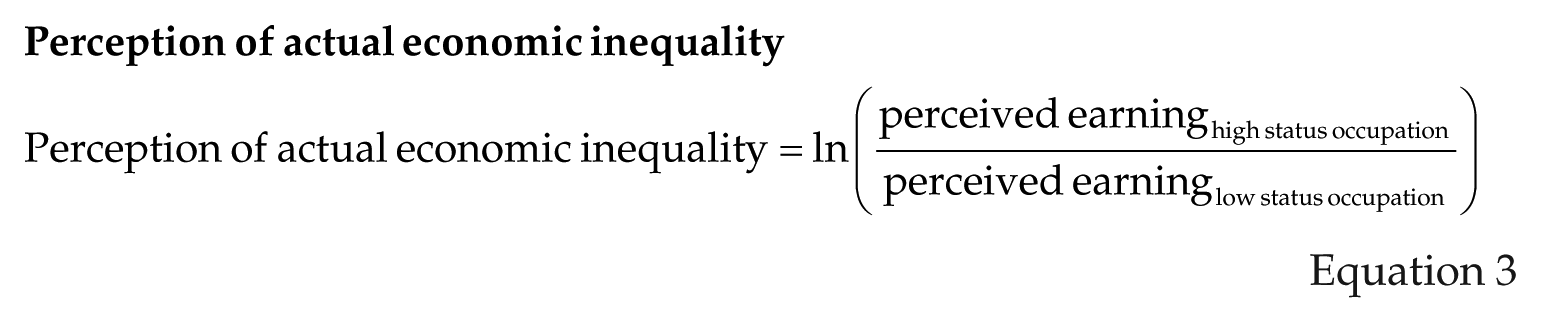
Perceived actual inequality: Following the Justice Evaluation Function (JEF), perceived actual inequality is defined as the “actual reward.” It is captured through respondents’ estimations of salaries for two contrasting occupations: a high-status job (e.g., a corporate chairman) and a low-status job (e.g., an unskilled factory worker). These occupations represent opposite ends of the income distribution and reflect societal stratification. A logarithmic ratio of these salaries standardizes the measure, with 0 indicating equality and positive values reflect beliefs that high-status occupations earn more. Larger values denote greater perceived inequality (Table 1).
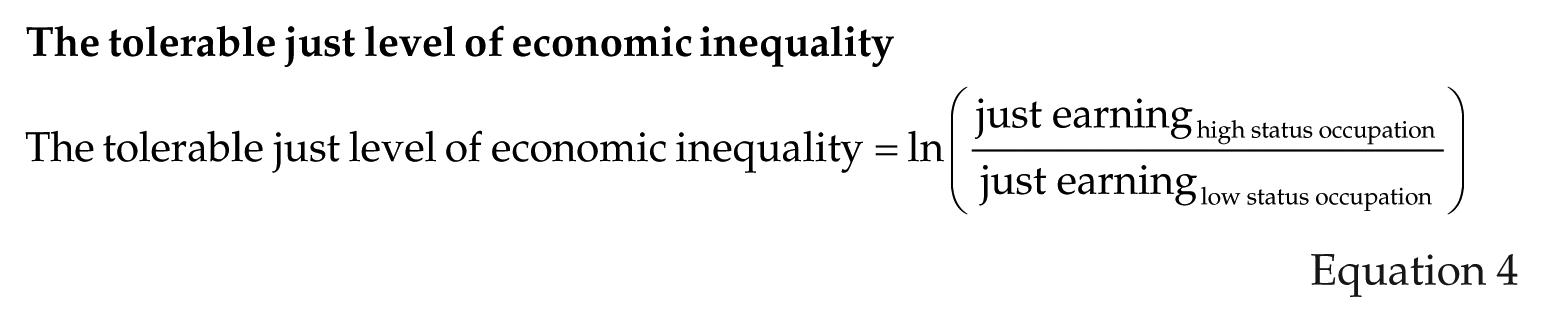
Tolerated (just) inequality: Respondents assign fair income levels to the same occupations. Logarithmic-ratios indicate acceptance of income gaps; higher values reflect greater tolerance for inequality, lower values indicate a more preference for equality.
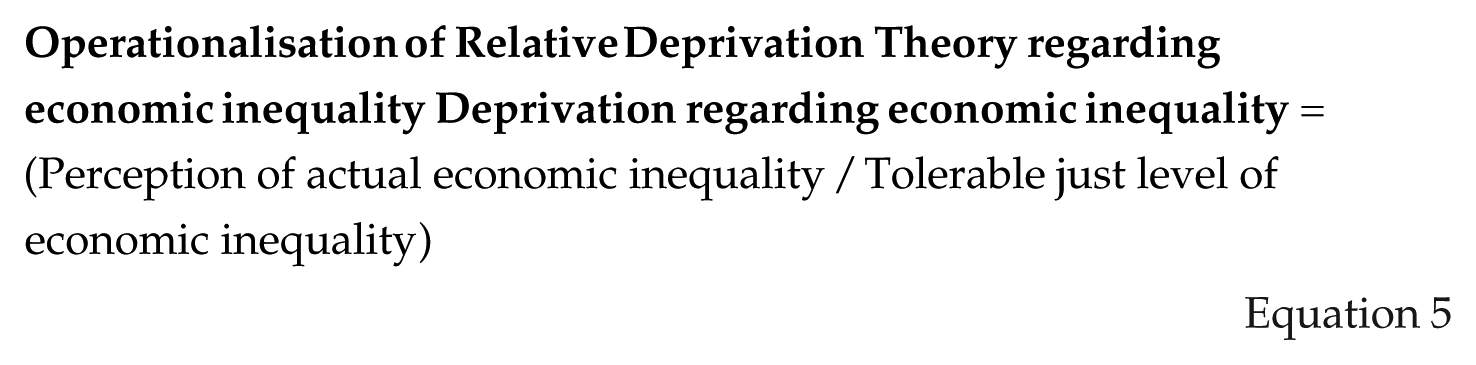
Deprivation: Conceptualized as the gap between perceived and tolerated inequality, deprivation occurs when a person’s perception of actual inequality surpasses the level that their define as a fair level of economic inequality. Values above 1 indicate deprivation, whereas values at or below 1 indicate no deprivation because the evaluation outcome is positive—that is, the person perceives economic inequality in reality as lower than the threshold they define as fair. 12
ISSP Questions About Actual and Just Earnings for a High and Low Status Occupation
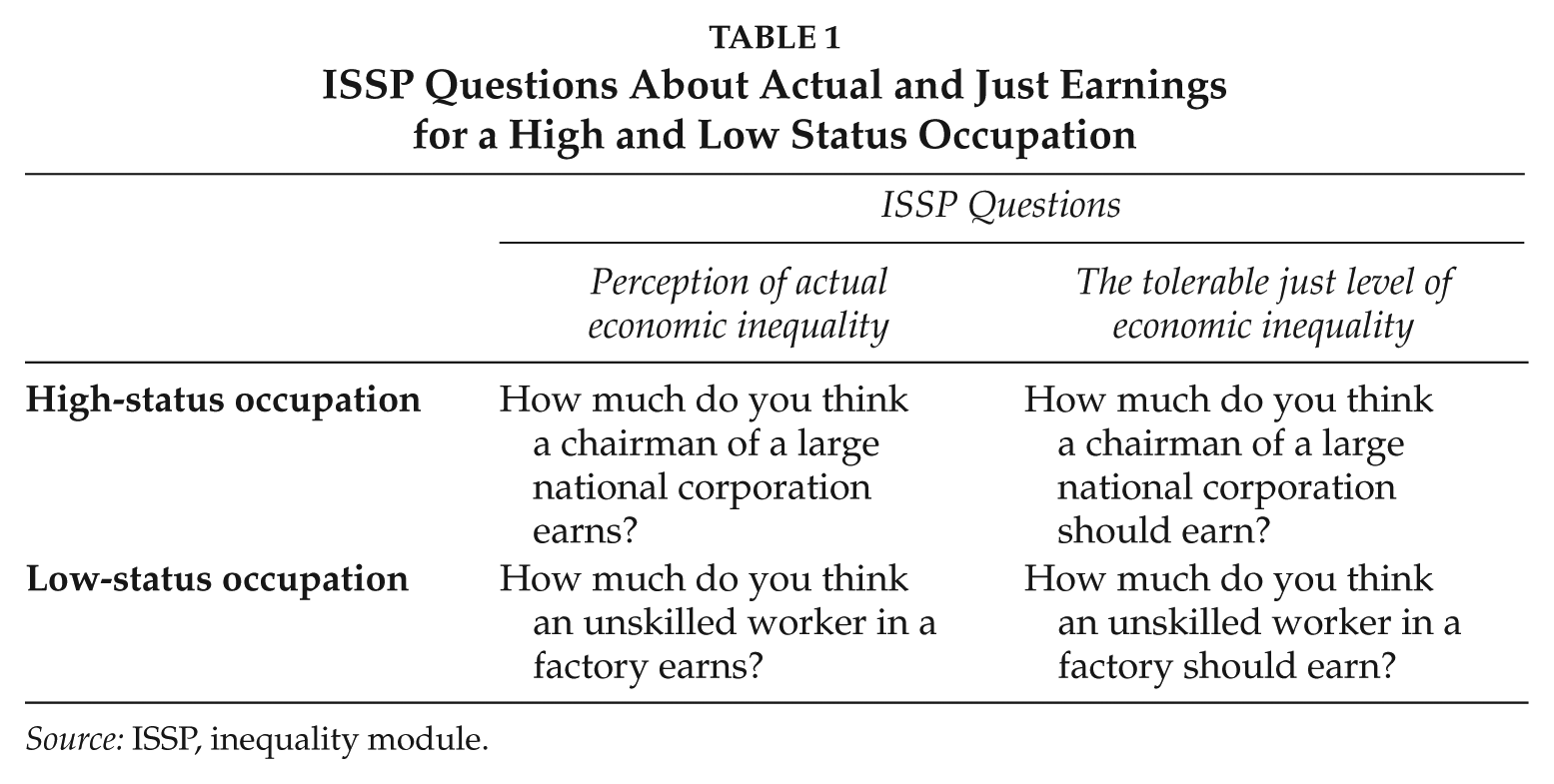
Source: ISSP, inequality module.
Independent variables are grouped into four categories: beliefs about success, distributive ideals, socioeconomic status (SES), and socio-demographic controls.
Beliefs about success (Merit vs. Ascription): Captures whether individuals attribute life outcomes to personal effort (merit) or structural factors such as family background or social connections (ascription) (Jost, 2004; Mijs, 2019). ISSP identifies four factors—merit, ascription, corruption, discrimination—but this study focuses on merit and ascription due to their relevance for inequality perceptions.
Distributive ideals: Reflect normative beliefs about how rewards should be allocated (Castillo, 2011b). Individualistic ideals prioritize self-reliance and merit-based rewards, whereas egalitarian ideals emphasize redistribution and social protection. These are measured through Likert-scale questions assessing preferences for market mechanisms versus state intervention.
Socio-demographic controls and SES: Age, gender, and subjective class (“self-placement” on a 0–10 scale) serve as controls. SES combines income, education, and occupational status into a standardized index capturing objective social position. A time dummy (2009 vs. 2019) allows assessment of how prolonged exposure to inequality affects deprivation evaluations.
Method
Hierarchical regression models are employed to test hypotheses, adding variables sequentially to assess their incremental explanatory power (Wampold and Freund, 1987). The five-step model includes:
SES only
SES plus socio-demographics
Addition of beliefs about success
Addition of distributive ideals
Time dummy to capture temporal effects
This approach clarifies how perceptions evolve under persistent inequality, illustrating the mechanisms shaping deprivation and offering insight into the societal tensions underlying Chile’s social unrest.
Empirical Analysis
As discussed in previous chapters, Chile experienced sustained economic growth from 1990 onward, which improved poverty levels, infrastructure, and education. By 2019, macroeconomic indicators remained positive, and inequality, although high, had slightly declined. This context raises a key question: why did mass demonstrations against inequality erupt in 2019, when living standards had improved and inequality had stabilized? A plausible explanation is found in the mismatch between objective indicators and public perceptions. While statistics showed progress, many Chileans felt that improvements were unevenly distributed, revealing a tension between economic development, inequality, and perceived injustice.
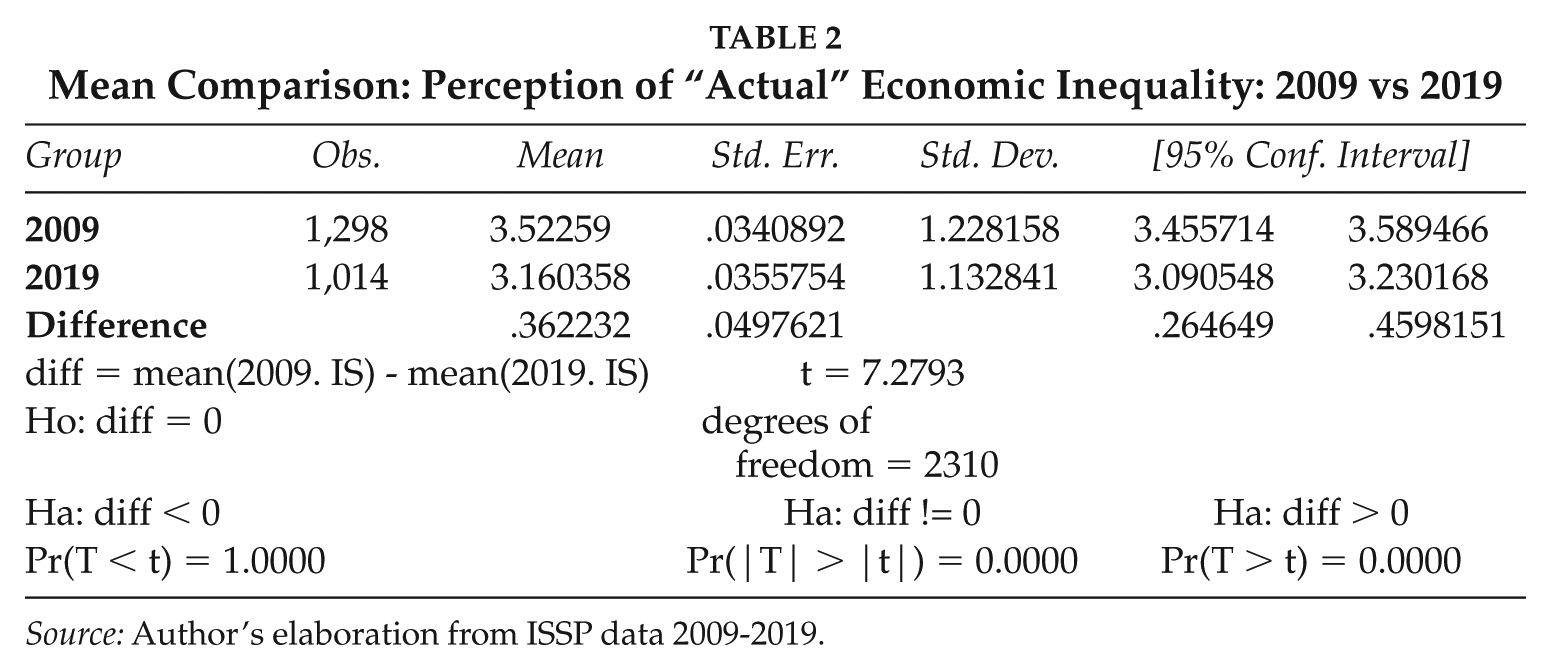
Table 2 shows that Chileans perceived lower income inequality in 2019 than in 2009, and mean tests confirm this decline as statistically significant. Public concern about inequality was therefore stronger a decade earlier, despite persistent criticism in public discourse. This counterintuitive finding indicates that the “Estallido Social” cannot be attributed solely to perceptions of inequality but likely reflects broader frustrations related to unmet expectations, distrust in institutions, and rising relative deprivation feelings against economic inequality.
Mean Comparison: Perception of “Actual” Economic Inequality: 2009 vs 2019
Source: Author’s elaboration from ISSP data 2009-2019.
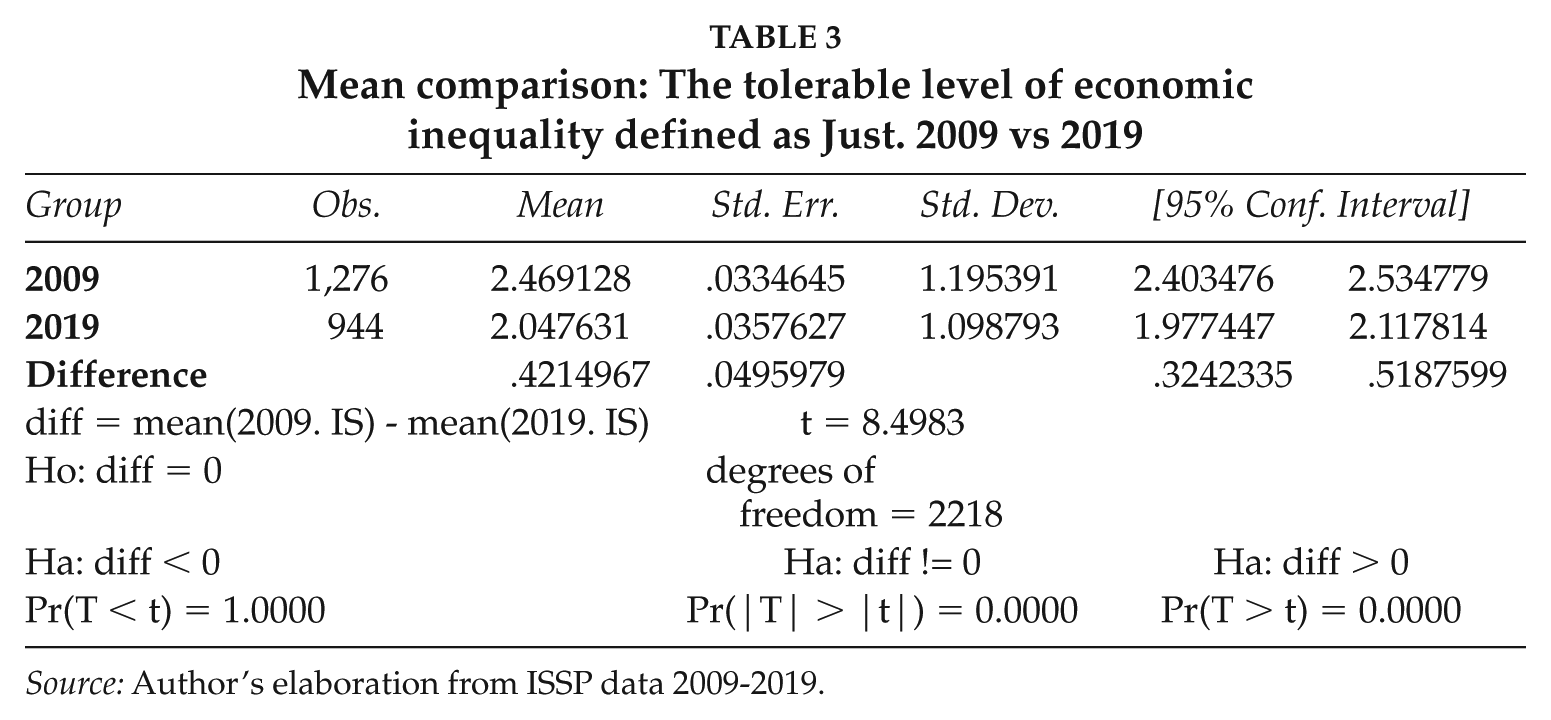
Building on this, what matters is not only how much inequality people perceive but the degree of inequality they consider acceptable. In this study, tolerance for inequality is measured through the perceived fair income gap between high- and low-status occupations: wider gaps signal greater acceptance of inequality. As Table 3 shows, Chileans in 2009 tolerated substantially larger disparities than those surveyed in 2019, a statistically significant decline. This tightening of what was deemed “fair” indicates that, even as perceived inequality fell, the public’s tolerance for it narrowed—widening the gap between reality and what people believed acceptable.
Mean comparison: The tolerable level of economic inequality defined as Just. 2009 vs 2019
Source: Author’s elaboration from ISSP data 2009-2019.
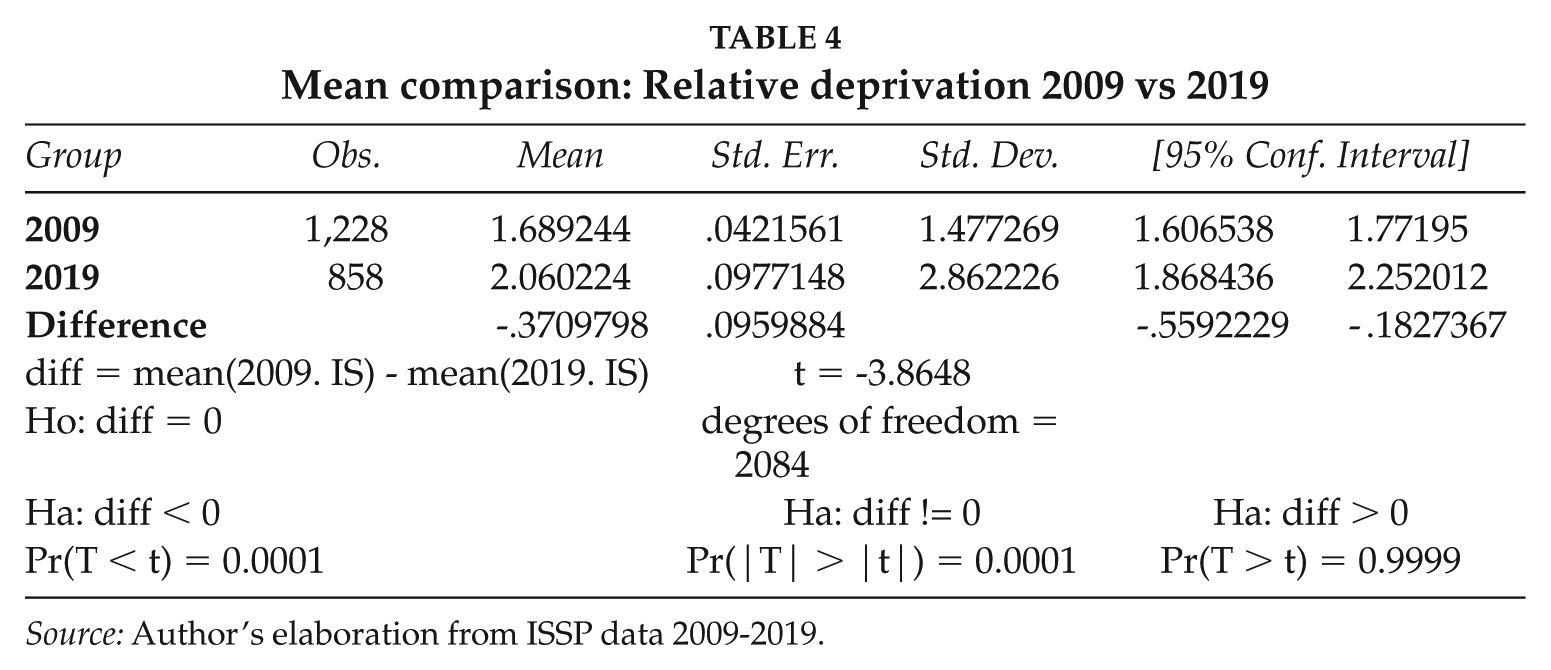
Therefore, Chileans in 2019 perceived inequality as somewhat lower but were also less willing to accept income gaps. This raises the central question: was the gap between perceived and just inequality larger in 2019? Table 4 confirms that deprivation increased significantly from 2009 to 2019. Although perceived inequality declined, tolerance for inequality declined even more, widening the gap between actual and fair inequality. This generated higher feelings of deprivation in 2019.
Mean comparison: Relative deprivation 2009 vs 2019
Source: Author’s elaboration from ISSP data 2009-2019.
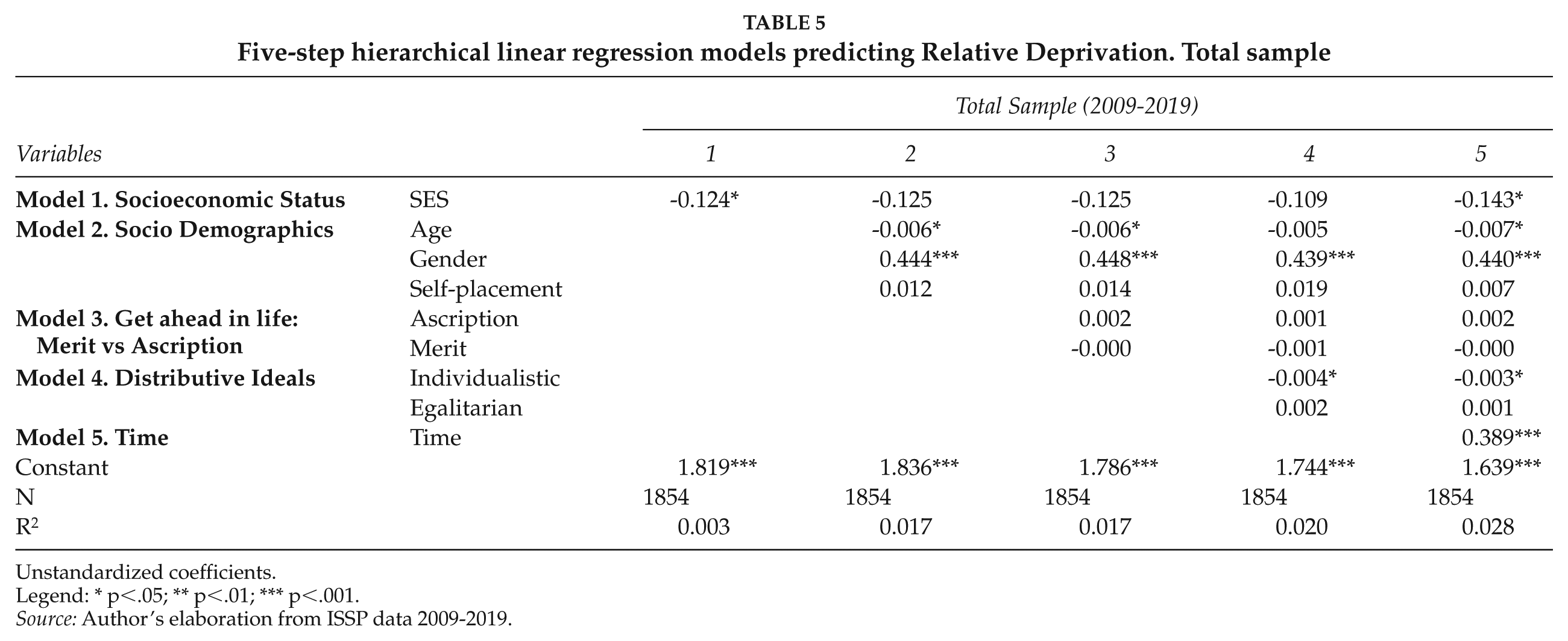
While deprivation clearly increased in 2019, its determinants help clarifywhy these feelings may havecontributed to the protests. To assess deprivation more comprehensively, both years were analyzed together. Table 5 introduces a five-stage hierarchical regression using the full sample, adding a dummy variable about time (reference: 2009). Model 2 confirms that women and younger individuals experience higher deprivation, while SES loses significance from Model 1 to Model 2. Adding beliefs about success has limited impact, but introducing distributive ideals shows that individualistic beliefs are associated with lower deprivation. Model 5 confirms that deprivation increased significantly from 2009 to 2019. SES regains significance when controlling for all variables, and older age continues to predict lower deprivation.
Five-step hierarchical linear regression models predicting Relative Deprivation. Total sample
Unstandardized coefficients.
Legend: * p<.05; ** p<.01; *** p<.001.
Source: Author’s elaboration from ISSP data 2009-2019.
The results indicate that deprivation is shaped by structural and temporal forces. Keeping everything constant, the profile of deprivation in Chile is a young woman of lower socioeconomic status, skeptical of individualistic distributive principles, and living in 2019. The key predictors of deprivation—gender, time, and socioeconomic status (SES)—suggest that material conditions primarily drive feelings of deprivation. Gender disparities affected women the most, societal changes led to lower tolerance for inequality, and individuals from disadvantaged socioeconomic backgrounds felt more deprived. Overall, Chileans in 2019 experienced higher deprivation than in 2009, which may help explain why mass protests erupted in 2019 but not a decade earlier.
Despite improvements in economic performance, poverty reduction, and a moderate decrease in inequality, public discontent intensified. In 2009, perceived inequality was higher, yet protests did not occur (at least not as massive as the Estallido). By 2019, tolerance for inequality had declined, widening the distance between perceived inequality and what Chileans judged fair. The “Estallido Social,” therefore, cannot be explained simply by levels of inequality. It resulted from the misalignment between perceived inequality and expectations of justice.
Traditional explanations for protests focus on increased awareness of inequality. However, these findings suggest that the critical factor is not just the perception of inequality but the perceived fairness of that inequality. The protests were not merely about recognizing economic disparities but about the growing disconnect between perceived inequality and what Chileans believed fair. Although Chileans perceived greater economic inequality in 2009 than in 2019, the Estallido started in 2019. This occurred not because inequality had worsened (at least not massively), but because tolerance for it had declined. By 2019, the gap between the perceived level of inequality and what Chileans considered fair had widened. As a result, despite a lower perception of inequality compared to 2009, feelings of deprivation intensified, as the existing economic disparities no longer aligned with what people judged just or acceptable.
Understanding both actual and ideal perceptions of inequality is essential for analyzing the roots of Chilean social discontent. Later in the article, I will explore potential explanations for these empirical results.
Discussion: Explaining the Chilean deprivation feelings: Why were Chileans more deprived in 2019 than in 2009?
A central aim of this research is to analyze how perceptions of economic inequality shaped the 2019 Chilean Estallido Social. Drawing on the Justice Evaluation Function (Jasso and Wegener, 1997) and the work of Schneider and Castillo (2015), the study develops an empirical approach to measure deprivation feelings based on the gap between perceived and just economic inequality. The results indicate that this misalignment was a key part of explaining why the unrest reached such magnitude. The protests reflected demands for a fairer society, as many Chileans felt that the stratification system no longer corresponded to principles of merit or justice. Thus, the Estallido Social was less a rejection of inequality per se than a call for greater distributive justice.
Two mechanisms help explain why deprivation intensified between 2009 and 2019: rising expectations and the growing role of meritocratic beliefs in legitimizing inequality. Although Chile experienced sustained economic growth, poverty reduction, and some stability in inequality, many felt excluded from the benefits. Economic gains appeared concentrated within a small elite, deepening the perception that the system was unfair. This disconnection between macroeconomic progress and fairness perceptions contributed significantly to the protests.
National Development And The Revolution Of Rising Expectations
The “revolution of rising expectations” provides a useful framework for understanding this dynamic. Research indicates that as economic and social conditions improve, individuals’ expectations rise even faster (Natarajan, 2011; Saha, 1982). When improvements in daily life fail to match these expectations, discontentment grows (Saha, 1982). This observation explains why large-scale protests often emerge during periods of prosperity rather than crisis: individuals perceive national progress but do not experience equivalent improvements in their own circumstances.
This framework is highly relevant for Chile in 2019. As earlier chapters noted, Chile experienced solid macroeconomic performance during the decade leading up to the protests—GDP growth, declining poverty, and a moderate reduction in inequality. Although Chileans were aware of these national trends, many saw no improvement in their personal economic situations. While certain groups benefitted, others remained stagnant, intensifying the perception of exclusion. In this context, frustration arose not from absolute deprivation but from growing disparities between expectations and perceived benefits of development.
The Estallido Social can thus be interpreted as a response to unfulfilled promises. Increased expectations, combined with a perception that gains were captured primarily by elites, widened the gap between aspirations and lived reality. This sense of unmet expectations contributed to higher deprivation in 2019 compared with 2009. Importantly, the shift did not result from worsening inequality but from decreasing tolerance for it. As aspirations grew, the injustice of unequal rewards became more salient, eventually fueling mass mobilization. In this sense, Chile became “a victim of its own success:” economic achievements heightened expectations that the existing system failed to satisfy.
“The tyranny of meritocracy” and deprivation feelings about inequality
A second factor shaping rising deprivation feelings relates to merit as a justification for inequality. Since Young (2017) introduced the concept of a “meritocracy” in The Rise of Meritocracy, the term has been associated with a system where success derives from effort, talent, and hard work rather than inherited privilege (Sandel, 2020). In theory, such a system eliminates structural discrimination and enhances social mobility by rewarding individual merit.
In practice, however, meritocracy is difficult to realize. Structural inequalities shape opportunities, and true equality of opportunity remains elusive. Sandel (2020) argues that meritocracy produces pride among those who succeed, while generating resentment toward those who fall behind, who are often blamed for their lack of achievement. This dynamic— “the tyranny of merit”—reinforces the belief that those at the bottom deserve their lower status, obscuring systemic inequalities.
Meritocratic ideals embed normative notions of justice into stratification systems by framing inequalities as legitimate outcomes of individual merit. Yet when people’s efforts do not translate into expected rewards, frustration deepens. As this research suggests, deprivation increases when expectations rise—partly due to meritocratic narratives—while structural barriers persist.
The Chilean case reflects this tension. Meritocracy raises expectations by promoting the notion that personal effort guarantees upward mobility. When these expectations fail to materialize, perceptions of injustice grow, especially in contexts of high inequality. According to Dubet (2021; 2011), such imbalances stem from conflating social equality with equality of opportunity. While social equality aims to reduce structural inequalities, equality of opportunity assumes a level playing field—an unrealistic condition in stratified societies.
Dubet argues that social mobility is an empirical indicator of equality of opportunity, lowering inequality and improving mobility by reducing the distance between social positions (Atria, 2021; Dubet, 2011). Yet in Chile, inequality remains high despite economic progress. This creates a paradox: rising economic success reinforces individualistic interpretations of inequality rather than collective ones. In their study of Chile, Araujo and Martuccelli (2014) developed the concept of “agentic individualism” to describe a context where success is seen as driven by self-effort and abilities, legitimizing disparities and limiting mobility. Under such conditions, meritocracy becomes a mechanism for reproducing privilege, allowing elites to preserve advantages while presenting inequality as deserved.
Meritocracy, Justice, And The Chilean Protest
The Estallido Social, therefore, reflects a protest against social injustice rather than a call for radical egalitarianism. The movement demanded greater equality of opportunity and a fairer distribution of life chances, not absolute equality of income or wealth. The empirical findings underline this point: deprivation rose because the gap between perceived and tolerated inequality widened. Although perceived inequality was lower in 2019 than in 2009, Chileans became more critical of what they considered a fair level of inequality. The protests thus reflected a heightened demand for justice rather than a rejection of inequality as such.
The perspectives of Sandel (2020), Dubet (2021; 2011), and Araujo and Martuccelli (2014) illuminate these dynamics. Meritocracy’s promise of equality of opportunity clashes with its tendency to reinforce stratification, particularly when mobility is limited. In Chile, meritocratic ideals coexist with high inequality, producing a system in which opportunities are unequally distributed while disparities are justified as merit based. The Estallido Social can thus be interpreted as a call to reconcile meritocratic principles with actual fairness.
In conclusion, the “Estallido Social” can be interpreted as a protest against the injustices of a meritocratic system that fails to deliver on its promises. Rather than seeking a fully equal society, the protestors were calling for a more just distribution of opportunities, in line with the principles of meritocracy. Therefore, Chile remains a highly individualistic society, even during moments of collective unrest, preferring distributive ideals that continue to prioritize individual fairness over social equality. Rising expectations, limited mobility, and deepening critiques of unjust inequality collectively explain why Chileans felt more deprived in 2019 than in 2009, highlighting the crucial link between meritocracy, social justice, and deprivation in contemporary Chile.
Final Conclusions
This article argues that the Estallido Social of 2019 must be understood as emerging from the tension between Chile’s celebrated economic progress and its persistent structural inequalities. The country’s economic achievements raised expectations for social mobility and fairness, yet institutional arrangements continued to reproduce unequal access to education, healthcare, and employment. What fueled the protests was not merely material inequality but the sense that Chile’s development model violated widely shared principles of meritocracy and fairness. Protesters contested a system where opportunities seemed predetermined by socioeconomic origin rather than effort or talent. Thus, the mobilizations expressed not a demand for egalitarian redistribution, but a call for a fairer and more meritocratic society.
Accordingly, this study interprets the Estallido Social as rooted in an individualistic ideal of distributive justice. Protesters sought a meritocratic society in which rewards correspond to effort, ability, and ambition rather than family origin. Rather than calling for radical state intervention or a fully egalitarian model, Chileans demanded a reorganization of the distribution system to ensure that social outcomes align with meritocratic ideals. The protests thus reflect a search for social justice grounded in meritocratic expectations within a context of persistent structural inequalities.
Theoretical Contributions
A key contribution of this research lies in articulating how Relative Deprivation Theory and Social Justice Theory jointly illuminate the dynamics behind the Estallido Social. The study demonstrates that perceptions of inequality are central to understanding social unrest. Deprivation arises when perceived societal inequality exceeds individuals’ fairness thresholds. By operationalizing deprivation as the discrepancy between perceived and fair inequality, the research offers a theoretically coherent and empirically tractable mechanism linking inequality perceptions to protest.
Integrating RD and Social Justice theories also explains why discontent escalates in contexts where meritocratic expectations are widespread but institutional practices continue to reproduce privilege. When citizens believe rewards should reflect merit but observe the opposite, the resulting cognitive and moral dissonance intensifies feelings of injustice and motivates collective action.
This study further advances RD framework by challenging the assumption that deprivation necessarily involves the respondent’s position within the comparison framework. While traditional RD research emphasizes interpersonal comparisons with explicit reference groups, this approach argues that such comparisons are not necessary when assessing deprivation related to societal inequality. In this context, deprivation emerges not from personal disadvantage relative to specific others but from a perceived violation of internalized standards of justice. Expectations of fairness shape both the perception of inequality and the threshold individuals deem tolerable. This refinement broadens RD theory’s applicability to macrosocial phenomena such as perceptions of inequality and their political consequences.
Limitations
Despite these contributions, the research faces two main limitations. First, the use of secondary survey data restricts the precision with which complex concepts—such as justice beliefs, deprivation feelings, and legitimacy perceptions—can be operationalized. Surveys rarely offer all indicators needed to capture these constructs fully, requiring theoretical compromises. This reflects a common challenge in empirical inequality research: balancing conceptual rigor with data availability.
Second, the Estallido Social itself is a multidimensional phenomenon that exceeds the scope of any single explanatory framework. This study does not aim to account for all the political, cultural, and economic forces behind the protests. Its more modest objective has been to examine how inequality perceptions contributed to the unrest. Other dimensions such as gender, territorial disparities, or broader political grievances were not included, but are fundamental to understanding the event’s complexity.
Future Research
The study identifies several directions for advancing research on perceptions of inequality, deprivation, and collective action. Following recent recommendations, future work should incorporate temporal dynamics through longitudinal designs to examine how perceptions evolve and under what conditions they become politically consequential (Castillo, García-Castro, and Venegas, 2022), addressing a major gap in cross-sectional research (Becker, 2021).
Second, greater attention should be paid to everyday experiences of inequality, as emerging research suggests that perceptions shape daily interactions and access to resources such as education, healthcare, and social networks (García-Castro, Willis, and Rodríguez-Bailón, 2019; Willis et al., 2022). Understanding how inequality is lived in daily life would enrich analyses of when and why discontent becomes collective action.
Third, research should expand beyond WEIRD societies (that is, Western, Educated, Industrialized, Rich, and Democratic) to include developing countries with high inequality, where expectations, norms, and institutional arrangements differ (Evans and Kelley, 2016; Mijs et al., 2022). A broader comparative agenda would clarify how perceptions of inequality vary across contexts and how they interact with structural factors. Future studies should examine how perceptions of inequality and deprivation translate into protest and collective action, particularly through cross-national comparative analyses of contexts with varying levels of inequality and protest traditions.