







Abstract
Chile is considered an outlier compared to other Latin American countries, where Indigenous demands have had significant effects on state reforms and the broader political landscape. The constitutional process initiated in 2019 opened new avenues for Indigenous political participation. In this article, we analyze the interactions among Indigenous and non-Indigenous collectives during the constitutional process through the lens of indigenismo. Drawing on Situational Analysis, we examine how different social worlds engaged with questions of identity, representation, and political rights throughout the constitutional process. The findings show that Indigenous participation was characterized by tensions between the promises of expanded political participation and the institutional and political forces that constrained their influence. These interactions reveal struggles to represent Indigenous communities within state institutions, where they are invited but often ignored. The article contributes to broader discussions about Indigenous political participation and the evolving role of indigenismo in contemporary Latin American politics.
Chile es atípico en comparación con otros países latinoamericanos, donde las demandas indígenas han tenido efectos significativos en reformas estatales y en el panorama político amplio. El proceso constitucional iniciado en 2019 abrió nuevas vías para la participación indígena. En este artículo, analizamos las interacciones entre colectivos indígenas y no indígenas durante el proceso constitucional a través del lente del indigenismo. Basados en el Análisis Situacional, examinamos cómo distintos mundos sociales se involucraron en temas de identidad, representación y derechos a lo largo del proceso. Argumentamos que la participación indígena estuvo caracterizada por tensiones entre promesas de mayor participación política y las fuerzas institucionales y políticas que limitaron su influencia. Estas interacciones revelan disputas de representación de las comunidades indígenas, las que son invitadas a instituciones estatales pero frecuentemente ignoradas. El artículo contribuye a los debates sobre participación política indígena y el papel del indigenismo en la política latinoamericana contemporánea.
Keywords
Chile experienced massive demonstrations that brought together the demands of different social groups, including Indigenous people, in October 2019. The use of Indigenous symbols and struggles–such as the Mapuche flag and resistance to colonialism and state violence–provided an Indigenous character to the social outburst (Palacios-Valladares, 2020; Caniuqueo Huircapan, 2019). Amid nationwide demonstrations in November 2019, political parties engaged in a process called “peace agreement,” which entailed changing the current constitution, written during the 1973-1990 military dictatorship, as a way to address civil society demands (Senado de la República de Chile, 2019).
Researchers and political stakeholders suggest that the common struggles of different social groups allowed for widespread support for the Indigenous cause. The political and economic system—perceived as unjust and unresponsive—created common ground among social movements, including Indigenous peoples (Piscopo and Siavelis, 2021; Palacios-Valladares, 2020). Likewise, a number of social movements saw the demonstrations as an opportunity to demand a new constitution and erase the legacy of Pinochet’s dictatorship (Morris, 2021). These intersections emphasised the struggles of Indigenous people, who constitute 12.8% of Chile’s population (Arce et al., 2022), as a symbol of oppression in their relationship with the Chilean state (Palacios-Valladares, 2020; Morris, 2021).
The support for the Indigenous cause during the social uprising enabled the inclusion of Indigenous peoples in relevant institutions during the constitutional process. Groups of Indigenous and non-Indigenous Chileans—allegedly on equal footing (Silva and Aylwin, 2022)—participated in independent political collectives to advance their demands. The Indigenous groups considered in the constitutional process were heterogeneous and participated at different stages. For instance, a group of Indigenous people sought to use state apparatuses to advance their autonomy and control over the decisions that affected Indigenous communities. A second group, with a relevant presence during the Constitutional Council in 2023, emphasized the need to avoid distinctions between Indigenous and non-Indigenous Chileans. They argued that most citizens are mestizo, hence no political distinctions were necessary between Indigenous and non-Indigenous citizens. Other groups sought complete autonomy and control over Indigenous territories.
These groups used institutional and extra-institutional means and emphasized the differences between Chilean and Indigenous identities. Moreover, they had different alliances with Indigenous organizations that operate within and outside the state institutionality (and sometimes both), such as the Consejo de Todas las Tierras (Council of All Lands), the Congreso Lafkenche, the Coordinadora Arauco Malleco, and Rapa Nui Community organizations among others.
These different Indigenous collectives enjoyed significant influence. For example, they were involved in the Constitutional Convention (CC) electoral process. The CC was responsible for drafting a constitutional proposal between 2021 and 2022, which incorporated several historical Indigenous demands. The active inclusion of Indigenous people in this formal political space received strong support from non-Indigenous Chileans (Huenchumil, 2019; Silva and Aylwin, 2022). A survey showed that 95% of Chilean citizens agreed that Indigenous people needed constitutional recognition and participation in decision-making (CIIR, 2021).
The prominence of Indigenous issues during the social uprising can also be understood in relation to broader Latin American debates on Indigenous identity, colonial legacies, and the role of Indigenous peoples within national political projects. These discussions have frequently been articulated through the concept of indigenismo, a heterogeneous intellectual and political current that has historically brought together states, intellectuals, and Indigenous actors seeking to address the “Indigenous question” (Bengoa, 2000: 19) in Latin America (Giraudo and Martín Sánchez, 2012; Favre, 1998; Villoro, 1950). Historically, indigenismo encompassed both state-led efforts to integrate Indigenous populations into national societies and political movements aimed at improving the social, economic, and cultural conditions of Indigenous communities while recognizing their distinct identities (Vergara and Gundermann, 2016).
In this article, we analyze the interactions between Indigenous and non-Indigenous groups during the Chilean constitutional process through the lens of indigenismo. This analytical perspective is particularly relevant in the Chilean case, where scholars have argued that Indigenous issues have historically occupied a peripheral place in formal political institutions compared with other Latin American countries (Rice, 2013, 2015; Parraguez, 2020; IWGIA, 2020). Moreover, much of the existing literature on indigenismo in Chile has focused on historical intellectual debates or the development of Indigenous organizations rather than on the contemporary political interactions that shape Indigenous participation in formal political arenas (Parraguez, 2020). Examining the constitutional process through the lens of indigenismo allowed us to explore how Indigenous and non-Indigenous actors interact within formal political spaces while negotiating competing understandings of identity, rights, and political representation. By focusing on these interactions, this study contributes to broader discussions about Indigenous political participation and the evolving role of indigenismo in contemporary Latin American politics.
The article is organized in five sections. First, we present the concept of indigenismo, which provides a framework for analyzing the political participation of Indigenous people in the constitutional process. Second, we present our methodological considerations, including the reasons for using situational analysis (SA) (Clarke, Friese, and Washburn, 2018) and the social worlds/arenas map as an analytical tool. Third, we focus on the findings of the analysis. Fourth, we discuss the findings within the literature associated with indigenismo and draw connections to current conversations around decolonial thought in the South. In closing, we synthesize the main findings and elaborate on the analysis’s contributions to understanding Indigenous people’s formal political participation in Chile.
Indigenismo
Literature in political science and historiography frequently presents indigenismo as a set of processes, ideas, and political initiatives aimed at addressing the situation of Indigenous peoples in Latin America (e.g., Bengoa, 2000; Cunin and López Caballero, 2020). Villoro (1950) and Favre (1998) have provided classical definitions of the concept. While Villoro (1950) defines indigenismo as “the set of theoretical conceptions and conscientious processes that, in different times, have manifested the Indigenous” (14), Favre (1998: 7) defines it as “a stream of opinions favourable to the Indians.” Both definitions highlight a broad intellectual and political orientation that seeks to make visible the struggles and cultural dimensions of Indigenous peoples within Latin American societies.
Historically, indigenismo developed as a heterogeneous current that brought together state institutions, intellectuals, and Indigenous actors concerned with addressing what became known as the “Indigenous question” (Bengoa, 2000: 19). Early expressions of indigenismo in México were closely linked to state-led efforts to improve the social and economic conditions of Indigenous populations and integrate them into the nation. Initiatives such as the Inter-American Indigenist Institute—established following the Pátzcuaro Congress of 1940—sought to coordinate policies among Latin American states while also promoting research and dialogue among scholars and Indigenous leaders (Vergara and Gundermann, 2016). At the same time, these initiatives were embedded in broader intellectual debates about national identity, modernization, and the place of Indigenous peoples in Latin American societies. These debates frequently reflected a tension between the search for modernization and the recognition of cultural and historical diversity within national communities (Svampa, 2016).
These classical definitions and historical experiences underscore the complexity of indigenismo as intellectual and political phenomena. While some strands emphasized the integration of Indigenous populations into national societies through state-led policies, others highlighted the need to recognize the cultural distinctiveness of Indigenous peoples and their capacity to contribute to broader national projects (Favre, 1998; Svampa, 2016). As a result, indigenismo has been described as a polysemic concept that encompasses a wide range of ideological positions and political strategies concerning Indigenous peoples in Latin America (Svampa, 2016; Cunin and López Caballero, 2020).
Defining indigenismo solely as a general sentiment in favor of Indigenous peoples does not necessarily provide an analytical framework for examining the political participation of Indigenous actors in contemporary political processes (Parraguez, 2020). In response to this limitation, scholars have proposed conceptual refinements that allow the concept to capture the complex interactions among Indigenous actors, state institutions, and political collectives. For example, Bengoa (2000) provides an operational definition that emphasizes three interconnected dimensions: the denunciation of Indigenous oppression, the search for policies aimed at improving the situation of Indigenous peoples, and the recognition of the Indo-American character of Latin American societies.
Similarly, Giraudo and Martín Sánchez (2012) identify several elements that characterize indigenismo in Latin America, including its emergence as a continental debate about the situation of Indigenous peoples, the role of intellectuals and policymakers in shaping indigenista discourse, and the involvement of state institutions in designing policies that reshape Indigenous–state relations. These dynamics illustrate that indigenismo involves multiple actors and arenas—including state institutions and Indigenous organizations—whose interactions shape how Indigenous issues are addressed in national political contexts.
Taken together, these debates highlight the heterogeneous and evolving character of indigenismo in Latin America. Rather than referring to a single doctrine or ideological tradition, we understand indigenismo as a historically evolving field of debate concerning the place of Indigenous peoples within national societies, the recognition of cultural diversity, and the role of the state in addressing the “Indigenous issue” (Bengoa, 2000:19). Over time, this field has encompassed multiple intellectual and political strands that reflect different understandings of Indigenous identity, rights, and political participation. These strands include state-led integrationist approaches that sought to incorporate Indigenous populations into national development projects, cultural perspectives emphasizing the value of Indigenous heritage and identity, political approaches associated with Indigenous movements demanding autonomy and collective rights, and more recent postcolonial and decolonial critiques that question the colonial assumptions embedded in earlier indigenista traditions (Svampa, 2016; Cunin and López Caballero, 2020).
We approach indigenismo not as a fixed ideological position but as an analytical lens that captures the evolving debates and tensions surrounding Indigenous–state relations in Latin America. From this perspective, indigenismo provides a conceptual framework for examining how different actors—including state institutions, intellectuals, and Indigenous political organizations—have articulated competing interpretations of Indigenous identity, rights, and political participation.
Indigenismo In Chile
The development of indigenismo in Chile differs in important ways from the trajectories observed in other Latin American countries such as Mexico, Peru, or Bolivia, where indigenista policies and intellectual traditions became central components of state-building projects during the twentieth century. Scholars have noted that the “Indigenous issue” (Bengoa, 2000: 19) historically occupied a more marginal position within Chilean political institutions and intellectual debates compared with other countries in the region (Rice, 2013; Parraguez, 2020). As a result, the development of indigenismo in Chile was less associated with large-scale state programs aimed at Indigenous integration and more closely linked to specific institutional initiatives and intellectual debates concerning the recognition of Indigenous peoples within the national community.
One important institutional space in which indigenista ideas circulated in Chile was the Instituto Indigenista Interamericano (Inter-American Indigenist Institute), created after the First Inter-American Indigenist Congress in Mexico in 1940. According to Vergara and Gundermann (2016), the Institute promoted cooperation among Latin American states and intellectuals interested in addressing the social and economic conditions of Indigenous populations through research, policy initiatives, and international dialogue. Chile participated in these debates through government representatives, academics, and policymakers who contributed to discussions about Indigenous policy at the continental level. These exchanges illustrate how indigenismo functioned not only as a set of state policies but also as a transnational intellectual field in which governments, scholars, and Indigenous actors debated the appropriate role of the state in Indigenous affairs (Svampa 2016; Vergara and Gundermann, 2016).
Despite this participation in continental indigenista networks, Chile did not develop a strong institutional indigenismo comparable to that of other Latin American countries. Instead, Indigenous issues were often addressed in the context of agrarian, rural development, or social policies that did not necessarily recognize Indigenous peoples as distinct political actors. This institutional marginality contributed to the persistence of assimilationist narratives that framed Chile as a relatively homogeneous nation, frequently emphasizing mestizaje or national unity over cultural and political differentiation (Parraguez, 2020; Rice, 2013; Yashar, 2005).
Nevertheless, indigenista debates continued to evolve in Chile throughout the twentieth century, particularly through the work of intellectuals, anthropologists, and Indigenous organizations who sought to challenge dominant narratives about national identity and Indigenous marginalization. These debates reflected broader transformations in Latin American discussions about Indigenous rights, identity, and political participation, especially during the late twentieth and early twenty-first centuries when Indigenous movements across the region gained increasing visibility and political influence (Svampa, 2016).
From this perspective, the Chilean case illustrates how indigenismo can be understood in the context of national debate rather than single policy formulation. Different actors—including state institutions, intellectual networks, and Indigenous organizations—have articulated competing interpretations of Indigenous identity, rights, and political participation within changing political contexts (Alvarado Lincopi, 2021; Samaniego and Ruiz Rodriguez, 2017; Párraguez, 2021). These tensions became particularly visible during the recent constitutional process, where Indigenous representatives, political parties, and civil society organizations debated the recognition of Indigenous peoples, the possibility of a plurinational state, and the scope of Indigenous political representation within Chilean democracy.
Understanding these debates through the lens of indigenismo allows us to situate the Chilean constitutional process within a broader Latin American tradition of discussions about Indigenous–state relations. At the same time, it highlights the specific historical trajectory of Chile, where Indigenous issues have often remained peripheral to formal political institutions until moments of broader political transformation—such as the constitutional process examined in this study.
Accordingly, this paper focuses on the following research questions: 1) What are the characteristics of the political participation of Indigenous people in Chile’s constitutional process through lens of indigenismo? 2) Why were efforts to gain greater political recognition and rights for Indigenous Peoples not more successful in the constitutional process? The purpose is to analyze Indigenous Peoples’ political participation in the constitutional process through the lens of indigenismo, exploring the forces that, on the one hand, foster greater political participation and, on the other, impede Indigenous People’s involvement in relevant formal political spaces. In the following section, we present methodological considerations to analyze data that we use to articulate a response to the research questions.
Methodological Considerations
We applied Situational Analysis (SA) to examine the interactions of collectives debating the integration of Indigenous rights during the constitutional process. SA is a theory-methods package developed as an extension of constructionist approaches to Grounded Theory (GT) (Clarke, Washburn, and Friese, 2022). We used SA’s emphasis on complex ecologies to analyze Indigenous political participation through the Social World/Arenas map.
Situational Analysis uses several mapping strategies to address complexity, including situational, relational, social worlds/arenas, and positional maps. Situational maps identify the human and non-human elements shaping a situation, relational maps trace relations among them, social worlds/arenas maps examine collective actors operating within arenas of commitment, and positional maps analyze discursive positions taken around controversial issues (Clarke, 2003; Clarke, Friese, and Washburn, 2018). Together, these tools support systematic analysis of complex social situations.
For this paper, we applied the Social World/Arenas (SWA) framework and mapping analytical tool provided in SA, because it facilitates the analysis of the collective dimension of the situation (Clarke, Friese, and Washburn, 2018). The SWA framework focuses on how social worlds—or “universes of discourse” (Clarke, Washburn, and Friese, 2022: 15)—engage in a wide range of activities to achieve common or similar goals (Strauss, 1978) within arenas where social worlds are ecologically organized around issues of concern (Clarke and Star, 2007).
We chose SA and the SWA framework to analyze Indigenous political participation in the constitutional process for two reasons: 1) it facilitates the analysis of collectives interacting—with and without consensus and in nuanced ways (Fletcher and Clarke, 2018)—in an arena defined by identity concerns during the constitutional process in Chile; and 2) it aids in addressing complexity and nuances in the interactions among the collectives involved. First, the inquiry situation can be understood from the perspective of collective actors interacting to position themselves regarding the constitutional recognition of Indigenous peoples and their rights (Clarke and Star, 2007). These interactions center on how identity shapes the recognition of Indigenous rights in constitutional developments. Second, the SWA framework provides theoretical support for analyzing the complex relations that characterize the constitutional process. In particular, the SWA conceptual toolbox offers useful concepts for examining these interactions, including how Indigenous actors become implicated in formal political spaces (Clarke and Star, 2007; Clarke et al., 2022). In Situational Analysis, implicated actors are groups affected by decisions made by others and are often “silenced/ignored/made invisible by those in power” (Clarke and Star, 2007: 119) or “discursively constructed by others” (Clarke, Washburn, and Friese, 2022: 21). This concept helped us interpret issues of political representation raised by research participants.
Data Collection And Analysis
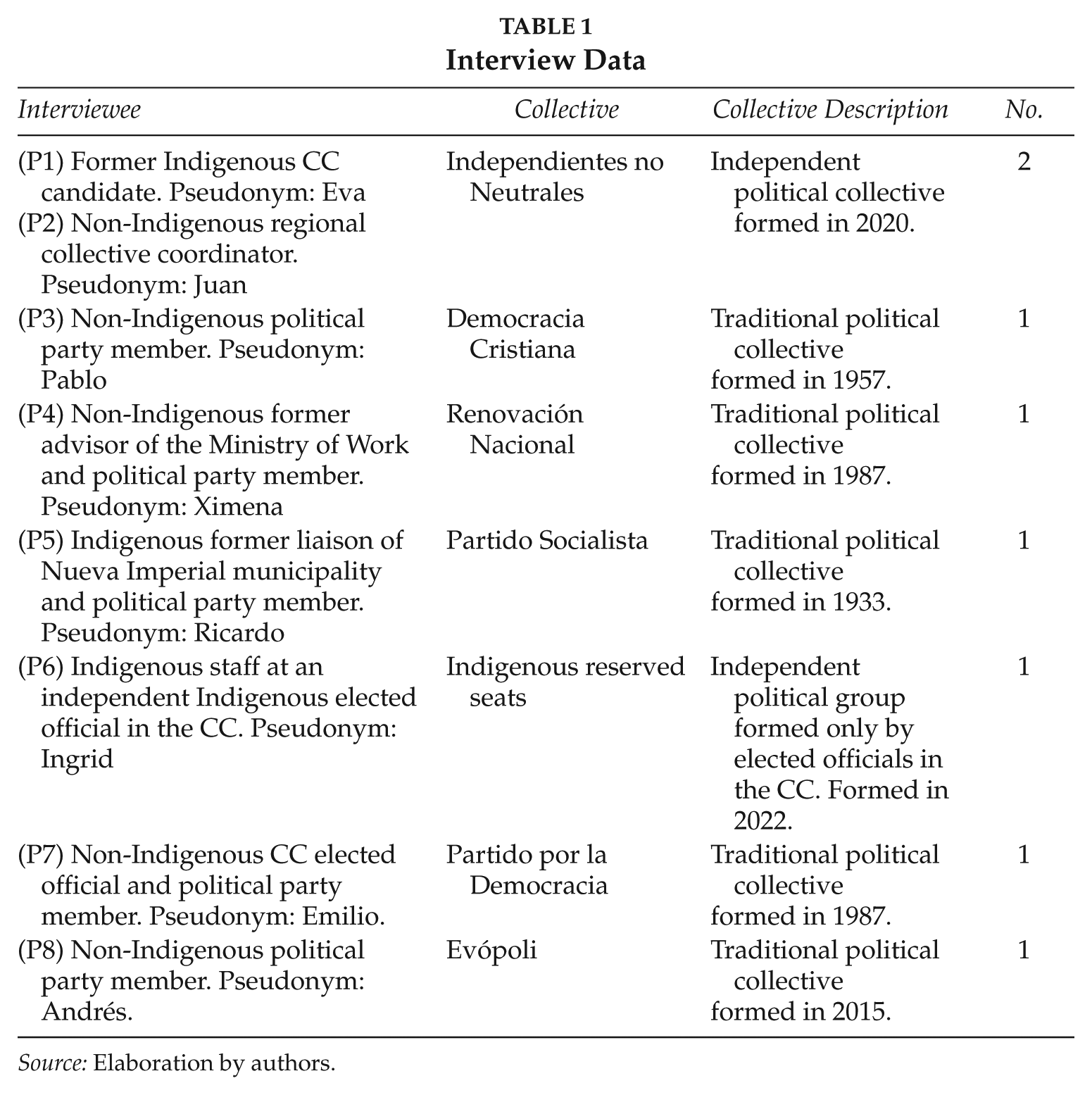
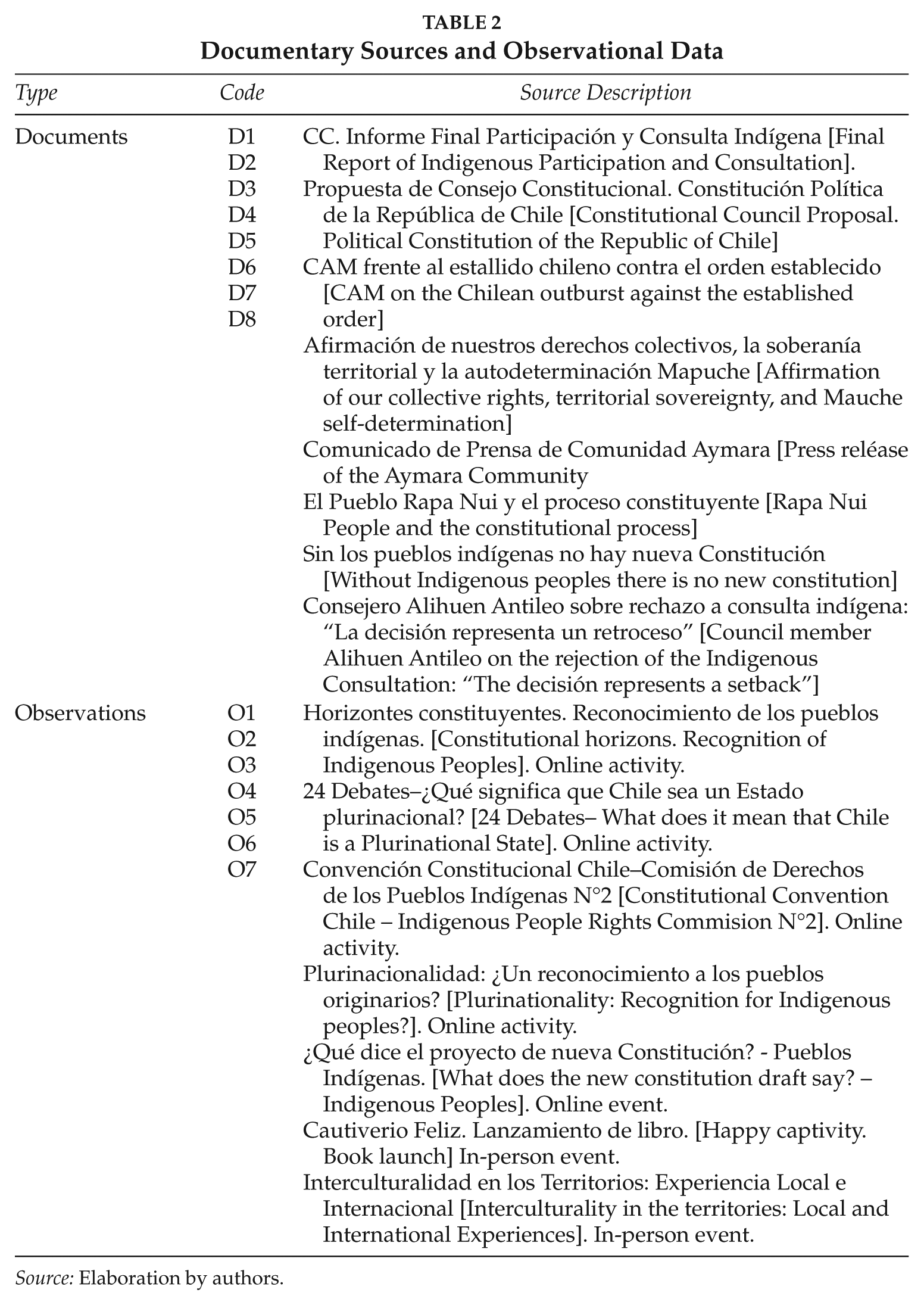
We used three data types to analyze Indigenous participation in the Chilean constitutional process: interviews (Table 1), document analysis, and observations (Table 2).
Interview Data
Source: Elaboration by authors.
Documentary Sources and Observational Data
Source: Elaboration by authors.
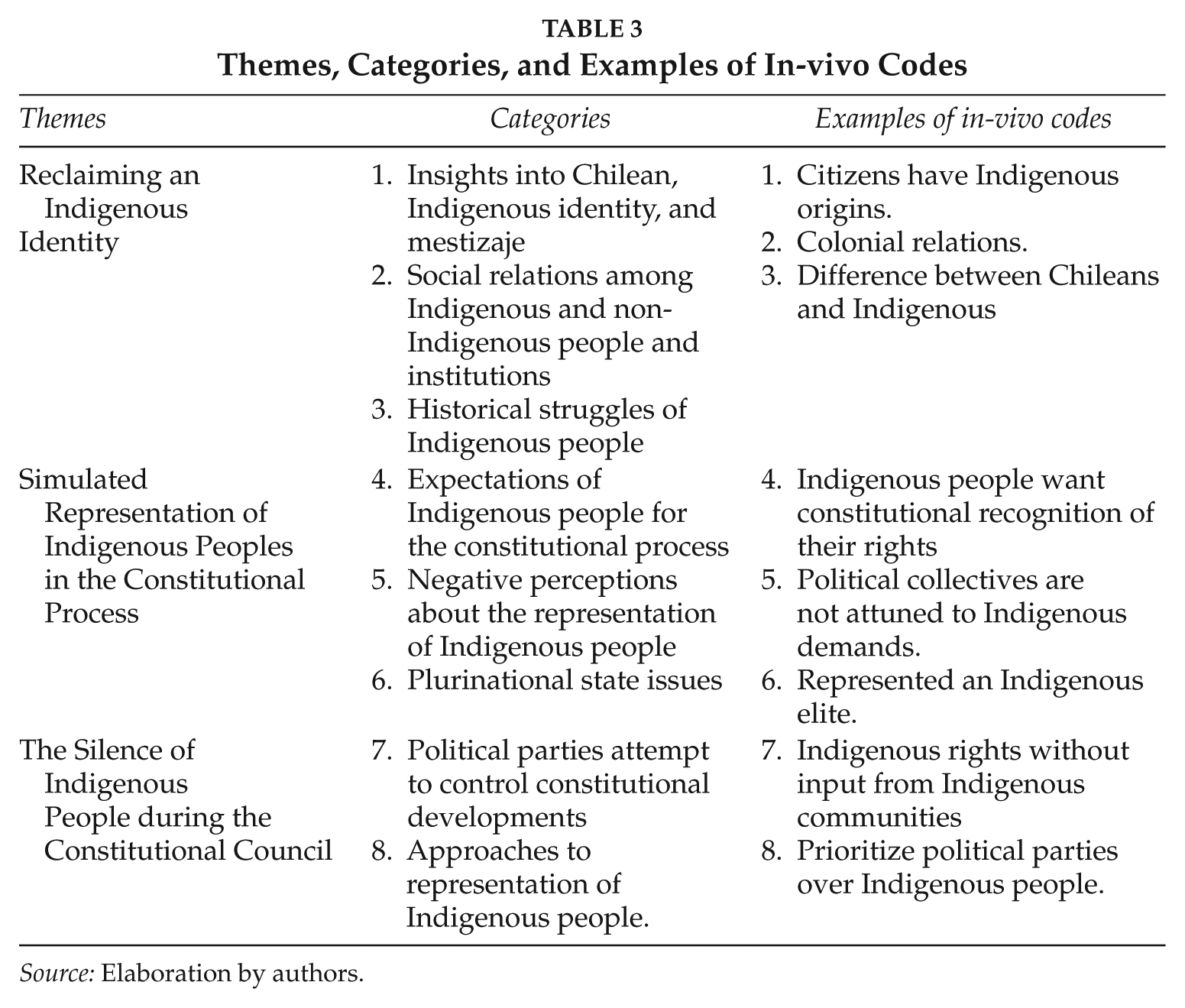
Following SA methods (Clarke et al., 2022), we transcribed the interviews verbatim and used the original texts of the written communications. Then, we conducted an initial in-vivo coding and produced over thirty-three codes for each interview and document (n = 532). We used verbatim transcriptions and in-vivo codes, which use the participants’ own words or phrases to capture their experiences in interviews and closely examine their narratives, texts, and written communications (Turra Chico, 2025). We compared the codes to identify similarities and differences and develop larger themes (Clarke, 2005; Corbin and Strauss, 1990). We created two levels of thematic categories based on the codes. Table 3 includes examples of in-vivo codes, the eight categories and the three broader themes.
Themes, Categories, and Examples of In-vivo Codes
Source: Elaboration by authors.
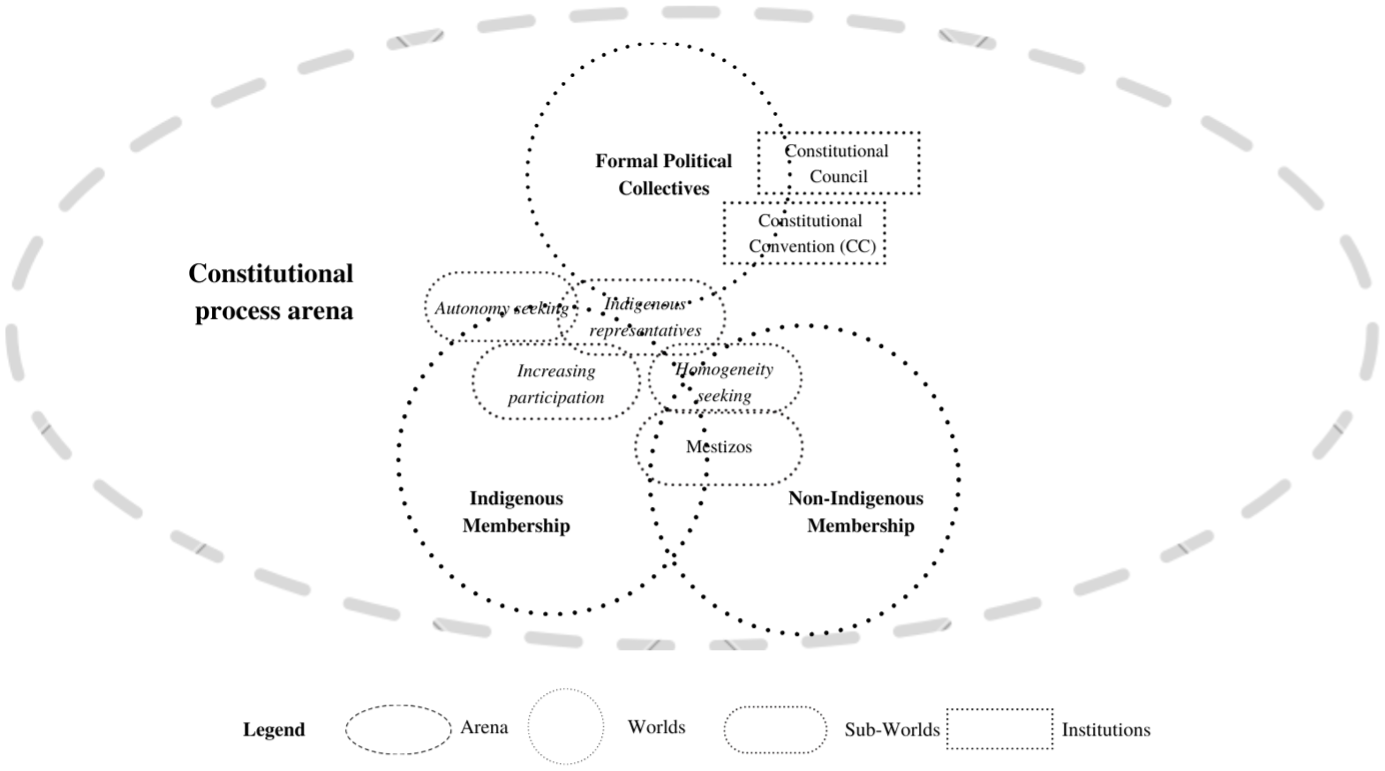
Following SA, we developed a SWA map (Figure 1), which helped us visually represent and analyze the collective actors who play a role and act in relation to the political participation of Indigenous People. The map does not represent the full scope and dimensions of the constitutional process. Rather, it is an “analytical and communicational device” (Valderrama Pineda, 2016: 289) developed to represent the analysis of an arena delimited by identity concerns where several collectives interact in a manageable way.
Visual Diagram of the Analysis.
Within the SWA framework, arenas are sites of encounter where different social worlds interact around issues of shared concern (Clarke, 2003; Clarke and Star, 2007). In this study, the constitutional process functions as the central arena where Indigenous and non-Indigenous collectives engage in political debates about the recognition of Indigenous peoples and their constitutional rights. These interactions center on identity concerns, particularly how Indigenous identity should be understood and represented within the Chilean state.
The map identifies three main social worlds that interact within this arena. The first corresponds to formal political bodies, which include political parties and independent political organizations participating in constitutional negotiations and which operate within state institutions. A sub-world within this group consists of Indigenous representatives elected through reserved seats, which were a mechanism that set aside a fixed number of positions in the constitutional convention for Indigenous communities. These representatives simultaneously participated in formal political negotiations and maintained connections with broader Indigenous organizations.
The second social world corresponds to Indigenous membership collectives, composed of organizations and actors who self-identify as Indigenous and whose primary concern is advocating for Indigenous rights and recognition. Within this world, our analysis identifies three sub-worlds, characterized by different political strategies. The first includes autonomy-seeking groups that emphasize territorial rights and self-determination, often combining institutional participation with extra-institutional forms of political action. The second comprises actors seeking increased participation within state institutions through alliances with progressive political collectives. The third includes groups that emphasize the shared or mestizo character of Chilean identity and promote alliances that downplay political distinctions between Indigenous and non-Indigenous citizens.
The third social world corresponds to non-Indigenous membership collectives, which include actors who identify primarily as Chilean or mestizo and whose political engagement focuses on broader social and political issues affecting the national population. Within this world, our analysis distinguishes between groups that recognize cultural differences between Indigenous and non-Indigenous populations and those that emphasize a more homogeneous national identity.
By mapping these social worlds and their interactions, Figure 1 helps clarify how different actors engaged with questions of identity, representation, and Indigenous rights throughout the constitutional process. The map illustrates that debates about Indigenous political participation were shaped not only by tensions between Indigenous and non-Indigenous actors but also by the coexistence of multiple positions and strategies within each social world. In the following section, we examine how these interactions unfolded in practice by presenting the main findings of the analysis.
Findings And Interpretation
The interactions among the social worlds represented in Figure 1 became particularly visible during key moments of the constitutional process, where debates about identity, political representation, and Indigenous rights unfolded within formal political arenas. In the following subsections, we describe the findings organized under three themes: 1) reclaiming an Indigenous identity, 2) disregarding the perspectives of Indigenous People in the Constitutional Convention, and 3) non-Indigenous officials speaking on behalf of Indigenous People during the Constitutional Council. These themes illustrate how interactions among Indigenous and non-Indigenous collectives shaped the opportunities and constraints of Indigenous political participation.
Reclaiming An Indigenous Identity
This first theme is on ideas related to affirming an Indigenous-based identity that is complex, autonomous, and different from Western culture, and pertains to the role of the non-Indigenous in promoting such affirmations. Here, we focus on the interactions between Indigenous and non-Indigenous membership groups, including the critical role that personal experiences related to Indigenous and non-Indigenous identities play in advocating for Indigenous rights.
Many Indigenous people were directly or indirectly involved in the process in various capacities, mainly through affiliations to territorial Indigenous organizations and political collectives. This political participation, supported by most citizens in the early stages of the constitutional process, enabled a widespread conversation about Indigenous identity in the country. An example of this early support was the election of the first president of the Constitutional Convention (CC), Elisa Loncón. Ninety-six elected members of the convention, mostly non-Indigenous, voted for her, which reflects the support to reinvigorate the Indigenous dimension amid the constitutional process.
Ingrid and Eva are two Mapuche women who participated in political collectives with representation in the constitutional process and provide an example of how Indigenous identity was relevant during this period. Their decision to participate was rooted in their life experiences as Indigenous people raised in Santiago. As an example, Ingrid narrates her relocation experience and its implications as follows:
My parents thought that for us not to suffer discrimination, we should move, learn Spanish well, and acquire Western culture. My parents' way of protecting us was through education. They thought education could protect us, not only from discrimination as Mapuche but also as women (P6).
Ingrid addresses the relations between Indigenous and non-Indigenous groups. Her narrative reflects the historical assimilation of Indigenous cultural traditions into mainstream Chilean culture. The migration to urban areas implies becoming an Indigenous-Chilean, —i.e., adopting Chilean cultural traits, such as learning Spanish and living in cities—which for Eva and Ingrid meant inhabiting a complex identitary intermediate that has pragmatic effects on personal and social levels. As an example of these impacts, Eva had decided to run as a representative of Indigenous people in the CC. However, before inscribing her candidacy and after a discussion with members of her community, she changed her mind, because, in her words, “there were so many things that I did not know [about the Mapuche culture], that maybe I would not know how to represent” (P1). Ingrid and Eva’s narratives exemplify how, historically, Indigenous and Chilean identities have been distant and different, making Indigenous people subjects of discrimination. Furthermore, by adopting Chilean cultural traits, Indigenous people are placed in an intermediate identity space—between being Indigenous and Chilean—that impacts how they interact, for example, in political spaces.
The unprecedented identity discussion during the constitutional process also interplays with the notion of mestizo identity. Mestizaje was frequently used with different intentions and meanings. The following narratives by Ingrid and a group of self-identified mestizos present these uses of the concept as follows:
There are many people that I know who say that we are all equal. We are all Chileans until relevant decisions need to be made. I usually say, well, we [Mapuche people] also have our own rights; we have a different culture, and we can contribute to society from there. They insist that we are all mestizos because we all have Indigenous blood (P6). For almost four decades, we have lived in an imposed pact, with an ideal of society created behind closed doors, which does not recognize diversity and creates a unitary and homogeneous state where only Western voices have been heard. The new Constitution must represent the mestizaje of this land, repairing the historical abuses committed against the Indigenous Peoples that inhabit what we now call Chile (D7).
Mestizo identity is a complex construct which was used with opposite political intentions during the constitutional process. On the one hand, mestizaje allowed alliances to homogenize identity in Chile and, therefore, disregard the idea that Indigenous People need specific constitutional rights. Conversely, Indigenous, mestizo, and non-Indigenous actors used mestizaje as a bridge to forge alliances across these worlds and to advocate for Indigenous rights, thereby providing an alternative interpretation of Indigenous and non-Indigenous interactions. Like Eva and Ingrid, some non-Indigenous and mestizo actors have reclaimed their Indigenous identities in their defense of the rights of Indigenous people.
Disregarding Indigenous Perspectives In The CC
The second theme highlights how elected officials disregard or ignore the perspectives of Indigenous People during particular moments of the constitutional process. When Indigenous and non-Indigenous elected officials interact in formal political spaces, they are often conflicted between their interests as representatives of Indigenous voters and their expectations as political actors. In other words, tensions arise for elected officials who have to prioritize and balance representing non-Indigenous political collectives or representing their Indigenous voters. These multiple affiliations often affect Indigenous people’s representation, even leading to ignoring their perspectives during the constitutional process.
The management of the results of the 2021 Indigenous consultation (D1) demonstrates how elected officials sometimes ignore Indigenous People’s perspectives. Indigenous voters participated in a consultation to provide input to articulate Indigenous rights in the constitutional proposal. The consultation presented the concept of a plurinational state as a foundational political model. Indigenous citizens were asked to provide their perspectives about what rights should or should not be included in the articulation of the plurinational state, without asking if the plurinational state was accepted as a potential political model. Moreover, the consultation results showed that “the right with the highest disapproval is the right to lands, territories and natural resources” (D1). Despite this result, Indigenous elected officials pushed to include the plurinational state model as an axis of the constitutional proposal, precisely emphasizing the right to territorial autonomy. Hence, the results of the consultation were partially dismissed. Emilio, a member of the 2022 CC, presents his perspective on the matter in the following narrative:
I think the most important bench was the Indigenous reserved seats. They had seventeen seats until they came apart [as an organization]. [. . .] When the plurinational state commission was established, Indigenous representatives said the order was to give content to the plurinational state, but we [the commission] had not discussed if we wanted to include the plurinational state. The answer was, but it has already been agreed to be included. [. . .] Sometimes, the reserved seats opted to represent their political collectives rather than Indigenous people themselves (P7).
This situation exemplifies the complex interplay between representing Indigenous People and their political collectives within state institutions. However, from the perspective of Indigenous elected officials, the plurinational state and its emphasis on territorial autonomy and control of natural resources was a strategic “push to move the fence” (P6) of the political limits to advance the Indigenous agenda. For its supporters, this political model allowed the recognition of the historically neglected constitutional recognition of Indigenous peoples and would allow the thriving of Indigenous cultures and their ways of living. However, a large number of Indigenous people considered that the plurinational state proposal was too large an advance of the Indigenous agenda. Ricardo explains this idea as follows:
I think the plurinational state today does not have support. First, I think the idea has been discredited. I also think there were excesses during the process. I mean, we have never had this type of discussion, and we started having it not from minus to more, but our representatives started with the more. For many people, this was dangerous because they were not clear about what it would imply. (P5)
For Ricardo, the plurinational state model can be considered premature because there was a gap between not having constitutional recognition of Indigenous people and a proposal centring a political model on Indigenous people for the entire state. For him, this type of push for the plurinational state proposal could be threatening for many citizens, because it caused apprehension regarding what it could imply in practice. For example, “through the restoration of Indigenous land” (P5), which was one of the core demands of the autonomy-seeking Indigenous groups (see Figure 1). These demands were considered radical by the mestizo and homogeneity-seeking social worlds. For Ricardo, detractors of the model utilized these uncertainties to discredit the plurinational state, making it unfeasible in the current political context.
Indigenous Silence During The Constitutional Council
The third theme comprises how non-Indigenous collectives attempted to take over the Indigenous agenda during the period of the Constitutional Council in 2023. The Council was the second entity charged with writing a new constitutional proposal after the rejection of the first, which was established by the Constitutional Convention. The Council, along with expert committees designated by the Chilean Congress, consisted of fifty elected representatives. The Council only had one indigenous representative, Alihuén Antileo. The diminished Indigenous representatives in this period resulted in non-Indigenous elected officials speaking for Indigenous people, without listening or having mechanisms for their direct participation. Consequently, we turn our attention to the way non-Indigenous elected officials spoke for Indigenous people to create constitutional proposals.
The Indigenous official proposed to conduct a new consultation process with Indigenous communities. This consultation was intended to reinvigorate Indigenous agendas in 2023, following the first proposal’s rejection. For Alihuén Antileo, this process was necessary as, if approved, some of the norms of the second constitutional proposal would have a direct impact on Indigenous communities. This would require a differentiated consultation process for Indigenous communities, as stated in the International Labor Organization Convention 169, which the Chilean Congress had ratified. However, the idea was rejected by the majority of the elected officials. In the words of the Constitutional Council president, this decision was because “this entity lacks the constitutional, legal, and regulatory powers to carry out an Indigenous consultation, and therefore, it is not appropriate for this Constitutional Council to do so” (D8).
The decision not to conduct a second Indigenous consultation left Indigenous people who did not participate in political or territorial collectives with no role in the Constitutional Council. At this moment, elected officials continued discussing how to recognize Indigenous people in the proposed constitution and articulate their rights. Article 5 of the Constitutional Council proposal mentioned that “the constitution recognizes Indigenous People as part of the Chilean Nation” and that the state will respect their “individual and collective rights” (D2). Additionally, it stated that the Chilean state recognizes “interculturality as a value of ethnic and cultural diversity” in the country, and that public institutions will “guarantee the acknowledgement and comprehension of such ethnic and cultural diversity” (D2). Besides these descriptions, no other Indigenous rights are mentioned in the proposal. Elected officials wrote this Indigenous-focused article without input from Indigenous communities.
For Ingrid, these circumstances reflected the historical relations within state institutions that have “forced Indigenous people to remain silent” (P6). The lack of dialogue and mechanisms to involve Indigenous people keeps their demands, cultures, and experiences invisible and relegates them to an undignified status. Referring to the composition of the Constitutional Council, Eva explains these ideas:
For me, this is it. We are still silenced. People keep hiding us. [. . .] I hope they make us visible so as to not feel inferior and that people do not keep talking for us. This is fundamental for me regarding the situation of Indigenous people, because I want us to feel dignity, that we are part of a country where we can contribute and that our culture is not going to die. (P1)
During the work of the Constitutional Council, non-Indigenous elected officials spoke on behalf of a large group of Indigenous people, while discussing how to incorporate their rights in a constitutional proposal. This is indicative of the extent to which non-Indigenous people in positions of power can create obstacles to the direct political participation of Indigenous people, even as they work to represent their rights.
Taken together, these findings illustrate how Indigenous participation in the constitutional process unfolded through complex interactions among multiple social worlds, where moments of recognition and alliance coexisted with institutional dynamics that ultimately constrained the effective incorporation of Indigenous demands.
Discussion
In this section, we discuss the findings in relation to two characteristics of indigenismo in the historical moment of the Chilean constitutional process. First, indigenismo emerges as a set of social and political processes through which Indigenous identity was reaffirmed and debated within broader Chilean society, often with the support of both Indigenous and non-Indigenous collectives involved in the constitutional process. Second, these debates are closely linked to the active—and frequently contested—participation of Indigenous people in formal political spaces. Indigenous people's participation in the constitutional process reflects political interactions that created expectations for the affirmation of distinct Indigenous identities and for expanded political participation and influence. At the same time, these interactions reveal countervailing forces that constrained both the public affirmation of Indigenous identities and Indigenous involvement in key formal political arenas. Using the Situational Analysis framework and the Social Worlds/Arenas map, these dynamics can be interpreted as interactions among multiple collectives—including Indigenous organizations, political parties, and non-Indigenous social groups—whose competing interpretations of identity, representation, and rights shape the possibilities and limits of Indigenous political participation in the constitutional process.
The alliances and support offered by non-Indigenous collectives enabled discussions about the Indigenous aspects of Chilean identity and society. These discussions differ in part from Giraudo and Martín Sánchez’s (2012: 91) definition of indigenismo, as they did not apparently seek to “transform or annihilate” the Indigenous dimension of society. Instead, in the early stages of the constitutional process, this perspective emphasized the difference between Indigenous and non-Indigenous people to promote cultural and identity diversity (Pairacán, 2022). This push—initially supported by non-Indigenous collectives—created expectations for greater Indigenous political participation.
Conversely, and more in line with Giraudo and Martín Sánchez’s definition, a contrasting perspective emphasized the commonality of Indigenous identity in all Chilean citizens. Some collectives used mestizaje to homogenize Chilean identity (Bonhomme, 2023), hence providing grounds to dismiss special constitutional rights for Indigenous people. These contrasting uses of mestizaje reflect broader debates in Latin America about its political meaning. Rivera Cusicanqui (2010; 2018) argues that mestizo identity has been historically shaped by colonial logics that repress Indigenous dimensions of identity while emphasizing European heritage. At the same time, she suggests that mestizaje can also be understood as a synthesis that recognizes the coexistence of Indigenous and European roots. From this perspective, reclaiming the Indigenous dimensions of mestizo identity opens decolonial possibilities for rethinking political organization and state–society relations in Latin America (Alvarado Lincopi, 2021; Rivera Cusicanqui, 2018).
The latter use of the mestizo identity is coherent with the definition of indigenismo provided by Bengoa (2000), which affirms a complex identity that is distinct from Western culture. This finding aligns with the literature that underscores the political recognition of Indigenous identity as a potential path to changing predominantly European-based ways of thinking about the state and political organization in Latin America (Van Cott, 2010; Brysk, 2000; Loncón, 2020). These conversations about mestizaje and Chilean identity mark an unprecedented emphasis on its Indigenous dimension, which, until the constitutional process, operated under homogeneous and non-Indigenous assumptions (Bonhomme, 2023; Pairacán, 2022).
The second dimension of our interpretation centers Indigenous people's active yet challenged participation in formal political spaces. Giraudo and Martín Sánchez (2012) proposed that Indigenous people have been traditionally part of indigenismo as receptors of policies designed to integrate them into national and state life, positioning Indigenous collectives as passive actors. However, Indigenous collectives actively sought to participate in the constitutional process. This active participation was supported by a number of non-Indigenous collectives (Palacios-Valladares, 2020) and enacted through the occupation of seats in the entities in charge of writing constitutional proposals and participation in political collectives and territorial organizations. Nonetheless, this active involvement was challenged during different moments of the constitutional process.
Indigenous participation was characterized by the constant struggle of collectives linked to social organizations to make their demands visible through state institutions. Their participation involved alliances with non-Indigenous collectives (such as Chileans ascribed to the mestizo world in Figure 1), with whom they advanced identity-based agendas designed to promote policies for Indigenous cultural acknowledgement, self-determination, and greater autonomy (Svampa, 2016).
The work of Indigenous representatives illustrates these challenges. The interactions between Indigenous representatives with other social worlds displayed in Figure 1 show how their purpose was to achieve national governance that reflects the plurality of ways of living in Chile. In turn, the state apparatus and social worlds, such as those seeking homogeneity, posed constant challenges to maintaining the state’s current organization—with no Indigenous constitutional recognition and diminished political participation— and became obstacles to achieving Indigenous demands. This situation aligns with Giraudo and Martín Sánchez’s (2012) definition of indigenismo, posited as seeking cultural transformations that could annihilate Indigeneity.
These challenges often develop through issues of political representation. These complex interactions that shape their political participation indicate how power manifests in the moves to agree, dissent, collaborate, and compete with regard to constitutional rights for Indigenous people. For example, Indigenous people were rendered implicated actors (Clarke, Washburn, and Friese, 2022; Clarke, Friese, and Washburn, 2018) during the CC and the Constitutional Council. Elected officials in the CC partially ignored the results of the Indigenous consultation, resulting in the inclusion of the plurinational state as a proposed political model and an emphasis on territorial autonomy, which contradicted the consultation results. Following SA, Indigenous voters were implicated because they were present in the consultation but ignored by officials (Clarke, Washburn, and Friese, 2022). Furthermore, non-Indigenous elected officials decided not to conduct a second Indigenous consultation, despite presenting a proposal that articulated Indigenous rights. Following SA, in this moment of the constitutional process, Indigenous People were implicated actors because officials “speak for” a large group of Indigenous people (Clarke, Washburn, and Friese, 2022: 163) while presenting proposals without any input from Indigenous communities.
This situation impacted the outcomes of the first stage of the constitutional process. Studies show that including the plurinational state was one of the main reasons for the constitutional proposal's rejection in 2022 (CADEM, 2022; Disi Pavlic, 2024; IPSOS, 2022). Researchers also suggest that the conversation about the potential implications of the plurinational state for citizens’ livelihoods shaped the constitutional conversation and its results (Piscopo and Siavelis, 2023; Faundes Peñafiel, 2022).
Indigenous actors did not constitute a unified political bloc during the constitutional process. As illustrated in our findings, different Indigenous collectives adopted distinct strategies regarding participation in the CC and the articulation of the Indigenous agenda. While some organizations and representatives sought to advance Indigenous demands through formal institutional participation, other sectors—particularly autonomy-oriented groups rooted in territorial organizations—expressed skepticism toward the constitutional process itself. For some, proposals such as plurinationality were perceived as institutional solutions developed within state-centered or academic frameworks that did not fully reflect the territorial struggles and priorities of Indigenous communities (Nahuelpán et al., 2022). These tensions reveal that disagreements within Indigenous movements over the appropriate arenas and strategies for advancing Indigenous rights were themselves a significant dimension of the constitutional process. In this sense, the limitations of the Indigenous agenda cannot be explained solely by the resistance of non-Indigenous actors, but must also be understood in relation to internal debates about representation, strategy, and political priorities within Indigenous movements.
These issues of representation indicate how power manifested during the constitutional process. Indigenous people without participation in political and territorial collectives had no mechanisms to influence decision-making; hence, they were less powerful actors (Clarke, Washburn, and Friese, 2022) in the constitutional process. The interactions between Indigenous elected officials and their political collectives left scarce space for Indigenous people with no affiliations to be represented on their own terms. The multiple affiliations of Indigenous officials create “layers of silence” (Star and Strauss, 1999: 9) that overshadowed Indigenous grassroots demands. These issues are part of the reasons why there is still no constitutional recognition of Indigenous people in Chile after both proposals, developed by the Constitutional Convention and Constitutional Council, respectively, were rejected by Chilean citizens.
This is coherent with the body of literature on indigenismo that posits that state apparatuses seek to subsume Indigenous demands into colonial perspectives of social development (Parraguez, 2020; Giraudo and Martín Sánchez, 2012). However, in the constitutional process, there was a constant pushback from Indigenous communities and other non-Indigenous actors to recenter Indigenous participation, as exemplified by the demand of the Indigenous official in the Constitutional Council to conduct Indigenous consultations and find democratic avenues to include the perspective of grassroots communities. This constant tension in the political realm, where Indigenous actors are sometimes invited but ignored, continues to obstruct Indigenous agendas and contribute to maintaining Indigenous People at the margin (Star, 1995) of formal political spaces in Chile.
Conclusions
We analyzed the political participation of Indigenous people in Chile’s constitutional process, focusing on the reaffirmation of Indigenous identities, the expectations of expanded political participation, and the forces that ultimately constrained their involvement in key formal political spaces. The findings show that Indigenous participation unfolded through a complex interplay between the affirmation of Indigenous identities and the institutional dynamics that limited the effective incorporation of Indigenous demands within state structures. On the one hand, the constitutional process opened unprecedented opportunities for public discussions about the Indigenous dimensions of Chilean identity and society. On the other hand, the interactions within formal political arenas revealed significant constraints on Indigenous political participation, as institutional dynamics and political negotiations often limited the extent to which Indigenous perspectives were incorporated into constitutional deliberations.
The process of reaffirming a complex and autonomous Indigenous and mestizo identity was characterized by the interplay between making visible and negating the Indigenous character of Chilean identity. Nevertheless, this enabled an ongoing conversation that brought identity and cultural differences between Indigenous and non-Indigenous people to the forefront of the political arena. These conversations have created a historical precedent to promote cultural and identity diversity through formal state politics.
The participation of Indigenous people in political collectives, territorial organizations, and reserved seats unfolded within a context marked not only by tensions with non-Indigenous political actors but also by important debates among Indigenous collectives themselves regarding the strategies and arenas through which Indigenous demands should be advanced. Yet, Indigenous and non-Indigenous collectives constantly pushed back on these attempts to recenter the attention on the Indigenous People and their demands. These tensions between being invited and ignored or silenced, as well as the ongoing reclamation of space for Indigenous demands in formal politics, characterized Indigenous political participation throughout the process.
The analysis of Indigenous political participation in the constitutional process through the lenses of indigenismo is relevant for two reasons. First, it provides a perspective on indigenismo in a country that is considered an outlier in comparison to other Latin American countries with longstanding Indigenous state participation (Parraguez, 2020). Second, the analysis focuses on the actual participation of Indigenous collectives in formal political spaces in interaction with formal governance and non-Indigenous collectives. This analysis differs from the literature on indigenismo in Chile and Latin America, which is frequently framed in historiography studies about Indigenous organizations (Bengoa, 1996; Foerster and Montecino, 1988) and the role of intellectual Indigenous actors that have advanced the Indigenous agendas in different countries (Samaniego and Ruiz Rodriguez, 2017; Parraguez, 2021). This article provides insights into the actions and interactions that facilitated and challenged the advancement of Indigenous demands in Chile’s constitutional process.
The findings of this article contribute to discussions on indigenismo, showing how debates about Indigenous identity, representation, and state recognition unfold through interactions among Indigenous and non-Indigenous actors in formal political arenas. By examining these interactions through Situational Analysis, the article highlights how indigenismo can be understood not only as a historical intellectual tradition but also as a dynamic field of political negotiations that shapes the possibilities and limits of Indigenous participation in contemporary constitutional processes. These findings suggest that the obstacles to the Indigenous agenda were shaped not only by resistance from non-Indigenous actors within state institutions but also by internal debates among Indigenous organizations regarding the legitimacy, scope, and strategic value of participating in the constitutional arena.
The analysis of this article is limited to formal political spaces and does not consider the role of Indigenous and non-Indigenous collectives in other arenas. Alternative studies on the advancement of Indigenous agendas under different circumstances, such as informal political spaces, could shed light on how Indigenous political participation unfolds outside state institutions. Such an approach could also be used to contrast how the advancement of demands of Indigenous people formulated within state institutions interact in other spheres, and thus contribute to providing a more complete analysis of their political participation.
Footnotes
Funding
The authors disclosed receipt of the following financial support for the research, authorship, and/or publication of this article: The doctoral project underpinning this research was funded by the Chilean National Agency for Research and Innovation (ANID) through the Doctorado en el Extranjero Program, contract/grant no. 72210064.

Héctor Turra Chico is an Assistant Professor at the Departmento de Didáctica y Práctica, Facultad de Educación, Universidad Católica de Temuco. Gabriela Alonso-Yanez is an Associate Professor at the Werklund School of Education of the University of Calgary. Roberta Rice is a Full Professor and head of the Department of Political Science at the University of Calgary. Eva Caurapán Puelpán is a member of Independientes no Neutrales in Chile.