






Abstract
“the historical unity of the ruling classes is produced in the state” (Gramsci, 2015: 438)
This issue of Latin American Perspectives on Chile critically reflects on interdisciplinary aspects of inconsistent neoliberal democracy, labor surplus population, as well as cultural and social movements in the nation’s last forty years of postdictatorial extractivist capital accumulation. The period is characterized by a sharp increase in precarious, disposable labor, completely lacking in social benefits, regulations or basic rights in the context of the expansion of financial capital, and the depredation of ecosystems. In Chile, as a result of the increment in levels of education over the past forty years, 55 percent of those with university education are overqualified for what they do. Workers are severed from production at a faster rate than they can be re-absorbed, as massive unemployment and underemployment become the rule. Surplus humanity leads to surveillance and incarceration, particular in the Global South. As we will discuss below, the Marxist concept of surplus population coincides with iliberal proliferation of police forces, border walls, and restricted civil and political rights.
This issue of Latin American Perspectives will address aspects of this phenomenon. What is the nature of the protest movements in the Chilean post-dicatorial period? Why do we see these forms of mobilization after 46 years of neoliberal politics? What has been the role of the state during these years? How has neoliberal postdictatorship model transformed Chileans’ subjectivities? What has been the relationship between subjectivities and politics during this period?
The alliances of major university student organizations (FECH, FEUSACH, FESES) experienced significant growth against the commodification of education. The movement protagonized the long cycle of mobilizations between 2000 and October 2019. Its breadth augmented as it became linked with the Teacher′s Union (Colegio de Profesores), the Central Labor Federation (CUT), Feminist collectives (March 8th Movement), and the No +AFP pension reform movement, as author Alexis Cortés points out in this LAP issue. Michelle Bachelet′s second presidential campaign in 2014 had set a clear timeline: 70% of tuition coverage within four years and full universal freedom of higher education within the next six years. However, in spite of the marches involving tens of theousands of students, President Bachelet ceased to promote the reforms as they remained a merely formal policy objective. By 2016, universality had turned into a long-term goal with no immediate policy commitment.
Undoubtedely, Chile has been characterized by an ongoing national crisis with different degrees of delegitimizating state governability, during the period of the centrist Concertación (1990-2010), the two right-wing governments of Sebastián Piñera (2010-2014 and 2018-2022), the Nueva Mayoría′s second presidential period of Michelle Bachelet, which incorporated the left for the first time since Allende′s Popular Unity government (1970-1973), and Gabriel Boric′s Broad Front Chile Digno (“Chile of Dignity”)–a coalition in alliance with Apruebo Dignidad which included the Communist Party, Democratic Socialist coalitions, and independents (2022-2026). The issue closes in 2025 with victory of the far-right coalition in the presidential elections.
During the first days of October 2018, President Sebastián Piñera (right-wing Chile Vamos, 2010-2014 and 2018-2022) boasted of the country's “good health,” claiming that Chile represented an "oasis" amidst Latin America′s waves of protests. However, as he spoke, protest movements were proliferating in Chile. The movement persisted in spite of the sabotage by the mainstream media, which was challenged by social networks and street art. Social media often publicized performances and protest activities the same day they ocurred. In 2006, the high school student, “Penguin Movement” sponsored creative street actions which took up matters extending from school issues to those of institutional harassment and abuse. Subsequently, in 2018, women marched in different Chilean cities, drawing hundreds of thousands in their defiant "purple tides." Artistic performances and urban mobilizations multiplied as student demands for public education began to coalesce with victims of workplace harassment. Lacking structures to regulate and guarantee rights, protestors consistently demanded an end to patriarchal violence, legal abortion, equal pay, and formal investigations into sexual harassment at home, schools and workplaces. Artistic performances proliferated throughout cities and rural/urban spaces.
In addition to the Penguin Student Movement, this issue of Latin American Perspectives covers labor and pobladores (shanty town dwellers) protests. Articles shine light on the rentier model based on extractivist wealth, labor precarities and women′s unpaid work. More importantly, they also address why the struggles of students, women, and social movements have persisted since the return to democracy. The protests include road blockades, strikes, pot-banging protests, clashes with security forces, occupations, cultural performance, and public shaming and denunciations.
Indeed, massive, ongoing street art protests date to the anti-dictatorship movements in the 1980s. In her article in this issue, Jennifer Lawrie reflects on the importance of street art creations during the late 1980s. Her article provides important dictatorship background of the early, postdictatorial student movement developing later in 2006 with the subsequent “Penguin Revolution.” Lawrie shows that the role of civic visual art creations had early expressions in street art performances in the 1983 Art Action Collective (CADA) as part of the anti-Pinochet resistance movement.
To this date, Chilean visual and artistic creators have resignified social and political change. In this sense, the long “transition” to democracy displayed new dialectics of censorship and self-censorship, promises and disenchantments, artistic imagination and politics. Lawrie′s article shows that the current phase of capitalism is not to be understood in its abstraction, but through real, concrete, and diverse sensuous experiences of inequality, political and visionary expressions. Color, spatial organization, rhythm, light, and expressive manifestations have accompanied social movements′imagination as they engage political subjectivity in constructions of solidarity and dissent.
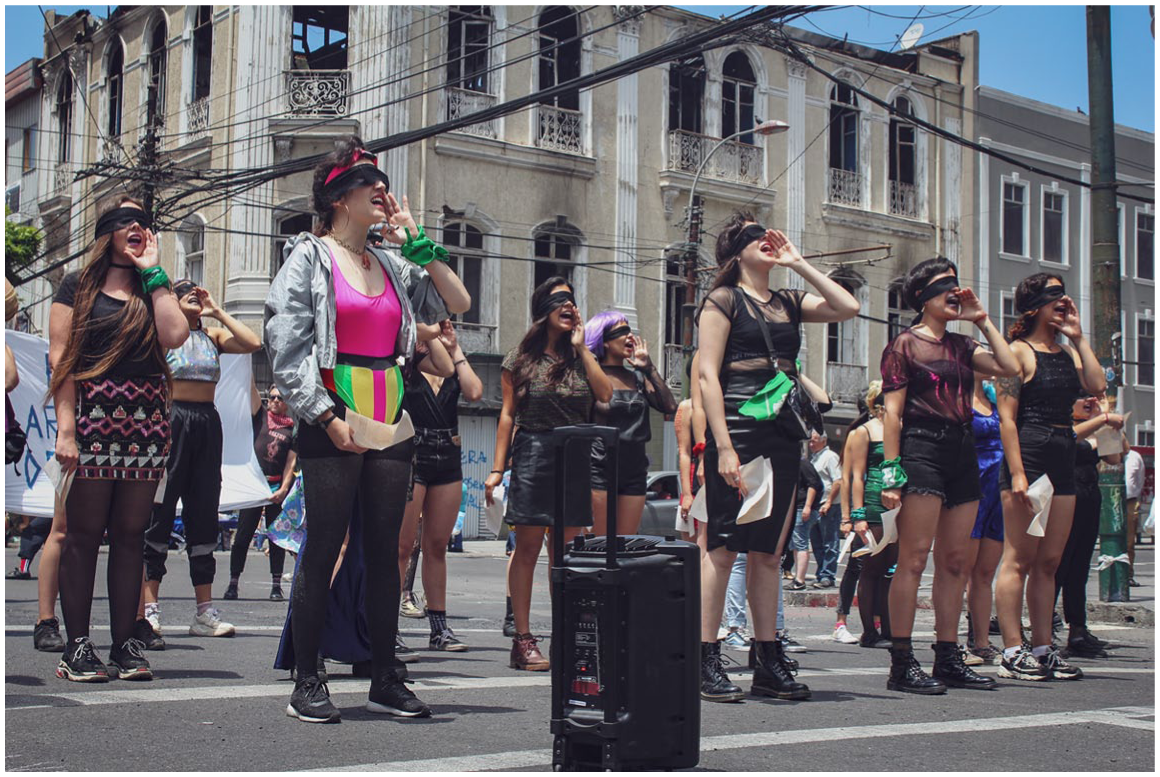
During the long anti-dictatorship Chilean resistance, the No+ (No more dictatorship) movement in Santiago inscribed political artistic messages in public spheres, contesting persecution, censorship and self-censorship. From CADA in the 1980′s to LASTESIS (a Chilean women’s collective) massive street performances in 2018, profound critiques of the subjective, cultural, economic and political dimensions of neoliberalism have taken place (Lechner and Güell, 1998; Moulian, 1997).
Since the end of the dictatorship in 1989, the critique of Chilean democracy has gone hand in hand with the critiques of neoliberalism. It has also lent itself to comprehending the “power of subjectivity” (Güell, 2019), given growing discontent and massivity in artistic, and cultural transformations. In fact, although the 17-year military dictatorship sought to demobilize civil society, it encountered high levels of resistance (Garreton, 2012) in the labor movement (specifically, the Central Única de Trabajadores – CUT), the student movements, pobladores (shanty town dwellers), and women′s, feminist and LGBTQ+ movements, particularly between 1983 and 2019 (Oyarzún, 2021).
Center-left Concertación de Partidos por la Democracia (Coalition of Parties for Democracy) –the political coalition founded in 1988 in opposition to Pinochet –governed between 1990 and 2010. The coalition united the Christian Democratic Party (PDC), the Socialist Party and the Social Democratic Radical Party, with the PDC’s Patricio Aylwin becoming president in 1990. However, the Concertación model of “elite democracy” excluded a broader, anti neoliberal alliance including the Humanist Party (Partido Humanista de Chile), the Communist Party, the Christian Left and the MIR (Movimiento de Izquierda Revolucionaria), parties which were generally considered “ultra” left. Yet, these organizations articulated the concerns of a large segment of the population.
Tensions over issues related to equality, autonomy and diversity represented a challenge to the Concertación and were played out at home, school and work. Excluded sectors continued to express their profound disenchantment and manifested their detachment from formal institutions and authoritarian enclaves, although massive anti-dictatorial mobilizations and discontent favored the election and re-election of Concertación governments until 2010. Yet, Chile′s neoliberal democracy continued to show intense contradictions, as large-scale protests increasingly demanded both specific and structural transformations during the post dictatorship years.
Between 1990 and 2006, the country's poverty rate dropped from 38.6% to 13.7%, and according to the World Bank, from 1990 to 2010, the country's GDP per capita tripled (CASEN, 2006). Thus, following the end of the 17-year-civil-military dictatorship in 1990, the nation was widely viewed as characterized by a stable democratic transition with a neoliberal economic agenda. Yet, at the same time, the slow and incomplete character of neoliberal coalition reforms (1990–2010) coincided with a sharp increase in protest activity, as citizen mobilizations led to a crisis of political representation that created space for combative new social movements.
This current Latin American Perspectives collection poses key theoretical questions debating how the working class becomes socially and historically reproduced in new, growingly impoverished numbers of highly indebted workers (see the article in this issue by Vidal, Durán, Lara and Ansaldo). Capitalist neoliberalism has resulted in increasing levels of poverty, inequity, and informal labor, although precarious work has even become associated with a more advanced developmental stage (World Bank, 2020). This phenomenon represents a new, neoliberal capitalist instance in keeping with what Marx (2005) viewed as different oscillations and cycles of accumulation, which exert pressure on workers to accept selling their labor under changing conditions of exploitation.
The article by Vidal, Durán, Lara and Ansaldo′s points to the success of capital in producing alienated labor as a self-enclosed social group, supposedly autonomous, and constructed by an abstract logic of accumulation. But the borders between “active” workers and those in “reserve” are constantly blurred. Chile displays new permissive labor laws, outsourced companies and digital platforms, calling to question the different logics between the formal and informal labor sectors linked to neoliberalism. Importantly, Vidal et al,′s discussion allows us to revisit the dynamics of capital accumulation, showing a dialectical connection between the effects of that accumulation in generating a relative surplus population, along with the reproduction of the very conditions of accumulation embodied in the reserve army of the unemployed. Thus, the reserve army is not restricted to sectors expelled from the labor market by accumulation dynamics only, but also by incorporating the entire contingent population that carries out reproduction and service duties in daily life, as unpaid labor.
Such key theoretical problems figure decisively in the case of the Global South in the formation of precarious conditions, lacking social benefits, legalities, regulation and standard social rights. This reflection highlights that in Chile the relative surplus labor population exists in multiple, concrete forms, with every worker belonging to a given category of labor relations. Dispossession and destitution, new permissive labor laws, outsourcing companies and artificial intelligence constitute new subjective conditions in the contemporary socio-historical constitution of the working class.
The Protest Cycle
Mass protest cycles are increasingly viewed as key to the democratization process in periods of transition, since their bonds erode authoritarianism, potentially accelerate liberalization, and broaden democracy through alternative imagination and new political practices. A survey from the year 2000 established that the most prominent demands of Chile′s protesters concerned retirement pensions (28 percent of respondents), acute problems in education (16 percent) and health (16 percent) (Garcés and Pinto, 2020). This issue of Latin American Perspectives covers studies of the October 2019 Revolt—the country′s largest mobilization in many decades – as well as conditions for the First Constitutional Convention. Articles center on oppressed and exploited sectors that have systematically challenged the country′s governability since mass protest movements emerged in 2006.
The hybrid, neoliberal framework of “growth with equity,” as well as the market-based structure of education during the governments of Bachelet I (2006-2010), Piñera (2010-2014), and Bachelet II (2014-2018) are critically examined by Kota Miura′s article in this collection. He looks at the conflicting relations between the “unheeded voice” of public consent in contrast to public discontent by focusing on ongoing post-dictatorship student protests from 2006 to 2018, including the above-mentioned 2006 High School “Penguin Revolution.” As other articles in this collection corroborate, Miura shows that the “incomplete turn” away from neoliberalism sustained popular mobilization and widespread discontent. He concludes that student protests gave way to partial, incremental reforms through the introduction of means-tested free tuition, as opposed to the right to a universal, free higher educational system, which the movement demanded.
Between 2011 and 2019, social movements reclaimed civil leadership and subjective agency in politics, insisting on developing a plural voice in determining their collective future. Importantly, articles in this issue center on the millions who mobilized throughout the country in that period, concluding with the narrower and controversial November 15, 2019 agreement, which nonetheless paved the way for a new constitution. The pact is considered as a passive resolution to the historical October 2019 social uprising (see the article by Nicolás Orellana Águila). In turn, Daina Bellido de Luna dialogues with theoretical views on relative workers’ overpopulation in Chile (2010-2022). She examines the role played by workers’ representatives in the food manufacturing sector during the October Revolt, elucidating the impact of digital technologies on trade union activities. She focuses on the 1979 Dictatorship Labor Plan, which remained intact since the return to neoliberal democracy. That Plan limits worker′s collective rights, as bargaining became exclusively confined to the workplace involving firm-level trade unionists—the only ones allowed to sign collective agreements. In that context, labor representatives faced the dual challenge of meeting their members’ needs, while, to a lesser extent, participating in the broader, national movements. She shows that social media posts withheld information about social movement protests, undoubtedly due to the hierarchical nature of Chilean workplaces, where fears of employers′ surveillance and potential retaliation were prevalent.
The article by Alexis Cortés that deals with the October 19 Rebellion identifies three primary outcomes: the crisis of legitimacy of the neoliberal development model implemented during the military dictatorship; increased political engagement among Chileans, accompanied by widespread distrust of political institutions and figures associated with the post-1990 neoliberal reforms; and the absence of a unified cohesive public project addressing the movement’s core demands.
In this issue, Ferré focuses on post-dictatorial mobilizations of forestry and subcontracted copper workers, as Chile′s trade unionism slowly emerges in the 2017 mobilizations against the dictatorship pension system. By 2019 labor mobilizations demanded a new pension system, as the Trade Union Bloc came to the fore in the Mesa de Unidad Social (Social Unity Roundtable). The Mesa constituted a pivotal point in broadening and coalescing the movement for change.
Bottom-Up Organizing
The Vidal et al. article concludes, among other aspects, that relative overpopulation in Chile “has a woman′s face.” Although this Latin American Perspectives issue does not thorougly cover the 2018 Movement, Feminist May, it is important to honor historical memory. Its slogan, “Not one (woman) less,” was designed to deepen the anti-dictatorship sologan “never again human rights violations in Chile.” It emphasized varous internationally recognized rights for women: freedom and equality, personal security, and a life free from cruel, inhuman, or degrading treatment. The feminist movement that emerged between the 2011 and 2019 protest cycle included the Ni Una Menos (Not one Woman Less) movement, as well as the Coordinadora Feminista 8 de marzo (March 8 Feminist Coordinating Committe 8M). The 2018 movement, stressed that democracy under neoliberalism remained incomplete in that it failed to adequately defend rights over bodies and sexuality, homes and health, work and nation. The refuge of the home and the silent spaces of schools, universities, and workplaces were still subject to violence, sexual and moral harassment, as was also public spaces. Until May 2018, many post-dictatorship feminist subjectivities and actors navigated uncertain spaces, amidst disaffection and mistrust of the political sphere. Taking over the streets became a powerful symbol of a gendered citizenship that represented a continuation of anti-dictatorship art performances.
By August 2019, the Social Unity Roundtable (Mesa de Unidad Social) gathered the most important labor unions, women, student, Indigenous, and civil organizations in efforts to massively organize discontent, income inequality, low pensions, and deficient healthcare and education. Subjective conditions of disenchantment had developed a profound political character, although massive alternatives to neoliberalism have not to date coalesced into a new, unified, long-term social project. Open, participative councils (such as cabildos abiertos) began to be organized in late 2019. Many were spontaneous; others organically grew out of particular social organizations, but they were all deeply interconnected by their dialogical understanding of popular imagination and desires, motivations and dissatisfaction.
In this issue, Joana Salém′s examination of Freire′s “Pedagogy of the Oppressed” is methodologically enlightening in the context of Chile′s sustained protest cycle. Her article relates very clearly to Orellana Aguila′s engaged and collaborative ethnography dating half a century ago. Salém reflects on self-organized assemblies arising during the October 2019 protest cycle, as they spontaneously constituted popular empowerment without professional intermediaries. Orellana Aguila′s article notably concludes by advocating for further research to deepen understanding of autonomous organizations and coalition building amidst Concertación′s neoliberal politics and pragmatic policymaking.
In a deep historical modality, Salem cogently revisits Paulo Freire′s praxis in the 1964-1969 Chilean agrarian reform. She centers on peasant unionizing as a key in destabilizing the old chains of authoritarian command, adherence to the oppressor, and particular tensions between dialogue and anti-dialogue. Significantly for this issue, she recovers the dialectics of economic-cultural totality, a view that is particularly relevant in understanding the O19 heterogenous social movement, as well as their capacity to symbolically and politically coalesce in horizontal dialogue between otherwise distant participants. Her reflection is crucial for understanding cooperativism, dialogical coalition work, and psycho-social awareness in the task of altering social, and vertical hierarchies, as she recovers the advances of the collective search for horizontal convergence in social transformations.
Francesco E. Penaglia′s study in this issue centers on the role of militant and vanguard leaderships influencing the protest movement, as he delves into internal disputes stemming from the different modes of both connecting with and challenging the neoliberal state and its institutions. His study accounts for two stages in the protest cycle. First, an expansion process marked by reshaping left collectives as strengthened by new militants from incipient social movements. Second, a demobilizing moment characterized by fragmentation, and disputes over tactics and strategy leading to the impossibility of unified mobilization, coordination and structures. The author analyzes the tactical and strategic tensions in left groups, the feminist movement, and political parties caught between autonomy and institutionalization in the Chilean protest cycle from 2006 to 2019.
No one coalition or political party could be identified in a leadership position in the O19 Revolt, although the movement displayed a degree of unity unseen since the 1970 Popular Unity years. Key sectors included the Social Coordinator (Mesa Social), the CUT (Central Workers Confederation), dock workers, professor associations, teachers and miners, the massive feminist coordinating organization, among other key, decentralized movements. Penaglia′s article offers a panoramic look at dialogical debates among feminist collectives, the No+AFP Movement (No More Pension Fund Administrators), the Central Unitaria de Trabajadores (United Workers Federation-CUT), dock workers and health care unions, urban poor and shanty town dwellers' movements such as Ukamau and the Federación Nacional de Pobladores (National Slum Dwellers’ Federation), as they advanced in broadening left-wing social and political activism. He characterizes discontent as a diffuse phenomenon in which individualism and fragmentation prevailed. Although many studies assert that no political parties were involved in the O19 movement, this study demonstrates the protagonism of parties including the Autonomist Movement, the Libertarian Left, New Democracy, Social Convergence, Workers to Power, the Communist Party, the Socialist Party, the Christian Democratic Party, the Humanist Party and Democratic Revolution, among others. However, the crises evidenced profound distances between social movements and political parties. The unmet challenge for the left in Chile has been increasing its presence in the streets, while at the same time pushing for institutional change; as a popular saying states: “One foot in the institution and one foot in the streets” (“un pie en la institución y un pie en la calle”).
The October 2019 Estallido Social
By October 2019 (referred to as O19), about a year after the Feminist Marches and after nearly 30 years of neoliberal governments, the massive popular revolt known as the Estallido Social (Social Outburst) unfolded. It highlighted inequality and abuse, social exclusion and lack of political representation. It was sparked by a fare evasion of public transportation that included several students who jumped the subway turnstiles protesting an increase in prices: “It is not thirty pesos”—they claimed. “It′s thirty years.” The slogan had symbolically extended the paradigm to involve the thirty years of neoliberal rule. Demonstrations increased in strength and numbers, culminating in a general strike that demonstrated that social upheaval would not be a passing phenomenon.
As police repression against students intensified under President S. Piñera′s second government, public anger mounted to unprecedented levels in the country′s history. On October 25, 2019, over 1.2 million people marched in Santiago—the largest demonstration in Chile′s history. The movement revealed a spirit of unity unseen since the Popular Unity years. Sectors included the Social Coordinator (Mesa Social), the CUT (Central Workers Confederation), dock workers, professor associations, teachers and miners, and Coordinadora 8M, a massive feminist coordinating organization, among other key social movements.
In this Latin American Perspectives issue, Miguel Lattz inquiry, based on ISSP data collected in 2009 and 2019, traces the origins of of the Estallido by examining the growing perceptions of economic inequality in the country, in a context of decreasing levels of tolerance. His study underscores that as the gap between the meritocratic discourse and the lived realities of social stratification grew, frustrated meritocratic expectations, though not demanding total equality, expressed unmet hopes for a fairer society. Income inequality persisted, with the richest 10% consistently earning at least three times more than the poorest 40%, according to the Palma ratio, calculated as Share of Income (Top 10%) /Share of Income (Bottom 40%) – as used by the OECD and the United Nations to measure income disparity.
The Nation Under Suspect: Mapuche Presence
The neoliberal concept in Chile in relation to neoliberal extractivism has become increasingly problematized. In Ricardo Lagos’ government (2000-2006)—the first socialist president after the Concertación′s transition to neoliberal democracy—privatization of basic infrastructure and natural resources was aggressively pursued. He privatized, for instance, Chile′s Fishing Law, handing over to seven families the right to “exploit all Chile′s maritime territory with all its marine flora en fauna” (Public Mapuche Statement, 2019). In addition, he promoted free-trade agreements at all levels.
In the twenty-first century, the same repressive methods that were used in the past have been employed against Mapuche people in Southern of Chile, as well as against Indigenous people in the North. Not surprisingly, Mapuche flags were widely displayed during all the O19 protests, while almost no Chilean flags were shown.
Mapuche Chile became a massive symbol of Indigenous and non-Indigenous people against the neoliberal system. During the O19 protests, polls showed that 85% of Chileans supported the protests, as 55.3% admitted to having participated in them. The Mapuche demand for plurinationality, autonomy and respect for their territories impacted demonstration social subjectivities. Their radical ecological revolt directly challenged extractivist neoliberal policies, as water scarcity, drought and forestry monoculture have produced serious environmental problems. The movement has demanded recovery of native forests and natural water cycles since the nineteenth century, as Mapuche people have lost 95 percent of their land. Their territory has shrunk from 10 million hectares in 1883, to about 500,000 today.
In contrast to countries like Mexico or Peru, Chile has not developed a strong or diversified Indigenista movement. In fact, the country does not currently recognize indigenous peoples in the still-current Pinochet′s 1980 Constitution. In this issue of the journal, Héctor Turra et al. critically examine the discussion on Indigenous identity, representation, social rights and political participation in Chile′s constitutional consultation process. Indigenous symbols and struggles, particularly Mapuche flags signaled the crisis of the homogeneous “national” concept, as Indigenous and non-Indigenous communities called for intersectionalism, and plurinationality. The movement challenged the legacy of the Pinochet dictatorship’s narrow concept of state and nationality. A 2021 survey showed that 95% of Chilean citizens agreed that Indigenous People deserved constitutional recognition and participation in decision-making processes. Indeed, consultation with Indigenous communities was required, according to the 169 ILO agreement ratified by the Chilean Congress. Nevertheless, the proposal was rejected on the basis of the 1980 Pinochet Constitution, which was still in effect. In Chile, Indigenous People lack mechanisms to influence decision-making.
Surprisengly, the last two constitution proposals (those of 2022 and 2023) were rejected by voters in referendums. The first constitutional process, however, highlighted the Indigenous perspective more than any other moment in Chilean history. Indigenismo gained recognition, not only as a scholarly concept, but as a component of political negotiations in the constitutional process.
In this context, the article on Mapuche Ekuwun by Turra et al. highlights the concrete difficulties of incorporating Mapuche culture in Chilean schools and culture. The article evaluates the educational environmental curriculum being implemented in the National System for Environmental Certification of Educational Establishment (SNCAE)—a bureaucratic, centralized process with no input from students or parents. In Mapuche culture, Ekuwun refers specifically to ancestral cultural reciprocity, respect, and a profound bonding between tangible and intangible beings inhabiting natural space.
Turra et al. propose incorporating Kimches (Mapuche elders) and traditional educators in a centralized national school system that has been particularly deficient. Their study shows that the Eurocentric, neocolonial, neoliberal, and extractivist perspective upheld by the national school process minimizes state control, promotes privatizing natural resources, and commodifies nature. The study calls for integrating Indigenous knowledge as a cultural means to help mitigate the current global environmental crisis, particularly affecting the Mapuche region where pollution, forest degradation, loss of ecosystems, food insecurity and water crisis impair people′s quality of life. Authors stress the urgent need to promote an articulation between Mapuche family culture and school teaching.
Nicolás Orellana Águila′s article deals with the social and political significance of the self-convened "asambleas auto convocadas [self-convened assemblies]” in the aftermath of Chile's October 2019 uprising. Until the beginning of COVID, the October uprising became a permanent mobilization of demonstrators as never seen before, beginning in Santiago and quickly spreading throughout the country. Research into the social experiences that emerged from the October protests has focused mainly on the cabildos convened by the Mesa de Unidad Social (MUS). The self-organized assemblies, with their roots in mass organizations and cabildos in the past (see article by Salinas, Castellvi, and Camus in this issue), embodied the previous spontaneously constituted expressions of popular power (Vergara and Baraybar, 2020).
Orellana engages in participative, ethnography and in-depth interviews into the study of the origins, dynamics, and effects of peoples′ massive organized assemblies. Assemblies adopted methodologies geared to promote autonomy, participative, direct, and horizontal logics. Employing participative ethnography and in-depth interviews, Orellana′s study scrutinizes the origins, dynamics, and effects of self-convened assemblies, asserting that autonomy plays a pivotal role in shaping their distinct nature. Participative, direct, and horizontal political logics stand out as defining features of the self-convened assemblies.
Juan Cruz Ferre studies popular uprising as a reaction to the social policy implemented during Pinochet′s dictatorship and continued, with few variations, into the twenty-first century. He analyzes health care, pension funding (AFP), and university tuition costs (the highest after that of the United States). His study traces the original development of the Chilean health system from 1924 to the creation of the 1952 Chilean Sistema Nacional de Salud (SNS), modeled after Great Britain’s NHS. In the early 1970′s Salvador Allende attempted to unify the health system under a model of tax-financed and publicly delivered healthcare, with community participation and equal care for everyone. The Project was upended by the 1973 military coup, and by 1981 the system was fundamentally transformed into the world′s first structural neoliberal health reform, introducing market mechanisms in the public sector, implementing service fees and the administrative decentralization of hospitals. By the turn of the century, no other country in Latin America had experienced such profound marketization of a welfare regime. The pension system had been privatized roughly for 20 years, and 70% reported that pensions provided by AFP were not enough to live on. The limited nature of welfare reforms during Chile′s Concertación-Nueva Mayoría governments meant that by 2017 Chile continued to represent a standalone neoliberal welfare regime among Latin American countries, just as it had in 2002. Much of the anti-worker legislation remained untouched until well into the 2020′s.
The social outbursts became a permanent mobilization as never seen before, starting in Santiago and soon spreading throughout the country. Orellana Aguila′s article analyzes self-reliance and autonomy in the case of Self-Convened “Asambleas” (grass-root assemblies), cabildos and study centers in the O19 uprising by examining the relationship between autonomy and institutional praxis, along with the institutional risks of co-optation, fragmentation, and attempts at subordination. His ethnographic, participatory, collective, and observant study becomes particularly pertinent considering the need for the social sciences and the humanities to bridge the separation between subject and object.
“Exploited Eyes”: Militarization And The O19 Revolt
In general terms, the O19 Revolt met the approval of over 85% of the population (Toledo-Campos, 2019). The process sought to transform key areas: The subsidiary state; the structural socioeconomic inequality and the high cost of living; the absence of a social protection system; the militarization of the civil Chilean police. In total, at least 11, 564 people were injured in the demonstrations. From these, over 1100 people experienced moderate to serious injuries (Palma and Labbé, 2023).
The first literal militarization process in post dictatorial Chile refers to Piñera′s second presidential term (2018-2022). Piñera declared a state of emergency on October 19, deploying an augmented military presence and repressive tactics, as he declared that the country was “at war” with a dangerous enemy: civil unrest, protests, and regional conflicts. Armed forces were mobilized in support of Chilean police. Military deployment had not been ordered since the anti-dictatorial mobilization of 1987. Curfews went into effect in Santiago, Valparaíso and Concepción with an army presence on the streets. Yet, in defiance of police brutality, the cycle of mass protests continued.
In the end, the repressive response to the O19 Revolt resulted in at least 20,000 arrested, over five hundred students blinded or nearly blinded (“exploded eyes”), 3,000 injured and at least 34 people killed. However, militarization further fueled the movement. At that point, At one point, a report indicated that 4464 protesters had been detained and 1659 were wounded in hospitals with firearms injuries — many with already serious eye injuries, having lost at least one eye from being shot with ball bearings; 64 were tortured, of which 18 experienced sexual abuse.
A Process Of Restoration: Transferring Social Energy Back To The State
An unsuccessful new constitutional process had been initiated toward the end of Bachelet II (2014-2018) in efforts to replace Pinochet′s 1980 constitution. It was presented as a legal process instead of a sovereign constituent assembly. The first initiative failed in Congress, as most right-wing parties opposed it. Nonetheless, the process served as a preamble of the more radical demands for a new constitutional text. The O19 protests ended when, in response to the escalating unrest, Chile’s political leaders reached a historic agreement to hold a plebiscite to draft a new Constitution enabling the replacement of Pinochet’s very pro-market document of 1980. Initially scheduled for April 2020, the plebiscite was postponed due to the COVID-19 pandemic and ultimately took place on October 25, 2020. The vote had marked a critical milestone in Chile's political history. According to the Chilean Electoral Service (SERVEL), it recorded the highest voter turnout ever, surpassing the 1988 participation in the plebiscite that ended the military regime (Dulci and Sadivia, 2021). At first, the results revealed overwhelming support for change: 78% of voters approved drafting a new Constitution, while 79% opted for a fully elected Constitutional Convention rather than a mixed convention involving congresspeople.
In the context of the Peace Pact of November 15, the article by Alzueta-Galar and Sagardoy-Leuza asks whether the 2019 Revolt movement emerged as a counter-hegemonic movement or as a “passivist moment” of restoration. They point to the November 15 Social Peace Agreement which concluded with the call for a new constitution. The article deals with the social and political significance of self-convened "asambleas auto convocadas," in the aftermath of the October 2019 uprising. The uprisings brought about the process of constitutional change, as well as the emergence of multiple grassroot organizations. Specificallly, the movement gave rise to cabildos as a diverse type of participatory citizen organization, which were aimed at promoting autonomy, participative, direct, and horizontal logics. With the support of engaged participative ethnography and in-depth interviews, Alzueta-Galar and Sagardoy-Leuza scrutinize the origins, dynamics, and effects of the assemblies, affirming the pivotal role that autonomy plays in shaping their distinct nature.
Today, almost five years after the O19, Alzueta-Garay et al.′s analysis demonstrates that after the “Estallido Social,” Chile’s political and social landscape remains apparently unchanged. In the end, the process of hegemonical normalization became inextricably linked to the rapid privatization of education, ironically described by OECD as the most radical reform of higher education in the region. Once again, the restoration of universal free education and other universal social rights came to a halt.
During this period, a presidential election took place, with Gabriel Boric of the left-wing coalition “Apruebo Dignidad” ultimately defeating far-right candidate José Antonio Kast in the December 2021 runoff. Boric, the youngest president in Chile’s history, assumed office amid heightened expectations, but as he and his administration advanced, he began losing popular support. Later, a second commission was established to draft a fresh proposal for a national constitution, this time supported by a panel of experts to help shield the proposal from criticism for “ideological extremism,” as the first constitutional assembly had allegedly been subjected to. However, once again, in December 2023, the proposal was rejected by Chileans at the polls. The rejection marked the end of the historical period that began in 2019 and signaled the conclusion of Chile’s "Estallido Social." Ironically, the end of the Chilean O19 protest cycle dissipated without the formulation of a new national constitution, thus preserving the 1980 Pinochet constitution.
LASTESIS performs in Valparaiso on November 20, 2019. LASTESIS is a feminist, interdisciplinary, and artistic collective that expresses feminist theses and demands through public and video performance.
Photo: Colectivo LASTESIS
Alzueta-Galar and Sagardoy-Leuza view the period between the O19 mobilizations and the counter-hegemonic November 15 agreement through the lenses of the Gramscian theory of ‘passive revolution,” which takes place when a hegemonic class incorporates some demands of a mobilized group. The November 15 agreement was signed by Boric before he became presidential candidate. It was also signed by most political parties, except the Communist Party, which contended that the November 15 agreement sought to co-opt figures from the mobilized subordinate groups, and in doing so disrupted the existing unity. The end result was a “revolution without revolution” (Gramsci, 2015: 434) — a punitive response to the will to constitute new historical subjects. Restoration and reaffirmation of institutionality were viewed as the only possible way out of Chile′s social crisis. Through two constitutional processes, the O19 Revolt appears to have transfered the social energy accumulated in the mass protests to the institutional apparatus of the state without dismantling Pinochet′s 1980 Constitution.
The Alzueta-Galar and Sagardoy-Leuza article ends with Chile′s most recent presidential election, characterized as a tense, historical conflict between current President José Antonio Kast, from the far-right Republican Party, and Jeanette Jara, a Communist who represented a broad coalition of left forces, faced each other in the runoff election, with the former winning by an overwhelming majority of votes. In Ferré′s analysis of the October mass mobilization process and its impact, Kast represents the harsh reaction to social mobilization, while Jara fulfils the transformative role of a Gramscian “passive revolution.” In the end, through the unchanged institutional frameworks of the state, the hegemonic classes were able to absorb the combative political activities of popular sectors as well as subjective, cultural agencies.
Footnotes
Edgars Martínez Navarrete is Researcher (SECIHTI) in the Facultad de Ciencias Políticas y Sociales, Universidad Nacional Autónoma de México (UNAM). Associate Researcher in the Instituto Francés de Estudios Andinos. Visiting Professor in the Doctoral Program in Social Anthropology at CIESAS – CDMX and Participating Editor of Latin American Perspectives. Kemy Oyarzún Vaccaro is Participating Editor of Latin American Perspectives. She is Professor at the Universidad de Chile and current Director of the Pablo Neruda Foundation