






Abstract
The article seeks to advance scholarly debate on the ideological disputes that unfolded after Chile’s social uprising in October 2019. Building on the notion of “Cultural Battles,” introduced by Antonio Gramsci (2023) and later reformulated by Edward Said (1996), we seek to examine the controversies articulated by various actors in the fields of art, culture, and heritage around the meaning and symbolic significance of the revolt increasingly shaped by conservative restoration. For this purpose, we examine two cases that reveal how artists and cultural institutions have engaged in struggles over the memory of the uprising, at times assuming counterhegemonic stances in relation to dominant narratives of identity and the nation. The article seeks to contribute to the broader discussion on the role of art and culture as devices of reflection and memory in times of social conflict.
El artículo busca contribuir a la reflexión sobre las disputas ideológicas posteriores al estallido social de Chile en octubre de 2019. Basándonos en el concepto de “Batallas Culturales” propuesto por Antonio Gramsci (2023) y reelaborado por Edward Said (1996) planteamos examinar las controversias sostenidas por diferentes actores del mundo del arte, la cultura y el patrimonio en torno al sentido y las significaciones de la revuelta que es cada vez más marcado por la restauración conservadora. Examinaremos dos ejemplos que dan cuenta de cómo los artistas y las instituciones de la cultura han participado de las disputas por la memoria de la revuelta, pudiendo asumir posiciones contrahegemónicas en relación a las narrativas dominantes de identidad y nación. En este sentido, el artículo pretende aportar elementos a la discusión más amplia sobre el rol del arte y la cultura como dispositivos de reflexión y memoria en tiempos de conflictividad social.
Keywords
Six years after the Chilean social uprising, debates over the legacies of the mobilization—the largest to have taken place since the restoration of democracy in the 1990s - have intensified. This article seeks to examine the ideological disputes produced in the post-uprising period, taking as its principal lens the concept of cultural battles (Gramsci 2023; Said, 1996; De Giorgi, 2021). Through a review of selected cases, we examine the ways cultural and heritage institutions become involved in controversies over the recent past, disputing national narratives structured around race, class, and gender.
Building on the examples analyzed, we seek to account for a much longer-standing ideological and political struggle over the construction of hegemonic narratives and imaginaries grounded in patriarchal and colonial models of the nation. The text is divided into three sections: the first offers a general reflection on the last few years in post-uprising Chile, drawing on the notion of cultural battles to think about culture and heritage as a site of politico-ideological contestation and conflicting memories (Van Geert, Roigé, and Conget, 2016).
In the sections that follow, we analyze two cases to illustrate these disputes at different moments in the post-uprising political cycle. First, we address Arturo Duclos’s exhibition entitled “Una Vida” (Duclos, 2024), through the question of how artists participate in cultural battles and conflicting memories within institutional and public spaces. In the second case, we address the disputes over cultural hegemony within art institutions in post-uprising Chile, drawing on the controversies surrounding the Museo Nacional de Bellas Artes (MNBA, 2024). In so doing, we seek to understand the scope of the cultural battles unfolding in museums and their repercussions for society, taking as our point of departure the controversies surrounding curatorial decisions grounded in critical museology.
October 2019: Memories In Conflict
The social uprising of October 2019 in Chile has inspired a significant body of research because of its distinctive features in the country’s recent history: the scale of the protests; their spread across different territories, generations, and social groups; the disproportionate violence of the state response; and the critique of the colonial and neoliberal foundations of society (Nash, 2019; Mönckeberg, 2019; Rojas Cabezas and Alvarado Villarroel, 2021; Matus, Ibarra, and Méndez, 2023). Moreover, the social struggles of October drew attention for their strongly symbolic, performative, and visual character, which gave rise to important processes of de-monumentalization, with the Baquedano statue becoming the principal symbol of the dispute in Plaza Dignidad, the main stage of the protest. During the months of the protests, the streets were taken over by images and bodies that not only denounced the abuses of a neoliberal state dominated by the elites and by big business, but that, above all, waged a material dispute against the prevailing order and proposed new repertoires for common life (Jara, 2019; Dittus, 2019; Ribeiro Cavalcanti and Barbosa de Oliveira, 2021).
Gradually, the street protests gave rise to a process of political dialogue and collectivization. The “cabildos,” as spaces of citizen dialogue at the neighborhood level, were convened by various institutions, whether formally politicized or not. Trade unions, environmental, cultural, and feminist organizations, as well as universities, student associations, and neighborhood councils organized diverse sites of civic encounter where residents were invited to think collectively about the country they aspired to build.
At that juncture, the citizen cabildos seemed to herald a new mode of political experience in Chile, one based on collectivity, association, and dialogue, arising from civic encounter in varied spaces and territories. In a nation shaped by an individualistic culture and social fragmentation, after nearly two decades under an intensely repressive dictatorship, the assemblies seemed to point to the reemergence of collectivity and to renewed trust among Chileans as they collectively sought to imagine the country they wanted to create.
Nevertheless, this process failed to foment a renewal of politics or a move toward more participatory, citizen-oriented models. Instead, an institutional resolution “from above” was adopted through an arrangement reached by political parties. In this context, a Constitutional Convention was instituted, composed of representatives chosen through popular election and charged with drafting a new constitution. The process was marked by an intense ideological confrontation, fueled to a significant extent by far-right sectors, and accompanied by persistent attacks on the constitutional delegates, who represented the various movements that had voiced demands during the social outburst: Indigenous peoples, feminists, and environmental movements. Faced with such a scenario of delegitimization, and due to a multiplicity of other factors such as confinement during the pandemic, the draft of the new constitution proposed by the Constitutional Convention was rejected on September 4, 2022. This event concluded the project of a deep transformation of the Chilean state, grounded in a constitutional proposal that set out a broad catalogue of social rights and articulated diverse demands, including constitutional recognition of Indigenous peoples, women’s rights, sexual dissidence, and the rights of nature.
The aggressive disinformation campaign waged throughout the process produced profound social distrust toward the constitutional proposal and, by extension, toward the October uprising itself. Subsequent events can be characterized as the response of the country’s conservative political bloc, which ended up spearheading a new reactionary constituent process, marked by a nationalist and retrograde discourse emblematic of the global far right.
Within this context, sentiments of despair, anger, and mistrust took hold among citizens in relation to the October 2019 social protests and to mobilization of any kind. These emotions were subsequently intensively manipulated by the media and the political establishment of the country’s right-wing bloc, whose members are mostly drawn from the economic and corporate elite. The uprising’s principal issues were pushed into the background: profound economic and social inequalities, the capture of natural resources for corporate ventures, environmental and social devastation, the precaritization of public services and of life more broadly (Moreno Pérez, 2024).
From that moment on, a public struggle developed over the meanings, memories, and emotions attached to the social uprising, as conservative sectors sought to consolidate their objective of preserving the “extractive” character of Chile’s political institutions (Ramis Olivos, 2024). These struggles unfold not only within public discourse, but also within the symbolic dimensions of protest. Here, the concept of “cultural battles,” developed by De Giorgi from Gramsci (2023) and Edward Said (1996), becomes especially meaningful. According to Said’s definition: “Culture is a sort of theatre in which diverse political and ideological causes are set against one another.” Rather than a tranquil space of harmonious coexistence, culture may become a true site of conflict, where such causes are made visible and enter into open contestation (Said, 1996 in De Giorgi, 2021: 302).
From the notion of cultural battles, De Giorgi proposes a framework for analyzing cultural policy that departs from both the conception of culture as a privileged sphere or the artistic production of a given social group, and the anthropological understanding of culture as an intrinsic dimension of all societies and social strata. The perspective of cultural battles instead posits that:
Whereas anthropology locates culture everywhere, this perspective posits that what is universal to all human beings is their political condition: all human groups and persons are enmeshed in relations of power of one kind or another. As a result, they are embedded in symbolic representations that are ideologically charged, in accordance with the position they occupy within those relations of power, which in the overwhelming majority of societies are asymmetrical. “Culture” is an ongoing process of producing meanings connected to the positions occupied in the social structure (De Giorgi, 2021: 303).
In the post-uprising cultural battle in Chile, symbols of the demonstrations that had once carried strong political resonance—such as the “perro matapacos,” an emblem of the revolt—were denigrated and cast as “violentist” or “Octoberist,” in an effort to strip them of the meanings attached to popular struggles; the expression “criminal uprising” became increasingly common. These symbolic disputes ultimately served to reinforce the hegemony and deepening of the country’s extractive and market-oriented model, which continues to prevail.
The alleged “failure of protest” installed a sense of popular disappointment, including among left-wing sectors that view the demonstrations as having failed to accomplish the aim of ending neoliberalism in Chile. Nevertheless, it is crucial to consider, as Nelly Richard (2024: 11) states, that “the recent history of uprisings around the world teaches us that their calls are able to mobilize the emotions of dissatisfied or rebellious crowds, without thereby being able to coordinate political wills over time in ways that bring about lasting changes in the organization of existing powers.”
By relinquishing totalizing claims or the “fetish-image” 1 of the protests, we can once again see what the struggle is really about, sustaining the foundational impulse of the demonstrations: the confrontation with the unequal power relations that gave rise to them in the first place. If, as Richard argues, the interpretation of the October demonstrations is confined solely to the perspective of opposing two wholly distinct blocs—the disorder of the uprising against the order of power—what remains is the resentment of defeat and a state of immobility in the face of the discursive, semiotic, and political reorganization of Chile’s extractive institutional powers. If, by contrast, one considers what the author defines as the in-between, 2 it becomes possible to see that the dispute that began in October is one more moment in a long process of dissonance and dissent (Richard, 2024). From this standpoint, this article examines the contemporary struggles over the memory, meanings, and symbols of the uprising, struggles that are taking place not only in the virtual sphere of social media, but also in urban space, print media, and, above all, in cultural and heritage institutions, as we discuss in the next section.
From The October Utopia To The Dystopia Of Octoberism
As has been noted previously, the period after the October social protests was characterized by a strong reactionary turn among Chile’s right and far-right forces. This process commenced during the first Constitutional Convention and deepened after its 2022 defeat. From then on, a set of new vocabularies and visual repertoires were produced, aimed at casting the October days in a threatening aura of violence and destruction.
Within the media and on social media, there was a growing circulation of expressions such as “violentists,” “octubrism,” and “octubrists.” The markedly derogatory use of these terms attempted to recast what was the most significant display of popular discontent since the democratic transition as an episode of delinquency and social violence.
In this way, the memories of the October uprising saw their symbols and images attacked, as well as the spaces dedicated to their material preservation. One illustration of this was the ongoing attacks against the Museum of the Social Uprising, a memory site for the protests that was spontaneously established by artists in 2020. In 2023, amid the celebrations of Heritage Day, representatives of the right and far right publicly declared their rejection of this heritage venue. According to one right-wing spokesperson, the museum was contributing to “the generation of hatred and divisions, precisely what we need least” (Riquelme, 2023). Another far-right political actor described it as “an ode to violence, hatred, and the division of Chileans, sponsored by a government disconnected from reality” (Riquelme, 2023).
This virulent reactionary process on the right even came to jeopardize the consensus surrounding narratives of the 1973 military dictatorship in the country, inaugurating an unprecedented process of historical revisionism by the right and the far right on the fiftieth anniversary of the military coup. According to the much-cited Nelly Richard, this meant a renewed struggle over a memory that, rather than constituting a static totality, is a zone of intermittencies: “we therefore understand that memory is a zone of intermittencies and jolts, of erasures and resurgences, of seepages and escapes” (Richard, 2024: 19).
In this terrain marked by the intermittency of memory, we contend that the intensity with which new imaginaries and subjectivities emerged throughout October— capable of proposing “a world of significations” (Castoriadis, 2013: 373)— generated an equally violent reaction in the attempt to stop this movement. Hence, the virulence of the attack launched by reactionary sectors—the October dystopia—was equally proportional to the emergence of new identities and subjectivities during the protests—the October utopia. After the uprising’s initial surge had subsided, and as faith in its capacity to reorganize or refound the whole order of existence waned, the dispute over the legacy of the social explosion gradually moved into the interstices of the symbolic struggle over its ability to unleash new imaginaries and give meaning to other worlds.
In other words, although not all the transformations desired and imagined during the protests manifested in political/institutional practice or in visible economic transformations, what emerged at that moment was what Ana Bugnone (2024) terms an “undertow”: a collective consciousness of transformation that persists after the uprising. She writes: “The ‘undertow’ denotes a silent yet enduring force that, over time, may significantly shape social reality” (Bugnone, 2024: 33). Although this profound backlash from the right has managed to exert social impact—suggesting that oblivion had won the battle against memory—the “undertow” persists and re-emerges in new images/actions. When it was assumed that every avenue had been exhausted, fresh events surfaced in the public sphere to reactivate discussion and disputes concerning the 2019 social outburst.
It is this “undertow,” as an intermittent terrain of memory, that conservative sectors aim to contain through the widespread use of terms such as “octoberists,” “octuberism,” and similar expressions. They hope to sever the October protests from any positive meaning, so as to reassert control over the power to signify what is “good” and “right.” This appropriation represents a major effort to criminalize all criticism of the elites’ patrimonialism, their colonial and brutally neoliberal politics, and the deep processes through which economic and social inequality is maintained in the country. In this scenario, the cultural sphere becomes the stage for struggles over the right to signify and narrate resistance to extractive institutions, symbolically contesting the dehistoricizing technologies of neoliberalism (Richard, 2024). In the next section, we turn to several artistic and cultural interventions that once again brought the “undertow” of the uprising to the surface.
Una Vida By Arturo Duclos
In early 2024, when it was assumed that common sense had already absorbed the notions of “octuberism” and “octuberist” as terms designating the uprising, the exhibition entitled Una vida (“A life”) was opened by Chilean artist Arturo Duclos at Casas de Lo Matta, a cultural venue in Vitacura, an affluent neighborhood in Santiago. The exhibition had been selected through a competition promoted by the Vitacura Cultural Corporation for the site’s annual cultural program, and it triggered controversy among right-wing and far-right sectors in the country.
As discussed in Ribeiro Cavalcanti (2024), politicians belonging to the Republican Party—who embody the far right in Chile—flooded the media and social media with derogatory remarks about the exhibition. For instance, a Republican Party councilor from the district of Vitacura argued that by permitting the artist to win the municipal contest for an exhibition at Casas de Lo Matta, the mayor was effectively promoting “a violent culture” in the municipality (Quezada, 2024). Another councilor was more explicit in his performative act of opposition: he recorded himself inside the exhibition, making contemptuous comments about the display and, by extension, the symbols that reappear throughout it, and he uploaded the footage to social media in an effort to stir outrage against both the exhibition and the artist (Ribeiro Cavalcanti, 2024). In the video, the councilor can be heard yelling, “Unacceptable! The Vitacura Cultural Corporation approved an exhibition that constitutes a genuine defense of octuberism. At the center of the room stands a barricade, along with signs invoking octubrista subversion” (Fernández, 2024).
The controversy eventually resulted in an invitation for the mayor to clarify the issue before the Vitacura Municipal Council, where, according to media accounts, a “heated debate” unfolded, with some councilors accused of threatening and attacking the mayor (Quezada, 2024). The forceful reaction of Republican Party councilors, who demanded that the “extreme left” content be removed from their districts, is indicative of the exhibition’s significance within the ongoing struggle over the interpretation and political framing of the nation’s recent history. In the exhibition text, Duclos (2024) states:
Over the course of the history of our last 50 years, we have witnessed major cultural transformations. In the region, Chile has functioned as a political, economic, and social laboratory, at very high cost to its population. This state of affairs has generated profound disaffection and social division, burdens we continue to carry to the present day, without having been able to advance a project of social recomposition. More than a cultural critique of our fractured and precarious political and social situation, I intend, from the standpoint of art and my own biography, to offer a raw analysis that makes clear that there are no good or bad sides here, but rather deep problems of frustration, intolerance, fear, and dehumanization—problems that have driven us toward social dismemberment, given the limited cultural thickness we have been able to build as a society in order to amend this course.
Although the artist states that the exhibition is grounded in a biographical perspective, one can also discern a critical gaze through which he recuperates Chile’s history: one marked by disillusionment and by the human costs of predatory political and economic projects. In this sense, the corpus of works assembled here—digital collages, family photographs, and, especially, the installation at the center of the exhibition space— recounts the history of Chile over the past fifty years, beginning with personal memory and a context defined by conflict and social inequality. These two dimensions are interwoven in the works presented by the artist, who continually plays with the passage between personal recollection and historical-social reflection.
As a recent social event, the October protests appear at the center of this exercise in historical self-reflection developed by Duclos. As expressed during the protests, Duclos presents the social uprising as the synthesis of these fifty years of history that he seeks to recover. As the connective thread running through these memories, the exhibition is notable in how it reanimates the memory of the social revolt. In a vivid, pulsating register, Duclos recreates the sensations, atmospheres, and sounds of the street protests, immersing the viewer in a bodily experience of collective mobilization. The exhibition became a monumental space, in the sense understood by Lefebvre, according to Eduardo de la Fuente (2019: 484): “practical, embodied, atmospheric, as well as representational and ideological (Images 1 and 2).”
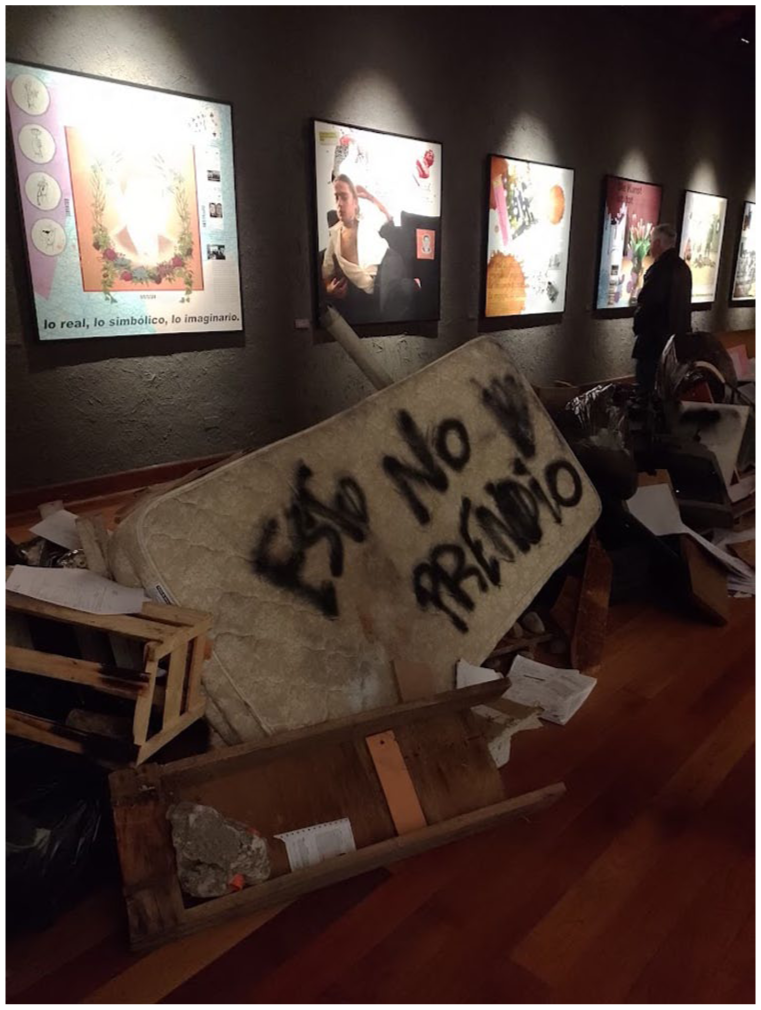
Arturo Duclos, Una Vida (2024).
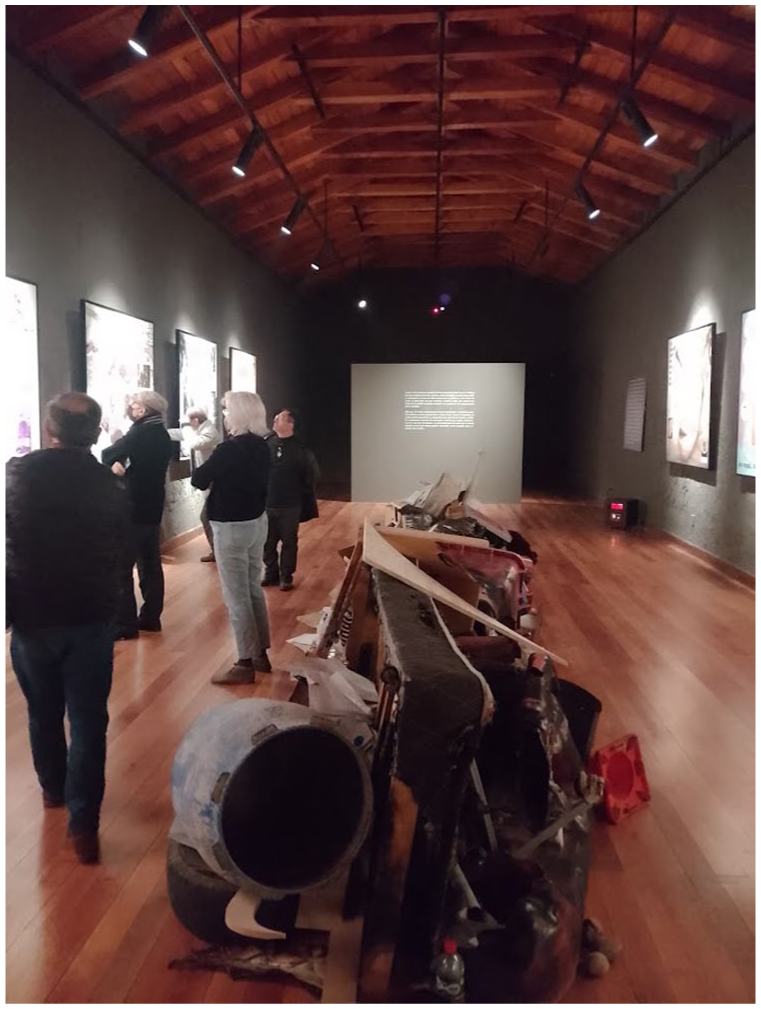
Arturo Duclos, Una Vida (2024).
For those who took part in the demonstrations, entering this monumental space was like being back in the streets again, near the barricades, hearing the shots of tear gas and rubber bullets. For those who had never attended the protests in person, the exhibition’s ceremonial atmosphere produced the uneasy impression of being, however momentarily, inside a conflict zone staged anew. The making of this atmosphere began at the threshold of the exhibition. Upon entering the room, the viewer was first met by total darkness, permeated by the sounds of shouts, sirens, and tear-gas blasts. After crossing the wall that separated the exhibition entrance from the gallery, the first image to emerge from the darkness was the installation occupying the whole room: a barricade, perfectly ordered and arranged.
It was impossible to cross the room without encountering the installation/barricade at every moment. Whenever visitors attempted to take photos or to stand in a position from which to view one of the collages, they were forced to engage with the barricade. To confront the barricade visually meant encountering the shields bearing “1312” (ACAB — All Cops Are Bastards), which were permanently fused with the figure of the “primera línea” (frontline), those who faced off against the police in an effort to protect the protesters. The mattress on which the graffiti “Esto no prendió” (roughly, “this didn’t take off”) is read inserts irony into this set of symbolic elements of an imminent struggle. The phrase painted on the mattress was originally spoken by the former president of Santiago Metro, Clemente Pérez, at the beginning of the protests, when, seeking to downplay the effect of the student protests on the Santiago Metro (the spark of the uprising), he remarked on a television program, “Guys, this isn’t taking off.” In response to his statement, massive protests erupted across the city and, ultimately, throughout the country (Ribeiro Cavalcanti, 2024).
The exhibition ends with a video projected in the room’s last section. No clear images are visible in it, and no figures can be made out; only the intense motion of people running and shouting, bombs detonating, sirens wailing—an immense, disordered mass of sound and image—can be perceived. On the ground, a sea of stones scattered in all directions recalls the street-level confrontations between protesters and police. In an instant, the viewer is once again plunged into the turmoil of the protests: a maelstrom of tear gas, smoke, gunfire, and cries. The sound from the video spills into the rest of the room, giving the exhibition an even more transdisciplinary character and making it impossible to feel at ease or indifferent to what is happening. Duclos brings us to experience memory as sensation, not simply as image. To feel it there, pulsing, alive, unfolding as we breathe.
By reconstructing the materials and atmosphere of the uprising, the artist did more than recover its memory: he brought the protest back to life, reviving it and reactivating its emotional force within the exhibition space, which ultimately provoked deep rejection among those who believed they had won the battle over the memory of “Octoberism.” In the next section, we will reflect on how cultural battles are likewise waged within the museum space, the quintessential site of ideological contestation over memory and history, drawing on the criticisms directed by Chile’s leading media conglomerate, known for its conservative profile, against the management and role of the Museo Nacional de Bellas Artes (National Museum of Fine Arts, MNBA).
Controversy Surrounding The Museo Nacional De Bellas Artes
In this section, we examine how the post-uprising cultural battles have shaped debates over the role of public museums in Chile, five years after the demonstrations. Accordingly, we examine the controversies that arose in 2024 surrounding the Museo Nacional de Bellas Artes, beginning with the critical commentary on the exhibition Struggles for Art. Map of relations and disputes over the hegemony of art (1843–1933). These controversies clearly illustrate the different competing conceptions of art institutions: museologies staged as spectacle, confronting nineteenth-century visions of art with more critical and contemporary conceptions of the museum that present the history of art and cultural institutions from feminist and decolonial perspectives. We detail the controversies that circulated predominantly in hegemonic news media, showing the conflictual dimension of museums, where different representations of art and narratives of the nation are brought into confrontation, as an echo of the political debates surrounding the October protests.
The debates and discussions around the Struggles for Art exhibit were largely concentrated between April and August 2024, driven primarily by the El Mercurio media group. 3 At the time of writing, the print version of this newspaper had published 17 letters to the editor, two opinion columns, one editorial, one interview, three news pieces, and one report on the subject; meanwhile, emol.cl had published seven news pieces and one video interview; and La Segunda had published two news pieces. While the debate was concentrated chiefly within this media group, it also appeared in the digital outlets Ex- Ante, El Líbero, El Mostrador, Diario Usach, Artishock, El País, and La Tercera, as well as on Radio U. de Chile and Tele13 Radio.
Struggles for Art is described as “the first conceptual proposal for imagining the new permanent narrative of the Museo Nacional de Bellas Artes, from the institutional triad of institutionality, teaching, and writing” (MNBA, 2022). In it, curators Gloria Cortés and Eva Cancino proposed a museography structured as a concept map, given this arrangement’s capacity for expansion and for problematizing new questions in order to think through the relations between art and society:
The works were installed at a low height, without distance, and with their frames almost entirely omitted, as a web of relations. In this configuration, the pieces appear without the informational and decorative filter that frames can introduce, prompting visitors to read them comparatively and reflectively, in dialogue with the abundant quotations distributed across the walls (MNBA, 2022).
The exhibition drew criticism from multiple actors, each emphasizing different issues: from the removal of the paintings’ frames to the framing of mediation practices, as well as objections to the museum’s administration. One example appears in an article in La Segunda, where artist Pablo Chiuminatto remarked: “in order to propose a curatorial program, the frames of the collection’s paintings were taken apart and rearranged alongside diagrams meant to explain ‘the struggles of art’” (La Segunda, 2024); whereas on Emol TV, Pablo Dittborn (2024) specified that: “apatronados 4 was not my idea; it was conservative, traditional [. . .]. The idea was that a bureaucratic decision had been made that affected an artwork, and that reveals a combination of ignorance and hubris [. . .], which is also bad management.”
On 24 April 2024, Chiuminatto once again clarified his remarks regarding the removal of the frames on the website El Mostrador, and in the newspapers La Tercera and El Mercurio. Three months later, the debate returned to the public agenda when a grandson of the painter Camilo Mori 5 submitted a letter to the editor in El Mercurio entitled “Denigration of Works at Bellas Artes.” There, Matías Mori commented the arrangement of his grandfather’s work in the exhibition Struggles for Art: “My grandfather’s works must not be exhibited outside the frames in which they were donated to the MNBA, nor should they be used as contextual justification for establishing the curatorial exhibition’s ideological purpose” (Mori, 2024).
From this publication onward, and over the span of a month, different media outlets devoted attention to the museographic and curatorial debate which, as in this letter, rapidly turned into criticism of the museum’s administration and programming, alongside accusations of a supposed process of indoctrination under the leadership of director Varinia Brodsky. Initially, the criticisms were directed at matters such as the placement of the artworks, the removal of their frames, and the material used for the exhibition labels (which were more informal than usual). Moreover, the curators were criticized for their stated intention to question classical historiography and to advance this search for a new curatorial narrative (Mori, 2024; Tamblay, 2024; Cereceda, 2024a; Ramírez, 2024). El Mercurio further frames the matter as controversial by publishing a report titled “At the Bellas Artes:” Controversy reemerges over the curatorial framing of an exhibition” (Ramírez, 2024). Nevertheless, at that stage, the dispute had taken place solely in this newspaper, in the form of three letters to the editor, one of which defended the museum.
After an official statement from the museum (MNBA, 2024), detailing the extensive research and conservation efforts behind the exhibition proposal—situated within the framework of critical museology— the letter to the editor by historian Josefina Tocornal shifted the debate in another direction, one directly tied to the issue of cultural battles: the programming and the role that the Museo Nacional de Bellas Artes ought to play in society.
That week, in a lengthy Sunday report entitled “The Crossroads of the Museo Nacional de Bellas Artes,” El Mercurio asked eight experts, including Tocornal, how the national heritage collection of Chilean painting should be displayed. Within this discussion, several critiques emerge concerning the MNBA’s administration and programming. Above all, the specialists consulted agree on the need to establish a permanent curatorial narrative with an emphasis on Chilean painting and sculpture up to the mid-twentieth century. Moreover, they argue that the museum’s exhibitions should be legible to all kinds of audiences, suggesting that, at present, they are geared toward a specialized public. Such critiques disclose a strong anti-intellectual component, a view of art confined to entertainment, and an understanding of mediation as nothing more than information transfer.
Two days later, the deputy editor of El Mercurio’s Arts and Letters section, Elena Irarrázabal, published a column that reframed the debate and resonated within the political sphere. In the column “A classist, racist, and sexist museum,” the journalist recounts her experience of visiting the museum and reproduces an unverified script used by a docent to welcome a group of young visitors:
“This is the museum, politically speaking. Historically, it is a racist, classist, and sexist museum," is one of the final phrases of this "welcome" to the museum [. . .]. And I wonder, with regret, whether it is necessary to receive visitors to the MNBA —among whom there are many children and young people— with such a divisive and political perspective. Each individual is free to develop their own opinions, yet it is difficult to comprehend, in a national museum, a statement that provides very little historical context and displays little appreciation for those who preceded us and who, through great effort, succeeded in creating this space for culture [. . .]. We must not keep fostering, from the State and from our cultural institutions, refoundational and polarized outlooks that left the country standing on the edge of the abyss. No more, please (Irarrázabal, 2024).
As can be seen, Elena Irarrázabal’s critique contains a political judgment, since she argues that this mediator’s script serves to divide Chilean society. She evokes the social uprising when referring to those “foundational and polarized visions that left the country on the brink of the abyss.” Furthermore, she issues a call for this not to occur from within a national space of state dependence, aligning herself with a conception of the museum as a neutral space.
Following this column, assembly representatives from right-wing parties summoned the Minister of Cultures to clarify whether the docent’s statement corresponded to an institutional guideline or to a personal opinion. Two letters to the editor escalated the accusatory tone articulated in the column. In both letters, readers infer a discourse of indoctrination on the part of the museum and argue that its management should be reviewed at both the leadership and staff levels. They allude to a series of labels that were attached to the social uprising, such as “sectarianism” or “decadence.” Two days later, on August 8, 2024, El Mercurio published an editorial offering an interpretation of events to date. Although at first the newspaper acknowledges the controversy and the diversity of opinions surrounding the museography, it then suggests that those who visited the museum had verified “something more than a mere curatorial intention,” and that, for specialists, the central concern relates to “the educational function, which, far from being fulfilled, appears to be being sabotaged by the museum’s own guides” (El Mercurio, 2024). In the following paragraph, the newspaper generalizes Irarrázabal’s particular experience and compares the docent’s claims—that the museum is a sexist, classist, and racist space—with the positions that intensified during the period of Chile’s Constitutional Convention.
In this way, El Mercurio links the MNBA’s discursive stance to the failed constitutional project of 2022. Similarly, and more explicitly, the online news site Ex-Ante ran a report (Soto, 2024) titled “Museo de Bellas Artes Faces More Criticism over the Octoberist Bias of Its Exhibitions,” alluding to the slogans that emerged in October 2019. The publication frames the social outburst through the space the museum educator grants to the vindication of minority claims.
[. . .] [T]hose who have listened to the guides bear witness to a political impulse that is almost entirely contrary to the museum’s own objectives. They depict it as a patriarchal institution, brought into being through European intervention in the country, and one that effectively demolished any manifestation of traditional culture [. . .]. There will scarcely be anyone left to defend these positions, which were intensified during the year of the Constitutional Convention but now seem to be receding into the past, into oblivion [. . .]. However, the notion of presenting a skewed perspective in order to reduce the museum’s value is wholly contradictory to the mission that a National Museum of Fine Arts ought to uphold (El Mercurio, 2024).
By contrast, on the same day the editorial was published, the newspaper El Mercurio also printed the letter to the editor “In Defense of the MNBA’s Museum Management,” in which thirty-seven specialists linked to the visual arts in Chile, Latin America, and Spain—including National Prize recipients Alfredo Jaar, Cecilia Vicuña, Paz Errázuriz, and Gonzalo Díaz – expressed concern about the direction the debate was taking, which they considered dismissive and insufficiently informed regarding Brodsky’s management. The letter argues that critical interventions in collections are a common practice in European museums such as the Museo Nacional Thyssen-Bornemisza, the Museo del Prado, the Museo Reina Sofía in Madrid, the MACBA in Barcelona, and the Museo delle Civiltà in Rome; as well as in Latin American museums such as the Museo de Arte Carrillo Gil and the MUAC in Mexico City, and the MASP in São Paulo. It further adds that “the most recent editions of [. . .] the Venice and São Paulo biennials have been expressly conceived around anything but timid revisions of the canons that prevailed throughout the last century” (Various authors, 2024). Likewise, the following day, ten scholars from the Faculty of Arts at the University of Chile published a letter to the editor in El Mercurio praising the director’s management and the curatorial exercises that put pressure on hegemonic narratives, such as the exhibition Struggles for Art. At the same time, in La Tercera, Chilean artist Cecilia Vicuña—winner of the Golden Lion at the Venice Biennale—published a column asserting that the MNBA’s leadership was in step with leading museums worldwide, such as Tate in London and the MoMA in New York.
This overview of the debate demonstrates how El Mercurio constructed and enlarged a conflict by presenting itself as a neutral news outlet that offers a platform for the grievances of “others,” adopting a purportedly objective stance while at the same time siding with those it identifies as majorities. The newspaper’s initial strategy was to reproduce El Mercurio’s letters to the editor—available only through paid access—and republish them within its own framing on the free Emol portal, thus transforming the letters into news items accessible to anyone with an internet connection (Cereceda, 2024a, 2024b, 2024c).
Second, through different formats—letters, feature reports, interviews—an emblematic newspaper of the hegemonic press raised the deeper question of what a museum ought to be, via its Arts and Letters section. Two descendants of Chilean artists whose works are part of the collection took part in the debate (Ramírez, 2024). For this media outlet, it was deemed relevant to solicit the views of these individuals, both as heirs to the moral rights over the works and as representatives of an artistic lineage—an arrangement characteristic of Chilean elites seeking to preserve the status quo. The discourse gradually took shape through increasingly articulated columns that fuse the museum’s current curatorial guidelines with the social uprising. Artists and specialists came out in defense of the museum and its curatorial choices, situating the exhibitions within a global and contemporary perspective on art. Finally, a right-wing leader proposed that the MNBA certify its exhibition itinerary in order to keep the contents of the exhibitions under surveillance.
Behind the criticisms of the museography and the curatorial approach deemed “revisionist” in Struggles for Art lay a concern—and a rejection—of the MNBA’s departure from a nineteenth-century conception of the museum (Tamblay, 2024; Ramírez, 2024), posing it instead as a neutral and ostensibly depoliticized space, distant from social conflict. In this view, the museum emerged as a transparent institution, without ideology or discourse, oriented toward educating new generations who are to be socialized with minimal questioning through the great works canonized by the oligarchic sectors of society.
This debate shows how post-social-outburst discourses that associate it with violence have become present within museum institutions, all the more so when these are public institutions with national reach, as is the case of the Museo Nacional de Bellas Artes. Here, the civilization/barbarism opposition is invoked to place critical museology on the side of octuberism, thereby invalidating any possibility of revisiting art history, as well as the foundations of the colonial and patriarchal social order that underlie it. In this way, the critical discourses and practices associated with decolonial or feminist museology are set against an imaginary of order and neutrality in art—a harmony sustained by the dominant classes, in which social hierarchies and inequalities are rendered invisible even as they are deepened.
Final Reflections
The two cases analyzed demonstrate how post-social-uprising hegemonic discourses have circulated in different ways across the spaces of artistic practice and within its institutions, through exhibitions that re-stage the atmosphere of the uprising, such as Duclos’s, or through the controversies that emerged around the MNBA, extensively discussed in the final section. In each case, it becomes clear that both interventions in public space and art institutions contributed to the intensification of political debate, through the controversy generated within institutional settings such as exhibitions and museums. In every instance, the actors involved were artists or institutional agents of the art world—museum directors, curators, journalists, and public policy figures—who participate in a space where contested memories are produced.
In fact, since the resounding defeat of the draft constitution that followed the October mobilizations, a harsh narrative has been constructed around the legacy of protest, repeatedly narrowed in hegemonic media to violence and delinquency, division and barbarism. This discourse has been forcefully installed and naturalized in the public agenda.
In this sense, the task of identifying new cases that may enrich this present reflection, with the aim of promoting a plural understanding of heritage and memory, responds to the question of which social sectors have the right to be represented and form part of a nation’s cultural legacy. We argue that memory and heritage are spaces under ongoing construction, and that art, as well as the institutional debates it provokes, can help to reframe the recent past in ways that are more plural and inclusive.
Footnotes

Notes
Raíza Ribeiro Cavalcanti is an Asistent Professor in the Department of Visual Arts, Faculty of Arts, University of Chile and co-coordinator of the Cultural Policy and Management Research Group. Marisol Facuse Muñoz is an Associate Professor in the Department of Sociology, Faculty of Social Sciences, University of Chile (FACSO, University of Chile) and Coordinator of the Sociology of Art and Cultural Practices Research Group. Lía Alvear is a cultural journalist from the University of Santiago de Chile. Mathieu Corp is an Associate Professor at Aix-Marseille University since September 2020. Heather Hayes is a translator living in Quito, Ecuador.