







Abstract
Monomeric compounds that protect against ultraviolet (UV) exposure, e.g. 2-hydroxy-4-acryloyloxybenzophenone (HABP), 2-[3-(2H-benzotriazol-2-yl)-4-hydroxyphenyl]ethyl methacrylate (BTEM), and 4-acryloyloxy-1,2,2,6,6-pentamethylpiperidine (APMP), were used as UV stabilizers for unsaturated polyester-based bulk molding compounds (BMCs). HABP and APMP were synthesized by reacting acryloyl chloride with 2,4-dihydro-xybenzophenone and 1,2,2,6,6-pentamethyl-4-piperidinol, respectively. The molded BMC samples were obtained using actual formulations containing these UV stabilizers, and the UV stability of the samples was estimated using a color difference meter. The results showed that HABP and BTEM afforded good protection against UV light, and these compounds showed a synergistic effect. APMP also showed a synergistic effect, but only when a small amount of the compound was used. These results were compared with the results obtained when copolymers of HABP and BTEM were used as UV stabilizers. The results showed that the polymerizable UV stabilizers demonstrated better protection against UV exposure, when they were added directly to the formulation of BMC, compared to the addition of copolymers as UV stabilizers.
Introduction
After prolonged use, the colors of polymeric materials change or small cracks are formed on the surface by the effects of light energy, resulting in a slow change in their original shape. These phenomena result from a process of oxidative degradation. Ultraviolet (UV) light generates free radicals from the chemical bonds in the polymer, and these free radicals produce color change, cracking, and degraded physical properties by breaking chemical bonds. UV stabilizers are used as additives to reduce the degradation process. If a polymeric material is to be used in outdoors, a UV stabilizer must be added to the polymeric material to block or reduce photochemical reactions. Among such representative organic UV stabilizers are compounds of the 2-hydroxybenzophenone series, the 2-(2-hydroxyphenyl)-2H-benzotriazole series, and the hindered amine light stabilizers. 1 –5
Bulk molding compounds (BMCs) are used in electrical equipment and construction materials due to their superior physical properties. Unsaturated polyester resins are used as a base resin, and styrene is used as the monomeric compound in BMCs, and also inorganic fillers, fiber reinforcement materials, and pigments are used in BMCs. Until now, BMCs have usually been used indoors, but the amount of use in outdoor environments is increasing. The outdoor use of a BMC requires the addition of a UV stabilizer. The most widely used UV stabilizers are low-molecular-weight compounds, but when a BMC material containing the generally used UV stabilizers is used outdoors for a long period of time, some patterned shapes may appear at the surface. This occurs because a low-molecular-weight UV stabilizer can move and gather, producing a phase separation phenomenon. To solve this problem, many studies have been conducted to develop polymeric UV stabilizers containing other polymeric materials. These polymeric UV stabilizers were synthesized from the polymerizable UV stabilizer. 6 –13
In the BMC system, a cross-linking reaction between unsaturated polyester resins and styrene was conducted during the final molding process. Therefore, we prepared several polymerizable UV stabilizers, added these compounds to the BMC formulation, and then tested the UV stability of the molded BMC samples.
Experimental
Materials and instruments
2,4-Dihydroxybenzophenone, 1,2,2,6,6,-pentamethyl-4-piperidinol, 2-[3-(2H-benzotriazol-2-yl)-4-hydroxyphenyl]ethyl methacrylate (BTEM), acryloyl chloride, and 2,2′-azobis(isobutyronitrile) (AIBN) were obtained from Aldrich Chemical and used as received. MP 712 (Sewon Chemical, Daejon, Korea) was used as an unsaturated polyester resin and contained a 40 wt% of styrene. L-01 (Sewon Chemical, Daejon, Korea) was used as a low-profile additive and was formed from polystyrene. Aluminum hydroxide (H32, Showa Denko Tokyo, Japan) was used as an inorganic filler. Alkenox t-butyl peroxybenzoate (TBPB, Empions, Ulsan, Korea) was used as a curing initiator. Titanium dioxide(Ti-pure R-902, DuPont, Wilmington, DE, USA) was used as a mineral pigment. Zinc stearate (Hi-Flow, Shinwon Chemical, Siheung, Korea) was used as an internal release agent. 101C-BMC (Owens Corning, Seoul, Korea) was used as a glass fiber, and the length of the glass fiber was 6 mm.
Infrared (IR) spectroscopy was performed using an FT-IR 680 spectrometer (Jasco International, Tokyo, Japan), nuclear magnetic resonance (NMR) was performed using a DPX 300 NMR spectrometer (Bruker, Madison, WI, USA), and elemental analysis was performed using an EA 1110 elemental analyzer (CE Instruments, Wigan, UK). Multy Cure 1000 (Jeil UV, Siheung, Korea) was used as a UV reactor for estimating UV stability, and a Konica Minolta spectrophotometer CM-2500d (Konica Minolta, Osaka, Japan) was used as a color difference meter to estimate stability under UV light. Molding was conducted using a 50-ton oil pressure press (Woosung Oil Pressure, Gyeongnam, Korea). The molder was manufactured by Nexgem (Cheongju, Korea).
Synthesis of HABP
The compound 2,4-dihydroxybenzophenone (21.4 g, 0.10 mol) was dissolved in 100 mL of 4% sodium hydroxide in a 500-mL three-necked round-bottomed flask. Then, 8.10 mL (0.10 mol) of acryloyl chloride in 50 mL of toluene was added dropwise to the above solution for 30 min with continuous stirring. Following the dropwise addition, the reaction was continued for 3 h. The organic layer was separated using a separatory funnel and the water layer was extracted with 100 mL of toluene; this process was repeated two times. The toluene solvent in the gathered organic layer was evaporated in a rotary evaporator, and the obtained product was recrystallized in ethanol for two times. The obtained 2-hydroxy-4-acryloyloxybenzophenone (HABP; 20.9 g; yield, 77.9%) was dried under vacuum at 50°C for 24 h.
Elemental analysis: calculated; C 71.6%, H 4.51%, found; C 72.0%, H 4.77%.
IR data (cm−1): −OH 3300, carbonyl 1739, aromatic 1627, and 1500.
NMR data: 5.95–6.55, −CH=CH2, 3H; 6.67, 1H; 6.88, 1H; 7.45–7.70, 6H; 12.35, −OH, 1 H.
Synthesis of APMP
The compounds 1,2,2,6,6-pentamethyl-4-piperidinol (51.4 g, 0.30 mol) and triethylamine (41.8 mL, 0.30 mol) were mixed in 200 mL of toluene in a 500 mL of round-bottomed flask. Then, 24.4 mL of acryloyl chloride in 100 mL of toluene was added dropwise to the above solution for 30 min with stirring. Following the dropwise addition, the reaction was continued for 12 h. The brown colored precipitate formed was separated by filtration. Water was used to extract triethylamine hydrochloride from the precipitate, and the crude product was recrystallized using cyclohexane to produce 46.5 g (yield, 69.1%) of 4-acryloyloxy-1,2,2,6,6-pentamethylpiperidine (APMP).
Elemental analysis: calculated; C 69.6%, H 9.89%, N 6.25%, found; C 68.9%, H 10.1%, N 6.17%.
IR data (cm−1): carbonyl 1,710, C=C 1,635.
NMR data: 1.09, 3H; 1.15–1.21, 12H; 1.89, 4H; 5.84–6.35, vinyl, 3H.
Synthesis of copolymer of HABP and BTEM
For this most representative copolymerization reaction, 15.0 g (0.056 mol) of HABP and 35.0 g (0.108 mol) of BTEM were combined in a 500-mL round-bottomed flask and 200 mL of toluene was added as a solvent, and the AIBN (0.27 g, 1.64 mmol) was added as an initiator. The reaction was conducted at 80°C for 24 h under N2 gas. After the reaction was completed, the solvent was evaporated using a rotary evaporator and the unreacted monomers were extracted from the solution using a large volume of ethanol. The product was dried under vacuum at 50°C for 12 h, and 43.5 g (yield, 87.0%) of copolymer was obtained.
IR data (cm−1): –OH 3300, carbonyl 1740, aromatic 1630 and 1495.
Elemental analysis: calculated; C 68.3%, H 5.06%, N 9.09%, and found; C 68.3%, H 5.05%, N 8.96%.
Synthesis of copolymer of HABP, BTEM, and APMP
The copolymer was synthesized by the same method as described above.
For this most representative copolymerization method, HABP of 14.7 g (0.055 mol), BTEM of 34.3 g (0.106 mol), and APMP of 1.00 g (4.46 mmol) were polymerized in 200 mL of toluene with AIBN (0.27 g, 1.64 mmol) as an initiator. The reaction was conducted at 80°C for 24 h under N2 gas, and 43.1 g (yield, 82.2%) of copolymer was obtained.
IR data (cm−1): –OH 3310, carbonyl 1740, aromatic 1628 and 1495.
Elemental analysis: calculated; C 68.3%, H 5.16%, N 9.03%, found; C 68.1%, H 5.07%, N 8.78%.
Molding of BMC
The formulation of the BMC used in this research is shown in Table 1. After mixing the above materials, the molding process was conducted at 150°C under 15 MPa for 4 min. The size of the molded sample was 200 × 200 × 4 mm3.
Formulation of BMC.
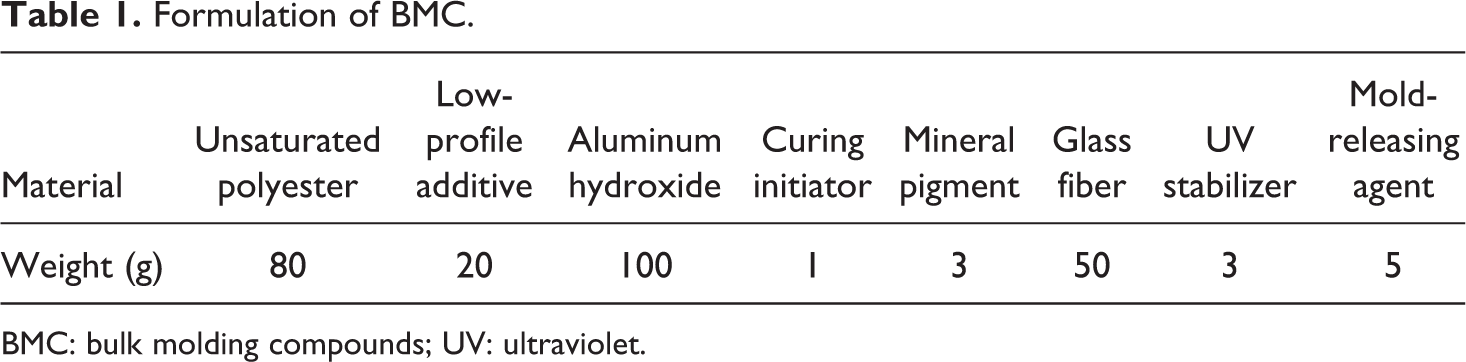
BMC: bulk molding compounds; UV: ultraviolet.
Test for UV protection
After formulation of the BMC with the contents shown in Table 1, the sample was prepared by molding. The UV stability of the molded sample was estimated by measuring the damage produced by UV irradiation. UV irradiation was conducted in a UV reactor (Multy Cure 1000, Jeil UV) containing a 1-kW UV bulb located 10 cm above the sample. After 10 min of irradiation, the damage was estimated by a color difference meter (Konica Minolta spectrophotometer CM-2500d), and the Y value was estimated to compare the damage caused by UV irradiation.
Results and discussion
Polymerizable UV stabilizers
During the BMC molding process, cross-linking reactions were conducted to the unsaturated polyester with styrene. Therefore, if the polymerizable UV stabilizer is added during this process, this cross-linking reaction is conducted together with the polymerization of this UV stabilizer. During the initial stage of this study, the copolymers of polymerizable UV stabilizers were synthesized and used as UV stabilizers. However, when these polymerizable UV stabilizers were directly added during the processing of BMC, a better UV stability was obtained. Subsequently, the method was changed by directly adding the monomer during the processing of the BMC. The polymerizable UV stabilizer in this research was either synthesized or purchased, and the structures of these UV stabilizers are shown in Figure 1.
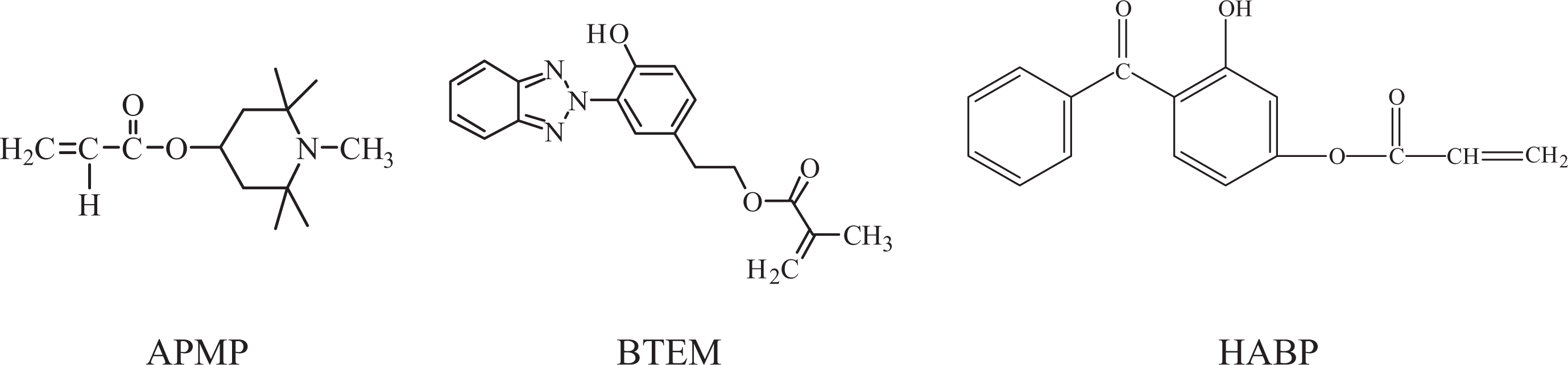
The chemical structures of the polymerizable ultraviolet stabilizers.
Estimation of UV stability of BMC
The UV stability of a BMC was estimated by measuring the damage to the molded BMC sample after UV irradiation. The Y value of the color difference meter (Konica Minolta spectrophotometer CM-2500d) was recorded. The UV stability test was conducted using both the original BMC that did not contain the UV stabilizer and the BMC that contained 3.0 wt% of the UV stabilizer. A 3.0 wt% means the BMC contained 3.0 g of UV stabilizer for every 100 g of resin. Both HABP and BTEM were used as polymerizable UV stabilizers. The total amount of UV stabilizer was 3.0 wt%. The results are shown in Table 2.
Y value of BMC samples containing UV stabilizer (HABP and BTEM) after UV treatment.
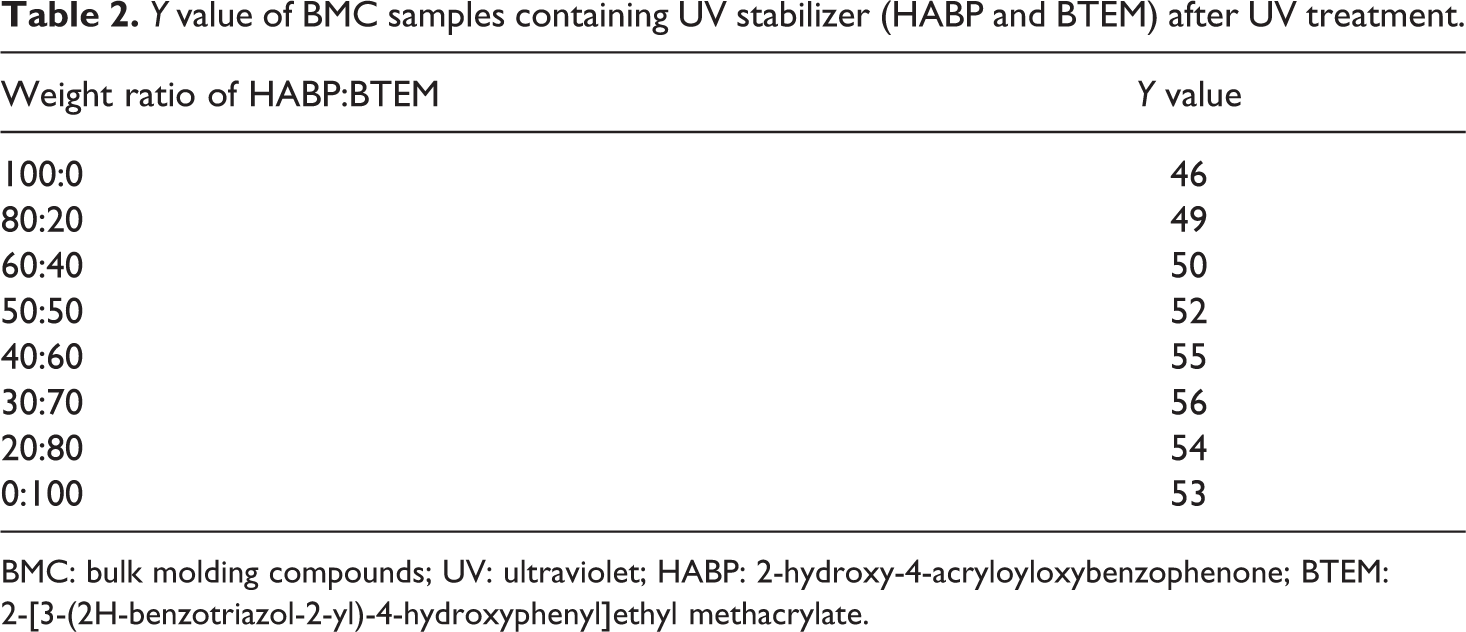
BMC: bulk molding compounds; UV: ultraviolet; HABP: 2-hydroxy-4-acryloyloxybenzophenone; BTEM: 2-[3-(2H-benzotriazol-2-yl)-4-hydroxyphenyl]ethyl methacrylate.
For the original BMC that did not contain a UV stabilizer, the Y values were 68 before UV irradiation and 21 after UV irradiation. Data shown in Table 2, comparing the results of using only HABP with the results of using only BTEM, show that BTEM produced the higher Y value. This means that BTEM produces a better UV stability than HABP. When both these compounds were used together, a synergistic effect was shown for UV stability. The best result was obtained when the ratio of HABP:BTEM was 30:70. Because HABP and BTEM have different mechanisms for UV protection, a synergistic effect was shown when both the compounds were used together. UV stability of the BMC molding samples was also estimated when all three compounds (HABP, BTEM, and APMP) were used together. Because the best result was shown when the ratio of HABP:BTEM was 30:70 (as in Table 2), the ratio of HABP:BTEM in this experiment was set at 30:70, and the amount of APMP was changed. The results are shown in Table 3.
Y value of BMC samples containing UV stabilizer (HABP, BTEM, and APMP) after UV treatment.
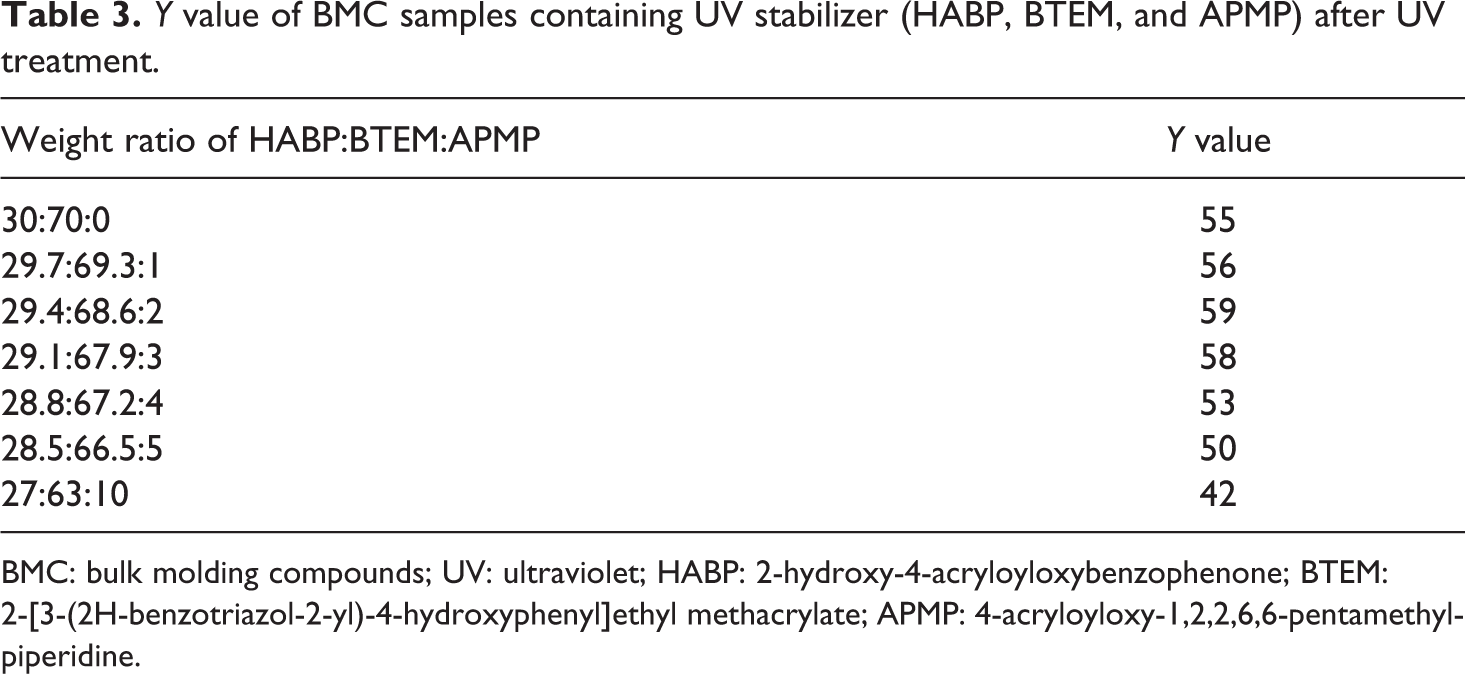
BMC: bulk molding compounds; UV: ultraviolet; HABP: 2-hydroxy-4-acryloyloxybenzophenone; BTEM: 2-[3-(2H-benzotriazol-2-yl)-4-hydroxyphenyl]ethyl methacrylate; APMP: 4-acryloyloxy-1,2,2,6,6-pentamethyl-piperidine.
When a large amount of APMP was used, the UV protection ability was decreased. However, when only a small amount of APMP was used, the synergistic effect was demonstrated. Table 3 shows that the best result was obtained when a 2-wt% of APMP was used in the mixture of UV stabilizers. If the amount of APMP was >2%, the stability of BMC was reduced. When a 10% amount of APMP was added, the Y value decreased to 42. In conclusion, a small amount of APMP must be used to obtain good UV stability and to show a synergistic effect. However, when a large amount of APMP was added, APMP interrupted the UV stability of the other two compounds. The mechanism of this interrupting effect is currently being studied.
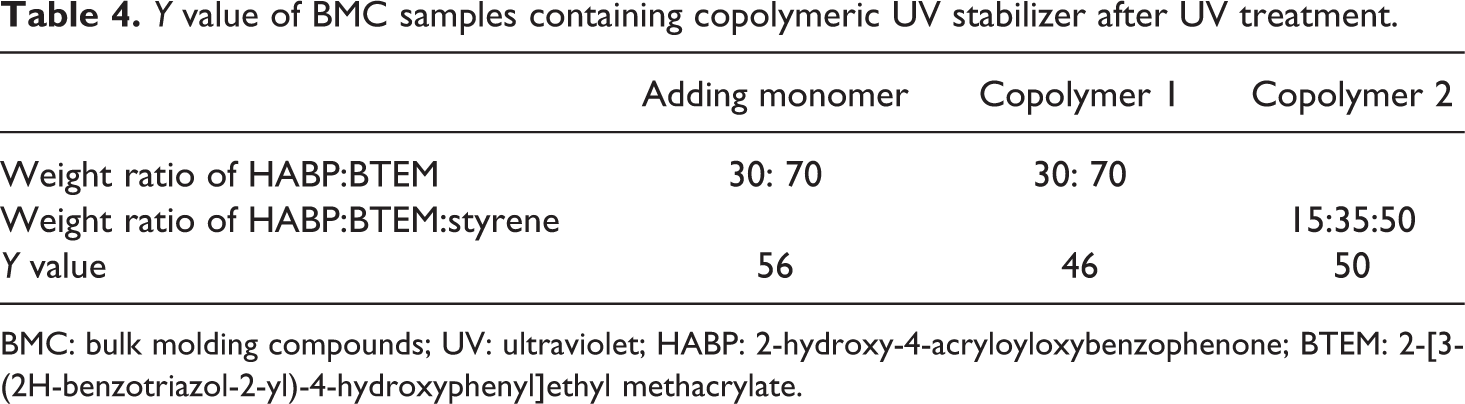
In the first stage of this research, the copolymers of the polymerizable UV stabilizers were used as the UV stabilizers in the formulation of BMC, and the UV stabilities were estimated. The representative results are shown in Table 4. In Table 4, copolymer 1 consists of HABP and BTEM (weight ratio of 30:70), and copolymer 2 consists of a copolymer of HABP, BTEM, and styrene (weight ratio of 15:35:50). In the case of copolymer 1, the amount of the copolymer 1 in the formulation is 3.0 wt% of the total amount of resin. In the case of copolymer 2, the amount of copolymer 2 in the formulation is 6.0 wt% of the total amount of resin, because the same amount of UV stabilizer must be used. These results were compared with the results in Table 2 and are shown in Table 4.
Y value of BMC samples containing copolymeric UV stabilizer after UV treatment.
BMC: bulk molding compounds; UV: ultraviolet; HABP: 2-hydroxy-4-acryloyloxybenzophenone; BTEM: 2-[3-(2H-benzotriazol-2-yl)-4-hydroxyphenyl]ethyl methacrylate.
During the synthesis of copolymer 1, the feed ratio (HABP:BTEM) was 0.056:0.108 mol. The ratio (HABP:BTEM) in the copolymer could be calculated from the ratio of C to N in an elemental analysis of copolymer 1. The results showed that copolymer 1 contained HABP and BTEM in a ratio of 0.056:0.103, which means that HABP is more polymerizable than BTEM. In the case of copolymer 2, it was very difficult to calculate the ratio (HABP:BTEM:styrene) using the data from elemental analysis.
Results in Table 4 indicate that the direct use of polymerizable UV stabilizers during BMC formulation produces better UV stability than when copolymeric UV stabilizers are used. Also, when comparing copolymers 1 and 2, copolymer 2 produced a better result than copolymer 1. Both copolymers 1 and 2 contained HABP and BTEM at the same ratio of 30:70, but copolymer 2 contained 50% styrene. The reason that copolymer 2 showed better UV stability than copolymer 1 appears to be that the styrene portion of copolymer 2 helped to mix copolymer 2 with the BMC resins.
Conclusions
In this study, three polymerizable UV stabilizers (HABP, BTEM, and APMP) were prepared, and these compounds were used during BMC formulation to increase the UV stability of molded BMCs. These compounds showed a synergistic effect for providing UV stability, and the best result was produced when using a ratio of HA-BP:BTEM:APMP = 29.4:68.6:2. When the copolymer of HABP and BTEM was used as a UV stabilizer, the UV stability was decreased compared with using HABP and BTEM directly.
Footnotes
Funding
This work was supported by the research grant of the Chungbuk National University in 2011.