






Abstract
The object of this work is to study and predict the tensile properties (tensile strength, elastic modulus, and elongation at break) of ternary nanocomposites based on epoxy/glass fiber/nanosilica using the fuzzy logic (FL). Two factors in three levels including glass fiber at 0, 5, and 10 wt% and nanosilica at 0, 0.5, and 1 wt% were chosen for adding to an epoxy matrix. From FL surfaces, it was found that the glass fiber content had a main role in the tensile properties of nanocomposites. The high levels of glass fiber content led to a significant increase in the elastic modulus and generally, the presence of glass fiber decreased the tensile strength and elongation at break. Also, addition of the nanosilica content resulted in an increased elastic modulus but decreased the elongation at break of nanocomposites. Finally, an FL model was obtained for each tensile property.
Introduction
The development of new polymeric materials by enhancing the tensile strength, hardness, toughness, and heat resistance is a major objective for both the academic and industrial community. 1 Using inorganic nanoparticles and fibers as composites and nanocomposites is one good way to improve the mechanical properties of polymeric materials. 2 The mechanical properties of composites are significantly related to the properties of their components, such as fiber, filler, and matrix, and the adhesion between them. 3 –5
Among polymeric materials, epoxy resins are widely used in industrial applications due to their high mechanical properties, adhesion and chemical resistance, and good solubility in a wide range of temperatures. 6 When compared with toughened epoxies with rubbers, the use of inorganic rigid fillers provides toughened epoxies without reducing the modulus. 7 In recent years, many researchers have focused on silicate nanocomposites 8,9 in thermoplastic or thermosetting matrices. 10 Mixing nanoscale silica particles with polymeric materials as polymer nanocomposites provides suitable mechanical properties compared to conventional organic and inorganic composites. 11 –14 On the other hand, composites reinforced with glass fibers are a type of engineering material that exhibited high modulus–weight and strength–weight ratios compared to some of the metallic materials. 15 Thus, the presence of both silica nanoparticles and glass fiber in the polymer matrix can lead to high mechanical properties, especially the elastic modulus.
The recent findings show that the mechanical properties of polymer nanocomposites improve by reinforcing them with glass fibers and silica nanoparticles. Yang et al. 16 reported that by adding silica nanoparticles to a polyamide 6 polymer matrix, the elastic modulus and strength increase. Bondioli et al. 1 observed that by adding silica nanoparticles of low-weight percentages to an epoxy matrix, the elastic modulus of the polymer significantly increases. Preghenella et al. 17 showed that by adding large quantities (about 30 phr) of silica nanoparticles to epoxy polymer matrices, their strain at break slightly increases, but their elastic modulus decreases. Kaushik et al. 18 reported that by adding 0, 2, 4, 6, 8, and 10 wt% short glass fibers to an epoxy polymer matrix, the tensile modulus increases significantly while the displacement at break decreases. Although many researchers have studied the mechanical properties of epoxy/long glass fibers with specific direction/filler particles composites, 15,19,20 the presence of both nanoparticles and short glass fibers in the polymer matrix is relatively new.
It is important to predict the mechanical properties of composites. To reach this goal, soft computing techniques like artificial neural networks, fuzzy rule–based systems (FRBSs), and evolutionary algorithms are used to model various nonlinear phenomena. Rules form the basis for the fuzzy logic (FL) to obtain the fuzzy output. The rule-based system is different from the expert system in the manner that the rule-based system originates from sources other than that of human experts and hence are different from the expert system. The rule-based form uses linguistic variables as its antecedents and consequents. The antecedents express an inference or inequality, which should be satisfied. The consequents are those that we can infer and are the output if the antecedent inequality is satisfied. The FRBS uses IF–THEN rule-based system, given by IF antecedent and THEN consequent. FRBSs have the following advantages: They can combine human knowledge as well as knowledge from numerical data obtained by observing the original phenomena. These models are described by fuzzy rules that are so explainable. Every fuzzy rule shows a local model that results in robustness and good estimation capability because the correction of each single parameter does not affect the global model. A suitable initial parameter set can be determined by human experts.
The main goal of the present work is to utilize FRBSs in a model and investigate the effects of parameters such as glass fiber at 0, 5, and 10 wt% and nanosilica at 0, 0.5, and 1 wt% on the tensile properties of epoxy/glass fiber/nanosilica ternary nanocomposites.
Experimental Materials
Epoxy (Eponate 503, density 1.17 g/cm3) and hardener (Eponate 565, density 0.920 g/ml) were supplied from Bitez Company, Turkey. The nanosilica (K-200, spherical shape with 7–40 nm average diameter and 0.005–0.1 g/cm3 density) was purchased from Keysu Industrial Co. Ltd, South Korea. In addition, glass fiber type A (Bolourin Tar Company, Iran), with 17–25 diameter and 3 mm length, was used as a fiber.
Sample preparation
For the primary mixing of samples consisting of epoxy resin, nanosilica, and glass fiber, mechanical stirring was used (3000 r/min) for 15 min at 80°C under a vacuum. Next, an ultrasonic homogenizer was used for 20 min for better dispersion of nanosilica powder in the epoxy resin. Then the compounds prepared by the ultrasonic homogenizer were poured manually into metal molds (with dimensions 2.5 × 25 × 3 mm3). Finally, the nanocomposites were first heated for 24 h at 30°C for curing and then for 4 h at 60°C for postcuring.
Characterization
The tensile properties were determined using a Zwick/Roell machine (model z100 series autograph UTM) at a crosshead speed of 5 mm/min, according to ISO 527-1. The morphology of the samples was studied by scanning electron microscopy (SEM) (model VEGA-II TESCAN, minimum resolution 10 nm at 30 kV and high vacuum mode with magnification 3x-500 kx) from the fracture surfaces of the samples. The samples were coated with a thin film (15 nm) of gold to avoid electrical charge accumulation during the examination and then analyzed at an accelerating voltage of 20 kV.
Fuzzy inference system
Fuzzy inference is the formulating procedure of mapping a specified input to an output by FL. The mapping prepares a base from which decisions can be made or patterns can be distinguished. The fuzzy inference procedure requires membership functions, FL operators, and if–then rules. Mamdani and Sugeno are the two types of fuzzy inference systems (FISs) in the FL toolbox. These two types of inference systems differ in the way the outputs are specified. The Mamdani-type fuzzy inference presents a fuzzy set output, while the Sugeno-type inference presents either a constant output or a linear mathematical expression. The most fundamental difference between these two types is the method by which the crisp output is generated from the fuzzy inputs. The Mamdani-type FIS applies the defuzzification technique to a fuzzy output, and the Sugeno-type FIS applies weighted average to calculate the crisp output. 21
In this work, the Sugeno-type FIS is used because the output results of the mechanical tensile tests were presented as numbers that in this case, the Sugeno type FIS shows the better analysis. For determining the tensile properties of nanocomposites using the Sugeno-type model, the initial steps are the same as in the Mamdani-type model. According to Table 1, the input glass fiber and nanosilica have three triangular membership functions in the range of 0–10 wt% and 0–1 wt%, respectively, as shown in Figures 1 and 2.
Rule base of the Sugeno-type FIS.
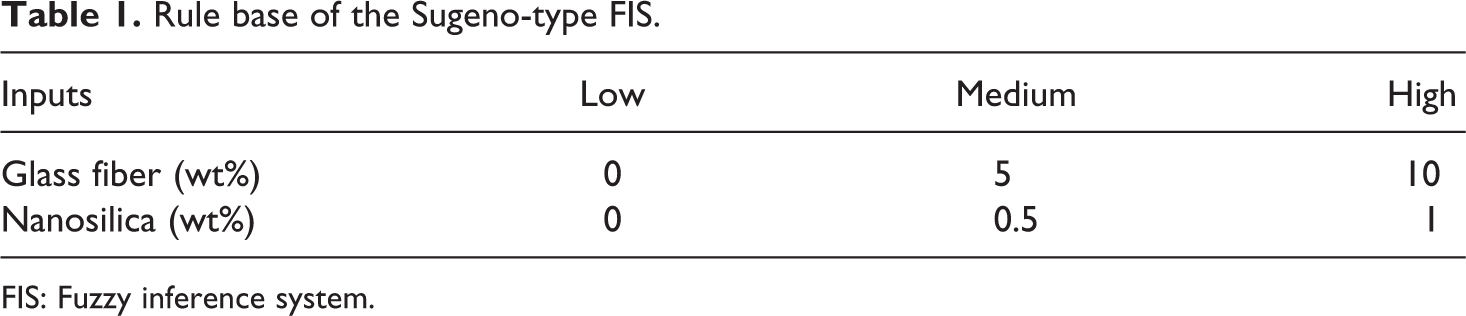
FIS: Fuzzy inference system.
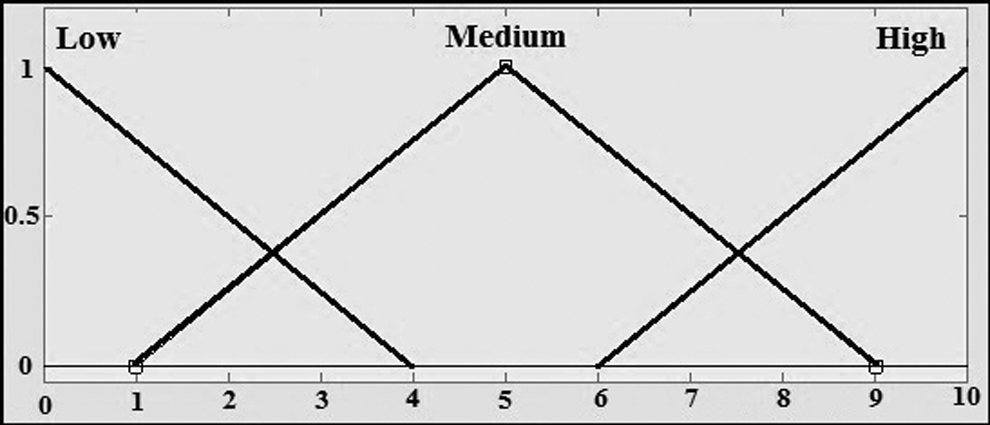
Glass fiber membership functions.
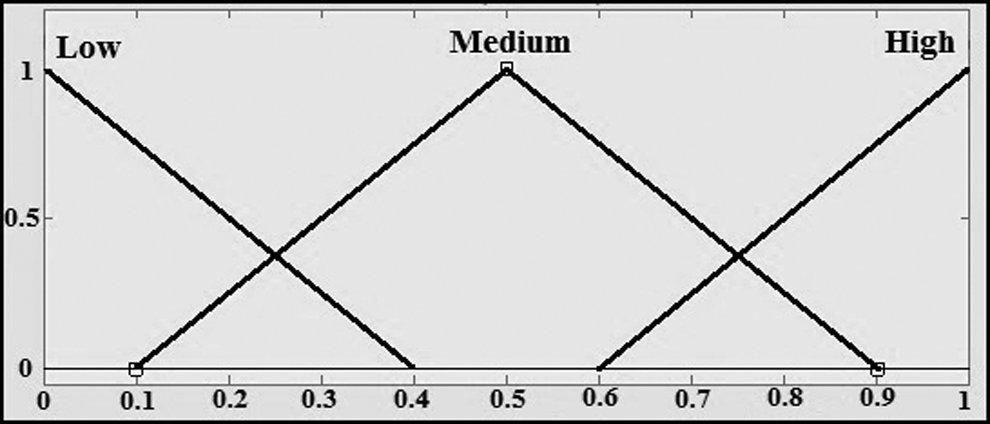
Nanosilica membership functions.
Since the output of the Sugeno-type model are as numbers, after extracting the tensile test results, the outputs were defined for the Sugeno-type as output functions and the fuzzy rules were written in nine different states, according to Table 2, for tensile strength, elastic modulus, and elongation at break, respectively.
The rules written for inputs and outputs in FRBSs.
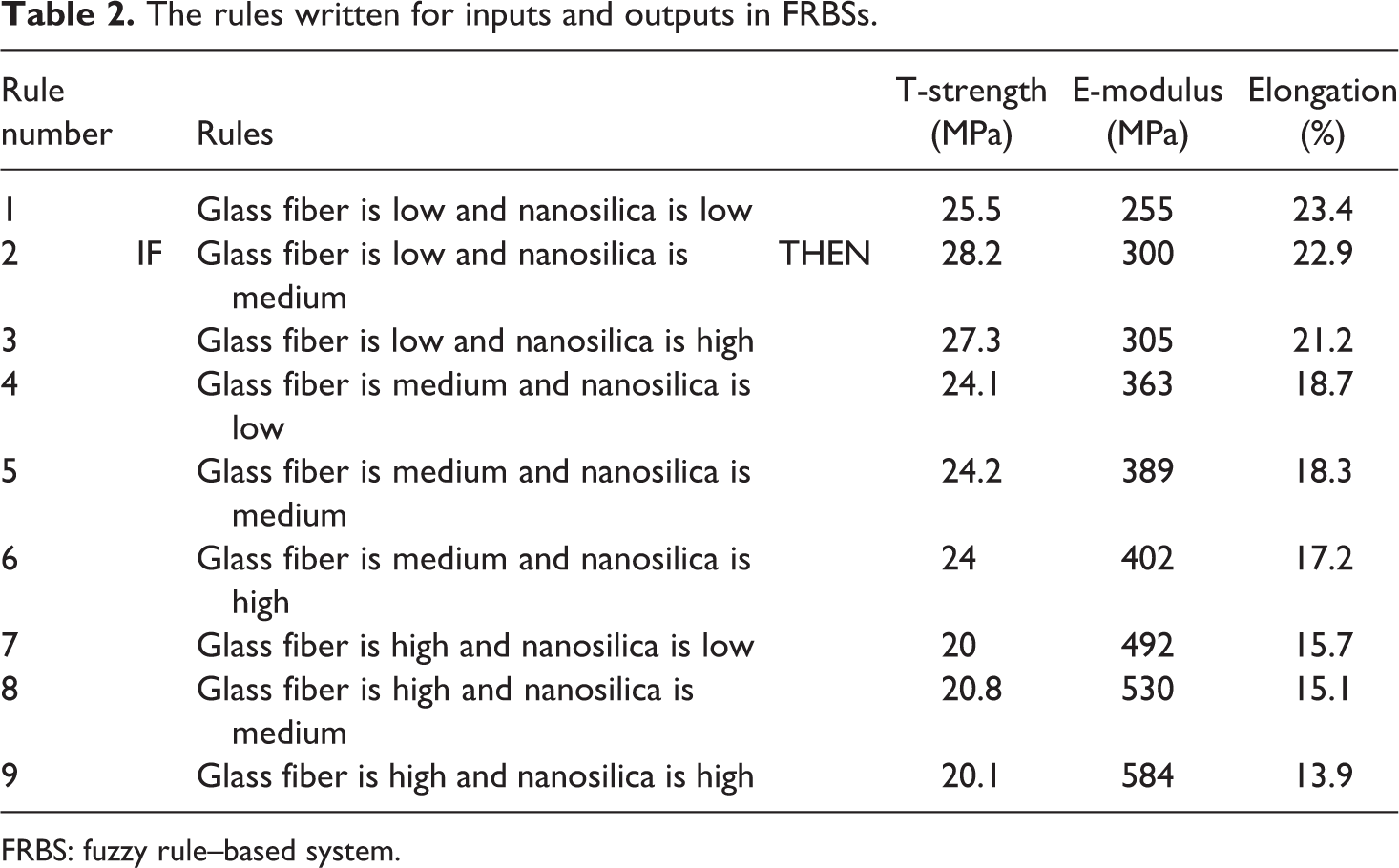
FRBS: fuzzy rule–based system.
Results and discussion
Effects of nanosilica and glass fiber on tensile properties
The FL shows the effect of input parameters (glass fiber and nano-silica) on output variables (tensile strength, elastic modulus and elongation at break). Therefore, the effects of nanosilica and glass fiber (as input parameters) on tensile strength, elastic modulus, and elongation at break (as output variables) using surfaces extracted from the FL are shown in Figure 3.
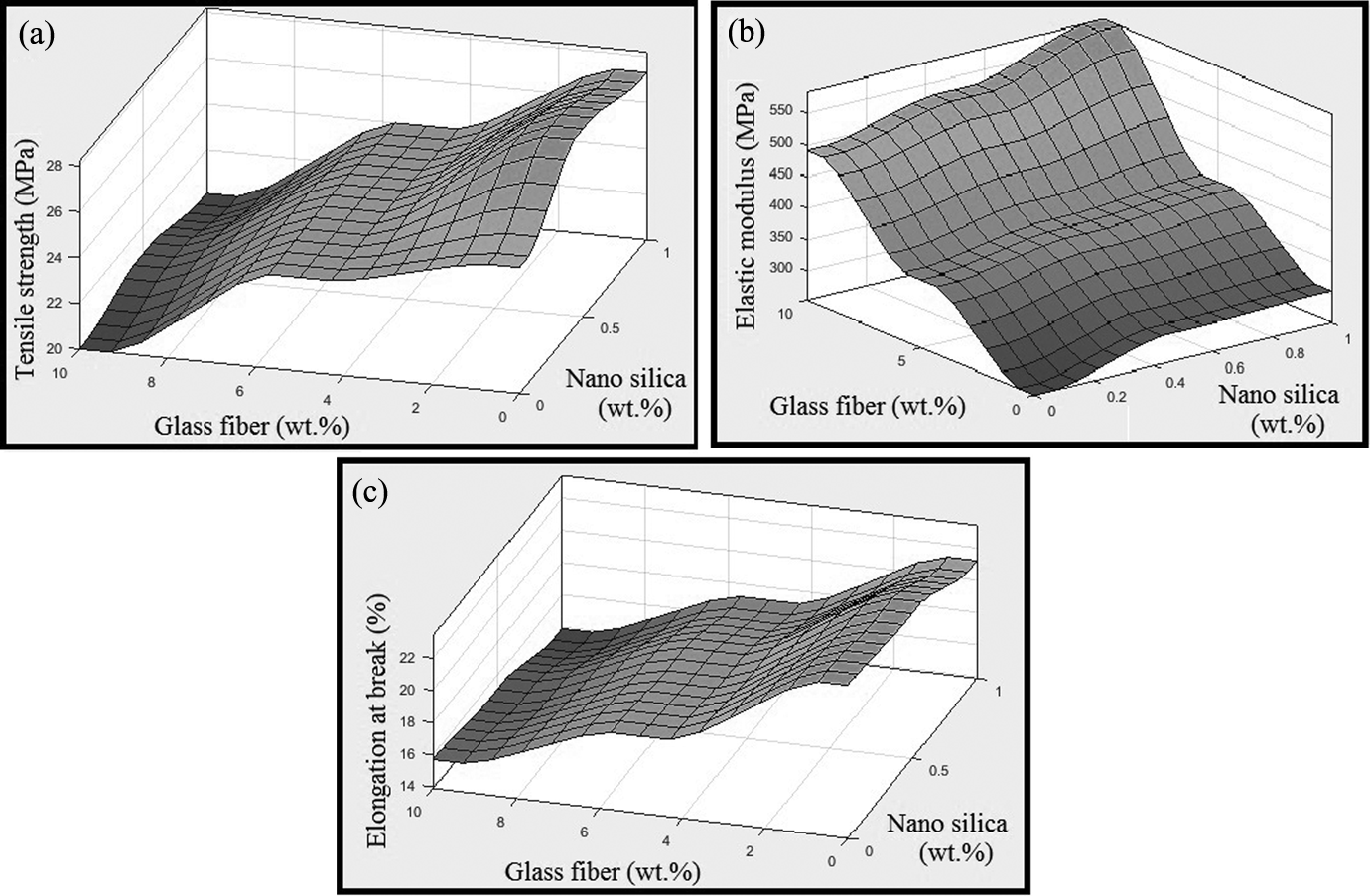
Surface of tensile properties versus nanosilica and glass fiber: (a) strength, (b) modulus, and (c) elongation.
It can be seen from Figure 3(a) that an increase in nanosilica from low to high levels first increases the tensile strength of nanocomposites and then decreases it slightly, while an increase in glass fiber decreases the tensile strength significantly. The tensile strength of nanocomposites demonstrated improvement because the nanosilica at a low level has good dispersion and interfacial adhesion to the matrix. 16 On the other hand, the lack of good adhesion between the glass fiber and the matrix and also the tendency of glass fiber to move out of the polymer matrix can lead to a significant reduction in tensile strength. 22 Figure 4 shows the SEM images from fracture surface of the samples including glass fiber. As can be seen from Figure 4, glass fiber does not have good adhesion to the polymer matrix. In Figure 4, the arrows indicate the areas related to the lack of adhesion between the fiber and the matrix.
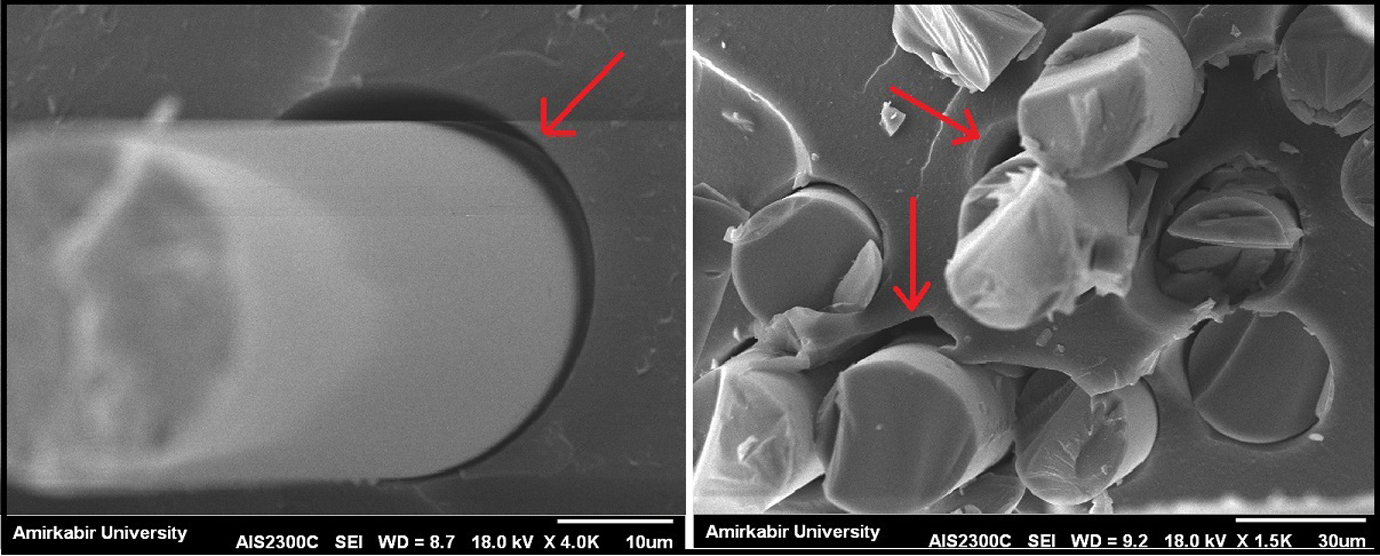
SEM images of fracture surface of the epoxy resin reinforced with glass fiber: 5 wt% (left) and 10 wt% (right). SEM: scanning electron microscopy.
According to Figure 3(b), an increase in nanosilica from low to high levels leads to an increased elastic modulus of nanocomposites, and an increase in glass fiber increases the elastic modulus significantly. It is obvious that the proper performance by the nanofillers can be achieved only when the homogeneous dispersion of nanofillers in a polymer matrix is realized. 23 Figure 5 shows the SEM images from fracture surface of the samples including nanosilica. As can be seen, an increase in the elastic modulus at low levels of nanosilica leads to a good dispersion of those particles in the polymer matrix. Bondioli et al. 1 reported that by adding nanosilica at low weight percentages to polymer matrices, the elastic modulus increases. Also, Figure 3(b) clearly shows that a very good interaction between the nanosilica and the glass fiber leads to a great increase in the elastic modulus of nanocomposites.
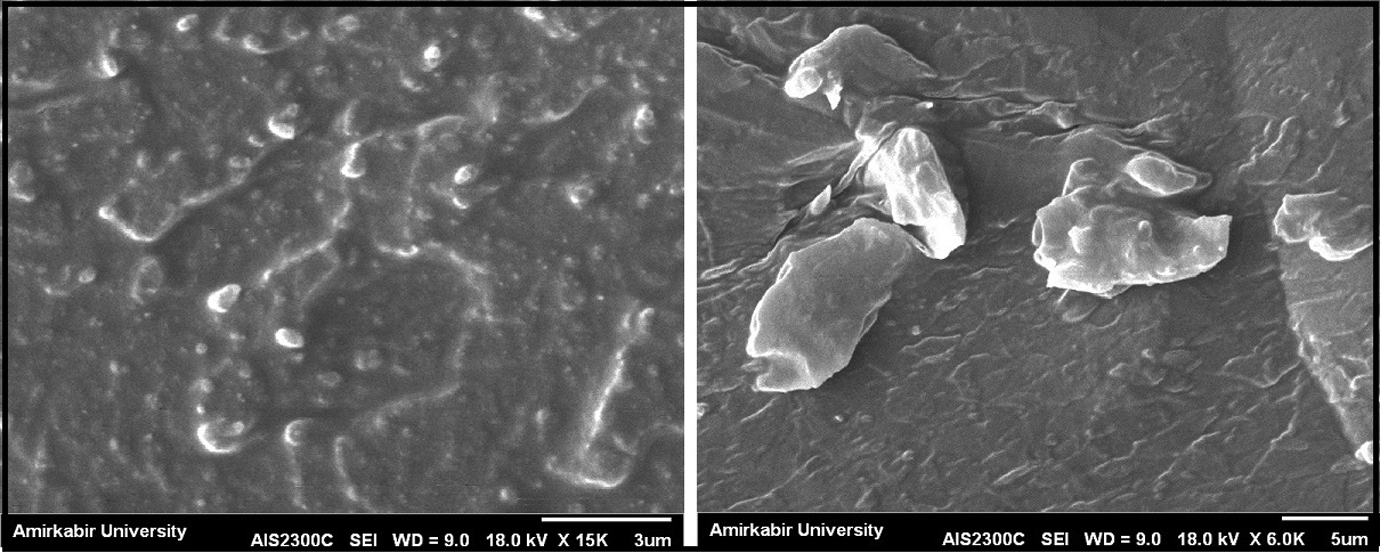
SEM images of fracture surface including 0.5 wt% (left) and 1 wt% (right) nanosilica. SEM: scanning electron microscopy.
The effects of glass fiber and nanosilica on elongation at break are shown in Figure 3(c). As can be observed, an increase in nanosilica from low to middle levels (0–0.5 wt%) leads to a very slight increase in the elongation at break of nanocomposites, whereas an increase to high levels causes decreased elongation at break. Increasing the nanosilica content causes good adhesion between the fiber and the matrix, leading to slight increase in elongation at break. In general, in composites containing glass fibers, the presence of various nanoparticles with suitable dispersion can lead to a good adhesion between the fiber and the matrix. It must be noted that whether the dispersion of particles is accompanied by agglomeration, reducing the elongation at break. 17 Moreover, according to Figure 3(c), an increase in glass fiber decreases the elongation at break because of the glass fiber’s very low elongation at break. 18
Fuzzy Logic rule-based modeling for tensile properties
After studying the effects of parameters on the tensile properties of nanocomposites, a regression model was obtained for each tensile property using the outputs from FRBS. Many software programs are used to extract a regression model from the data (e.g. regression using regression using spline and curve fitting in MATLAB R16). Using curve fitting in MATLAB not only results in the development of a regression model with various degrees in the form of polynomials but can also demonstrate a surface for the model. Moreover, R 2 presented in this method shows the validity of the model, that is, R 2 closer to 100% means that the model is more valid. Figure 6 shows the surfaces obtained from the curve fitting method for tensile properties with respect to the amount of glass fiber and nanosilica.
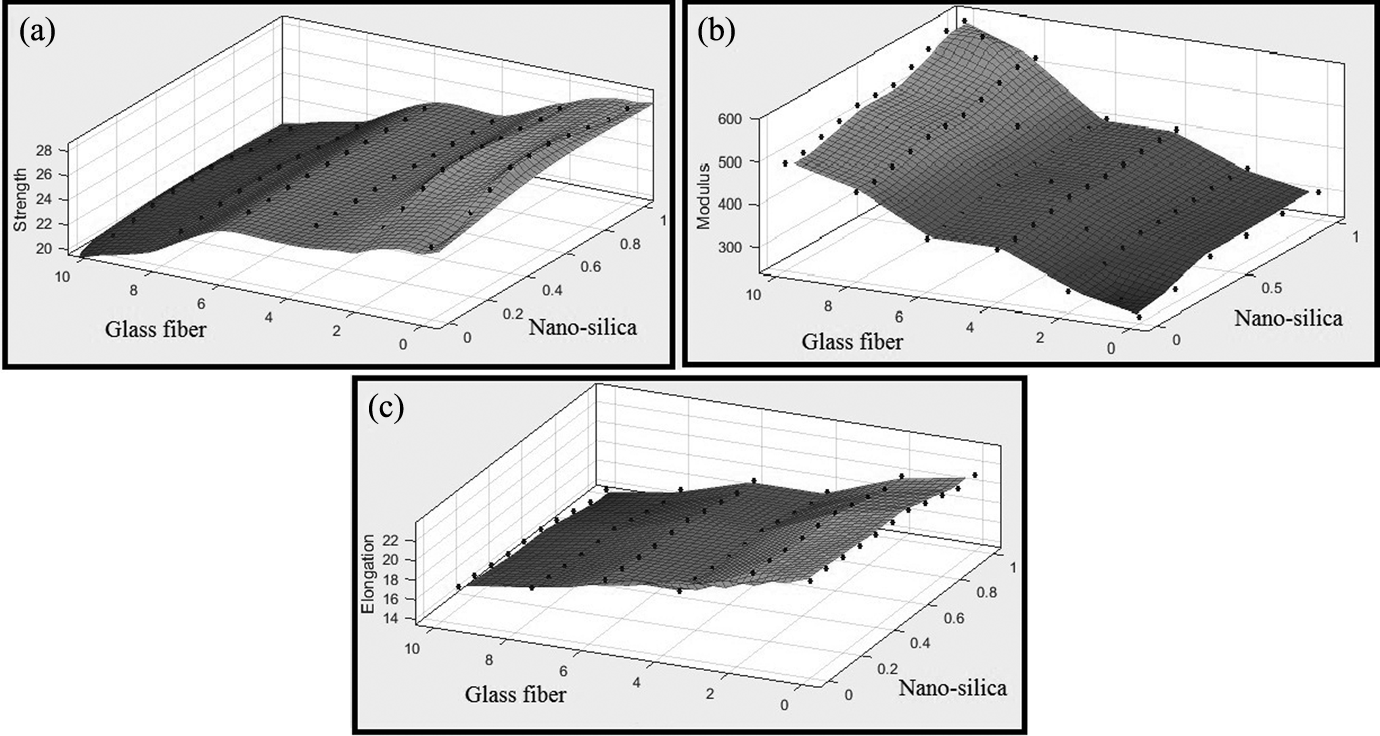
Surfaces extracted from interpolation in curve fitting method: (a) strength, (b) modulus, and (c) elongation.
Figure 6 shows that the surfaces obtained by interpolation from the curve fitting method are very similar to the surfaces obtained from the FL (Figure 3). Therefore, this method can provide a proper model for the tensile properties of nanocomposites. Among all the polynomials extracted for the tensile properties of nanocomposites using the curve fitting method, the third-order polynomials had the highest R 2 value. For this reason, the third-order models were used for determining the tensile properties.
The third-order polynomials extracted as regression models for tensile strength, elastic modulus, and elongation at break using the curve fitting method are presented in Table 3.
Regression models with R 2 for tensile properties.
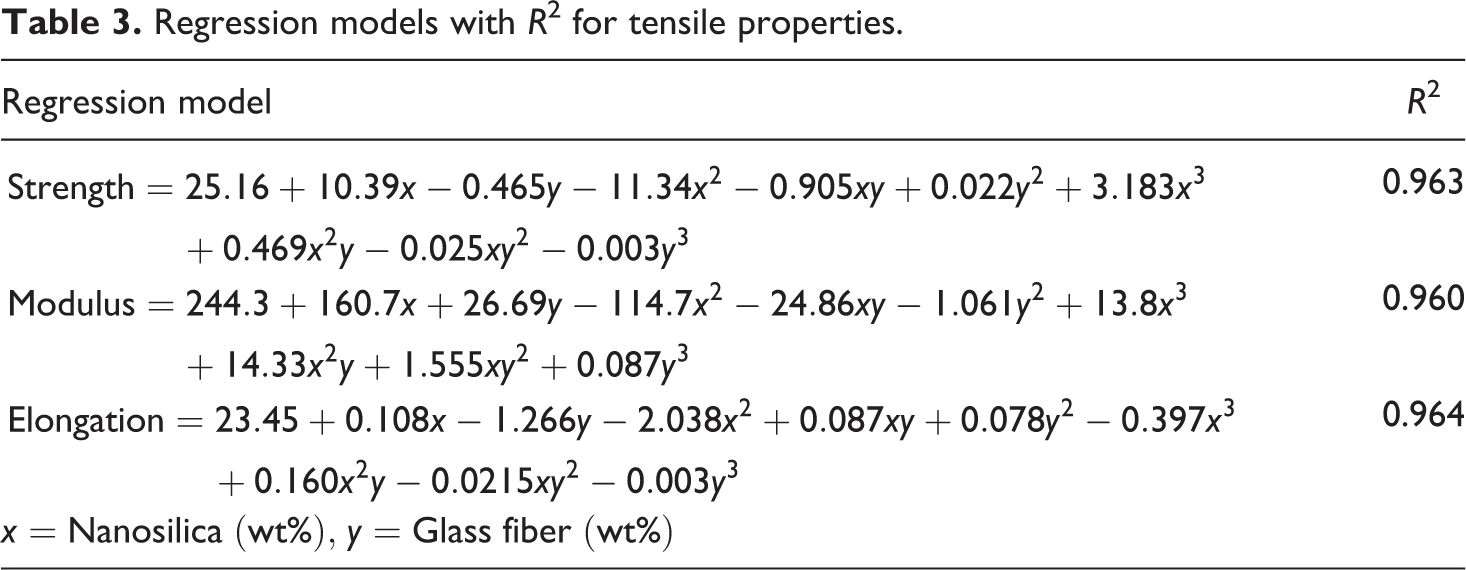
According to Table 3, in this article, the R 2 value was obtained as slightly more than 96% for tensile strength, elastic modulus, and elongation at break, indicating a very good fit between the models and the experimental data.
Conclusion
In this article, the FRBS is used for modeling and investigating the effects of nanosilica and glass fiber on the tensile properties of epoxy polymer matrices. The results are summarized as follows: Based on the fuzzy rule system surfaces, the effect of nanosilica and glass fiber on tensile strength, elastic modulus, and elongation at break of the nanocomposites was significant. According to the results, increasing nanosilica from low to medium levels led to an increase in elastic modulus by 17% and an increase in tensile strength by 10%. Whereas the presence of this filler decreased the elongation at break by 9%. The results of the effect of glass fiber on tensile properties showed that adding this reinforcement to the epoxy matrix led to an increase in elastic modulus by 92% but significantly reduced the tensile strength and elongation at break of the compounds. The models obtained according to the fuzzy rule–based modeling for the tensile properties of nanocomposites indicated the highest R2 value (about 96%).
Footnotes
Declaration of conflicting interests
The author(s) declared no potential conflicts of interest with respect to the research, authorship, and/or publication of this article.
Funding
The author(s) received no financial support for the research, authorship, and/or publication of this article.