






Abstract
Rubber-like hyperelastic materials exhibit stress softening (Mullins effect) and irreversible residual deformation (permanent set) during cyclic loading. This work proposes a simplified phenomenological two-phase softening model that simultaneously captures both phenomena in isotropic incompressible elastomers. The formulation extends the classical pseudo-elastic framework by introducing a residual stress contribution associated with deformation-induced evolution of a secondary network, thereby enabling prediction of permanent deformation. Coupled with the Gent hyperelastic model, the proposed framework is validated against published experimental data under uniaxial tension, equibiaxial deformation, pure shear, and transverse vibration loading. Using only two additional material parameters, the model accurately reproduces stress softening and permanent set while maintaining a simple constitutive structure. The proposed approach offers a physically motivated and computationally efficient framework for modeling cyclic deformation of rubber-like materials.
Keywords
Introduction
Permanent set in elastomeric materials refers to the irreversible residual deformation remaining after unloading from large deformation. Experimental investigations on filled and unfilled rubbers demonstrated that cyclic loading induces stress softening and residual strain, commonly referred to as the Mullins effect.1,2 The magnitude of permanent set increases with deformation level and filler concentration because of filler-induced stiffening and microstructural alteration within the polymer network.1–3 Several constitutive formulations have been proposed to describe this behavior. The pseudo-elastic framework of Ogden and Roxburgh 4 introduced a softening variable to characterize the Mullins effect, while Dorfmann and Ogden 2 further incorporated permanent set through additional internal variables. Network-based approaches such as the two-network theory of Tobolsky 5 and subsequent molecular-network evolution models6–10 explained residual deformation through chain scission, crosslink alteration, and secondary network formation. Other phenomenological and damage-based formulations11–14 employed deformation-history-dependent softening functions to reproduce stress softening and hysteresis during cyclic loading. Recent developments also incorporated deformation-induced anisotropy and hyper-pseudoelastic formulations for improved prediction of cyclic behavior in rubber composites.15–17 Recently, Anssari-Benam et al. 16 extended the pseudo-elasticity framework to simultaneously capture Mullins softening, permanent set, and induced anisotropy through a separable damage formulation. Their model demonstrated improved predictive capability under complex loading conditions while maintaining a relatively low computational cost. Dong et al. 18 proposed a hyper-pseudoelastic constitutive model for rubber composites capable of describing the evolution of cyclic stress softening during repeated loading–unloading cycles. The model effectively reproduced the progressive mechanical response associated with filler-induced damage and residual deformation. Zhan et al. 17 presented a comprehensive review of the Mullins effect in tough elastomers and gels, highlighting recent advances in damage mechanisms, network-based constitutive formulations, and anisotropic modeling approaches. The review emphasized that accurately describing multiaxial loading effects, permanent deformation, and anisotropic damage remains a significant challenge for existing constitutive models. Recent studies on shape-memory polymers under finite deformation have focused on constitutive frameworks that couple stress softening, damage evolution, and shape recovery mechanisms. Although these models successfully capture thermo-mechanical recovery effects, their formulations are generally more complex and involve additional internal variables compared with rate-independent pseudo-elastic approaches. In the present work, a comparatively simple invariant-based phenomenological model is proposed for incompressible hyperelastic materials. The formulation extends the classical pseudo-elastic concept by introducing an additional residual stress contribution associated with deformation-induced secondary network evolution. The model employs only two additional material parameters and directly correlates permanent set with the maximum previously experienced deformation through an exponential softening relation. The proposed formulation is incorporated with the Gent hyperelastic model and validated using published experimental data under uniaxial, equibiaxial, pure shear, and dynamic loading conditions, showing good agreement with experimental observations over different deformation modes.
Basic concepts
The kinematic relationship for finite deformations of incompressible, isotropic, and hyperelastic rubberlike material is reviewed in this section. Let us consider a deformable body

The principal invariants of


The stress-softening behavior of rubber-like materials is governed by an inelastic effect that retains only the maximum previously attained deformation in memory. While the strain intensity-based model of Beatty and Krishnaswamy
19
employs the maximum previous strain measure at a material point, the present work adopts a simpler invariant-based approach in which the selective memory depends solely on the maximum value of the first invariant


Here,

The stress-softened material response for any elastic deformation for which


Limitation of
-based selective memory
The present model employs the maximum previously attained value of the first invariant
The stress-softened gent material model
The finite elasticity of rubber-like materials arises from the limited extensibility of polymer chains within the molecular network.6,20 Several constitutive formulations have been proposed to model finite chain extensibility and stress-softening behavior in elastomers, including the Arruda–Boyce model,
3
full-network theories,21–25 and damage-based softening models.2,11–14 Among these, the Gent model provides a simple and effective representation of limiting chain extensibility in rubber-like materials. The corresponding strain-energy density function is expressed as follows:

Proposed model for softening with residual strain
Constitutive modelling of stress-softened elastomeric materials requires a thermodynamically consistent framework capable of describing coupled thermo-mechanical deformation and microstructural damage evolution. The mechanical response of rubber-like materials is governed by an appropriate strain-energy density function associated with entropy-driven changes in the polymer network structure.
9
Therefore, the constitutive formulation must satisfy the fundamental laws of thermodynamics while accounting for stress softening, residual strain, and network alteration effects during deformation.2,11,14–16 The energy balance equation is formulated by considering the transformation of the material from the initial hard state to a softened state together with progressive changes in the polymer network structure within the material configuration, leading to the following governing relation:


Using the local energy balance equation (9) and definition of free energy the definition of free energy


Equation (12) represents the second law of thermodynamics under the assumption that the balance laws of physical and material forces hold, this assumption further simplifies the dissipation inequality a



It can be further shown that

It can be concluded that the general form of strain energy density function
An additional term is included in the SED strain energy density function to describe the damage and residual strain. For incompressible hperelastic materials, Holzapfel et al.
12
assumed a strain energy function

The damage energy function

Using from equations (5) and (6) the constitutive equation for the stress-softened material can be described as follows:




Here, we propose a phenomenological function of strain energy correlating the damage mechanism with residual strain as follows:

Thermodynamic admissibility of the proposed model
The proposed constitutive formulation satisfies the Clausius–Duhem inequality under isothermal conditions. The total free-energy density is expressed as



Simple uniaxial extension or compression
The deformation field in simple uniaxial extension or compression is defined as

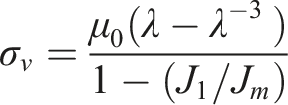
Through equations (8), (20) and (21), By applying traction-free boundary conditions on the remaining two lateral surfaces, the Cauchy stress corresponding to the virgin Gent model material in the loading direction can be expressed as follows:

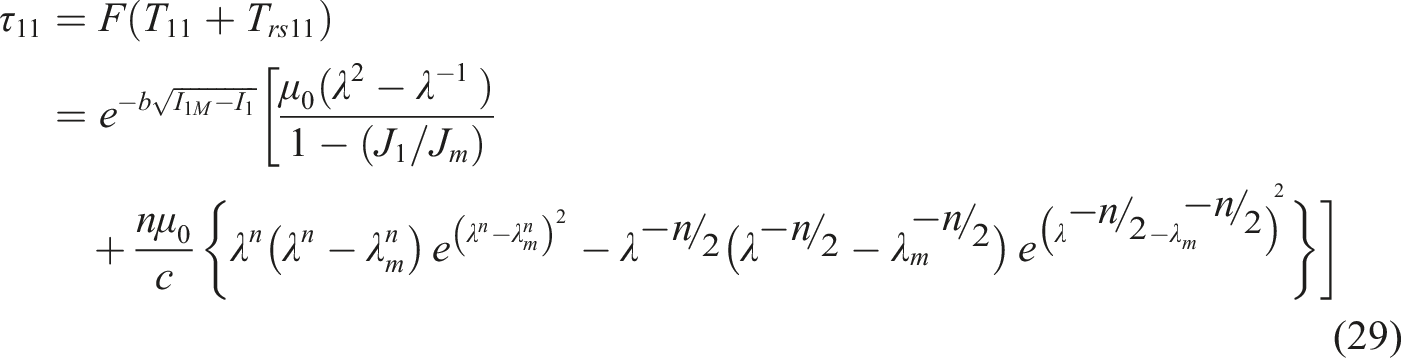
The corresponding engineering stress,
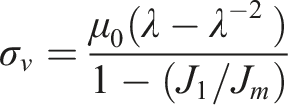

It is worth noting that the two additional material parameters introduced in the present formulation possess distinct constitutive roles. The parameter (
Equibiaxial deformation
The deformation field in the equibiaxial stress condition is defined as
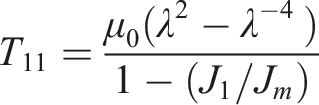

The residual stress defined in (28) is active during loading and unloading as long as
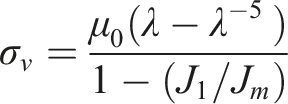
The engineering stress responses for both the virgin and stress-softened materials incorporating permanent set effects are determined as follows:

Pure shear
The deformation field in pure shear is defined as
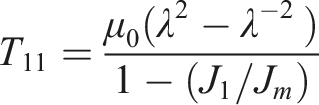

The residual stress defined in (30) is active during loading and unloading as long as
The corresponding engineering stress expressions for the virgin and stress-softened Gent model material are derived as follows:

Materials and method validation of new softening model
Figure 1 presents the comparison between the proposed stress-softening model and the uniaxial experimental data of Millard F. Beatty and Shankar Krishnaswamy. The proposed formulation, coupled with the Gent hyperelastic model, accurately captures the primary loading response, Mullins stress-softening behavior, and the residual deformation during unloading and reloading cycles. The close agreement between the theoretical predictions and experimental observations demonstrates the capability of the model to represent permanent set effects under uniaxial deformation. Comparison of theoretical prediction of Gent limiting extensibility model and proposed softening model (solid curves) with Mullin and Tobin uniaxial extension data (solid dots) for which 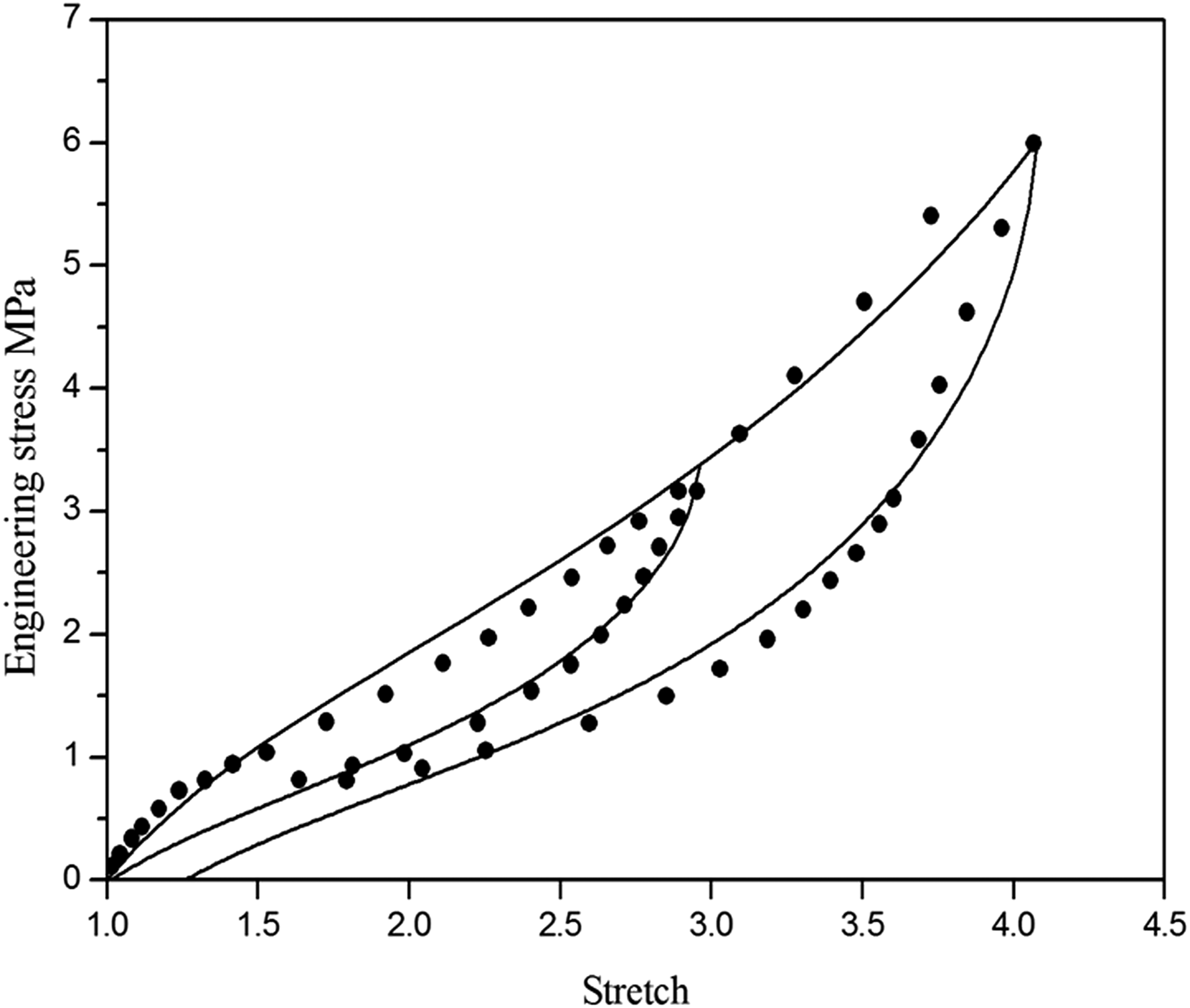
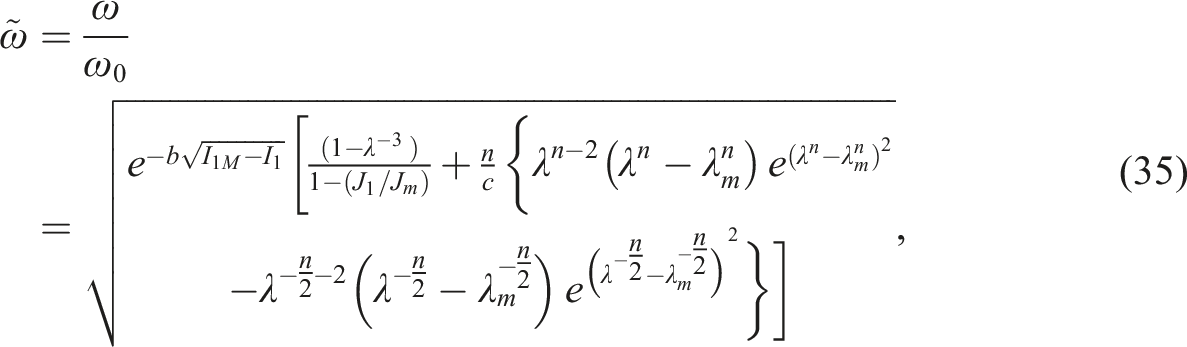
Figure 2 illustrates the validation of the proposed softening model under equibiaxial deformation using the experimental results reported by Johnson and Millard F. Beatty. The model successfully reproduces the nonlinear stress–strain response, stress-softening characteristics, and residual strain effects observed experimentally. The results confirm that the proposed constitutive formulation remains effective under multiaxial loading conditions. Figure 3 shows the comparison of the proposed model predictions with the pure shear experimental data reported by Grégory Chagnon and co-workers. The model provides good agreement with the experimental response during cyclic deformation and effectively captures the reduction in stiffness associated with the Mullins effect together with the induced permanent set. This demonstrates the robustness of the formulation for describing stress-softening behavior in pure shear deformation. Next, a dynamic transverse vibration experiment reported by Zuniga and Beatty
13
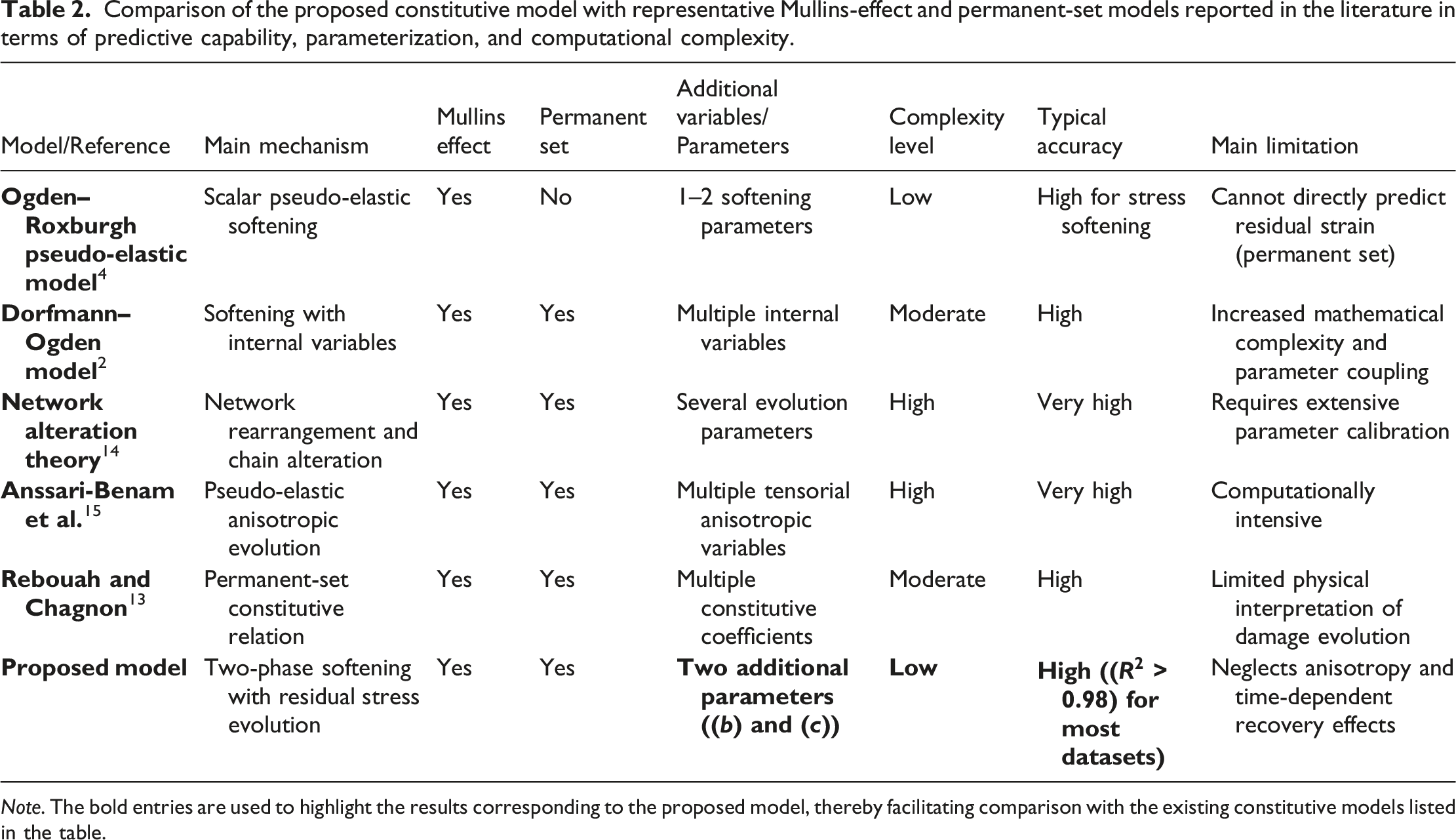
was considered to further validate the proposed stress-softening model with permanent set. The Gent model was employed for the virgin material response, and the normalized transverse vibrational frequency for the stress-softened material was obtained as follows: Comparision of theoretical prediction of Gent limiting extensibility model and proposed softening model (solid curves) with Johnson and Beatty equibiaxial extension data (solid dots) for which Pure shear normalized data by Chagnon et al. (solid dots) for which Comparison of theoretical prediction of Gent limiting extensibility model with Zuniga-Beatty transverse vibration data (solid dots) for Buna-N rubber for which with our proposed permanent set model Quantitative assessment of the proposed model predictions against experimental data under different loading conditions. Comparison of the proposed constitutive model with representative Mullins-effect and permanent-set models reported in the literature in terms of predictive capability, parameterization, and computational complexity. Note. The bold entries are used to highlight the results corresponding to the proposed model, thereby facilitating comparison with the existing constitutive models listed in the table.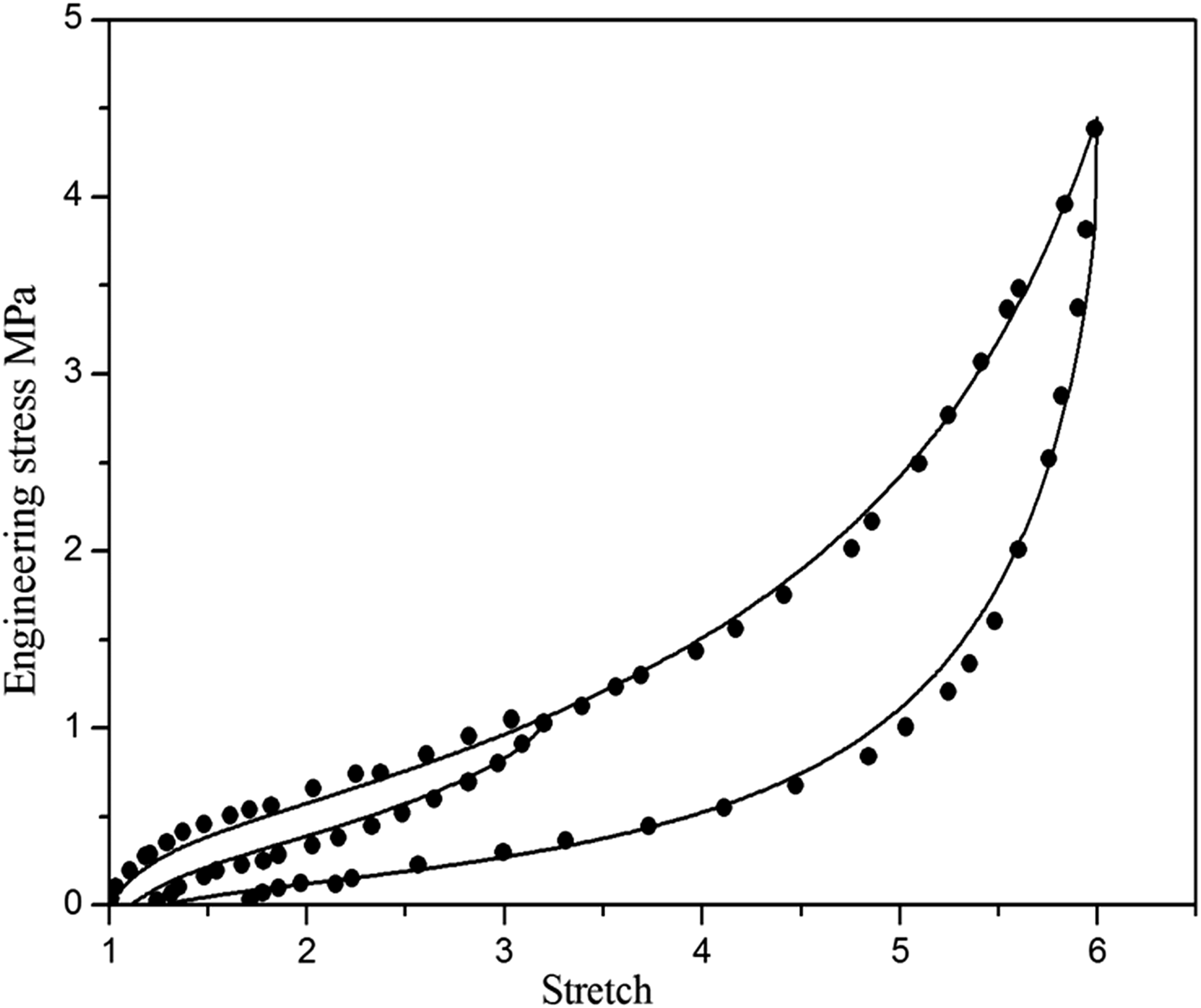
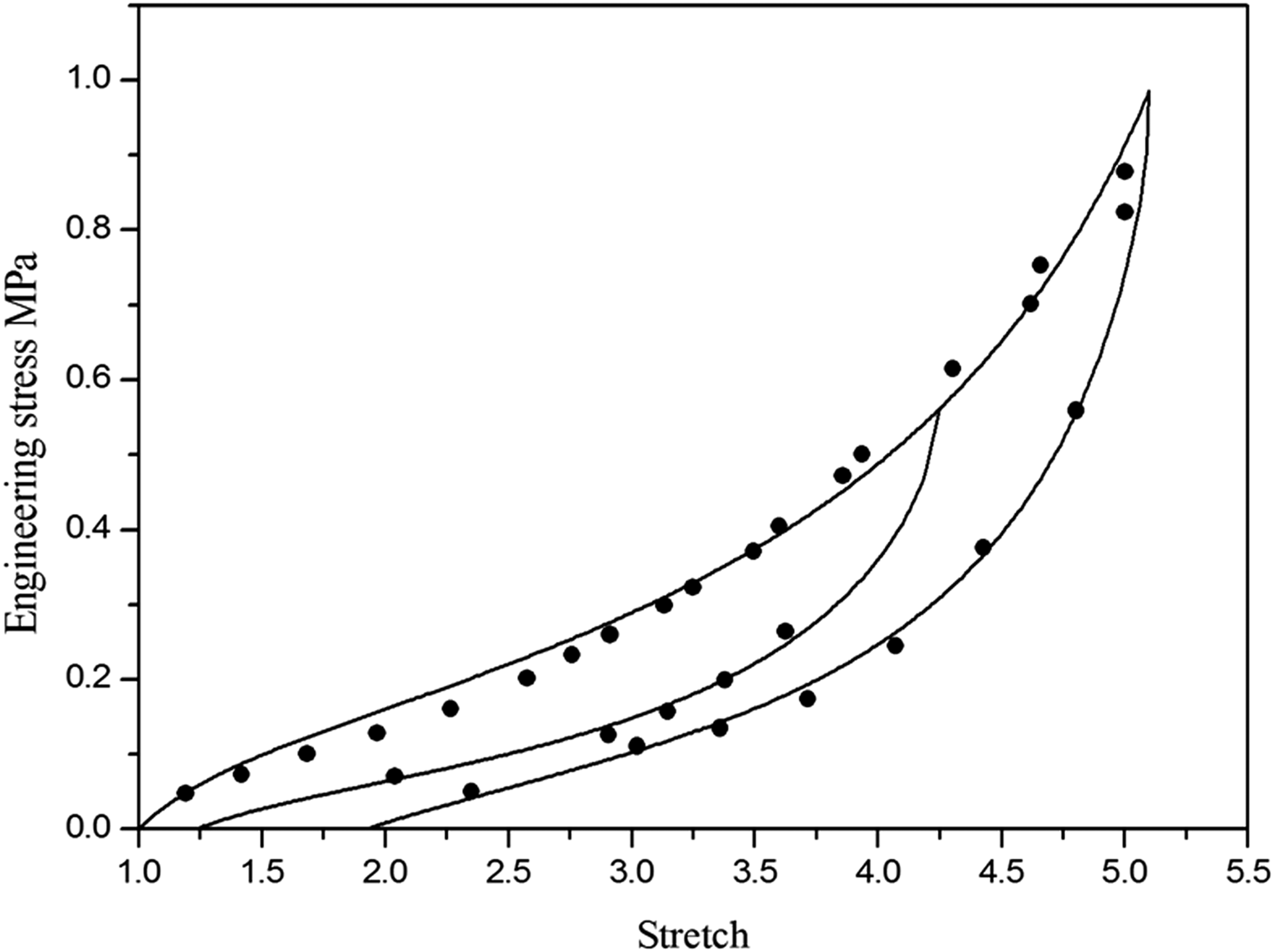
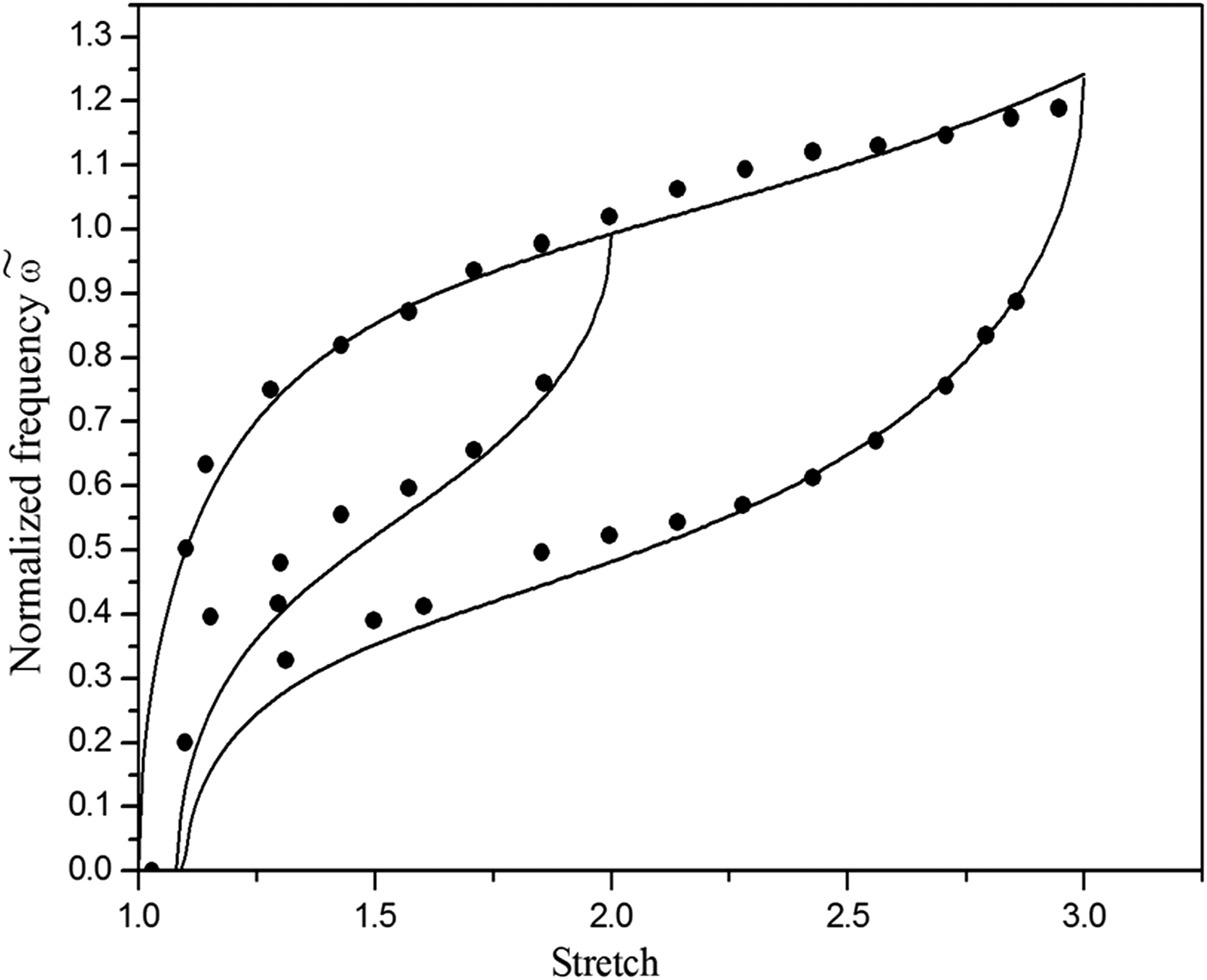
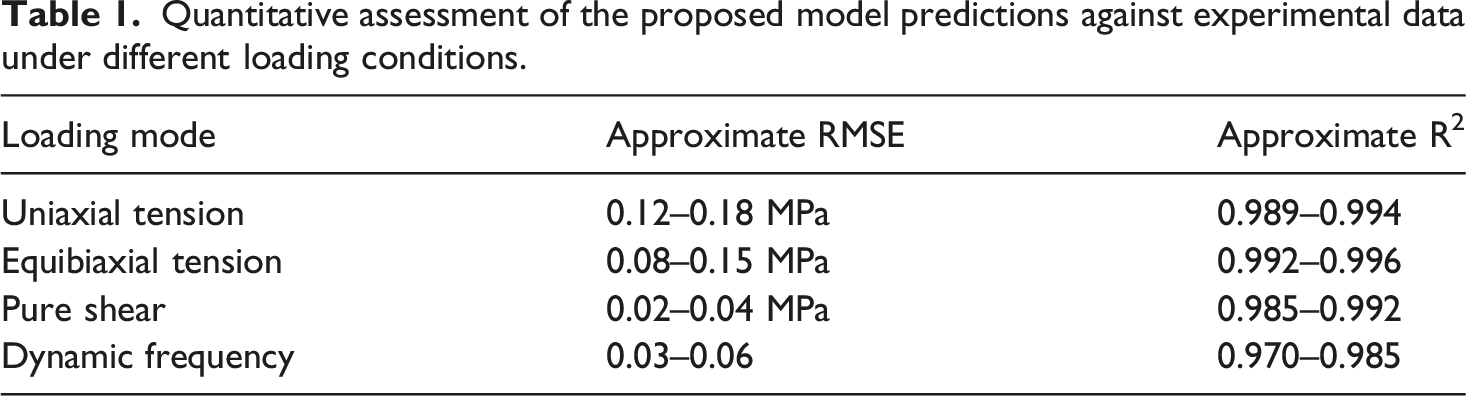
The agreement between the theoretical predictions and experimental observations is excellent across all loading modes, with estimated coefficients of determination exceeding approximately 0.98 for the quasi-static tests and 0.97 for the dynamic vibration response.
The transverse vibration frequency depends directly on the tangent stiffness of the preconditioned elastomer. The proposed residual stress mechanism modifies the effective constitutive stiffness through the additional residual energy contribution. As the maximum deformation history increases, both the softening function and residual stress evolution alter the effective stiffness of the material. Consequently, the observed reduction in normalized vibration frequency is physically consistent with the Mullins-type degradation and permanent-set evolution captured by the proposed constitutive model. Figures 1–4 illustrate the physical concept and validation framework underlying the proposed constitutive model. The virgin elastomer is initially composed of an amorphous polymer network. During deformation, partial alignment and localized crystallization-like network evolution occur within the stretched molecular chains. Upon unloading, the primary amorphous network tends to recover elastically; however, the evolved secondary network restricts complete retraction of the chains. As a result, a residual deformation remains within the material configuration, producing permanent set. The proposed residual stress contribution phenomenologically represents this deformation-induced network evolution.
Comparison of constitutive models for mullins effect and permanent set
The proposed model simultaneously captures Mullins stress softening and permanent set using only two additional material parameters, thereby maintaining low computational complexity and straightforward parameter calibration. Unlike the classical Ogden–Roxburgh pseudo-elastic model, which describes stress softening but cannot directly predict residual deformation, the present formulation incorporates permanent set through an additional residual stress contribution derived from a phenomenological residual energy function. The present formulation follows the classical invariant-based pseudo-elastic approach, where the maximum previously attained value of the first invariant 1. The model simultaneously captures both Mullins softening and permanent set within a unified constitutive framework. 2. Only two additional material parameters are required to characterize the inelastic response. 3. The formulation directly relates residual deformation to the maximum previously experienced strain. 4. The constitutive equations maintain a comparatively simple invariant-based mathematical structure. 5. The model can be readily incorporated into commonly used hyperelastic strain-energy functions such as the Gent model. 6. The proposed framework provides a simple physical interpretation based on deformation-induced network evolution.
Concluding remarks
A simple phenomenological model has been developed to simultaneously describe Mullins stress softening and permanent set in rubber-like materials. The model incorporates a residual stress contribution linked to deformation-induced network evolution and accurately predicts cyclic responses under various loading conditions with only two additional material parameters. The introduced constitutive parameters possess clear phenomenological interpretations. Parameter
Footnotes

Funding
The authors received no financial support for the research, authorship, and/or publication of this article.
Declaration of conflicting interests
The authors declared no potential conflicts of interest with respect to the research, authorship, and/or publication of this article.