





Abstract
Drying is a core rubber processing step that directly affects product performance. Yet systematic comparisons of mass transfer across drying methods—and the link between moisture migration and microstructure—are lacking. This study compares hot-air and microwave drying of natural rubber, revealing how each governs dehydration kinetics and microstructural evolution. Both methods show three-stage dehydration (rapid, falling, and constant rate), but microwave drying cuts total drying time by over 80% due to volumetric heating. A high-precision Page model (R2 > 0.99) fits both methods well; its exponential parameters capture stage-specific moisture migration. Hot-air drying follows counter-current transfer (heat in, moisture out), yielding low Deff (0.76–6.84 × 10⁻⁷ m2/s) and hm (0.08–0.39 × 10⁻⁷ m2/s). Microwave drying drives co-directional heat and mass transfer via electromagnetic excitation, giving Deff (2.33–7.47 × 10⁻⁶ m2/s) and hm (0.29–1.29 × 10⁻⁶ m2/s) ∼10× higher. LF-NMR confirms these molecular-scale differences and establishes a quantitative link between relaxation time and hm—enabling real-time drying monitoring and optimization.
Keywords
Introduction
Natural rubber, as a vital strategic material and industrial raw material, is widely cultivated and has significant applications globally.1,2 Due to its high elasticity, high strength, and excellent insulation properties, natural rubber is extensively used in numerous fields including industry, agriculture, national defense, transportation, and healthcare.3–7 During the processing of natural rubber, drying 8 is a critical step affecting the final product quality. Effectively removing moisture from the rubber interior not only enhances the product’s mechanical properties and surface quality but also significantly improves its stability during storage and transportation, extending its service life. Traditional drying methods such as air drying, 9 hot air drying, 10 and vacuum drying 9 commonly suffer from issues like lengthy drying cycles, high energy consumption, and uneven temperature distribution, limiting improvements in production efficiency and energy utilization. Against this backdrop, microwave drying technology 11 has emerged as a promising alternative solution in the drying field due to its unique thermal and non-thermal effects. This technology utilizes high-frequency electromagnetic waves to heat the entire sample simultaneously, achieving rapid and uniform dehydration from the inside out.
Angelo Canale and Giovanni Benelli utilized microwave drying as an innovative preservation technique for bee pollen. Their findings demonstrate that microwave drying provides substantial advantages in maintaining the quality of pollen. Specifically, no significant differences in phenolic and flavonoid content were observed across varying microwave power levels and processing durations compared to untreated fresh pollen. 12 This evidence confirms that microwave-assisted drying is a highly effective method for preserving bioactive compounds in fresh pollen. In contrast, conventional preservation techniques such as hot-air drying and freeze-drying may adversely affect both the sensory attributes and the bioactive composition of pollen. Rute Quelvia de Faria, acknowledging the potential of microwave heating to improve time and energy efficiency in food dehydration processes, optimized microwave drying parameters for corn seeds. Compared with conventional drying methods, this approach reduced drying time by 5 h while maintaining key physiological indicators, including seed germination rate, viability, and longevity. 13 Wittawat Wulyapash and Awassada Phongphiphat conducted a comparative study on thermal air drying versus microwave drying for sludge dewatering. Results demonstrated that microwave drying reduced drying time by at least 37.5%, with the decreased number of drying cycles leading to significant energy savings. 14 Multiple studies consistently demonstrate that microwave drying technology, through its unique heating principle, exhibits significant advantages in shortening drying time,15,16 reducing energy consumption,17,18 and improving product consistency.19,20
Guangyu Wang investigated the microwave drying process for sludge and proposed a novel method for distinguishing between free water and bound water. The process was found to consist of three distinct stages: the preheating stage, the constant-rate drying stage, and the falling-rate drying stage. The preheating and constant-rate stages primarily remove free water, whereas the falling-rate stage predominantly eliminates bound water. 21 Hulin Dong conducted a systematic comparison of hot-air and microwave drying methods and calculated the effective moisture diffusion coefficients. Microwave drying of rubber exhibited shorter drying times and higher moisture diffusion coefficients than hot-air drying. 22 To deepen understanding of moisture migration mechanisms during drying, low-field nuclear magnetic resonance (NMR) technology—an advanced non-destructive testing method 23 —revealed unique advantages unmatched by conventional approaches. By detecting the relaxation behavior of hydrogen atoms in a magnetic field, this technique precisely distinguishes between bound water and free water in rubber systems, 24 enabling accurate analysis of water form and content. 25 During drying, the migration and desorption of water molecules cause systematic changes in relaxation time. This not only provides information on total water content but also reveals, at the molecular level, the distribution state of water, its migration patterns, and the interaction mechanisms with rubber molecular chains.
Previous studies on natural rubber drying have primarily focused on aspects such as drying characteristics, kinetics, energy consumption, quality, and process parameters of hot-air and microwave drying. However, systematic research on internal and external mass transfer properties during the drying process remains relatively scarce. This aspect is critical for achieving a deeper understanding and enabling precise control of the drying mechanism. In this study, natural rubber is selected as the research subject to systematically analyze the dynamic evolution of moisture content during drying. It focuses on investigating the effects of drying temperature and material quantity on rubber drying characteristics and internal/external mass transfer behavior. Corresponding mathematical models are established to determine kinetic models suitable for describing moisture migration patterns in rubber drying. Furthermore, low-field nuclear magnetic resonance (NMR) technology is employed to elucidate the mechanisms of internal and external mass transfer. This research aims to deepen the understanding of moisture migration mechanisms in natural rubber during hot-air and microwave drying processes, providing theoretical foundations for improving drying processes and optimizing operating conditions.
Materials and methods
Materials and preparations
The natural rubber used for the drying experiments was supplied by Jingyang Co., Ltd, located in Xishuangbanna, Yunnan Province, China. Following acid coagulation and preliminary processing, the rubber was prepared for experimental use. According to formula (1), rubber samples were dried in a hot-air oven at 115 ± 1°C to determine their initial moisture content (IMC). The measured moisture content of the raw material was approximately 22%. All natural rubber samples were cut into small particles prior to testing. The prepared samples were placed in crucibles and subjected to drying either in a hot-air oven or a microwave tube furnace. After intervals of 30 min and 2 min, respectively, the samples were removed, weighed, and the drying-weighing cycle was repeated until constant weight was achieved.

Drying experiment
Hot air drying experiments were conducted in a forced-air drying oven (Shanghai Yiheng Scientific Instrument Co., Ltd, model DHG-9245) at five different temperatures (80°C, 90°C, 100°C, 110°C, and 115°C). Approximately 40 g of sample was uniformly spread in a crucible and placed into the preheated oven to ensure consistent thermal conditions. In parallel, six different sample masses—20 g, 30 g, 40 g, 50 g, 60 g, and 70 g—were evenly distributed in separate crucibles. The oven temperature was maintained at a constant temperature of 115°C. Samples were withdrawn at 30-min intervals for gravimetric measurement. The experiment concluded when the measured moisture content (calculated as described in the Materials section) fell below 0.8%.
Microwave drying experiments were conducted using a microwave tube furnace (custom-built equipment at Kunming University of Science and Technology). During the drying process, a low-temperature infrared thermometer was employed to provide real-time monitoring of sample temperatures, thereby preventing over-drying or localized overheating and ensuring both operational safety and drying efficiency. When the microwave tube furnace was set to 115°C, samples with six different masses—20 g, 30 g, 40 g, 50 g, 60 g, and 70 g—were introduced into the drying chamber, with microwave power maintained at 700 W. After a fixed drying interval of 2 min, the samples were promptly removed from the chamber and immediately weighed. The experiment was terminated when the measured moisture content in the samples decreased to below 0.8%. Notably, the weighing procedure was required to be completed within 5 s to minimize moisture reabsorption and enhance measurement accuracy.
Drying characteristic parameters
The moisture ratio (MR) and drying rate (DR) of rubber under various drying conditions were calculated using the following equations:

Typically, the value of Me is very small compared to Mt and M0, so it can be considered irrelevant to MR calculations. Therefore, equation (2) can be simplified to equation (3) for determining the MR value:

Mt, M0, and Me(water/dry matter) represent the moisture content at any given time, the initial moisture content, and the equilibrium moisture content, respectively.

Effective moisture diffusivity
Fick’s second law of diffusion is employed to describe the transport of water within biomaterials during drying processes. The diffusion of water is a complex phenomenon that involves multiple mechanisms, including capillary flow, molecular diffusion, liquid and vapor diffusion, thermal diffusion, and surface diffusion. Due to this complexity, the concept of an effective water diffusion coefficient is introduced. This coefficient depends on temperature, moisture content, and the structural characteristics of the material. The water diffusion rate is considered the sole physical mechanism explaining water evaporation from the substrate surface during moisture transport. Fick’s second law of non-steady-state diffusion was selected to determine the moisture diffusion rate in rubber,
26
as detailed below.

For longer drying times, the series converges very rapidly, and the first-order term can approximate the series with high precision, while higher-order terms (n > 1) approach zero as t increases. Therefore, the higher-order terms can be neglected, simplifying to:

Take the natural logarithm and linearize:

The effective moisture diffusion coefficient (Deff) was estimated using the nonlinear regression analysis method with the curve fitting tool in Origin 2021 software. The slope method was applied by plotting the natural logarithm of the moisture ratio (MR) against drying time to determine the slope (k) of the resulting linear fit, which was then used to calculate Deff according to the appropriate formula.



The effective water diffusion coefficient values for natural rubber under different drying conditions were estimated using equation (10).
Mass transfer coefficient
The mass transfer coefficient (hm)
27
is employed to calculate the mass transfer rate and can be determined using the Biot number (Bi).



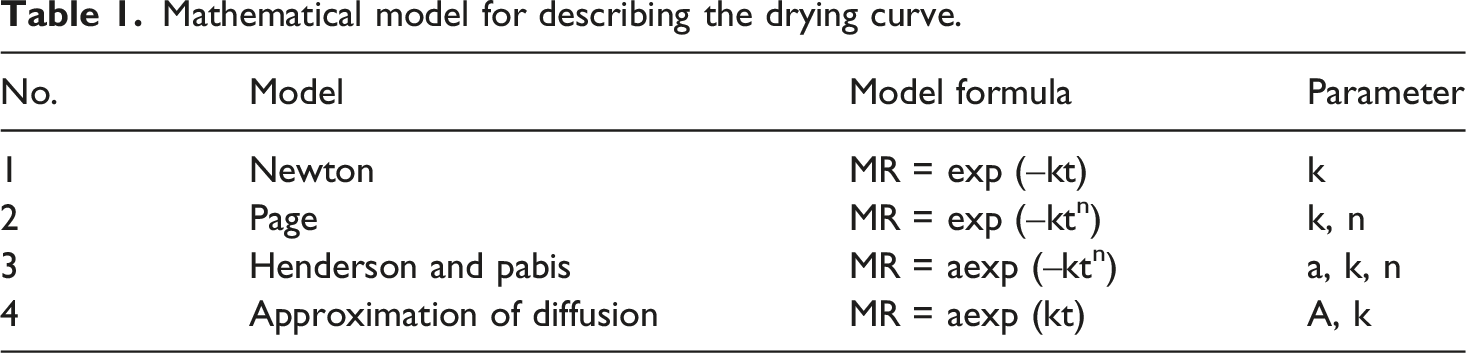
Drying kinetics
Mathematical model for describing the drying curve.
Low-field nuclear magnetic resonance analysis
The low-field nuclear magnetic resonance (NMR) spectrometer (Suzhou Newman Analytical Instruments Co., Ltd, model MesoMR12-060HI) is the key instrument used in this experiment. It features a magnetic field strength of 0.5 T and a stable temperature of 32 ± 0.01°C.The system consists of a permanent magnet, a sample chamber, and a radiofrequency (RF) system. The maximum effective testing space for sample tubes is 60 mm × 60 mm, with a resonance frequency of 23 MHz. This instrument was employed to acquire transverse relaxation time (T2) and two-dimensional T1–T2 spectra of water during natural rubber drying, as well as to determine the direction of water migration throughout the drying process. The principle of low-field NMR instruments involves applying an external gradient field to convert the energy change signals of water molecules during resonance into signal relaxation values, thereby inducing nuclear magnetic resonance phenomena in water molecules within the magnetic and gradient fields. 29
During the experiment, the sample was heated and subsequently cooled to room temperature before being placed in a glass tube with a diameter of 25 mm, positioned at the center of a permanent magnetic field. The central resonance frequency of the sample was determined using a hard-pulse free induction decay (FID) sequence. Subsequently, the transverse relaxation time (T2) was measured employing the Carr–Purcell–Meiboom–Gill (CPMG) pulse sequence. Finally, a combination of Inversion Recovery (IR) and Carr-Purcell-Meiboom-Gill (CPMG) pulse sequences was employed to simultaneously measure both the longitudinal relaxation time (T1) and transverse relaxation time (T2) of the dried natural rubber sample via NMR testing. Key experimental parameters: Main frequency SF = 12 MHz, Offset frequency O1 = 459 kHz, 90-degree pulse duration P1 = 7.8 μs, 180-degree pulse duration P2 = 12.4 μs, Number of samples accumulated NS = 4, Echo time TE = 0.40 ms, Number of echoes NECH = 1000.
Statistical analysis
The coefficient of determination (R2)
30
measures the regression model’s ability to explain variation in the dependent variable, reflecting the model’s goodness of fit to the data. The sum of squared deviations (X2)
31
measures the difference between observed values and model predictions, indicating data dispersion or model fitting error. The former assesses explanatory power while the latter evaluates error magnitude, enabling these two metrics to determine the optimal drying kinetic model and judge model quality. Higher model quality is indicated when X2 approaches 0 and R2 approaches 1.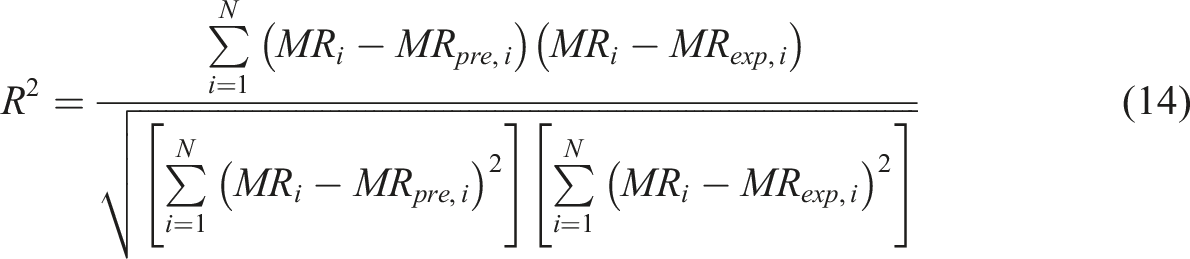

Among these, MRexp,i, MRpre,i, and MRi represent the experimental MR, predicted MR, and average experimental MR, respectively; N and n denote the total number of data points and the number of constants, respectively.
The experiment was repeated three times, with results expressed as mean ± standard deviation (SD). Data were analyzed using SPSS software with a completely randomized design one-way analysis of variance (ANOVA), with a significance level of p ≤ 0.05.
Results and discussions
Hot air and microwave drying
Figure 1 shows the drying curves for rubber dried by hot air and microwave, respectively. Figure 1(a)–1(c) illustrate the variation of moisture content over drying time. Changes in moisture content ratio with drying time (hot air drying - h, microwave drying - min). (a) Hot air drying (different material quantities). (b) Hot air drying (different temperatures). (c) Microwave drying (different material quantities). Changes in drying rate with drying time: (d) Hot air drying (different material quantities). (e) Hot air drying (different temperatures). (f) Microwave drying (different material quantities).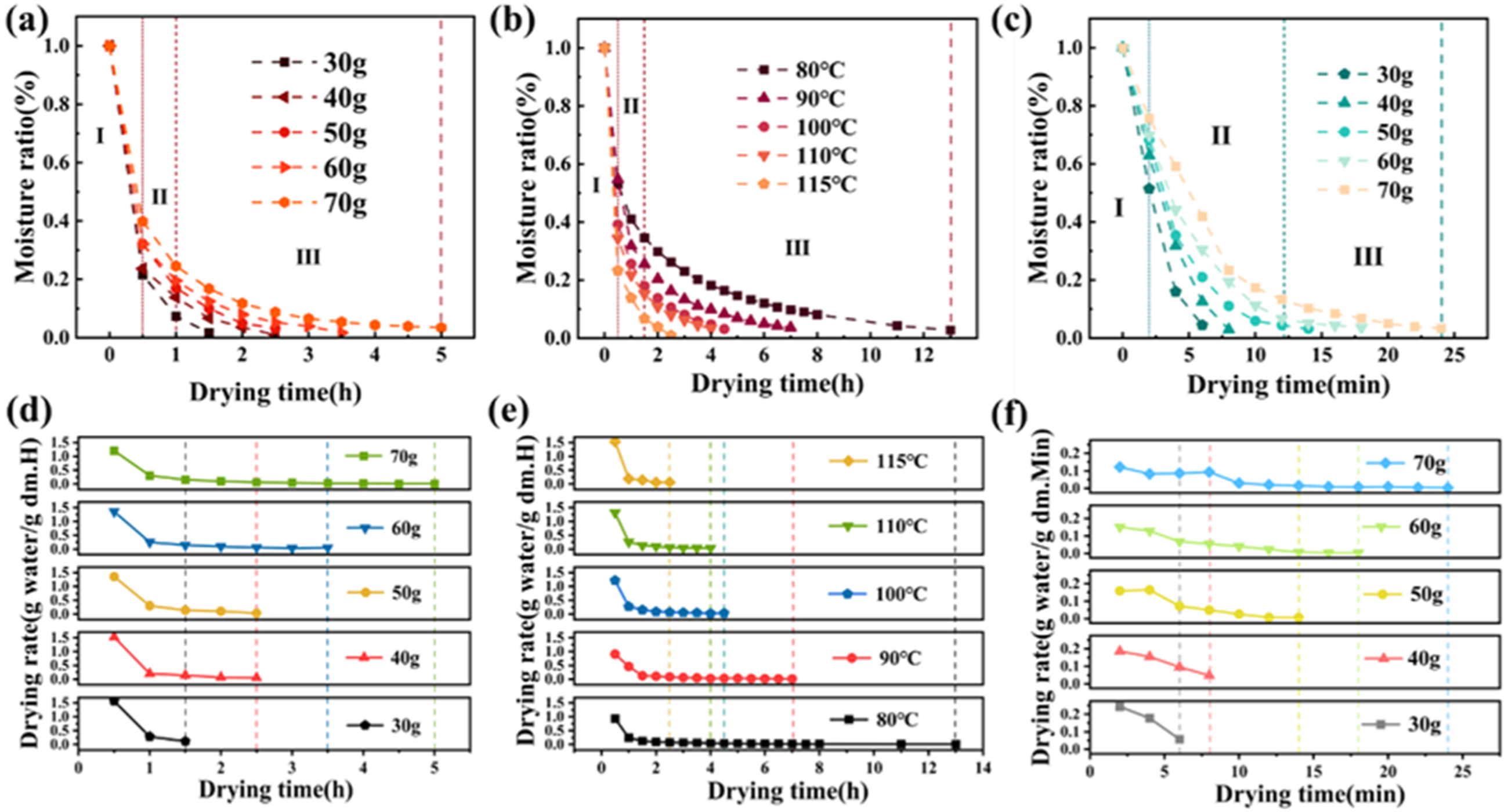
Regardless of the drying method, the moisture content of the material continuously decreases as drying time increases, with faster moisture reduction observed at 30 g and 115°C. Observing the changes in moisture content throughout the drying process reveals that both hot-air drying and microwave drying can be divided into three distinct stages: rapid dehydration, decelerating dehydration, and constant-rate dehydration. In hot-air drying, the third stage accounts for a relatively large proportion of the total drying duration, whereas in microwave drying, the three stages are more evenly distributed. By the time hot-air drying reaches its initial dehydration stage, microwave drying has already completed the entire drying process. This is attributed to the ability of microwaves to promote internal moisture migration through volumetric heating. The advantage of microwave drying in significantly reducing drying time has been experimentally validated across various materials.32–34
Figure 1(d)–1(f) depict the drying rate as a function of drying time. During the initial stage, the drying rate is significantly elevated due to the abundance of free water on the material surface and relatively low mass transfer resistance. This effect is particularly pronounced under conditions involving smaller sample masses or higher drying temperatures. At this stage, moisture evaporation is primarily governed by external conditions (such as air temperature and flow velocity), with the synergistic effects of heat and mass transfer facilitating rapid vaporization of surface moisture. As drying progresses and the material’s moisture content decreases to a specific value, the remaining water is predominantly bound water associated with the matrix. Its vaporization requires overcoming a higher energy barrier. Simultaneously, the diffusion path for internal moisture lengthens and migration resistance increases, leading to a sharp decline in drying rate. In the final stage, despite only a small amount of moisture remaining to be removed, drying efficiency significantly decreases due to diffusion rates being constrained by the material’s internal structure and the form of water binding. Consequently, removing the last third of moisture requires nearly two-thirds of the total drying time. This pattern is particularly pronounced in polymeric materials such as rubber, where drying kinetics are closely related to the form of water present and the material’s microstructure.
Development of a drying kinetic model
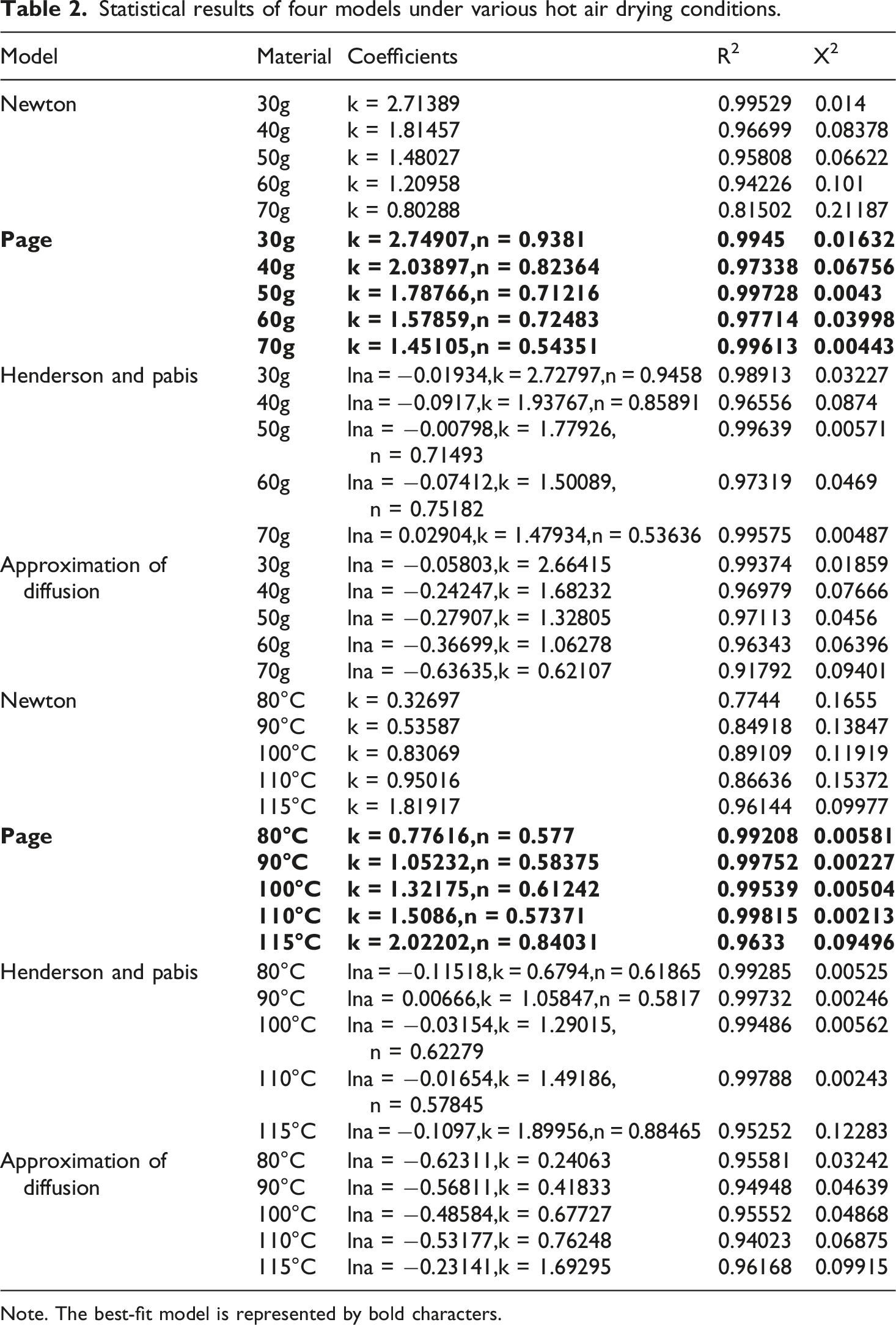
Statistical results of four models under various hot air drying conditions.
Note. The best-fit model is represented by bold characters.
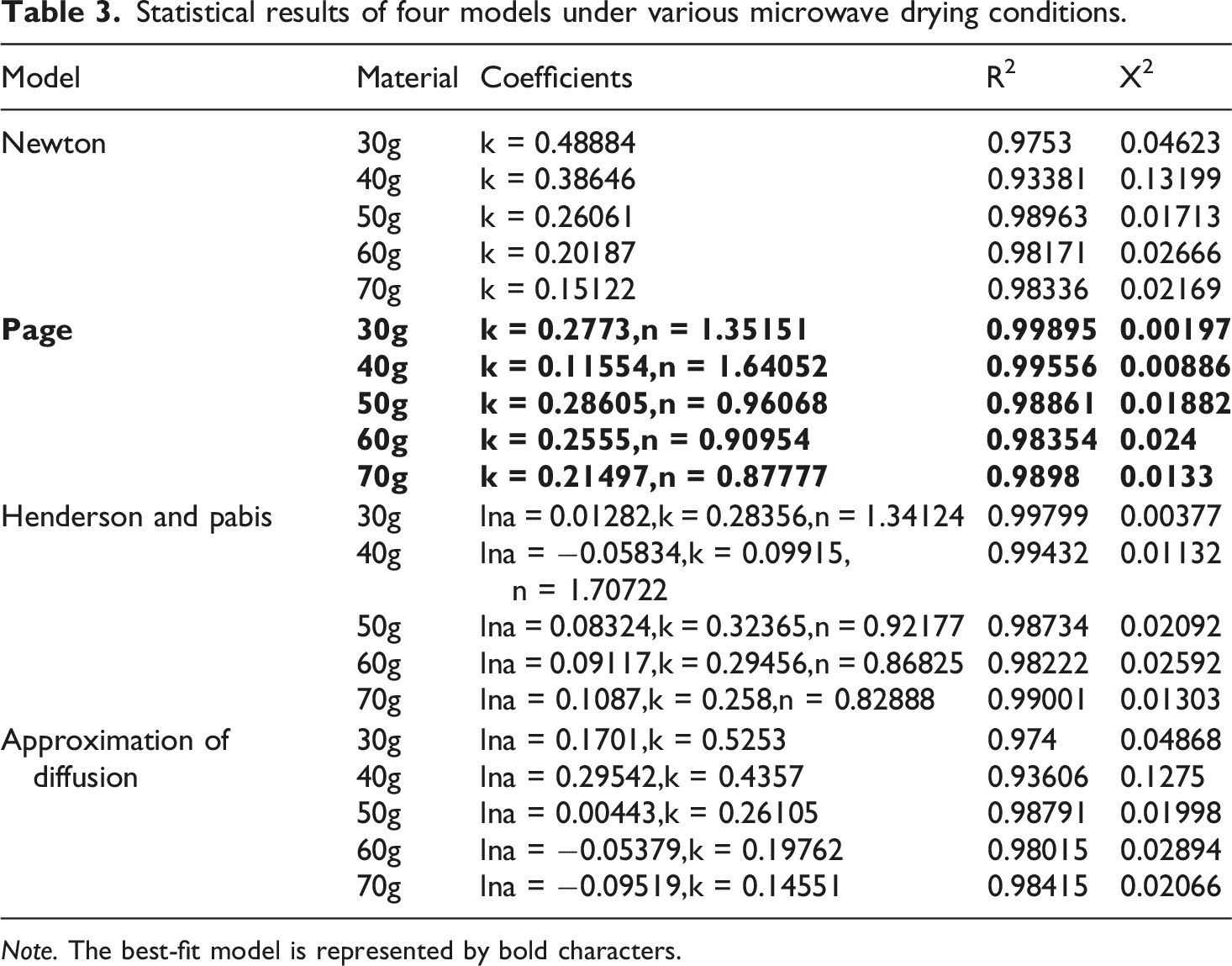
Statistical results of four models under various microwave drying conditions.
Note. The best-fit model is represented by bold characters.
Specifically, the fitting accuracy under different hot-air drying conditions ranked from highest to lowest as Page > Henderson and Pabis > Approximation of Diffusion > Newton. Under different microwave drying conditions, the fitting accuracy ranked from highest to lowest as Page > Henderson and Pabis > Newton > Approximation of Diffusion. Regardless of hot-air or microwave drying, the Page model demonstrated the optimal fitting performance. To illustrate the superior fitting performance of the Page model, this study plots the time-dependent moisture content obtained from the linearised Page model in Figure 2. Curves showing the time-dependent moisture content of the linearised Page model under different conditions: (a) Hot-air drying (varying feed rates); (b) Hot-air drying (varying temperatures); (c) Microwave drying (varying feed rates).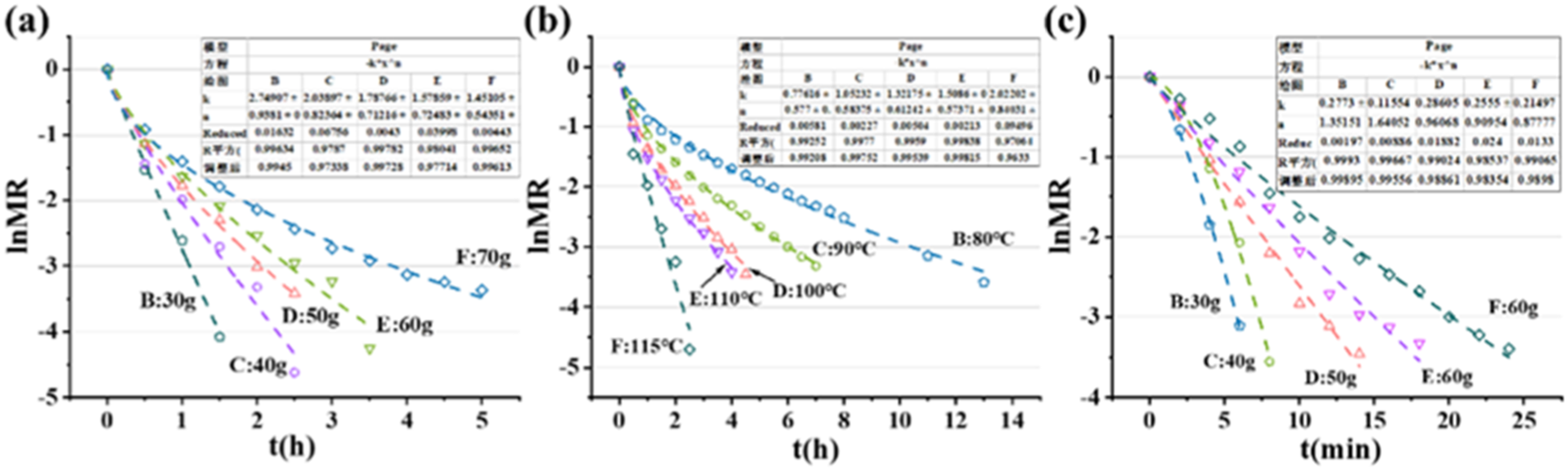
Validation of drying kinetic model
To further validate the model’s fitting performance, one set of variable conditions was selected: 40g of material at 115°C. The predicted and experimental moisture ratios during hot-air and microwave drying processes were compared, as shown in Figure 3. The results show that the experimental data points and predicted values exhibit a highly consistent linear distribution trend near the 45° reference line (y = x), with the vast majority of data points clustered closely on both sides of the reference line. This indicates that the Page model accurately captures the moisture change patterns during rubber drying. This excellent agreement is not only evident in the overall trend (R2 > 0.99) but also in the precise prediction of both the initial rapid dehydration stage and the later slow diffusion stage of drying, further validating the Page model’s ability to describe the kinetic behavior of rubber drying. The reliability of this model stems from its exponential form matching the internal moisture migration mechanism in rubber. It accurately reflects both the rapid evaporation of surface free water and the gradual diffusion characteristics of bound water in later stages. Furthermore, the consistency between experimental and predicted values remains stable across different drying methods (hot air/microwave), demonstrating the Page model’s strong robustness to variations in rubber drying conditions. Comparison of page model predictions and experimental values. (a) Hot air drying. (b) Microwave drying.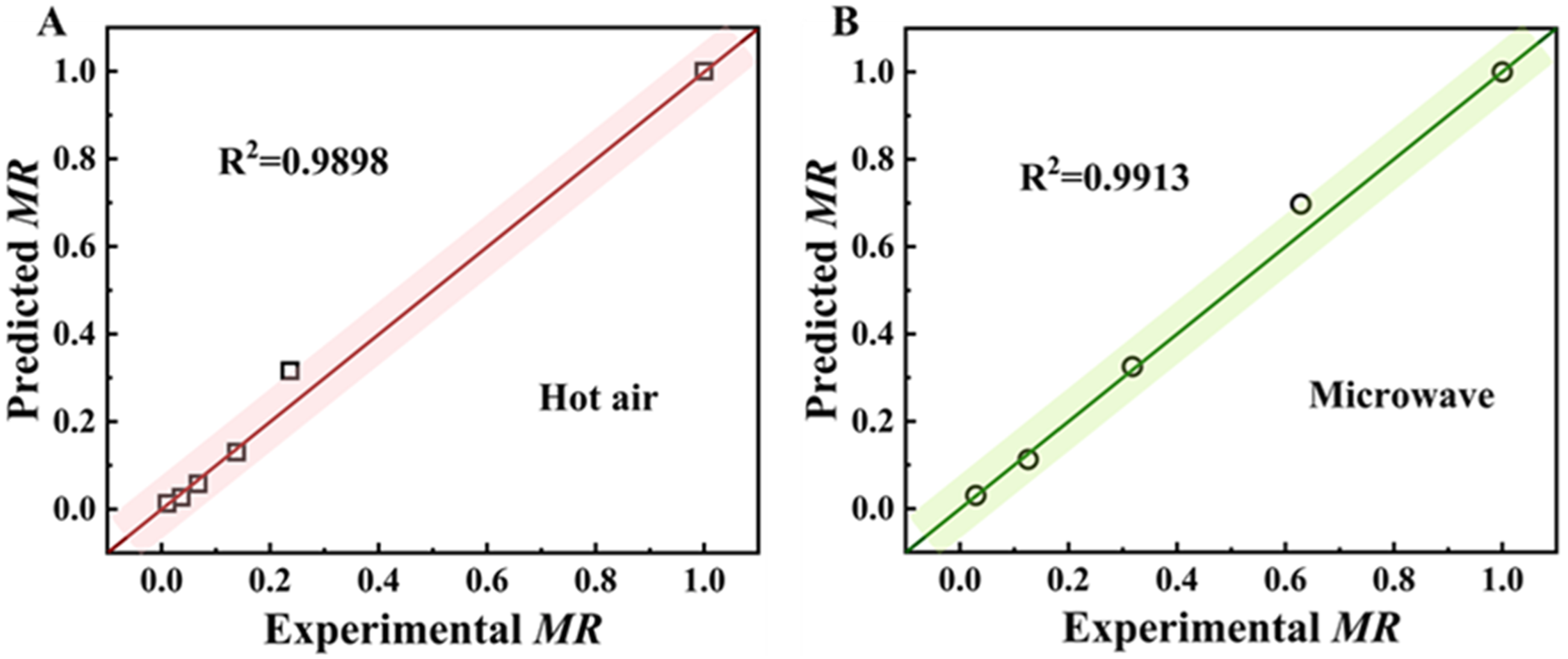
Mass transfer parameters
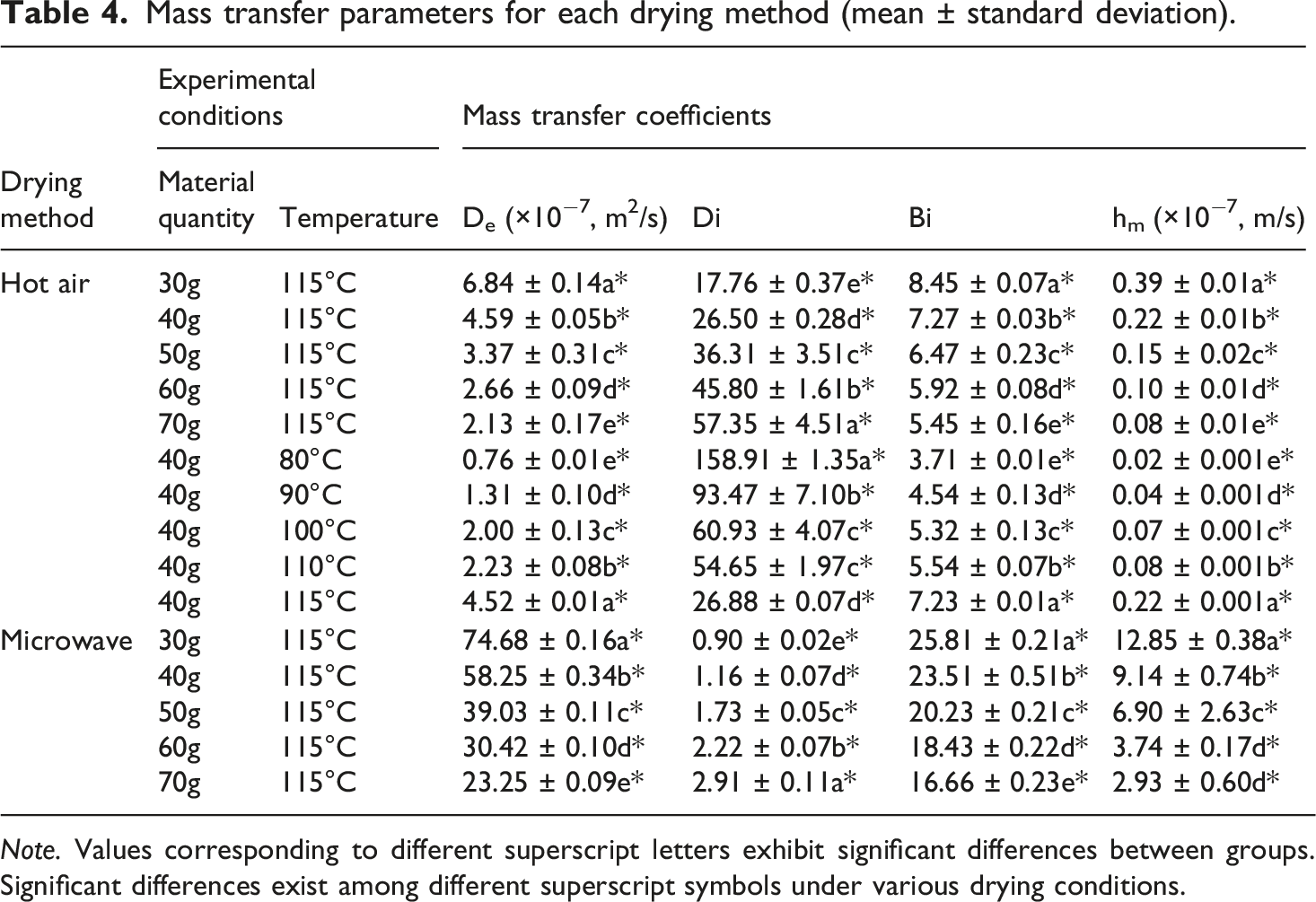
Mass transfer parameters for each drying method (mean ± standard deviation).
Note. Values corresponding to different superscript letters exhibit significant differences between groups. Significant differences exist among different superscript symbols under various drying conditions.
Analysis of the drying rate over time (Figure 1) reveals that mass transfer parameters during rubber drying are strongly influenced by material quantity and temperature conditions. Under conditions of smaller sample masses and higher temperatures, these parameters generally exhibit higher values. This trend can be attributed to the shorter moisture migration path associated with reduced material quantities, as well as the increased molecular kinetic energy induced by elevated temperatures, both of which significantly enhance mass transfer efficiency. Conversely, larger sample masses and lower temperatures result in longer drying times required to remove equivalent amounts of moisture. This is because, under such conditions, moisture removal is predominantly governed by slow internal diffusion mechanisms. Internal moisture diffusion encounters greater resistance compared to surface evaporation, leading to substantially reduced values of mass transfer parameters. Further comparison of the differences between the two drying processes reveals that hot-air drying primarily relies on convection or conduction of hot air to achieve heat transfer. This “outside-in” heating method creates a counter-current mass transfer path opposite to the direction of moisture migration, increasing mass transfer resistance and thereby hindering the outward migration of internal moisture. In contrast, microwave drying directly excites water molecules through an electromagnetic field, inducing vibration and internal heat generation, which enables “inside-out” volumetric heating. This co-directional mechanism fully aligns heat and mass transfer, not only eliminating counter-current resistance but also promoting outward moisture migration through the rapid buildup of internal vapor pressure. As a result, the mass transfer coefficient is significantly enhanced—this is the fundamental reason why microwave drying technology can substantially reduce drying time and improve drying efficiency.
Low-field NMR analysis
LF-NMR analysis and moisture diffusion mechanism
By comparing the spectra of hot-air drying and microwave drying in Figure 4, the distinct differences in moisture migration mechanisms between the two drying processes are clearly observable. The T2 spectrum of hot-air drying exhibits a prominent peak in the 102–104 ms range, corresponding to surface free water. This peak features a relatively long relaxation time. This phenomenon arises because hot-air drying relies on a counter-current mass transfer pathway (heat transfers from the exterior to the interior, while moisture diffuses from the interior to the exterior). Consequently, the removal rate of free water is slow, resulting in a large peak area with a gradual decay. Meanwhile, signals in the short T2 range (0.1–10 ms) are relatively weak, indicating a lower efficiency in the removal of bound water via hot air drying. This is attributed to the need to overcome significant intermolecular forces, which is consistent with the low mass transfer coefficient observed in this process (Deff = 0.76 × 10‒7 to 6.84 × 10‒7 m2/s). In contrast, the microwave drying T2 spectrum exhibits a significantly reduced peak area within the same interval (102–104 ms) and a leftward shift of the peak—indicating shorter T2 values—reflecting efficient removal of free water. This advantage stems from microwaves’ co-directional mass transfer mechanism (internal heating aligns heat and mass transfer directions) and higher mass transfer coefficient (Deff = 2.33 × 10‒6 to 7.47 × 10‒6 m2/s), accelerating water migration. Additionally, the enhanced signal observed in the short T2 interval (0.1–10 ms) during microwave drying indicates that the high-frequency electromagnetic fields generated by microwaves can disrupt the hydrogen bonding between water molecules and the polar functional groups of rubber. This converts some bound water into a mobile state, making it easier to remove. This distinction not only confirms the high efficiency of microwave drying in removing free water but also reveals its ability to activate bound water. This further explains why its drying rate significantly outperforms hot-air drying. T2 spectra for different drying methods: (a) Hot-air drying; (b) Microwave drying. T1-T2 spectra for different drying methods: (c) Undried; (d) Hot-air drying; (e). Microwave drying.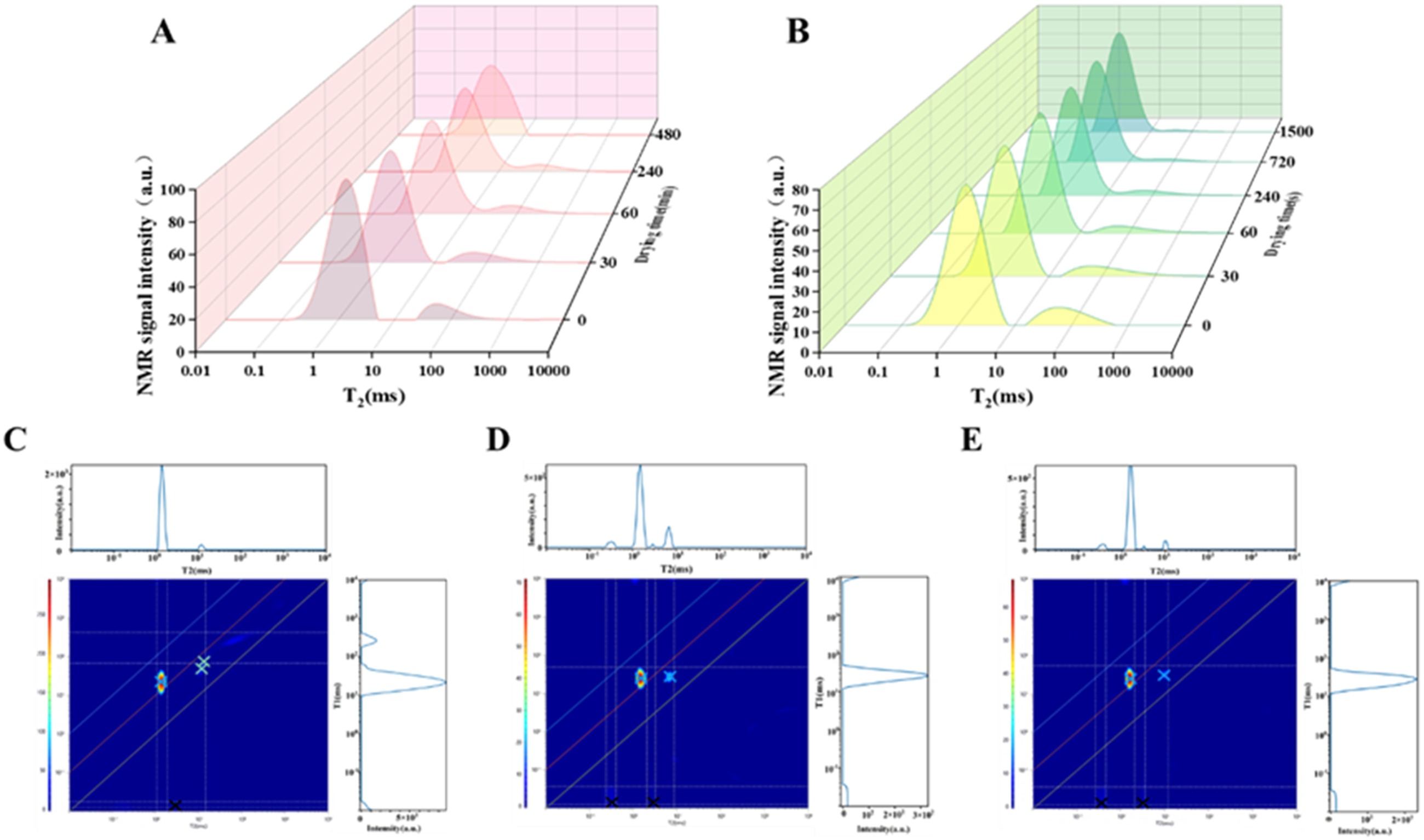
LF-NMR analysis and aging characteristics
During hot-air drying of natural rubber, as the degree of aging increases, changes such as cross-linking and breakage occur in the rubber molecular chains, leading to alterations in the degree of restriction on molecular motion. Low-field NMR (LF-NMR) analysis reveals that in the early stages of aging, molecular cross-linking restricts segmental motion, manifested by a rapid decay in signal amplitude. As drying continues, molecular chain breakage occurs in the later stages, resulting in increased molecular motion freedom in certain regions. In contrast, during microwave drying of natural rubber, LF-NMR detected minimal changes in signal amplitude, with molecular motion exhibiting a uniform trend of increased freedom. This indicates that microwave drying effectively delays the rubber aging process.41–43
LF-NMR analysis and peak shapes
Half-peak width and peak symmetry factor calculated for different hot-air drying times.

Half-peak width and peak symmetry factor calculated for different microwave drying times.
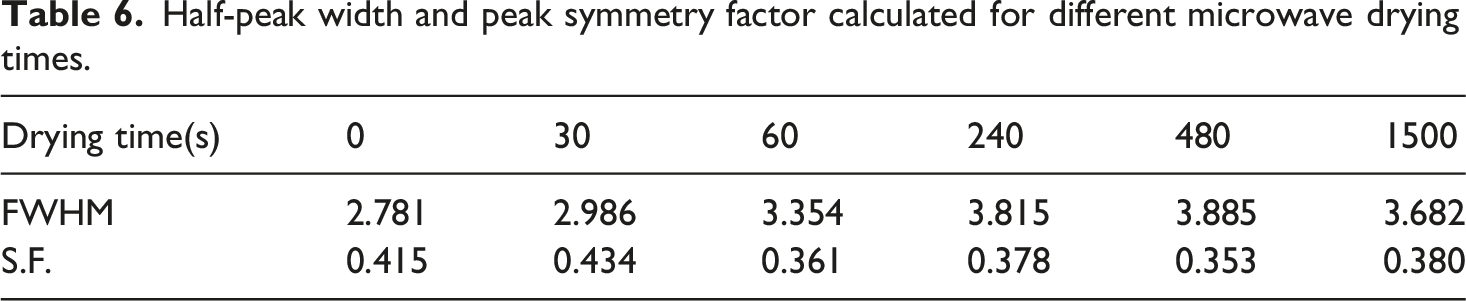
During hot-air drying of rubber, the initial peak observed via LF-NMR exhibits a sharp, symmetrical shape. As drying progresses, the peak gradually broadens and undergoes morphological changes, with symmetry disappearing. This indicates that diverse microenvironments form within the rubber during drying, leading to agglomeration, poor dispersion, and multiple factors affecting hydrogen proton relaxation. For instance, localized cross-linking or disentanglement of rubber molecules may occur, altering hydrogen proton relaxation properties in these regions compared to others. Alternatively, uneven moisture removal could cause differing interactions between rubber molecules and residual water at various sites, resulting in asymmetric relaxation time distributions. These phenomena indicate that rubber molecular motion is no longer uniform and regular as in the initial state. Instead, it is influenced by multiple factors, with various relaxation mechanisms acting concurrently.
Throughout the microwave drying process of natural rubber, the peak shapes exhibit symmetrical peaks compared to hot-air drying, indicating that the microscopic environment of hydrogen protons within the natural rubber system is relatively uniform during this process. This implies that most hydrogen protons possess similar motion states and relaxation characteristics. The relatively regular molecular structure of natural rubber and consistent intermolecular interactions result in similar local magnetic field environments experienced by hydrogen protons. Consequently, their relaxation times are concentrated during transverse relaxation, manifesting as sharp peak shapes in LF-NMR spectra. The symmetry of these peaks indicates no significant special environments or interactions favoring one side over another within the system. This suggests that the arrangement of rubber molecules and their interactions with the surrounding environment (such as moisture) are relatively balanced in all directions. No specific hydrogen protons are subject to unusual influences that would cause the relaxation time distribution to skew toward one side.
Conclusion
This study systematically compared the dehydration kinetics of natural rubber under hot-air and microwave drying conditions by employing four mathematical models to quantitatively characterize the drying behavior. The results show that the Page model (R2 > 0.99) accurately describes moisture migration under both drying methods. Its exponential form effectively captures the rapid evaporation of surface free water during the initial stage, while adequately representing the progressive diffusion of internal bound water in the later stages. Analysis of mass transfer parameters reveals that microwave drying, which utilizes a unique co-directional mass transfer mechanism—where volumetric heating aligns the directions of heat and mass transfer—exhibits significantly enhanced mass transfer efficiency. Specifically, the effective diffusion coefficient (Deff = 2.33–7.47 × 10‒6 m2/s) and the mass transfer coefficient (hm = 0.29–1.29 × 10⁻⁶ m2/s) are approximately one order of magnitude higher than those observed in hot-air drying (Deff = 0.76–6.84 × 10‒7 m2/s, hm = 0.08–0.39 × 10‒7 m2/s). This difference primarily arises from the dielectric heating effect induced by the microwave electromagnetic field, which excites high-frequency oscillations (2450 MHz) in water molecules, thereby significantly enhancing the driving force for water migration. Further investigation of the drying mechanism at the molecular scale using low-field nuclear magnetic resonance (NMR) revealed fundamental differences in hydrogen proton relaxation behavior between the two methods. During hot-air drying, the T2 spectrum gradually broadened and lost symmetry, reflecting the coexistence of molecular chain cross-linking (associated with shortened T2) and chain scission (linked to prolonged T2) caused by thermal-oxidative aging, resulting in a heterogeneous relaxation environment. In contrast, microwave drying consistently maintained sharp, symmetric T2 peak shapes. This indicates that its uniform electromagnetic field distribution effectively prevents localized overheating, maintaining hydrogen protons in a highly homogeneous chemical environment. This provides microscopic evidence of microwave drying’s superiority in preserving material structural integrity.
Footnotes

Author contributions
Dandan Yao: Conceptualization, Data curation, Formal analysis, Investigation, Methodology, Validation, Visualization, Writing – original draft. Chao Yuwen: Data curation, Investigation, Methodology. Linguang Ruan & Lin Yan: Conceptualization, Investigation. Shenghui Guo: Conceptualization, Investigation, Methodology, Supervision, Writing–review & editing. Bingguo Liu: Funding acquisition, Project administration, Supervision, Writing–review & editing.
Funding
The authors disclosed receipt of the following financial support for the research, authorship, and/or publication of this article: This study received significant support from the Yunnan Province Major Science and Technology Project (202302AC080001), the Yunnan Fundamental Research Projects (202401BE070001-009), the Yunnan Fundamental Research Projects(202501AU070099), the Yunnan Revitalization Talents Support Plan (XDYC-CYCX-2022-0044). And the Supported by Science and Technology Projects of Yunnan Universities Serving Key Industries (FWCY-QYCT2025008).
Declaration of conflicting interests
The authors declared no potential conflicts of interest with respect to the research, authorship, and/or publication of this article.