







Abstract
The impact of military service on the status attainment of World War II veterans has been studied since the 1950s; however, the research has failed to come to any consensus with regard to their level of attainment. Analyses have focused on cross-sectional or longitudinal data without considering the effects of service over the life course. The authors argue that World War II veterans, regardless of race, have greater attainment, measured in terms of education, income, and occupational prestige, over their lifetimes than nonveterans. They use census data from the 1950 through 2000 Public Use Microdata Sample. The authors find that military service afforded white veterans significant advantages through their early and middle working years; however, their nonveteran peers eventually caught up. They also find that black veterans receive more of a social status advantage relative to black nonveterans, and military service helps to close the socioeconomic gap between blacks and whites.
As of 2007, approximately 11 percent of armed forces veterans in the United States were World War II veterans. 1 The bridging hypothesis contends that military service members learn valuable skills while serving in the military that translate into opportunities in the civilian sector. 2 The primary aim of this study is to use 1950 through 2000 decennial census data to empirically test the bridging hypothesis. This research addresses the question of whether service in the armed forces functions to advantage or disadvantage World War II veterans' economic well-being, as measured by social status achievement (education, income, and occupational prestige).
Specifically, how are military service and the military as an institution valued by society, as indicated by the social status that World War II veterans achieve when they leave the service? Many have described the U.S. military as a meritocracy. In a meritocracy or any society where one is judged by one’s contributions, one should be able to change one’s social position by hard work and achievement. However, we question if one’s gains in human capital and achievement can overcome ascribed status, such as race. The decennial census data allow us to compare social status achievement across birth cohorts, using the life course perspective. These data also allow us to compare across racial categories by utilizing the human capital approach. In addition, with these data we can compare across six distinct points in time.
This research makes three distinct contributions to the fields of military sociology and social stratification. First, this research, unlike any of the previous research, tracks World War II veterans from 1950 through 2000 to compare them to their nonveteran peers over their entire adult lives. Previous research in the field has been much narrower in breadth, focusing on snapshots in time or short-duration longitudinal studies conducted over a period of ten years or less in most cases. Second, this study shows how military service affected those who served in World War II in terms of three different but interrelated measures of social stratification: education, income, and occupational status. Higher levels of education give people access to higher status occupations, which in turn are likely to produce more income. Third, this study provides a basis for choosing between earlier studies that suggest an advantage received by World War II veterans versus those that suggest a veteran disadvantage.
Background
Bridging Hypothesis, Life Course, and Human Capital Theory
The bridging hypothesis states that service members learn valuable skills while serving in the military that translate into opportunities in the civilian sector. 3 According to this hypothesis, a bridge is created because the military provides opportunities for both training and education that, in many cases, is directly applicable to civilian sector work. This is consistent with Broom and Smith’s original conception of a bridging occupation, which they describe as one “that provides, through work experience, the conditions and opportunities for movement from one occupation to another.” 4 Interestingly, in their original work, they describe the work of a soldier as a bridging occupation.
Some scholars have examined veteran attainment through the lens of a life course perspective with an emphasis on alteration. Military service is viewed as a life-altering experience that affects “the timing and sequencing of events in the transition to adulthood, especially when they occurred early in life.” 5 Many have identified service in the armed forces as a turning point in the life course because it can alter trajectories in either an advantageous or a detrimental manner. Elder, Modell, and Parke suggest that service in the military increases the likelihood of redirection in a person’s life and provides opportunities that may not be available in civilian life. 6
Human capital theory is integrally tied to both the bridging hypothesis and the life course perspective in that it also attempts to explain education, wage, and occupation differentials in individuals. One of the foundations of human capital theory is that both education and training—undertaken for the purpose of increasing personal income—are costly in terms of time and money and should therefore be considered investments. 7 For service members, the costs are defined in terms of time that could be spent in civilian jobs that could potentially increase on-the-job training and seniority, networking opportunities, and earnings. The time also could be spent on higher education that could increase future occupational status and earnings. Conversely, Elder argues that the military helps develop human capital from a life course perspective. 8 His argument is based on the belief that service in the armed forces can serve as a “mechanism by which unpromising beginnings lead to opportunity and fulfillment instead of to failure.” 9
Prior Research
World War II veterans' social status attainment studies
Stouffer et al. conducted one of the first studies on veteran attainment of social status. 10 Among other results, they found that World War II veterans were generally optimistic about their personal prospects for increasing their individual social status after the war but pessimistic about their prospects as a group. The fact that servicemen tended to be more optimistic about their personal chances of employment than about the chances of employment for veterans in general is significant because most of the subsequent research on World War II veterans shows that they did well compared to their nonveteran peers.
A great deal of research has shown that white World War II veterans tend to do better than their white nonveteran peers in terms of income and education. 11 When looking at Duncan Socioeconomic Index (SEI), Dechter and Elder distinguished between the differences in social status attainment of officers and enlisted servicemen. They found that officers had greater postwar SEI occupational advantages than enlisted servicemen. 12 In contrast, enlisted men actually fared worse than nonveterans. It is worth noting that most of the officers who served in WWII were white, while blacks are and have been primarily concentrated in the enlisted ranks. 13 Focusing on income rather than occupation, Angrist and Krueger concluded that World War II veterans earn less than nonveterans. 14 Thus, prior research shows both positive and negative effects of World War II veteran status.
Several patterns emerge in the literature on World War II veterans' social status attainment. Some of the research on World War II veterans demonstrates that they received an advantage for their service in the armed forces. 15 The research points to the Servicemen’s Readjustment Act of 1944—commonly referred to as the GI Bill of Rights. The goal of this legislative measure was to help World War II veterans transition back into civilian life by helping with educational training, unemployment compensation, and loan guarantees for homes, farms, and businesses. Any veteran with at least ninety days of service with an honorable discharge from the service could qualify. Veterans used these benefits to the fullest extent, and in 1946 the Veterans Administration reported that 6.6 million veterans had applied for school or job training. 16 The expansive benefits of the GI Bill are viewed as a significant factor in the attainment of social status for World War II veterans.
The social status advantage stemming from the GI Bill extended to both white and black men in World War II. In fact, some authors suggest that the black veteran advantage was greater than any other WWII veteran advantage. Military service may allow blacks and other minorities to more clearly understand mainstream achievement values and work within a structured environment as well as appreciate the value systems of others to whom they may otherwise not have been exposed were it not for military service. The military also may serve as a transition point in the lives of troubled black youth and allow them to change the trajectory of their life course, thus severing them from their past and allowing them to move on to new opportunities. At the same time, it must be recognized that the fact that black men were eligible for GI Bill educational and mortgage benefits did not mean that they could go to the colleges of their choice or buy the houses they might have wanted in a racially segregated America.
Critique of veteran social status attainment studies
In general, relatively few measures of social status attainment have been used in World War II veteran studies. Several studies have used earnings income or educational attainment or both as measures of social status attainment. Other studies have added a measure of occupational prestige, usually Duncan’s SEI of the respondent’s job. 17 Furthermore, these studies have generally relied on the use of earnings income and have not used family or household income, retirement income, disability income, or benefits in kind to measure veterans' or comparison groups' earnings. Adding these sources of income and benefits might change the way that we understand veteran social status attainment.
A large number of studies have used longitudinal data to examine World War II veterans' social status attainment. Some researchers have relied on cross-sectional data from either census data or social security records. These data sources may not tell the whole story behind veteran attainment. For example, Fredland and Little used the 1966 National Longitudinal Survey and Villemez and Kasarda as well as Martindale and Poston used 1970 census data to examine WWII veteran income attainment. 18 All of this research found that WWII veterans earned a premium for their service regardless of race but that blacks and nonwhites earned greater premiums than whites compared to their nonveteran peers.
Although some studies have controlled for geographic region, most have used national data and have not made any attempt to understand how geographic region of origin and place of residence affect veteran social status attainment. These studies assume that income in one geographic area is equal to income in another area. Regional and local labor market differences may make a significant difference in veteran attainment. For example, it has been shown that those labor markets with high military presence are less segregated in terms of residence and employment. 19
Hypotheses
Based on the veteran status attainment literature and underlying notions—human capital, life course, and bridging environment hypothesis—our hypotheses reflect our expectations regarding comparisons between male World War II veterans and male nonveterans over six decennial census periods. First, as human capital theory and some previous research suggest, controlling for background factors such as region, marital status, and education level, male World War II veterans should attain greater social status than do their male nonveteran peers.
Hypothesis 1: Veterans will have more education, income, and occupational prestige than will their nonveteran peers.
Hypothesis 2: The black veteran advantage will manifest itself in increased income, education, and occupation opportunities. Black veterans will receive more of a social status attainment advantage relative to black nonveterans than will white veterans relative to white nonveterans.
Second, the bridging environment hypothesis suggests that, overall, male World War II veterans and particularly those who are more disadvantaged from the outset should achieve greater socioeconomic status than do their male nonveteran counterparts.
Method
Data
We use the 1 percent Integrated Public Use Microdata Series (IPUMS) sample of the 1950 through 2000 decennial censuses. The IPUMS consists of thirty-seven representative samples drawn from the American population over fifteen federal censuses. The 1 percent sample contains approximately 744,000 household and 2,267,000 person records for 1950–2000. 20 All of the IPUMS samples are cluster samples and are based on households or dwellings. The 1960 and subsequent samples employ more elaborate stratification schemes than did the 1950 sample (see the results section for a discussion on the 1950 veteran underenumeration). The latter samples are based not only on geography but also on such characteristics as household size, race, and group quarters membership. In addition, the 2000 decennial census allowed for multiple race categories to be entered as responses. The IPUMS allows for integration of these variables to ensure a seamless comparison across the six decades.
After removing those with zero income and zero on the SEI scores our total sample over all six periods consists of 739,920 respondents. The SEI is a measure of occupational prestige that is calculated using the income level and educational attainment associated with each occupation in 1950. Otis Dudley Duncan derived scores for each occupation using median income and education levels for men in 1950 to predict prestige assessments of a select group of occupations based on a 1947 survey. Duncan’s resulting statistical model was used to generate scores for the entire range of 1950 occupations and is still widely used to compare occupations today. 21 The Duncan SEI scale ranges from 3 to 96. A 3 on the scale might typically include occupations such as “coal mine operatives and laborers; operatives, yarn, thread and fabric mills; porters; laborers, saw mills, planning mills and mill work.” 22 An SEI score of 96 would include occupations and professions such as architects, dentists, chemical engineers, lawyers and judges, physicians, and surgeons.
To allow our analysis to contain no one older than one hundred years, we removed those born prior to 1900. This left us with 739,920 respondents, of whom 358,300 are veterans, who represent approximately 48.42 percent of the sample, and black veterans are approximately 6.42 percent of the veterans.
Analysis
Data analysis focuses on the central question regarding the differences in attainment between World War II veterans and their nonveteran peers. We use descriptive statistics to first define the characteristics of the sample and the distributions of the variables to be analyzed. Then we use multivariate regression analysis (ordinary least squares; OLS) to determine the effect of several independent variables on our three dependent variables: education, income, and occupational prestige. We code education in three categories: less than high school, high school graduate, and some college. We use the natural logarithm of wages and earnings income, as opposed to income, because it more closely approximates the normal distribution. As mentioned above, our SEI scores for occupational prestige range from 3 to 96.
Based on the literature, data limitations, and scope of the problem, we limit this study to males who were of service age during World War II and who were black or white. The racial and ethnic categories for Hispanics and other minority groups have changed multiple times between the 1950 and 2000 censuses and would therefore be difficult to disentangle in this study. Women were excluded from the study because they were not asked their veteran status until the 1980 decennial census. We limit the study to those who had some positive income and were working at each decennial census point. Because it is impossible to take the log of a negative number or zero, this study does not capture the social status attainment of those with no income, the homeless, those who dropped out of the labor force for any other reason, or those who received only benefits in kind. These exclusions all come at the cost of degrees of freedom, a reduction in sample size, and a clearer understanding of veteran social status attainment in the aggregate.
We use several independent variables to test the stated hypotheses, including veteran status, race, age squared, marital status, region, educational attainment, interaction terms that account for the interaction of veteran status and race (coded so that it measures the joint effect of being black and a veteran), and percentage of veterans in a birth year. We use age squared given that income typically rises with age and then levels off. The background variables include marital status (married or single) and regional variables (North or South). We removed the widowed and West region variables from the regression equations because they caused a dependency problem among the independent variables in the proposed model. In addition, in all of the regressions that include education as a dependent variable, we removed the education independent variables. We recognize that education can affect income and occupational prestige.
Results
Decennial Census Underenumeration
The 1950 decennial census was the first census following World War II in which World War II veterans could have claimed veteran status. In this census year the veteran population in general and the World War II veteran population in particular were underenumerated. A plausible reason for the underenumeration could have been the large number of veterans who were in institutions of higher education as a result of the Servicemen’s Readjustment Act of 1944. The primary purpose of this act was to ease World War II veterans' transitions back into civilian life by providing education, training, guaranteed home loans, unemployment compensation, and job finding assistance. The bill was designed as a social welfare program to reduce the economic burden caused by the demobilization of millions of service members. 23 It also was designed to alleviate some of the problems that resulted from the World War I demobilization. Returning World War I veterans received a sixty-dollar allowance and a train ticket home—making their return to civilian status a “rude and bitter” experience—punctuated by a recession and followed by the Great Depression of the 1930s.
In the peak year of the program, 1947, veterans accounted for 49 percent of college enrollment. Of the 15.4 million veterans in the population approximately 7.8 million were trained, including 2.23 million in college, 3.48 million in other schools, 1.4 million in on-the-job training, and 0.69 million in farm training. 24 Some estimate that the influx of veterans into the education system doubled the number of college students at that time. 25 In fact, at some institutions of higher education veterans composed the majority of the student body. For example, in 1945 veterans made up 89 percent of New York University’s student body. 26 These trends are clearly reflected in the percentage change in the number of respondents who stated that they had some college or a college degree between 1950 and 1980.
Descriptive Results
The first step in this analysis is to present the descriptive statistics of the sample by comparing the means of the key variables. We conducted t-tests between veterans and nonveterans on age, region, marital status, and income. The shaded areas in Tables 1 and 2 indicate those means that are not statistically significant at the .05 level. Although the results are not shown, t-tests were also performed on income, education, and occupational prestige for age groups (20–24, 25–34, 35–44, and 45–50). Tables 1 and 2 are aggregated to include all age categories.
Descriptive Statistics of Black Veterans and Nonveterans
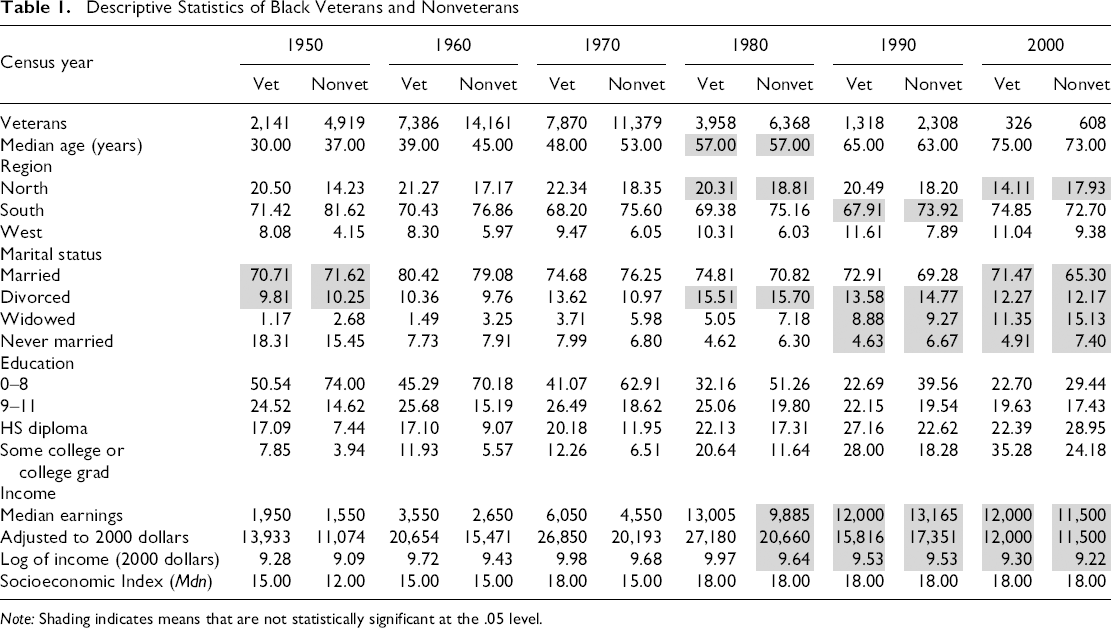
Note: Shading indicates means that are not statistically significant at the .05 level.
Descriptive Statistics for White Veterans and Nonveterans
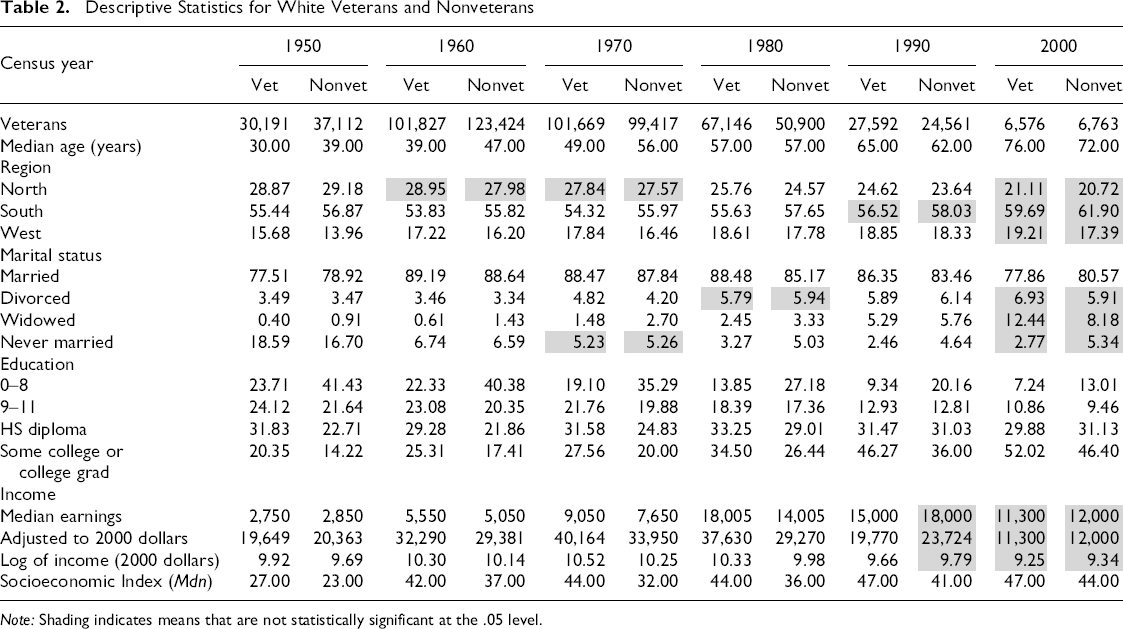
Note: Shading indicates means that are not statistically significant at the .05 level.
Veteran status
Tables 1 and 2 also present the demographics for each census by veteran status and race. Approximately 90 percent of the sample in each year is white, and the remainder is black. When we compare within racial groups by veteran status in Tables 1 and 2, as one might expect, we see that the majority of the black respondents, unlike white respondents, are nonveteran. The World War II army was racially segregated, with relatively few black units. In each year, black nonveterans outnumber black veterans by a ratio of roughly 2:1. A different trend exists for whites. We find that there are fewer white veterans than white nonveterans in 1950 and 1960 (see the above discussion on the 1950 underenumeration). After 1960 and until 2000, there were more white veterans than white nonveterans. In 2000, the white veteran and white nonveteran numbers were essentially identical.
Age
Examining age across the decades for black and white veterans and nonveterans, we find that, between 1950 and 1970, the median age of black and white veterans is lower than that of their black and white nonveteran counterparts. In 1980, the median ages of veterans and nonveterans, regardless of race, are identical. After 1980, the trend reverses, and the median age of black and white veterans is higher than that of their black and white nonveteran counterparts. One could argue that morbidity rates for nonveterans might be higher than those of their veteran peers, excluding combat deaths, because only healthy members of the population are conscripted.
Region
Based on our other control variables—region, marital status, and education—the veteran and nonveteran proportions for region of residency are very similar for whites and blacks. At least 66 percent of all blacks and 50 percent of whites, regardless of veteran status, live in the South. This trend is consistent across all time periods.
Marital status
For each decade, close to 75 percent or more of the sample, regardless of race or veterans status, is married. Whites are slightly more likely to be married, while blacks are slightly more likely to be either divorced or widowed.
Education
Blacks and whites steadily increase in their percentage of college graduates from cohort to cohort for both veterans and nonveterans. However, whites have a higher percentage of college graduates than do blacks, regardless of veteran status.
Income
The incomes for veterans and nonveterans, as well as for blacks and whites, rose between the 1950 and 1980 censuses. During this time, for the most part, black and white veterans had higher median log incomes than did their nonveteran counterparts, except for white nonveterans in 1950. Income figures are expressed in log dollars. Log dollars were computed by taking the natural logarithm of income adjusted in year 2000 dollars. By 1990, there is no significant difference in mean income between black veterans and black nonveterans. This signals an end to the black veteran advantage. The same is true for whites. Overall, we see that white veterans earn less after 1970 than in previous years; however, among blacks, nonveterans earn more as they age.
Duncan Socioeconomic Index
Because one of the variables used to create the SEI is income, it is the case that the mean SEI differences between veterans and nonveterans and across all groups of comparison are similar to the mean differences in income. The mean SEI for the sample is 31.71, with a median of 22. An SEI of 31 on the 1950 Duncan scale would include occupations such as building managers and superintendents, self-employed proprietors, boilermakers, machinists, sheriffs, and plumbers. Veterans have a significantly and substantially higher mean SEI than do nonveterans, whites have a significantly and substantially higher mean SEI than do blacks (except for 2000), and black veterans have a significantly higher mean SEI than do black nonveterans (except for 1980 and 1990). White veterans have a significantly and substantially higher occupational prestige than do white nonveterans in all years.
Regression Results
Remember that our interest is in examining the social status attainment of veterans and nonveterans by race. In the next section we use the terms advantage and disadvantage to interpret our regression results. Before we begin our interpretation we want to clarify what we mean by advantage and disadvantage. When we use the term advantage we are referring to a positive coefficient. Likewise, when we speak of a disadvantage we are referencing a negative coefficient.
Education
Table 3 highlights the results of educational attainment regressed on World War II veteran status, age, race, marital status, region, education, race and veteran status interaction, and percentage of birth year for each decade. We first examine the education regression results since much of past research suggests that GI Bill educational benefits are important factors in veteran social status attainment. 27 We also believe that it is important to understand the impact of veteran status on education prior to using education as a predictor for veteran income and/or occupational prestige. We suggest that controlling for these background factors, World War II veterans will attain greater social status (measured by education, income, and occupational prestige) than their nonveteran peers.
Education Models
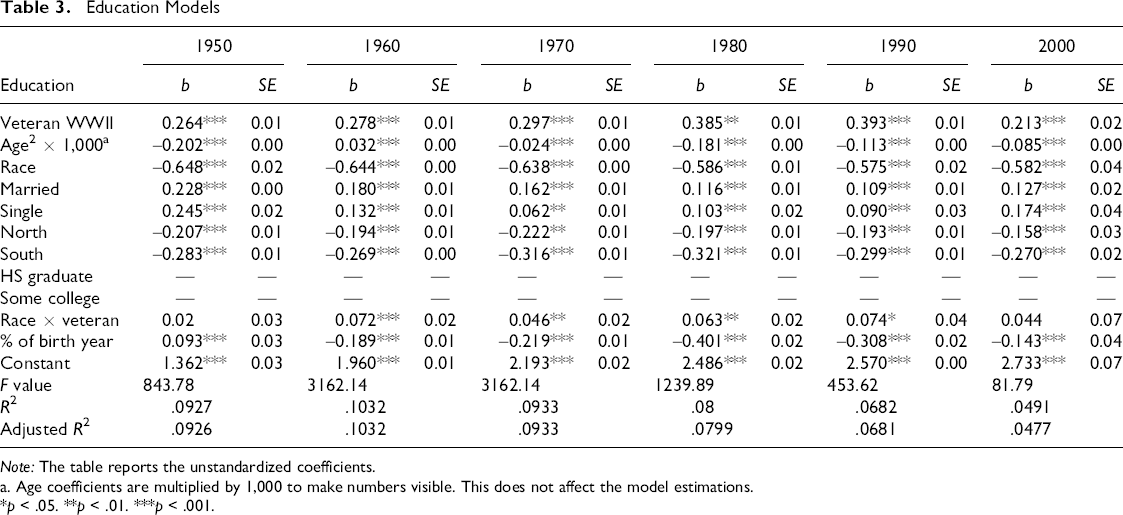
Note: The table reports the unstandardized coefficients.
a. Age coefficients are multiplied by 1,000 to make numbers visible. This does not affect the model estimations.
*p < .05. **p < .01. ***p < .001.
In Table 3, the models show an educational advantage for World War II veteran status and race. For age, we find that being older provides an educational disadvantage. For each year, we find that the educational attainment for World War II veterans grows in magnitude. However, we do see a slight drop in the educational attainment advantage for World War II veteran status to 0.213 in 2000 from 0.393 in 1990. In reference to race, blacks clearly have an educational disadvantage compared to whites. For each period (with the exception of 2000) and starting in 1960, this educational attainment disadvantage for blacks begins to decrease slightly. There is, however, a slight increase in their educational attainment disadvantage between 1990 (–0.575) and 2000 (–0.582). We conclude that World War II veteran status is the strongest positive predictor and race is the strongest negative predictor of educational attainment.
When we examine the control variables across each decade we find that for the most part married and single respondents both have an educational advantage, while being from the North or South (relative to the West) provides an educational attainment disadvantage. There are also educational attainment advantages associated with being married or single versus being divorced or widowed, although the educational attainment advantages are generally double for being married versus being single in every census period. Interestingly, residing in the North and the South versus the West generally resulted in educational disadvantages; however, these disadvantages for living in the South were substantially higher than living in the North relative to the West. In addition, and with the exception of 1950, there is a large educational attainment disadvantage for being in a birth cohort with a large proportion of veterans.
The above findings suggest that in terms of educational attainment, World War II veterans do in fact receive substantial educational advantages relative to their nonveteran peers. Furthermore, these educational advantages extend to both black and white veterans, although the magnitudes of the differences are slightly higher for black veterans relative to black nonveterans than white veterans relative to white nonveteran peers. Figure 1 clearly illustrates how these advantages are maintained throughout the lives of veterans. This figure shows that veterans have more education than their nonveteran peers, regardless of race. However, by 2000 white veterans and white nonveterans are close to converging on educational attainment while black veterans continue to have higher levels of education than their black nonveteran counterparts.
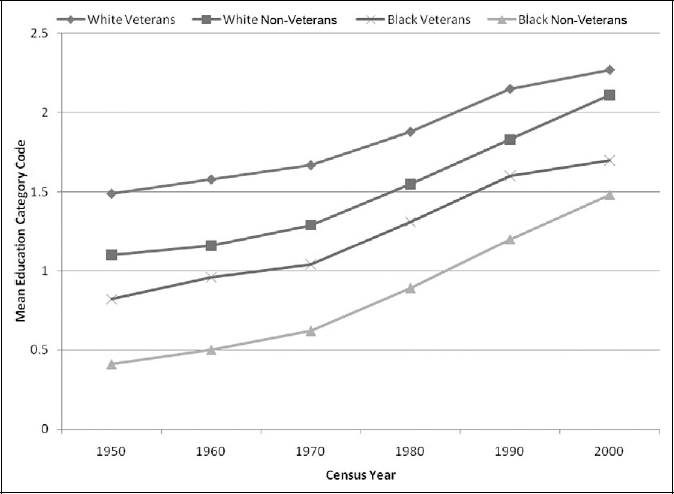
Black and white veteran versus nonveteran education
Income
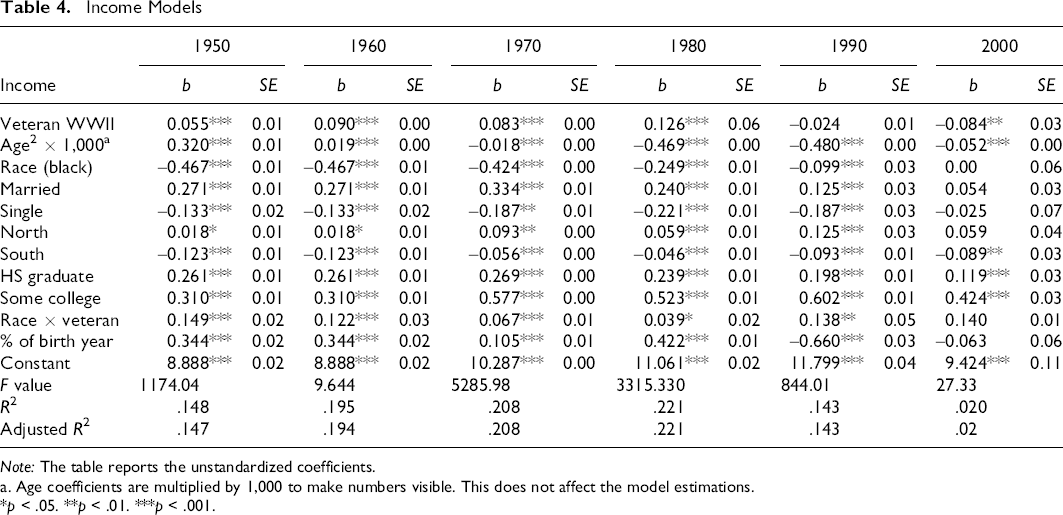
Table 4 illustrates the results of income regressed on the same variables as educational attainment with the addition of education. Age (being older) generally provides income advantages in the 1950 (0.320) and 1960 (0.019) censuses. However, beginning with the 1970 census, and continuing to the 2000 census, older respondents experience an income disadvantage. We suspect that this reflects older men cutting back from full-time employment. The World War II veteran status and race predictors do not have the same consistency and strength for income as they did for education. Race is a strong negative predictor of income for most years, but so is living in the South. In fact, living in the South is a consistent negative predictor of income for each year. Race reverses direction in 2000 and is no longer statistically significant during the same time period. Across each decade we find, for the most part, married respondents, those from the North, high school graduates, and those with at least some college all experience income advantages, while being single, black, or from the South results in significant income disadvantages. The region effect remains stable across all six censuses, unlike the education models in the previous section. As expected, we find that education contributes a great deal to an income advantage.
Income Models
Note: The table reports the unstandardized coefficients.
a. Age coefficients are multiplied by 1,000 to make numbers visible. This does not affect the model estimations.
*p < .05. **p < .01. ***p < .001.
We find that black veterans as compared to black nonveterans continue to experience an income advantage for their service, except in 2000. One noteworthy result emerges when we compare the black veteran income advantage in the 1960s (0.122) to that of the 1970s (0.067). It is clear that their income advantage decreased sharply over the decade. This can be an indication either that civil rights benefits were not tied to service or that civil rights benefits had not been realized by 1970. It is clear, however, that those who are single, black, or from the South have significant income disadvantage.
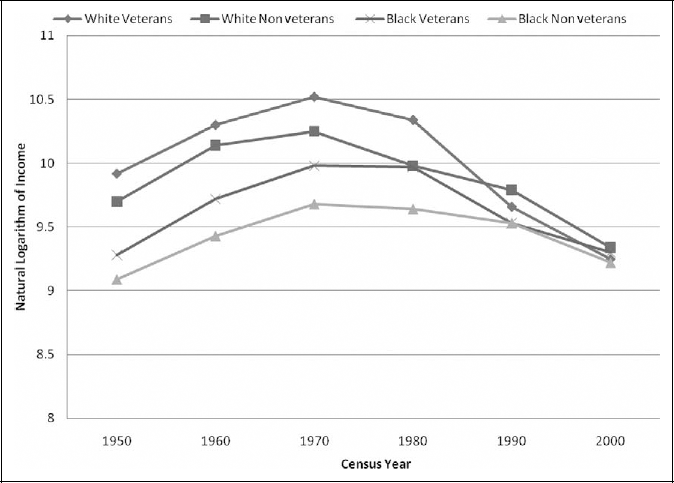
Figure 2 shows the mean natural logarithm of earnings for World War II veterans and nonveterans by race from the 1950 census through the 2000 census. This figure clearly illustrates that World War II veterans have an income advantage over their nonveteran peers. We also find—similar to the education results—that although both black and white veterans earned an income advantage, the magnitude of the difference between black veterans and black nonveterans was greater than the magnitude of the difference between white veterans and white nonveterans. In addition, Figure 2 shows that income for World War II veterans increased dramatically between the 1950 and 1960 censuses, leveled during the 1970 and 1980 censuses, and decreased during both the 1990 and 2000 censuses. By 2000 the income for all four groups converged. Our findings suggest that the income advantage for World War II veterans began when they entered the civilian labor force and remained until the 1990 census, at which point their nonveteran peers, regardless of race, still in the labor force caught up and in some cases surpassed them in terms of income.
Black and white veteran versus nonveteran natural logarithm of income by census
Occupational prestige
The descriptive section above shows very clearly that veterans generally have higher occupational prestige than nonveterans, that whites generally have higher occupational prestige than blacks, and that both black and white veterans generally have higher occupational prestige than their nonveteran peers. As in the previous sections for education and income, we use OLS regression to simultaneously control for several factors that might be associated with SEI to determine if veterans groups receive an occupational prestige advantage or disadvantage for their service. We expect that the mean SEI differences between veterans and nonveterans, blacks and whites, black veterans and black nonveterans, and white veterans and white nonveterans will be similar to the mean differences in income given that income is one of the variables used to create SEI.
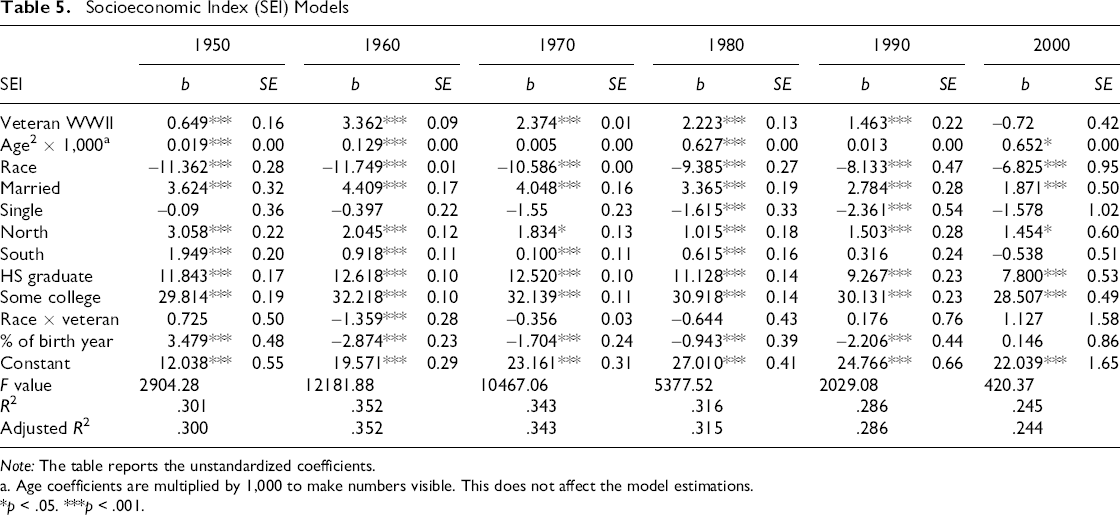
Table 5 shows that veterans have an occupational prestige advantage over their nonveteran peers. This finding as well as those for the education and income models serve to substantiate our notion that these veterans will have more education, income, and occupational prestige than will their nonveteran peers. Across the decades we see a substantial change in the occupational prestige advantages for veterans. Veterans earned an SEI advantage until the 2000 census. The veteran SEI advantage increased from the 1950 census (0.649) to the 1960 census (3.362), leveled out in the 1970 (2.374) and 1980 (2.223) censuses, decreased in the 1990 census (1.463), and dropped precipitously to an SEI disadvantage by 2000. The black veteran coefficient (race and veteran interaction term) is statistically significant only in 1960. We find that the only period in which members of large veteran cohorts earned an SEI advantage is in 1950 (3.479). This suggests that those born to cohorts with larger proportions of World War II veterans do not experience an occupational prestige advantage more than those born to cohorts with lower proportions of veterans.
Socioeconomic Index (SEI) Models
Note: The table reports the unstandardized coefficients.
a. Age coefficients are multiplied by 1,000 to make numbers visible. This does not affect the model estimations.
*p < .05. ***p < .001.
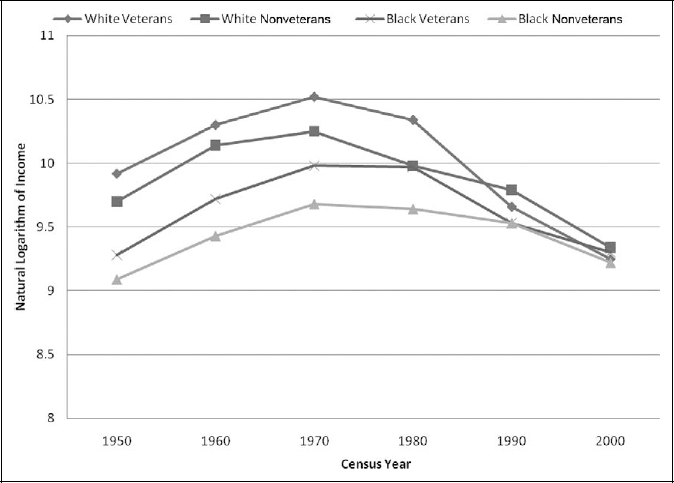
Figure 3 shows the SEI scores for World War II veterans and nonveterans by race from the 1950 census through the 2000 census. This figure clearly illustrates that World War II veterans will have higher SEI scores than will their nonveteran peers. We see that although both black and white veterans have an occupational prestige advantage, the magnitude of the difference between black veterans and black nonveterans is much less than the magnitude of the difference between white veterans and white nonveterans. In addition, Figure 1 shows that SEI scores for white World War II veterans increased dramatically between the 1950 and 1960 censuses and began leveling off at the 1970 census. Our findings suggest that the occupational prestige advantage for black World War II veterans began when they entered the civilian labor force and remained until the 1980 census, at which point their black nonveteran peers caught up in terms of occupational prestige. By 2000, black nonveterans barely surpassed black veterans in terms of occupational prestige. When it comes to occupation, there is still a strong race effect.
Black and white veteran versus nonveteran Duncan Socioeconomic Index (SEI) score by census
Discussion
Our first hypothesis states that as human capital theory and previous research suggest, controlling for background factors such as region, marital status, and education level, World War II veterans will have more education, income, and occupational prestige than will their nonveteran peers. We find this to be the case with education, income, and occupational prestige, but to lesser degree for latter. The magnitude of these veteran and nonveteran differences is most pronounced in the earlier censuses.
The second hypothesis states that the black veteran advantage will manifest itself in increased income, education, and occupation opportunities. Our hypothesis goes on to suggest that black veterans will receive more of a social status attainment advantage relative to black nonveterans. Our data show that World War II veteran status does not serve as an education, income, and occupational prestige equalizer for race. We conclude that military service does serve to close the gap between blacks and whites.
The basic findings include that male World War II veterans, both black and white, surpassed their nonveteran peers through their life course but more so in the earlier years. The more highly educated men, black and white, veterans and nonveterans, remained in the labor force longer than the less educated. Although the race gap in education was not closed by World War II veteran status, black veterans were more advantaged relative to their nonveteran peers in terms of education than were white veterans relative to white nonveterans. In a larger context, this study clearly indicates that service in the armed forces can be a viable option to gain entry into the middle class, especially entry into the black middle class.
The veteran advantage in education among both black and white men contributed to a veteran income advantage. After 1950, the income of male World War II veterans, both black and white, declined more than that of nonveterans. By 2000, the incomes of male veterans and nonveteran, both black and white, had converged. The educational and income advantages enjoyed by white veterans were reflected in higher occupational status than that attained by nonveterans. These gains were not realized among black males.
Footnotes
The authors declared no potential conflicts of interests with respect to the authorship and/or publication of this article.
This research was supported in part by the U.S. Army Research Institute for the Behavioral and Social Sciences under contract W91WAW 09 C 0077. The views expressed in this article are those of the authors and not necessarily of the Army Research Institute, the Department of the Army, or the Department of Defense.