







Abstract
This study investigates how veteran status influences earnings for working-age American women. Recent increases in women’s participation in the U.S. military mean that the proportion of female veterans is rising and is forecast to increase over the next 30 years. Yet we still know relatively little about the relationship between women’s military experience and later labor-market outcomes. Drawing on American Community Survey data from 2008 to 2010 and employing a new set of occupational categories better suited to veterans, we investigate how occupation and race/ethnicity influence the effect of veteran status on women’s earnings. Findings corroborate previous support for the “bridging hypothesis” in two ways. First, veterans are overrepresented in higher paying occupations and underrepresented in the lowest paying ones, partially accounting for their higher earnings. Second, military experience particularly enhances the earnings of disadvantaged race/ethnic minority women.
At a time when popular stories of women’s military experience are at a peak—including the opening of all positions to women (Pellerin, 2015)—research is only beginning to scratch the surface of how such a dramatic social shift is changing women’s lives. Women now represent 14% of active duty enlisted personnel (up from 2% in 1973) and 16% of officers (up from 4%; Patten & Parker, 2011). These increases mean that the proportion of female veterans has been rising, and it is forecast to increase still further over the next 30 years (National Center for Veterans Analysis and Statistics, 2014). Indeed, while the overall veteran population is expected to decline between 2013 and 2043, the number of female veterans is expected to rise. Despite these important developments in women’s military careers, however, we still know surprisingly little about the relationship between women’s military experience and their later labor-market outcomes.
Research on veterans’ earnings largely draws on a “bridging hypothesis” to explain the link between military service and civilian labor-market experience, particularly for race/ethnic minorities (Cooney, Segal, Segal, & Falk, 2003). The metaphor of a bridge suggests that the military provides training and experience that boost human capital and help veterans, especially those from disadvantaged backgrounds, move into better occupations in the civilian labor market than they otherwise would have had. The vast majority of investigations of the hypothesis concern its effect on male veterans of different racial groups; far less is known about its applicability to women, particularly women who have recently served.
Participation in the U.S. military is intimately related to race/ethnicity, particularly for women (Patten & Parker, 2011). In 2010, nearly half of active duty enlisted women were non-White, 31% of whom were Black (double the proportion of Black enlisted men; Patten & Parker, 2011). Thus, tracking how military experience affects women’s postmilitary earnings must consider the influence of race/ethnicity on women’s earnings.
Research on veterans’ experiences is one of the few areas of social science research in which it is still common to find studies excluding women entirely. We directly address this oversight by focusing on the earnings of female veterans in a competitive job market. In an era when women increasingly depend solely on their own earnings to support themselves and their families and when the number of woman veterans is rising, such research is much needed.
Veteran Status and Earnings
The answer to the question of how veteran status is related to civilian earnings is multifaceted, and findings are inconsistent. Some groups of veterans have an earnings advantage and some do not (Cooney et al., 2003; Defleur & Warner, 1985). It depends on era of service, race/ethnicity, and combat experience (Cooney et al., 2003; MacLean & Elder, 2007), and the body of research about men is much more developed than the research about women. In order to assess the relevant factors, we review the research on both women and men.
Most studies of men have found an overall earnings advantage for veterans that depends on era of service (Phillips, Andrisani, Daymont, & Gilroy, 1992; Sampson & Laub, 1996). In a recent review, MacLean and Elder (2007) showed that the effects of military service depend on race and era of service: While there was no effect of veteran status for World War II veterans, Vietnam veterans and those following (in the all-volunteer force [AVF] era) suffered an earnings penalty, but only if they were White (Angrist, 1990; MacLean & Elder, 2007). Male veterans (undifferentiated by race/ethnicity) serving since September 11, 2001, outearned nonveterans (Kleycamp, 2013). Other research suggests that the longer the period of service, the lower the civilian earnings (Bryant, Smaranayaka, & Wilhite, 1993; Bryant & Wilhite, 1990; Fitzgerald, 2006). Finally, some of the earnings disadvantage among men in more recent eras is explained by combat experience (MacLean & Elder, 2007; Savoca & Rosenheck, 2000).
Studies of women have similarly found that era of service and race/ethnicity predict differences in veteran and nonveteran earnings. In early research—based on women serving in the pre-AVF and early AVF periods—Poston, Segal, and Butler (1984) found an earnings advantage for female veterans, particularly among Whites, and Defleur and Warner (1985) similarly concluded that female veterans outearned their nonveteran counterparts. Later research using more recent data, however, has found different results. In general, military service has had negative consequences for more recent AVF-era female veterans (Cooney et al., 2003; MacLean & Elder, 2007). Mehay and Hirsch (1996), for example, found that net of controls, such veterans faced a wage penalty compared to nonveterans, and that the penalty was greater for Whites. Drawing on 1990 data, Prokos and Padavic (2000) used age as a proxy for era of service and found that young veterans (Black and White) had no earnings advantage over nonveterans, but that older veterans outearned their nonveteran counterparts, an effect especially pronounced for Blacks. Most recently, Kleycamp (2013) found that female veterans serving after September 11, 2001, outearned nonveterans. Thus, whereas it is clear that female veterans serving in earlier periods gained an earnings advantage (with some racial groups benefiting more than others), the research is less clear about the earnings reward for women serving more recently. Because of the historic ban on women in combat roles, studies of female veterans have not assessed how combat experience affects female veterans’ earnings the way they have men’s.
Explanations for Veterans’ Differential Earnings
Scholars traditionally have turned to the concept of a “bridging environment” to explain the logic behind veterans’ earnings premiums (Defleur & Warner, 1985; Lopreato & Poston, 1977; Poston, Segal, & Butler, 1984). The bridging environment thesis centers on the notion that military service enhances civilian employment opportunities by providing training and skills that transfer to the civilian labor force, thereby increasing the chances of securing a job and maximizing income. This advantage would be particularly pronounced for people from disadvantaged backgrounds who, unlike their more privileged peers, face few opportunity costs from military service—in other words, they have fewer civilian labor-market opportunities to forego by joining.
Most directly, the bridging hypothesis posits that veterans’ route to improved job prospects and higher earnings operates via “skills transfer”: skills garnered in the military transfer to civilian employment situations. Using National Longitudinal Survey of Youth data, Mangum and Ball (1989), for example, found that almost half of veterans in the sample (49.8% of the men and 45.8% of the women) were able to directly transfer their military skills into civilian jobs, meaning that their Military Occupational Specialty (MOS) matched their civilian occupation. Yet, while for men the combination of veteran status and holding a job matching their MOS (in other words, “transferability”) resulted in higher earnings, for women, this relationship to earnings was absent: Transferability was not a factor in explaining women’s earnings. The exception was nurses, for whom such training in the military was associated with significant earnings premiums compared to civilians. Another study, however, found a positive effect for skills transfer for both sexes, although it found rates of skills transfer far lower than the nearly 50% figure (Petroff, 1998). Since most studies of transferability lack analyses of female veterans, the question of whether skills transfer works for women as it does for men is an open one.
Researchers who have substantiated that military service failed to increase earnings or actually decreased them point to the opportunity costs explanation: Military service interrupts civilian career progressions, especially in careers demanding special training and seniority (Cooney et al., 2003; Defleur & Warner, 1985; Mehay & Hirsch, 1996), and so the opportunity cost of military service would be greatest for veterans who began careers offering better opportunities for economic mobility.
Studies of the effect of veteran status on earnings show that, net of controls, the effect depends to some extent on race (Mehay & Hirsch, 1996; Poston et al., 1984; Prokos & Padavic, 2000), raising two possibilities stemming from the bridging environment thesis. One draws on the notion that military experience provides the largest payoff for workers from disadvantaged or minority backgrounds (Browning, Lopreato, & Poston, 1973; Cooney et al., 2003). The logic is that the bridge may best serve those who enter with the least human capital, as they have the most to gain. Black and Hispanic women are more likely than White or Asian women to come from disadvantaged neighborhoods (Eschbach, Ostir, Patel, Markides, & Goodwin, 2004; Sampson, 2012), and they also face greater disadvantages than Whites in the civilian labor market. White women outearn minority women (with the exception of Asian women) and tend to hold better paying occupations (Padavic & Reskin, 2002). Occupationally, Black and Hispanic women are more likely to be employed as health aides, cashiers, and maids than are White and Asian women (who are more likely to be employed as elementary/middle school teachers and registered nurses; authors’ calculations from 2010 American Community Survey [ACS] data downloaded from Integrated Public Use Microdata Series [IPUMS; Ruggles, Genadek, Goeken, Grover, & Sobek, 2015]). Women’s earnings similarly indicate a Black and Hispanic disadvantage (U.S. Department of Labor, 2016). In the first quarter of 2016, Black women earned 81.5% of White women’s earnings (US$625 per week, compared to US$767), Hispanic women earned 73.8% of White women’s earnings (US$574 per week, compared to US$767), and Asian women earned 121.6% of White women’s earnings (US$933 per week, compared to US$767). The Asian advantage in the civilian labor force stems from their greater levels of educational attainment (Hegewisch, Liepmann, Hayes, & Hartmann, 2010). Given the labor-market disadvantages faced by some race/ethnic groups, the bridge may be more advantageous for them than for those who face better occupational and earnings prospects.
The above considerations give rise to the following research questions:
Do contemporary female veterans gain an earnings advantage vis-à-vis their nonveteran counterparts? If a veteran–nonveteran earnings advantage appears, does occupation explain it? Do any positive effects of military service differ between race/ethnic minority women and White women?
Data, Method, and Analysis
The sample is pooled from the 2008, 2009, and 2010 ACS, a nationally representative sample of 3% of the U.S. population, which we downloaded from IPUMS (Ruggles et al., 2015). The pooled 3-year data are ideal to ensure that the woman veteran sample is large enough to fully account for differences by race/ethnicity. The sample comprises employed women in the prime working years between ages 18 and 55. The original ACS nonveteran sample is unnecessarily large, considering that we use it primarily for comparison purposes, so we selected a subsample of nonveterans. We selected all veterans for inclusion and then selected a nonveteran sample of the same size. After selecting only employed women with earnings greater than zero, the final analytic sample was 45,048 women, a slight majority of whom are veterans (n = 23,079). We address the details of all measures in the next section.
Measurement
Dependent variables
Earnings is based on the IPUMS variable that reports total personal earned income standardized in 2010 US dollars and logged for regression analyses.
Independent variables
Key independent variables are veteran status, race/ethnicity, and occupation. Veteran status is a dummy variable coded 1 for veterans. Race/ethnicity is a series of dummy variables representing six race/ethnic groups: White, Hispanic, Black, Alaskan/Native (American Indian or Alaskan), Asian, Multi/Other (multiracial and people who chose two or more racial categories or who checked the “other race” option).
Occupation is coded in two ways. The first is a standard occupational classification based on six major census occupational categories: (1) management, business, and financial; (2) professional and related; (3) service; (4) sales and office; (5) natural resources, construction, and maintenance; and (6) production, transportation, and material moving. The omitted category for regression analyses is management, business, and financial. We refer to this as Measure A in the results.
The second more refined coding of occupation comes from rigorous inductive analyses of detailed occupational codes and represents 11 occupational categories: professional and managerial; service; sales; office and administrative; fishing, farming, construction, and extraction; installation and repair; production; transportation; health care (except nursing); nursing; and protective services. To arrive at these categories, we examined the 25 most common occupations for veterans and nonveterans, broken down by race/ethnicity (using frequency distributions of detailed occupational codes). We identified occupation groups that were unique to veterans as a “most common job,” resulting in the inclusion of five new occupational categories (office and administrative work, health care not including nursing, nursing, installation and repair work, and protective services). Thus, the expanded set of occupation groups accounts for veteran-specific occupational patterns. We refer to this as Measure B in the results.
Control variables
Controls include hours and weeks worked, demographic characteristics, and family variables relevant to earnings. Weekly hours is usual hours worked per week, ranging from 1 to 99. We also include a squared term to account for its nonlinear effect on earnings (diminishing returns to greater hours). Weeks worked per year is a six-category variable, each coded to its midpoint.
Demographic variables include age, education, disability status, marital status, and the presence of small children. Age is a continuous variable measured in years and ranges from 18 to 55. For analyses, we use age cohorts, captured with dummy variables and include the following categories: 18–24, 25–29, 30–34, 35–39, 40–44, 45–49, and 50–55. Controlling for age is important because of its influence on earnings and because it helps to account for when veterans served in the military. Currently enrolled indicates whether the respondent is taking classes at the time of the survey (1 = yes). Education is measured by a series of dummy variables coded 1 for each of the following: less than a high school diploma, high school diploma or graduate equivalency degree, some college, associates degree, bachelor’s degree, master’s, and beyond.
A dummy variable captures whether respondents reported a disability. Respondents are coded 1 if they reported a functional disability (according to ACS definitions) and, for veterans, if they reported a service-related disability that was not captured by the ACS functional disability variable. Previous research suggests that disability is an important control variable when studying veterans’ employment (Prokos & Cabage, 2015).
Marital status is measured by a dummy variable (1 = married, spouse present). Presence of children age 18 and under in the household is measured with a dummy variable coded 1 if respondents fell in this category.
Hypotheses
Based on the idea that the military serves as a bridge to higher pay, we posit the following hypotheses.
Analysis Plan
To test Hypothesis 1, predicting a veteran advantage in earnings, we use ordinary least squares (OLS) regression to ascertain the effect of veteran status on logged earnings, with controls for demographics and hours and weeks worked. Hypothesis 2 predicts that the occupational distribution of veterans and nonveterans explains some of the effect of veteran status on earnings. After verifying whether a relationship exists between veteran status and earnings (Hypothesis 1), we ascertain whether veterans and nonveterans have different occupational distributions. Doing so involves developing new occupational categories that are especially suited to research with veteran populations and determining whether the new categories better capture the earnings variance (overall and for veterans). We then test whether controlling for both measures of occupation in the regression equation indicates that occupation mediates the effect of veteran status on earnings. We test Hypothesis 3 by adding interaction terms between veteran status and race/ethnicity to determine whether being a veteran has stronger positive effects on earnings for Black, Hispanic, Alaskan/Native, Multi/Other than for Whites and Asians.
Findings
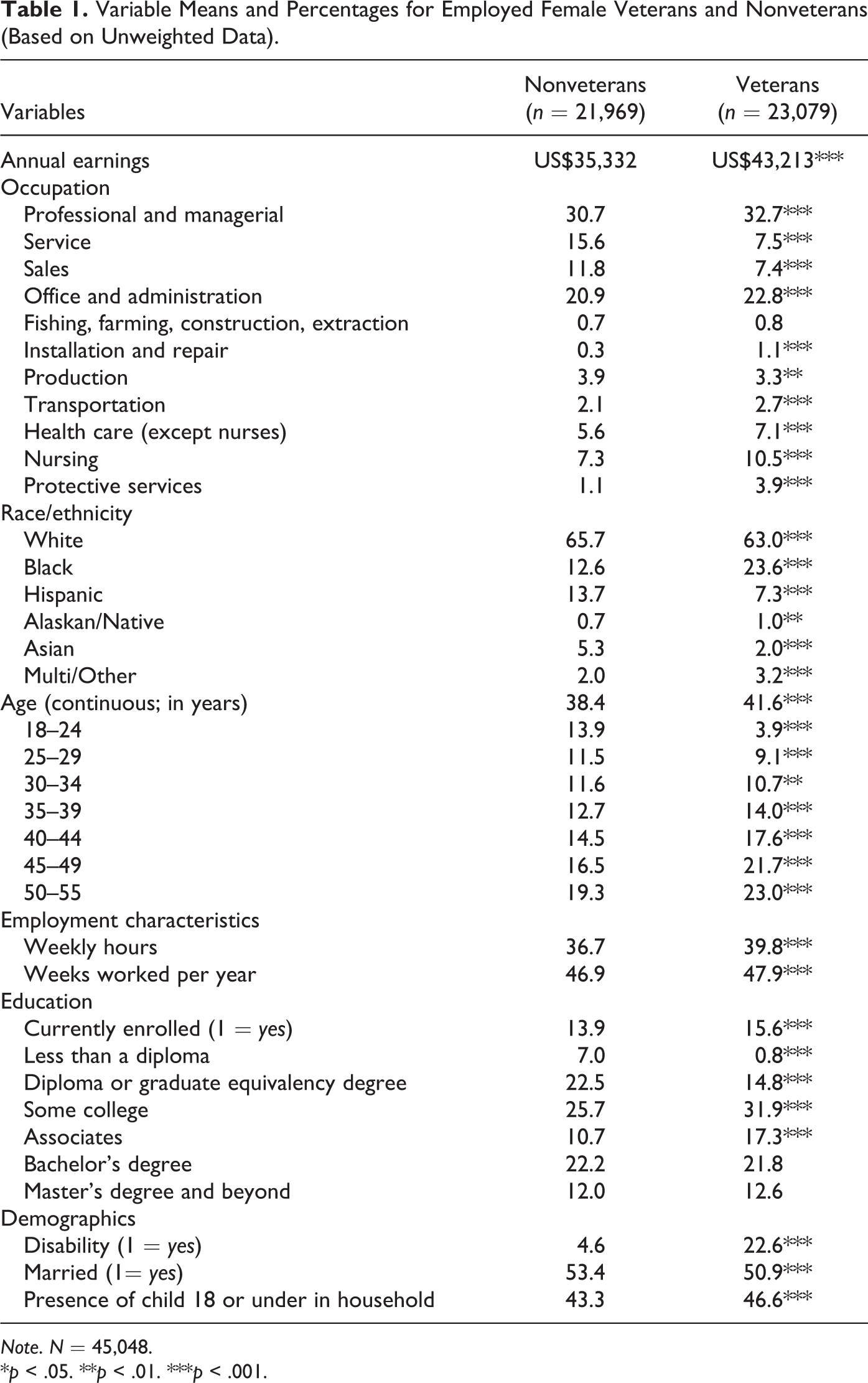
Descriptive statistics show that veterans benefit from an earnings advantage. Table 1, which reports descriptive statistics, shows that veterans outearn nonveterans by a wide margin (US$43,213 per year compared to US$35,331). This table also shows other differences between veterans and nonveterans. Veterans are less likely to be White and more likely to be Black. On average, they are older (41.6 compared to 38.4) and less likely to be at the lowest educational attainment levels. Veterans work more hours per week and more weeks per year than nonveterans. They are less likely to be married and are slightly more likely to have children in the household. Finally, veterans are far more likely than nonveterans to report a disability (22.6% compared to only 4.6%).
Variable Means and Percentages for Employed Female Veterans and Nonveterans (Based on Unweighted Data).
Note. N = 45,048.
*p < .05. **p < .01. ***p < .001.
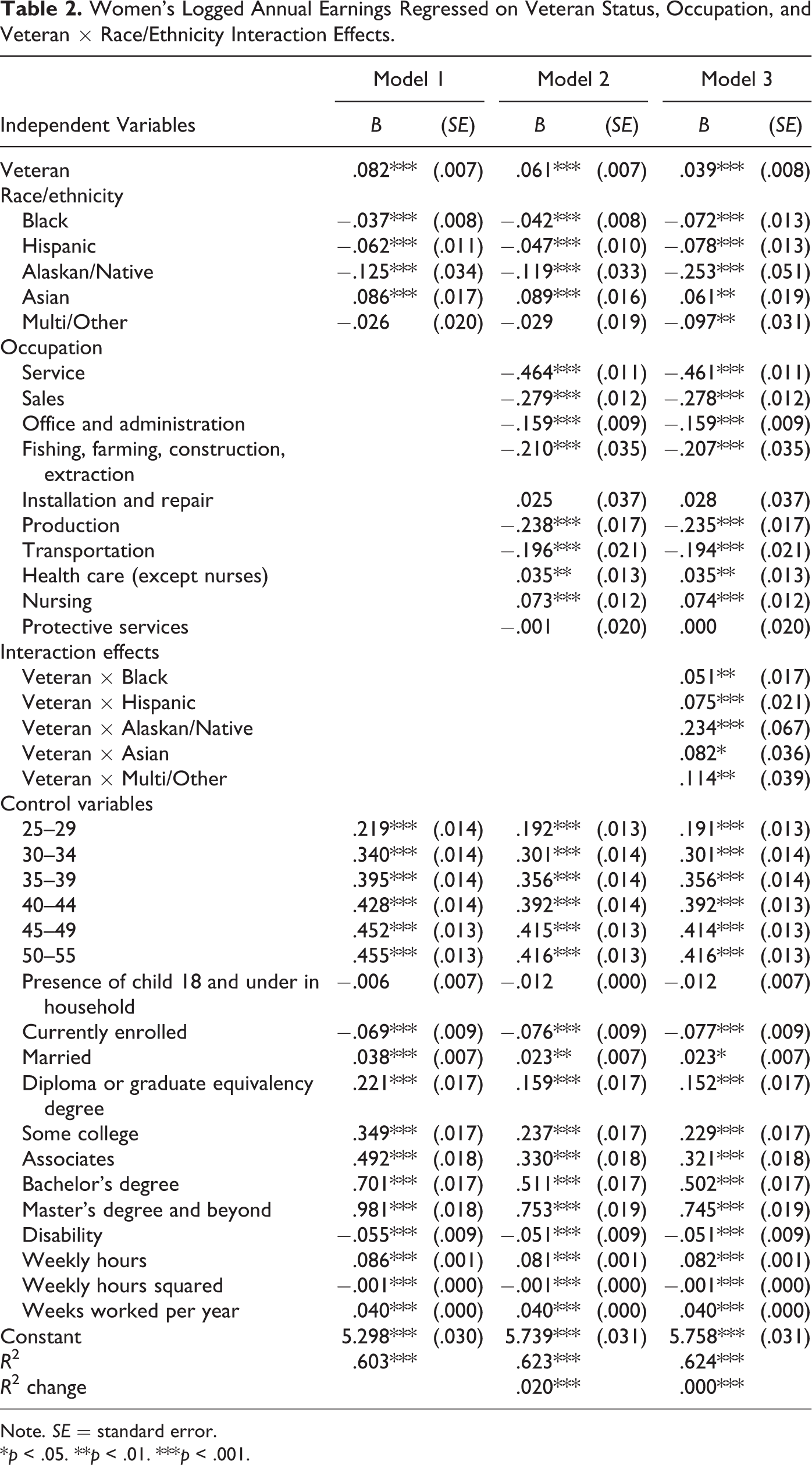
Turning to multivariate analysis, Table 2 shows OLS results regressing veteran status and control variables on logged wages. Model 1 shows that, net of controls, veterans outearn nonveterans by about 8%, confirming Hypothesis 1 (b = .082 [exp(b) − 1 × 100]). Results of control variables are unsurprising and consistent with previous research on earnings.
Women’s Logged Annual Earnings Regressed on Veteran Status, Occupation, and Veteran × Race/Ethnicity Interaction Effects.
Note. SE = standard error.
*p < .05. **p < .01. ***p < .001.
Do occupational differences between veterans and nonveterans explain some of the earnings differences (Hypothesis 2)? Our results indicate that differences in the occupations held by veterans compared to nonveterans do partially account for veterans’ higher earnings. These results hold when using both Measure A and Measure B, although the new measure is better in two regards: it better captures the fact that veterans and nonveterans tend to hold different occupations and explains the veteran earnings premium. Below we detail our occupational measure and the relationship between veteran status and occupation. We then test occupation’s mediating effect on veteran/nonveteran earnings differences.
We constructed two competing measures of occupation in order to determine which was best in models of the influence of occupation on earnings. The first (Measure A) is the six-category ACS measure described above. To create the 11-category Measure B (shown in Figure 1), we first examined frequency distributions of detailed census occupation codes to determine the 25 most common occupations for veterans and nonveterans (taking into account race/ethnicity). Doing so allowed us to develop a new set of broad occupational groupings that reflect the distinct occupational outcomes of veterans (results not shown).
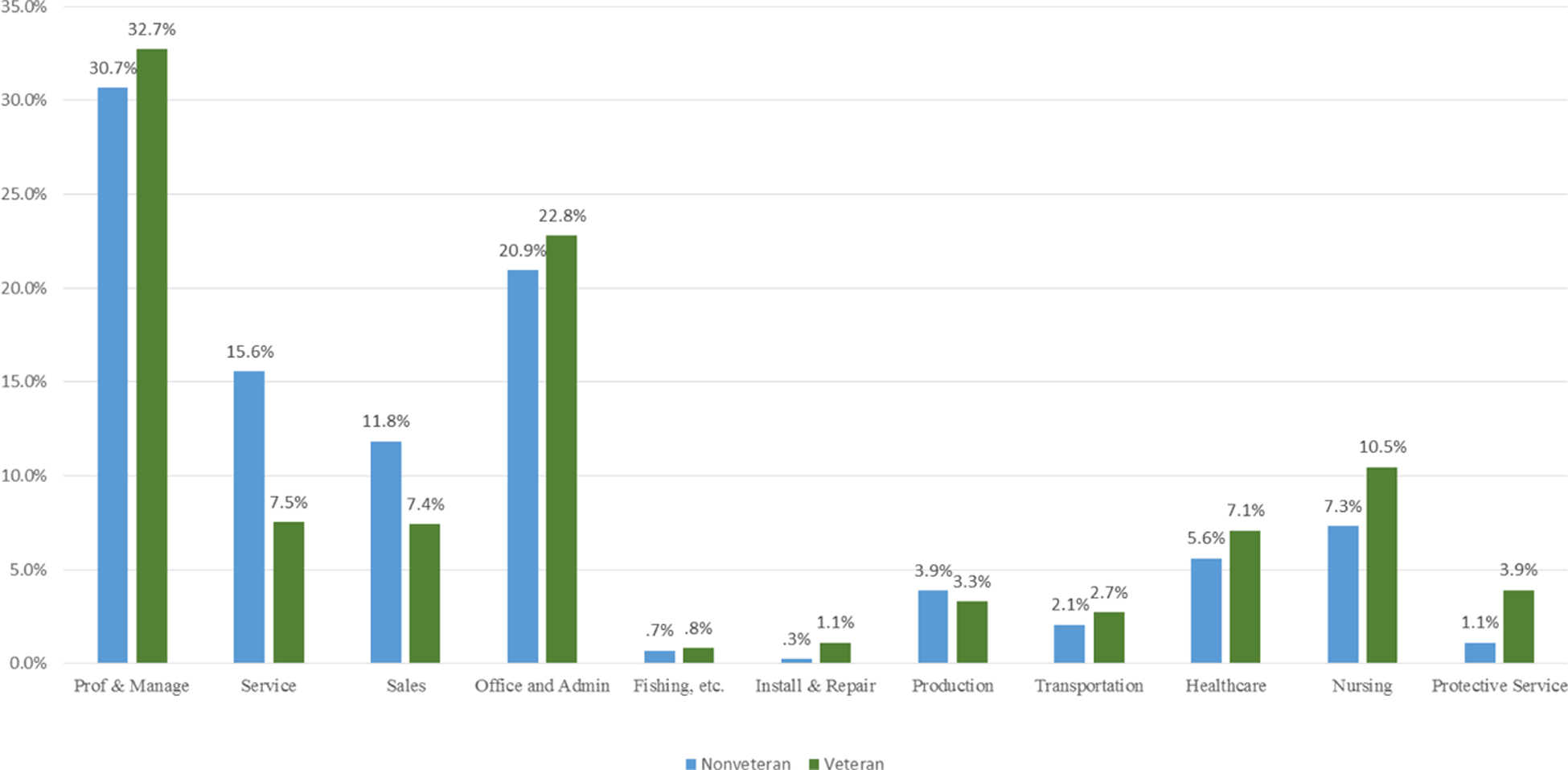
Occupational distribution of female veterans and nonveterans across 11 occupational categories.
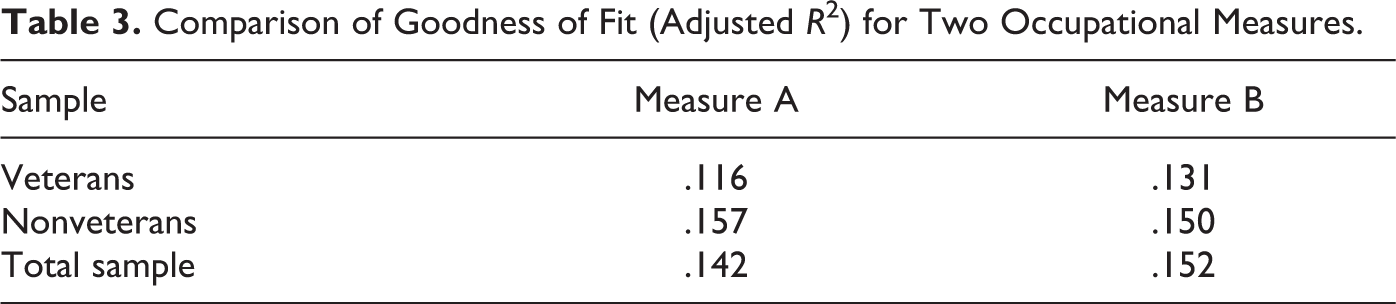
Next, we compared Measure A and Measure B in bivariate and multivariate contexts to confirm that Measure B truly captured the different occupational distributions of veterans compared to nonveterans and that it had a significant effect on earnings. By regressing earnings separately on Measure A and Measure B, we compared the extent to which each measure explains variation in earnings. Table 3 summarizes the adjusted R2 of three bivariate regressions: one with the veteran sample, one with the nonveteran sample, and one for the total sample. For Measure A, each occupation dummy significantly affected logged earnings (p < .001), and the adjusted R2 was substantial (.142). Measure B also produced significant results for each dummy variable (with the exception of “installation and repair”), and the adjusted R2 was even greater (.152). Thus, Measure B accounts for 1% more variation in earnings than Measure A. Breaking the results down by veteran status shows that the increase in explanatory power of the new coding in Measure B is more pronounced for veterans (although occupation explains less of the variance in earnings for veterans in all models). The new coding strategy explains 2% more variance in veterans’ earnings (from .116 to .131).
Comparison of Goodness of Fit (Adjusted R2) for Two Occupational Measures.
To summarize results thus far, we confirmed that veterans outearn nonveterans, that occupational distributions differ between veterans and nonveterans, and that our new categorization of occupations better explains earnings (especially for veterans).
Using these results as the foundation, we now proceed to complete our test of Hypothesis 2 by regressing earnings on veteran status while examining the mediating effects of occupation. Results in Model 2 in Table 2 allow us to observe whether occupational differences between veterans and nonveterans account for the veteran earnings premium by adding controls for occupation to the model. Occupation explains an additional 2% of the variation in earnings, net of controls. Further, the effect of veteran status declined from .082 to .061 after controlling for occupation, indicating that occupation explained 26% the effect of veteran status on earnings (.26 = (.082–.061)/.082). (Results of similar models using Measure A explained a smaller portion—1% of the variation in earnings and 8% of the effect of veteran status on earnings.) This analysis of the overall effect of occupation on earnings provides preliminary support for Hypothesis 2.
To complete the Hypothesis 2 test and to confirm that occupation mediates the relationship between veteran status and earnings, we must also verify that each occupational category is significantly related to earnings. Professional and managerial occupations are the reference category. Health care except nurses, an occupation in which veterans are overrepresented, is the only occupational group with statistically significantly higher earnings than the reference category (b = .035). Two occupations have earnings on par with the reference category: installation and repair and protective service (the lack of significance for the coefficients in these cases demonstrates no difference between their effect on earnings and the effect of the omitted category). Again, protective service occupations are ones in which veterans are overrepresented. All other occupational categories have significant and negative effects on earnings (i.e., incumbents in professional and managerial occupations outearn them). Service occupations, in particular, have a very strong negative effect on earnings (b = −.464). Importantly, this is a group of occupations in which veterans are underrepresented, lending support to the notion that occupation mediates the effect of veteran status on earnings. Taken together, the significant relationships between veteran status and occupation, and between occupation and earnings, offer strong support for the hypothesis that occupation mediates the relationship between veteran status and earnings.
We now turn to Hypothesis 3, which predicted that the veteran advantage will be larger for Black, Hispanic, Alaskan/Native, and Multi/Other than for Asian and White women. Looking first at descriptive statistics, Figure 2 shows mean earnings broken down by veteran status and race/ethnicity, and it reveals a “veteran advantage” in earnings for all race/ethnic groups. Consistent with Hypothesis 3, the veteran advantage is also proportionally larger for disadvantaged race/ethnic minorities than for White and Asian women. The numeral appearing above each bar for veterans refers to the percentage that veterans of each race/ethnic group earn relative to same-race nonveterans. White veterans’ earnings are 20% greater than their nonveteran counterparts’, a smaller proportional advantage than for all but Asian women.
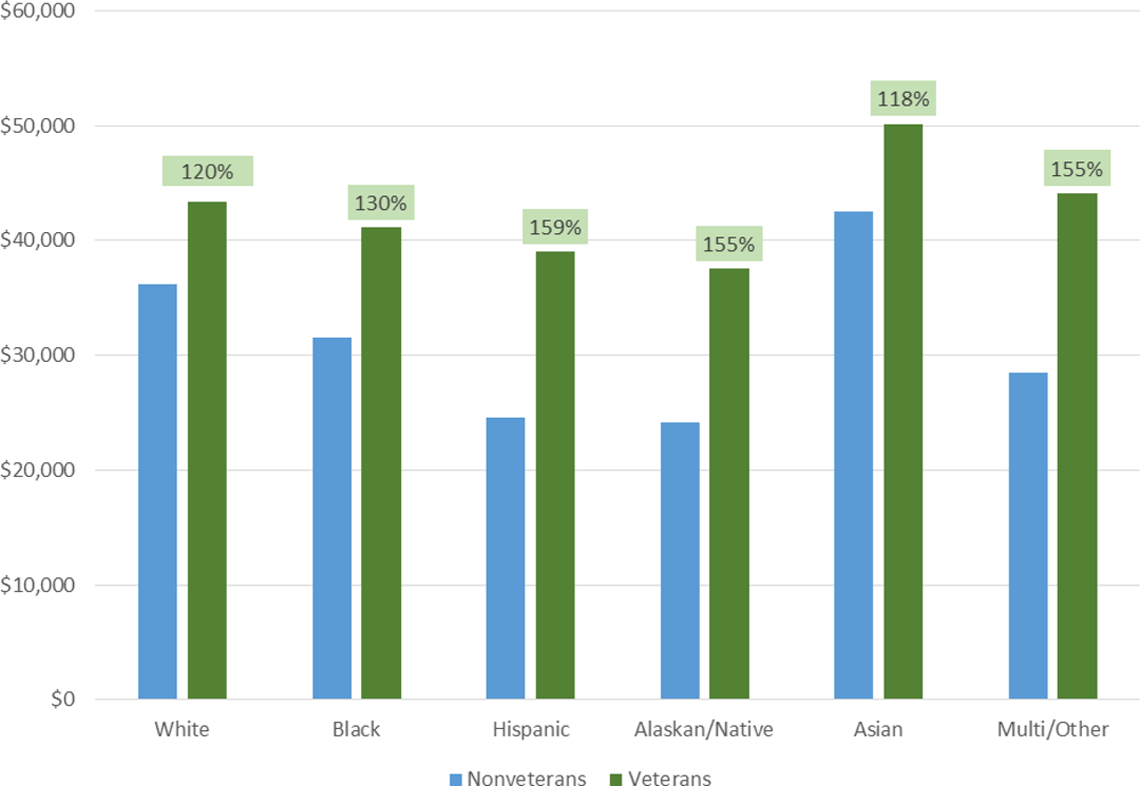
Earnings differences for female veterans and nonveterans by race/ethnicity.
Turning now to the multivariate analysis, Model 3 of Table 2 includes interaction effects between veteran status and race/ethnicity and confirms Hypothesis 3. The positive and significant interaction effects demonstrate a stronger positive effect of veteran status for all groups of race/ethnic minority women than for White women (whose boost for being veterans is 3.9%). The coefficient for the interaction effect of Veteran × Black is .051, indicating an additional 5.2% earnings boost compared to nonveteran Black women. For other minority groups, this effect is even stronger: .075 for Hispanic women (or an additional 7.8% earnings boost), .234 for Alaskan/Native women (or an additional 26.4% earnings boost), .082 for Asian women (or an additional 8.5% boost), and .114 for Multi/Other women (or an additional 11.6% boost).
To illustrate these positive effects of veteran status for race/ethnic minority women, we calculated predicted mean earnings for each race/ethnic group of veterans and nonveterans and present them in Figure 3. Predicted means are calculated with all control variables set to their means. This figure demonstrates that veteran status has greater payoffs for race/ethnic minority women. In fact, in all cases, female veterans of color earn more than White nonveterans, net of controls. Furthermore, all else being equal, Multi/Other female veterans outearn White veterans, on average (US$29,274 compared to US$28,802). Black, Hispanic, and Alaskan/Native women earn only slightly less than their White veteran counterparts, on average. Asian women continue to be an exception: Both nonveterans and veterans outearn all other groups of women.
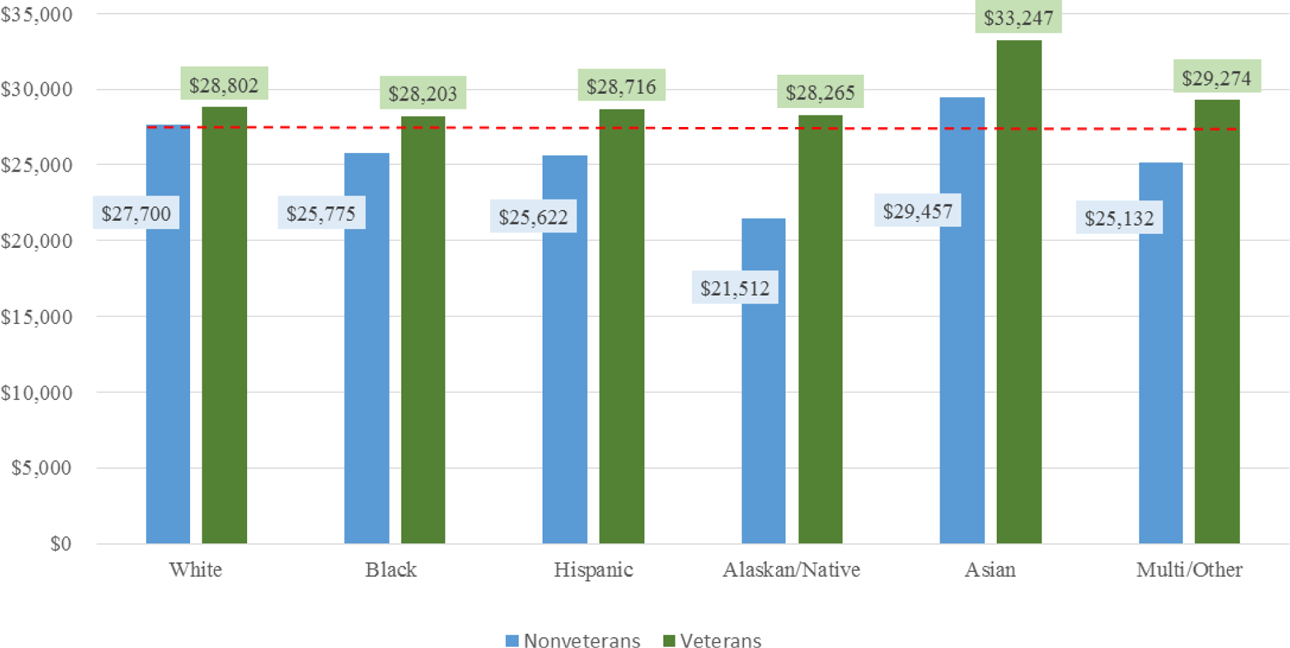
Predicted mean earnings based on regression results. The red dashed line shows White nonveteran predicted mean earnings.
In that same model and figure, the effects of nonveteran status and its relationship to race/ethnicity are quite apparent. Once we account for the interaction term between veteran status and race/ethnicity, the negative effects for nonveteran Black, Hispanic, Alaskan/Native, and Multi/Other women are considerably larger than in previous models. Asian nonveterans still outearn their White counterparts, but this effect is lower in Model 3 than in previous models, indicating that the effect is less strong for nonveterans than it is for veterans. In sum, race/ethnic disparities in earnings are markedly higher for nonveterans than for veterans. Thus, veteran status not only boosts earnings for veterans, it also reduces (and in some cases, even eliminates) the race/ethnic earnings gap.
Discussion and Conclusions
The findings from this large, nationally representative sample of female veterans and nonveterans offer support for the bridging hypothesis. Female veterans outearn nonveterans, an effect partially explained by occupation. Moreover, these findings corroborate previous research about the relationship between veteran status, race/ethnicity, and earnings: The veteran advantage in earnings for women depends on race/ethnicity. More specifically, race/ethnic minority women facing the fewest nonmilitary labor-market opportunities show the greatest gains in the civilian labor market after their military service. Finally, we used these data to construct an improved measure for capturing the occupational distribution of veterans.
Our research indicates that a key reason for the veteran advantage is that female veterans are more likely to be in occupational categories with relatively high earnings and less likely to be in the lowest-paid ones. Compared to nonveterans, veterans are more often professionals and managers, health-care workers, nurses, and protective service workers, and they are less often service or sales workers. Because we lack MOS data, we cannot definitively claim that military training is responsible for these occupational outcomes via “transferability of skills” (i.e., that the advantage results from the transfer of military skills to the civilian labor market). But our results point in that direction. Each of the higher paid occupations requires human capital that the military tends to offer. Professionals and managers, for example, learn bureaucratic skills during military service, a classic claim of transferability (Browning et al., 1973); health-care workers and nurses—where military women historically have been concentrated (Stiehm, 1989)—also learn transferable skills; protective service workers learn many of those particular skills as a matter of course in their military training, making them easily transferable. In contrast, the two lower paid occupations—sales and service—require little by way of human capital and also have an underrepresentation of veterans—presumably because military experience “saved” female veterans from some of the lowest-paid jobs in the occupational hierarchy. Thus, military experience seems to indeed build a “bridge” to better paid civilian employment. Of course, we cannot rule out the possibility that a set of unmeasured characteristics predicts both military service and occupation.
We also found that veteran status has a bigger payoff for minority women than for White women. While all veterans outearn nonveterans in each racial group, the size of the difference is also informative. The earnings gap between White female veterans and White female nonveterans is substantially smaller than the earnings gap for Black women, Hispanic women, Alaskan/Native women, Asian women, and Multi/Other women. Indeed, the premium is large enough among disadvantaged groups (Black, Hispanic, Alaskan/Native, and Multi/Other) that veteran status raises their earnings to be on a par with and sometimes higher than that of White nonveterans. (Asian women are an exception because nonveterans already outearn White women, and their within-group veteran advantage is even more pronounced.) These findings indicate that the bridge to better employment provided by military service is especially effective for women with the lowest civilian labor-market opportunities—namely, disadvantaged racial minorities. These are also the women who suffer a lower opportunity cost for having served in the military. White and Asian women face better labor-market prospects than disadvantaged minority women, and therefore, their investment risk for joining the military is higher, and the bridge serves them less well (see also Cooney et al., 2003). In other words, for White women, an investment in the military may not pay off as well because they can instead spend that time investing in civilian careers.
In an era where the proportion and absolute number of female veterans is higher than it has ever been and is predicted to increase, insights about their labor-market options is timely. It is surprising that so little is known about employment outcomes for this group, and our findings add knowledge about this neglected area. Since much previous knowledge centers on the pre–Gulf War eras, our findings for contemporary female veterans are particularly relevant. Another contribution is our new occupational measure. The commonly accepted categorization of occupations fails to capture the unique occupational outcomes of veterans, and being able to indicate these outcomes helps us better understand the connection between veterans’ military experience and their civilian career outcomes.
Our findings about skill transferability raise possible avenues for future research. Now that women are allowed into combat positions, the effect of combat experience on earnings and hireability is one area that calls for research. Prior research has shown a negative effect of combat experience on earnings and hiring desirability (Kleycamp, 2009; MacLean & Elder, 2007; Savoca & Rosenheck, 2000), implying either that combat skill drags down wages or that it negatively “signals” to employers something about how successfully veterans can transfer their skills to the civilian labor market (Kleycamp, 2009). Whether such findings also apply to women remains to be seen. Research that can only now begin would shed light on how these processes differ for women and men who are combat veterans.
Our findings also raise questions for future research about whether programs designed to reintegrate veterans into the labor force have similar effects for women and men. For example, while historically and currently veterans’ preference in employment has disproportionally benefited men (because of their overrepresentation in the military; Lewis, 2013), as the ranks of female veterans grow, will female veterans be positioned to take advantage of these preferences? Are other reintegration programs (e.g., the Veterans Health Administration’s partnerships with state-level programs) equally effective for women and men? Such research would add to our knowledge about the employment transition process and, more broadly, the social mobility of women and male veterans.
Footnotes
Acknowledgments
We thank Wendy Christensen for helpful suggestions about resource materials.
Declaration of Conflicting Interests
The authors declared no potential conflicts of interest with respect to the research, authorship, and/or publication of this article.
Funding
The authors received no financial support for the research, authorship, and/or publication of this article.

References
Supplementary Material
Please find the following supplemental material available below.
For Open Access articles published under a Creative Commons License, all supplemental material carries the same license as the article it is associated with.
For non-Open Access articles published, all supplemental material carries a non-exclusive license, and permission requests for re-use of supplemental material or any part of supplemental material shall be sent directly to the copyright owner as specified in the copyright notice associated with the article.
