






Abstract
Purpose:
Sexual harassment remains a persistent problem in the U.S. military despite extensive research and policy initiatives. Theoretical explanations identify individual circumstances (e.g., power differentials) and organizational factors (e.g., climate, culture). However, data constraints limit the capacity to link individual contexts with independent measures of environments.
Data/Methods:
A unique Defense Equality Opportunity Climate Survey allows assessment of organizational climates and individual experiences with multilevel analyses.
Results:
Sexist environmental context increases the likelihood of personal harassment experiences after controlling for individual-level variables. However, unit-level climate, group cohesion, and job satisfaction are not significant.
Conclusion:
Both individual and organizational factors are important. However, the organizational context has less to do with culture or unit cohesion and more to do with tolerance of sexism. Focusing on problem units may be effective for reducing the prevalence and persistence of sexual harassment.
Sexual harassment remains a persistent problem in the U.S. military despite extensive research over more than three decades and policy initiatives designed to reduce the incidence (Buchanan, Settles, Hall, & O’Connor, 2014; Cortina & Berdahl, 2008; Stander & Thomsen, 2016). Research shows that sexual harassment is a widespread phenomenon with adverse consequences for both individuals and organizations. For example, targets have been found to experience career interruptions, lowered productivity, lessened job satisfaction, lowered self-confidence, loss of motivation, physical health ailments, and loss of commitment to work and employer. For the organization, legal damages may be small compared to costs associated with reduced productivity, turnover, absenteeism, employee transfers, loss of company loyalty, low levels of job satisfaction, and health costs. 1 The objective of this article is to identify and test the independent influences of individual-level and organizational-level factors on the likelihood of reporting sexual harassment.
Theoretical Orientations
Theoretical explanations, both for prevalence and persistence, tend to operate at different levels of analysis (micro, macro). At the individual level, harassment experiences are often seen as resulting from unequal power relations that are socially constructed (e.g., see Uggen & Blackstone, 2004). Alternatively, organizational-level factors like climate, job gender context, and tolerance may influence the probability that individuals experience sexual harassment (Buchanan et al., 2014). Butler and Schmidtke (2010) identify organizational (structural), sociocultural (sex role contexts), and attraction (based on age and marital status) models as potentially competing explanations for harassment in the military, with empirical support for all three domains.
Military “culture” is another organizational dimension sometimes put forward to account for the levels of harassment, based on a “hypermasculine” environment, focus on unit/team cohesion, clearly delineated lines of authority, and power or other indicators thought to contribute to a unique military context (e.g., see Castro, Kintzle, Schuyler, Lucas, & Warner, 2015). Organizational-level perceptions of cohesion and commitment typically are based on the subjective views of respondents who may or may not have experienced sexual harassment or assault. Even when individual-level data are aggregated to represent organizational units, the same respondents provide the information measuring microlevel experiences and larger unit-level contexts. 2
Defining Sexual Harassment
Sexual harassment was originally defined as “deliberate or repeated unsolicited verbal comments, gestures, or physical contact of a sexual nature which are unwelcome” (U.S. Merit Systems Protection Board [USMSPB], 1981, p. 10). This definition has been expanded to include any conduct of a sexual nature creating “an intimidating, hostile, or offensive working environment” (USMSPB, 1988, p. 4, 1995, p. 48). Overall, the defining criteria have been criticized for being too broad, contributing to empirical and theoretical inconsistencies in different research studies (Schneider, 1982). For instance, definitions are sometimes discipline-specific, which can confound clear conceptualizations and comparisons of results (Terpstra & Baker, 1986). While considerable overlap exists, most researchers use the discipline-specific definitions. Sociologists often focus on environmental variables at both the societal and organizational levels (e.g., power/status differences), psychologists typically emphasize individual variables (e.g., sexist attitudes), economists look at labor market issues (e.g., who benefits?), while organizational/business studies use work structures (e.g., formal/informal hierarchies). As a result, the body of literature available on the topic is disparate and often useful primarily within a particular discipline (Harris, 2007).
Because the defining criteria for identifying sexual harassment have been “uninvited and unwanted,” other complicating factors lie in the perceptions and evaluations of being “unwanted.” Definitions of “acceptable” versus unwanted may differ substantially between the perpetrators and the targets (Baker, Terpstra, & Cutler, 1990; Fitzgerald & Ormerod, 1991; Loredo, Reid, & Deaux, 1995; Saal, 1996; Sev’er & Ungar, 1997; Shields, 1998). Many different behaviors, including requests for dates, pressure for sexual activities, comments, jokes, gestures, and touching, can constitute sexual harassment. Definitions of these behaviors as sexual harassment can vary systematically based on individual characteristics as well as the contexts in which the behavior occurs. As a result, some have argued that sexual harassment is highly subjective, and the experiences of women and men may be variable and open to alternative explanations (Gordon, 1981). The definition of sexual harassment includes a range of behaviors, including legally defined harassment, sexist behaviors, and sexual assault. These behaviors often overlap in real-life situations. Thus, there is still a lack of conceptual distinction among them and limited research attempting to sort through the various conceptualizations.
More formal operational definitions derive primarily from legal frameworks or from social psychological perspectives (Cortina & Berdahl, 2008). Legally, quid pro quo includes the exchange of work-related benefits or consequences for sexual favors through bribes, threats, or even physical force. Additionally, behaviors creating a “hostile and offensive work climate” are illegal, including unwanted sexualized actions to alter, interfere with or affect one’s work performance, sometimes referred to as environmental harassment (Firestone & Harris, 1994; Sev’er, 1999). The legal definition of environmental harassment (hostile work climate) is considered more ambiguous. One problem has been how to determine whether an act is unwanted; another has been deciding the “burden of proof” that the action was against the individual’s will. Expectations of financial losses and/or psychological pain due to the harassment have also been an issue. Some courts have demanded that targets have proof of both before claims of environmental harassment can be made. Two Supreme Court rulings help to discredit the idea that assessments of environmental harassment are subjective. First, the “reasonable” person standard grants anyone classified as reasonable to assess whether she or he is being subject to harassment or acceptable behaviors (e.g., teasing, fun jokes, etc.; Greenhouse, 1993; Wells & Kracher, 1993). Second, the ruling that “psychological stress” does not have to be documented by medical professionals establishes precedence for allowing individuals to interpret their own experiences within the boundaries of the organization (Wells & Kracher, 1993).
The social psychological approach has evolved over time, with recent work identifying four dimensions: sexist behavior, crude or offensive behavior, unwanted sexual attention, and sexual coercion (see, e.g., Defense Manpower Data Center [DMDC], 2012; Morral et al., 2014). Sexual coercion clearly fits with quid pro quo while unwanted sexual attention fits with hostile environment (Cortina & Berdahl, 2008). However, given the legal ambiguities associated with hostile and offensive workplace environment, the interpretation of sexist behavior and crude/offensive behavior may be less clear. Do they constitute sexual harassment per se, or are they antecedent factors that might lead to a hostile environment?
Defining Sexism and Sexist Environments
Sometimes labeled gender harassment, sexism includes generalized sexual or sexist comments or behaviors that insult, degrade, or embarrass women or men. Sexist attitudes typically are based on stereotypical views of behavior (De Judicibus & McCabe, 2001). Bem (1974) suggested that typical masculine traits include rationality, risk-taking, and aggression, while feminine traits include nurturance, emotional expressiveness, and self-subordination. Often these characteristics are associated with stereotypical beliefs that women are inferior to men (particularly in the paid workplace), and that men have the prerogative to initiate sexual behavior and to use pressure to achieve it when necessary (Bartling & Eisenman, 1993; Walker, Rowe, & Quinsey, 1993). Thus, an environment can be sexist, although the behaviors creating that situation may not constitute legally defined sexual harassment.
Sexism is likely to be related to sexual harassment and sexual assault (SHSA) because people with sexist attitudes may be unlikely to believe that the behavior is unwanted and may accuse the target of having in some way encouraged the perpetrator (Valentine-French & Radtke, 1993). Importantly, people are likely to take stronger actions when they are confident that the situation will be perceived by others as sexual harassment (Fitzgerald, Swan, & Fischer, 1995).
Further, as noted by Ormerod et al. (2005) in their conclusion: Empirical research to date suggests that
Research Question
Are there organizational (unit)-level measures that have an independent influence on the likelihood that individuals report experiences of sexual harassment in those units within the last 12 months?
Hypotheses
Based on previous research, sex of respondent, race, ethnicity, and rank are expected to be associated with a greater risk of personally experiencing sexual harassment independently of individual perceptions of organizational climate.
Beyond the individual-level associations, it is expected that aggregate, unit-level indicators will be predictive of reports of personal sexual harassment experiences independently of individual characteristics and perceptions. In particular, units with a less favorable environment on a sexism indicator have a greater likelihood of individuals reporting personal harassment experiences.
Method
The survey instrument was designed for military personnel to respond to questions related to equal opportunity and organizational effectiveness. The questions were developed at the Defense Equal Opportunity Management Institute (DEOMI), which specializes in the measurement of equal opportunity climate scales. A typical Defense Equal Opportunity Climate Survey (DEOCS) “…is intended for organizations of any size, and is suitable for military and/or civilian personnel. The questionnaire measures climate factors associated with the military equal opportunity (EO) program, civilian equal employment opportunity (EEO) program, Sexual Assault Prevention and Response (SAPR), and organizational effectiveness (OE) issues” (DEOMI, 2013, providing a copy of the questionnaire). At the unit level, climate surveys typically are implemented once a year, initiated by the commanding officer. All members are invited to participate voluntarily, and their results are confidential. No information is provided to the commander that would allow the identification of individual respondents (see Walsh, Matthews, Tuller, Parks, & McDonald, 2010, for a more extensive discussion of the surveys).
Response rates of 50–60% in typical DEOCS implementations are interesting in two ways. First, these response rates are at or above those typically found in organizational research (Baruch & Holtom, 2008). However, given that the surveys are initiated by the unit commanding officer, one would expect a high response. The fact that the response rates are consistent with those in other organizational surveys suggests that credibility is given to the statement that participation is voluntary and confidential. Additionally, recent research at DEOMI indicates that respondent demographics closely resemble those of the units involved in the survey at a particular point in time. This gives credibility to the idea that these are “representative” surveys, with one important qualification. Within any specific period, there is no random selection process of the units included in the data collected, largely because they are initiated by the commanding officers. Furthermore, historically Army and Navy units have more actively employed the DEOCS, producing overrepresentation of respondents from those service branches. This historical pattern changes because new guidelines now require all Department of Defense (DoD) units to participate on an annual basis. Nevertheless, the analysis of any particular accumulation of responses should observe the distribution of the participating units. If sufficient numbers of respondents are identified by branch or other characteristics, it is possible to weight the data to reflect the DoD-wide reference population. Weights developed by branch, rank, race, sex, and/or other variables deemed central to the research focus assure proportional representation for general conclusions drawn from the sample. Data analyses were completed using IBM SPSS Version 21 and R Version 3.02.
Unique Analysis Opportunity
This research utilizes a unique data set that allows independent assessment of organizational climates and the experiences of individuals within those organizations. The DEOCS implemented a module to examine issues related to SHSA in 2011. An overall survey was conducted from March 17 to 24, 2011, in which 21,304 active duty members of the military completed the core climate assessment survey; 6,585 voluntarily participated in the SHSA module and 14,449 did not complete the supplement (excluding 2,306 civilians). In effect, this provides two independent samples. This is especially valuable in avoiding single source bias when organizational measures are created based on aggregating individual-level responses (e.g., see Podsakoff & Organ, 1986).
Figure 1 displays part of the unique analysis opportunity. Data are aggregated to the unit level for each of the independent samples and combined into one file. From Sample 1, the proportion of respondents reporting personal sexual harassment experiences is arranged on the Y-axis. From Sample 2, responses on the sexist environment unit climate scale are displayed on the X-axis. There is a clear pattern showing that Sample 1 respondents are less likely to report harassment in units reported to have a more favorable climate by Sample 2 respondents. Notice the overall favorable pattern on the Sexist Environment Scale illustrated by the concentration of units toward the right side of the scatter plot, and the diversity among units, with some showing less favorable “climates.” There is considerable variation on reports of sexual harassment experiences, ranging from zero to about 23% of the respondents in the units. The linear correlation is strong (r = .56, r2 = .31) and is a better fit than a nonlinear log transformation. This bivariate relationship suggests that the unit-level indicators may have an independent influence on individual-level responses, which requires a hierarchical modeling approach.

Proportion of individuals reporting sexual harassment (Sample 1) by sexist unit climate identified from Sample 2.
Sampling and Measurement Concerns
The respondents were asked a single question on sexual harassment: “Within the past 12 months,
To help assess the validity, reliability, and generalizability of the samples, the demographics of those completing the surveys are compared between the two samples and to those from the larger DoD reference population of active duty members. If the test samples are demographically distinct, it could mean that there are measurement concerns, with a select group of individuals choosing to answer the additional questions compared to the “typical” samples of those answering the standard DEOCS items.
It is possible that the respondents to the supplemental questions are more likely to be members of a particular service branch (e.g., Army) or race, for example, but their response patterns match those typically responding to the DEOCS. If the profiles do not match those completing the core DEOCS, then weighting the data can help to solve the problem of representing the larger set of DEOCS respondents. Even if this is the case, it is important to consider more general reliability and validity issues based on response patterns.
Three climate scales were used in this analysis. Sexist Environment is measured based on 4 items reflecting gender-based differential treatment, sexist jokes, and sexually suggestive remarks, with a Cronbach’s α of .86. Organizational Commitment includes 5 items related to a sense of shared values, pride, intentions to stay with the unit, and agreement with unit policies, with a Cronbach’s α of .81. Work Group Cohesion, based on 4 items focused on working well together, caring about, and trusting each other, has an α of .92. Each scale has a high level of internal consistency.
The SHSA module was being β tested to decide whether it could or should replace the Sexual Harassment Scale items currently being used as part of the DEOCS. This test in itself could compromise the decision by individuals as to whether they would complete the follow-up surveys. It could be the case that the respondents felt they had “already” answered those (or those types of) questions.
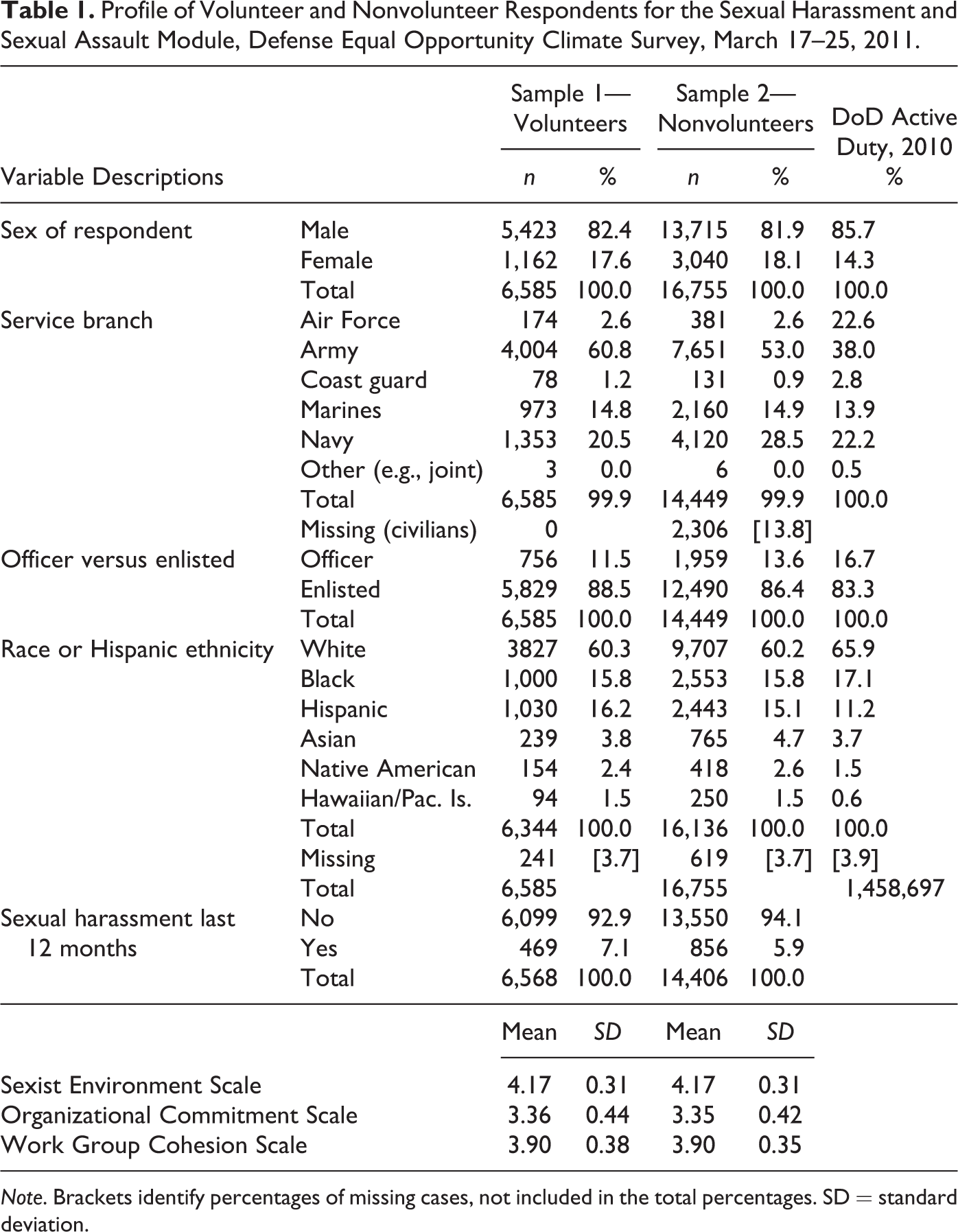
To assess the potential for sampling bias based on participation, Table 1 provides a systematic comparison of the two samples and a profile of the active duty forces in 2010. The two samples match each other very well, suggesting little selection bias among those volunteering to participate in the SHSA module. Notably, however, both samples underrepresent Air Force personnel and overrepresent Army personnel, with the Army comprising 60.8% of the volunteers and 53.0% of the nonvolunteers compared to 38.0% in the profile of active duty personnel. Slightly more women and slightly fewer officers are represented proportionately in the samples. Whites and Blacks are somewhat underrepresented, while Hispanics are a bit overrepresented in comparison to the DoD profile. The impact of these differences is examined by comparing unweighted results to those obtained after weighting the cases by branch, rank, sex, and race/ethnicity. Interestingly, the average scores for the unit climate scales are almost identical for the two samples, but the proportion reporting sexual harassment is slightly higher for the volunteers (7.1%) than for the nonvolunteers (5.9%).
Profile of Volunteer and Nonvolunteer Respondents for the Sexual Harassment and Sexual Assault Module, Defense Equal Opportunity Climate Survey, March 17–25, 2011.
Note. Brackets identify percentages of missing cases, not included in the total percentages. SD = standard deviation.
Results
Table 2 presents estimates from hierarchical generalized linear models (HGLMs, generated using R, version 3.02; see Bates, Maechler, Bolker, & Walker, 2015). The first equation is a standard logistic equation predicting individual-level reports of experiencing sexual harassment in the previous 12 months. The second equation is based on an HGLM approach, with unstructured unit-level heterogeneity in the average level of harassment risk included (random intercept), and virtually reproduces the original patterns. The third equation introduces unit-level indicators over and above the individual-level variables. Independent variables include sex, race, ethnicity, rank, and scale scores for measures of sexist environment, organizational commitment, and work group cohesion.
Logistic and Hierarchical Logistic Models Predicting the Probability of Individual Reports of Sexual Harassment.

Note. The dependent variable is coded 1 for yes, experienced sexual harassment and 0 for no. Higher scores on the three scales indicate more “favorable” contexts (less sexist, higher organizational commitment, and higher work group cohesion). The variable names identify code 1 for the dummy variables. AIC = Akaike information criterion.
*p < .05. **p < .01. ***p < .001.
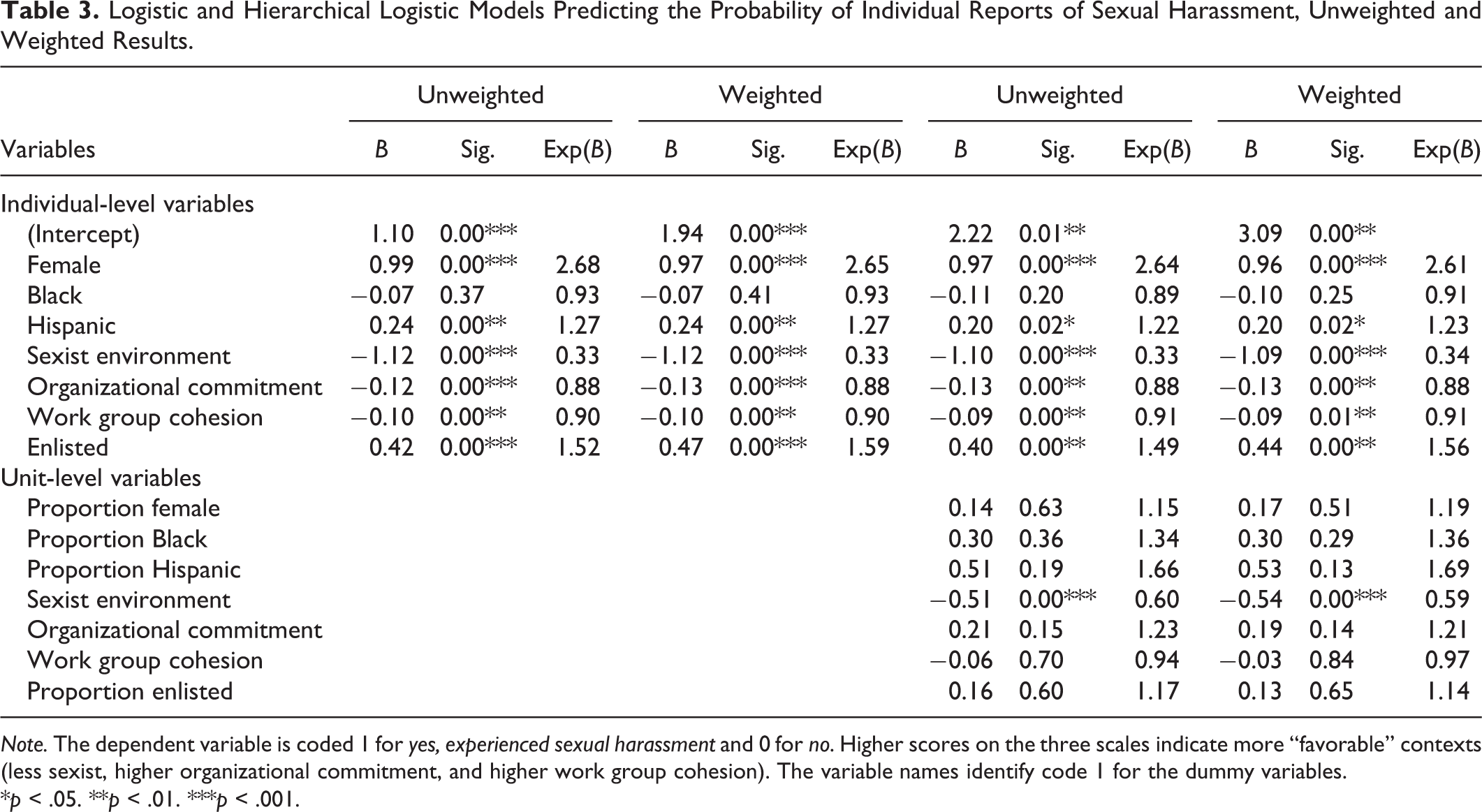
On the sexual harassment variable, yes, experienced harassment is coded 1, while no is coded 0. Higher scores on the scales indicate a more favorable climate. Therefore, positive coefficients identify a greater likelihood of individual reports of sexual harassment and negative coefficients illustrate a lower likelihood. For example, the value of B = 0.99 for female in the first column is the log of the odds of reporting versus not reporting and indicates that women are substantially more likely to report experiencing harassment. The coefficient of −1.12 for the Sexist Environment Scale indicates that a one-point improvement is associated with a reduction in the log of the odds of reporting sexual harassment. Converting the logit coefficients from log of odds (B) to odds ratios [Exp(B)] provides a useful way to assess the magnitude of relationships. For example, the exponent of B (0.99) is 2.68, indicating the women are much more than twice as likely as men to report harassment, controlling for the influences of the other variables in the equation. (An odds ratio of 1.0 would indicate an equal likelihood for both men and women.) The exponent of B (−1.12) is 0.33, showing that more favorable individual-level assessments of the sexist environment are associated with a reduced likelihood of reporting harassment.
Overall, women, Hispanics, and enlisted personnel are more likely to report harassment experiences, even when controlling for their reports of overall unit climate. Not surprisingly, more favorable individual-level assessments of climate on the three scales are all significant. There is no statistically significant difference for the Black respondents. These basic findings hold up for both simple logistic and hierarchical logistic approaches and also hold up when unit-level indicators are controlled.
Results indicate that sexist environmental context, measured at the organizational level (military unit) from an independent sample, has a significant and substantial influence even after controlling for individual-level variables. The odds ratio of 0.60 suggests that an increase in the favorability of climate sexism reduces the odds of harassment reports by about 40%. Perhaps equally important, unit-level variables like organizational commitment and work group cohesion do not have significant influences in predicting individual statements about experiences of sexual harassment in the last 12 months. Further, the compositions of units by sex, race, ethnicity, and rank do not appear meaningfully to influence the likelihood of sexual harassments reports.
Table 3 introduces the issue of weighting to account for disproportionate representation of the DEOCS respondents by branch, rank, sex, and race/ethnicity. What is most striking is that the results are very similar whether the sample is weighted or not. (This makes sense because the primary variables employed to weight the data are also included in the analyses, suggesting a reasonably well-specified set of models. The one additional variable in the weight is the branch of service, to account for the overrepresentation of respondents from the Army and underrepresentation of other services.) Again, the prominent finding is that more sexist environments at the unit level, measured by an independent sample of respondents, are associated with substantially greater likelihoods that respondents in a separate sample report personal sexual harassment experiences.
Logistic and Hierarchical Logistic Models Predicting the Probability of Individual Reports of Sexual Harassment, Unweighted and Weighted Results.
Note. The dependent variable is coded 1 for yes, experienced sexual harassment and 0 for no. Higher scores on the three scales indicate more “favorable” contexts (less sexist, higher organizational commitment, and higher work group cohesion). The variable names identify code 1 for the dummy variables.
*p < .05. **p < .01. ***p < .001.
The link between environmental context and individual experiences can be displayed in simpler form. When there are no individual-level reports of sexist behavior, there is very little individual-level sexual harassment. This relationship is clearly displayed in Figure 2. Of survey respondents reporting no sexism, only 1.4% of males and 3.4% of females report personal sexual harassment experiences. Conversely, when any sexist behavior is reported, large percentages also report individual-level sexual harassment (40.1% of the males and 35.0% of the females). The multivariate analyses confirm that this basic relationship holds up after controlling for other individual and organizational variables.
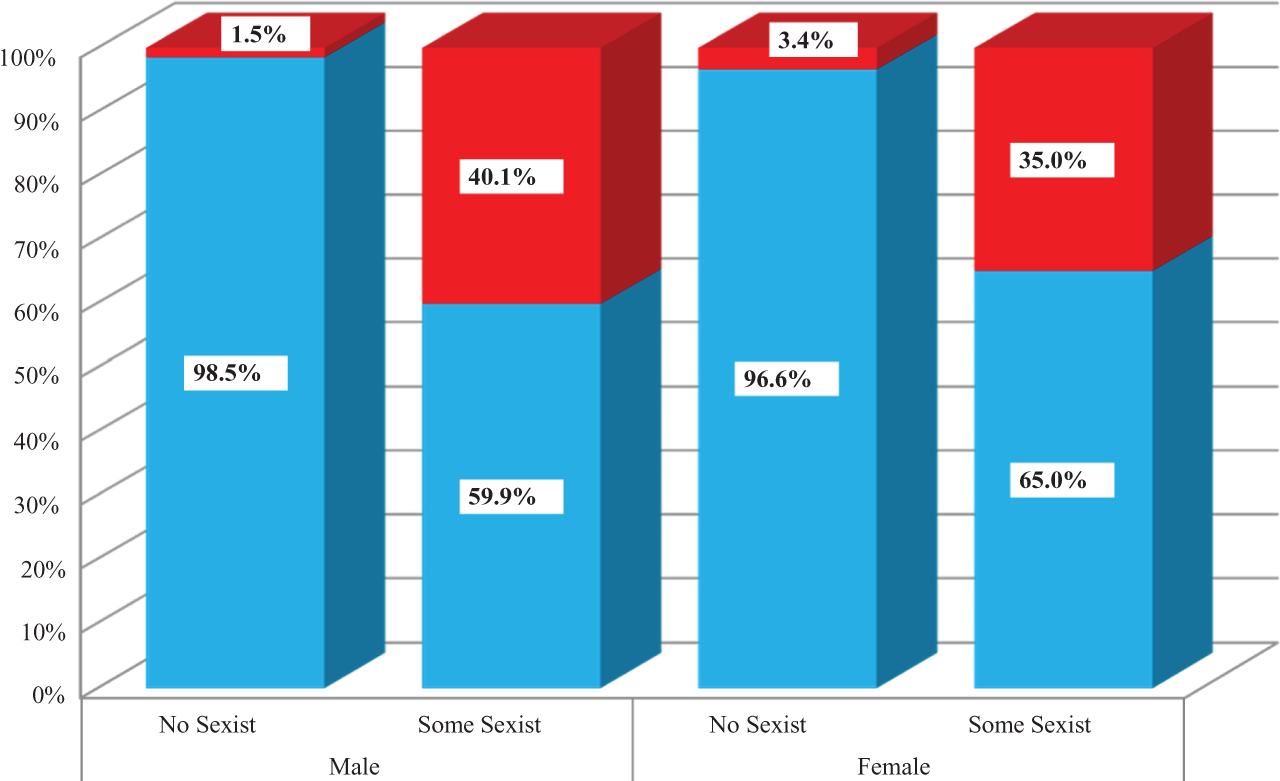
Reports of individual sexual harassment behaviors by report of sexist behaviors, Defense Equal Opportunity Climate Survey, March 17–25, 2011.
Discussion
Even given the sampling and measurement quality concerns in the DEOCS data, these results provide strong confirmation of arguments presented in a great deal of previous research. Individuals typically in less powerful positions are more likely to report sexual harassment, even while those holding more favorable organizational assessments are less likely to report such experiences. This provides substantial for the first hypothesis. The one exception relates to the insignificant finding for Black respondents, though this is consistent with other research (e.g., see Hackett, Harris, & Firestone, 2011).
Early analyses completed with 1988 DoD data established the strong relationship between environmental and individualized harassment (Firestone & Harris, 1994, 2003; Harris & Firestone, 1997). This has been replicated in 1995, 2002, and 2006 with the DMDC random samples, and now in 2011 with the DEOCS. However, these earlier findings are based only on individual reports about their own experiences. The unique data set provided two independent samples with large enough numbers of cases to be able to aggregate responses from one sample to create indicators of organizational climate for 320 units and then use those indicators to predict individual-level reports of sexual harassment in the other sample. These findings strongly support the importance of the aggregate context related to sexism in determining the likelihood of individualized experiences of sexual harassment, providing substantial though partial support for the second hypothesis. The lack of significant relationships tied to the unit-level measures of commitment, cohesion, and proportional representation undermine at least part of the organizational culture thesis.
Conclusion
The new analyses support past research, indicating that sexist environmental context influences the probability of individual harassment (and assault) experiences. It seems very clear that there are units in which sexism still may be unofficially condoned and institutionally supported. Altering the “Unit Climates” of such organizations may be central to reducing individualized sexual harassment and assault. The military is not intrinsically a “sexist institution.” This is well illustrated by the variations in level of sexism across different units and by the concentration of units toward the favorable end of the scale, both of which are shown in Figure 1. Addressing individual behaviors and experiences is important, but attempting to remedy the problem of harassment by focusing exclusively on changing individual behaviors will be marginally successful at best. It should be clear from this analysis that it is possible to target-specific units that display an adverse environmental climate (see especially Figure 1). Until now, there has been only limited evidence of the link between organizational contexts and individual experiences. While the specific military units are deidentified in the data available for this research, such information is available to command leadership. Taking existing policies to the next level by identifying and focusing on problem units may well be more effective in reducing the prevalence and persistence of sexual harassment than practices implemented to date.
Footnotes
Acknowledgements
Part of this research was supported by a Senior Faculty Research Fellowship completed at the Defense Equal Opportunity Management Institute (DEOMI) in 2011. Opinions expressed in this report are those of the authors and should not be construed to represent the official position of the U.S. military services, or the Department of Defense, or DEOMI. We would like to acknowledge the extensive contributions of Dr. Juanita M. Firestone, who died in 2013. We also appreciated the constructive input from four anonymous reviewers.
Declaration of Conflicting Interests
The author(s) declared no potential conflicts of interest with respect to the research, authorship, and/or publication of this article.
Funding
The author(s) received no financial support for the research, authorship, and/or publication of this article.