







Abstract
Identity fusion, the visceral sense of interconnectedness between oneself and the members of a group, has been associated with military service anecdotally and examined among foreign military groups. However, no study to date has explored fusion and its relationship with functioning among U.S. military members. The aims of this study were (1) to examine the incremental predictive validity of fusion, (2) to examine the relationship between fusion and pro- and antisocial in-group behaviors, and (3) to determine how one’s attitude toward their military service may affect fusion. Data were collected via self-report using Amazon’s Mechanical Turk software. Results indicated that fusion predicted progroup beliefs and in-group helping behaviors above and beyond other indicators of military identity. Further, satisfaction with the military mediated the relationship between fusion and willingness to give time to other veterans. Identifying an important mediator of fusion expands upon earlier work in the field and suggests routes for future inquiry.
Across a range of military conflicts, the connection between military personnel is often described as brotherly or like family (Fredman et al., 2015; Swann et al., 2014). This level of connection is consistent with recent research in the area of identity fusion or the melding of oneself with members of a group—creating an instinctual sense of interconnectedness (Swann & Buhrmester, 2015). While some research has explored aspects of military identity (Griffith, 2002; Johansen, Laberg, & Martinussen, 2014; Lancaster & Hart, 2015) and military personnel are often used as anecdotal examples of fusion, no research has examined the role of fusion specifically in U.S. military members and veterans. This lack of empirical study is particularly surprising given that two of the strongest predictors of fusion: negative shared experiences (Jong et al., 2015) and performing physical rituals together (Buhrmester & Swann, 2015) are primary characteristics of military service.
The strong bonds that military service members share have been studied in the context of social identity theory and, to a lesser extent, identity fusion, although these theories are not mutually exclusive (Newson et al., 2016; Whitehouse & Lanman, 2014). Although fusion somewhat overlaps with social identity theory (group identification and self-categorization) in that it “assumes that interpersonal relationships and the meaningful memories created within them play a key role in solidifying the bond between members and the group” (Buhrmester & Swann, 2015, p. 2), fusion differs in important theoretical ways. Primarily, fusion and group identification are distinct in that those who are fused retain their sense of personal agency; with group identification, however, the personal self fades as identification increases (Hornsey, 2008; Swann & Buhrmester, 2015), that is, social identification theory posits that personal identity diminishes as group identity becomes more salient, while fused individuals retain both their personal and their social identities which together influence behavior (Swann, Jetten, Gomez, Whitehouse, & Bastian, 2012). Additionally, those who are fused experience the group members as individuals and as close, personal connections, whereas in social identity theory’s group identification and self-categorization, others are replaceable and anonymous in-group members (see Buhrmester & Swann, 2015, for a full review of these constructs). In other words, social identification theory suggests that group members behave on behalf of and for their collective, and members are linked through their shared identification (Turner, Hogg, Oakes, Reicher, & Wetherell, 1987). However, fused individuals feel a deep sense of connection to both their group and the individuals within the group (Gomez et al., 2011). In summary, what makes fusion unique in the study of cohesion is (1) identities are bound with other individuals within a group, becoming a central component to one’s personal self-concept; (2) one’s personal identity is maintained while coinciding with their group membership; and (3) members feel a profound sense of “oneness” with other members, which influences behavior (Newson et al., 2016; Swann et al., 2012; Whitehouse & Lanman, 2014).
Beyond the study of identity, unit cohesion has been the focus of extensive research in military populations (see Oliver, Harman, Hooever, Hayes, & Pandhi, 1999); however, the influence of fusion on behavior remains unstudied in U.S. military and veteran populations. The standard model—the central theoretical approach to group cohesion in the military—describes four related and interacting bonds in a group: peer (horizontal), leader (vertical), organizational, and institutional (Siebold, 2007, 2011). These four levels map on to the hierarchical structure of the military. Horizontal or peer bonds take place among members of the same or similar rank, and vertical or leader bonds between commanders and their subordinates within a group, such as a company or platoon. These two levels of bonding make up what is known as primary group cohesion. Secondary group cohesion is broader and constitutes broader organizational (e.g., between a company and battalion) and institutional bonds (i.e., the entire military branch). Group cohesion has been found to influence morale, group pride, trust, commitment, cooperation, and performance in accomplishing tasks (MacCoun & Hix, 2010; McClure & Broughton, 2000). Similar to the distinction between self-categorization and fusion, a key difference between cohesion and fusion lies in how group members view each other: Cohesion leads group members to find a sense of identification with other group members they have not necessarily met (MacCoun & Hix, 2010; Swann, Gómez, Seyle, Morales, & Huici, 2009). While both cohesion and fusion involve strong group bonds that influence behavior, fusion requires a deep, interpersonal relationship with specific people within a group, whereas cohesion alone does not (Gomez et al., 2011; McClure & Broughton, 2000). It is important to note that, theoretically, group cohesion and fusion can be accordant; the way in which fusion influences behavior is not necessarily at odds with primary group cohesion. Rather, fusion is a more intense, additional bond (e.g., “my platoon is my family”) that exists beyond an institutional or organizational level (Gomez et al., 2011; Swann et al., 2009).
Burhmester and Swann (2015) reviewed a large body of research that provided empirical support for the distinction between fusion and identification. For example, Gomez and colleagues (2011) used factor analysis to distinguish these concepts, and additionally showed that high fusion, but not high identification, was associated with a willingness to sacrifice for one’s group, even when the respondent’s well-being was threatened. Similar work has shown that fusion is more likely than identification to predict a willingness to sacrifice one’s life for the protection of group members or to donate money to support group members (Buhrmester et al., 2012; Swann, Gómez, Dovidio, Hart, & Jetten, 2010). Similar findings show that fusion exists cross-culturally, with greater fusion consistently being associated with more extreme behaviors (e.g., Atran and Sheikh, 2015; Sheikh et al., 2014; Yoo, Swann, & Kim, 2014). At the same time, there is growing empirical support for the importance of military identity as well as the relationship between identity and psychosocial outcomes (e.g., Griffith, 2002). Given this work, it is essential to demonstrate that fusion is able to uniquely predict important outcomes beyond other established measures of military identity.
The military seems to be a likely environment for the development of fusion when considering the familial nature of the military. Bonding experiences during difficult training, relying on one another during difficult deployments, and the shared culture of the military may provide an ideal environment for fusion. A number of researchers have used military and paramilitary groups as an exemplar of the construct. For example, Whitehouse, McQuinn, Buhrmester, and Swann (2014) studied the formation of identity fusion among Libyan revolutionaries and reported strong family-like bonds between fighters and their battalions. Similarly, Atran, Sheikh, and Gomez (2014) found that fused Moroccans with strong sacred values were more willing to make extreme sacrifices for their group and to fight against materially stronger armed forces. Fredman et al. (2015) introduced fusion with an example of a World War II B-17 bomber crew and their pact to never abandon each other, ultimately leading to all of them dying together when only one member’s death was inevitable. Given that fusion has been used anecdotally for U.S. service members, and shown empirically in non-U.S. military and paramilitary samples, it is surprising that no published research has empirically studied fusion among U.S. military members and veterans, despite the seemingly rich environment for fusion to form.
Gómez and colleagues (2011) recently developed and validated a self-report assessment of fusion with the goal of increasing and improving research in this area. The original version of this measure taps into feelings of fusion with one’s nation using items such as “I am one with my country” and “My country is me.” The items are adaptable for different groups and were modified to reference members of the military as outlined below. This measure has been shown to strongly predict the endorsement of extreme progroup behaviors, has exhibited strong reliability and validity (Gómez et al., 2011), and has demonstrated utility in a variety of samples (see Gómez et al., 2011; Swann et al., 2012; Whitehouse et al., 2014). Given the significant impact of pro- and antisocial behaviors, better prediction of these outcomes via fusion could be important both in applied settings (such as reintegration programs) and in broadening our understanding of maladaptive postmilitary functioning.
The aim of the current study was to empirically explore the role of identity fusion among U.S. military members and its association with psychological functioning. Similar to previous work (Gómez et al., 2011), we hypothesized that fusion would demonstrate incremental predictive validity through a series of stepwise regressions. Seeing the military as a family and having a deep sense of connection to the military was initially tested, with fusion being subsequently added, to demonstrate that fusion was affecting outcome variables above and beyond other measures of identity. Second, we hypothesized that fusion among participants would be positively related to extreme progroup behaviors (e.g., willingness to die for others) and in-group helping behaviors (e.g., willingness to help veterans; Buhrmester et al., 2012; Gómez et al., 2011; Swann et al., 2010). This hypothesis was tested through the effects fusion has on progroup and in-group helping behaviors while controlling for other indices of group identification. Finally, we hypothesized that participants’ attitude toward their time in the military may potentially affect their memories of their service history and their relationships with other members of the military. For example, positive regard toward service could inflate endorsement of fusion items, as those who feel positively about the military may be inclined to endorse greater connection to veterans regardless of fusion. Thus, we sought to examine the role of regard toward the military separately and predicted that regard toward the military would mediate identity fusion with our outcome variables of interest.
Method
Participants
Post–9/11, military veterans (i.e., meeting the official designation per the Code of Federal Regulations as a Veteran—180 days on active duty since 2001) and service members (military members who did not meet veteran status) completed an online survey (N = 246). This time frame was chosen to focus only on veterans who had served voluntarily and relatively recently. The sample was primarily male (72.4%) and White (76.0%) with a mean age of 33.37, SD = 7.60. Other common ethnic groups were African American/Black (n = 20, 8.1%), Hispanic (n = 19, 7.7%), and Asian American (n = 15, 6.1%). Army service was most common (n = 96, 39.0%), then Air Force (n = 54, 22.0%), Navy (n = 53, 21.5%), Marine Corps (n = 34, 13.8%), and nine participants reported serving in the Coast Guard (3.7%). In terms of military deployments, 63.0% (n = 155) reported a deployment as part of Operation Iraqi Freedom, Operation Enduring Freedom/Operation New Dawn (two operations in Afghanistan); 9.8% (n = 24) reported other deployments since 2001.
Procedure
We developed an online survey (administered via Qualtrics software) and posted it on Amazon’s Mechanical Turk (MTurk) system, where participants completed the survey in exchange for payment. MTurk is a service that connects researchers and developers with a population of survey takers (“workers”). The workers, who must be at least 18 years old, sign up for MTurk through Amazon and are paid to complete tasks based on their background, expertise (e.g., translation work), and demographics. Researchers and developers post their surveys as “Human Intelligence Tasks” (HIT); a worker’s HIT total displays the number of accepted tasks they have completed and can determine their eligibility for other projects. Previous research has shown the MTurk community to largely mirror the general population (Chandler & Shapiro, 2016). The project was described as a survey of military-related attitudes and explicitly stated that eligible participants must have served, or are currently serving, in the U.S. military between 2001 and the present day. Given the nature of the project (any Mturk worker with one approved HIT could view the project), a number of validation measures were included in the survey. Participants first completed an item asking about their military service (i.e., whether and how they met “veteran” status). Then, we asked a series of questions about the military (e.g., the location of their branch service academy) to validate veteran status or service membership. A total of 523 individuals accessed the survey. Of those, 222 accessed the informed consent page but failed to continue. Given the project setup, we are unable to determine whether these were individuals who did not qualify or were simply not interested in the project. Further groups were eliminated for completing the informed consent but failing to answer any other items (n = 27), failing to complete the survey (n = 17), responding randomly to the items (n = 5), answering multiple validation items incorrectly (n = 5), or failing the embedded attention tasks (n = 1; incorrectly responding to an item embedded in a survey that specifically told them how to respond to that item).
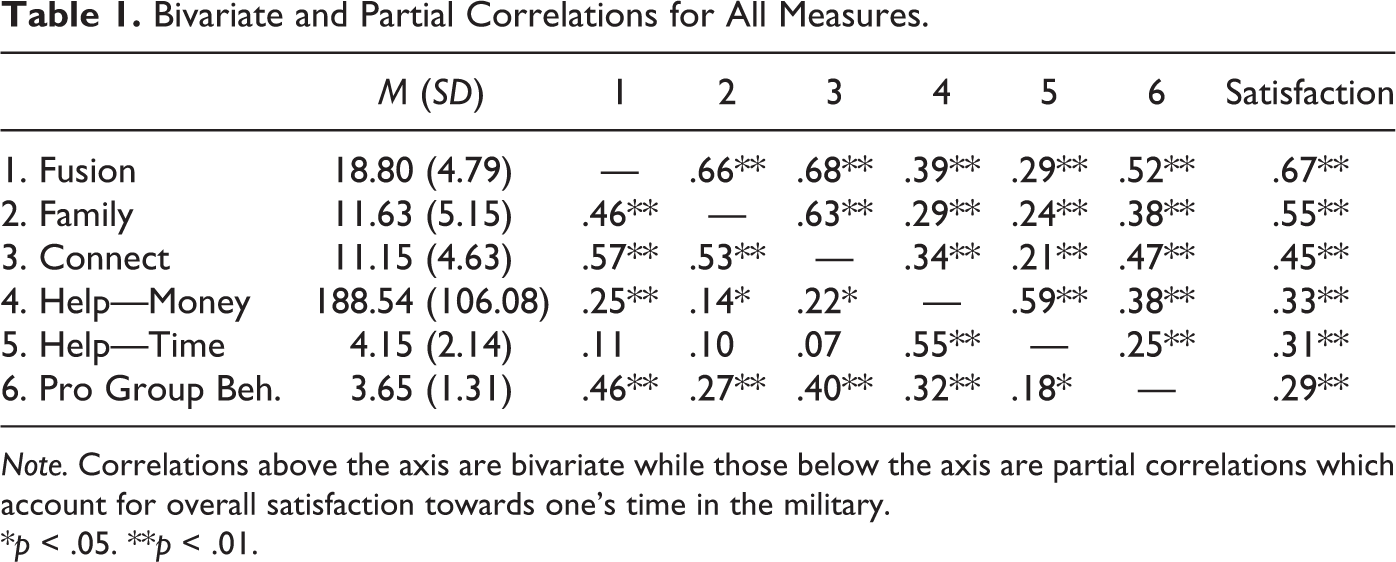
Participants were then asked to complete the measure of military identity (which included the fusion items), a measure of extreme progroup beliefs, a measure of in-group benevolence, and, finally, a demographic questionnaire. Means and SDs for all participants are presented in Table 1. Participation averaged around 10 min, and participants were paid US$1.00 after completion.
Bivariate and Partial Correlations for All Measures.
Note. Correlations above the axis are bivariate while those below the axis are partial correlations which account for overall satisfaction towards one’s time in the military.
*p < .05. **p < .01.
Measures
Military identity
Military identity was assessed using a revised version of the Warrior Identity Scale (Lancaster & Hart, 2015) which is designed to examine multiple dimensions of military-related identity. The scale provides four options from 1 (strongly disagree) to 4 (strongly agree) on 38 items related to military identity. For the current study, we retained a 3-item scale of seeing the military as a family (e.g., “By leaving the military I lost a family”; Cronbach’s α in this sample was .69) and a 6-item scale of feeling connected to the military (e.g., “Only other veterans can truly understand me”; Cronbach’s α in this sample was .83). These scales were chosen as they are most conceptually similar to fusion and thus would provide the strongest case for incremental predictive validity.
Military fusion
This scale was created for the current project by adapting the verbal measure of identity fusion as described in Gomez et al. (2011). This measure was designed to quickly and efficiently assess fusion using a 7-item format. The items were “I am one with the military,” “I feel immersed in the military,” “I have a deep emotional bond with the military,” “The military is me,” “I’ll do for them military more than any other veteran would do,” “I am strong because of the military,” and “I make the military strong.” The original scale asked participants to rate each item on a scale from 0 to 6. However, in the current study, the fusion items were included in the identity scale described above and thus were assessed using options from 1 (strongly disagree) to 4 (strongly agree). Cronbach’s α for the 7-item measure was .91, which is somewhat higher than the value of .82 originally reported by Gomez et al. (2011).
Extreme progroup behavior
For this measure, we adapted the 7-item measure Swann et al., (2009) developed to examine endorsement of willingness to fight and die for their group to make it applicable to military members. Sample items include “I would fight someone insulting or making fun of veterans as a whole” and “I would sacrifice my life if it saved another veteran’s life.” Each of the items is rated on a 7-point scale from (strongly disagree) to (strongly agree), and consistent with previous work, an aggregate total score is formed; Cronbach’s α in this sample was .87 (Swann et al., 2009).
In-group helping behavior
We developed a 2-item measure in which participants are asked how they would respond in terms of monetary and time-related obligations if both a civilian and a veteran, who have equal needs, asked for assistance after a local disaster. Given a limited resource (500 dollars for the monetary item and 10 hours for the time item), they are forced to allocate the resource between the veteran, the civilian, and themselves. Given the fixed amount of resources, any allocation to the veteran necessarily reduces amount given to self and civilian. Scores for allocation to veterans for each item were separately utilized as an index of willingness to assist members of the in-group.
Military satisfaction
We developed a 1-item measure to assess participants overall rating of their military experience. For this item, they were asked to indicate “Overall, how would you rate your experience in the military” on a 5-point scale from very negative to very positive.
Results
Overall, most participants reported a generally positive view of their time in the military with most selecting positive (n = 126) or very positive (n = 63) on the 1-item measure of satisfaction. Additionally, on our measures of in-group helping behaviors, participants allocated significantly more money to a veteran in need (M = 188.54, SD = 106.06) than a civilian, M = 120.12, SD = 80.06, t(245) = 9.27, p < .001. Further, participants also allocated significantly more time to a veteran in need (M = 4.15, SD = 2.14) than a civilian, M = 3.00, SD = 1.89, t(245) = 5.96, p < .001.
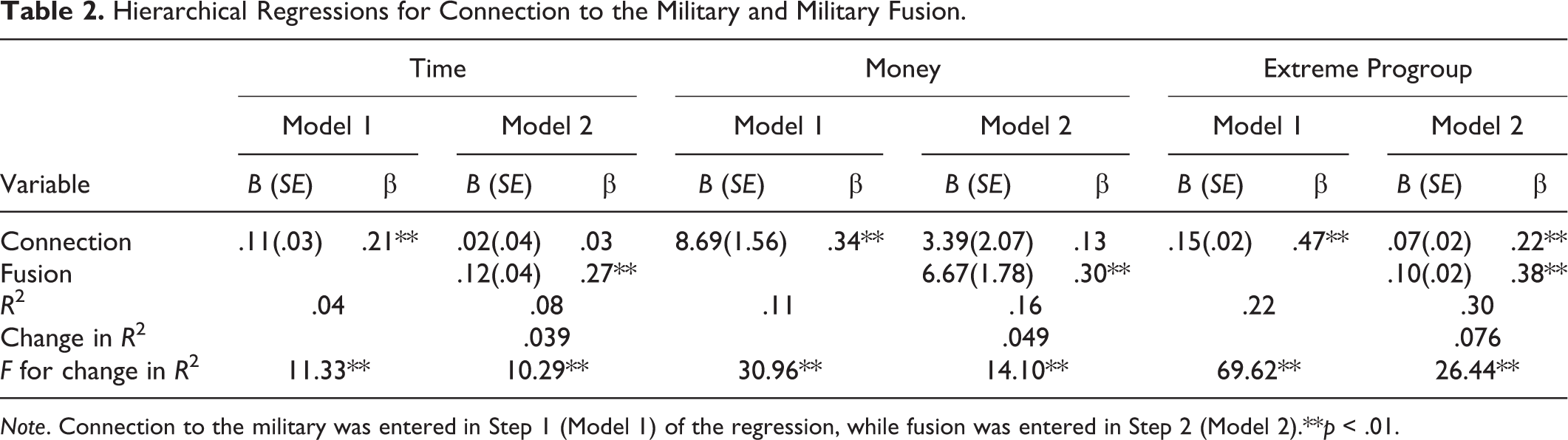
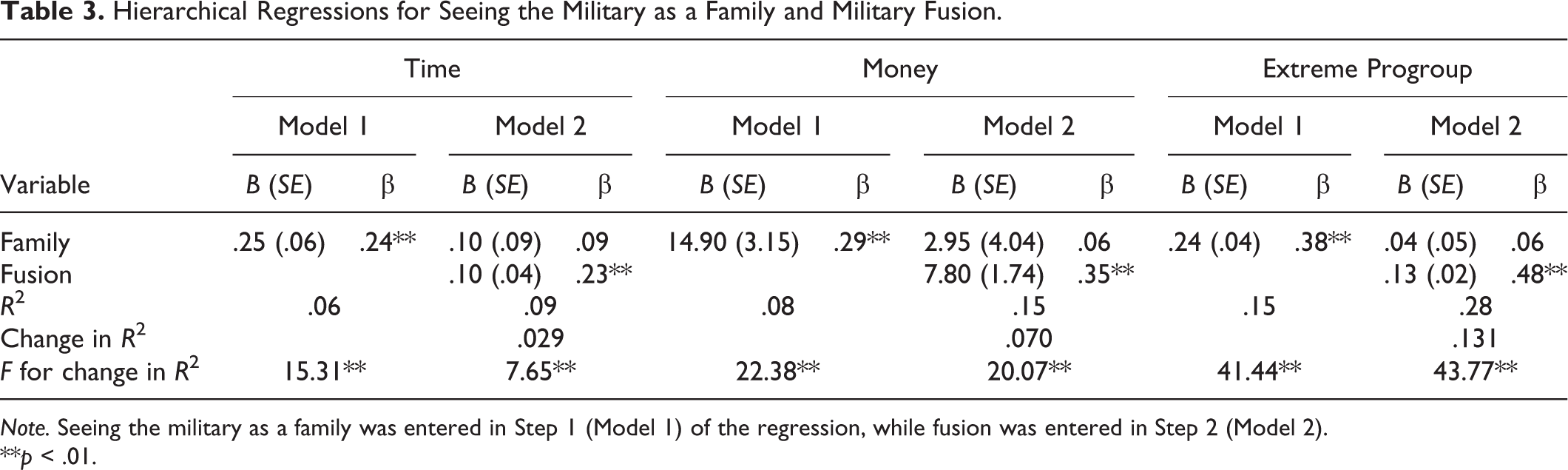
To test our first hypothesis, that fusion would demonstrate incremental predictive validity, we ran a series of regressions in which extreme progroup behaviors and our two measures of in-group helping were the dependent variables. For these regressions, measures of identity (seeing the military as a family and a deep sense of connection to the military) were entered in the first step of their respective regressions, while fusion was entered in the second step (see Tables 2 and 3 for full results). A significant relationship between fusion and the dependent variable would demonstrate that fusion predicted additional variance above and beyond identity. In the first regression, both connection, t(242) = 2.93, p =.004, and fusion, t(242) = 5.14, p < .001, significantly predicted extreme progroup behaviors. After accounting for fusion, seeing the military as family did not predict progroup behaviors, t(242) = .859, p = .39, while fusion was maintained as a significant predictor, t(242) = 6.62, p < .001. For willingness to give money to veterans, neither connection, t(242) = 1.64, p =.103, nor family, t(242) = 0.73, p =.467, were significant predictors, while fusion significantly predicted money in both regressions, t scores of 3.76 (p < .001) and 4.48 (p < .001), respectively. Similarly, for willingness to give time to veterans, neither connection, t(242) = 0.33, p = .738, nor family, t(242) = 1.15, p = .251, were significant predictors, while fusion significantly predicted time in both regressions, t scores of 3.21 (p = .002) and 2.77 (p = .006), respectively.
Hierarchical Regressions for Connection to the Military and Military Fusion.
Note. Connection to the military was entered in Step 1 (Model 1) of the regression, while fusion was entered in Step 2 (Model 2).**p < .01.
Hierarchical Regressions for Seeing the Military as a Family and Military Fusion.
Note. Seeing the military as a family was entered in Step 1 (Model 1) of the regression, while fusion was entered in Step 2 (Model 2).
**p < .01.
As is clear from the regression equations, the data support our second hypothesis that fusion would predict indices of progroup behaviors (see Table 1 for full detail of bivariate correlations). To test our third hypothesis, that these effects would be partially influenced by one’s satisfaction with their time in the military, we conducted a series of partial correlations which controlled for the effects of their overall perception of the military. As can be seen in Table 1, after controlling for rating of their military experience, fusion was no longer a significant predictor of willingness to volunteer time to help other veterans.
To follow-up these partial correlations, we ran mediation analyses using a bootstrapping procedure in which satisfaction with military experience was entered as the mediator, fusion as the independent variable, and extreme progroup and in-group helping behaviors as the dependent variables. Using the PROCESS macros (Hayes, 2013), we set for 5,000 bootstraps using the 95% confidence interval. We tested mediation using both the Sobel test and the 95% confidence intervals. Confidence intervals which do not “cross” zero are considered to demonstrate significant effects. Results indicated that ratings of military experience fully mediated the relationship between fusion and willingness to give time to other veterans (Sobel z = 2.37, p = .02; indirect effect 95% confidence interval [.01, .11]). Considering the correlations between fusion and extreme progroup behavior and willingness to give money also decreased after controlling for ratings of military experience, we also tested a mediational model for these two variables. However, the relationship between fusion and these variables was not significantly mediated for either extreme progroup behaviors or giving money (Sobel z = −1.76 and 1.46, respectively).
Discussion
The goal of the current study was to explore identity fusion among a sample of U.S. military veterans and service members and to better understand how attitudes towards one’s service and the military affects fusion and behavior. Fusion demonstrated incremental predictive validity above and beyond two indices of group identification. As expected, identity fusion among military members was positively associated with both extreme progroup beliefs and in-group helping behaviors. While fusion is clearly associated with veteran behavior, it appears that satisfaction with time in military service significantly mediates at least some of these relationships.
Our results differ from Gomez et al. (2011) in that both fusion and identification predicted extreme pro-group behaviors. They argue “…although identified individuals may know what they can do for the group, they hesitate to make extreme sacrifices for other group members” (p. 930). One potential explanation is that most of the initial work in fusion has focused on fusion with those in one’s country or religion. Another plausible explanation for these differences is that military members not only have previously considered the fact they may have to die for others but often pride themselves on a willingness to do so. Our findings indicate that the relationship between fusion and identification may be moderated by the group type, and the role of group type warrants further study.
The findings of this work suggest that identity fusion among military members does play a role in veteran attitudes and beliefs but is strongly dependent upon one’s feelings toward their time in service. If these experiences are positive, evidence suggests military members will endorse a greater willingness to help other veterans and act in extreme ways to help other members of the military. Further research is necessary to determine the relationship between explicitly negative military experiences and fusion. Consistent with previous work (Buhrmester et al., 2012; Gómez et al., 2011; Swann et al., 2010), extreme progroup behavior was still significantly related to fusion after controlling for satisfaction, indicating that identity fusion is indeed predictive of endorsing progroup behavior.
While this research is an important initial step in understanding military identity fusion, this study contains a number of notable limitations. Although a brief quiz was used to discourage nonmilitary members from completing this study, participants were not required to show proof of military service, and thus military status is not known. Additionally, given the nature of the MTurk sampling, it is unclear how representative this group is to the larger military population. The study was further limited in design by the exclusive use of self-report measures (some of which were very brief), fixed order survey items (which may lead to unknown effects of order), and by the cross-sectional nature of the design and analyses. Furthermore, regard toward the military was measured retrospectively with no empirical way of assessing regard during time of service. Finally, this study was somewhat limited by the scales used. The reliability of the seeing the military as a family subscale was low relative to the Warrior Identity Scale validation study (see Lancaster & Hart, 2015), and the extreme progroup behavior measure (Swann et al., 2009) has yet to undergo a formal validation study. With these considerations in mind, future work on fusion would benefit from more established measures of extreme progroup behaviors, and replication could produce reliability at previously observed levels.
Our results suggest that fusion shares an important relationship with in-group attitudes in U.S. military veterans and warrants further examination. Military fusion differs from other forms of identity fusion in that military service is more similar to a vocation than a nationality but also has lifelong implications (Once a Marine, always a Marine, etc.), that is, it has elements of both being a temporally limited experience as well as a potentially permanent part of identity. This may be related to the U.S. military emphasizing organizational boundaries and distinctive values since becoming an all-volunteer force in 1973—a change that is believed to have shifted military service from an institutional format to an occupation (Janowitz, 1975; Moskos, 1986). Future research should explore predictors of identity fusion development during military service time, as the mechanism in which people become fused is still relatively unknown (Gomez et al., 2011). Previous work has implicated the role of ritual, combat experiences, and seeing group members as family (Buhrmester & Swan, 2014; Whitehouse et al., 2014), and these may be important avenues in this line of research. The field would further benefit from meaningful “cutoff” scores for fusion, which would allow for additional, between-group analyses. Additionally, further work is necessary to clarify the relationship between fusion and other indices of military identity. For example, how fusion and group identification may each contribute to the veteran experience with a specific focus on the development of each type of identification.
Additional research is necessary to explore potential mediators between fusion and relevant outcomes. A number of researchers (Buhrmester & Swann, 2014; Gomez et al., 2011; Swann et al., 2014) have emphasized the fact that strong fusion can lead to sense of group invulnerability and invincibility, which may be particularly relevant for military members. Other possible mediators include familial-like bonds that may carry a sense of duty, leading to extreme progroup behaviors. That is to say that fused individuals construe other group members as living extensions of themselves, like family members, and feel obligated to act on their behalf.
A number of important questions remain unanswered in regard to the importance of fusion in a military sample. First, we found fusion to be associated with the endorsement of both pro- and potentially antisocial behaviors. Thus, examination of positive versus potentially dysfunctional outcomes of fusion and how, if necessary, fusion can be adapted for civilian life will greatly add to this field. Second, research has shown strong fusion can trigger negative emotions and interventions aimed at “defusing” problematic or extreme aspects of fusion may be clinically relevant for those working with veteran and military populations. While this idea requires additional inquiry and has yet to be explored in military populations, Buhrmester and Swann (2014) argue that defusing individuals engaging in antisocial or extreme behaviors is prudent. Fused individuals may be resistant to defusion due to an emotional investment with members of their group, but disrupting the process through which a person engages in harmful behavior to themselves or others is clinically imperative. Further, Swann and colleagues (2014) note fusion may strengthen in response to cultural events such as holidays. The potential waxing and waning of fusion (especially around American holidays such as the Fourth of July and Veterans Day) may lead to important insights about the malleability of this construct. Finally, no study to date has directly assessed the interaction or distinction between group cohesion and fusion. Understanding the potential compounding effects, or the factors that lead to cohesion but not fusion, could provide insight into the predictors of extreme behaviors, both positive and problematic, performed by military members.
This study is the inaugural work quantifying and examining the role of identity fusion among U.S. military veterans and service members. Identity fusion has demonstrated its influence over the beliefs and endorsed behaviors of veterans and service members beyond other measures of military identity. This initial step encourages future work with a range of possibilities such as the relationship between fusion and identification, the exploration of how fusion forms among veterans, how it is maintained following service, and how it may be potentially advantageous or disadvantageous. While there is clearly much work to be done, identity fusion predicts important pro- and antisocial outcomes in military members and warrants further study as a domain of military identification.
Footnotes
Declaration of Conflicting Interests
The authors declared no potential conflicts of interest with respect to the research, authorship, and/or publication of this article.
Funding
The authors received no financial support for the research, authorship, and/or publication of this article.