







Abstract
Army recruiting, initial entry training, and retention enterprises consume tremendous manpower resources and become disproportionately more expensive and challenging as the size of the Army increases. Fortunately, empirical evidence suggests that the Army could readily improve enlisted continuation rates by changing enlistment contracts from its present form, requiring soldiers to reenlist or opt-in to continue service, to open-ended enlistment contracts that require soldiers to opt-out of service upon fulfilling their service obligations. Changing enlistment contracts to an opt-out paradigm—similar to how officer populations are currently managed—could greatly increase the number of soldiers who continue service past their initial enlistment obligation. Improved continuation rates could save the Army hundreds of millions in recruiting and reenlistment incentives, as well as freeing thousands of Non-Commissioned Officers serving as recruiters, drill sergeants, and retention specialist to support other operational requirements.
Manning an organization as large and complex as the U.S. Army is no small challenge. The total Army force (Active, Reserve, and National Guard) consists of more than 1 million soldiers, making it larger than any other employer in the United States with the exception of Walmart. Complicating manning challenges beyond sheer size are a myriad of laws, Department of Defense (DoD) directives, and Army policies that further constrain personnel decisions. A few examples include mandatory end strengths, limited lateral entry, rank distribution limits, mandatory promotion opportunities, and enlistment and reenlistment length requirements. Each of these limits push manning decisions further from an optimal solution.
Congressionally established manning requirements—officially known as end strength requirements—and policy limiting lateral entry constrain the Army to fill structural personnel needs through accessions (recruiting), promotions, and retention. 1 Meeting end strength laws requires a delicate balance between new accessions and loss management. Personnel managers must forecast both voluntary and involuntary losses in order to backfill all losses from more junior populations. Any change in separation behavior or end strength requirements necessitates adjustments to recruiting and promotions to cover the difference.
Recruiting the right quality and quantity is a continual challenge due to competition with the civilian labor market, colleges, and other military services as well as a decreasing eligible and propensed population (Mission Readiness, 2009). Recruiting becomes increasingly more expensive when accessions targets are high because the Army must invest in more advertising, additional recruiters, and larger bonuses (Heaton, Hosek, Martorell, Simon & Warner, 2010). Moreover, recruiters as well as drill sergeants are Non-Commissioned Officers (NCOs) primarily in the ranks of staff sergeant and sergeant first class that are consistently in high demand to fill leadership and skilled technical positions throughout the Army.
On average, each new soldier costs the Army US$68,600 to recruit and train (Army G1 Estimates). 2 When accession missions increase, total expenditures on enlistment bonuses rapidly increase. This increase in spending results from both the need to attract a wider segment of the population to Army service and the failure to differentiate between recruits’ willingness to serve. Once enlistment bonuses become available, all eligible recruits receive the bonus despite the fact that most would join without a bonus. 3 Moreover, smaller accession requirements allow the Army to be more selective, which leads to less attrition, hence fewer recruits (Congressional Budget Office, 2006). 4 Common quality measures such as Armed Forces Qualification Test scores, educational attainment, and various waivers point to higher attrition for recruits with lower aptitude, less education, and a history of legal problems (Army G1 Estimates).
Beyond budgetary impacts, the accessions and training enterprises consume a large manning requirement at the expense of the operational force. 5 Soldiers undergoing initial entry training, along with instructors, administrators, and recruiters are not available to combatant commanders for operational use. When Army end strength is at steady state, approximately 6% of the enlisted population is undergoing initial entry training at any given time, although this number may surpass 8% as the Army grows. 6 In Fiscal Year 2017 (FY17), the Army utilized 7,600 NCOs as active duty recruiters and expects to use more than 8,000 in Fiscal Year 2018 (FY18) in the active force. An additional 5,800 NCOs served as drill sergeants and instructors to support initial entry training (Army G1 Estimates).
Similar to accessions prior to entering the Army, shaping reenlistment behavior at the back end of enlistment contracts is also an increasingly expensive and challenging proposition under current policies. Continuation behavior (i.e., the probability of soldiers remaining in the Army over time) is central to manning decisions because it directly influences recruiting, reenlistment, and promotions targets. Statutory end strength requirements ensure that continuation rates are inversely correlated to accessions requirements. As the Army faces challenges meeting recruiting targets or decides to increase the number of NCOs in its formations for added capabilities, it relies on reenlistment bonuses to entice more soldiers to extend their service.
Focusing on qualitative measures, more experience and higher quality soldiers make for a better trained, more capable force. The longer tenure increases the likelihood that soldiers will have had the benefit of unit training events such as field training exercises, crew gunnery, rotations through combat training centers, and deployments to real-world contingency operations. Individual and collective training is the central focus of most operational units while not serving on deployments. New soldiers coming from training bases require a substantial effort to successfully integrate into their units and may take months of additional training before they can to contribute to unit readiness.
Each enlisted soldier has an End Term of Service (ETS) date that represents the day a soldier will leave the Army unless changed by signing a reenlistment or extension contract. 7 Within recent cohorts of enlisted soldiers, 14% separate from service prior to completing initial entry training and 35% separate prior to reaching their original ETS date. An additional 30% of each cohort will allow their enlistment contract to expire and separate. 8 In FY16, the population that “ETSed” at the end of their first enlistment included 16,493 soldiers and junior NCOs. If the Army were able to adopt practices that increased the average duration of service for voluntarily separating soldiers by just 1 year, the impact to accessions would be substantial. The FY16 accession mission, for example, could have been reduced by 18,800 recruits, freeing end strength capacity to fill operational assignments. 9
More directly, the Army should strongly consider changing its strategy to meet its personnel needs. In FY17, the Active Army shipped 63,775 nonprior service recruits: investing US$1.3 billion in accessions expenses, US$2.6 billion to train these recruits, and will likely spend hundreds of millions more in future reenlistment bonuses. Yet despite this expenditure, less than 20,000 will likely take action to reenlist. 10 The time is right for the Army to consider opt-out enlistment contracts, transitioning from automatic separations upon reaching one’s ETS date to a model requiring soldiers to request discharge upon fulfillment of their enlistment obligation. Empirical evidence suggests this small change in framing can substantially improve soldier continuation; thereby freeing hundreds of millions in accession and retention costs as well as creating a more experienced force and enabling thousands of NCOs to move from recruiting and training bases to operational units. A more experienced and operationally focus force would increase the Army’s capabilities without increasing its size.
Current Army Retention Policy
The Army manages continuation behavior with reenlistment policies designed to incentivize the retention of soldiers in understrength military occupational specialty (MOSs) and the reassignment or separation of those in over strength specialties. Unlike commissioned officers and senior NCOs who are retained on an indefinite status, service members with less than 10 years of service must take action to reenlist in order to remain in the military (U.S. Code 10 § 505). Army regulation (AR) further expands this requirement to include all soldiers with less than 12 years of service and below the rank of staff sergeant (AR 601-280). Under current policy, soldiers enter their reenlistment option window 15 months prior to their ETS date with the window closing 90 days before ETS. Within 3 months of their ETS date, soldiers must request an exception to policy to reenlist. 11 Pictured in Figure 1 is a rough time line for soldiers entering the Army under a 3-year enlistment contract with training and reenlistment windows depicted.
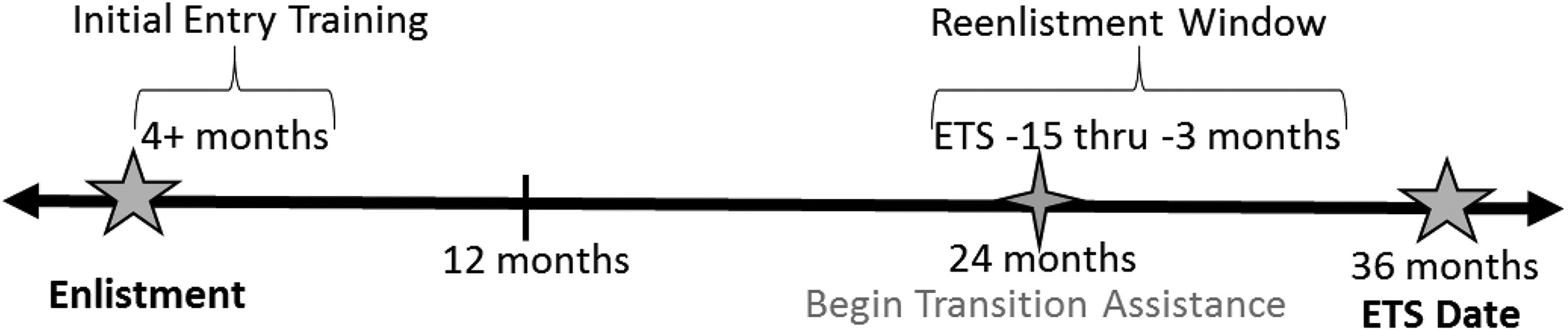
Time line of a soldier with a common 36-month enlistment contract.
To ensure the continuation of an adequate number of soldiers, the Active Army employs a force of 940 career counselors. 12 This professional force is comprised of staff sergeants through sergeants major whose sole objective is to achieve an assigned reenlistment mission. In Army units not authorized a professional career counselor, AR 601-280 requires commanders of battalion-sized elements to field a full time retention NCO not included in the career counselor force. Additionally, company-sized elements are required to assign a part-time retention NCO from within their formations totaling thousands of soldiers spending part of their time employed toward this mission. 13
Efforts to Increase End Strength in FY17
Shortly after the 2016 Presidential Election, Congress required the Active Army to increase in size from 460,000 to 476,000 by the end of FY17 (FY17 National Defense Authorization Act). This law change provided the Army just 9 months to reverse a 6-year downsizing trend dating back to the Budget Control Act of 2011. Leadership primarily relied on increased accessions and larger retention bonuses to meet the higher end strength requirement.
In FY16, the Army assessed 59,080 nonprior service recruits with new enlistment bonuses totaling US$168 million. In FY17, the Army shipped 63,775 nonprior service recruits with an estimated bonus total of US$247 million. Put another way, the marginal cost of enlistment bonuses between FY16 and FY17 was US$17,000 per additional recruit. 14 This high marginal cost is primarily due to the Army’s lack of systems to account for a recruit’s desire to serve, instead offering bonuses to all eligible recruits. Additionally, because of limited number of qualified individuals available in winter and spring months, the Army must rely on expensive “Quick Ship” bonuses to incentivize shipment during these seasons to avoid exceeding training base capacity in the summer when a large number of recent high school graduates wait to begin training.
Another policy selected to support growth was the Selective Reenlistment Bonus (SRB) designed to incentivize retention of understrength specialties and grades. SRBs were larger than previous years and in some cases only authorized to individuals eligible to ETS within the last 9 months of FY17. The Army obligated US$383 million in SRBs in FY17 compared to US$156 million in FY16 (Presidential Budget Request, 2017). Similarly, reenlistment bonuses are an expensive way to meet end strength requirements as they oblige the government to pay every eligible reenlistment regardless of the individual’s preference to remain in the Army. Furthermore, offering reenlistment bonuses to all retained soldiers impedes the Army’s ability to balance grade and skill requirements that is traditionally the primary function of the SRB.
Following the Army’s requirement to grow in FY17, SRBs were US$13,000 higher than previously offered for understrength specialties while soldiers in all other specialties receive US$10,000 to reenlist. Additionally, all soldiers received US$10,000 if they extended their separation dates by 12 or more months as opposed to traditional reenlistments that must be for a period of at least 2 years (MILPER 17-008). The collective result of these policies was an increase in retention rate by 11 percentage points over FY16 rates or approximately 2,035 additional soldiers. 15 Because soldiers could receive large bonuses for shorter duration extensions, the number of extensions exceeded the total increase in retention by more than 1,000 soldiers. These individuals under ordinary circumstance would have likely reenlisted for longer durations but instead choose to sign extension contracts.
Retaining the additional 2,035 soldiers was not cheap. Because the Army chose to incentivize all those eligible, the Army spent US$230 million more in FY17 than FY16 in retention incentives. Put another way, the Army spent US$113,000 per additional soldier despite the fact that extension bonuses were US$10,000 or less per soldier. 16 The primary driver of this high marginal cost per retained soldier is that the government paid all soldiers who reenlisted or extended for 12 months. In addition to the 2,035 soldiers enticed to extend, 5,500 other soldiers received bonuses who would have likely reenlisted without any monetary incentive. 17 Despite extraordinary efforts of Army career counselors, many specialties remain understrength and additional measures were required to meet end strength requirements in FY17. 18 Nine months is not a significant amount of time to alter slowly changing continuation behavior.
As the Army continues to grow and demands more NCOs to meet changing operational requirements, an alternative strategy should be considered to improve continuation behavior, improve efficiency of enlistment and reenlistment bonuses, limit the demands placed on the accessions community, and shrink Generating Force requirements. Fortunately, behavioral economics points us to an empirically tested strategy to improve continuation rates by leveraging human bias.
Literature Review: Choice Architecture and Status Quo Bias
The breadth of research show that behavior is readily shaped by how alternatives are appointed. Choice architects can design initial settings to encourage a desired behavior such as encouraging healthy eating in a school cafeteria line by placing healthy food options prior to less healthy alternatives (Thaler & Sunstein, 2003). Small differences in presentation order are often enough to change eating habits. Similar to cafeteria design, various programs have successfully increased retirement savings through automatic enrollment in programs with the option of opting-out of the program. Employees are substantially more likely to save with employer sponsored retirement savings plans if they are automatically enrolled—with an opt-out option—versus having to enroll to participate (opt-in; Madraian & Shea, 2001; Thaler & Benartizi, 2004; Thaler & Sunstein, 2009). Studies observe that this change in entry requirements result in as many as a 35 percentage points increase in participation with 95% of employees eventually taking part (Beshears, Choic, Laibson, & Madrian, 2009). Moreover, participants are unlikely to change their default portfolio options in retirement savings plans, instead choosing to continue investing in familiar or preselected options (Samuelson & Zeckhauser, 1988). Additionally, program designers were able to encourage savers to more than triple their contributions over time by offering options to commit future raises to savings prior actually receiving a raise (Thaler & Benartzi, 2004).
Similar to increasing savings propensity by changing the default settings of employer sponsored savings plans, other programs have experienced similar results. Auto insurance customers are more likely to choose default coverage options even if those options are more expensive or do not necessarily align with their specific preferences (Johnson, Hershey, Meszaros, & Kunreuther, 1993). Participation in organ donation programs increase greatly when required to opt-out of donating rather than opting-in (Johnson & Goldstein, 2003). Nations with opt-out organ donation options frequently see participation exceeding 90%, whereas countries with opt-in options have participations rates below 15% (Davidai, Gilovich, & Ross, 2012). Selection of more expensive green energy choices for electrical service also increases based on small changes to initial offerings (Ebeling & Lotz, 2015). Businesses have also long recognized the profit potential of this human bias and often use opt-out policies for privacy options (e.g., Internet search engines, social networking sites), contract termination (e.g., cellular service, Internet/cable service, and gym memberships), and e-mail solicitations. Collectively, the body of literature in both experimental and real-world examples demonstrates that subtle changes in the presentation of options can result in substantial changes in behavior. These results hold true across very diverse programs encouraging businesses and other public service organizations to continue to develop ways to further guide employee behavior.
The tendency to choose the default or for a person to choose inaction likely stems from several common biases. One reason is that transactional cost of changing an initial option is significant enough to prevent action. For example, in the case of retirement savings, the effort required to educate oneself on investment options and uncertainty in preferences is enough of an opportunity cost to encourage inaction (Lusardi & Mitchell, 2005). The ambiguity effect suggests that people lacking information choose options with the most predictable outcome (Ellsberg, 1961). In the case of retirement savings or reenlisting in the Army, continuing with one’s current path, such as forgoing savings or separating from the Army, may seem to be the most predictable outcome. Feelings of lacking competence within a particular area can also lead to inaction and this tendency can become more pronounced when one becomes aware that they lack information (Heath & Tversky, 1991; Tversky & Shafir, 1992). In the context of retirement savings, those with the least financial literacy are the most responsive to automatic enrollment in employee sponsored savings plans (Choi, Laibson, Madrian, & Metrick, 2002; Madraian & Shea, 2001). Additionally, due to inherent loss aversion, individuals fear potential losses more than gains made resulting from switching away from the status quo (Samuelson & Zeckhauser, 1988). Moreover, the weaker the initial preferences of the individual, the stronger the tendency toward the status quo (Samuelson & Zeckhauser, 1988). This may result from lack of knowledge regarding options (Fox & Tversky, 1995) or simply a higher level of comfort in the familiar (Knoll, 2010).
Recently, the military adopted a new blended retirement system (BRS). This program reduces the value of the defined benefits of a military pension, but in exchange provides up to 5% contribution matching to retirement accounts. Leaders took advantage of choice architecture research, choosing to auto-enroll military members into the Federal Government’s retirement savings program. The BRS sets the default retirement savings at 3% of base pay, which is matched by the Federal Government and invested in an age-matched “lifecycle” fund (Thrift Savings Plan, 2017). This “nudge” will likely lead many more service members to save for their future than if individuals had to take action to opt-in. While individuals may prefer a different savings amount or fund option, relatively few will likely change this initial position. The default options in the BRS implicitly illustrate that the authors and advocates for this new retirement system acknowledge human bias toward the initial program setting.
Default Settings in Army Enlistment Contracts
Army enlistment contracts also have default positions, and most salient to continuation behavior, if soldiers takes no action, they will separate from the Army upon reaching their ETS date. Assuming soldiers are subject to the same status quo bias that entice people to contribute to their 401K plans and donate organs, it is reasonable to believe that many of these individuals who take no action to reenlist will separate from the Army due to inertia. In fact, the very fence sitter the Army hopes to target through reenlistment bonuses are the most likely to succumb to their inertia. While soldiers are required to meet with career counselors prior to separating, their expectation for continued service may be difficult to reframe. The effort required to weigh career options and fill out reenlistment paperwork as well as the fear of missing out on external work opportunities are enough to entice many to separate. However, if the initial enlistment contracts were written without ETS dates and instead included initial service obligations similar to officer commissioning programs, then Army leadership would effectively flip inertia to work in favor of rather than against continuation. 19
Changing the initial retention options could effectively change the underlying expectations for continued service. Experiments in organ donor options suggest that opt-out settings reduce the perceived sacrifice of donating one’s organs upon death when compared to opt-in options (Davidai et al., 2012). Individuals subject to an opt-in framing for organ donation were more inclined to believe that donating was a large personal sacrifice relative to those framed in an opt-out program. In the context of continuing service, a default setting of being required to request separation as opposed to automatic separation at the end of one’s enlistment contract frames the decision differently. If the Army adopted an opt-out position, the decision to separate would be “I am choosing to leave my profession and my fellow soldiers to pursue other life options” rather than the present “I have completed my enlistment term and so it is time for me to leave.” This underlying social psychology may help explain some of the large disparity between voluntary separation rates between officers and enlisted. Figure 2 depicts enlisted voluntary loss rate (ETS for enlisted and resignation for officers) more than double that of officers by time in service. 20 Loss rates at 3 and 4 years of service are particularly high as most enlisted soldiers finish their initial enlistment contracts. After 10 years of service, officers and enlisted separation rates decrease substantially as soldiers become more senior and the value proposition of the 20-year cliff vesting retirement benefits become more salient. High voluntary and involuntary separations for enlisted soldiers explains why only 5% of enlisted soldiers will reach 20 years of service, while 30% of officers presently reach that important milestone (Army G1 Estimates).
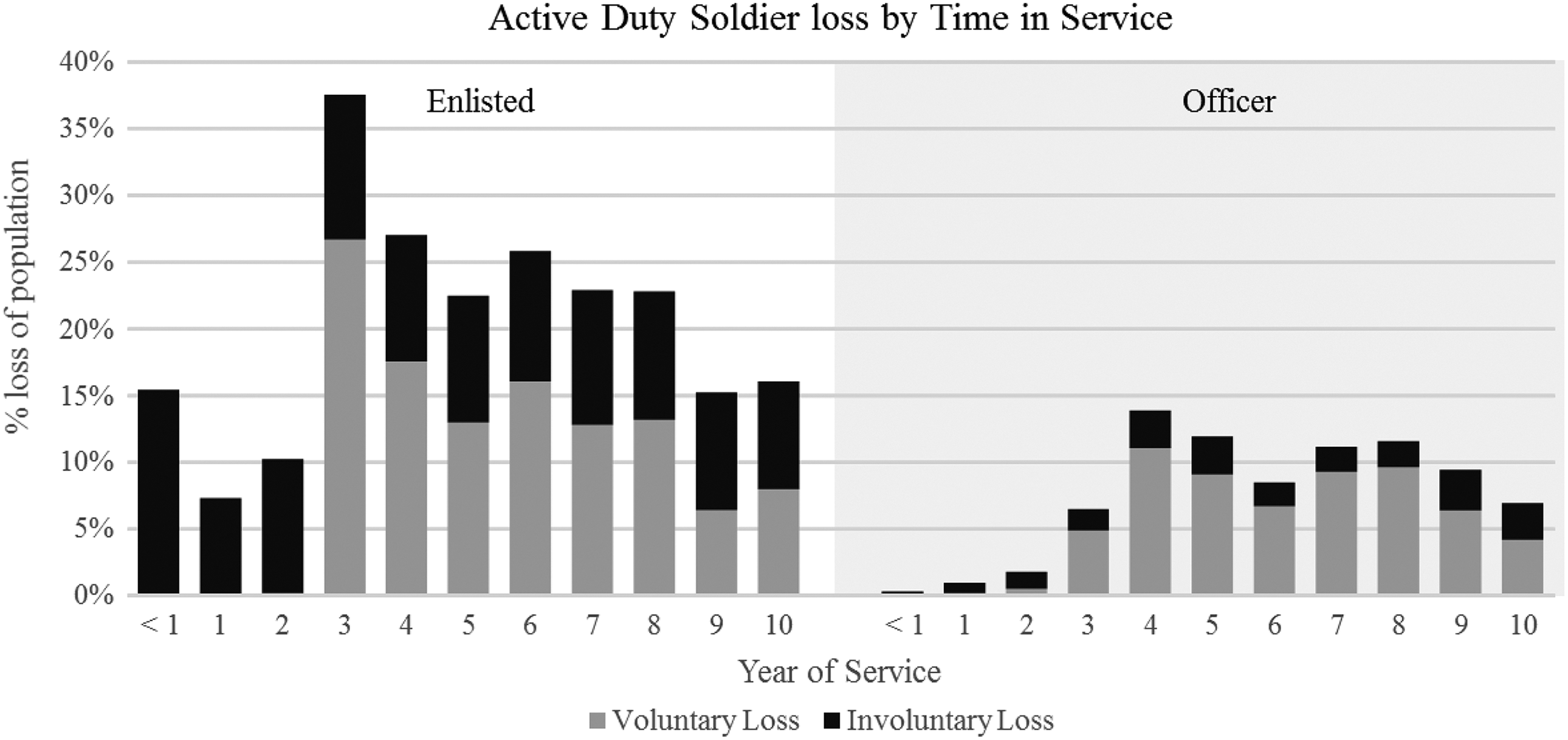
Percentage of soldiers (enlisted and officer) voluntary (End Term of Service, retirement, and resignation) and involuntary (training failure, medical, misconduct, and performance) separated by time in service between FY14 and FY17.
The Army further exacerbates the natural tendency for soldiers to separate upon completion of their enlistment contract by creating a system to facilitate their departure. The Transition Assistance Program (TAP), as part of Soldier for Life, begins helping soldiers prepare for civilian life 12 months prior to their ETS date. The curriculum includes resume preparation, interview classes, training, and job placement resources to help improve employability (Soldier for Life-TAP, 2017). While the Departments of Defense and Labor have invested considerably in improving the transition process and outcomes for service members, this yearlong process reduces uncertainty and enhances the expectation of separating upon reaching ones ETS date. Under this mandatory program, soldiers actively work to consider their employment preferences, research schools or jobs, and develop resumes and interview techniques to obtain the best possible career match. While few would suggest that the Army return to days of less transition assistance, it is important to acknowledge that this process places a focus on separating from the Army while many soldiers are still very new to the Army and only recently eligible to reenlist (see Figure 1).
Recommendations to Increase Continuation Behavior
Army leadership should petition the DoD and congress to remove the statutory requirement to reenlist upon completion of enlistment contracts. Because this requires law change, the wording of the change should allow flexibility for each service to implement this change as to best meet the needs of their organization similar to how the “voluntary indefinite” status is implemented differently across NCOs ranks of each service. 21 Although empirical research in other contexts suggests that this opt-out enlistment change could greatly reduce or delay the number of individuals who voluntarily separate, what is unclear is the extent of the effect. A pilot program could help identify the magnitude of the change and allow leadership time to adjust resources to meet the best interests of each component.
Soldiers should retain the same ability to leave the force at the end of their enlistment contract as they do today; however, the key difference in this new policy is how one makes and officially communicates a choice to separate from service. To do so, the soldier would request separation in the same manner currently used for officers. This rather small change in requirement effectively changes enlistment contracts from opt-in to opt-out. To avoid turbulence leading up to training events and deployments, soldiers would be required to submit their release requests to Army leadership a fixed amount of time prior to departure. This time should be short enough to dissuade preemptive release requests yet long enough to provide adequate time for TAP and leadership to plan for losses. Additionally, soldiers would enter TAP once they receive an approved separation date. Moving TAP enrollment after soldiers signal their desire to separate greatly reduces the likelihood that this program would incentivize undecided soldiers to separate.
Some of the cost savings that the Army realizes in improved continuation behavior will be offset by paying for a more senior force. However, the Army’s paygrade distribution will not change since the Army promotes enlisted soldiers above the rank of Specialist (E4) based on its own requirements and not time in service. 22 Junior soldiers, up to the rank of Specialist, do receive promotions based on time in service and presently achieve this rank within 2 years. However, because military pay tables determine compensation from time in service in addition to paygrade, improved continuation would result in increased payroll spending. The paygrades of E4 and E5 represent 88% of all “ETSing” soldiers. 23 The differential in pay for an additional year of experiences within these grades is less than US$2,400/year. 24 Moreover, the military pay tables cap pay for E4s after 6 years of service and for E5s after 12 years of service.
If continuation improvements are particularly effective, the Army may also observe an increase in retirement eligible soldiers. This change, coupled with ongoing changes to the military’s BRS, will continue to change the probability of retirement. However, given the average recruiting and training cost of a new soldier are US$68,600 and that the marginal cost of retention efforts in FY17 was US$113,000 per soldier, the relatively small increase in base pay is more than offset by other savings. Furthermore, Army leadership should welcome a more experienced force.
Addressing Common Concerns
Fear of the unknown is the most probable concern for most Army leaders. Some may worry that continuation behavior cannot possibly increase by removing or reducing the apparatus that deliberately seeks to retain soldiers. Clearly, no one can say with certainty what the precise outcomes of this change will be or even what form the final system may take. From testing, we may find that wholesale removal of reenlistment requirements is more powerful than initial predictions or that this change only works for first term soldiers who are true fence sitters. However, testing is central to better understanding the effects of policy change and to optimally meet the interests of each service. It is difficult to imagine a scenario where providing leaders more flexibility to adjust their personnel policies would create an inferior system than the present.
Some leaders may be concerned that higher continuation rates may lead to stagnation of promotions or the inability to remove low potential soldiers. This was a problem for the Army during the interwar years of the 20th century and was the impetus of the up or out officer promotion system created after the Second World War (U.S. Senate Hearing, 1947). Fortunately, the Army already has tools in place to address enlisted stagnation problems that may arise. The Qualitative Management Program (QMP) exists to involuntarily separate NCOs that are too senior to switch to a new occupation but reside within an over strength specialty. If retention is improved enough to not only remove retention bonuses within specialties but necessitate QMP boards to separate those with the least potential, the average quality of NCO can only improve. The QMP has many parallels to officer promotion boards increasing selectivity (reducing promotions) in the current up or out system. 25 Additionally, administrative bars to continued service presently enable commanders to remove underperforming or low potential soldiers. These tools, along with retention control points which establish the maximum time a soldier is allowed to serve in a given paygrade, will continue to ensure promotion times do not slow to unacceptable levels. 26
Some may be concerned that soldiers could leave the Army to avoid deployments if not bound by contract. Removing ETS dates for those past their initial enlistment contract is unlikely to substantially impact deployment availability. Under current policies, officers and senior NCOs are largely not bound by contractual obligations yet they regularly deploy. Furthermore, our most junior soldiers, and those potentially least indoctrinated with Army values, will still be contractually obliged to deploy as part of their initial enlistment commitment. Furthermore, many other soldiers beyond their initial enlistment term would be bound by additional duty service obligations for various incentives. 27 Despite these safeguards, manning the force during periods of frequent deployments will always challenge personnel systems in an all-volunteer force regardless of reenlistment policy and voluntary separations may need to be denied at times by Army leadership.
One final societal question is if too great of a burden may be placed on too few if the Army reduces the total number of people who serve. Undoubtedly, delaying voluntary separations would reduce the number of soldiers who enter the Army, substituting new recruits for junior soldiers who are beyond their enlistment term. It is unclear what the best ratio of veterans to nonveterans might be for society, but this ratio is currently driven by the prevalence of WWII, Korean War, and Vietnam Era veterans when the military was several multiples larger than it is today. Additionally, the total end strength of the military—and the strain of deployments—is a central planning concern for the national defense strategy. Army leadership will always need to make manning adjustments to maintain the force they require for the national strategic objectives. As long as our military remains an all-volunteer force, soldiers will have the option to separate when they feel their personal burden of service has become too great.
Conclusions
The ability to effectively manage soldier continuation behavior is central to meeting the structural requirements of the Army as well as the other branches of service. Higher rates of continuation directly results in fewer recruits required, less unit turnover, more experienced soldiers, more soldiers available to serve in operational requirements, and more gradual promotions. The impetus for reducing voluntary separations is still higher while the Army is growing due to the high relative costs of increasing recruiting and reenlistments numbers. Empirical research in the fields of behavioral economics and psychology offers a cost saving solution to better continuation through taking advantage of natural human bias using choice architecture. Altering the reenlistment process from one that requires soldiers to opt-in to remain in the Army to one that allows them to continue service with no action could greatly increase the continuation rate of enlisted soldiers. This improvement could save hundreds of millions of dollars allocated for enlistment and reenlistment bonuses, even more in training costs, as well as free up thousands of junior soldiers, career counselors, recruiters, and drill sergeants to support operational requirements.
Moving to such an opt-out paradigm will likely require a joint effort across the force due to the requirement for a law change but would be well worth the effort. The savings and readiness improvements discussed previously for the Active Component of the Army could easily also apply to the Army Reserves, Army National Guard, Navy, Marine Corps, and Air Force. In total, the savings could add up to billions in unnecessary spending while creating a more capable military force.
Footnotes
Acknowledgments
We would like to thank our colleagues throughout the Army staff for their contributions supporting this research. In particular, we wish to recognize Dr. Robert Steinrauf, Mr. Keith Olson, COL John Checco, and SGM(R) J.D. Riley for their candid insights and encouragement to complete this article.
Declaration of Conflicting Interests
The authors declared no potential conflicts of interest with respect to the research, authorship, and/or publication of this article.
Funding
The authors received no financial support for the research, authorship, and/or publication of this article.