







Abstract
The military environment presents an intersection between a setting featuring unavoidable risk and individual risk-taking propensity; prior work suggests risk-takers have positive and negative outcomes here, and messaging about risk-taking in the military is mixed. The current study used social identity theory to examine how self-reported risk propensity related to three identities/outcomes among cadets at the U.S. Military Academy: attributes of an archetypal “Model Soldier” (physical and military excellence), “Model Student” (grade point average, service positions, and behavior), and Military Values (bravery, duty, and resilience). Structural equation modeling demonstrated that risk-taking was positively related to our Model Soldier and Military Values identities but negatively associated with being a Model Student. Additionally, high-risk-taking cadets were viewed by peers and instructors as confident but prone to judgment, self-discipline, and insight difficulties, suggesting overconfidence among risk-takers. Quantified as a difference between confidence and self-discipline, judgment, and insight, overconfidence mediated the relationship between risk-taking and the three identities, suggesting overconfidence drives both positive and negative associations with risk-taking. Military and leadership implications are presented.
Comfort with risk, or risk-taking propensity, is a relatively stable, cross-situational characteristic that describes why otherwise safe individuals engage in behaviors with the likelihood of negative physical, legal, and/or psychological outcomes (e.g., Steinberg et al., 2008; Zhang et al., 2019). In a military context, however, physical, operational, and decisional risks are unavoidable aspects of environments featuring life-endangering circumstances, fluctuating conditions, limited information, time pressure, and/or unknowable variables (e.g., Momen et al., 2010; U.S. Department of the Army, 2012). Confidence in navigating risky decisions with effective judgment is heavily featured in doctrine and training in the United States and other countries and may also be part of military identity (Lanir et al., 1988; Trewin et al., 2010). This intersection, between (1) individual risk-taking propensity, (2) an environment in which risk is unavoidable, and (3) where risk is addressed through education and training, provides an opportunity to evaluate dispositional risk-taking for both positive and negative outcomes (Sookermany et al., 2015).
The nexus between environment and personality is the key; individuals with higher risk-taking propensity may have favorable outcomes in environments, such as the military, that frequently feature risk (Firing & Laberg, 2012). However, the dark side of such propensity may include unfavorable and unnecessary risk-taking behaviors in those same contexts (Killgore et al., 2008). This constitutes a fundamental problem for organizations, like the military, that desire and incentivize positive risk-taking or for whom risk is unavoidable. Will encouraging and recruiting individuals comfortable with risks cultivate both excitement for opportunities like airborne training and also rule-breaking behavior simultaneously, or can outcomes be shaped? Further, late adolescence to early adulthood is a developmental window in which some individuals might be especially prone to risky decisions (Steinberg et al., 2008), which is relevant to the U.S. Military in that 45% of active duty officers and 51% of enlisted service members are within this window, for example, under 25 (Department of Defense, 2017, p. 37). Together, this suggests the military training environment is a particularly important context for investigating the outcomes of individuals high and low on risk-taking propensity.
At the U.S. Military Academy (USMA), both the military context and early adulthood period are important; evaluating how dispositional risk-taking operates here shows the results of being high or low on risk-taking propensity for young service members in training and suggests trajectories for their time in service. The primary aim of the current study was thus to understand the strengths and liabilities of risk-taking propensity in regard to constructs important to officership, the institution, and the military generally. We attempted to address the concept of risk in a way that is, “understanding of the positive and negative aspects of the risk construct,” and also involves values and identity growth, understudied aspects of military-relevant risk-taking (Sookermany et al., 2015, p. 23). We first integrate previous work on risk-taking, military doctrine, and social identity theory. We identify overconfidence as a possible basis for how risk-taking propensity influences outcomes and suggest it offers intervention targets. With this framework, we defined key outcomes at USMA that would suggest what a cadet valued and was motivated by. Our models evaluated how risk-taking shaped alignment to these identities and also how overconfidence might be a factor in this relationship. Finally, we discuss implications of a model that shows both benefits and liabilities of risk-taking driven by overconfidence.
Risky Behaviors and Risk-Taking Propensity
The preponderance of research on risk-taking examines willingness to engage in specific risky behaviors with clear negative consequences (e.g., Steinberg et al., 2008) or connects life outcomes to general risk-taking propensity that is related to but distinct from other stable attributes (e.g., Zhang et al., 2019). Self-reported risk-taking propensity is not tantamount to engaging in risky behaviors across all situations; however, a large literature demonstrates the presence of a self-reportable, cross-situational disposition to take risks (Fleeson & Jayawickreme, 2015; Zhang et al., 2019), the presence of which is connected to behaviors and outcomes in military populations, including postcombat difficulties, nonbattle injuries, and suicidality, among others (Nassif et al., 2019; Start et al., 2019; Verrall, 2019). Generally speaking, studies that investigate positive (e.g., asking someone out on a date) and negative risks simultaneously indicate correlations between them and similar underlying mechanisms, further suggesting a global propensity to engage in risky behaviors or make risky decisions (Duell et al., 2016; Patterson et al., 2019). Whether risks are positive or negative can at times be a matter of perspective (Menkhoff et al., 2006), and whether risks are necessary and contextually based versus unnecessary and extraneous to the context may be the most important distinction in a military environment (Momen et al., 2010). External factors may then influence whether risk-taking propensity has ultimately positive or negative outcomes, and recent authors encourage more complexity in evaluating correlates of risk-taking propensity in military populations (Sookermany et al., 2015; Verrall, 2019).
Confidence and self-awareness are possible mechanisms through which a cross-situational risk-taking propensity may influence behaviors or decisions. Aviation has considered the interrelatedness of risk-taking propensity, confidence, and decision-making, with a particular focus on accountability and safety (Bennett et al., 2015). Military pilots have higher risk-taking propensity than their civilian counterparts, and among military pilots, experience increases endorsement of risky aviation decisions (Sicard et al., 2003; Thomson et al., 2004). Authors suggested that high performance might increase tolerance of contextually relevant risk and create overconfidence, but overconfidence itself was not directly tested. More general settings suggest this mechanism of overconfidence, even among experts (Lin & Bier, 2008). As individuals gain confidence through feedback, they assume more risk-taking in subsequent decisions (Krueger & Dickson, 1994). This might be due to overconfidence causing a decrease in risk perception, or judging situations as less risky, or by misestimating one’s own abilities or the abilities of others (Chamarro et al., 2019; Moore & Schatz, 2017). This has often been studied in relation to “bad” outcomes, but overconfidence can produce positive results through risk-taking as well (Phua et al., 2018; Vitanova, 2019).
Overall, links between overconfidence, dispositional risk-taking, and resultant behavior have been explored in financial, business, and sporting contexts (e.g., Broihanne et al., 2014) but have not been directly evaluated in a military environment. The risk-taking overconfidence connection may be particularly important to test, as situational overconfidence offers more accessible intervention targets as compared to the personality characteristic of risk-taking propensity. For example, several studies demonstrate that overconfidence decreases likelihood that one’s own performance is accurately judged and internalized, and precise feedback can help counteract this incorrect but self-enhancing disposition (Grieco & Hogarth, 2009; Morales-Camargo et al., 2015). The specific manifestation of overconfidence, for example, decrease in risk perception and overestimation of self versus others, might be context specific (Moore & Schatz, 2017); however, clarifying how overconfidence manifests in a specific military setting suggests how feedback or awareness could be used to counteract the negative outcomes of risk-taking.
Risk-Taking in Military Doctrine
When considering military leadership doctrine and theory, leaders are instructed and encouraged to assess, manage, and embrace acceptable levels of risk to accomplish the mission (e.g., Connelly & Zaccaro, 2017). In the military and similar contexts (e.g., firefighting, first response), accepting prudent risk is an explicitly stated, guiding principle; “a willingness to accept prudent risk in unfamiliar or rapidly changing situations” is identified as a key component of U.S. Army leadership (U.S. Department of the Army, 2012, p. 3). This emphasis on tolerance of prudent risk has been preponderant in military doctrine in the United States and in many other nations and military schools including USMA (2015). Risk-taking is also implicitly addressed through decision-making principles, such as making sound judgments under time pressure in changing environments (USMA, 2018), or through affective concepts such as bravery, audacity, or facing danger, which may reference physical risk (U.S. Department of the Army, 2012; USMA, 2015). Historically, risk-taking among military leadership has often been set in a positive light; Danton’s famous phrase “Audacity, then again audacity, always audacity and the Fatherland will be saved!”—later borrowed by military leaders from Napoleon to General George Patton—has cultivated a belief in combat units that audacity and daring are necessary to victories. At high leadership levels, risk-taking may be associated with winning through opponent deception, which may have strengthened a belief in the connection between risk-taking and military efficacy (Johnson et al., 2002).
Military doctrine emphasizes that prudent risk is necessary, and audacity and bravery are valued, but overarching messages about risk propensity to military leaders are mixed. Some argue that military leadership has become risk averse over time (Lythgoe, 2019), whereas others uphold risk tolerance as vital to learning (Sookermany et al., 2015). Research on the outcomes of risk propensity in military leadership is limited and, like much of the research on risk-taking in general, is mostly focused on negative health/behavioral aspects (Breivik et al., 2019). Comfort with risk-taking in high-stakes military leadership settings may be associated with attributes such as optimism or overconfidence (Satterfield, 1998) and may be more tied to masculinity than efficacy (Hinojosa, 2010). Boldness and willingness to wager physical risk are considered important leadership qualities among subordinates, however (Sosik et al., 2012). This underscores the importance of leader evocation of trust in high-risk situations but still does not address outcomes when leaders are comfortable with risk or instead risk averse (cautious). Overall, the relationship between risk-taking propensity and effective military leadership for optimal outcomes remains empirically uncertain, especially in high-risk contexts (Hannah et al., 2010).
Risk-Taking and Identity
Risk-taking has typically been studied with respect to distinct outcomes such as health behaviors; relatively less is known about how this attribute influences overarching constructs including identity and organizational beliefs. Social identity theory, which posits that aspects of individuals’ sense of self, their values, and ultimately behavior are derived from the social groups they feel belonging to, is a useful framework for understanding how USMA cadets and other trainees navigate their early military experience (e.g., Hornsey, 2008). This theory has previously been used to understand individual differences in values internalization at USMA and to link risk-taking propensity and military identity (Firing & Laberg, 2012; Franke, 2000). However, environments that provide a good match between the strengths of the individual and organizational values may increase identity and congruent behavior (Callina et al., 2017). Given that risk is inherent to military operations and addressed during training, trainees high in risk-taking propensity may experience this match, and thus greater identity development, values assimilation, and identity-congruent behavior. This has not been fully evaluated in a military training setting but has been used as a framework to evaluate risk-taking and identity affiliation in a nonmilitary-relevant population (Cruwys et al., 2020). USMA, as both a collegiate and military context, presents multiple possible priorities as “total institutions” where individuals live, work, and develop (Soeters et al., 2006).
In business, a common context for understanding risk-taking’s positive consequences, risk-taking positively influences trust (Neves & Eisenberger, 2014) and is a core component of entrepreneurial identity (Mills & Pawson, 2012). In college, risk-taking through deliberate experimentation may have positive consequences for identity (Dworkin, 2005), despite findings that excessive risk-taking is a sign of poor adjustment (e.g., Suerken et al., 2016). Among collegiate athletes, risk-taking propensity is associated with greater affiliation with an athletic identity and less affiliation with an academic identity (Yukhymenko-Lescroart, 2018), suggesting that, when faced with competing priorities, the social identity that is more congruent with risk-taking (athletics vs. academics; Huang et al., 2010) is preferred.
Development in contexts featuring multiple identities like collegiate athletes may be applicable to USMA cadets (and USMA student athletes as well), as they may face competing priorities and professional identities. The institution emphasizes character development through excellence across multiple programs and requirements, which may offer opportunity for diverse identities (physical, military, and academic; USMA, 2018). Academic identity, conceptualized as student performance, social placement within college, and academic motivation (Jensen & Jetten, 2016), is itself important here as well, especially given that overall cadet performance is heavily weighted by academics and academic performance is used to determine leadership assignments (USMA, 2016a). In sum, risk-taking can drive motivations and identities when there is a match between risk-takers and contextual values, and competing identities or priorities may illuminate this process in military trainees.
Identity development and assimilation to military culture are key factors in soldier development and, ultimately, performance (Black et al., 2019). Military identity has been variously defined but generally encompasses assimilation of military culture and values and may also include motivation and performance in relevant tasks (for a review of the historical development of military identity, see Johansen et al., 2014). Social identity work suggests that this identity will be dependent on the specifics of the group under consideration (Tajfel et al., 1971), indicating the military identity at USMA will be tailored to the context. Self-report measures of warrior identity have been developed and are predictive in veterans and those currently in service but may not be relevant to cadets or trainees (Lancaster & Hart, 2015). Understanding military identity in trainees is nonetheless important, as identity development may be potentiated during times of stress in young adulthood (Anthis, 2002), which has relevance for intentional stressors impacted on military trainees.
So, what might a military identity look like for trainees? From a training standpoint, organizational identity and assimilation of values are important aspects of military instruction, especially at USMA (2018). Values championed by the larger Army include accepting prudent risk as noted above but also duty and resilience among others (U.S. Department of the Army, 2012). The masculine identity that emerges includes these values and emphasizes physical prowess and confidence (Hinojosa, 2010). A strong military identity has been linked to performance on military tasks (Johansen et al., 2014) but also to maladjustment as veterans (Lancaster & Hart, 2015). This suggests that performance may be incorporated into military identity but also that strong military identity may have negative outcomes in the longer term. Additionally, ascribing to military-relevant values may not necessarily imply strong trust in and identification with the organization (USMA or the U.S. Army), as these characteristics are separable and shaped by factors such as organizational climate (Ng, 2015). The current study aims to add to this understanding by connecting risk-taking to military identity and values internalization. We examined context-specific outcomes and explicitly championed values in order to best understand how identity and character develop in context.
Hypotheses
We selected three possible competing identities composed of key outcomes at USMA, given its simultaneous position as an educational institution and training program for future Army officers. The identities were an archetypal “Model Soldier,” a “Model Student,” and we also defined a set of Military Values, such as duty and bravery, that are integral to both USMA and the greater Army context (see Figure 1; USMA, 2018; U.S. Department of the Army, 2012). Our specific hypotheses were as follows.
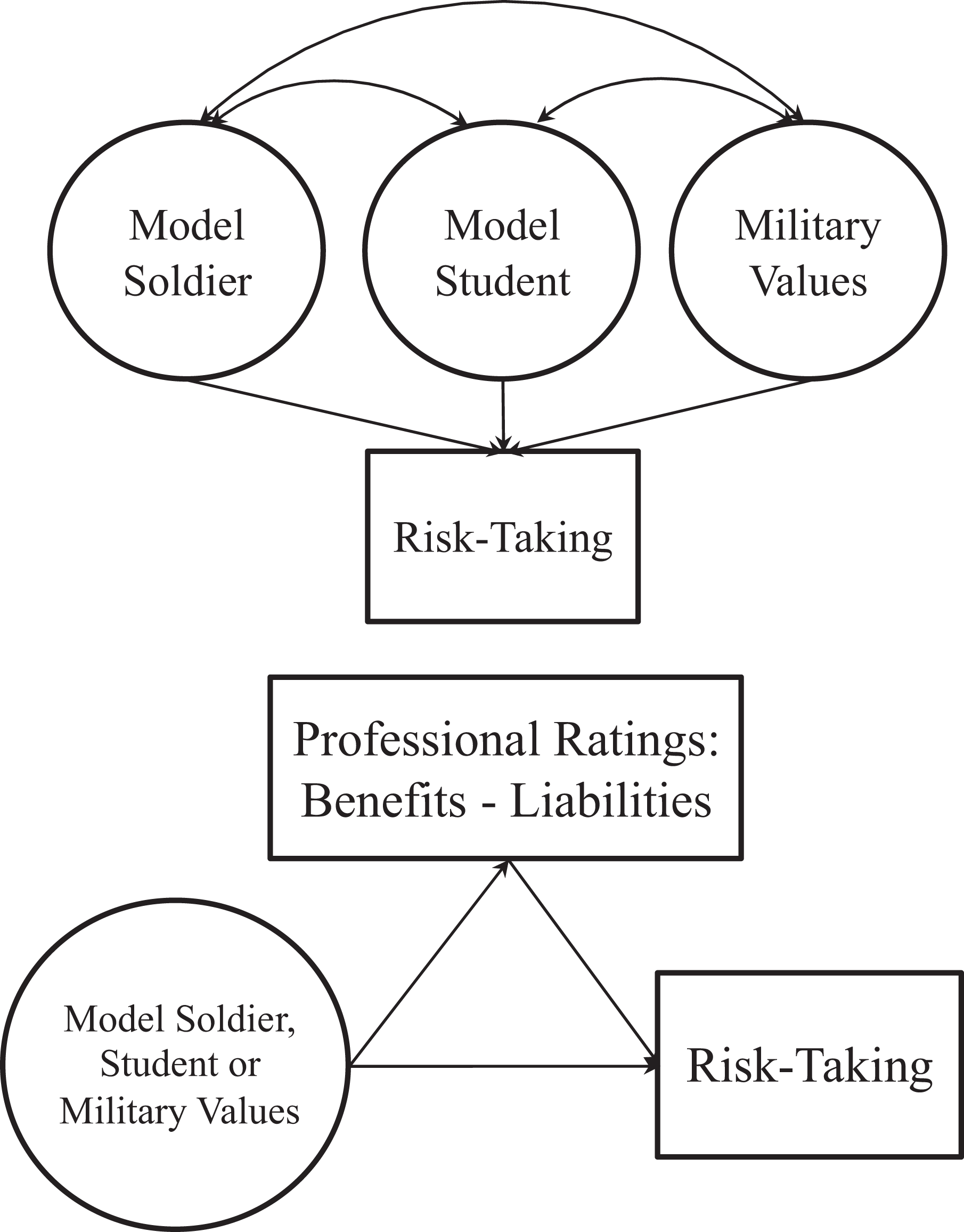
Top: Hypothesized model connecting outcomes and self-reported risk-taking. Bottom: Hypothesized mediation model demonstrating that the relationship between risk-taking and outcomes is mediated by a difference score between the benefits and liabilities of risk-taking as measured by the rating instrument.
We based the Model Soldier identity on military-relevant performance outcomes, and the Military Values concept was comprised of self-report, based on work demonstrating that affirming military ideals and military-relevant performance are related, but distinct entities (Johansen et al., 2013, 2014). For the Model Solider factor, we utilized military-related metrics important to USMA (e.g., leadership grade), physical performance scores based on previous work connecting military identity to physical prowess, and risk-taking propensity to physical fitness and positive identity (Hinojosa, 2010; Steinfeldt & Steinfeldt, 2012). Based on this work, as well as the above-cited literature demonstrating higher risk-taking propensity in military as compared to civilian groups, and theoretical work linking risk-taking to military identity, we expected our measure of risk-taking propensity to associate positively with military-relevant performance and values (e.g., Lanir et al., 1998; Sicard et al., 2003).
Previous work suggested that more cautious and conscientious students (i.e., lower on risk-taking) would perform better academically and acculturate USMA’s values and behavioral expectations and that organizational trust, civic behavior, and grades are interrelated (Conway et al., 2009; Gurbuz, 2009; Suerken et al., 2016; Zhang et al., 2019). Given this, we expected the Model Student identity to provide an example of the negative outcomes of risk-taking propensity such that those high on risk-taking would have lower affiliation to the Model Student identity.
In line with work reviewed above demonstrating how risk-taking, feedback or experience, and overconfidence are connected, we further expected the multirater professional growth rating system used by USMA to help illuminate how risk-taking propensity related to our outcomes. Specifically, we formulated our final hypothesis as follows.
We expected a mediational relationship to define the relationship between risk-taking propensity and affiliation to our identities, given previous work supporting overconfidence in risk-takers to negative outcomes (e.g., Campbell et al., 2004; Thomson et al., 2004). As noted above, overconfidence has often been proposed as an avenue through which risk-taking propensity leads to future decisions, behaviors, and outcomes, but this has not been fully tested in a military sample. Although we were not able to test all possible overconfidence mechanisms (e.g., feedback internalization, risk appraisal in specific contexts), we expected our global metric of the difference between confidence and conscientiousness-related traits to not only relate to risk-taking propensity but operate as a basis for how risk-taking relates to identity affiliation and outcomes.
Method
Participants and Data Collection
Data from the graduating classes of 2018 to 2021 were included in analyses. The primary structural equation model (SEM) included data from N = 3,307 cadets (76% male, 24% female; 66% Caucasian, 13% Black, 10% Hispanic, 9% Asian, 1% Native American, and 2% Other 1 ; and 19% Division I Athlete). Of the full sample, 93 cadets had missing values among the various outcome metrics.
Self-report data are part of a larger, longitudinal study of character and leadership at USMA (Callina et al., 2017). The study was approved by USMA’s Institutional Review Board (IRB) system in order to survey cadets and obtain relevant performance measures from USMA’s personnel database. For self-report measures, cadets volunteered to complete a battery of character-related questionnaires during one class session of an education module that features small-group discussions about character and leadership topics. The cadet discussion facilitator read a statement about the voluntary and confidential nature of the survey, and volunteers were then provided with time to complete it. No compensation was provided for volunteers due to concerns over influence. The survey was administered in the late spring of the academic year. Nonquestionnaire metrics, such as cadet grades, are integral to USMA’s cadet development system and are entered into a large personnel database. Data were drawn from this personnel database, the questionnaire database from the larger project, and specific departments and coded by an anonymous ID in accordance with IRB procedures.
Risk-Taking Propensity
Measures of risk-taking vary as to their coverage of specific risky behaviors (e.g., drug use), a tolerance for high-risk decisions, or the related construct of sensation-seeking (Bran & Vaidis, 2019). For the current study, we used the subscale of the Conformity to Masculine Norms Inventory (CMNI) specific to risk-taking (CMNI-46 adapted from the original CMNI; Mahalik et al., 2003; Parent & Moradi, 2011). Based on published factor loadings, we selected three of the five risk-taking items, which asked about a general interest in risky or dangerous situations, for example, “I am happiest when I’m risking danger.” This scale is not specific as to whether risks were cognitive (i.e., risky decisions) or physical (i.e., sensation-seeking) in nature and thus approximates global risk propensity. Cronbach’s α = .90. The overarching measure was initially developed among men, but the risk-taking subscale has subsequently been used among men and women to understand how general risk-taking propensity relates to identity as well as other outcomes (e.g., Miller, 2008). Prior work has also demonstrated invariance by gender for the CMNI-46 overall (Parent & Smiler, 2013).
Model Soldier Identity Metrics
Military identity is a relatively understudied construct, and much of the work on it focuses on the negative and hypermasculine aspects that, for example, erode gender climate or predict poorer adjustment postservice (Hinojosa, 2010; Lancaster et al., 2018). Instead, for the purpose of this study, we hoped to provide a performance-based operationalization that would help us understand cadets who were performing consistently well across military-relevant leadership and physical fitness domains, who opt for additional military training, and evaluate how risk-taking propensity and overconfidence operated for them.
Military leadership grade
A major component of the military program is a performance-based leadership grade given for assigned duties and responsibilities in military activities determined by the supervising officer (USMA, 2016b). The military performance grade was taken from the academic year the survey was administered.
Military-focused summer training
Participation in optional, military-focused summer training programs was an important outcome, as it suggested additional commitment to military identity. These training opportunities were split into two variables: one coded for participation in the more common airborne school and another coded for participation in any other military-focused program (e.g., Survival Evasion Resistance Escape or SERE school). As described below, service-focused trainings, such as peer counselor, were counted in the Model Student identity. Participation in the category was counted across the student’s time at USMA and not linked to when the survey was collected, as the order in which students participate in trainings is related to scheduling and other preferences unrelated to our constructs of interest.
Physical performance
A variety of physical fitness outcomes were considered for the Model Soldier factor. Two challenging and required courses in the physical program were selected: boxing and a class called Military Movement. The latter course includes a variety of skills that are novel to most cadets and several specifically test fear management.
The Army Physical Fitness Test (APFT) is composed of a 2-min effort of push-ups, 2-min effort of sit-ups, and a two-mile run. At the time of data collection, all soldiers, including USMA cadets, completed this test twice a year. The average in each event for the relevant academic year was used. Students are also required to complete a yearly obstacle course, with a passing time required for graduation; completion time was used as an additional physical performance metric. The APFT and obstacle course times were from the academic year of the survey administration, whereas the course grades above were taken from whatever year the course occurred, usually freshman year.
Model Student Identity Metrics
As a service academy, the USMA experience includes military training but also rigorous academics and service-oriented opportunities (USMA, 2016a). Based on the work cited above, our Model Student identity included integration of USMA-specific values as important to the self and simultaneously behaving in ways that align with USMA; such integration of organization-specific beliefs is important for performance and retention across several organizational and educational contexts (e.g., Chen et al., 2015). To us, a Model Student was a cadet who prioritized academics, service, and good behavior and who had an overall positive view of the institution of USMA itself and the experiences therein.
Academic performance
Academic grade point average (GPA) is a traditional computation of course grades and credits. The academic GPA was taken from the academic year (fall and spring semesters) that the survey was administered.
Behavioral reports
USMA staff, faculty, and cadet leaders may complete a behavioral report in response to observed behavior in order to commend a cadet or provide feedback to their supervising officer. Each report submitted to the larger Academy database is tagged as positive or negative; positive reports are often submitted for volunteer work or exceptional performance, whereas negative reports included minor rule-breaking conduct. The number of negative and positive behavioral reports for each cadet was used as a behavioral outcome.
Summer training: Service
Optional summer training programs focused on service (e.g., peer counseling, garrison) were included in the Model Student construct and coded as either having ever participated in service-oriented summer training or not.
USMA-self overlap
We assessed personal alignment of USMA-specific values and USMA-self overlap by adapting items from the Personal and Organizational Values Congruency Scale measure to our context (Posner, 2010). Items asked whether cadets felt their values were similar to USMA’s and whether their time at USMA influenced their values. Cronbach’s α for this scale = .82. See the Online Appendix for item descriptions.
Military Values Identity Metrics
Although we expected our Military Values construct to be related to our Model Soldier identity, prior work suggests that military ideals are separate from other aspects of military identity (Johansen et al., 2013). Importantly, we conceptualized our Military Values as attributes that both a hypothetical Model Soldier or Model Student at USMA would aspire to. Although many interrelated characteristics are listed across USMA and military doctrine on ideal soldier attributes, we selected three that we felt best captured the essence of Military Values, defined below (see Online Appendix for items and further details).
Bravery
The Bravery Scale from the Values in Action (VIA) measure of character strengths was selected as possibly related to risk-taking as a part of the values system of the military (VIA-120; Peterson & Seligman, 2004). For the present sample, Cronbach’s α = .83. The VIA was of interest due to its relevance to the profession of arms and the USMA population in particular (e.g., Matthews et al., 2009). This scale was included as part of the Military Values construct, as bravery is explicitly mentioned in Army doctrine (U.S. Department of the Army, 2012).
Resilience
To measure resilience (also called hardiness), we used the Dispositional Resilience Scale (DRS-15R; Bartone et al., 2008). Resilience is an important construct in the military generally (U.S. Department of the Army, 2012) and is championed at USMA (2018) specifically. Cronbach’s α = .82 for this sample. Previous work has tied resilience and risk-taking, implying that risk-takers must be resilient to risks that do not pay off (Nicholson et al., 2005).
Motivations to attend West Point
The authors developed a scale that measured motivations for attending West Point, asking cadets to evaluate how important each of 15 reasons is for them. For the current study, one item was selected for its relevance to the Military Values construct: “I feel a duty to serve in the military.” As was the case with the other values in this group, duty is an explicit value in Army doctrine.
Overconfidence Metric: Professional Growth Ratings
A 23-item instrument was developed by USMA that represents the essential characteristics of the Army profession (U.S. Army, 2019; U.S. Department of the Army, 2012). Cadets are evaluated by two instructors and three other cadets and complete a self-version per semester; ratings were averaged by rater across the academic year in which the survey was administered. Five of the 23 items were selected a priori as being of interest to the construct of risk-taking in the USMA military environment: confidence, judgment/decision-making, self-discipline, warrior ethos, and self-awareness (see Online Appendix for item descriptions and details).
Scores from this instrument were used as hypothesized mediators of the relationship between risk-taking and our proposed latent factors Model Soldier, Model Student, and Military Values. This instrument was used a measure of constructs like judgment and self-awareness, given concerns over cadet’s accuracy in self-rating such attributes (Bass & Yammarino, 1991).
Analytic Approach
Construction and evaluation of the models detailed in Figure 1 proceeded in several steps. As a precursor to the full SEM, a multivariate linear model examined which physical fitness outcomes were related to risk-taking. Prior research established that physical performance is positively related to risk-taking, and risk-taking is associated with military-relevant physical tasks (Firing & Laberg, 2012; Ruedl et al., 2010); however, there was little research to informing which of the physical measures important to USMA would be most relevant. Next, an SEM related risk-taking to our three identities: Model Student, Model Soldier, and Military Values. Missing data were imputed using full information maximum likelihood; for further information about SEM, see Weston and Gore (2006). SPSS Version 25 was used for multivariate models; structural equation and mediation models used R Version 3.3.0, lavaan package, Version 0.6 (Rosseel, 2012). Invariance testing by gender, which evaluates whether our model is equally valid in men and women, was also run (van de Schoot et al., 2012). Specific attention to whether our model was comparable across gender was important, given gender differences in risk-taking (Byrnes et al., 1999), debate over such differences (Nelson, 2016), and differences in military-relevant outcomes and values (Porter et al., 2019).
For the SEM, the Model Soldier identity was composed of three a priori predictors: participation in airborne, participation in other military-focused summer training, and military leadership grade, plus the physical performance variables from the preceding analysis. The Model Student identity included five a priori predictors: positive behavioral reports, negative behavioral reports, academic GPA, participation in a service-focused summer training, and a self-report of institution-self overlap. The Military Values identity was composed of the three self-report constructs: bravery, duty, and resilience. The final SEM contained these three latent variables with risk-taking as a predictor, which tests relationships between the identities and evaluates how each is connected to risk-taking. To assess moderation effects by demographics, the latent variable predictors (e.g., academic GPA) were regressed onto covariates gender, race, NCAA athlete status, and graduation year, as we expected covariates to account for different amounts of variation across predictors (see Figure 1).
General linear models next examined how risk-taking related to items on the professional growth instrument confidence, judgment/decision-making, self-discipline, warrior ethos, and self-awareness, with ratings included across three sources: self, cadet, and instructor. From this, items were identified that were reliably related to risk-taking, either in the positive direction, suggesting that risk-takers were rated highly on the construct, or in the negative direction, indicating risk-takers were viewed as having less of the attribute. A difference score was created with the average of items significantly positively related to risk-taking subtracted from items negatively related to risk-taking. This difference score was intended to quantify the relative benefits versus liabilities of risk-takers. Mediational SEMs then tested whether the relationship between risk-taking and the three latent variables from the SEM (Model Soldier, Model Student, and Military Values) could be accounted for by this benefits versus liabilities difference, adding a mediational effect to the previous SEM.
Results
Risk-Taking and Outcome Categories
Physical fitness was a key outcome for the Model Soldier construct, with a large number of possible metrics at USMA. A preliminary multivariate regression was conducted to select fitness outcomes most suitable for the SEM. Grades for boxing, military movement, most recent APFT run, sit-up, and push-up score, and most recent obstacle course score were entered into a multivariate general linear model (GLM), with gender, race, NCAA athlete status, and graduation year as covariates and risk-taking as another predictor. The omnibus effect of risk-taking was significantly associated with this set of physical fitness outcomes, Pillai’s Trace: F(6, 1063) = 3.45, p = .002; univariate effects demonstrated that military movement course grade and APFT push-ups were significantly and positively related to risk-taking, military movement: F(1, 1068) = 9.97, p = .002, η2 = .009; APFT push-ups: F(1,1068) = 9.56, p = .002, η2 = .009, whereas the others were not (APFT sit-ups: p = .98; APFT run: p = .65; obstacle course: p = .86; and boxing: p = .095). Risk-taking was most relevant to novel and challenging physical skills (Military Movement course) and to upper body strength (APFT push-ups) but not aerobic capacity or training (APFT run) or other physical fitness courses (boxing). Risk-taking was selectively related to specific physical skills and not overall fitness.
A SEM then tested how risk-taking related to the three latent variables Model Soldier, Model Student, and Military Values, with risk-taking as a predictor to all three. The Model Soldier construct included five observed predictors: military program leadership grade, military summer training program participation (airborne and other entered seperately), and two physical variables from the above multivariate analysis, APFT push-ups, and Military Movement class grade (see Figure 2). The model was a good fit to the data (χ2 = 612, p < .001; RMSEA = .048, SRMR = .042; see Online Appendix for parameters and details). Risk-taking was significantly related to the Model Solider and Values constructs in the positive direction and negatively to the Model Student latent variable. The Model Soldier and Student latent constructs were positively related to each other, but neither was reliably related to the Military Values construct. This result implied that military-relevant values are held by cadets regardless of their performance in academic and physical/military areas.
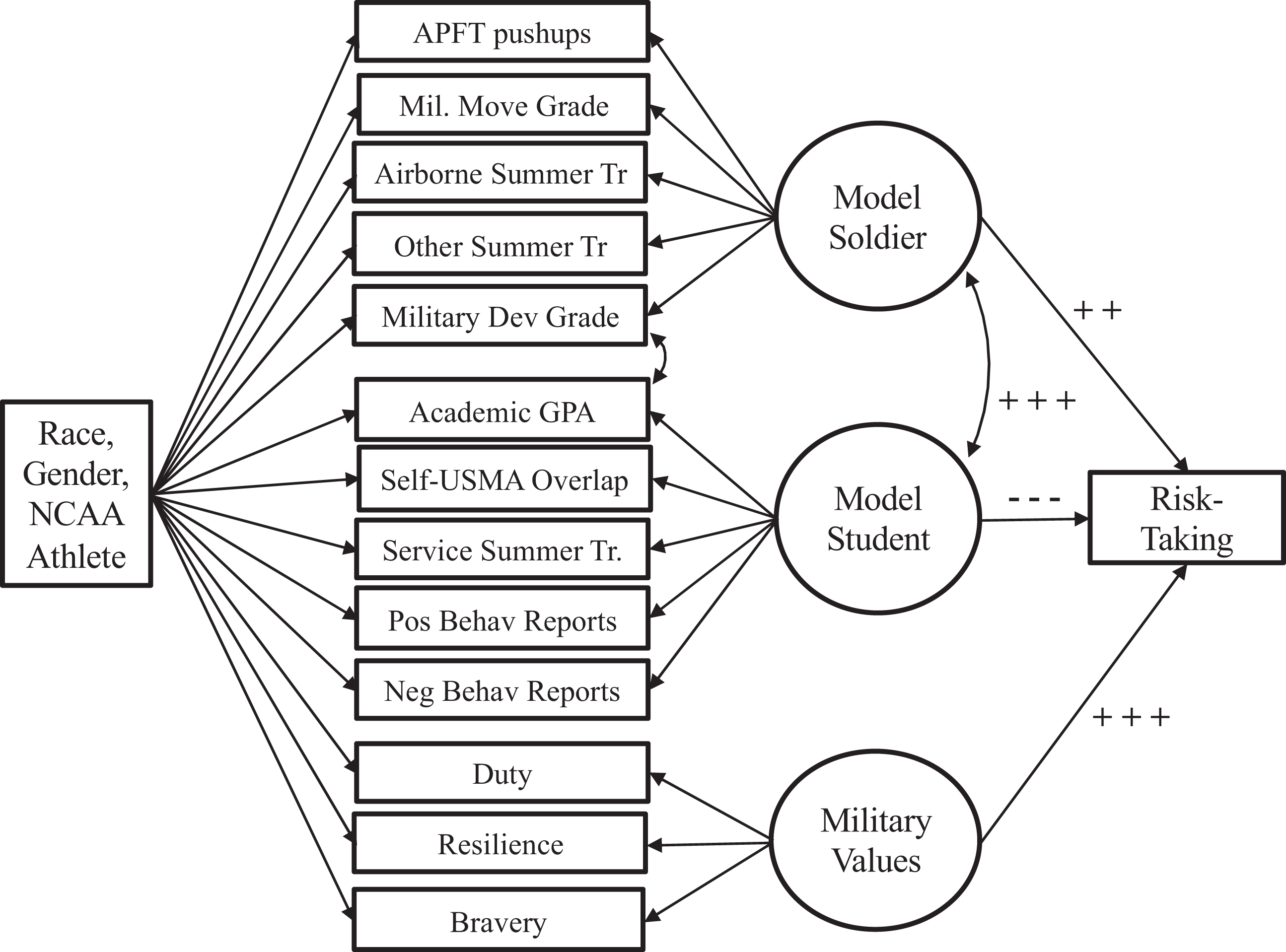
Results of the structural equation model connecting risk-taking to the Model Soldier, Model Student, and Military Values identities. Note. Arrows shown are significant at p < .05. Relationships between risk-taking and identity are labeled to show the direction of the effect: showing a positive relationship + p < .05. + + p < .01. + + + p < .001; showing a negative relationship − p < .05. − − p < .01. − − − p < .001. Covariates race, gender, athlete status, and graduation year were modeled separately onto each predictor and were all significant for at least one predictor, but details are not shown for clarity. See Online Appendix for parameter estimates.
Many of the predictors comprising the latent variables demonstrated a significant interaction with gender and not all in the same direction. Invariance testing evaluated the effect of gender on each of the three latent variables separately; this evaluates whether our identities have the same meaning in men and women. The Military Values identity demonstrated strong invariance (see Online Appendix for details). The Model Soldier and Student concepts demonstrated weak invariance, with equal loadings by gender but differences in intercepts and means. This finding indicated that the meanings of our Model Student and Soldier identities were comparable across genders. However, mean differences persisted between genders; thus, gender is important to our models.
Risk-Taking and Character and Leadership Ratings
Risk-taking was then related to scores on the rating instrument developed by USMA. A generalized linear mixed effects model tested how risk-taking was related to the five items, confidence, self-discipline, judgment/decision-making, self-awareness, and warrior ethos, as completed by the three reporter sources (peer, instructor, and self). Race, gender, athlete status, and graduation cohort were covariates. A significant reporter by item by risk-taking interaction was found, Pillai’s trace: F(10, 1796) = 3.67, p = .020. Follow-up GLMs with the same covariates tested the influence of reporter and risk-taking for each of the five items separately. Judgment, self-discipline, and self-awareness demonstrated a negative relationship with risk-taking, and a risk-taking by reporter interaction was not significant, judgment interaction: F(2, 2496) = 2.44, p = .086; self-discipline: F(2, 2712) = .46, p = .63; and self-awareness: F(2, 2675) = 1.04, p = .49. Peers, instructors, and high-risk-taking cadets themselves view them as having poorer judgment, self-discipline, and self-awareness as compared to low-risk-taking cadets.
For warrior ethos and confidence, there was a significant interaction between risk-taking and reporter, confidence: F(2, 2721) = 7.0, p = .001; warrior ethos: F(2, 2327) = 6.28, p = .005. The 95% confidence intervals around the parameter estimate, for how risk-taking predicted the score from each reporter, were used to understand the interaction. For warrior ethos, the peer and instructor estimates of how risk-taking related to item rating were not significantly different from zero, whereas the self-rating was significantly positive and nonoverlapping from the other two reporters (peer: 95% CIs [−.019, .030]; instructor: [−.038, .031]; and self: [.034, .092]). For confidence, the peer and self-ratings were different from zero and positive, and the instructor rating was not (peer: 95% CIs [.037, .085]; instructor: [−.037, .032; and self: [.047, .11]). Therefore, high-risk-taking cadets viewed themselves as demonstrating more warrior ethos, but their peers and instructors do not. High-risk-taking cadets viewed themselves as more confident, and peers agree, whereas instructors do not. These analyses suggested a dissociation between confidence and conscientiousness-related attributes for risk-taking cadets, with confidence outpacing judgment, self-awareness, and self-discipline.
Mediational Analysis
The differentiation of items on the rating scale was then used to determine whether the difference between confidence and conscientiousness-related items was responsible for aforementioned relationships between risk-taking and key outcomes. This “overconfidence” metric was computed as a difference score between the mean of peer and self-rated confidence (these were positively related to risk-taking), and the mean of judgment, self-awareness, and self-discipline (all rater sources, negatively related to risk-taking). A mediational effect of overconfidence was added to the relationship between risk-taking and each of the three latent constructs; the model was otherwise identical to the previous version. The overconfidence metric was positively related to risk-taking and a significant mediator of the relationship between risk-taking and each latent construct (Figure 3). The direct effect from risk-taking to the latent construct was still significantly related to the Model Soldier, Student, and Military Values constructs, indicating that the mediational effect was not entirely responsible for the relationship.
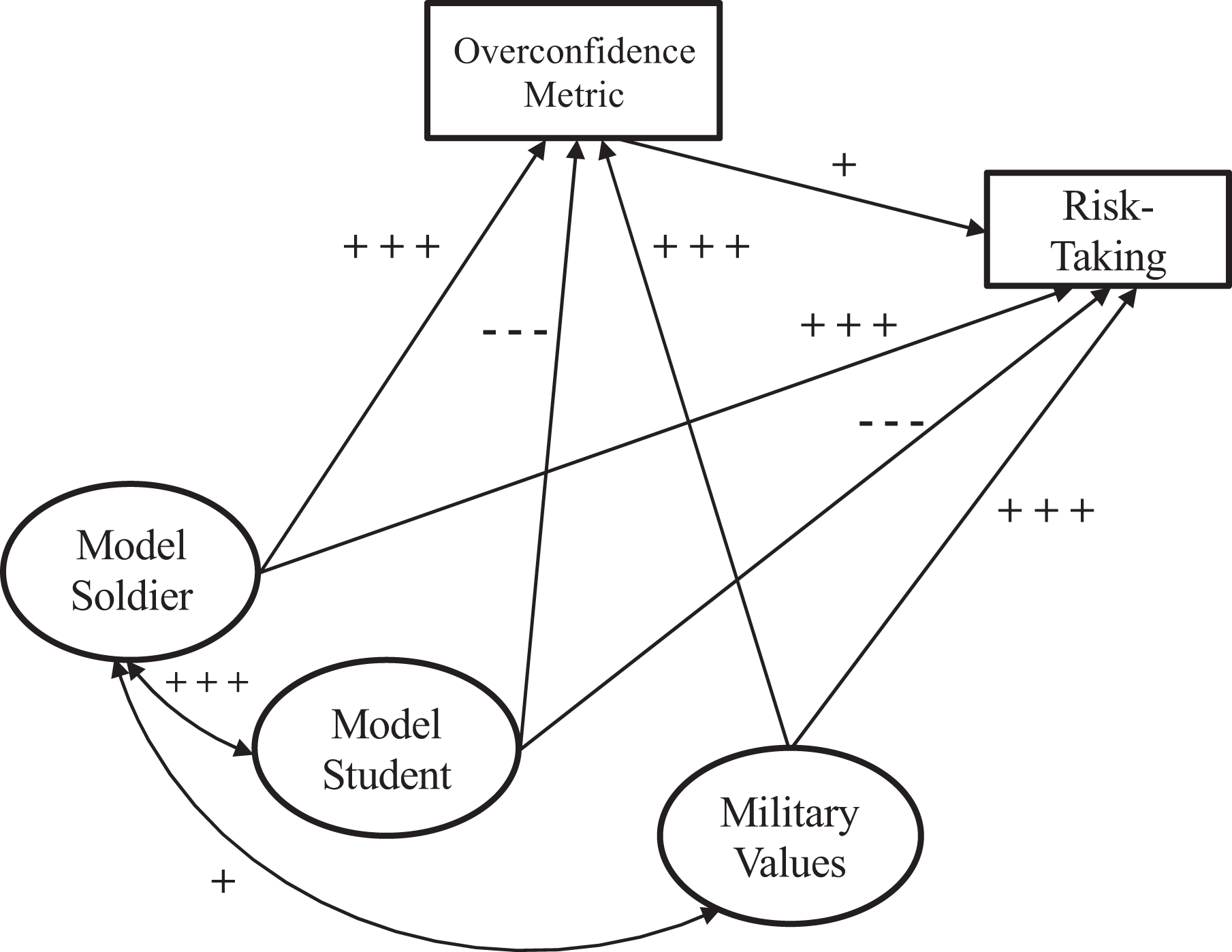
Results of the mediational structural equation model (SEM), which tests whether overconfidence mediates the relationship between risk-taking propensity and alignment of our three identities. Note. To do this, a mediating effect of overconfidence was added to the previous SEM. The predictors creating the three latent constructs were estimated as before but are omitted for clarity. Arrows shown are significant at p < .05 and are labeled to show the direction of the effect: showing a positive relationship + p < .05. + + p < .01. + + + p < .001; showing a negative relationship − p < .05. − − p < .01. − − − p < .001.
For the Model Student construct, the mediational relationship between overconfidence and the latent variable was negative, meaning that high levels of overconfidence were associated with lower Model Student outcomes (p < .001). For the Military Values and Model Soldier latent constructs, the relationship between overconfidence and the latent variable was positive, meaning that higher levels of overconfidence were associated with higher levels of Model Soldier outcomes and Military Values (p < .001 and p = .001, respectively). Therefore, the relationship between risk-taking and key outcomes is partially accounted for by a mismatch between a cadet’s confidence and conscientiousness-related competencies such as judgment and self-discipline, in a way that increases the level of Military Values and military-relevant performance outcomes but decreases academic performance outcomes.
Two final mediation models tested the effects of the overconfidence metric on the Model Soldier and Model Student latent variables for women only, given the invariance of these factors. Separate models tested whether, for women only, overconfidence mediated the relationship between risk-taking and these two latent constructs. The mediational effects were not significant for the Model Soldier construct (indirect effect estimate, p = .86). However, for the Model Student construct, the mediation effect of overconfidence accounted for the direct effect of risk-taking on the Model Student outcomes, rendering the direct effect nonsignificant (direct effect p = .27; indirect effect total estimate p < .001). For women, overconfidence did not impact military-relevant performance, but for academics, overconfidence is important to consider in understanding how risk-taking may lead to poorer outcomes.
Discussion
The purpose of the current study was to examine the intersection between individual risk-taking propensity and the military training environment, which prepares cadets at the USMA for an environment in which risk is unavoidable. In line with our hypotheses, risk-taking propensity was linked to simultaneous positive and negative outcomes and was also related to endorsing military ideals (Hypotheses 1 and 2). Importantly, cadets with higher risk-taking propensity were perceived as more confident but of less sound judgment, lower self-awareness, and lower self-discipline. This confidence–conscientiousness mismatch, suggestive of overconfidence, mediated the relationship between risk-taking and all outcomes (Hypothesis 3). The direction of the mediation demonstrated that our overconfidence metric potentiated facets of military identity, including values such as duty and military-relevant performance, but was detrimental to academics and behavior. These findings offer a greater understanding of the potential benefits and liabilities of risk-taking in a military training environment. The specificity of outcomes to the USMA environment is unavoidable, but the overall findings demonstrating that overconfidence is a basis for how dispositional risk-taking influences priorities, values, and outcomes have direct translations to other military contexts and suggest interventions where overconfidence may be problematic.
The associations we found between risk-taking propensity and positive and negative outcomes have generally been supported by prior work (Breivik et al., 2019) and further suggested that risk-taking moderates adherence to various available social identities. Academic performance and conformity to USMA’s behavioral expectations and values system appeared as clear liabilities of the attribute, whereas physical and military excellence was a benefit (e.g., Black et al., 2019; Zhang et al., 2019). In both cases, overconfidence was partly responsible for the relationship. The confidence–conscientiousness discrepancy mediated the negative relationship between risk-taking and academic achievement, which indicated that cadets with a larger mismatch between confidence and judgment or self-discipline had lower academic GPA, less institution-self overlap, and more negative/fewer positive behaviors. The converse was also true: Cadets with higher GPAs and good behavior had approximately equal confidence and conscientiousness. Academic difficulties in overconfident cadets could be a result of not preparing sufficiently (e.g., studying) or insufficient planning (Dunlosky & Rawson, 2012). Poor internalization of rules and institutional values might be related to relatively poorer moral reasoning and more self-absorbed reasoning in high risk-takers (Malesza & Ostaszewski, 2016), and perhaps their tendency to reframe morals and neglect the larger context (Kuther & Higgins-D’Alessandro, 2000). Although further work is needed to identify precisely which overconfidence facet is active in any given case, directly addressing the apparent poor self-awareness in risk-takers in a way that is tailored to the context (e.g., moral decisions, academic planning) might be a novel avenue for addressing negative outcomes associated with risk-taking propensity.
Despite these findings, basic professional values, such as duty, were positively associated with risk-taking and potentiated by overconfidence, which suggests that some values of risk-takers are not entirely driven by a self-absorbed view. The relatively poor assimilation of institution-specific values, with the preservation of larger beliefs, might be associated with overprecision, a facet of overconfidence described as a belief that one knows “the truth” more than others (Moore & Schatz, 2017). If overprecision were identified in future research, it may help contextualize feelings of cynicism about an institution such as USMA or the Army, despite otherwise affirming military values. Our models describe organizational affiliation and pro-organizational behavior as divergent from motivating values such as duty. High risk-takers ascribe to the latter component but not to the former, providing further explanation for why military identity can simultaneously be associated with positive moral values but also greater behavioral problems that seem to defy these same values (Jacobson et al., 2008).
The current data suggested that a military environment and the requisite identity match the strengths of dispositional risk-takers in some ways, allowing them avenues to showcase strengths, similar to athletic or business environments where positive aspects of risk-taking are studied (e.g., Mills & Pawson, 2012). At the same time, conscientious and low-risk-taking students at USMA also demonstrated strengths important to the institution (high academic GPA, good judgment) and reported greater affiliation with USMA values specifically, findings in line with previous work on organizational identity (e.g., Mesmer-Magnus et al., 2018). This result underscored the importance of understanding the strengths and limitations of both high- and low-risk propensity individuals and may inform potential recommended career paths for cadets following graduation, such as choice of military branch.
With respect to the military generally, results demonstrate risk-taking’s benefits and liabilities, both of which are closely associated with overconfidence, and calls into question the extent to which risk-taking is worth championing. Analogous concerns have been raised in the entrepreneurial literature (Hsieh et al., 2017), which also traditionally has viewed risk-taking positively. This implication may be of considerable importance, given the relatively large theoretical military literature and doctrine that speaks positively of risk-taking and its close relatives (e.g., audacity, boldness), which tend to romanticize or assume that taking bold risks is crucial in military operations (Hannah et al., 2010; Lanir et al., 1988).
In this investigation, the negative outcomes associated with risk-taking propensity included poorer grades, lower self-institution overlap (despite good internalization of beliefs such as duty), greater reports of bad behavior, and fewer prosocial behaviors. This constellation may underlie some of the problematic behaviors frequently studied in military populations, such as excessive drinking, as many of these are risk factors for sexual assault when combined with other traits such as sexism (Locke & Mahalik, 2005). A large literature stresses the problems inherent to hypermasculinity and defines excessive confidence and risk-taking as aspects of it (e.g., Miller, 2008; Mowen et al., 2019). Further, women and other groups may face difficulties when attempting to excel in organizational cultures where hypermasculine qualities are held as ideals (Koeszegi et al., 2014; Rosen et al., 2003). The current study builds on this literature to show additional outcomes of excessive confidence and risk-taking propensity and implies that the problems related to these hypermasculine facets (e.g., rule-breaking behaviors) might be helped by reinforcing accurate self-construal and cautiousness. Further study is needed to understand the impact of targeting these facets, but it is possible that addressing excessive confidence and low self-awareness might be a more palatable avenue to reducing toxic and hypermasculine organizational climates, as compared to strategies that challenge hegemony and incite resistance (Buchanan et al., 2017; Isaac et al., 2016; Isbell, 2019; Kime, 2019).
Several important limitations in the current study may be helpful to inform future work with the construct of risk-taking. Importantly, our measure of risk-taking emphasized its affective components (i.e., comfort with dangerousness or risk) in an unspecified context, describing a global risk-taking propensity. It also was developed as part of a negative construct, toxic masculinity, so finding negative outcomes aligns with the measure’s intent and may have overemphasized the negative side of the construct. We replicated previous findings that the average level of risk-taking propensity is greater for men as compared to women, but results suggested that how risk-taking influences outcomes is consistent across gender (Lemaster & Strough, 2014; Miller, 2008). However, the relatively small sample size of women renders a full analysis of any gender effects statistically underpowered, and this is an important direction for future work. In addition, other measures or tasks used in past work have instead emphasized risky situations in decision-making, which may be particularly relevant to risks encountered in a military context that features unavoidable risk through fluctuating conditions, limited information, and so on (Lanir et al., 1988). Future work should elaborate on the connection between cognitively focused types of risk-taking and the aspects of risk-taking studied here and how these relations relate to outcomes in the military. Risk-taking was negatively associated with sound judgment in our analyses; if and how this finding translates to decisions and leadership outcomes, especially under stress, is an important avenue to explore.
We conceptualized risk-taking as a relatively stable attribute; however, important contextual influences may change risk tolerance. Experiences such as stress or deployment may alter risk tolerance and propensity to engage in unsafe behaviors (Killgore et al., 2008), and the same action can be considered risky for one person but safe for another depending on experience, training, and personal situations (Bran & Vaidis, 2019). We also focused on risk-taking propensity and did not fully disentangle it from other stable attributes such as narcissism (e.g., Zhang et al., 2019). Further understanding of variation in risk-taking and risk appraisal, or further delineation from other stable attributes, would be an important extension of this work and would enable better characterization of who is at risk of negative outcomes.
The current investigation described cadets at USMA and the outcomes relevant at this stage of their development and training. Understanding how risk-taking propensity relates to performance in the greater Army, including retention, disciplinary action, organizational trust over time, and performance in opportunities such as Ranger School and Special Forces units, is vital to understanding how risk-taking propensity impacts the larger force. Prior work in the military has often focused on how risk-taking is associated with negative behavioral outcomes (e.g., Jacobson et al., 2008; Killgore et al., 2008); these studies underscore the negative sides to risk-taking propensity. The current work demonstrated that high-risk cadets demonstrated institutionally important strengths, whereas low-risk cadets demonstrated other important assets; how these variables operate in these students’ eventual careers is currently unknown. Understanding these trajectories will be important to contextualize effects, focus intervention efforts, and inform talent management in an ever-changing force.
Conclusions and Implications
At USMA, cadets with higher risk-taking propensity demonstrate greater military and physical performance, while also exhibiting more behavioral problems, poorer grades, and have a discrepancy between their confidence and conscientiousness-related attributes. The boldness that makes SERE school sound exciting, duty to serve vital, and physical training important might also result in a cadet paying less attention to factual knowledge (grades) and be more inclined to break rules. Conversely, conscientious and cautious cadets might perform more poorly in physical tasks and show less interest in some aspects of military training, but their behavior is in line with expectations, academic achievement and service take priority, and their self-awareness is good. Our models suggest that both risk-taking and risk aversion have important benefits and liabilities, and both ends of the spectrum seem to have importance for the military.
Although our sample represents military trainees, risk-taking propensity itself a reasonably stable attribute, and it altered affiliation selectively toward some identities and not others. These cadets may be on trajectories that they maintain during the rest of their time in service with respect to priorities and values. Importantly, our results demonstrated that overconfidence is a possible basis for how risk-taking propensity influences these outcomes, and cited work suggests situational overconfidence is a possible intervention target that might be accessible across time and context for service members. Interventions that balance confidence and other competencies may help temper negative consequences of risk-taking propensity, such as misconduct. Projecting and inspiring context-appropriate confidence is rightfully an important aspect of leadership training in the military; this work suggested that equal emphasis should be placed on incorporating self-reflection and feedback, especially for those groups in which individuals would be expected to have a higher baseline of risk-taking propensity.
Supplemental Material
Supplemental Material, sj-docx-1-afs-10.1177_0095327X20973373 - The Benefits and Liabilities of Risk-Taking Propensity and Confidence at the U.S. Military Academy
Supplemental Material, sj-docx-1-afs-10.1177_0095327X20973373 for The Benefits and Liabilities of Risk-Taking Propensity and Confidence at the U.S. Military Academy by Hillary S. Schaefer, Andrew G. Farina, Dave I. Cotting, Eliot S. Proctor, Cheveso L. Cook and Richard M. Lerner in Armed Forces & Society
Footnotes
Acknowledgment
We sincerely thank the Office of Institutional Research at USMA and the rest of the Project Arete team for their help and support.
Declaration of Conflicting Interests
The authors declared no potential conflicts of interest with respect to the research, authorship, and/or publication of this article.
Funding
The authors disclosed receipt of the following financial support for the research, authorship, and/or publication of this article: This article was supported by a grant from the Templeton Religion Trust (to Richard M. Lerner).

Supplemental Material
The supplemental material for this article is available online.
Note
References
Supplementary Material
Please find the following supplemental material available below.
For Open Access articles published under a Creative Commons License, all supplemental material carries the same license as the article it is associated with.
For non-Open Access articles published, all supplemental material carries a non-exclusive license, and permission requests for re-use of supplemental material or any part of supplemental material shall be sent directly to the copyright owner as specified in the copyright notice associated with the article.
