







Abstract
This article analyses the civil–military relations in Kenya in the context of civilian-activated politicization that is taking place the same way it happens in Latin America and the United States under the former Trump administration. In Kenya, this involves the use of the military in noncombat internal missions such as infrastructure development and management of public institutions especially where such institutions are perceived to be inefficient due to corruption both in public and private sectors. Judging from the outcomes of public works undertaken by the military, corruption and inefficiencies cannot be ruled out. This is demonstrated by the Kenya–Somalia Border Securitization Project where 34 million dollars was used to erect a 10-km fence in the war against terrorism. The outcomes of this study negate the logic of the proponents of developmental militarism in Africa who have been vocal in advocating the deployment of the soldiers to solve noncombat social challenges in the continent. Based on three case studies examined, deploying the military to engage in public works projects brings the military into a political minefield, is not productive, and proves to be an unreliable way to combat internal political corruption.
Keywords
Introduction
In his last term of presidential tenure, Uhuru Kenyatta had a high inclination to deploying military personnel to perform civilian or “fatigue” duties (K’Akumu, 2022). This led to an outcry in the local media where the action was labeled as “militarization of government” and queried by this article as “the rise of the militarized state?.” The political reaction by other stakeholders is what is termed hereby as praetorian politics (Dorman, 2013; Perlmutter, 1986). This refers to the contestations by governance stakeholders regarding the (perceived) undue influence of the military in the Kenyan society. Nevertheless, the term “militarized state” simply refers to a state that is involved in any aspect of militarism, in the sense that terms like “developmental state” (Wade, 2018; Woo-Cumings, 2019), “bureaucratic state” (Bourdieu & Farage, 1994; Wilson, 1975), “regulatory state” (Dubash & Morgan, 2012, 2013; Majone, 2019), and “predatory state” (Vahabi, 2016) have been used in the past. In the ordinary dictionary sense, the word “militarize” has two meanings:
To equip or supply (a place, organization, etc.) with soldiers and other military resources (what is referred to here as combat militarism) and,
To give (something) a military character (what is referred to here as noncombat militarism).
In the Kenyan case, we are interested in the second aspect, in the context of developmental militarism as advocated by scholars and administrators of Africa who believe that the military resources should not be left idle during peacetime while the nation remains wanting in terms of development.
Militarization may result from various activations of militarism. Lesley Merryfinch (1981) defined “Militarism” as the case: “When military goals, values and apparatus increasingly dominate a state’s culture, politics and economy” (p. 9). As this study is about developmental militarism in Africa, in the same token, we can define developmental militarism as a political administration where military goals, values, personnel, or apparatus increasingly drive the development agenda of the state.
In the political economy of developing countries, the instrumental role of the military in governance and development cannot be assumed. It has become apparent that the military plays an important role in the quest of democratic governance (Degaut, 2019; Hassan et al., 2018; Lutterbeck, 2013) in maintaining democratic governance (Decalo, 1989; Varol, 2013) and in overall economic development and national stability (Decalo, 1989; Kibicho, 2005; Salihu, 2020; Shaw, 1979). This article presents an analysis of the developmental role of the military in Kenya to ascertain whether the deployment of the military on civilian duties during the political administration of President Uhuru Kenyatta contributed to the welfare of Kenyans as citizens of a democratic country. Developmental militarism, in this context, applies to the involvement of the military in the conception, planning, or execution of development projects of the state.
This study analyses the cases of civilian-activated militarization of state development projects in the public works sector in Kenya. Existing literature tends to support the involvement of the military in the development of African nations because of the assumption that the military has capability advantages in comparison with civilian institutions. The key research question in this context is, following the recommendations of authors such as Shaw (1979), Gotowicki (1997), Diop (2013), and Zimmermann and Matisek (2020), whether it makes economic sense to involve the military in the development agenda of the state in Africa. Therefore, this study opted to put to test the notion that the military institution can perform better than civilian institutions in delivering development and services to the citizenry of the African state. To achieve its research goal, the study adopted three case study projects in the built environment sector concerning construction of security wall along the Somalia border, rehabilitation of transportation infrastructure, and provision of municipal services within metropolitan Nairobi.
Kenya is a suitable case study in the area of developmental militarism because since independence the country has not engaged in external war except the invasion of Somali in 2011, an operation that was strategically taken over by African Union Mission in Somalia (AMISOM). Therefore, the military has been relatively idle, and it was good to experiment whether they can be used to execute war against underdevelopment. Second, it is important to note that Kenya is unique among countries in Africa where military coups have been rampant in that the military has not interfered with the civilian administration since independence. Finally, Kenya is one of the countries whose governance is modeled as democratic capitalism where private sector involvement is encouraged; therefore, it would be interesting to see the implications of developmental militarism on economic governance in such an African country.
The Many Faces of Militarization of the State
As noted earlier, militarization can take both combat and noncombat militarism. In civil–military relations literature, noncombat militarism may take the form of politicization of the military or militarization of politics which refers to the drawing of the military to the political space of the state. In democratic societies, the state is made of the political elites and the military where the military is supposed to protect the state from external threats while the political elites manage the civil affairs of the state using various strategies, instruments, and institutions. According to Golby (2021), politicization or militarization may occur in two ways: civilian activation, where civilian leaders attempt “to co-opt the military for personal, partisan, or electoral gain” and military activism where “individual or collective efforts by the military to inappropriately influence policy outcomes or provide political advantage to a party, candidate, or group” (p. 150). Military activism is what has been going on in places like Turkey (see Yilmaz, 2020), however, and what is exciting scholars in the subfield of civil–military relations currently is the civilian activation that has occurred in North, Central and South America in the recent past.
Some of the recent cases of politicization of the military include Donald Trump’s America (see Beliakova, 2021; Brooks, 2021) while militarization of politics is currently ongoing in Latin America (see Diamint, 2015; Pion-Berlin & Acácio, 2020; Solar, 2021); in Brazil under President Jair Bolsonaro (Harig, 2021) and Mexico under President Andres Manuel Lopez Obrador (see Sánchez-Talanquer & Greene, 2021) and in Honduras under President Juan Orlando Hernández (see Beliakova 2021; Mani, 2021; Rawxley, 2017) detailed instances when President Trump administration politicized the U.S. military using a variety of ways including an initial appointment of two retired Generals for positions of Defence and Homeland Security and a retired Lieutenant General as national security advisor. This motivated Beliakova (2021) to coin the concept of “erosion by deference” to advance the idea that delegating policymaking responsibilities to members of the military profession does constitute a threat to civilian control. Alternatively, Brooks (2021) compared President Trump’s politicization strategy to the global trends and found that the American model was not different from what was going on in the rest of the world. Golby (2021) on the contrary used the concept of “civilian activation” to demonstrate how President Trump as a civilian head of state endeavored to draw the military into the politics of his country.
In the developing world, many countries undergo militarization whether civilian activated, military activism, or other typologies. Apart from the Latin America and Turkey that have been mentioned, in South Asia two other countries stand out as overly militarized. These are Myanmar (formerly Burma) and Pakistan. For most times since gaining independence from British colonialism in 1948, Myanmar has been under military rule (Kipgen, 2016) but from 2009 was under a quasi-democratic government (Buchanan, 2016; Seekins, 2015) until after 2020 elections when the military seized power again. The militarization in Myanmar is a unique one because it involves militarization by militia force where state, military, or political leaders recruit private armies for their security in civil war situation. Here, the militarization is done to participate in internal insurgencies (Abrahamian, 2017). This presents a case of militarized ethnic nationalism or militarization of politics (Fink, 2008; Han, 2017; Kipgen, 2016; Olivius & Hedström, 2019; Pau, 2012; Stokke et al., 2022). According to Petrie and South (2014), “For more than half a century, rural areas of Myanmar populated by ethnic nationalities have been affected by conflicts between ethnic insurgents and a militarized state, widely perceived to have been captured by elements of the ethnic Burman majority” (p. 223).
Like Burma (Myanmar), Pakistan too was a British colony before its establishment as an independent state from the British India Empire in 1947. Likewise, Pakistan is a classic example of militarization arising from the fact that it has faced a constant armed conflict with the neighbor India with whom it has fought three major wars since independence (Azhar, 2009; Cohen, 2002; Ziring, 1974). But the militarization in Pakistan is not exactly the same as that of Myanmar as it occurs in many forms, primarily in terms of arms race where more national financial resources are tied to the manufacture and importation of arms (Bildirici & Kayikçi, 2021; Faruqui & Schofield, 2002; Ullah et al., 2021). Ullah et al. (2021) reported that Pakistan spent 4.03% of its gross domestic product (GDP) on defense in 2019, making it the 19th big spender in the world for that year. In this macroeconomic analytical context, Ullah et al. (2021) analyzed causal relationship between militarization and economic growth in Pakistan and found that “Overall evaluation of military regime suggests that the militarization has a comparatively more positive significant impact on economic growth than non-militarization.”
That notwithstanding, militarization in the context of politicization also exists in Pakistan. The constant threat by India led to the military’s meddling in the politics of Pakistan in terms of military takeovers or military control of civilian governments (Schofield, 2007). In this context, Azhar (2009) reported that, apart from the three wars, Pakistan has suffered “violent regime changes, assassinations of democratically elected leaders, and repeated military dictatorships.” The first military coup took place in 1958, followed by the second in 1969; then, there was an interlude of civilian rule in 1971 lasting up to 1977 to give way to the third coup that re-introduced military rule until 1988 when there was a return to civilian rule that was curtailed by a fourth coup in 1999 (Faruqui & Schofield, 2002). The Pakistani military, also, has been used in internal territorial disputes especially in the Balochistan Province, where Khan (2009) noted that “the militarized Pakistani central state continues to view Balochistan as a source of natural resources, pursuing a largely military solution to lingering socioeconomic and political problems” (p. 1072).
Another aspect of militarization documented in Pakistan concerns civilian organizations (Jihadist and sectarian militant groups) that are active in the Federally Administered Tribal Areas (FATA), the semiautonomous tribal region of Pakistan along the Afghan border (Ali, 2018; Ullah, 2013). These armed groups are known to commit war crimes against noncombatant civilian population especially women and children (Naseer, 2015).
From the two Asian case countries, we can see that militarization takes many forms in the developing world. From Pakistan, we learn that external threats can drive states into militarization in the form of arms race. In addition, external threats may create advantage for military the involvement in politics through military coups or through military influence of political decisions. Furthermore, militarization also occurs in the form of military intervention on internal political conflicts (as is the case of Balochistan Province) or militarization in terms of raising political militias or insurgents, as in Myanmar or the FATA region of Pakistan.
This literature is by no means comprehensive; it is only indicative of the goings-on on militarization in the developed and developing worlds. This being a qualitative study; no representation is intended for the countries covered; however, the literature considered here helps in charting the typologies of militarization across the globe. Figure 1 is a graphical summary of these typologies of militarization. From the figure, we can see that militarization bifurcates into combat and noncombat typologies.
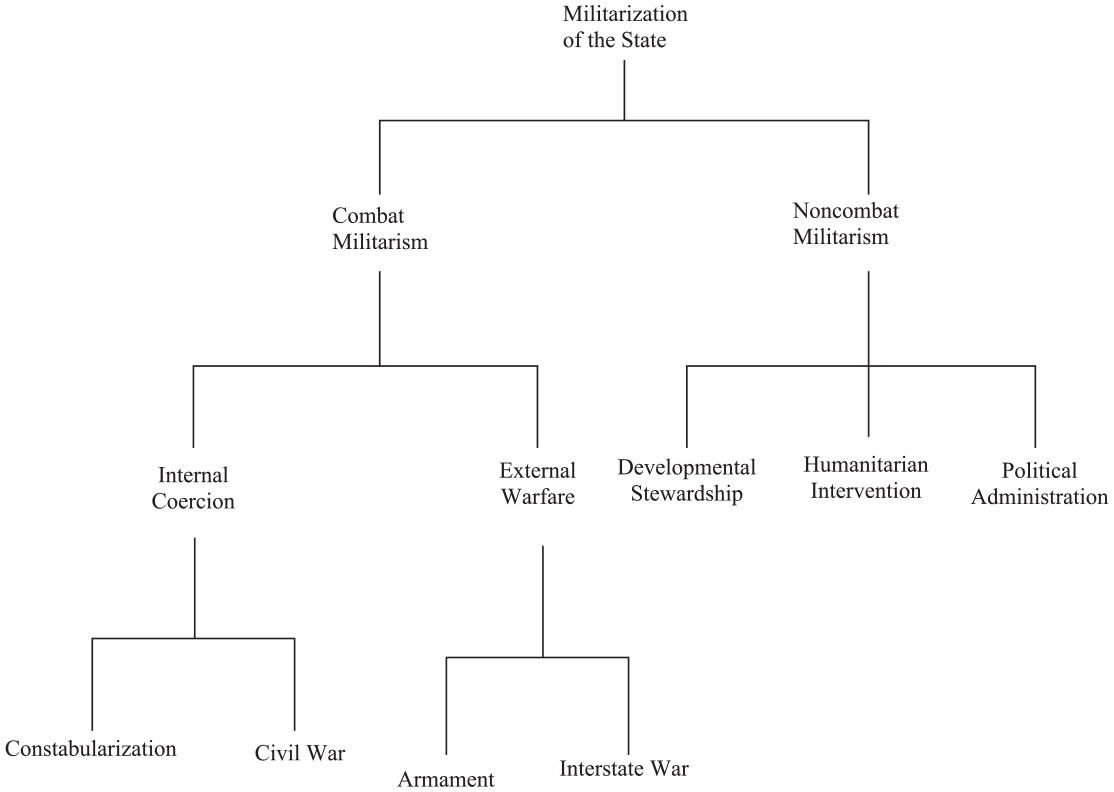
Typical Militarization of the State.
The combat typology then bifurcates into militarization for internal coercion or external warfare. Internal coercion may involve the use of the military for constabulary duties, a phenomenon that is well documented by Flores-Macías (2018), Magaloni and Rodriguez (2020) and Flores-Macías and Zarkin (2021, 2022) in Latin America. Internal coercion may mean, also, civil war as seen in cases like Myanmar or Pakistan in the context of the Balochistan or FATA regions. The external warfare, on the contrary, bifurcates into armament or interstate war as in the case of Pakistan. Armament or the arms race refers to a situation where a significant portion of a country’s national budget is dedicated to military development vis-a-vis the fulfillment of the country’s civilian needs. For example, North Korea has been militarizing through armament for many decades without engaging in any warfare.
On the contrary, the noncombat militarization trifurcates into political administration, humanitarian intervention, or development stewardship. Political administration involves cases where military personnel are appointed into civilian positions like in the case of Trump’s America or where the military exert undue influence over political decisions or a complete takeover of the state in a military coup. Pakistan is a unique country in the world as far as militarization is concerned because it exhibits all the typologies as sketched in Figure 1. Humanitarian intervention occurs where the military assists civilian institutions to manage recovery from natural or manmade disasters, while in development stewardship the military is involved with the implementation of development policy, what we refer to here as developmental militarism.
The foregoing review provides a general picture of militarization of the state at the universal or global level. It misses intricate details of African developmental militarism, which is the subject matter of this study. Therefore, in the next section, we focus on developmental militarism in Africa and the politics that it engenders. The section explores in detail the rationale for the involvement of African militaries in development projects so as to develop a hypothesis that is used to empirically evaluate their performance in public works projects in Kenya.
Developmental Militarism and Praetorian Politics in Africa
Using case studies of Burma (Myanmar) and the Philippines in Southeast Asia, Brooten (2011) did a comprehensive study on the relationship of militarization with the media and human rights. Similarly, a study on the relationship of militarization with development is intriguing.
In the African continent, the state is facing both armed and unarmed enemies internally rather than externally which has led some commentators to recommend the indiscriminate use of the military as one of the solutions to this crisis (see, for instance, Diop, 2013). In this case, the armed internal enemies include militants (like in the Pakistani and Myanmar cases): ethnic-based insurgents, radicalized and violent extremists. Meanwhile, unarmed enemies include poverty, disease, and hunger. Chretien et al. (2007) recommended that “military forces may extend their public health capabilities to civilian populations not adequately served by civilian public health programs—for example, groups experiencing humanitarian emergencies or people in remote areas beyond the reach of ministries of health.” On the contrary, terrorism has become a real challenge as terror groups affiliated to the Middle East based Al Qaeda rise against the African state such as Boko Haram in Nigeria and Al Shabab in East Africa.
The role of the military in fighting disease was dramatically demonstrated in South Africa, recently, following the outbreak of COVID-19. Under “Operation Notlela” (signifying militarization by linguistic application), the South African National Defence Force (SANDF) was deployed to help the police in enforcing the lockdown protocols in the country (Bester et al., 2020). This was within the military mandate of disaster management or response to humanitarian situations (Fidell, 2020), as we have seen in the forgoing discussion, the military can be mobilized to fight deceases. Furthermore, the military was deployed to evacuate South African nationals from Wuhan city (Arendse, 2022).
Africa also faces other myriad of challenges including high rates of infant mortality, urban violence, youth unemployment, rapid population growth, climate change, political intolerance, and corruption (Diop, 2013). Faced with such adversaries, African states can mobilize resources including the military to fight poverty, disease and underdevelopment and internal strife. Diop (2013) has observed that failure to do so may worsen the security situation in the continent. This makes deployment of the military to combat internal strife and public service inevitable because the state, public, and private sectors have failed to solve the problems independently. One of the major factors singled out for this failure is corruption in the public service (Diop 2013). On the contrary, Gotowicki (1997) argued that
Throughout the world, with few exceptions, armies represent professional, highly structured, hierarchal organizations characterized by high levels of discipline and motivation. By virtue of their function and training, armies also acquire highly prized skills and values, such as the capacity for intercommunication, an esprit de corps, and self-sufficiency. A military’s unique structure facilitates rapid decision-making and efficient execution of these decisions. These institutional characteristics provide military organizations with the potential to undertake social action well beyond the defense function. The military also comes to serve as the corporate representation of and defender of a state’s nationalism.
However, there exist equally strong arguments against mobilizing the military to do chores that are traditionally performed by the public and private sector. The military should exist to protect the state and secure the territorial integrity of a country. Mobilizing it away from this focus will lead to distraction and insecurity of the state (see Shaw, 1979). Nonetheless, mobilizing the military to play noncombat roles is tantamount to “militarization” of society. Due to the relative weakness of the public and private sectors in Africa and the fragility of the civilian state, unleashing military power in this way spells doom to the African society. The dominant potential of the military may lead to further weakening of the public and private sectors and the civilian state (see Diop, 2013). In addition, obviously militarization will attract officer corps into state politics and political power. The political elites would lose out to officer corps in such a power struggle thereby negating the operational principle of subordination to civilian rule.
In the history of developmental militarism, Egypt stands out in Africa. Since 1952, when Gamal Abdel Nasser took over his country in a military coup d’etat, the country has been caught in political militarization whether under military or civilian rule (Abul-Magd, 2013). Nasser initiated a militarization project that integrated the military into every aspect of Egyptian polity in which the military became the principal political institution in the country (Gotowicki 1997). The military was involved in manufacturing, agriculture, and infrastructure development projects. This continued into the 1970s, when the Egyptian military, in an initiative conducted through a Ministry of Defense subsidiary the National Service Project Organization (NSPO), converted large portions of their military production capacity to the production of civilian goods. The military enterprises were manufacturers of a wide variety of products such as washing machines, heaters, clothing, doors, stationary, pharmaceuticals, and microscopes (Gotowicki, 1997).
The NSPO also had a Food Security Division that endeavored to achieve self-sufficiency in food production. The military was also involved in a significant number of major national infrastructure projects such as construction of power lines, sewers, bridges, overpasses, roads, schools, and installing and maintaining telephone exchanges (Gotowicki, 1997). Subsequent regimes of Anwar Sadat and Hosni Mubarak did not change this situation. The NSPO fatigue duties expanded during Mubarak’s 30-year tenure (McDonough, 2018). According to Transparency International (2018), Egypt has remained an officer corps’ republic even after the Arab Spring. Similarly, an Egyptian historian Zeinab Abul-Magd observed that (see Hawthorne & Miller, 2020):
Post-Mubarak Egypt became a more brutal security state instead of a democracy primarily because the military succeeded in exploiting the hidden powers it had acquired during his regime. Hosni Mubarak, an ex-air force officer himself, allowed retired military officials to become a business elite with a monopoly over key economic sectors. He also let military officers infiltrate civilian state agencies, strengthening military control over citizens’ daily lives [emphasis added].
Elsewhere, the African Peace and Security Architecture has proposed the “Peace Engineering Corps” approach that institutionalizes the deployment of soldiers for infrastructure buildout and other civilian development project purposes (Zimmermann & Matisek, 2020). This is based on the rationale that in many African states the military is allocated a large share of the national budget and that the military has more capacity than civilian government institutions in terms of equipment, technical capabilities, and trained personnel (Zimmermann & Matisek, 2020). Zimmermann and Matisek (2020) view this as “a new peacetime strategic role for militaries” that could “contribute to state stability and reduce the trade-off between military and non-military spending” (p. 112). In this context, the military could play a key role in Africa’s development particularly with regard to the United Nations Sustainable Development Goals (Zimmermann & Matisek, 2020). Given the strong suggestion that it is beneficial to deploy the military to fight underdevelopment in Africa, we shall proceed to look at three case studies of military involvement in development projects in Kenya. This marks an evaluation of the military’s identified virtues of superior equipment, great organizational capacity, better human resource, and high discipline.
Case Study Selection and Data Analysis
During President Kenyatta’s rule, the military was involved in civilian work in many ways including appointment of serving and retired officer corps in public management positions. However, in terms of development projects (developmental militarism), the focus of this study, there were three major public projects executed by the military: the Kenya–Somalia Border Securitization Project, the Rehabilitation of Transport Infrastructure, and the Provision of Municipal Services in Metropolitan Nairobi. As these were the main public works projects the military was involved in during the time of reference, we may not talk of case selection here since all cases have been considered. Data on these projects were obtained from the popular media and other sources using the document analysis strategy (Pershing, 2002). Qualitative document analysis (QDA) has emerged as a method of qualitative research arising from ethnographic content analysis (Wach and Ward, 2013; Wesley, 2010; Altheide et al., 2008; Altheide & Schneider, 1996), involving reflexive analysis of documents (Altheide, 1987).
Bowen (2009) define document analysis as “a systematic procedure for reviewing or evaluating documents—both printed and electronic (computer-based and Internet-transmitted) material” (p. 27). According to Salminen et al. (1997), electronic documents refer to documents stored using modern information technologies. Morris and Ecclesfield (2011) noted that the “ever-increasing production of digital textual data in a wide variety of forms” presents opportunities for qualitative research, while Karppinen and Moe (2012) pointed out that “With the growth of the Internet and computer-mediated research tools, policy researchers can access and search a wider range of documents with greater ease than ever before.” Guided by these observations, the study took advantage of computer-based and Internet-transmitted documents. This proved more useful given that the research was conducted during lockdown period due to the COVID-19 pandemic and only remote access of documents was possible. Furthermore, Bowen (2009) notes that document analysis involves the examination and interpretation of data by the researcher to “elicit meaning, gain understanding, and develop empirical knowledge” (p. 27). In the context of this study, meaning, understanding, and empirical knowledge are attributed to the praetorian politics generated in the governance sphere by the involvement of the military in development projects in Kenya, especially in relation to the three case studies. What do the Kenyan cases speak to the advocacy for developmental militarism in Africa?
Documents contain text (words) and images that have been recorded without the researcher’s intervention (Bowen, 2009) hence the researcher in this study had no influence on what the document contains, which formed the basis for limiting bias in the process of analysis. The documents that were considered in this study included any published material; here, publishing refers to a set of dictionary meanings: a) to disseminate to the public or b) to produce or release for distribution. The study considered various materials including videos (television recordings) and print materials including texts photographs and graphics. Audio and visual documents were first transcribed before being subjected to analytical review. Documents, thus prepared, were subjected to reflexive analysis by the researcher to tease out the praetorian politics embedded therein. The reflexive inquiry involved answering basic questions:
What was the motivation of the actors in the context of developmental militarism?
What efficiency goals did the project achieve in the wisdom of the advocacy for developmental militarism?
What was the reaction of other stakeholders in the institutional framework of governance?
The results of these analyses are reported in the subsequent sections. Something to note about these cases is that they were all informalized development projects. No feasibility studies were done about their implementations neither were any conventional development procedures followed. They were simply conceived and executed by political and military decision-makers and executed by the military. Therefore, there are no detailed project documents relating to their rationale and accountability. Hence, very scant knowledge can be accessed about their formal identity which marks a limitation to the method of document analysis.
Case Study 1: Kenya–Somalia Border Securitization Project
The Kenya–Somalia Border Securitization Project is a noncombat mission that began when a combat mission to Somalia was re-invented into an internal civil works instead of a military engineering project. In 2011, Kenyan soldiers made incursion into Somalia in “Operation Linda Nchi” (Anderson & McKnight, 2015; Olsen, 2018) following constant terrorist attacks on Kenyan soil by the Somali-based al-Shabaab (Makanda, 2019). The Kenyan mission was intended to be brief but Kenya Defence Force (KDF) quick success on Kismayu impressed the AU who in turn requested that the former be integrated into AMISOM (Nderitu, 2015). As the conflict dragged on the Kenyan security, bosses decided that it was more logical to build a border security wall between Kenya and Somalia (Bartlett, 2020).
Although Cannon and Pkalya (2019) have disputed this perspective, it was generally thought that al-Shabaab attacks had increased following Kenya’s attack on Somali soil. Therefore, the National Security Advisory Committee (NSAC) decided to build a wall along the borderline, of approximately 710 km, with Somalia to protect the country from frequent attacks by the militants. The borderline runs from the Kenya–Ethiopian border to the north down to the Indian Ocean. The Kenya–Somalia Border Securitization Project, as approved by NSAC, involved construction of a wall comprising a series of concrete barriers, fences, ditches, and watch towers equipped with CCTV surveillance (Bartlett, 2020). The project was to be implemented in three phases along the borderline: Mandera to Elwak (160 km), Elwak to Libat (445 km), and Libat to Kiunga (105 km). The Ministry of Interior and Coordination of National Government that oversees internal security was the main actor in the project implementation. Therefore in 2015, the Ministry mobilized the National Youth Service (NYS) to build the wall. Later, the responsibility for the wall was transferred to the Ministry of Defence by a presidential directive. This followed the stoppage of work by the NYS personnel citing lack of remuneration (Bartlett, 2020). Hence, the wall was taken over from NYS by KDF personnel.
After 4 years of the project, when the matter came up in Parliament, it turned out that Kenya Shilling 3, 380, 353, 960.52 (approximately 34 million dollars) of taxpayers’ money had been spent on the public project but only 10 km of wire fence had been constructed. This caused furore in the House but there was very little the legislators could do except to stop further allocation of funds to the project. No investigations could be done because the project was handled by the military whose accounts are classified and not subject to public audit.
This is a case that speaks directly to Diop’s advocacy on service delivery. According to Diop (2013), the military should be allowed in to provide services since the state has failed in delivering through private and public sector enterprise due to corruption. The building of the wall, for instance, is a civil works project that should have been tendered to a private construction company. However, the state ministry in charge conveniently avoided this process and decided to implement the project through a public service agency under its auspices, the NYS. This public enterprise too ran into problems of corruption when workers downed their tools for working but not being paid despite availability of funds. It is from this point the military took over with the expectations that it would perform better than the private and public sectors, according to Diop’s theory, to deliver the project and miserably failed the test of corruption. Here, even Gotowicki’s myth that a military’s unique structure facilitates rapid decision-making and efficient execution of these decisions was blown off.
Case Study 2: Rehabilitation of Transport Infrastructure
In this case, the military was involved in several public transportation projects including Rehabilitation of Nairobi—Nanyuki railway line; Rehabilitation of Nakuru—Kisumu railway line; Rehabilitation of Kisumu Port; and Rehabilitation of ferry. The problem with these projects is that there is very little documentation about them. Much of the information available is from public addresses by leaders concerned. For instance, the intention to rehabilitate the Nairobi—Nanyuki Metre Gauge railway line was revealed by the Governor of Laikipia County, where the line ends, who in a news brief told the public that the 240-km line would be rehabilitated at a cost of Kenya Shilling 3 billion.
According to the Governor, the Kenya Railways Corporation (KRC) had already injected Kenya Shilling 1 billion while the national government was to provide the rest. The work was to be completed in 5 months. The Governor was quoted by Kenya News Agency as saying that “Rehabilitation is in three stages; one group will work from Nanyuki-Marua section, the second group is allocated the Marua-Sagana section while the third will rehabilitate from Sagana-Thika stretch.” 1 Work on the project was to be undertaken by the local youth who would do bush clearing and once bush clearing was done cohorts from the NYS and technicians from the Kenya Defense Forces would be deployed implement the technical aspects of rehabilitation.
Three months later, there were news reports of the managing director (MD) of KRC announcing that the parastatal body had so far paid NYS and KDF Kenya Shilling 1.8 billion for rehabilitation of the railway line. Furthermore, the MD indicated that by engaging NYS and KDF, KRC was spending less and that the rehabilitation project would have cost Kenya Shilling 18 billion if a private contractor was involved. This was an attempt to justify to the public, the involvement of the military as “a cost-cutting measure.” At the same press briefing, the Chairman of the board of management for KRC revealed that “We brought in the engineers from KDF to work on the embankments, viaducts, and bridges while NYS cleared the lines because they were covered by shrubs and all sorts of things.” 2
Further reports were attributed to the president who was addressing the public at a military pass-out parade at the KDF’s Recruits Training School in Eldoret. The president thanked KDF by noting that
The rehabilitation works on the Nairobi to Nanyuki meter-gauge railway line, the work done by Navy Engineers in the rehabilitation of the Kisumu Port, and the ongoing work on Nakuru to Kisumu line; are a few of such projects the Defence Forces have executed with excellence. For this reason, we are, indeed, proud of your contribution to the realization of the Vision 2030 journey.
3
Other news reports concern the Chief of Defence Forces (CDF) going on fatigue duty to inspect the civil works. It was reported that the General went on a 3-day inspection mission covering “the rehabilitation of the Longonot–Mau Summit–Kisumu–Butere railway line, the construction works at the Kisumu Shipyard, the progress of the Wagon Ferry construction, the dredging at the Kisumu Port and the Mbita causeway.” 4 He was accompanied by senior officers from KDF and KRC, including MD of KRC and the Commander of Border Security Command. This is a case of what Harig (2021) termed as “negative convergence” where civilian and military leaders’ interests converge to promote militarization.
This project helps us to get insights into the motivation of the actors. For instance, it is in this project that the president has motivation in involving the military in the developmental goals of the state when in his speech he stated that “For this reason, we are, indeed, proud of your contribution to the realization of the Vision 2030 journey.” The Kenya Vision 2030 is the country’s current development strategy that aims to transform Kenya into a newly industrializing, middle-income country providing a high quality of life to all its citizens in a clean and secure environment by the year 2030. Therefore, the military under President Uhuru Kenyatta was given the stewardship for executing the development strategy of the nation, and this is tantamount to developmental militarism.
The second insight we get from the actors when the MD of KRC indicated that by engaging NYS and KDF, they were spending less and that the rehabilitation project would have cost Kenya Shilling 18 billion if a private contractor was involved. The strategy was not to involve private contractor, again in relation to Diop’s theory discussed above, because of the inefficiency in terms of costs involved hence using military personnel and equipment with input of public personnel and equipment would cut into the cost excesses involved in private tendering. However, regardless of how benevolent cutting the wasteful excesses of the private sector business is, the bottom line is that the military is entering the territories of the private and public sectors in a state modeled in the framework of democratic capitalism, and this is tantamount to militarization.
Case Study 3: Provision of Municipal Services in Metropolitan Nairobi
The national government or the state was keen on taking over the municipal services of the city of Nairobi which are devolved functions according to the Constitution over allegations of rampant corruption in the city government. The Constitution allowed such a takeover under Article 187; hence, a transfer deed was crafted between the County Governor and head of the city-county and the Cabinet Secretary in Charge of Devolution. In this agreement, the governor handed more than four services to the national government: County Health services; County Transport services; County Public Works, Utilities, and Ancillary services; and County Government Planning and Development. Thereafter, the national government created the Nairobi Metropolitan Services (NMS) to provide these services to the city residents. The NMS was headed by a director, and an army General was appointed to this position by the president. Hence, the management of municipal services was effectively taken away from a duly elected urban government by the state and handed over to a military officer. Later, seven officers of the ranks of major and above, four from the army and three from the air force, were seconded to the NMS; however, their special qualifications were not made apparent.
The next thing the president did was to invite the military officer to sit in his Cabinet, the country’s top policy-making organ, a move that was challenged in Court. In a case filed by one of the legislators, the High Court ruled that the appointment of Badi into the Cabinet was not approved by the National Assembly; hence, it was not clear as to by whom and how Badi would be oversighted. Despite this drawback, the General went ahead to perform his fatigue duties diligently in terms of overseeing the provision of municipal services within metropolitan Nairobi (K’Akumu, 2022). For instance, on October 5, 2021, the president flagged of 83 municipal vehicles that had been condemned to be sold as scrap metal. This was done in collaboration with KDF engineers at a cost of Kenya Shilling 22 million. The vehicles included tipper trucks (21), fire engines (24), ambulances (6), hydraulic street lighting platforms (3), scrub street sweepers (2), and graders (2). Another 74 more were to be rehabilitated in the next couple of months.
Discussion
These three cases represent aspects of developmental militarism where the military is drawn into the spaces of private or public sectors as development actors. The public actors in this case involve the Ministry of Interior for the securitization wall project, the KRC for the rehabilitation of transport infrastructure project, and the city government in the provision of municipal services project. The main motivation is to reduce wastage of public funds through corruption and bureaucratic procurement processes for engaging the private sector. Whereas the first case has shown that corruption was not eliminated under the military stewardship, neither was service delivery improved; all the three cases exhibit serious lack of transparency and accountability in the transactions of development projects. This goes against the arguments of the main promoters of deployment of the military for noncombat development projects (see Diop, 2013; Gotowicki, 1997; Shaw, 1979; Zimmermann & Matisek, 2020).
The three cases go a long way to prove that in Kenya, the boundaries of political elites and military elites are being blurred in a “subjective control” project in a process that Golby (2021) has defined as civilian activation. This means that the autonomy and professionalism of the military are being compromised for subjective interests. On the contrary, Beliakova (2021) has argued that delegating policymaking decisions constitutes deference to the military that in turn erodes democratic or civilian control in what she terms erosion by deference. In this context, both sides of the civil–military relations stand to lose.
Although Diop (2013) had pointed at corruption in the public and private sectors as the debilitating factors that may justify deployment of the military in noncombat public service, this argument is appealing but misleading for Kenya. At the face value, it may seem commendable to deploy the military in corruption prone institutions, but the notion that deploying the military to corruption hot spots will eliminate corruption in Kenya is misguided. Likewise, the efficiency model used to justify the militarization of civil works is false. Just from one case of Kenya–Somalia Border Securitization Project, where 34 million dollars is used to erect a 10-km wire fence in 4 years tell more than a story of corruption. It breaks down into 2.5 km per year at a cost of 3.4 million dollars per kilometer. The deafening silence in the wake of the revelations also pronounces lack of accountability. The concealment of public funds spent on the militarized civil projects is not a healthy public management culture. The bottom line here is that the military is not a solution to the corruption or inefficiencies of public service.
Another insight from the border securitization case is that in developing countries, like was the case with Pakistan, it is easy for the military to wade into the political arena when the state is facing external threats. This is what happened when the government declared war on al Shabab militants from Somalia. Faced with this kind of security situation, the government decided to build a security wall along the Kenya–Somalia border to prevent the militants from crossing from Somalia into Kenyan territory. This is how the military waded in to spend taxpayer’s money and no wall was built and no audit queries could be raised because the military’s spending is not subject to scrutiny.
In the second project, at least some service delivery was done. However, it is important to note that, apart from the Nairobi–Nanyuki project, costs of the projects are rarely quoted in public. Even for the Nairobi–Nanyuki project where costs were quoted, there is no documentation of any rational estimates. For instance, how did KRC estimate the cost by private contractor at Kenya Shilling 18 billion and were the savings determined a priori? Initial report was that KRC was to contribute Kenya Shilling 1 billion; then, there were reports of interim payment of Kenya Shilling 1.8 billion. What accounted for this variation in costs?
The project is shrouded in disturbing secrecy, yet it represents a collaboration between the public sector (represented by KRC) that is well known for corrupt dealings and the military. The project also represents a contradiction in the public services in Kenya. On one hand, it is the public service sector that has crafted elaborate rules in terms of Public Procurement Act principally to stem wastage of public resources through corruption and other vices to achieve efficiency in service delivery, and on the other hand, another section of public sector actors who are circumventing these rules by engaging military actors to reduce the wastage of public funds through the said rules.
Despite its civil nature, the takeover of the management of municipal services in Nairobi mirrors a coup d’etat. The motivating reason for the takeover was corruption and incompetence of the city government (K’Akumu, 2022). Whether corrupt and incompetent or not, the city government was a democratically elected and constitutionally legitimate political administration. Corruption charges could be litigated in courts of law rather than being used to justify a takeover. In any case, corruption and incompetence are stock reasons for soldiers who take over civilian governments in Africa. The taking over of a civilian municipal government, therefore, is similar, if not tantamount to a coup d’etat.
In this context, taking the civil responsibilities of an urban government and handing over to an institution created by presidential Executive Order and operated by military personnel are tantamount to developmental militarism as previously defined. After creating the NMS and appointing a serving General as its Director General, the president attempted to bring the whole unit under his control by including the director general to his Cabinet (K’Akumu, 2022). In the ensuing praetorian politics, a legislator of the national assembly challenged the move in the High Court claiming that it was unconstitutional. The court ruled that “There is no doubt the appointment of Badi [Director General] into the Cabinet was not approved by the National Assembly. As such it is unclear as to by whom and how Badi will be oversighted” (see K’Akumu, 2022). The political implication of this “oversight” issue is that the entire action of transfer of civil responsibilities is deemed corruptible.
Conclusion
The main logic advanced by proponents of developmental militarism in Africa are that the military can be more efficient in executing solutions to social problems (Gotowicki, 1997) compared with the public and private institutions, that militaries are the most technologically equipped in the developing world and that this resource could be applied to development projects during peace time (Diop, 2013; Shaw, 1979; Zimmermann & Matisek, 2020). However, from the Kenyan case studies, it becomes apparent that deploying the military to undertake fatigue duties is a political minefield as it elicits a lot of political controversy in a liberal democracy, as seen especially in the case of provision of municipal services in Metropolitan Nairobi.
Second, the case studies have illustrated that deploying military personnel to improve efficiency in public service delivery is not productive. From the case of the building of the security wall, it becomes apparent that the military is just as inefficient as the public or private sector. Therefore, Gotowicki’s theory of military precision does not always hold water for military organizations in Africa. Third, the Kenyan cases unveil the military organization in Africa as an opaque institution to that would easily harbor corruption rather than defeat it. This is summed up by the incident of using 34 million USD to build a 10-km fence.
Whereas there could be better reasons to deploy military personnel to perform civilian duties, it would not be worthwhile to deploy them for purposes of efficiency in public service provision or for defeating corruption, as it would not do better than its counterparts—the public or private sector institutions.
Footnotes
Acknowledgements
The first time I wrote and submitted this article to Armed Forces & Society, it received one positive and one very negative review that led to its outright rejection. Then, following the contentions from the negative review, I realized that the original article had the problem of being multifocal. Thereafter, I refocused the article and re-submitted although this was not an option given by the editorial office. Fortunately, this time round it received three positive reviews that led to its eventual acceptance. Therefore, I am delighted that the final version has been accepted and hope that other articles will be generated from the other focuses of the original article. For all these reasons, I wish to thank the original two anonymous reviewers and the subsequent three anonymous reviewers, the managing editor and the editor in chief of Armed Forces & Society, for their valuable assistance in the whole process.
Declaration of Conflicting Interests
The author declared no potential conflicts of interest with respect to the research, authorship, and/or publication of this article.
Funding
The author received no financial support for the research, authorship, and/or publication of this article.
