







Abstract
Previous valuable scholarship has examined how data centers affect the development and use of artificial intelligence (AI) technology. Additional research has analyzed how energy consumption and energy efficiency impact data centers. However, less scholarship has considered how data centers, energy capabilities (energy production and energy efficiency), and AI development interact to affect international security. Thus, this exploratory study considers the relationship between data centers, energy capabilities, and AI development and analyzes their potential impact on power distribution in the international system. In doing so, the study develops four indices to capture influential factors related to AI development and security. The study highlights the important role data centers, energy capabilities, and AI development may play in shaping the international balance of power and global security.
Keywords
Introduction
According to many scholars and policymakers, artificial intelligence (AI) technology has the potential to drastically affect the international balance of power, military conflict, and global security (Horowitz, 2018). As Glonek remarks: Enormous efficiency gains will be realized as AI reduces the demands on humans to process data, preventing cognitive overload and enabling more thorough analysis. Situational awareness will grow, operations will become more precise, and decisions will be better informed. The speed of warfare will increase. Those with the best AI tools will be constantly exploiting the initiative, while those without will struggle to make sense of what is happening. (Glonek, 2024, 90)
Horowitz et al. (2022) state: AI has the potential to both enhance and undermine relative national power, introducing significant uncertainty for state actors (928). Relatedly, data centers are critical to the development and use of artificial intelligence (AI) technologies. As digital technology executive Marc Ganzi contends: “As we see it, data centers are becoming AI factories with data as the input and intelligence and insights as the output. (Wiltermuth, 2024)
Data centers produce the required storage capacity, computing power, and infrastructure to operate AI programs in the form of data processing, model training, and inference (IEA, 2023). A key factor that can affect the ability of data centers to operate AI technology is energy availability. AI searches and tasks require ten times more electricity than normal internet searches and tasks. In addition, there is often a significant lag between the growth of AI computing power and the available energy to operate data centers. New data centers typically require 1 to 2 years to build while creating new energy for the grid to run data centers normally takes 4 years (Coskun, 2024). Data centers currently consume 1% to 2% of power worldwide, and it is estimated that data center power demands will grow 160% by 2030 (Goldman Sachs, 2024). Research also indicates that due to increasing demands of AI technology, data centers could use 21% of worldwide electricity by 2030 (Foy, 2023). Thus, the massive amount of energy required by data centers is a critical issue for AI development. Given the important role AI can play in international security and the understanding that data centers and power availability are critical to AI, this study examines the nature of states’ data centers, energy capabilities (i.e., energy production and energy efficiency), and infrastructures related to AI development and considers their potential effect on state power and global security. Thus, the study examines how data centers, energy capabilities, and states’ AI infrastructures can potentially influence state power and global security from an exploratory and theoretical perspective. 1
Important research has analyzed how energy consumption and energy efficiency affect data centers (Foy, 2023; Liu et al., 2020). Previous valuable scholarship has also examined how data centers affect the development and use of AI technology (Barroso et al., 2019; Hoosain et al., 2023; Ilager et al., 2020). Furthermore, a small body of scholarship has investigated how AI development affects global security (Allen & Chan, 2017; Horowitz, 2018; Horowitz et al., 2022; Morgan et al., 2020; Tegmark, 2017). However, scholarship has not examined how data centers, energy capabilities, and AI development interact to affect the international balance of power and global security. This line of research is important to international security for several reasons. One, data centers are critical to AI development. Second, energy capabilities play a significant role in the type of AI that data centers can operate, and the level of sophistication of AI directly affects the balance of power in the international system and global security. More specifically, advancements in AI technology are dependent upon the ability of data centers to acquire and utilize large stores of energy. Thus, considering how energy capabilities and energy efficiency affect data centers and the potential impact data centers have on AI development is important to discussions regarding AI, the international balance of power, and global security. Additional factors may also affect levels of AI development, and how AI technology can be utilized regarding security, which can potentially affect the distribution of power internationally. These factors relate to levels of state wealth, cyber capabilities, and military spending.
This exploratory study proposes a theoretical framework to examine the influential state-level factors that can potentially affect AI development regarding security, with special emphasis placed on data centers and energy capabilities. A central argument in the study is that to fully understand how AI can impact levels of state power in the international system and global security, researchers must consider energy production and energy efficiency and their potential impact on data centers. As previously mentioned, additional economic and defense-related factors are also important to consider. Thus, the exploratory study presents four indices to capture states’ infrastructures surrounding AI development, and AI development potential, regarding security. The indices are not intended to be exhaustive but rather provide an initial, exploratory schema for gauging AI capabilities and AI development potential regarding security. The indices attempt to capture current levels of AI development regarding security as well as measure the infrastructure states have in place that can possibly affect current and future AI development regarding security. Thus, the indices seek to measure current and future AI development potential regarding security.
The layout of the remainder of the article is as follows. First, the article examines how AI impacts the international balance of power and global security based on previous research. Next, the article analyzes important factors that can potentially affect data centers and AI development. These factors include energy capabilities, energy efficiency, the location of data centers, state wealth, defense resources, and cyber security. Next, the article presents four indices to measure states’ level of AI capabilities and AI development potential regarding security. The article then discusses the index rankings. Finally, the article discusses the implications of the index rankings, the importance of data centers, energy capabilities, and AI development to international security, and the study’s limitations.
Artificial Intelligence and International Security
While scholarship examining how AI can affect international security is still in its nascent stages, previous research finds that AI directly affects states’ military capabilities and will play an increasingly expansive role in global security as AI becomes more advanced (Allen & Chan, 2017; Garcia, 2024; Horowitz, 2018; Horowitz et al., 2022; Morgan et al., 2020; Rashid et al., 2023; Tegmark, 2017). Researchers contend that AI affects international security for several reasons. One reason is due to AI’s effect on the international balance of power (Allen & Chan, 2017; Horowitz, 2018; Horowitz et al., 2022; Morgan et al., 2020). The international balance of power refers to the distribution of economic and military power between states. According to scholars, as states increase the amount of power they have relative to other states they acquire more political, economic, and military influence regionally and globally (Blachford, 2021). Thus, changes in relative power, and the distribution of power between states, can produce significant changes in the international system. AI is important to the Balance of Power (BOP) because researchers have found that AI impacts the economic and military capabilities of states and the amount of relative power they have in the international system (Allen & Chan, 2017; Horowitz, 2018; Morgan et al., 2020).
In a novel study, Horowitz et al. (2022) explore how AI can affect national power (military and non-military), and the nature of the international system including the balance of power, institutional order, and international norms. They raise several important points when considering how AI can impact state power and the international system. One, AI can generate countless economic effects by impacting agriculture, health care, retail, transportation, and many other sectors through numerous AI applications. They contend that the speed of AI development in the private sector and the ability of government regulators to keep pace with private-sector AI development will affect how AI is applied and deployed. Second, and relatedly, the nature of globalization will affect technological diffusion between states which can affect the speed of AI development. Third, how AI is integrated across civilian and military spheres will affect how AI influences state power and security. In addition, states will have to decide how they desire to utilize AI for defensive purposes. Finally, and related to the second point, how AI affects the balance of power and global security will also be influenced by military AI “makers” and “takers.” Military AI takers refer to states that have the infrastructure in place to develop AI at a high level and apply it within their economies and militaries. AI military takers refer to the states that do not have the same level of research and development infrastructure as the makers and must rely on acquiring their AI technological developments from the investments made by the makers. Also, Horowitz et al. (2022) contend that more powerful states are engaged in AI competition regarding the “first-mover advantage,” while other states are more content with AI competition involving the “second-mover advantage.” The first-mover advantage in this context refers to the advantage states gain by developing a specific AI technology before competitor states. The second-mover advantage is the advantage states possess due to acquiring AI technology from a maker state before other states.
In related research,L. Y. Hunter et al. (2023) interviewed international AI experts to assess AI’s impact on international security. One question that was asked was: “Regarding the international balance of power, how important is the development of AI technology on a 1–10 scale (1 = Not Important at all; 10 = Extremely Important)” (L. Y. Hunter et al., 2023, 210). The average response was 9.40, and every expert answered 8 or higher. AI affects states’ military capabilities in several ways including but not limited to weapons systems, lethal autonomous weapons systems (LAWS), autonomous vehicles, data collection, data analysis, decision-making processes, information warfare, and cyber capabilities (L. Y. Hunter et al., 2023). AI enhances each of these objects and functions as well as the operating speed of numerous military-related processes.
Given the important role speed plays in military conflict, AI can significantly impact military capabilities and the nature of conflict by inferring a decisive advantage to states that have superior AI technology (Davis, 2022). The ability of AI programs to collect large sums of data and analyze it quickly can also provide states with significant advantages regarding decision-making capabilities on the battlefield (Hoffman & Kim, 2023; Rashid et al., 2023). In addition, AI is central to sophisticated lethal weapons systems and autonomous weapons systems that can be used in conflict, providing states with advantages over their adversaries (Hall, 2017; Rashid et al., 2023). Finally, AI is frequently utilized in information warfare campaigns and cyber operations (Hanson et al., 2024; Kaneria & Pandey, 2023; Yamin et al., 2021) that can influence citizens in states and potentially disrupt societies. In summary, AI is employed in a wide array of economic and military applications that can drastically affect levels of economic and military power, the balance of power internationally, and the outcomes of military conflicts.
While AI can affect state power and defense, the manner AI is employed, and the usefulness of military AI applications can be conditioned by several additional factors. Based on scholarship in military innovation theory, the ability of states’ militaries to incorporate new technologies and innovations is dependent upon states’ institutional capacity, expertise, and overall resources (Horowitz et al., 2022, 85). Military strategies and operating procedures often need to be reconfigured when new technologies are integrated into militaries (Schulzke, 2022). Thus, the degree to which military leaders and military members believe in the importance and usefulness of new technologies impacts the degree new technologies are incorporated within militaries as well as the effectiveness of new technologies (Modig & Andersson, 2022). Therefore, military effectiveness can be limited if new technologies and innovations are not properly understood and accepted by military leaders and military operators (Kuo, 2022). AI is important to discussions regarding military innovation theory because as previous scholarship documents, AI is an evolving technology and a critical factor in shaping military power, the nature of conflict, and the international balance of power. Thus, assessing the factors that impact AI development within states is important to discussions regarding the international balance of power and global security.
Several clarifying points should be made concerning the study. One, the exploratory study discusses AI as it relates to security. This refers to the factors that can potentially affect AI development and levels of state power. Based on previous research, the assumption is that levels of AI development affect, and are affected by economic and military power, and changes in states’ economic and military power affect the international balance of power. Furthermore, changes in the international balance of power affect global security based on the distribution of power in the international system. Thus, when discussing AI development and security, the argument is that AI development impacts security by affecting levels of economic and military power that influence the international balance of power and subsequent global security. Therefore, this exploratory study seeks to consider the factors that are part of states’ infrastructures that can potentially affect AI development. Finally, it is important to note that this exploratory study does not directly test the relationship between AI development and the international balance of power. The study is exploratory and examines the relationship between data centers, energy capabilities, and AI development regarding security, and considers the potential of these factors to influence the international balance of power and global security.
Regarding AI development and defense, the study argues that states that have greater potential to develop AI will likely have distinct security advantages over other states due to the numerous advantages AI provides regarding a wide range of tasks and processes. As Horowitz and Pindyck remark: “The story of who innovates and why is critical to understanding patterns of warfare and transitions of power in the international system” (Horowitz et al., 2022, 85). In addition, the study does not make an argument regarding the extent to which AI should or will be weaponized by states. Rather, the study contends that the nature of AI will likely infer significant advantages for states from a security standpoint in numerous areas that can include or exclude AI weapons systems. Also, the degree AI technology is utilized by governments and militaries can vary by state. Thus, the focus of this study is not on the granular application of AI within militaries but rather is an exploratory investigation of the factors that are part of states’ infrastructures that can potentially affect AI development and levels of state power which have implications for the international balance of power and global security.
In considering the effect AI has on the balance of power and international security, it is important to examine the infrastructure states have in place that can potentially affect AI development. While many factors are important to states’ infrastructure regarding AI development, two factors that are central but have been minimally examined in the literature on AI and international security are the nature of data centers and states’ energy capabilities. Thus, it is important to discuss the nature of data centers, how energy capabilities affect data centers, and the potential effect data centers have on levels of AI development, state power, and international security. This is crucial as AI development is dependent upon data centers and data centers are reliant upon large stores of energy to function. Thus, examining how energy capabilities and data centers can potentially impact AI development and the distribution of power between states is critical to international security. Finally, additional economic and defense-related factors can also affect states’ infrastructures which can potentially impact AI development and security. The next section of the article examines previous research in international energy economics to assess how energy resources, energy production, and energy capabilities can affect international security.
International Energy Economics
Previous scholarship has examined how energy dynamics shape international power and international relations in the areas of security, diplomacy, and trade (Griffiths, 2019; Ilechukwu & Lahiri, 2022;Z. Yang et al., 2024). Researchers find that energy security can affect geopolitical risks and vice versa (Khan et al., 2023). In addition, states with greater energy capabilities are generally considered to have more power in the international system (World Bank, 2024). Greater energy resources or capabilities allow states to increase productivity across numerous economic and military sectors (Samaras et al., 2019; Topcu et al., 2020), sustain military operations (Saritas & Burmaoglu, 2016), and generate revenue by selling or trading traditional or renewable sources of energy on the international market (Vivoda, 2022; H. Yang et al., 2023). Research has also examined the effect energy transformations (e.g., the utilization of renewable technologies and the transition from high to low carbon emissions systems) have on international relations (Kutsmeda, 2022; Z. Yang et al., 2024). This scholarship finds that global energy system transitions can affect global security by creating new power dynamics between states and increasing competition over minerals and materials needed for renewable energy. Thus, based on previous scholarship in international energy economics, it is evident that energy production, energy efficiency, and energy transformations play an important role in the international balance of power by impacting states’ economic and military production capabilities and influencing the ability of states to generate revenue from selling or trading energy in global energy markets. The next section of the article examines how data centers, energy capabilities, and additional economic, technological, and defense-related factors can potentially affect AI development regarding security.
Data Centers, Energy Capabilities, and Artificial Intelligence
In one of the few known studies to explore the role data centers play in international conflict and security, Delerue (2024) considers the importance of establishing clear legal rules and norms regarding the military targeting of data centers in conflict. As Delerue remarks: “data centers can constitute military objectives in some circumstances, and thus may be the object of an attack” (Delerue, 2024, 221). Delerue contends that international humanitarian legal regimes need to carefully consider how, if, and under what circumstances data centers can be targeted in military combat because damaging data centers could result in significant societal disruptions (Delerue, 2024). Damaging data centers can lead to catastrophic effects based on the vital role data centers play in modern computing, communications, cloud services, data storage, and data transmissions.
There are many different types of data centers (government, military, private, and a mixture of government and private) that are used for various purposes (Delerue, 2024). Data centers are critical to the development and use of AI technology. Data centers generate large amounts of computational power and data storage that AI requires to operate. Data centers consist of networking hardware, servers, and storage systems that are integral to AI. Data centers provide low-latency, high-bandwidth connections that are needed for AI training models and AI inference programs. Thus, the networking infrastructure of AI data centers allows for the efficient transfer of significant amounts of data needed for AI operations (Barroso et al., 2019; Hoosain et al., 2023; Ilager et al., 2020).
Data centers are vital to AI’s development, expansion, and operation. They are also critical to cloud-based services that run AI applications. Data centers support models and processes such as Infrastructure as a Service (IaaS), Platform as a Service (PaaS), and Software as a Service (SaaS), all of which support and employ AI applications. Data centers generate significant computational power that is required to run applications that are based in the cloud. Data center components such as servers, storage systems, switches, routers, and security devices function in a coordinated manner to process complex computations and large amounts of data to allow cloud-based services to operate. Data centers also house large stores of data for cloud-based applications to provide data availability, redundancy, and avert the loss of data. Data centers provide data transmission between cloud-based applications and data centers through high-speed internet connections and secure private networks, which generate real-time data access for cloud-based users. Tools such as application program interfaces (APIs) and middleware solutions coordinate the transfer of data between cloud applications and the hardware in the data centers allowing for reliable communication between data centers and cloud services. Finally, to provide for data security in the data transfer process, data centers employ numerous encryption techniques, firewalls, and secure access protocols (Barroso et al., 2019; Hoosain et al., 2023; Ilager et al., 2020). Thus, states’ cyber capabilities are an important factor that affects AI development and the balance of power internationally due to the important role cyber security plays in protecting data centers and the data transmissions to and from data centers.
Cyber capabilities are critical to AI, the balance of power, and security for several reasons. One, cyber capabilities affect the level of data security within data centers that operate AI programs (Borky & Bradley, 2019). When the cyber security of data centers is compromised, vital information can be stolen by adversaries that can affect AI competition and resulting levels of state power. Also, vulnerable cyber infrastructure allows adversarial actors greater opportunity to execute cyber-attacks against data centers that can impede AI development. Finally, data center servers often transmit valuable information to external applications through the internet and cloud (R. Hunter & Weiss, 2021). Thus, AI programs rely on secure internet connections to transmit information from data centers to external applications. Adequate cyber capabilities provide for secure networks allowing for secure and high-speed transmissions. When cyber capabilities are weakened, networks may be compromised, or the speed of data transmission may be reduced leading to less capable AI operations.
Many data centers have been refigured in recent years due to the significant computing demands of AI applications. Numerous data centers have transitioned to utilizing Graphics Processing Units (GPUs) and Tensor Processing Units (TPUs) that are designed for the specific requirements of AI operations (Krazit, 2024). Data center administrators often attempt to balance the computer requirements of AI, the substantial operating costs of data centers, security requirements, power usage effectiveness (PUE), and general performance (Levine, 2023). One critical issue for data centers is accessing the large amount of energy that is necessary to operate data centers.
Data centers require large stores of energy to function due to the significant computing demands of AI (Liu et al., 2020; Masanet et al., 2020). Data centers utilize vast amounts of energy for data processing and storage. AI requires substantial computational power because AI training models interact with large datasets through the usage of complex algorithms, requiring significant computing capabilities. The AI-related tasks need large amounts of energy as processors such as GPUs and TPUs must operate continuously. Furthermore, when AI models are used for real-time data analysis and decision-making processes, AI models run continuously, which further exacerbates energy demands. Finally, as AI programs are more sophisticated and advanced, they require more energy because they need more computational power and training datasets to perform tasks. Thus, AI technology requires significantly greater power as it becomes more advanced (Foy, 2023).
While data centers require large amounts of energy for computational purposes, data centers also require significant energy for cooling systems. The servers and processors in data centers produce substantial amounts of heat which requires cooling to prevent mechanical breakdowns and failures. Thus, the combination of energy required for computational operations and cooling leads to significant energy consumption for AI-related data centers. To offset the massive energy requirements for data centers, data center operators have attempted to utilize more energy-efficient hardware and advanced cooling technologies. However, even with the use of more energy-efficient hardware and advanced cooling technologies, energy consumption remains a critical issue for AI development (Berreby, 2024).
In 2010, the electricity consumption for data centers accounted for 1.1% to 1.5% of overall global electricity consumption (Corcoran & Andrae, 2013; Liu et al., 2020). In the United States, it accounted for 1.7% to 2.2% of overall domestic electricity consumption (Koomey, 2011; Liu et al., 2020), an increase from 1% in 2005 (Liu et al., 2020; Mathew et al., 2012). In 2012, the energy consumption of data centers worldwide was 270 billion kilowatt-hour (kWh) and the yearly energy consumption of data centers had a compound annual growth rate of 4.4% from 2007 to 2012 (Liu et al., 2020; van Heddeghem et al., 2014). The energy operating costs of a normal data center double every 5 years (Buyya et al., 2013; Liu et al., 2020), and an average data center consumes energy equivalent to 25,000 homes and 100 to 200 times the energy of a standard office building of comparable size (Liu et al., 2020; Poess & Nambiar, 2008). Data centers are expected to become the largest energy consumers in the world with energy consumption levels expected to increase to 4.5% of total worldwide energy consumption in 2025 (Liu et al., 2020; Su, 2017). Given the large amount of energy required to operate data centers, energy allocation for data centers is critical for current and future AI development.
A related issue that affects the ability of data centers to operate increasingly sophisticated AI programs is the level of power usage effectiveness (PUE) of data centers and states. While large amounts of energy are required for AI programs, more advanced AI programs will require even greater energy resources. Some of the increased demand for energy can be offset by expanding PUE. Recent proposals have focused on the energy consumption of subsystems located in data regarding infrastructure systems, data storage and data management, network infrastructure, and computing (Avgerinou et al., 2017; Liu et al., 2020). For example, proposals are examining total power consumption based on the composition of microprocessor systems (Venkatachalam & Franz, 2005), enhancing the energy efficiency of GPUs (Mittal & Vetter, 2014), developing technology to reduce energy consumption based on the type of data center storage system (Bostoen et al., 2013), exploring ways to reduce energy usage through the network architecture of data centers (Hammadi & Mhamdi, 2014), and focusing on cooling technology in data centers (Ebrahimi et al., 2014; Liu et al., 2020).
Advances in AI can also affect energy efficiency. AI can play an important role in assisting governments in transitioning to more efficient and clean energy structures (Lee & Yan, 2024). Recent scholarship finds that AI can impact energy production and energy efficiency by deploying AI applications for energy efficiency and energy utilization, the use of Machine Learning (ML) for energy forecasting, algorithm and pattern recognitions for learning systems regarding energy usage, and the management and transportation of energy resources (Entezari et al., 2023). Scholarship also finds that AI algorithms are being used to enhance the efficiency of renewable energy maintenance systems with special emphasis on predictive models that attempt to forecast potential faults and breakdowns in energy systems (Afridi et al., 2022). Overall, advances in PUE can reduce the amount of energy data centers require.
The PUE of states and the degree government policies promote energy efficiency can affect the amount of power data centers can access to operate AI programs. Given the large energy demands of data centers, when states have higher PUE and energy-efficient policies, more energy is available for data centers to employ in their AI processes (Koronen et al., 2020). Thus, greater energy efficiency and energy-efficient policies create more power that is available for data centers to operate AI programs. However, even with greater PUE, more sophisticated AI programs will require a growing reservoir of energy.
Overall, energy capability and energy efficiency are major factors that influence the ability of states to develop sophisticated forms of AI that can be harnessed for economic and military purposes. For instance, the ability of data centers to run sophisticated AI algorithms that transmit data to military AI applications in real-time (for purposes such as data analysis, data collection, target identification, autonomous vehicle transportation) is dependent on data centers having large stores of energy to operate. In addition, data centers often require access to significant energy sources to run AI algorithms for domestic economic purposes regarding logistics, data analysis, financial transactions, and network communications. States that can produce more energy and use it efficiently to run data centers have significant economic and military advantages over other states.
Many forms of energy are employed to power data centers. One of the most common forms of energy is electricity from the power grid. This form of energy is often derived from fossil fuels, nuclear power, and renewable energy (hydroelectric, wind, and solar; IEA 2023). Many data centers utilize renewable energy (solar power, wind, hydroelectric) as it can serve as a powerful energy source and reduce carbon emissions (IEA 2023). Numerous data centers also produce energy on-site using fuel cells and generators. The generators are commonly powered by renewable sources of energy, diesel, or natural gas. The generators can also serve as an important backup source of power in the event of a power disruption (Kutsmeda, 2022). Some data centers also employ Combined Heat and Power (CHP) systems. CHP systems capture the heat produced by generating electricity. This method of energy production increases overall power output and enhances energy efficiency (Kalam et al., 2012).
The large energy demands of data centers have affected where data centers are located (Delerue, 2024; Liu et al., 2020). One method some companies such as Google and Meta have adopted to increase PUE is to place data centers in high-elevation areas in the Arctic region which provides greater access to renewable energy, cooler air, and less humidity (Liu et al., 2020). These locations allow data centers to be cooled more easily and less energy is required for the data centers’ cooling systems (Liu et al., 2020). Other companies such as Amazon have placed data centers in high-elevation locations in the Northern Hemisphere (Liu et al., 2020). Overall, regions with higher elevations and cooler temperatures are becoming more common locations for data centers (Liu et al., 2020).
Another important factor when considering energy capabilities, data centers, and AI development is private-public collaboration. The extent to which governments effectively collaborate with private entities regarding energy production and allocation, PUE, and the construction, maintenance, and regulation of data centers can significantly affect the ability of data centers to house and operate more sophisticated AI programs as well as address environmental concerns related to energy production and waste management (Federal Energy Management Program, 2024; International Energy Agency, 2023; U.S. Department of Energy, 2024).
Civil–military relations can also affect AI development regarding security. The nature of civil-military relationships can influence how AI is incorporated into militaries for several reasons (Brooks, 2020). In some cases, expertise in the functionality of specific AI applications and knowledge of the core tenets of AI algorithms that operate military AI applications may reside outside the military (Pfaff et al., 2023). In these instances, militaries may be reliant on civilian expertise regarding particular AI programs. Relatedly, the extent to which partnerships exist between the military and private, technology sector can shape research and development initiatives and outcomes regarding AI in defense (L. Y. Hunter et al., 2023). Thus, the nature of collaboration between the military and private sector affects the level of sophistication of AI within militaries. In addition, discussions and debates between military and government leaders regarding the scope and acceptable use of AI for defense can influence how AI is deployed in combat situations (Brooks, 2020; Pfaff et al., 2023). In summary, the nature of civil–military relations, and the level of trust between the military and civilian sectors can shape how effectively AI can be incorporated into militaries.
Levels of state wealth and the availability of defense resources are additional, critical factors that can affect AI development regarding security (Horowitz, 2018; Horowitz et al., 2022). States that have greater wealth and resources that can be utilized for defense can develop and utilize AI for security to a larger degree. Thus, state wealth and military expenditures are crucial elements of state infrastructure that can impact AI development, the balance of power between states, and global security.
Overall, numerous factors affect the extent to which the infrastructure of states allows for the development of AI regarding security. Key factors include but are not limited to the nature of data centers, energy production capabilities, energy efficiency, cyber security, state wealth, and military resources. These factors are critical to global security because they can potentially affect AI development and the international balance of power. States that are better positioned to utilize energy efficiently to power data centers can produce more advanced AI that provides distinct economic and military advantages for their states. In addition, cyber capabilities, state wealth, and military resources can potentially impact the development and application of AI regarding security. Thus, in the next section, four indices are constructed to examine how each of these factors interacts to potentially affect AI development, state power, and security.
AI Security Index
The AI Security Index (ASI) is an exploratory effort to account for key factors that can potentially affect AI development capabilities, and AI development potential, as it relates to security. One important note is that the ASI cannot gauge all factors that influence AI development, and AI development potential, regarding security. Many additional factors outside the ASI can impact AI development. However, the ASI attempts to include the factors that are critical to AI development regarding security based on available data. In addition, the ASI attempts to include the factors that currently influence AI development as well as account for the infrastructure that is in place within states that can affect AI development potential regarding security. Meaning, that although some states may currently lag behind others regarding AI development, the indices also gauge states’ infrastructures that can be utilized for AI development. Thus, the ASI seeks to capture the factors that affect current AI development as well as AI development potential regarding security. 2
The first measure included in the ASI is the number of data centers within states. This measure is included as the number of data centers within states can directly affect AI development. The data for the measure are collected from Statista (Taylor, 2024). The natural log of data centers is used to provide for comparison across states. Several limitations should be discussed regarding the data centers measure. One, as mentioned previously, some data centers are owned and operated by multinational companies (MNCs) outside their state of origin. Thus, the number of data centers within a state is not uniformly reflective of AI technological capacity because a given data center may be housed in a certain state, but it is owned and operated by a foreign entity. Second, the data on the measure do not indicate the level of sophistication of data centers or whether data centers are classified as hyperscale data centers. Hyperscale data centers are large-scale facilities with massive amounts of data and user traffic specifically tailored for AI operations. Unfortunately, reliable global data on hyperscale data centers are not currently available by state. Some data centers are government-owned and operated while others are exclusively private, and some data centers are a mixture of government and privately funded and operated. The data centers measure does not indicate whether the data centers are owned and operated by governments, private entities, or a combination of the two. Finally, the data center measure is restricted to 23 states. In summary, while the data centers measure has limitations, it does provide a useful indication of technological capacity regarding AI development because the number of data centers within states is generally reflective of the ability to operate and develop AI technology.
Another important factor that can affect AI development is state wealth. State wealth is a vital factor in AI development because states with greater wealth can devote more resources to AI development projects in the form of technology, human capital, data, and physical infrastructure. Thus, state wealth is an essential factor in AI development. Gross Domestic Product (GDP) is included in the index as a measure of state wealth. The natural log of GDP is used to provide comparisons across states. Utilizing GDP (log) to gauge state wealth is a common technique in cross-national research (Tucker-Drob et al., 2014). The GDP data are collected from the World Bank (2022). While GDP is considered an appropriate measure of state wealth based on its use in previous cross-national scholarship, it is important to note that GDP cannot account for all economic factors that can influence economic growth and AI development. Additional economic factors outside of GDP can also influence AI development.
The next measure in the ASI is energy production. As mentioned previously, energy production is important to AI development as data centers rely on large amounts of energy to run AI programs. In addition, more advanced forms of AI often require greater stores of power. Thus, energy production is essential to AI development. The energy production measure used for the ASI is the total amount of energy production worldwide by state. The data are collected from the U.S. Energy Information Administration (EIA, 2022) and are in the form of quadrillion British Thermal Units (BTUs).
While energy production is critical to AI development, energy efficiency is also important. Greater energy efficiency leads to more available energy and less energy depletion for high-energy-load tasks. Thus, energy efficiency can increase energy stores over time producing more available power that data centers can employ to operate AI programs. A measure for energy efficiency is included in the ASI that captures the energy efficiency of states. The data for the measure are collected from the American Council for an Energy-Efficient Economy (ACEE) International Energy Efficiency Scorecard (IEES). The ACEE (IEES) measures the degree the world’s top 25 energy-consuming economies advance energy efficiency policies. The scorecard utilizes 36 metrics to analyze each state’s energy efficiency policies and performance regarding building, industry, and transportation sectors (Subramanian et al., 2022).
The next two measures in the ASI are military expenditures and military expenditures as a percentage of GDP. The data for the measures are collected from the World Bank (2022). Military expenditures are included because military expenditures indicate the amount of resources states devote to defense. The natural log value of military expenditures is included to provide for comparison across states. In addition, the amount of expenditures states devote to military spending (as a % of GDP) is often referred to as the defense burden. The defense burden indicates the amount of funding commitments to defense as a percentage of overall state wealth. The two measures are included to account for overall levels of military spending and military spending based on levels of state wealth. While there is often important debate within states regarding spending priorities regarding defense, the two measures are included in the ASI because states with greater defense resources can devote more funds to AI development and AI applications regarding security. Thus, levels of defense spending are integral to AI development regarding security.
The next measure in the ASI captures the nature of AI development and AI governance within states. The data for the measure are collected from the AI Readiness Index (ARI) from Oxford Insights (2022) which measures the degree states are capable of incorporating AI into their societies. The ARI is comprised of three main pillars. The first pillar is the government pillar which measures the degree governments have a clear vision for how they develop, manage, and regulate AI. The government pillar also captures the digital capacity of states regarding the skills and practices needed to adapt to and incorporate AI technology. The next pillar is the technology pillar. The technology pillar accounts for the supply of AI tools from states’ technology sectors, the degree of innovation capacity within states, the extent to which the business environment supports innovation and research and development spending, and the level of human capital regarding technological skills and education. The last pillar is data and infrastructure. The data and infrastructure pillar measures the degree of high-quality data availability for accurate and representative training models and the infrastructure available to operate AI programs (Rogerson et al., 2022). Overall, the ARI is an influential component of the ASI due to the important role states’ AI governance and AI infrastructures play in AI development regarding security.
The next measure in the ASI captures the cyber capabilities of states. Cyber capabilities are important as they affect the ability of states to protect their AI operations, data infrastructure, and transmit data from data centers to external applications securely and efficiently. The data for the cyber capabilities measure are collected from the National Cyber Power Index (2022) at the Belfer Center for Science and International Affairs at Harvard University. The NCPI takes into consideration government strategies regarding cyber policy, cyber capabilities regarding defensive and offensive operations, allocation of cyber resources, and the cyber capabilities of the private sector within states regarding technology companies, workforces, and innovation. The NCPI captures states’ cyber capabilities and cyber potential regarding the ability of states to employ cyber capabilities effectively (Voo et al., 2022). The NCPI is limited to the top thirty states.
In total, four separate indices are generated to assess states’ level of AI development and AI development potential regarding security. States are only included in each index when data are available for each measure and each state that is included in the index. Thus, many states are not included in every index due to data availability. Four indices are created because data is not available for all states for the measures: the number of data centers, energy efficiency, and cyber capabilities. Thus, to assess ASI for a larger number of states (i.e., states in which data is not available for the number of data centers, cyber capabilities, and energy efficiency measures) three additional indices are created to indicate AI development and AI development potential, for these states. Although the three additional indices are more limited due to the exclusion of one or a combination of the measures (depending on the specific index), the additional indices do provide useful information regarding levels of AI development, and AI development potential, as they take into consideration important factors that can potentially affect AI development regarding security.
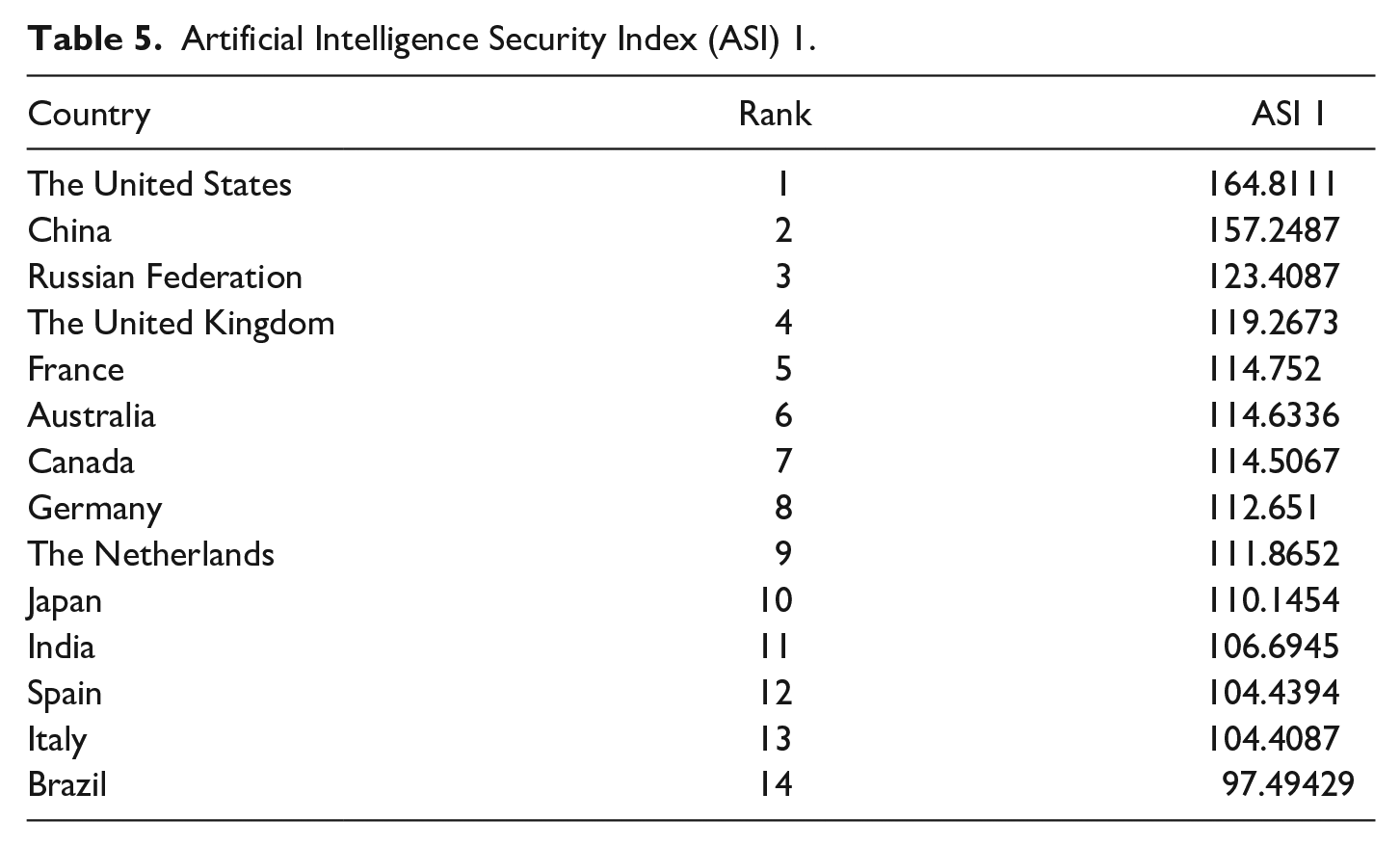
The first and primary index (ASI 1) consists of the number of data centers (log), state wealth (log GDP), energy production (EP), energy efficiency (EE), AI Readiness (AI), military expenditures (ME), military expenditures as a percentage of GDP (ME[GDP]), and cyber capabilities (NCPI). The number of states included in the index is limited to 14 states based on data availability for the number of data centers, cyber capabilities, and energy efficiency measures (states are only included when data is available for every measure for each state). Also, the measures EP, EE, AI, and NCPI are weighted (*) to produce comparable numerical values within the index as well as place appropriate relevance on each measure within the context of the index. The purpose of utilizing the natural log and weights for some components is to ensure that the components do not skew the results of the ASI based on the size of the numerical values of the components and to have each component represented according to the theoretical importance of each component as discussed earlier in the paper. Thus, each component is included in the ASI to reflect its theoretical importance without skewing the results based on the size of the observational units. 3 Table 1 displays the log transformation and weighting procedures for the components. Table 1 also displays the rationalization for the log transformation and weighting procedures of the components. In addition, Table 1 indicates the average percentage that each component influences the overall ASI total score. 4 Table 2 displays the summary statistics for the original values of each component of the ASI (prior to the log transformation or application of weights). Table 3 displays the values of each component of the ASI after the log transformations or application of weights. Table 4 displays the description for each abbreviation and symbol in the index. The formula for the AI Security Index 1 is:

ASI Components: Transformation/Weighting Rationalization.
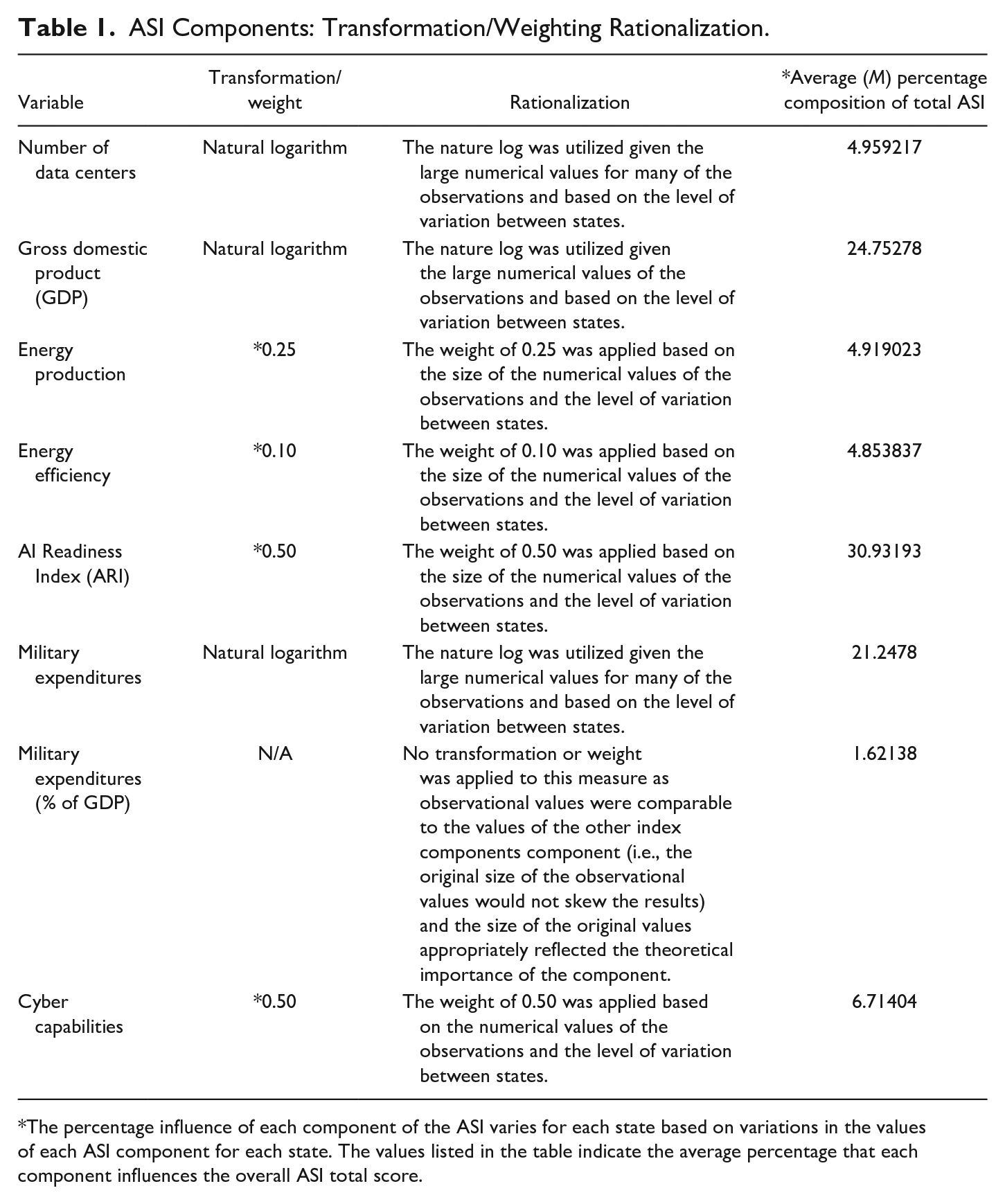
The percentage influence of each component of the ASI varies for each state based on variations in the values of each ASI component for each state. The values listed in the table indicate the average percentage that each component influences the overall ASI total score.
Summary Statistics (ASI Components: Original Values).
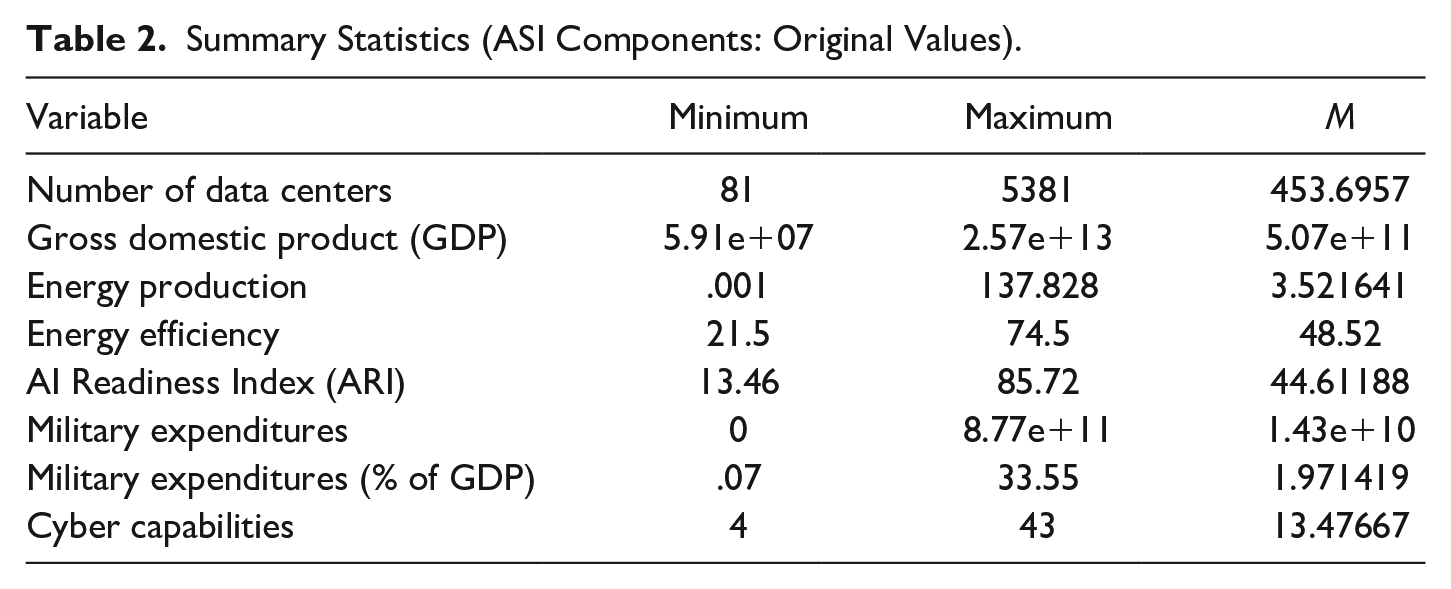
Summary Statistics (ASI Components: Transformed/ Weighted Values).
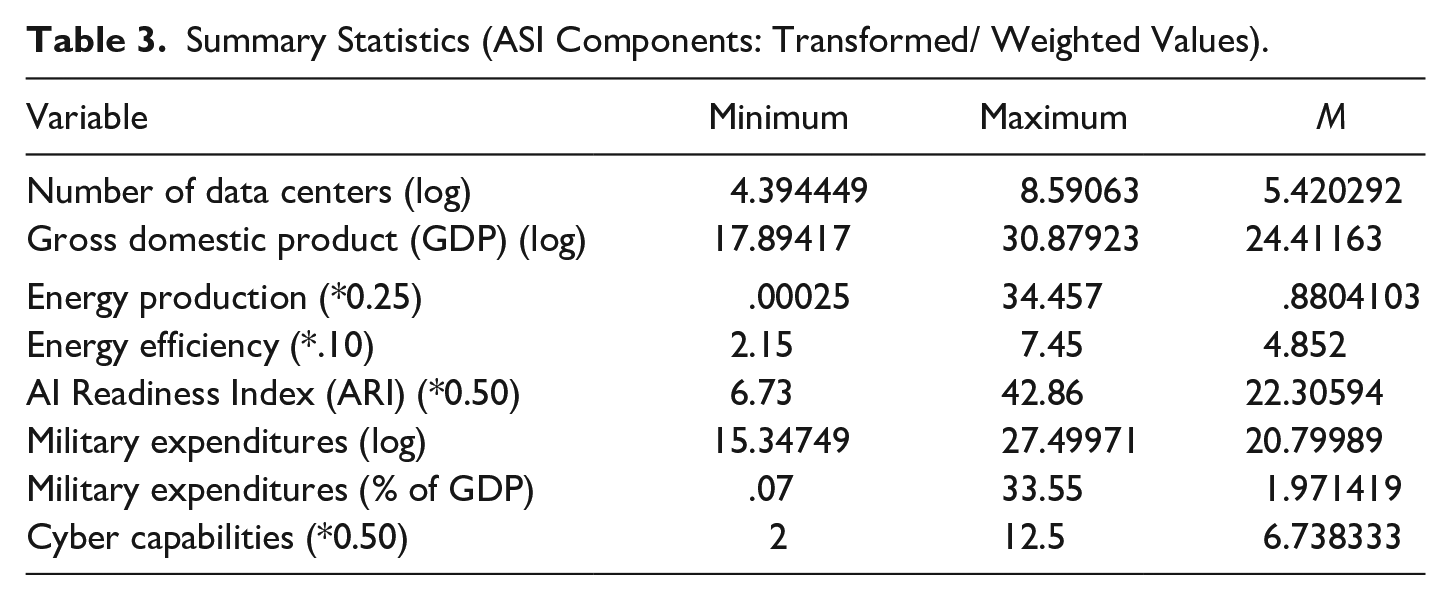
Artificial Intelligence Security Index (ASI) Formula Key.
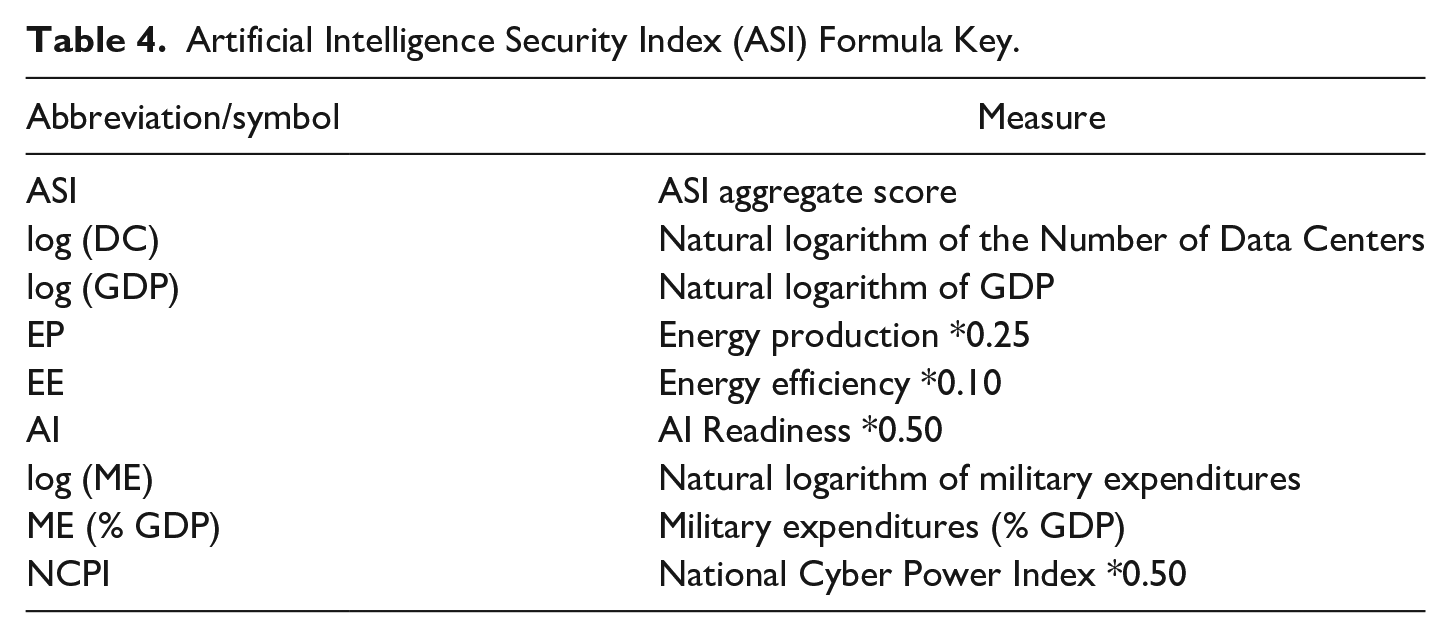
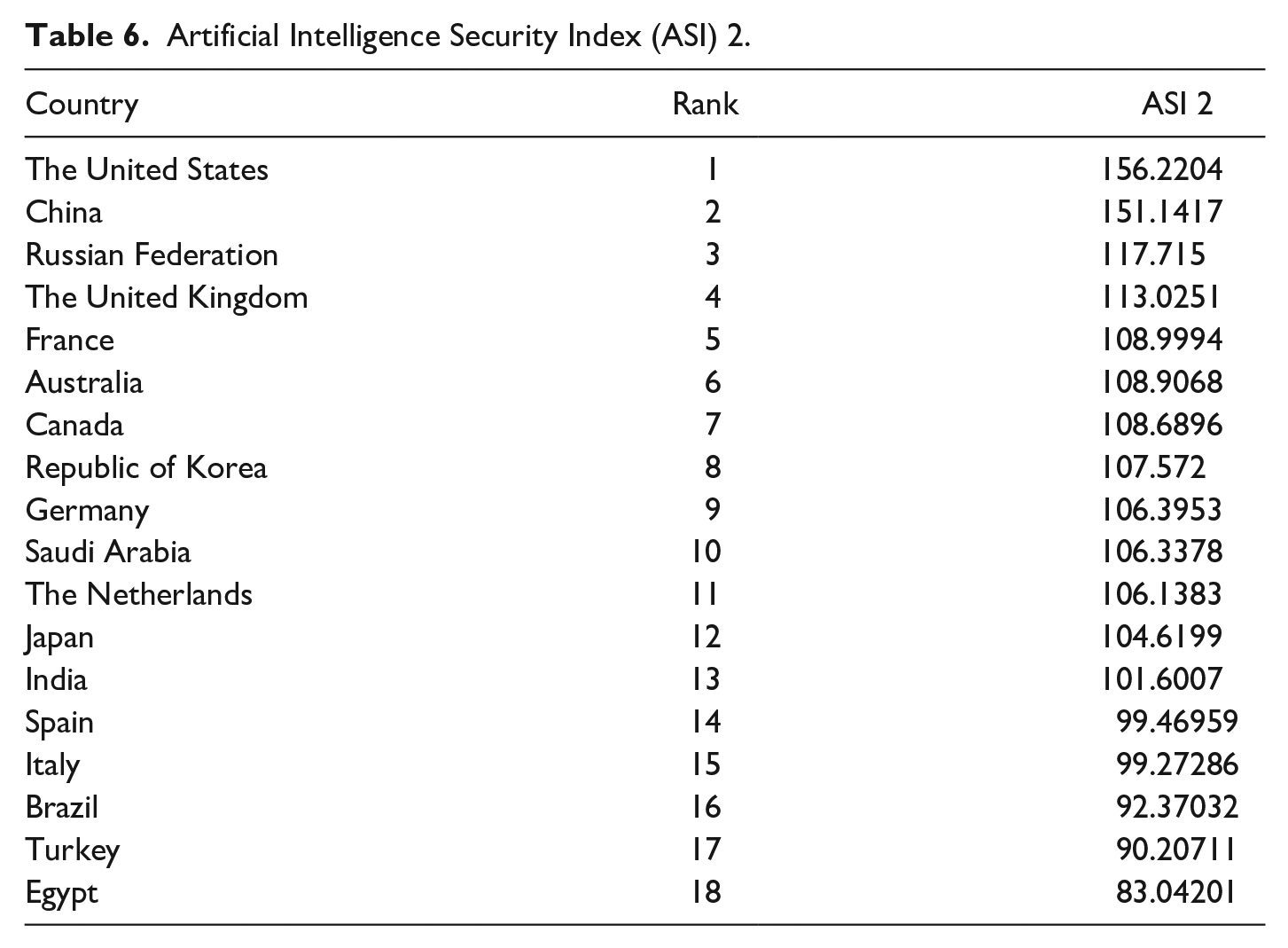
The second index (ASI 2) excludes the number of data centers measure since the number of data centers measure is limited to 23 states. Thus, to provide a larger number of states included in the index, the number of data centers measure is excluded for the ASI 2. The second index (ASI 2) consists of state wealth (log GDP), energy production (EP), energy efficiency (EE), AI Readiness (AI), military expenditures (ME), military expenditures as a percentage of GDP (ME[GDP]), and cyber capabilities (NCPI). The number of states included in the index is limited to eighteen states based on data availability for the cyber capabilities and energy efficiency measures. Also, as with ASI 1, the measures EP, EE, AI, and NCPI are weighted to produce comparable numerical values within the index as well as place appropriate relevance on each measure within the context of the index. The formula for the AI Security Index 2 is:

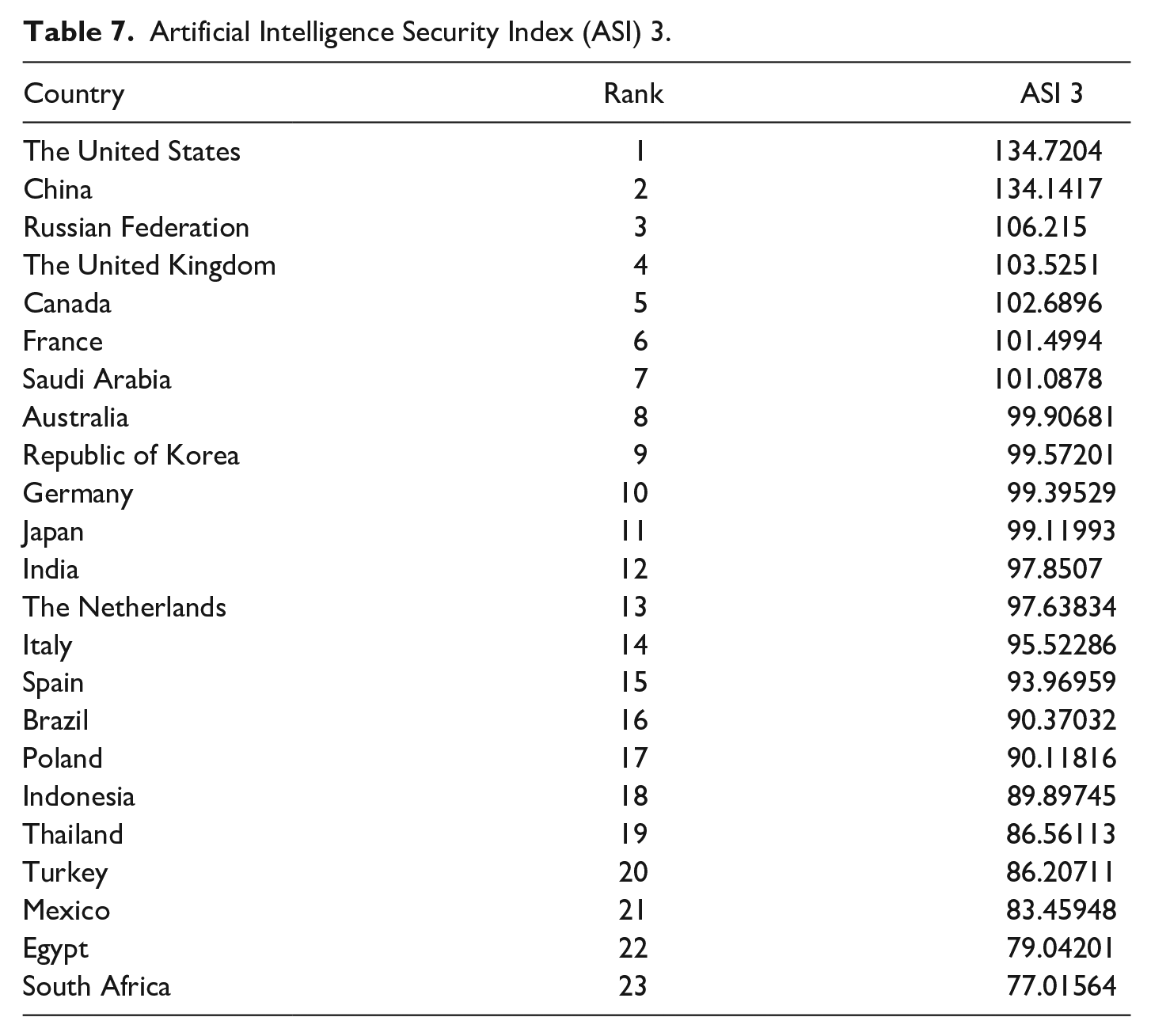
The third index includes the same factors as ASI 2 but excludes cyber capabilities given that the cyber capabilities measure (NCPI) is limited to 30 states. Thus, to provide greater coverage for the index regarding the states included, the cyber capabilities measure is excluded for ASI 3. The ASI 3 includes twenty-three states. The same weights are applied to EP, EE, and AI as in the previous indices. The formula for ASI 3 is:

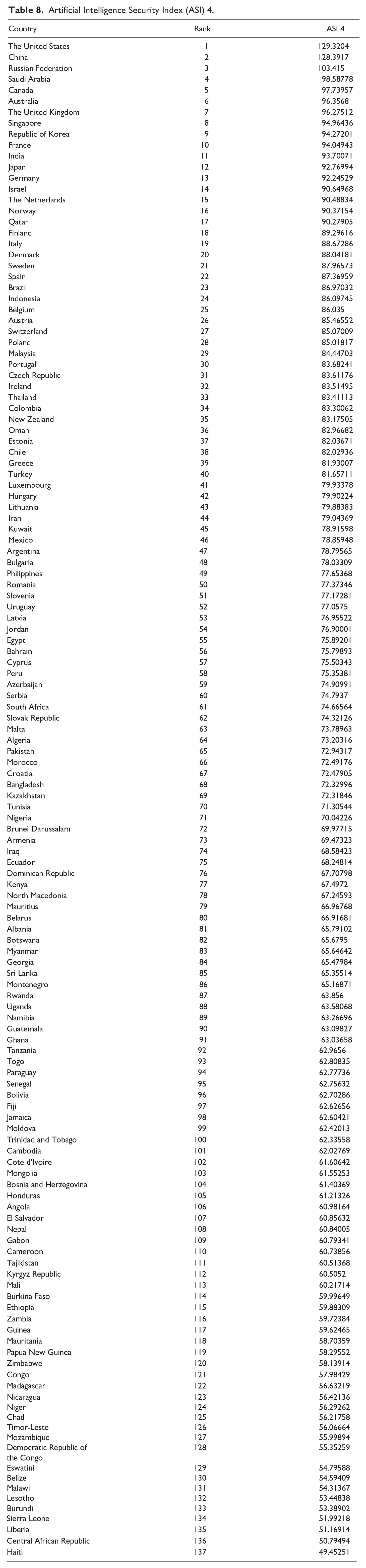
The fourth index includes the same measures as the ASI 3 but excludes the cyber capabilities and energy efficiency measures as the cyber capabilities measure includes 30 states and the energy efficiency measure includes 25 states. The same weights are applied to EP and AI as in the previous indices. The ASI 4 includes 137 states. 5 The formula for ASI 4 is:

Results
In examining Table 5 and the ASI 1, we find that the United States is ranked one (164.81), followed by China (157.24) and Russia (123.40). The United States and China are separated by 7.57 points. The United States ranks .05% higher than China in the ASI 1. In examining Table 6 and the ASI 2, we find that the United States is ranked one (156.22), followed by China (151.14) and Russia (117.71). The United States and China are separated by 5.07 points. The United States ranks .03% higher than China in the ASI 2. We find similar results when examining the ASI 3 and ASI 4 in Tables 7 and 8. The United States is ranked first, followed by China at a close second and Russia at a more distant third.
Artificial Intelligence Security Index (ASI) 1.
Artificial Intelligence Security Index (ASI) 2.
Artificial Intelligence Security Index (ASI) 3.
Artificial Intelligence Security Index (ASI) 4.
In respect to the United States and China, several themes emerge when examining the ASI 1 and the individual factors in the index. One, the United States and China are closely ranked on many factors regarding state wealth, military expenditures, and cyber capabilities (the United States is ranked first and China second for each factor). While China and the United States are also ranked similarly regarding energy production (China is ranked first and the United States second) the gap between China (137.828 quadrillion BTUs produced in 2022) and the United States (98.526 quadrillion BTUs produced in 2022) is significant. However, the United States has a substantial advantage over China regarding the number of data centers and AI readiness. The United States ranks first in the number of data centers (5,381) and China ranks fourth (449). The United States is also ranked one on AI readiness (85.72 points) and China is ranked seventeenth (70.84 points). Regarding AI readiness, the U.S. scores significantly higher than China with respect to the government pillar, technology pillar, and data and infrastructure pillar. Both states are ranked lower regarding energy efficiency (China is ranked ninth and the United States is ranked tenth).
Concerning Russia, factors contributing to Russia’s ranking in the top three of the ASI 1 are high levels of energy production (3rd), military expenditures (3rd), and cyber capabilities (3rd). Factors that prevent Russia from being ranked higher are the number of data centers (9th), energy efficiency (22nd), and AI Readiness (40th). Also, regarding AI competition between the three major power states (United States, China, and Russia), Russia’s level of state wealth (8th) may present Russia with challenges in maintaining pace with the United States and China regarding investment in AI research and development.
In examining Table 5 (ASI 1), we find the United Kingdom, France, Australia, Canada, Germany, the Netherlands, Japan, India, Spain, Italy, and Brazil are ranked 4 through 14. In examining Table 6 (ASI 2), we find the United Kingdom, France, Australia, Canada, the Republic of Korea, Germany, and Saudi Arabia are ranked four through ten. The states are close in their respective ASI 2 scores indicating similar levels of AI development and AI development potential regarding security. The Netherlands, Japan, India, Spain, Italy, Brazil, Turkey, and Egypt are ranked 11 through 18 in the ASI 2.
One notable state to discuss in analyzing the ASI 2 is Saudi Arabia. Saudi Arabia ranks 10th in the ASI 2. In examining specific factors of the ASI 2 and Saudi Arabia, Saudi Arabia ranks 39th in the AI Readiness Index. However, Saudi Arabia ranks fourth in energy production, fifth in military expenditures, and 17th in state wealth. Thus, while Saudi Arabia may currently rank 39th in the AI Readiness Index, higher levels of energy production, state wealth, and military expenditures indicate Saudi Arabia has substantial infrastructure and potential regarding AI development. If it chose to do so, Saudi Arabia could employ its significant energy resources, state wealth, and military expenditures to increase AI development regarding security. Thus, the case of Saudi Arabia demonstrates how the ASI takes into consideration AI development and AI development potential regarding security and the balance of power. Although some states may currently trail others regarding AI development, it is important to consider important factors that can affect AI development over time such as energy production, energy efficiency, state wealth, and defense resources.
Discussion
This study is an exploratory effort to examine the factors that can impact AI development, and AI development potential, regarding security. The ASI rankings suggest that the United States and China are the top two states in the international system regarding AI development and security, with the United States consistently ranked one, followed by China at a close second. Russia ranks third in each index. Russia’s overall score trails the United States and China by a decent margin in each index. While the United States, China, and Russia rank in the top three in all indices, the United Kingdom, Canada, France, Saudi Arabia, Australia, the Republic of Korea, Germany, Japan, India, the Netherlands, Italy, Spain, and Brazil consistently rank in the top ten to fifteen of the indices. The index rankings indicate that these states possess significant infrastructure and potential to develop AI regarding security.
Future AI development could be conditioned by the ability of states to access energy sources along with the application of energy efficiency techniques. As it stands currently, China leads the world in energy production and has a slight edge over the United States regarding energy efficiency, although it trails eight other states. Given that AI development often depends upon the energy supply available to data centers, the development and use of numerous AI military applications (e.g., data collection and analysis, target/threat identification, communications, and vehicle and weapons systems operations), will likely be affected by energy supply, energy production, and energy efficiency. Thus, the potential outcomes of military campaigns and the geopolitical composition of the international system can be impacted by the degree that data centers can assess the required power to operate sophisticated AI programs. To maintain competitive military advantages, major power states will likely have to access large stores of energy and use it efficiently to operate AI defensive applications.
While the four indices have attempted to capture the factors that can potentially affect AI development regarding security, several limitations should be discussed. One, quantitative research on AI capabilities regarding state power and security is still in its nascent stages. Numerous additional factors that can affect AI development and AI development potential are not included in the current indices due to data limitations. Second, data are not available for every state for every component of the ASI. There is missing data for some states for some components of the ASI. Thus, the ASI can only account for states where data are available for each component of the ASI. Future research could expand upon the ASI to include additional data as it becomes available. Third, based on the evolving nature of AI technology, numerous additional factors will need to be identified and accounted for in future studies to assess states’ AI development capabilities and potential regarding security.
Future studies should expand on the indices to incorporate additional factors that are critical to AI development. One example is future research that could analyze additional state-level AI capabilities regarding the role of private versus public sector AI investment and assess the effect on the ASI. Future research could also examine how variations in the AI infrastructures of developed and developing states affect the global AI race. In addition, although a modest amount of public information is available regarding the factors that can affect AI development, some information remains classified regarding AI development and specific military applications which could affect the ASI rankings. Thus, while the ASI accounts for publicly available data regarding factors that can affect AI development, classified information regarding AI military applications is not included due to the covert nature of some AI development programs.
The study contends that it is important to account for the factors that can affect the infrastructure of states that impact AI development regarding security. The main argument advanced in the study is that considering the nature of states’ data centers and energy capabilities (energy production and energy efficiency) is vital to discussions regarding AI development, state power, the international balance of power, and global security. States that can acquire and utilize large amounts of energy efficiently to power data centers and operate advanced AI will likely have significant advantages over other states with stark implications for global security.
This study contends that the nature and location of data centers are also important to AI development and global security. More specifically, the number of data centers, the sophistication of data centers, and the location of data centers can affect AI development and security. Regarding data center location—geography, climate, and whether data centers are housed in another state can affect AI development and security. Future research should also examine how the location of data centers can affect potential conflict scenarios given the important role data centers play in the development of AI and the data transmissions that occur between AI hardware in data centers and external AI applications. Future studies should also examine how data centers that are located in other states, and the distance between data centers and the applications that receive the data transmissions, can affect the operating speed of AI military applications and consider the security implications. Finally, research should analyze how the defense and protection of data centers could impact conflict scenarios and global security. AI experts have acknowledged the critical role data centers play in providing vital data for numerous economic and defense-related functions. Future, realistic conflict scenarios could entail the targeting of data centers to cripple specific economic and military applications and operations. Thus, future studies should consider how the location and protection of data centers can impact AI development and global security.
Footnotes
Declaration of Conflicting Interests
The author declared no potential conflicts of interest with respect to the research, authorship, and/or publication of this article.
Funding
The author received no financial support for the research, authorship, and/or publication of this article.
