






Abstract
This systematic review investigates how patterns of civil–military relations (CMR) influence the interstate conflict and crisis engagement. Despite a proliferation of theories and methodological innovations, the field remains fragmented, with persistent gaps and conflicting empirical results. Examining 31 studies from diverse academic journals, the review maps trends in the use of CMR-related variables and synthesizes findings from 98 explanatory concepts associated with interstate conflict and crisis engagement, ultimately identifying eight key CMR factors. The analysis, drawing on sign-test results, reveals that while some CMR dynamics—such as militarism in autocracy, military influence in CMR, and structural coup-proofing mechanisms—show potential influence, no single factor emerges as a definitive or consensus determinant. This result underscores the urgent need for more integrated theoretical frameworks and a deeper exploration of causal mechanisms, offering clear priorities and directions for advancing future research in the field.
Keywords
The relationship between civil–military relations (CMR) and conflict remains a major theme within political science (Brooks, 2019, p. 393). Within this broad theme, a more focused research agenda examines how variation in domestic CMR patterns influences state’s propensity to engage in interstate conflict. Studies within this scope have been fruitful in generating different theoretical frameworks that treat domestic-level CMR patterns as key explanatory variables for conflict and crisis engagement. Methodologically, works have also steadily included cross-national time series analysis among more qualitative case-based analyses. However, despite contributing to various theoretical innovations and incorporating diverse methodological frameworks, this body of scholarship still contains several gaps.
To begin with, scholars have noted that comparativists rarely employ civil–military interaction as explanatory or moderating variables in explaining interstate conflict and crisis engagement (Belkin & Schofer, 2005, pp. 145–146; Kasza, 1996, pp. 355–356). In recent years, this shortcoming has been somewhat abated, judging by the increasing number of studies in this research agenda. Second, the theoretical insights generated by this research agenda remain disconnected from one another, lacking integration and limiting contribution to knowledge accumulation about how CMR patterns affect interstate conflict and crisis engagement. Only a few studies, such as Dassel (1998) and Pickering and Kiyani (2026), have attempted to examine and integrate how different theoretical insights related to CMR patterns influence conflict and crisis engagement. Third, theoretical insights generated by this research agenda occasionally yield conflicting empirical results, leaving unadjudicated competing arguments that lack thorough follow-up examinations. For example, empirical research on how civilian control over the military affects the initiation of interstate conflict yields contradicting findings: some studies suggest that stronger civilian control decreases the likelihood of armed conflict initiation (Choi & James, 2008; Sechser, 2004), while other works find otherwise (Betts, 1977; Gonzalez, 2024, p. 169; Lee, 1991). These shortcomings highlight a lack of integration, accumulation, and clarification in theoretical debate and contradicting empirical findings in this research agenda—gaps which existing reviews on the broader themes of CMR may not address (Brooks, 2019; Feaver, 1999).
These limitations motivate a critical review of the studies that explain how different CMR patterns influence interstate conflict and crisis engagement. The review pursues two main objectives. First, it assesses the extent to which existing empirical findings align with the major theoretical expectations regarding how different CMR patterns shape interstate conflict and crisis engagement. Second, it synthesizes empirical findings relevant to these theoretical expectations. To accomplish these goals, this review combines a systematic literature review with a synthesis of results using the “sign-test,” which summarizes findings based on the direction of the reported coefficients. This methodology follows Borenstein et al. (2009, pp. 325–326) and has been employed previously by Trinn and Wencker (2021). One important caveat is that because multiple theoretical arguments often predict the same directional effect, the sign-test cannot distinguish which theoretical mechanism is most supported by the empirical evidence. Nevertheless, this approach provides a valuable assessment of accumulated empirical tendencies and helps identify areas where findings remain inconclusive. These contributions help clarify priorities for further research and highlight opportunities for developing more integrated theoretical frameworks concerning how CMR patterns influence conflict and crisis engagement.
This review is structured into five sections. The first section clarifies the conceptual underpinning of CMR and interstate conflict and crisis engagement. The second section discusses the sampling strategy and the sign-test method as a procedure to accumulate the knowledge based on the sample. The third section descriptively presents the findings on patterns and trends from the sample of collected articles, and the dataset employed by the articles within the sample. The fourth section presents the set of significant evidence of effects derived from the sign-test and discusses the arguments related to the CMR patterns and interstate conflict and crisis engagement. The concluding section summarizes the state of empirical research on CMR-related explanations of interstate conflict behavior and suggests several directions for future research on this agenda.
CMR and Interstate Conflict and Crisis Engagement
This review subscribes to the general definition of CMR as the concept that encompasses various relationships between the military and the civilian. These interactions include, among other dimensions, the relationship between the military organization and the broader society. 1 This review intends to specifically place the focus on the dynamics between political elites and senior military leadership at the apex of the state (Brooks, 2019, pp. 380–381; Feaver, 1999; Nielsen & Snider, 2009, p. 3). However, during the review process, it becomes clear that several articles under examination incorporate both elite and societal levels of CMR, which include the influence of military preferences in the population as part of their explanations. Consequently, although this systematic review maintains an elite-centered focus, it is necessary to report and analyze those societal-level variables whenever they are integral to the authors’ original arguments. Arguably, this inclusion reflects the structure of existing scholarship rather than deliberate broadening of the review’s scope.
Two other central concepts closely related to CMR are civilian control and military autonomy, both of which are multifaceted and contested in the field. 2 Civilian control depicts a condition when the military follows the decision of civilian leadership regardless of whether the military agrees with those decisions; it can also be conceptualized as a distribution of power between political leaders and military officers (Pion-Berlin et al., 2024, p. 2). Military autonomy, in contrast, can be understood in either political or professional terms. Politically, it is often treated as a condition that stands in contrast to civilian control; professionally, it denotes the armed forces’ freedom to manage their professional affairs without political interference (Pion-Berlin et al., 2024, pp. 2–3).
In the professional sense, one could argue that civilian control may in fact benefit from some degree of military autonomy, consistent with Huntington’s (1957) notion of objective control. 3 In the political sense, the relationship between civilian control and military autonomy can be conceptualized as a continuum ranging from full civilian control to complete military dominance in the decision-making arena (Bruneau & Croissant, 2019, p. 7). To capture the variation in CMR patterns along this spectrum, this review selected four key words that will be used in the sampling strategy: civil–military relations, civilian control, military regime, and military leader.
The other core concept underpinning this systematic review is interstate conflict and crisis engagement, which broadly refers to contentious interaction between two or more sovereign states that involves or threatens the use of military force. Within this broad domain, studies in the conflict literature operationalize the dependent variable in several conceptually distinct ways. The phenomena examined in this review are collectively treated under the broader category of conflict and crisis engagement, as elaborated below.
The first is war, which corresponds to the highest level of interstate conflict, defined as any series of sustained combats between armed forces characterized by three elements: (1) a significant scale of casualties, (2) preparation and engagement by large-scale social organizations, and (3) invocation of legitimate consequences of killings as duty (Singer & Small, 1972; Small & Singer, 1982). 4 The second is militarized interstate dispute (MID), which refers to “. . . instances of conflict in which the threat, display or use of military force is explicitly directed towards another state, but without escalating to full-scale war” (Jones et al., 1996, p. 163). The third is interstate crisis, defined as a change in type or an increase in the intensity of disruptive interactions between two or more states, with a heightened probability of military hostilities that destabilize their relationship and challenge the structure of an international (global, dominant, or sub-global) system (Brecher & Wilkenfeld, 1997).
In addition to the variation in the type of phenomenon studied, the literature also varies in the aspect of conflict and crisis engagement behavior examined. Studies in this literature commonly focus on three aspects: (1) initiation, defined as the action by which a state triggers a conflict episode against another state; (2) participation, defined as entry to a conflict episode, regardless of the initiator and the target; and (3) onset, defined as the temporal beginning of the episode. Alternatively, studies in the literature also focus on conflict escalation, defined as increasing the intensity of the episode, and reciprocation, defined as whether the target state in the episode responds to the threat of the use of force. Recognizing this variation is important because the sampled literature might not converge on a single aspect of conflict and crisis engagement.
Finally, in anticipating that the number of studies examining both CMR and conflict behavior remains limited, this review adopts a broad scope encompassing what can be termed conflict and crisis engagement—rather than the narrower conflict initiation—to accurately reflect the range of dependent variables examined. This broad scope covers state involvement in wars, militarized interstate disputes, and interstate crises, including initiation, onset, participation, escalation, and reciprocation of such phenomena. This inclusive approach ensures sufficient coverage of the limited literature at the intersection of CMR and interstate conflict. The sampling strategy uses three key terms to identify relevant studies: interstate war, militarized interstate dispute, and armed conflict. Although no interstate crisis-specific keyword was added, studies employing interstate crisis behavior (ICB) data were nonetheless captured because they address similar theoretical questions and frequently co-occur with MID-related literature in the sampled articles, as the dataset distribution in the findings section confirms.
Sampling and Sign-Test Methods
The sampling strategy for this review involved retrieving the sample from two widely used publication databases—ProQuest and Clarivate Web of Science Platform—using a predefined set of keywords covering the period from 1990 to 2024. This time frame was selected because the volume of studies on CMR and interstate conflict and crisis engagement increases substantially after 1990, even though earlier foundational scholarships exist (e.g., Betts, 1977; Huntington, 1957; Snyder, 1984). Prior to 1990, much of the relevant scholarship appeared primarily in monograph form rather than in peer-reviewed journals, which complicates systematic comparison across studies.
The review draws on 22 political science and international relations journals. 5 Following Trinn and Wencker’s (2021) approach, journal selection prioritized disciplinary relevance and scholarly impact. Eleven journals are classified as high-impact according to Giles and Garand (2007), 10 are indexed in the Clarivate’s Social Science Citation Index, and one additional journal is indexed in ProQuest’s PAIS database.
The keywords search included the terms “civil-military relations,” “civilian control,” “military regime,” “military leader,” “conflict,” “dispute,” “war,” and “use of force.” The search was limited to peer-reviewed journal articles and excluded dissertations, book reviews, editorials, commentaries, book chapters, and monographs. Restricting the sample to journal articles mitigates comparison challenges arising from mixing publication types, such as equating the evidentiary weight of a monograph with that of a peer-reviewed journal article.
Two inclusion criteria were applied to identify the final sample. The first inclusion criterion was whether the article deals with CMR-related dimensions as the explanatory factor and the interstate conflict or crisis engagement as the outcome to be explained. This criterion excludes articles that discuss decision-making processes occurring during or after the onset of interstate conflict or crisis, as such processes are not the focus of this review. However, studies that examine conflict or crisis escalation and reciprocation are retained, provided they treat CMR patterns as antecedent conditions explaining these outcomes. Articles focusing on decision-making processes that unfold once conflict is already underway are excluded. In the case of reciprocation, although the outcome occurs after conflict or crisis initiation, CMR-related variables still function as a prior explanatory factor predicting the target state’s response, not as a variable capturing within-conflict decision dynamics. Second, the review process excluded articles that produce new theoretical understanding but do not discuss empirical evidence to substantiate their claims. Although such contributions may offer important theoretical insights, they were omitted from the sign-test due to their design as plausibility probes rather than empirical articles; a research synthesis aimed at assessing evidence of effect must be grounded in empirical findings.
The initial search strategy using ProQuest and Web of Science yielded 2,051 and 1,325 journal articles, respectively. After removing duplicates, editorials, and unnamed articles, 2,786 articles remained. Filtering to 22 target journals reduced the list to 696 articles and abstracts screening identified 29 articles meeting the inclusion criteria. Two additional recent articles were identified through supplementary search procedures: one through hand-searching of journal volumes containing other sampled articles, and one through expert recommendation during the review process. Both met the inclusion criteria and were incorporated into the final sample, which contains 31 articles, comprising 203 analyses: 199 regression models and four qualitative analyses. Table 1 summarizes the studies included in the review, reporting key study characteristics, the civil–military relations measures examined, the dependent variable in question, and the direction of the reported empirical findings.
Civil–Military Relations Variables and Empirical Findings in the Reviewed Studies.
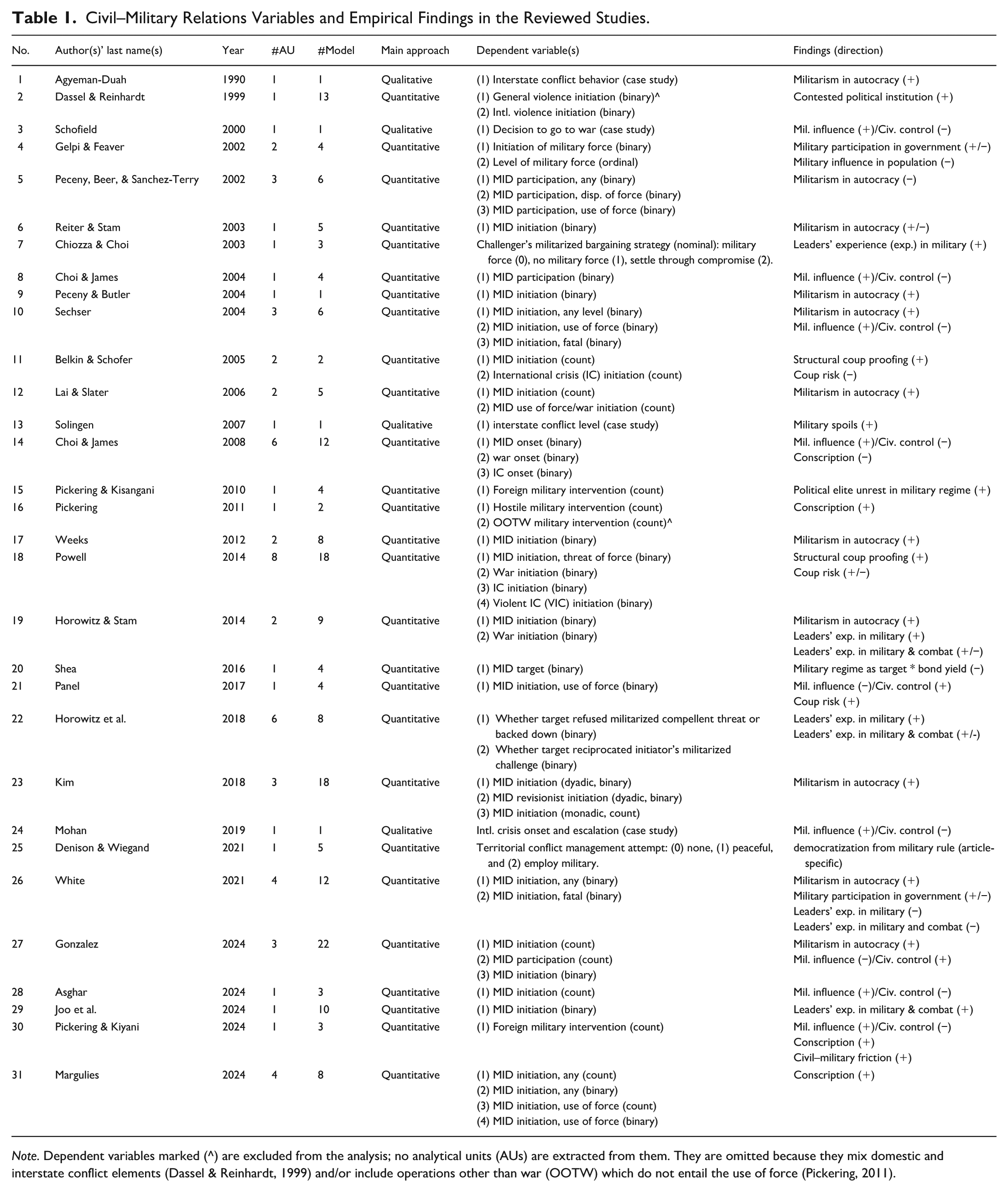
Note. Dependent variables marked (^) are excluded from the analysis; no analytical units (AUs) are extracted from them. They are omitted because they mix domestic and interstate conflict elements (Dassel & Reinhardt, 1999) and/or include operations other than war (OOTW) which do not entail the use of force (Pickering, 2011).
The synthesis is organized around analytical units (AU) extracted from each article. The extraction procedure follows Trinn and Wencker (2021, pp. 117–118), who define analytical units using three criteria: (1) the reviewed article, (2) the disaggregated outcome, and (3) the dataset employed. For example, if an article examines two distinct operationalizations of the outcomes—such as (1) the number of interstate conflicts a country engages in during a year, and (2) whether a country initiates an interstate conflict—each outcome is counted as a separate AU. Similarly, if a study investigates conflict or crisis participation using two different datasets—such as the Correlates of War (COW) project’s MID dataset and ICB dataset—each is counted as a separate AU. In this way, an AU serves as a focused unit of analysis that enables structured comparison and synthesis across studies.
According to Trinn and Wencker (2021, p. 117), this procedure helps mitigate the problem that could arise from synthesizing research studying the same population using the same or similar datasets, which creates non-independence among the models within those studies. In addition, while their approach includes only quantitative studies, this review extends it to incorporate qualitative research with a simple modification. For qualitative studies, the case is the primary unit regardless of outcome variation, where each case constitutes one AU. This adjustment preserves conceptual consistency across methodological traditions and integrates qualitative evidence without inflating its empirical leverage.
It is important to clarify the scope conditions implied by the sampling strategy and AU extraction procedure. Although this review focuses on CMR-related variables as explanatory factors of interstate conflict and crisis engagement, AUs are retained if they include at least one CMR-related predictor, regardless of whether other covariates are also included in the model. As a result, political, institutional, and relational covariates—such as regime type, alliance characteristics, or military capability—appear frequently across AUs, reflecting their common co-occurrence with CMR indicators in empirical models. The review also does not draw a strict distinction between independent and control variables; instead, it encompasses all explanatory factors employed in the sampled studies to evaluate the consistency and relative performance of CMR-related determinants relative to the standard predictors within the broader empirical landscape of interstate conflict research.
After compiling the sample and extracting the AUs, the review proceeds to the sign-test to evaluate the directional consistency of empirical findings. Following Borenstein et al. (2009, pp. 325–326), the test counts the number of reported positive and negative coefficients for each variable, regardless of statistical significance, 6 and evaluates whether the observed distribution deviates from what would be expected under a binomial distribution with a 0.5 probability of success. Given the inclusive coding strategy described above, clear decision rules are required to distinguish robust empirical regularities from inconsistent findings. To reach statistical significance at p < .05 level, a variable must appear in at least six AUs; variables with fewer than six AUs cannot reach this threshold. Holm–Bonferroni correction to adjust the p-value accordingly is also applied to account for the multiple hypothesis testing problem.
The sign-test evaluates whether the observed distribution of positive and negative effects deviates from what would be expected under the null hypothesis of equal likelihood. It does not identify or establish causal mechanisms, nor does it adjudicate among competing explanations, particularly when multiple mechanisms predict similar directional effects. Instead, based on the decision rules above, it is useful for classifying variables based on the strength and consistency of the empirical evidence in the reviewed literature. Following Dixon (2009) and Trinn and Wencker (2021), variables meeting the Holm–Bonferroni-adjusted threshold of p < .05 are classified as consensus determinants, indicating robust and consistent directional effects across studies. Building on this approach, this review further distinguishes between variables that meet the conventional significance threshold (p < .05) but not the adjusted threshold, which are treated as providing evidence of effects, and variables that fail to meet either threshold, which are classified as inconclusive. This extended classification is intended to organize the accumulated evidence and highlight variables that merit further theoretical development and empirical scrutiny, without implying theoretical consensus.
Trends and Patterns: The Effect of CMR-Related Factors on Conflict and Crisis Engagement
This section outlines the key trends and patterns in the reviewed studies. This review examines the distribution of AU, dependent variables, datasets, and independent variables within the reviewed studies. Analyzing these trends and patterns benefits readers by providing an overview of prevailing methodological approaches, research designs, and underexplored theoretical arguments in this research agenda. Such an overview can inform future studies by highlighting opportunities to refine existing research designs or to focus on areas that might require innovative theoretical framework.
The notable pattern is related to the number of published articles and AU extracted from each study. The sampling strategy yielded 31 articles, comprising 203 analyses: 199 regression models and four qualitative analyses. The relatively small sample reflects this review’s focus on CMR-related factors and interstate conflict and crisis engagement. The number of published articles varied between 1990 and 2024, peaking in 2024, possibly due to Kenwick’s (2020) recent conceptualization and measurement of civilian control as a latent variable. Across 31 articles, there are a total of 67 AUs, averaging 2.16 AUs per article. The article with the highest number of AUs is Powell’s (2014) article, with eight AUs due to multiple dependent variables operationalizations, datasets, and observation periods (Figure 1). 7
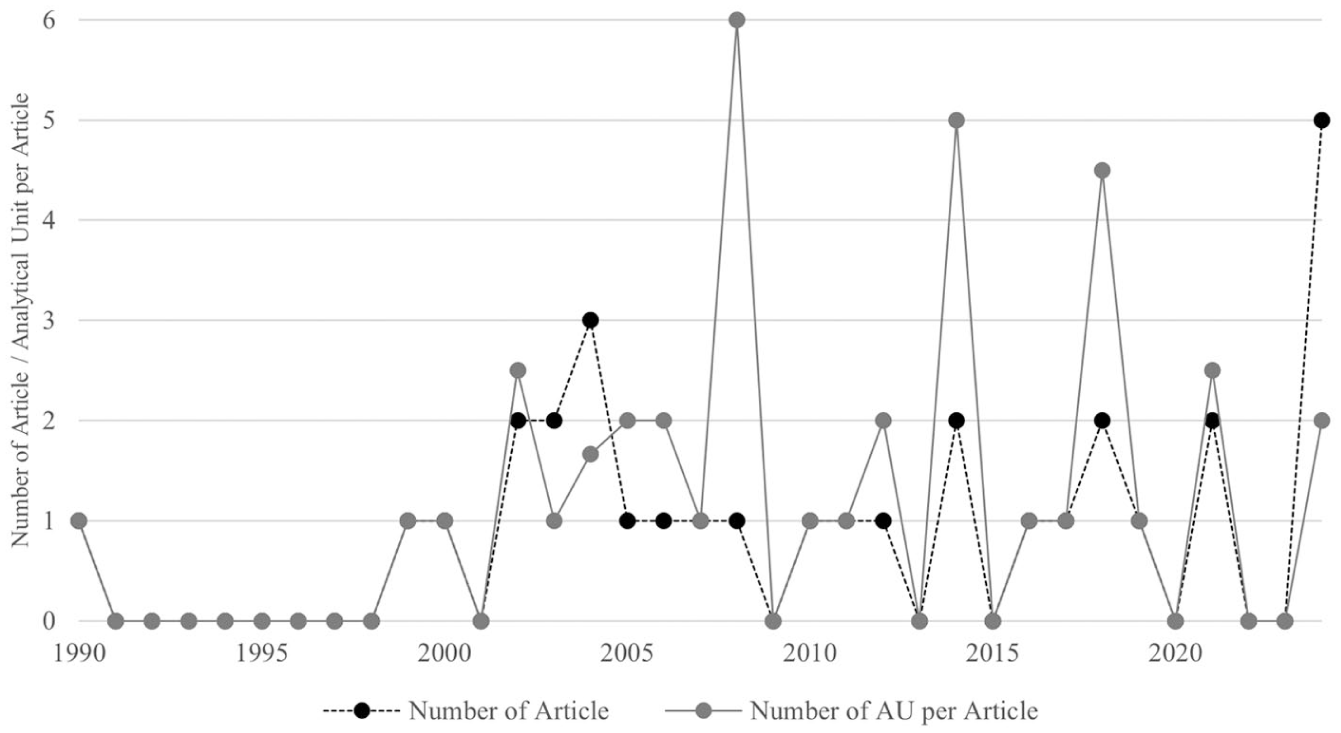
Total number of articles in the sample and share of analytical units per article.
The second pattern concerns the diversity of dependent variables across the reviewed studies. Eighteen articles examine a single dependent variable with a single operationalization, while 13 others employ two or more dependent variables or operationalizations. For example, Gelpi and Feaver (2002) examine the effect of the civil–military gap in the United States on two dependent variables: (1) the propensity to use military force, and (2) the initiated dispute hostility level. Table 2 presents the distribution of dependent variables across the analytical units.
Distribution of Dependent Variables by Operationalization Across Analytical Units.
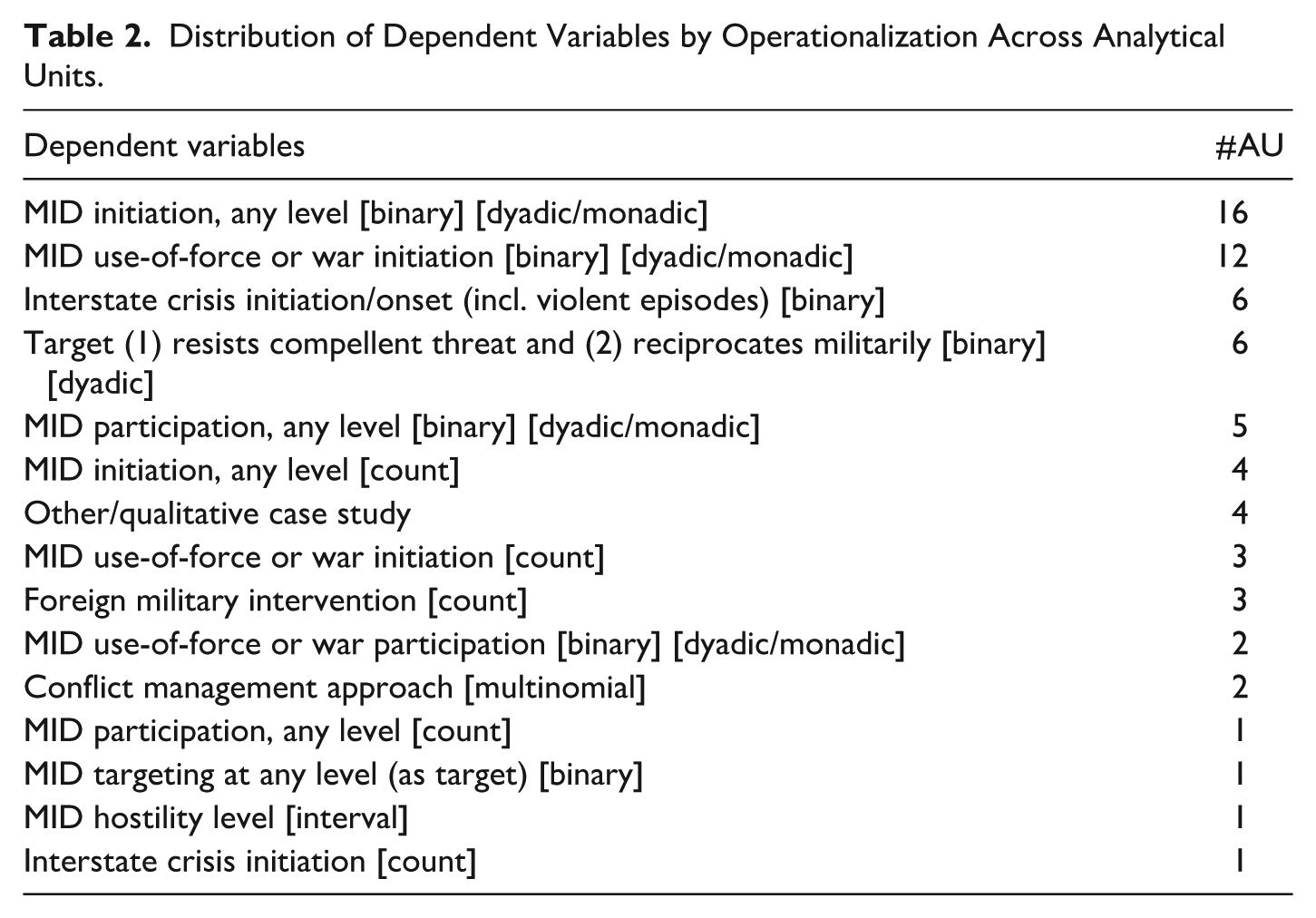
The most frequently used dependent variable is the binary indicator of MID initiation at any hostility level—operationalized in monadic, undirected dyadic, or directed dyadic designs—appearing in 16 AUs. The second most common is the binary indicator of MID initiation at the use-of-force threshold or above, including war initiation, across comparable operationalizations (monadic and directed dyadic), with 12 AUs. Tied for third are two dependent variables, each appearing in six AUs: the binary indicator of interstate crisis onset—including violent episodes—drawn from the ICB dataset, and the binary indicator of target-state reciprocation in response to militarized compellent threats. At the other end of the distribution, four dependent variables appear in only one AU each: the annual count of a state’s MID participation at any hostility level, the binary indicator of being targeted in an MID, the continuous MID hostility level score, and the annual count of a state’s interstate crisis initiations. This variation highlights the breadth of research designs examining the effect of different CMR patterns on interstate conflict and crisis engagement.
The third pattern is related to the diversity of conflict and crisis datasets employed in the reviewed articles, alongside the qualitative case studies used in four other articles. 8 This review identifies five commonly used datasets. COW project’s MID dataset is by far the most frequently utilized, appearing in 45 different AUs (Ghosn & Palmer, 2003; Gochman & Leng, 1988; Gochman & Maoz, 1984; Jones et al., 1996; Maoz, 2005; Palmer et al., 2015). The ICB dataset (Brecher et al., 1988; Brecher & Wilkenfeld, 2000) is the second most frequently used, employed in seven AUs. Three AUs draw on the International Military Intervention dataset, as used by the original studies (Kisangani & Pickering, 2008; Pearson & Baumann, 1993; Pickering & Kisangani, 2009). In addition, Paul Huth’s (1996) territorial dispute dataset and the Issues Correlates of War (ICOW) project (Hensel et al., 2008) are each employed by one AU. One article, comprising six AUs, constructs its own dataset by combining the military compellent threat (MCT) dataset with the MID dataset (Downes & Sechser, 2012; Sechser, 2011) (Figure 2).
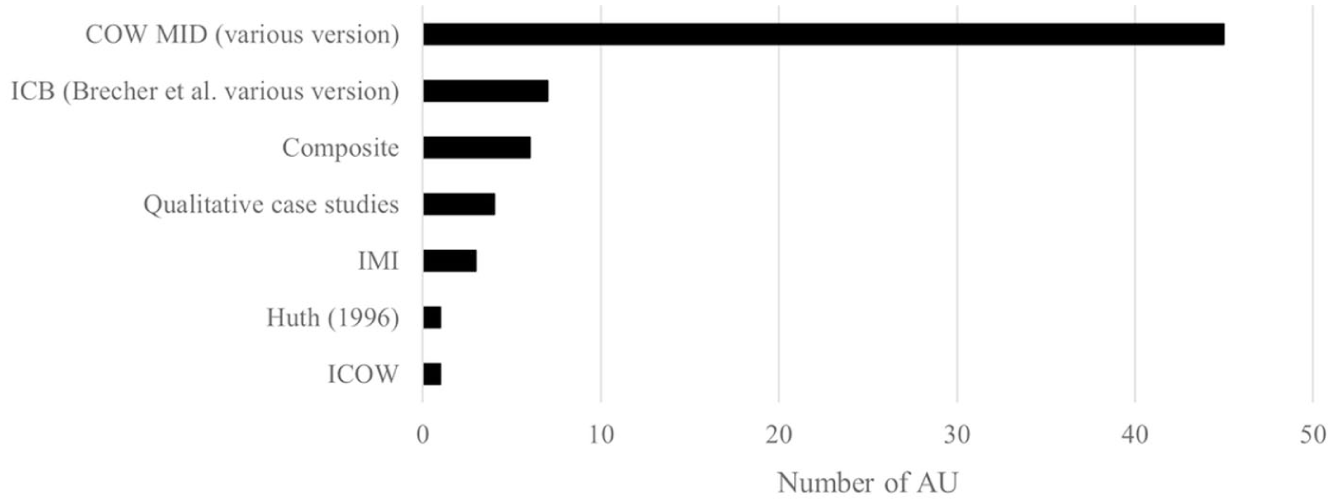
Number of analytical units per dataset.
The prominence of MID dataset across the reviewed studies points to its established role as the field’s default measure of interstate conflict behavior measure of interstate conflict behavior. Despite its prominence, the full set of dependent variables examined in the reviewed articles is not synonymous with MIDs. As noted earlier, these studies also identify a broader set of conflict-related outcomes—including interstate crisis engagement, military intervention, reciprocation of compellent threat, and territorial disputes management—each tied to different conceptual frameworks and distinct datasets. Thus, while the MID dataset appears prominently because it aligns with how many studies define conflict behavior, it represents only a subset of the wider conflict and crisis-related phenomena explored in the literature. Its predominance may therefore reflect patterns of data availability, rather than the conceptual boundaries of conflict and crisis behavior analyzed.
The fourth pattern concerns the use of independent variables. This review’s assessment of independent variables follows a conceptual logic broadly consistent with—though not identical from—the approach of Trinn and Wencker (2021, pp. 119–120). While their approach emphasizes maintaining distinct conceptual understanding while ensuring similar operationalization for related concepts, this review places greater emphasis on the interrelationships among certain variables. For example, as discussed earlier, civilian political control and military influence are conceptually intertwined: a high degree of civilian control typically implies limited or absent military influence in government. For this reason, this review codes military influence as a single variable that also captures the inverse of civilian political control over the military.
Using this approach, this review identifies 98 variables, which were analyzed 737 times across 67 AUs. A more detailed typology—one that does not aggregate variables with similar operationalizations into broader conceptual categories—yields 188 distinct entries, which are provided in the Supplementary materials. One important clarification here is that the resulting distribution of variables reflects both CMR-related and non-CMR predictors commonly employed in the literature, consistent with the inclusive variable coding strategy described in the previous section. Despite the large number of variables available, only a small subset is commonly used, while more than half appear only infrequently. Of all identified variables, only 36 are employed in more than six AUs, and just nine are used in over 20 AUs. The five most frequently used variables are democracy (52 AUs), territorial contiguity or capital-to-capital distance within a dyad (included in 50 AUs); major or superpower status of the initiator (38 AUs); alliance portfolio similarity, either with the opponent or the system leader (37 AUs); military capability, measured in absolute terms or via CINC score (35 AUs).
The next step categorizes the variables into five distinct groups: (1) variables related to CMR, (2) political variables (excluding those directly tied to CMR), (3) socioeconomic variables, (4) geographical variables, and (5) leadership-level variables. Figure 3 illustrates the distribution of these variables across categories, highlighting the comparatively limited use of CMR-related variables relative to the political variables that appear as explanatory or control variables in the reviewed articles. In total, the review identifies eight distinct CMR-related variables, which were analyzed 82 times. In contrast, 56 political variables appear over 460 times across 67 AUs, consistent with standard modeling practices in interstate conflict research.
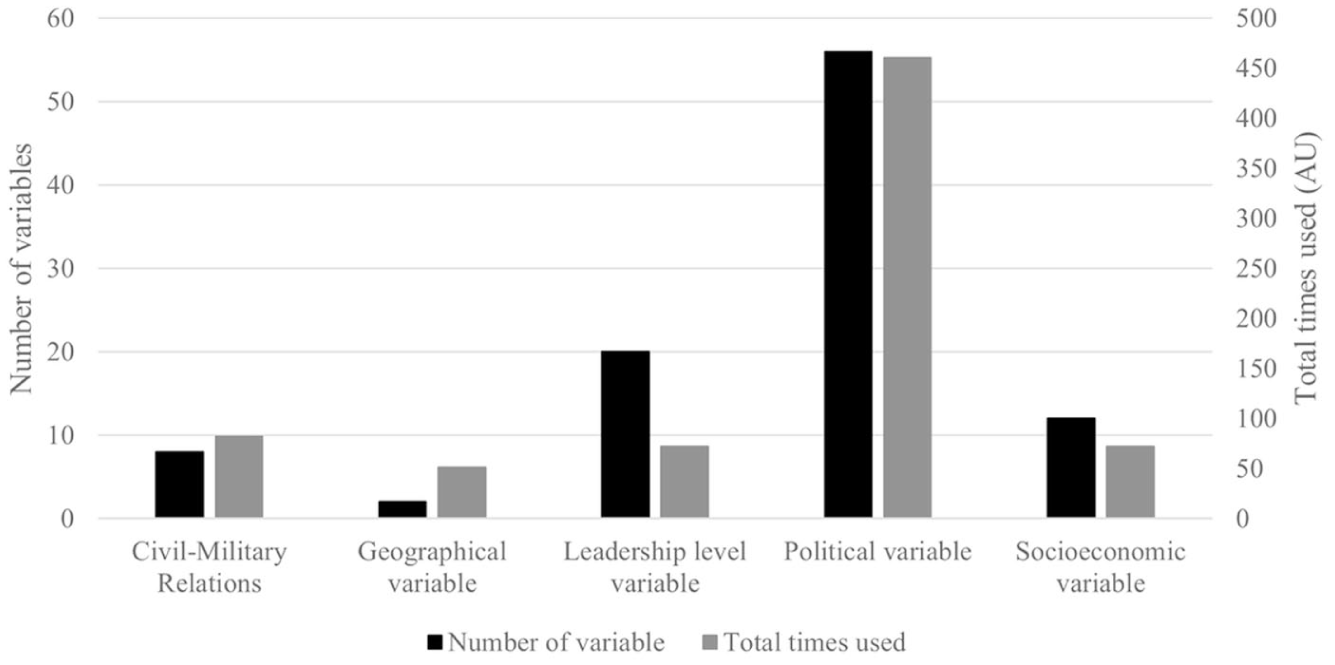
Number of variables per category and analytical units per category of variable.
The CMR-related variables include: (1) military influence in CMR or civilian control, (2) coup risk, (3) military conscription, (4) military or veteran participation in government, (5) the presence of structural coup-proofing mechanism in the form of effective paramilitary and counterbalancing organizations, (6) influence of military preferences within the population, (7) military regimes (also referred to as militarism), and (8) civil–military friction. These eight variables reflect existing studies on military regimes as a distinct regime type, as well as the innovative nature of research in this area, where scholars have sought to explore novel conceptualizations of various facets of CMR.
The other categories exhibit varying levels of robustness. Socioeconomic variables include 12 distinct variables studied 72 times, while geographical variables consist of only two distinct variables studied 51 times. Leadership-level variables represent an innovative area of study, encompassing 20 distinct variables that are in total examined over 72 times.
The review identifies 24 interaction terms, each specific to an individual study. As shown in Figure 4, the most common interaction terms involve relationships between leadership-level variables and political variables (eight interaction terms), followed by interactions between two political variables and between CMR and political variables (five interaction terms each). In contrast, interaction terms involving CMR variables are relatively limited. Only three interaction terms link CMR and leadership variables, and just one appears for both CMR-CMR and CMR-socioeconomic variable combinations. The limited use of interaction terms involving CMR variables highlights a potential avenue for future research. For example, scholars could further explore how civilian control—a core CMR variable—conditions the effects of other political or institutional factors, such as participation in international organizations during humanitarian interventions, as examined by Recchia (2015), or the more recent study on how military conscriptions reduce the propensity of conflict engagement conditioned upon the high level of military proportions of the population.
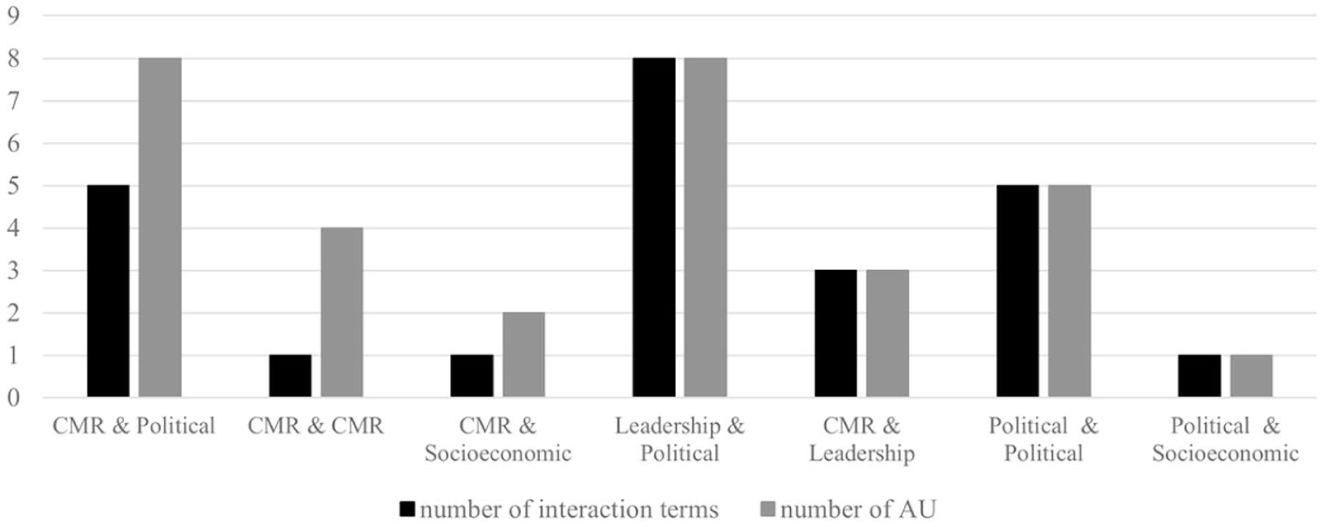
Number of variables and analytical units per category of interaction variable.
Sign-Test Result: Consensus Among CMR-Related Dimensions?
Having mapped the range of variables, datasets, and interaction terms in the literature, this section turns to a systematic synthesis of whether CMR variables exhibit consistent directional effects on interstate conflict and crisis engagement. It presents the findings from the sign-test and situates the observed empirical patterns alongside existing theoretical arguments about the mechanisms through which different CMR-related factors may influence conflict and crisis engagement. Two caveats warrant attention. First, due to the limited volume of research on this topic, the results are not disaggregated by dependent variable type. More fine-grained analyses will become feasible as additional studies on CMR and engagement in conflict and crisis accumulate. Second, this section focuses exclusively on arguments related to CMR patterns, which fall within the scope of this review.
Figure 5 presents the sign-test results for variables appearing in at least six analytical units, showing the proportion of positive coefficients across studies. CMR-related variables, which meet this threshold, are displayed alongside commonly used predictors in conflict research to benchmark their consistency relative to the empirical baseline. These non-CMR variables are not analyzed for their own sake but serve as reference points against which the strength and consistency of CMR-related effects can be evaluated. Including standard controls situates CMR variables within the broader empirical landscape of conflict research and facilitates assessment of whether CMR factors exhibit effects comparable to or distinct from well-established predictors. The subsequent analysis in Figure 6 narrows the focus to CMR-related variables—including leadership-level variables deemed important—providing a more targeted assessment once this broader context is established.
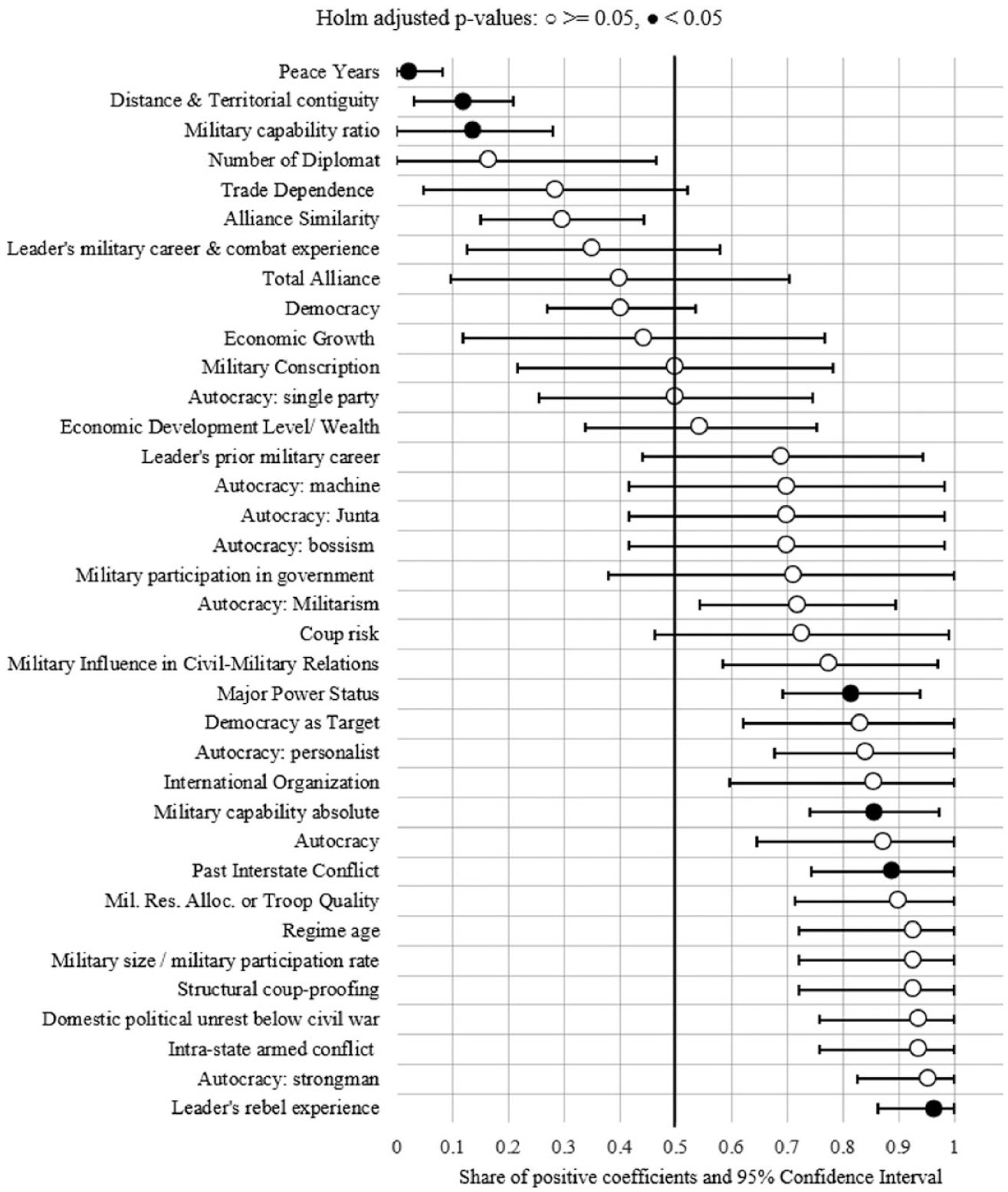
Variables related to internationalized conflict and crisis engagement.
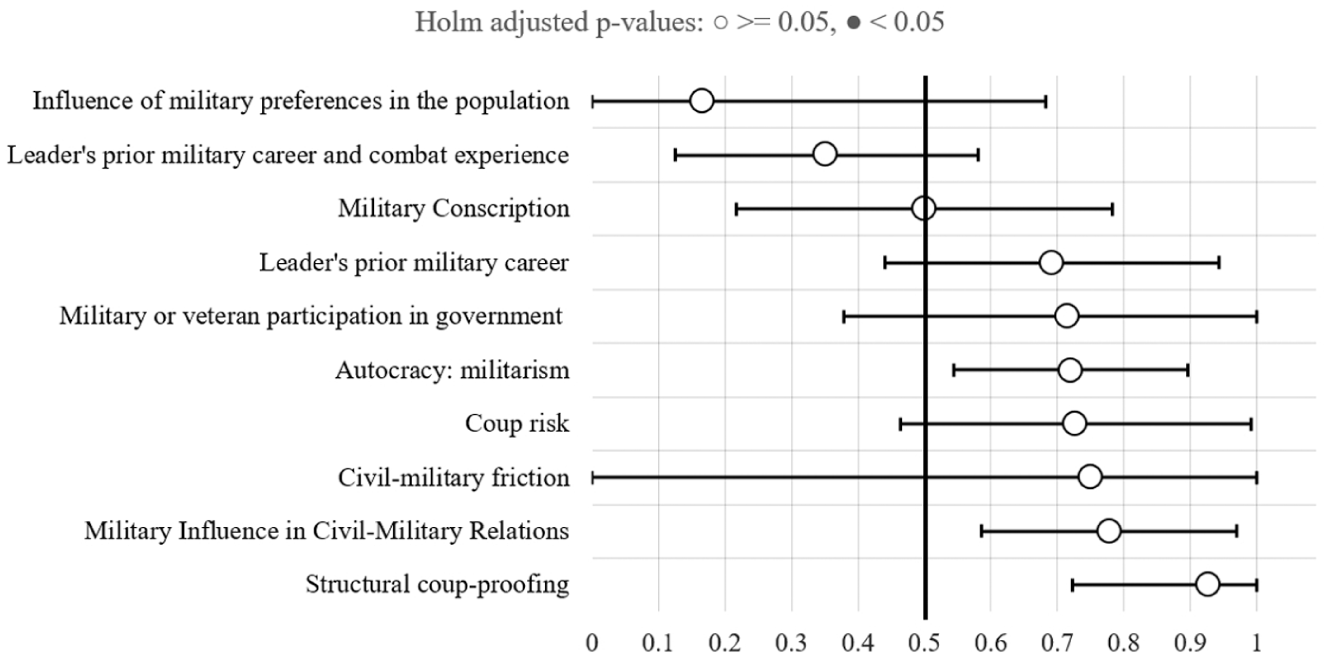
CMR-related variables related to interstate conflict and crisis engagement.
Of the 98 variables identified, only 36 appear in six or more AUs and are therefore visualized in Figure 5. The points represent the proportion of positive coefficients reported for each variable. Filled points indicate p-values below the Holm–Bonferroni-adjusted 0.05 threshold, identifying variables classified as consensus determinants of interstate conflict and crisis engagement. The widths of the confidence intervals vary with the number of applications across AUs, with wider intervals indicating fewer observations.
The seven consensus determinants, indicated by filled points in Figure 5, are variables that exhibit robust and consistent association with interstate conflict and crisis engagement. These include geographic proximity (shorter distance between capitals or territorial contiguity), a shorter period of peace, greater military capability of the initiator, major or superpower involvement, leadership experience in rebel or armed opposition movements, military capability asymmetry within the dyad, and prior interstate conflict experience. Of the remaining 29 variables displayed in Figure 5—including six related to CMR patterns—none met the Holm–Bonferroni-adjusted significance threshold. Twelve of these nevertheless provide evidence of effects under the conventional p < .05 criterion, while the remaining 17 are classified as inconclusive despite, in some cases, frequent empirical application (e.g., democracy and economic development).
Sixty-two variables examined in fewer than six AUs were excluded from Figure 5 and classified as inconclusive by design. Although some of these variables—such as civil–military friction and military influence in the population—are theoretically salient, their limited empirical coverage precludes any inferences about the consistency and direction of their effects on conflict and crisis engagement. Turning specifically to CMR-related variables, none achieved consensus status in the full sign-test. Six variables fail to meet the Holm–Bonferroni-adjusted threshold, while three—military influence in CMR (p = .03088), structural coup-proofing (p = .03125), and militarism in autocracy (p = .04328)—exhibited evidence of effect under the conventional significance criterion. The remaining CMR-related variables, including coup risk, military or veteran participation in government, military influence in the population, civil–military friction, and conscription remain inconclusive.
The absence of consensus among CMR-related variables may reflect several factors. These include the limited number of studies examining those CMR-related variables, their relative infrequent applications across AUs, and the use of stringent significance thresholds when evaluated alongside well-established conflict predictors. To assess whether CMR-related variables exhibit greater consistency when evaluated independently of non-CMR covariates, a second sign-test is conducted focusing on eight CMR variables and two closely related leadership variables—leaders’ military career and combat experience.
The results of the second test, as displayed in Figure 6, confirm the robustness of the earlier findings when the analysis is restricted to CMR-related variables and the two leadership-level variables. None of the CMR variables met the Holm–Bonferroni-adjusted significance threshold of 0.05, although three CMR-related variables continued to exhibit evidence of effects under the conventional significance criterion. As in the initial analysis, these findings indicate the absence of consensus determinants related to CMR patterns, while also identifying a subset of variables with non-random directional tendencies. Taken together, the results suggest that restricting the sign-test to CMR variables does not alter the overall classification of variables as providing evidence of effects or remaining inconclusive. The following section reviews the theoretical underpinnings of the eight CMR-related variables, linking the observed directional tendencies to the mechanism proposed in existing studies, and highlighting where theoretical arguments are most, least, or ambiguously supported.
The first variable concerns militarism in autocracy, defined as the degree to which military actors dominate autocratic decision-making and shape leaders’ preferences regarding the use of force. Existing militarism theories fall into four broad categories. Normative explanations argue that leaders with military backgrounds are more predisposed toward belligerence (Sagan, 2003). Institutionalist accounts emphasize smaller selectorates (Peceny et al., 2002), reliance on the military for infrastructural power, and weaker domestic constraints, all of which encourage aggression (Lai & Slater, 2006). Rationalist perspectives suggest that military elites perceive higher expected benefits from conflict, normalize violence, favor offensive doctrines, and select leaders lacking professional restraint (Brecher, 1996; Debs & Goemans, 2010; Horowitz & Stam, 2014, p. 535; Posen, 1984; Sechser, 2004; Snyder, 1984). Structural arguments highlight how external threats pave the way for heightened military preparation and elevate military influence, increasing the likelihood of aggressive policies (Kim, 2018, p. 1156). Contrary to militarism arguments, military conservatism tradition emphasizes caution, organizational restraints, and officer-corps oversight, predicting no increased propensity in conflict engagement (Feaver & Gelpi, 2004; Gelpi & Feaver, 2002; Huntington, 1957; Peceny & Butler, 2004, pp. 569–570; Peceny et al., 2002; Weeks, 2012, p. 335).
The sign-test provides empirical support for militarism arguments: 18 of 25 AUs show positive association between military regimes and engagement in interstate conflict or crisis. This pattern holds across multiple operationalizations—including the CNTS dataset (Banks, 2002), Geddes (2003; Geddes et al., 2014), infrastructural power (Lai & Slater, 2006), personalism and militarism indices (Weeks, 2012), and the Cheibub et al. (2010) dataset—indicating robust directional consistency. Although the sign-test cannot adjudicate among competing explanations, examining the underlying studies suggests that institutionalist mechanisms—infrastructural power, reduced domestic constraints, regime transformation, and erosion of civilian control—are most frequently invoked in AUs supporting militarism. Three AUs combine institutionalist and rationalist logic (e.g., audience effects, leaders’ beliefs about violence), and three rely primarily on structural accounts emphasizing external threats and the rise of military leadership. Five AUs do not clearly specify the causal mechanism linking militarism to conflict behavior. Taken together, these patterns suggest that institutionalist explanations appear most prevalent in the reviewed literature, although frequent mixing of mechanisms and under-specification complicate identification of the precise pathways.
The second variable concerns military influence in civil–military relations, which directly challenges civilian control over the armed forces. The central debate asks whether greater military influence heightens or reduces the risk of interstate conflict. Competing perspectives—civilian conservatism and military conservatism—frame this question in contrasting ways.
Proponents of civilian conservatism, paralleling the militarism thesis, argue that stronger military influence increases conflict and crisis propensity. They point to several reinforcing mechanisms: the military’s institutional interest in prestige and budgetary expansion (Vagts, 1937); professional orientations that privilege coercive solutions and rapid responses to perceived threats (Brecher, 1996, p. 220; Lasswell, 1941); systematic exaggeration of external dangers and sensitivity to “windows of opportunity” (Posen, 1984, p. 28; Snyder, 1984; Walt, 1987); and socialization into a power-oriented worldview that normalizes the use of force (Vasquez, 2009). By contrast, civilian leaders are often viewed as more restrained, owing to electoral accountability and broader national perspectives that enable them to temper military preferences when civilian control is effective (Choi & James, 2008; Cohen, 2002; Desch, 1999; Pickering & Kiyani, 2026, pp. 5–6).
Conversely, advocates of military conservatism argue that limited military involvement in decision-making may promote stability. Some arguments developed in the literature on military regimes contend that professional officers—more cognizant of the human and material costs of war—may act more cautiously than civilian leaders. Civilian hawkishness, in this view, stems from inexperience, political incentives, or overconfidence in military solutions (Feaver & Gelpi, 2004, p. 5; Sechser, 2004; Van Evera, 1999). This position, however, remains contested. Much of the supporting evidence is derived from U.S.-centric cases and lacks consistent cross-national validation (Asghar, 2025, p. 6). Moreover, some institutionalist critiques suggest that strong civilian control may unintentionally facilitate the use of force by depoliticizing military expertise, and reducing societal aversion to war by militarizing infrastructure and transitioning to a voluntary, technology-intensive, downsized military (Levy, 2017).
The reviewed studies include both qualitative case analyses and statistical research, Early work relying on coarse measures such as the Cross-National Time Series dataset (Banks, 2002) or composite proxies (Choi & James, 2004), whereas more recent studies employ Kenwick’s (2020) latent index of civilian control. Across these operationalizations, the sign-test results consistently support the civilian conservatism arguments: 14 of 18 AUs reveal a positive association between weaker civilian control and engagement in interstate conflict or crisis, indicating robust directional consistency. Twelve of 14 AUs rely solely on statistical analyses and generally reference mechanisms linked to civilian conservatism or military adventurism, though few explicitly specify the causal pathways involved. In contrast, two qualitative studies identify organizational dynamics—particularly military biases in evaluating power parity and windows of opportunity (Mohan, 2019; Schofield, 2000)—while only one includes the absence of institutional counterbalances as a source of military aggressiveness.
The third variable concerns structural coup-proofing mechanisms—which are closely linked to coup risk—appearing in two studies (Belkin & Schofer, 2005; Powell, 2014). Structural coup-proofing through counterbalancing fragments coercive powers by dividing the armed forces into competing organizations, thereby reducing their capacity to coordinate and execute a coup (Belkin & Schofer, 2005, p. 147; Feaver, 1999, p. 225; Quinlivan, 1999). One theoretical perspective argues that such arrangements may increase leaders’ incentives to initiate internationalized conflicts: external mobilization can intensify interservice rivalries, weaken potential challengers, and consolidate political control, provided the expected costs of conflict remain manageable (Belkin & Schofer, 2005, pp. 151–152).
A competing argument, advanced by Powell (2014, pp. 175–176), predicts the opposite once coup risk is considered. As coup-proofing increases, the conflict-inducing effects of coup risk likely diminish. Coup-proofing reduces these effects by obstructing coordination among armed actors, degrading the effectiveness and quality of regular forces, and diverting resources toward regime security forces, thereby reducing the state’s capacity for external conflict.
Empirically, six AUs report a positive association between structural coup-proofing and conflict propensity. These studies focus narrowly on counterbalancing and exclude other mechanisms—such as ethnic stacking—that have received greater attention in more recent research (e.g., Allen & Brooks, 2023). 9 Their operationalizations rely primarily on measures of counterbalancing, including Pilster and Böhmelt’s (2011) index of effective organizations and Belkin and Schofer’s (2003) counterbalancing measure. De Bruin’s (2021) State Security Forces dataset potentially offers a more fine-grained measure of structural coup-proofing mechanisms, but has not been used in the reviewed studies. 10
Despite the observed positive association, two issues merit attention. First, although Belkin and Schofer argue that counterbalancing increases conflict propensity, their evidence does not directly substantiate the proposed causal mechanism; instead, it shows mechanisms indicating that higher coup risk leads to reliance on coup-proofing. Second, Powell’s findings emphasize the moderating effect of coup-proofing on coup risk: conflict propensity is highest when coup risk is high and coup-proofing is low, and weaker as coup-proofing intensifies. When considered independently of coup risk, however, coup-proofing itself is associated with higher conflict propensity, though the underlying mechanism is not empirically demonstrated.
So far, this review has focused on three CMR-related variables that display evidence of effects in the sign-test. The evidence of effects or higher levels of significance suggests that these variables have been thoroughly studied, allowing researchers to have a clearer understanding of how they generally influence interstate conflict and crisis engagement. On the other hand, variables that do not reach significance indicate that their effects are less certain and may require more empirical research. The next five variables show lower levels of significance in the sign-test.
The fourth variable concerns heightened coup risk, which captures leaders’ vulnerability to removal through irregular means and is closely related to structural coup-proofing. A central argument in the literature holds that elevated coup risk increases leaders’ incentives to initiate diversionary external conflict, particularly when rulers fear violent removal from office and face uncertainty about post-exit survival (Miller & Elgün, 2011).
Several mechanisms link coup risk to external belligerence in autocratic regimes. Heightened coup risk may incentivize leaders to engage in interstate conflict or crisis with the aim of fragmenting the armed forces and reducing coordination among potential coup plotters (Belkin & Schofer, 2005). It may also encourage “gambling for resurrection,” whereby leaders pursue risky foreign policy strategies even after costly setbacks to prolong their tenure (Miller & Elgün, 2011, p. 200). Additional mechanisms include attempts to generate rally-around-the-flag effects to bolster regime legitimacy and deter challengers; to divert the attention of military elites away from domestic political threats (Lai & Slater, 2006, p. 121); or to erode potential challengers’ access to military or public support by mobilizing coercive resources externally (Panel, 2017, pp. 340–341).
Empirically, the reviewed studies operationalize coup risk using Belkin and Schofer’s (2003) structural coup risk index and Panel’s (2017) dummy indicator based on irregular entry to office, drawn from Svolik’s (2012) data on leaders and ruling coalitions. Across these measures, eight of 11 analytical units report a positive association between coup risk and engagement in interstate conflict and crisis. While this pattern supports the expectation that heightened coup risk increases incentives for diversionary conflict, the underlying studies rarely specify which mechanisms are operative in practice. As a result, the existing evidence confirms a consistent directional relationship between coup risk and conflict propensity but provides limited insight into the precise causal pathways linking domestic elite insecurity to external aggression.
The next variable concerns military conscription, examined in four articles assessing whether conscription or the all-volunteer force (AVF) affects the propensity to engage in external conflict. These articles offer two contrasting perspectives. Proponents of conscription as a constraint on military adventurism argue that mass mobilization raises the political and societal costs of war, thereby deterring leaders from engaging in interstate conflict. Public sensitivity to casualties strengthens democratic accountability and encourages caution, particularly among leaders shaped by earlier conscripted service (Betts, 1977; Gelpi & Feaver, 2002; Huntington, 1957; Kant, 1963). Kant’s classical formulation further suggests that AVFs—described in some studies as less representative of society, though this may not hold empirically in all contexts—provide political leaders with a more readily usable instrument of force, reducing concern about domestic backlash and thus increasing conflict propensity (Bandow, 2000; O’Hanlon, 2005). More recent research shows that this constraining effect depends on high military participation rates: when a broader share of the population bears the costs of service, public scrutiny intensifies and leaders become more risk‑averse (Margulies, 2025).
Conversely, advocates of the conscription–conflict link contend that conscription lowers the threshold for using force by ensuring a steady manpower supply, fostering militarism, and socializing citizens to accept state coercion (Hayes, 1973; Morse, 2006). Veterans of conscripted armies who enter politics may be more, not less, inclined toward the use of force (Pickering, 2011, p. 122), whereas AVFs may face recruitment and retention constraints that can temper leaders’ willingness to resort to military action (Choi & James, 2004; Marlowe, 1983).
Empirically, the sign‑test results reveal no directional consensus: six AUs support each side of the debate. This balance persists across multiple operationalizations, drawing on data from Prasad and Smythe (1968), Horeman and Stolwijk (1998), Toronto (2007, 2022), and Horowitz et al. (2011). When linked to the underlying mechanisms, these findings show divided evidence for both the military preparedness and political‑cost arguments, while the causal processes connecting conscription to interstate conflict and crisis behavior remain largely underspecified.
The fifth variable concerns military participation in government, measured by the presence of active-duty officers or veterans in cabinet positions, and its implications for interstate conflict and crisis engagement, largely reflecting the tension between military and civilian conservatism. Three mechanisms link military involvement to government decisions on the use of force: military advisors may persuade elites to adopt military views, shape the options presented to leaders, or constrain policymakers by empowering opposition to civilian leadership (Gelpi & Feaver, 2002, p. 780). An alternative perspective—civil–military competition—is agnostic to neither argument and argues that dysfunctional strategic assessments occurring when civilian and military leaders compete for or share political power may increase conflict propensity (Brooks, 2008; White, 2021, pp. 553–554).
Empirically, the variable is examined in two studies across seven AUs, yielding no directional consensus: five AUs report positive associations with conflict and crisis engagement, while two report negative effects. This mixed pattern offers limited support for militarism or conservatism arguments but aligns more closely with civil–military competition accounts.
The final two CMR-related variables—the influence of military preferences in the population and civil–military friction—are each examined in only one reviewed article, limiting systematic synthesis but pointing to potentially novel mechanisms. The influence of military preference in the population, measured by the percentage of veterans among the population, tests the war weariness hypothesis: publics with greater exposure to war are expected to constrain leaders’ propensity to initiate conflict (Gelpi & Feaver, 2002, p. 784). Civil–military friction draws from the effectiveness argument, which posits that stable and cooperative elite relations enable credible coercive capacity, whereas persistent friction undermines military effectiveness and constrains external action (Kiyani et al., 2025, p. 5). Empirically, the former variable is examined in two AUs and the latter in one AU, precluding meaningful conclusions about directional consistency but highlighting underexplored pathways linking societal attitudes and elite coordination to interstate conflict engagement.
The final set of variables concerns leadership-level experience linked to CMR aspects: leaders’ military service and combat experience. These individual-level attributes matter because leaders often exercise substantial autonomy and possess information advantage during crises—thus becoming relatively inhibited—making personal experience an important factor shaping how they assess the costs, benefits, and risks of interstate conflict (Baum & Potter, 2008; Potter & Baum, 2010). Conceptually, arguments about leaders’ military career and combat experiences parallel the institutional level militarism and conservatism debates (see discussion on militarism in autocracy and military influence). In a specific vein, military experience tempers leaders’ restraint only when it includes direct combat exposure: the realities and limitations of military power are expected to cultivate caution, a realistic outlook, risk aversion, and conservative conflict preferences (Horowitz et al., 2018; Horowitz & Stam, 2014).
Empirically, leaders’ military career is examined in four studies across 13 AUs, yielding no directional consensus: nine positive and four negative associations with conflict and crisis engagement. Leaders’ military and combat experience is analyzed in four studies across 17 AUs, with six positive and 11 negative associations. Taken together, these findings provide limited support for either militarism or conservatism mechanisms associated with military service, while offering only weak and inconsistent evidence for the tempering effect attributed to combat experience.
Discussion and Conclusion
This study systematically examines research on how CMR patterns influence interstate conflict and crisis engagement. It shows that recent scholarship has generated novel explanations while revisiting long-standing debates concerning the political and strategic consequences of civil–military dynamics. These include, among others, a reexamination of existing debates on militarism and conservatism using novel latent indices, as well as a shift in the conservatism debate toward arguments linking effective civil–military interaction with a higher propensity for conflict.
The reviewed studies employ a wide range of research designs, methodological strategies, dependent variables, conflict datasets, explanatory variables, and interaction terms to examine both established and emerging arguments about CMR and engagement in interstate conflict and crisis. Although quantitative approaches dominate, relatively few studies complement large-N analyses with in-depth qualitative investigations, leaving the empirical basis of theorized causal mechanisms underspecified. At the same time, the diversity in operationalizing engagement in interstate conflict and crisis—through different dependent variables and datasets—reflects theoretically informed modeling choices, creating opportunities for future work to assess the robustness and scope conditions of existing theoretical claims.
Substantively, this review identifies 98 distinct independent variables used as explanatory or control variables. The sign-test-based synthesis reveals that no CMR-related variable emerges as a consensus determinant, though cross-study comparison is constrained by the extensive use of study-specific interaction terms. A small set of consensus determinants corresponds to well-established control variables in the interstate conflict and crisis engagement literature. Nonetheless, three CMR-related variables exhibit evidence of effects: weaker civilian control, the presence of structural coup-proofing institutions, and higher levels of militarism in autocracies. The remaining five CMR-related variables, along with two leadership-level variables, do not meet the significance threshold, underscoring how little is known about their effects on conflict and crisis engagement. These patterns and findings raise important questions about how future research can build on existing work while addressing methodological and conceptual gaps.
Taken together, the findings and limitations identified through this sign-test-based review point to several avenues for advancing research on the relationship between CMR patterns and interstate conflict and crisis engagement. Methodologically, future research could strengthen existing statistical analyses—many of which establish statistically significant results but leave causal processes underspecified—by more systematically integrating qualitative evidence. Case-based analysis can clarify causal pathways, assess competing mechanisms, and help determine whether observed effects generalize across different types of interstate conflict and crisis, or are contingent on institutional or strategic contexts. For example, future research could trace whether strong military influence and high militarism in autocracies operate through shared mechanisms or represent distinct pathways to conflict and crisis engagement.
The review also yields implications for how future studies select and operationalize dependent and independent variables. First, diverse operationalizations and datasets of interstate conflict and crisis engagement suggest opportunities for developing novel arguments that link different CMR dimensions to different forms of conflict and crisis engagement. 11 Second, given the absence of CMR-related consensus determinants warranting inclusion as standard model specifications, future studies can prioritize the three variables that display evidence of effects when incorporating CMR into the broader models of conflict and crisis engagement. At the same time, variables that currently show weak or inconsistent results merit systematic empirical reinvestigation, as existing findings do not yet provide sufficient cumulative evidence to assess their effects on interstate conflict and crisis engagement. This observation applies equally to recently introduced CMR concepts and novel interaction terms. These concepts have been proposed to move analysis beyond debates centered narrowly on civilian versus military conservatism—illustrated by contributions examining excessive military delegation (Brooks, 2024), prospect-theoretic framing of civil–military bargaining (Winger, 2017), and multilateral burden-sharing in conflict decisions (Recchia, 2015)— their broader theoretical contribution remains contingent on accumulation of cross-case empirical evidence and explicit tracing of underlying mechanisms. Collectively, these CMR-related explanations offer a pathway for future research to explore how civil–military dynamics enrich broader theoretical accounts of conflict and crisis engagement.
Beyond these directions, future research addressing the substantial knowledge gap at the intersection of CMR and engagement in interstate conflict and crisis could also benefit from a more eclectic theoretical approach that helps identify promising variables and mechanisms for specific cases (Sil & Katzenstein, 2010). Future progress could also draw on interdisciplinary perspectives, including political psychology and organizational studies. While some studies have already demonstrated the value of such approaches, greater attention is needed to clarify how dynamics at individual, organizational, and institutional levels are connected within frameworks explaining conflict and crisis engagement. Overall, this study highlights both the limits and the promise of existing research at the intersection of CMR and interstate conflict and crisis engagement. The absence of CMR-related consensus determinants reflects the fragmented state of a research agenda that has expanded in scope faster than its empirical findings have accumulated. Nevertheless, through systematic synthesis, this study has helped integrate this disconnected research agenda by accumulating theoretical arguments and existing findings, as well as clarifying which arguments require further refinement and which remain at an early stage of empirical examination.
Supplemental Material
sj-csv-1-afs-10.1177_0095327X261455771 – Supplemental material for Integrating Research on Civil–Military Relations and Interstate Conflict and Crisis Engagement: A Systematic Review
Supplemental material, sj-csv-1-afs-10.1177_0095327X261455771 for Integrating Research on Civil–Military Relations and Interstate Conflict and Crisis Engagement: A Systematic Review by Sigit S. Nugroho in Armed Forces & Society
Supplemental Material
sj-csv-2-afs-10.1177_0095327X261455771 – Supplemental material for Integrating Research on Civil–Military Relations and Interstate Conflict and Crisis Engagement: A Systematic Review
Supplemental material, sj-csv-2-afs-10.1177_0095327X261455771 for Integrating Research on Civil–Military Relations and Interstate Conflict and Crisis Engagement: A Systematic Review by Sigit S. Nugroho in Armed Forces & Society
Supplemental Material
sj-csv-3-afs-10.1177_0095327X261455771 – Supplemental material for Integrating Research on Civil–Military Relations and Interstate Conflict and Crisis Engagement: A Systematic Review
Supplemental material, sj-csv-3-afs-10.1177_0095327X261455771 for Integrating Research on Civil–Military Relations and Interstate Conflict and Crisis Engagement: A Systematic Review by Sigit S. Nugroho in Armed Forces & Society
Supplemental Material
sj-csv-4-afs-10.1177_0095327X261455771 – Supplemental material for Integrating Research on Civil–Military Relations and Interstate Conflict and Crisis Engagement: A Systematic Review
Supplemental material, sj-csv-4-afs-10.1177_0095327X261455771 for Integrating Research on Civil–Military Relations and Interstate Conflict and Crisis Engagement: A Systematic Review by Sigit S. Nugroho in Armed Forces & Society
Supplemental Material
sj-csv-5-afs-10.1177_0095327X261455771 – Supplemental material for Integrating Research on Civil–Military Relations and Interstate Conflict and Crisis Engagement: A Systematic Review
Supplemental material, sj-csv-5-afs-10.1177_0095327X261455771 for Integrating Research on Civil–Military Relations and Interstate Conflict and Crisis Engagement: A Systematic Review by Sigit S. Nugroho in Armed Forces & Society
Supplemental Material
sj-csv-6-afs-10.1177_0095327X261455771 – Supplemental material for Integrating Research on Civil–Military Relations and Interstate Conflict and Crisis Engagement: A Systematic Review
Supplemental material, sj-csv-6-afs-10.1177_0095327X261455771 for Integrating Research on Civil–Military Relations and Interstate Conflict and Crisis Engagement: A Systematic Review by Sigit S. Nugroho in Armed Forces & Society
Supplemental Material
sj-csv-7-afs-10.1177_0095327X261455771 – Supplemental material for Integrating Research on Civil–Military Relations and Interstate Conflict and Crisis Engagement: A Systematic Review
Supplemental material, sj-csv-7-afs-10.1177_0095327X261455771 for Integrating Research on Civil–Military Relations and Interstate Conflict and Crisis Engagement: A Systematic Review by Sigit S. Nugroho in Armed Forces & Society
Supplemental Material
sj-csv-8-afs-10.1177_0095327X261455771 – Supplemental material for Integrating Research on Civil–Military Relations and Interstate Conflict and Crisis Engagement: A Systematic Review
Supplemental material, sj-csv-8-afs-10.1177_0095327X261455771 for Integrating Research on Civil–Military Relations and Interstate Conflict and Crisis Engagement: A Systematic Review by Sigit S. Nugroho in Armed Forces & Society
Footnotes
Acknowledgements
I thank Aurel Croissant and Nikitas Scheeder for their valuable feedback on an early draft of this paper, presented at the doctoral colloquium at the Institute of Political Science, Heidelberg University, in winter 2024, as well as three anonymous reviewers whose comments have greatly improved this manuscript.

Funding
The author disclosed receipt of the following financial support for the research, authorship, and/or publication of this article: The author’s doctoral research was supported by the German Academic Exchange Service (DAAD). The open-access publication of this article was funded by Heidelberg University Library through a publishing agreement with SAGE.
Declaration of Conflicting Interests
The author declared no potential conflicts of interest with respect to the research, authorship, and/or publication of this article.
Supplemental Material
Supplemental material for this article is available online.
Notes
Author Biography
References
Supplementary Material
Please find the following supplemental material available below.
For Open Access articles published under a Creative Commons License, all supplemental material carries the same license as the article it is associated with.
For non-Open Access articles published, all supplemental material carries a non-exclusive license, and permission requests for re-use of supplemental material or any part of supplemental material shall be sent directly to the copyright owner as specified in the copyright notice associated with the article.
