






Abstract
Military modernization in post-conflict states is routinely expected to consolidate cohesion and democratic subordination. This article argues that, under conditions of institutional asymmetry and legal uncertainty, the same reforms can generate alienation among the officers most aligned with them. Drawing on a cross-sectional study of 295 Colombian Armed Forces officers using K-means clustering and semantic network analysis, we identify a phenomenon we term Enlightened Professional Dissonance. Civilian academic exposure was associated with stronger doctrinal adaptation, yet adaptation was positively related to commitment crisis and identity erosion. A dominant profile of “alienated modernizers” paired high adaptation with acute estrangement and narratives centered on legal vulnerability and perceived abandonment. The findings complicate linear professionalization theories, suggesting that modernization can redistribute risk downward, weakening institutional attachment in transitional democracies.
Keywords
The Paradox of Military Modernization
Over the past two decades, armed forces across the Global South have undergone far-reaching transformations, propelled by doctrinal reform, professionalization, and deeper engagement with civilian academic environments. These reforms are commonly grounded in a core normative premise that higher levels of education and updated doctrine will, almost by default, bring military professionals into closer alignment with democratic norms, reinforce institutional cohesion, and lessen the intensity of civil–military frictions. This linear formulation, in which expanded professional education combined with doctrinal updating is assumed to yield stronger institutional coherence and deeper democratic adherence, has become a piece of conventional wisdom in civil–military relation scholarship (Huntington, 1957; Janowitz, 1960). Yet empirical evidence on how these transformations reshape officers’ professional identities remains mixed. While some studies emphasize enhanced professionalism and normative alignment (Brooks, 2008; Huntington, 1957), others suggest that modernization processes may generate new forms of internal tension, particularly in post-conflict and hybrid operational environments (Ben-Ari & Elron, 2001; Kalyvas, 2006; Soeters, 2020).
We advance the concept of enlightened professional dissonance to capture a condition in which officers who most fully internalize modern doctrine, and who possess higher levels of civilian academic training, experience greater alienation, identity strain, and erosion of institutional commitment. Far from reflecting resistance to change or ideological opposition to democratic norms, this dissonance emerges from an acute awareness of institutional asymmetry: a widening gap between the normative demands imposed by modern doctrine and the legal, material, and organizational safeguards available to support its implementation. Civilian education equips officers with what we term normative–operational risk sensitivity, the analytical capacity to interrogate the distance between doctrinal rhetoric centered on legitimacy and human rights and the realities of the field, where persistent threats coexist with judicial insecurity. The soldier-scholar, in this sense, is not necessarily a more compliant servant of the state but a more critical observer of its contradictions.
We examine this paradox through the strategically significant case of the Colombian Armed Forces during the post-conflict period. Following the 2016 Peace Agreement with the Revolutionary Armed Forces of Colombia (FARC), the Colombian Army undertook an ambitious doctrinal transformation known as the Damasco doctrine (National Army of Colombia, 2020). Designed to shift the force from a counterinsurgency orientation toward a multi-mission institution influenced by the North Atlantic Treaty Organization (NATO)-aligned professionalization models, international humanitarian law (IHL), stabilization operations, and “Unified Action,” Damasco redefined the normative, legal, and cognitive demands placed on officers. The doctrine functions not merely as a set of tactical manuals but as a “normative architecture of expectations,” promising officers a professional environment defined by legal clarity, legitimacy, and state backing. Simultaneously, the Army expanded officers’ exposure to civilian higher education at the operational and strategic levels, under the assumption that academic socialization would facilitate doctrinal adaptation and democratic consolidation.
The reality of the post-conflict period, hybrid warfare, persistent criminal threats, and intense judicial scrutiny stands in stark contrast to this doctrinal promise. Officers with advanced civilian degrees possess cognitive tools that sharpen their perception of this asymmetry: education functions less as a source of detachment than as a lens that renders institutional risk legible. Tasked with stabilizing a post-conflict state, they often understand themselves as legally exposed while carrying out that mandate.
The central research question guiding this study is how post-conflict doctrinal modernization and the expansion of civilian education are reconfiguring the professional identity and institutional loyalty of Colombian Armed Forces officers. This question matters because Colombia functions as an early warning case for a broader phenomenon whose implications extend well beyond Latin America. As armies worldwide shift from conventional warfare toward normatively dense missions, including stabilization, territorial control, and peacekeeping, it becomes essential to understand how these transitions reshape officer corps, with direct consequences for both operational effectiveness and institutional stability.
These findings reframe military modernization not as a uniformly integrative force, but as a process that can generate internal fractures precisely among the most professionally adapted officers. The article contributes empirically by providing systematic evidence from a strategically relevant post-conflict military undergoing rapid transformation, and theoretically by demonstrating that education and doctrinal reform can function as double-edged swords: enhancing professional capacity while simultaneously exposing institutional vulnerabilities. In the Colombian case, modernization produces not compliance-induced cohesion but a critical professional consciousness that destabilizes traditional forms of loyalty when institutional support is perceived as insufficient. The Colombian Armed Forces, rather than an exceptional case, offer an early warning of the unintended organizational consequences that may accompany the global diffusion of modern military doctrine, where professionalization, unmatched by credible legal and institutional protections, can become a driver of internal fragmentation rather than cohesion.
Theoretical Framework: The Political Economy of Enlightened Professional Dissonance
This article examines a striking paradox within Colombia’s post-conflict military. Officers with the most advanced civilian education and the highest levels of doctrinal adaptation often report the most acute strain in their attachment to the institution. Conventional civil–military theory treats professionalism as inherently stabilizing, predicting that education and doctrinal sophistication should strengthen both cohesion and democratic subordination (Desch, 1999; Pion-Berlin, 2005). Although recent work has identified tensions in contemporary professionalism and civilian control, the underlying expectation remains that competence and education generally reinforce loyalty (Brooks, 2020; Feaver, 2003; Kohn, 2002; Schake & Mattis, 2016). This article develops an alternative account of why modernization may instead produce friction precisely among the officers most aligned with its ideals by treating reform as a political economy of risk in which credit and liability are distributed unevenly across the chain of command and the civil–military boundary (Bovens, 2007; Hood, 2011).
The intellectual architecture of Western civil–military relations rests on two foundational pillars that, despite normative differences, share optimism about the integrative effects of professionalization (Desch, 1999; Feaver, 2003). Huntington’s paradigm of objective control argues that civilian supremacy is best secured by cultivating an autonomous professional sphere endowed with specialized expertise in the management of violence and a self-consciously apolitical ethos (Huntington, 1957). As officers become more professional and technically specialized, their propensity for political intervention should decline. Education deepens corporate identity and reinforces boundaries between civilian and military spheres (Huntington, 1957). Janowitz rejects the isolationist premise and instead advances the notion of a constabulary force suited to limited and low-intensity warfare. This model requires officers with broad political and social understanding, as well as sustained exposure to civilian education, so that military values increasingly converge with those of democratic society (Janowitz, 1960). In this Janowitzian vision, the soldier-scholar is an officer capable of operating in complex political–military environments with intellectual sophistication and professional restraint (Avant, 2005; Janowitz, 1960). Contemporary debates still move between these poles, even as their limitations in irregular and hybrid conflicts have become harder to ignore (Avant, 2005; Brooks, 2020; Kalyvas, 2006).
Both paradigms share a blind spot in the Global South; they presume a symmetric professional bargain between the state and the officer corps (Pion-Berlin, 2005; Stepan, 1988). Classical theory assumes a state that provides clear mandates, institutional backing, and credible legal protection in exchange for competence and obedience (Huntington, 1957; Janowitz, 1960). Yet comparative evidence from Latin America shows how fragile that symmetry can be, as professionalization may also enhance the capacity to evaluate civilian performance and, in some contexts, to justify intervention when core obligations appear unmet (Pion-Berlin, 2005; Skaar, 2014; Stepan, 1988). This article theorizes such settings as Institutional Asymmetry; officers modernize and adapt while the state defaults through ambiguous mandates, weak legal cover, and blame shifting (Bovens, 2007; Hood, 2011). Under asymmetry, the Janowitzian promise of integration through education can generate blowback. Civilian education does not only socialize officers into democratic norms; it equips them to audit the state’s coherence and performance (Ateş, 2024; Brooks, 2020). When that audit reveals persistent gaps between professed standards and organizational realities, the outcome may be rationally grounded alienation rather than deeper integration.
To explain why alienation becomes especially salient during doctrinal modernization, the framework draws on sociological institutionalism. Organizations adopt formal structures not primarily to enhance efficiency but to embody rationalized myths that secure legitimacy (Meyer & Rowan, 1977). Coercive, mimetic, and normative pressures then produce organizational isomorphism across fields (DiMaggio & Powell, 1983). The gap between what organizations say, decide, and do can be sustained through organized hypocrisy (Brunsson, 1989) and through decoupling practices that protect the technical core even under monitoring (Bromley & Powell, 2012). In Colombia, post-agreement doctrinal change, exemplified most clearly within the Army by the adoption of the Damasco doctrine (National Army of Colombia, 2020), aligns with NATO-oriented standards and emphasizes Unified Land Operations, Mission Command, and strict observance of IHL. It can therefore be read as a legitimacy-oriented reform driven by isomorphic mimicry (Arjona, 2016; Williams, 2019). By embracing this package, the Armed Forces constructs a normative architecture of expectations that communicates modernity and professionalism to domestic elites and international audiences, reinforcing Colombia’s broader transitional justice narrative (Uprimny, 2011; Williams, 2019). Yet these legitimacy structures collide with the technical core of operations in the gray zone, particularly in hybrid criminal–insurgent environments where legal and operational lines blur (Arjona, 2016; Kalyvas, 2006).
Historically, decoupling made this contradiction manageable. Doctrine could function as a repertoire for classrooms, training centers, and legal advisers, while field operations demanded improvisation and situational pragmatism (Arjona, 2016; Bromley & Powell, 2012; Meyer & Rowan, 1977). The crisis emerges as decoupling becomes harder to sustain under legal and political reforms. Colombia’s layered transitional justice architecture, culminating in the Special Jurisdiction for Peace (JEP), expanded accountability for insurgents and state agents, intensifying judicial scrutiny of military operations (Skaar, 2014; Uprimny, 2011; Williams, 2019). These mechanisms have triggered forced recoupling. The state increasingly expects the rationalized myth, the pristine doctrine, to be applied literally in the mud of irregular conflict. Officers are then judged retrospectively against doctrinal standards that were designed in part to generate legitimacy, not to resolve the operational dilemmas of hybrid warfare (Dannenbaum, 2018; Norheim-Martinsen & Nyhamar, 2015).
Forced recoupling generates a structural trap. On paper, doctrine promises legal safety if procedures and rules of engagement are followed. In practice, strict adherence can be incompatible with mission success under uncertainty (Hill & Niemi, 2017; VanLandingham, 2024). The erosion of combat immunity, the rise of the International Criminal Court, and expanding doctrines of command responsibility have increased the likelihood that each use of force becomes an object of judicial review (Dannenbaum, 2018; Fellmeth & Crawford, 2022; Norheim-Martinsen & Nyhamar, 2015). At the same time, officers are expected to practice Mission Command, promoting decentralized initiative, while bearing expanding legal responsibility for acts committed by subordinates in ambiguous settings (Hill, 2019; Hill & Niemi, 2017; Knevelsrud et al., 2024). Debates in other theaters show how Mission Command can be framed as deepening accountability rather than shielding responsibility, a trend courts and investigative bodies increasingly reinforce (Hill & Niemi, 2017; VanLandingham, 2024). The net effect is a dual mandate that is difficult to reconcile, even as officers are expected to take operational risks while simultaneously avoiding legal exposure.
This is where the political economy of risk becomes central. Accountability systems distribute credit and blame asymmetrically. Political and bureaucratic actors have incentives to avoid blame under uncertainty, particularly when security outcomes are politically salient and legally contestable (Bovens, 2007; Hood, 2011). Residual risk shifts from the institution to the individual officer, as success is absorbed by the system as proof of performance, yet scandal or legal controversy prompts the mobilization of doctrine and legal standards to isolate and prosecute commanders on the grounds of purported procedural failure (Dannenbaum, 2018; Fellmeth & Crawford, 2022; Norheim-Martinsen & Nyhamar, 2015).
Contrary to professionalization orthodoxy, the officers most vulnerable to this trap are often the most educated. Professional Military Education remains oriented toward socialization and doctrinal internalization, producing officers who speak a shared institutional language (Ateş, 2024; Pantev et al., 2005). Civilian graduate education in the social sciences, by contrast, trains analytic scrutiny of power, incentives, and institutional contradiction (Bovens, 2007; Hood, 2011). Immersion in such environments shifts officers from a myth-accepting to a myth-analyzing posture, generating three forms of literacy that fuel Enlightened Professional Dissonance (Ateş, 2024; Brooks, 2020). Legal operational literacy allows officers to recognize how the conflation of IHL and International Human Rights Law produces evidentiary standards that are difficult to meet in combat and leave soldiers exposed (Dannenbaum, 2018; VanLandingham, 2024). Contractual literacy recasts military service as a reciprocal arrangement in which the absence of clear rules of engagement, legal protection, and institutional support is read as breach rather than misfortune (Bovens, 2007; Hood, 2011). Systemic literacy enables officers to decode blame avoidance, interpreting doctrinal ambiguity less as design failure than as a functional feature that shields political principals while transferring legal and reputational costs onto tactical commanders (Hinterleitner & Sager, 2017; Hood, 2011; Skaar, 2014).
Taken together, these insights from classical sociology, institutional theory, and socio-legal scholarship allow us to conceptualize Enlightened Professional Dissonance as a condition of institutional strain in which officers internalize modern doctrinal demands while developing the analytical capacity to assess the legal and organizational environments that fail to support them, so that under institutional asymmetry, greater civilian academic exposure widens rather than narrows the perceived gap between operational expectations and effective protection (Bromley & Powell, 2012; Dannenbaum, 2018; Meyer & Rowan, 1977).
Taken as a whole, the framework challenges the linear integration thesis in the professionalization literature (Brooks, 2020; Feaver, 2003): under conditions of low perceived institutional support, where political and legal risks are displaced onto individual officers rather than absorbed by the institution (Bovens, 2007; Hood, 2011), the resulting crisis is best understood not as a failure of character or leadership but as a structural by-product of modernization in a judicialized security environment, one that produces internal critics who remain committed to professional ideals while growing estranged from bureaucratic and legal realities (Arjona, 2016; Meyer & Rowan, 1977; Skaar, 2014; Williams, 2019).
Based on this framework, the article advances three testable expectations:
The underlying logic is that officers who fully internalize modernization doctrine may become more sensitive to inconsistencies between institutional discourse and everyday organizational practice.
In other words, the officers most aligned with reformist doctrine may also be more likely to experience institutional strain when organizational support is perceived as insufficient.
In addition to these confirmatory expectations, the article includes an exploratory component. Rather than if civilian education pushes officers toward a single attitudinal direction, the analysis examines whether greater civilian academic exposure is associated with lower institutional disconnection and with a greater likelihood of occupying more defined officer profiles, including but not limited to alienated reformist positions. This distinction between hypothesis-testing and exploratory analysis is important for interpreting the officer typology presented later in this article.
Consistent with this framework, the empirical analysis proceeds in two stages. First, it evaluates the hypothesized associations between civilian academic exposure, doctrinal adaptation, identity erosion, and commitment crisis. Second, it examines whether combinations of these orientations form distinct officer profiles and whether civilian education is distributed unevenly across them.
Methodology
Research Design and Participant Selection
We employed a cross-sectional survey design to examine the relationship between civilian academic exposure and professional identity strain among Colombian Armed Forces officers during a period of doctrinal transition. The study focused on active-duty commissioned officers enrolled in the Curso de Estado Mayor (CEM) at the Escuela Superior de Guerra (ESDEG) in Bogotá. The CEM is a career requirement for promotion from Major to Lieutenant Colonel and concentrates officers at a pivotal stage of professional advancement. We selected this setting because it marks a transition toward operational and strategic responsibilities, where tensions between doctrinal modernization and institutional loyalty are likely to become especially acute.
The target population comprised the complete cohort of student officers enrolled in the 2026 academic cycle. A total of 408 officers were invited to participate during a plenary session. Of these, six declined informed consent, yielding an initial pool of 402 respondents. To ensure data quality, we applied a cleaning protocol and used listwise deletion across the focal variables included in the main analyses. Because the item measuring civilian academic exposure was answered only by officers with prior civilian studies, and because the regression and clustering models required complete cases on the core attitudinal measures, the final analytical sample used in the principal models consisted of 295 officers.
Robustness checks using an alternative three-item operationalization of the Commitment Crisis index excluding Q20 yield substantively identical conclusions. The key predictors retain the same direction and statistical significance across specifications. All models report heteroscedasticity robust standard errors (HC3). 1
Data Collection
Data were collected on January 10, 2026, in a single session designed to maximize participation and maintain standardized conditions. Officers completed the survey in a plenary setting, accessing the questionnaire via QR code on a secure platform. A pilot test with three officers (n = 3) preceded full administration to assess item clarity and technical functionality. Participation was voluntary, anonymous, and preceded by informed consent. No personally identifiable information was collected.
Measures
The principal explanatory measure is Civilian Academic Exposure, operationalized as an ordinal five-point agreement scale capturing respondents’ self-reported perception of how prior studies in civilian universities shaped their critical perspective on traditional military doctrine. This distinction is analytically important: whereas Table 1 describes respondents’ formal academic credentials, this variable measures the perceived cognitive effect of civilian socialization, not simply whether an officer obtained a civilian degree, but whether that experience was meaningful for doctrinal reflection.
Descriptive Characteristics of the Survey Sample.
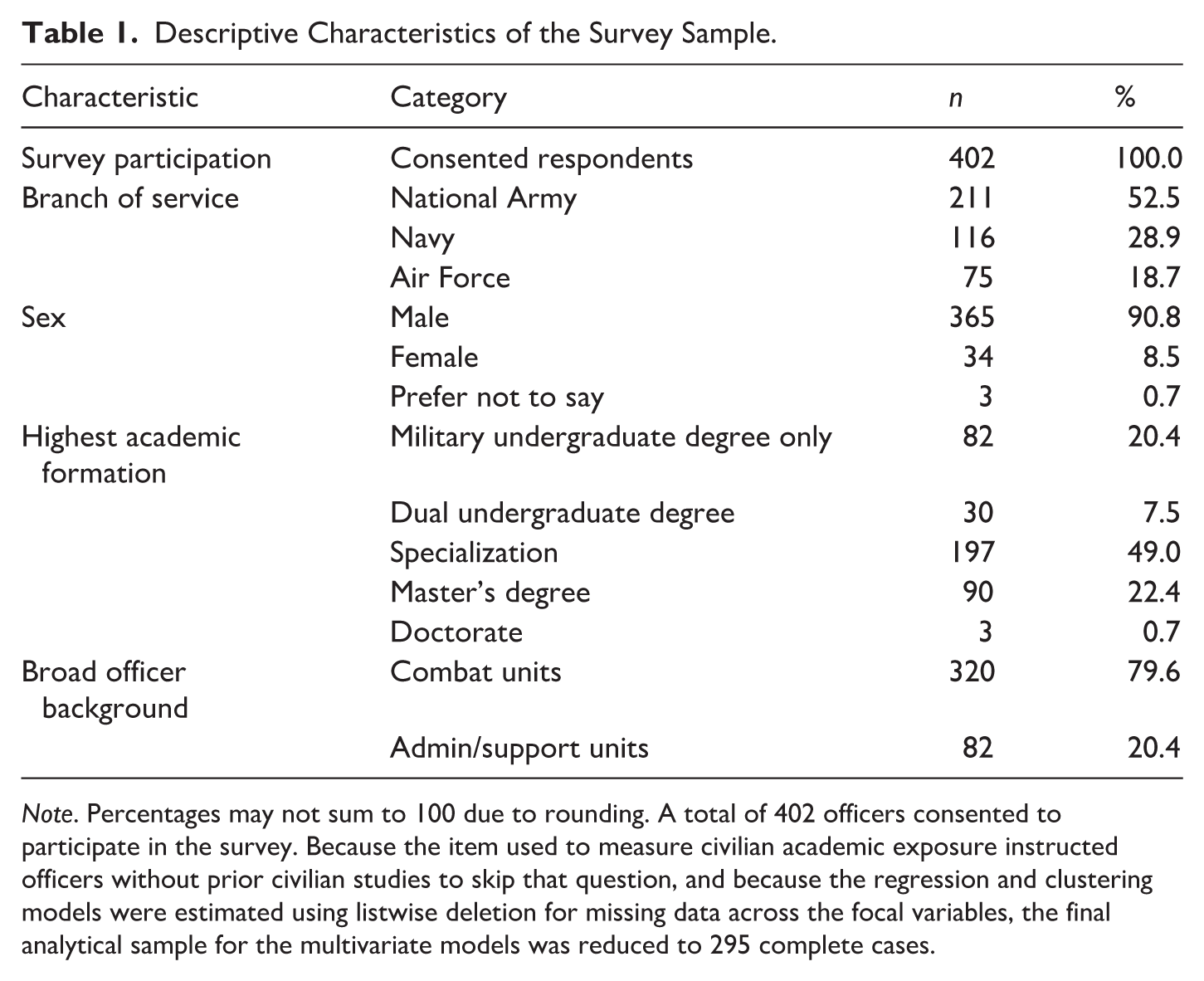
Note. Percentages may not sum to 100 due to rounding. A total of 402 officers consented to participate in the survey. Because the item used to measure civilian academic exposure instructed officers without prior civilian studies to skip that question, and because the regression and clustering models were estimated using listwise deletion for missing data across the focal variables, the final analytical sample for the multivariate models was reduced to 295 complete cases.
Four attitudinal indices constitute the core attitudinal measures. Doctrinal Adaptation captures receptivity to post-conflict operational frameworks, including doctrinal updating and internalization of reform-oriented principles associated with the Damasco doctrine. Identity Erosion measures perceived symbolic devaluation and strain in professional role coherence under changing institutional conditions. Commitment Crisis captures weakening institutional attachment, doubts about organizational reciprocity, and tension between personal sacrifice and institutional support. In the confirmatory analyses, these two indices operationalize the attitudinal outcomes associated with Enlightened Professional Dissonance. A fourth dimension, Lack of Institutional Support, measures perceptions of insufficient legal, political, and organizational backing from the institution and the state; it plays a central role in the exploratory profile analysis and in interpreting how doctrinal adaptation may become corrosive under conditions of perceived abandonment.
All four indices were constructed by averaging conceptually related items on five-point Likert-type scales (1 = strongly disagree, 5 = strongly agree), with items recoded as necessary so that higher values consistently indicate greater intensity of the relevant construct.
The analysis also incorporates contextual variables—unit type (combat versus administrative/support) and region of origin—and an open-ended item whose qualitative responses inform the semantic network analysis presented later.
In empirical terms, H1 evaluates the association between civilian academic exposure and doctrinal adaptation. H2 examines the relationship between doctrinal adaptation and identity erosion, while H3 evaluates the relationship between doctrinal adaptation and commitment crisis. Beyond these confirmatory models, the exploratory profile analysis uses doctrinal adaptation, identity erosion, commitment crisis, and lack of institutional support to identify distinct officer configurations. For this purpose, the four attitudinal dimensions were standardized prior to the K-means clustering procedure to ensure comparability across measures. The full wording of the survey items used to construct each index is provided in the Appendix.
Analysis
Analyses were conducted in Python 3.10 using pandas and scikit-learn. Following data quality screening, we used listwise deletion for the focal measures, resulting in 295 complete cases. Responses were recorded on ordinal Likert-type scales. The core constructs, for example, Doctrinal Adaptation and Commitment Crisis, were operationalized as composite indices derived from item sets that were substantively coherent. Consistent with psychometric conventions in the social sciences, these Likert-type composites were treated as approximately continuous measures, supporting the use of Pearson’s r and Ordinary Least Squares (OLS) regression given the established robustness of parametric methods to moderate departures from normality (Carifio & Perla, 2007; Norman, 2010).
The main analyses rely on linear regression models for the confirmatory component. As a nonparametric robustness check, we also estimated the Spearman rank-order correlations for the key bivariate associations, which yielded substantively similar patterns. For the exploratory component, we applied the K-means clustering to standardized indices to identify subpopulations defined by distinct configurations of doctrinal adaptation, identity erosion, commitment crisis, and perceived lack of institutional support. Solution quality and stability were assessed using elbow plots, silhouette coefficients, and multiple random initializations. Given the cross-sectional design, all results are interpreted as associational rather than causal.
In addition, open-ended responses were analyzed using standard Natural Language Processing (NLP) preprocessing for Spanish text, including stop-word removal, lemmatization, and terminology standardization. Term Frequency–Inverse Document Frequency (TF-IDF) weighting was used to identify cluster-distinctive terms, and semantic co-occurrence networks were estimated to visualize how respondents linked key themes, providing qualitative triangulation of the quantitative profiles.
Results
A total of 402 officers consented to participate in the survey. The sample included respondents from the Army (52.5%), Navy (28.9%), and Air Force (18.7%) and was predominantly male (90.8%). In terms of academic background, nearly half of the respondents reported a specialization degree (49.0%), while 22.4% reported a master’s degree and 20.4% reported only a military undergraduate degree. Broadly classified by career trajectory, 79.6% of respondents primarily served in combat units, compared to 20.4% in administrative or support units. Because the item capturing civilian academic exposure was answered only by officers with prior civilian studies, and because the multivariate models relied on listwise deletion, the final analytical sample for the regression and clustering analyses comprised 295 complete cases.
H1 proposes that greater civilian academic exposure is positively associated with higher doctrinal adaptation. As shown in Figure 1, officers reporting higher levels of civilian academic exposure also report stronger doctrinal adaptation, consistent with the article’s theoretical expectation. A linear regression analysis confirms that exposure to civilian academic environments is a significant positive predictor of doctrinal adaptation (b = .21, SE = .06, p < .001, R² = .04). This finding provides initial support for the article’s core argument. Rather than functioning merely as an external credential, civilian academic experience appears to be linked to greater receptivity to doctrinal modernization. At the same time, this association should be interpreted as correlational rather than causal, given the cross-sectional design of the study.
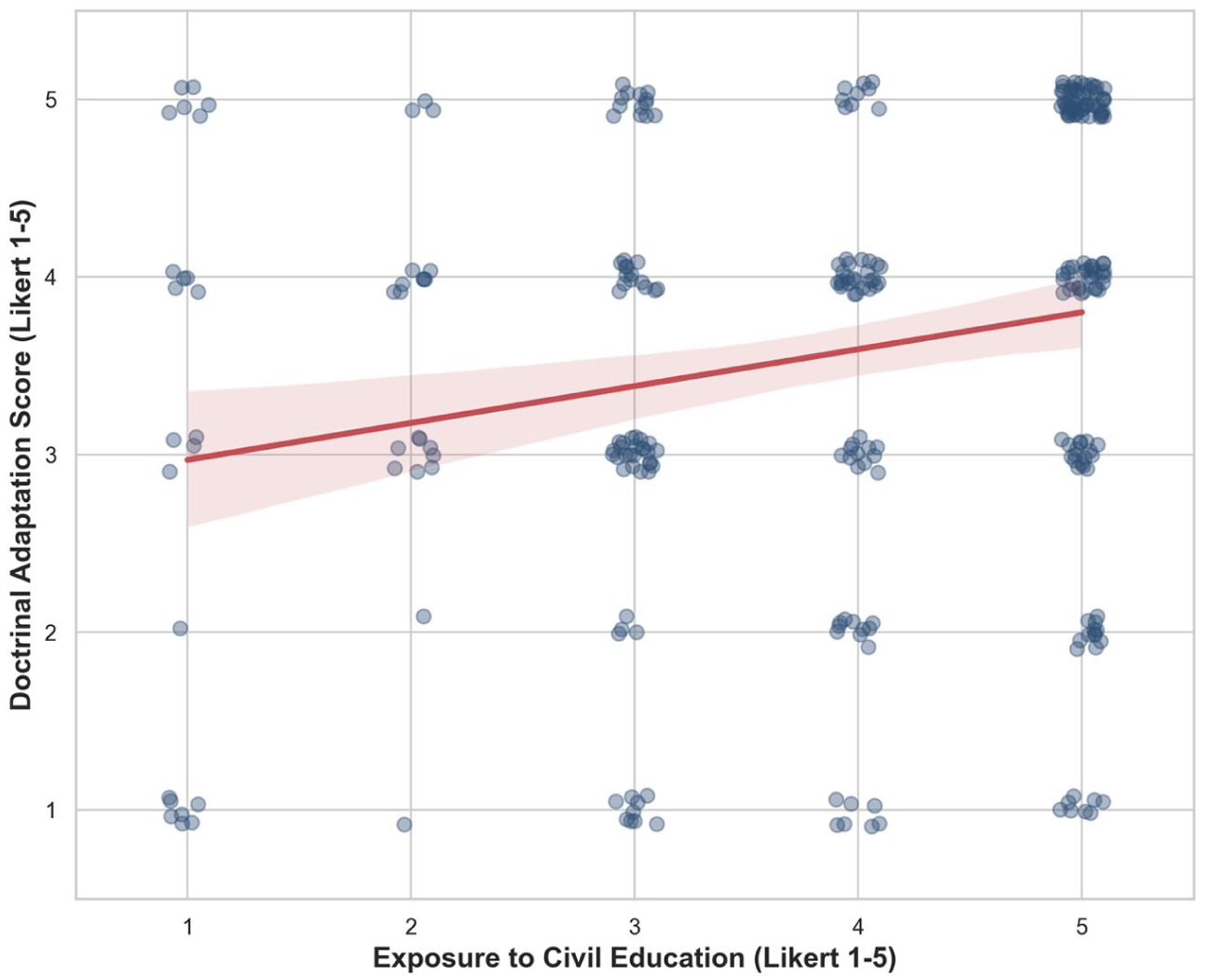
Exposure to civil education and doctrinal adaptation score.
The pattern shown in Figure 1 suggests that this is not a marginal phenomenon restricted to a small subgroup but a broader tendency within the analytical sample. In a strategic environment where the armed forces’ mission has shifted from conventional warfare toward stabilization and forms of unified action, civilian higher education appears to provide interpretive resources that help officers engage with more abstract and reform-oriented doctrinal frameworks. In that sense, external academic exposure is associated with the cognitive modernization of the officer corps, even if its explanatory power remains modest.
Having established that civilian academic exposure is positively associated with doctrinal adaptation, the analysis next examines how this adaptive alignment is situated within a broader structure of institutional strain. The following results move beyond the initial regression to show how doctrinal adaptation coexists with different configurations of commitment crisis, perceived institutional support, and identity erosion across the officer corps.
Profile Identification and Structural Validity
To examine these broader configurations, K-means clustering on standardized scores yielded a three-cluster solution with acceptable structural validity (Silhouette coefficient = .30). Analysis of variance confirmed that the profiles differed significantly across all focal variables, F(2, 292) = 78.3, p < .001, supporting the distinctiveness of the resulting typology.
Although the K-means algorithm assigns cases to clusters solely by minimizing within-cluster variance, it does not generate substantive labels. We therefore named the three clusters inductively after inspecting the standardized cluster centroids (Table 2) and the corresponding profile plot (Figure 2), using the most diagnostically salient combinations of doctrinal adaptation, commitment crisis, perceived institutional support, and identity erosion. “Alienated Modernizers” denotes officers whose high doctrinal adaptation coexisted with the highest levels of commitment crisis and identity strain; “Secure Traditionalists” captures the inverse configuration, characterized by comparatively low adaptation and low crisis; and “Disconnected” refers to an intermediate profile that remained moderate across dimensions rather than consolidating a coherent modernization or traditionalist orientation. These labels are descriptive shorthand for empirical configurations rather than normative characterizations.
Mean Scores of Professional Values and Adaptation Metrics by Officer Profiles.
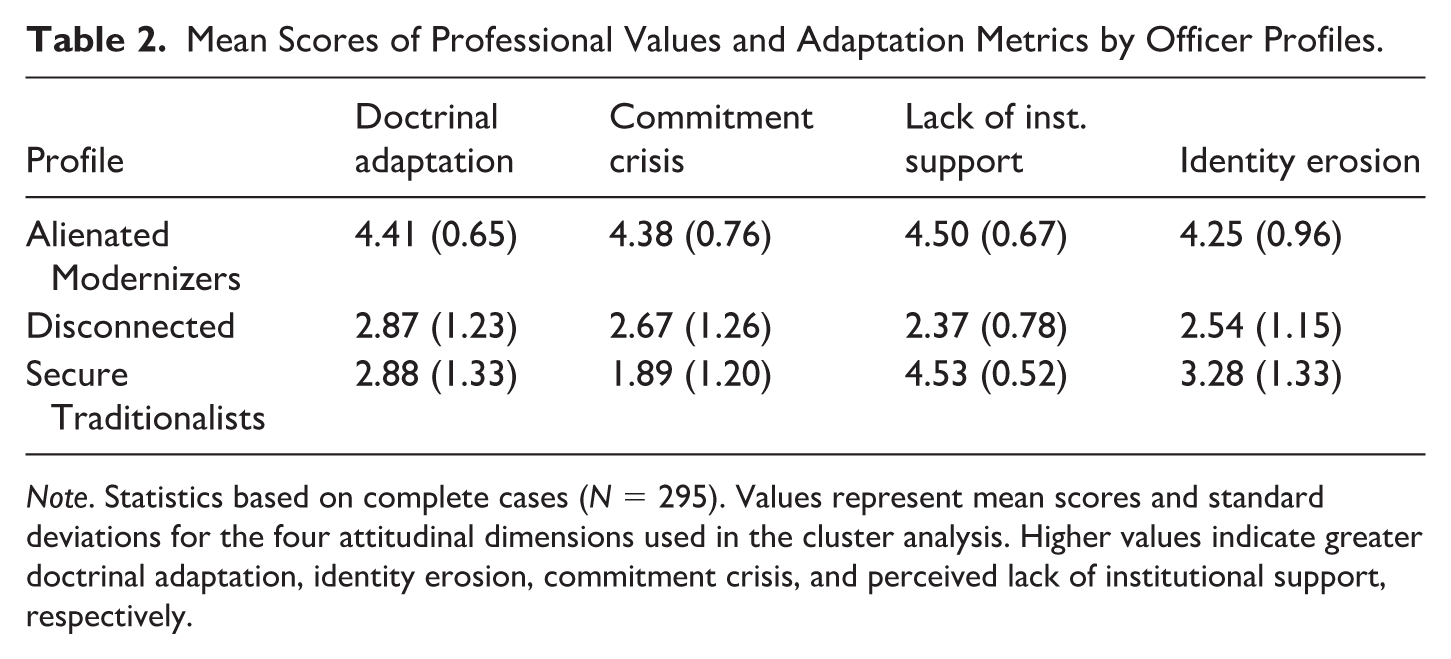
Note. Statistics based on complete cases (N = 295). Values represent mean scores and standard deviations for the four attitudinal dimensions used in the cluster analysis. Higher values indicate greater doctrinal adaptation, identity erosion, commitment crisis, and perceived lack of institutional support, respectively.
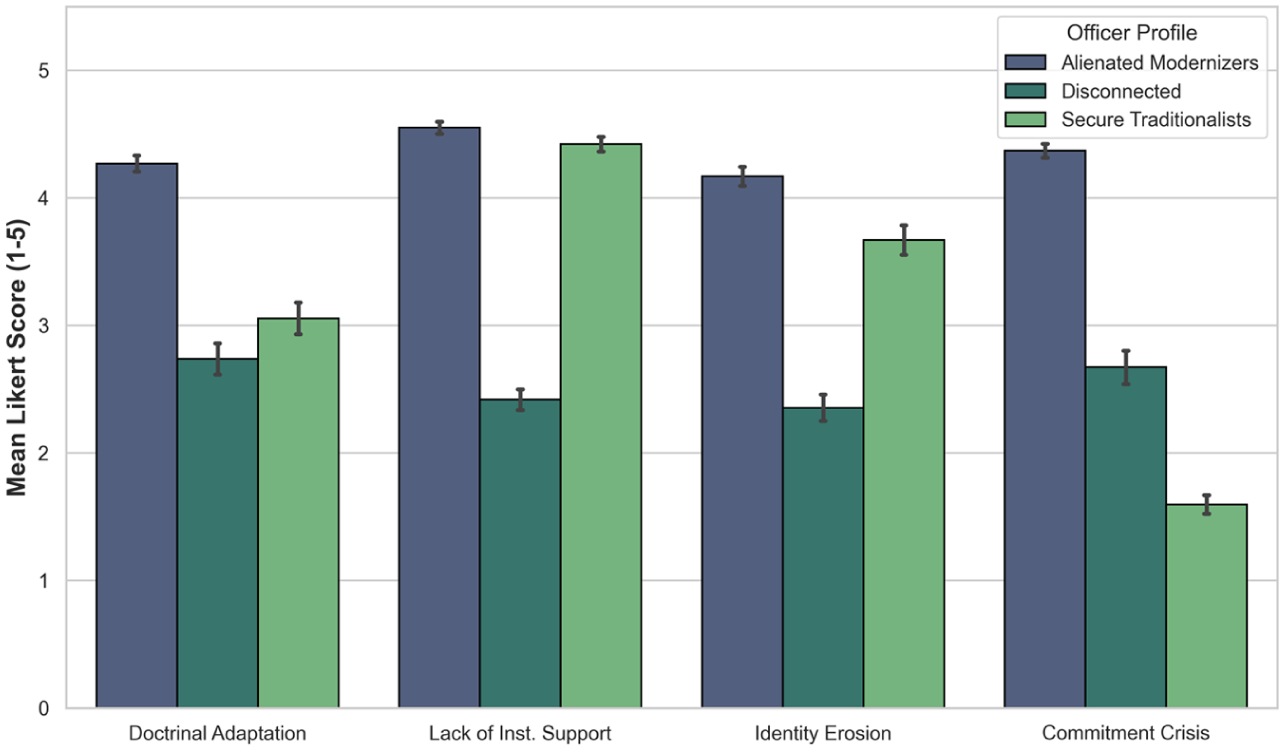
Psychometric profiles of officer clusters: the adaptation-alienation paradox.
Table 2 summarizes the configuration of each profile. The “Alienated Modernizers” (n = 131, 44.4%) are characterized by high doctrinal adaptation (M = 4.41, SD = 0.65) paired with the highest commitment crisis scores (M = 4.38, SD = 0.76). The “Secure Traditionalists” (n = 88, 29.8%) exhibit the opposite pattern: comparatively low adaptation (M = 2.88, SD = 1.33) and minimal commitment crisis (M = 1.89, SD = 1.20). The third cluster, labeled “Disconnected,” occupies an intermediate position across all four dimensions.
Figure 2 visualizes these profile configurations, highlighting the relative distance among clusters across the four attitudinal dimensions. The contrast is especially visible between the “Alienated Modernizers” and the “Secure Traditionalists,” while the “Disconnected” cluster occupies an intermediate position that is neither fully reform-oriented nor traditionally cohesive. In this sense, the figure complements Table 2 by showing that doctrinal adaptation does not map onto a single institutional response but instead coexists with divergent configurations of crisis, support, and identity.
Figure 3 refines the interpretation of the profile structure by showing how civilian academic exposure is distributed across clusters. The highest proportion of officers with high civilian academic exposure appears among the “Alienated Modernizers” (71.8%), but the “Secure Traditionalists” also display a comparatively high level (64.8%), whereas the “Disconnected” cluster shows the lowest proportion (46.1%).
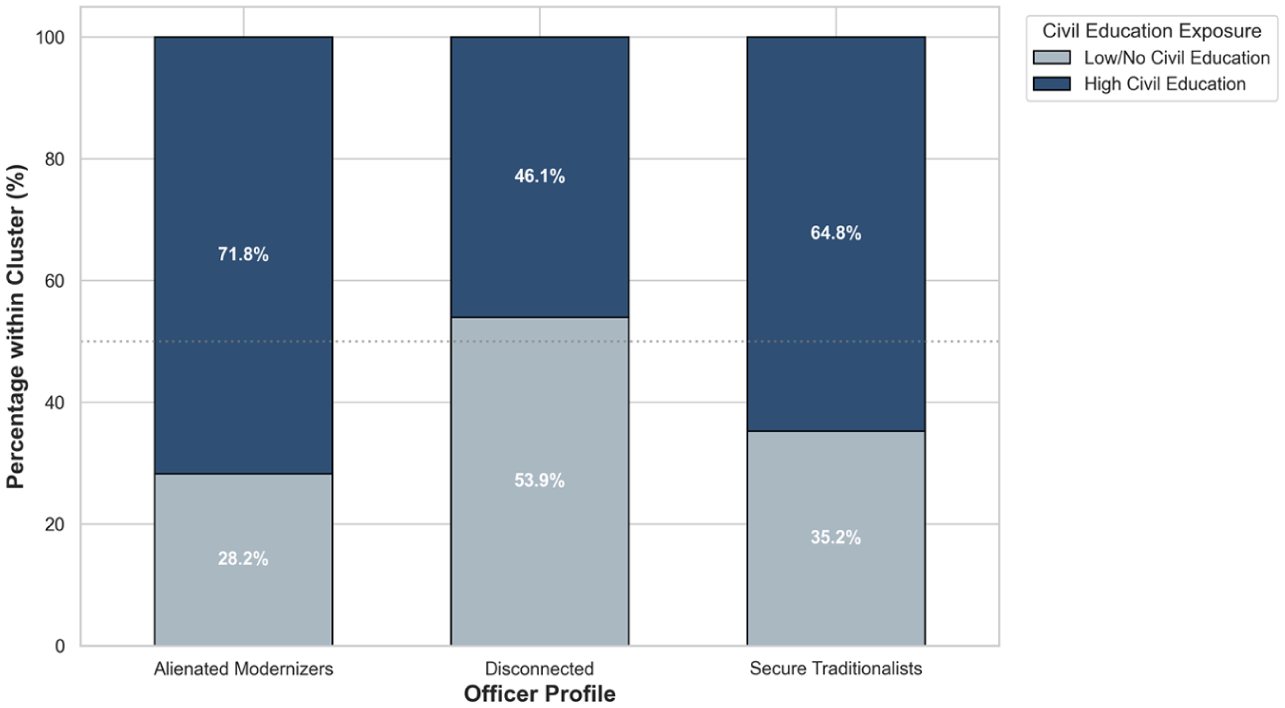
Distribution of high exposure to civil education across officer profiles.
This pattern suggests that civilian academic exposure does not push officers toward a single attitudinal direction. Rather than uniformly producing alienated reformism, civilian education appears more clearly associated with a reduced likelihood of remaining institutionally disconnected and with a greater likelihood of occupying more defined positions within the attitudinal structure of the officer corps. In that sense, civilian academic exposure seems to strengthen analytical positioning, although the substantive direction of that positioning may vary across officers.
Figure 4 examines the broader correlation structure among the four attitudinal dimensions. The heatmap shows that doctrinal adaptation is not isolated from institutional strain but is instead embedded in a wider pattern of association with identity erosion, commitment crisis, and perceived lack of institutional support. This result is important because it moves beyond profile description and shows that the coexistence of reform-oriented adaptation and institutional estrangement is not limited to a single cluster-based interpretation.
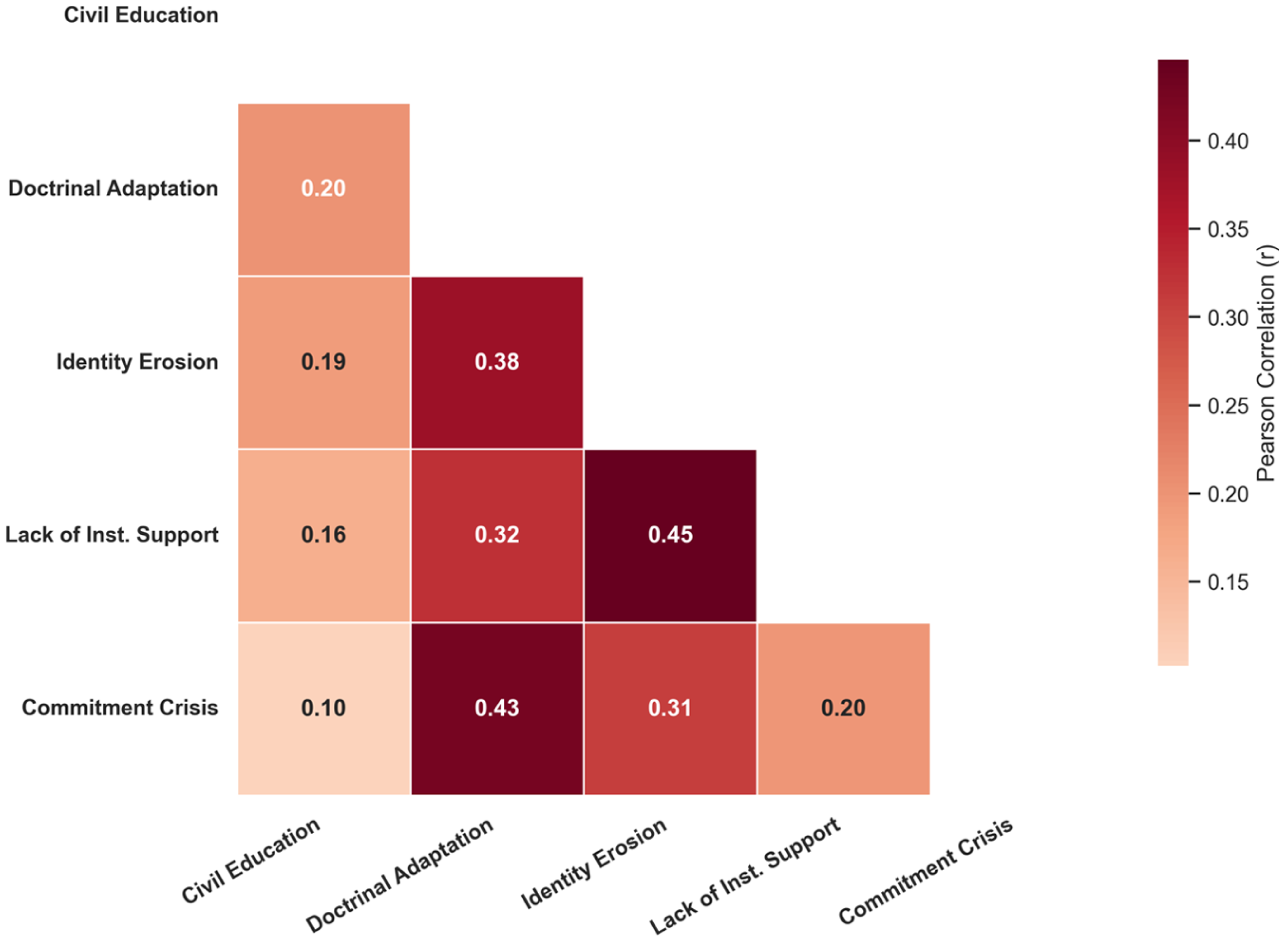
Bivariate correlation matrix of doctrinal and professional constructs.
Taken together, these associations are consistent with H2 and H3. Officers who report stronger doctrinal adaptation also tend to exhibit greater identity erosion and stronger commitment crisis, suggesting that adaptation to doctrinal modernization may develop alongside increasing strain in the officer’s relationship to the institution. Rather than reflecting a straightforward process of normative integration, the pattern points to a more ambivalent dynamic in which doctrinal alignment and institutional estrangement can emerge simultaneously.
The correlation structure shown in Figure 4 suggests that the tensions identified in the profile analysis are not confined to a single cluster but reflect a broader pattern within the officer corps. Doctrinal adaptation is positively associated with both commitment crisis and identity erosion, while also correlating with perceived lack of institutional support. Taken together, these associations reinforce the article’s central claim that modernization does not simply generate greater normative integration but may also deepen institutional strain among those officers most aligned with doctrinal reform.
The next step is to examine whether this relationship operates uniformly across institutional settings. Figure 5 therefore explores whether the association between doctrinal adaptation and commitment crisis varies according to officers’ unit background, distinguishing between predominantly combat trajectories and administrative or support trajectories.
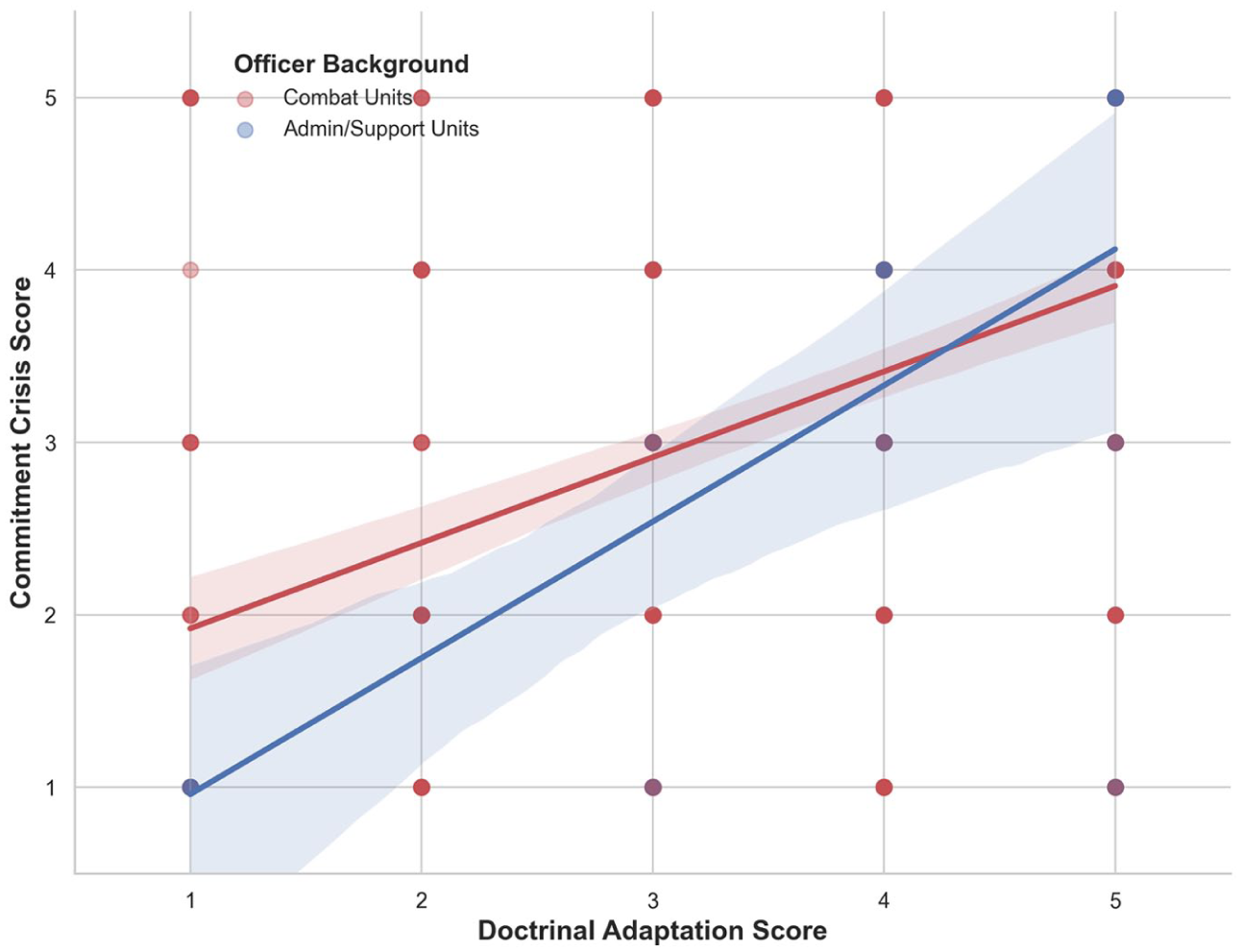
Interaction effect of doctrinal adaptation on commitment crisis by unit type.
The interaction analysis shown in Figure 5 indicates that the positive association between doctrinal adaptation and commitment crisis does not vary significantly by unit background. Although doctrinal adaptation has a significant positive association with commitment crisis (b = .61, p = .024), the interaction term between adaptation and unit type is not statistically significant, b = −0.12, SE = 0.27, t(291) = −0.43, p = .669. This pattern is consistent with the parallel slopes visible in the figure and suggests that the relationship between adaptation and institutional strain is not meaningfully conditioned by whether officers developed their careers primarily in combat or administrative settings.
This finding adds an important qualification to the broader argument. The tensions associated with doctrinal modernization do not appear to be confined to a specific institutional niche or to officers in one particular type of assignment. Instead, the association between adaptation and commitment crisis appears across distinct organizational trajectories, suggesting that the strains identified in the preceding analyses are more broadly embedded in the post-conflict transformation of the force.
Taken together, the preceding figures point to a consistent pattern rather than a single isolated result. Civilian academic exposure is positively associated with doctrinal adaptation, doctrinal adaptation is embedded in broader configurations of identity strain and commitment crisis, and these tensions are not limited to one segment of the institution. At the same time, the evidence should be interpreted as associational rather than causal, given the cross-sectional design of the study.
To further clarify the interpretive logic underlying the profile most central to the article’s argument, the final analytical step turns to a semantic network analysis of the open-ended responses associated with the “Alienated Modernizers” (n = 131). Rather than introducing a separate line of evidence, this qualitative-semantic analysis serves as a form of triangulation, helping to identify the concepts and associative patterns through which this group narrates the relationship between doctrinal reform, institutional support, and professional identity.
The network was constructed in three stages. First, the textual responses were preprocessed using standard natural language processing procedures, including stop-word removal, lemmatization, and terminological normalization. Second, a TF-IDF weighting procedure was used to identify terms that were particularly distinctive within this profile while reducing the influence of generic military vocabulary. Third, semantic co-occurrence matrices were used to generate the network structure, in which nodes represent salient concepts and edges represent their co-occurrence within the same narrative segments.
To conclude the empirical analysis, Figure 6 presents the resulting circular co-occurrence graph mapping the conceptual relationships that characterize this cluster’s professional worldview. The network structure suggests that the discourse of the “Alienated Modernizers” is not primarily organized around ideological opposition to doctrinal reform. Rather, the most salient nodes, including “Operational,” “Legal Framework,” and “Morale,” point to a fundamentally pragmatic orientation. The densest connections link “Operational” with both “Legal Framework” and perceived lack of support, forming a triadic pattern centered on the conditions under which military action is expected to be carried out.
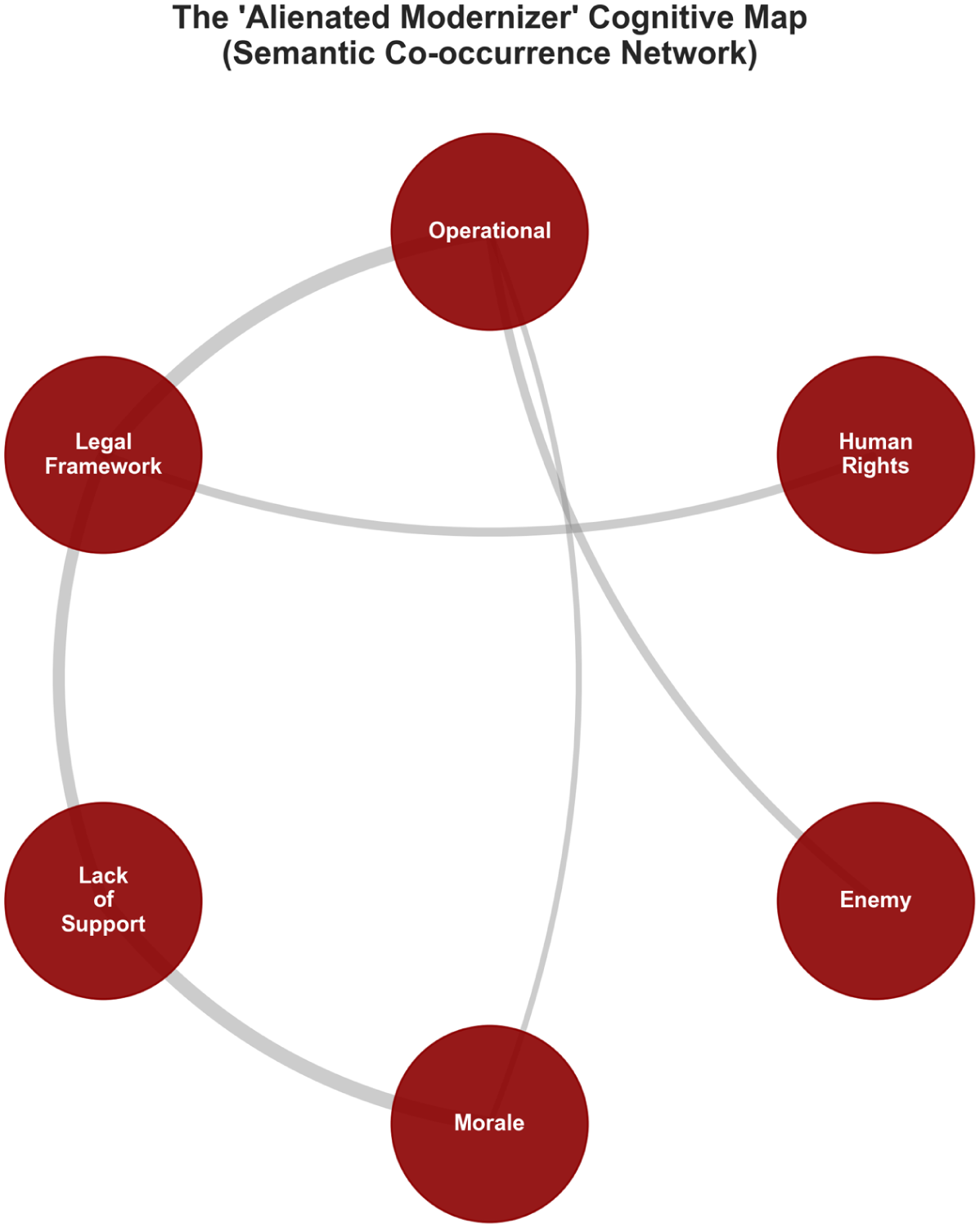
Semantic co-occurrence network of the “Alienated Modernizer” profile.
This semantic structure complements the quantitative findings by showing that these officers remain strongly concerned with the practical execution of military missions, while also emphasizing the legal and institutional conditions that shape their implementation. In that sense, the network suggests that their estrangement is not rooted in rejection of modernization itself but in the perceived gap between reform-oriented doctrinal expectations and the institutional safeguards available in practice. This qualitative pattern reinforces the broader argument of the article: doctrinal adaptation and institutional strain may emerge simultaneously within the same professional outlook.
Taken together, the results point to a central paradox of post-conflict military modernization: the officers most aligned with doctrinal reform may also be those most likely to experience institutional strain. The discussion now turns to the theoretical and institutional implications of this pattern.
Discussion
The findings support the article’s central claim, albeit with an important refinement. Civilian academic exposure was positively associated with doctrinal adaptation, yet this adaptive alignment coexisted with higher levels of identity erosion, commitment crisis, and perceived lack of institutional support. The person-centered analyses add nuance: rather than showing that civilian education uniformly produces alienated reformers, the results indicate that officers with greater academic exposure are less concentrated in the disconnected middle and more likely to occupy clearly defined attitudinal positions, including not only the “Alienated Modernizers” but also, to a lesser extent, the “Secure Traditionalists.” Modernization, in other words, appears to sharpen analytical positioning rather than push officers uniformly in one direction.
These patterns have direct theoretical implications. Rather than treating professional education as a straightforward mechanism of integration, the findings suggest that exposure to civilian academic environments expands officers’ capacity to identify inconsistencies between doctrinal ideals and organizational realities. Under conditions of perceived institutional abandonment, that heightened reflexivity contributes not to deeper incorporation but to more critical and strained forms of professional identification. Enlightened Professional Dissonance, in this sense, does not describe resistance to modernization, but a condition in which adaptation and estrangement emerge together within the same professional outlook.
This complicates a durable assumption in civil–military relations scholarship: that professionalization and education, by themselves, consolidate cohesion and democratic subordination. The tension is not that educated officers reject the normative vocabulary of the state—the empirical pattern is consistent with internalization of an IHL-centered doctrinal framework. What weakens instead is confidence in the state’s administrative and political apparatus as a reliable provider of protection once doctrine encounters operational ambiguity. In that sense, the Colombian “soldier-scholar” resembles less a bridge to society than an internal critic whose education heightens sensitivity to reciprocity, institutional consistency, and legal predictability—a pattern that runs counter to Janowitz’s expectation that civilianization narrows value distance and stabilizes civil–military relations and suggests that under the scope conditions observed here, doctrinal modernization may generate friction precisely among the officers most engaged with its normative demands.
The results also qualify the promise embedded in Huntingtonian and post-Huntingtonian formulations that professional expertise tends to reinforce predictable subordination through a stable professional bargain (Desch, 1999; Huntington, 1957). Classical accounts often presume a relatively symmetric exchange: the officer corps provides competence and restraint, while the state provides clear mandates, institutional backing, and credible legal protection (Huntington, 1957). Comparative work in Latin America has long warned that this symmetry is empirically fragile, particularly where states demand security outputs under conditions of political contestation and institutional weakness, or where expanding missions blur boundaries and redistribute risk (Pion-Berlin, 2005, 2016; Stepan, 1988). The present findings sharpen that warning by suggesting that modernization may increase officers’ capacity to detect and articulate institutional asymmetry, which can then become a source of dissonance rather than integration. Put differently, expertise may function less as an automatic channel of compliance than as a diagnostic capacity that renders institutional inconsistencies more visible.
Read through Charles Moskos’s plural or segmented conception of the modern military, the Colombian officer corps appears less as a single profession converging toward civilian norms than as a differentiated institution in which modernization produces durable internal subcultures. Moskos (1973) argued that modernization often generates internal compartmentalization, with convergent and divergent sectors coexisting within the same force. The clusters identified here fit that pattern. The “Alienated Modernizers” approximate a convergent sector in terms of doctrinal fluency and cognitive alignment with reform, whereas the “Secure Traditionalists” resemble a divergent sector whose cohesion remains comparatively stable even under perceived institutional strain. Colombian historiography has described earlier conflict-period officer norms through a “plural divergent” optic, making the present configuration appear less anomalous than a reorganization of enduring internal differentiation under heightened legal scrutiny and political exposure (Cardona, 2022, p. 123).
Under this reading, modernization may concentrate individualized risk more heavily on the convergent segment, sharpening cleavages of institutional loyalty driven less by ideology than by asymmetric protection. This segmentation also helps explain why reform scripts may be adopted for legitimacy while practical risk is displaced downward, tightening the political and legal linkage between doctrine and field-level judgment.
A sociological institutionalist lens helps explain why this segmented pluralism makes the paradox especially acute during doctrinal modernization. Organizational reforms often serve legitimacy as much as technical efficiency, particularly when external audiences and domestic elites demand recognizable scripts of “modern” professionalism (DiMaggio & Powell, 1983; Meyer & Rowan, 1977). Such reforms can be sustained through decoupling, whereby formal doctrine and compliance discourse perform legitimacy while operational practice remains adaptive to the technical core (Bromley & Powell, 2012). This arrangement becomes more fragile when monitoring intensifies, and organizations are pushed to tighten the link between talk, decisions, and action (Brunsson, 1989).
The Colombian post-conflict environment contains precisely these pressures. Transitional justice and expanded oversight are consistent with a reduced organizational capacity to keep doctrine and field judgment loosely coupled (Norheim-Martinsen & Nyhamar, 2015; Skaar, 2014; Uprimny, 2011; Williams, 2019). Under these conditions, doctrine becomes not only a professional language but also a standard for retrospective evaluation, increasing perceived exposure when operational environments remain hybrid and ambiguous (Arjona, 2016; Kalyvas, 2006). Although the cross-sectional design does not allow temporal sequencing to be established, the positive associations observed between doctrinal adaptation and identity strain are consistent with this tightening of coupling.
Qualitative evidence adds specificity to the proposed mechanism. The semantic network associated with the alienated profile is organized around operational action, legal framework, morale, and lack of support, with human rights embedded within the legal frame rather than positioned as an external threat. That architecture is difficult to reconcile with an ideology-centered account or with a simple backlash against reform. Instead, it suggests that officers narrate their predicament in terms of operational–legal tension combined with perceived institutional abandonment.
This pattern is consistent with socio-legal scholarship on the judicialization of armed conflict, in which battlefield decisions increasingly become objects of retrospective legal scrutiny and commanders experience heightened uncertainty regarding exposure (Dannenbaum, 2018; Norheim-Martinsen & Nyhamar, 2015; VanLandingham, 2024). It also aligns with work showing how responsibility doctrines, evidentiary expectations, and accountability politics can shift the practical burdens of war downward, especially under ambiguous mandates and contested environments (Bovens, 2007; Hood, 2011). The contribution here is primarily empirical: judicialization is not treated as an abstract macro-legal trend but as a cognitive and identity burden that appears concentrated among officers more strongly aligned with doctrinal modernization.
Civilian education appears to matter not as a direct cause of alienation but as an amplifier of legibility. With cross-sectional data, it is not possible to determine whether civilian education produced the critical stance observed here (socialization) or whether officers who were already more critical were more likely to seek civilian degrees (selection). What the qualitative material can do, however, is clarify the character of that critique. Alienated officers did not primarily narrate their discontent in partisan or factional terms; rather, their language centered on legal certainty, protection, and procedural backing, which is consistent with an accountability-and-risk interpretation (Bovens, 2007; Hinterleitner & Sager, 2017; Hood, 2011).
In this sense, civilian education may operate less as a direct cause of alienation than as a cognitive resource that makes institutional contradictions easier to recognize and articulate (Ateş, 2024). This interpretation also helps reconcile the positive association between education and doctrinal adaptation with the simultaneous rise in commitment crisis. Education may strengthen officers’ capacity to operationalize reform while also heightening sensitivity to the gap between doctrinal promise and institutional protection. Future research should test this mechanism using longitudinal cohorts or quasi-experimental variation in educational exposure across career stages and assignments.
The findings also point to a meritocratic paradox with both sociological and institutional significance. Militaries pursuing reform tend to reward doctrinal fluency, managerial competence, and legal-normative literacy. Yet those same attributes appear linked, in this setting, to the highest levels of estrangement. If modernization produces a substantial cohort of highly capable officers who become especially sensitive to perceived abandonment under judicialization, the institution faces a retention and cohesion problem endogenous to professionalization itself. This extends debates about professionalism beyond civilian control alone and toward questions of organizational sustainability under accountability pressure (Brooks, 2020; Feaver, 2003). The implication is not that modernization fails but that it can outpace the state’s capacity, or willingness, to provide predictable backing for commanders operating under ambiguity.
Comparatively, the study suggests that similar dynamics may emerge in transitional or hybrid security environments where accountability rises faster than institutional capacity and where doctrinal modernization is partly driven by external legitimacy demands (DiMaggio & Powell, 1983; Meyer & Rowan, 1977; Williams, 2019). Professionalization in such contexts may generate internal critics who remain committed to the ideals of lawful force yet become estranged from the bureaucratic realities that implement and police those ideals. The policy implication is therefore not to slow education or doctrinal reform but to align doctrinal ambition with credible institutional supports capable of moderating the adaptation-to-crisis link: predictable investigative protocols, robust legal assistance, consistent command guidance, and administrative procedures that reduce the perception that liability is individualized when doctrine collides with operational uncertainty. Without such support, more education is not, by itself, a sufficient recipe for cohesion; under some conditions, it may instead intensify the very strains that professionalization theory typically assumes it will solve.
Conclusion
This article reframes what professionalization can mean in post-conflict armed forces. In the Colombian case, modernization did not simply produce more institutionally integrated officers; it also exposed a deeper fault line within the profession itself. Officers with greater civilian academic exposure were more likely to report stronger doctrinal adaptation, yet that same adaptive alignment coexisted with higher levels of commitment crisis, identity erosion, and perceived lack of institutional support. Rather than indicating a simple failure of reform, this pattern points to a more paradoxical dynamic: the officers most capable of internalizing the normative language of modernization may also be those most likely to perceive the distance between doctrinal ambition and institutional reality.
The central implication is theoretical. Much of the professionalization literature has tended to assume that education, expertise, and doctrinal sophistication strengthen cohesion, reinforce democratic subordination, and stabilize the professional bargain between the armed forces and the state. The findings presented here suggest a more contingent interpretation. Under conditions of institutional asymmetry, education and doctrinal competence are not inherently cohesive. Instead, they may sharpen officers’ capacity to evaluate whether the state is providing the legal clarity, organizational backing, and reciprocal protection that its own reform discourse presupposes. In that sense, professionalism may operate not only as a mechanism of compliance but also as a form of internal scrutiny.
This is the broader significance of what the article conceptualizes as Enlightened Professional Dissonance. The term describes a condition in which officers do not reject reform, democratic norms, or legal restraint; rather, they internalize them. Yet in doing so, they become more sensitive to contradictions between doctrinal expectations and the institutional conditions required to enact them. The problem, therefore, is not ideological backlash or lingering attachment to unreformed military identities, but a credibility gap in the professional bargain: reform demands adaptation, yet the institution is not always perceived as providing the protections needed to sustain it.
The findings also refine how the role of civilian education should be interpreted. The evidence does not support a simple linear claim that civilian education uniformly produces alienated reformers. Rather, civilian academic exposure appears to reduce the likelihood of remaining in an institutionally disconnected middle and to increase the likelihood of occupying more clearly defined attitudinal positions within the officer corps. In that sense, education seems to operate less as a direct cause of alienation than as a cognitive resource that increases institutional legibility. It equips officers not only with analytical tools to interpret doctrine but also with the conceptual language needed to recognize inconsistency, asymmetry, and institutional ambiguity.
This has important implications beyond Colombia. In transitional and judicialized security environments, modernization may be driven simultaneously by operational learning, democratic oversight, international legitimacy pressures, and legal accountability. Where those pressures intensify faster than the institution’s capacity to provide predictable support, reform may generate internal critics who remain normatively committed to lawful force while becoming increasingly estranged from the bureaucratic realities that implement and police it. Professionalization, in such contexts, should therefore be understood not only as a process of acquiring expertise but also as a process that can redistribute organizational risk and transform the meaning of institutional loyalty.
The practical lesson is not that military education or doctrinal reform should be slowed. The lesson is that doctrinal ambition must be matched by credible institutional protection if modernization is to remain organizationally sustainable. Predictable investigative protocols, robust legal assistance, consistent command guidance, and administrative procedures that reduce the perception of individualized liability are not secondary complements to reform; they are part of the institutional infrastructure that makes reform viable. Without them, the same processes intended to produce better-adapted officers may also deepen the very strains that professionalization theory has often assumed they would resolve.
The argument should nonetheless be generalized cautiously. Because the study relies on cross-sectional data, it cannot fully disentangle socialization from selection, nor can it establish temporal sequencing between education, doctrinal adaptation, and institutional strain. Future research should test these scope conditions with longitudinal designs, cohort comparisons, or quasi-experimental variation in educational exposure across career stages and assignments. Even with those limitations, the Colombian case makes one point difficult to ignore: in post-conflict armed forces, modernization does not simply ask officers to learn new doctrine. It also asks them to decide whether the institution that demands adaptation can still be trusted to stand behind them when doctrine meets uncertainty in practice.
Footnotes
Appendix

Funding
The authors received no financial support for the research, authorship, and/or publication of this article.
Declaration of Conflicting Interests
The authors declared no potential conflicts of interest with respect to the research, authorship, and/or publication of this article.