






Abstract
Combat motivation lacks theoretical grounding and has overlooked reserve soldiers facing dual-identity challenges. This study provides an application of Self-Determination Theory (SDT) to combat motivation, examining how intrinsic motivation predicts reserve soldiers’ willingness to risk their lives and return for future deployments. Data from 778 Israeli Defense Forces combat reserve soldiers following extended deployment during the “Iron Swords” War were analyzed using ordinal logistic regression. Intrinsic combat motivation—operationalized through SDT as unit cohesion (relatedness), mission necessity (competence), and operational enthusiasm (autonomy)—was tested alongside trust in commanders and civilian concerns. Intrinsic motivation was the dominant predictor of both outcomes. The two outcomes exhibited different motivational profiles: immediate risk-taking depended almost entirely on intrinsic motivation, while sustained commitment additionally required trust in commanders and was undermined by career concerns. Findings suggest that fostering intrinsic motivation is essential for combat effectiveness, while retention additionally requires trustworthy leadership and career protection.
Keywords
Introduction
Why do they fight? It is an age-old question, and the answers vary with culture and context (Berkovich, 2017). Stouffer et al’s (1949) World War II surveys first systematically examined this question, revealing that unit bonds—rather than ideology or abstract patriotism—were central to combat motivation. Subsequent research has identified primary group cohesion, ideological commitment, survival instincts, institutional incentives (Pawiński & Chami, 2019), and identity fusion (Gómez et al., 2023) as key factors. Yet the discussion remains largely descriptive, ignoring established motivational theories such as Self-Determination Theory (Deci & Ryan, 2000). Moreover, the role of leadership and home-front pressures as moderators of combat motivation remains virtually unexplored (Ben-Shalom et al., 2005).
These gaps become especially consequential when examining reserve soldiers, whose combat motivation operates under fundamentally different constraints than active-duty forces. Unlike career soldiers, continuously embedded in military culture, reservists must repeatedly negotiate civilian and military identities, balancing family obligations, career demands, and unit commitments with each mobilization (Gazit et al., 2021; Lomsky-Feder et al., 2008). The unprecedented mass mobilization of IDF reservists during the Iron Swords War, following years of institutional decline in reserve participation, brought these tensions into sharp focus and exposed the absence of a theoretical framework adequate to explain them.
We examine two conceptually distinct motivation outcomes among IDF reserve combat soldiers deployed during the Iron Swords War. Willingness to risk one’s life in combat captures engagement once on the battlefield—the immediate psychological calculus of danger acceptance. Willingness to return for subsequent deployments represents the decision to report to the battleground, made in the civilian sphere under competing pressures from family, career, and personal well-being. For reservists, these are fundamentally different motivational moments: one occurs within the military context where unit bonds and operational demands are salient; the other at the civilian-military boundary where home-front considerations loom large. We ask: First, to what extent do intrinsic combat motivations, operationalized through SDT’s three psychological needs as unit cohesion (relatedness), perceived operational necessity (autonomy), and operational enthusiasm (relatedness), predict willingness to risk life and willingness to return for duty? Second, how does trust in commanders and home-front considerations (family and career concerns) impact these two outcomes?
By situating combat motivation within SDT and examining the roles of leadership trust and home-front pressures, this research offers a theoretically grounded account of reserve soldier motivation. Critically, we argue that trust in military commanders may serve as the linchpin enabling reservists to sustain intrinsic motivation despite mounting extrinsic pressures. While combat motivation research has largely overlooked leadership trust (Ben-Shalom et al., 2005), we propose that for reservists, who experience discontinuous command relationships and must weigh military obligations against civilian responsibilities, commander trust may be the decisive factor translating intrinsic motivation into sustained combat commitment. This has significant implications for military leadership development and reserve force management, particularly in protracted conflicts where repeated mobilizations test the limits of voluntary service.
The Iron Swords War and the IDF Reserve System
The IDF reserve system was designed on a “nation-in-arms” doctrine, in which a small conscript core would hold defensive lines for approximately 48 hours while hundreds of thousands of reservists mobilized to form the principal fighting force (Ben-Dor et al., 2002). This model made reserve service a central feature of adult civic life for Israeli Jewish men, with annual obligations of 21–45 days persisting until age 44 and beyond (Cohen, 2010).
By the early 2000s, the system was in measurable crisis. Ben-Dor et al. (2002) documented declining participation rates and growing gaps between statutory obligations and actual service, arguing that the traditional mass-mobilization model was becoming unsustainable. Reserve participation dropped from over 30% of the population in the 1980s to approximately 12% by the 2010s, as the Reserve Law of 2008 reduced maximum service ages, limited annual service days, and granted the IDF greater discretion over who was called up. Reforms that, while protecting reservists’ civilian rights, further eroded training frequency and unit readiness (Rein-Sapir et al., 2021). Perliger’s (2011) analysis characterized reserve forces as facing both structural decline and motivational erosion, driven by economic pressures, growing inequality in the burden of service, and shifting conceptions of civic obligation.
The immediate pre-war period added a political dimension to this institutional weakness: beginning in January 2023, tens of thousands of reservists participated in mass protests against proposed judicial reforms, with many publicly threatening to suspend volunteer service (Harel, 2024; Ziv, 2025). The reserve force mobilized on October 7 was therefore not only institutionally weakened but politically fractured, its social contract under active renegotiation.
The Iron Swords War differed fundamentally from all preceding Israeli conflicts of the 21st century. Previous Gaza and Lebanon operations, while operationally demanding, followed a recognizable pattern: limited duration, defined objectives, and reserve deployments measured in weeks (Itsik, 2025a). The October 7 attack inverted this pattern in every dimension. The Hamas assault constituted the most severe failure of Israeli military defense in decades, a surprise mass-casualty attack targeting civilian communities within sovereign Israeli territory, resulting in over 1,200 deaths and 250 abductions on a single day (Itsik, 2025a). The war that followed was simultaneously multi-front, without a defined endpoint or victory condition visible to those serving. The emergency mobilization reversed a decade of institutional disengagement abruptly and completely: reservists who had been progressively detached from military life were called up within hours, many serving months of continuous high-intensity ground combat rather than the statutory 15–30 days they had been structured to expect (Itsik, 2022; Zerach, 2024a).
What made the motivational context of this mobilization particularly distinctive was the convergence of combat demands with acute home-front threat. Unlike prior deployments in which the civilian sphere remained substantially secure, soldiers in the Iron Swords War served while their own families and communities were simultaneously exposed to missile attacks, displacement, and national grief. Cohen Zada’s (2025) qualitative study of teachers called up under emergency orders captures this dual-exposure pattern precisely: reservists reported grave concern for their families’ safety amid ongoing missile threats, while simultaneously experiencing deep uncertainty about the duration of their service and their discharge dates.
Subsequent research confirmed the psychological toll of this convergence: Levi-Belz et al. (2025) found that reserve-duty combatants exhibited the highest rates of probable PTSD, depression, and anxiety at both 1 month and 1 year after the October 7 attack, with minimal improvement over time and, uniquely, increasing suicidal ideation, patterns distinct from all other exposure groups. Itsik’s (2025b) study of reservists 1 year into the war documented growing economic and family pressures and a measurable decline in willingness to continue fighting, even as unit capability perceptions remained stable. Together, these findings situate the Iron Swords War mobilization not as an episodic disruption of the kind the transmigrant model was developed to describe, but as a sustained state of dual institutional demand under conditions of simultaneous resource depletion on both fronts.
Against this backdrop, this study addresses the absence of established motivational theory from combat motivation research and the neglect of reserve soldiers’ dual-identity constraints, by applying Self-Determination Theory (SDT) and examining leadership trust and home-front pressures as contextual moderators.
Self-Determination Theory and Intrinsic Combat Motivation
To understand what sustains a soldier in prolonged war, we must first look to foundational theories of human motivation. Self-Determination Theory (SDT) defines three basic psychological needs that form the basis of motivation: autonomy—the need to act in accordance with one’s values and make meaningful decisions; competence—the innate need to be effective and demonstrate mastery; and relatedness—the need for meaningful human connection (Deci & Ryan, 2000). Motivation stemming from satisfying these internal needs, known as intrinsic motivation, is far more powerful and resilient than extrinsic motivation, which relies on external rewards or punishments (Deci & Ryan, 1985).
When applied to military contexts, SDT provides a powerful theoretical lens for understanding combat motivation (Loverre et al., 2025). Recent research demonstrates that autonomy-supportive leadership behaviors directly satisfy soldiers’ autonomy needs, fostering autonomous motivation and job satisfaction (Knevelsrud et al., 2023), while basic psychological needs satisfaction mediates the relationship between soldiers’ psychological hardiness and operational engagement (Rybakovaitė et al., 2021). The vast literature on combat motivation identifies three core intrinsic factors—social cohesion, perceived necessity of war, and operational enthusiasm—that map onto SDT’s three needs (Ben-Shalom & Benbenisty, 2016, 2019).
Social Cohesion (Relatedness)
This is perhaps the most-researched factor in military psychology, representing the powerful bonds and commitment among soldiers in a fighting unit (Siebold, 2007). Decades of research show that soldiers are primarily motivated not by abstract ideals, but by profound loyalty and a desire not to let comrades down (Marshall, 1947; Moskos, 1970; Stouffer et al., 1949). The theoretical connection to SDT is direct: when relatedness needs are satisfied, soldiers internalize group goals and exhibit the cooperative, prosocial behaviors central to unit effectiveness (Chambel et al., 2015; J. Raabe et al., 2020).
Perceived Necessity of War (Autonomy)
This factor reflects the soldier’s internal agreement with and endorsement of the mission. When soldiers believe in the necessity and justice of the war, their participation becomes a matter of choice and conviction rather than mere compliance—the hallmark of autonomous motivation. This internal justification can include shared ideology explaining the fight’s purpose (Moskos, 1970; Wong et al., 2003), negative perception of the enemy (Ballard & McDowell, 1991; Schneider, 2021), or the overwhelming feeling of having “no choice” but to fight for survival (Stouffer et al., 1949). The theoretical link to autonomy is grounded in SDT’s conceptualization of autonomous motivation as acting from internal endorsement rather than external coercion: when soldiers experience autonomy-supportive leadership that enables them to internalize mission goals, they more readily perceive operations as necessary (Knevelsrud et al., 2024).
Operational Enthusiasm (Competence)
This factor addresses the professional satisfaction and even enjoyment derived from combat (Keegan, 1993). For some soldiers, combat is a domain where they demonstrate mastery and experience profound purpose in what Gray (1999) describes as a “spectacle” of sublime experiences. The connection to competence is grounded in SDT’s framing of competence satisfaction as the experience of effectiveness and mastery; in military settings, this corresponds to operational proficiency and professional pride. Empirical evidence supports this mapping: perceptions of high competence are among the most effective motivators in technical and operational military roles (I. J. Raabe et al., 2020; Rybakovaitė et al., 2021).
Among IDF reservists specifically, research indicates that bonds with unit members were the strongest motivation, followed by recognition of the war’s necessity, while competence-related motives ranked lowest among intrinsic motivations (Ben-Shalom & Benbenisty, 2016, 2019)
While SDT effectively explains the intrinsic “push” toward military engagement through need satisfaction, it does not fully account for the competing “pull” of civilian life that is particularly salient for reserve soldiers. Reservists must repeatedly transition between civilian and military identities, facing potential losses in their civilian resources with each mobilization. To understand this other side of the motivational equation, the pressures and costs that reservists face, we must turn to a complementary theoretical perspective.
Conservation of Resources and the Reserve Dilemma
While SDT explains the intrinsic “push” toward military engagement through the satisfaction of autonomy, competence, and relatedness needs, it does not fully account for the competing “pull” of civilian life—the costs and losses that reservists face when mobilized. Motivational theories like SDT focus on what drives individuals toward goals, but reserve soldiers face a more complex calculus: they must weigh the intrinsic motivation to serve against the tangible resources they risk losing in their civilian lives. To understand this other side of the equation—the pressures and potential losses that compete with military motivation—we turn to Conservation of Resources (COR) Theory (Hobfoll, 1989), which provides a complementary framework for understanding how competing role demands deplete resources and undermine well-being.
The motivational landscape of a reserve soldier is fundamentally different from that of a career soldier. Reservists are, as Lomsky-Feder et al. (2008) describe them, “migrants” who must constantly navigate the boundaries between their military and civilian identities. This dual identity makes them inherently more critical of the military hierarchy and positions them as a unique bridge between the army and the civilian population. Their motivation is not a static attribute but is shaped by constant negotiation between the military, society, and their personal lives (Gazit et al., 2021).
COR theory posits that individuals are motivated to obtain, retain, and protect the things they value, known as resources. These include objective assets (career and finances), social resources (family and community connections), and energy resources (time and mental well-being). Psychological stress occurs when these resources are threatened, lost, or when investment in gaining new resources fails (Hobfoll, 1989). Critically, COR theory predicts “loss spirals”, initial resource losses increase vulnerability to further losses, creating cascading negative effects on functioning and well-being (Vinokur et al., 2011). Military research has demonstrated that deployment-related resource loss mediates the effects of combat stress on PTSD, depression, and health outcomes, with resource loss being a stronger predictor than resource gain (Goldfarb & Ben-Zur, 2017).
A call to active reserve duty during wartime triggers precisely this kind of threat. As Goldfarb and Ben-Zur (2017) demonstrated using COR theory with Israeli reservists, military service directly threatens the reservist’s accumulated life resources by disrupting careers, straining family relationships, and depleting personal energy. Empirical work shows that even when motivation increases during a crisis, pressures from family and work act as significant negative factors on reservists’ well-being and retention (Werber et al., 2013). Research on U.S. National Guard and Reserve members found that combined high combat exposure and high family stress substantially increased PTSD prevalence compared to low-stress conditions, illustrating how resource threats compound one another (Vogt et al., 2008).
The “Iron Swords” War that erupted on October 7, 2023, created unprecedented conditions for Israeli reservists. Tens of thousands were mobilized abruptly, many serving for months in high-intensity combat operations while their civilian lives remained on hold (Zerach, 2024b). During this sustained mobilization, reservists faced the dual burden of combat stressors and mounting civilian resource losses—career disruptions, prolonged separation from families, and financial strain. Research on spouses of reserve soldiers during this conflict identified substantial stress profiles, with 21.3% experiencing high perceived stress and deployment-related stressors (such as fear of spouse injury) predicting membership in higher stress categories (Zerach, 2024a). This context amplifies the COR framework’s relevance: the decision to return for subsequent deployments involves not just intrinsic motivation but also a calculation of accumulated and anticipated resource losses.
The theoretical framework presented thus far reveals a central conflict for reservists: the intrinsic “push” to serve (explained by SDT) versus the “pull” of losing civilian resources (explained by COR). One mechanism reservists use to manage this conflict is negotiation. Gazit et al. (2021) argue that there are at least three levels of negotiation—individual, group, and macro-sociological agreements—with the most critical negotiation being between a soldier and their direct commander and families. Research demonstrates that family-supportive work environments and perceived organizational support predict changes in psychological strain over time, indicating that commanders and unit leadership can act as buffers against resource loss (Britt & Dawson, 2005). This positions the commander not just as a tactical leader but as the key mediator who must balance mission demands with a soldier’s civilian life. This pivotal role makes trust in the commander the final, crucial element of our framework.
Trust in Commanders: The Linchpin of Reserve Motivation
Having established that reserve soldiers face a fundamental tension between intrinsic motivations to serve (SDT) and the pull of civilian resource loss (COR), we now turn to the critical mechanism that may enable reservists to navigate this conflict: trust in their commanders. Trust is not simply an outcome of good leadership—it is a psychological resource that fundamentally alters how soldiers perceive risk, accept influence, and sustain motivation under competing demands.
Organizational trust theory defines trust as a psychological state comprising judgments about a leader’s competence (ability to accomplish the mission), benevolence (concern for subordinates’ welfare), and integrity (adherence to acceptable principles) (Mayer et al., 1995). In military contexts, trust determines the extent to which subordinates are willing to accept leader influence, particularly when orders carry personal risk or require discretionary effort beyond formal obligations (Sweeney et al., 2009). Empirical research demonstrates that commander trust predicts critical outcomes, including unit cohesion, morale, information sharing, decision quality, and execution speed (Adams & Sartori, 2006).
Trust connects to both theoretical frameworks central to our model. From an SDT perspective, trust enables autonomy satisfaction: when soldiers trust their commanders, they experience greater psychological freedom to internalize mission goals and make decentralized decisions aligned with their values (Knevelsrud et al., 2024). Military doctrine explicitly positions mutual trust as the foundation for mission command—a leadership philosophy that empowers subordinates with disciplined initiative and decentralized decision-making authority (Army, 2019). Trust thus facilitates the autonomy support that, as discussed earlier, strengthens autonomous motivation.
From a COR perspective, trust functions as a protective resource that buffers against perceived resource loss. Research demonstrates that trust between hierarchical levels attenuates the negative effects of organizational constraints: when trust is high, soldiers experience greater flexibility and better decision quality even under centralized structures and high task demands. This buffering effect is particularly crucial for reservists, who already face resource depletion from civilian-military role conflict. A trusted commander can reduce the perceived costs of service by demonstrating concern for soldiers’ civilian obligations, facilitating negotiation between military demands and family/career needs, and signaling that resource investments in military service will not be exploited.
Critically, trust does not simply add to motivation—it moderates the relationship between motivation and behavior. The theoretical mechanism is threefold: First, trust reduces perceived interpersonal and role risk, enabling soldiers to translate intrinsic motivation into actual combat behavior without fear that their commitment will be exploited or misused (Sweeney et al., 2009). Second, trust increases information sharing and shared awareness, creating the conditions under which motivated soldiers can act effectively (Bjørnstad & Ulleberg, 2021). Third, trust enables decentralized decision latitude, allowing intrinsically motivated soldiers to convert their motivation into discretionary effort and initiative (Adams & Sartori, 2006). Empirical evidence supports this moderating role: studies show that trust strengthens the positive effects of leadership behaviors on performance and attitudes, and that trust moderates the relationship between organizational structure and effectiveness (Bjørnstad & Ulleberg, 2021). For reservists specifically, trust in commanders may be the decisive factor that determines whether intrinsic combat motivation translates into willingness to risk life and return for duty, or whether resource loss concerns override motivational forces.
The IDF reserve system provides a particularly compelling context for examining commander trust. Reserve units constitute a unique social framework that allows soldiers to combine civilian and military life (Horowitz & Kimmerling, 1974). Reserve soldiers, who come from diverse ethnic, social, and religious backgrounds (Itsik, 2022), develop a distinct internal culture based on values of equality, humor, and partnership. Differences between ranks are minimized, and communication between officers and soldiers takes place in informal language. This social-based command style promotes trust and strengthens cohesion (Sion & Ben-Ari, 2009).
Sion and Ben-Ari (2009) found that reserve units have a less hierarchical and formal command style than regular units, while still maintaining clear role distinctions necessary for mission execution. Relationships are built on trust and social closeness, with humor serving as a key tool for emotional connection and conflict resolution. Personal attention and humor help commanders foster trust while respecting role boundaries. These commanders often see themselves as responsible for maintaining social cohesion both during and outside of military service.
Studies have shown that while soldiers don’t view commanders as primary motivators, commanders play a key role in building unit cohesion and framing the war, especially in reserve forces (Ben-Shalom & Benbenisty, 2016, 2019). Critically, the commander’s position as mediator between military demands and civilian obligations—what Gazit et al. (2021) describe as the central negotiation point—makes trust in the commander essential for managing the SDT-COR tension. A trusted commander can facilitate the negotiation that allows reservists to sustain intrinsic motivation despite mounting resource losses, while a distrusted commander may amplify the perceived costs of service and undermine even strong intrinsic motivation.
Research Hypotheses
Drawing on the theoretical framework developed above, this research examines two conceptually distinct outcomes among reserve soldiers: willingness to risk one’s life in combat (battlefield engagement) and willingness to return for subsequent deployments (reporting decision). We test how intrinsic combat motivation (operationalized through SDT’s three needs), home-front resource considerations (grounded in COR theory), and trust in commanders predict these outcomes, and whether trust moderates the relationship between intrinsic motivation and behavior.
Hypothesis 1: Intrinsic Combat Motivation (SDT)
Based on Self-Determination Theory, we predict that satisfaction of the three basic psychological needs—operationalized as unit cohesion (relatedness), perceived operational necessity (autonomy), and operational enthusiasm (competence)—will predict both combat outcomes:
Hypothesis 2: Home-Front Resource Considerations (COR)
Based on Conservation of Resources theory, we predict that concerns about civilian resource loss will differentially affect the two outcomes. Willingness to risk life occurs within the military context where intrinsic motivations are salient and resource considerations are psychologically distant. In contrast, willingness to return for duty is a decision made in the civilian sphere where family and career concerns are immediately salient:
Hypothesis 3: Trust in Commander (Direct Effects)
Based on military trust theory, we predict that trust in the company commander—comprising judgments of competence, benevolence, and integrity—will directly predict both outcomes by enabling influence acceptance and reducing perceived interpersonal risk:
Hypothesis 4: Trust as Moderator
Based on the theoretical argument that trust functions as a protective resource that enables intrinsic motivation to translate into behavior despite competing demands, we predict that trust will moderate the relationship between intrinsic motivation and both outcomes. Specifically, when trust is high, the positive effect of intrinsic motivation on combat behavior will be stronger because soldiers perceive lower interpersonal risk, experience greater information sharing, and have more latitude for discretionary effort. When trust is low, even high intrinsic motivation may not translate into behavior due to concerns about exploitation or misuse of commitment:
Methods
This study employed a cross-sectional survey design to examine factors influencing reserve soldiers’ combat motivation during the “Iron Swords” War. Grounded in Self-Determination Theory (Deci & Ryan, 1985; Ryan & Deci, 2017), the research investigated how intrinsic motivational factors predict reservists’ willingness to risk their lives in combat and their willingness to return for subsequent deployments. We also examined trust in company commanders and civilian sphere concerns as additional predictors. Data were collected from combat reserve soldiers immediately following extended deployment.
Participants
Participants were 778 Israel Defense Forces (IDF) reserve soldiers who completed a digital survey following extended combat deployment during the “Iron Swords” War (response rate ≈ 10%). Notably, at the time of data collection, participants had already received orders to report for a subsequent deployment within 2–3 months, rendering the willingness to return for future service item a concrete and imminent decision rather than a hypothetical one.
All participants served in ground forces combat units and participated in both defensive and offensive operations following the October 7, 2023, Hamas offensive. Participants served across a range of combat roles within the Ground Forces Command, including infantry, armor, engineering, and artillery units. Findings should therefore be interpreted as representative of a combined-arms ground combat force rather than the IDF reserve system as a whole.
At the time of the survey, each respondent evaluated their single, current company commander. To preserve strict anonymity, unit-level identifiers were not collected; thus, responses cannot be clustered by specific commanders, and the analyses treat the individual soldier as the sole unit of analysis.
Regarding employment, 70.9% (n = 551) were salaried employees, 8.7% (n = 68) were self-employed, and 18.1% (n = 141) reported other statuses. Regarding student status, 32.0% (n = 249) identified as students and 64.9% (n = 505) as non-students. Complete data were available for 756 participants. The approximately 10% response rate reflects challenges of surveying reserve soldiers immediately post-deployment during active conflict, as participants were transitioning back to disrupted civilian lives.
Procedure
Data were collected by the Behavioral Sciences Branch of the Ground Forces Command within the Israeli Defense Forces as part of a comprehensive organizational survey assessing combat unit resilience. The survey was administered digitally via personal mobile phones in January 2024, approximately 4 months into the conflict, immediately following soldiers’ first release from continuous combat deployment. Battalion commanders distributed the survey link to company commanders, who forwarded it to all soldiers in their units. Battalion and company commanders who distributed the survey completed a separate leadership questionnaire and are not included in the present analysis. Non-commissioned officers and platoon-level leaders within the units were included in the sample as soldier-respondents. Participation was voluntary and anonymous. The survey included measures of combat motivation, trust in leadership, civilian sphere concerns, unit cohesion, and self-efficacy; the present study analyzes the motivation-related variables.
Measures
All measures used 5-point Likert-type scales (1 = strongly disagree, 5 = strongly agree) unless otherwise noted.
Dependent Variables
Willingness to Risk Life
Measured with a single item: “I am willing to risk my life and even sacrifice it in the operational missions assigned to me by my commanders, for the security of the State of Israel” (M = 4.27, SD = .95). This item captures immediate combat motivation and personal risk acceptance.
Willingness to Return for Future Service
Measured with a single item: “I will be willing to report for reserve duty the next time I am summoned” (M = 4.34, SD = .94). This item assesses sustained commitment despite accumulated personal costs.
Single-item measures were used because they assess concrete, unambiguous behavioral intentions that do not require multiple indicators (Wanous et al., 1997). The two items, while correlated (r = .55, p < .001), represent conceptually distinct aspects: immediate risk-taking versus sustained commitment.
Independent Variables
Intrinsic Combat Motivation
Drawing on Self-Determination Theory (Deci & Ryan, 1985; Ryan & Deci, 2017), intrinsic combat motivation was operationalized as motivation arising from inherent satisfaction and psychological need fulfillment. SDT identifies three core needs: autonomy, relatedness, and competence.
Intrinsic motivation was measured using three items from the Combat Motivation Scale (Ben-Shalom & Benbenisty, 2019), each reflecting one need: “I draw strength and encouragement from my comrades in the unit to carry out my operational tasks” (relatedness), “I believe that the operational activity I perform is essential for maintaining the security of the State of Israel” (competence), and “The thought of offensive operational activity fills me with energy” (autonomy). Items were averaged (M = 4.24, SD = .71, α = .64). While α = .64 falls slightly below the conventional .70 threshold, this is acceptable for a three-item scale measuring conceptually distinct facets (Cortina, 1993; Schmitt, 1996). The composite demonstrated strong criterion validity (r = .62 with willingness to risk life; r = .54 with willingness to return; both p < .001).
Trust in Company Commander
Measured using three items adapted from Nyhan and Marlowe’s (1997) organizational trust scale: “I trust the professionalism of my company commander,” “I trust my company commander’s judgment during the operational mission assigned to us,” and “I trust my company commander to protect my interests before the senior command.” Items were averaged (M = 4.18, SD = .97, α = .92).
Civilian Sphere Concerns
Measured using an adapted version of the home/family stressors subscale from the Deployment Risk and Resilience Inventory-2 (Vogt et al., 2013). We adapted the measure to the Israeli reserve context through expert review: 10 military leaders and psychologists (all reservists) evaluated items for cultural appropriateness, retaining only items with unanimous agreement. The final measure presented 12 concerns, and respondents selected the four that most influenced their reserve service. This forced-choice format identified the most salient concerns while avoiding response fatigue. Each concern was coded as binary (selected = 1, not selected = 0). Consistent with Conservation of Resources Theory (Hobfoll, 1989) and its specific application to IDF reservists (Goldfarb & Ben-Zur, 2017), these 12 concerns operationalize the threat of resource loss across the primary civilian domains. While many of these represent threats to valued condition resources (e.g., maintaining the stable role of an employee, spouse, or present parent), they also encompass the depletion of energy resources (e.g., family financial strain, time, and emotional bandwidth). Specifically, following Goldfarb and Ben-Zur’s (2017) categorization of reserve-duty resource domains, items like ‘Damage to career’ and ‘Family financial situation’ capture economic resource threats, while items like ‘Impact on spouse relationship’ and ‘Missing child growth’ represent acute familial resource losses. The forced-choice format effectively identified the most salient avenues of anticipated resource depletion for each individual.
Control Variables
Student Status
Coded as a binary indicator (0 = non-student, 1 = student) to account for potential differences in civilian obligations between students and established professionals.
Results
We tested whether intrinsic combat motivation, grounded in Self-Determination Theory (relatedness, competence, autonomy), would predict reserve soldiers’ willingness to risk their lives and return for future service during the “Iron Swords” War. We also examined trust in commanders and civilian concerns. Intrinsic motivation emerged as the strongest predictor of both outcomes, with effect sizes substantially exceeding all other factors.
Table 1 presents descriptive statistics and correlations for all study variables. Participants reported high levels of willingness to risk their lives (M = 4.27, SD = .95) and return for future service (M = 4.34, SD = .94), with similarly high intrinsic motivation (M = 4.24, SD = .71) and trust in commanders (M = 4.18, SD = .97).
Descriptive Statistics and Correlations Among Key Variables.
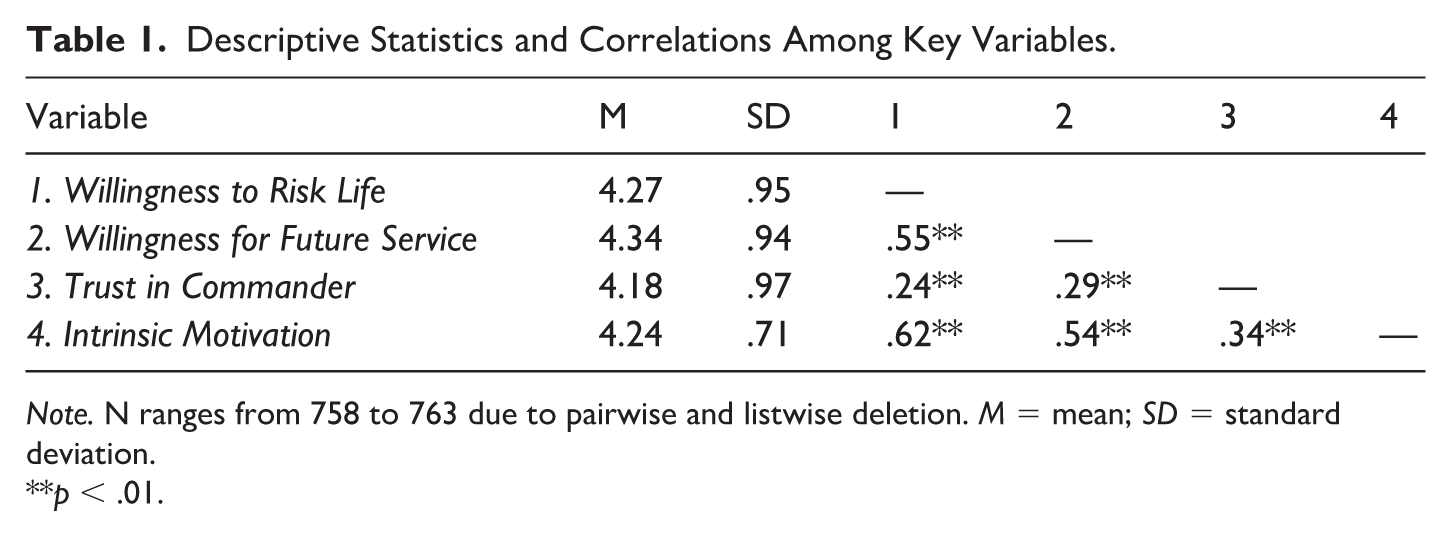
Note. N ranges from 758 to 763 due to pairwise and listwise deletion. M = mean; SD = standard deviation.
p < .01.
As shown in Table 1, willingness to risk life and willingness to return were strongly correlated (r = .55, p < .01), indicating these outcomes are related but distinct. Intrinsic motivation showed strong correlations with both risk life (r = .62, p < .01) and return (r = .54, p < .01). Trust in commanders correlated significantly with both risk life (r = .24, p < .01) and return (r = .29, p < .01), and with intrinsic motivation (r = .34, p < .01).
Figure 1 displays the distribution of civilian concerns selected by reservists (up to four from 12 options). The most frequently chosen were “Family stress/worry” (60.7%), “Impact on spouse relationship” (52.6%), and “Inability to help family in crisis” (46.8%). “Caregiving concerns” was least frequently selected (4.1%).
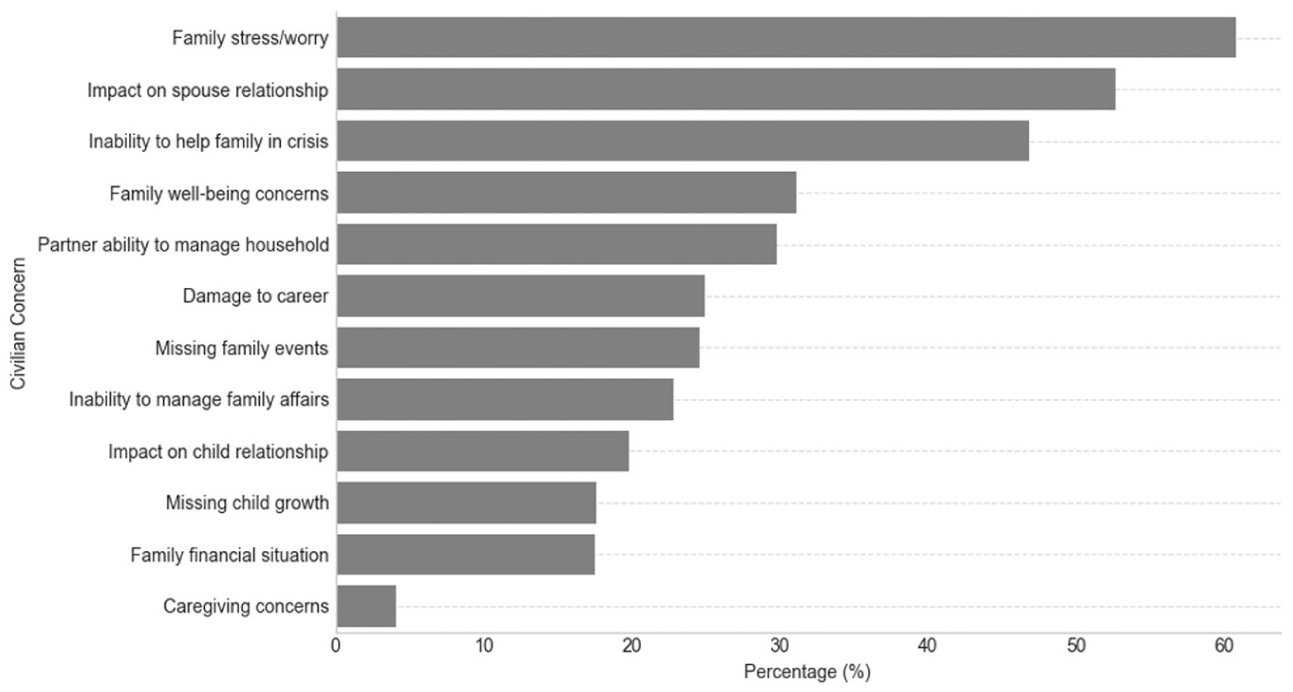
Percentage of reservists selecting each civilian concern.
Hypothesis Testing
To test hypotheses, ordinal logistic regression models were estimated for both outcomes, as this method appropriately models ranked Likert-type-scale data without assuming equal intervals (Agresti, 2010; Bürkner & Vuorre, 2019). Two models predicted willingness to risk life (Model 1, Nagelkerke R2 = .41) and willingness to return (Model 2, Nagelkerke R2 = .34), with predictors including intrinsic motivation, trust in commanders, 12 civilian concerns, and student status. Results appear in Table 2. All models were tested for proportional odds assumption violations. 1
Summary of Ordinal Logistic Regression Models predicting Willingness to Risk Life and Willingness for Future Service.
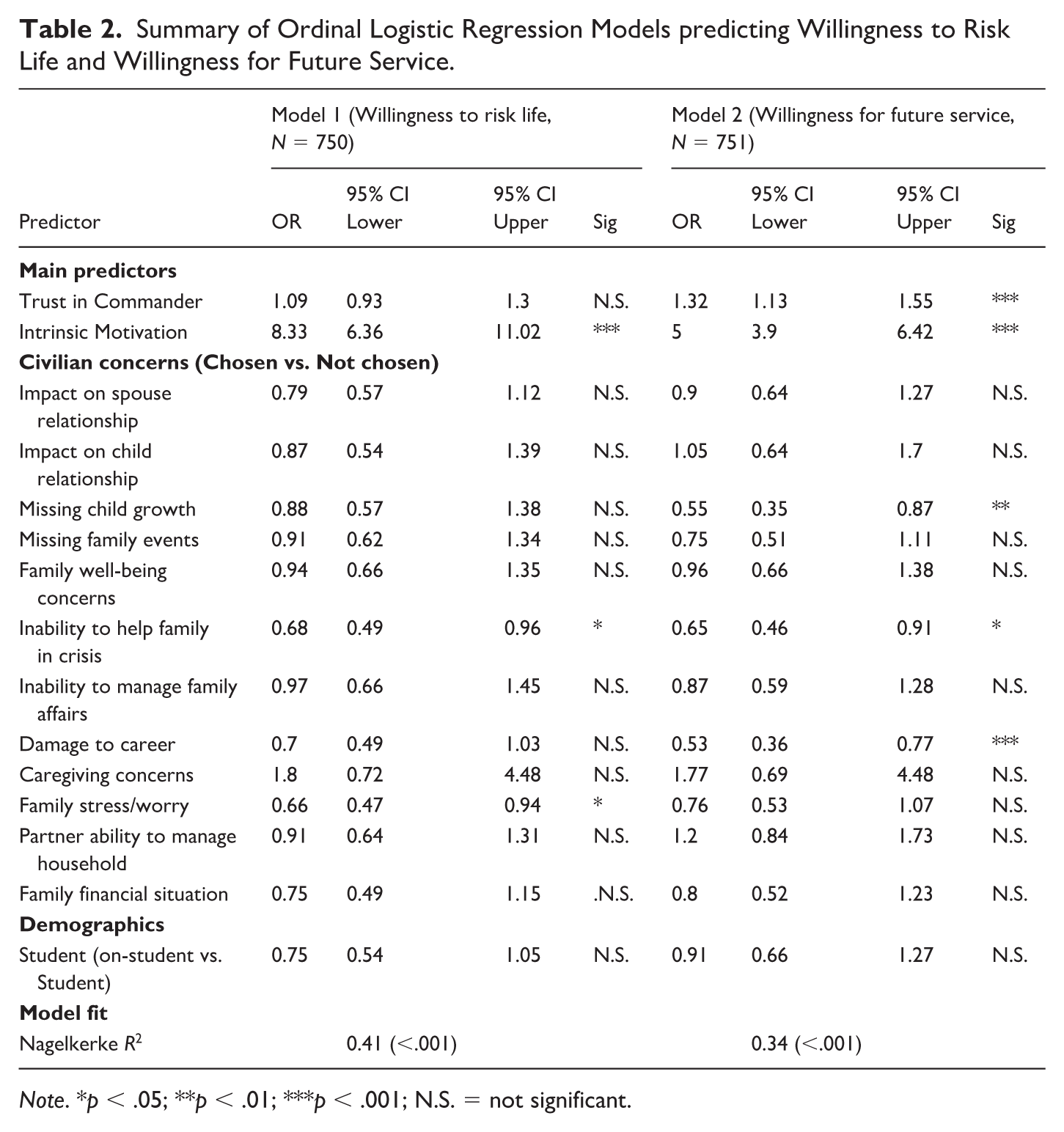
Note. *p < .05; **p < .01; ***p < .001; N.S. = not significant.
Hypothesis 1: Intrinsic Combat Motivation
Both H1a and H1b (Table 2) were strongly supported. Intrinsic motivation powerfully predicted willingness to risk life (OR = 8.33, 95% CI [6.36, 11.02], p < .001) and return for service (OR = 5.00, 95% CI [3.90, 6.42], p < .001), exceeding all other predictors. These findings support Self-Determination Theory: intrinsic motivation rooted in psychological need satisfaction (cohesion, mission necessity, enthusiasm) emerged as the dominant predictor of both outcomes, remaining robust even after controlling for leadership trust and civilian sphere concerns (Deci & Ryan, 2000).
Hypothesis 2: Civilian Sphere Concerns
H2a predicted civilian factors would not affect willingness to risk life. This was largely supported: most civilian concerns showed no significant association, though two emerged as negative predictors: “Inability to help family in crisis” (OR = 0.68, p < .05) and “Family stress/worry” (OR = 0.66, p < .05).
H2b predicted civilian factors would negatively affect willingness to return. This received partial support: only three factors significantly predicted lower willingness: “Missing child growth” (OR = 0.55, p < .01), “Inability to help family in crisis” (OR = 0.65, p < .05), and “Damage to career” (OR = 0.53, p < .001). These findings suggest that specific concerns related to children, family crises, and career—rather than civilian pressures broadly—impact sustained commitment.
Hypothesis 3: Trust in Company Commander
H3a (trust would predict risk life) was not supported: trust in commanders was not significantly associated with willingness to risk life (OR = 1.09, N.S.). However, H3b was supported: trust significantly predicted willingness to return (OR = 1.32, 95% CI [1.13, 1.55], p < .001). This differential pattern—trust matters for sustained commitment but not immediate risk-taking—suggests that trust operates as a long-term relational factor rather than an immediate tactical motivator.
Hypothesis 4: Moderating Role of Trust in Commander
H4 proposed that trust in the company commander would moderate the relationship between intrinsic combat motivation and both outcomes, such that the effect of intrinsic motivation would be stronger when trust is higher. To test this, we estimated additional ordinal logistic regression models (Table 3) including interaction terms between centered intrinsic motivation and centered trust in commanders.
Summary of Ordinal Logistic Regression Interaction Models predicting Willingness to Risk Life and Willingness for Future Service.
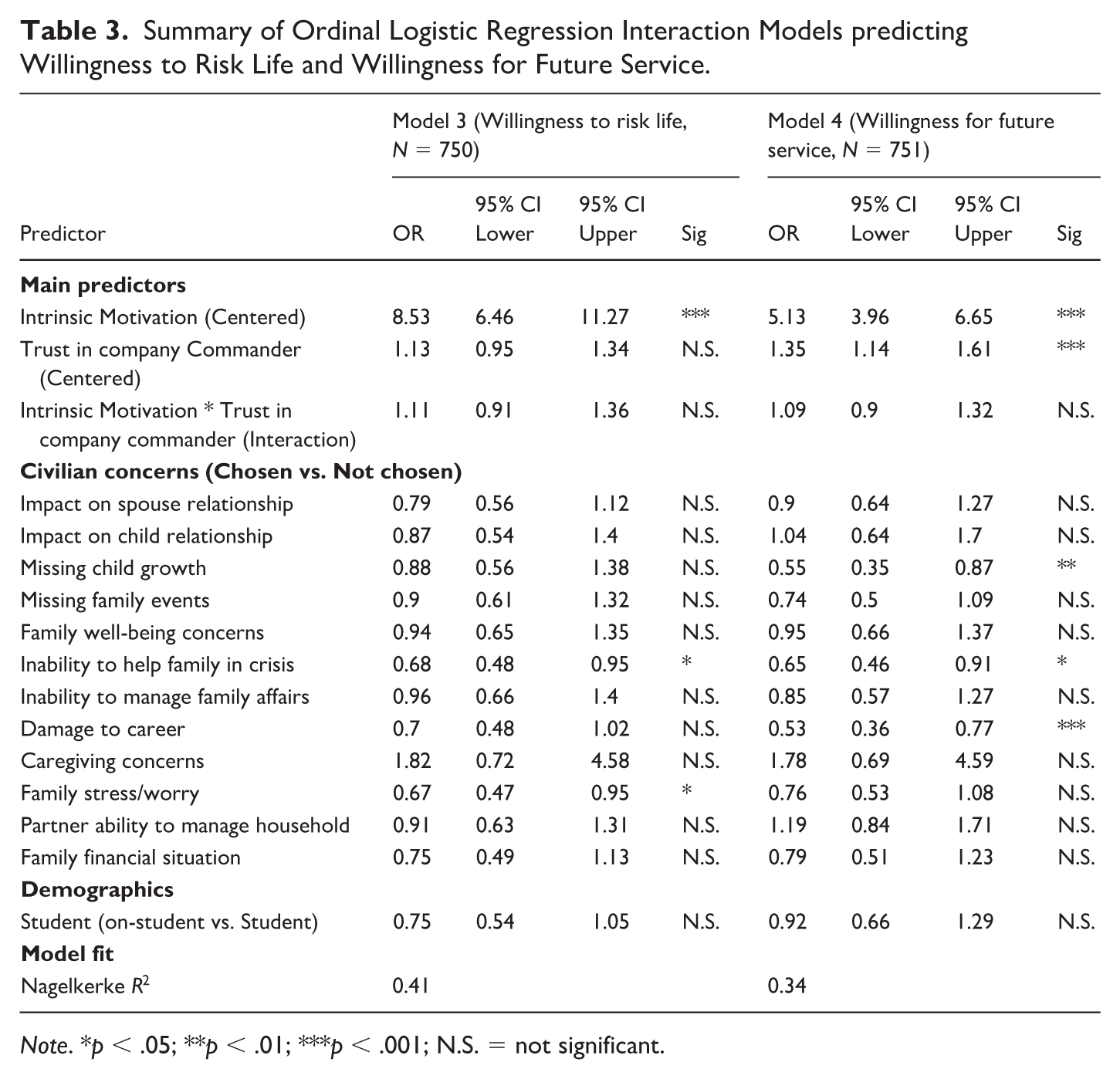
Note. *p < .05; **p < .01; ***p < .001; N.S. = not significant.
The interaction was not significant for either outcome. For willingness to risk life (Model 3), the interaction term was non-significant (OR = 1.11, 95% CI [0.91, 1.36], N.S.). Similarly, for willingness to return (Model 4), the interaction was non-significant (OR = 1.09, 95% CI [0.90, 1.32], N.S.). H4 was not supported: the robust effects of intrinsic motivation on both outcomes did not depend on the level of trust in commanders.
Discussion
This study makes three primary contributions to understanding combat motivation among reserve soldiers. First, we provide the first empirical application of Self-Determination Theory (SDT) to combat motivation, demonstrating that intrinsic motivation—rooted in psychological need satisfaction (relatedness, competence, autonomy)—is a powerful predictor of both willingness to risk life and sustained commitment. Second, we reveal distinct motivational profiles: immediate risk-taking is driven almost entirely by intrinsic motivation, while sustained commitment depends on intrinsic motivation, trust in commanders, and specific civilian concerns (career damage, family crises, missing child development). Third, we demonstrate that trust in commanders operates as a long-term relational factor predicting retention but not immediate combat risk-taking, challenging assumptions that leadership influence operates uniformly across motivational outcomes.
Distinct Motivational Profiles: Immediate Risk-Taking Versus Sustained Commitment
Our key empirical finding—that immediate risk-taking and sustained commitment have fundamentally different motivational profiles—aligns with and extends emerging research on military redeployment and retention. Studies of repeated deployments consistently show that initial deployment willingness is driven primarily by intrinsic motives such as mission commitment and service ideals, whereas redeployment decisions increasingly depend on accumulated experience, leadership trust, family tradeoffs, and career considerations (Griffith, 2021; Kirby & Naftel, 2000; Petty, 2012). Our findings provide the first direct comparison of these motivational profiles within the same sample and context, demonstrating that the distinction operates not only across deployment cycles but also across different types of commitment within a single deployment.
For immediate risk-taking, the motivational profile is strikingly simple: intrinsic motivation dominates, with unit cohesion, perceived mission necessity, and operational enthusiasm accounting for the vast majority of explained variance. Trust in commanders and demographic factors showed no significant effects. Two acute family concerns did reach significance as negative predictors of immediate risk-taking: inability to help a family in crisis and family stress and worry. This is itself consistent with COR theory: It seems immediate, non-deferrable threats to core family resources cannot be fully suspended even in combat contexts. Beyond these, however, unit cohesion, mission necessity, and operational enthusiasm dominated completely. The salience of mission necessity in particular may reflect the nature of the October 7 attack, in which reservists’ own civilian communities were directly targeted (Itsik, 2025a). This pattern mirrors findings that first-time deployers and soldiers facing immediate combat rely heavily on intrinsic mission commitment and unit bonds (Griffith, 2021; Petty, 2012).
In contrast, sustained commitment (willingness to return) exhibits a more complex profile. While intrinsic motivation remains the strongest predictor, trust in commanders emerges as significant, and specific civilian concerns, particularly career damage and missing child development, exert substantial negative effects.
These findings align with Goldfarb and Ben-Zur’s (2017) direct application of COR theory to Israeli reserve combat soldiers, which identified familial and economic resources as the primary domains of loss following reserve duty. Career damage maps onto economic resource loss; among soldiers for whom child development concerns were most salient, missing child growth represents a familial resource loss of a particular kind: developmental milestones are non-fungible in COR terms, as the opportunity for age-appropriate parent-child interaction during sensitive periods cannot be recovered or substituted later (Hobfoll, 1989). This irreversibility may explain why this concern carries the strongest odds ratio in the model, exceeding even career damage.
The Iron Swords War context may have amplified this calculus substantially: unlike the routine duty periods studied by Goldfarb and Ben-Zur, participants had served months of continuous combat and had already received orders for a subsequent deployment at the time of data collection. Under COR’s loss accumulation principle, soldiers were projecting forward into an anticipated cycle of further depletion, a resource calculation that eroded sustained commitment even among those with strong intrinsic motivation. This pattern parallels redeployment literature showing that continuation decisions increasingly weigh leadership quality, perceived organizational fairness, family separation costs, and career tradeoffs (Chun, 2005; Hosek & Totten, 2004; Williams, 2011).
Theoretically, these findings align with learning and evaluation models of military retention, which posit that service members update their expected utility of continued service based on accumulated experience with deployment costs and benefits (Hosek & Totten, 2004). Griffith’s (2021) finding that combat trauma, casualties, and civilian job disruption reduce continuation intentions while job stability and financial security increase them is consistent with this experience-based updating process. In SDT terms, immediate risk-taking appears sustained by autonomous motivation predominantly, while sustained commitment requires both autonomous motivation and an autonomy-supportive organizational environment (represented by leadership trust) in the absence of excessive civilian resource pressures (career and family costs).
COR theory further illuminates this differential pattern. In acute combat contexts, relational and identity resources—unit bonds, mission meaning, professional identity—are not easily substituted or compensated for by other resource types, consistent with Hobfoll’s (1989) observation that resources tied to core self-perceptions face impediments to devaluation or replacement. This may help explain why intrinsic motivation dominated immediate risk-taking regardless of civilian pressures. In contrast, resource loss accumulation across the civilian domain—career disruption, family separation costs, missed developmental milestones—accounts for the erosion of sustained commitment (Goldfarb & Ben-Zur, 2017; Hobfoll, 1989). Practically, these findings suggest that military organizations require different emphases for sustaining immediate combat effectiveness versus long-term retention: the former depends on fostering intrinsic motivation through meaningful missions and unit cohesion, while the latter additionally requires building leadership trust and mitigating civilian resource costs—factors that prior reserve retention research has consistently identified as determinants of reenlistment intention (Randall, 2006; Williams, 2011).
Trust in Commanders: A Relational Factor for Sustained Commitment
The differential role of trust in commanders represents an important finding with both theoretical and practical implications. Trust did not predict immediate willingness to risk life but significantly predicted willingness to return for future service. This pattern challenges assumptions that leadership influence operates uniformly across motivational outcomes and instead suggests trust functions as a long-term relational factor rather than an immediate tactical motivator. In high-stakes combat situations, soldiers rely primarily on intrinsic motivations rooted in unit bonds and mission identification; however, as personal costs accumulate across deployment cycles, trust in leadership becomes crucial for sustaining continued participation.
This finding aligns with organizational research showing that trust is especially critical for maintaining voluntary commitment in contexts marked by ambiguity and personal sacrifice (Dirks & Ferrin, 2002; Kramer, 1999), and extends military retention research demonstrating that leadership quality and perceived organizational fairness predict continuation decisions after deployment (Randall, 2006; Williams, 2011). The fact that trust did not moderate intrinsic motivation’s effects but operated as an independent predictor suggests it works not by neutralizing civilian-military tensions but by providing a relational foundation that sustains soldiers’ willingness to reengage despite accumulated costs.
For reserve forces repeatedly transitioning between civilian and military spheres, interpersonal trust between commanders and soldiers emerges as a strategic retention asset. Building trust through transparent communication, consistent decision-making, and visible concern for soldiers’ civilian needs becomes essential for preserving long-term reserve force readiness during prolonged conflicts.
It is also worth noting that this finding emerged in a context in which institutional and political trust were openly contested. The months preceding the war had seen public debate about reserve service obligations, with many reservists questioning the legitimacy of serving under the circumstances (Harel, 2024; Ziv, 2025). That proximate commander trust retained predictive power for sustained commitment in this environment is consistent with prior Israeli reserve research showing that commanders function specifically as mediators between military demands and civilian life, and that reserve unit relationships are built on social closeness rather than formal hierarchy (Ben-Shalom & Benbenisty, 2019; Sion & Ben-Ari, 2009).
These findings together suggest that interpersonal trust at the unit level may remain operative even when broader institutional trust is strained, though this interpretation requires direct measurement of institutional trust to test properly. It is important to note that the present study measures interpersonal trust in the proximate company commander, a construct distinct from institutional trust in the IDF as an organization and from political trust in governmental decisions regarding the conduct of the war. In the Iron Swords War context, where the October 7 intelligence failure and ongoing debates about the management of the conflict made institutional and political trust actively contested, these forms of trust may carry independent motivational weight beyond the commander relationship. The current data cannot disentangle these levels, which represents a limitation and a direction for future work.
Limitations and Future Directions
Several limitations should be noted. First, the cross-sectional design precludes causal inferences; while intrinsic motivation strongly predicts both outcomes, longitudinal research is needed to establish temporal precedence and test whether motivation changes across deployment cycles. Second, data were collected during active deployment, which enhances ecological validity but raises questions about whether responses reflect immediate emotional states or stable attitudes. Third, the study was conducted in Israel’s unique reserve context, where universal conscription, existential threat perceptions, and civil-military integration differ from volunteer military systems; comparative research in other reserve forces would assess generalizability.
While our SDT-based measure of intrinsic motivation demonstrated strong criterion validity, future work should systematically distinguish between interpersonal trust in direct commanders, institutional trust in the military organization, and political trust in governmental decisions regarding the use of force. In the Iron Swords War context, these constructs were particularly salient and potentially divergent, and their differential effects on combat motivation across deployment cycles represent a critical research priority.
The sample represents a specific subset of ground forces combat units deployed during the war, spanning infantry, armor, engineering, and artillery roles; generalizability to other branches of the IDF reserve system, such as air force, navy, or intelligence units, or to reserve forces in different conflict contexts, cannot be assumed.
In addition, due to strict operational security constraints imposed by the military during active wartime, the dataset does not include key demographic variables such as participant age, military rank, marital status, or parenthood. This precludes the examination of how these individual characteristics may moderate the relationships between motivational orientations and the outcome variables; future research conducted under routine conditions should incorporate these covariates.
Practical Implications
These findings offer actionable guidance for reserve force management. First, fostering intrinsic motivation—through meaningful missions, consistent unit assignments, and tactical autonomy—should be the primary focus for both combat effectiveness and retention, as it satisfies the three SDT psychological needs and is the strongest predictor of both outcomes. Second, sustained retention requires building trust through transparent communication about deployment decisions and visible concern for civilian obligations. Third, the two strongest civilian predictors of reduced willingness to return, missing child growth and career damage, point to distinct but complementary intervention targets. Career costs require structural solutions: legislative protections and employer partnerships that shield reservists from occupational penalties. Missed parental presence requires a different response: reintegration support, family-oriented briefings during the discharge period, and, where operationally feasible, flexible return schedules that allow soldiers meaningful time with their children before the next deployment cycle.
Conclusion
This study demonstrates that Self-Determination Theory provides a powerful framework for understanding combat motivation, with intrinsic motivation emerging as the dominant predictor of both immediate risk-taking and sustained commitment. The finding that these commitments have different motivational profiles—immediate risk-taking driven by intrinsic factors alone, sustained commitment requiring intrinsic motivation plus trust and career considerations—has important implications. For reserve forces during prolonged conflicts, the message is clear: foster intrinsic motivation through meaningful missions and cohesion as the foundation, but recognize that retention requires trustworthy leadership and career protection. Future research should examine how these dynamics evolve across deployment cycles and test SDT’s applicability in other military contexts.
Footnotes
Acknowledgements
The authors wish to thank the IDF reserve soldiers who participated in this study and generously shared their experiences during an exceptionally demanding period of service.

Funding
The authors received no financial support for the research, authorship, and/or publication of this article.
Declaration of Conflicting Interests
The authors declared no potential conflicts of interest with respect to the research, authorship, and/or publication of this article.