







Abstract
This article describes and explains perceptions of how able government bodies are to prevent and handle crises based on surveys of Norwegian citizens and civil servants. The citizens generally have a rather high level of trust in the government’s ability to handle and prevent crises, and there are no big differences between the general public and the civil servants regarding their perception of crisis management. Trust-related factors are the main explanatory variables among the citizens, whereas the variations in the views of the bureaucrats are related to policy area, perceived coordinative capability, and mutual trust between governmental bodies.
Introduction
In this article, we will address how public executives perceive the capacity of the state apparatus to prevent and handle crises, accidents, and catastrophes and how the same capacity is assessed by the general public. 1 Capacity is related to factors like ability, competence, preparedness, organization, and trust. Our analytical focus is on organizations and organizing. How organizations such as government agencies and ministries experience their own capacity to organize might be important for understanding how they handle crises (Hutter & Power, 2005). When a crisis strikes, the political–administrative leadership will first try to define and interpret the crisis and only then assess its capacity (Boin, t’ Hart, Stern, & Sundelius, 2005). Capacity assessment entails not only prioritizing resources but also handling intra- and interorganizational coordination and understanding the various technologies used in different public and private organizations.
Organizations have always been susceptible to uncertainty in the form of external shocks. But such shocks also reveal organizational weaknesses because organizing for routine activities seldom prepares them for crisis. In recent years, there has also been a growing recognition of organizational processes as significant sources of risk. Man-made and manufactured risks have received more attention in the risk-management literature (Beck, 1992; Turner & Pidgeon, 1997), and the interdependency of the various levels of risk processing suggests that regulatory regimes are embedded in organizations, which predefine them (Morgan & Engwall, 1999).
In a representative democracy, it is also important to know how the general public assesses the government’s ability to prevent and handle crises and accidents. That assessment, in turn, is dependent on how the government defines crises and accidents, what information is given, “the generation of meaning,” whether the leadership engages in blame avoidance, and learning processes in government (Boin et al., 2005). If there is a big gap between what citizens expect the government to do, based on their assessment of ability, competence, and former crises, and what government executives think that they are able to do, there might be a legitimacy problem.
We will address such problems by focusing on the case of Norway. Our main research goal is to describe and explain citizens’ and civil servants’ perceptions of how able government bodies are to prevent and handle crises and accidents. We will distinguish between two dimensions of crisis management: The first one is cause of crisis: man-made or of natural origin, even though it is not always easy to separate natural causes from man-made causes of crises (Smith, 2006). The second dimension is phases of crisis. A central challenge is to balance the need for increased prevention against the need for a stronger response and a strategy of resilience (Wildavsky, 2003). Most scholars distinguish between four phases of crisis management: prevention, preparation, mitigation, and aftermath (Boin et al., 2005). However, we will only differentiate between the prevention and the handling of a crisis.
The empirical database is two surveys. The first is a questionnaire given to a representative sample of the population in which citizens were asked about their attitudes to government and governmental activities. The second is a questionnaire given to civil servants in all ministries and central agencies. The citizens were asked how they assessed the government’s ability to prevent and handle various crises and accidents, and the government executives were asked how well prepared their organization was to prevent and handle various crises, accidents, and catastrophes.
We start by giving a brief outline of the Norwegian context generally and in this specific policy area. We then go on to present our theoretical approach to explaining citizens’ and civil servants’ perceptions of the ability of government to prevent and handle crises. For the citizens, we will emphasize broad explanatory factors such as demographic features, trust, and political factors. For the civil servants, we will focus on structural, cultural, and demographic features. In the third part of the article, we will present our empirical data. We start by describing how the government’s ability to prevent and handle various risks and crises is perceived by the general public and by government officials. In the next empirical section, we will analyze variations in the perception of crisis management in the population and among civil servants. In the discussion and conclusion, we will outline and interpret our main empirical findings and discuss some implications.
The Norwegian Context
Norway has relatively strong collectivistic and egalitarian values and a consensus-oriented policy style. The regime’s performance support for democracy and the level of trust in public institutions are generally higher than in most other countries (Christensen & Lægreid, 2005; Norris, 1999), as is the general level of trust in society (Rothstein & Stolle, 2003). The public sector in Norway is large and there is a relatively high level of mutual trust among public-sector organizations.
Over the last decade, Norway has avoided any major disasters or catastrophes, and we will expect this to affect the way citizens look at their government in this policy area and also the way civil servants assess their own capability. A rather high level of trust in government can therefore be expected, in this policy area as well as in others, but we do not have any set of variables or single variable measuring what effect the lack of major disasters or catastrophes might have had that could be used to differentiate between the respondents.
However, some accidents and crises of smaller scale and scope have occurred during this period, and they could be important enough in a rather homogeneous society with a small population (4.8 million). The passenger ship Sleipner, which went down on the west coast in 1999 (15 people dead), is one example. Others are the Rocknes shipwreck in 2004 (18 people dead) and the train accident at Åsta in 2000 (19 dead). In addition, catastrophes that have occurred outside Norway have also affected Norwegian citizens and the Norwegian authorities: For example, 84 Norwegians were killed in the Tsunami in South-East Asia in 2004. Deaths have also been caused by avalanches and as a result of epidemics caused by the e.coli (2006) and giardia (2005) bacteria. In addition, there have been natural disasters resulting in major material damage. Although they have not reached Norway, the SARS and bird flu epidemics have also had an effect on Norwegian public discourse as well as on the authorities. The same goes for the terrorist attacks in the United States (9/11) and the bombings in Madrid (2004) and London (2005).
Some of the accidents in Norway have led to the reorganization of government crisis-management organizations (Fjell, 2007), whereas others have not. The government launched a reorganization of the central apparatus for crisis management in 1999 by appointing a public commission to assess the vulnerability of Norwegian society. One of the commission’s main proposals was to improve vertical and horizontal coordination in the security administration by establishing a new special ministry of crisis management. However, these recommendations were not approved by the government in the White Paper presented to the Parliament in 2002 (St.meld. No. 17 [2001-2002]). Somewhat surprisingly, the process resulted in only minor changes in the crisis administration (Lægreid & Serigstad, 2006). Ultimately, a hierarchical model of this kind proved to be too radical for the ministries involved, and the government favored an upgrading and strengthening of the agencies in the field. In contrast to the major dispute that took place over the organizational model, there was overall agreement about what the problems were in the field of crisis management. Most of the bodies and actors involved acknowledged the problems of fragmentation, weak coordination, and low priority assigned to crisis management, but no agreement on a radical organizational solution was possible.
It may seem paradoxical to focus on crisis management and legitimacy/trust in a system with a generally high level of trust and legitimacy, and comparatively few examples of disasters and major crises. In fact, crisis management questions have been more on the agenda in the last decade than one might expect, and there have been several public reports on the organization of crisis management and occasionally heated public debate on these questions. One reason for this may be that a combination of long-term lack of experience with major crises and disasters, an increasingly threatening world, and national versions of these environmental scares on a smaller scale has made both the authorities and the public feel more insecure and vulnerable. Another reason may be that the Norwegian way of handling insecurity and pressure for change is to launch reorganization processes that often are characterized by negotiation, resulting in compromise and limited change. This has also been the case concerning crisis management.
Part of the picture is also that Norway often takes part in handling of crisis in other countries. Norway has a reputation as an international crisis manager, particular in participating in solving humanitarian crises, and its financial contributions are disproportionally greater than the size of the population. This creates of course an attention toward crises in Norway. Although the self-evaluation of Norway as an international crises manager is generally high in the population, this may create belief in the government’s ability also to manage domestic crises, both when it comes to on spot handling and financing.
Theoretical Approach
Our theoretical approach will be twofold: We will first present perspectives that may be helpful for understanding and explaining citizens’ perception of the capability of the authorities to prevent and to handle what can be termed “crisis management.” We will proceed by presenting an approach that will help us understand why civil servants perceive their own ability in the field as they do.
Citizens’ Assessments of Crisis Management
In a representative democratic system, it is very important that the way the authorities solve problems and handle tasks is accepted and trusted by the general public. This also applies to crisis management. The authorities need the acceptance, support, and sometimes even assistance from and help of citizens. In crisis management, which by nature does not generally involve routine tasks and which sometimes requires an immediate response from the authorities, it can be argued that it is particularly important that the authorities’ approach to problem solving is regarded as legitimate by the general public.
One basis for focusing on public legitimacy is to use the distinction Easton (1965) makes between diffuse and specific support, meaning that people either have a general attitude of trust or distrust toward the political–administrative system as such, including its basic institutions and actors, or else focus their attitudes in a more differentiated manner on specific institutions and actors. If we combine the facts of high generalized legitimacy and rather few major disasters and crises, a valid approach is to look at how citizens assess the capacity of the authorities to handle tasks in specific public areas/policy fields, as a measure of trust in and perceived legitimacy of the system. This assessment is, as indicated, expected to be at a high general level but is also expected to vary with different independent variables. The way citizens in Norway assess public-sector problem solving has formed the subject of a lot of studies, at both the central (Christensen & Lægreid, 2005) and local levels (Rose & Pettersen, 2000). We thus know that public assessments vary significantly (Huseby, 1995; Strømsnes, 2003) and particularly with regard to broad welfare areas; specific groups of variables have been tested and found significant as explanatory factors. We will use these groups of variables as our starting point for formulating assumptions about the public assessment of the security field.
The most common group of variables used to explain variations in how citizens assess public-sector tasks and problem solving are what in theoretical terms are named demographic features. 2 We will include three demographic variables here, particularly the most typical socioeconomic variables, reflecting societal experiences as a basis for explaining attitudes toward crisis management. The first one is civil status. If people are married and/or have a family of their own, they tend to be more integrated in society but probably also more dependent on the public sector. Our argument is that both these features will make them more generally supportive toward the authorities’ approach to problem solving and specifically toward the prevention and handling of crises.
In our analysis, we will include an occupation variable linked to whether people are working, studying, or living on various kinds of benefits. We will assume that people who are living on benefits or who are students are more dependent on the authorities for problem solving and also on their ability to handle and prevent crises and that therefore they will also have a more positive attitude toward them.
Our third demographic variable is age. Generally, one would expect trust in government to increase with age; older people tend to be more collectively oriented, whereas today’s younger generation has experienced a public sector that is either shrinking or blending in elements from the private sector; older people have experienced the buildup of the welfare state and will therefore tend to have more trust in government. 3
In scrutinizing public-sector tasks and problem solving, one explanatory factor that has gained much attention recently is what can broadly be termed trust. Trust is one of the most widely used concepts in contemporary social science research (Prakash & Selle, 2004). However, it is a multifaceted and a highly contested and controversial term. We will include in our analysis two aspects that have been theoretically linked to trust by other researchers: one connected to general trust in society (Putnam, 1993, 2001) and the other more specifically related to trust in the political and institutional system (Rothstein, 1998).
To measure general trust, we will construct a variable called social trust. We will assume that if people mistrust their fellow citizens and thus, according to our definition, have a low degree of social trust, they will be more skeptical about the ability of public-sector organizations to manage tasks (Rothstein, 1998); this may also be true for crisis-management matters. For Putnam, religious activity is an important creator of social trust (Putnam, 2001). In Norway, too, this variable has been shown to have some effect on peoples’ participation in elections and also on their assessment of the authorities (Strømsnes, 2004). Putnam’s (2001) argument is that people who attend religious meetings and services regularly are integrated in communities and this makes them more trustful toward society. We will assume that this is also so in Norway and that this sort of integration makes people more supportive toward the authorities. However, strong religious integration can foster skepticism toward a public sector that may be interpreted as threatening. The last variable we will include in this group—how respondents subjectively assess their own position in society—is in some ways connected to the former one. We will assume that people who regard themselves as holding a high rank in society will also be most integrated in that society and therefore have the most positive attitudes to public task solving—also in the particular field studied here.
Trust in the political and institutional system will be measured as a combination of the respondents’ self-confidence—indicated by the extent to which they believe they can affect political decisions—and whether they see politicians as trustworthy. By combining the responses to seven statements in the survey, we have constructed a variable which we call political efficacy. 4 Our hypothesis will be that a high degree of political efficacy will mean a high level of confidence in the authorities’ ability to prevent crises and to handle crisis management. Furthermore, we will include a variable that covers the respondents’ attitudes toward civil rights in this particular field. The assumption is that people who are more oriented toward civil rights and civil liberties will have less positive attitudes toward the government’s ability to handle and prevent crises. Their attitude may arise out of mistrust of the authorities’ ability to prevent and handle crises, necessitating the introduction of extraordinary measures.
When citizens’ assessment of the public sector is scrutinized, one group of variables is normally always included—namely, political factors, like party affiliation and how respondents rank themselves along a left–right spectrum. In politically stable countries like Norway, these factors tend to have rather weak explanatory power (Christensen & Lægreid, 2005; Rose & Pettersen, 2000). We will nonetheless include these variables in our analysis because crisis management is a policy area that may be special in the sense that it implies a tension between leftist support for regulation but not in violation of civil rights, and right-wing support for draconian measures, particularly when it comes to combating terrorism. When the survey was conducted, the Centre-Left government, which came into office in 2005, was 1 year into its term. We will assume that those who voted for the parties that formed this government still have confidence in its ability to solve and handle problems in general and those concerning internal security in particular. The same argument applies to ranking the respondents on a right–left spectrum. As, in Norwegian terms, the government has a pronounced leftist orientation, we will assume that respondents who regard themselves as left oriented will have a more positive attitude toward the ability of the authorities under this particular government. However, this assumption maybe contested if rightists support strong regulatory measures only in this special policy area.
Civil Servants and Crisis Management
Inside the civil service, other factors will be of importance for understanding and explaining civil servants’ assessment of their own capacity to cope with tasks and solve problems. These include their jurisdiction, their knowledge of the field in question, their contact with other actors inside this field, and their overview of the public sector more generally. Many of these factors are related to what can broadly be defined as formal structure. Where actors are structurally located is a reflection of vertical and horizontal specialization (Egeberg, 2003). The field of crisis management throws up governmental complexities and dilemmas along vertical and horizontal axes (Wise & Nader, 2002). The experience of recent accidents and crises has shown that inadequate organization and failure to coordinate, both at lower operative levels and higher administrative levels, are recurring problems, and several studies and reports have corroborated this finding (Kettl et al., 2004; Wise, 2002). Thus, we will expect coordinating capability to affect perceptions of crisis-management capability. In the fields of safety and security, tasks and responsibility tend to be spread among several sectors and levels and involve a large number of actors. As shown, in Norway, the willingness to coordinate these fields better has been rather moderate.
Crisis management is by nature a fragmented, complex, and disjointed area and a growing number of cases and problems do not fit into the traditionally functional structure of polities (Kettl, 2004). In organizational theory, such problems are classified as “wicked problems” (Dror, 1986; Harmond & Mayer, 1986). Coordination is further complicated by the vertical nature of policy making. As a rule, modern polities are organized according to the principle of purpose, which makes them vertical in nature and characterized by strong functional sectors—pillars or silos—and weak coordinating mechanisms (Kettl, 2003). In the case of crisis management, the traditional problems of organizational coordination are multiplied and the stakes associated with success or failure vastly raised (Kettl, 2004).
Fundamentally, these difficulties of coordination in crisis management are about politics, values, and trust (Kettl, 2004). When crises occur, citizens criticize public agencies and civil servants. Another problem is that there is a trade-off between security on one hand and civil rights and civil liberties on the other hand, an issue that was intensively debated in many countries when tougher terrorist laws were proposed after 9/11 (Etsioni, 2004; Rykkja, Fimreite and Lægreid 2011).
In our empirical analysis of the variation in civil servants’ perceptions of the ability to prevent and handle crises, we will apply three sets of organizational or institutional features. According to an instrumental-structural perspective, decision-making processes in public organizations are either the result of strong hierarchical steering or negotiations among political and administrative leaders (March & Olsen, 1983). In addition, the formal structure of public organizations will channel and influence the models of thought and the actual decision-making behavior of civil servants (Egeberg, 2003; Simon, 1957). A major precondition for such effects is that leaders score high on rational calculation (Dahl & Lindblom, 1953), meaning that they must have relatively clear goals, choose structures that correspond with these goals, and have insight into the potential effects of the structures chosen. A major precondition for the connection between the overall focus on rational calculation and the specific variables chosen is that certain civil servants in certain positions, related to hierarchical level and tasks, will have an attention structure and knowledge that give them more insight into crisis management and will therefore assess situations different from civil servants with other positions and tasks.
We focus on the importance of five structural variables for understanding the variation in perceptions of crisis-management capability among civil servants: policy area, position, tasks, perceived coordination capability, and management tools. The relevance of policy area is measured by drawing a distinction between ministries and agencies more directly involved in crisis management in different sectors. We would expect civil servants in agencies and ministries with a specific crisis-management responsibility to perceive their authorities’ ability to prevent and handle crises as greater than people not belonging to such policy areas.
Furthermore, the basis of our expectations is that diversity in structural position, seeing crisis management from different points of departure, and performing tasks that involve knowledge bases, networks, and activities will create variety in the assessment of crisis management. Our general assumption is that civil servants in leadership positions will generally give a more positive evaluation of their own organization’s ability to handle and prevent crises than people without leadership responsibilities. Crisis management in central agencies is primarily attended by people in leadership positions. Leaders are primarily meant to attend to or to be responsible for handling and preventing crises and they will therefore see them from a top hierarchical-coordinative perspective. In addition, we would expect civil servants whose main tasks involve staff functions to have a more positive attitude to crisis management than civil servants with other tasks because their daily work involves tasks that bring them more into contact with crisis prevention and handling.
Two more structural variables are used. Perceived coordination capability measures whether civil servants see their own organizational unit as scoring high on coordination capacity or not. We would expect employees who perceive such capability also to score higher on perceived preparedness of the authorities to prevent and handle crises. The last variable is the use of diverse management tools, whether hard or soft, as extensive use of these tools may indicate a positive attitude toward renewal and therefore a perception of crisis management as part of modernization. 5
The second perspective used in the analysis is the cultural-institutional one (Selznick, 1957). Such a perspective views the development of a public organization as based on historical traditions, path dependency, and informal norms and values (Krasner, 1988; March, 1994). Actors will think and act according to a logic of appropriateness, not one of consequence. What is appropriate for a civil servant to do is defined by the institution to which he or she belongs and internalized through socialization (March & Olsen, 1989). Common identities and a high level of mutual trust are central characteristics and they make it possible to coordinate many activities in ways that make them mutually consistent. A high level of mutual trust tends to enhance appropriate behavior and vice versa. In civil service systems with strong vertical sector relationships, such as Norway, civil servants know what they are supposed to do and how to act and this creates and maintains trust relationships within the different sectors, but it may also constrain trust and coordination among sectors (Fimreite et al., 2007). One would expect there to be a tension between a more traditional sector culture concerning crisis management and a new more holistic and collaborative one.
Thus, we would expect administrative culture and context to make a difference for perceived crisis management capacity. People in ministries and central agencies with a high level of mutual trust will generally be expected to make a more positive evaluation of these organizations’ ability to handle and prevent crises. The same will be the case for people with a high level of identification with their own organization or with the central government in general. Another general expectation is that civil servants working in a policy area with a high level of conflict may be less likely to perceive crisis management positively.
Third, we need to be sensitive to demographic variables as explanatory factors for different perceptions of crisis management. The focus will be more on where civil servants come from and the social background they bring with them into the ministries and central agencies regarding norms, values, and competence, than where they are located in the organizational structure or the administrative culture.
The general reasoning here is that civil servants, through their socioeconomic background or their individual careers, have acquired certain norms and values that are relevant in their jobs. The more specific questions will be whether such differences in background systematically lead to variations in their perception of crisis management. Will civil servants who are older and have a longer tenure experience the various coordinative efforts different from their younger, less experienced colleagues? Will there be gender differences, with women taking a more positive attitude to the authorities’ ability to prevent and handle crises? Will educational background help to explain the variation?
Data and Method
The empirical data in this article are based on two surveys, both conducted in 2006, one of the general public and one of civil servants. All civil servants with at least 1 year tenure, from executive officers to top civil servants in Norwegian ministries, and every third civil servant in the central agencies were included. The response rate was 67% in the ministries and 59% in the agencies. The survey of the general public was based on a representative sample of Norwegian citizens between 18 and 79 years old. The questionnaire was sent by e-mail to 2,700 individuals and 1,368 responded. The response rate was 50%. 6
We take a broad empirical approach to the question of crisis management. The general public was asked the following questions: “What trust do you have in the Norwegian authorities’ ability to prevent various types of accidents and crises?” and “How competent do you think the Norwegian authorities are to handle various types of accidents and crises?” For both questions, we listed three types of accidents and crises: (a) natural disasters such as avalanches, flooding, and storms; (b) air, railway, road, and shipping accidents; and (c) infections related to food and drinking water like e.coli or epidemics such as bird flu. For the first question, the respondents were asked to rank their trust from 1 (very high trust) to 5 (very little trust). For the second question, the options were ranked from 1 (very competent) to 5 (very incompetent).
The civil servants were asked to answer the following questions: “How well prepared are the public authorities in your field of work to prevent and handle crises, accidents, and disasters (e.g., avalanches, storms, plane crashes, railway and shipping accidents, epidemics, and terrorist attacks)? We asked the respondents to rank their answers from 1 (very well prepared) to 5 (very badly prepared).
The Dependent Variables—Prevention and Handling of Crises
Table 1 reveals three main findings about how citizens assess the government’s ability to handle crises. First, the general level of satisfaction is pretty high. In general, more people score high than low on trust and confidence in the government when it comes to crisis management. Second, citizens have more confidence in the government’s ability to handle crises than to prevent them. This is especially the case when it comes to natural disasters, but it also applies to some extent to transport accidents. Third, there are some variations between different types of accidents and crises. The government scores highest on trust and competence among citizens when it comes to handling transport crises and accidents. The citizens’ assessment of the government as incompetent is highest when it comes to dealing with epidemics. This is not surprising given that the survey was conducted around the time that both a giardia and an e.coli epidemic broke out in Norway. Regarding crisis prevention, the citizens were most skeptical about the government’s ability to prevent crises arising from natural disasters. Crises following from flooding, storms, and avalanches are not easy to prevent, in the view of a majority of citizens.
Citizens’ Assessment of the Government’s Ability to Prevent and Handle Various Types of Crisis (2006 Percentage)

Note: “Don’t know” is excluded (about 3%). Differences between the two questions and their categories are significant at .01 level (two-tailed t test).
Even though the differences commented above are statistically significant at .01 level, there is also a high positive intercorrelation between citizens’ assessment of different types of accidents and crises and their evaluation of the prevention and handling of these crises. The pattern here is cumulative. The average correlation is .54 (Pearson’s r significance = .01). This means that if citizens’ responses generate high scores for one type of crisis, they will do so for the other two types as well; in addition, a high level of confidence in the government’s ability to prevent crises seems to go hand in hand with confidence in its ability to handle them. Thus, there is a tight coupling between perceptions of different types of crisis and prevention and reaction.
Table 2 shows that civil servants generally report that they are well prepared to prevent and handle crises, accidents, and disasters within their own field of work. Two thirds of the civil servants in the ministries and agencies who expressed an opinion on this issue said they were either well or very well prepared. However, one third of our respondents answered “don’t know” or “not relevant.” This relatively high score indicates that many civil servants work with tasks or in agencies that are not closely related to crises, internal security, or accidents.
Perceptions Among Civil Servants and Citizens in General of How Well Prepared Government Authorities Are to Prevent and Handle Crises
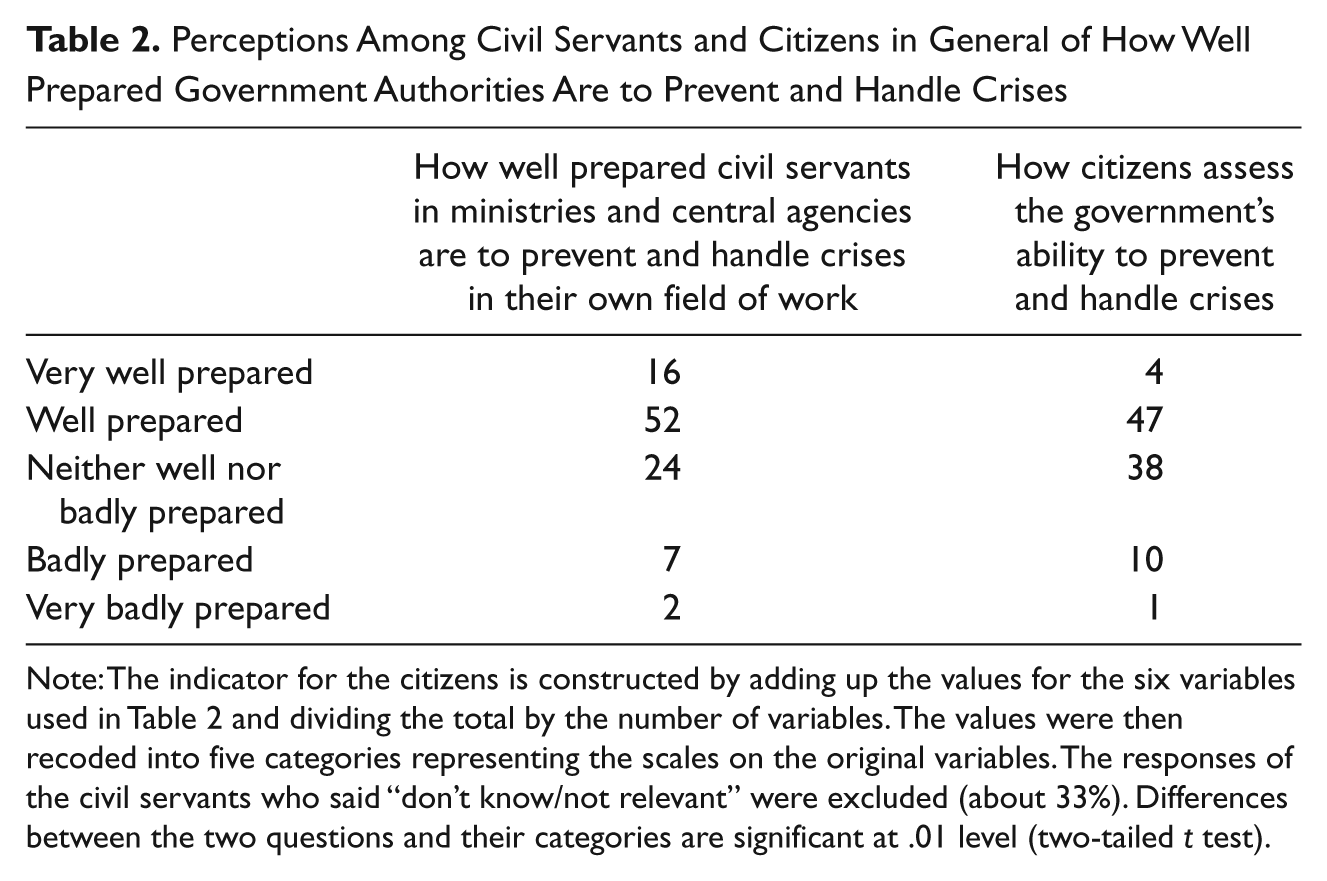
Note: The indicator for the citizens is constructed by adding up the values for the six variables used in Table 2 and dividing the total by the number of variables. The values were then recoded into five categories representing the scales on the original variables. The responses of the civil servants who said “don’t know/not relevant” were excluded (about 33%). Differences between the two questions and their categories are significant at .01 level (two-tailed t test).
The questions posed to the civil servants and general public were not identical, and this makes a comparison between the two populations somewhat difficult. However, we did construct an index based on the different questions to the citizens that makes it possible to give a rough comparison with the profile of the civil servants in the ministries and central agencies. 7 The main impression is that the citizens are more skeptical about the preparedness of government bodies than the civil servants are. Although 68% of the civil servants said they were well prepared to prevent and handle crises, only 51% of the citizens agreed with this. However, in both groups, only a small minority said the government bodies were badly prepared. There is a need for comparison with other countries to reveal whether Norway differs in this matter.
Multivariate Analyses
This section focuses on how the findings presented in the above section can be explained by our theoretical approaches and the independent variables constructed from them. We start by focusing on the citizens.
Variations in Citizens’ Perception of Government’s Crisis-Management Capability
We conducted stepwise ordinary least squares (OLS) regression analyses, using the same model for each dependent variable. 8 The variables that displayed the most stable significance are presented in Table 3.
Summary of Regression Equations by Demographic and Political–Cultural Features Affecting Citizens’ Perceptions of the Government’s Ability to Prevent and Handle Crises (Beta Coefficients, Linear Regression)
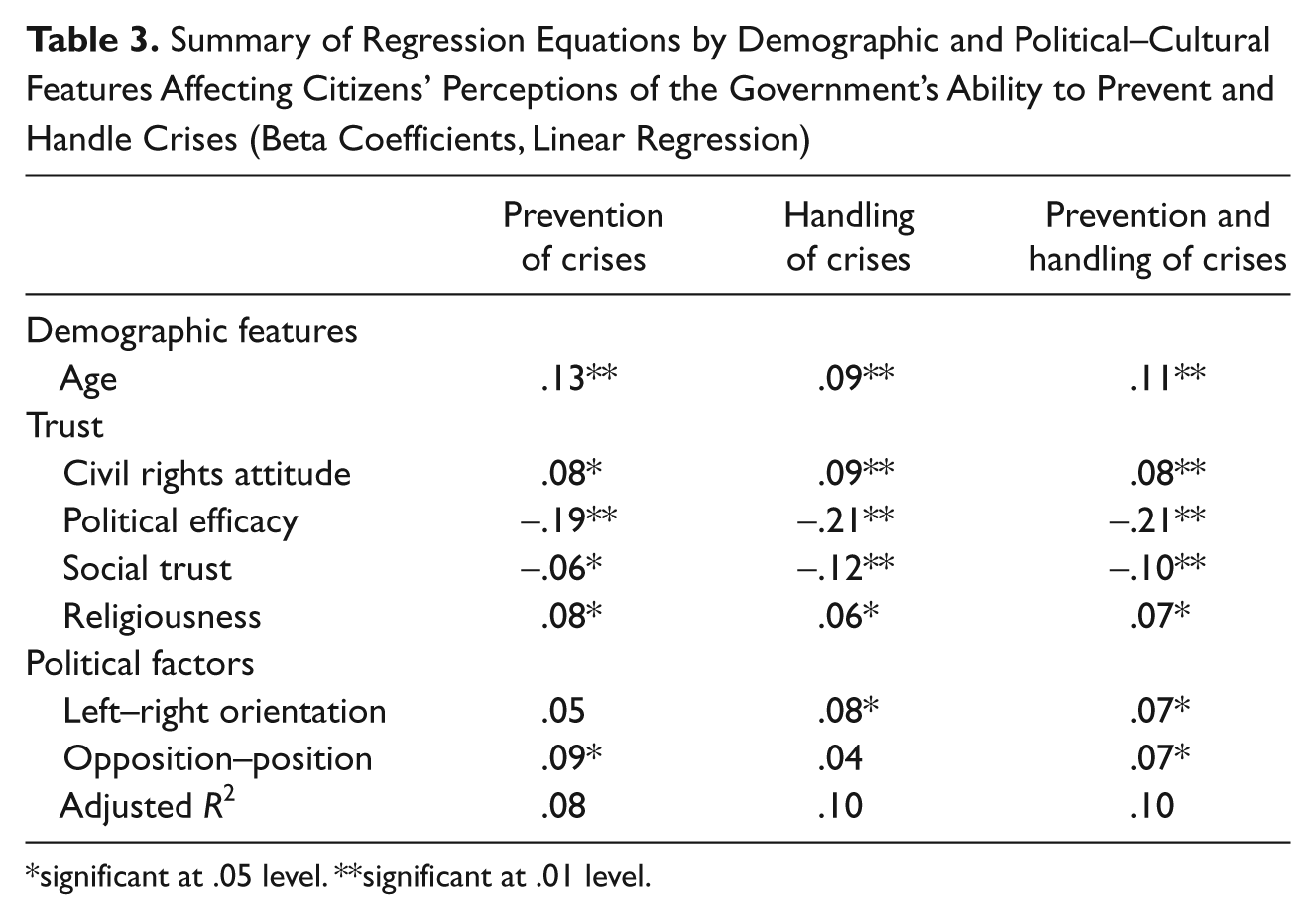
significant at .05 level. **significant at .01 level.
The multivariate analysis reveals, as we assumed in the theoretical section, that variables categorized under the broad term trust are important for explaining variations in the public’s perceptions of the authorities’ ability to prevent and handle crises. As we expected, people with high political efficacy—which can be interpreted as high trust in political institutions—also have a high level of trust in the authorities’ ability to prevent and handle crises. This corresponds with other research in and on Scandinavian countries. Bo Rothstein’s (1998) argument about the universal welfare state’s ability to create general trust also seems to be relevant for the field of internal security. But social trust is also important. Both aspects highlighted by Putnam in his discussion of trust—confidence in fellow citizens (1993) and religious activity (2001)—explain, as we assumed, positive assessments of the ability to handle and prevent crises.
One variable categorized under the broad label of trust is attitudes to civil rights. As we expected, people who value civil rights highly give the lowest assessment of the authorities’ ability. Their skepticism maybe due to the fear that the authorities may easily infringe civil rights when adopting crisis-prevention and management measures (Kettl, 2004). Political factors were also shown to be important, maybe more so than we expected. Our assumption that left-oriented respondents tend to assess prevention and handling of crises in this field more positively than right-oriented respondents gains some support. This is somewhat in contrast to the conventional wisdom that leftists are more system skeptical than others. Our other political variable—namely, whether the respondents voted for one of the three parties forming the Centre-Left government that took office in 2005—may account for this. As already mentioned, this government has a pronounced leftist orientation. What we see here may therefore reflect more general confidence in the ability of the new government than specific confidence in government ability in this field. The effect of the variable opposition versus position supports such an interpretation.
The demographic features we included in our analysis are somewhat less important than we assumed. Just one variable from this group has a significant affect on the assessments, and that is age. But this variable has the opposite effect of what we assumed. Older people are more skeptical about the authorities’ crisis-management ability than younger people are. Our theoretical argument was connected to old peoples’ general trust in the authorities. What we see here may therefore be the consequence of something else: older people’s greater fear and uncertainty about unknown situations that they cannot control or perhaps also that they have longer memories of crises and disasters and a higher level of insecurity.
Variations in Civil Servants’ Perceptions of Their Crisis-Management Capability
We now turn to the question of the relative explanatory power of the various independent variables for civil servants’ views of their own ability to prevent and handle crises. Here, too, we conducted a stepwise OLS regression analysis. The variables with the most stable significance are presented in Table 4. 9
Summary of Regression Equations by Structural, Cultural, and Demographic Features Affecting Civil Servants’ Perceptions of the Government’s Ability to Prevent and Handle Crises (Beta Coefficients, Linear Regression)
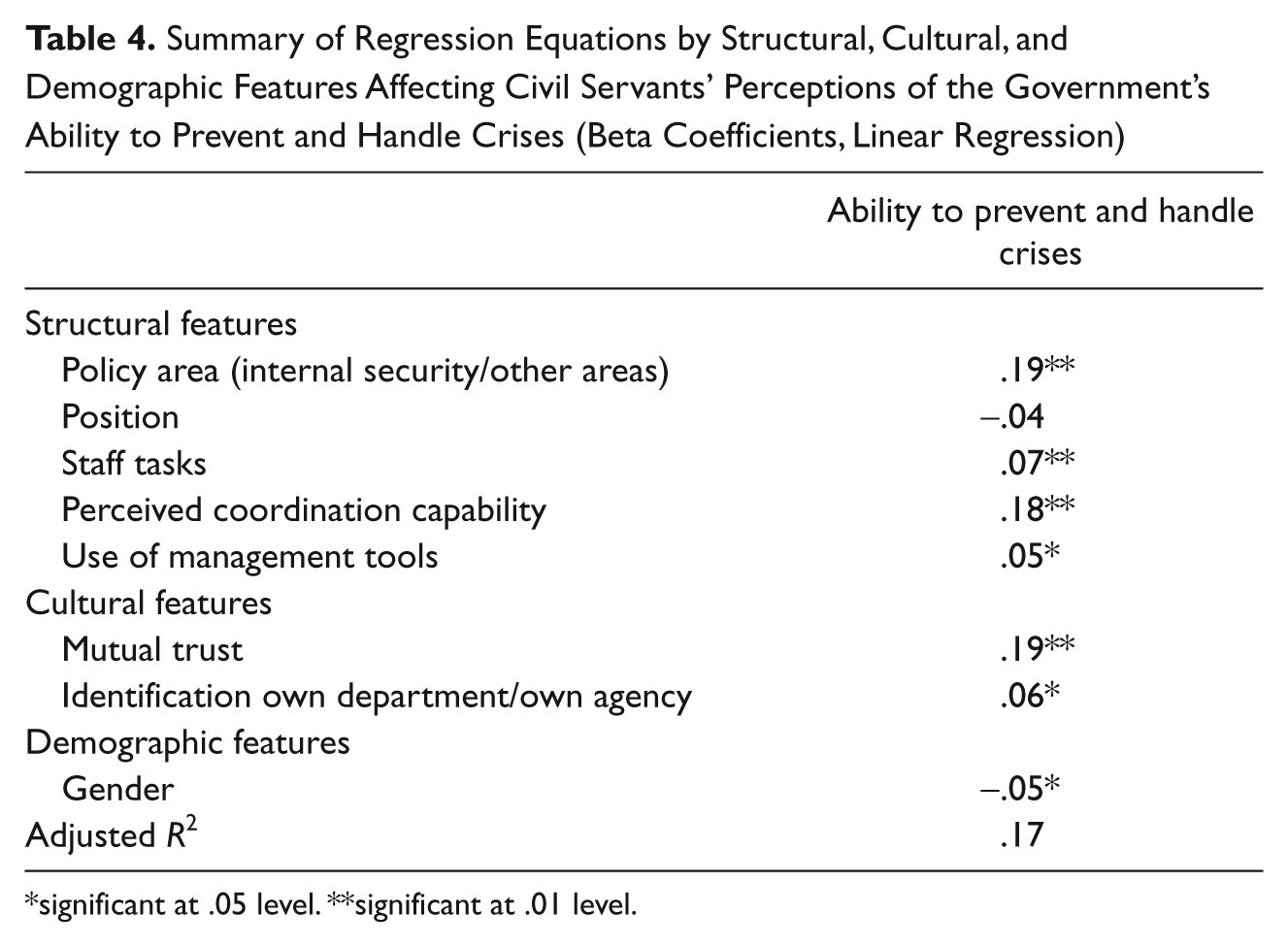
significant at .05 level. **significant at .01 level.
The multivariate analyses show that compared with the citizens’ assessments of crisis-management capability, we are able to explain a fair amount of the variation in the civil servants’ assessments. Policy area makes a significant difference. Civil servants working in agencies with special responsibility for internal security and crisis management are significantly more satisfied with their own crisis-management capability than those working in other agencies. This might illustrate the problem of practicing the principle of sectoral or institution-based responsibility. Theoretically, we would expect that integrated crisis management would result in less awareness of those tasks and conversely that more separate and specialized organization of functions would result in more awareness and capacity. Indeed, that is exactly what our data indicate. But these results say nothing about how easy it is to coordinate crisis management between agencies that are heavily focused on these tasks. We also see a clear effect of another structural variable: coordination capability. Civil servants scoring high on coordination capability report a higher level of perceived crisis-management capability than those who report problems of coordination. Having personnel work as a main task and use of management tools also seem to produce an effect, but it is much weaker. The same is the case for civil servants reporting that modern management tools, such as knowledge-based management, team-based management, value-based management, ethical guidelines, service declarations, and benchmarking, are important in their own field of work. The effect of leadership position is not significant in the final model but is significant if we exclude personnel tasks from the model.
Cultural variables also have an effect. In particular, a high level of mutual trust between ministries and central agencies tends to enhance perceptions of crisis-management capability. There is an effect of identification with own agency or department, but this is weaker. There is also a significant effect of one demographic variable, gender. Men tend to score higher on their assessments of crisis-management capability than women. 10
Discussion
Specific features and contexts of this policy area lead to differentiated reactions from citizens, and this can be related to our two dimensions of crisis management: phases of crises (prevention or handling) and causes of crises (man-made or of natural origin). Citizens are generally most positive when it comes to the government’s ability to handle man-made crises and transport accidents and most skeptical regarding the prevention of natural disasters, such as avalanches, flooding, and storms (Table 5). This is in many ways a natural reaction and perception of risk. If one believes in modern technology, as people in Western societies tend to, it is easier to imagine the government coping with man-made crises than with natural disasters, which will normally be seen as unpredictable and difficult to handle. This might be important given that climate change and the increased number of media reports of natural disasters are likely to raise people’s level of fear and insecurity.
Citizens Perceptions of Different Phases and Causes of Crises
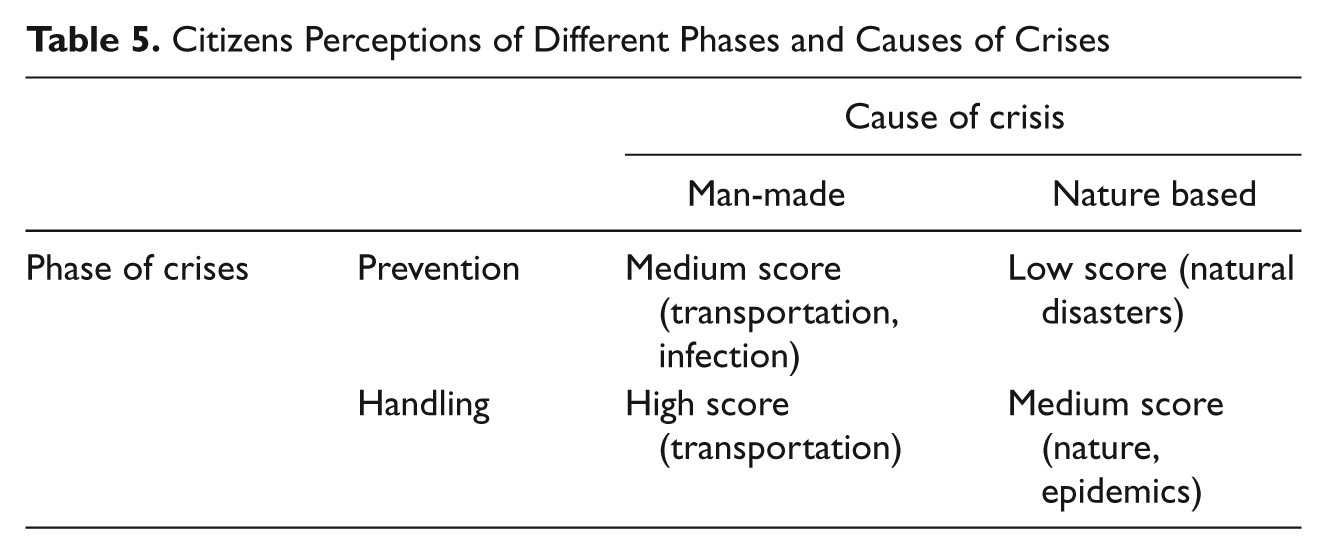
Citizens have more confidence in government authorities’ ability to handle crises than to prevent them and more confidence in crisis management in the area of transport than in the area of epidemics. Again, this seems plausible for two reasons. Crisis prevention will cost a lot of money and it is not easy to have enough resources to maintain an overall high level of prevention, particularly because certain kinds of disasters happen seldom. But crisis prevention can also save a lot of money (see Wildavsky, 2003). Handling crises that have already occurred is another matter because that is more specific, and it is therefore easier to focus resources and efforts. International experiences might also be part of this picture. International crises management experiences may also be part of the picture. When Norway is involved in crises abroad, it is normally about handling and not preventing them. When citizens differentiate between sectors, they are obviously influenced by the frequency of experiences and media coverage. Specific experience with infectious diseases in Norway, like e.coli, or media coverage of scandals like SARS, bird flu, and mad cow disease, probably make people more skeptical about prevention and handling capability. By contrast, the handling of major transport crises or accidents, which happen very seldom in Norway, yield the highest score on trust and legitimacy.
All in all, citizens have a rather high level of trust in the government’s ability to prevent and handle crises. But there are some variations in their perception because they trust handling more than prevention. They also see both prevention and handling as more secure in man-made than in natural disasters. But despite this variation, it is only the score for the prevention of natural disasters that is low, whereas for all the other types, the scores are medium or high. This indicates that citizens’ trust in government when it comes to crisis management is pretty generalized. If they have trust along one dimension and one area they also have trust along most other dimensions and areas. This confirms the distinction Easton (1965) makes between diffuse and specific support. A broad empirical analysis of the crucial factors explaining citizens’ attitudes to public service delivery in Norway shows that generalized trust in the Norwegian system is rather high (Christensen & Lægreid, 2005). Our results might be interpreted as part of this diffuse support of the system.
This is further emphasized by the fact that political efficacy is the main explanatory factor for variations in trust levels among citizens. People who have less trust in political institutions are much more skeptical than those who have greater trust. Generally, variables linked to the label trust and political factors are more important than demographic factors in explaining variations in citizens’ assessments here, but age also makes a difference. We can sum up the results from the regression analysis by saying that older people, people with low political efficacy, people with low social trust, people who are politically right oriented, people who pay a lot of attention to civil rights, people who engage in little religious activity, people who assess civil rights highly, and people who vote for the opposition parties are most skeptical about the crisis-management capability of the government authorities.
One general implication of this set of explanatory variables is that social integration and social resources seem to foster general trust and also confidence in governmental ability to handle crises. People displaying such characteristics obviously feel less insecure and vulnerable, because they belong to social groups and have greater social competence and more insight into the importance of collectivity when it comes to crisis management. Another is that citizens who are right leaning generally seem to be more skeptical about the public sector in general and about its crisis-management capacity more specifically. Without having actually asked them about it, one can imagine that these citizens would prefer private actors to play a more central role in crisis management and will see individual responsibility as part of the equation. The third element is a concern for civil rights; something that one can imagine covers the whole political spectrum. These people will probably react strongly to excessive preventive measures because they see them as being at odds with democratic values and individual rights.
There are some notable contrasts between our expectations and our main findings, even though the main picture of the importance of trust variables is confirmed. Interestingly enough, and in contrast to what we expected, young people have more trust in the government’s ability to prepare for and handle crises, which maybe explained by the fact that young people are more exposed to and focused on the dangers facing a modern society. A final deviation that should be mentioned is that social class has no effect on attitudes concerning trust, which may reflect a low level of class consciousness in an egalitarian society.
There are no big differences between the general public and the government authorities regarding their perceptions of crisis management. Only a small minority, both in the general public and among the civil servants, say that the government is very badly prepared. However, civil servants seem to assess themselves slightly more positively than citizens do. Again, this may reflect not only a high level of trust in government among citizens in Norway but also a competent civil service. It is also democratically reassuring that the difference is rather small because a wide gap could have indicated a legitimacy crisis. Awareness of security issues also seems to have grown over the past decade, and both citizens and government officials are now less “innocent” about what the potential dangers facing a modern society are.
Among the civil servants, as expected, structural variables related to specialization and coordination have strong explanatory power. Civil servants working in regular agencies and ministries espousing the principle of general responsibility for crisis management in their own area and who experience big coordination problems give the lowest assessment of crisis-management capability. In contrast, civil servants in specialized agencies with particular responsibility for crisis management and who report good coordination believe they are most capable when it comes to crisis management. This shows that attention, related to formal structure and tasks, is important. Having crisis management as one’s main institutional focus is an advantage when it comes to both attention and resources, but it also increases knowledge about the preventive potential and handling ability. Actors with a lot of other tasks to attend to, and where internal security and crisis-management tasks are only one kind of task among many others, will perceive more problems. Generally speaking, the existence of coordination problems indicates a fragmented structural context, which is problematic for this policy area.
In addition, the administrative culture must be taken into consideration. Mutual trust between ministries and subordinate agencies tends to enhance crisis-management capability. This is what Bardach (1998) labels “smart practice,” where the crucial point is not so much structural reorganization and new coordinative structures but softer cultural measures, where different public organizations find pragmatic ways to collaborate based on a common cultural understanding.
Overall, in addition to the most important independent variables of policy area, perceived coordination capability, and mutual trust, there is also a group of factors with weaker but significant effects. Civil servants working on staff tasks, using diverse management tools, identifying strongly with their own agency, and who are male score relatively higher on their perceptions of crisis-management capability. Staff tasks often offer opportunities for a closer relationship with the leadership and more insight into their concerns, and also decrease people’s focus on daily casework, which may increase positive perceptions of perceived capacity for handling internal security. Civil servants using diverse new management tools will probably be more preoccupied with the challenges of crisis management.
If we compare our expectations with our findings, there are some interesting discrepancies. Even though many of the structural variables confirmed the expected results, administrative level, position, and some tasks did not. We expected administrative leaders to be more prepared to prevent and handle crises than those lower down in the hierarchy, but this turned out not to be the case. This may indicate that this is a rather specialized policy area. Of the cultural variables, level of conflict does not show the expected results. But this may also be because it is not conflicts as such that are important but rather whether these features are coupled to policy areas that have potential crisis-management challenges. None of the demographic variables show the expected results, and again men score higher than women on perceptions of preparedness.
Conclusion
For a small country that has not experienced many man-made or natural disasters, Norway has been rather preoccupied with crisis-management questions and reforms of crisis management. There seem to be some major reasons for this. One is that in a globalized world, disasters and crises occurring elsewhere feel closer and insecurity thus increases; in other words, people feel that crises have something to do with them, whether Norwegians are involved or not. This is certainly the case for terrorist attacks and epidemics like SARS and bird flu, and even more so when Norwegians are directly involved, like in the tsunami disaster, which prompted an immediate response from the government. Norwegians taking part in crisis prevention and handling abroad add to this. Domestic crises, like the e.coli bacteria epidemic, where children were the most vulnerable, also have a profound effect and prompt both immediate action and long-term structural adjustments, like more coordination.
Typical for the way Norway handles crisis-management concerns is that, even though commissions are assigned to work on the problems, the government uses a lot of resources and media coverage is intensive, the results of these processes are rather limited. This may indicate that path-dependency and sector concerns are relatively more important than really doing something in a new and more coordinated way about crisis management. Crisis management obviously has difficulty staying high on the political agenda in a country like Norway where crises are less frequent than in countries with bigger populations, a greater likelihood of natural disasters, a greater terrorist threat, more ethnic, religious, and other types of conflicts, and so on.
The main factors affecting citizens’ crisis-management perceptions are to be found in several trust variables. Political efficacy, social trust, and religiousness are all related to some kind of social capital and integration, which makes people feel more secure and have more confidence in the authorities’ ability to handle crises. This seems to show that this policy area is somewhat special because it is more closely tied than others to social resources and integration. With regard to the civil servants, the main finding seems to be that structural variables are important for explaining variations in perceptions, but this applies less to hierarchical ones and more to policy area and coordination capability. This may indicate that this policy area is so special that it requires special attention and a separate kind of organization. As among citizens, mutual trust as a cultural variable is also important.
The main finding from our survey of citizens’ and civil servants’ perceptions of crisis management is that preparedness is generally perceived to be on a high level, whereas civil servants give it a more positive assessment than citizens do. Nevertheless, the difference between the two assessments is rather small, which maybe a reflection of a homogeneous and safe society. There is no big gap between citizens and civil servants when it comes to assessment of the government’s crisis-management ability. This indicates that there is not a significant legitimacy problem in this policy area, which has to be seen in relation to the fact that Norway has not faced a major disaster or catastrophe over the last decades. However, the implications of this could point in different directions. Either the Norwegian authorities will be able to handle a major disaster and have the support of citizens in doing this because diffuse support is high and there are spare resources readily available or else the fact that Norway has never experienced a major disaster or terrorist attack leaves us vulnerable.
If we compare Norway with the United States, both options are relevant, even though our main argument is related to the former. In the United States, diffuse support for the government and the public sector is generally lower than in Norway, so the legitimacy and spare resources to handle disasters and crises maybe lower, making the government more vulnerable. However, the U.S. government had major problems handling both 9/11 and Hurricane Katrina, even though the United States was probably more prepared than Norway would have been, and this made citizens more critical of the authorities’ ability to handle crises (Birkland, 2009; Boin, 2009). The United States is probably similar to a number of Western European countries in having a lower level of trust toward government than the Nordic countries, but one added factor differentiates the United States from these countries and that is size and complexity. 9/11 showed that this was a factor obstructing a quick response and that U.S. megastructures in both the military and civilian sectors imply increased coordination but even more organizational complexity (Hammond, 2007; Kettl, 2004).
Crisis management is possibly easier to implement in low-risk countries. No experience does not necessarily mean no preparedness, although such a context could imply more vulnerability. Countries that frequently face “real” threats or crises have to react but may also face greater losses in confidence and trust at the same time. Different starting points or benchmarks make a difference. There could be a greater focus on the building up of governmental trust and legitimacy as a precondition for handling crises in countries with less direct experience with severe crises. A related factor is that it is probably easier to improve preventive measures and step up the level of preparation when legitimacy and trust are high or increasing, as making spare resources available in government organizations is easier when trust is high.
A general theory that can explain the causes and handling of crises and disasters does not exist (Boin, 2008). The implication of our findings for crisis theory is based on a subjected definition of crises implying that crises occur when those involved perceive a situation in terms of threats, urgency, and uncertainty (Boin, 2008; Rosenthal, Charles, & t’Hart, 1989). We reveal that the perception of crises to a great extent is dependent on different dimensions of trust: social trust, citizens’ trust in government, and mutual trust between government bodies. Thus, trust is a significant factor that needs to be taken into account and this implies that a theory of crises to a great extent has to be context dependent. Thus, a generic and general crises theory will be difficult to formulate. The implication for the practice of crises management of this insight is that meaning making and crises communication is a crucial feature of crises management (Boin et al., 2005). To build and maintain trust and credibility is a core challenge in effective crises management.
In what ways could our main results for Norway say something about our ability to cope with modern, transnational crises such as global warming and the current financial crisis? One argument would be that with a political and administrative leadership characterized by high legitimacy and trust—high diffuse support—it would overall be easier to cope with these crises. The capacity to deal with such modern transnational crises is also related to political communication and the executive’s meaning-making capabilities to reduce the public and political uncertainties caused by such crises. But there are also other factors that make this easier than in many other countries. A small population in a sparsely populated country and with a lot of revenue from the oil and gas industries would have a better basis for taking measures and those measures would have to be less comprehensive than in many other countries.
As alluded to several times, it seems to be a paradox that Norway is so preoccupied with crisis management without having experienced any major crisis, disaster, or terrorist attack. The paradox can be related to the fact that the country’s role in international crisis management is disproportionately greater than its size in the community of nations. This tells us that crisis-management theory must also look at countries and contexts that have little experience of crises domestically, particularly if the same countries are active participants in handling crises abroad. In this article, we have, however, not been able to study empirically the effect of the degree of exposure to risk, the frequency of occurrence of crises, and the severity of actual events on citizens’ perception of their government’s ability to manage crises as well as the civil servants’ judgment of their own efficacy in such events.
Footnotes
Appendix
The authors declared no potential conflicts of interest with respect to the research, authorship, and/or publication of this article.
The authors disclosed receipt of the following financial support for the research, authorship, and/or publication of this article: The authors received financial support for the research from the Norwegian Research Council.