







Abstract
Much intellectual effort is dedicated to examining the relationship between citizens and their government. In theory, for example, it is presumed that if government officials and citizens work collaboratively to determine and prioritize community needs, then public policies and government actions are likely to reflect the contributions and wishes of the public. As a result of such interactions and collaborative action, communities are assumed to have the capacity to engage their government to articulate concerns and solve problems. Examining these assumptions, this exploratory case study focuses on post-Katrina New Orleans to determine if rebuilding strategies that made the effort to include citizens in the process have increased community capacity. The authors consult key community organizers and the directors of leading nonprofit organizations to speak on behalf of citizens. Capitalizing on the hands-on experiences of organizational leaders and community organizers, in-depth interviewing is used to learn more about these efforts and to understand the nonprofit–government relationship and its contribution to building community capacity. Case study results are discussed in relation to the assumptions of Cuthill and Fein’s theory of local governance and community capacity building. The authors conclude with a discussion of the research implications and areas in need of further examination.
Keywords
Research suggests that management decision making can be positively impacted by citizen involvement in assessing government services, in determining policy priorities, and envisioning new strategic directions. In the wake of the increasing severity of natural disasters and other catastrophic events, the potential of this more collaborative approach is receiving more and more attention, especially in the arena of emergency management. In fact, a report by the U.S. Department of Homeland Security (2008) recently identified citizen involvement in emergency management as a key factor in building local community capacity for successfully responding to disasters. Rather than relying on conventional bureaucratic tools such as rigid plans, decision protocols, and formal relationships, some argue that the performance of emergency management systems in catastrophic disasters is dependent on complex interactions among multiple sector organizations and citizens (Getha-Taylor, 2007; Kapucu, 2007; Robinson & Gerber, 2007). Others, such as Cuthill and Fein (2005) theorize that if government officials and citizens work collaboratively to determine and prioritize community needs, then public policies and government actions are likely to reflect the contributions and wishes of the public (Cuthill & Fein, 2005). Moreover, they contend that such collaborative action results in the increased capacity of communities to engage their government to articulate concerns and solve problems.
The impact of Hurricane Katrina on the City of New Orleans provides a poignant illustration of the crippling effect a natural disaster can have on government’s ability to effectively respond in emergency situations. There have been several attempts to include citizens in the rebuilding effort—such as the short-lived Bring New Orleans Back campaign and the subsequent Unified New Orleans Plan (UNOP) and its community congresses. Current research addresses the perceptions of those involved in implementing large-scale planning efforts (Williamson, 2007), examines government decision making with regard to evacuation planning and the coordination of first responders (Kiefer & Montjoy, 2006; Waugh & Streib, 2006), presents strategies that promise responsive emergency management systems (Getha-Taylor, 2007), and identifies areas in need of improvement after significant shortcomings in local and federal coordination and preparedness (Menzel, 2006). However, there is little research that examines whether community capacity building has occurred in the context of the rebuilding of New Orleans. Moreover, there is not much known about the relationship between government and the nonprofits that address the capacity-building goals of the rebuilding effort. Examining this relationship can provide insight for public administrators and nonprofit leaders on how to develop and use collaborative relationships that are intentional, rather than symbolic, and ultimately connect citizens with their government.
This case study assesses the rebuilding effort from the perspective of nonprofit leaders who serve as advocates for increasing citizens’ capacity to engage and interact with their government. Their goal is to address citizen needs and concerns on a day-to-day basis and not just in relation to emergencies or disasters. Building on the definition of community capacity as the ability to respond to natural disasters, we conceptualize it as citizens’ ability to organize and engage government to raise awareness about citizen concerns, to interact more effectively with the community, and to address the needs of both communities and individuals. We consult key organizational leaders and community organizers involved in the rebuilding of New Orleans to explore the role of nonprofits in building capacity. Given their hands-on experiences, knowledge of the city and region, and ongoing contact with citizens, we geared our research to examine the role of nonprofit organizations in building community capacity to engage government. From the point of view of these nonprofit leaders, we attempt to conceptualize the extent of progress that has been made to equip citizens with the ability to engage their government in the context of the New Orleans rebuilding efforts. Utilizing in-depth interviewing, our aim is to learn more about these efforts and to inform our understanding of the nonprofit–government relationship and its contribution to building community capacity.
This case study provides an overview of our rationale for examining the rebuilding efforts of New Orleans. An analysis of the literature on citizen engagement and capacity building highlights some of the theoretical underpinnings and practical challenges of collaboration. We examine the role that nonprofit organizations can play in the process. We then present the key stages of the rebuilding effort. Next, we describe our approach for the in-depth interviews with key nonprofit leaders. Finally, we present the results of our analysis and conclude with a broader discussion of the research implications.
Citizen Involvement as Capacity Building
Many researchers and scholars suggest that citizen involvement is a vital component of democratic governance that results in informed management decisions (Callahan, 2007; Cohn-Berman, 2005), transparency and fairness in policy development (Lukensmeyer & Torres, 2006), capacity building (Cuthill & Fein, 2005), and increased trust in government (Keele, 2007). Despite these benefits, the challenges of involving citizens in the public policy process are significant, and progress is often limited. In many instances, for example, public administrators are conceptualized as experts insulated from the public (Callahan, 2007). More often than not, bureaucratic processes are too rigid to accommodate new approaches for citizen engagement (Timney, 1998). In some cases, government actors can simply be overwhelmed by citizen demands for results or an improved quality of life and may feel they cannot—or should not—be held accountable for all of them. As a result, elected officials and public administrators often rely on traditional participation mechanisms, such as public meetings, as the primary means to listen to and engage with the public (Adams, 2004). These encounters fall far short of the ideals of citizen involvement, as they are often sparsely attended due to citizens’ work schedules, lack of interest, child care needs, or fear of public speaking (Adams, 2004; Berner, 2001; King, Feltey, & Susel, 1998).
The public sector’s involvement in disasters has increased significantly in the 20th century (Kapucu & Van Wart, 2006), highlighting the relevance of including citizens in emergency preparedness and planning initiatives. In the past, public agencies followed contingency plans and continued to operate in traditional ways that kept the public at a distance. But with the increasing scope and impact of natural disasters, the complexities of mobilizing supplies, technology, interoperability, and personnel—and of addressing needs at the frontlines of such disasters—have increased as well. Such challenges require significant investment in capacity building at the community level before a disaster occurs (Kapucu, 2007). Moreover, as is evidenced by the case of Hurricane Katrina, and other natural disasters, community capacity is essential because the process of rebuilding communities is a long one that requires many interactions with government: for seeking the help of first responders, for establishing law and order, and for facilitating community stability and rebuilding. Kapucu (2007) defines community capacity building as the means by which the community has the ability to respond to and address the immediate needs caused by a natural disaster (rather than becoming overwhelmed and powerless as a result of them). We take this definition a step further and argue that community capacity building can and should be facilitated as a result of citizen interactions with their government as rebuilding efforts commence.
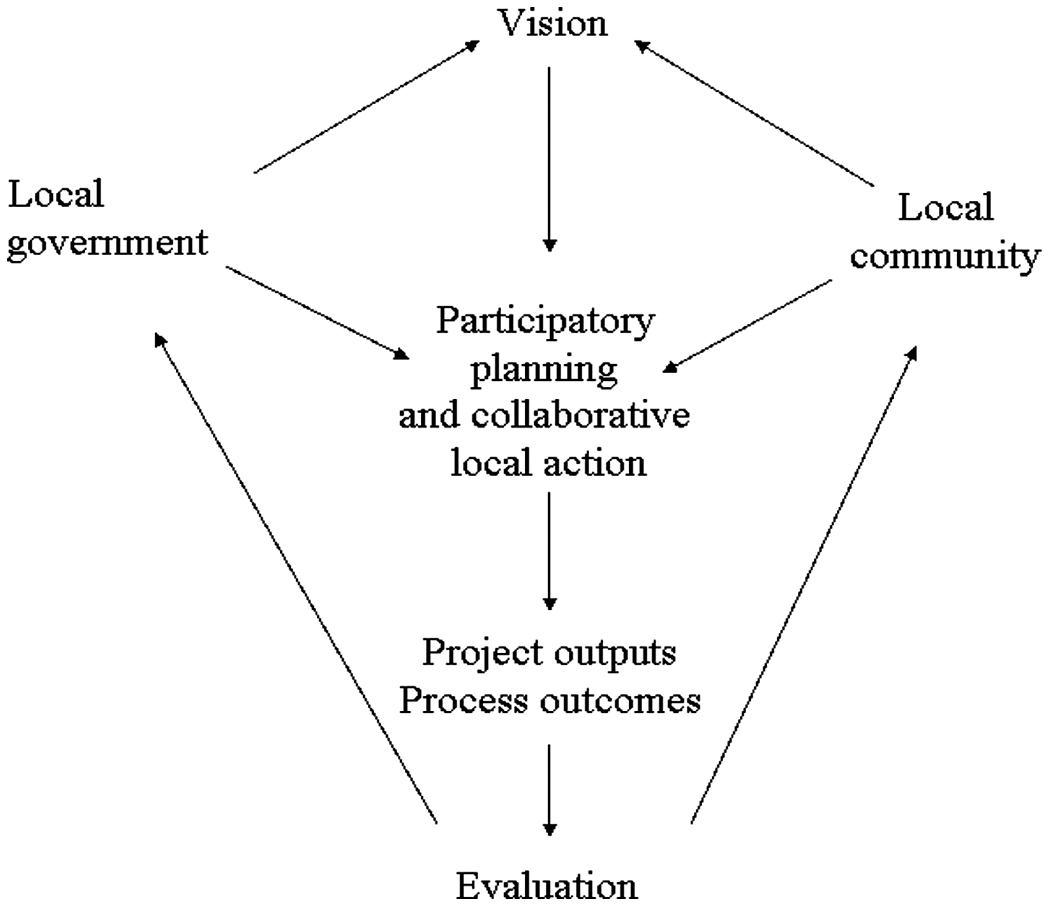
Cuthill and Fein (2005) pose the question: How can local governments enhance the capacity of citizens to take informed action for a sustainable local community? Their research, which seeks a better understanding of capacity building, has yielded a conceptual framework describing the capacity-building requirements for such collaborative local action. The framework (see Figure 1) proposes an emerging role for local government: to facilitate citizen involvement in local governance through capacity building. That is, as a result of capacity building, engaged and capable citizens are better able to be involved in the planning and management of government issues. The two main components of their capacity-building framework are local government and community capacity-building requirements. Local government capacity-building requirements refer to the development of institutional mechanisms for collecting and providing relevant information to the public; the establishment of equitable, accountable, and transparent participatory policy and processes; and the management of these activities in a supportive organizational culture. However, community capacity-building requirements refer to enhanced linkages between government and community through the actions of individuals and/or groups in a cooperative manner.
The model for collaborative local action
Cuthill and Fein (2005) argue that communities with local capacity are better able to actively assess and respond to community needs. To achieve this level of action, they stress the importance of visioning, a vital process for government officials and citizens defining their community needs or strategic direction. Just as government must serve as a resource and willing partner that interacts with citizens, citizens must remain engaged and organize their activities to interact with government more intentionally. As a result, public policies and government actions should reflect the contributions of the public, and opportunities to assess the results should exist.
Nonprofits and Citizen Involvement
Historically, nonprofit organizations play a vital role in providing citizens with a means to come together in pursuit of community goals, whether those goals are to advocate for something or to disseminate information to stimulate participation (Putnam, 2000; Reid, 1999; Salamon, 1995; Smith, 2001). Nonprofits can play a vital role in governance as they support active civic participation (Boris & Krehely, 2001; Ferris, 1998). Through the actions of nonprofits, citizens can potentially “build organizational skills . . . that enable them to work together to solve community problems, . . . [and] seek, redress, or change through policy process” (Salamon, 1995, p. 301). Thus, a relationship between government and nonprofits can create opportunities for citizens to participate in democratic governance to achieve “public purposes [and] voice their concerns to government” (Boris, 1999, p. 4).
In addition to government and citizens, nonprofit organizations can play a vital role in linking government to its community. Collaborating with nonprofit organizations, for example, is considered beneficial for public managers, as these organizations are often closely tied to citizens and undertake activities that can assist government in meeting broader social concerns, such as quality of life issues, access to services, strategies for engaging government, and the assessment of government performance (Yang & Callahan, 2005). Nonprofits can offer community members the opportunity to voice concerns and take action on key issues (such as education and lack of affordable housing) with priority-setting activities and other programs (Rathjeb, 2008). Such action can foster relations that enable nonprofits and citizens to enhance government efficacy. Government–nonprofit relationships can emerge to address turbulent environments (Kapucu, 2007); it is assumed that a community in which such a relationship exists prior to a disaster, for example, will function better and adapt its behavior more appropriately when exposed to risk or upheaval (Comfort, 1999). However, because of the voluntary nature of nonprofits and the nonprofit–government relationship, their effectiveness depends on the willingness of an array of individuals and organizations across sectors to participate in and contribute to the success of the collaborative endeavor (Kapucu, 2007).
A Case Study of Community Capacity
The single-case study design is used in this research to explore the extent of progress that has been made to equip citizens with the ability to engage their government and to examine the role of nonprofit organizations in building community capacity in the context of a post-Katrina New Orleans. Single case study designs are appropriate when the phenomenon under examination is unique (Yin, 2005). This research context is unique in the sense that the impact of the storm required the city to rebuild its economy, infrastructure, government services, and the connections between friends and neighbors as many citizens resided in temporary housing or relocated to other cities and states. Several planning strategies were implemented with varying degrees of public deliberation. Government reports, agency websites, and accounts of rebuilding efforts are used to describe these efforts.
Case studies are also exploratory when they set out to determine future directions for a given research project or flesh out research questions for future research (Yin, 2005). Our aim here is to examine the New Orleans rebuilding efforts and to explore the assumptions of Cuthill and Fein’s (2005) community capacity framework. Interviews with nonprofit leaders and community organizers inform our understanding of the impact of these attempts to build community capacity. Findings from this research will inform a larger research agenda to document the rebuilding efforts and the influence of citizen participation in the process. Applying the findings more broadly, the research will conclude with a discussion of the implications of the findings and questions that should be satisfied by future research.
The Case: Post-Katrina New Orleans
Louisiana’s cacophonous politics—and the corruption that goes along with them—is considered part of the cultural richness of the state (Jurkiewicz, 2007), which generally ranks last in measures of health and human progress and first in measures of dysfunction. Moreover, with the exception of social clubs, churches, and events related to Mardi Gras, New Orleans is not known for its strong history of citizen involvement (Williamson, 2007). Also relevant is the history of race and inequity in New Orleans; entire populations have historically been marginalized by race and class (Gill, 1997; Spear, 2009). From the times of slavery and continuing after hurricane Katrina, social inequity is a reality sustained by a dysfunctional local government. Nonetheless, in the absence of local leadership and the disparate impact of Hurricane Katrina, citizens took initiative in the aftermath; they used their motorboats to rescue the stranded, opened their homes to shelter them, and made donations for others in need. Out of necessity and desire, New Orleanians created a new sense of civic leadership as they participated in the planning process to rebuild the city (Williamson, 2007). The public’s unprecedented engagement in the rebuilding efforts was rooted in residents’ general lack of trust in government leaders and deep discontent in government-driven planning (these planning efforts are outlined below) and their desire to remain in New Orleans. As a result, new organizations were established. According to the City Works directory of neighborhood organizations for New Orleans Parish, for example, more than 200 newly formed neighborhood-based groups were established throughout the city (City Works, 2007). A myriad of umbrella organizations such as the Genteelly Civic Improvement Association’s board, the Neighborhoods Partnership Networks, and the Planning Districts Leadership Coalition sprang up to facilitate neighborhood collaboration, to provide access to government personnel and information, and to strengthening the citizen’s voice in the community.
Multiple Citizen Involvement Efforts
Although many nonprofit organizations devoted their efforts to connecting people to their government, there were several government-led initiatives charged with outlining a plan of action for rebuilding the city. Some initiatives were initially criticized for excluding the public while including powerful business interests. Other efforts included citizens but relied heavily on the input of planners and technical experts. Still other activities included citizens in defining key priorities and a vision of the rebuilt metropolis. This section describes these efforts.
Four nonsequential rebuilding initiatives were part of the post-Katrina recovery efforts: the Federal Emergency Management Agency Emergency Support Function No. 14 (ESF-14), Mayor Nagin’s Bring New Orleans Back (BNOB), the City Council Lambert Plan, and the UNOP. ESF-14, or the Long-Term Community Recovery, was the first rebuilding effort initiated after Hurricane Katrina. The purpose of ESF-14 was to assist “state and local governments in defining and addressing their long-term community recovery needs and goals while maximizing impact and cost-effectiveness of recovery efforts through coordination of federal, state, local and non-profit, academic and private sector resources” (New Orleans Plan Database, 2006). Efforts to elicit community involvement resulted in more than 10,000 Louisianans’ participation in the ESF-14 planning process, including 30% of Louisiana citizens displaced by the hurricane. However, little attention was given to the results of ESF-14, and it did not form the basis of a formal planning process (New Orleans Plan Database, 2006).
Mayor Nagin’s BNOB, the first alternative plan to ESF-14, was critiqued for its almost entirely top–down process with minimal citizen involvement. Members of the business community were the central contributors to city redevelopment plans. Although the initiative was originally spearheaded by Mayor Nagin, he was less supportive after the BNOB process gained considerable criticism and public scrutiny for a proposed plan that had the potential to shrink the city’s footprint and impact resident diversity by class and race (Williamson, 2007).
The Lambert Plan was introduced by New Orleans’s city council when it became clear that the BNOB would not move forward. It was initiated and implemented by local consultants. However, they failed to include the city planning commission, and they did not include all neighborhoods in the planning process: Only neighborhoods that experienced at least two feet of flooding were invited to contribute, thereby excluding a significant portion of the New Orleans population from the planning process. Moreover, the plan did not offer opportunities for prioritizing issues or unifying the individual parish plans into one cohesive redevelopment approach (Williamson, 2007).
An effort to correct the mistakes of prior planning processes, the UNOP sought to build on the torrent of citizen responses that followed the Hurricane Katrina catastrophe and to ensure extensive public participation in the rebuilding process (Williamson, 2007). This was not an easy task, given a number of failed planning efforts and their diminishing effect on citizen trust in government. To address these problems, planners began working with AmericaSpeaks, a nonprofit organization that specializes in large-scale citywide planning. Community Congress I (CCI), a citywide town meeting, did not live up to expectations—participants were not representative of the city as a whole. So city government and AmericaSpeaks collaborated to implement Community Congress II (CCII), during which 2,500 past and present New Orleans residents participated from multiple cities via telecasts and the Internet. Members of the hurricane diaspora participated via the Internet from 16 other cities outside of Louisiana. Through the use of technology, AmericaSpeaks was able to bring together, in discourse, a group of individuals that approximated the pre-Katrina demographics of New Orleans (Williamson, 2007). The extensive outreach to “ordinary” people enhanced the credibility of the UNOP process. The plan was adopted by the Louisiana Planning Authority.
Method for Interviews With Nonprofit Leaders
Between October 2008 and January 2009, we conducted semistructured interviews with 10 executive directors and community organizers. Three of the interviewees work in organizations that have a mission and long tradition of facilitating citizen participation in New Orleans. These are individuals who work in larger organizations and focus their efforts to cultivate a relationship with elected officials and government personnel to have an impact on policy decisions. Two respondents are executive directors of newly established organizations. They tend to have limited resources (e.g., facilities, staff, and budget) and are the primary champions of their cause to connect citizens to their government. Two respondents work for nonprofit organizations as community organizers. They are lifelong residents who have developed a strong reputation as leaders who are capable of rallying citizens and bringing their concerns to the forefront. They also align their efforts or work for well-established nonprofit organizations that are deeply rooted in the city. The remaining three interviewees have added citizen engagement and capacity building to their preexisting organizational missions. Much of their work involves a high degree of sense making as they try to determine citizen needs and determine how government is responding to them. A majority of respondents were born and raised in New Orleans or the region. Two, in particular, returned to New Orleans after the storm to support the city and its people who were coping with overwhelming problems and needs.
All of the respondents describe their work as concentrated in urban neighborhoods and providing services to African Americans and Latinos. Each, either explicitly or implicitly, noted that the issue of race has had an impact in the way citizens relate to their government. The relationship is described as strained, lacking in trust, and defined by the notion that government is insensitive to the needs of its people. Members of the Latino community are also described as disconnected to city government as the ties to their country of origin are the ones that seem to matter more to them. Although race is a factor that can influence citizen participation in the policy process, other variables such as lack of formal education, lack of motivation due to overwhelming economic problems, lack of confidence or fear of public speaking, and limited interest in engaging government overall are identified by the interviewees as commonly running interference in the collaborative process between citizens and government.
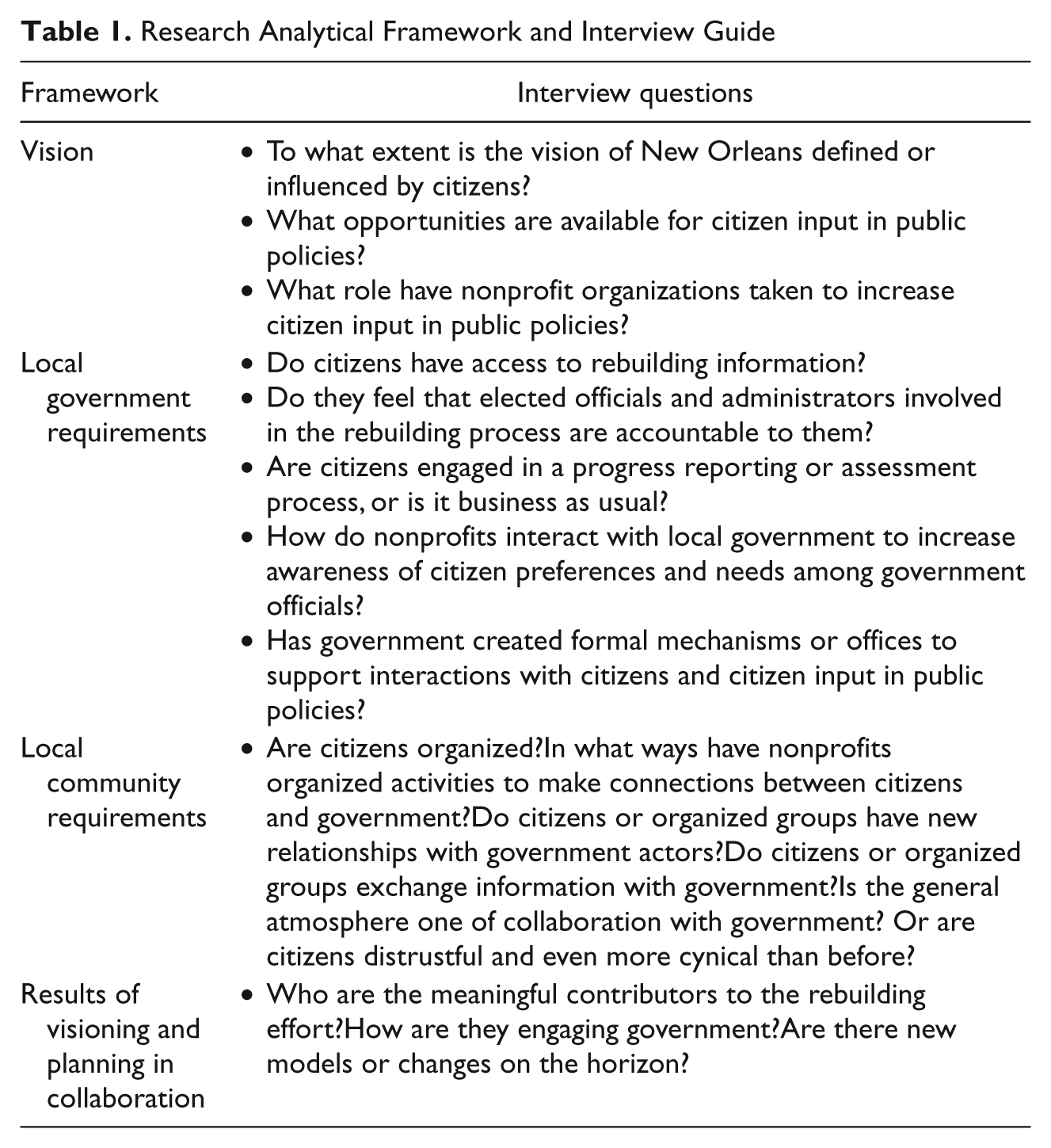
Each of the interviews was conducted for approximately 60 to 90 min. In the effort to generate reliable findings (Yin, 2005), the interview questions aligned with the components of the Cuthill and Fein (2005) framework. Questions, for example, focused on how citizens are involved in the visioning process of rebuilding (vision), how government interacts with citizens and nonprofit organizations (local government requirements), how nonprofits and citizens have organized themselves to interact with government (local community requirements), and whether the Katrina experience has led to lasting change in the way government and citizens interact (results of visioning and planning in collaboration; see Table 1). Respondents were promised confidentiality for their participation in this research as a way of generating candid responses to our questions and protecting their work and the relationships with government agencies and personnel.
Research Analytical Framework and Interview Guide
Findings
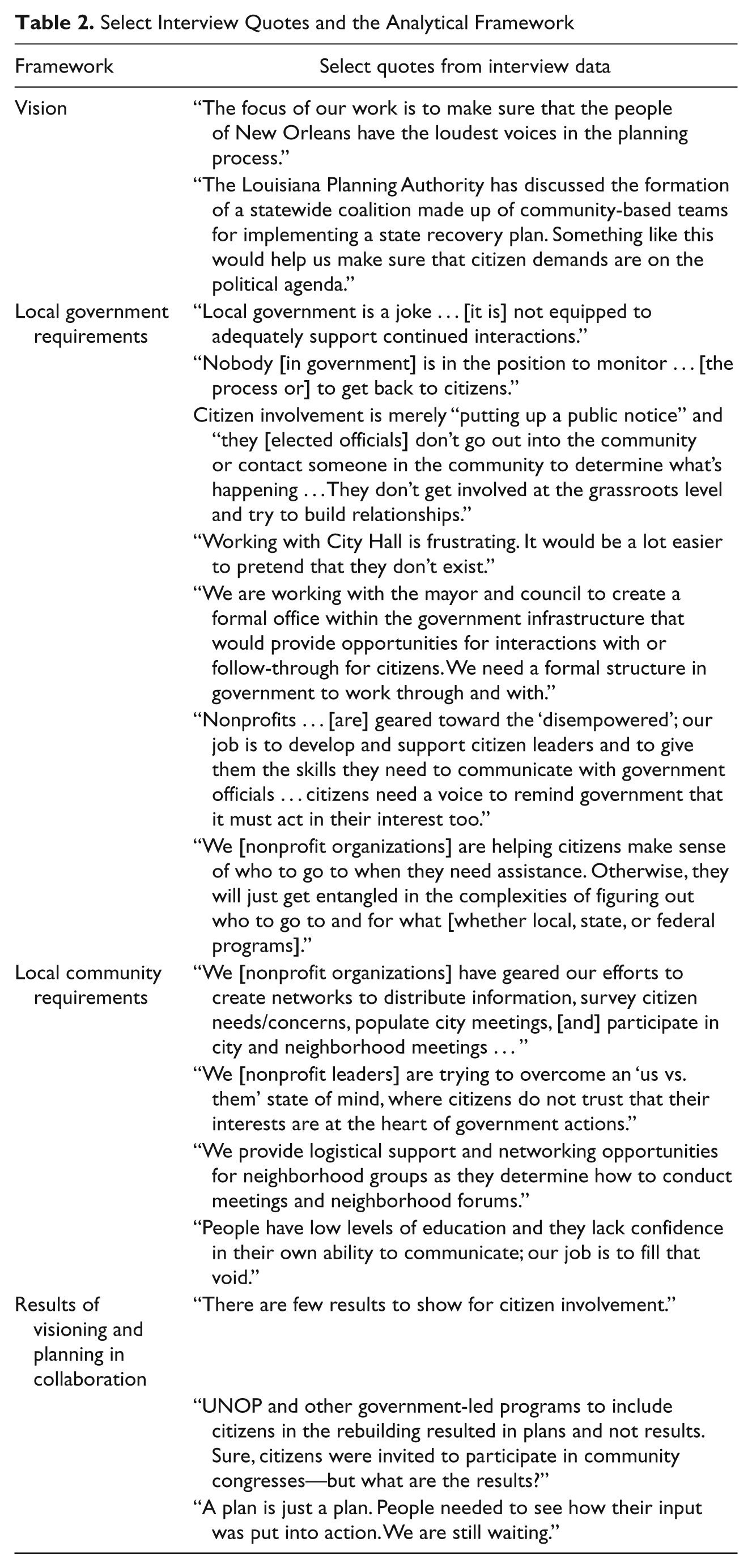
Table 2 provides a summary of the key preliminary research findings. For each element in the Cuthill and Fein (2005) framework, key quotes are used to demonstrate the interviewees’ points of view regarding government and the role of nonprofits in the capacity-building process (see Table 2). These findings are discussed in greater detail below.
Select Interview Quotes and the Analytical Framework
Vision
CCII (as part of the UNOP) was considered a successful event that brought elected officials to the table to consider the views of citizens. Many credit the event’s achievements to the nonprofit AmericaSpeaks, which was largely responsible for its structure and process. Although the visioning activities of CCII were considered a sincere attempt to bring citizens into the rebuilding process, the nonprofit leaders interviewed do not consider this one-day event a success at building capacity. As one respondent noted, “The planning session was a sincere effort, but citizens did not see tangible results. They remember the meeting, but not the plan; they remember the issues, but have very little to show for their discussion and contributions to UNOP.” Another respondent sharing a similar view of CCII, observed that “after Community Congress II, we don’t see a lot of implementation . . . We didn’t see positive results. If you poll citizens, they’ll remember the UNOP process but not the actual plan.”
The interviewees emphasized that their organizations are part of a strong nonprofit presence in the community. These organizations work with individuals and organized groups to find ways to communicate with government so that citizens’ voices are heard. As one respondent said, “The focus of our work is to make sure that the people of New Orleans have the loudest voices in the planning process.” Several nonprofit leaders agreed that the burden to identify interested citizens, to equip them with the confidence to speak, and provide them with the tools to foster meaningful interactions and governmental results falls primarily to nonprofit organizations. Such capacity building can potentially contribute to the long-term vision of building a statewide coalition to sustain and facilitate local efforts. For example, interviews reveal that the Louisiana Planning Authority has discussed the formation of a statewide coalition made up of community-based teams to implement a state recovery plan. Such a structure would be maintained to facilitate ongoing collaboration between citizens and government.
Local Government Requirements
Although the rebuilding effort offered opportunities for citizen involvement, respondents noted that “local government is a joke,” and ill equipped to adequately support continued interactions. For example, there are very few sources of information with updates on the rebuilding effort, and there is no central office or call center dedicated to addressing citizens’ concerns or questions. As one respondent stated, “Nobody is in a position to monitor what is happening . . . to get back to citizens.” Another respondent noted that government representatives did not appear to be “on the ground” or “committed” to determining the needs of or interacting with citizens. There may be meetings with citizens about rebuilding progress, but as one respondent articulated, “There is little follow-through when everyone leaves the room.” Another respondent described the government’s approach to citizen involvement as merely “putting up a public notice” and stressed that government personnel are isolated from the community—that “they [elected officials] don’t go out into the community or contact someone in the community to determine what’s happening . . . They don’t get involved at the grassroots level and try to build relationships.”
Interviewees noted that to address community problems and needs, existing nonprofits have been revived and others created. The work of nonprofit organizations is described as helping citizens “make sense of who to go to when they need assistance.” Rather than government taking the lead in continuing the dialogue with citizens that began with CCII, for example, a majority of respondents pointed out that it is nonprofits that have taken the reigns, not only providing services to citizens but also finding ways to determine and articulate their needs and expectations of government as well. In many instances, the work of the nonprofit leaders interviewed is geared toward the “disempowered”; they institute leadership and other programs designed to organize citizens and build skills to facilitate effective communication with government.
Nonprofit leaders report that they are attempting to work with the mayor and council to create a formal government office that would provide opportunities for interactions with or follow-through for citizens. Citizen inquiries currently fall under the auspices of the Office of Recovery and Development in City Hall, but several respondents argue that the responsibilities of continued engagement with citizens on broader topics, in addition to Hurricane Katrina, should be placed in an Office of Neighborhoods. Unfortunately, building relationships with government is described by respondents as wearisome, with one respondent commenting, “Working with City Hall is frustrating. It would be a lot easier to pretend that they don’t exist.”
Local Community Requirements
Much of the emphasis thus far has been on the government’s failure to involve citizens in the rebuilding of a post-Katrina New Orleans. Although the government has been slow to institutionalize public involvement mechanisms or administrative offices to support continued interactions, citizens have similarly shown limited success in mobilizing to engage elected officials, to build awareness of citizen needs, or to formalize channels of communication. The interviews reveal that there is dramatic variation in how citizens are organized across the city. Some neighborhood-based groups have regular meetings and action plans. Others, in the case of Latino communities, are not organized and are less likely to show interest or participate in local politics. Still other neighborhoods have been able to conduct forums or weekly meetings to gather and disseminate information and discuss the progress of rebuilding.
Nonprofit organizations have geared their efforts toward creating networks to distribute information, surveying citizens about their needs and concerns, populating city meetings, participating in city and neighborhood meetings, and creating partnerships with other nonprofits to improve service delivery. The focus is on creating a united front and showing citizens that their needs, preferences, and aspirations are important and should be addressed by the officials that they elect. Reflecting on their experiences in a post-Katrina New Orleans, the interviewees mentioned several barriers to citizen engagement and capacity building—people, for example, have low levels of education and lack confidence in their own ability to communicate. They highlight that grassroots organizing has its benefits, as citizens are more likely to attend and speak at neighborhood-run meetings. Organizing citizens at the neighborhood level is viewed as a critical strategy for building capacity. In many instances, nonprofit organizations provide logistical support and networking opportunities for neighborhood groups as they determine how to conduct meetings and neighborhood forums. In addition, nonprofits have provided job and leadership training. In fact, the nonprofit directors interviewed for this research believe that their assistance is critical and that citizens are more likely to attend a neighborhood or nonprofit-sponsored event rather than one hosted by the government. Although this can be attributed to New Orleans’s history of government corruption, the prevailing view of government is not so much that it is corrupt, but rather that it “holds all the cards.” Nonprofit leaders are trying to overcome an “us-versus-them state of mind” that leaves citizens believing that their interests are simply not at the heart of government actions.
Results of Visioning and Planning in Collaboration
The exploratory interviews with nonprofit leaders suggest that the New Orleans rebuilding efforts have established a track record of having very little meaningful citizen involvement in government action or decision making. The results of citizen contributions are not evident either to citizens or to those working to ensure that citizens’ needs and preferences are on the agenda and receive the attention of elected officials. Nonprofit organizations are working diligently to fill the void between citizens and their government and to develop a citizen-oriented process that will keep government accountable. At the time of this research, for example, the Louisiana Planning Authority was discussing with nonprofit and advocacy groups the formation of a community-based, statewide coalition to implement a recovery plan. However, overall, efforts suggest that the community’s capacity to organize, engage, and participate in the rebuilding process has not been improved through government-sponsored rebuilding activities—even those that attempted to include the public in the process. A majority of respondents noted that fostering the community’s capacity to determine areas of need and to engage government is a process that takes time and is likely to be developed at the grassroots level. Many of the city’s residents continue to be suspicious of the government; others lack the confidence to confront government at public meetings, whereas still others are unaware of how to engage and communicate with elected officials.
Conclusion
We set out to determine what progress has been made in equipping citizens with the capacity to engage their government in the context of a post-Katrina New Orleans. The interviews provide some evidence that there is limited progress in increasing citizen capacity building, despite various involvement efforts. Interviewees identified several challenges—all of which are referenced in the citizen involvement literature—as barriers to citizen involvement in the policy process. These include administrative barriers and inadequate government infrastructure (Timney, 1998), citizens’ reluctance to confront government officials in public venues, and low levels of trust in government (Adams, 2004). However, a majority of interviewees are hopeful that their organization’s programmatic actions (e.g., training programs for community organizing and leadership and network building) will, in the long run, result in intentional citizen action and the capacity of citizens to articulate needs, suggest policy options, and engage government in a productive manner. It is probable that the continued lack of citizen capacity is related to the inability of government to follow-through on priorities and plans that were developed using citizen input.
In addition to exploring the progress of citizen engagement and capacity building, we examined the relationship of government and nonprofit organizations. As a result of an analysis of multiple rebuilding efforts and interviews with nonprofit leaders working to increase citizen involvement in government decision making, our findings suggest that nonprofit organizations can potentially play a vital role in supporting government and citizens as they find ways to communicate with each other, articulate community needs, and develop strategies to address citizen preferences. By acting as an intermediary, for example, our findings present illustrations of how nonprofits can play an important role in developing relationships between government and citizens through advocacy, lobbying, and skill-building programs for resident leaders. Nonprofits in New Orleans seem to be taking the lead with advocating for an accountable and transparent participatory process for citizens in the rebuilding effort, as they work with government to emphasize the value of citizen involvement and suggest new government structures that can serve as the hub of exchange and activity.
Our findings highlight the work of several nonprofit organizations that seem to have a hand in nearly all of the aspects of the Cuthill and Fein (2005) capacity-building framework and are a vital part of stimulating citizen interest, conveying citizen needs, and equipping citizens with the skills necessary to engage government. From the point of view of these nonprofit leaders, local government is still missing from the governance equation. According to the Cuthill and Fein framework, local government capacity building should include the development of institutional mechanisms for the collection of information and its dissemination to the public. Such mechanisms would contribute to creating government transparency by providing citizens with the ability to hold elected officials accountable and to develop trusting relations with government. These mechanisms are yet to be formalized in New Orleans. Although we determined that there is some interest in developing such a citizen-centered office at the state and local levels, there is little evidence to suggest that these proposed mechanisms will be developed in the near future.
These findings are preliminary and imply that there is more to be determined. Future research should, for example, focus on government administrators. Our results are one sided and could be balanced by seeking the perspectives of those working in government. In addition, the points of view of citizens themselves should be examined to provide further insight on the progress of building community capacity. A large-scale research project would more directly gauge the level of citizen demand for more authentic opportunities to engage government. Research should also determine whether citizens feel as though they are a vital part of the planning process and whether they have the skills and tools necessary to collaborate with city officials and administrators in the rebuilding of New Orleans.
Footnotes
The author(s) declared that they had no conflicts of interests with respect to their authorship or the publication of this article.
The author(s) disclosed receipt of the following financial support for the research, authorship, and/or publication of this article: This research was implemented with the generous support of the Research Assistance Program of the Office for the Advancement of Research at John Jay College of Criminal Justice at The City University of New York.