







Abstract
This article uses a constructivist approach to scrutinize embedded actions of situated agents of governance to explore the governing of activation services in Israel. It probes beliefs, discourses, and practices of meso-level regulation administrators and street-level workers to analyze the emergence of a new stringent and disciplinary activation mode. Ultimately, this activation mode reconfigured the “social contract” between the state and its unemployed citizens via intensive intimacies: a conflicted microspace governed with little discretion and imbued with a reformative vision of state–society relations. The article demonstrates how situated agents’ meaning-making is essential to examining shifting governance forms and their political ramifications.
Individualization of social services is a significant trend in contemporary transformations of the welfare state. Individualization implies that social services are adjusted according to individual circumstances, needs, and wants, and permits its users opportunities for participation in the design of said services, thus allowing for the creation of effective custom-made treatments (Borghi & van Berkel, 2007; Needham, 2011; van Berkel & Valkenburg, 2007). The process of individualization mirrors the attempt to modernize the welfare state in the midst of growing ideological and financial constraints, creating flexible services in which political recognition of late modern societies’ heterogeneity and differentiation converge with the economic imperative of efficiency. Although relevant for many services, individualization is particularly essential to activation services. Activation policies challenge the “social contract” rooted in social rights of citizenship by conditioning citizens’ entitlement to social security and income support schemes on their active participation in work-related duties. These policies require unemployed citizens to take additional responsibility for their well-being via labor market reintegration (e.g., Gilbert, 2002; Handler, 2004; Lødemel & Trickey, 2000) as part of their participation in poverty reduction. Activation policies are based on a new sociopolitical rationale that interprets unemployment as an individual impediment rather than as a structural phenomenon. Individualization is thus an inherent characteristic of activation services, based on individual diagnosis of personal barriers; resources are assigned to change behavior and optimize support toward the labor market (Borghi & van Berkel, 2007; Pascual, 2007; van Berkel & Valkenburg, 2007).
Although individualization became a central concept in contemporary policy discourse, its elasticity contributes to an ambiguous guideline for policy practitioners and analysts (Cutler, Waine, & Brehony, 2007; Ferguson, 2007; Needham, 2011; van Berkel & Valkenburg, 2007). Borghi and van Berkel (2007) suggest resolving this setback by scrutinizing the administrative apparatus by which individualized activation is governed. Following this, I argue that individualization is best understood by analyzing the actions and interactions of those who govern it. To explain the production of intensive intimacies, a particular form of individualization that emerged in the Israeli activation program, this article probes the governance of activation services and demonstrates how individualization is governed by private and public actors entrenched in specific political and cultural contexts.
Governing Individualized Activation: The Role of Situated Agents and Agencies
The inherent link between activation and an individualized mode of service delivery led scholars to argue that to accurately study individualization of activation services, it must be examined where social policy reforms and public sector reforms intersect, as individualization is practiced only via new organizational mechanisms and innovative governing strategies introduced by said reforms (Borghi & van Berkel, 2007; Bredgaard & Larsen, 2007; van Berkel & Valkenburg, 2007). These new practices of rule are state deployed with the intention to govern activation of individuals and service-providing agencies. However, the nature and outcomes of such institutional “activating efforts” are uncertain, resulting from conflicting tendencies and potential tensions between “old” and “new” governance modes (Borghi & van Berkel, 2007; Newman, 2007).
Furthermore, to understand the dynamics and outcomes of these hybrid constellations of governance, we require a theoretical framework that acknowledges the agency of contextualized actors and their meaning-making capacities. Acknowledging the meaning ascribed to the subjects of activation by governing agents is imperative to analyzing individualization of activation services (Borghi & van Berkel, 2007; Korteweg, 2006; van Berkel & Valkenburg, 2007). This is because the interpretations of activated individuals’ motivation and behavior are prominent among the administration and delivery of activation. Such interpretations draw on “welfare culture”: a set of societal knowledge, values, and ideas that surrounds, informs, and either justifies or opposes various welfare-state interventions (Pfau-Effinger, 2005, p. 4). Moreover, governing agents “make meanings by emphasizing certain relationships among signs over the infinity of other possibilities,” and engage in “defining ‘privileged subjects’ that they claim deserve the benefits of organized social welfare, counterposed to those who do not” (Padamsee & Adams, 2002, pp. 190-191).
The scholarly practice concerning governance in social policy draws on varying traditions in the social sciences (Daly, 2003; Dingeldey & Rothgang, 2009). This is true also for studies of activation. On one hand, we can identify a structural–organizational approach to the governance of activation that draws on political economy, and institutional and organizational scholarship (Borghi & van Berkel, 2007; Bredgaard & Larsen, 2007; Dingeldey, 2007, 2009; Newman, 2007; Riccucci, 2005; van Berkel, 2010; van Berkel & Valkenburg, 2007; van Berkel & van der Aa, 2005; Weishaupt, 2010). This approach engages with macro- and meso-level structures (e.g., regimes), however, tends to disregard the enactment of active participants at the micro level. On the other hand, a poststructural approach to the governance of activation (Dean, 1995, 1999; Korteweg, 2003; Marston, Larsen, & McDonald, 2005; McDonald & Marston, 2005; Watkins, 2006) often draws on Foucault and his successors’ attempts to offer meticulous conceptual tools for micro-level inquiry into the reproduction of subjectivities under regimes of activation, while neglecting to incorporate the meso and macro levels into the analysis.
The constructivist approach to governance developed in the recent works of Bevir and Rhodes (Bevir, 2007, 2011; Bevir & Rhodes, 2006) has the capacity to accommodate insights from structural and poststructural approaches. Following this vein, I suggest analyzing the mechanisms and strategies of rule that form different governance constellations by using a constructivist account of governance. The constructivist approach focuses on the actions of situated agents of governance informed by cultural and political contexts. This approach enables us to recognize situated agents and agencies operating in a heterarchic field of state power, and to differentiate between a minimum of two sets of governance relations: those between institutional actors (the state and nonstate providers) and those between individual actors (street-level workers and citizens; Newman, 2007). The Israeli case of governing individualized activation is a case in point that illustrates the necessity for a refined understating of governance sensitive to the meanings produced by organizational or individual situated actors of governance (that are governing either organizations or individuals) and their respective implications for activation policy.
By utilizing a constructivist bottom–up account, this research probes the beliefs, discourses, and practices of meso-level administrative agents and micro street-level agents to better understand the emergence of a new mode of stringent and disciplinary governance that ultimately reproduced the social contract between the state and participating citizens via intensive intimacies. I begin by introducing the Israeli activation policy and follow with methodology. The following section contextualizes the practice of the Statutory Agency (SA) administration that regulates private job centers that implement the program and analyzes consequences of individualization of activation. Subsequently, the analysis shifts to the street level, probing practices of personal advisers (PAs) and their contribution to the production of intensive intimacies. The article concludes with theoretical reflections and implications of the case study.
The Israeli Activation Program: An Introduction
The Israeli welfare-to-work “Work-First” program began in August 2005. This activation program was initiated as an experimental policy focused on labor market reintegration for the long-term unemployed and additional groups entitled to income support allowance (ISA): the Israeli social assistance plan. It was designed and promoted by the Budgetary Department (BDT) of the Israeli Ministry of Finance (MOF) as a Work-First program meant to pressure participants into finding immediate employment. The ISA is a residual means-tested allowance subsidized and administered nationally and a last resort for populations unable to attain minimal income from other sources. Its main beneficiaries include single-parent households, the long-term unemployed, low-income families and individuals, and populations designated as unassignable to work for various reasons (Morginstien & Shmelzer, 2001). From an international perspective, ISA benefits are low. Its replacement rate, based on a production laborer’s salary, for a two-parent household with two children is 43%. This is lower than Denmark (79%), Sweden (78%), Britain (73%), France (70%), and Germany (62%), and higher than Spain (41 %) and the United States (24%; Koreh, Gal, & Cohen, 2007).
The program was implemented between August 2005 and April 2010 in Ashkelon, Jerusalem, Hadera, and Nazareth by four private one-stop job centers established by the state for this purpose. Private for-profit job centers were perceived by the BDT as a-political, efficient, and flexible entities capable of creating individualized activation services (BDT, 1999). Job centers’ street-level discretion and flexibility were important to policy entrepreneurs in realizing individualized services and market-like efficiency. Job centers were authorized by the state to execute the “employment test,” an ISA eligibility test previously implemented by the Public Employment Service (PES). To maintain eligibility, participants were obligated to participate in soft-skills workshops, job searches, and PA (Employment-Goals Planners in Hebrew) consultations 30 to 40 hr weekly.
The participants of the program were assigned according to residence and had no choice in the matter. A total of 26,519 participants were assigned to the four job centers during the 1st year of the program, and 46,761 were assigned by the end of December 2009 (Statutory Agency [SA], 2006; SA Monthly Report, October, 2009). Based on the institutional presupposition that “everybody is capable to work in some capacity,” there was no prescreening procedure; therefore, all eligible citizens were sent to the program (with few exceptions; in 2007, additional exemptions were introduced.). During the 1st year, 7,300 participants underwent 10,800 job placements (30% were placed more than once). A total of 75% of designated participants were placed in part-time jobs (SA Report, 2006). During the second phase of the program (August 2007-December 2009), 7,772 participants underwent 12,307 job placements, 66.4% of which were part-time jobs (SA Monthly Reports, August 2007-December 2009). However, the program contributed poorly to participants’ income. During the 3rd year of the program, for example, working participants earned on average 2,618 NIS (New Israeli Shekel) a month (about US$700, 70% of the minimum wage); 63%-84% of working participants earned less than the minimum wage (Rabbis for Human Rights and the Mizrahi Democratic Rainbow-New Discourse [RHR and MDRND], 2008).
PAs became a new profession in the Israeli welfare state that implemented the new eligibility test and supervised the completion of active policy duties; they had state-authorized approval to eliminate participants’ eligibility for a month when failing to meet the demands or 2 months when refusing job offers (sanctions were full but temporal, so participants could return to the job center and retake the eligibility test). Although employed by private companies, Israeli PAs are akin to street-level bureaucrats (Smith & Lipsky, 1993; Lipsky, 1980) as they received authorities from the state, implemented a public program with street-level discretion, and answered to statutory supervision.
Method
The article draws on a number of sources. First, it is based on fieldwork conducted in two job centers for 10 months in 2009-2010, including 64 observed research sessions (5-8 hr each), participation in job center’s activities, 25 PA interviews, and 14 staff interviews. In addition, I conducted nine interviews with SA personnel. Second, this article is based on analysis of policy documents and interviews with policy makers who participated in policy design. Based on these sources, the article synchronizes institutional and ethnographic insights from two primary arenas of state conduct resulting in a comprehensive analysis of the governance of individualized activation.
The Political and Cultural Contexts of State Regulation: Understanding the Origins of a Centralistic Administrative Control
Emerging interagency relations between new regulative and delivery agencies of activation may have implications for implementation (Lindsay & McQuaid, 2008). I argue that specific “relations of governance” that emerged at the meso level between the SA and the job centers had significant consequences for individualization. This section contextualizes the construction of the statutory regulative agency and analyzes the political and cultural factors that influenced its mode of conduct vis-à-vis the private agencies. This led to a centralist–bureaucratic mode of control that made street-level implementation harsher and intensified the formal duties of the new social contract (i.e., participation hours). Understanding how engaged state actors perceive and conduct their regulative duties enables us to trace the origins of this mode of control “from a distance” in the governance of Israeli activation.
The Ministry of Industry, Trade, and Employment (MITE), accompanied by the MOF, constructed the organizational infrastructure of the program. The establishment of the SA, responsible for supervising and regulating the conduct of the private job centers, began just 6 months prior to the program’s initiation on February 2005. The MOF believed that a “market-like” financial model will self-regulate job centers without the need for state intervention. The SA was devised as a small agency with few public servant positions, a limited organizational capacity, and no predefined auditing and regulating mechanisms (interview with the SA’s first chairperson June 2, 2009; Government Decision 90, May 4, 2004). However, ultimately the state was required to intensify its “regulation through contract” with in-depth supervision (see Benish, 2010; Bredgaard & Larsen, 2007). This established the SA as a significant agency in the program’s implementation.
Following the program’s inauguration, SA administrators dealt with various unexpected issues emerging from the street level, thus establishing the SA as an integral actor in the implementation of the program (interview with the SA’s first chairperson, June 6, 2009; interview with the BDT coordinator of the program, March 9, 2011). These issues primarily resulted from program design: The target population was heterogenic and no screening processes were implemented; therefore, people aged 18 to 67 years, regardless of health conditions, reported to job centers and participated in rigorous weekly programs. This situation further intensified public critique of an already criticized policy. Advocacy nongovernmental organizations (NGOs), public committees, and members of the Knesset practiced this criticism, which was reflected in media coverage and agitated advocacy campaigns. This is the first context in which the practice of the SA was embedded. This atmosphere had a significant effect on how SA public administrators perceived and implemented their duties. Public critique centered on the delegation of state authorities to the private job centers and, consequently, emphasized the responsibility of the state to supervise their conduct to prevent abuse of power (Israel Academy of Sciences and Humanities [IASH], 2007; RHR and MDRND, 2008). Advocacy NGO’s in particular criticized the so-called “privatization of the state” and its effect on citizenship. Linking this campaign to the wider antiprivatization sentiments in Israel contributed to its success. Public pressure to maintain state accountability was amplified by the fact that during the program’s first stage, state-defined economic incentives were based on decreasing payrolls and eliminating eligibility creating a conflict of interest between job centers and participants.
The atmosphere enhanced distrust between SA administrators and new private “agents of the state” (see Bredgaard & Larsen, 2007). These factors emphasized the regulatory responsibility of the SA, which acted to maintain state accountability over two main aspects: job centers’ appropriate delivery of a comprehensive service that fulfills reform principles and the appropriate treatment of a particular perception of participants’ rights. Safeguarding these bred a centralistic and bureaucratic mode of regulation.
“Safeguarding the Public”: Emerging Relations of Governance
The SA was responsible for enforcing the contract between the state and private concessioners, and for overseeing the production and delivery of individualized activation services. Developing this new service was expensive and required significant state investment: During the first 2 years, each job center received upwards of 73 million NIS (approximately US$20 million; IASH, 2007). The SA made certain that centers fulfilled tasks and provided each participant with a personalized action plan comprising 30 to 40 weekly hours. SA administrators embraced the Work-First rationale of the program according to which in-need citizens must be disciplined to break free of dependency and poverty, and that radical change necessitates intensive and comprehensive measures. However, growing distrust of private job centers led to the SA’s centralistic approach that emphasized statutory responsibilities. The last SA chairperson defined it as follows:
The program requires a minimal scope in terms of (participation) hours and your obligation as a concessionaire is to fill it with meaningful content that will promote (participants) and not just do it in a “shoddy fashion” . . . My job is to check if that’s what you are doing. The only participants who will receive “reduced hours” are the ones we, as the state, will be convinced they cannot, and I don’t want to leave this decision to the job center, for such considerations as comfort, economic preferences or “cream skimming” . . . We brought this program in order to produce a substantial intervention . . . So, what now? Should I just give you discretion to reduce its scope?! No! We will do it for those (participants) who can’t, who find it too hard and have problems. But we are the state—not you! And although this is a difficult and long procedure to examine and approve every participant, it seems to me as something we must not let go of. (Interview with the SA’s last chairperson, March 10, 2010)
SA administrators were concerned that reduced hours hamper reformative policy effectiveness. They feared that delegating discretion regarding the scope of action plans would lead to job centers’ abuse as they would be able to grant opt-out options. Consequently, SA administrators preferred lengthy centralistic and bureaucratic processes that they perceived as adequate as they would exclude private interests and safeguard against potential whims that could jeopardize participants’ rights (Interview with the SA’s first chairperson, June 2, 2009).
In addition to this enhanced distrust, SA personnel sought comprehensive individual action plans to solve the enduring social problem of “black” (informal) labor, which interrupted the institutional efforts of formal labor market reintegration. The SA practice was also embedded in cultural assumptions regarding ISA beneficiaries and additional publicly supported populations in Israel, as immoral participants engaging in black labor with unreported sources of income. An intensive activation program was sought to remedy this criminal behavior by taking control over participants’ time:
There was a great fear that job centers will abuse this opportunity (discretion) in order to reduce costs by massively reducing the time of required participation . . . (and) dodge the execution of the policy. The basic idea, in any case, although it wasn’t formally defined as such . . . this policy takes over your time. It takes your time (as a participant A.M). If you don’t have control over your time you can either give it in return to your allowance (by participating the program A.M), or give it in return to work. This is a very important principle which reduced about 12% of beneficiaries on the first day of the program! (interview with the second SA chairperson, August 16, 2010)
The administrators of the Israeli activation policy perceived it as a mechanism to fight black labor in Israel. To understand the severe response against this phenomenon, it is vital to consider two symbolic protagonists functioning as complementing concepts in the Israeli political discourse regarding rights and duties of marginal groups: the frayer (sucker) and the parazit (parasite; Feige & Runiger, 1993). The frayer does not look after his own interests, and is fooled and disadvantaged by others. To avoid becoming a frayer, a basic cultural motivation, one utilizes and legitimizes illegitimate strategies against the “system.” This counter strategy is interpreted as political opposition to the unequal and polarized class structure of the Israeli society (Feige & Runiger, 1993): As a result of unequal opportunities for mobilization, alienated individuals scam the system to receive as much resources as possible. This key scenario (Ortner, 1973) of the Israeli society produces inclinations toward welfare recipients that have lead to practices of regulation. By enforcing the weekly hours, the SA used job centers to filter out state fund abusers and keep only those deserving of state support. Consequently, the SA rejected street-level discretion that would enable PAs to relax program duties that would allow participants to maintain eligibility while working informally, that is, being parazitim who exploit the state.
Distrusting the job centers shaped a particular mode of regulation. A prominent aspect of this regulation focused on a meticulous enforcement of the mandatory scope of participants’ individual action plans. Supervision of the centers and their PAs was made either directly or via outsourced companies. The bureaucratic mode of regulation manifested in continuous individual inspections of PAs’ work based on strict instructions that undermined street-level autonomy. PAs did not have the authority to adjust individual plans to participants’ needs. As 30 to 40 weekly hours was the default action plan scope, PAs submitted special requests when appealing for a reduction of the plan scope as a result of disabilities, personal issues, or special needs common among disadvantaged participants. The next section addresses said procedures and clarifies their influence on the governance of activation at the street-level.
Governing Activation From a Distance via Bureaucratic Procedures
To adjust program scope, PAs obtained documentation of participants’ social, physical, and mental conditions, and consequently, submitted requests to designated SA committees. Request approval was lengthy due to bureaucratic routines and ratification processes. PAs often reported that, as the program progressed, SA procedures and regulations accumulated at the expense of their street-level discretion and professional autonomy. This process affected the PA–participant relationship: PAs became stricter, and spent supplementary time on paper work and documenting their actions to pass inspections. These outcomes differed significantly from the preliminary intention to create a “flexible and efficient” mode of delivery by private agencies. The uncompromising regulations and centralist governance of the program caused tensions between PAs and participants, for whom PAs represented the primary street-level authority. Yet PAs’ capacity to adjust the scope and demands of the action plan according to needs and characters of participants was limited. PAs had to enforce comprehensive action plans even when it was clear that personal circumstances required reduced measures. These tensions were reflected in the type of program sanctions. Although varied behaviors justify sanctioning, the lion’s share of sanctions performed by the four job centers was the result of a failure to fulfill the formal demands of the program in terms of the required hours and participation days, that is, the inability to accomplish the new duties of a rigorous social contract. During the first year of the program, 88% of the sanctions (11,826 out of 13,433) resulted from the failure to meet requirements (Statutory Agency, 2006). During the second and more moderate phase of the program (August 2007-December 2009), this rate was maintained (89%) nonetheless (SA Monthly Reports, October 2007-December 2009).
The embedded meso actions of the SA enforced the implementation of demanding action plans for participants. This mode of governing established street-level implementation as rigid and intensive even prior to an examination of its contents. Here practices of governing institutions and governing individuals intersect to shape the character of individualization of Israeli activation (see Figure 1). The content of the micro street-level relations of governance between participants and PAs is explored in the next section.
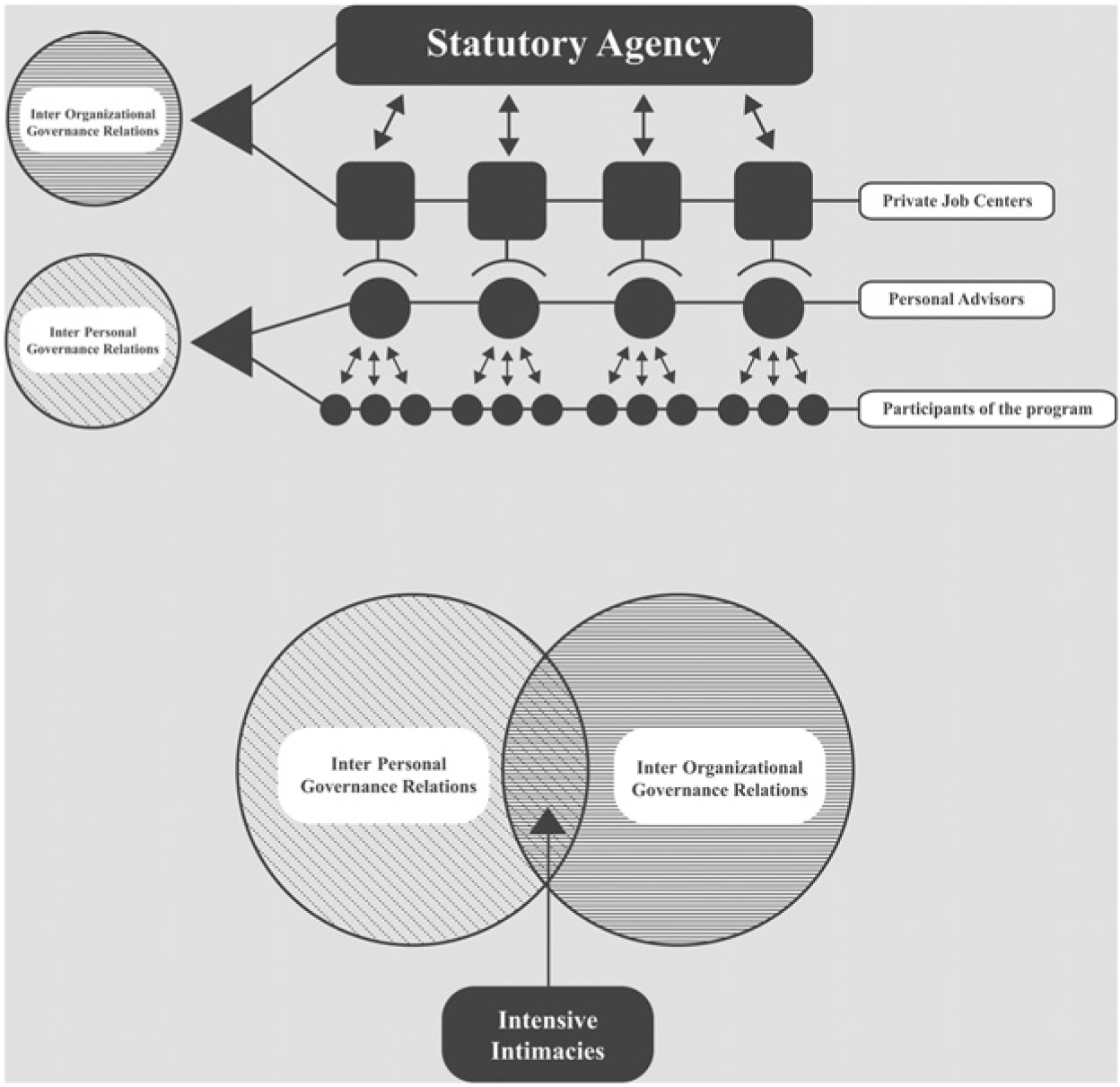
Intersecting Relations of Governance and the Production of Intensive Intimacies.
Personal Advisers and the Uniformed Governance of Resilient Citizens
Case Management As an Innovative Interpersonal Strategy of Governance
PAs are responsible for implementing the “activation process”: They realize the transition from social rights of citizenship to tentative and conditioned entitlements (Dwyer, 2004; Shaver, 2002), which paved the way for the construction of a novel active participant imbued with new self-awareness and specific qualities and inclinations (Dean, 1999; McDonald & Marston, 2005). In spite of their limited discretion in regard to the formal duties of the new policy, PAs played a pivotal role in the production of the Israeli activation service. These new street-level bureaucrats benefited from discretion in processing and translating the metagoals of the policy “from dependency to self-sufficiency” to mundane scripts, routines, and practices that ultimately dictated the “informal duties” of the program. In this section, I argue that Israeli PAs produced a stringent and disciplinary mode of activation through their daily interaction with participants. This mode of conduct is embedded in common welfare culture assumptions regarding the nature and characteristics of dependent populations, which interlink with a “social entrepreneurial” organizational orientation of the job centers.
Israeli PAs had no standard professional background or statutory training and were part of Israel’s middle class. Job centers received great autonomy in recruiting and training PAs according to their private social entrepreneurial organizational culture. When selecting suitable candidates, job center managers searched for specific profiles such as charisma, spark, assertiveness, and communication skills. Individuals who experienced crises and were able to propel forward regardless were particularly fitting as this was the dominant perception of how participants must act (interviews with job centers’ managers, 1.3.09 and 11.5.10). Through daily interaction with disadvantaged citizens, PAs were required to instigate significant change, and encourage self-sufficiency and independency via the labor market. To succeed, PAs had to be creative to “get through” to participants and “get the job done.” Case management is a powerful mode of interpersonal governance through which a new active and responsible self is constituted (Dean, 1999; McDonald & Marston, 2005). Next, I explore the mundane sites and routines through which individualized activation was produced by PAs.
The Ethos of a Productive Self-Made Israeli: The Cultural Contexts of PAs’ Practices
Newly arrived claimants had their first acquaintance with the job center at orientation where personnel members presented the program policy, goals, and requirements. A senior officer at an orientation session explained as follows: So, who are we, really? Income Support payrolls grew tremendously during the last decade—enormous expenditure by the state with no proportion (to population increase). There is a gap between the things the state gives and the things it receives in return. We are seeing here a “second generation” of allowance recipients. We know there are some who receive the allowance for a reason—there are problems—and we are here to help everyone get back to work! . . . Our worldview is: people should believe in themselves and succeed! Every person who will believe in himself can be successful! We offer empowerment and support for people who need to rebuild their skills in order to reintegrate in the harsh and competitive labor market of our times . . . The PA will be your “shadow” and your consultant for each and every matter . . . you must cooperate with him! . . . Remember, you don’t have to be here—if you find it difficult no one forces you—but if you want to be here you must take responsibility over your life! At this point one of the new participants responds: “what do you mean?! You don’t give us any choice!” The presenter replies: “there’s a choice for those who engage in ‘black’ labor!” (Anonymous senior officer 25.8.09)
In an additional orientation session, the officer clarified, Everyone has skills and talents and an ability to find a job, although the market does not always give us what we want. Suddenly, one of the participants interferes and asks: “What about vocational training?” “Why?” asks the PA “first of all, find a job!” “What if one does not have any profession? Shouldn’t he be secured?” he tries again. “First, we demand you’ll start working—put some effort and give (us) something —after you’ll have a job it’s possible to receive funding for training.” The participant replies: “that’s compulsion! I didn’t choose to be here!” “No!” says the presenter, “ you chose to receive income support allowance. No one has to be here! You can’t receive it for nothing—you have to do something for it. If you chose to claim it, do something!” (Anonymous senior officer 1.9.09)
These accounts uncover the latent normative–cultural assumptions of job center staff. First, the organizational discourse criminalizes the target group. Participants were framed as a peripheral group that abuses the treasury and does not redeem itself via effort and labor. Welfare fraud was considered to be widespread in this group. As a result, participating in the program was perceived as voluntary though leaving could incur severe economic consequences for those depending on it. With regard to the majority of participants, poverty and unemployment were the result of an inherited “culture of poverty,” where people chose to become welfare dependents and made a “career” of it. According to this viewpoint, low motivation and competency combined with a lack of responsibility and civil morality accounted for this population’s status (participants who suffer from mental, physical, or health problems and considered unfit to work are exceptional). The message job centers conveyed was if you can manage without the allowance, you ought to leave; but if you need it, you must accept and internalize the new rules of the game.
Second, although the organizational discourse acknowledged participants’ issues, the only assistance that was offered was labor market reintegration. Guided by his PA, each participant assumed an individualized quest that inevitably led to work. This was a highly technical understanding of individualization. Participants received support according to diagnosed needs (e.g., child care) and were processed as per this philosophy: Only independent labor determined successful quest completion, regardless of individual skills, hopes, and concerns. The primacy of labor is not only the result of a neoliberal Work-First paradigm, but it draws on an important ethos of Israeli citizenship stemming from the first settlers who devoted their lives to collective nation-building projects (Shafir & Peled, 2005, chap. 2) in which labor was considered a civic virtue. Based on this ethos, a republican model of citizenship in which rights are conditioned on participation in collective duties (e.g., military service) was developed. Labor has always differentiated between “productive” and “unproductive” and consequently, “deserving” and “undeserving” members of society (Rosenhek, 2006, p. 321). The ethos of self-sacrifice became a legitimating source used by elites to justify uneven distribution of collective resources; the frayer culture developed as an antithesis. Thus, disciplining underprivileged Israelis with a “laboring morale” drew from republican historical roots to fight immoral behavior against the state as the guardian of the nation. PAs used entrenched cultural schemes to interpret ISA beneficiaries as immoral individuals who needed discipline to become productive, laboring citizens.
The job centers realized the new policy rationale and demanded a change in the name of the state. Within the job center, a new social contract emerged, in which the allowance that once promised a steady, albeit low, sustainability outside the labor market shifted to temporal support centered on labor reintegration. The new duties of the contract were now defined via micro-level PA–participant relationships, and took the form of a monthly action plan comprising tasks and activities. Notwithstanding, this rearticulation of the contract was not individualized or flexible: First, as discussed previously, PAs had to meet certain formal requirements enforced by the state, and second, PAs’ practice was embedded in the cultural–political context detailed above.
PAs used said cultural and normative resources when interpreting participant’s achievements and failures to formulate judgments regarding their effort and competency. The belief that everybody has the ability to change his status and “do something” to improve his life was predominant. It was derived from the “self-made man” ethos, emphasizing individual responsibility for individual well-being, while, respectively, undermining the effect of structural and historical factors for social exclusion. This ethos resonated in job centers’ discourse as “success stories” of ex-participants who faced difficult circumstances, yet managed to find viable employment with the program’s aid. These stories functioned as key scenarios (Ortner, 1973), a list of actions and qualities necessary to achieve the program’s goals and succeed, including commitment, resiliency, and dedication. In addition to formal obligations, including workshops, job interviews, and meetings, the described qualities comprised the informal duties. Through these informal demands, a new subjectivity was constituted.
The following is taken from conversations with Shirley, a veteran PA who deployed traits the program aspired to develop: Different actors (such as social workers and advocacy NGO’s) are producing our participants’ distress, by focusing on their own misery they don’t help them to leave it behind. We tell them: that’s it! No more misery! No more distress! Let’s see how we can change it and leave it behind. She further explains: “even if you have such problems, I mean, very well—there are people who will go to work with a backache and even with cancer! Here, the way I deal with such circumstances comes into play: if one gives up and submerges into misery, or if he ‘gets a hold’ on himself, overcomes the pain or hardships and makes an effort in spite of everything.” (Shirley, veteran PA, August 17, 2009; August 19, 2009)
PAs’ normative prism put forth an individual road to success by producing “resilient citizens,” agents with the capacity to transform themselves and their life circumstances in spite of unfavorable conditions. It is through this prism that formal policy goals become disciplinary practices. The next section focuses on PA technologies that functioned as “ethical scenarios,” that is, the apparatuses and contexts in which “moral codes” (Rose, 1999, p. 245) are inscribed and “techniques of the self” are inculcated to model a desired citizen-participant. Resistance and conflict persist however.
PAs Technologies: Transforming Subjectivities Through Intensive Encounters
To demonstrate the effect PAs’ technologies had on the individualization of activation, this section analyzes two representative sessions of PA–participant interactions. The first is a meeting between Sharon, a single mother of a 3-year-old boy, and Edna, her veteran PA. Sharon recently returned to the job center after being fully sanctioned last month to receive a new action plan. At the onset of the meeting, Edna used my presence to recall the breach: When Sharon arrived here she said she wants to work and presented a serious attitude—what we term “job ready”. . . She has missed a couple of days from the course and was unable to justify her absence, which we defined unjustified. Sharon knew she didn’t have good reasons and explained . . . she couldn’t find an arrangement for her young boy in the mornings. (Edna, veteran PA, August 23, 2009)
As Sharon is “ripe” for work, Edna explained that this month’s program included a job-search workshop and a “job-seeking” day comprising a couple of job interviews. As Edna spoke, Sharon nodded her head in approval. However, when Edna called to reserve Sharon a spot in the workshop, it was already full. Thus, Edna wanted to register her for a different workshop far from Sharon’s home.
Well look: what happens if you take your son to the kindergarten at 7:00 a.m.? Sharon answers: “I can try but it depends on the traffic—I may be late again!” Edna understands she must try harder and switches to a more energetic mode: “what if you’ll make an effort, be the first one there, and give him two kisses and a hug and leave? You must make an effort and think how you solve it—you have to start working on it . . . Employers want employees who come in early! . . . Think ahead and look for solutions. This is what we do here: getting ready to work!” Edna continues: “what do you think people who live outside the city do? . . . Take me as an example: I get up at 5:30 a.m. in order to avoid the morning traffic, and I get to work an hour earlier every day just to come in on time! It’s possible!” Sharon tries to hold her ground, and says: “I live in a distant neighborhood outside the city—it is impossible to get to the center of the city at these hours! The distance and the traffic are causing the problem and not my wake-up time or how fast I can leave my son in the morning!” In response, Edna comes up with an original solution: “what if we’ll provide you with a nanny for 15 min every morning that’ll allow you to leave earlier?” (Interaction between Sharon, the program participant, and Edna, the veteran PA, August 23, 2009)
Ultimately, the two decided that Sharon will consider Edna’s proposal or devise her own solution. Alternative paths were not offered to Sharon; there was one workshop available, and she must find a way to get there on time. The Work-First character of the policy and the for-profit character of the job center reduced the variety of tools PAs had—additional factors that hamper the potential to individualize action plans. Sharon had to be prepared to resolve this issue in their next meeting.
Once Sharon left, Edna reacted as follows: Her main barrier is the boy: she had him late and now she wouldn’t compromise in regard to him! This is the thing that drives her! It’s unacceptable! I constantly remind her that it’s impossible to refuse a job-offer because of . . . her distanced residence or her unwillingness to give the boy to a nanny. I already urge her because she’s not interested in anything but that! It’s a major barrier to finding a job, finding a partner and any other change in life. I told her: children are the most important thing for us, but you must place work in the highest priority! Your independence is extremely important! (Edna, veteran PA, August 23, 2009)
This negotiation explicates how cultural assumptions were converted into technologies of agency to form a stringent mode of activation. Edna did not adjust the action plan according to Sharon’s needs and wants; however, she enthusiastically demonstrated to Sharon that she can handle the stringent duties and offered her an individualized model of agency and self-change. Edna’s attempts focused on adjusting Sharon to the rigid circumstances of the action plan and not vice versa. Edna produced technical individualization: an intrusive engagement with immediate realities while showing indifference to real participant concerns, in this instance, Sharon’s maternal commitment and duties. Sharon wanted to work, as Edna stated, but was unwilling to abandon her old child rearing duties of citizenship as a Jewish woman (Berkovitch, 1997) and replace them with gender-blind job-seeking duties.
A conversation concerning “arriving to the workshop on time” turned into “therapeutic encounter” (Rose, 1999, p. 248), which “. . . attempts to bring the subject from one way of acting and being to another . . .” (Rose, 1999, pp. 249-250). Edna was motivated primarily by what she understood as deficiencies in Sharon’s self-management. The imperative—“start working on it!”—hails an “entrepreneur of the self,” which, through initiating and planning, takes responsibility for future outcomes—namely, employment and independence. This political rationale makes individuals design their lives “through the choices they make among the forms of life available to them” (Rose, 1999, p. 230) to achieve personal well-being via the market. Through this PA technology, Sharon’s informal program duties were defined. By conducting “her-self,” Sharon can demonstrate maturity and responsibility and promote her-self to a higher moral ground. Edna’s authority drew on two sources: a state-given authority to sanction, and a promise to participate in the contemporary project of self-improvement, achieved only through work and economic independence.
An important institution in the PA–participant relationship was “hearing” a formal interaction in which the PA acknowledged the participant of critical information regarding his or her action plan, such as sanctioning. Notwithstanding, hearings did not necessarily lead to sanction but rather functioned as a ritual reminding participants of their formal and informal duties as active, responsible job-seeking citizens. PAs used their authority to perform formative events in the transformation process of participants. One such hearing was held for Ester, a mother of six also caring for disabled husband. The hearing was conducted by Kobe, her experienced PA. In August, Ester missed 4 days when she took a vacation without asking for permission. Ester worked part-time and had a low income that left her income support unchanged. Kobe demanded that she increase her hours, but she had not. At the onset of the hearing, Kobe explained, I feel we are not going anywhere, perhaps you want to but there’s no progress, and also your approach—it doesn’t seem you are trying hard enough. Kobe then informs Ester that she’s sanctioned due to her absences. Ester protests: “you can be a little flexible!” but Kobe replies immediately: “you went away without telling anyone! What will happen if I’ll disappear from work for a week?! This is a place where you suppose to find work—and it doesn’t work with you! . . . We had several attempts and I can see now that it was wrong! I gave you plenty of relieves and helped you so much—for a matter of fact you are missing many more hours from your action plan!” Ester replies with defiance and anger: “can you find work for me in these hours?!” (Ester is already working and quite limited in terms of working hours a.m.), and Kobe answers: “look, you can leave the program, I understand the difficulties.” Finally, Ester signs the form and acknowledges the sanction. At this point, Kobe’s senior team leader, with whom Kobe made plans in advance, joins the meeting. He listens to the story and “decides” to give Ester last opportunity: He delays the sanction until the end of the month and urges her to make some progress until then. He warns: “I want you to know we are documenting the conversation and it’s your absolutely last opportunity.” At this point Ester starts crying. These are tears of relief mixed with embarrassment which results from her admonition, despite the fact that the sanction was eventually cancelled, or at least postponed. Seeing Ester weeping Kobe says: “let’s leave it, it doesn’t . . . I want you to know I’ll get into serious trouble if anyone will know what just happened. Assist me, we’ll look for another job for you and you’ll make sure to come and fulfill your hours in the workshop in the meantime.” (Interaction between Kobe, the veteran PA, and Ester, the program participant, August 20, 2009)
In such rituals of admonition, PAs played out “good cop, bad cop” scenarios with participants perceived as uncommitted and dependent. These rituals were important milestones in responsibilization: a process meant to instill responsibility and self-discipline in participants and shift accountability from the PA (who represents the state) to the individual. The hearing functioned as a “technology of agency,” which “seeks to enhance and improve individual’s capacity for participation, agreement, and action” (Dean, 1999, p. 173). In this case, Ester was not trying hard enough and must demonstrate progress by being proactive and working more. Reproducing Ester as an active and responsible laboring participant impairs any attempt to view her as a comprehensive individual and provide her with an individualized activation service. Ester’s tangible hardship as a single breadwinner was excluded from Kobe’s cultural frame of treatment, solely focused on her insufficient work commitment. There was no flexibility in the delivery of the service as Ester did not perform in accordance with the docile job-seeking subjectivity.
By contextualizing the practices of street-level agents of activation, this section explained how a stringent and disciplinary mode of activation contributed to the production of intensive intimacies. This activation mode centered on disciplining individuals and enforcing a standardized model of a “productive Israeli citizen” that failed to recognize the individual circumstances and needs of participants.
Summary
Producing individualized activation services became an inherent aspect of welfare-state restructuring in recent decades. Via these services, the state aspires to rearticulate the social contract with its unemployed citizens while simultaneously transforming them. Using the Israeli case, I argue the importance of acknowledging cultural- and political-embedded practice of situated agents of governance to understand the production of individualized activation services. Unlike other governance approaches utilized in social policy research, applying a constructivist approach to governance (Bevir, 2007, 2011; Bevir & Rhodes, 2006) enables us to reconstruct the meaning-making that underpins the actions of situated agents so that we can understand the emerging actions and interactions between them.
The Israeli activation program was implemented by private job centers and regulated by the SA. Guided by entrenched cultural schemes as to the nature of ISA beneficiaries and influenced by broad opposition to the policy, SA administrators distrusted private job centers to implement the adequate measures to resolve the public social problem of “dependent Israelis.” As a result, the SA established a centralistic–bureaucratic mode of governance that undermined the discretion of PAs and made participants’ formal duties inflexible by enforcing weekly participation of 30 to 40 hr in job center activities. These emerging relations of governance between the state and nonstate providers intersected with stringent and disciplinary interpersonal governance relations between PAs and participants. Embedded in similar cultural schemes and an entrepreneurial orientation of job centers, PAs converted the metagoal of the policy into daily social “technologies of the self.” PAs perceived unemployed (or underemployed) participants as immoral citizens scamming the state and abusing public resources. Their unwillingness to become self-sufficient laborers was viewed as a deviation from the model of labor as a civil duty, which enjoys cultural primacy in Israel, and the neoliberal model of the resilient employee that underpins competitive market economy. Ultimately, however, PA’s technologies were used to reintegrate participants into a secondary labor market, where hard work was rewarded by minimum wages and precarious employment, shifting responsibility and risk to underprivileged citizens.
Launched with an intention to provide individualized custom-made services for the unemployed, the program ultimately imposed a uniform service on a heterogeneous population. The juxtaposition of the two relations of governance ([one] SA vis-à-vis job centers and [two] PAs vis-à-vis participants) produces a rigid activation model, in terms of extensive participation demands on one hand and a moral imposition of a responsible and entrepreneurial subjectivity on the other (see Figure 1). As a result, the reconfiguration of the social contract between the state and its unemployed citizens manifests through intensive intimacies: a conflicted micro social-space governed with little discretion and imbued with a reformative vision of the relations between the state and its participants. This reformative vision is based on a model of the resilient citizen: a proactive and responsible participant, contributing via flexible labor to the Israeli neoliberal political project.
In contrast to several governmentality and uncritical governance approaches that tend to overstate the dispersal of the (neoliberal) state (e.g., Rhodes, 1994; Rose & Miller, 1992), the Israeli case demonstrates that a constructivist analysis of the agents of governance can explicate why and how the state retains a central role in shaping activation outcomes, though not necessarily as intended. The Israeli state refused to lose control by forfeiting this new social regulation apparatus to private agents and maintained significant statutory intervention in program governance. Indeed, the Israeli case reveals that centralization and liberalization may go hand in hand in the restructuring of contemporary welfare apparatuses. Dominant state actors may strive to liberalize the public sector (and the labor market), with no intention of losing control and autonomy in the process. A state-centered analysis of the Israeli program reveals how the BDT established private job centers and mobilized them to circumvent the PES (which was reluctant to embrace a tough Work-First paradigm) and advance a neoliberal state project (Maron, 2011). Although acknowledging the embedded actions and interactions of situated agents of governance at the meso and micro levels helps to better understand the outcome of individualized activation, accounting for the design and implementation of new governance strategies at the macro level contributes to a more comprehensive analysis of the state. Analyzing new governance strategies at the backdrop of intrastate relations can provide important analytic insights in regard to the ideational motivation and institutional interests that underpin the transformation of the state.
Footnotes
Author’s Note
I wish to thank Sara Helman for her superb guidance throughout my doctoral research (on which this article is based), as well as Yuri Kazepov, Christine Bertram, Regine Paul, and two anonymous Administration & Society reviewers for their insightful comments on earlier drafts.
Declaration of Conflicting Interests
The author declared no potential conflicts of interest with respect to the research, authorship, and/or publication of this article.
Funding
The author(s) disclosed receipt of the following financial support for the research, authorship, and/or publication of this article: This research was supported by the Israel Science Foundation Grant #115-2008.
Author Biography
Maron, A. (forthcoming). The privatization of social services in Israel: Processes and trends. In I. Galnoor & A. Paz-Fuchs (Eds.), Privatization policy in Israel: State responsibility and the private/public distinction. Jerusalem: Van- Leer Jerusalem Institute (Hebrew).
Maron, A. (forthcoming) Conflicting articulations of citizenship under a neo-liberal state project in the contested implementation of the Israeli Workfare Program. Mediterranean Politics. (Part of a special issue on “Neoliberal Reforms and the Reconfiguration of State Power in the Mediterranean: Implications for Local Governance”; Guest editor: Sylvia I. Bergh).