







Abstract
Researchers as well as practitioners often elevate collaborative governance as a necessary condition for effective responses to extreme events. This research has a dominating focus on large-scale catastrophes and disasters, whereas little attention is devoted to less serious emergencies. Another void concerns performance measurement. Addressing these gaps, this study investigates plausible explanations for collaborative activity and outcomes in response to extreme winter conditions in Sweden. Analysis of a survey of Swedish public managers suggests that, in this case, collaborative action is associated with preparatory actions and disruptions affecting other organizations. The analysis generates conflicting findings regarding underlying explanations for collaborative outcomes.
Interorganizational collaboration remains a popular subject among emergency management scholars. This research is expanding at a rapid pace, covering a variety of issues related to intergovernmental and public–private collaboration to prepare for and respond to disruptive events. Insights from this research suggest that collaboration is a necessary condition for effective responses to crises, emergencies, and disasters (Kapucu, 2006; Waugh & Streib, 2006). Emergencies involve remote and unpredictable “wicked” problems without clearly defined causes, characteristics, and solutions, which require managerial responses that cut across different specialized functions, policy sectors, and public and private spheres (Churchman, 1967; Kiefer & Montjoy, 2006). A special type of governance has developed in response to these challenges, characterized by mutual adjustment of organizational policies and procedures toward a common objective and interaction at a low level (McGuire, 2006).
Studies of governance in this area have advanced the understanding of collaboration in processes of mitigation, preparedness, response, and recovery. Meanwhile, this research has several limitations, which need to be addressed to develop knowledge about collaborative emergency management. First, most prior studies remain silent on the role of situational constraints, particularly regarding managers’ perceptions of problem severity in relation to actual events. Second, many studies make theoretical assumptions about the conditions under which collaborative arrangements produce positive outcomes, but few studies investigate outcomes by systematic empirical analysis (Kiefer & Montjoy, 2006; McGuire, 2006; Thomson, Perry, & Miller, 2008). Third, to complement in-depth case studies of single collaborations, analytical frameworks should be developed for comparative analysis across collaborations and policy fields (McGuire & Silvia, 2010; Sowa, 2008).
These shortcomings may partially be attributed to a dominating focus in the emergency management literature on catastrophes and disasters where the need for collaborative responses is rather obvious. Less is known about the role of collaborations in response to disruptions at a lower scale—so-called routine emergencies. Addressing these limitations, this study seeks to answer two empirical questions. Data consulted in this research point to variation between collaborative arrangements regarding the level and intensity of collaboration. Specifically, survey responses show that collaborations differed regarding mobilization, that is, the number and types of organizations included and the type of collaboration activities undertaken in response to emergency. The first question investigated in this study is what factors may account for these differences in mobilization? Next, the data also indicate variation across collaborations regarding performance outcomes in response to emergency—with respect to self-reported success and to objective indicators of service delivery capacities. The second question hence asks what factors may account for differences in outcomes of collaborative responses to emergency?
The study makes three contributions to the literature on collaborative emergency management. First, the study incorporates problem representation as an explanatory variable. Second, it seeks to explain mobilization of collaborative arrangements as well as outcomes of their efforts to respond to emergency. Third, it investigates a data set of 66 Swedish public organizations and their responses to extreme weather conditions in the winter of 2009-2010. The combination of low temperatures and heavy precipitation in this period was more severe compared with the average Swedish winter. On average, these conditions qualified as a once in a ten-year event causing disturbances in several service delivery systems, including transportation, water, and electricity supply (Swedish Civil Contingencies Agency, 2010b). This case is therefore a suitable empirical basis for examining the dynamics of mobilization and performance of collaborations in response to routine emergency.
Mobilization and Outcomes of Collaborative Responses to Wicked Problems
To advance knowledge of the capacity of collaborations to respond to crisis, emergency, and disaster, one way forward is to compare events across scales of scope and magnitude. To date, however, most studies on collaborative emergency management have focused on catastrophes and disasters. The typical case study in this area thus involves “an unexpected event that exceeds the normal capacity of a community to respond” (Comfort, Ko, & Zagorecki, 2004, p. 298). Whereas a focus on the most extreme events is justified to mitigate the costs associated with large-scale disasters, it should also be accompanied by research into less severe extreme events. Specifically, studies of less severe disruptions and disturbances open up new possibilities assess problem severity as a candidate explanation for collaboration activity and outcomes.
The term routine emergencies refers here to disturbances that are foreseeable and that fall within what systems are designed to handle (Comfort, Boin, & Demchak, 2010; Handmer & Dovers, 2007). Routine emergencies hence involve anticipated events—often labeled hazards or incidents—posing a threat to societal functions, which require mobilization of public resources. Such events may trigger a crisis—a situation characterized by a combination of threat to core values, limited response time, and uncertainty—for those actors affected by them (Boin, ‘t Hart, Stern, & Sundelius, 2005). Obviously, routine emergencies do not challenge societies in the same way as disasters or catastrophes do (Quarantelli, 2005). Although catastrophes and disasters always require a dramatic increase in interorganizational coordination, the need for collaborative responses to routine emergencies is not as clear. This is why routine emergencies provides an interesting case for collaborative management; managers representing different organizations in a collaboration may not share the same perception of the scope of the problem, leading potentially to diverging views concerning the need and terms for collaborative responses. The nature of disruptions (scope and novelty) and the type and experience of organizations (e.g., emergency services vs. other organizations) are likely to feed different interpretations of unfolding events, imposing challenges to collaborative emergency management based on common understandings and goals (Caruson & MacManus, 2011; Weber & Khademian, 2008). Therefore, contrary to Kapucu and Van Wart (2006), it cannot simply be assumed that collaboration in routine emergencies always operates effectively.
The notion of wicked problems refers to problems that have no definitive formulation and multiple candidate solutions (Churchman, 1967). In return, no definitive standards are available to retrospectively assess the effectiveness of interventions to address such problems (Buchanan, 1992). Therefore, the principal challenge in the study of collaborative emergency management is how to assess performance in relation to unclear problem states and multiple interpretations of managerial effectiveness. This study responds to this challenge by leaning on two theoretical premises. First, it recognizes the need to combine internal network qualities and external service delivery capacities when evaluating performance in relation to wicked problems (Connick & Innes, 2003; Mandell & Keast, 2008; Sanderson, 2000). Second, it recognizes that the ability of collaborations to manage extreme events is conditioned by a combination of external environment conditions and internal network traits (Hicklin, O’Toole, Meier, & Robinson, 2009; McGuire & Silvia, 2010). Turning to the broader collaborative governance literature, some studies engage in efforts to develop theories or frameworks of collaborative governance focusing on external and internal conditions for collaboration formation, working relationships, and outcomes (e.g., Ansell & Gash, 2008; Chen, 2010; Emerson, Nabatchi, & Balogh, 2012; Hudson, Hardy, Henwood, & Wistow, 1999; Rainey & Busson, 2001; Thomson & Perry, 2006; Wood & Gray, 1991). At the same time, theorists acknowledge the complexity and nonlinearity of the relationship between collaborative activity and outcomes, which raise the need to explore multiple frameworks (Bryson, Crosby, & Middleton Stone, 2006; Gazley, 2008). Research on collaborations and their outcomes has therefore been depicted “as part of an extended, systematic, learning process” requiring comparative analysis of findings over time and across cases (Bingham, Fairman, Fiorino, & O’Leary, 2003, p. 336). Further theory development thus hinges on testing of hypotheses to assess frameworks in different samples and policy contexts (Emerson et al., 2012; Thomson et al., 2008).
Positioning this study in relation to these ongoing efforts to theorize collaborative governance, the objective is to assess empirically some general determinants of collaborative mobilization and performance in relation to routine emergency management. Hence, this research does not seek to validate any specific model or unified theory of collaborative governance in the context of emergency management. Instead, the study investigates candidate explanations for mobilization and outcomes as two independent sets of variables.
Factors Explaining Collaborative Activity
Models of collaborative public management commonly assume that external environmental conditions affect organizational attitudes to collaboration and involvement in interorganizational arrangements (Scholz, Berardo, & Kile, 2008). Likewise, crisis management research asserts that the capacity of managers and leaders to respond to crisis and emergency depends on their ability to comprehend or make sense of event characteristics (Boin et al., 2005). Following Schattschneider (1960), it is generally assumed that the framing of problems affects who is likely to become involved to respond (Koontz et al., 2004). Recent empirical research on collaboration in emergency management domains is dominated by studies of emergency preparedness (Caruson & MacManus, 2007; Gerber & Robinson, 2010; McGuire & Silvia, 2010) or managerial responses to low-chance, high-impact catastrophic emergencies, such as 9/11 (Kapucu, 2006; Waugh, 2003) and Hurricane Katrina (Comfort, 2007; Hicklin et al., 2009; Kapucu, Arslan, & Collins, 2010; Kiefer & Montjoy, 2006; Simo & Bies, 2007). Consequently, studies do not thoroughly investigate how variability in the (perceived) scope of the disruption affects collaborative activity and outcomes.
Few prior studies use subjective measures of problem severity in relation to actual events to assess how problem representations may influence collaborative actions and outcomes. There are good reasons to study in greater detail how perceived problem severity may affect collaborative activity and outcomes. High-chance, low-impact disruptions—such as some extreme weather conditions—are encountered more frequently than major disasters, but they still impose substantial costs to society. 1 Such routine emergencies are located in the gray area between normalcy and a state of complex emergency, which increase uncertainty and give potential weight to problem representation as a plausible explanation for collaborative action and outcomes. In this study, three explanatory variables have been identified capturing different dimensions of problem severity: disruption scope, resource shortage, and resource surplus.
Disruption scope refers here to the perceived level of disruption inflicted by environmental conditions—in this case extended periods of low temperatures and heavy precipitation. Crisis management research suggests that actors perceive event information differently (Weick, 1993), which may account for different patterns of collaboration. In general, perceived high problem severity is likely to increase the inclination to collaborate (Lubell, 2005). In theory, organizations may seek to engage in collaboration because they encounter disruptions they cannot cope with on their own (referred to here as resource shortage) and/or to support other organizations affected by disruption (resource surplus). These motivations derive from resource dependency as a widely acknowledged theory of collaboration (Fleishman, 2009; Kapucu, Augustin, & Garayev, 2009). Taken together, disruption scope, resource shortage, and resource surplus are variables capturing different dimensions of problem severity—all of which are expected to be positively related to collaboration activity. Thus,
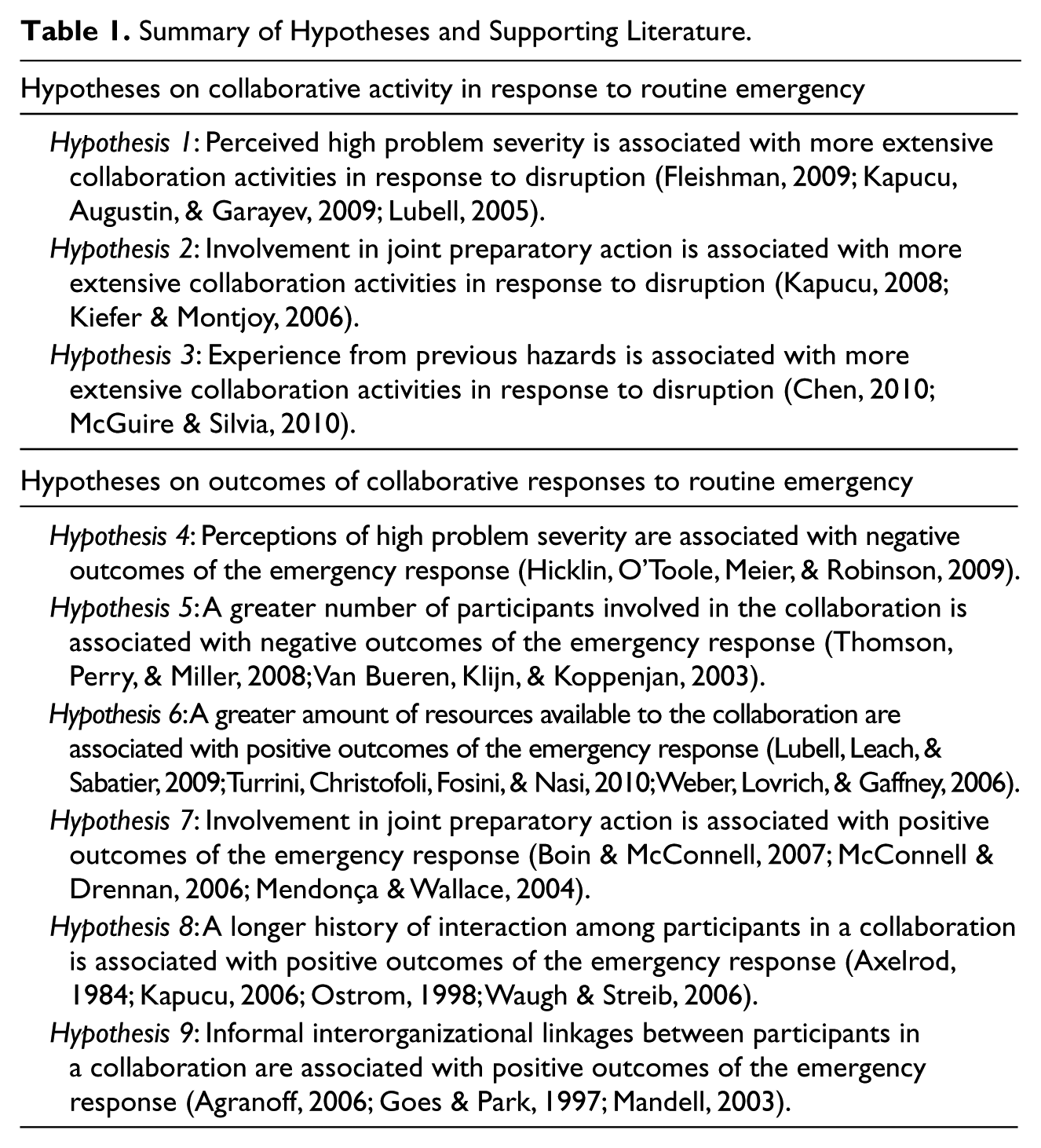
Hypothesis 1: Perceived high problem severity is associated with more extensive collaboration activities in response to disruption.
In emergency management, preparatory action is generally assumed to influence the capacity to deal with emergency and hazard. Involvement in joint preparedness activities may strengthen collaborative arrangements in times of crisis and emergency. If preparedness is conducted in conjunction with other organizations, preparatory efforts are likely to increase awareness of collaboration and the inclination to exploit interorganizational ties in times of disruption (Kapucu, 2008; Kiefer & Montjoy, 2006). From this follows that
Hypothesis 2: Involvement in joint preparatory action is associated with more extensive collaboration activities in response to disruption.
At the same time, research shows that mobilization of emergency response networks sometimes diverge from preexisting contingency planning (Boin & McConnell, 2007; Kapucu, 2005). These conflicting findings justify empirical assessment of the relationship between preparatory action and collaborative activity.
Next, aggregation of previous emergency experience can potentially increase the capacity to cope with situational constraints imposed by emergency (McGuire & Silvia, 2010). Based on learning from prior experience, organizations may over time develop resources (cognitive, administrative, material) to cope with disruption, which can explain incentives to collaborate. Prior emergency experience may also develop trust and modes of reciprocity among organizations, which is generally assumed to have a positive impact on collaboration based upon “positive prior working relationships” (Chen, 2010, p. 385). In turn, it is hypothesized that
Hypothesis 3: Experience from previous hazards is associated with more extensive collaboration activities in response to disruption.
Factors Explaining Collaborative Outcomes
Turning to candidate explanations for collaboration outcomes, researchers lower the expectations of finding generalizable relationships. Thomson et al. (2008), for example, predict that “it is unlikely we will ever arrive at a single approach to evaluate collaboration outcomes” (p. 104). Part of the problem is equifinality; especially when it comes to assessing client-level outcomes, the number of candidate causal paths is vast (Graddy & Chen, 2009). Nevertheless, previous research offers some insight into plausible explanations.
On the role of problem complexity, collaborative responses to emergencies are complicated by the scope of events; the greater the scope, the greater the need for swift coordination (Hicklin et al., 2009). Collaborative efforts are likely to be complicated by perceived situational constraints and, hence, it can be hypothesized that disruption scope is negatively related to collaboration outcomes.
Hypothesis 4: Perceptions of high problem severity are associated with negative outcomes of the emergency response.
Regarding collaborative process variables, research suggests that the explanation for successful collaborative outcomes can be attributed to the way collaborative arrangements are set up and how they are operated. Findings reported by Thomson et al. (2008), for example, shows that collaborative outcomes are positively related to a number of process features, including joint decision making, administration, mutuality, and trust. Following these findings and research reviewed elsewhere (Turrini, Christofoli, Fosini, & Nasi, 2010), this analysis investigates the relationship between five process variables and collaboration outcomes.
First, the analysis tests the assumption that outcomes are influenced by the scope of collaboration. Increase in network size is generally likely to increase the tension between self- and collective interests and thus the costs of reaching negotiated agreements will increase (Thomson et al., 2008). Likewise, the greater the number of actors that are involved, the greater the strategic uncertainty, which in turn increases the risk for stagnation and deadlocks in problem solving (Van Bueren, Klijn, & Koppenjan, 2003). The effect of collaboration scope on outcomes is therefore assumed to be negative.
Hypothesis 5: A greater number of participants involved in the collaboration is associated with negative outcomes of the emergency response.
Second, studies report a positive relationship between the level of resources available to networks participants and collaborative outcomes (Turrini et al., 2010; Weber, Lovrich, & Gaffney, 2006). This evidence indicates that resources are positively associated with network-level outcomes as well as with client-level performance (Lubell, Leach, & Sabatier, 2009). Thus,
Hypothesis 6: A greater amount of resources available to the collaboration are associated with positive outcomes of the emergency response.
Third, the obvious logic of crisis preparedness is that investments in joint preparation and planning will lead to more positive outcomes of crises and emergencies. Yet, the pitfalls are many and research points to a number of reasons why preparedness often fails in practice (McConnell & Drennan, 2006). However, all else being equal, one would expect collaborations that spend more resources (money, time, attention) on preparatory actions would perform better compared with collaborations that spend less resources. If not for other reasons, attention to preparedness is likely to increase vigilance, the readiness to take action, and the ability to improvise in the face of complex extreme events (Boin & McConnell, 2007; Mendonça & Wallace, 2004). On this basis, it is hypothesized that
Hypothesis 7: Involvement in joint preparatory action is associated with positive outcomes of the emergency response.
Fourth, there is widespread support in the literature that successful collaborations correlate with high levels of trust, which is particularly important in response to extreme events (Kapucu, 2006; Waugh & Streib, 2006). Trust, in return, develops gradually over time through processes of repeated interaction (Axelrod, 1984; Ostrom, 1998). Therefore, one would expect that a longer history of contact prior to any given event would lead to more positive outcomes. Hence,
Hypothesis 8: A longer history of interaction among participants in a collaboration is associated with positive outcomes of the emergency response.
Emergency management is a special case in this regard; unscheduled disruptive events call for interaction within preexisting arrangements but frequently also within newly formed ad hoc collaborations. If Hypothesis 8 is correct, one would expect a positive relationship between collaboration in preexisting networks and outcomes, whereas collaboration in newly formed networks would have a negative correlation with outcomes.
Fifth, the level of formalization of a network of actors has proven important to explain collaborative outcomes and so have more informal ties. Formalization includes concrete mechanisms of network functioning, such as decision procedures, formalized rules, and written agendas (Turrini et al., 2010). Formalization is indirectly covered by Hypothesis 8 as one would expect formalization to be higher in preexisting arrangements compared with newly formed networks. Meanwhile, studies report that collaborative outcomes are also positively related to the existence of multiple informal linkages among organizations (Agranoff, 2006; Goes & Park, 1997; Mandell, 2003). Thus,
Hypothesis 9: Informal interorganizational linkages between participants in a collaboration are associated with positive outcomes of the emergency response.
Data
Data for this analysis were retrieved through a web-based survey conducted by the Swedish Agency for Civil Emergency Planning in 2010. The survey targeted public managers with emergency management responsibilities in 66 organizations at national, regional, and local levels in Sweden. One respondent per organization was selected and thus the final data set comprises 66 responses distributed across seven organization types: national-level agencies (n = 15), county administrative boards (n = 21), county councils (n = 18), county authorities (n = 4), local governments (n = 4), self-governing regional authorities (n = 2), and state-owned companies (n = 2). Organizations were selected on the basis of their formal roles in the Swedish system for emergency management, as given by current legislation. Survey questions focused on the response of these organizations to periods of heavy precipitation and low temperatures in the winter of 2009-2010. The survey covered 45 questions related to organizational perceptions about event severity (scope and seriousness of disruptions), specific types of disruptions encountered, actions taken in response to severe weather conditions, emergency preparedness, and intensity and forms of interorganizational collaboration. Complementary data to document prior experience from natural hazards were retrieved from the Swedish Natural Hazards Information System, which contains data on natural hazards in Sweden from 1950 to date. Additional data on some outcome variables—including network-level outcomes and client-level effectiveness—were retrieved from Statistics Sweden.
Variable Measurement
Dependent Variable Measures
Although some studies emphasize the deeper meaning of collaboration activity as including processes of joint rule-making, development of shared norms, and interdependence (Thomson & Perry, 2006), other studies use more limited measures of interactions and contacts. Due to data constraints, this study adheres to the latter approach. Building from the operationalization developed by McGuire and Silvia (2010), the analysis of collaboration activity is based on an additive measure combining (a) number of reported contacts with other organizations (CONT), (b) number of interorganizational activities (ACT) (participation in newly formed collaboration networks, participation in preexisting collaboration networks, informal contacts, and other types of collaboration activities), and (c) number of contacts across administrative levels (LEV) (local, regional, national). 2 These six items have a Cronbach’s alpha coefficient of .7, suggesting good scale consistency. All inter-organizational activities are dichotomies. Contact across administrative levels is coded on a scale from 0 (no contacts) to 3 (contacts with organizations at all levels). Interorganizational contact includes the total number of contacts and has a range of 0 to 10. The additive measure of collaboration activity (CA) is calculated by multiplying these three measures:

The range for the collaborative action scale is 0 to 96 (where 96 represents contact with eight partner organizations at the three levels across the four types of activities).
Developing measures for collaboration outcomes raises additional methodological challenges, particularly in relation to crisis and emergency management (McConnell, 2011). One problem stems from the idea that collaborative management aims at goal attainment, which is hard to discern empirically due to complexity and ambiguity (Mandell & Keast, 2008; Matland, 1995; Sanderson, 2000; Vangen & Huxham, 2012). To address this challenge, collaborative governance research frequently combines multiple measures along two dimensions: (a) network-level performance and (b) client-level effectiveness (Turrini et al., 2010). 3 Network-level performance includes “the sustainability, legitimacy and maintenance of the networked structure per se,” whereas client-level effectiveness refers to “the aggregate outcomes for the population of clients being served by the network (p. 533).” Combining performance indicators at these levels is also consistent with the need for multivariate measures to analyze outcomes in crisis management (Gerber & Robinson, 2010; McConnell, 2011). Building from these insights, this study includes three measures of network-level outcomes and three measures of client-level effectiveness. Measures of network-level outcomes include (a) self-reported success, (b) coordination, and (c) innovation and change (Chen, 2010; Turrini et al., 2010). Survey responses are used to assess self-reported success; in the survey, respondents were asked to grade how well collaboration worked in the emergency response phase (responses range from 1 = good, to 2 = very good). Complementary data to measure coordination and innovation and change were retrieved from annual surveys of local and regional government crisis preparedness conducted by the Swedish Civil Contingencies Agency (2009, 2010a). Building from this data, coordination measures self-reported capacity to collaborate in planning, preparedness, and response to emergency. Responses range from 0 (capacity not fulfilled) to 2 (completely fulfilled). Innovation and change is measured as an additive scale covering the level of change from 2009 to 2010 in the perceived fulfillment of three emergency performance criteria: knowledge, planning, and capacity. 4 The innovation and change-scale measures annual change in each region in the mean value for the three criteria. The range is 0 to 1.11 (higher scores indicating more change).
Measures of client-level effectiveness include the specific tasks performed by any given network to serve its clients (Graddy & Chen, 2009). In Sweden, in the winter of 2009-2010, key managerial challenges included disruptions in water supply and transportation systems as well as some material loss, which in turn increased the pressure on rescue services (Swedish Civil Contingencies Agency, 2010b). Protection of critical infrastructure is also listed as a key performance target in emergency planning in Sweden (Swedish Civil Contingencies Agency, 2010c), making service delivery in these areas a valid starting point to measure client-level effectiveness. Building from these observations, public satisfaction (percentage of population in each region in 2010) with service delivery in three areas are included as measures of client-level effectiveness: (a) water supply (range = 69%-88%), (b) transportation (47%-58%), and (c) rescue services (71%-80%).
Independent Variable Measures
In the survey, respondents were asked to grade the scope of the disruption. On this basis, disruption scope is measured using a scale of self-reported disruption ranging from 0 (no disruption) to 4 (severe disruption). The mean value for disruption scope (Table 2) is .70 across the 66 organizations. Next, respondents were asked whether their own organization and whether other organizations within their domain of responsibility or geographical area had been affected by disruptions. Responses to these questions (dichotomies) are used as proxies for resource shortage and resource surplus, respectively. The mean value is .42 for shortage and .56 for surplus.
Summary of Hypotheses and Supporting Literature.
Summary of Variables Explaining Collaborative Activity.
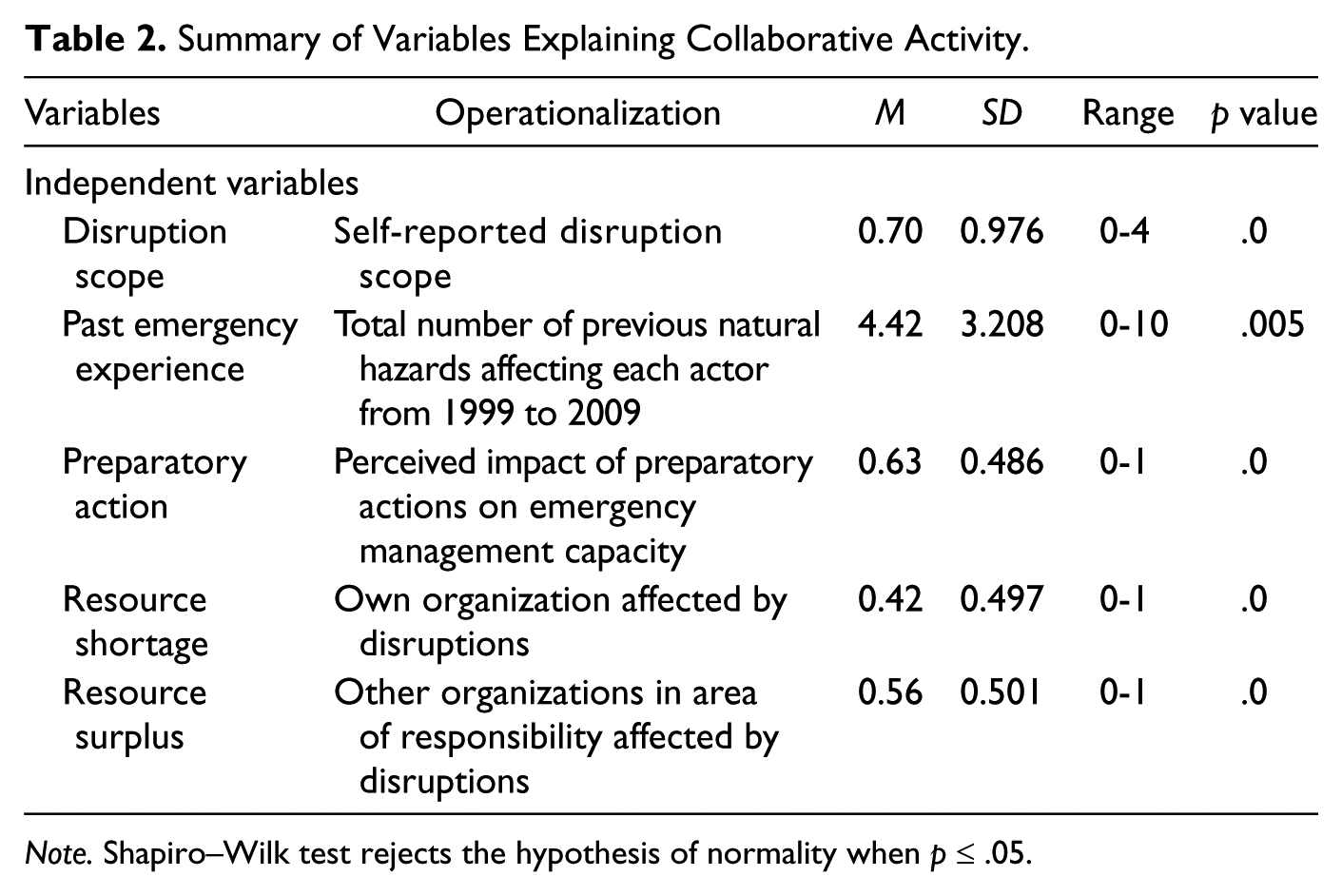
Note. Shapiro–Wilk test rejects the hypothesis of normality when p ≤ .05.
Questions about emergency experience were not included in the survey and therefore complementary data were gathered from the Swedish Natural Hazards Information System, which contains data on natural hazards in Sweden from 1950 to date. 5 A count was made of the number of natural hazards affecting each actor in a period of 10 years (1999-2009) preceding the winter of 2009-2010 (results range from 0 to 10). 6 The mean number of previous hazards in the data set is 4.42 over the 10-year period.
To assess the importance of emergency preparedness, the analysis assesses association between perceived impact of preparatory actions and emergency management, which is measured as a dichotomy in the survey (1 = preparedness measures did matter for the response and 0 = preparedness measures did not matter). The mean for this variable is 0.63.
Table 2 displays the mean, standard deviation, and range for the dependent variables. Shapiro -Wilk tests are added in the right-hand column to assess the distribution.
Local financial resources are commonly used as a measure of resource munificence, which refers to “the level of resources available to a network from its environment” (Turrini et al., 2010, p. 540). Here, resource munificence is measured using data on budget spending on civil protection retrieved from Statistics Sweden. Mean values for all municipalities in a county were used as measures for resource munificence.
Analysis of participation in new versus preestablished networks is conducted using survey responses indicating participation in preexisting networks and new networks, respectively (both variables are measured as dichotomies, where 1 = participation, and 0 = no participation).
Finally, informal interorganizational linkages aim at the level of informal contacts between organizations in relation to the emergency response. Such linkages are covered by the survey, which asked respondents whether they had engaged in any informal contacts. Responses were coded as a dichotomy (0 = no contacts, 1 = continuous informal contacts).
Table 3 summarizes the mean, standard deviation, range, and Shapiro–Wilk tests for these variables.
Summary of Variables Explaining Collaborative Outcomes.
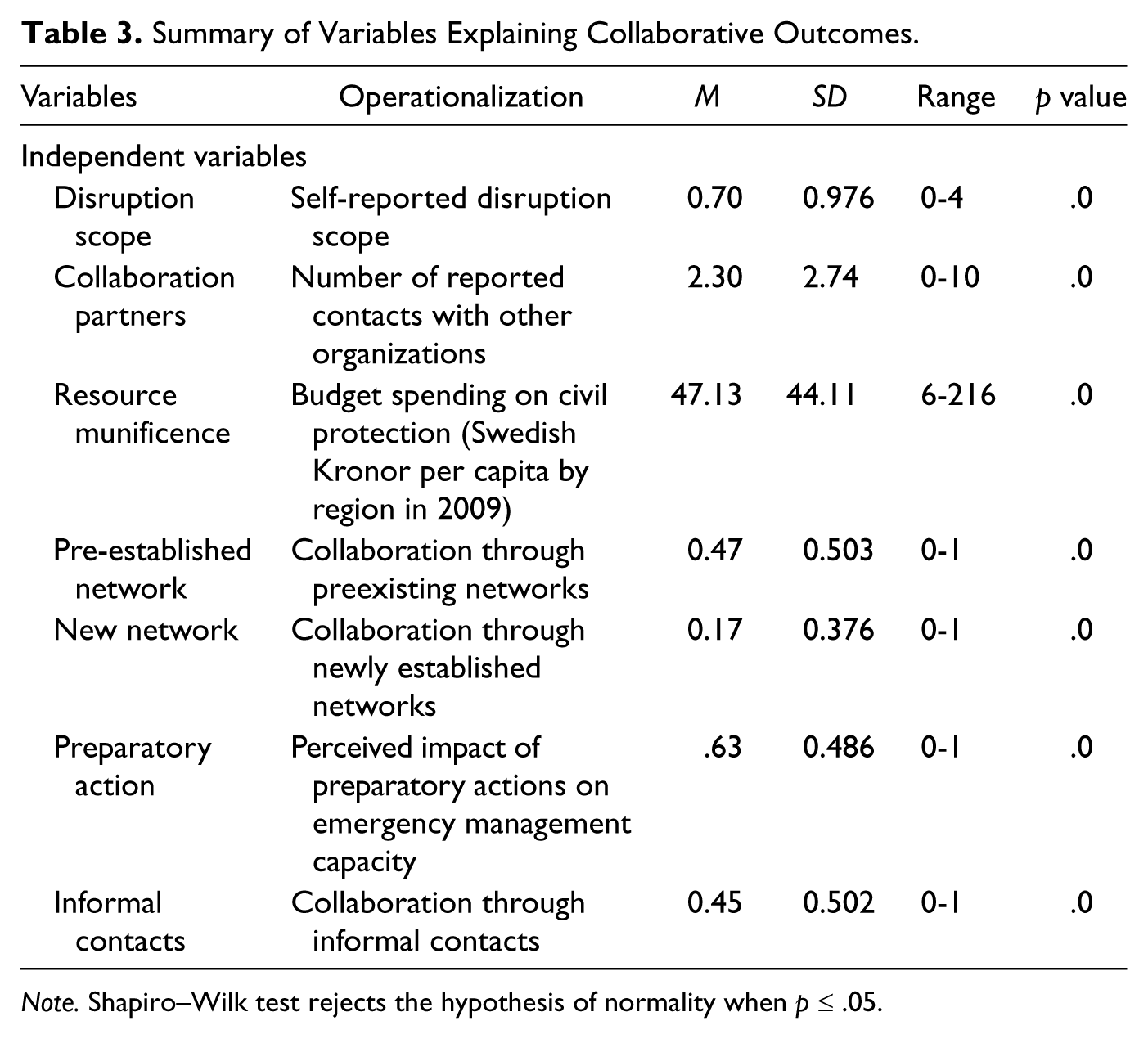
Note. Shapiro–Wilk test rejects the hypothesis of normality when p ≤ .05.
Analysis Results: Bivariate Correlations
Shapiro–Wilk tests reported in Tables 2 and 3 show that the explanatory variables are not normally distributed. For this reason—and also considering the relatively limited size of the data set—hypothesis testing is conducted using Spearman’s rank-order correlation.
Collaboration Activity
Table 4 presents bivariate correlations between the ten explanatory variables and the collaboration activity scale. The findings offer mixed results for Hypotheses 1 to 3.
Correlation Matrix of Factors Associated With Collaborative Activity.
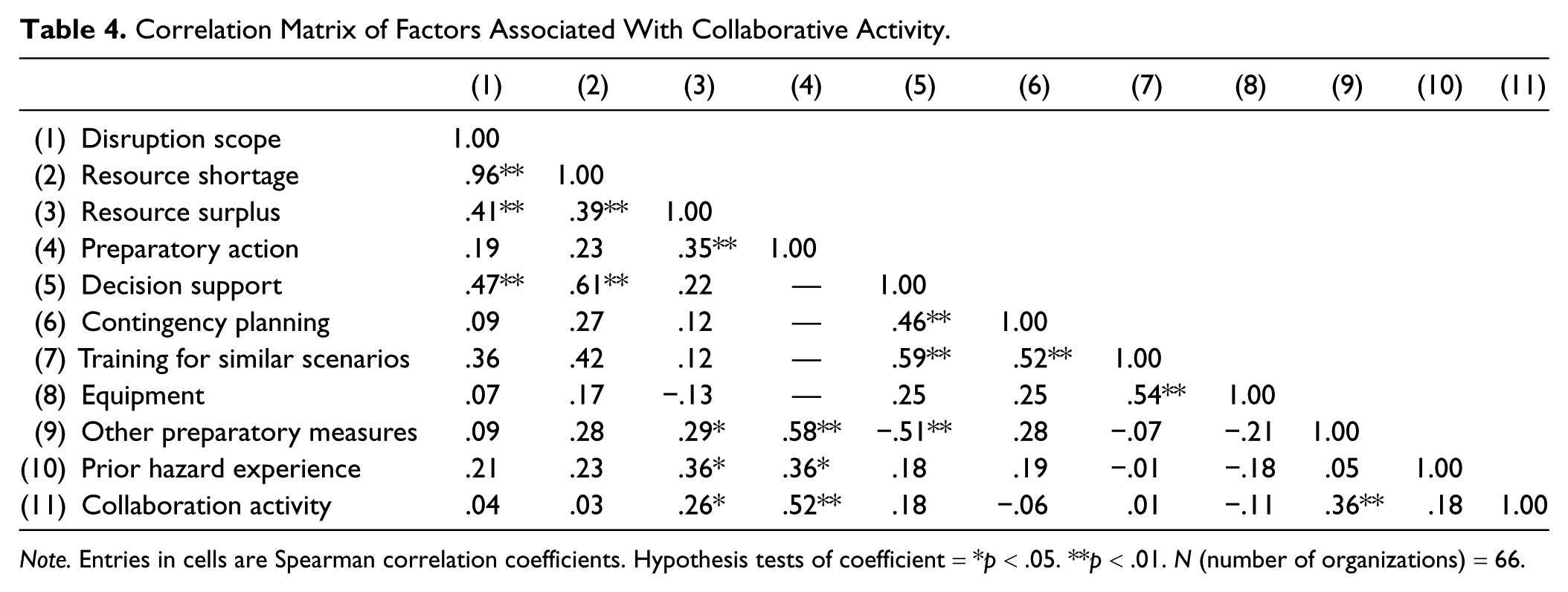
Note. Entries in cells are Spearman correlation coefficients. Hypothesis tests of coefficient = *p < .05. **p < .01. N (number of organizations) = 66.
The results indicate that three out of the ten variables have significant and positive association with collaboration activity: resource surplus, preparatory action, and other preparatory measures. Movement across the range of these three variables is associated with an increase in the collaboration activity scale. First, among the three variables used to measure problem severity, only resource surplus is positively associated (r = .26, p = .05) with collaboration activity. Thus, in substance, organizations that perceived that other organizations were affected by disruption were more engaged in interorganizational collaboration compared with organizations that themselves were affected by disruption. This lends partial support to Hypothesis 1, which assumed a positive relationship between perceptions of high problem severity and collaboration activity. Second, preparatory action is associated with high levels of collaboration activity (r = .52, p = .01), which is consistent with Hypothesis 2. However, out of the five specific preparedness measures, only the open response category (“other measures”) turned out to be positively associated (r = .36, p = .01) with collaboration activity. Third, previous natural hazard experience is unassociated with collaboration activity, which is inconsistent with Hypothesis 3 (assuming association between experience from previous hazards and collaboration activity).
Collaboration Outcomes
Table 5 summarizes association between the seven independent variables (Variables 1-7), the three network-level outcomes (Variables 8-10), and the three client-level outcome variables (Variables 11-13). Findings from Table 5 are overall inconsistent with outcome Hypotheses 4 to 9. Still, some observations merit attention.
Correlation Matrix of Factors Associated With Collaborative Outcomes.
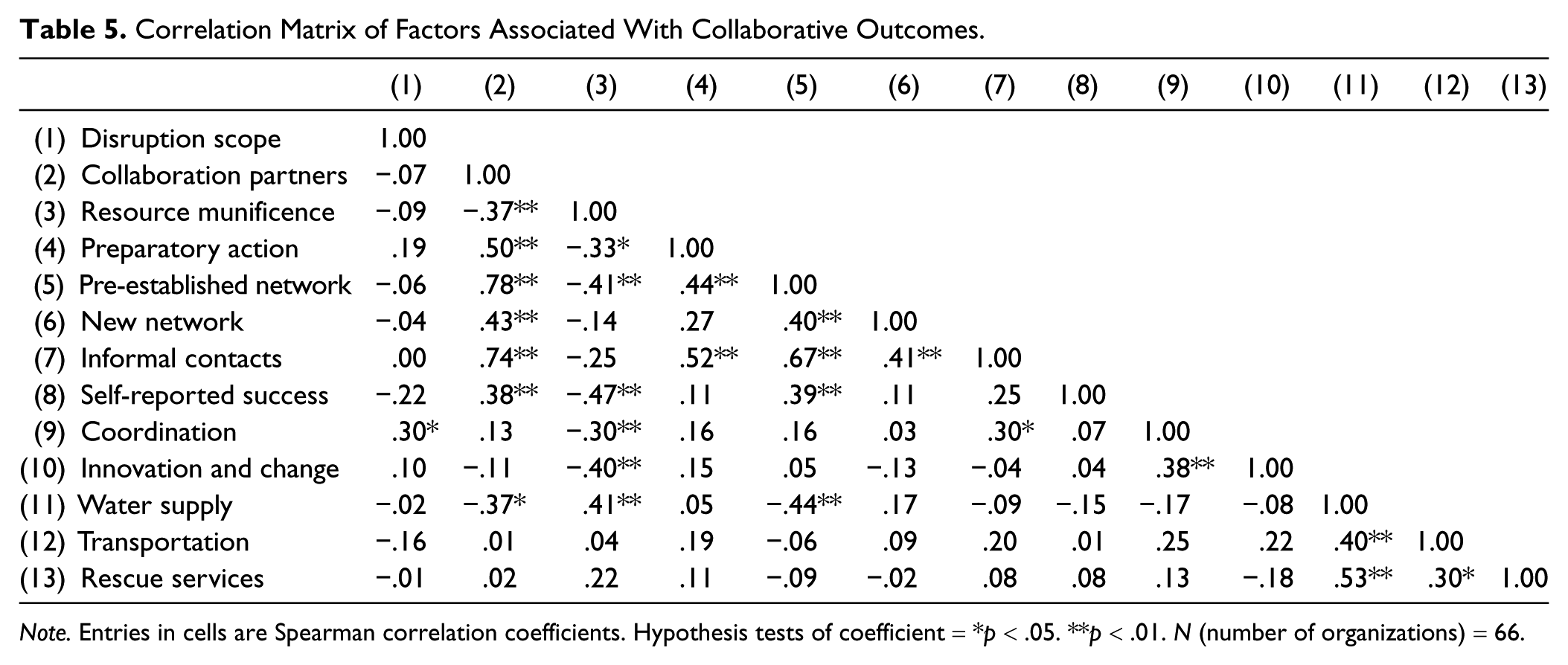
Note. Entries in cells are Spearman correlation coefficients. Hypothesis tests of coefficient = *p < .05. **p < .01. N (number of organizations) = 66.
Concerning problem severity, Hypothesis 4 assumes association between perceptions of high problem severity and negative collaboration outcomes. Contrary to this assumption, Table 5 shows that disruption scope is only associated with one outcome measure—coordination (network level)—which is inconsistent with Hypothesis 4. Findings conflict with Hypothesis 5, which assumed association between greater numbers of actors involved in collaboration and negative outcomes of the emergency response. Although this assumption seems to hold for water supply (r = −.37, p = .05), Table 5 displays positive association (r = .38, p = .01) between the number of collaboration partners and self-reported success, which is at odds with Hypothesis 5. Next, Hypothesis 6, which assumed association between the amount of resources available to the collaboration and collaboration outcomes, only holds for water supply (r = .41, p = .01). Interestingly, significant and negative associations were found between resource munificence and all three outcome measures at the network level. Results regarding preparedness are inconsistent with Hypothesis 7 because no relationship was found between involvement in preparatory actions and outcomes. In fact, when examining more closely the relationship between more specific preparedness actions and outcomes, the only significant relationship found (r = −.44, p = .05) is between crisis planning and self-reported success, which suggests that planning is associated with lower levels of perceived performance. The analysis also generated conflicting evidence regarding Hypothesis 8, which assumed association between outcomes and the longevity of the interaction. This seems to hold for self-reported success, which is associated (r = .39, p = .01) with participation in preestablished networks. Meanwhile, the data indicate significant but negative association (r = −.44, p = .01) between participation in preestablished networks and water supply. Finally, the data do not lend any support to Hypothesis 9, which expected informal linkages among organizations to be associated with collaboration outcomes. Out of the six outcome variables, informal linkages only have a positive association with coordination.
Discussion
Collaborative governance scholars have devoted considerable attention to the conditions under which various collaborative arrangements form, mobilize, and perform in different situations and contexts. Several studies in this vein specifically address collaboration in relation to wicked problems focusing on the conditions under which interorganizational networks cope effectively with complex extreme events. These studies are limited in two respects; first, most of them are concerned with extreme disasters and, second, few employ empirical measures of collaborative performance. Addressing these limitations, this article tests nine hypotheses (Table 1) regarding mobilization and performance of collaborative arrangements in response to severe winter conditions in Sweden 2009-2010. Although the findings are limited to emergency management in Sweden, the findings offer some general guidance for future research.
First, results from this research suggest that involvement in collaborative activities in response to emergency increases when managers perceive that other organizations are affected by disruption (Hypothesis 1). No significant relationship was found between disruptions affecting the own organization and collaborative activity. Two implications can be drawn from these findings. First, the predictability and relatively limited scope of routine emergency (compared with disasters) offer a straightforward explanation as to why organizations affected by disruption do not engage in collaboration. Hence, as given by the definition of routine emergency, disruptions do simply not exceed organizational capacities and can be managed without mobilization of external support. Second, several plausible motivations should be explored further to explain why collaborative activity increases when other organizations are affected by disruption, including benevolence (provision of material or analytical support), uncertainty (activate interorganizational networks as a precautionary measure to heighten preparedness in case disruptions would deteriorate), and legitimacy (demonstrate commitment to common network norms and goals). These motivations are not mutually exclusive and should be investigated in greater detail.
Second, the analysis has demonstrated empirically that collaborative action is associated with preparatory action (Hypothesis 2). In this research, preparatory actions involve measures taken to prepare for emergency, including development of analysis and decision support, crisis plans, mobilization of equipment, training of similar scenarios, and other activities. Managers who reported that preparatory action was important for their ability to respond to disruption were more prone to engage in collaboration compared with managers who did not emphasize preparatory action. This observation corroborates the expectation that preparedness overall increases collaborative emergency response effectiveness (Kapucu, 2008). Yet, researchers also call for more fine-grained analyses of what specific resources are required to strengthen collaborations and their performance more generally (Chen, 2010; Gazley, 2008; Koontz et al., 2004). In this study, “other preparatory measures” is the only variable that is associated with collaborative activity (see Table 4). One interesting avenue of study is to uncover the causal mechanisms mediating the effects of preparatory action on collaborative activity and outcomes (Emerson et al., 2012). For example, to what extent do preparatory work heighten managers’ mental preparedness to collaborate in response to emergencies (Weber & Khademian, 2008)?
Third, results reported here indicate that prior experience of natural hazards is unrelated to involvement in collaborative activity, which is at odds with Hypothesis 3 and inconsistent with findings reported elsewhere (McGuire & Silvia, 2010). In theory, prior experience is an antecedent condition that strengthens network ties in collaborative arrangements over time; repeated interaction is likely to feed learning about other actors’ responses, which facilitate collaboration among network participants (Kapucu, 2006; Thomson et al., 2008). On this basis, results from this research give reason to investigate further prior hazard experience as an antecedent condition for collaboration activity and outcomes. Such efforts should involve assessment of the capacity of collaborations to learn from prior events.
Fourth, no relationships were found between perceived problem severity (Hypothesis 4) or number of actors involved in collaboration (Hypothesis 5) and outcomes at network and community levels. In addition, contrary to the hypothesized importance of resources (Hypothesis 6), the analysis indicates negative association between budget spending on civil protection and network-level outcomes. Meanwhile, the analysis found munificence to be positively related to water supply as a measure of client-level outcomes. Taken together, these results are consistent with findings reported in prior research, which documents mixed effects of resource munificence on collaborative performance (Turrini et al., 2010). This calls for more research on the relationship between resource munificence and collaborative outcomes, particularly in the context of poor emergency response operations, which are frequently followed by calls for increased resources.
Fifth, data reported here do not support the assumption that emergency management outcomes are conditioned by collaborative process variables. The analysis comfirms some expected bivariate relationships, yet it also shows that correlations fluctuate from positive to negative depending on the choice of outcome measure. This is the case for collaboration partners, resource munificence, and preestablished networks, which all have positive relationships with network-level outcomes but negative relationships with client-level outcomes. Meanwhile, several plausible intermediate factors—for example, leadership (Bryson et al., 2006; Silvia & McGuire, 2010), entrepreneurship (Page, 2003), lead-agency involvement (Choi & Brower, 2006), and personality and psychological traits of participants (Smith, 2000)—have been ignored due to data constraints and may account for some of the variance, which warrant future inquiry.
One final observation involves the costs associated with collaboration and, ultimately, the efficiency of collaborative crisis management. This article seeks to expand the study of collaborative emergency management by assessing network-level and client-level outcomes of emergency. However, none of the measures used here enable insight into the costs associated with collaborative responses to disruptions. Potential costs include loss of freedom to act independently and investment of scarce resources (Hudson et al., 1999). Collaborative public management research generally pays more attention to the benefits of collaboration than the costs. Future studies should therefore investigate the terms for efficiency by documenting the relationship between participation in collaborations and increased costs (e.g., time and energy, risk aversion, and unwillingness to contribute with resources) and how those costs relate to benefits in terms of improved emergency response capacity (Agranoff, 2006).
Conclusion
Using survey data on organizational responses to extreme weather conditions in Sweden, this article makes a conceptual and empirical contribution to research on collaborative responses to extreme events. Using a combination of empirical performance measures at network and community levels, the study adds insights regarding plausible explanations for mobilization and performance of collaborations in response to routine emergency. The findings should be weighed against evidence from other studies addressing collaborative responses to extreme events in other administrative and social systems.
Governments invest substantial public resources to facilitate and strengthen collaboration between public and societal actors in emergency preparedness and response activities. One task for social science research is to systematically evaluate these efforts by studying outcomes at different levels and across types of events. Routine emergencies are a legitimate target for this research as they are encountered frequently and impose societal, environmental, and economic costs. Collaborative arrangements are typically treated as multiorganizational networks, yet in practice, each organization is represented by individuals who vary in their perception of events and capacity to respond under pressure. One avenue for future research is to assess what role these individual characteristics have in shaping collaborative management. For example, new insights may be gained by combining the collaborative governance perspective with theoretical approaches emphasizing situational constraints and individual factors in emergency response networks (cf. Smith, 2000).
More conceptual and empirical work is needed to better understand the conditions for collaborative performance in response to disruptions. Besides developing tools for performance measurement and analytical methods to assess the impact of antecedent conditions on collaborative management, this research should more carefully address the normative question of what constitutes effective governance in response to wicked problems. Specifically, what empirical performance measures should be used to assess responses to problems that have multiple plausible solutions? This problem, some argue, justifies a focus on networks’ adaptive capacities to address unexpected and complex problems by means of flexibility and improvisation. The flip side of this approach, others argue, is a missed opportunity to systematically assess the ability of collaborations to provide better services to communities in times of disruption. More careful treatment of the normative principles of performance measurement would provide new perspectives on collaborative emergency preparedness, response, and outcomes in relation to events on different scales.
Footnotes
Acknowledgements
The author would like to thank Chris Weible, Michael McGuire, and two anonymous reviewers for useful comments on earlier drafts of this article.
Declaration of Conflicting Interests
The author declared no potential conflicts of interest with respect to the research, authorship, and/or publication of this article.
Funding
The author disclosed receipt of the following financial support for the research, authorship, and/or publication of this article: This research was supported by a grant from the Swedish Civil Contingencies Agency.