







Abstract
Challenges have been made to validate “classical” forms of management. This study facilitates suggestions to view organizational theory from a design perspective. Affirming how Luther Gulick explored design, tests of a construct were used to substantiate POSDCORB as a framework. Integrated within are elements of linguistics and Alexandrian patterns. An instrument development model was used to approximate POSDCORB as it demonstrated acceptable content validity, as well as construct validity and reliability. Having explored a proxy, models were established using multivariate data. The study provides framework-theory-model scenarios, evidence to indicate the adoption of institutions, and element support.
Keywords
Challenges have been made to substantiate the “classical” forms of management as described by engineer Frederick Taylor, French industrialist Henri Fayol, and administrator Luther Gulick (Shafritz & Ott, 2001). Their approaches have been described as being more prescriptive than empirical (Scott, 2003); however, this only hints at the complexities. Sixty-eight administrative principles were found in the French literature as described by Charles-Jean Bonnin (Martin, 1987; Stillman, 1991). For simplicity, we can assume that an encapsulation of principles needed to occur. Taylor (1903) believed that by removing the variability of humans, new efficiencies could emerge for accomplishing a given task, and he even had an information bureau. Until his death, Fayol worked to develop what was described as the first comprehensive theory of management (Shafritz & Ott, 2001), and Gulick inherited and extended aspects of Fayol’s work. In Gulick’s quest to teach the work of an executive, he used pattern-based design, and instances of POSDCORB-like institutions have evolved.
Early Definitions and Integration
The plan to substantiate the above thesis is to more fully assess POSDCORB as a framework. It is not the one and only framework, and we refer to POSDCORB as simply “A Framework” with an emphasis on the word “A.” A general framework helps to identify the elements (and the relationships among these elements) that one needs to consider for the analysis of institutions (Ostrom, 2005). Furthermore, frameworks organize diagnostic and prescriptive inquiries as they provide “the most general list of variables that should be used to analyze all types of institutional arrangements” (Ostrom, 1999, pp. 39-40). Gulick (1937b) gave voice to POSDCORB within a discussion of organizational patterns. An analysis, if it is to be of value in future years, “must be brought within a single system of definition and nomenclature” (Gulick, 1937c, p. 195). What POSDCORB may lack as a research framework, it may gain as being application based.
The framework-theory-model approach has been described as “a nested set of theoretical concepts—which range from the most general to the most detailed types of assumptions” (Ostrom, 2005, p. 27). This approach has been used to guide research associated with practices involving common pooled resources (McGinnis, 2000; Ostrom, 2005; Ostrom, Gardner, & Walker, 1994, to name a few). Some early automated data processing practices among the 50 American states were documented as being pooled or centralized (Public Administration Service, 1965). Subsequently, a shift away from controlling computer hardware toward coordinating information resource management (IRM) occurred. Gulick’s POSDCORB may illuminate the issues, concerns, and problems for information managers (Horton, 1985) and may overarch information resource areas (Caudle, 1990). These concepts will be integrated in more detail below, but first we will reveal issues that can arise if framework attributes go unnoticed.
After a brief history, some design attributes of POSDCORB are discussed. Continuing the plan, definitions associated with this structure are subsequently identified. A mixed-methods instrument development model will then be used to qualitatively and quantitatively assess a comparison. Quantitative results from an empirically validated construct will be explored to substantiate a POSDCORB proxy. Two organizational theories are presented. Multivariate data will then be used to test the strength of the proxy as influenced by the elements. Finally, we will interpret the results, assess the theories, and offer some conclusions.
Historical Perspective
The “classical” contributions to organizational theory have been well documented, including the works of Taylor (1903), Fayol (1937), Gulick (1937b), and Urwick (1937). Neoclassical organizational theory has been portrayed as trumping the former in several introductory sources (e.g., Scott, 2003; Shafritz & Ott, 2001; Stillman, 1991). Generations of scholars may not have read Gulick (Meier, 2010), yet, his work sits prominently in the representations and models of contemporary researchers (Agranoff, 2007; Agranoff & McGuire, 2001; Fairholm, 2004). Submissions to a prominent public administration journal further reveal how most remain squarely within POSDCORB categories (Raadschelders & Lee, 2011). Scholars could be sending one message, whereas students may be receiving another.
Contributions from Gulick were reformatory and forward-thinking (Meier, 2010), but a distinguishing issue that deserves refocus is his use of design. In early public administration, design aspects were largely initiated by Gulick. Accordingly, he made up the word POSDCORB, “designed to call attention to the various functional elements of the work of a chief executive” (Gulick, 1937b, p. 13). This word was conceived and published in Gulick’s (1935) earlier notes and discussions and in his collaborative works (Commission of Inquiry on Public Service Personnel, 1935).
Herbert Simon played a key role in the development of the “neoclassical” organization theory, thereby challenging the classics (Shafritz & Ott, 2001). His book Administrative Behavior became the most influential in public administration (Sherwood, 1990). Vincent Ostrom (1989) claimed that Simon’s attack on the works of Gulick was associated with an intellectual crisis of the discipline. Since then, the studies and theories of organizations have taken several paths.
Open systems (Katz & Kahn, 1966), contingency theory (Thompson, 1967/2003), and structural contingency theory (Pennings, 1992) make up some of the core inquiries. Empirical studies have been hypothesized (DiMaggio & Powell, 1983; Gresov, 1989, to name a few), as well as attempts at a broad synthesis (Bolman & Deal, 2008; Mintzberg, 1979). But few have returned to Gulick’s work to analyze POSDCORB as a whole. Meier and Bohte (2003) explored his principles, and Fairholm (2004) successfully surveyed POSDCORB for completeness. Often organizational paths lead back to the work of Gulick. For instance, the new “new public management” approaches may simply be POSDCORB re-dressed with new labels (Raadschelders & Lee, 2011). For more than 60 years, public administration has relied, to varying degrees, on the acronym of POSDCORB “to distill management activities into seven basic tasks” (Agranoff & McGuire, 2001, p. 298).
Without models, Hammond (1990) and Meier and Bohte (2000) revealed how scholars uncritically accepted the arguments of Simon’s work. Lacking evidence, the “classical” approach still persists as the base upon which other theories are built (Shafritz & Ott, 2001). A qualifying framework marker is that it should help organize empirical research (Ostrom, 1999). Little research existed about the principles at the time of the critiques (Meier & Bohte, 2000), and evidence supporting the holistic set of principles are still lacking. Taylor, Fayol, and Gulick were interested in public administration in terms of what it “should be” (Scott, 2003, p. 9) and through Gulick’s design science, “how things might be” (Meier, 2010, p. 284).
Gulick was influenced by the work of Fayol (Fitch, 1996), the extent to which can be seen in that he had his work translated from French to English (Gulick, 1937a). Fayol had descriptions of administration member tasks, such as those of planning, organizing, command, coordination, and control, while another council member was envisioned to undertake financial problems, and yet another member was assigned to the organization of accounting and statistics (Fayol, 1937). It appears that Gulick encoded and encapsulated
POSDCORB has been dubbed a framework by at least some (Graham & Hays, 1986; Stillman, 1991), and extensions have been described (Richardson & Baldwin, 1976; Graham & Hays, 1986). Gulick used a sequence to his list (Fitch, 1996), as do other pattern scholars (e.g., Alexander, Ishikawa, & Silverstein, 1977; Kerievsky, 2005). As criteria, Elinor Ostrom (1999) questioned whether a framework performs “better than others in a similar range of applications?” (p. 65). In terms of durability, scholars have asked whether there is “a POSDCORB equivalent set of tasks that replaces the standard planning, organizing, and so forth?” (Agranoff & McGuire, 2001, pp. 297-298). They later reported “to date, no readily agreed-upon set of functional activities exists that is the hierarchical equivalent of POSDCORB” (Agranoff, 2007, p. 26).
A discussion of public administration frameworks also appears to be lacking. This differs from policy studies, and the field of policy implementation, in which several frameworks are described (Sabatier, 1977; Sabatier, 1999; Sabatier & Mazmanian, 1980; Van Meter & Van Horn, 1975, to name a few). The same can be said for the field of institutional analysis (Crawford & Ostrom, 2000; McGinnis, 2000; Ostrom, 1999; Ostrom, 2005; Ostrom et al., 1994). Ask any administrator and they will likely report how implementing policy is among their primary duties, and how analyses are subsequently done on their teams. From those implementation- and analysis-based discussions, more insightful frameworks, theories, and models have ensued (Ostrom, 1999; Sabatier, 1999). Arguably, their studies are stronger because of these structures. In his own field, Gulick (1935, 1937b) sought an early way to teach public administration, and he developed POSDCORB. Acknowledging the works of Wamsley and Zald (1973), the taxonomical works of Debbasch and Van Braam, and attempts by Raadschelders (2011) and Stillman (2005), the quest for public administration frameworks appears to be lacking.
What “class” is POSDCORB that could make it enduring? A class can be defined as a template for the creation of instances (Goldberg & Rubin, 1995). A “base class” is the most generalized class in a class structure (Booch, 1994). Others have documented instances (Fairholm, 2004) and positioned POSDCORB within a focal core (Agranoff, 2007, p. 194). Being a “base class,” a POSDCORB framework cannot be functionally specific. Social science scholars are now coming to this realization. For instance, a “base game” of one framework showed only a physical world, and thus emptiness and nothing (Crawford & Ostrom, 2000). Empty classes or categories appear in linguistics (Chomsky, 1996). James Thompson (1967/2003) found these attributes in Gulick’s work, and he warned of this difficulty: homogenizing on one dimension does not homogenize on all. However, just as the work of Thompson endures, so does the work of Gulick (Meier, 2010). To support our beginning thesis, this article attempts—in three main parts—to (a) reconstruct Gulick’s design, (b) explore blends of framework definitions, and (c) explain instances of POSDCORB-like institutions.
Reconstructing Gulick’s Design
Gulick’s perspective of public administration was practitioner based. This included being the director of the Commission of Inquiry on Public Service Personnel and a member of the President’s Brownlow Committee, as well as many other positions. He not only conceptualized organizational design but also facilitated a presidential reorganization (Wamsley & Dudley, 1998). Gulick simply could not have subordinates developing their own forms of administration, and POSDCORB served the Brownlow Committee as the framing idea (Stillman, 1991). The purpose of this part is to reconstruct Gulick’s attempts to simplify public administration by using a pattern-based language and a framework.
Having a domain for patterns is important (Alexander, 1964). Design is concerned with how things ought to be and “with devising artifacts to attain goals” (Simon, 1981, p. 133). A framework serves to codify a language, and the resulting structures can be defined as being “a kind of microarchitecture that codifies a particular domain” (Booch, 1996, p. 274). The elucidation of fundamental elements is important for frameworks (Ostrom, 1999). Public administrators indicated that the traditional activities summarized by POSDCORB “fully explain the purpose and processes of their work” (Fairholm, 2004, p. 586). Noting the possibility of other domains and frameworks, the domain of this study may be considered established.
Gulick (1935) codified initials so that one word could stick in the minds of administrators. After presenting POSDCORB, his word appeared in later publications (Commission of Inquiry on Public Service Personnel, 1935; Gulick, 1937b), as well as discussions (too numerous to cite) up to the present (Raadschelders & Lee, 2011). Those codes look similar to the reduction schemes later used by Simon in his descriptions of complex architectures. In a section entitled “Simple Descriptions of Complex Systems,” Simon (1981) reduced 64 codes down to 35, and then indicated how many could be reduced to just 1. In Gulick’s treatment of Fayol’s work, he made use of reducible codes, and from Gulick’s construction, we can assume he was envisioning a framework. Gulick predicted it would take at least 2 years to establish a framework (Commission of Inquiry on Public Service Personnel, 1935) and, right on schedule, he published POSDCORB (1937b). A refactoring and regeneration of this structure may uncover similarities with engineers.
Scholars believe Gulick was associated with design. One indicated how Gulick showed “a clear awareness of the complexities of designing organizations” (Hammond, 1990, p. 145). Another referred to Gulick’s work as a “Grand Design” (Van Riper, 1990, p. 610). Yet another referred to Gulick as being a design scientist (Meier, 2010). Simon (1947) sought a comprehensive framework, but it is possible that Gulick had already designed one.
Mature frameworks are desirable as they can be reused as the basis for many applications (Fayad, Schmidt, & Johnson, 1999). Yet, parameterized classes cannot have instances unless we instantiate them (Booch, 1994). More specifically, decision frameworks “ask that you
Design Applicability
Fayol’s comprehensive work predated Gulick, so it can be said that he inherited Fayol’s works. However, inheritance is also an engineering term. While designing, the identification of artifacts has been previously suggested. Artifacts can also be thought of as objects. The use of inheritance is just one of several techniques in object-oriented design. With systems as diverse as social institutions, a start might be to decompose a system into objects and then use the resulting structure as a framework for expression (Booch, 1994). To practitioners, administrative patterns can be easily identified, and Gulick saw many similarities in organizations (Van Riper, 1990).
The need for refined frameworks has encouraged researchers to revisit the foundational work of Christopher Alexander (Gamma, Helm, Johnson, & Vlissides, 1995; Goldberg & Rubin, 1995; Johnson & Hicks, 2004; Kerievsky, 2005). Alexandrian form applies to objects and design patterns. He admonished designers to look for repeatable patterns in architectural design (Goldberg & Rubin, 1995). In a condensed Alexandrian form, a small set of POSDCORB patterns, with associated contexts, forces, and relatedness, will be provided below.
Contemporaries have subsequently recognized the importance of “a pattern language” as described by Alexander (Johnson & Hicks, 2004; Kerievsky, 2005, to name a few). Elements are the patterns themselves whereby each one describes a problem which: occurs over and over again in our environment, and then describes the core of the solution to that problem, in such a way that you can use this solution a million times over, without ever doing it the same way twice. (Alexander et al., 1977, p. x)
Some patterns may be “true invariants,” or a solution that summarizes a property common to all possible ways of solving a stated problem (Alexander et al., 1977). Referring to those 68 principles of administration, “unlike Gulick, Bonnin wrote organizational principles for all levels of the bureaucracy from supervisors to ministers” (Martin, 1987, p. 299). For frameworks, multiple levels of analysis are desirable (Ostrom, 1999). Gulick probably believed there were too many principles to teach. A person with a pattern language “can design any part of the environment as . . . [t]he expertise is in the language” (Alexander, 1979, p. 353). With Fayol’s work, Gulick recognized patterns and compressed them inherently into those of
Object-Oriented Government
In dealing with complexity, the decomposition of concepts into artifacts and objects was previously suggested. Some have indicated the possibility of using objects to conceptualize an object-oriented government. For instance, the delegation of responsibility to operating units, loosely coupled dependencies among these operating units, and reuses of policies and procedures “are the hallmarks of an object-oriented government” (Goldberg & Rubin, 1995, p. 49). Other organizational design scholars exist (e.g., DeSanctis & Fulk, 1999), but an object-oriented view may be closer to the designs needed of record keeping and reporting. Perhaps the discipline of information technology and practices in engineering can be tapped for techniques.
Initials have been developed so that one word could remain in the minds of engineers. Being object oriented has been described as having elements of polymorphism, inheritance, and encapsulation (Gamma et al., 1995; Goldberg & Rubin, 1995; Kerievsky, 2005; van der Linden, 2002, to name a few). Variations exist, but these object-oriented practices are in frequent use. For brevity, designers refer to these three interchangeably as “PIE” (cf. van der Linden, 2002). Goldberg and Rubin (1995) describe how a language is object oriented when its representational capabilities are object oriented and when it exhibits the properties of: Encapsulation, in which “the language supports the representation of information and information processing as a single unit that combines behavior with the information needed to carry out the behavior,” Polymorphism, which is characterized by “the language mak[ing] it possible to send the same message to different objects and elicit a distinct but semantically similar response from each,” and Inheritance, wherein “the language supports the definition of a new entity as an extension of one or more existing entities, such that the new entity inherits existing behavior and information” (p. 46).
To those new to Alexandrian patterns, we seek to provide a template that can be applied in many situations (Gamma et al., 1995), as animations of diverse situations may occur. Ostrom (2005) found the need to “limit the frame” by focusing on only a few components. Similarly, we focus on only
Design Technique Interrelatedness and Select Parts of POSDCORB.
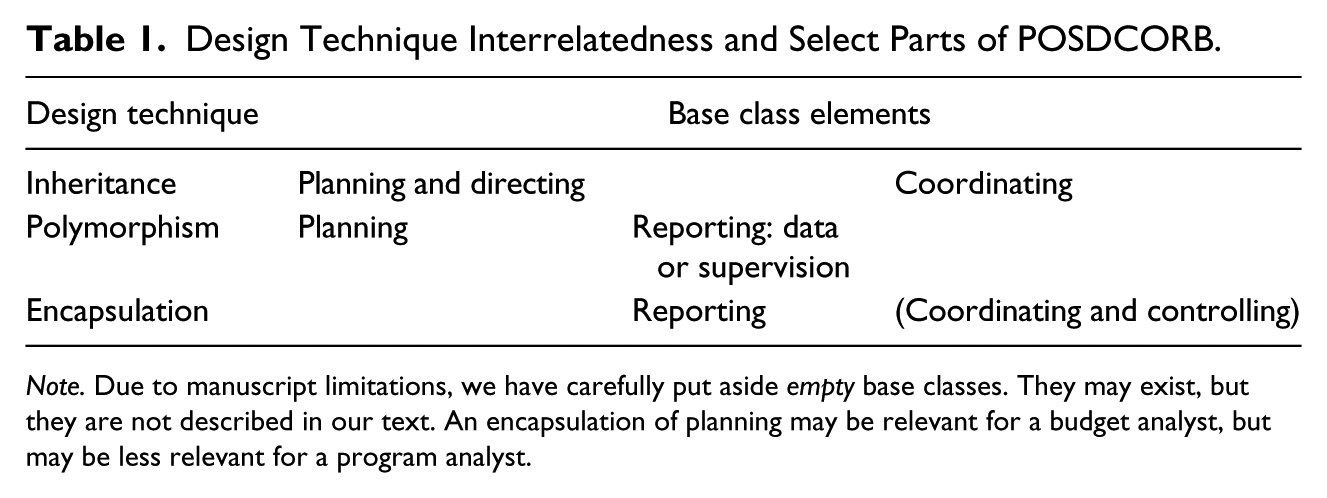
Note. Due to manuscript limitations, we have carefully put aside empty base classes. They may exist, but they are not described in our text. An encapsulation of planning may be relevant for a budget analyst, but may be less relevant for a program analyst.
PIE: Inheritance of Planning
Using inheritance, a hierarchy of levels with regard to organizational
PIE: Polymorphism with Reporting
Gulick tried to accommodate polymorphism by bringing together words to send a message that could be interpreted differently by people in distinct but semantically similar ways. An example is Gulick’s
PIE: Encapsulation (Coordination and Control)
Gulick encapsulated the work of Fayol by combining
PIE: Empty Base Classes and Extensions
We have carefully put aside some empty base classes. They may exist, but they are not described in our text. Based on a reader, encapsulations of
A Synthesis of PIE and Social Science Literature
Recent literature has become seemingly PIE-like. Three types of isomorphism have been described and publicized by organizational theorists (e.g., DiMaggio & Powell, 1983). Encapsulating those three may suggest a need for organizations to be polymorphic, a trait whose presence has been found in modern organizations (Usher, 1999). Polycentric approaches to institutions and framework articulations have been tested (McGinnis, 2000; Ostrom, 2005). These concepts may be new to some, but engineers commonly use frameworks and PIE.
A Methodology with Criteria
A mixed-methods instrument development model is a form of exploratory design consisting of two phases: qualitative followed by quantitative (Creswell & Plano Clark, 2007). The remainder will be exploratory/qualitative in one part, and explanatory/quantitative in the second. Ways to assess the value and usefulness of a framework have been suggested above (cf. Ostrom, 1999), and two more criteria are as follows: Does the framework encourage integration across other disciplines? Does the framework provide a coherent language for identifying universal elements of theories attempting to explain an important range of phenomena (Ostrom, 1999)? These criteria will be assessed before our final conclusion.
In summary, no one has analyzed POSDCORB empirically and as a whole. Some have explored primary aspects of Gulick’s principles (Meier & Bohte, 2003) and leadership (Fairholm, 2004). It was assumed that Simon changed his effort to comprehend the whole as it became less interesting or relevant to research interests (Meier, 2010; Stillman, 1991). An empirical study, such as the one herein, could possibly renew a focus placed on framework attributes. We believe the elements of control and coordination lie within information technologies. So why not look at the strength of Gulick’s POSDCORB in terms of being a framework related to data management? Simon (1973) has previously suggested applying information technology to organization design. Having identified PIE-like design properties in Gulick’s language, let us see whether his concept holds up as a framework.
Exploring Blends of Framework Definitions
This second part will explore the possibility that interdisciplinary constructs are congruent, or at least similar to POSDCORB. When looking at an acronym from “classical” organization theory, it may help to consider a similarly seasoned attribute. In describing an “ideal type” bureaucracy, sociologist Max Weber (1922/1946) theorized how “[t]he management of the modern office is based upon written documents (‘the files’), which are preserved in their original or draught form” (p. 197). In our opinion, the files are used for acquiring, storing, processing, and distributing data so that, subsequently, the data may be
Shared Definitions
Prior researchers have done a broad synthesis in an attempt to define IRM. Those definitions, similar to the organizations they support, have evolved over time. In 1975, in lieu of public complaints about government “red tape,” Congress passed P.L.93-556 creating the Commission on Federal Paperwork (Plocher, 1996). In their 1977 document titled “Information Resource Management,” the Commission described the problems of paperwork and red tape, not as documents to be managed, but rather “as information content to be treated as a valuable resource” (United States Commission on Federal Paperwork, 1977, p. 16). In the late 1970s, Forest Horton, Jr., directed the commission that was the basis for the 1980 Paperwork Reduction Act (Caudle, 1990). The law attempted to create an “umbrella” for governing virtually all federal agency information activities (Plocher, 1996). The provisional definition of IRM (with our emphasis) became as follows: (13) The term “information resources management” means the
The above definition, as codified in law, illustrates links to POSDCORB. As Gulick sequenced (Fitch, 1996), planning is first. The relationships among different organizational variables may be understood in terms of set membership (Fiss, 2007). Four of the elements are the same:
Shared Elements Used in POSDCORB, Legislation, Construct, and Decision Framework.
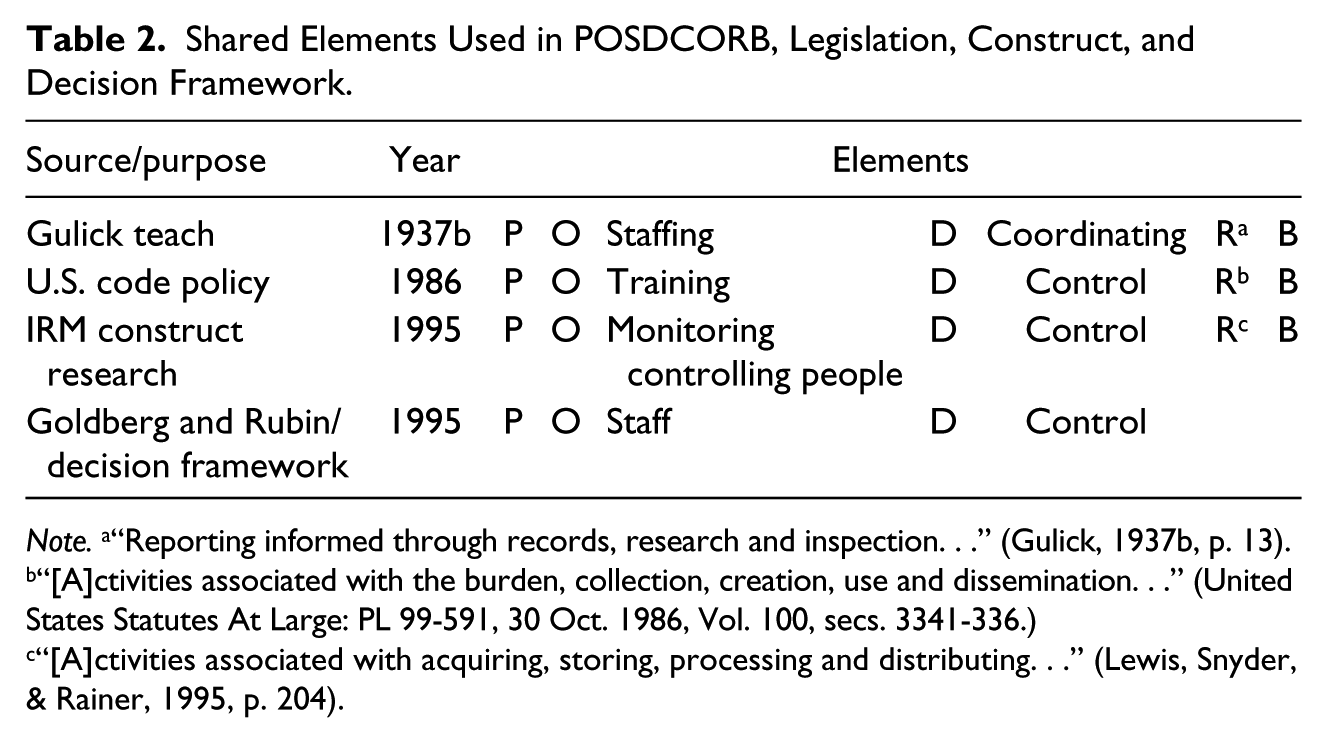
Note. a“Reporting informed through records, research and inspection. . .” (Gulick, 1937b, p. 13).
“[A]ctivities associated with the burden, collection, creation, use and dissemination. . .” (United States Statutes At Large: PL 99-591, 30 Oct. 1986, Vol. 100, secs. 3341-336.)
“[A]ctivities associated with acquiring, storing, processing and distributing. . .” (Lewis, Snyder, & Rainer, 1995, p. 204).
A Construct
A construct for IRM was obtained from a study done by Lewis, Snyder, and Rainer (1995). Their work was titled “An Empirical Assessment of the Information Resource Management Construct,” and their analysis is quite apt for this comparison. They followed a paradigm for construct measurement as enumerated by Gilbert Churchill (1979). First, the domain of their construct (with our emphasis) was specified: IRM is a comprehensive approach to
Next, they generated a sample of items, and a measurement instrument was designed and refined through several iterations. Then they collected data from which the reliability and validity of their instrument could be assessed. Finally, they used additional data from an industry sample to summarize and provide a profile of IRM implementation. They found evidence supporting construct validity with a rotated factor solution meeting criteria of simplicity, interpretability, and the percentage of variance explained. They found construct reliability as six Cronbach’s alpha coefficients were above .8 and all were above .6 (Lewis et al., 1995). Thus, four elements match POSDCORB and the Paperwork Reduction Reauthorization Act:
Between the two constructs and Gulick’s acronym, it appears that the references to control are somewhat incongruous with
Gulick’s “Holding Company” (Theory 1) and Contingency Theories
Previously, a study on information technology was tapped for a technique, but can we also animate some models? Gulick (1937b) envisioned an apolitical “holding company” (Theory 1). According to Gulick (1937b), some large enterprises may need only “the loosest type of central coordinating authority . . . nothing more than a holding company” (p. 34). It is possible that some have evolved. Among early contingency theorists, Thompson (1967/2003) described core forms of technologies. Long-linked technologies are characterized by serial interdependence in which the actions of Z can only be performed after the actions of Y, which in turn are contingent on the actions of X, and so on (Thompson, 1967/2003). An example of this might be the flow and processing of 80-column cards in the era of early computers. Around 1960, the processing of data had to be done with this very limited media. People who could design systems were in short supply. In intensive technologies, a variety of techniques are drawn upon “to achieve a change in some specific object; but the selection, combination, and order of application are determined by feedback from the object itself” (Thompson, 1967/2003, p. 17). As a technique endorsement, Thompson used “objects,” but more importantly, his statement is quite relevant to the task at hand. Let us suggest a link between Gulick’s idea of a “holding company” and Thompson’s technologies.
In established centralized agencies, the routines of feedback have to be orderly and cyclical to accommodate multiple entities. In a mediating technology, the situation arises whereby clients or customers “are or wish to be interdependent” (Thompson, 1967/2003, p. 16). Centralization may be caused by a crisis (Mintzberg, 1979) and heads of the IRM bureaus surveyed by NASIS may have found a need to provide intensive technology-type organizations, mediating technology-type organization, or combinations of both. Given the early costs of data storage, if a centralized bureau acted as a “holding company” (Gulick, 1937b), it could aggregate (Williamson, 1975) or retain the files of an agency, but only those suitable and in a standardized way. Clients would want unencumbered access or the host would be too restrictive.
Structural Contingency Theory (2) and Rule-Based Institutions
Lacking “goodness of fit,” or wherever an instance of misfit occurs, “we are able to point specifically at what fails and to describe it” (Alexander, 1964, p. 23). Gulick (1937b) had concerns with overcentralization and “fit” whereby organizations may fail to be effective. Johannes Pennings (1992) defined contingency theory (2) as follows: “For organizations to be effective, there has to be a goodness of fit between its structural design and the conditions of its environment” (p. 268). Institutions have enduring regularities of human action in situations structured by rules, norms, and shared strategies (Crawford & Ostrom, 2000). Ask most administrators and they will affirm how IRM entities are seemingly run by rules. A “goodness of fit” for holding files in a rule-based institution may change over time.
In summary, close similarities are revealed between the definitions. Gulick tried to teach POSDCORB, and a law and a construct of IRM appear to be markedly similar. Long after his vision, IRM policy entities may have become holding company like (Theory 1), or rule based with contingencies (Theory 2) by controlling or coordinating files. In the last part that follows, our suggested framework and associated theories will be modeled.
Explaining Instances of POSDCORB-Like Adoptions
The prior discussion suggested some design attributes of POSDCORB and how we have a theoretically grounded proxy. The next section will attempt to explain some possible causes for the adoption of rule-based POSDCORB-like institutions. Past studies and practices suggest a wide range of factors that could influence why centralization in organizations occurs. Additional coordination may be required due to the rudimentary attributes of files within bureaus. However, besides narrative descriptions presented by the Council of State Governments (CSG) and NASIS, it is unclear what causes an American state to centralize IRM functions. In contrast to qualitative descriptions, NASIS surveyed the states on a yearly basis, and a high degree of regularity can be found in its publications. As changes occur over time, the degree of processing centralization or decentralization may also change. Historically, four fluctuations of the degree of centralization have been described (Evaristo, DeSouza, & Hollister, 2005). Based on the perception of problems, and the degrees of coordination required to fix them, a state’s adoption of a “holding company” may be found.
Some determinants of IRM centralization, and by proxy, POSDCORB, may be gleaned from the base strengths of a state. This could include a governor’s institutional power (GINSTPWR). Other factors could include a state’s population, budget parameters, the number of transactions processed, and the number of employees. Yet, the states still vary widely in a key respect: the year in which they established a state IRM policy entity. A deeper analysis among the 50 American states might suggest what accounts for those differences.
Method
It may be possible to discern patterns by observing when IRM is centralized with core public administration variables. The first animation suggests an instantiation. However, a multivariate data set, acquired from periodic sources, could suggest a temporal dimension. Under a premise of
Variables and Descriptions.
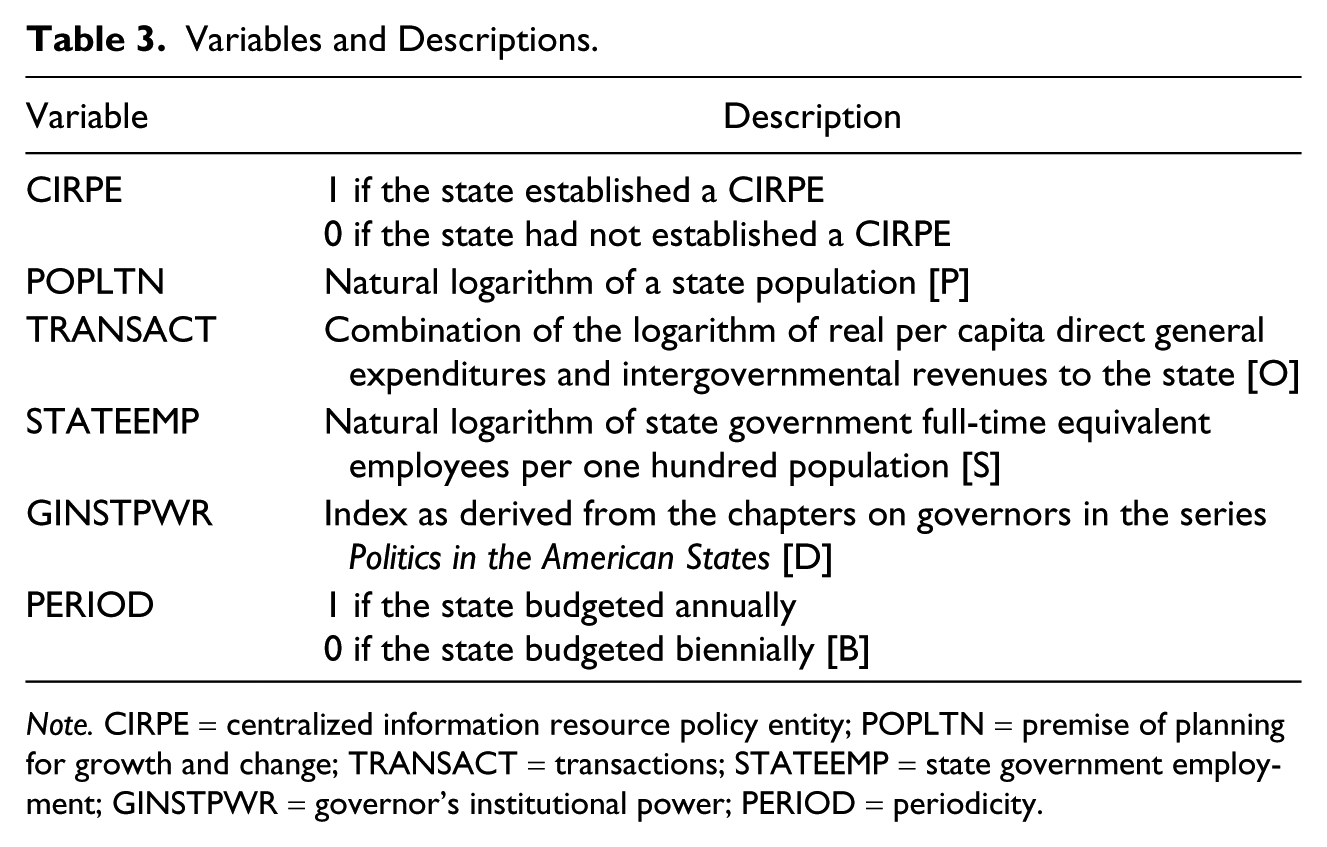
Note. CIRPE = centralized information resource policy entity; POPLTN = premise of planning for growth and change; TRANSACT = transactions; STATEEMP = state government employment; GINSTPWR = governor’s institutional power; PERIOD = periodicity.
The sources for the dependent variable are national organizations that monitor data processing practices. The CSG was among the first to assemble automation information about the states. Since 1965, NASIS, which in 1989 became the National Association of State Information Resource Executives (NASIRE) and, in 2001, became the National Association of State Chief Information Officers (NASCIO), assembled state IRM practices. As indicated above, links to POSDCORB from IRM have been suggested. A Centralized Information Resource Policy Entity (CIRPE) for each state is the dependent variable of this analysis. The representation is dichotomous and was recorded for each 5-year interval from 1965 until 1995. The year of adoption was established for each state by NASIRE (1991) and CSG (1996). The CIRPE data were obtained from a NASIRE (1991) document titled “State Information Resource Management, Structure and Activities.” We obtained the year for the dependent variable in a table about the history, roles, and functions of state information policy organizations. Since that document was published in the early 1990s and an observation was necessary for 1995, the CSG (1996) series, Book of the States, was used to obtain those designations. A 0 was recorded for each period within a state until that year was encountered, and a 1 was recorded in that and in subsequent periods. Again, the dependent variable has been linked above.
A population (POPLTN) of each state is used as a proxy for the degree of change experienced and the need for forecasting, foreseeing, or
The GINSTPWR for each state was assembled from ascending editions of the book titled Politics in the American States. GINSTPWR is expected to have a positive influence on a state’s propensity to have a CIRPE. The greater a governor’s control, the more likely that person would
To test each of the variables, econometric methods were used. The cutoff level for statistical significance is .05. The unit of analysis is each of the 50 American states with the observation years being 1965, 1970, 1975, 1980, 1985, 1990, and 1995.
Results
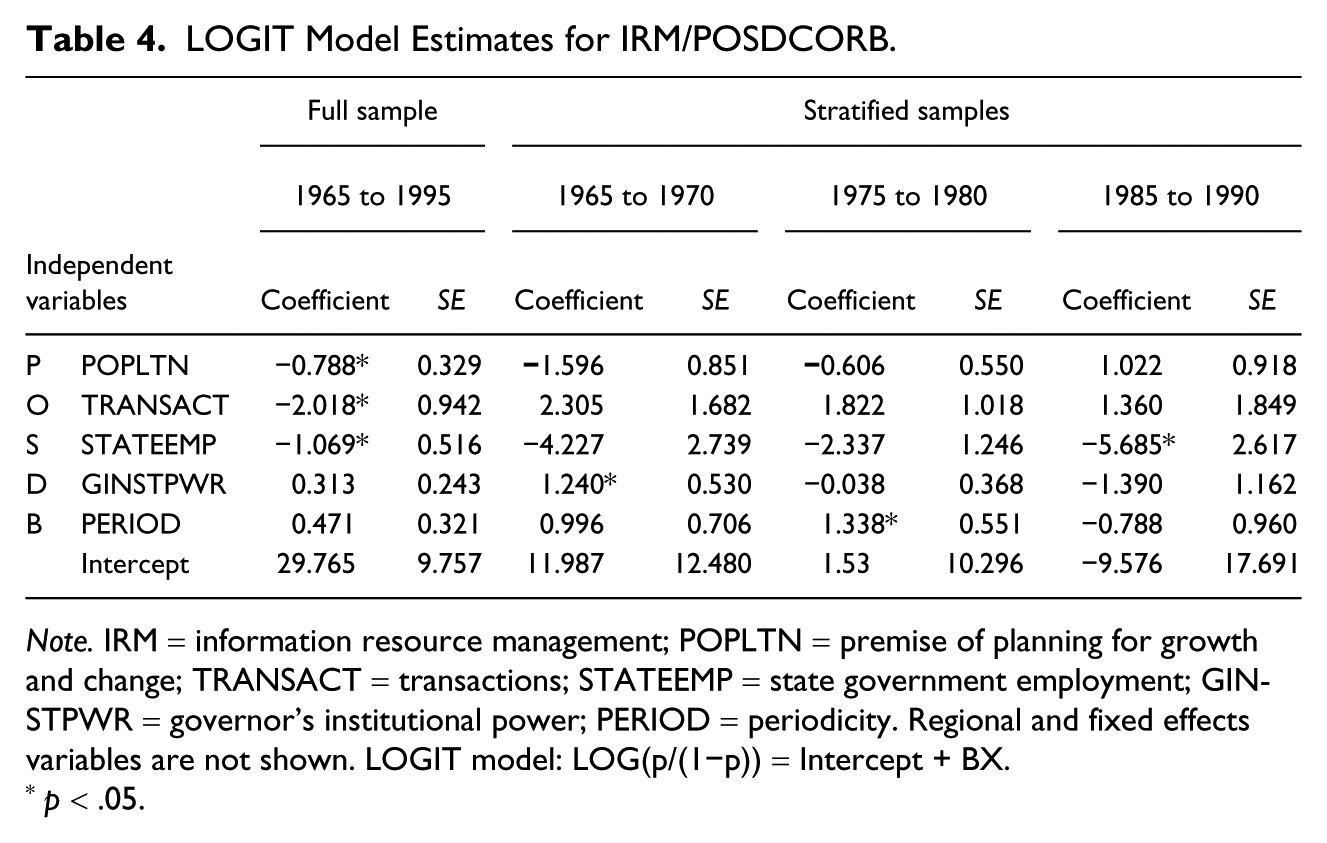
The results are presented in Table 4. These include the models across the range of data, as well as stratifications. The variables were tested using a LOGIT, a PROBIT, and an LPM; however, we opted not to report and comment on the LPM and PROBIT results, as the LPM can predict probabilities that can exceed 1, and the PROBIT results were sufficiently similar to those of LOGIT. The variable coefficients, signage, and levels of significance are aligned for comparison, and within an ascending chronology.
LOGIT Model Estimates for IRM/POSDCORB.
Note. IRM = information resource management; POPLTN = premise of planning for growth and change; TRANSACT = transactions; STATEEMP = state government employment; GINSTPWR = governor’s institutional power; PERIOD = periodicity. Regional and fixed effects variables are not shown. LOGIT model: LOG(p/(1−p)) = Intercept + BX.
p < .05.
In Figure 1 (all models), positive signs reveal centralization and control. Negative signs show decentralization and coordination. The planning variable proxy, POPLTN, in the full sample is within a .05 significance level. This assumes a two-tailed t-distribution and 330 degrees of freedom. As predicted, the sign is negative, supporting the assumption that the greater the number of people in a state, the less likely it is that IRM will be centralized. The estimate for TRANSACT was also significant. Representing the average of state revenues and expenditures, the model detected a .05 level. It was surmised that the greater the expenditures and revenues of a state, the less likely that a CIRPE would exist: The greater the number of transactions, the greater the need for decentralization. The employee estimate (STATEEMP) was also significant at .05. Here, too, a negative relationship shows the greater the number of employees, the greater the propensity for a state to be decentralized and have coordinated IRM. The variables for a GINSTPWR and state budget periodicity (PERIOD) appeared to be insignificant at least to the extent measured by the full sample. Even though the results of these variables fail to support the postulated relationships, the time-series nature of this study opens more avenues of inquiry.
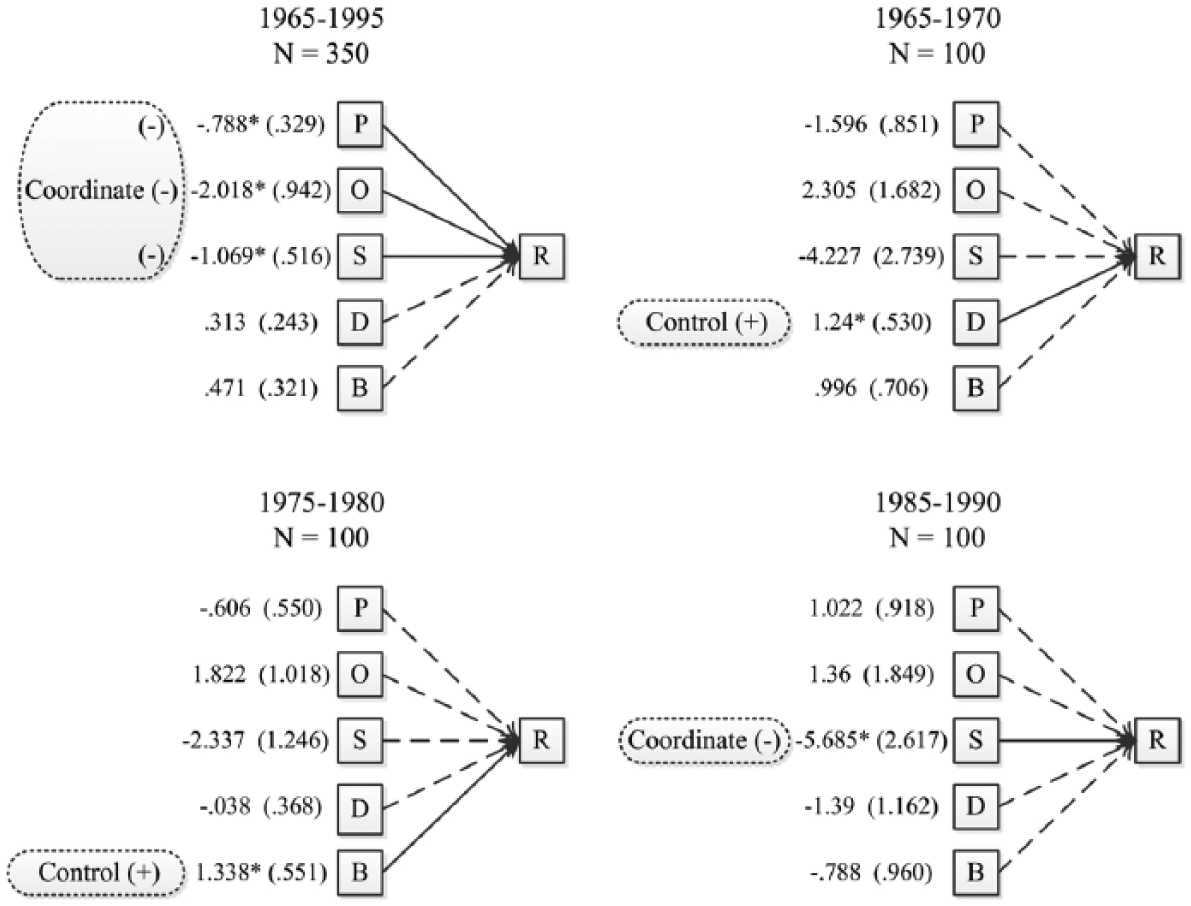
Path coefficients for the models.
To discern more significant variables, we stratified the data. Excluding the out year of 1995, a closer look at the 10-year intervals starting in 1965 is also presented. The results of the 1965 to 1970 estimation are seen (Figure 1, upper right) with the power of a governor (GINSTPWR) being significant at the .05 level. The coefficient of this variable was, as expected, positively signed. This supports how within the earliest time frame, the greater a governor’s control in a state, the greater the ability to direct and the more likely that a CIRPE will exist. Based on the 1975 to 1980 interval (Figure 1, lower left), the variable for budget periodicity (PERIOD) also became significant at the .05 level. However, the model revealed unexpectedly that PERIOD was positively signed. This indicates how states that budget annually are more likely to control a CIRPE. A stratified sample for the next 10 years showed the STATEEMP variable as being significant and negatively signed (Figure 1, lower right).
Discussion
The purpose of this section is to assimilate the statistical findings. The techniques in the prior section tested the variables by holding other factors constant and by looking at different time frames. Models associated with theories will be presented. Besides attempting to explain the adoption of POSDCORB-like institutions, contingency theory (2) will be assessed, as will Thompson’s technologies, and Gulick’s “holding company” (Theory 1). Also to be revisited are the situational foci that may have led to the scrutiny of Gulick’s work.
Associated Theories
Between the qualitative and quantitative phases, evidence was provided for the dependent variable, the institutional proxy for POSDCORB. This implies that the full set of variables could be considered to be determinants of IRM configurations. After POPLTN, aligned with the need for
But why would not all agencies want to place their transactions on a central computer? Or why would some agencies have their data on a central system, and then want to place it on their own system? It could be that, among other restrictions, the routines of centralized bureaus were too stringent. Again, structural contingency theory (2) holds that for organizations to be effective, “there has to be a goodness of fit between its structural design and the conditions of its environment” (Pennings, 1992, p. 268). Centralized data processing bureaus had their own set of environmental problems, one of which was the inability to keep up with peripheral agencies’ requests. For this reason, moves toward decentralization may have occurred. In terms of organizational theory, the multiple contingencies a work unit might face could cause an organizational “misfit” to occur. In one file-intensive study, it was concluded that organizational misfits result in poor organizational performance (Gresov, 1989). For this reason, an agency might want its data added to (or removed from) a centralized system.
It is of little surprise that the GINSTPWR variable detected those problems in the earliest periods of the sample. Governors sought control over mainframe computers and problems. If not resolved at lower echelons, a data processing crisis in a bureau of a state may ultimately rise to the level of that state’s chief executive. With the need for an agency to standardize procurement or process critical data, gubernatorial
A budget cycle, whether annual or biennial, is a certain, controlled event.
As a proxy for
Thompson’s Technologies
A focal agency’s core operations may include POSDCORB (Agranoff, 2007, p. 194). Yet, cases regarding the coordination of administrative policies were documented much earlier. Based on the core technology descriptions of long-linked, intensive, and mediating types (Thompson, 1967/2003), these three can possibly be generalized to the presence of POSDCORB-like entities. Based on coefficient signage,
Situational Foci/Ignoring Framework Attributes
Gulick facilitated coordination by “organization” and “the dominance of an idea.” However, Simon initially focused his early criticisms on only the first (Hammond, 1990). When focusing solely on specific organizational areas, Simon could easily find fault with Gulick’s principles and his POSDCORB. The value of isomorphs has been previously established (DiMaggio & Powell, 1983), as well as polycentricity (McGinnis, 2000). Simon may have conjured up singular morphs and/or empty framework classes. In his 1997 version of Administrative Behavior, Simon appears to reconsider some of his 1947 criticisms. For instance, he distinguished between his: “basic science” approach to organization theory that is taken in Chapter II. On the other hand, we can think of organization theory as providing a guide to designing organizations—in the same way that architecture provides a guide to designing buildings, and engineering a guide to designing machines and structures. (Simon, 1997, p. 50)
The first sought elements via empirical evidence, whereas the second was concerned with designs. Engineering, according to Simon (1997), was more concerned with “designing systems that will accomplish desired objectives” (p. 50). Gulick used organizational design by word as well as in action (Wamsley & Dudley, 1998). But was Simon attempting rapprochement?
Simon (1997) took “a second look at organization theory from an engineering or design standpoint” (p. 50). He later commented how “[t]he ‘principles of organization’ still appear with great regularity in textbooks on organization” (p. 51). From an engineering or design perspective, elements of coordination are highly desirable to those in IRM. His later book provided an example of a “fundamental inquiry into the organization of computer hardware systems” (p. 54). Simon’s work was valuable, but he may have unintentionally deflected students of administration away from “the properties of organizational structures” (Hammond, 1990, p. 170). Generations of scholars have misinterpreted Gulick’s contribution “through the eyes of Simon’s critique” (Meier, 2010, p. 284).
Finally, would POSDCORB be considered a framework? As with other framework scholars, scenarios of framework-theory-model were used. The study suggests answers to the previous framework assessment questions (Ostrom, 1999). Gulick’s work provides a pattern language for addressing universal elements, and possibly “true invariants” as described by Alexander. POSDCORB elements may be “base classes” involving multiple inheritance. In our view, a better integration has been shown across policy, IRM, and public administration disciplines. In terms of framework performance, the studies of other scholars, as well as our group, reveals how POSDCORB endures. The models that resulted from the framework and associated theories can partially explain organizational change in rule-based institutions.
Conclusion
Using a mixed-methods approach, evidence was suggested for the dependent variable, the proxy for POSDCORB. A multidisciplinary study was used to show how the concept contained elements of patterns and designs. It appears Gulick attempted to design a framework with a pattern language and techniques like encapsulation, polymorphism, and inheritance. He used encapsulation to simplify and codify his experiences and those of Fayol. He used polymorphism to widen his audience, depending on their situation. Finally, he used inheritance to bring together the more numerous concepts into a single and complete framework. The blending of a definition, a law and an empirically validated construct was accomplished. Support could then be found as most of Gulick’s POSDCORB variables became significant, some over time, with the remainder implying based on signage.
The study is important as it indicates how, in the 1930s, the “classical” Gulick envisioned design, in the 1940s, the “neoclassical” Simon faulted Gulick for a lack of evidence, yet in the 1990s, he suggested using design. A “classical” approach has gained credibility. In terms of POSDCORB criticism, some of it may not have been entirely grounded. Framework structures can exist, but they lack utility until they are activated. In Simon’s (1997) later commentary, he suggested a second look at organization theory from a design perspective. Yet, Gulick was a design scientist (Meier, 2010) and appeared to use design techniques such as PIE and A-PIE.
The study partially reconciles Simon’s differences between his first and fourth editions of Administrative Behavior by suggesting an emphasis on design. It took Pennings (1992) two tries with his version of Structural Contingency Theory. Organizations need to change. It is up to administrators to apply the POSDCORB framework, perhaps with coordination or control. With huge files, data- and IRM-based entities became the “model” institutions for trying to achieve a balance. Over time, these entities became in situ examples of “holding companies” (Theory 1).
Observing rules and structural contingencies (Theory 2) these roles are quite challenging. Future studies could be done on framework extensions toward collaboration. Studies on the centralization of personnel or budgeting may be insightful. How POSDCORB integrates with institutional analyses or policy implementation research may also be of interest. To centralize is to choose one organization form over another. To do so may activate POSDCORB-like institutions. Another instantiation is to decentralize. Gulick provided the components, and it is up to others to take action.
Footnotes
Declaration of Conflicting Interests
The author(s) declared no potential conflicts of interest with respect to the research, authorship, and/or publication of this article.
Funding
The author(s) received no financial support for the research, authorship, and/or publication of this article.