







Abstract
Nowadays, media and media logic have become important and inherent elements in everyday practices of public administration and policy making. However, the logic of the media is often very different from, and conflicting with, the logic of political and administrative life. So the question of how public managers experience and deal with media attention is more relevant than ever. An analytical sketch of the literature on the relationship between public managers and media provides three main categories of literature (public relations, agenda, and mediatization tradition). These three categories are used to develop statements (so-called Q-sort statements) to capture the way public managers experience their relationship with the media. A group of managers involved in oversight then sorted these statements into order of preference. The research reveals three different groups of managers who show different attitudes to media attention and whom we have labeled as adaptors, great communicators, and fatalists.
Introduction: How Public Managers Perceive Media Influence
At a time when society and governance processes have become considerably more complex, and many authors argue that most service delivery and public decision making takes place within networks of interdependent actors that require collaborative leadership (Ansell & Gash, 2008; Klijn, 2008), public managers are visibly exposed to the media. Public leaders, both public managers, but certainly politicians, are followed and covered by the media at every step they take, as are their personal characteristics as leaders, and now even their private lives are extensively covered (see Bennett, 2009). This creates new challenges for public leaders and public managers to cope with the growing complexity of governance issues and the complex knowledge needed to understand and tackle these issues and cope, at the same time, with the media and their logic.
Media Attention and the Consequences for Public Managers
Media attention, many authors have argued, has its own logic (see Altheide & Snow, 1979; Bennett, 2009). The news-media logic refers to how news is constructed. It concerns the content of the news provided as well as the formats in which news is created and processed (Altheide & Snow, 1979). The format of an item on the television news bulletin, for instance, has to meet certain criteria: The slot allocated for the story is only a few minutes long, it has to have news value, and it should attract or keep the attention of the viewers. These criteria influence how reality is constructed in the news story (Bennett, 2009; Hjarvard, 2008). At the same time, media as a separate institution have risen in importance (Cook, 2005). Media attention forms a crucial and important factor in the information we receive about policy issues and how we make sense of them (Mazzoleni & Schulz, 1999).
Thus, politicians and public managers not only find themselves regularly in the spotlight of the media, and need to cope with that attention, but also realize that how they communicate their ideas and initiatives to and through the media is of crucial importance.
This Article: Exploring How Managers Perceive Media Influence
In this article, we explore literature that has interesting things to say about how public managers can react to media attention. Although literature around this topic is maturing, this mainly comes from disciplines other than public administration and public management. “Public Managers, Media Influence, and Governance: Three Theoretical Perspectives” section distinguishes three research traditions on media influence and discusses these traditions and their focus and what we can learn from these perspectives.
We then use this distinction in research traditions as the basis for an explanatory enquiry into how public managers experience media attention (and how they cope with it). We look at how public managers working in organizations in the Dutch civil service, which are performing oversight on public services (education, health, safety), view the relationship between media and governance processes they are involved in. This is an interesting group of public managers as they are involved in complex governance processes where media often play an important role. Oversight function seeks to improve quality in schools (education), hospitals (health care), or safety issues. In this capacity, oversight organizations are engaged in complicated negotiating processes. They have to fine and punish when organizations underperform and stimulate improvements. However, their reports and interventions can catch media attention. Particular types of incident (e.g., schools that badly underperform, food incidents, etc.) tend to receive much media attention. And that media attention is both a threat and an opportunity. An opportunity because it can enhance the effect of oversight activities as the pressure of the media is on the organizations that are scrutinized. But, a threat in the sense that media can frame the activities and incidents in their own way and, for instance, simplify the issue or question the effectiveness of the oversight organization itself.
To research the way managers employed in organizations with oversight tasks view their relationship with the media, we use Q methodology (Brown, 1980), a methodology for systematically and scientifically mapping underlying inter-subjectivity on a topic. Using Q methodology, we developed a set of statements and invited our public managers to select and prioritize statements about the topic. The statements they sorted were inspired by the three research traditions we identified in the literature. In “Identifying the Discussion by Public Managers: Methodology” section, we outline our Q methodology approach. “Public Managers and Their Views on Media and Governance: Results” section contains our findings, and in “Conclusion” section, we present our conclusions and reflections.
Public Managers, Media Influence, and Governance: Three Theoretical Perspectives
If we look at the relationship between media and media attention and governance processes, several different branches of literature give us different perspectives on these relationships. Each of these branches of literature has its own focus and highlights different elements of the relationship between media and governance, although not always defined in those terms.
Three Perspectives on Media Influence
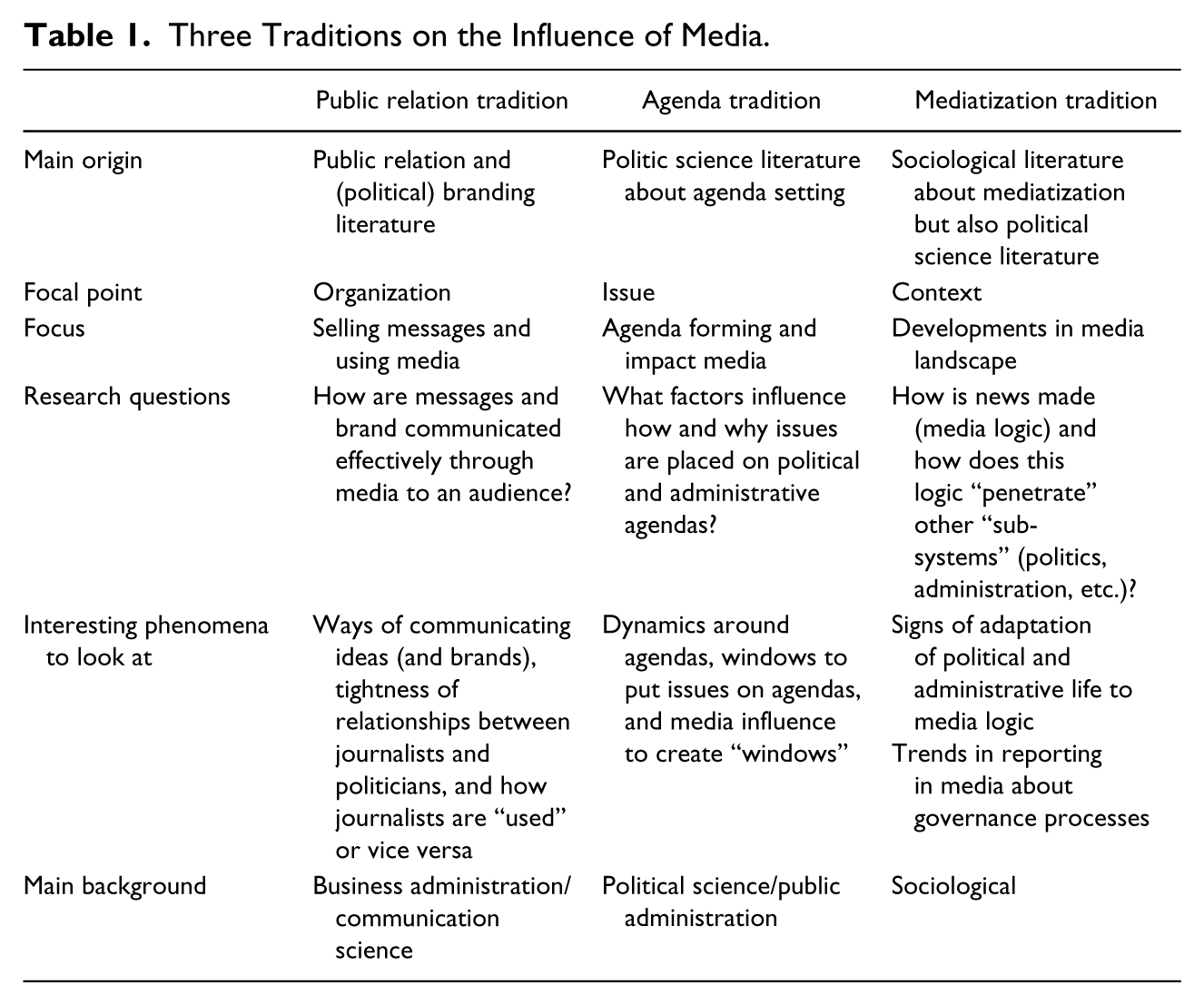
In general, if we slightly overstate the differences, one can find three distinctive research traditions, which we identify as the public relations tradition, the agenda tradition, and the mediatization tradition, respectively. In the first tradition, the emphasis is placed on communicating specific ideas, brands, or messages by means of media to a wider public. We find this view in the literature on public relations (see Moloney, 2002; Stromback & Kiousis, 2011) and in the literature on communication and (political) marketing and branding (see Hankinson, 2004; Lees-Marshment, 2009; Needham, 2006). Although this literature acknowledges that the media also influences the messenger and the message, the primary focus is how a specific actor (in our case, a public actor) can reach an audience and is able to “sell” the message mainly through the media.
The second research tradition provides us with a different angle to look at the relationship between media and governance. It focuses on the relationship between media and the political and policy agenda and how media influence that agenda. The starting point is not, as in the first perspective, the organization that wants to communicate a message but the (policy) issue and the decision-making process. Cobb and Elder (1972, 1983) show in their classic study of agenda setting that media attention can push issues higher up the agenda and can open up decision making to previously excluded groups. Thus, the focus is on the interaction between media attention and (changes in) the political and policy agenda.
The third research tradition again offers another look at the relationship between media and media attention and governance. The perspective of mediatization argues that media do not pay attention to news (and other events) in an unbiased way. This literature argues that the media are guided by a media logic (see Altheide & Snow, 1979; Bennett, 2009; Mazzoleni & Schulz, 1999). Media outlets such as newspapers and TV are looking for newsworthy items that can be framed as conflict and can be personalized or dramatized. Therefore, this third perspective focuses on characteristics in the media system and how the resulting media logic “invades” other domains, such as the domains of the political or administrative. Table 1 summarizes the main differences between the three research traditions.
Three Traditions on the Influence of Media.
All three perspectives have in common that they attribute the media a very important position. Thus, the difference is not whether media are an important factor in governance processes but rather how this relationship is theorized. We elaborate each of the perspectives below. Of course, it is not possible to do justice to each of the traditions in this short section. We only discuss the main characteristics which can then be used as an analytical tool for our empirical research.
The Public Relation Perspective: Getting the Message Through
Under the public relation tradition, we include the literature not only on public relations but also on political marketing and branding.
1
Basically, this literature takes an organization and how it builds (communication) relations with its relevant publics as a starting point. The literature of this perspective recognizes that it is more difficult to reach an audience in a time when media are more dispersed and citizens are more individualized (Arvidsson, 2006; Stromback & Kiousis, 2011). Needham (2006) remarks, “Parties and companies must work harder to build long term relationships with supporters to ensure repeated sales” (p. 180). She argues that creating brands
2
is actually a way to build that relationship by creating a set of ideas and leadership styles that bind voters. Needham (2006) mentions four major characteristics of brands in political life: First, brands simplify choice and reduce dependence on detailed information . . . Second, brands provide reassurance by promising standardization and replicability, generating trust between producer and consumer. Third, brands, like parties, are aspirational, evoking a particular vision of the good life. Fourth, to be successful, brands must be perceived as authentic and value-based, necessitating congruence between the internal values of the product or company and its external message. (p. 179)
The advantages outlined by Needham echo those writers who emphasize the value of brands and the importance that in this tradition is given to the strength of the content of the message (see Arvidsson, 2006; Hankinson, 2004; Kotler, Asplund, Rein, & Haider, 1999; Lees-Marshment, 2009; Moloney, 2002).
But besides the strength of the message, this tradition focuses on the way the message is communicated and the relationships that are being built with an audience. In particular, the literature on public relations emphasizes that relationships are built and sustained between an organization and its relevant publics (Stromback & Kiousis, 2011). This is not only achieved by the content of the message (for instance, the brand) but also by the communication process.
The public relation tradition is especially interested in the effects of what is called information subsidies, where the collective effort of public relations agents is “to reduce the prices faced by others for certain information, in order to increase its consumption” (Gandy, 1982, p. 12). Information subsidies can take the form of press releases, direct mail, advertisements, (presidential) speeches, web pages, rallies or protests, and so on. Several authors observe that there is an increase in the volume of information subsidies aimed at the media (see Davis, 2007; Esser, 2013). But, there is also evidence that media shape the candidates’ agenda at least as much, therefore vice versa, and with research reporting that information subsidies only have a limited impact on the political agenda (Tedesco, 2011; see also Walgrave & Van Aelst, 2006, for an overview). Instead, it is argued that the effectiveness of information subsidies varies across context and is dependent on factors such as the personality of the politician, the approval rate, and relationships with the press (Stromback & Kiousis, 2011).
This brings us back to at least one conclusion that the various literatures in this perspective seem to agree on that relations and communications, whether in the form of information subsidies or the construction and maintenance of brands, need constant nurturing (Eshuis & Klijn, 2012). Thus, in the public relation perspective, the effectiveness of communication and building relationships is related to the quality of the message (the idea, the brand communicated, see Arvidsson, 2006), the way they relate to the relevant audience (the way that audience is identified), and the characteristics of the relationship between organization, message, media, and audience (see Kotler et al., 1999; Lees-Marshment, 2009; Needham, 2006).
To be successful in this pursuit requires a good analysis of one’s audience (market research, building your network), positioning one’s image (by brands), and providing the right information incentives (see Stromback & Kiousis, 2011). For our empirical research, we use this tradition especially as inspiration for statements about the question of how public managers can communicate their message through the media to an audience.
The Agenda Perspective: How Does Media Attention Change the Political Agenda?
In contrast, the agenda perspective takes a different route in looking at the relationship between media and governance processes. In this perspective, it is not so much the organization and its communication strategy that is at the core of the perspective but rather the complex interaction between media attention, actors and actors’ strategies, and the governance process as a whole. Thus, the issue and the complex governance process in which it emerges are emphasized.
Agenda perspectives stress the complexity of governance processes. It is not one central actor that is dominating the decision-making process but rather the process of agenda forming is a continuous struggle between various actors and their strategies. In this struggle, policy issues are formulated and reformulated and the struggle is not only to get the issue on the agenda but also a struggle on the way the policy issue is formulated (see Dery, 1984; Kingdon, 1984). And different actors emphasize different aspects of an issue, which can lead to the fact that an issue is rarely treated systematically in the political system (see Baumgartner & Jones, 2009).
The media are important in both the way an issue is framed and how much attention a issue gets and, thus, whether it is likely to get on the agenda. And this makes outcomes unpredictable. Cobb and Elder (1983) stress that one of the core strategies of actors to get issues on the agenda is expanding the issue to a larger public (see also Baumgartner & Jones, 2009). Media attention is crucial for getting wider recognition of the issue. Research disagrees about whether media attention has an impact on the political agenda or whether that impact is largely symbolic. Walgrave and Van Aelst (2006) show in their overview article that half the studies find a large impact and half the available studies find only limited impact. One of the reasons is that the impact on, for instance, presidential speeches or other events where rhetoric is used may be large but less on changes in the actual political agenda. Walgrave and van Aelst suggest that the actual impact of media differs for several contingencies such as types of issues (obtrusive issues or not, the ownership of the issue, etc.) and various factors in the political context (election time or not, political configuration like the type of government-opposition game, etc.). Apart from the question of the actual influence of media attention on the (political) agenda, it is clear that media attention makes agenda and decision-making processes more complicated than they already are, agenda forming theories argue (see Baumgartner & Jones, 2009; Kingdon, 1984). Baumgartner and Jones (2009) argue in their extensive research into agenda forming in the United States: A major source of instability in American politics is the shifting attention of the media. Media outlets generally base their stories on a limited number of sources and imitate each other, so ideas and stories often spread quickly once they have become a topic of interest. (p. 103)
Baumgartner and Jones however also highlight some aspects of the media that are also strongly emphasized by the mediatization perspective, for instance, the fascination with conflict and competition and the positive feedback one often sees in media attention (media attention for an issue generates more media attention!).
Thus, the agenda perspective highlights the complexity of the interaction between media and governance processes and the various factors that might influence the impact of media attention on agenda setting. Whether issues arrive on the agenda depends partly on the media attention that can be generated, and also on the way issues are (re)framed, the strategic moves of other actors, and their interactions. The interplay of media attention and actors’ strategies changes the governance processes. Formulating the issue in such a way to enhance the possibility of being adopted by the media and gaining wider support of actors creates the possibilities of new agenda issues and new decisions. For our empirical research, we use this tradition of the literature especially as inspiration for statements about the complexity of the interactions between media and governance
The Mediatization Perspective: The Pervasive Media Logic
Many authors have argued that as a result of growing competition between various media outlets (even if they have the same owner) and patterns of commercialization, the media have changed dramatically over the past decade (see Bennett, 2009; Landerer, 2013; Mazzoleni & Schulz, 1999; Strömbäck, 2011). The media face the dual pressure of driving up advertisement revenues by attracting larger readerships and audiences while at the same time operating on reduced budgets and reducing staff sizes (Cook, 2005). But, media can also, Cook argues, be recognized as a separate institution with their own rules. This leads to what is called in the literature a media logic, which, in terms of content, leads to biases in the news (see Bennett, 2009; Patterson, 2000). Bennett (2009) identifies four types of informational biases that are the result of the recent developments in the media business:
Personalization or a strong tendency in the news to emphasize the personal aspect of news and downplay the social economic or political context in which the event takes place. The idea is that when news is framed in a more personal way, it appeals to more readers and viewers.
Dramatization or a strong tendency toward dramatizing news, emphasizing crisis, and conflict in stories, rather than continuity or harmony. The recent trend to provide the news live at the scene has only reinforced the dramatization bias.
Fragmentation or an increasing focus on isolated stories and events, separating these from the larger context and from each other.
Authority-disorder bias or a preoccupation with order and whether authorities are capable of maintaining or restoring that order. At the same time, a shift has taken place from an attitude where media are favorable to politicians and authorities toward an attitude where media are suspicious to authorities.
But media logic also refers to the format of the news. Media outlets only have limited space and thus the story needs to be told in short “sound bites” and needs a clear and attractive story line (Altheide & Snow, 1979; Cook, 2005; Landerer, 2013). The argument in much of the mediatization literature is also that this media logic, with its emphasis on dramatization and fragmentation, also “invades” other domains such as the political and administrative system (Altheide & Snow, 1979; Strömbäck, 2011). As a result, politicians adapt to media logic by choosing issues that do well in the media, speaking in sound bites and dramatizing their performance (see Fischer, 2003; Landerer, 2013; Strömbäck, 2011).
In general, many of the hypotheses about the changes and biases in the content of the news are confirmed by empirical research (see Altheide & Snow, 1979; Strömbäck, 2011). Patterson’s (2000) analysis of 5,000 news stories between 1980 and 1999 confirms many of these biases and shows a significant change in both the subject of news and the way news is presented in the United States. Strömbäck (2011) shows that members of parliament in Sweden attribute great influence to media in terms of their influence on politics and the public. And this is confirmed in other studies in other countries (see Van Aelst & Walgrave, 2011, for material on Belgian and Dutch politicians). Research on the perceptions of politicians about media influence and how it affects politicians’ behavior suggests that perceptions are not necessarily the same as the media’s “real” impact, as we already witnessed in the previous literature tradition when it came to the influence of media attention on the political agenda. Thus, although part of the mediatization literature emphasizes the broad global character of this mediatization trend, there is still debate about the strength of this invasion of media logic in other domains, especially the political domain. And there is a growing amount of literature that challenges the idea of a single media logic that penetrates through a wide number of systems. This literature argues that media logic is a very broad concept (Landerer, 2013; Reunanen, Kunelius, & Noppari, 2010) but the influence of media logic differs in various institutional contexts, the image is more nuanced within the media system itself, and the image is too much written from the perspective of “bad media and good politics” (Landerer, 2013).
But in general, the mediatization tradition in the literature highlights the way news is made and its effects on other domains. It emphasizes that politicians and public managers change their behavior as a result of the media attention and increasingly incorporate the media logic into their behavior. But, the perspective also emphasizes the power of media as a separate institution. For our empirical research, we use this perspective as inspiration for statements about how public managers view the way media operate and influence.
Connection Between the Traditions
In this section, we have outlined and distinguished between three traditions in the literature. The section shows how each adds something to our understanding of the relationship between media and governance processes. It is important, however, to recognize how the three distinct traditions are related and also “borrow” arguments from each other. For example, the agenda tradition and mediatization tradition share a similar characterization of the media. The public relation tradition explicitly mentions the importance of influencing the agenda and establishing communication relations with a relevant public. But, it also stresses that to influence political or societal agendas, the characteristics of the media and their logic have to be taken into account. And the mediatization traditions also look at the way media use official information subsidies and how this is related to changes in the media landscape (for instance, the limited amount of resources to collect data). So there are many connections between the three research traditions, and they can be combined in a way one looks at the relationship between media and governance.
Identifying the Discussion by Public Managers: Methodology
Building on this reading of traditions, we are interested to know to what extent these traditions are operating as perspectives in practice. A growing number of political and public administration scholars are using a methodology known as Q methodology to systematically sample the perspectives on a topic and identify underlying viewpoints (Brewer, Selden, & Facer, 2000; Dickinson, Jeffares, Nicholds, & Glasby, 2013; Jeffares & Skelcher, 2011). The appeal of Q methodology is how it enables researchers to correlate the view of one person with another quantitatively and to use factor analysis to uncover underlying structure. To do this, Q methodology research requires the researcher to comprehensively capture the diversity of the debate, to sample this into a discrete set of items (usually statements), and to ask a sample of respondents to sort the items into order of preference using a technique called Q sorting, that is, a modified rank-ordering procedure. A Q study requires enough respondents “to establish the existence of a factor” and “for purposes of comparing one factor with another” (Brown, 1980, p. 192); the existing corpus of Q research has found between 25 and 75 respondents to be sufficient to reach a “point where the testimony of great numbers and additional informants provides no further validation” (Brown, 1980, p. 194).
By using Q methodology, it is possible to develop a set of statements based on the three traditions identified above and administer these statements to public servants to explore how and whether these traditions are operating as perspectives in practice.
Q Methodology: How to Construct the Statements
In short, Q methodology presents a series of statements representative of the debate on an issue (the Q set) to the respondents (the P set), who are asked to sort the statements into a distribution of preference (a Q sort). From this, statistically significant patterns are derived and interpreted (mainly by using factor analysis). The results of a study with Q methodology can be used to describe a population of opinions or preferences (Brown, 1980). The process of developing Q sets and administering a Q sort is well developed and set out in detail elsewhere (Jeffares & Skelcher, 2011; Watts & Stenner, 2012). Below we describe our approach following the usual stages found in previous Q studies.
As a starting point of developing our statements, we extracted a long list of statements of opinion from our reading of literature around 3 the three traditions outlined in the previous section. To reduce the list to a manageable number that could be sorted by public managers while maintaining the diversity of the debate, we selected potential statements using a sampling grid (Fisher, 1960). Across the horizontal axis, the grid considered the four main aspects that are relevant for the investigation of the relationship between media and oversight, as follows:
What: What is the relationship between the entities “media” and “oversight”?
Who: Which actors are relevant?
Why: How can the relationship between media and oversight be explained?
How: How do the actors see and interpret the relationship between media and oversight?
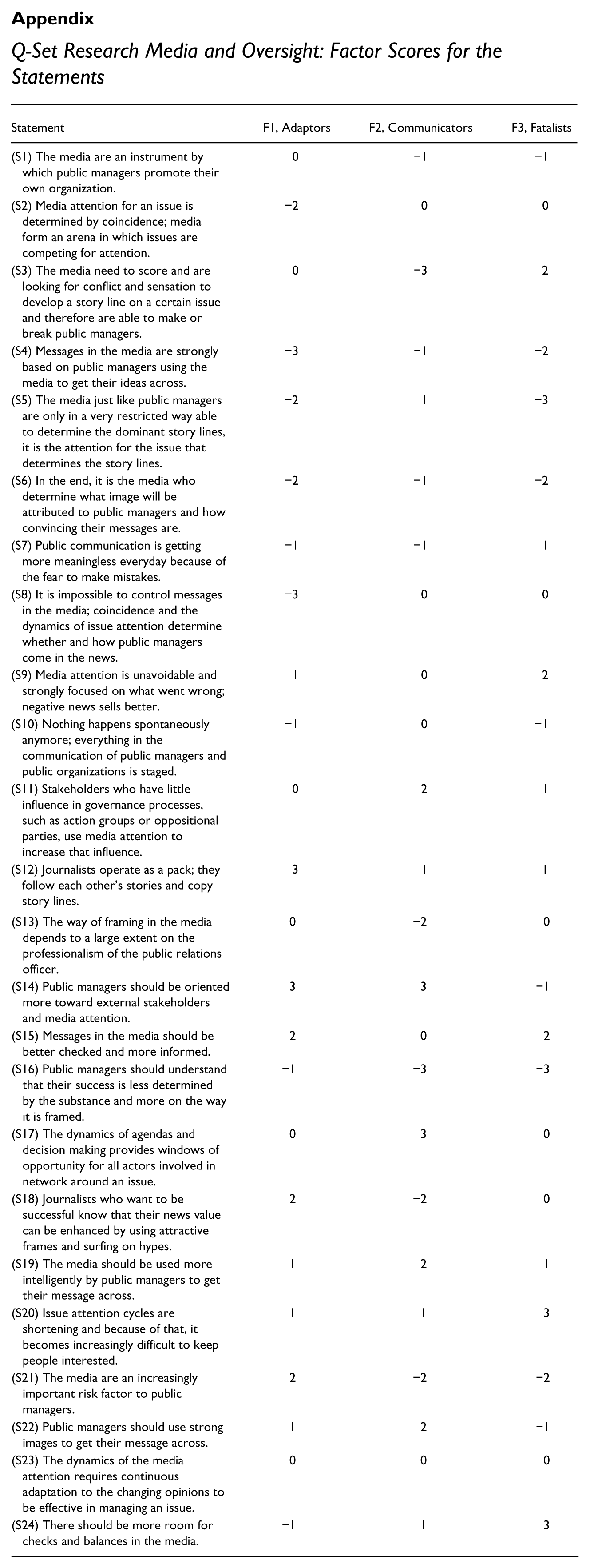
In addition, across a vertical access, the grid considered two types of statements: definitions and prescriptions (following Dryzek & Berejikian, 1993; Jeffares & Skelcher, 2011). By allocating our long list of statements into the eight cells of the 4 × 2 grid, we were able to identify and strip out duplicates. To ensure a balanced sample (Fisher, 1960), we retained three statements in each cell (each inspired by one of the research traditions) giving us a total of 24 statements (see the appendix). 4
Selection of the P Set and Q Sorting
In selecting our person sample, we required a sample diverse enough to establish the number of shared subjective viewpoints operant around a topic, aiming for a set between 25 and 75 respondents (Jeffares & Skelcher, 2011; Watts & Stenner, 2012); the central aim of a Q study is to achieve a Q set that represents the diversity of the debate rather than a P set that represents the population (as in survey research). Our P set is composed of people working in the field of oversight and enforcement in the Netherlands. These respondents are working for different governmental organizations and therefore have different perspectives on the relationship between media and oversight. The respondents are working for inspectorates, ministries, research organizations, and municipalities. After the selection of a diverse P set of people working in different areas of oversight and enforcement, respondents were asked to perform the Q sort.
Q sorts can be administered in either a face to face interview or online. Based on the demographic of our P set, we decided to administer our study online using an application called POETQ (Jeffares, Dickinson, & Hughes, 2012, as used in Dickinson et al., 2013). We e-mailed a link to the online Q sort to 108 people 5 working at organizations in the field of oversight and enforcement. A total of 33 people completed the Q sort (31% response rate). The respondents are representatives of the organizations surveyed and public managers in the field of oversight and enforcement. Nine of the respondents work as inspectors, 8 have a function in policy development, 10 have a management position, and 6 work as advisors on the field of oversight and enforcement.
The Process of Sorting the Statements
We asked respondents to sort the statements in order of “most agree” and “least agree with my current point view.” Statements are placed on a forced-free grid representing a quasi-normal distribution, “forced-free” in that participants were free to sort the 24 statements into 7 piles representing 7 degrees of agreement ranging from least agree (−3) to most agree (+3), but then forced to make choices between statements and restricted in how many statements they could place in each pile (Jeffares & Skelcher, 2011). The process of sorting on POETQ is detailed in earlier work (Dickinson et al., 2013).
Analysis and Interpretation
To analyze data from the Q sort, special software is used, in our case, the PQmethod (Schmolck & Atkinson, 2011). The process of analysis correlates each Q sort collected by person, based on a pair-wise comparison of the placement of the 24 statements by 33 respondents. Groupings of highly correlated sorts were then extracted from the matrix. Both Principal Components Analysis and Centroid Factor Analysis with Varimax rotation were used, both giving broadly similar results. A three-factor solution using Centroid and Varimax was retained. We then flagged Q sorts that loaded significantly on our three factors to produce factor arrays, giving us three synthetic or idealized Q sorts for interpretation. A significant loading is based on the number of statements, so with 24, this is calculated as loading of 0.52 at p < .01.
In interpreting these three synthetic Q sorts, we were concerned with three questions—the character, the distinctiveness, and the rationale of the exemplars, those Q sorts with the highest loading on the factor. Character is defined by the placing of statements; here, we are interested in what is the most and the least agreeable for this factor viewpoint, along with what the factor seems broadly indifferent about. Distinctiveness is identified by focusing on which statements are uniquely placed in comparison with the other factor viewpoints. Rationale is identified by focusing first on the two or three Q sorts that most closely resemble the idealized factor Q sort; here, the additional written responses are useful for fleshing out the viewpoints. The process of interpretation therefore involves taking a factor array and interpreting this as a shared viewpoint by focusing on character distinctiveness and rationale. Our interpretation of the three viewpoints is outlined in the next section.
Public Managers and Their Views on Media and Governance: Results
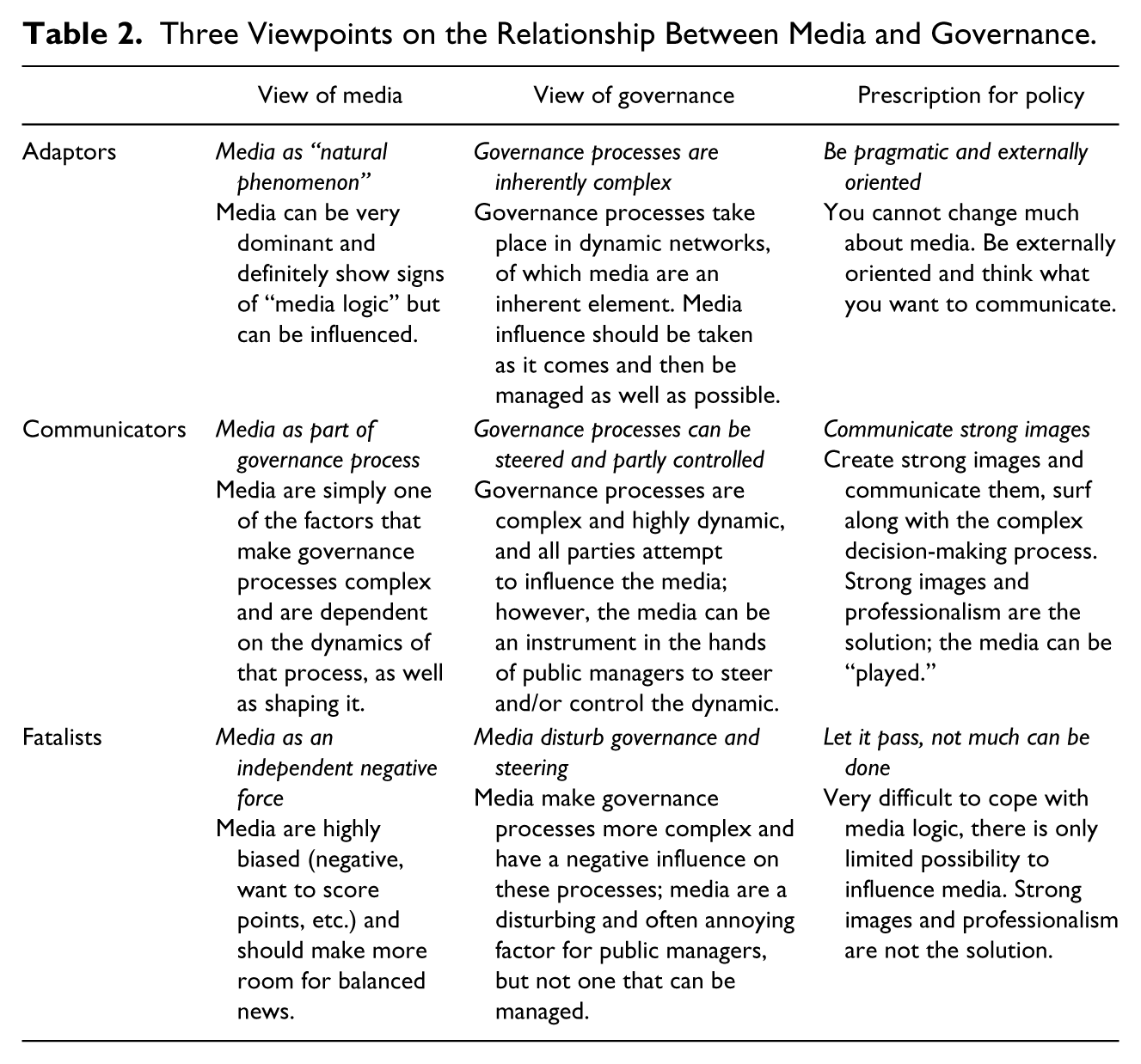
The three viewpoints drawn from the three-factor arrays (see the Appendix) have been labeled as Adaptors, Communicators, and Fatalists. Below we analyze the three viewpoints in depth.
Adaptors
Public managers with this viewpoint see some of the modern media logic as unavoidable, but try to cope with that through external orientation. Adaptors experience media logic first of all as something that is ever-present (S12, S9, and S18). They have mixed feelings about the possibility of influencing the media. They strongly disagree with the idea that they cannot control the media (S8), and disagree with the sentiment that, despite the best efforts, the media somehow dictate how public managers deliver their messages (S6). This viewpoint downplays the influence of media, seeing them as “barking dogs” than as “biting dogs.”
Although the media are an inherent complication shaping their work and this group strongly agrees with the statement that journalists operate as a pack (S12) and use attractive story lines (S18), it is not something that is out of control or something that distracts from what is really important. Adaptors have incorporated the media into their work and, importantly, feel that they maintain control over them. Although they cannot entirely control what the media say and do, they are able to influence the media (S5). Perhaps most importantly for adaptors, this view maintains that a strong external orientation (S14) and the professionalism of the public manager contribute to getting the message out.
Communicators
The second viewpoint shows similarities to the first but also differs significantly from it. This viewpoint sees governance as an inherently dynamic and mediatized process, one that is a necessary element of public managers’ work. Those informing this viewpoint disagree with the claim that the media is in control over public dialogues, and they relativize the dominance of the media. They disagree strongly with a number of statements that stress the media logic characters. These communicators do not see journalists as possible risks (S21) and generally disagree with the idea that journalists are mainly after “sensation” and “conflict.” Nor do they believe that media deliberately use attractive and often provocative frames to make news events more spectacular and “sensational” than they are (S18). In contrast to the first viewpoint, this communicator viewpoint is far less concerned with media logic and the dominant position of media. Instead, they place emphasis on the complexity of governance and agenda forming processes (see S17 about dynamics of agenda building processes and S11 about actors trying to access decision making by media).
For this viewpoint, it is all about how to communicate a message in the challenging setting of complex policy and agenda settings. The answer to that challenge is that public managers should communicate well (S19) and use strong images and frames (S22) to create the story lines they want. If they do that, this view claims, media will probably follow them and report events in a way favorable or otherwise in line with policy goals. Thus, communicators think rather well of journalists as a professional group. They seem to see the relationship as one of “mutual professionalism” (see Reunanen et al., 2010). For them, the media are channels that can be used and arenas that can be played. They stress that this requires professionalism on the part of government, but a professionalism that can be learned, improved and, in the end, used to achieve policy goals and purposes.
Fatalists
This viewpoint frames media attention as something that is not only inherently there but also a disturbance to what is important in their work (S9). They do not really feel that media is a risk to their career (21), but that it is a one-sided game, where the media decide on story lines and public professionals can do little more than follow that line or mildly resist it. They argue that they need more space to push back against such story lines and go out more aggressively to disagree with overly simplistic or otherwise erroneous story lines put out by the media (S24). This group stresses that short media attention and media logic are reflected in the shortening attention cycles in their own organizations (S20). Thus, they also think that the media attention itself contributes to the complexity of the governance processes of which they are a part. They are concerned about public organizations adopting media logics at the expense of the values of public administration.
In Table 2, we summarize the three viewpoints against each other, positioning each view in terms of opinion about the media, prescription to policy, and view of governance.
Three Viewpoints on the Relationship Between Media and Governance.
Conclusion
In this article, we have discussed various research traditions in the relationship between media and governance. We distinguished a public relations tradition that stresses the communication and strong images when dealing with the media; an agenda tradition that emphasizes the complex interaction between actors and the role of media in that process; and a mediatization tradition that stresses the changes in the media system itself and the resulting biases in news making and reporting. We used the traditions as inspiration to develop statements about the relationship between media and governance that we presented to a group of respondents involved in oversight in the Netherlands to identify different opinions.
We found three main views with our respondents that we “labeled” as adaptors, communicators, and fatalists. Of the three, the fatalists are the most pessimistic about the possibilities of being able to influence media. They basically think that the media will tell their own story and frame it in a sensational way regardless of their own efforts; they are both negative and passive about influencing the media. The second group, the communicators, is the most optimistic and argues that public managers need to be proactive when it comes to dealings with the media, to communicate strong images. They see the process as an interesting and complex governance game in which public managers have to act strategically and communicate strong images. They are positive about the media and feel they can effectively play the media. The first group, the adaptors, can be situated in between the other two viewpoints. Public managers here acknowledge the important role of the media and that media frame the news, which makes governance processes more complicated. But, they also believe in communicating strong images that may help their organization achieve its goals and influence public opinion. They are mixed about the role of the media and think it can be positive or negative. They see opportunities for influencing the media, but concede that the media are unpredictable as well.
It is an interesting finding that two of the three viewpoints hold the view that there is media logic and that it is an important inherent characteristic of the public sphere and of the public service (Views 1 and 3). This matches earlier findings that state that politicians also view the role of the media as important and inherent to the system in which they work and live (see Strömbäck, 2011; Van Aelst & Walgrave, 2011). Although these viewpoints share the impression that the media have their own dynamic, in terms of specific goals, means, ends, and strategies, they express different perspectives on what public managers can do about the media. The fatalists are very pessimistic about their ability to influence—let alone use—the media logic and see it as a negative influence to the already troublesome steering of complex governance networks. For them, the media are a nuisance. In contrast, the adaptors are more optimistic (although certainly not as optimistic as the communicators); they also stress the complexity of governance networks and the inability to control media logic in general, but they do see room to strategically bend upcoming media attention into positive outcomes for steering. Their overall judgment over the role of media in governance processes is more or less neutral; media are part of the game and cannot be controlled, but if attention comes along, they can be used for the good if properly acted upon.
Of course, our study also has limitations. The Q methodology is suited to the identification of the complex relations between the three emergent perspectives and the more subtle viewpoints of the public managers, but it is difficult to generalize our findings to other public managers. For that, additional analysis should be performed in different sectors. But, all in all, these findings have consequences for how we generally perceive the effects of media logic in complex governance processes. Overall, the debate about media logic has been rather negative, in the sense that media is perceived as an uncontrollable nuisance, alien to the logics of policy and steering. Until now, the debate about the media logic has been mostly about the media and their own logic, and the effects of that for policy. Our analysis shows that for practicing public managers—the people who deal with media logic—the view is much more nuanced. In fact, what they make of media logic is not so much an effect of the media but of their own perceptions of them. That suggests that the relationship between media logic and the logic of governance in complex governance processes is much more interactive than the current debate about media logic suggests. Media influence is just as much in the hands of media as it is in the hands of the public managers and professionals who deal with it. Further research is required to acquire more precise findings as to how this interactive relationship plays out in practice and associated implications for existing theories about media logic. The influence of the media is here to stay, but what it means for governance remains to be seen and will be at least partly in the hands of public managers and professionals who work with it.
Footnotes
Appendix
Q-Set Research Media and Oversight: Factor Scores for the Statements
| Statement | F1, Adaptors | F2, Communicators | F3, Fatalists |
|---|---|---|---|
| (S1) The media are an instrument by which public managers promote their own organization. | 0 | −1 | −1 |
| (S2) Media attention for an issue is determined by coincidence; media form an arena in which issues are competing for attention. | −2 | 0 | 0 |
| (S3) The media need to score and are looking for conflict and sensation to develop a story line on a certain issue and therefore are able to make or break public managers. | 0 | −3 | 2 |
| (S4) Messages in the media are strongly based on public managers using the media to get their ideas across. | −3 | −1 | −2 |
| (S5) The media just like public managers are only in a very restricted way able to determine the dominant story lines, it is the attention for the issue that determines the story lines. | −2 | 1 | −3 |
| (S6) In the end, it is the media who determine what image will be attributed to public managers and how convincing their messages are. | −2 | −1 | −2 |
| (S7) Public communication is getting more meaningless everyday because of the fear to make mistakes. | −1 | −1 | 1 |
| (S8) It is impossible to control messages in the media; coincidence and the dynamics of issue attention determine whether and how public managers come in the news. | −3 | 0 | 0 |
| (S9) Media attention is unavoidable and strongly focused on what went wrong; negative news sells better. | 1 | 0 | 2 |
| (S10) Nothing happens spontaneously anymore; everything in the communication of public managers and public organizations is staged. | −1 | 0 | −1 |
| (S11) Stakeholders who have little influence in governance processes, such as action groups or oppositional parties, use media attention to increase that influence. | 0 | 2 | 1 |
| (S12) Journalists operate as a pack; they follow each other’s stories and copy story lines. | 3 | 1 | 1 |
| (continued) | |||
| (S13) The way of framing in the media depends to a large extent on the professionalism of the public relations officer. | 0 | −2 | 0 |
| (S14) Public managers should be oriented more toward external stakeholders and media attention. | 3 | 3 | −1 |
| (S15) Messages in the media should be better checked and more informed. | 2 | 0 | 2 |
| (S16) Public managers should understand that their success is less determined by the substance and more on the way it is framed. | −1 | −3 | −3 |
| (S17) The dynamics of agendas and decision making provides windows of opportunity for all actors involved in network around an issue. | 0 | 3 | 0 |
| (S18) Journalists who want to be successful know that their news value can be enhanced by using attractive frames and surfing on hypes. | 2 | −2 | 0 |
| (S19) The media should be used more intelligently by public managers to get their message across. | 1 | 2 | 1 |
| (S20) Issue attention cycles are shortening and because of that, it becomes increasingly difficult to keep people interested. | 1 | 1 | 3 |
| (S21) The media are an increasingly important risk factor to public managers. | 2 | −2 | −2 |
| (S22) Public managers should use strong images to get their message across. | 1 | 2 | −1 |
| (S23) The dynamics of the media attention requires continuous adaptation to the changing opinions to be effective in managing an issue. | 0 | 0 | 0 |
| (S24) There should be more room for checks and balances in the media. | −1 | 1 | 3 |
Declaration of Conflicting Interests
The author(s) declared no potential conflicts of interest with respect to the research, authorship, and/or publication of this article.
Funding
The author(s) received no financial support for the research, authorship, and/or publication of this article.