







Abstract
Administrative reorganization has become widespread practice in modern democracies. Various case studies highlight the relevance of political ideology for bureaucratic contraction, others the role of socioeconomic pressure and institutional constraints. We examine these explanations in a study of the German Länder, which have substantially contracted their bureaucracies since the 1990s. Quantitative analysis of a novel data set of 479 ministerial departments in 13 Länder over two decades suggests that the ideological complexion of governments is a stronger predictor of administrative reform than socioeconomic pressure or institutional constraints. Moreover, interaction models show how socioeconomic and institutional variables condition the effect of ideology.
Introduction
Administrative reform as a means to improve public sector performance has always been on the agenda of national governments. The objectives and instruments of administrative reform have varied from time to time. In the recent past, governments around the globe have concentrated their reform efforts on the redesign of administrative organizations. Although the 1980s and 1990s were characterized by organizational proliferation, “a much changed economic and political environment has ushered in a period of bureaucratic contraction” (MacCarthaigh & Roness, 2012, p. 773). Thus, the question becomes highly relevant under which conditions “states are able to reduce, i.e. to abolish or terminate parts of their administrative structure” (Adam, Bauer, Knill, & Studinger, 2007, p. 221).
A growing number of studies deal with this issue (Boin, Kuipers, & Steenbergen, 2010; Carpenter & Lewis, 2004; Lewis, 2004), resuming a classic approach exploring the “mortality” of government organizations (Kaufman, 1976).Despite valuable findings, this literature still displays some imbalances and gaps (cf. Adam et al., 2007; MacCarthaigh, Roness, & Sarapuu, 2012). First, most studies have focused on U.S. agencies. As national contexts are crucially important for the understanding of public organizations (Van Thiel, 2012), it remains unclear whether respective concepts and theories are applicable beyond the United States. Second, as the extant literature concentrates on single cases, more “comparisons across countries, time and organizational subpopulations” would be needed for drawing “general conclusions on causal factors actually affecting termination” (Adam et al., 2007, p. 227).
In this regard, Germany is a most interesting case. First, it fits well into the international wave of organizational contraction. Although Germany’s bureaucracy was traditionally characterized by “persistence, autonomy [and] growth” (Ellwein, 1994, p. 39), its recent administrative policy has primarily targeted the “streamlining of the bureaucratic apparatus” (Adam, Bauer, & Knill, 2008, p. 154). Especially at the state (Länder) level, governments have terminated many agencies, reshuffled administrative branches, and even abolished entire administrative tiers (Hesse & Götz, 2003, 2004).
Second, German Länder administrations form an unusual set of “comparable cases” (Lijphart, 1971). As the Länder implement the bulk of federal legislation, they have an identical core of administrative responsibilities. At the same time, they can shape their state organization autonomously, which has resulted in different administrative structures. Moreover, although all Länder governments have embarked on bureaucratic contraction, the outcomes of these reforms vary considerably (Bogumil & Ebinger, 2011). Thus, the Länder provide an extraordinary opportunity to compare agency termination across space, time, and administrative branches.
Third, the recent reorganization of Länder bureaucracies offers a chance to reexamine competing explanations for organizational continuity and change. The reforms were initiated by party governments to contract administrative structures and this way, “streamline the state” in terms of personnel and expenditure (Bogumil & Ebinger, 2008; Götz, 2012). Therefore, diverging partisan ideologies might have affected reform outcomes. This is in line with studies contending that party ideologies matter in public administrations (Berry, Burden, & Howell, 2010; Koop, 2011; Lavertu, Lewis, & Moynihan, 2013). It also fits a well-known theorem in policy analysis that ideological profiles of government parties affect policy performance (Hibbs, 1977; Schmidt, 1982). The “parties-do-matter” theorem has been confirmed for public policies of the German Länder (Hildebrandt & Wolf, 2008; Schniewind, Freitag, & Vatter, 2009). Therefore, it might also apply to administrative reorganization, which belongs to the few matters where the Länder have exclusive legislative powers protected from federal intervention. Taken together, the partisan composition of government should plausibly account for the varying reform outcomes in the Länder.
However, the streamlining of Länder bureaucracies might also be driven by other factors than party ideologies. This interpretation finds support in several studies on the United States highlighting the importance of budgetary constraints (Carpenter & Lewis, 2004), the institutional design of the administration (Boin et al., 2010), or political turnover (Lewis, 2002). Similar explanations are put forward for the German Länder. For instance, Bogumil and Ebinger (2008) argue that Länder with severe financial constraints and demographic challenges are in stronger need of downsizing their bureaucracies. According to Reiners (2008), Länder with “simpler” administrative structures are more inclined to profound reforms than those with more complex structures. Finally, government turnovers are considered to explain substantial reforms in particular cases (Bogumil & Ebinger, 2011).
Despite these findings, it would be premature to conclude that parties do not matter for agency termination in the German Länder. In fact, this hypothesis has never been systematically examined. There are studies on “big” reform cases (Bogumil & Ebinger, 2005), specific types of administrative change (Reiners, 2008), and the reorganization of particular administrative branches (Bauer et al., 2007). However, a comparative analysis of reform outcomes in all Länder, over time and across administrative branches, is still lacking.
Against this background, our article explores whether the recent reorganization of Länder bureaucracies is affected by the ideological complexion of government or follows a distinct logic. In doing so, we systematically examine the above-mentioned explanations. Building on partisan theory in policy research (Schmidt, 1996), we also connect the competing approaches by arguing that the impact of party governments is conditioned by the socioeconomic and institutional environment in which they operate. This way, we reach a more nuanced picture to what extent party ideology affects administrative reform in the Länder context.
The article is structured as follows. In the next section, we use a novel data set on administrative reorganization in 13 Länder between 1990 and 2009 to show that reform activity has considerably varied across space and time. To explain this variation, we derive different hypotheses from the extant literature regarding socioeconomic pressure, institutional constraints, and political agency. Separate tests reveal that the partisan composition of government best explains the varying reform outcomes. More specifically, right-wing coalitions of Christian Democratic Union/Christian Social Union (CDU/CSU) and the liberal Free Democratic Party (FDP) are the most active reformers whereas leftist governments of the Social Democratic Party of Germany (SPD) and the Party of Democratic Socialism (PDS) 1 are the most inactive ones. Interacting the different approaches confirms the relevance of party ideology: SPD governments streamline their administrations primarily under high budgetary pressure and low institutional constraints whereas CDU governments reform more systematically. The final section reflects on the contribution of our findings to the study of administrative reorganization as well as to comparative policy analysis.
Administrative Reorganization in the German Länder
Over the last decades, the German Länder have reorganized their state administration several times. However, the relevant aims and means have differed. While in the 1960s and 1970s Länder governments expanded their administrative organizations to improve state capacity (Becker, 1989, p. 895ff.), the reforms of the 1990s primarily aimed at streamlining the state (Adam et al., 2008). In the latter context, organizational contraction became the main reform target, as agency termination was considered a suitable means to sustainably reduce public personnel and thus state expenditure (Bogumil & Ebinger, 2008).
Several studies have investigated this recent reorganization of Länder administrations (Bauer et al., 2007; Bogumil & Ebinger, 2011; Reiners, 2008). However, comparative analyses across space, time, and administrative branches are still lacking. An obvious reason is that such analyses require systematic stocktaking of the entire state administration, including all organizational units and their (usually hierarchical) relationships. Relevant maps of administrative organizations only exist for a few smaller countries, such as Norway, Ireland, Estonia, Lithuania, and Hungary (MacCarthaigh & Roness, 2012).
Against this background, the data set used here is unique in several respects. Mapping the entire bureaucracies of German Länder, it encompasses a major part of the administrative organization of a large Organisation for Economic Co-Operation and Development (OECD) country. Including all 13 “territorial states” (Flächenländer), it allows for comparisons of different administrative structures within a homogeneous context. 2 Finally, covering the period from 1990 to 2009, it provides the opportunity to explore reform outcomes over a considerable time span.
To analyze bureaucratic contraction in the Länder context, we concentrate in the following on organizational changes, that is, numerical differences of administrative agencies over time. We made this choice for several reasons. As mentioned above, organizational streamlining of state bureaucracies has been center stage of recent administrative policies at Länder level: Nearly all Länder governments since the 1990s declared the reduction of agencies as a major task of their administrative reform efforts (see relevant quotations in Götz, 2012, pp. 2-3). This political focus has been taken up by a growing body of studies exploring organizational reform in the Länder (cf. Bogumil & Ebinger, 2008), which also link up with the international literature on agency termination (cf. Adam et al., 2007). Moreover, there is descriptive evidence that organizational contraction of Länder administrations led to a considerable reduction of public employees and thus also indicates streamlining of the state bureaucracy in its substance (cf. Götz, 2012). 3
In accordance with this focus, the data set concentrates on the “core bureaucracy” of the Länder, excluding all organizations that perform public tasks but are not formally part of the state administration, such as independent agencies or local governments. Moreover, there are organizational units that belong to the Länder administrations but not to their core bureaucracy, such as courts, police stations, schools, and public universities, which provide important services to citizens. Merging or abolishing such organizations would usually not be considered streamlining of the state but as degradation of its performance.
As the core bureaucracy of each Flächenland consists of up to several hundreds of organizational units (agencies), we use a two-dimensional categorization to identify changes in a differentiated manner. Vertically, each agency receives an identifier indicating the scope of its competences (statewide or regional) and its position in the bureaucratic hierarchy. On this basis, we distinguish three types of bureaucratic systems (Becker, 1989; Hesse & Götz, 2003, 2004). “Classic three-tiered systems” have an intermediate level of administration below the ministerial level, which supervises a subordinated third level of agencies. “De facto three-tiered systems” have intermediate authorities only in some ministerial divisions, supervising the respective agencies at a lower level. “Two-tiered systems” have only one administrative level below the ministerial departments, supervised directly by them.
Horizontally, we code administrative units according to their policy tasks. For this purpose, the data set distinguishes between eight department types that correspond to the characteristic government portfolios at Länder level (Hesse & Götz, 2003):
State Chancellery (Prime Ministerial office);
Finance;
Justice;
Internal Affairs;
Economy (including regional policies);
Environment and Agriculture;
Labor and Social Affairs;
Education and Science.
This way, the data set encompasses the size of state departments in terms of subordinated agencies. As the departmental structure of Länder governments has remained overall stable since the 1990s, we may compare the structural change of individual departments. 4 Coding agencies by ministerial departments also allows us to examine the partisan nature of reform outcomes. Although Länder parliaments formally decide about a redesign of the state administration, governments are the key players in administrative policy-making, as they prepare legislative bills with detailed targets of how many agencies should be reduced by each department. Because all selected Länder have been governed by (various coalitions of) nationwide parties, we may explore which party governments as a whole and which parties’ ministers in particular are more or less active administrative reformers.
Temporally, the data set covers the period from 1990 to 2009. Our unit of analysis is the ministerial department in a Land, and our dependent variable is the numerical difference of agencies at the beginning and at the end of each legislative period. 5 For each Land, we start with the legislative term that includes the year 1990, followed by all subsequent terms through 2009. For the five “new” Länder (Brandenburg, Mecklenburg–Western Pomerania, Saxony, Saxony–Anhalt, Thuringia), we begin in 1994 because their first parliamentary term after German reunification in 1990 was characterized by many specificities affecting the comparability of these cases. Altogether, the data set contains 479 observations.
A first inspection of the data uncovers remarkable patterns (Figure 1). All Länder have substantially streamlined their core bureaucracies since the 1990s. On average, the stock of departmental agencies in 1992 has shrunk by 58% in 2009. 6 At the same time, there are considerable differences between individual Länder: Although Saxony–Anhalt has reduced the original stock of agencies by nearly 80%, that number is only 40% in North–Rhine Westphalia. These differences are particularly intriguing because the Länder administrations have similar competences, responsibilities, and organizational structures (see above). Our study thus shares the advantages of “most similar systems designs” in classic comparative analysis, just that the units are subnational entities, not countries.
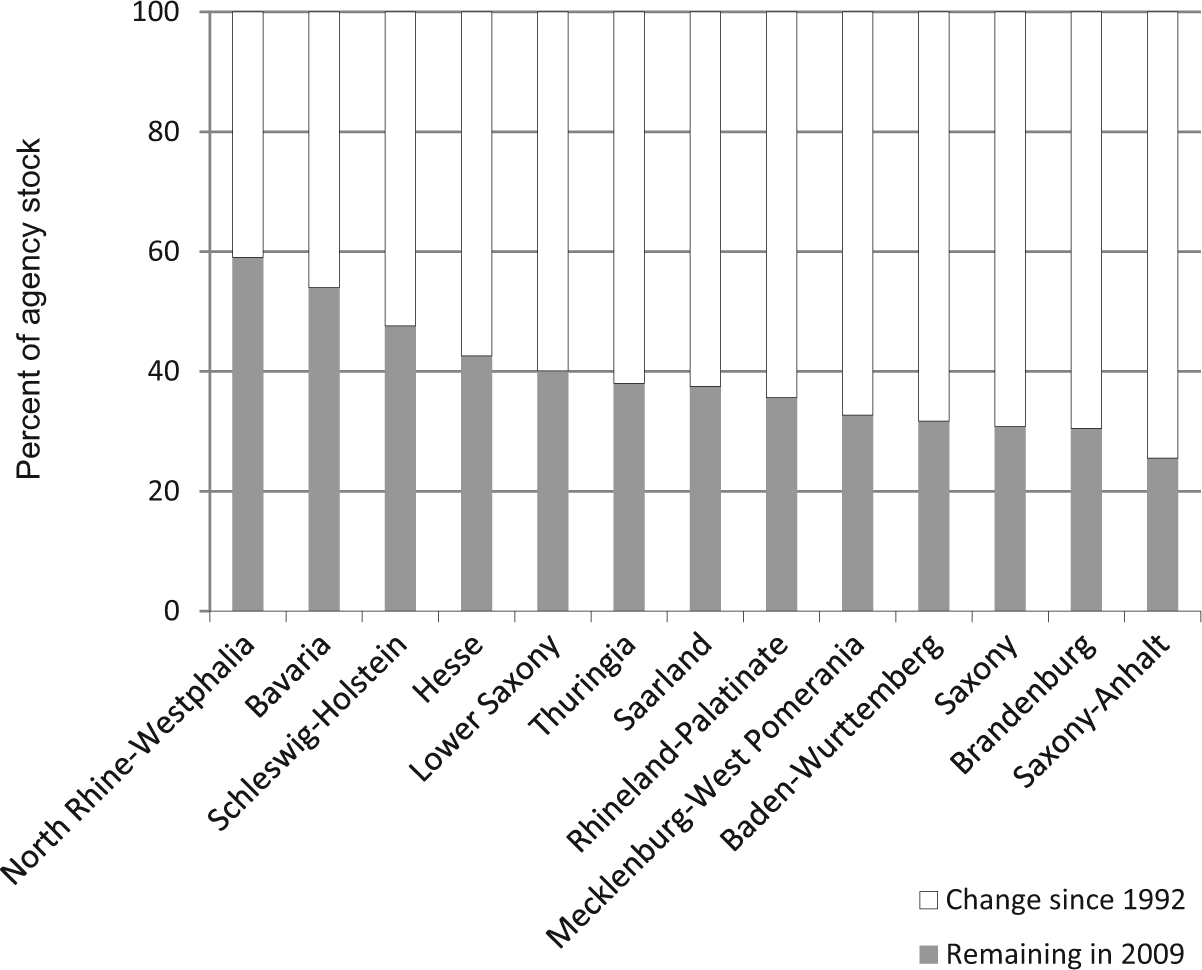
Percent of agencies reduced by structural reforms, by Land.
There is also considerable variation over time. Figure 2 shows the reform outcomes for individual Länder by legislative terms (expressed as percentage decrease of the number of agencies during the respective term). Although most large reforms occurred in the second half of the sample period (from 2,000 onwards), differences in reform trajectories prevail. For instance, Baden–Württemberg and Saxony started their major reforms not before 2005, whereas Mecklenburg–Western Pomerania, Lower Saxony, and Schleswig–Holstein began earlier and implemented two major reforms respectively. Finally, Bavaria, North Rhine–Westphalia, and Thuringia displayed relatively modest reform outcomes over the whole time span.
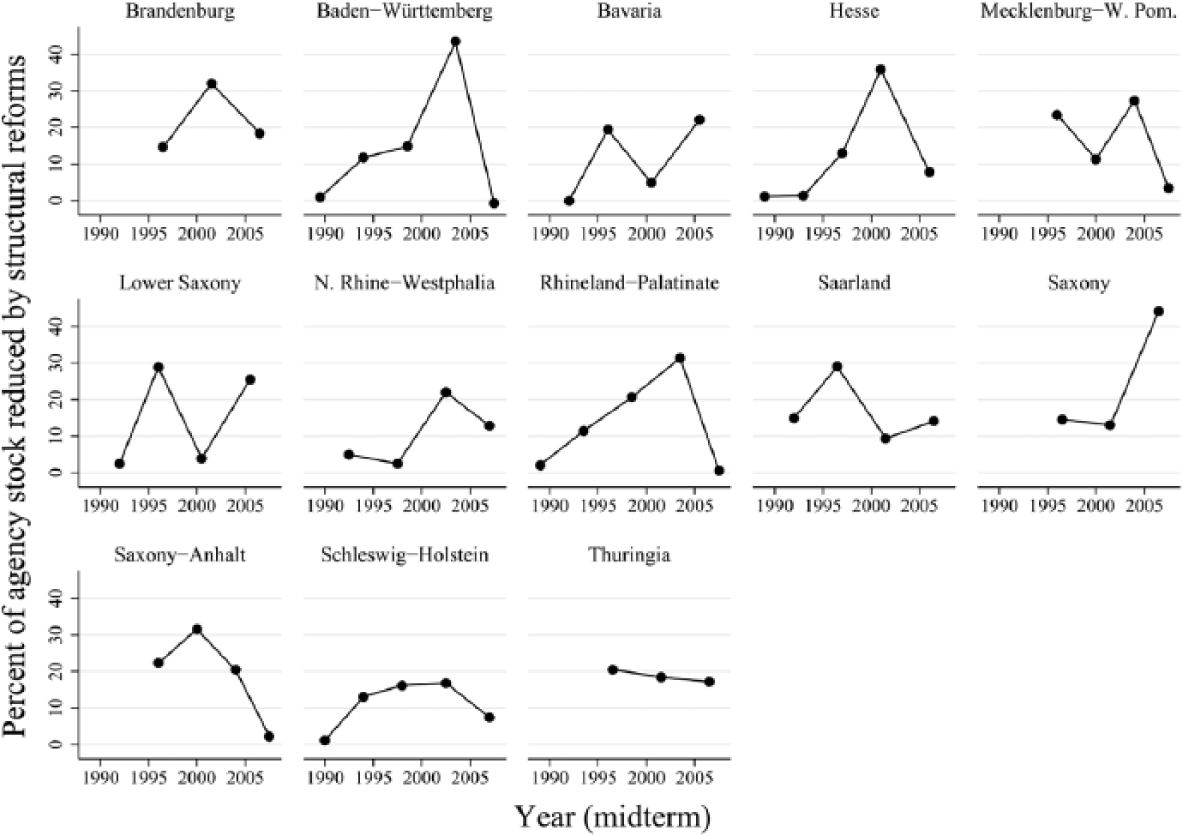
Trajectories of reform, by Land.
At first glance, there seems to be some structure in this grouping: Small Länder from Eastern Germany, such as Saxony–Anhalt and Mecklenburg–Western Pomerania, were the most active reformers whereas two large Länder located in the Western part—Bavaria and North Rhine–Westphalia—were among the laggards. However, geographical size and historical legacies cannot sufficiently account for the variation. Counterexamples include Thuringia, a small East German Land that has reduced its state bureaucracy only reluctantly, as well as Lower Saxony, a larger Western Land having streamlined its bureaucratic structures twice in the same period. Hence, more differentiated factors must explain the varying reform outcomes. This is the task we now turn to.
Theory and Hypotheses
The literature on agency termination offers a variety of heterogeneous factors to explain organizational continuity and change (Adam et al., 2007; Carpenter & Lewis, 2004). In the following, we make a first step toward a more integrated theory by grouping the relevant factors according to their underlying mechanisms and examining their interrelations. The first group of factors refers to the socioeconomic environment that puts more or less “external pressure” on governments to streamline bureaucratic structures. The second includes institutional characteristics of a bureaucracy that may constrain the government’s room for organizational contraction “from inside.” The third group comprises factors related to political agency, that is, genuinely political determinants motivating a government to embark on administrative reorganization. For each of these groups, we will specify two explanatory factors before elaborating on their theoretical interrelations.
A first socioeconomic determinant of bureaucratic contraction is the size of a state in terms of territory and population. In the case-oriented literature on agency termination, state size is invariant and thus does not qualify as relevant independent variable (Adam et al., 2007). In comparative perspective, however, it might explain varying patterns of administrative reform. Large Länder are generally more heterogeneous with regard to their economic and social geography than smaller ones (Götz, 2012, p. 90). Therefore, they have to maintain a larger number of regular and specific agencies to keep the state administration functioning. Consequently, state largeness can be considered an obstacle to bureaucratic contraction independently of the given administrative infrastructure. 7
A second socioeconomic factor highlighted in the literature is budgetary constraints. Adam et al. (2007) contend that “the higher the pressures of austerity, the more we should expect decision-makers to consider organizational termination as a way to solve budgetary crisis” (p. 230). This argument seems to be particularly relevant for the Länder context (Bogumil & Ebinger, 2008). Because in Germany nearly all tax-raising powers are assigned to the federal level, the Länder cannot counterbalance their budgets by increasing revenues but only by cutting expenditures. Administrative reform is an obvious strategy in this respect, given that a major share of Länder budgets is spent for civil service and organizational contraction entails opportunities for cutting back on staff (Götz, 2012, and cf. Note 3). Moreover, high indebtedness may force governments to initiate retrenchment policies for maintaining or regaining citizen support. In this regard, bureaucratic contraction should be the preferred choice as it affects citizens less directly than austerity measures in other Länder policies such as education or internal security.
Apart from socioeconomic pressure, internal characteristics of a bureaucracy should influence administrative reform activities. One relevant feature stressed in the literature is size (Adam et al., 2007, pp. 225-226). Regarding the persistence of individual agencies, organizational size in terms of resources and personnel is generally considered an asset because large agencies are more powerful to resist external pressure for organizational change. Regarding the entire bureaucracy, however, large size in terms of agencies per inhabitants—here termed as degree of bureaucratization—should be positively related to reform activity, because there are more “leverage points” for organizational contraction, all else equal. Moreover, a high degree of bureaucratization in comparison with other Länder should make it easier for governments to justify the need for reform. 8
In addition to size, the “institutional thickness” (Kaufman, 1976) of a bureaucracy should affect its resilience. Studies on policy termination suggest that “the more complex the institutional arrangements are, the more stability they have” (Geva-May, 2004, p. 314). This fits a widespread assumption in the Länder-specific literature that three-tiered administrations are more difficult to change than two-tiered ones (Reiners, 2008). Although three-tiered administrations may offer more “leverage points” for organizational contraction due to their more differentiated vertical structure, their institutional structure is more complex owing to large agencies at the intermediate level that may effectively defend the organizational status quo for themselves and their subordinated agencies. Two-tiered administrations lack such powerful inbuilt veto players.
Political factors may also account for administrative reform activity. Lewis (2002) argues that the termination of U.S. federal agencies is mainly driven by the perceptions and rationales of political parties: “What one party views as a frivolous expense or unforgivable error, another party views as an indispensable component of its policy program” (p. 91). In this regard, the extant literature stresses the significance of government turnover (Adam et al., 2007, p. 224; Lewis, 2002). When opposition parties come into power, they may wish to terminate the policy programs of the previous government and the related administrations. Furthermore, newly governing parties may initiate bureaucratic contraction to demonstrate their reform capacity whereas incumbent governments prefer to maintain the administrative structures in which they are used to operate. This rationale seems particularly relevant for the Länder where party governments have few policy areas in which they can sharpen their profile.
Finally, the extant literature points to the relevance of party ideology in administrative reorganization (Berry et al., 2010; Koop, 2011; Lavertu et al., 2013). For instance, Carpenter and Lewis (2004) argue that U.S. federal agencies are “at greater risk under Republicans than Democrats, perhaps due to ideological preferences for smaller government” (p. 229). Similarly, partisan theory in comparative policy analysis claims that government parties shape public policies according to their ideological preferences (Hibbs, 1977; Schmidt, 1982, 1996). This has also been confirmed for several policies in the German Länder (cf. Hildebrandt & Wolf, 2008). For example, right-wing governments led by the Christian Democrats (CDU) tend to expand the police force, governments including the Liberals (FDP) invest more in public schools, and leftist coalitions of Social Democrats (SPD) and Greens are more active in environmental protection and in child and youth services. In view of such findings, one might contend that the ideological complexion of Länder governments affects administrative reorganization as well. More specifically, right-wing governments of CDU and FDP should actively pursue bureaucratic contraction. As the Liberals prefer a “slim” state for ideological reasons, they should envisage organizational streamlining to fulfill their policy promises vis-à-vis their electorate. Furthermore, they might claim to spend the savings of administrative reforms for “future-oriented” investments (e.g., education). The CDU should join their liberal coalition partner in embarking on bureaucratic contraction, because it could spend the envisaged extra funds for their preferred policies (e.g., internal security). As compared with governments led by the CDU, “grand coalitions” of CDU and SPD should be more reluctant to downsize administrative structures bureaucratic contraction as they generally have an expansionary effect on public policy (Schniewind et al., 2009, pp. 330-332). In contrast, leftist governments led by the SPD should be significantly less inclined to bureaucratic contraction, as the implementation of their key policies (e.g., environment, social affairs) requires powerful administrative capacities. This is particularly true for coalitions of SPD and PDS because the latter has a clear preference for a “strong” state due to its socialist legacy.
Of course, the role of parties is not deterministic. This would simply contradict reality because significant reforms have been implemented by both right-wing and left-wing Länder governments (Bogumil & Ebinger, 2008). Nevertheless, different mechanisms may be at work. Schmidt (1996) argues that the impact of party governments on public policies depends on the socioeconomic and political environment in which they operate. Therefore, “interaction effects of the party composition of government and state structures [should] feature more prominently” (Schmidt, 1996, p. 177). Taking up this argument, we assume that leftist governments become active reformers primarily in view of strong exogenous pressure, such as high public debt (cf. H2). Under these circumstances, they should prioritize downsizing their bureaucratic apparatus instead of cutting back resources in other policy areas (education, social security, etc.). Right-wing governments, in contrast, should aim at “streamlining the state” for ideological reasons and thus, initiate administrative reforms regardless of budgetary pressure.
Institutional constraints might affect the reform activity of party governments in a similar vein. Taking up the argument of H3, leftist governments should become active reformers given a high degree of bureaucratization that can be retrenched without strong political efforts. Conservative governments as ideologically driven reformers should again “optimize” the state bureaucracy regardless of its dimension.
Estimation Strategy
The dependent variable of our analysis is the difference in the number of agencies assigned to a certain department in a certain Land at the beginning and at the end of a legislative term. 9 As is common for such count variables, we do not expect a normal distribution. Figure A1 confirms this (see online appendix): The bulk of the cases are clustered between 0 and 20 agencies reformed whereas larger reforms are less and less frequent. For statistical estimation, this means that ordinary least squares (OLS) regression would be biased and would routinely predict implausible results (e.g., negative counts).
Various maximum-likelihood estimators have been designed to tackle the issues associated with skewed count variables. Of the two distributions commonly used, we prefer the negative binomial distribution to the Poisson distribution because the negative binomial model estimates an extra variance parameter; it is thus more flexible with regard to the high degree of overdispersion in our data. 10
Besides overdispersion in general, Figure A1 also displays clear signs of “excess” zeros. In 38% of the cases, no agencies were reformed at all. This is a symptom of “zero inflation,” which even exceeds the flexibility of the negative binomial distribution. From a theoretical point of view, zero inflation suggests that the data were generated by two separate processes: In our model, these are the decisions of whether administrative reform should be attempted at all, and if so, of how large the reform should be. The determinants of these two processes may be the same, but strong zero inflation generally suggests different data generation processes.
Two basic approaches are available to model count processes with zero inflation: so-called “hurdle models” and the “zero-inflated negative binomial model” (ZINB). Both models combine two estimators: a binary probit model for the probability of administrative reform and a binomial count model for the size of reform. The models differ with regard to the theoretical and statistical underpinnings of the treatment of zeros. Hurdle models assume that in all zero cases, the count process was not initiated (the “hurdle” was not crossed, just like a Heckman model would assume that selection has not occurred). In our model, this would mean that all zeros result from government decisions not to attempt a reform. This is a strong assumption because it excludes the possibility of failure: that a certain government did in fact attempt a reform but failed for reasons such as lack of support from within the administration. The hurdle model does not allow for zero-size reforms. Vice versa, it assumes that all positive outcomes have to clear the same “hurdle,” no matter whether the intended reform concerns a single agency or a great many.
The ZINB model relaxes these assumptions. It assumes that some of the zeros are “structural” whereas others are true “sample” zeros, that is, they may reflect unsuccessful or unfinished reforms. To the extent that an observation reflects a true sample zero, it is considered valid in both the probit component and the count component. The ZINB model then maximizes the likelihood that each zero observation is either explained together with the reform observations through the count process or as a qualitatively different category through the probabilistic process. Non-technically speaking, cases with a value of 0 will be treated as “very small reforms” if they look much like comparable cases with small positive values. The difference between 0 and 1 is then not categorically different from the difference between, say, 1 and 2. Because this evaluation is integrated into the maximum-likelihood estimator, no assumptions about the nature of zeros are necessary. Due to this flexibility in estimating different data generation processes, the ZINB model is our preferred estimator. 11
Modeling the Data Structure
Before turning to the empirical analysis, we have to address some particularities of our data structure. A first issue concerns policy diffusion. Although the case-oriented literature on agency termination concentrates on internal determinants, theories of policy innovation also suggest that reforms in one federal state may affect those in other states (Berry & Berry, 1999). Following this perspective, administrative reorganization in the Länder constitutes a field in which relevant diffusion effects are likely to happen (Müller, 2006). As explained above, the Länder not only have comparable administrative responsibilities but also face similar problems such as budgetary squeeze and demographic change that can be mitigated by bureaucratic contraction. As Länder officials continuously interact within the “cooperative” structures of German federalism, they may learn about successful administrative reorganization from their peers in other Länder. Furthermore, as German news media spread policy innovations across state borders, Länder governments may come under public pressure to follow the example of reform leaders. To model such diffusion effects, we include a nationwide spatial lag of the preceding legislative term as an independent variable, aggregated on the level of the governmental department. Because spatial lags are endogenous to the degree that they capture independent reactions to common shocks, we used a generalized two-stage strategy to instrument for the lag with its prediction from a comprehensive ZINB model of exogenous variables (Franzese & Hays, 2007). Two instruments were constructed, one for reform size and one for reform probability.
Another issue arises from the temporal structure of our data. Because the data set contains several legislative terms per Land, it is unlikely that the observations are independent of each other. Rather, based on Figure 2 above, we expect the reform activity in a certain term to be inversely related to the reform activity in the previous term. After large reform efforts, governments should be more inclined to grant the administration a rest, and vice versa. Statistically speaking, there is negative autocorrelation in the data. We address this issue by including the lagged dependent variable among the regressors, that is, simply the value of the dependent variable (reform) in the previous term. A negative coefficient for this variable will indicate that administrative reform indeed follows a wavelike pattern (unlike a positive coefficient, which could reflect a more linear pattern). 12
We also have to address the multi-level structure of our data. The units of analysis, the individual departments, are nested within governments, which are again nested within Länder. The model is thus likely to overestimate the significance of the coefficients. We correct for this by calculating cluster-robust standard errors at the governmental level. Concerning alternative strategies such as hierarchical random-effects estimation, the relatively low number of Länder and the technical complexity of the ZINB model are prohibitive.
A final issue is that our cases vary with regard to sheer reform potential. The more agencies commanded by a department, the more are available for reform, and the more are thus exposed to the “risk” of increasing the dependent variable. We model this initial situation by adding the number of agencies assigned to a certain department at the beginning of a legislative term as a separate regressor. From a theoretical point of view, this means that the coefficients of other variables can be interpreted independently of reform potential. To give an example, a certain type of ministerial department will not be associated with larger reform “just because” it featured many agencies in the first place. 13
In addition to reform potential and the spatial and temporal lags, we include three more basic variables: a time trend (year of inauguration of Land government), the length of a legislative term in years (to control for early government termination), and a dummy for “new” Länder (i.e., the territory of the former GDR [German Democratic Republic]). 14 A table showing descriptive statistics for all variables used in the analysis is in the online appendix.
Results
Tables 1 to 5 show the estimation results. The first three tables test hypotheses according to the three theoretically motivated clusters discussed above: the socioeconomic model, the administrative model, and the political model. This stepwise procedure also ensures convergence of our complex maximum-likelihood estimator. The following two tables then combine selected variables into interactive models.
Administrative Reform Predicted From the Socioeconomic Context.
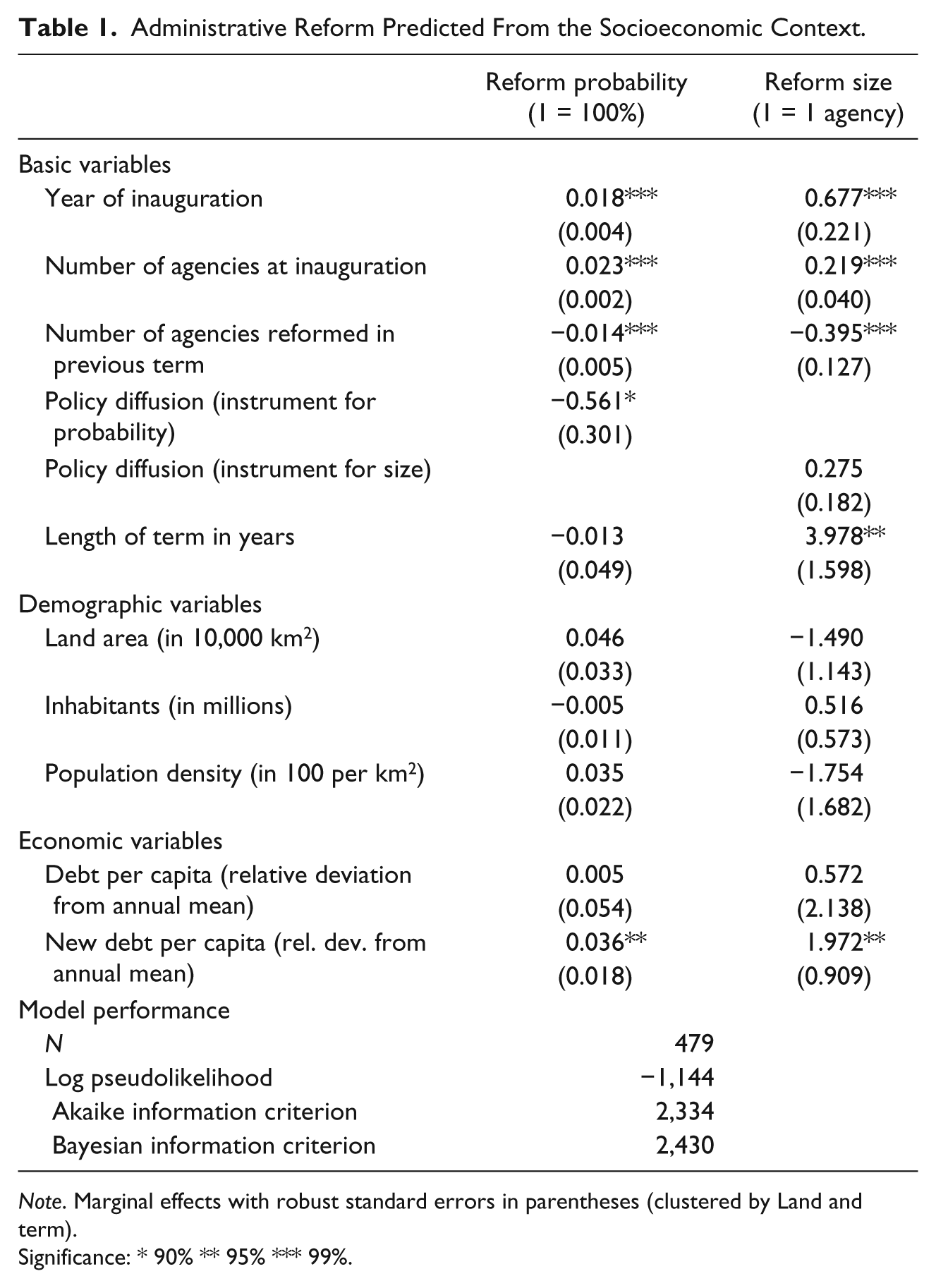
Note. Marginal effects with robust standard errors in parentheses (clustered by Land and term).
Significance: * 90% ** 95% *** 99%.
Administrative Reform Predicted From the Structure of the Administration.
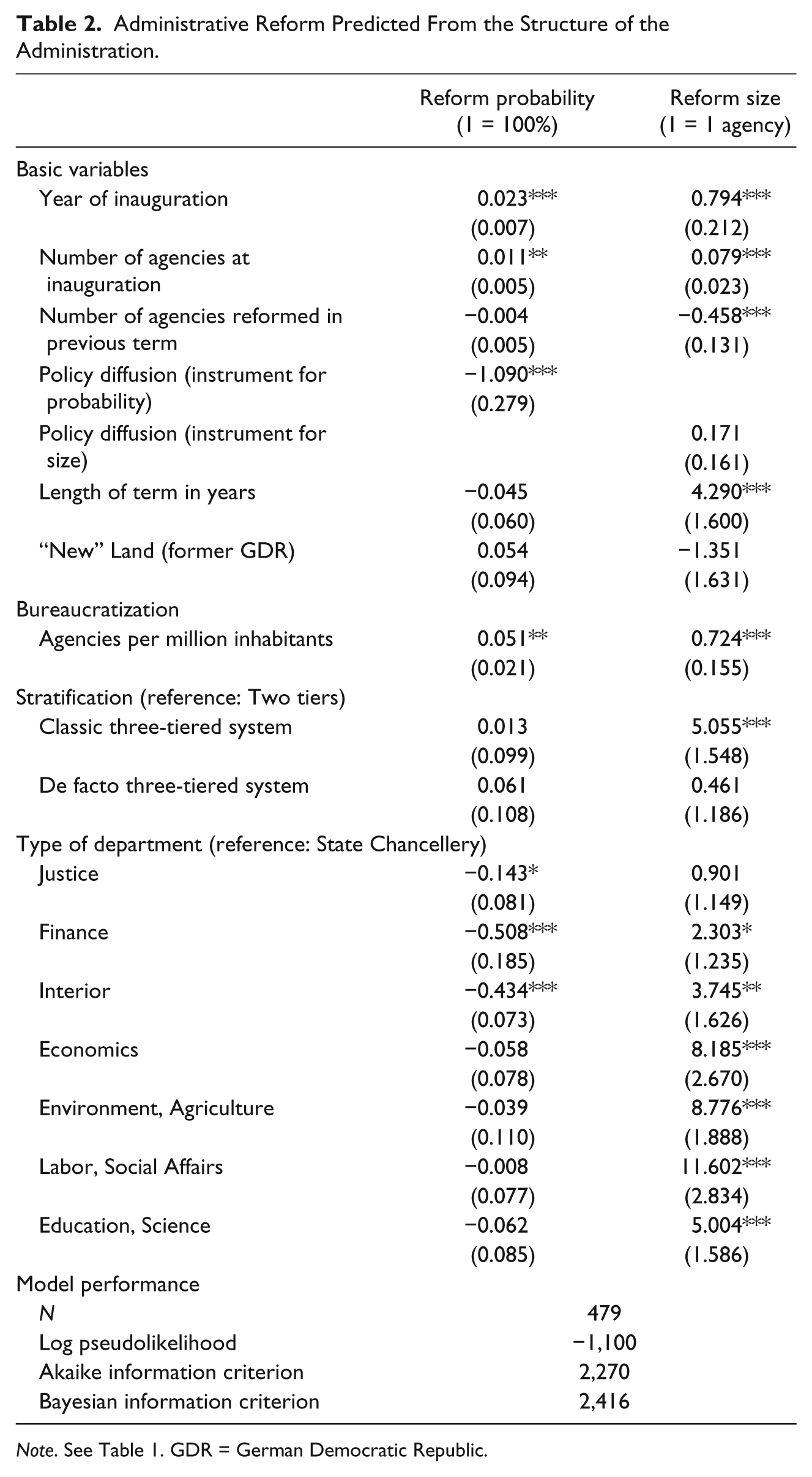
Note. See Table 1. GDR = German Democratic Republic.
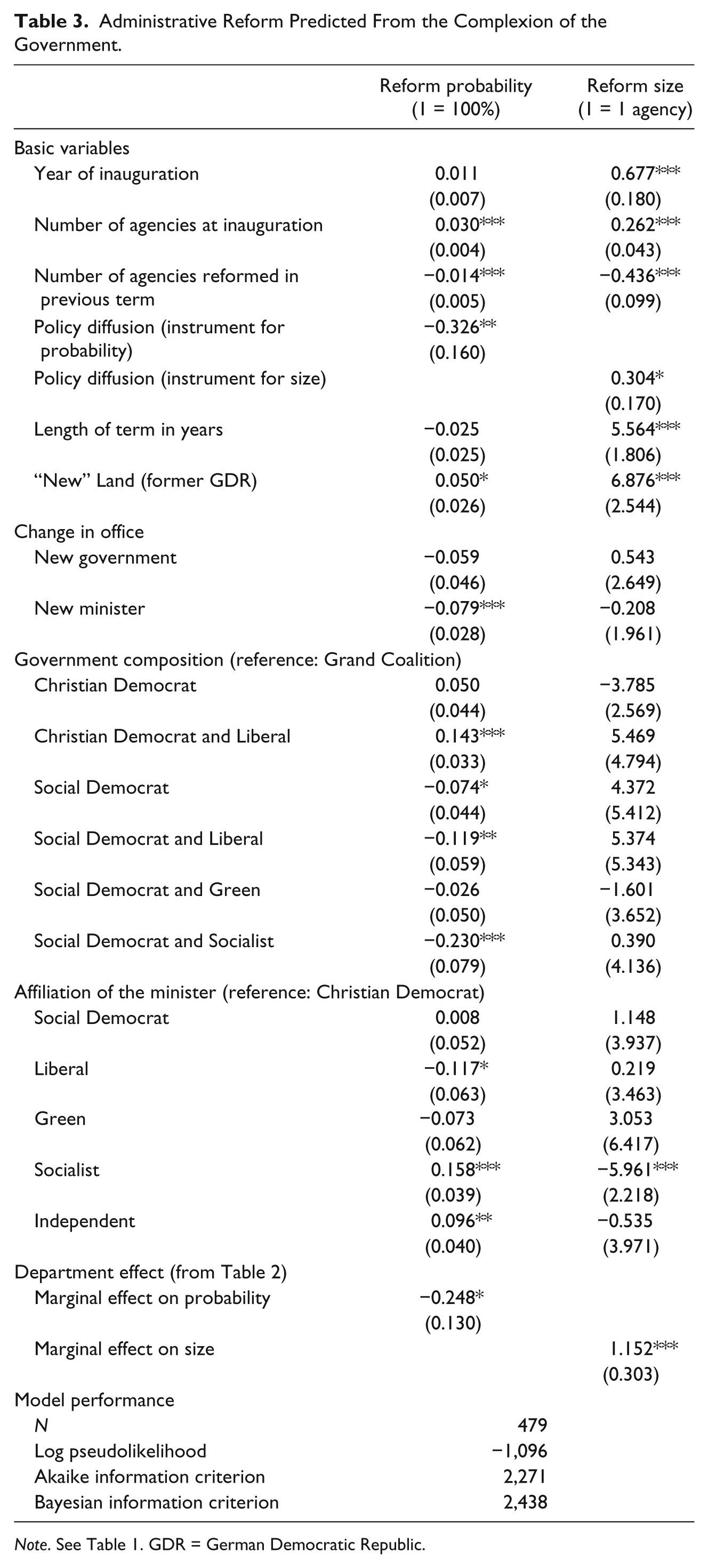
Administrative Reform Predicted From the Complexion of the Government.
Note. See Table 1. GDR = German Democratic Republic.
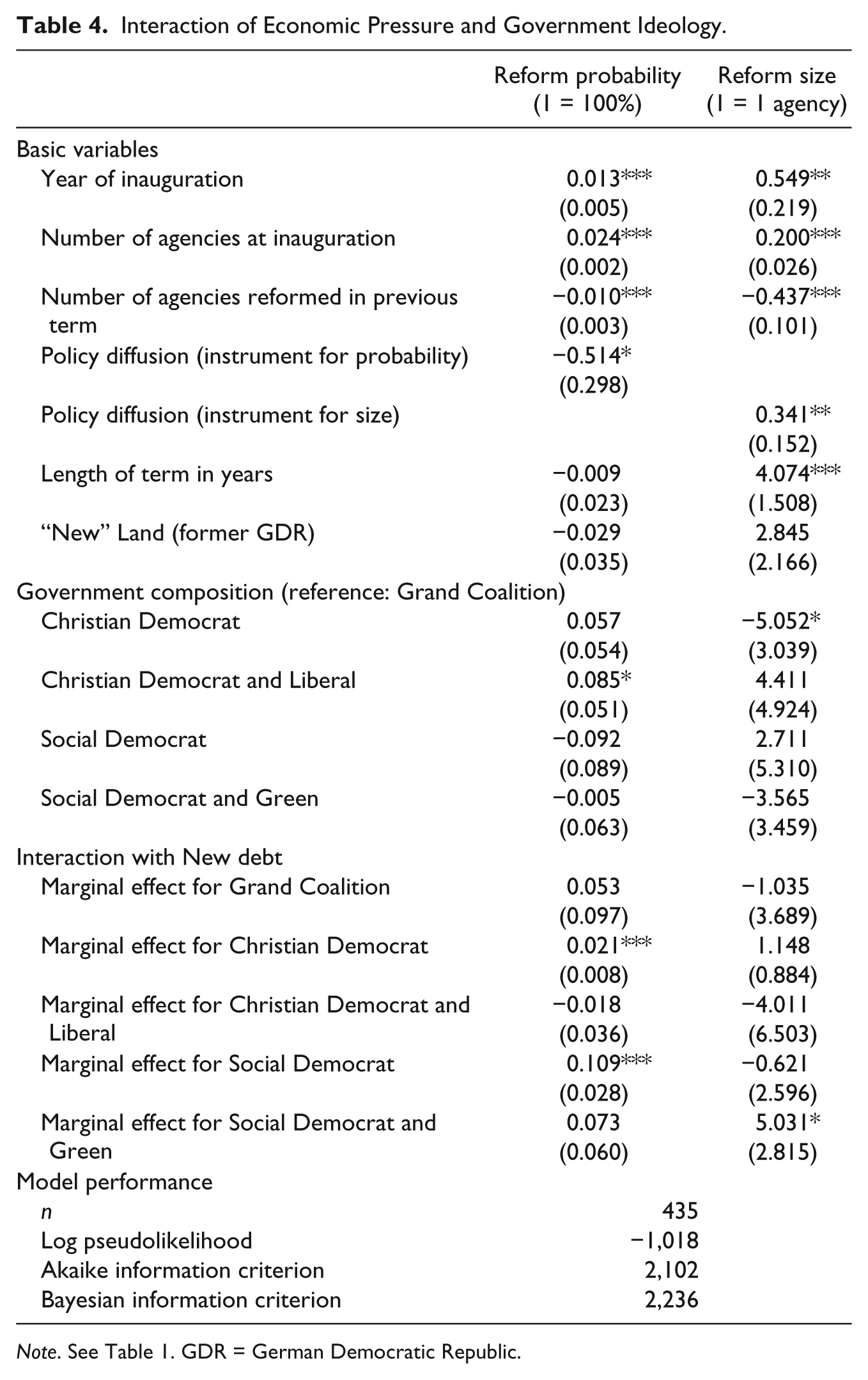
Interaction of Economic Pressure and Government Ideology.
Note. See Table 1. GDR = German Democratic Republic.
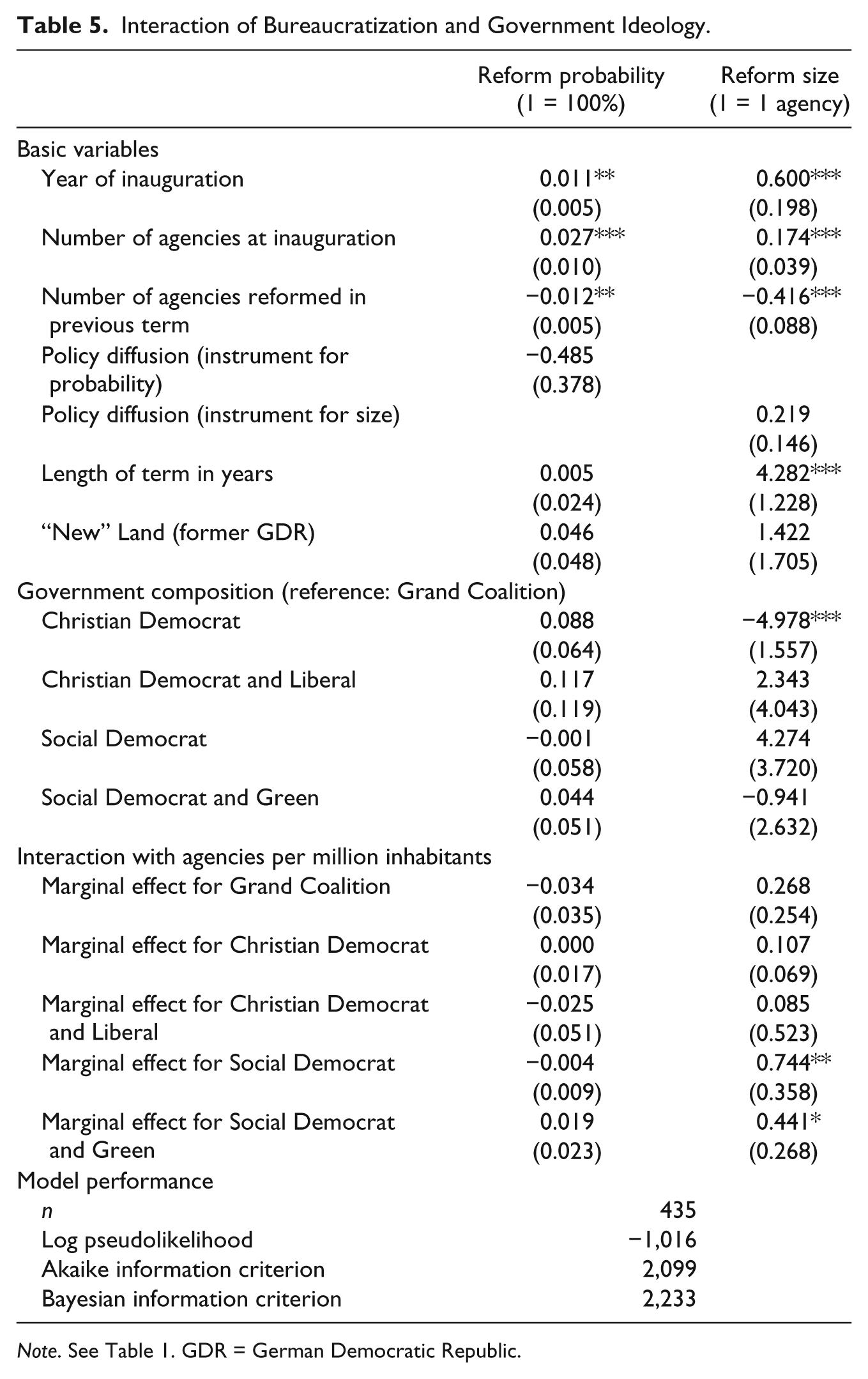
Interaction of Bureaucratization and Government Ideology.
Note. See Table 1. GDR = German Democratic Republic.
Because the raw coefficients of the ZINB model are hard to interpret beyond the direction of the effects, we converted all coefficients into marginal effects for continuous variables and first differences for dummies (raw results are in the online appendix). The results in Tables 1 to 5 can then be interpreted as follows: The left column shows marginal effects on the probability of reform. A value of 1 is equivalent to 100%. To give an example, an effect of .1 means that an increase of the respective independent variable by 1 increases the probability of reform by 10%, all else equal. 15 The right column shows marginal effects on the size of reform (given that a reform was attempted). A value of 1 is equivalent to one agency. An effect of 3 then means that an increase of the respective independent variable by 1 increases the number of agencies reformed during a term by 3.
Table 1 shows the results for the socioeconomic model. Concerning the basic variables, we find the expected wavelike pattern of reform outcomes over time. The relevant effect of −0.395 is quite remarkable. It means that in a given legislative term, nearly one agency less will be abolished for any two agencies that were abolished in the previous term. In addition, reform probability is slightly reduced as well (by 1.4%, as indicated in the left column). This “negative path dependency” is also persistent in the following models. We also find the expected effects for the time trend (increasing reform activity over the years), reform potential (the more agencies, the more reform), and term length (the longer a term, the more reform).
Policy diffusion has a positive effect on reform size. Although significant in only some of the models, about one quarter of the nationwide policy trend may have diffused into the individual Länder. In contrast, however, diffusion has a negative effect on reform probability. Although it seems that governments design administrative reform with an eye on recent examples, the decision whether to enact a reform in the first place appears to be entirely driven by each Land’s internal situation. The negative effect even suggests that administrative reform depends on top politicians who aim to make a mark against the general tide. A case in point is Lower Saxony in 2005 where Prime Minister Christian Wulff launched an extraordinarily large organizational reform to demonstrate his leadership capacity (Bogumil & Ebinger, 2008). 16
Concerning the demographic variables, the results are quite modest. The size of a Land does not systematically affect the probability and size of administrative reform (H1 is rejected). This is equally shown by all relevant indicators: Land area, number of inhabitants, and population density (which includes both territory and population size).
Budgetary pressure does not turn out to be a strong predictor either. As for state indebtedness (debt per capita), both coefficients are weak and non-significant. The state deficit (new debt per capita) shows significant effects in the expected direction, but they are not extraordinarily strong (H2 is partially confirmed). Thus, although budgetary consolidation may have been a major driver of the overall administrative reform dynamics in the German Länder, it does not explain much variation of reform activity across space and time.
The results for the institutional constraints are documented in Table 2. The degree of bureaucratization matters (H3): A high number of agencies per inhabitants promotes the probability and size of organizational contraction. In contrast, the vertical structure of Länder bureaucracies affects reform activity in a differentiated manner: Three-tiered systems are not reorganized more frequently than two-tiered ones, but if reformed, the former are contracted significantly stronger than the latter. One explanation for this finding may be mutual learning: Given that several Länder have been able to operate with a two-tiered system, governments in three-tiered systems recognized that the middle tier could be substantially reduced, if not completely abolished. Relevant examples include two large Länder, Lower Saxony, and Baden–Württemberg (both in 2005), where the respective governments justified the abolishment or substantial streamlining of their three-tiered administrations in this vein (Hesse, 2007; Hesse & Götz, 2008).
The multi-level structure of our model permits some insights into the varying resilience of ministerial departments. Concerning reform probability, all department types display similar values except for the ministries of Justice, Finance, and the Interior that are below average. These are also the departments with the lowest values for reform size, while other departments have contributed the lion’s share of administrative reform (Labor, Environment, Economics, and Education). Given that the model controls for the number of agencies at the beginning of each term, the effects are remarkable. As departments such as environment had evolved into highly differentiated organizations to fulfill a variety of specific policy tasks, they offered more room for bureaucratic contraction and were addressed accordingly by administrative reformers (Bauer et al., 2007). In contrast, departments such as Finance and the Interior could not be streamlined to the same degree because they had to maintain the core functions of the state. Thus, they were quite rarely the object of relevant reform attempts (Hesse, Götz, & Schubert, 2007; Jock, 2008).
Table 3 summarizes the findings for the political explanations, that is, the impact of government turnover (H5) and of party politics (H6). Again, we examine reform activity at both governmental and departmental levels. The model is controlled for the effect of department type to make sure that relevant effects are not due to the fact that certain portfolios are frequently taken by certain parties (e.g., Economics by the FDP or Environment by the Greens). 17 This means that the political variables in Table 3 can be interpreted independent of department type.
As outlined in H5, new governments are conventionally believed to be particularly active administrative reformers. Our results rather point to the contrary: Older Länder governments are more inclined to administrative reform than newly installed ones. 18 Although the respective effects are non-significant at the government level, we find a significant negative correlation of new ministers and reform probability at the departmental level. This suggests that administrative reforms are rather initiated by “experienced” ministers who have acquired both the technical knowledge to identify reform potential in a bureaucracy and the political skills to push a reform through against internal opposition. 19
Regarding the partisan composition of governments, the relevant effects impressively fit our theoretical expectations (H6). Right-wing coalitions of CDU and FDP are the most active reformers. Their likelihood to initiate administrative reform is 14% higher than that of grand coalitions (CDU-SPD), and in case of reform, they manage to reduce five more agencies on average (even if not significantly so). In contrast, SPD-led governments are significantly less likely to enact reforms, with leftist coalitions (SPD-PDS) achieving the lowest score (23% below grand coalitions).
The effects on the governmental level do not necessarily imply that administrative reforms are initiated by individual ministers in accordance with their respective party affiliation. Rather, the intra-governmental decision-making processes seem to be more complex. This becomes clear when turning to the performance patterns at ministerial level. Quite contrary to the governmental level, departments headed by FDP ministers are least likely to be reformed whereas those of non-party ministers show higher reform activity, controlling for coalition composition. The latter finding reflects that independents are often included in party cabinets to take over “unpleasant jobs” such as streamlining the bureaucracy. The significantly low performance of FDP ministers points to collective choice problems, for example, that the Liberals promote the administrative reform agenda of coalition governments but then tend to “free-ride” on their partners’ efforts. The opposite seems to apply for PDS ministers, who were more likely to enact reforms in their departments. However, these reforms were significantly smaller than those initiated by any other party and thus, do not necessarily suggest that PDS ministers “sacrifice” their departments for the good of the coalition. Examining these interpretations would need an in-depth analysis of cabinet decision-making, which is beyond our current scope.
As explained above, the party variables in Table 3 can be interpreted independent of department type due to our control strategy. However, additional evidence for the role of party politics in administrative reform can be found by relaxing this restriction and focusing explicitly on the departments primarily targeted by reforms of different party governments. This analysis suggests that parties tend to retrench departments that are traditionally “owned” by their political opponents. The lead of CDU-led governments in reform activity is largest in the department of the environment, traditionally, the preserve of social–democratic/green coalitions. Vice versa, the only department where SPD-led governments show significantly more reform activity is that of economics, traditionally, a core area of Christian–democratic/liberal coalitions. The pattern in between these two poles is less clear, however, and more systematic research is needed to scrutinize the impression generated by our excursus (for evidence from the United States, see Gilmour & Lewis, 2006).
The evidence so far shows that party ideology clearly matters for administrative reform. What remains to be explored are interactions of party with socioeconomic and institutional constraints (H7 and H8). For this purpose, we use the two variables that proved significant in Tables 1 and 2, respectively: new debt per capita as a measure of budgetary pressure and agencies per million inhabitants as a measure of bureaucratization. Interaction terms were calculated by multiplying these variables with each of the party composition dummies. The reference group for the constitutive effects is again the grand coalition. For the interaction itself, we calculated the overall effect of new debt for each type of government (coefficients for the multiplicative interaction are in the online appendix). 20
Both interaction models lend support to our hypotheses. The effects in Table 4 indicate that SPD-led governments are not less inclined to administrative reform than their right-wing counterparts provided that the new debt rate is high. For SPD–Green coalitions, reforms are significantly larger under higher new debt rates, and for SPD governments, the probability of reform increases at the same time. As the overall reform activity of SPD-led governments is lower, this means that leftist governments tend to launch administrative reforms in response to budgetary pressure whereas the reform activity of right-wing governments is more universal. Figure 3 visualizes this pattern. For relatively low new debt rates (left side), CDU governments are up to 30% more likely to initiate reform than SPD governments. As new debt increases (toward the right side), this difference decreases until the two predictions meet for the highest new debt rates.
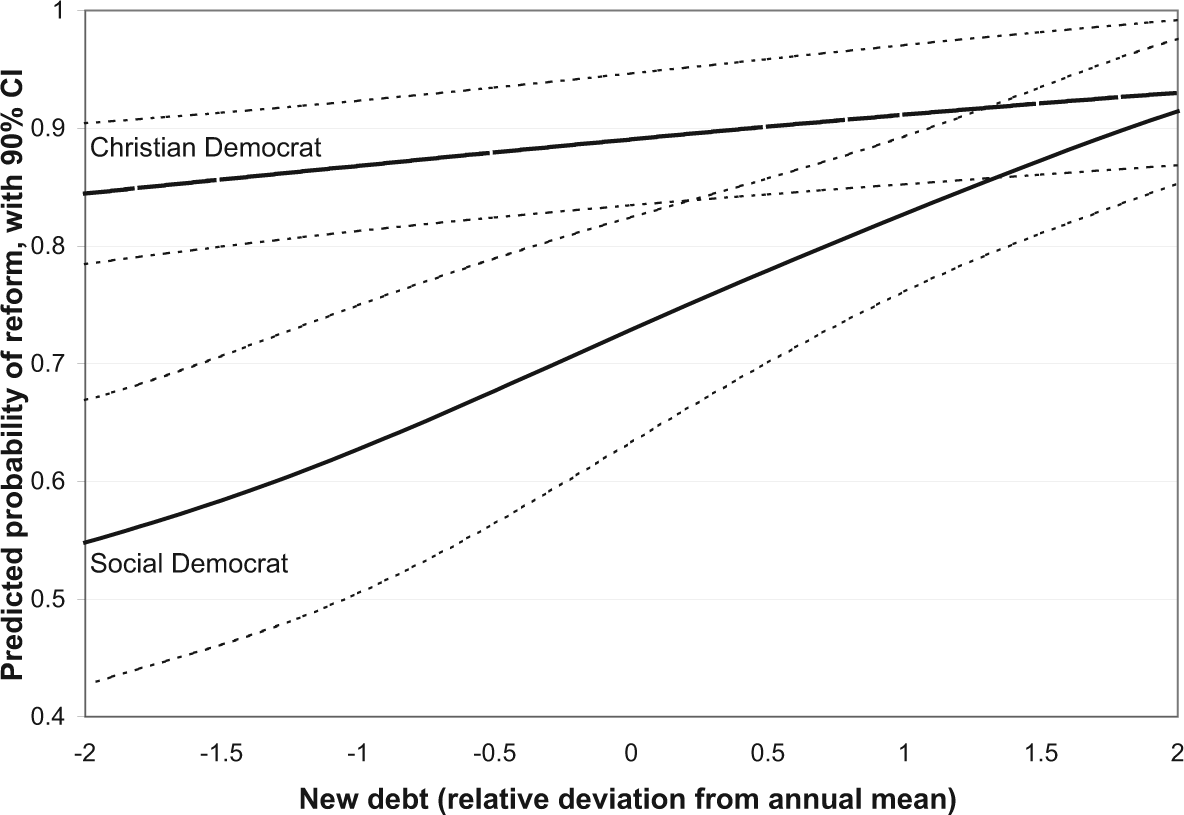
Predicted reform probability depending on the level of new debt, by government party.
Similarly, institutional constraints are significantly interacted only with leftist governments. As Table 5 shows, SPD-led governments tend to streamline administrative structures to a higher extent if there is more room for maneuver in terms of agencies per inhabitants. In contrast, the reform activity of right-wing governments remains constant regardless of the bureaucratization level. This is visualized in Figure 4. For relatively low levels of bureaucratization (left side), the size of reforms initiated by SPD and CDU governments does not differ significantly. As bureaucratization increases (toward the right side), SPD governments enact significantly larger reforms. The figure also shows how CDU reforms are at no point larger than SPD reforms. A comparison with CDU-FDP coalitions (not shown) yields systematically larger reforms for low levels of bureaucratization. Participation of the Liberals seems to be decisive in this respect.
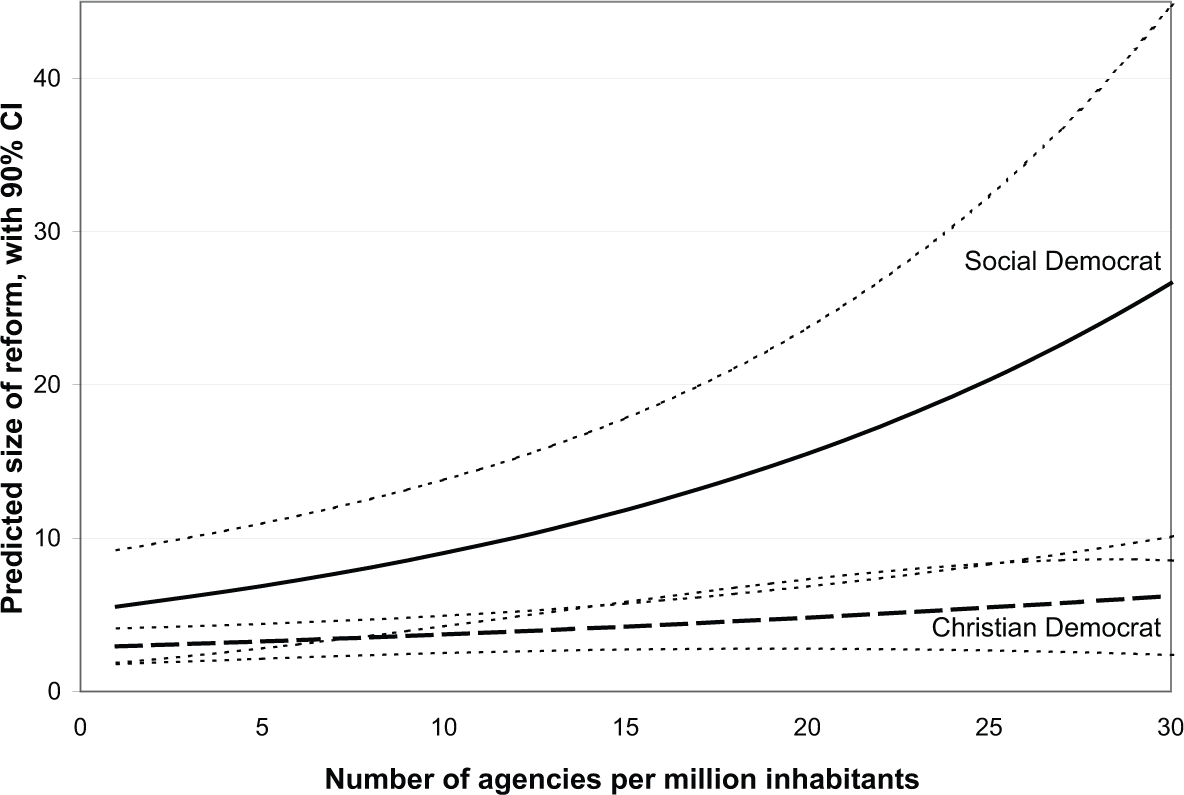
Predicted reform size depending on the degree of bureaucratization, by government party.
Taken together, we may conclude that political parties do considerably matter for administrative reform in the German Länder. The reform activity of leftist governments varied with contextual constraints, but tends to be quite sizable under high economic pressure or institutional opportunities. In contrast, CDU-FDP reforms have apparently been motivated by ideological reasons and were thus implemented on a more persistent level irrespective of variations in the socioeconomic and institutional environment. This finding nicely mirrors a comparative analysis of a related policy process, namely, the privatization of state-owned enterprises (SOE), by Zohlnhöfer and Obinger (2006), who conclude
that social democratic parties are indeed ready to sell off SOE when under intense fiscal strain, but that they—in contrast to bourgeois parties—do not regard this policy as an effective instrument to enhance economic growth and thus abstain from using it in the absence of fiscal problems. (p. 48)
The mechanisms we have identified thus seem to affect the size and structure of government quite generally.
Conclusion
Like many other states, the German Länder have substantially streamlined their bureaucracies since the 1990s. Given the considerable variation of reform outcomes, the Länder constitute a unique sample to test concurrent explanations of administrative reorganization across space and time. This study has analyzed the impact of socioeconomic, institutional, and political factors in a comparative manner that are most prominent in the extant literature but have not been systematically examined before. A comprehensive evaluation of our findings suggests that the ideological complexion of party governments is the most powerful predictor of bureaucratic contraction in the Länder context. More specifically, in the socioeconomic model (Table 1), the state deficit turned out to be the only significant factor, having a moderate effect on bureaucratic contraction. Compared with this, institutional constraints seem to matter more (Table 2): A high degree of bureaucratization promotes both the probability and the size of reform whereas the vertical structure of Länder bureaucracies affects reform size. Regarding the political variables, administrative reorganization tends to be initiated by “experienced” ministers knowing their subordinated bureaucracy. However, it is the partisan composition of government exerting the strongest effect on bureaucratic contraction: Right-wing governments of CDU and FDP are clearly more active reformers than leftist governments led by the SPD. The strength of this relationship is not only indicated by the relevant coefficients in Table 3 but also supported by the models in Tables 4 and 5, highlighting the interplay between the different explanatory variables. More concretely, SPD-led governments embark on bureaucratic contraction mainly under strong budgetary pressure and highly bureaucratized structures whereas CDU-led governments reform independent of these circumstances. In other words, the effects of budgetary pressure and bureaucratization shown in Tables 1 and 2 are driven by leftist governments, which further underlines the explanatory power of partisan theory.
These findings have several important implications that may also pave the way for future research.
First, bureaucratic contraction at Länder level is not a mere technical matter, driven by exogenous pressure and institutional opportunities. Quite in line with studies on administrative reorganization in the United States (Carpenter & Lewis, 2004), it rather resembles generic government policy shaped by party ideologies. Policy research on the German Länder could thus compare the partisan impact on administrative reorganization with that in other policy areas. Moreover, the present framework might be expanded to subnational authorities in other federations, such as Austria (Hammerschmid & Meyer, 2005), to explore the applicability of our findings beyond the German context.
Second, as reform activities of different party governments are affected in various ways by socioeconomic and institutional contexts, future studies might explore interactive relationships that can be derived from our framework and may pave the way toward a more integrated theoretical model. For example, does policy diffusion work more within parties than between regions? Is budgetary pressure more effective in contexts with large bureaucracies? Under what circumstances do new governments enact reforms?
In a similar vein, our multi-level analysis showed that the mechanisms underlying the partisan effects are more complex. For instance, although CDU-FDP governments are the most active administrative reformers, departments headed by FDP ministers within these governments are least likely to be reformed. This seeming paradox points to collective choice problems in cabinet decision-making that qualitative studies might uncover in more detail.
The third implication refers to the procedural nature of administrative reorganization. Bureaucratic contraction has generally taken place in “waves,” that is, reform-intensive phases were followed by “rest periods.” This indicates that there might be a best practice of which kinds of agencies to change at specific stages of the entire reform process. Investigating this issue would presuppose not only “snapshots” of core bureaucracies at the beginning and end of legislative periods but more detailed information on the birth, survival, and death of individual agencies. Based on such a refined data set, studies of Länder administrations could be more systematically connected with the literature on agency termination (Adam et al., 2007; MacCarthaigh et al., 2012; Rolland & Roness, 2010, 2011), exploring whether different party governments apply distinct reform strategies, which strategies are most effective, and whether administrative reorganization is ultimately rewarded by electoral support.
Supplemental Material
Online_appendix_AandS59726 – Supplemental material for Party Government and Administrative Reform: Evidence From the German Länder
Supplemental material, Online_appendix_AandS59726 for Party Government and Administrative Reform: Evidence From the German Länder by Alexander Götz, Florian Grotz, and Till Weber in Administration & Society
Footnotes
Acknowledgements
We would like to thank Volker Reiprich for his valuable support in completing the dataset for this article.
Declaration of Conflicting Interests
The author(s) declared the following potential conflicts of interest with respect to the research, authorship, and/or publication of this article: Alexander Götz declared that he remains solely responsible for his contribution to this article and the latter does not reflect the position or views of the state government of Lower Saxony.
Funding
The author(s) received no financial support for the research, authorship, and/or publication of this article.
Notes
Author Biographies
References
Supplementary Material
Please find the following supplemental material available below.
For Open Access articles published under a Creative Commons License, all supplemental material carries the same license as the article it is associated with.
For non-Open Access articles published, all supplemental material carries a non-exclusive license, and permission requests for re-use of supplemental material or any part of supplemental material shall be sent directly to the copyright owner as specified in the copyright notice associated with the article.
