







Abstract
Local and civil society can play decisive roles in disaster response. Yet, the disaster management literature is unclear regarding the conditions that enable cross-sectoral collaboration. Using a collaborative governance framework and 44 semi-structured interviews, this study investigates how trust, pre-existing relations, interdependence, knowledge, and resources affect cross-sectoral collaboration during disaster response in Turkey. The results illustrate how these factors interact with system context factors, such as political compatibility, to facilitate or hinder cross-sectoral collaboration. The study concludes that cross-sectoral collaboration is no panacea for successful disaster response, but empirical examples also suggest that cross-sectoral collaboration can contribute to reducing suboptimal disaster response.
Keywords
Local communities bear the brunt of natural disasters worldwide and play a decisive role in mitigating their impacts. “Inclusory or community-based disaster response has rapidly become a major, if not the dominant, paradigm in international disaster policy” (Bankoff & Hilhorst, 2009, p. 700). The disaster management literature conveys part of the rationale for this; local and civil society actors provide local knowledge and access to various social networks, which contribute to more effective disaster response operations (Bae, Joo, & Won, 2015; Bernier & Meinzen-Dick, 2014; Jalali, 2002; Miller & Douglass, 2015; Simo & Bies, 2007). Yet, to be effective, local and civil society actors also need the support of governmental actors (Bernier & Meinzen-Dick, 2014), which introduces the need for collaboration. It is less clear, however, under what conditions these actors may engage in cross-sectoral collaboration. Honing in on these conditions is key as the character of such collaboration may itself, at least partly, condition effective response operations (Kapucu, Arslan, & Collins, 2010). Drawing on concepts and assumptions from a theoretical, collaborative governance framework emphasizing system context conditions (Emerson & Nabatchi, 2015), this article sheds light on these issues by investigating state authorities’ collaboration with local and civil society actors during disaster response in Turkey. This article thereby contributes to the collaborative governance literature focusing on disaster management and augments the discussion on cross-sectoral collaboration and their outputs in relation to complex societal problems. Here, cross-sectoral collaboration implies “the linking or sharing of information, resources, activities, and capabilities by organizations in two or more sectors to achieve jointly an outcome that could not be achieved by organizations in one sector separately” (Bryson, Crosby, & Stone, 2006, p. 44).
Disaster governance approaches are “nested within and influenced by broader societal frameworks of governance” (Tierney, 2012, p. 347). Centralized and hierarchical disaster governance systems typically lack voluntarism and community involvement traditions, which challenge cross-sectoral collaboration. Turkey has a long history of disasters and the centralized and hierarchical disaster management system has repeatedly received critique for its lack of coordination and collaboration (Ganapati, 2008; Kapucu, 2012) and exclusory stance toward local and civil society actors (Balamir, 2013; Disaster and Emergency Management Presidency [AFAD], 2012; Ministry of Public Works and Settlements, 2009).
Since implementing disaster management reforms in 2009, which emphasized coordination, collaboration, and decentralization, however, the importance of local and civil society actor collaboration is increasingly acknowledged in Turkey. Still, the centralized political–administrative system, typically not conducive to local and civil society participation, can make reform ambitions difficult to attain in practice.
In 2011, two earthquakes hit Van and Erciş in the predominantly Kurdish-populated south-eastern province of Van (the first major event since reforms had been implemented), killing 644 and injuring more than 4,000 people (Erkan et al., 2013). If local and civil society participation is generally challenging in Turkish disaster response, this region’s political polarization due to long-standing conflict between the Turkish government and the Kurdistan Workers’ Party (PKK) potentially intensifies the challenges. In view of these multiple hurdles, collaborative efforts between the state authorities on one hand and the local and civil society actors on the other are expected to be limited, which in turn is expected to affect disaster response effectiveness negatively. Still, this study found that the extent of cross-sectoral collaboration varied among disaster response activities, which warrants closer investigation of the prevalence of conditions enabling such collaboration in each activity. Collaborative governance scholars also encourage more work on task-related networks and effectiveness (Kapucu et al., 2010) and on exploring how local actors’ interaction with the public sector may vary in promoting local emergency management collaboration (MacManus & Caruson, 2011). This article investigates cross-sectoral collaboration between the state authorities and the local and civil society actors during disaster response in Turkey. More specifically, it analyzes the presence of trust, pre-existing relations, interdependence, knowledge, and resources, and explores whether these conditions facilitate cross-sectoral collaboration as suggested by the collaborative governance literature. A within-case design is used to compare three core disaster response activities: damage assessment, search and rescue (SAR), and aid distribution. The study also explores how cross-sectoral collaboration influences the ability of the actors to conduct these activities.
First, the role of local and civil society actors in disaster response as depicted in the literature is introduced. Second, the context and method of the case study are described. Third, the prevalence of cross-sectoral collaboration and the conditions promoting such collaboration are presented along with examples of how cross-sectoral collaboration relates to effective response operations. Finally, the findings are discussed and placed in the context of prior collaborative governance research along with suggestions for future research.
Disaster Response and Local and Civil Society Actors
The societal effects of disasters span many sectors. Consequently, this is why effective disaster response hinges on fruitful horizontal and vertical inter-organizational collaboration (Kapucu et al., 2010; Twigg, 2004; Waugh & Streib, 2006). Disaster management often involves diverse sets of actors, and disaster managers must act as network brokers, creating and facilitating networks, connecting faith-based organizations, civil society organizations, and social services (McGuire, Brudney, & Gazley, 2010). Many such actors are local and “local actors are faster and more effective in responding to disasters” while also “coordinating their response activities more effectively” (Kapucu et al., 2010, p. 240). Local actors are also key for effective disaster response as they can access disaster sites quickly, can mobilize social resources and networks effectively, possess valuable local knowledge that distant disaster managers and government officials lack, and often enjoy legitimacy in, and the trust of, their communities (Aldrich, 2012; Bae et al., 2015; Bernier & Meinzen-Dick, 2014; Miller & Douglass, 2015; Simo & Bies, 2007). Partnering with non-governmental organizations (NGOs), local governments, and civic organizations further facilitates resource distribution and information dissemination (Bernier & Meinzen-Dick, 2014; Jalali, 2002).
The disaster literature, thus, clearly conveys that local and civil society actor involvement is important for successful disaster response outcomes and also conveys what these actors bring to the table (i.e., local knowledge) in supporting these operations. Local and civil society actor involvement is, thus, a necessary but insufficient condition for effective disaster response. Local and civil society actors, however, often need government actors’ support to reach their potential (Bernier & Meinzen-Dick, 2014). The integration of disaster management authorities and local and civil society actors is, however, a collaborative challenge (Boin & Bynander, 2015) and the disaster management literature is less clear regarding the conditions that enable these actors to collaborate. Collaborative governance is another research area that offers important insights in answering these questions.
Existing disaster response research concerning local and civil society actors focuses to a large extent on emergent groups and citizens (see, for example, Drabek & McEntire, 2003), whereas local authorities and established NGOs surprisingly have gotten less attention, particularly in politically polarized contexts (see Bankoff & Hilhorst, 2009, for an exception). Descriptions of these actors’ roles in disaster response are not uncommon in the disaster literature but few investigate them from a collaboration and/or performance perspective (Gazley, 2013; Nolte & Boenigk, 2011).
Generally, there is also a lack of studies focusing on the results of cross-sectoral collaboration and studies linking the conditions for such collaboration to performance (Emerson & Nabatchi, 2015; McGuire & Agranoff, 2011). The studies that do exist frequently suffer from conceptual conflation of process and outcome performance, which impedes further progression of the field (Emerson & Nabatchi, 2015; Ulibarri, 2015).
A Theoretical Framework of Collaborative Governance
To help structure the analysis of the conditions that enable for cross-sector collaboration, this article borrows concepts and assumptions from Emerson and Nabatchi’s (2015) framework for collaborative governance. This framework integrates the many parts of collaborative governance into a dynamic system. It also emphasizes the importance of the system context in shaping the conditions for cross-sectoral collaboration, which they define as
the processes and structures of public policy decision making and management that engage people across the boundaries of public agencies, levels of government, and/or the public, private, and civic spheres to carry out a public purpose that could not otherwise be accomplished. (Emerson & Nabatchi, 2015, p. 18)
In short, the framework involves a set of nested dimensions such as “system context” and “drivers” that help initiate collaboration. “Collaborative dynamics” (consisting of three interacting components), “collaborative actions,” “outcomes and adaptation” are also part of the framework. “Each component and its subsidiary elements are worthy of further investigation” (Emerson & Nabatchi, 2015, p. 223) and in this article, two of the “collaborative dynamics” (shared motivation and capacity to act jointly) will be examined in more detail. “Shared motivation” captures the interpersonal relationships of participants and their attitudes toward one another, and “capacity to act jointly” contains elements (procedural and institutional arrangements, leadership, knowledge, and resources) that create the potential for taking effective action (Emerson & Nabatchi, 2015). “Shared motivation” will be assessed by investigating the elements of trust and pre-existing relations. Within collaborative governance literature, trust is essential for collaboration (Emerson, Nabatchi, & Balogh, 2012), and it reduces transaction costs and promotes knowledge exchange (Koppenjan & Klijn, 2004). A prehistory of conflict, or a bad “track record,” naturally reduces trust while positive recurrent interactions increase trust and make future interactions more predictable, for example, by establishing common values and increased role clarity (Ansell & Gash, 2008).
Within “capacity to act jointly,” the elements resources and knowledge will be assessed because they are significant for collaborative efforts and are typically contributed by local and civil actors. In addition, one “driver,” interdependence, will be assessed in this article as it is a well-known condition fostering collaboration (Mandell & Keast, 2008). Interdependence may also create trust (Kapucu et al., 2010); however, truly mutual dependence can be jeopardized if public authorities do not perceive NGOs as equal partners (Nolte & Boenigk, 2011), conceivably more prevalent in highly centralized governance systems. Yet, the Turkish state authorities’ dependence on local and civil society actors’ resources and knowledge is not negligible. Provincial state officials responsible for disaster management in Turkey may be even more dependent than officials in centralized systems elsewhere as turnover rates are high, in part due to the administrative practice to rotate provincial and district government officials. Such practices limit the amount of time these authorities have to foster their own local knowledge and networks. Yet, local and civil society actors often lack a formal role in disaster response activities and, in turn, depend on state authorities to provide them with accreditation and/or a “seat at the table.”
In addition to investigating the presence of the enabling conditions in three different activities, this article also explores how cross-sectoral collaboration relates to the actors’ ability to conduct these activities. In an attempt to do so, McConnell’s (2011) concept of crisis management success and failure is partly used as it is adapted to a crisis/disaster context (in contrast to Emerson and Nabatchi’s framework). Emerson and Nabatchi’s (2015) approach to assessing the outcome type relevant for disaster response assumes that all activities are conducted collaboratively, which is not the case here. According to McConnell (2011), disaster response is successful/effective if it “follows pre-anticipated and/or relevant processes and involves the taking of decisions which have the effect of minimizing loss of life/damage, and restoring order” (p. 68). “Relevant” processes can change and divert from pre-anticipated ones if serving the purpose better (McConnell, 2011). This resembles desired traits of disaster response operations: flexibility and improvisation (Waugh, 2009).
Context of the Case Study
Cross-sectoral collaboration does not occur in a vacuum, but rather in a multifaceted political and administrative system context. As Emerson and Nabatchi (2015) note, this system context is crucial for understanding collaborative governance and how it influences the conditions for it. Consequently, the system context of Turkey is briefly described here.
Hierarchy and centralization are key defining characteristics of the Turkish administrative and disaster management system (Ganapati, 2008; Kapucu, 2012). The central government consists of the central administration in Ankara and the provincial and district administrations. The provincial administrations (governorates) are divided into districts, and these entities are governed by provincial and district governors, respectively, valis and kaymakams, which take and implement decisions on behalf of the government in Ankara (Kapucu & Palabıyık, 2008). Valis and kaymakams are central authorities positioned locally, and are responsible for disaster management, among other duties. In the event of a disaster, they lead the Crisis Coordination Centers (CCC) where their deputies, provincial ministries, security/law enforcement agencies, and NGOs are represented.
In this article, local and civil society actors include municipalities, muhtars, and NGOs. Municipalities do not assume any particular responsibilities during disasters but are responsible for certain relevant services such as police, fire, and infrastructure (Kapucu & Palabıyık, 2008). In 2005, municipalities were tasked with locally adapted emergency and disaster planning, but implementation is slow (Balamir, 2013). Provincial governorates have no power to intervene in municipal disaster planning, yet they hold all responsibility after a disaster, which causes an “incongruous relationship” between the two (Gülkan, 2009). Also, valis and kaymakams are appointed by the Council of Ministers, whereas the village and neighborhood leaders (muhtars) and municipal officials are elected by popular vote. Hence, in some areas, the provincial and district governors are appointed by ministers of a political party other than the one holding power in the municipality and/or the local constituency. This was the case in Van during the earthquakes.
Both Van and Erciş are located on Lake Van and administered by Van province, which in terms of development, ranks 75th of Turkey’s 81 provinces (Erkan et al., 2013). The mountainous region is poor and home to an ongoing conflict between the Turkish government and the PKK, who is advocating political and cultural rights and self-determination for Kurds in Turkey. In 2011, Van municipality was represented by the pro-Kurdish “Peace and Democracy Party” (BDP), whereas the provincial and district governors were appointed by the ruling “Justice and Development Party” (AKP). Along with AKP’s increased dominance, political and ethnical polarization in society has clearly become stronger. As disaster response in Turkey is “heavily dependent on the compatibility of political affiliations, particularly between central government and municipalities” (Gülkan, 2009, p. 25), the prospect for cross-sectoral collaboration between the state and the municipal authorities is unfavorable. Without political compatibility, pre-existing positive relations are probably less common, and subsequently the likelihood of distrust is increased. Actors that are less political and have more limited ambitions in other policy areas (such as disaster-niched SAR-NGOs) may, thus, have better chances for constructive collaboration.
The newly created AFAD belongs to the Prime Minister’s Office and is the “sole authority of disasters and emergencies” (AFAD, 2014). (AFAD is similar to the Federal Emergency Management Agency in the United States.) AFAD is responsible for coordinating all actors in all disaster activities. At the time of the 2011 earthquakes, AFAD’s provincial offices were affiliated with the provincial governors. AFAD is responsible for NGO accreditation and increasingly arrange NGO workshops and trainings because they perceive NGOs as “indispensable” and as “main solution partners” alongside the ministries and the military (AFAD, 2012). NGOs contributed substantially to the 1999 earthquake response while the government largely faltered. This fact served significantly to improve the legitimacy of NGOs (Jalali, 2002; Kubicek, 2002).
Muhtars have no formal role in disaster response (nor do NGOs) but they have related duties including facilitating social welfare, population registration, maintaining order and security, and strengthening social relations (Akay, 2007). Oktay (president of AFAD), Tetik, and Gökçe (2013) assert that the “main principles of the recovery process” suggest that local communities and governments should play some role and assume some responsibilities (p. 1393). They also point out that the 2009 disaster legislation demands that actors on all levels collaborate throughout all phases of disaster management. Given the Turkish state’s dominant role, cross-sectoral collaboration mainly implies state authorities’ collaboration with municipalities, NGOs, and muhtars.
Method and Data Collection
Network governance scholars see the need for studying the relationship between inter-organizational network structures, their activities, and effectiveness measures (McGuire & Agranoff, 2011). Research efforts are also encouraged to explore how variations in interaction between local actors and the public sector affect local emergency management collaboration (MacManus & Caruson, 2011), and to focus on “specific task-related networks” in relation to effectiveness (Kapucu et al., 2010, p. 241). This study will take a step in this direction by examining the presence of enabling conditions for cross-sectoral collaboration in a disaster context and exploring how such collaboration affects disaster response effectiveness.
This study uses a qualitative within-case design, which is a partly novel approach in these matters. As the system context is “constant” across activities, the detected variation in cross-sectoral collaboration and disaster response effectiveness highlights the collaborating actors’ relationships. To capture the nature and quality of these relationships, semi-structured interviews and focus group interviews were used. The questions facilitating these efforts included the following: Which type of actors did you conduct activities with? Did you have any previous contact with these actors? Did you experience any collaboration difficulties or any other difficulties? If so, what? Were these difficulties overcome? How? Interviewing collaborating actors, especially actors from different sectors about their resources and relationships with other actors, goes “a long way toward uncovering and understanding the roles of individuals in helping or hindering collaboration” (Emerson & Nabatchi, 2015, p. 197f).
Asserting network performance is a tall order, hindered by both “conceptual and empirical roadblocks” (McGuire & Agranoff, 2011, p. 274). Frequently employed approaches for studying disaster response performance are social network analysis (SNA; see, for example, Kapucu et al., 2010) and single case studies (see, for example, Nolte & Boenigk, 2011). The analysis in this study partly rests on the involved actors’ self-evaluation of disaster response performance (McConnell, 2011). Investigating collaborative public management outcomes, Mandell and Keast (2008) claim we must “become more comfortable with the legitimacy of participants’ self-evaluations” (p. 729). As in any approach, a guard against self-serving biases, such as overestimating performance, is required (Andrews, Boyne, Moon, & Walker, 2010). Hence, the self-evaluations used in this analysis were reviewed for biases.
Data Collection
Interviews were conducted in Istanbul, Ankara, and Van in October to November 2013 and in Istanbul, Ankara, Van, and Erciş from March to June 2015. Istanbul hosts many of the NGOs working in Van and Erciş after the earthquakes and Ankara hosts ministries, expert institutions, and AFAD headquarters (HQ). Interviewees were selected based on their experience in and of the Turkish disaster management system and/or their position during the earthquakes. Interviewees were located using mainly snowball sampling on site. The first-wave respondents were contacted through one of four interlocutors (one relative of an informant, who is a well-connected teacher in Van, and three university employees: one Swedish disaster scholar, one Turkish disaster scholar, and one Turkish public administration/disaster scholar).
The article’s empirical backbone is comprised of 44 semi-structured interviews that were conducted in English and Turkish (mainly in Van and Erciş) using local interpreters. The interviews commonly lasted between 1 and 3 hours. Thirty-nine interviews were recorded and transcribed. Five interviews were not recorded but were promptly dictated onto the recorder and transcribed (see Table 1 below). Four key interviewees were interviewed twice due to their changing of positions, which led to new/richer information. As some interviewees asked to remain anonymous, all interviewees were anonymized to protect their identities. The interview transcripts were re-read repeatedly and analyzed thematically as well as contrasted and compared with each other, primary sources (i.e., AFAD strategy documents, plans, and reports documenting Turkey’s implementation of the Hyogo Framework for Action), secondary sources (i.e., news articles, academic articles, and UN reports), and field notes.
Breakdown of Interviewees.
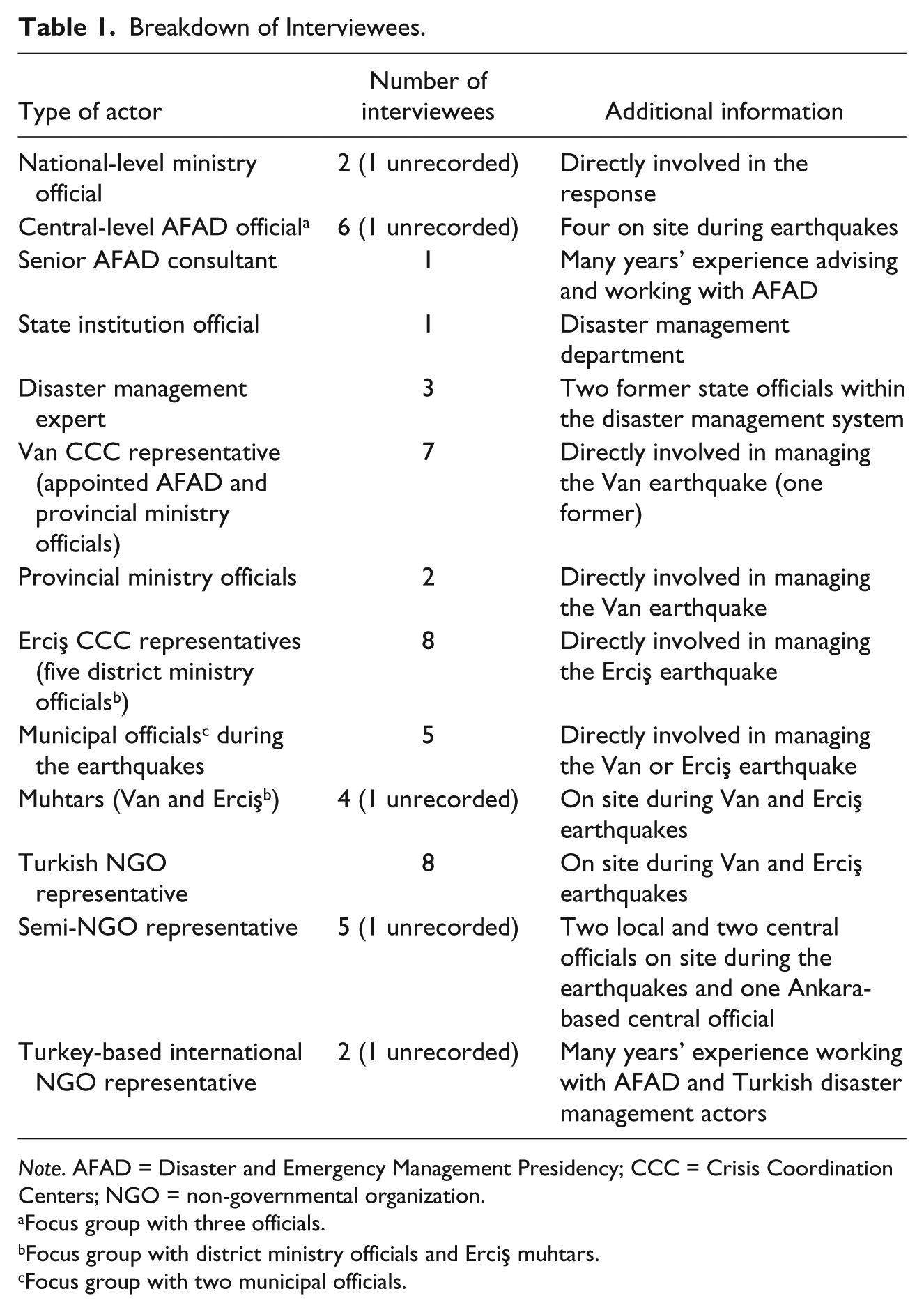
Note. AFAD = Disaster and Emergency Management Presidency; CCC = Crisis Coordination Centers; NGO = non-governmental organization.
Focus group with three officials.
Focus group with district ministry officials and Erciş muhtars.
Focus group with two municipal officials.
Other sources to consult when assessing disaster response performance can include inquiry reports, witness testimonies, and expert and stakeholder briefings (McConnell, 2011). Yet, in the case of Turkey, it is generally difficult to acquire documentation from public sources (Çaha, 2009; Kapucu & Palabıyık, 2008; Yalçındağ, 1997) as public officials and employees often see themselves as owners of the state (Çaha, 2009) and “almost every kind of information is treated as confidential” (Timothy & Tosun, 2001, p. 352). Subsequently, public documentation covering the Van and Erciş earthquakes was scarce and not readily available.
Core Disaster Response Activities and Cross-Sectoral Collaboration
In most disasters, damage assessment, SAR, and aid distribution are core activities central for well-being; in their wake, lives begin returning to “normalcy.” Other studies divide response activities in a similar fashion (Platt & Durmaz, 2015). These activities also bring similar managerial challenges (matching needs to available resources and actor coordination) and are all conducted during uncertain, complex, and urgent conditions. In this article, muhtars, NGOs, and municipalities are included in local and civil society actors, whereas business organizations and emergent groups are not.
This section will analyze the presence of trust, pre-existing relations, interdependence, knowledge, and resources and whether these facilitate cross-sectoral collaboration. A within-case comparison across the activities will also be made in the “Discussion and Conclusion” section in an effort to explore whether and how cross-sectoral collaboration influenced performance in relation to each activity.
Damage Assessment
Ankara [AFAD HQ] should know this; the biggest problem was damage assessment. . . . We [provincial CCC] should have been quicker conducting damage assessment to enable people to get back to normal as soon as possible. (Interview 10)
When conducted in a correct and timely manner, damage assessment enables people to return to homes that are deemed safe and prevents people from residing in unsafe buildings. After the Van and Erciş earthquakes, harsh weather conditions and the lack of temporary shelter facilities made quick assessment even more pertinent. After 1 month, many buildings in Van had still not been inspected (Karanci, Kalayçioğlu, Basbuğ Erkan, Özden, Çalişkan, & Özakşehir, 2011), which contributed to more than 160,000 people having to leave Van (AFAD, 2014; Özcağdaş, 2011; Hürriyet Daily News, Nov 11, 2011).
One contributing aspect was the lack of resources and knowledge. Despite the fact that engineer and expert teams from the Ministry of Environment and Urbanization branches and universities from all over Turkey came after the first earthquake, a shortage of well-trained personnel to carry out rapid assessments and common assessment standards remained (Interviews 31, 33, 36; Earthquake Engineering Research Institute [EERI], 2012; Erkan et al., 2013). Experts claimed that only superficial, external inspections were made (Today’s Zaman, Nov 11, 2011). This could possibly be related to AFAD’s “impossible” time frames, which put heavy pressure on damage assessors (Interviews 31, 36). Provincial officials were also criticized for taking too long before reaching out to available resources in the form of NGOs and local actors (such as professional unions and chambers), once realizing their own were insufficient (Erkan et al., 2013; ODTÜ, 2011).
Alongside the provincial CCC’s efforts, the municipal CCC organized local damage assessors from the Union of Turkish Chambers of Engineers and Architects whose services and later assessment reports were offered to the provincial CCC. This improvised initiative, beyond the municipality’s duty, brought potential for extra resources and knowledge and the added benefit of familiarity with the local building tradition. Yet, the lack of trust and positive pre-existing relations stemming from a history of conflict hindered its realization. Upon approaching the provincial CCC, they initially claimed that their “own” experts were sufficient according to a municipal official (Interviewe 3). A municipal damage assessment report recommended the demolition of one damaged hotel, yet the same municipal official claimed that the provincial CCC was not interested in the report’s findings (Interview 3). So, the hotel continued to accommodate guests. During the second earthquake, the hotel collapsed and 25 people lost their lives (Hürriyet Daily News, Nov 13, 2011). A provincial CCC official said, “The hotel was heavily damaged in the first earthquake, and in the second earthquake it just collapsed. Obviously, the damage assessments there were not good” (Interview 10). A national ministry representative further stated that “If the damage assessment had been done in a proper way, the hotel would have been closed and many lives would have been saved” (Interview 13, see also Erkan et al., 2013). Such collaboration difficulties were not as significant in Erciş, due to the fact that the municipality was politically compatible with the state authorities and that these actors had enjoyed good relations even before the earthquakes (Interviews 5, 12, 38, 41, 11).
According to good disaster management practice, critical buildings such as schools and hotels are prioritized for assessment as they can double as shelters (EERI, 2012, Interview 36). State officials, however, claim that no damage assessment of the hotel was made after the first earthquake (Today’s Zaman, Jul 16, 2014). Despite this, the provincial CCC stated that many buildings were safe and could be entered without fear, a rhetoric that changed after the second earthquake (ODTÜ, 2011; Özcağdaş, 2011). By then, trust in and legitimacy of experts and institutions was eroded (ODTÜ, 2011). Following the hotel collapse, police met protestors demanding the governor’s resignation with teargas, which turned the protest into a confrontation (“Protesters Clash With,” 2011). The Van Public Prosecutor’s Office and the Constitutional Court later launched several investigations into bribery and negligence complaints connected to damage assessments (Hürriyet Daily News, Jul 24, 2012).
Moreover, state authorities fell short in providing coherent information regarding the future of the affected people and their homes (ODTÜ, 2011), in part due to not having information channels to the affected population (Interview 35). Also, lacking a common information management system delayed damage assessment (Erkan et al., 2013), as population registry and cadastre information were unavailable, which created problems with ownership and compensation issues (Interviews 6, 35). Three to four months after the earthquakes, the CCCs in both Van and Erciş created joint damage assessment teams with muhtars, as they had both communication channels to inhabitants and information about local properties. The contributed resources and knowledge partly helped to alleviate the information deficit (Interviews 28, 32).
In sum, damage assessment activities displaying shortages of methods, well-trained personnel, and information dissemination cannot be deemed effective. State authorities’ decisions did not minimize damage to the affected people or help in restoring stability. It seems that “shared motivation” was absent. Distrust and the lack of positive pre-existing relations due to political incompatibility made cross-sectoral collaboration between state authorities, municipal actors, and municipality-affiliated NGOs difficult. This affected the “capacity for joint action” negatively. In addition, local actors were not effectively used as damage assessors or as sources of legitimacy and trust vis-à-vis the affected population. Joint response effort initiatives came late for the same reasons. Yet, realizing their dependence on locally informed muhtars, the state authorities initiated collaboration, which in turn partly alleviated informational deficits.
SAR
SAR activities aim to rapidly locate and remove people trapped under debris. In Van and Erciş, professional SAR activities were mainly performed by AFAD’s SAR Brigades, NGOs, university teams, and international teams. This section focuses on the activities of AFAD as well as a number of local and national Turkish SAR-NGOs.
Of the individuals buried under the rubble, SAR teams rescued 28% alive. This is a high number compared with similar earthquakes worldwide (AFAD, 2014), which is normally around 10% (Interviewe 4). Both SAR and health representatives praised the collaborative efforts of SAR teams and semi-NGO Ulusal Medical Kurtarma Ekipleri (UMKE), who provided life support and hospital transportation to those people rescued by SAR teams (Interviews 7, 27). An SAR-NGO actor said, they “collaborated brilliantly with UMKE in Van and they were extremely helpful for us” (Interview 7). Even though a system to prioritize buildings and to mark searched buildings (ODTÜ, 2011) was lacking, the SAR operations in Van and Erciş suggest that SAR capacity has improved since the 1999 earthquakes (Interviews 13, 4, 7, Platt & Durmaz, 2015), and that SAR-NGOs have provided substantial resources and knowledge. Some SAR-NGOs gain experience by participating in international operations and use UN standards as benchmarks. After its creation in 2009, AFAD has increased interaction with SAR-NGOs also during non-acute times (at least in bigger cities) and pre-existing relations facilitated collaborative efforts in the Van and Erciş response. There is, for example, an NGO–AFAD chat group for exchanging information, alert levels, and support requests. More frequent interaction between AFAD’s SAR units and this NGO (e.g., in workshops and meetings) has resulted in good relations between the NGO team leaders and AFAD (Interview 25). Respondents also mentioned that AFAD and SAR-NGOs regularly train together to increase their level of professionalism (Interviews 2, 4, 21). In terms of interdependence, AFAD has most likely realized that it is not cost effective to maintain single handedly all necessary SAR resources for responding to disasters. Consequently, the building of relationships is seen as paramount both for the NGOs and AFAD: “This contact is very helpful in times of crisis, that people know each other, have worked together before” (NGO, Interview 2). “We train together to be able to collaborate better during disaster times . . . so now, many members from different provinces have very close ties because of this and it is very useful” (AFAD, Interview 4).
In general, local knowledge was used efficiently to direct SAR teams on site (Erkan et al., 2013). A local SAR-NGO contacted their Istanbul branch (this organization is nationwide) within the quake’s first minute, conducted a city reconnaissance, and commenced work on a collapsed building within 30 min. As this NGO’s other teams (coordinated from Ankara) arrived in Van, they were deployed to Erciş following a short briefing by the local branch (Interview 2). In Erciş, an AFAD employee, who was originally from Van but working elsewhere, was recruited to coordinate SAR activities due to his local knowledge.
The first “non-local” SAR teams arrived in Van from Istanbul 4 hr after the first quakes (Interview 2). At that time, no provincial CCC was arranged yet, and to fill the vacuum, the SAR-NGOs established a CCC (ODTÜ, 2011). One SAR-NGO interviewee familiar with these conditions said, “if there is a coordination hub that’s great, if not, we fix it ourselves” (Interview 7). After the provincial CCC had been established, the SAR-NGO resources were integrated and coordinated by AFAD (Interview 2). When coordinating SAR activities, AFAD improvised and bypassed certain plans. “The disaster situation is chaotic. The plans and rules that you made are not applicable, you can’t follow them. All this [coordination] just happened spontaneously” (Interview 4, interviews 6, 12 also mentioned plan’s limited use). AFAD rapidly communicated with SAR-NGOs following the earthquakes and supported them in, and getting to, Van and Erciş (Interviews 2, 7, 21). AFAD also provided some SAR-NGOs with accommodation and equipment on site (Interview 4).
Pre-existing relations between SAR-NGOs and AFAD facilitated their effective collaboration on site as it was not necessary to negotiate operation accreditation or leadership:
We had great relations with the local AFAD leader. He really trusted us and just said “we need teams in that building” and we went there and it was completely okay. We saw him after three days and he knew that we had rescued many people. (Interview 25)
In comparison, some NGOs involved in psycho-social support and aid distribution without pre-existing relations with the authorities struggled to receive accreditation and felt that the district and provincial CCCs dictated where they could and could not work (Interviews 14, 17, 20, 44). Some even mentioned that they regularly avoided collaborating with provincial and municipal CCCs or disobeyed instructions so they could work more effectively. This helped balance out some of the politically biased aid distribution discussed further in the next section.
In sum, SAR activities were more effective than the damage assessment activities. Both SAR-NGOs and state authorities (AFAD) improvised to coordinate activities efficiently, and the percentage of rescued survivors was high. Effectively using local knowledge on the disaster site and drawing upon SAR-NGOs’ resources and experience contributed to the “capacity for joint action.” Apparently realizing its dependence on SAR-NGOs, AFAD initiated cross-sectoral collaboration in communication, transportation, and information exchange with the SAR-NGOs from the onset. This was eased by “shared motivation” where pre-existing relations and joint exercises contributed to trust and shared knowledge. These conditions also enabled improvisation. As opposed to the NGOs involved in aid distribution, none of the SAR-NGOs interviewed felt uneasy being coordinated by AFAD (or the state authorities), because their roles were clear from the outset.
Aid Distribution
Huge amounts of aid came from all of Turkey and abroad (“Today’s Zaman, Oct 26, 2011). Yet, a lack of logistic oversight and tools resulted in aid being stuck in depos and slowly delivered (AFAD, 2014, Interviews 11, 17, 42, 43; Özcağdaş, 2011). Moreover, persistent accusations flourished that aid was not reaching the neediest but was instead being delivered in a politically biased manner (“Today’s Zaman, Oct 26, 2011; Interview 3, 20). A municipal official claimed that “Everyone tried to help and provide support to their own side; to their own voters . . . the people who didn’t support any one side did not receive any help” (Interview 3). Similar claims were made by non-municipal interviewees (6, 17, 20, 33). (Similarly biased aid distribution has also been observed elsewhere; see, for example, Häberli, 2013.)
CCC and municipal representatives in Erciş described the initial chaos in tent distribution (Interviews 32, 38; Erkan et al., 2013). Tents were distributed without making registries; partly due to insufficient resources such as software and the lack of computers. Local public institutions had been damaged by the earthquakes and many of surviving staff members had left Erciş so, for example, school computers could not be accessed (Interview 13). Furthermore, tents were distributed without knowing people’s actual needs resulting in unfair distribution (Interview 32), and this served to erode public trust in state officials (Erkan et al., 2013). The interviewed Erciş’s neighborhood muhtars, however, claimed to have all the knowledge the district CCC needed regarding citizens’ needs and they conveyed indignation over not being consulted. “If they [district CCC] had coordinated with us, it would have been so much easier. The muhtars know their communities better than anyone in the CCC; which houses had been damaged, who had lost family members, or needed aid” (Interview 32). The district governor did ask the muhtars to make lists of the most urgent needs (Interviews 32, 41) but interviews indicate that these resources were not used. When the muhtars tried to reach the district CCC to report needs, post-earthquake security measures hindered them (Interview 32). “We [neighborhood muhtars] could have collaborated extensively with the responsible officials after the earthquake hit and we could have been very useful. Together, we could have performed better [than what became], but they never utilized us” (Interview 32).
Both the neighborhood muhtars and the district CCC respondents agree that they need to build closer interpersonal relations (Interview 32). The advantages and importance of having pre-existing relations are found elsewhere. A Van provincial official called the village muhtars for information regarding collapsed buildings, injuries, and deaths. This saved time and resources, and helped in prioritizing services and activities as needs assessments were done from the office (Interview 26). Part of the district CCC’s motivation for not relying on neighborhood muhtars’ information was that some neighborhoods were considered too populous and overwhelming for the muhtars to manage (Interview 32). There were also issues of distrust and a perceived risk of unfair distribution; one citizen complained that his village muhtar only distributed aid to his relatives (Interview 32). Over-reporting of needs did occur (Interviews 11, 32) and a mobile aid distributing NGO shared, “The muhtar signed the papers for us and we watched as he collected the goods and called the family representatives. We made sure he did not stall the goods and [that he] distributed them equally” (Interviewe 7). In Van, a neighborhood muhtar was convinced that aid distribution would have been fairer if conducted by the muhtars rather than by the state. This muhtar was initially helping the people in his neighborhood, but “when the state [authorities] came, they told us to go inside our offices and stay there” (Interview 28).
The district CCC interviewees stressed that muhtars lack training in how to perform potential disaster roles, whereas the neighborhood muhtars strongly felt that they were excluded because of their non-compatible political affiliation (Interview 32). In any case, the state authorities and neighborhood muhtars engaged in little, if any, collaborative effort. Yet, the case was different for the village muhtars, who Erciş CCC members had allied with prior to the earthquakes (attempting to remedy the state’s traditionally strained relations with some of the local communities):
Before the earthquake we had good relations and contact with the local people and actors. . . . I had good communication with the political actors loyal to BDP [pro-Kurdish party] who see themselves to be in opposition. For example, I had good relations with all 84 village muhtars . . . [During the earthquake] I benefited from the relationships I created with them before the earthquake. (Interviewe 13)
Investing in similar pre-existing relations with neighborhood muhtars may have brought equally positive returns. The Erciş CCC was overwhelmed by aid demands, which in 3 days sparked the creation of the “Local Advisory Earthquake Committee.” This functioned as an improvised “bridge between the bureaucracy and the people” (Interview 11). No Erciş CCC respondent mentioning this committee reflected upon the fact that muhtars normally fulfill this bridging role. This is alluded to by a Van CCC official. “Muhtars are the most important bridge between us and the local people, in both directions. They are very efficient; both in sabotaging for us but also in helping us” (Interview 35). The committee was staffed by local resources from NGOs, faith-based organizations, family and health ministry, and educational institutes. One local committee interviewee said that a muhtars’ federation representative was included (Interview 11). The committee members visited the affected areas to verify the reported needs and to reach those who were immobile, and also delegated tasks to NGOs.
Some NGOs tried to forward the needs reported to them via their local networks to the CCCs. In Van, a local independent NGO explained that they focused on registering peoples’ needs as neither the municipality nor the governorate would let independent actors distribute aid. This NGO stressed that neither the provincial nor the municipal CCC accepted the information they provided and their motivations for this were similar. “We have our own [party compatible] NGOs” (Interview 17). One provincial CCC official, working with NGO accreditation shed light on issues of distrust. “This region has sensitive issues . . . we are not sure of their [NGOs] capacity or their agenda” (Interview 12). This cautious attitude in regard to NGOs was less apparent in the more homogeneous Erciş, where, cross-sectoral collaboration generally seemed to be slightly more forthcoming when compared with Van.
One district CCC official meant that NGOs decided themselves whether to act jointly or independently. “Some worked with us but most worked on their own as they already knew people in Erciş before arriving. Either way, it was no problem” (Interview 8). Another Erciş CCC official claimed, “The NGOs really passed the test. They worked with us [Erciş CCC] delivering the supplies that came here and did excellently. There was good coordination” (Interview 13). Upon completing SAR tasks, some SAR-NGOs also doubled as aid delivery resources. One SAR-NGO, who delivered aid independently, shared,
Sometimes it is better to not push aside the government but if there is an immediate need I don’t want to wait for five or six days for everything to get settled . . . We do something good for the people, and in the end, we in fact help the government. Because after we leave, the people who don’t get assistance will not blame us, they will blame the government. (Interview 7)
Regarding distributing tents without knowing actual needs, one NGO commented on their procedure (later used by various ministries), also benefiting those unable to leave their homes for security or health reasons (Interviews 11, 25).
We visited people to see their needs first and then came to the storage to provide for those needs. NGOs and state actors realized that this was a better way . . . We learned from [working in] Japan and Pakistan. (Interview 2)
In sum, delays, political bias, and the initial lack of distribution methodology contributed to making aid distribution ineffective. Aid distribution improved once the local committee and mobile teams were activated as these collaborative activities decreased information deficits regarding the true needs. Here, the significance of “shared motivation” for “capacity for joint action” was evident: Those muhtars and NGOs with pre-existing positive and trusting relations with the state authorities were able to function as knowledge bearers and provided valuable resources. Those lacking these ties experienced difficulties with accreditation, red tape, and/or political incompatibility. As a result, some actors could not operate whereas others decided to operate independently.
Discussion and Conclusion
This article investigated cross-sectoral collaboration between the state authorities and the local and civil society actors during disaster response in Turkey. More specifically, it analyzed the presence of trust, pre-existing relations, interdependence, knowledge, and resources, and explored whether these conditions facilitated cross-sectoral collaboration during three core disaster response activities: damage assessment, SAR, and aid distribution. The study also explored how cross-sectoral collaboration influenced the ability of the actors to conduct these activities. The response operations were conducted in a centralized, state-dominated, and politically polarized setting, typically not conducive for cross-sectoral collaboration (Kubicek, 2002). Hence, the extent of cross-sectoral collaboration between SAR-NGOs and the state authorities’ SAR teams were more unexpected than the extent of joint response efforts during the other two activities.
It was further expected that limited cross-sectoral collaboration would impair disaster response. Many instances during the earthquakes responses in Van and Erciş seemed to point in this direction; for example, limited collaborative efforts due to the lack of trust and pre-existing relations implied that the state authorities missed out on valuable local knowledge and resources, sources of legitimacy, and trust vis-à-vis the community. This mirrors the components’ (in this case, “shared motivation” and “capacity for joint action”) mutual reinforcement of each other, which is central in Emerson and Nabatchi’s (2015) framework.
The caveats of this study include potential responder bias due to recall effects, for example, regarding the estimation of performance and the assumed link between the extent of cross-sectoral collaboration and degree of disaster response performance. Even though the odds may increase, far-reaching cross-sectoral collaboration does not result in effective disaster response by default. It is difficult to present counterfactual evidence showing that employing these resources would have improved the enactment of the response activities. This study at least lends support to the idea that where state authorities collaborated with local and civil society actors and made use of these actors’ knowledge and resources, activities were conducted more successfully and vice versa. There were, however, examples of how materially resourceful and well-known NGOs (and thereby, less dependent on state authorities) avoided joint response efforts with powerful state authorities in distributing aid as a means of conducting tasks in a more effective manner and avoiding cooptation. Avoiding state bureaucracy reduced delays and politically biased aid distribution. Hence, considering the political dynamics and power relations present, avoiding cross-sectoral collaboration was also (although to a lesser extent) related to response effectiveness. Less materially resourceful actors (such as the local politically independent aid distribution NGO in Van or the muhtars in Van and Erciş) were, however, more dependent on the state’s collaboration initiatives to be able to put their (mainly informational) resources to use. Without such initiatives and/or when state authorities were unapproachable, local and civil society actors’ capacity to contribute to response efforts was severely circumscribed. The enabling effect of interdependence for cross-sectoral collaboration, thus, seems to vary with actors’ resourcefulness.
One reason the state authorities did collaborate with the local and civil society actors was their dependence on these actors’ local knowledge and networks for information dissemination. Yet, the time it took the state authorities to “realize” or “acknowledge” this dependence varied with actor type. State authorities’ hesitance toward admitting this dependence may be understood when considering the political risk of doing so. In Turkey, citizens generally expect the paternalistic state and its central administration single handedly to produce and provide goods and services (Kalaycıoğlu, 2012). State authorities relying on or collaborating with local or civil society actors may be regarded as failing in their duties, which especially in a politically polarized setting can play in the hands of the political opposition. When collaborating or building collaborative capacity with politically incompatible actors, state authorities and municipal representatives run the risk of ceding some potential credit for disaster operations to them and also risk losing some of their potential credibility and trust with their main support base. SAR was the activity with the most positive examples of collaborative efforts. Here, the state authorities more easily accepted their dependence on SAR-NGOs from the outset (potentially due to SAR-NGOs’ limited policy ambitions in other areas), which resulted in rapid utilization of available resources. In the other activities, such resources were underutilized due to less effective cross-sectoral collaboration. For example, municipal representatives did not participate in the provincial CCC due to political differences. Emerson and Nabatchi (2015) propose an exploration of the interplay of “drivers” and “system context” to understand their relationship. In this case’s politicized system context, the potential of the driver interdependence to create cross-sectoral collaboration varied with actor type.
The extent to which interdependence enabled cross-sectoral collaboration in this case was also highly related to the elements of trust and pre-existing relations. These elements affected whether state authorities conceded their dependence on other actors and whether they chose to collaborate with them or not. These shared motivation elements, in turn, appeared to be influenced by the history of political conflict as tense pre-existing relations most often followed political incompatibility. Negative pre-existing relations and underlying distrust between the state and the Van municipal authorities (stemming from political differences) led to ineffective collaboration during damage assessment. A similar pattern was noticed in Van’s post-earthquake rebuilding process when stakeholders’ involvement “was prevented by the political tensions caused by the Kurdish separatist movement” (Platt & Durmaz, 2015, p. 18). In contrast, the increased actor interaction between SAR-NGOs and AFAD ahead of the earthquakes contributed to clearly defined roles and mutual trust, which facilitated their collaborative efforts. Of the three activities analyzed in this study, SAR efforts were completed with least difficulties, and in this activity, the state authorities engaged in substantial collaboration with civil society actors from the onset of the earthquakes.
The example of the Erciş governorate (CCC) and the muhtars further highlights the importance of positive pre-existing relations for cross-sectoral collaboration. The fact that they had positive pre-existing relations with muhtars, despite their political differences, further indicates that positive pre-existing relations trump distrust caused by political incompatibility. The outreach to village muhtars initiated before the earthquakes was in part motivated by the district officials’ realization and perceived need to maintain good relations with local leaders. Yet, during the first weeks of the earthquakes, distrust and political incompatibility seemed to trump perceptions of such dependence, which prevented cross-sectoral collaboration. This example attests to the importance of initiating relations in less politicized situations before disasters occur, and the fact that disaster events may change the relative importance of (some) system context conditions and drivers. In light of Emerson and Nabatchi’s (2015) framework, this example also suggests that actors’ “shared motivation” can overcome thorny system context conditions (even more so if provided with good leadership).
The essential disaster response skill improvisation (contingent on specialized and shared knowledge, routine, and knowing what needs to be done, Waugh, 2009) also seems partly promoted by pre-existing relations. Although improvisation was noted during damage assessment in Van and in the emergence of Erciş’s Local Advisory Earthquake Committee during aid distribution, SAR activities displayed elements of improvisation both by the state authorities and the SAR-NGOs. This was most likely contributed by SAR-NGOs’ professionalism, established routines from various operations and joint NGO–AFAD exercises, and their positive pre-existing relations. Moreover, maintaining SAR teams is a hallmark activity of AFAD, even during non-acute times, which makes it comparatively more “natural” for them to establish and maintain relations with actors that can provide response operations with extra resources. The gap between non-acute and acute tasks is bigger for the actors conducting the other activities, which negatively affect routine, degree of professionalism, and regular interaction with local and civil society actors. Likewise, a lot of expertise for damage assessment was lost in the reorganization that created AFAD.
This study supports previous research claiming that local and civil society actors need government actors’ support to be more effective in disaster management (Bernier & Meinzen-Dick, 2014; Boin & Bynander, 2015). Yet, collaborative efforts also suggest the opposite. State authorities’ access to muhtars’ informational resources four weeks into damage assessment activities did not miraculously or suddenly solve all the problems, but it did alleviate some uncertainty (e.g., regarding the owner status of assessed houses). Had the collaborative efforts between the state and the Van municipal authorities been more extensive, municipal resources and knowledge may have contributed to improving the response operations. In Erciş, joint activities with the local advisory committee improved aid distribution, although some problems remained. Yet, this study also suggest that cross-sectoral collaboration between state authorities and local and civil society actors in disaster response activities is no panacea for guaranteeing successful disaster response. When lacking positive pre-existing relations, trust, and clear roles, the state authorities may have had sensible motivations for not relying on local and civil society actors uncritically as these actors can perform suboptimally and/or act according to their own “agendas,” which may or may not contribute to successful response operations for the majority (see, for example, Siddiqi, 2008).
For the actors involved to find a shared agenda or “a shared theory of change” (Emerson & Nabatchi, 2015), persistent attention must be paid to resolving the exclusory dilemmas for local and civil society actors that are perceived as “politically incompatible” by state authorities. Research involving “principled engagement” (covering conflict resolution, participation, and representation concepts) is a good place to start (Emerson & Nabatchi, 2015). Collaborative governance research also underscores the importance of brokers and leaders who can connect and support various actors locally (McGuire et al., 2010; Waugh & Streib, 2006). Studies examining how state authorities can initiate and maintain such relations locally, across political borders, are encouraged, particularly in challenging polarized system contexts. Disasters’ quick onset and complex actor involvement can, however, prevent long-term “principled engagement” efforts, which may aggravate collaboration. Yet, disaster situations are also prone with uncertainty and urgent needs, features believed to spur collaboration. These features are also present in Emerson and Nabatchi’s (2015) “uncertainty” and “consequential incentives” drivers. A continued focus on system context conditions and their interaction with “drivers” for collaboration may be particularly revealing, perhaps especially so in politically polarized system contexts where state–local collaboration is most needed but also most challenging. This focus would also be valuable for research on other contingencies such as terrorism disasters. It would also be valuable to explore how this article’s findings fare in other contexts and contingencies.
A local focus coheres with practitioners and scholars that underline the local-level actors’ significance and observe the decentralizing disaster governance trend (Miller & Douglass, 2015). In this endeavor, a continued comparative focus making use of “natural experiments” (Ansell & Gash, 2008, p. 562) is encouraged as it holds the potential to fine-tune our understanding of how local collaborative capacity can be encouraged by uncovering varying system contexts and drivers and their relation to collaboration. Maybe then, it will be possible to achieve more optimal collaborative disaster management that truly harnesses the potential of each and every contributing actor.
Footnotes
Acknowledgements
The author thanks Daniel Nohrstedt, Charles Parker, Mikael Granberg, and anonymous reviewers for comments on earlier drafts of this article. The author also thanks the Swedish Research Institute in Istanbul.
Declaration of Conflicting Interests
The author(s) declared no potential conflicts of interest with respect to the research, authorship, and/or publication of this article.
Funding
The author(s) disclosed receipt of the following financial support for the research, authorship, and/or publication of this article: This research was carried out within the Center for Natural Disaster Science (CNDS) research school, supported by the Swedish Government strategic research funding to Karlstad University, Swedish Defence University, and Uppsala University.