







Abstract
In today’s politically contentious times where the role of the federal government and career federal workers is continually challenged, it is critical that we understand how the political world affects career choices among federal employees. This study proposes a theoretical framework that integrates the political environment into concepts of turnover intent among public sector employees based on research examining open systems and the administrative presidency. The framework is then explored through interviews with federal employees, former appointees, and lobbyists to understand the impacts of the broad political environment on individuals.
This study begins with a simple idea; if one regards the work of government as fundamentally political, why do researchers so rarely explore how that political world affects the lives of careerists and their career decisions? So much of the research on job choices is isolated to managerial and demographic variables inside of an organization. Understanding the impact of these internal elements such as pay, mission, and relationships with coworkers is in and of itself important for managers in building retention plans. However, this approach ignores what the open systems scholarship makes so clear: Organizations and their operations shape and are shaped by their environment, just as people shape and are shaped by their organizations. In the process, it also ignores all that we can learn from public administration and political science research on relationships between agencies/individuals and political actors including elected officials and appointees. Politics in this context includes the conflicting agendas, campaigning and acting either in support of or against the administrative state, and the provision of stability or instability in workflow and resources that elected officials and appointees bring to agencies and, thus, influence career employee choices.
With 60% of the white-collar federal workers and 90% of executives eligible to retire as of 2016 (U.S. Government Accountability Office, 2007), the federal government is at a critical juncture where retaining the best and brightest in federal service is of the utmost importance. The National Commission on the Public Service (Volcker Commission) in 1989 asserted that there was a “quiet crisis” in public service where the highest quality employees were leaving federal service due to pay and opportunities for advancement. When they convened again in 2003, they concluded that the problem had continued to grow (Lewis, 2008). By 2008, Light believed that the “quiet crisis” named by the Volcker Commission had become a “deafening crisis” as dissatisfaction levels were high. While we have not yet experienced a mass exodus of federal workers, an improving economy and an aging workforce indicate that high turnover rates among the most experienced federal workers is likely.
At the same time that a large portion of upper-level careerists are eligible to retire, there is a shortage of current careerists who are prepared to take on the roles of those who are likely to leave. The Government Accounting Office (now the Government Accountability Office) suggests that government performance could suffer because of lost institutional knowledge stemming from this shortage and imminent hiring needs (U.S. Government Accountability Office, 2009). Those who do have the knowledge and experience to step into the shoes of those who leave also have a variety of alternative job opportunities in nonprofits, contracting firms, state and local governments, think-tanks, and other private sector firms.
This perfect storm of exit opportunities through retirement or other jobs, and shortages of qualified employees inside of government creates an important challenge for leaders in federal agencies. However, while the numbers suggest a potential crisis, the realities of the last few decades show that turnover is low in the federal government. Aberbach and Rockman (2001) aptly pointed out that the evidence of a mass exodus is in itself “quiet.” In fact, the 2015 Federal Viewpoint Survey found that in the next year, 18.54% of federal employees want to change jobs within government, 4.00% wanted to take a job outside of government, and 10.97% wanted to leave the federal workforce for “other” futures. When asked about retirement, 25.04% expressed the desire to retire within the next 5 years. Given that only a portion of those who expressed turnover intent will actually leave, the issue in 2015 appears to be more of a potential concern than the crisis that the Volcker commission warned about.
While the potential crisis was still relatively calm in 2015, the political environment for federal agencies appears to be increasingly contentious. As of June 13, 2017, almost 5 months into President Trump’s administration, of the 558 appointments requiring Senate confirmation identified by the Partnership for Public Service as key policymaking positions, 1 only 84 nominations were made, and 42 appointees were confirmed (Partnership for Public Service, 2017). This leaves 77.4% of Senate-confirmed positions without either an appointee or nominee. While the appointment process is always slow, by comparison, the Obama administration had no appointees or nominees for 59.4% of positions at the 100-day mark. Budget proposals from the administration include drastic changes to funding and Full Time Equivalents (FTEs) that vary widely from one agency to another ranging from a proposed 31% budget cut at the Environmental Protection Agency (EPA) to a 10% increase for the Department of Defense (Parlapiano & Aisch, 2017). Soon after the election, agencies such as the Department of Energy were asked to identify specific career employees who worked on programs that the new administration disliked (Slotkin, 2016). Signals indicate that the Trump administration intends to significantly alter administrative agencies by directly targeting agencies, programs, and individual employees on a larger scale than previous administrations who focused on a handful of programs or agencies. Traditional lines between the administration and careerists are blurred, creating professional and ethical challenges for careerists who are historically more insulated than in today’s federal workplace.
In the current cutback climate, the challenge is to retain the strongest employees while managing reductions in the workforce. Organizations such as the EPA plan to offer early retirement options to employees, but it is likely that the strongest employees who have career opportunities elsewhere will be the first to take these offers. This environment may also influence younger employees (who already expect more career mobility) in their decisions to stay in federal service versus moving among public organizations, including state and local service and other sectors.
The challenge is to properly design staffing programs for individual agency needs. We do know that well-executed retention programs can effectively improve job satisfaction and reduce turnover (for an example, see Abbasi & Hollman, 2000). But if we rely solely on internal organizational factors in the discussion of retention, which is often the case in prior research on turnover intent, we ignore the impact of the broader environment on organizations. This study proposes a theoretical framework for studying turnover intent that integrates the political environment both directly and indirectly into our understanding of what pushes people to want to change jobs in the public sector. A series of interviews then explores how the political environment filters into turnover preferences. The interviews include a focus group interview of federal employees from across the government who participated in the Key Executive MPA program at American University. Other interviews were semistructured individual interviews with careerists from multiple federal agencies, including one that is highly politicized and one that is primarily scientific, and with individuals in the political arena with experience as congressional staff, appointees, and lobbyists.
Through interviews, one sees that participants are acutely aware of symbolic messages on how their work is valued sent from the political world. On the whole, interviewees are also deeply connected with their agency mission and had a strong desire for the public and political world to recognize the importance of their work. This leads the author to conclude that there may be both a direct and an indirect path from frustration and stress associated with politics to reduced job satisfaction that contributes to expressions of turnover intent.
Multiple Streams of Research
Fortunately, there is robust research on employee turnover intent. Moreover, there is equally robust scholarship on how external environments directly and indirectly affect agency management and behaviors. Finally, a significant body of research exists on how presidents and their appointees try to politicize agencies to pursue policy agendas that often conflict with the agendas of Congress and interest groups. This study seeks to merge these streams by exploring how the wider political environment filters into organizations and influences employee career change decisions.
General Environmental Influences
Studies of motivation and turnover intent have focused on internal organizational questions, largely ignoring the recognition by the systems research that organizations do not operate in isolation. Rather, the open systems research tells us that an organization actively influences and is influenced by its outside environment. Federal agencies are nested in a political environment that includes Congress, the White House and the Office of Management and Budget (OMB), the courts, other agencies, interest groups, contractors, the media, and the general public. It is reasonable to say, using the open systems perspective, that these relationships influence the operations and culture of an agency.
The stability or lack of stability of the system affects organizational form and structure (Burns & Stalker, 1961/1994; Hannan & Freeman, 1977). Burns and Stalker (1961/1994) viewed systems on a continuum ranging from mechanistic to organic systems where the stability of the system dictates where it places on the continuum. Stable conditions call for a mechanistic organizational form emphasizing traditional hierarchy and reliance on formal rules and regulations. On the contrary, dynamic conditions call for organic systems with less rigidity and more employee participation. In this way, the broader environment affects the organizational structure and, therefore, individual employees. Hannan and Freeman (1977) propose that organizations respond to the stability of their environment by either specializing or generalizing. Where environments are unstable, organizations attempt to cope with instability by taking a more generalized approach, leaving them without the expertise that specialization develops.
Given that the political environment that federal agencies function within varies from one agency to another, it is possible that the environment requires agencies to adjust their working styles/structures and, thus, influences individuals. J. Q. Wilson (1989) offers perhaps one of the most widely recognized applications of systems theory to the study of public agency behavior. Wilson proposed a typology where an agency’s ability to measure and report outcomes and outputs to Congress, the White House, and other interested actors alters agency relationships with the political environment. Beyond simply stating that an agency’s ability to define outputs and outcomes determines agency relationships, Wilson goes on to argue that the more controversial or uncertain the causal theory informing an agency’s mission or task, the more external political scrutiny it is likely to get from a variety of actors. Agencies with controversial tasks are also more likely to have politically turbulent or complex environments rather than placid and simple environments, thus making for less standardization, routinization, and stability of work environments. As a result, agency management is conditioned on responsiveness to environmental demands, thereby pushing agencies to adjust their internal management approaches and potentially can affect employee turnover decisions.
The nature of our separation of powers system is evident in agency design, as the conflict between Congress and the president shows up in the battle over structures. Moe, Chubb and Peterson (1989) state, “American public bureaucracy is not designed to be effective. The bureaucracy rises out of politics, and its design reflects the interests, strategies, and compromises of those who exercise political power” (p. 267). Lewis (2003) discusses how the structural choices made while establishing an agency dictate who has control of the agency—the White House or Congress—and how much control they have. In his words, and building on the classic work of Harold Seidman (1998), “Agency design is fundamentally and inescapably political” (Lewis, 2003), and has substantive impacts on policy (Canes-Wrone, 2009; Lewis, 2003). The key to understanding the pathologies of the administrative state is to understand the politics of its creation. Lewis (2003) proposes that when agencies are born as a response to a political concern, they are more likely to house conflicting goals. For example, the Department of Agriculture both promotes farming and regulates farming activities.
The political nature of an agency can alter employment options for upper-level careerists as well. Borjas (1982) discusses how job experience in politically important federal agencies is highly valued in the private sector. Therefore, high-level careerists at these agencies have higher turnover probabilities. In 1980, Borjas hypothesized that if federal agencies function as political bodies that seek to maximize political support by being responsive to key constituents, government will assign different wage/employment packages for agencies that are politically valued. This holds true to recent events where post-9/11 security agencies including the newly formed Department of Homeland Security were exempted from federal hiring laws. Along those lines, P. A. Wilson (1994) found that among members of the Senior Executive Service (SES), political factors such as the power of the workgroup that the SES member led and the exertion of political control in their workplace influenced decisions to leave.
Tools of the Administrative Presidency
Scholars explore the relationship among agency careerists, appointees, and the White House in multiple ways. The key point in the study of the administrative presidency is that because passing legislation is so difficult, presidents use administrative tools to influence change. In this process, presidents and appointees also confront concerns that career bureaucrats will either actively oppose or be indifferent to the presidential agenda (Durant & Resh, 2011). There are two sets of tools that presidents use to influence change within the bureaucracy: “unilateral tools” including executive orders and signing statements, and “contextual tools” such as reorganization, appointments, and budgetary influence (Durant, 1998; Durant, 2009; Durant & Resh, 2011; Waterman, 2009).
Executives work to control the bureaucracy through agency reorganization and centralization. The White House can “rearrange the furniture” into White House offices to control the bureaucracy and affect policy (Aberbach & Rockman, 2009). Such centralization includes shifting agency functions and policymaking to the White House where the White House acts as a “counter bureaucracy” to control agency behavior (Rudalevige, 2009). Presidents also use the budget to control agencies. They work with Congress to enact spending limits, and to defer or rescind spending (Waterman, 2009). The use of these tools can fundamentally change careerist roles and their ability to fulfill their responsibilities, ultimately influencing careerist perceptions of their jobs.
Politicization of agencies
The choice and placement of appointees is a critical method of executive control (Lewis, 2003). Wood and Waterman (1994) discuss the signaling process where presidential appointees communicate administration preferences to the bureaucracy. When signals are clear, agencies adapt. However, it is often the case that signals are “confused, confusing, ambivalent, or even downright conflicting” (see Durant, 2009 for an example; Aberbach & Rockman, 2009). Appointee positions are also placed deeper into the bureaucracy as a means to exert greater control over career staff, thereby increasing the politicization of an agency (Lewis, 2008). This politicization involves staffing the bureaucracy such that it will be responsive to the president (Rudalevige, 2009) and at the end of a president’s term, they then try to convert appointee positions into career positions to have a more lasting ideological impact on the bureaucracy (Edwards, 2001). While this is a concern, Maranto (2005) highlights that this “burrowing” in of appointees into career positions is the exception rather than the rule. Presidents often choose to increase politicization of an agency when agency perspectives differ from presidential values (Lewis, 2008), but the politicization is usually done in ways that can be reversed by future administrations.
Lewis asserts that politicizing the bureaucracy can create “hidden effects” on morale, tenure, and incentives of career managers. Short-term political gain from politicization can lead to longer-term destructive consequences (Lewis, 2008; Lewis, 2009). One can argue that presidential attention and politicization of agencies can contribute to or decrease turnover intent. It is possible that increased attention corresponds with increased workloads, stress, and instability within agencies increasing the likelihood that people will want to change jobs. However, it is also possible that presidential attention increases the mission salience, thereby motivating people who support their agency’s mission.
In many cases where the president’s views differ from agency missions and goals, appointees are placed in their positions to undo agency actions instead of to promote the agency (Auer, 2008). This can create great strains in careerist–bureaucratic relations as career staff have often self-selected into an agency because they support agency programs and policies (Edwards, 2001). The result is that agencies that have controversial goals or polices are more likely to have appointees burrowed deeper into their organizations (Lewis, 2008; Maranto & Hult, 2004). The dominance of appointees in such agencies may create conflict with careerists as the latter have less discretion and may be asked to perform functions that differ from their personal preferences.
The Appointee–Careerist Nexus
Tenure, trust, and ideology
To this point, I have reviewed scholarship that discusses appointees as a primary mode of influence for the White House in a complex system that provides a motivation for political control. It is widely cited that appointees only stay in office for an average of about 2 years (Auer, 2008; Dull & Roberts, 2009; Gill & Waterman, 2004; Michaels, 1995). This short tenure gives rise to an assortment of nicknames for appointees, including “in-and-outers,” “short-termers,” and “birds of passage” (Auer, 2008; Lewis, 2009). Similarly, short appointee tenure led Heclo (1977) to refer to our system as a “government of strangers.” Short tenure of appointees can have long-term consequences for agency performance and stability (Auer, 2008; Michaels, 1995). Short tenure also implies that there are periods of time where political positions are left vacant, and those vacancies affect agency performance (Dull & Roberts, 2009). According to Lewis (2009), short appointee tenure disrupts policy implementation and executive monitoring, breaks up interagency teams, and leaves important programs without representation in the political and budget process. Short tenure of appointees impedes their ability to constructively plan and build team relationships within and outside of their immediate offices (Lewis, 2008, p. 4). However, the impacts of short appointee tenures may be lessened when appointees move between appointed positions in the same agency as Maranto (2005) found happens often. If short appointee tenure is linked to limited institutional success, careerists may feel that their efforts are futile. If this is the case, careerists may seek more fulfilling positions elsewhere.
This is consistent with Derthick’s (1990) finding that appointee turnover is a source of stress for staff in that appointees acted as a buffer between elected officials and the bureaucracy. Appointees need to learn to trust every time. If there is high turnover, there is little time for appointees to build relationships before leaving and placing the bureaucracy in the position of never moving beyond questions of trust (Resh, 2014; Yang & Kassekert, 2010). In the process of building trust, given some time, appointees with extreme views of career staff softened their views (Garrett, Thurber, Fritschler, & Rosenbloom, 2006; Pfiffner, 1996).
As the preceding suggests, the relationship between career staff and appointees is fraught with tensions, some of which are based in ideological differences. Where party affiliations between career staff and appointees correlate, career staff are more likely to trust appointees, find them competent, and approve of their decisions (Maranto & Hult, 2004; Michaels, 1995). Many administrative presidency scholars view the impacts of politicization in terms of an ideological match between appointees and agency mission where agency morale is most affected when the administration seeks to limit, change, or constrain an agency (for examples, see Aberbach & Rockman, 1976, 2001; Hult & Maranto, 2010; Maranto, 1993; and Lewis, 2008). While overall ideological congruence matters, the bureaucracy tends to be more politically centrist than their appointee counterparts. Bureaucratic compliance is probably a result of policy changes landing within bureaucratic “zones of indifference” (Maranto & Hult, 2004). Related to this point, Golden (1992) found that bureaucrats expressed that it was extreme ideology in appointees rather than partisanship that affected appointee–careerist relationships. While extreme ideology may matter more than partisanship, there may be heightened impacts and setbacks in appointee–careerist relationships when there is a change in party control of the White House as new appointees will see existing careerists as affiliated with the previous administration (Michaels, 1995), which could in turn lead to more turnover.
These questions are not unique to the United States’ context. In an emerging line of research from Europe, there are multiple studies exploring how partisan congruence affects turnover among senior managers. Ennser-Jedenastik (2014) finds that, in Austria, managers in state-owned enterprises were more likely to “survive” if their partisan affiliation matched the party in power. Similar findings held true in Denmark at the local level but were not supported at the national level (Christensen, Klemmensen, & Opstrup, 2014). Boyne, James, John, and Petrovsky (2010) examined local authorities in England and found that the chief executives were subject to turnover when performance suffered but were insulated from turnover resulting from partisan differences. However, they also found that the next layer of senior executives were more likely to experience turnover when there were both performance issues and ideological differences with the political party in power.
Friction between appointees and career staff often has more to do with management styles than policy differences (Auer, 2008). This is seen in examples from the Reagan and George H. W. Bush administrations, where party did not change but leadership styles did. George H. W. Bush offered a break from Reagan’s bureaucrat-bashing approach by encouraging collaboration between noncareerists and careerists (Auer, 2008). At the National Highway Traffic Safety Administration (NHTSA), Reagan administration delays in work demoralized staff whereas the energy from appointees under George H. W. Bush invigorated staff, showing that political leadership can directly affect careerist motivation (Golden, 1992).
Bureaucrat bashing
In addition to the direct impacts of appointee actions, careerists often must reconcile working for administrations that have actively engaged in bureaucrat bashing during campaigns. Bureaucrat bashing influences how bureaucrats perceive themselves, their agencies, programs, and supervisors. Garrett and his colleagues (2006) find that, on an emotional level, careerists experienced frustration and hostility toward the White House, appointees, and the media, and on a programmatic level, bureaucrat bashing fostered low morale, difficulty with training, and poor recruitment.
This tension can lead to administration efforts to encourage careerists to quit. While there is not a large-scale change in the bureaucracy when administrations change, new leadership does have ways to move careerists that they perceive as being problematic. Administrations can push careerists to leave their jobs through three mechanisms: (a) the “frontal assault” where a careerist is told that they can leave their job or transfer elsewhere and be given assistance, or if they stay, their performance reviews will be damaging; (b) transferring an employee to an undesirable position to encourage them to leave (often involving relocation to a different part of the country); or (c) transferring an employee to a job with no responsibility, referred to as being sent to a “turkey farm” (Lewis, 2008, p. 33). Additional mechanisms for moving politically undesirable careerists include utilizing reductions in force (RIFs) or reorganizations where an individual is buried in a hierarchy (Lewis, 2008, p. 39).
All of these factors contribute to a hostile work environment. In addition, it may encourage early retirement decisions and implementation delays as government employees become more risk adverse (Garrett et al., 2006). While careerists may not leave because of one set of appointees, such a hostile work environment may contribute to employee disillusionment that eventually builds to exit desires.
Careerists respond to their environment in a number of ways. Golden (1992) examines bureaucrat responses to control by adding Hirschman’s concepts of exit, voice, and loyalty to approaches emphasizing the choice between cooperation and resistance. Also added is neglect where careerists quietly do not do what is asked of them to undermine decisions. Auer (2008) similarly found that assuming the guise of neutrality helped civil servants cope with disconnects between personal preferences and administration policy. When civil servants oppose administration actions, they may take a neutral stance and emphasize statutory requirements over exit or voice.
Theoretical Framework
The primary goal of this study is to address existing gaps in our understanding about the factors that lead to turnover intent in federal agencies. As noted earlier, otherwise excellent, important, and informative prior research has relied primarily on testing internal organizational factors to predict and account for turnover intent. While this is certainly an important focus and has leavened our understanding of federal employee turnover, it fails to adequately consider the link between these factors and the political environment of federal agencies. Thus, in contrast to prior research that focuses on management practices in public agencies to determine the sources of variation in employee turnover, this study expands the theoretical lens to include both the direct effects of external environments on turnover intent and their indirect effect as a determinant of agency internal operations that then filter into individual employee responses to their job.
The theoretical framework proposed here is predicated on the findings of the research streams reviewed above. As illustrated in Figure 1, this study posits that an agency’s environment has both direct and indirect influences over careerist turnover intent. The overarching logic of the integrated model is that environmental political variables (e.g., bureaucrat bashing, congressional sequesters and continuing resolutions, and politicization by presidents; agency type; political shocks, etc.) can have direct effects on turnover intent (e.g., “I like the job, but I don’t like being demeaned by citizens or elected officials for being a bureaucrat so I want to leave”), organizational factors (e.g., “I don’t like my job and want to leave because political appointees in my agency keep careerists in the dark and don’t value our input”), and job satisfaction (e.g., “I want to leave because they underfund my agency, keep heaping more work on us, and cut my opportunities for training”). The external political environment has indirect effects on turnover intent via its impact on internal organizational factors, which in turn can lower job satisfaction, which can lead to turnover intent. The possibility or reality of turnover intent, job satisfaction, and management pathologies can influence the actions of actors in the political and economic environment (e.g., either increasing or decreasing micro-management of agencies or reducing contracting out mandates because of scandals).
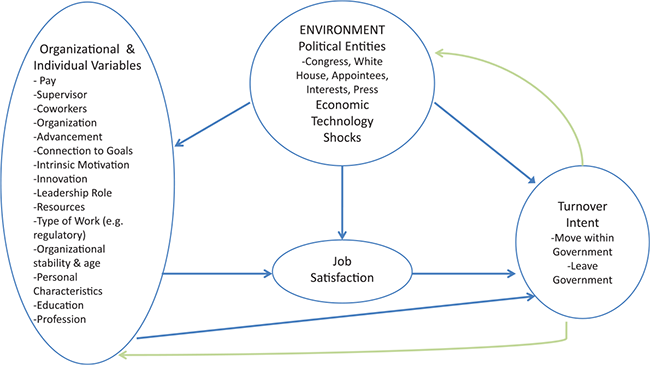
Theoretical framework.
More precisely, the environment (including political, economic, demographic, and technological components) directly influences internal organizational variables, job satisfaction, and turnover intent. In terms of organizational variables, in federal agencies, the pay structure is a product of the political world, thereby making a direct link between the political world and pay satisfaction. For example, there was a federal freeze on pay for 3 years followed by a meager 1% increase.
Interview data and research on open systems and the administrative presidency also indicate that the political world influences organization structures and resource distribution. As the political world sets an organization’s goals and mission, it also has a direct impact on people’s views of and connection to goals. Also, those in leadership roles are more likely to be in direct contact with political decisions and political entities.
The environment also affects job satisfaction by altering the stability of one’s work where people may become frustrated or burnt out when faced with surges in activity based on political priorities. It is also rare, but feasible, that the political environment can create sufficient stress that it can lead someone to want to change jobs. Finally, the model also includes feedback loops where turnover intent itself amasses enough energy to turn around and influence the environment by sending a strong message to the political world about success or failure, which then may cause actors to alter relevant organizational variables in ways to correct any deficiencies that are occurring.
This study offers this integrative model as a corrective to an oversight in most prior research on employee turnover intent. Specifically, the explicit focus of otherwise informative, important, and impressive research has been on internal organizational factors, with less attention given to the effects of external variables. At best, one can say that the external environment is implicit in the findings of prior research (e.g., “Of course we know that the internal operations of agencies are affected by external factors”). But would that answer be sufficient to public management scholars were the situation reversed—that is, if only external agency factors were considered without looking at internal factors and the causal mechanisms involved, identified, and tested empirically? And when has “implicit” ever been tolerated as a “case closed” argument in social science research? Certainly, a science of administration could never be built on such weak premises, and even a less ambitious goal of theory building related to turnover intent.
Method
Data were collected from two sets of interviews. The first was a focus group interview of 18 senior federal employees, and the second set included 17 individual interviews. Overall, interviewees currently worked in 21 different agencies, and three worked in other political roles. The agencies represent included agencies that are considered extremely liberal and extremely conservative, and more moderate agencies based on the ideological ratings collected by Clinton and Lewis in 2007. Most participants drew from their personal experience at multiple agencies and under multiple administrations. The interviews were semistructured where I asked all interviewees the same list of questions, but participants extended their responses to address additional issues. The questions are supplied in the appendix. As a protection, interviewees were asked to speak about their general impressions of working for the federal government or their agency rather than their specific jobs or experiences. However, all interviewees spoke directly about their personal experiences. Consistent with institutional review board (IRB) requirements, none of the quotes are linked to employees from specific agencies.
The focus group interview was conducted in September of 2013 with 18 members of American University’s Key Executive Program. The program is designed for high-level careerists who want to move ahead and become members of the Senior Executive Service (SES). As such, they have committed themselves to federal careers and are unlikely to want to leave government. They have also generally been with the federal government for many years. Participants came from across the federal government, and approximately half of them had worked in multiple agencies. They represented a wide variety of professional and educational backgrounds including people who worked in budget offices, information technology, scientific areas, public affairs, and public outreach and collaboration. Some had worked in the private sector before changing to public service, a few had experience working for members of Congress, and others spent their entire careers with the federal government. The group was demographically mixed with men and women, and racial and cultural diversity. The one demographic variable that was less mixed was age. Almost all participants appeared to be in their 40s and 50s. The interview took an hour and a half, 17 out of 18 of the interviewees contributed to the discussion, and the remaining interviewee listened but did not offer any comments.
In addition to the focus group interview, individual interviews were conducted with careerists at multiple federal agencies, and to gain an outside perspective, with two lobbyists and a Senate staffer with extensive experience with careerists. Interviewees were identified using a snowball approach where I networked to find people to interview and then asked interviewees to identify others who may participate. Because they were talking about their jobs and concerned about confidentiality, many people chose not to identify other people to interview. No single interviewee identified more than one additional person to interview. The interviews were conducted both in person and over the phone. None of the interviews were conducted at anyone’s place of employment.
Overall, 17 individual interviews were conducted. Fourteen were careerists from a variety of agencies including scientific and regulatory agencies, and one person in an agency that is cited by Lewis (2008) as one of the most politicized agencies in the federal government. To gain a congressional, appointee, and lobbyist perspective, I also interviewed three people with this political experience. One is a former congressional staffer who served on the Obama transition team and now works as a lobbyist. The next worked for the Senate and has also worked in a federal agency. The third has experience as an appointee, Senate staffer, and is currently a lobbyist. Two identified themselves as Democrats and one as a Republican. Including the focus group, 35 people were interviewed. While the sampling technique is not as robust as a randomized sample, the breadth of experience captured by the interviewees leads the author to be confident that the interviews represent a wide variety of perspectives and support the conclusion that the influence of the political factors on career employees warrants empirical inquiry. The comments in the focus groups and interviews are not necessarily reflective of a representative sample, but representativeness is sacrificed here for depth and nuance that provides avenues for future exploration.
Findings and Propositions for Future Research
General Environmental Influences
The systems scholarship introduced the concept that an organization’s environment permeates through the organization affecting its internal structures and operations (Burns & Stalker, 1961/1994; Hannan & Freeman, 1977). In this conceptualization, the stability or instability of the environment will filter into organizational structures and then to the experience of individual employees. Four broad environmental factors of federal agency emerged as themes in the interviews: changes in time and the economy, shocks to the overall political system, agency typologies, and surges in political attention.
Time and the economy
As political and economic environments are dynamic, careerist turnover intentions will differ from year to year, offering opportunities and constraints for turnover. A more volatile political environment inside government may drive people to want to change jobs, but recognition of a weak economy can push people to seek new jobs inside of government rather than leaving the security of the federal workplace. During interviews, many of the participants expressed a willingness to absorb increased frustrations during the recession because they were thankful to have their jobs and have security.
While not directly asked about whether time was a factor, many interviewees referenced changes over time. Some cited differences in terms of the larger political environment saying that over the last decade, increased contentiousness has led to changes within agencies such as more rigid hierarchies controlling careerist outputs, and projects being canceled (Interviews 10/16/13, 3/28/14, 4/8/14). These stories are consistent with the open systems propositions of Burns and Stalker (1961/1994) and Hannan and Freeman (1977), who posited that the stability or lack thereof of a system affects organizational form and structure.
Interviewees also acknowledged that their feelings about their jobs were influenced by the broader economic environment. When discussing the 3-year federal pay freeze followed by a 1% increase, two respondents noted that they were glad to have their federal jobs during the economic downturn, and were glad to do their part in controlling government costs by having their pay frozen. However, as time passed, they felt that continued pay freezes with increased expenses such as health insurance and cost of living made it unreasonable. One person said in reference to the political world freezing federal pay,
The only reason that I’m aware of for why they are treating us so poorly is just to make an example of us. The first couple of years, when the economy was really bad, I felt ok. There were all of these people out there in the hinterlands that were losing their jobs. So yes, I’ll do my share. But now the economy has improved, and I’m still doing my share to keep costs down, and that’s not fair. (Interview 12/23/13)
This suggests another interesting point about the influences of time. What is a tolerable frustration at one point in time (e.g., the first year of pay freezes after the economy crashed) becomes intolerable at another point in time (e.g., 3 years later as the economy stabilized). Thus, future research needs to look not only at turnover intent at one point of time but also to ascertain the cumulative effects over time.
Shocks to the environment—effects of system breakdowns, furloughs, and busted budgets
When the political world acts in a way that directly affects agencies, managers need to be ready for employee reactions in the agency as a whole and within work groups. Interviewees indicated that short-term political plays have long-term effects on employee morale and career choices. In the fall of 2013, political tensions peaked during a battle over the federal budget. The government shut down from October 1 through October 16. During this period, hundreds of thousands of federal employees were furloughed, and contractors were left without funding. Interviewees felt that the implications for morale, trust, and career decisions would be longer lasting. Some people felt that the shutdown was a direct message about their worth, expressing, “During the shutdown we were treated like a bunch of waste” (Interview 1/17/14). Others thought that it would trigger people leaving, especially people who were eligible to retire:
A lot of the people who hung on through the recession, and are feeling more secure, once we got the shutdown, they decided that they had had it. They were done. You can expect to see a rush to the door of the old civil service people. And then on the other side, some of the younger people are saying, “Whoa, what is this? Is this what I have to look forward to?” That will lead some of them to start looking. I think the shutdown and the politics have a really strong impact on people. (Interview 11/5/13)
The budget battles and shutdowns created tension within programs on multiple levels. The two that emerged most in interviews were the wastefulness and uncertainty stemming from continuing resolutions and missing budgets, and the second was the divisiveness within offices when managers had to choose who was “essential” and who was “non-essential.” The latter required some people to continue working and others to not work. As a manager, one person expressed frustration with the budget process saying,
The furloughs and the shutdown were very damaging. We all just think it is going to happen again. There is lack of trust in the process, which has been growing for years. At my level, we still don’t have our budget. It is April; it is third quarter. If you told a private sector manager, “You have to manage your program, but we have no idea what your budget is going to be, and you aren’t going to get your budget until halfway through the year, but we are holding you accountable for accomplishing goals and managing that money well,” it just wouldn’t be tolerated. But we tolerate it. That kind of thing wears on people, especially when you are in a leadership position, and you are responsible for resources and getting work done. (Interview 4/8/14)
Choosing which employees were essential and which were nonessential caused rifts within offices. Managers were often told that they could choose one or two people as essential: These people would continue to work and receive pay. Others were sent home, their emails shut down, told not to communicate with coworkers at all, and told to watch the news each night to see whether they were to return the next day, all the time uncertain if they would be paid. One person summed it up: “Up to September 30th we were working 10-hour days. On October 1st we were non-essential” (11/5/13). Another said, “We had to put together two lists: mission essential and “not.” People who were not essential were really offended thinking that others thought what they did was not important. That government shutdown had a greater effect that what I thought it was going to have on the workforce” (Interview 3/25/14). Most people who were deemed nonessential expressed frustration, saying that they wanted to work, didn’t quite know what to do with their time when they didn’t know how long they would be out for, and that it was unsettling to be completely cut off from coworkers. In another agency, the resentment went in the other direction, where people who were required to work felt that those who were nonessential got a paid 2.5-week vacation, while they held down the fort (Interview 4/1/14).
Agency typologies
J. Q. Wilson’s (1989) typology of agencies creates an interesting proposition about whether the nature of an agency’s work pushes it to act in predictable ways. When asked whether different types of agencies (e.g., regulatory) altered how agencies were treated by the political world, feedback was mixed. One person felt that political treatment of agencies was based on issues rather than agency type noting that, “Some of the agencies go along quietly, and don’t attract a lot of attention. Others have a target on them all the time.” As an example, that person said, “EPA is a scientific organization, but they aren’t treated the same way that National Institutes of Health (NIH) is as far as being on the hit list or being attacked. Politicization in agencies depends on who the politicians want to stand next to for the picture to be sent back home” (Interview, 11/5/2013).
Others felt that agency type was a relevant distinction. In discussing agency relationships with the public and the political world, an interviewee made a comment that supported J. Q. Wilson’s (1989) theory that the ability to produce outputs and outcomes defined an agency’s relationship with the political world. The interviewee said, “With governmental public health work, a lot of what we do goes unseen. You have success when something doesn’t happen. But how do you show that to people? Like when an outbreak doesn’t happen” (Interview 4/1/14). When asked about agency relationships to Congress, another respondent based the answer on agency function or type:
Regulatory agencies have no permanent allies and no permanent enemies. As long as you are not satisfying anybody, you can convince Congress that you are hitting it about right. Industry hates us and thinks we are over-regulating. Public interest groups think we are in the pocket of industry. So, we’ve hit the tone about right. In other agencies, you select the tool that you have, but the whole environment is different. (Interview 9/11/13)
Surges in political attention
Those jobs that were most directly link to mission (e.g., policy analyst) were also the most politicized jobs within agencies. When a crisis hit, or an initiative needed to get off the ground, it was these people who were on the frontline to work long hours and often quickly change course when the political winds shifted. People in supporting roles such as procurement generally had more stability in their workloads and work content. Time and again, when discussing major crises or political pushes, people discussed how careerists burnt out. Many interviewees discussed the heavy price paid by careerists under these circumstances. There is a general consensus in research that people involved in heavily politicized or “hot” issues quickly burn out (Guy, Newman, & Mastracci, 2008, on emotional labor). On discussing work on one such issue, an interviewee said,
I think it can be a huge opportunity to move forward the mission of your office. From the standpoint of your work life, it can be very taxing. I’ve watched colleagues just get burnt out and tired because it is so much responding to the political . . . and not necessarily working to improve things. It can be very, very frustrating. There are people that it burns them out, but in a way, they are sort of addicted so they just keep on, and I assume their personal life suffers. They just become disgruntled and difficult. There are other people who move on. (Interview 4/8/14)
Another interviewee who was working on such an issue said, “These have been the worst, most intense years of my career. People do feel stressed, and at a certain point it does become physical, how much can you do? How long can you keep up stressful stuff?” He continued, “Some people say, ‘I can’t stand it where I am because of all that,’ and other people are like, ‘wow, this is exciting.’ Some people start excited, and they stick with it, and eventually burn out” (Interview 4/1/14).
Another person expressed that a large political push in his agency drew mixed staff ideological support from staff, but even those who believed in the activity finished with damaged morale (Interview 3/20/14).
These moments of crisis or increased attention also prompt additional congressional attention to agencies. After the initial flurry of activity related directly to the issue at hand, attention shifts to agency performance often highlighting shortcomings in performance. An interviewee stated,
The expectation is that you are going to continue to provide a high level of continued service. This is where there is a disconnect. The expectations of the public and Congress are really high levels of service. At the same time, they are cutting the agencies. It’s hard. The agencies want to provide that, but there are certain things that we just can’t do in terms of resource limitations. But actually, disasters are good for us because Congress always comes in with a big stimulus package and we get all sorts of money. But it is a one-time shot, then it fades—memories are short. (Interview 3/25/14)
From the perspective of a Senate staffer, shortcomings in responses to crises were often an impetus for reorganizations. He discussed a part of a department that was widely thought to need work. After its perceived inability to respond to a disaster, the organization was broken into three smaller pieces (Interview 5/10/14).
Preventing burnout when the political world demands extra efforts for a priority is one of the most important challenges for upper-level managers. Managers need to think through ways to support staff when demands are excessively high to prevent long-term damage to their organizations. As such, a high level of emotional intelligence is necessary among managers, a need that agencies need to screen for and nurture within their agencies. While the stress of working on high priority issues is inevitable, managers can provide protections and breaks when they see an employee approaching burnout. As Guy et al. (2008) point out, there are also a variety of things that can be done in their HR recruitment and retention policies. These include tailoring job descriptions and reward systems in ways that incorporate and value traits associated with emotional intelligence.
Tools of the Administrative Presidency
The two sets of administrative tools identified in the administrative presidency scholarship are unilateral and contextual actions (Durant, 1998; Durant, 2009; Durant & Resh, 2011; Waterman, 2009). In interviews, the impact of contextual actions consistently emerged as a frustrating piece of working in a political environment. Among these actions were reorganization, resource controls, and the appointee use of hierarchy and bureaucratic controls.
Reorganization
Both Congress and the White House use reorganization as a political tool. Agencies must recognize that there are costs to morale and job satisfaction during these disruptions that can, in turn, lead to dissatisfaction and employee turnover. Given the political nature of reorganizations and the implications for careerists, the impacts of reorganization on turnover intent also warrant further exploration. In my interview with a careerist in a highly politicized agency, the respondent discussed how during President Obama’s first term, appointees worked on a major initiative by building a small “insiders team” where careerists were plucked out of offices and reassigned to the project. Political appointees had created an entirely new structure for the program, leaving careerists in existing offices offended and demoralized. In President Obama’s second term as efforts shifted to preserving the program from future political changes, that new office is being dismantled and distributed back into existing offices.
In discussing how the highly political nature of the program affects careerists, this interviewee said,
I’ve seen people where their program ended. There is a general feeling of disappointment, but they know they will be moved somewhere else. Maybe that is a by-product of my department being heavy on appointees—that the thing I’m working on is somewhat temporary. It only exists as long as this combination of executive leaders, the department, and Congress want it to exist. The people here see the ability of things to shift in the sand, where it is stone in other agencies.
He summed up the experience as follows: “I can understand my part in the machine, but every 4 years the entire machine can be taken apart and reorganized and suddenly, the thing that I thought I was accomplishing is totally different” (Interview 4/3/14).
Resource controls—budget and FTEs
Another way that the political environment directly influences organizations, and then individuals, is through the distribution of resources within an agency. Consistent with Mintzberg’s (1983) proposition that power is unevenly distributed within organizations and that external actors work to influence the organization, careerists described changing resource distribution within agencies based on the political preferences of the White House, appointees, and influential members of Congress. Careerists also described moving within agencies based on the availability of resources among agency programs. People are acutely aware of which parts of the agency are most powerful. Power, in turn, is largely derived from the political spectrum. Therefore, their interpretation of their position within the agency is defined by political prioritization.
Once the overall budget is set, with very few exceptions, appointees and the OMB determine the distribution of those resources within an agency. Similarly, FTE allotments are made primarily within the executive branch with congressional intervention occasionally appearing in the form of caps or specific instructions in appropriation bills and accompanying reports. A possible future measure in turnover research for agency politicization is the stability of resource distribution. Some interviewees described internal power and budgetary/FTE success as having consistent winners within the organization, and others described a shifting internal power structure that depended on the priorities of appointees and the president. One person described the internal distribution of resources as follows:
It changes over time depending on what the current priorities are, or based on what is happening in the public health, or based on the director’s priorities. For a while those can be the favorite children in terms of resources and it also creates lots of demands. You hear of people that are working in those offices that are getting lots of attention. They are working day and night, and people expect them to respond to emails at 10, 11, 12 at night. So, in some ways it is better to not be on one of those topics, because of your work life balance. On the flip side, if you are not one of those priorities, you are not going to get resources, particularly in this age of tight budgets. (Interview 4/1/14)
Those with greater leadership responsibilities may be more likely to want to change jobs because managers consider themselves the buffer between careerists and the political world and work to insulate their staff from the push and pull of political demands. In doing so, they absorb the stress of the political environment to protect their staff. This strain is further complicated when staffing is limited and FTE counts are stagnant. This is a direct influence from the political world as OMB and agency heads set these numbers. Many people reported frustration with having the money to hire people but not the FTE allotment. Interviewees had mixed impressions of whether they could hire the right new people and whether they could refill positions when people left. One person reported that his office hired about one person for every three that retired (Interview 4/3/14). Another said that because of so many applicants with veteran’s preference, when he tried to hire a contractor who had been working for his office for 5 years, the contractor did not make the list of people to interview (Interview 3/25/14). In general, managers reported that navigating the byzantine personnel hiring process was an art form in itself that took time and practice to master.
Appointees and bureaucratic hierarchy as control
Through the course of the interviews, and as the scholarship on the administrative presidency and political appointee–careerist relations illustrates, it became clear that different administrations use bureaucratic processes as a method of control. Creating strict hierarchical chains for any communications between agencies and Congress limited the information that congressional staff had to work with and assured that any messages sent from the agencies were consistent with administration positions. Interviewees considered the tightening of bureaucratic controls as a function of both management styles and a contentious political environment consistent with the open systems scholarship (Burns & Stalker, 1961/1994; Hannan & Freeman, 1977) and with the administrative presidency scholarship on presidential tools for control (Durant, 1992; Durant & Resh, 2011).
For instance, for every communication between Congress and agencies, staffers needed to send a letter through a member that was then sent through the agency down to the correct careerist. That careerist would then have to send their response through multiple layers within the agency before it could make it back to Congress (Interviews 10/16/13, 5/10/14, and 5/28/14). Both Senate staffers and careerists expressed frustration over the use of bureaucratic controls and said that it did differ from one administration to the next. A Senate staffer who worked for Democrats explained,
When it was the Clinton administration, apparently, the White House was a free-for-all and you could talk to anybody. It wasn’t directly an open door, but you could talk to the people you needed to talk to. When Bush/Cheney came in, it was like slamming the door shut. There were probably directives put out that said “Do not ever talk to congressional staffers or you will lose your jobs.” They cut everything off. We thought that the Obama administration would loosen up a bit and have more information sharing and open door policy. It hasn’t been that way. (Interview 5/10/14)
Similarly, an interviewee who had worked for Republican members expressed the same frustrations. He found that in moving from the Clinton administration to the Bush administration, Republicans thought that they would have better access to the agencies and were surprised when they faced strict bureaucratic controls (Interview 5/29/14).
Careerists found these controls to be a frustration and a distraction from their work. Some even thought that it was a reason that people changed jobs. One described the process of getting reports out of her former agency as a “happy to glad syndrome.” She explained,
So you’d write up your interview and everywhere you had “happy,” they’d say “Change it to glad.” You’d change it and it would go to the next level where they would say, “Everywhere you had glad, lets change it to happy.” And it would go back and forth that way endlessly. That down time where you are sitting waiting for people to review it and you are fidgeting with it, that is a very hard period for these young, energetic people who are used to saying “let me go attack this and get it done.” I think that the bureaucracy can really wear you. (Interview 11/5/13)
Another careerist felt that the Obama administration used bureaucratic controls more than she had seen in the past:
If there is leadership that is more relaxed, and doesn’t like bureaucracy, it is different than when someone likes bureaucracy. You know, get this signature and that signature and the other signature. It is like that now and it never was before. Now they are very cautious about following the politically correct policies. There is a lot of bureaucracy. My memos need to undergo a chain of command. That adds a lot of burden and time. (Interview 10/16/13)
As careerists cited excessive bureaucracy as a reason to change jobs, it is important to pursue further research on how political efforts to control create the hierarchical structures that so frustrate careerists. Thus, the impact of hierarchy on turnover intent decisions seems another profitable area to explore in future research.
The Appointee–Careerist Nexus
Interviews indicated that careerists try to shelter themselves from the political world. As a protective measure, careerists temper their responsiveness to the White House, appointees, and Congress. Heclo’s (1977) observation nearly four decades ago still appears valid. Careerists realize that as appointees and administrations change, they need to be careful to not align themselves too firmly with a policy or project that has too much political attention. One interviewee said,
We have to be supportive of the president and the White House, but at the same time, we can get into trouble, and it may be more difficult to do our mission if we are seen to align too closely with a particular administration. (Interview 4/8/14)
Another staffer on the Hill said,
I think sometimes depending on who is in office, especially if it is divided, there might be trepidation for career people to be helpful, because they might see it as someone trying to undermine them or take their money away. There is probably skepticism about the politics, but I think that careerists are not targeted. (Interview 5/10/14)
However, there are cases where careerists are targeted, as was the case at the Food and Drug Administration when careerist emails and correspondences were secretly reviewed by appointees (Lichtblau & Scott, 2012). Some interviewees said that an important component of career success was the ability to stay politically neutral. One such respondent said,
There is a core there that has stayed politically agnostic in the way that they do their jobs. I can guess what party they are in, but they leave it at home. Those who have a stronger identification feel it more when the administration changes. (Interview 4/3/14)
Another explained,
What we tend to see is that we see turnover at the GS and SES level where certain people made it well known where their political alignments were. Those who didn’t make their alignments known moved to the top. And for those who did make their alignments known, a memo comes out that they are going to be spending more time with their family. That was very common in our agency, so I think people, even at the lower GS levels, all are aware of the dynamics at the change of an administration. (Interview 9/11/13)
While some had identified a need to appear politically neutral as a defense against the political world, others made a conscious decision to stonewall efforts by appointees or do as they are asked with the least possible effort, seeing appointee requests as an absurdity given that they would leave quickly, and any of their efforts would be undone by the next appointee. On responding to appointees, a careerist summed it up:
I think we all sit down and say, ok what is the flavor of the week? The political appointees come in and want to move the north–south walls east–west and then they leave. Then the next ones come in and say they want the east–west walls to be north–south. We say, “We’ve seen it and it didn’t work, but fine.” We do it. (Interview 11/5/13)
Future research begs for answers to the question of how these zigs-and-zags, as well as the philosophy of careerists in reacting to them, might be linked to turnover intent. For practice, it seems useful to assess the philosophy of careerists periodically as a manager to ensure that they are not a source of frustration and to develop strategies for coping with them.
Another question is how general bureaucrat-bashing taints the working relationship between appointees and careerists. Interviewees repeatedly remarked that a lot of bureaucrat bashing by elected officials was warranted for other agencies or the government at large, but that their agency was different. It appeared that people created a psychological defense against the system-wide attacks by differentiating between their work and general government work. However, a lack of pay raises made the issue of being undervalued personal. Most interviewees voiced frustration over the message being sent to them about their value from 3 years of pay freezes followed by a 1% increase, and a freeze on bonuses. In the words of one respondent,
It is disrespect. They are saying you don’t value me. It is a feeling of not being respected and valued among people I see. If you are getting enough strokes from what you are doing, that may work like discovering a polio vaccine, but most federal employees do not have that. Even little pay raises were a pat on the back. Now they have taken bonuses away. You don’t have a pay raise, you don’t have a bonus, you don’t get a step increase. (Interview 11/5/13)
Another person described the pay freeze as “demoralizing” (Interview 12/23/13), and yet another felt that while she gave bonuses averaging 1% to her group, the small amounts of the bonuses after taxes actually made them insulting (Interview 4/8/14).
Merged into people’s concepts of pay were concepts of fairness and transparency. While most felt that pay freezes were unfair, others thought that as long as everyone was treated the same, it was acceptable. One person did not think that pay would be an issue, given that pay scales are public, people know how it works when they enter government, and that it was clear what one needed to do to move ahead (Interview 3/20/14). Thus, we need to unpack how bureaucrat bashing is operationalized to fully understand it’s impact. Where words by elected officials are dismissed as rhetoric or fair in the general sense, tangible punishments such as pay freezes and RIFs may be more salient.
Final Observations
What becomes clear through the course of this research is that much of the tension between the political world and careerists is the result of different time horizons, a factor well known in presidency research (Pfiffner, 1996). Careerists are distance runners who need to preserve themselves for long federal careers. They are negotiating a system that tightly controls their communications and threatens to affect them when the political winds change. Political appointees are sprinters who need to move quickly in mad dashes when windows of opportunity arise. While careerists want to support the political world and provide institutional and policy knowledge, they are constrained by agency structures put in place to control communications and the need to pace themselves as they have watched peers burn out after participating in large political pushes. As one executive explained,
If the Secretary and all the political swirl is at the center, how far away from that is far enough not to get burnt out in all of the chaos, sucked out into all of the chaos, but not so far out that they forget about you and you are suddenly totally disconnected or defunded? (Interview 4/3/14)
The political world also alters agency structures and power distribution affecting all employees including those who do not work directly on overtly politicized issues.
With this in mind, these findings offer numerous avenues for future research linking the political world to the lives and career choices of careerists. An emerging theme from this study is that the impact of the political environment on careerists is partially about ideological conflicts but more about the stability or instability of organizations. Therefore, my next step in this research is to construct measures of the volatility of agency environments. For example, agencies that experience large budget changes from year-to-year face different challenges than those with steady funding streams. These new measures can be paired with currently used concepts of politicization such as numbers of appointees, and existing data sets including FedScope and the Federal Viewpoint survey to quantitatively identify how agency environment filters into the experience and choices of careerists. This approach also allows for inclusion of a systems perspective that looks holistically at political environments to include measures of attention from the president, appointees, and Congress as proposed in the theoretical framework presented here. If, as posited in this study, the political environment of an agency influences careerists, excluding this consideration and focusing only on what happens inside the walls of an organization means that our view of federal service is overly simplistic and, thus, risks failing to adequately prepare people with the political and coping skills necessary to navigate the challenges of public service. Such a focus is important, timely, and long overdue in the public management scholarship on turnover intent.
Footnotes
Appendix
Declaration of Conflicting Interests
The author(s) declared no potential conflicts of interest with respect to the research, authorship, and/or publication of this article.
Funding
The author(s) received no financial support for the research, authorship, and/or publication of this article.