







Abstract
Scholars in public administration now recognize three levels of analysis: macro, meso, and micro. But there is uncertainty about the relationship between levels and concern about a “schism” in research. However, linkages between levels can be demonstrated easily. At the macro-level, leaders develop an overall strategy for pursuing national priorities, which determines the broad architecture of the state. Institutions must be built, renovated, or managed to give effect to these strategies: This is the meso-level of public administration. Overall, strategies also shape the micro-level relationship between people who rule and people who are ruled. This is done by categorizing people—as subjects or citizens, for example—and by redefining categories. Macro-level strategies evolve, with consequences for the agenda at the meso- and micro-levels. Experience at lower levels also shapes strategy at the macro-level. The interaction among levels is illustrated by comparison of three eras in modern American history.
A Schism Ahead?
Many scholarly fields recognize that research must be undertaken at different levels of analysis. Economists examine bigger questions about the national economy (macroeconomics) and smaller questions about individuals, households, and firms (microeconomics) (Stock, 2013, pp. 4-5). Political scientists pursue high-level research on political regimes and low-level research on the political activity of individuals (Landman & Carvalho, 2016, pp. 24-25), whereas scholars in management studies undertake macro-level research on business policy and strategy as well as micro-level research on group behavior (Aguinis, Boyd, Pierce, & Short, 2011, p. 396). There is general recognition that a healthy field is one in which all levels are given attention.
American public administration lacks such “level diversity.” In recent decades, the field has been mainly occupied with the middle level of government: that is, the problems of managers in public agencies who are responsible for executing policies authorized by political overseers (Frederickson, Smith, Larimer, & Licari, 2012, p. 100). Early advocates of this “public management approach” questioned the usefulness of earlier “macro-level” work on the architecture of the state and design of administrative systems (Elmore, 1986, pp. 70-72; Stokes, 1986, p. 46). They also declined to focus more narrowly, neglecting research about the psychology of interactions at the individual level between officials and ordinary people (Grimmelikhuijsen, Jilke, Olsen, & Tummers, 2017; A. L. Olsen, 2015, p. 47).
Recently, public administration scholars have argued for more level diversity. Some have proposed an approach known as behavioral public administration (BPA), with a “micro-level focus” on the behavior and attitudes of citizens, employees, and managers within the public sector (Grimmelikhuijsen et al., 2017, p. 46; Tummers, Olsen, Jilke, & Grimmelikhuijsen, 2016, p. 1). Others have called for a “macro-level” approach to public administration, focused on “big questions” about how the state evolves in response to changing circumstances (Durant & Rosenbloom, 2016; Milward et al., 2016; Peters & Pierre, 2016b, p. 11; Pollitt & Bouckaert, 2017, pp. 223-225).
Recognition of multiple levels opens exciting opportunities for research. But it also raises a question: how are levels connected with one another, if at all? One concern is that there could be a “great schism” in public administration, in which researchers working at different levels go their own way—working with incompatible theories and methods (Moynihan, 2018). Similar concerns have been voiced in other fields (Aguinis et al., 2011; Skott, 2014). The remedy is a deliberate effort to explore possible connections between levels of analysis. If a schism in public administration is to be avoided, “bridging” work is necessary to show how levels of analysis relate to one another (Moynihan, 2018, p. 4).
This article illustrates how bridging might be done. The purpose is not to settle definitively how research at each level should be conducted, or to identify all the ways in which work at different levels might be connected. Rather, the aim is to make a prima facie case that there are linkages between levels, and that the exploration of such linkages may itself be an important avenue of research. A dynamic interaction between levels is proposed. In one sense, the concerns of practitioners and scholars at lower levels of administration are constrained by high-level choices about governmental priorities and lines of policy. From this point of view, the meso- and micro-levels of administration are nested within the macro-level. But there is a reciprocal effect as well. Learning and contestation at lower levels also informs high-level choices about priorities and policies.
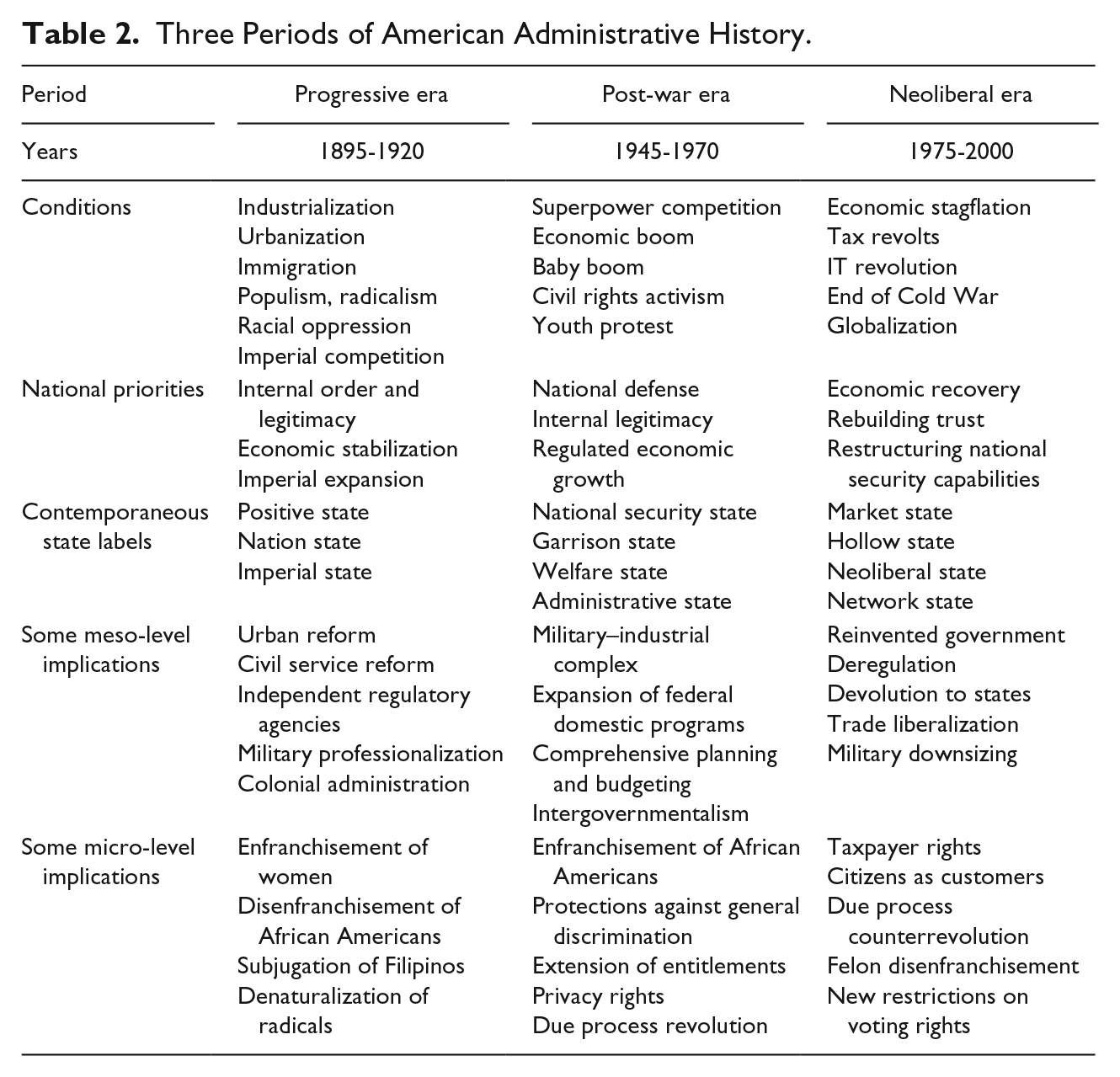
This reciprocal connection between levels can be illustrated by examining American administrative history. 1 During three periods—the Progressive era (1895-1920), the post-war era (1945-1970), and the neoliberal era (1975-2000)—national leaders pursued distinct priorities and policies. These high-level strategic choices guided the meso-level project of administrative reform, as well as micro-level understandings about the relationship between officials and ordinary people. But the process of institutional reform, as well as the work of negotiating relationships at the street-level, also generated knowledge that contributed to the adjustment of high-level strategies.
Defining Levels of Analysis
Before we can consider how levels of analysis are connected with one another, we must define what the levels are. This is a challenge for two reasons. The first is that the field has given inadequate attention to the question of how levels should be defined; more work on clarifying these concepts is necessary. The second is that no single framework for defining levels can ever win universal acceptance: Because such frameworks involve judgments about values, they are essentially contested concepts (Gallie, 1955). The aim here is limited: to propose a framework (Table 1) that is plausible, and then to use that framework for the purpose of demonstrating that it is possible to connect levels. There are certain to be other frameworks and ways of connecting levels.
Levels of Analysis in Public Administration.

The proposed approach to macro-level analysis focuses on “strategies for governing”—that is, the overall strategies crafted by national leaders that identify priorities and broad policies to achieve those priorities (Roberts, 2020). This macro-level approach treats the state as the “basic building block” of political order in the modern world (Painter & Jeffrey, 2009, p. 20; Peters & Pierre, 2016a). There are roughly 195 states, each constituted by an institutional apparatus that performs critical functions (Finer, 1997; Jessop, 2016; Mann, 1988, p. 49; Skocpol, 1979, p. 29). At the apex of this institutional apparatus are leaders who have particular influence over the exercise of state authority (Allen, 2018, Chapter 1; Laski, 1919, p. 27; Mills, 1999, p. 4; Skocpol, 1979, p. 29).
These leaders typically have well-developed ideas about how to govern their state (Robinson & Gallagher, 1961, p. 20; Tucker, 1971, p. ix). They are concerned with a bounded set of goals (Ghani & Lockhart, 2008; Merriam, 1944, Chapter 7; White, 1939, p. 7). At minimum, they must maintain effective control over territory and resist attacks from other states (Crawford, 2006, p. 58). Leaders also want to establish legitimacy in the eyes of the governed population and the leaders of other states (Gilley, 2009). They will also be concerned with economic growth and perhaps also with the advancement of human rights. And they worry about their own survival in office (Bueno de Mesquita, 2003).
Judgments about the relative importance of these goals are shaped by leaders’ perception of circumstances at a particular moment in history. Many “environmental factors”—demography, geography, climate, economic structure, the state of technology, the structure of geopolitics—influence their judgments about priorities (Gaus, 1947, Chapter 1; Pollitt & Bouckaert, 2017, Chapter 8). Leaders also make judgments about policies that are most likely to accomplish their priorities. This bundle of priorities and policies can be called a “strategy for governing” (Roberts, 2020). 2 Many of the labels that we use to describe the agendas of specific leaders—Trumpism, Putinism, Xi Jinping Thought, Reaganism, New Dealism, and so on—refer to strategies for governing. Such strategies are diverse and fragile. Leaders have different values, face different circumstances, and reach different conclusions about the best way of pursuing priorities under uncertain conditions. National strategies also vary over time because of changes in leadership and conditions.
Leaders put strategies into effect by renovating the institutional apparatus that constitutes the state. 3 This work of renovation—dismantling obsolete capabilities, building new capabilities, shifting agency operations to emphasize different values—constitutes the meso-level of public administration. In other words, work at the meso-level is directly influenced by leaders’ overall strategy: There is an immediate connection between “regime-level politics” and projects of administrative reform (P. E. Arnold, 1995, p. 416). High-level political concerns can even shape the details of institutional design and administrative practice (Lewis, 2008; McCubbins, Noll, & Weingast, 1989; Moe, 1989, p. 267). Because strategies are fragile, institutional renovations are never finished; every state is subject to “continuing processes of transformation” (Schon, 1973, p. 30). Similarly, administrative reform priorities change as overall strategies change. There are “tides of administrative reform” that reflect the preoccupations of the moment (Light, 2006, pp. 11-13).
Macro-level strategy also shapes micro-level relationships between officials within the state apparatus and people outside of it. To see how this is so, consider how the scope of micro-level BPA research is presently defined: as the study of behavior and attitudes of “citizens, employees and managers within the public sector” (A. L. Olsen, Tummers, Grimmelikhuijsen, & Jilke, 2018, p. 1121). The labels employed in this definition—citizens, employees, managers—may seem self-evident, but they are not. They are socially constructed roles: that is, ideas about the way that people should behave and relate to one another (Frederickson et al., 2012, pp. 9-10; Giddens, 2018, pp. 6-7). Moreover, these roles vary substantially over place and time.
Consider the variety of labels that have been used to describe people who are ruled. In the past, millions of people living on American territory were counted as subjects rather than citizens: They were required to obey American law but had limited rights against the government. Millions were not counted as people at all: They were treated as “articles of merchandise” (Dred Scott v. Sanford, 60 US 393 (1857)). Moreover, the meaning of citizenship itself has varied dramatically over time, becoming thicker—that is, with more rights attached to it—and sometimes thinner (F. Cooper, 2018, p. 25).
Even today, people can be categorized in many ways. Millions of people living in the United States are not American citizens. They are lawful permanent residents, tourists, temporary workers, refugees, or foreigners living in the United States without authorization. Moreover, not all citizens within the United States are the same. Children and felons have restricted rights, even though they are citizens. Citizens of Massachusetts have different rights than those of Alabama. In practice, citizenship is thinner for poor African Americans than it is for wealthy White Americans. Some people argue that fetuses are citizens, whereas others deny they are persons at all (Schroedel, 2000, pp. 3-8).
We can make similar observations about the labels that we use to describe public officials. The people we call “managers” today have been called by many other names in the past. Fifty years ago, senior officials were more likely to be called administrators. A century ago, they were likely to be called clerks, even in top-level positions. Administrators and clerks had different ideas about their duties, and specifically about their obligations to the governed, than do managers today.
This raises the question of how particular labels come to be applied at a moment of time. This question cannot be answered without considering the priorities and policies of national leaders: that is, macro-level strategy. Leaders make strategic choices that result in the recategorization of people. By pursuing territorial expansion, for example, American leaders have converted aliens to subjects. Leaders have also chosen for strategic reasons to reclassify subjects as citizens—as happened after the passage of the Fourteenth Amendment in 1868 and the Indian Citizenship Act in 1924. Considerations of overall strategy have also induced leaders to thicken citizenship—for example, by expanding the right to vote (F. Cooper, 2018, p. 25). There can be reversals in status as well. In the 1990s, leaders adopted felon disenfranchisement laws that made citizenship thinner for some people (Manza & Uggen, 2006). Citizenship can also be removed entirely, as it was for some radical immigrants after World War I (Weil, 2013, pp. 55-82). Security concerns have also led to the removal of rights for noncitizens, such as the “enemy combatants” held at Guantanamo after 2001 (Sands, 2005, Chapter 7).
So far, we have emphasized the ways in which macro-level strategy influences meso-level reforms as well as micro-level interactions between officials and the governed. Influence may go the other way as well. Leaders engage in policy learning: They look at the results of administrative reform and reassess their decisions about priorities and the broad lines of policy (Bennett & Howlett, 1992). Micro-level interactions can also generate feedback effects. People may object to the roles which they have been assigned and refuse to behave as required. Foreigners might engage in activities that are proscribed by law; subjects might demand to be reclassified as citizens; and citizens might refuse to comply with unjust or discriminatory laws (Perry, 2013). Leaders may decide that is it infeasible or imprudent to stop this sort of behavior and respond instead by assigning new roles (e.g., granting citizenship) or by redefining rights within any particular role (such as allowing undocumented aliens to acquire driver’s licenses). Alternately, administrators might realize that an effort to restrict roles—to make citizenship thinner or remove it entirely—is easier than initially expected. This experience might encourage further repression, as happened to African Americans after Reconstruction (Franklin & Higginbotham, 2011, pp. 260-286).
The interaction between the three levels of public administration may be understood by looking at historical examples. The following three sections look briefly at three periods of history: the Progressive era (1890-1910), the post-war era (1945-1975), and the neoliberal era (1980-2008). Leaders in each era followed a distinctive strategy for governing. As a result, the substance of meso-level administrative reform also shifted from one era to the next. Strategic shifts also led to the recategorization of people as well, with consequences for micro-level interactions. In each period, experience at the meso- and micro-levels also had feedback effects on macro-level decisions in later years. A summary is provided in Table 2.
Three Periods of American Administrative History.
The Progressive Era
In the Progressive era, the United States was convulsed by economic and social change (Box, 2018, pp. 34-55; Wiebe, 1980, pp. 11-43). The country experienced an intense phase of laissez-faire capitalist industrialization. The economy was prone to cycles of boom and bust, labor–management conflicts, and exploitation by monopolies in key sectors such as railroads and steel. Cities grew rapidly, exceeding their capacity to provide basic services. Immigration from Central and Eastern Europe boomed. Many Americans felt that life within the United States was spiraling out of control. They worried about the collapse of old ways of life, rising inequality, the capture of government by corporate interests, and the threat to “American ideals” from immigration.
Conditions in the realm of foreign affairs seemed simpler (Nugent, 2008, pp. 237-304; Wiebe, 1980, pp. 224-255). There was no direct threat to the United States from abroad. However, this was a period of intensified competition among European colonial powers. American leaders wanted to resist European incursions into the Western hemisphere; many also wanted to join in the imperial competition by acquiring their own colonies and gaining access to markets in Asia.
Macro-Level Strategy
The Progressive era was marked by controversy over the appropriate response to these conditions. Still, a rough consensus on strategy had emerged by the 1910s. The top priority was the restoration of social and economic order and recovery of popular control over domestic affairs (Wiebe, 1980). Order would be restored by building new administrative capabilities, whereas popular control would be restored by reform of legislatures and electoral processes (Skowronek, 1982). In the field of foreign affairs, meanwhile, the nation experimented with imperialism. After the Spanish–American war of 1898, the United States acquired the territories of Guam, Puerto Rico, and the Philippines. It also annexed Hawaii and staged military interventions in Cuba, the Dominican Republic, Haiti, Mexico, Nicaragua, and Panama (Nugent, 2008, pp. 295-299).
The Meso-Level Agenda
It was universally understood that this governance strategy required an overhaul of institutions that had been designed for a simpler time (Croly, 1914, p. 24). Indeed, the first steps toward the field of public administration were taken as part of this drive to adopt “new measures . . . [for] new conditions” (Goodnow, 1900, pp. 261). Much of this reform took place within local government. Local governments were ill-equipped to deal with growth and immigration: Corruption was rampant, and there was little capacity for planning and implementation of policy. Reformers sought to concentrate authority in the hands of professional city-managers and build the capacity to provide basic services (Teaford, 2016, p. 41). Civil service commissions were created to stop patronage, expose corruption, and improve efficiency (Tolbert & Zucker, 1983). Election administration was also professionalized, to break the power of political machines (Ruppenthal, 1906).
There was federal reform as well, much of it concerned with controlling corporate power. Congress established an independent body, the Interstate Commerce Commission, to regulate railroads. Another independent agency, the Federal Trade Commission, was set up to control private monopolies like the Standard Oil Trust, while one third—the Federal Reserve—was intended to “break the despotism of the great banks” (Springfield (MA) Daily News, 1913). The federal government also strengthened its Civil Service Commission so that more positions were governed by the merit principle (Stahl & Mosher, 1956, pp. 25-26).
There was institution-building in the field of foreign affairs too. Problems of maladministration during the Spanish–American War led to restructuring of the military departments of government. A general staff was created to improve planning and coordination within the War Department, which also gained new powers over state militias (J. M. Cooper, 1997, pp. 153-172; Skowronek, 1982, pp. 212-247). The United States was reconceived as an imperial power as a result of the war (Snow, 1902, p. 577). More than 100,000 American soldiers were sent to fight Filipino rebels between 1899 and 1901 (J. R. Arnold, 2011). The Bureau of Insular Affairs was established within the War Department to oversee administration of the new dependencies. American authorities launched broad projects of social reform in the colonies, whereas American universities launched programs for the “scientific study of colonial administration” (Blount, 1913; Ng, 1975, pp. 88-143).
Micro-Level Relationships
Macro-level decisions about strategy also led to an overhaul of understandings about micro-level relationships between rulers and the ruled. This was not a straightforward transformation. Understandings about roles varied substantially between contexts. Sometimes the aim was to thicken citizenship, but in other instances, the aim was the consolidation of social and racial hierarchy, as well as the authority of a new class of experts.
Reformers acknowledged that they were redesigning micro-level relationships. Proponents of civil service reform said that they wanted to adjust “the allegiance of the public servant” by breaking loyalties to party machines (Stahl & Mosher, 1956, p. 6). But the new obligations of public servants were not toward citizens directly: rather, they were obligations toward the state (Stahl & Mosher, 1956, pp. 6, 275). The duty of the civil servant was to “execute the will of the state” as expressed through law (Ford, 1900, p. 183; Freund, 1894, p. 409; Goodnow, 1900, pp. 9, 16, 95). This implied that officials should maintain a certain distance from the public. Officials were expected make independent judgments about how law should be interpreted and applied in particular cases (Bowman, 1906, pp. 612, 620, 623; Sharfman, 1937, p. 949).
Municipal reformers sometimes maintained a certain distance from the public as well. Some were paternalists, whose aim was to do what they thought best for the urban poor, especially for new immigrants. For these reformers, clients were treated as eventual equals: First, they had to be imbued with middle-class values and made into “real Americans” (Davis & Schwartz, 1920, p. 721; Teaford, 2016, pp. 32-33).
Administrative reforms also reflected an ambivalence about popular empowerment. Municipal reform emphasized “centralized executive decisionmaking” by professionals rather than direct control of administration by politicians or voters (Box, 2018, p. 49). Within organizations, power shifted upward from workers to supervisors. The premise of the “scientific management” movement was that “all possible brain work should be removed” from the frontlines of the workplace; managers would “assume . . . the burden of gathering together all of the traditional knowledge which in the past has been possessed by the workmen” (Ashley, 1922, p. 19; Gilbreth, 1912, pp. 34, 41, 54).
Elsewhere, the division between rulers and ruled was more rigid. The 10 million people who lived in American dependencies were merely subjects with limited rights against the state (Edmunds, 1901). Within the continental United States, citizenship meant different things for different people. White women were counted as citizens but denied the right to vote. African Americans were treated worse: The Supreme Court affirmed the legality of racial segregation (Plessy v. Ferguson, 163 US 537 (1896)) and President Wilson tolerated the introduction of “outright segregation” within federal government (Sosna, 1970, p. 31).
Feedback Effects
Leaders observed the effects of their strategic decisions at the meso- and micro-levels of administration and sometimes learned from them. We can briefly note some of the ways in which this was true. Broadly, the improvements in social and economic conditions that resulted from state action in the Progressive era encouraged further efforts at state-building in later decades (White, 1926, pp. 8, 463-465). (So did the experience of wartime mobilization.) One exception might be the experiment with imperialism, which proved costly and contentious and which was slowly abandoned after 1920. By contrast, policies that targeted immigrant groups proved politically popular and led to more restrictive measures in the 1920s (Fairchild, 1924). Efforts to constrain the citizenship rights of White women were much more contentious and ultimately abandoned in 1920. African Americans also mobilized more effectively to resist their categorization as “second-class citizens,” although leaders would not abandon these policies for another generation (Franklin & Higginbotham, 2011, pp. 351-379).
The Post-War Era, 1945-1970
Conditions in the quarter-century following World War II were markedly different than in the Progressive era. Fears about external threats dominated this period. The safety that Americans felt because of geographic separation was shattered after the Soviet Union acquired nuclear weapons and long-range bombers. The post-war era was dominated by geopolitical struggle as each “superpower” attempted to check the expansion of its rival (Gaddis, 2007, Chapter 1). However, fears about economic instability and inequality receded. By the late 1940s, American policymakers had developed a system to measure and regulate the performance of the economy (Council of Economic Advisers, 1947). It was believed that careful macroeconomic management would eliminate the cycle of boom and bust (Heller, 1966). The United States experienced a long period of economic growth after World War II that caused a substantial decline in inequality (Piketty, 2014, Figure 9.2).
Still, concern about social order and legitimacy increased throughout this era. The movement against segregation and disenfranchisement of African Americans gained momentum (Branch, 1988). By the early 1960s, racial tensions contributed to rioting in major cities (National Advisory Commission on Civil Disorders, 1968, pp. 203-206). The post-war baby boom also led to the expansion of the college campuses, which became seedbeds for social protest in the 1960s (Owram, 1996, pp. 185-237). A more affluent and better-educated population demanded new rights, more government services, and new forms of social and environmental regulation (Huntington, 1975).
Strategy
The main priority of American leaders in the post-war era was national security—specifically, defense against threats from the Soviet Union and its satellites. The main lines of national security policy were deterrence, through the buildup of nuclear and conventional forces; the development of anti-Soviet alliances; and resistance against the expansion of Soviet influence through covert, diplomatic, and military action.
At home, American leaders aimed for stable growth by promoting a system of managed capitalism. International trade and investment were more carefully controlled, whereas key industries were more tightly regulated. Policymakers actively used government spending, taxing, and interest rates as instruments for influencing the economy (Yergin & Stanislaw, 1998, Chapter 2). At the same time, national leaders sought to bolster internal order and legitimacy, largely by expanding government services and entitlements to create an American version of the welfare state and by thickening the concept of citizenship for some groups.
Meso-Level Reforms
The post-war shift in overall strategy led to a massive project of institutional renovation. One result was the apparatus that came to be known as the national security state or the military–industrial complex (Hogan, 1998; Hooks, 1991). Between 1948 and 1970, defense spending accounted for most of the federal budget, and millions of people were employed in the armed services as well as the civilian agencies and contractors that supported the military. Specialists in public administration dealt with immense challenges relating to military reorganization, coordination, and civilian control (G. C. Lee, 1949). The Department of Defense was created, along with the Department of the Air Force, the Central Intelligence Agency, and the National Security Council.
Specialists in public administration also laid the foundations for an expanding welfare state. This included an enlarged Social Security system, as well as new health insurance programs for aged and poor, income support programs, and programs to support education, public housing, and urban redevelopment (Trattner, 1999, Chapter 14; Zelizer, 2015, pp. 319-323). At the same time, the federal government also created new institutions to protect civil and political rights—such as the Civil Rights Division within the Justice Department and the Equal Employment Opportunity Commission (Lichtman, 1969; University of Chicago Law Review, 1965). The cumulative result of these initiatives was a “massive federal intervention” in state and local affairs, supported by elaborate apparatus to manage intergovernmental relations (Sundquist & Davis, 1970, p. 625).
The post-war expansion of governmental functions also led to a new concern for top-level policymaking and control. Executive staff became bigger and more attention was given to processes for rational decision-making (Hammond, 1968). Public administration specialists designed systems for comprehensive planning and budgeting (Carey, 1961; Greenhouse, 1966). Chief executives were also expected to shoulder responsibility for bureaucratic reorganizations, and public administration specialists supported this task as well (P. E. Arnold, 1998, Chapter 8; M. Lee, 2010, Chapter 1).
Micro-Level Relationships
Post-war shifts in overall strategy also had critical effects on the relationship between rulers and the ruled within the United States. Again, these micro-level shifts were complex and sometimes contradictory.
It is often said that the United States experienced a “rights revolution” in this era (Dodd, 2018, p. 2). For example, many African Americans gained the right to vote and equal access to public services. Women received legal protection against discrimination in employment, education and housing, the right of access to contraceptives and abortions, and more equal standing in family law (Rosen, 2000). The voting age was lowered from 21 to 18 years in an effort to staunch youth radicalism (Blumenthal, 2018, p. 68).
Shifts in constitutional law also strengthened citizens’ claims on the state. Until the 1960s, most benefits conferred by government were considered to be privileges, which could be removed at the discretion of government. After the 1960s, these benefits were defined as forms of property that could not be withdrawn without due process (Reich, 1964). At the same time, courts recognized a constitutional right to privacy and reformed administrative law to assure a larger public role in policymaking (Stewart, 1975). Contemporaneous with these legal shifts was a change in political culture. Many Americans expected more of their government (Wildavsky, 1973).
However, the post-war era was not entirely concerned with popular empowerment. There were trends in the other direction too. The principle of technocratism—rule by experts—continued to influence many aspects of foreign and domestic policymaking (Straussman, 1978). The expansion of the national security state also led to an increase in citizens’ obligations toward government. More than 5 million men were conscripted for military services between 1950 and 1970. 4 Millions more were subjected to intrusive “loyalty investigations”—probing political beliefs and sexual orientation—as a condition of employment (Garrison, 1955; Johnson, 2004; Thurman, 1985, p. 2). The rising cost of national defense transformed most adult Americans into federal taxpayers. 5
Feedback Effects
Once again, leaders and members of the public learned from the experience of the post-war era. Significant failures in foreign and domestic policy eventually resulted in a more cautious view about the potentialities of government action and about the feasibility of comprehensive social and economic planning. There was also a reaction against the concentration of executive power in federal government (Schlesinger, 1973). Many Americans balked at the mounting cost of government, whereas conservatives worried about persistent social instability, which they attributed to the “democratic surge” of the 1960s (Huntington, 1975, p. 10). Macro-level strategy would evolve in following years in response to these concerns.
The Neoliberal Era, 1975-2000
Conditions facing American policymakers changed again between 1975 and 2000. Threats to national security eventually faded. Superpower competition ended in 1991 after the collapse of the Soviet Union (Gaddis, 2007, Chapters 6 and 7). However, worries about economic performance increased substantially. The long post-war boom ended: The 1970s were marked by slow growth, high inflation, and persistent budget deficits at the federal level. People became conscious of economic competition from Japan in the 1970s and 1980s, and China after the 1990s (Borstelmann, 2012, Chapter 1).
American government also faced a serious erosion of legitimacy after 1970. Trust in the military slumped because of apparent failure during the Vietnam War, revelations about misconduct during that war, and public resistance to conscription (King & Karabell, 2003, Chapter 1). There was a simultaneous decline in overall trust in government. Many people believed that policymakers had lost control over the economy and society, and even government itself. Federal spending exceeded one fifth of gross domestic product (GDP) for the first time in peacetime in 1975. Talk of a “taxpayer revolt” became commonplace (Morgan, 1998).
Another distinctive feature of the neoliberal era was the rapid advance of information technologies after the introduction of mass-produced microprocessors in 1971. This led to radical transformations in the structure of the economy. It also allowed new forms of social mobilization and increased the pace and instability of democratic politics.
Strategy
National priorities changed substantially during this era in response to these new conditions. Security concerned abated. The Cold War mind-set dissipated after the collapse of the Soviet Union. By the end of the 1990s, American leaders were downsizing parts of the national security state and preparing for a “unipolar world order” (Hansen, 2000; U.S. Department of State, 2000, p. 2).
The main strategic priorities in the neoliberal era were improving economic performance and rebuilding public trust in government. By the 1990s, there was a bipartisan consensus on how this should be done (Lemann, 1998). The overall aim was to liberate market forces by reducing government restrictions on the economy, including controls on international trade and finance. Public trust would be restored by boosting economic growth and reducing the size and cost of government (Troy, 2009). This formula was sometimes known as neoliberalism (Harvey, 2005). New information technologies were deployed as part of this trust-building exercise: They were expected to make government less bureaucratic and more responsive to citizens (Gore, 1997, Chapter 6).
Meso-Level Reforms
Institutions were again restructured to give expression to this new strategy. As part of the effort to restore trust in the military, conscription was abandoned in 1973. The armed services also shifted to high-tech weaponry, which reduced the need for soldiers (Adas, 2006, pp. 339-382). The end of the Cold War allowed further reductions in personnel. By 2000, the active duty military was one third smaller than it had been in 1975. These changes resulted in a remarkable rebound in trust in the military (King & Karabell, 2003).
The shift in economic policy also required major institutional changes. To combat inflation, the Federal Reserve acquired more autonomy and power (Greider, 1989). Federal authorities experimented with balanced-budget laws and other reforms to control deficit spending (Hager & Pianin, 1998). Federal agencies cut back regulations, and some agencies—including the Interstate Commerce Commission—were eliminated (Horwitz, 1986; Kahn, 1988, pp. xv-xvii). Rulemaking procedures were streamlined so that agencies had more freedom to reduce regulations (Starr, 1986). There was a drive to reduce spending on welfare programs that were seen to discourage labor force participation (Trattner, 1999, Chapter 14; Weaver, 2000, p. 223).
At the same time, a host of public management reforms were introduced to improve the performance of government agencies. Indeed, the flourishing of the “public management movement,” with its emphasis on efficiency, innovation, and service quality, was largely due to this shift in macro-level strategy. Cash-strapped governments needed advice on how to make government “work better and cost less” (Hughes, 2003, p. 51; Lynn, 2006, p. 104; Pollitt & Bouckaert, 2017, p. 6). The “new paradigm” for public management involved breaking up public monopolies and applying the “market model” in the provision of public services, privatizing functions and outsourcing work, decentralizing responsibilities to state and local governments, using new technologies to streamline work processes, replacing process controls with performance-based controls, and encouraging managers to treat citizens as customers (Hood, 1991; Osborne & Gaebler, 1992).
However, the neoliberal agenda sometimes led to more government rather than less. In an attempt to bolster “law and order,” Congress increased the number of criminal offenses, sentences for existing offenses, and financial support for state and local police (Baker, 2008). One result was a sevenfold increase in the U.S. prison population between 1972 and 2012 and large program of prison-building, often by private contractors (Travis, Western, & Redburn, 2014, pp. 34-36). Some critics decried the emergence of a vast “correctional-industrial complex” in the 1980s and 1990s (Austin, 1990).
Micro-Level Relationships
The relationship between rulers and ruled was reshaped during the neoliberal era, sometimes by reversing developments of the previous quarter-century. In some ways, citizens were relieved of obligations toward the state. Americans were promised that taxes would be controlled more rigorously. And young men were freed from the draft—another “form of taxation,” according to the commission that recommended its elimination (President’s Commission on an All-Volunteer Armed Force, 1970, p. 122). However, rights were restricted as well. Federal agencies launched a “counter-revolution” in administrative law so that people had fewer opportunities to speak during agency rulemaking and adjudications (R. J. Pierce, 1996). Privatization also had the effect of limiting public influence over governmental activity (Feiser, 2000). Some national leaders also said that the poor should stop making demands on government and take “personal responsibility” for their condition. 6
The adoption of market language within the public sector also shaped micro-level behavior. The relationship between officials and the public “was increasingly expressed in commercial terms” (van Doorene & Steur, 2018, p. 16). From one point of view, this seemed to empower ordinary people, as they were transformed into “sovereign consumers” (N. Olsen, 2018, p. 2). But people could also be burdened by this reframing. Customers are expected to take personal responsibility for making sound choices—caveat emptor—and scholars questioned whether less advantaged Americans could manage this responsibility (Fountain, 2001; Jos & Tompkins, 2009). Others worried that managers, defining themselves as efficiency-minded “entrepreneurs,” would forget their obligation to treat citizens fairly (Bellone & Goerl, 1992; Terry, 1993).
There was also evidence that the United States was returning to an era of differentiated citizenship. The campaign for law and order had a disproportionate effect on African American males. They were more likely to be imprisoned and often lost voting rights because of new felon disenfranchisement laws. Some states adopted other measures designed to discourage African American voting, while safeguards against such practices were weakened (Berman, 2015). Some critics suggested that the United States was constructing a “new racial caste system” (Alexander, 2010, p. 55). Gays and lesbians also protested against second-class citizenship throughout the 1980s and 1990s (Faderman, 2015, pp. 415-512).
Feedback Effects
We are still in the process of realizing how feedback from meso- and micro-level practices in the neoliberal era will influence macro-level strategy. As I will note in the conclusion, contemporary politics is largely concerned with interpreting what the lessons of recent decades should be. But we can see some lines of reaction already. For example, while aspects of the “public management revolution” of the late 20th century have proved resilient, there are ways in which that reform project has “stalled or receded” (Pollitt & Bouckaert, 2017, p. 213). Fallout from financial deregulation and globalization has led to a new emphasis on the build-up of regulatory capabilities, homeland security functions, and border and immigration controls. The rights of some foreigners within the United States have thinned (S. Pierce & Selee, 2017). But the last decade has also seen a reaction among African Americans against criminal justice policies of the 1990s and also the adoption of new laws against discrimination on the basis of sexual orientation or gender identity. In these respects, the concept of citizenship seems to be thickening.
Three Levels, Tightly Connected
This has been a very brief review of a century of American history. It is open to criticism for incompleteness. We need more detailed administrative histories like the prize-winning series of books written by Leonard White between 1948 and 1948 (Roberts, 2009). White wanted to show how the national “administrative system” evolved in response to “the characteristics of society, the flow of events . . . [and] prevailing values” (White, 1948, p. vii). Today, we would say that White was connecting the macro- and meso-levels of public administration. Regrettably, the field of public administration has largely abandoned the project of producing administrative histories (Pollitt, 2008; Raadschelders, 2010, p. 235). This has compromised our ability to appreciate the evolution of ideas at any one level of analysis and to appreciate how dynamics at different levels are related to one another.
Still, this brief review should be sufficient to make a prima facie case that worries about a “great schism” in public administration are unjustified. The three levels of analysis are tightly connected. We cannot understand developments at the meso-level of public administration—where the work of building, renovating, and administering specific institutions is done—without examining developments at the macro-level, where leaders adjust overall strategies in response to changing conditions. Similarly, it is impossible to conduct micro-level research without awareness of the macro-level. The “units of analysis” that are currently applied in micro-level research—“citizens, employees, and managers” (Tummers et al., 2016, p. 1)—are not stable. The labels that we attach to rulers and ruled change over time, and so does the meaning that we attach to those labels. These changes are largely driven by strategic choices at the macro-level. People are assigned new roles because leaders consider it necessary in the pursuit of broader objectives, such as order and legitimacy, national security, and economic growth.
However, the relationship between levels of analysis is not strictly top-down. Leaders also draw lessons from their experience in executing strategies. At the meso-level, leaders observe how some institutional reforms succeed, whereas others fail. At the micro-level, leaders see how people accept new roles or struggle against them. Changes to macro-level strategy are not determined solely by the lessons that are drawn from experience: Other factors—such as changes in international politics, demography, economy, and technology—are probably more important. But judgments about how to respond to changing conditions are also shaped by understandings about what has proved to be feasible at the meso- and micro-levels.
As we have seen, there have been many moments in American history when new conditions forced a substantial change in macro-level strategy. We are going through another of these moments now. Faith in the neoliberal formula has been shaken, but there is still uncertainty about what should replace it. There is growing awareness of the need to pay attention to macro-level questions. In 2018, the National Academy of Public Administration launched a study of “grand challenges” likely to face American government over the next decade (National Academy of Public Administration, 2018). The Network of Schools of Public Policy, Affairs, and Administration has also emphasized the need to study ways of “reconstruct[ing] governance . . . in times of disruption and crisis” (NASPAA, 2019). It is too early to say how macro-level strategy will change over coming decades. But we should expect that macro-level choices will have consequences at lower levels of public administration. At the meso-level, institutions will have to be built, renovated, and managed differently. At the micro-level, relationships between rulers and ruled will be adjusted once again.
Footnotes
Declaration of Conflicting Interests
The author(s) declared no potential conflicts of interest with respect to the research, authorship, and/or publication of this article.
Funding
The author(s) received no financial support for the research, authorship, and/or publication of this article.
