






Abstract
The financial crisis has made the theme of economic development particularly significant. Analysis of this topic cannot ignore a key actor, that is, public administration. Here, we focus on all the Italian municipalities (n = 7,978), analyzing the relationship between local public policies (in terms of municipalities’ governance and local governments’ financial engagement) supporting urban economic development and local entrepreneurial presence (total number of active firms). Applying the general least square (GLS) method for over 4 years (2014–2017; n = 31,912 observations), we find that the financial autonomy of cities and their financial efforts toward international programs, agriculture, agri-food and fisheries, tourism, culture, and economic development policies favor entrepreneurial presence. Our conclusion, contributing to public management and policy literature, also highlights some limits of the research and some related opportunities for further research on the subject.
Introduction
The financial crisis that began in 2008 continues to direct focus toward issues of economic development requiring a great deal of attention from both political and academic perspectives. In Italy alone, more than 11,000 companies have declared bankruptcy in 2018.
Consequently, this article makes specific reference to economic development that is linked, to some extent, to the concept of economic sustainability (Blackburn, 2012), which is the ability to produce sustainable income and work, given rational use of available resources and minimization of nonrenewable resources. The link between economic sustainability and economic development is clear (Spangenberg, 2005). If economic development is pursued with due attention to intergenerational equity, then sustainable development is also pursued.
At the same time, we cannot address the issue of economic development without paying due attention to the role played by a key actor in economic development management: public administration (Calcagnini & Perugini, 2019). On this aspect, Sustainable Development Goal no. 8 of the U.N. 2030 Agenda states: “Promote development-oriented policies that support productive activities, decent job creation, entrepreneurship, creativity and innovation, and encourage the formalization and growth of micro-, small- and medium-sized enterprises, including through access to financial services.”
Furthermore, there has been much debate in the political and academic spheres on the role of institutions—considering government at central, regional, and local (Warner & Hebdon, 2001) levels—and the potential impact of their policies on the provision and efficiency of public financial commitment (Pergelova & Angulo-Ruiz, 2014; Preuss, 2011; Rodríguez-Pose & Garcilazo, 2015). The most common view is that institutions and the quality of government are aspects of particular importance, in terms of their impact on economic development (Acemoglu et al., 2001; Amin, 1999; Hall & Jones, 1999; Rodrik et al., 2004).
This highlights the most two important elements that allow us to define the purpose of the article:
Public institutions’ engagement (public policy) toward economic development.
The impact of public policy on economic development.
In relation to the first point, in this article, focusing on the local level, we consider some governance aspects capable of influencing the political decision-making process that defines local public policies. We also take into account the financial engagement of local governments (considering their institutional role as territory managers) as the financial starting point of the implementation of local public policies supporting economic development. In particular, we consider economic development expenses incurred by all Italian local authorities (no = 7,978) over 4 years (2014–2017).
Regarding the second point, in this work, we focus on entrepreneurship, considering its relationship with economic development (Zhang et al., 2010) and the potential impact of public policies on entrepreneurship (Singh & Gaur, 2018). In particular, we take into account entrepreneurial presence, as an indicator of economic development (Namise et al., 2019) and as a source of the gross domestic product, the most common index of economic development. In fact, entrepreneurship is largely recognized as a means of innovation, job development, and economic growth (Audretsch & Keilbach, 2004; Wong et al., 2005). The indicator of entrepreneurial presence considered in this article is the total number of active firms for each municipality composing the sample.
Consequently, the purpose of this article is to shed light on the impact of municipalities’ governance and local governments’ expenditure on entrepreneurial presence at a local level. This research can contribute to facilitate organizational planning activities, namely to support policy makers and public management in decision-making processes aimed at making corrections in case of critical issues and avoiding waste of money and the incorrect allocation of resources. Moreover, this work represents a contribution to the literature on public management, as it allows for a better understanding of the role of local public choice in the economic development of the local government territory. Indeed, the literature on public choice theory (taken as a theoretical foundation in this article) and on the role of public administration in economic development is mainly theoretical and focused on central governments, whereas this article is empirical and examines local governments.
The article is organized as follows. The next section offers a brief review of the literature on public choice theory as the theoretical foundation guiding of this article. Section “A Brief Overview of Public Choice Theory and Entrepreneurship” presents a literature review useful for the identification of the research hypothesis, and section “Literature Review and Research Hypothesis” describes the context of the study. The fifth section contains the research methodology, variables, and their analysis. The sixth and seventh sections, respectively, outline the key findings of our empirical research and discuss the main implications and conclusion.
A Brief Overview of Public Choice Theory and Entrepreneurship
Given the link between long-term economic growth and entrepreneurial activity, as well as the role of the public sector in economic development, policy makers must take into account the impact of their decisions on entrepreneurship (Acs & Szerb, 2007) that arises, essentially, from public policies defined at supranational, national, regional, and local levels. This highlights the importance of public policies and consequently, public choice theory (Buchanan & Tollison, 1984) which comprises the theoretical framework of this article. This theory is based on the assumption that politicians are focused on their own interests, rather than the common good. Consequently, they make choices (craft policies) that impose objectives on public organizations that are related more to winning electoral consensus, than to achieving efficiency. Public choice theory scholars question how the democratic approach can ensure the pursuit of the public interest. According to this approach, the definition and implementation of public policies are aimed at political gain, rather than at satisfying the needs expressed by the community. To constrain this risk, the public choice perspective implies an organizational change in providing services, from monolithic provision by local government monopolies toward multiple solutions, devolving responsibilities to production units (Bailey, 1993). This should lead to enhanced flexibility and ability in services provision to improve the citizens’ satisfaction.
Another important proposition of public choice theory is that competition is necessary to address policy makers toward the public interest rather than their own private interests. To this end, according to Boyne (1996), the extent of central funding has an inverse relationship with local competition: substantial central funding reduces competition.
According to public choice theory, entrepreneurial presence is crucial to competition. In effect, on the basis of this theory, diverse authors have made specific recommendations on how to minimize political opportunism, including institutional activity to promote and encourage local entrepreneurship that contributes to wealth generation (Mbaku, 2008).
In this sense, empirical literature on the influence of public policy on entrepreneurship is oriented mainly toward considering central governments. Acs et al. (2001), for example, examined the influence of governmental policies on the path of internationalization of small- and medium-sized enterprises. Considering the role of entrepreneurs in driving economic growth, Kreft and Sobel (2005) highlighted that the public policy supports toward promoting entrepreneurship are principally represented by preferential loans to new businesses and preferential tax treatment for new or small businesses. Analyzing the effectiveness of public policies to encourage individuals to become entrepreneurs, Acs et al. (2016) found that most western world policies waste taxpayers’ money supporting micro businesses with low propensity for growth and innovation.
Furthermore, globalization contributed strongly to the shift from the market to the entrepreneurial economy with a deep impact on policy-making. In effect, policy makers face the challenge of developing new policies and strategies to generate economic development (Grimm, 2009).
Obviously, this is not a comprehensive review of the abundant literature on public choice theory, but it provides some insights on this theory and the impact of public policy on entrepreneurship that highlight the lack of empirical research on public choice at the local level and its effect on entrepreneurship. In effect, contributions on public choice theory and local governments are focused mainly on their reorganization, aimed at making them more competitive and reducing the risk of opportunistic political behavior (Boyne, 1996, 1997, 1998).
Consequently, based on public choice theory, the originality of this work lies in its analysis of economic development policies at the local level, to verify whether they contribute to the realization of public interests in supporting economic development of the administrated territory. This allows the article to contribute to the debate on local government choices and their impact on local economic development.
Literature Review and Research Hypothesis
As highlighted in the previous section, economic development cannot be separated from the role of a key player, public administration. Public institutions are particularly involved, at the central level—where national and international economic plans and programs are defined and approved—and, above all, at the local level. Here, by virtue of administrative decentralization and the principle of autonomy, municipalities, sometimes even small or very small ones, govern the territory with their own regulations and policies. The role of local governments is fundamental; they represent the institutional reference point closest to the citizen and to economic and social organizations (De Matteis & Preite, 2017), which has the task of promoting the culture of sustainable economic development through the development of an overall strategy that translates into local public policies.
In all social science fields, there is a transversal scholarly consensus that public institutions play a fundamental role in economic development. Economic sociologists have highlighted the importance of institutions in pursuing effective public policy and economic development (e.g., Coleman, 1988; Granovetter, 1973). Public institutions, on one hand, define the rules within which economic activities take place. On the other hand, they determine the public policies driving economic interactions (Abdelgalil & Cohen, 2007), generating incentives and disincentives, which are essential factors influencing the economic outcomes in the governed territory. In more recent decades, the contribution of economic sociologists has been explored by diverse categories of social scientists. Geographers (Amin, 1999), political scientists (Putnam, 2000), and economists (e.g., Acemoglu et al., 2001) have examined the ways in which institutions can influence economic development, concluding that long-term economic results frequently derive from institutional conditions more than from other economic factors (Rodrik et al., 2004). An important aspect of political institutions concerns the quality of government. It is, especially at regional and local levels, the key element influencing the economic activity in a city’s territory. Therefore, the ability and the effort of local governments to manage territory, through implementation of its policies, affect economic development (Rodríguez-Pose & Garcilazo, 2015).
Also in the field of management studies, a common approach assigns a main role to local governments. More recently, this role derives from description in Local Agenda 21 and in the 2030 Agenda for Sustainable Development (Bebbington & Unerman, 2018). Public administration is one of the main actors engaged in promoting sustainable economic development (Ball et al., 2014), and the role of public institutions is not merely of a regulatory nature. In fact, public institutions are real catalysts for development, and thanks to the preparation of strategic guidelines and policies for achieving the objectives of economic development, they can realize a sustainable performance (Adams et al., 2014) exerting a strong influence on collaborations with civil society and the entrepreneurial world. The role of managerial quality and its effect on organizational performance in public administration is particularly relevant (Meier & O’Toole, 2002). Therefore, in the implementation of economic development, there is a common orientation that attributes a key role to cities. The presence of a ruling political class that is up to these challenges is a prerequisite for initiating a process of economic development. It involves taking on new responsibilities, and urges municipalities to reflect on their institutional function, the way in which they fulfill their mandate and their ability to make choices for the community in a way that looks to the future.
The last item refers to the ability to make public choices that reflect a consideration of value and strategic relevance, now attributed to sustainable economic development (Economic and Social Commission for Asia and the Pacific, 2004; Tolba, 1997), which are now attributed to sustainable economic development. In general, it is a matter of reasoning and promoting a new development model based on renewed economic–social relations and on a rational use of resources (including financial resources) and, therefore, centered on a profound cultural and organizational change in the way of managing public administration.
The aspects highlighted in the literature and referred to above (e.g., the quality of government, the ability of local government in managing territory, the characteristic of the ruling political class) underline the relevance of the governance of municipalities in contributing to the definition of local economic development policies. Hence, the first hypothesis guiding the present work is as follows:
Specifically, the research conducted in this article considers some governance elements that can influence the decision-making process and, consequently, that can impact public choices defining local policies.
First, literature on the relevance of the decision-making body composition, also in terms of gender, is abundant, and analyzes its influence on the body’s deliberations, as well, if gender diversity may improve board variety and deliberation (see, among others: Erhardt et al., 2003; Simões & Marques, 2012).
Second, political stability should be guaranteed (Pollitt & Bouckaert, 2011) to define a clear and lasting strategic orientation that is indispensable for the implementation of public policies (including economic development policies).
Third, the autonomy of a municipality at governance level implies a certain degree of autonomy in decision-making. A particular aspect of this autonomy is represented by the possibility that the local government owns and controls its resources (Brunsson & Sahlin-Andersson, 2000). Therefore, the decision-making autonomy and, specifically, the availability of resources may be elements supporting the adoption of local economic development policies.
The implementation of local public policies implies the financial commitment that cities address to their policies to support economic development. This is why this work focuses on the financial items identified in the Annual Report, which are considered as the first (financial) step toward the implementation of public policies.
Given that this article is focused on Italian local governments, it is interesting to highlight that the accounting system still operates mainly on cash basis. Consequently, this should lead to a more natural consideration of the cash aspects of economic development policies. The financial balance depends on the managerial ability to face outgoing cash flows with enough revenue, or the capability of financing investments in the short, medium, and long-term with adequate funding arrangements.
Over time, the financial balance can obviously influence a public institution’s ability to support economic development through suitable control on its financial aspects.
In other words, focusing on the economic development aspects, we consider that the expenditures incurred by municipalities for local economic development represent an element that provides information on the implementation of economic development policies. In effect, operating expenditures result in the immediate provision of municipal outputs supporting the economic development of the current generation (Monkam, 2014). At the same time, the presence of capital expenditures aimed at economic development is a useful indicator for understanding whether future economic development can also be pursued.
From this, the second research hypothesis arises as follows:
In this article, the role of municipalities in achieving economic development is interpreted in terms of local public policies supporting this element at the urban level. Local public policies are analyzed in their governance and the financial sphere, considering, respectively, some elements of the decision-making process that impact on public choice and the financial commitment required of local governments by their economic development policies. With regard to economic development, entrepreneurial presence is taken into account, as entrepreneurship has been broadly recognized as a means of economic growth. We believe that this is a particularly important area of research because, in spite of the great practical importance of the issue, there seems to be no consensus on whether the public policies designed to contribute to entrepreneurship are effective, in terms of firm growth and development (Spencer & Gomez, 2004).
Entrepreneurship and the Italian Context
As this study considers all Italian municipalities and the entrepreneurial presence in their territories, it is useful to offer a short insight into the Italian entrepreneurial context, which shows the important role of local governments in supporting economic development.
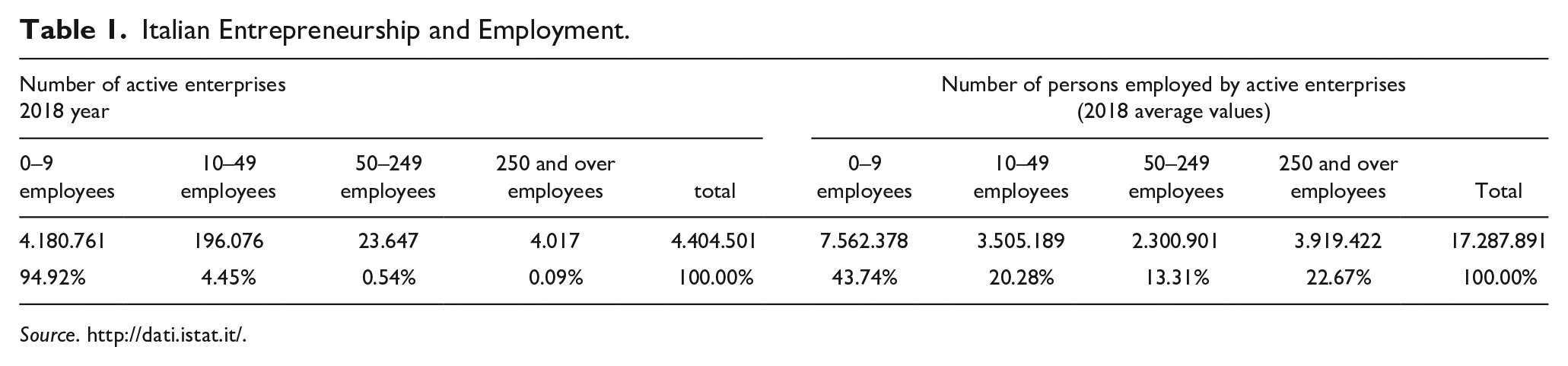
In the Italian production context, micro-sized enterprises prevail (95%). According to the Italian National Institute of Statistics (ISTAT, 2018), the average size of firms is 3.8 persons employed; in the industrial sector (accounting for 10% of active enterprises), the average size is 9.7 employees; in the construction sector, there is a concentration of 12% of active enterprises, and their average size is 2.6 persons employed; the active enterprises of the services sector (accounting for 78% of enterprises) are 3.3 employees per enterprise (Table 1).
Italian Entrepreneurship and Employment.
Source. http://dati.istat.it/.
In Italy, micro-sized businesses employ about 44% of total employees. Therefore, these enterprises make a significant contribution to the economic and social development of the area in which they operate. However, they are conditioned by the local territory, which more often represents their market.
If a firm’s size, on one hand, constitutes an element of operating flexibility, allowing for quicker adaptation to changes from the environment, on the other hand, it represents a weakness because a firm may less easily survive external shocks.
As said in the previous sections, among the various actors contributing to the economic and social development of a territory, local authorities (municipalities, provinces, and metropolitan cities) play an important role, through the allocation of public resources in areas of competence, by performing their institutional functions through local public policies (regulation of social and economic relations, production of collective goods, production of goods and services, fund transfers, etc.). This is even more evident in a context such as the one just described, where micro enterprises are more affected by local economic development policies than are large enterprises, which more often benefit from national support. Indeed, according to the Italian National Institute of Statistics, the performance of Italian Public Administrations and, in particular, the spending capacity of local authorities, represents a possible lever for the development of local production systems (ISTAT, 2019, pp. 253–258).
Sample, Variables, and Data Analysis
Sample
The sample we used in this analysis is composed of the total number of Italian municipalities (no = 7,978) for the years 2014 to 2017. This allowed us to have more detailed, reliable, and accurate information on the object of the research. Consequently, considering a sample represented by the total amount of Italian local governments allowed us to better understand the kind of relation that exists between the financial engagement of municipalities and the entrepreneurship presence (as a factor of economic development) in the Italian case.
Dependent Variable
To develop the analysis, we considered the active enterprises represented by the total number of firms listed in the Italian Chambers of Commerce registered for each of the 4-year-long periods considered (2014–2017) in each of the 7,978 Italian municipalities. We considered this variable as the indicator of the entrepreneurial presence of each city in the sample: in other words, this variable shows the entrepreneurship level for each year and each city considered in this analysis. The number of observations for the dependent variable amounts to 31.912. These data were collected from the Italian Chambers of Commerce.
Independent Variables
To test HP1, the analysis considered some governance elements capable of influencing the decision-making process and, consequently, the public choices defining local policies. The indicators used are as follows:
The percentage of women composing cities’ decision-making bodies, to consider gender influence on the implementation of local economic development policy (Erhardt et al., 2003; Simões & Marques, 2012);
The number of changes in the political governance of each municipality of the sample for the 4-year period considered because political stability can affect governance permanency and, consequently, the implementation of local public policy (Pollitt & Bouckaert, 2011);
The financial autonomy index, which measures the financial capacity of the municipality to develop its political programs independently, that is, without recourse to transfers from the state, the region, or other public bodies. This index highlights the level of autonomy of the municipality governance to choose the policies to develop, deriving from the availability of local governments’ own resources (Brunsson & Sahlin-Andersson, 2000).
To test HP2, on the basis of the previous conceptual framework, we used financial resources (Balaguer-Coll et al., 2010) as independent variables, considering that they trigger the implementation of local public policies leading to economic development (with relation to the economic support policies).
To select them, we used a qualitative study conducted by applying the semistructured interview methodology. Starting from the whole list of “missions” contained in the expenditures section of the Financial Report, we interviewed 89 Financial Directors of Italian municipalities, after the explanation of the research objective. We asked them what missions comprising the Financial Report they regard as more related (on the basis of the financial commitment destination) to the local economic development of the administrated territories. Interviews took place in person or by telephone (lasting approximately 30 minutes) between the end of 2019 and the beginning of 2020. This allowed us to identify the most relevant missions for each interviewee. Cross-referencing the answers, we found the missions reported as relevant by all respondents. We were then able to switch from the 19 initial missions to the six we used in the next analysis. These are: Mission 5—protection and enhancement of cultural assets and activities; Mission 7—tourism; Mission 10—transport and the right to mobility; Mission 14—economic development and competitiveness; Mission 16—agriculture, agri-food policies, and fisheries; Mission 19—international relations.
The independent variables are shown in Table 2.
Independent Variables.
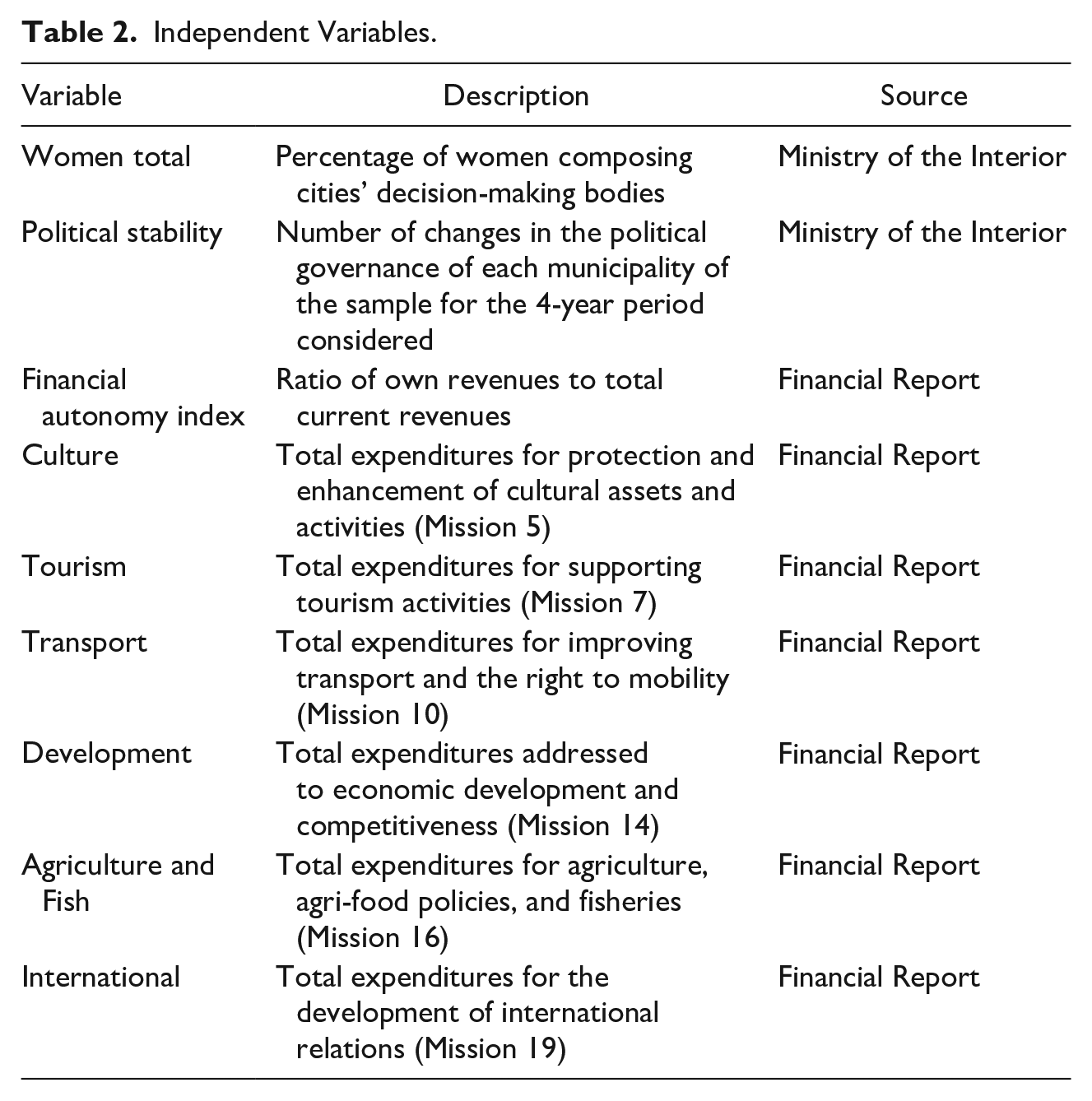
Almost all data related to financial independent variables were collected from the Financial Reports of the cities composing the investigated sample. Two independent variables (percentage of women composing cities’ decision-making bodies and financial autonomy index) were collected from reports available on the website of the Italian Ministry of the Interior. With this data, we created a balanced data panel, which we used to estimate our model (Hsiao, 2003).
Descriptive Statistics
Following, we present some descriptive statistics related to the dependent variable. First, we show the trend of active entrepreneurs. To this end, we calculated the median of the aforementioned variable per each year that we consider (2014–2017). We obtain the following graphic (Graphic 1):
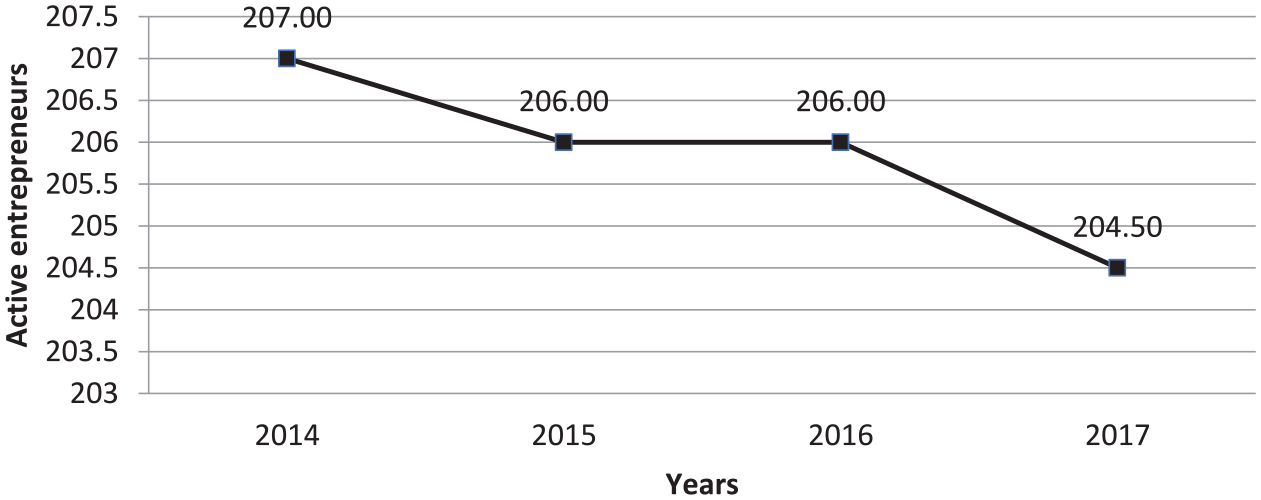
Trend of the median active entrepreneurs.
Second, in the following tables, we show the mean, median, and standard deviation of the dependent variable (active entrepreneurs) for the 4-year period considered (Table 3).
Statistics.
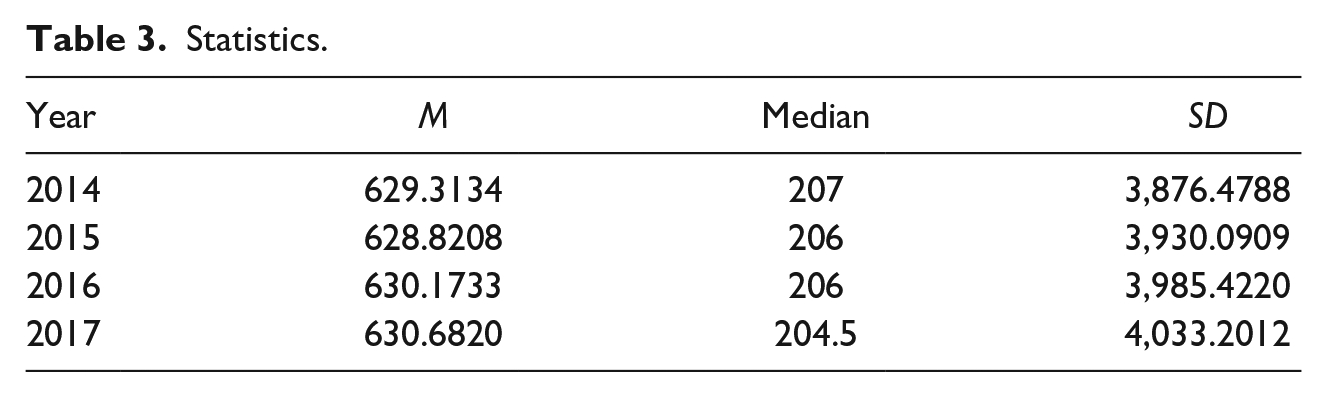
The results highlight greater variability than the average over the years. In fact, this is demonstrated by the high standard deviation values (Table 4).
Correlation Matrix.
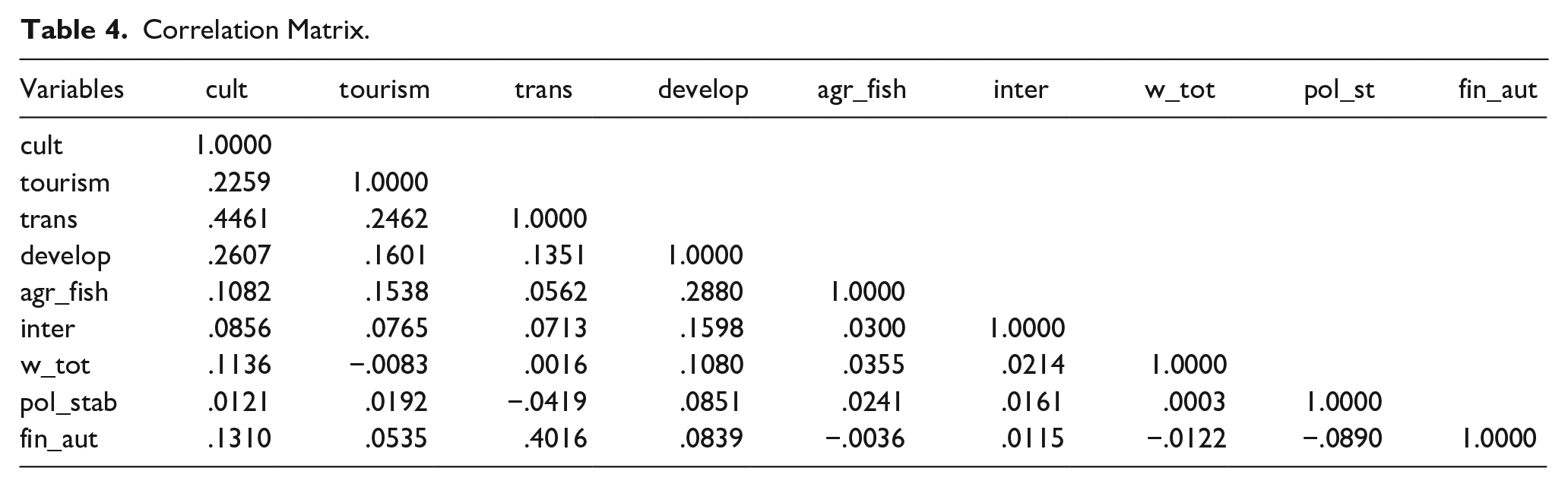
In the correlation matrix, we extract the natural logarithms of all financial variables (“cult,” “tourism,” “trans,” “develop,” “agr_fish,” and “inter”). The data in the above table show that, in all cases, there is no correlation between any independent variables (in fact, most of the correlation values are very low).
As the correlation matrix shows that the variables are not correlated, we expect that there will be no problems of multicollinearity. To verify this, we used the condition index (Table 5).
Collinearity Diagnostics.
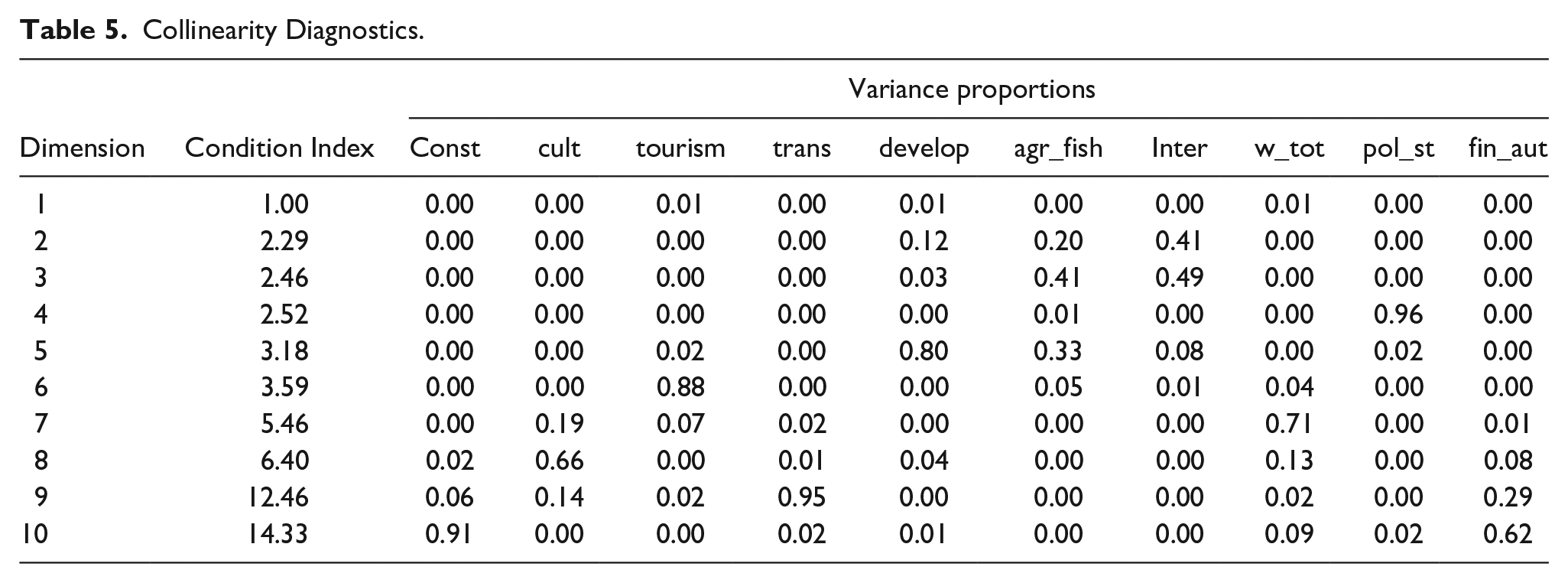
As it is easy to see in the previous table, the condition indexes are small enough and, in any case, less than 30, which means that we have a low degree of collinearity. This is evident when looking at the rows of the matrix with proportions, where we find very low values (the majority of the values, in fact, are very close to 0), and we can therefore conclude that our variables are not collinear.
Models
To verify the existence of an influence between dependent variable (active entrepreneurs), quantitative variables (expenditures indicators), and other variables (total women, political stability, and financial autonomy index), we developed a model that considers the dependent variable “active entrepreneurs,” for municipality i (I = 1,. . ., n) at time t (t = 2014,. . .,2017,) and all independent variables (for municipality i at the time t). We determined,
where
Methodology and Data Analysis
The methodology that we used to estimate the previous panel was the GLS (general least square) method. First, we were able to use this method because we did not have a lagged dependent variable. Then, our units of observation, local districts, differed in many significant ways (e.g., the size); this is a common source of heteroscedasticity, which is a strong assumption that may not hold in applied problems like the one we are considering, where the units of observation have an important spatial component. Some relatively recent contributions, such as Anselin and Lozano-Gracia (2008) and Baltagi et al. (2008), are typical examples of empirical applications that require the use of spatial heteroscedasticity and autocorrelation consistent estimators. Therefore, we could have chosen the OLS (ordinary least squares) method to estimate (Balaguer-Coll et al., 2016), but we selected the GLS method, because we also had random effect over the individuals (local districts). On the contrary, as Aitken’s theorem suggests, using the method of the minimum generalized squares (GLS) makes the estimators BLUE (best linear unbiased estimator), even in the presence of heteroscedasticity and/or autocorrelation of errors.
In our model, we inserted the temporal dummy variables (τ), through which we were able to capture the cyclical variations of the periods and the geographic control variables, nw = North-West, ne=North-East, c = Center, and s= South (with Island,) to verify the consistency of the geographic distribution of the sample elements (Rickels et al., 2016). Furthermore, we considered the population control variables—pop = Population and fam = Households—(Katircioğlu & Zabolotnov, 2020). In addition, we used the log transformation of the investment variables, which allowed us to obtain two results. First, we eliminated the problem of the difference in size between the investment variables (which, in some cases, have values as high as two million euro) and the other variables used in the model. Second, we used a log transformation to adequately capture a possible nonlinearity relationship between the variables. Then the models became,
At this point, we were able to proceed with the estimation of the models. To this end, we used the econometric program STATA (31,912 number of observations) and we obtained Table 6.
Estimation.
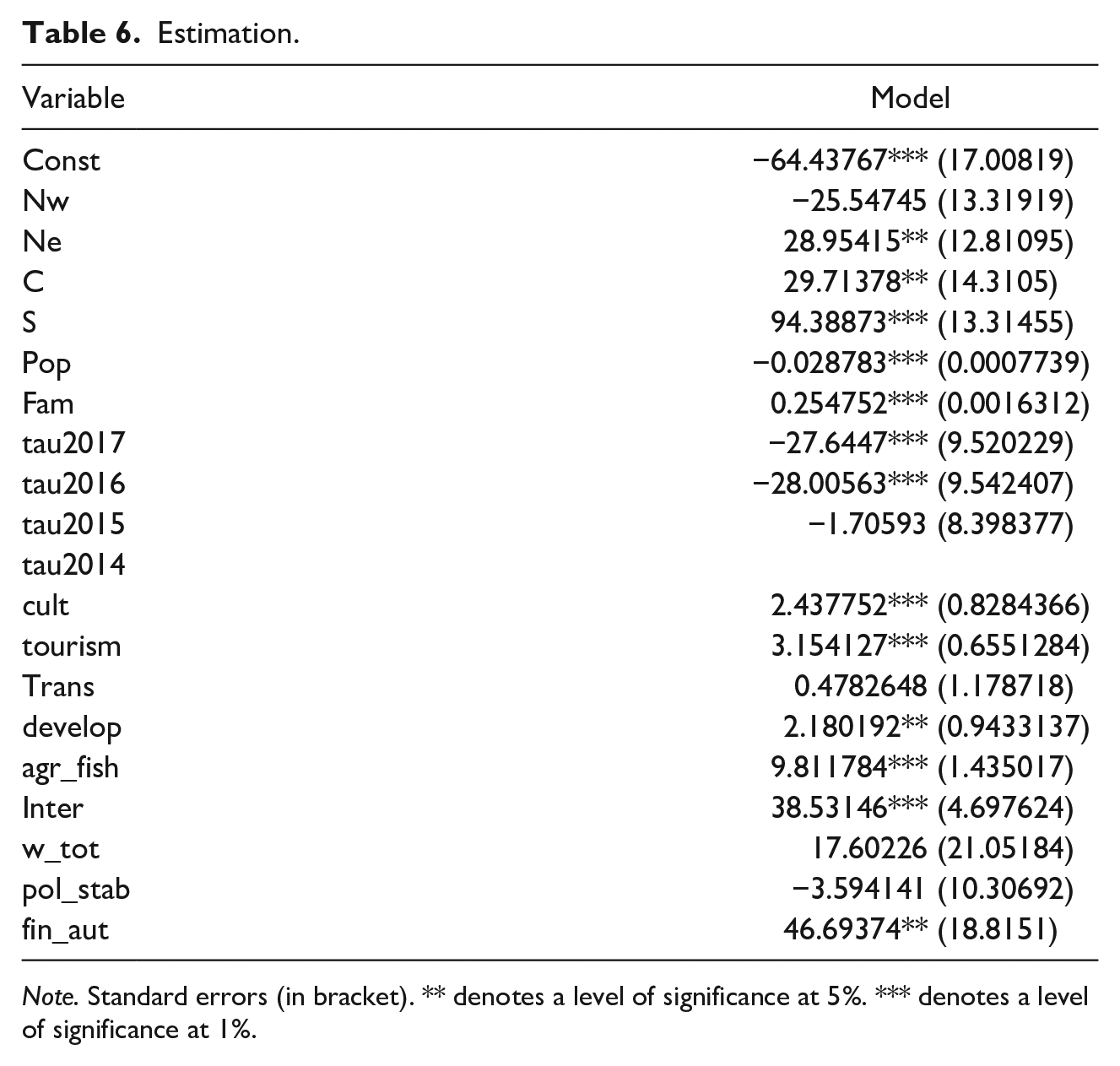
Note. Standard errors (in bracket). ** denotes a level of significance at 5%. *** denotes a level of significance at 1%.
Discussion
Our results indicated that the governance of municipalities, in contributing to the definition of local economic development policies, can produce impacts on local entrepreneurial presence (HP1).
In particular, we found a strong positive relationship (ß = 46.7) between the institution’s ability to actively manage its finances, so-called financial autonomy (Fin_aut), and its capacity to affect entrepreneurial presence. The autonomy of a municipality at governance level, that is the possibility for the local government to own and control its resources (Brunsson & Sahlin-Andersson, 2000), is an element supporting the adoption of local economic development policies.
That consideration is important in a public choice theory framework because when decisions regarding collection and allocation of public funds are highly concentrated at the central level of government, without leaving room for decision-making at decentralized (local) levels (which are closer to and more controlled by citizens), the effects on entrepreneurial presence could not be the same as in more decentralized contexts. As is known, the decentralization of decision-making process at the local level may improve the effectiveness of decisions with respect to the economic, social, and environmental needs of the administered territories, especially when local needs demand a local response (Pollitt & Bouckaert, 2011). The ability of local governments to find additional external funds through the development and financing of projects, including European Union projects, can allow cities to improve their decisional autonomy, carrying out ambitious development policies. That has been particularly true in the last 10 years, given the Italian central government’s cutbacks to municipalities’ transfers, forcing them to find new channels to finance their activities.
As for the other two variables of governance at the local level (the political stability and the percentage of women composing cities’ decision-making bodies), we did not find significant statistical association with the entrepreneurial presence.
Our findings also indicated that the financial commitment that cities invest in their policies to support economic development produce positive effects on entrepreneurial presence (H2). This highlights the importance of local public policies and, consequently, public choice theory (Buchanan & Tollison, 1984). From this point of view, the article indicates that, at a local level, Italian policy makers contribute to realizing public interests in supporting economic development of the administrated territory, in terms of entrepreneurial presence.
Specifically, if we focus attention on the most significant variables (p value not exceeding 5%), it emerges that the expenditures allocated to international development activities (Inter) by the municipalities produce greater positive impacts (ß = 38.5) on the number of firms active in the territory. It should be noted that the area of need for which these expenditures are intended is very particular and connected to specific situations wherein, due to cultural, historical, or social affinities, or due to the presence of economic synergies or territorial contiguity, a city finds itself operating outside the national context. In this case, the interventions may include the administration and operation of the activities for relations and participation in international associations, for international promotion programs, and for international development cooperation activities. Analysis of the programming documents of some municipalities belonging to the sample shows, in particular, that these expenditures refer, among other things, to the implementation of international cooperation projects for development financed by the EU (for example, INTERREG projects) that the municipality manages as a leader or partner. It follows that finding EU funding for the local economy can produce positive impacts on entrepreneurial presence at the local level.
Furthermore, the variable linked to expenditure in agriculture, agri-food policies, and fisheries (Agr_fish) is statistically significant (ß = 9.8). It should be noted that the municipalities allocate resources to this item of expenditure to provide services related to the development of rural areas, of the agricultural and agro-industrial, food, forestry, livestock, hunting, fishing, and aquaculture sectors. In numerous circumstances analyzed, these are resources destined to encourage agriculture through the provision of contributions aimed at supporting firms damaged by natural disasters. Consider, for example, the spread of the xylella bacterium, which in recent years has affected numerous olive crops and caused economic damage for many agricultural entrepreneurs in the South of Italy.
It is interesting to note that the variable measuring the expenditures destined for tourism (Tourism) is also relevant (ß = 3.15). These are funds that municipalities allocate mainly for the promotion and development of tourism in the area, such as tourist events and shows (“white nights,” musical concerts, popular festivals, fairs, etc.) that are intended to attract flows of tourists and visitors. In hindsight, economic advantages can occur, not only during the period in which the events are organized/sponsored by the municipality, but also in subsequent ones. As is known, such moments can be an opportunity for local businesses and potential customers to contact each other to engage in subsequent commercial exchanges.
No less important (ß = 2.4) are the expenditures allocated to the cultural sector (Cult), which benefits from public resources for the performance of activities of protection and support, restructuring and maintenance of assets of historical, artistic, and cultural interest, as well as of archeological and architectural heritage. The provision of cultural and support services to cultural structures and activities not necessarily aimed at tourism also falls within this sphere of expenditure. From the analyses carried out, it emerged that these expenditures are destined, in most cases, to protecting and enhancing the “material” capital, which is the patrimony represented by the artistic treasures preserved in museums, art galleries, and squares. However, in many circumstances, the “immaterial” capital is also protected and enhanced, represented by the ensemble of popular, gastronomic, linguistic, religious traditions, local handicrafts and, more generally, cultural traditions that distinguish a given territory. These expenditures have purposes that are, in part, similar to those intended for tourism, when there are proposals to exploit the “material” and “immaterial” capital to attract a greater flow of visitors to the place. However, municipalities allocate expenditures to culture even beyond possible repercussions in terms of tourist flows, when these resources are destined to create opportunities for cultural development of the local population, through the management of theaters/museums/libraries and the organization of thematic forums and training events. It seems clear that the effects produced by these expenditures, in terms of greater economic development, are not easy to quantify in the short term but require a reasonable amount of time to be measured. For this reason, in this study, a period of 4 years was taken into account.
Equally important (ß = 2.2) are the resources destined for economic development (Develop), which usually finance activities to promote the development and competitiveness of the local economic system, including services and interventions for the development of productive activities related to territory, trade, crafts, industry, and public utility services. Finally, the promotion and enhancement of services for innovation, research, and technological development of the territory should not be neglected. In many circumstances, these are resources dedicated to regulating activities, for the purpose of exercising trade in public areas. This activity represents an opportunity for cities to review market areas, to aim to strengthen and consolidate those that already work well and rethink those that have registered lower attendance of operators and less public acceptance. Furthermore, from the analyses carried out, it emerged that many observed municipalities allocate their resources to realizing innovative projects for the benefit of the local entrepreneurial factories, through tax breaks, which provide for the implementation of ultra-wideband fiber optic networks, to break the digital divide in the local area and encourage digital literacy.
The resources allocated to the areas of need mentioned above produce positive impacts on most of the Italian territory, except in the northwest area, where the corresponding geographical variable (Nw) does not appear to be significant. This result is most likely due to the greater degree of development in the North West, in consideration of the presence of numerous firms operating in international contexts. In that context, entrepreneurial presence depends largely on the development conditions of foreign markets.
The time variable (reference year of the analysis) appears significant (with a negative sign) compared to the number of active firms, in 2016 (Tau2016: ß = −28.00) and 2017 (Tau2017: ß = −27.6), as highlighted in Graph 1. In fact, in the 2 years under consideration, there is a decrease in the (median) value of active businesses.
Finally, it should be noted that the number of inhabitants (Pop), which measures the operational size of each city, is significant, but the strength of the relationship is rather limited (ß < 0).
Conclusion
The analysis of economic development cannot ignore the consideration of a key actor in the implementation of these aspects, which is represented by public administration. This work is focused on local governments, which contribute to the definition and implementation of social and economic policies (Calcagnini & Perugini, 2019). We analyzed the relation between local public policies for economic development (considering cities’ governance and financial engagement) and local entrepreneurial presence (total number of active firms), as an indicator of economic development. Therefore, the research aimed to test the relationship between local public policies (in terms of municipalities’ governance and local governments’ financial engagement) in supporting urban economic development and local entrepreneurial presence.
Our findings indicate that the potential for local governments to own and control their resources (decisional autonomy) is paramount for more effective decisions. Moreover, according to Acs and Szerb (2007), it is necessary for mayors to take into account the impact of their decisions on entrepreneurship, given the link between long-term economic growth and entrepreneurial activity. This highlights the importance of public policies and, consequently, public choice theory (Buchanan & Tollison, 1984). From this point of view, the article indicates that, at a local level, Italian policy makers contribute to realizing public interests in supporting economic development of the administrated territory, in terms of entrepreneurial presence.
Moreover, the results of the analysis highlight that the effectiveness of local public policies depends also (but not only) on the financial commitment that cities invest in their policies to support economic development. This is why this work focuses on the financial items identified in the Annual Report, which are considered as the first (financial) step toward the implementation of public policies. According to Bebbington (1997) and Burritt and Schaltegger (2010), the availability and use of financial resources are factors influencing environmental, social, and economic development.
Our findings are consistent with Spencer and Gomez’s (2004) suggestions, in terms of the contribution of cities’ programs to entrepreneurship presence at a local level.
If we focus attention on the most significant variables (p value not exceeding 5%), it emerges that the expenditures allocated by cities for international development activities (Inter), agriculture, agri-food policies and fisheries (Agr_fish), tourism (Tourism), cultural sector (Cult), and economic development (Develop) produce greater positive impacts on the number of firms active in the territory. Moreover, the dimension of cities is significant, but the strength of the relationship is rather limited.
The present analysis refers to the whole Italian local government context (n = 7,978 Italian municipalities) with reference to a period of 4 years (2014–2017). Therefore, it is interesting to highlight that the aforementioned positive impacts of local policies on entrepreneurial presence may lead to a potential image enhancement for the local political class (this is an important aspect, considering the depth of voters’ loss of trust in politics).
Furthermore, it is interesting to emphasize that the literature on the subject refers mainly to theoretical observations. Nevertheless, this research contributes to the literature on public choice theory and public management, providing some empirical evidence on the role of financial public choice at the local level in supporting economic development of the territory administered by municipalities.
The results of the analysis also lead to some managerial implications, useful for both the political class and local public management.
First, given the importance of financial autonomy, a joint effort between politicians and public managers is needed to implement policies aimed at increasing revenues (e.g., additional external funds through the development and financing of projects, including European Union projects—especially in the future, by means of Next Generation European Union Funds, improving revenue collection capacity), and at analyzing expenditures to reduce wasted resources, for example, through the implementation of management control systems (De Matteis et al., 2021). This would improve the financial autonomy of the local authority and, consequently, facilitate its decision-making processes.
Moreover, considering the relevance of expenditures for local economic development, it appears necessary to make expenditure choices on the basis of the objectives to achieve (performance-based budgeting), increasingly moving away from the incremental logic of historical expenditure (Angiola & Bianchi, 2015; De Matteis et al., 2021);
Our results do not seem to be conclusive. In fact, the analysis involves some limitations from which some indications for future research arise.
First, this article focuses on the Italian context and considers the local government level. In future, the results of this research could be expanded to other geographical frameworks and/or consider different government levels. However, this aim could only be sustained if country differences in the distribution of powers between local and central governments are taken into consideration regarding the role of cities in supporting economic development/sustainability of their administrated territory.
Second, the economic development variables could be more numerous than the entrepreneurial presence considered in this work (e.g., gross domestic product, employment indicators, etc.). Given the unavailability of other data at the local level, this article focuses on the total number of firms listed in the Italian Chamber of Commerce register for each of the four yearlong periods considered (2014–2017) in the 7,978 Italian municipalities, as the indicator of the entrepreneurial dynamism. Future research on the subject could consider other dependent variables (if available) to extend, from the quantitative point of view, the concept of economic development/sustainability.
Footnotes
Declaration of Conflicting Interests
The author(s) declared no potential conflicts of interest with respect to the research, authorship, and/or publication of this article.
Funding
The author(s) received no financial support for the research, authorship, and/or publication of this article.
