







Abstract
Social equity is a normative value in the field of public administration; however, policy guidance and associated funding rules are often rooted in values of equality. This perspective explores the conditions under which a public administrator’s professional responsibility to social equity goes beyond a program’s requirements for equality-based outcomes. This mismatch often results in extraneous efforts on the part of the administrator to implement creative solutions above and beyond what is funded and required by bureaucratic guidance. Realigning program rules and providing sufficient funding with an eye for equity will provide responsible public administrators with sufficient resources for success.
Concern for social equity is an integral consideration in public policy development and leadership. Government bureaucracies set the programmatic goals for initiatives set forth by legislative actions. Public administrators are responsible for bringing these initiatives to fruition, guided by detailed policy guidance documents, reporting requirements, and budgetary expectations. Stringent policy requirements intended to maintain accountability of public dollars also restrict administrator autonomy, making it more challenging for administrators to address the distinctive needs of their populations. The use of standardized program implementation models is often rooted in an assumption of population homogeneity, which is rarely the case in practice. In contrast, contemporary public administrators are challenged by their professional responsibility to consider the needs of their communities when implementing programs, balancing efficiency and effectiveness while prioritizing socially just outcomes (Frederickson, 2005; Svara & Brunet, 2005).
Although identified as a normative value in public administration, there is a lack of consensus about whether social equity is operationally desirable or even achievable in a practical sense. On the side of dissent, the aspiration of social equity in public administration lacks tangible metrics, is never fully satiated, and is extraneous to the public administrator’s scope of authority (Durant & Rosenbloom, 2017). A neutral, balanced, and fair approach to policy implementation is best aligned with our administrative roles. Arguments favoring social equity in public administration are rooted in the assumptions that our discipline is not value-neutral (Frederickson, 2005; Guy & McCandless, 2012; Norman-Major, 2011) and public administrators are uniquely positioned to mitigate the effects of historical inequities through the equitable redistribution of public resources whenever feasible. Nonetheless, social equity is a challenging goal for even the most committed public administrator, as “without clear and immediate results, it is difficult to build support for programs that are designed to reduce inequity” (Norman-Major, 2011, p. 240). Furthermore, program guidance for policy initiatives is rarely flexible or generous enough for administrators to pursue equitable outcomes without seeking supplementary funding sources or making budgetary or operational sacrifices. Instead, guidelines tend to be restrictive and rooted in the dissenter’s argument of procedural fairness, magnifying the operational challenges many public administrators face when implementing government-subsidized social policy initiatives.
The following perspective explores what happens in the administrative gap created when program guidance is aligned with the value of equality and public administrators hold themselves to the higher ideal of social equity in program implementation. The theoretical context for this examination rests on four foundational arguments: first, bureaucrats design social policy initiatives to be implemented with a standard of procedural fairness (equality); second, there is a distinct conceptual difference between equality and social equity in public policy; third, public administrators are held to a higher standard of social equity by our professional responsibility; and fourth, the gap created by this misalignment requires public administrators often to go above and beyond to achieve transformational outcomes. Using Pennsylvania’s programmatic response to opioid use disorder (OUD) as an example, this perspective defines and then applies these arguments and their implications for responsible public administrators. Informational interviews with agency leaders about program implementation challenges suggested that social equity in the form of transportation equity was a significant concern that disproportionately affected success. However, instead of requesting additional funds or leaving the issue as an unmet need for participants to manage on their own, agency leaders take it upon themselves to creatively mitigate the problem on behalf of their clients. These selfless acts, driven by professional responsibility, are examples of exemplary leadership in public service. Yet, they also reinforce the under-resourced public servant stereotype, where we consistently go above and beyond to produce administrative miracles in the name of social justice. To combat this stereotype and properly reward administrators for their efforts, funders must design and fund initiatives with this level of commitment in mind. That way, public administrators will be more appropriately resourced to effectively promote social justice and equity in the course of regular action.
Distinguishing Equality and Social Equity in Public Administration
Public policy initiatives in the United States are rooted in the normative value of equality. Beginning with the Declaration of Independence and through the Constitution, Bill of Rights, to the Civil Rights Act of 1964 and beyond, ideals of equality and fairness guide public policy at all levels of government. Equality asserts that all Americans have an equal, constitutional right to public resources and the opportunity to flourish regardless of the social group to which they belong. This is an essential component of American democracy, with beginnings tracing back to the Founders. The public sector operationalizes this ideal through the rational goal of procedural fairness, encompassing the public administrator’s commitment to the development and implementation of fair and equal processes for constituents to access public resources and the perception that the process is fair as assessed by the public and the legal system (Herian et al., 2012; Martin et al., 2022; Tyler, 2006). This effort reinforces the social and political belief that citizens should be treated equally and have the same opportunities for success in our society despite any historically disparate treatment (Johnson & Svara, 2011). Thus, many public programs are restorative in nature as they seek to restore equal access to resources when injustice has failed a particular social group. This type of policy initiative is critical as many social groups, including racial minorities, LGBT communities, and undocumented immigrants, continue to fight for recognition of their rights under the U.S. Constitution (Curfman, 2022; Gibson & Nelson, 2022; Robinson, 2022; Solórzano, 2022).
A recent example of a policy initiative rooted in the equal distribution of resources is the federal at-home COVID-19 testing initiative (COVID.gov, 2023). Through this initiative, the federal government entitles every U.S. household to receive at-home COVID-19 tests delivered free of charge through the U.S. Postal Services. Each requesting household receives four tests, regardless of the number of people living in the dwelling, the household members’ citizenship status, or household income level. For some households, the number of tests provided will be more than what is needed; for others, it will not be enough. Every household, however, is afforded the equal opportunity to receive four free tests as part of the federal government’s effort to remove barriers to testing access for all demographic groups and combat the spread of COVID-19.
Svara and Brunet (2004) highlight procedural fairness as one of four necessary conditions for achieving social equity in public administration. This objective, due to its objective nature and focus on present social circumstances, properly fits in the realm of equality when pursued in isolation. Yet, when in concert with the other three criteria of access (distributional equity), quality (process equity), and equal outcomes, the public administrator’s standard of care elevates from that of equality to social equity. Social equity is a function of distributive justice where those in power allocate resources to disrupt the status quo and promote successful outcomes for historically disenfranchised social groups (Johnson & Svara, 2011). In this construct, decision-makers, such as public administrators, use their judgment and expertise not only to restore equal access to resources but also to redistribute resources as a means for correcting past inequities and promoting more equal footing for all. Its operationalization is highly subjective, based on the public administrator’s assessment of justice, and rooted in the normative value of social justice. In this model, care for the common good goes beyond the pursuit of procedural fairness to address the troubled, institutionalized history of economic and social disenfranchisement of marginalized groups through public policy and its enduring effects.
As one of the first actions of his presidency, President Biden signed an executive order formally acknowledging the federal government’s historical creation and reinforcement of systemic inequalities through laws and public policy (The White House, 2021). To reverse some of the effects on today’s society, the President pledged that his administration would pursue social equity by reviewing and revamping many federal policies and procedures. More specifically, the order commits to “remove systemic barriers to and provide equal access to opportunities and benefits, identify communities the Federal Government has underserved, and develop policies designed to advance equity for those communities” (The White House, 2021, Role of the Domestic Policy Council, Section 3). This is a salient example of social equity in public policy. Social equity is rooted in the understanding that everyone should receive the same treatment under the law, but historically has not. Therefore, those in power must distribute resources to ensure everyone gets what they need on the back end. In this sense, social group membership matters in the allocation calculations. Privileged groups and individuals will not likely receive the same level of government support as those in need, thus highlighting the critical distinction between social equity and equality in public policy. When the goal is social equity, historically disadvantaged groups are prioritized for receiving the level of support and resources they need to become whole. When the goal is equality, everyone is treated the same and receives the same level of support afforded to them as equal members of society.
The Public Administrator’s Responsibility to Social Equity
Social equity has long been a “normative cornerstone” of public administration, rooted in the Rawlsian approach of prioritizing the care of those most in need (Svara & Brunet, 2004, p. 101). Public administration practitioners, scholars, and experts have debated the appropriate scope, measurements, and application of social equity and justice in contemporary administration (Frederickson, 2005; Svara & Brunet, 2005). More than two decades ago, the National Academy of Public Administration (NAPA) offered the following working definition of social equity in public administration: The fair, just and equitable management of all institutions serving the public directly or by contract, and the fair, just and equitable distribution of public services, and implementation of public policy, and the commitment to promote fairness, justice, and equity in the formation of public policy. (NAPA, as cited in Johnson & Svara, 2011).
This definition holds public administrators to a higher responsibility of combining goals of equality, social equity, and social justice in the management of agencies, distribution of resources and services, and implementation of policy. Although essential as an aspiration, however, the field vacillates on the practicality of such a commitment, especially when administrators are primarily responsible for more clearly defined outcomes of economy, efficiency, and effectiveness in policy administration (Norman-Major, 2011; Wooldridge & Gooden, 2009). Equitable outcomes are desirable for most public administrators but become less attainable as political and budgetary pressures require prioritizing procedural fairness over the promotion of justice.
Administrative responsibility calls for the contemporary public administrator to pursue social equity as a means and a relevant end. The tension between equality and social equity aligns with the oft-employed and classical debate between Carl Friedrich’s call for public administrators to be driven by responsibility and Herman Finer’s prioritization of accountability in the public administrator’s role (Jackson, 2009; Wang & Crosby, 2019). As subordinates to elected official and the will of the people, Finer’s argument suggests that equality is a rational and sufficient end goal for the contemporary public administrator. When public programs and resource administration promote equal treatment and access to services for all constituents, the public administrator has met her obligation. On the other hand, Friedrich holds public administrators to a higher professional and personal accountability standard, requiring a commitment to justice and the equitable administration of program resources beyond what the general will of the people may specify.
This administrative distance between the policymakers’ emphasis on equality and the administrator’s responsibility to social equity places an additional, underfunded burden on public administrators. Upholding procedural fairness as a form of equality and distributive justice as a form of social equity in the current social, political, and economic environment is a high bar that not every administrator will likely achieve without sufficient support and resources. In practice, this looks like administrators “going above and beyond” to administer essential services and resources equitably, using creativity and ingenuity to progress the spirit of the policy beyond what is written and funded. The profession celebrates this level of commitment from administrators who have ensured fair and equal distribution of resources while also making additional provisions for those disproportionately impacted by adverse outcomes in their communities, as illustrated by the National Public Service Awards. In this prestigious award selection process, nominees must demonstrate how they have improved public service and promoted democracy through their work. The most exemplary applicants also must establish their efforts to be “champions of social equity” and to be “willing to take risks to achieve change” (NAPA, 2023, para. 3).
Through creativity and sacrifice, public administrators develop solutions addressing historically unjust systems and seek to replace them with equitable solutions that restore justice. In this sense, the responsible administrator works towards social equity in public policy administration, even when professional accountability may only require procedural fairness in the distribution of resources. Although many administrative leaders are proud to make this extra effort, like those interviewed in the following example, it can lead to burnout for others.
Example: Promoting Transportation Equity in Pennsylvania’s OUD Treatment Programs
Using the lens of transportation equity in treatment of opioid use disorder, the following example illustrates the administrative complexities involved in implementing equality-based policy initiatives despite the administrative professional’s commitment to social equity. Through this example, the public administrator’s commitment to a higher ideal despite program funding and guidance restrictions becomes evident. In this sense, the exploration is both a celebratory tale and a cautionary message about the misalignment of equality and social equity in public policy and its implications for public administrators.
More than 1.6 million people in the United States suffered from OUD in 2021, with more than 48,000 people dying from synthetic opioid use annually (United States Department of Health and Human Services [HHS], 2022). Opioid addiction, overdose, and death impact every social demographic in the United States, but it has been particularly crippling in rural areas where residents perceive drug addiction as the most pressing social problem in their communities, closely followed by the lack of public transit system access (Pew Research Center, 2018). Moreover, approximately 60% of rural community residents live in an opioid treatment shortage area where the travel time to addiction care is four times longer than the national average (Cole et al., 2019).
In response to this epidemic, the federal government has dispersed OUD treatment funds to states through a combination of Medicaid reimbursement and competitive grants managed by the Substance Abuse and Mental Health Services Association (SAMSHA), the agency within HHS leading public behavioral health efforts on a national level. SAMSHA’s strategic response has commanded a substantial investment of public resources, topping over $10 billion since 2017 (HHS, 2023). However, these efforts have not proportionately reached historically disenfranchised groups, such as those experiencing poverty and living in rural areas, signaling the need to adopt a more equitable policy administration approach (Andrilla et al., 2019; Olfson et al., 2018; Pro et al., 2020).
In early 2020, we initiated research to explore how social inequities on the community level influenced the administration and, ultimately, the efficacy of federally subsidized opioid treatment programs in Pennsylvania. The Pennsylvania Department of Human Services (DHS) employs a hub-and spoke Centers of Excellence for Opioid Use Disorder (COE) model to administer federal opioid treatment funds. In this federally-funded program, an authorized group of 45 agencies are challenged to identify, case manage, refer with a warm hand-off, and occasionally treat Medicaid-eligible individuals struggling with OUD in Pennsylvania (DHS, 2023). Like many others nationwide, the program engages the Medication-Assisted Treatment model, a high-touch, high-engagement addiction treatment model, blending FDA-approved medication regimens with mental and behavioral health supports (FDA, 2023). Transportation equity becomes a concern because of the various medical and social supports patients must interface with to maintain weekly compliance. In preliminary information-gathering interviews, the research team met with administrators, case managers, and program managers of five COE programs in Pennsylvania, seeking to gain a practical understanding of how the lack of transportation funding affected the administration of these programs across different geographies.
Following transcript development and textual analysis of qualitative trends, the five sites were de-identified and coded for their land use type (urban, rural, and suburban) and themes related to transportation equity and ease of program implementation. Table 1 shows the proportional distribution of the themes based on land-use type.
COE Transportation Equity Interview Themes by Land-Type.
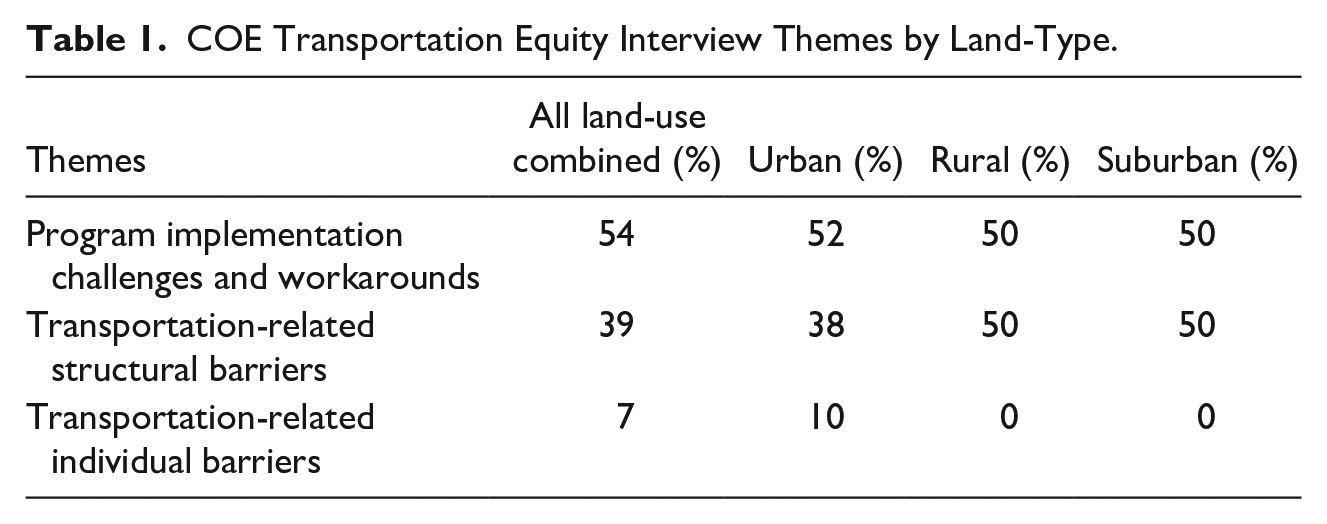
As Table 1 summarizes, three main categories of concern related to transportation equity emerged from the informational interviews: policy implementation and administrative challenges (54%), structural barriers to care (39%), and individual barriers to care (7%). Thematically, the discussion of policy administration challenges overshadowed all other barriers to transportation equity in providing opioid addiction treatment services.
Applying the Framework of Social Equity in Public Administration
OUD treatment program administration in Pennsylvania offers a salient example of how the proposed administrative framework for understanding social equity in public administration works in practice. First, it illustrates the federal government’s enduring focus on procedural fairness and equality. In 2018, DHS published goals and benchmarks for a new COE initiative. In this guideline document, DHS outlined the vision for the program and the requirements of enrolled COE agencies. The vision DHS set forth for the COE initiative consisted of “ensuring effective care coordination, integrating physical and behavioral health needs for every patient with an Opioid Use Disorder (OUD), and increasing access to Medication-Assisted Treatment (MAT)” (DHS, 2018, p. 3). Of particular importance within this vision statement is the aspiration to meet the “health needs for every patient,” which is consistent with the characteristic of equality-based initiatives in public policy. By leaving out any mention of equity, there is an unstated assumption of homogeneous needs amongst the target population of OUD patients. Furthermore, funders and policy designers expected that successful implementation of the policy initiative would subsequently address these unnamed needs despite any location or population-specific barriers agencies might encounter.
Second, this example highlights the distinction between equality and social equity in public administration. Although transportation needs are a known challenge in rural areas, COE guidance does little to account for transportation equity in its requirements or financial reimbursement models beyond referring impacted individuals to partner social service agencies. As part of the first goal for COEs to build and deploy an OUD case management team, agencies must make initial contact with new patients in a physical location within 30 miles of the COE (DHS, 2018). Although a fair requirement, it is not equitable when considering the various operating locations of agencies. Rural agencies operate in counties with lower population density, wider boundaries, and fewer transportation options than urban and suburban agencies, which typically have access to more potential patients per square mile and widely accessible public transportation. Funders expect agency administrators across the state to follow the same rules despite varying access to patients, community demographics, and geographic settings.
More specifically, in interviews administrators spoke of nonexistent transportation-specific funds associated with the COE grant, meaning that insurance company restrictions, managing uninsured and underinsured patients in alignment with program rules, and conflicting transit company rules often complicated administrative and operational decision-making.
Third, the public administrator’s responsibility for social equity is apparent in this example of program implementation. Interviews with chief administrative officers and program managers at COE agencies about the challenges related to transportation equity and the effective administration of the COE initiative provided salient illustrations of the public administrator’s professional commitment to social equity. On the topic of sufficient funding for removing transportation barriers for their clients, one interviewee from a rural agency stated, “We will transport clients. It’s on us. We’re taking that cost. . .But they really need that, so that’s why we’re doing it.” This quote represents another reminder that the COE grant does not provide specific funding for client transportation. In addition, a per-member-per-month reimbursement model gives agencies a flat rate per patient triggered by at least one face-to-face encounter every 30 days, regardless of the number of visits or provider type seen. In this example, the administrator is undeterred by the lack of transportation-specific funding, as the rural setting offers few options for ensuring that MAT patients can attend appointments. Although not required or reimbursed by the grant, agency administrators incorporate transportation into their responsibility.
Similarly, an interviewee from a suburban agency commented on balancing client needs with the grant’s flat reimbursement rate: “I could see them 15 times in a month, or I can see them one time in a month, and we still get paid the same amount. . .If someone is waiting for medical assistance to be active and they really need some support with rides, we’ll help them as much as we can. But sometimes it’s just not feasible because we also have to make sure we’re getting face-to-face contacts with all of our clients. And then we only have, we have three vehicles dedicated to COE.” In urban areas, the administrator’s commitment to mitigating the problem of transportation equity persists, but it manifests differently. An urban administrator comments, “We try to do tokens, but we go through them like candy, and it’s frustrating sometimes too, and I totally get it, but there’ll be times we give someone tokens to get back to their appointment, and then they do not show up to the appointment, and we’re like, ‘Well, what happened?’ ‘Well, I had to go grocery shopping,’ and it’s like, ‘I feel you, I get it.’” As these examples demonstrate, the gap between client needs and grant allowances places an additional administrative burden on agencies. Committed to serving clients wholistically, administrators make sacrifices to meet their professional responsibility to social equity despite funding challenges.
Finally, this example illuminates how responsible administrators fill the administrative gap between equality and social equity in program implementation. In speaking about the member-per-month funding framework, an urban administrator observed, “So they built it so that you had to have a pretty robust program in order to make your funds last. [But] If you’re a small program like us, the reimbursement is really - we’re just hanging on.” As previously stated, reimbursement rates generally cover the cost of medical providers and associated medications but do not specifically cover the cost of transportation. This is despite the program-inherent need for the client to interact with various support providers during treatment. Because public agencies have limited funds, any activities outside the immediate scope of the grant are non-reimbursable costs.
In the interviews, administrators shared some of the workarounds their agencies employed to offset the rigid structure of COE requirements and a lack of necessary funding to reduce the impact of transportation inequities for their clients. There was some variation in the creative solutions employed by geographic location. Administrators of centers in urban areas reported sufficient access to transportation options for their clients, but coordination and schedules were difficulties. Rural center administrators had less trouble coordinating care as multiple services were often consolidated within single social service agencies for easy access; however, getting the patients from home to the service provider proved difficult. Suburban administrators reported being particularly vulnerable as public transportation was more readily available than in rural areas but more geographically challenging to access. Sometimes, clients had to take up to five buses to access a single provider.
To successfully manage these challenges, agency leaders adapted by developing innovative solutions to the transportation equity problem. In urban areas, agency leaders reported expanding their case manager role beyond COE requirements. In these agencies, case managers spent significant portions of their time becoming familiar with transportation tips and offerings from community partners, coordinating schedules, and seeking alternative modes of transportation for patients. In rural and suburban areas, transportation coordination involved managing an organizational van or paratransit services on behalf of clients, which required meticulous scheduling and planning to ensure that clients did not have excessively long wait times for drop-off and pick-up. Although necessary and critical to patient compliance, this creative use of the case management role or management of an in-house van service was an unreimbursed cost that administrators took upon themselves to better their communities. On an operational level, all agency leaders talked about moving funds between grants or accounting categories to offset non-reimbursable costs for COE transportation activities.
Conclusion
Public administration has long recognized and aspired to promote equitable and socially just outcomes. Excellence in public service is a crucial aspect of any social policy effort. It involves a commitment to providing the highest level of service to the public in a fair, efficient, and effective manner. Administrators must be responsive to community needs, provide accurate information and guidance, and collaborate with others to achieve common goals. When public service professionals strive for excellence, they help build trust in government and contribute to society’s overall well-being through the fair and equal implementation of public policy. This noble calling requires dedication, personal and professional sacrifice, and a genuine desire to make a positive difference in the lives of others.
Heroes of public service are heralded for going above and beyond their regular duties to ensure that they administer programs and policies fairly and sufficiently meet the needs of the most disenfranchised constituents and clients. Despite insufficient budgets and policy guidance falling short in this socially just endeavor, responsible administrators persist in this effort. Yet, beyond formal accolades, the efforts of public administrators can often go unnoticed or unappreciated, and the professional responsibility to social equity adds a layer of complexity to their roles. The exploration here aims to highlight this challenge and identify its cause.
Although limited to five centers, this example of the administrative gap between equality and social equity in public policy suggests that the lack of transportation-specific funding and reimbursement models is a salient concern for agencies—the misalignment saddles administrators with the professional responsibility to implement creative solutions with few supporting resources. In the case of OUD treatment, public administrators’ efforts ensure that clients stand a better chance of adhering to all program requirements despite the heavy reliance on transportation access.
Responsible public administrators are committed to social equity in their work. Funders must acknowledge and anticipate this commitment beyond maximizing economy, efficiency, and effectiveness in public administration. Meaningful achievement of social policy requires flexible policy solutions and sufficient funding to fully support administrators’ commitment to the community. Although equality remains an essential baseline requirement for all public initiatives, policy guidance also must be flexible enough for administrators to advance equitable solutions to social disparities without requiring exorbitant creativity and personal and professional sacrifice that can lead to unnecessary burnout.
Footnotes
Author Note
Seri Park is now at the Department of Civil and Environmental Engineering, University of Nevada, Reno.
Data Availability Statement
Data sharing not applicable to this article as no datasets were generated or analyzed during the current study.
Declaration of Conflicting Interests
The author(s) declared no potential conflicts of interest with respect to the research, authorship, and/or publication of this article.
Funding
The author(s) received no financial support for the research, authorship, and/or publication of this article.
