






Abstract
This article critically examines the public value knowability debate by synthesizing competing perspectives from recent Perspectives scholars and illustrates how legitimacy, rather than certainty, serves as justification for public value propositions and the use of public authority. This illustration is applied to a thought experiment of a public value proposition based in state forest management to demonstrate public action without certainty. The implication of the analysis suggests that rather than expecting absolute certainty of public value propositions, public administrators must embrace uncertainty with humility, public engagement, and a willingness to learn.
Introduction
The debate related to the knowability of public value addresses the fundamental nature and utility of public value as a concept. It was brought to the front of public value discourse in an extended edition of Perspectives (Eckerd, 2021). Within this extended edition, Prebble (2021) opened Pandora’s box by asserting that public value is unknowable. Prebble’s argument was responded to in-turn by several accomplished public-value-scholars – Mark Moore, Jean Hartley and John Benington, Guy Peters, and Timo Meynhardt – who all offered distinctive insights into the debate that included differing but also complementing viewpoints. This debate was revisited and extended 3 years later – by the same scholars – in an edited volume on public value creation (Cook, 2024) in the book’s lead-off section entitled “The Puzzle of Public Value, Public Authority, and Public Governance.” These two collective bodies of work represent a dense wealth of knowledge about how scholars and practitioners should be thinking about this concept that we have been calling public value. In this Perspectives essay, I revisit the 12 works in these two collections and use them to offer suggestions on how to approach the “public value” knowability dilemma. In the first section I dissect the works to winnow the debate. In the second section I synthesize the wheat of the works to provide clarity on key elements of the debate as suggested by the scholars. In the third section I present a thought experiment (in the manner of Prebble, 2024b) of a public value proposition to consider via a state government agency and use the synthesis to interpret the scenario in the thought experiment. The concluding section offers suggestions on how to move forward with the debate on public value knowability.
Winnowing the Public Value Knowability Debate
This section examines the major pieces of the knowability puzzle each scholar offers. The following section seeks to put the puzzle pieces together. I do not mean to separate the wheat from the chaff in this analysis, but to claim that all is wheat would not move the debate forward.
Mark Prebble
Prebble’s (2021a) core argument is that public value is fundamentally unknowable due to the inherent complexity, diversity of opinions, and the unpredictability of public authority’s effects. To structure the argument he defines public value as “collective wellbeing” and notes this includes other related terms, such as “public interest, the common good (or common welfare/weal), bonum commune, or the good of society.” He defines Moore’s (1995) idea of the “public value proposition” as “any proposed action in government; everything from legislative change to decisions of street-level officials” (Prebble, 2021a, p. 1584). From this Peeble frames the problem at hand as “is it possible for a ‘heterogeneous person’ to know that the expected outcome of a public value proposition will (or will not) add to public value, and is it possible to know that with sufficient confidence to justify the imposition of public authority?” (p. 1587).
The answer is no – following Scanlon (1998), Prebble suggests that any public value proposition fails to meet the necessary conditions for certainty that “a reasonable person cannot reasonably reject” (p. 1588). Applying these necessary conditions to the nature of public value – whether it pertains to “an aggregation of all individuals,” “a discrete entity not composed of people,” or a combination of either – results in any public value proposition failing to meet the requirement as an objective judgment (regardless of not even knowing who has the “final” judgment) and can be reasonably rejected: hence public value is unknowable. However, this does not mean that we should turn to a nihilistic approach to government and the decisions that are made that effect the public due to the inability to ensure public value; instead, this emphasizes the need to let go of rigid policy positions and embrace “humility, discourse, and compromise” (p. 1582).
Prebble (2024a, p. 13–14) elaborates by stating that it is impossible for a public official to determine if an action will increase public value with enough confidence to justify using public authority, with an emphasis on the moral responsibility of the official to citizens Given that public authority affects all people and that all people deserve equal respect (supporters and dissenters; Larmore, 2005; Waldron, 1987), public officials must offer justifications that are universally acceptable (i.e., valued). However, that standard is impossible to meet, as “Value is always relative” (p. 20). Prebble (2024a) reminds us – through an analysis of the social welfare function debate – that there is not a way out through any of the exhaustive conceptualizations of “public” as each relies on some level of opinion imbued into the decision. This includes decisions by public officials to enact public authority to create public value. Yet – and similarly to Prebble (2021a) – instead of resorting to nihilism or cynicism, we should rely on “professionalism in government” which includes “a commitment to society as a whole, an understanding of the laws that enables and restrains action, tolerance of disagreement and a willingness to explain every action” (Prebble, 2024a, p. 27). Thus, public officials must validate public value propositions through the process of government according to law, and act with “the humility to acknowledge ignorance and accept accountability” (p. 27).
Mark Moore
Moore (2021, p. 1606) accepts Prebble’s (2021a) logic of the knowability of public value but suggests the logically derived normative standard for public value is impossibly strict. He argues that empirical analysis and rational decision-making are insufficient for determining the “best” policy choice, highlighting both epistemological limitations and the subjective nature of what should be valued. Instead, Moore focuses on procedural legitimacy to overcome unknowability and garner public support. He contends that democratic processes and politics – which Prebble deliberately avoided – can be designed to achieve “scientific and philosophical rationality,” while also being “inclusive and reasonably well-disciplined, and facilitate collective, social learning” (p. 1607). In other words, good governance is about continuous learning about facts and values to improve individual and collective well-being.
Moore (2024) reiterates his stance on Prebble’s (2021a) position and emphasizes the importance of Prebble’s (2024a) shift in focus from substantive criteria to procedural rules in how society (and public officials) should approach public value. He argues that while substantive values define what public policies should achieve, procedural values (such as fairness and inclusion) are critical in establishing legitimacy and support for those policies, especially under uncertainty. Moore suggests that procedural ideas that guide governing and collective decision-making ought to be viewed as “substantive values in their own right that have to be protected, expressed, realized, and advanced through public policy making and implementation” since these ideas “often embody ideas of good, just, and proper relationships not only as means for democratic decision-making and action, but also as ends in themselves” (p. 47). Such procedural ideas in a democratic society – such as public participation (see Arendt, 1958) – are designed to support individual rights, freedoms, equal respect, and justice in the pursuit of improving society (i.e., public value) across a broad range of heterogeneous people who are living under the same democratic society.
Jean Hartley and John Benington
Hartley and Benington (2021, p. 1610–11) frame their argument from a global perspective of “tectonic changes” (such as geo-political shifts) that have created a constant uncertainty and requires a shift from viewing public value as an end state to an active process, like from government to governing. From this, they somewhat implicitly accept Prebble’s position on public value unknowability due to how the uncertainty inherent in the world makes it impossible to “know” public value, arguing instead that public value creation is a contested democratic process (Benington, 2015).
While Hartley and Benington (2021) agree that public value propositions are unknowable, knowledge and evidence – which can vary on a continuum of quality and sufficiency and are provisional due to uncertainty – about such propositions and their outcomes still holds merit. In short, they counsel, be a “knowability skeptic” (p. 1617). They extend this idea of healthy skepticism into the contested democratic process that is public value creation; channeling Mouffe (1993), they argue for “agonistic pluralism” to construct publics that involve constructive engagement with opposing views instead of seeking comfortable consensus. (p. 1619). This process to create legitimate public value among differing interests aligns with Prebble’s (2021a, p. 1582) parting remarks on embracing “humility, discourse, and compromise.”
Benington and Hartley (2024) introduce Swilling’s (2020) approach to navigating “polycrisis” – the state tectonic changes and global uncertainty – as a way to also navigate the “cloud of unknowing” related to public value propositions (p. 58). This approach is based in optimism for moral change, advocates for “radical incrementalism” (aligning with the shift to an active-process), and reiterates the value of agonistic pluralism to navigate interactions at ideological, institutional, and individuals levels.
Echoing their support of the unknowability of public value, Benington and Hartley (2024) reiterate the importance of using evidence – varying along a continuum of confidence and is provisional based on the time and context of the public – to inform decision-making in this process and to learn from public value propositions that did not turn out as planned.
Guy Peters
Peters (2021, p. 1624–1625) provides an optimistic counterpoint to Prebble’s position: he agrees that public value “is vague and perhaps unknowable and represents a rather thin justification for public action,” but he argues for the capacity of governance mechanisms to produce justified public actions despite having the “perfect measure of public value.” Drawing on Simon’s (1947) concept of bounded rationality, he contends that historical precedent, analytic tools, and policy experimentation can provide sufficient grounds for public governance that balances competing values and improves common well-being. He emphasizes that the challenge is not to eliminate uncertainty but to manage it responsibly.
Peters (2024) is largely a reprint of Peters (2021), but he comments on the risks of Prebble’s (2024a) emphasis to assess public value through popular approval in democratic processes. Peters suggests this is potentially dangerous as it prioritizes majority preferences over policy outcomes and long-term public interests. He warns that overreliance on majoritarian approval can lead to the rise of populist figures who distort public value rather than serving it. Testing public value through democratic legitimacy along with institutional safeguards is the better path forward (Peters, 2021; 2024).
Timo Meynhardt
Meynhardt (2021, p. 1631) is clear and upfront about his position in the knowability debate: “Public value is knowable, public value creation is not.” Public value as an outcome is knowable, its dynamic evolution is not. He grounds his position towards public value in Moore’s (1995) conception of public managers seeking out the common good but adds an individual, subjective psychological component when it comes to viewing and defining public problems that ill serve the common good. Public value is in the eye of the beholder – it is situated in one’s subjective and affective views towards their own gains related to meeting basic needs in comparison to their perception of public society (Meynhardt, 2009, p. 212). This approach to public value leads Meynhardt (2021) to disagree with Prebble (2021a) – “public value is a matter of attitude and can be analyzed like any other value” (Meynhardt, 2021, p. 1635). Drawing on his earlier work (Meynhardt, 2009; 2015), he emphasizes that public value emerges when basic human needs – security, personhood, belongingness, and pleasure – are perceived as being met. Although such public value can be identified, its creation remains indeterminate as it is a relational phenomenon grounded in the interplay between individual affective perceptions and collective social contexts. This dynamic self-organizing process by which societal norms are internalized and linked with individual emotions and self-concepts is unknowable. With the knowability of public value and the unknowability of its creation and evolution, Meynhardt (2021, p. 1640) suggests that public value management should focus on dignity and respect through ongoing dialogue to promote how both individuals and collective “flourish in community.”
Meynhardt (2024) reiterates the distinction between public value and public value creation but focuses more on the psychological underpinnings. He criticizes the static interpretation of public value in governance literature and stresses the need for dynamic, context-sensitive analysis. He maintains that public value – a “necessary fiction” – can be understood as a guiding concept rather than an absolute truth that can be measured like other attitudinal values. By introducing the concepts of circular causality and non-linear interactions, he further illustrates the psychological complexity of public value creation, arguing that public value emerges from collective emotional dynamics rather than rational calculations. Meynhardt (2024) maintains that this demarcation of public value versus public value creation frees us from Prebble’s (2024a) paradox of justifying public value propositions: “public authority is only justified by the creation of public value,” yet “there is always a gap of knowledge and insight to justify its use” (Meynhardt, 2024, p. 92). His position on public value management stays the same – “we can measure and know what people think and feel about public value” (p. 95) but it also requires reflexive practice and the ability to embrace change.
Mark Prebble (Again)
It is well worth covering the counter-response that Prebble provides to both the 2021 and 2024 series of writings from the other scholars, as he clarifies and adds to his arguments. For the first counter-response, Prebble (2021b, p. 1643) interprets what Moore, Hartley and Benington, Peters, and Meynhardt concluded in their arguments based on two questions: “(i) is public value knowable? (That is a question of epistemology); (ii) can we know enough to create public value? (That is a question of feasibility).” Regardless of his interpretations (with which I partially agree as noted in the next section), he suggests they all missed his main point: “. . . whether it is possible to justify the use of public authority by the claim that it will promote public value” (p. 1645). He says it is not as if all such claims are subjective opinions that are insufficient for moral justification as demonstrated by the justification test. Even a well-planned and executed democracy with its courts, delegations, and checks of public accountability and public discourse cannot ensure public value creation; but it may “reduce the risk of damaging uses of public authority” (p. 1649). Prebble (2021b) challenges public officials to consider the day-to-day exercise of public authority. adopt the point of view of those being impacted, and determine whether you can convince them that they would support the public value proposition being exercised.
For the second counter-response, Prebble (2024b) provides a thought experiment involving a hypothetical society of two equally well-intentioned citizens who disagree on the best course of action. The scenario demonstrates the need to accept the unknowability of public value to have an operating polity. Questioning the “righteous certainty” of what a person “knows” is a necessary condition for the legitimacy of government actions. Prebble argues that such legitimacy arises not from absolute certainty but from a shared commitment to due process and mutual respect. He further contends that acceptance of public authority requires acknowledging the unknowability of public value, which prevents the imposition of any single viewpoint as absolute truth. This adds to his previous arguments that unknowability is not just a limitation, but a critical element for ensuring legitimacy, when coupled with the basis for public authority (like the idea of the unwritten social contract). To make legitimacy happen, he emphasizes the importance of procedural fairness, open dialogue, and respect for diverse perspectives in public decision-making. He reiterates his call for public officials to approach their roles with humility, recognizing that their authority rests on procedural legitimacy rather than epistemic certainty.
Synthesizing the Public Value Knowability Debate
In Table 1 I provide an abbreviated synthesis of ideas across scholars related to their positions on five key components (based on what they discussed in their work) in the public value knowability debate. The first column addresses the core issue – each scholar’s stance on whether public value is knowable or unknowable; the second contains thoughts on viewing public value as an adaptive process versus a measurable outcome; the third captures how each author addresses the role of legitimacy in overcoming the challenge of unknowability; the fourth covers the nature and role of public authority in public value propositions; and the fifth includes an overarching statement of the scholars’ perspective for practice.
Summary of Key Aspects of the Public Value Knowableness Debate.
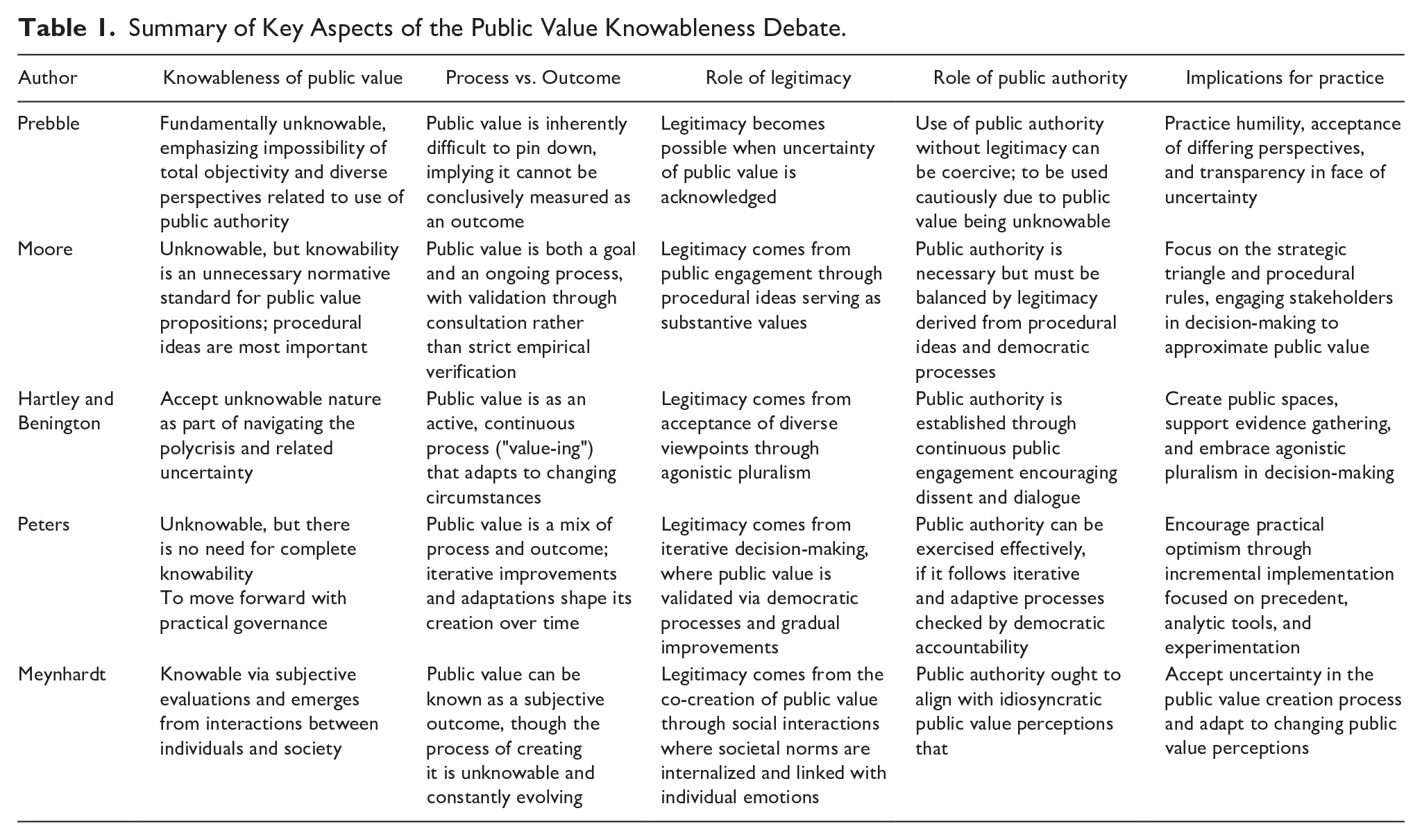
All the scholars seem to agree to some extent with Prebble’s logic and his conclusion that public value propositions are unknowable. But the devil is in the details: Moore, Hartley and Benington, and Peters all roughly argue that complete knowability is unnecessary to move forward with action (i.e., including the use of public authority via government); Meynhardt agrees that the public value creation process is unknowable, but disagrees about individual subjective perception of the outcome of public value propositions. This appears to be the biggest source of dissonance among the scholars. Prebble (2021b, p. 1652–1653) addresses this by suggesting that he and Meynhardt are talking about two separate meanings of public value. Prebble’s understanding is “that a better situation has more public value than another situation,” while Meynhardt’s focuses on “a collective understanding of what constitutes goodness,” with a change in the latter producing a change in the former. However, I believe this is a misleading recharacterization. I view Meynhardt as suggesting that public value is entirely in the eye of the beholder; thus one’s perception of any “situation” holding public value reflects their own idiosyncratic perceptions based on how they perceive the situation meets their basic needs.
Despite this difference, there is general consistency (and optimism) with how best to proceed with the debate on public value knowability: the primary focus ought to be on how to build legitimacy through transparent and inclusive public processes and procedures. Moore supports this assertion through his notion of procedural legitimacy through the strategic triangle; Hartley and Benington embrace the uncertainty of public value to encourage agonistic pluralism to drive engagement and dialogue; Peters advocates for iterative decision-making through democratic processes that also encourages experimentation; Meynhardt suggests the need for adaptive social processes and interactions that respond to changing public value perceptions; and even Prebble notes that legitimacy can be gained when unknowability is accepted by focusing on how daily uses of public authority are approached with humility and public discourse.
With the pieces of the puzzle laid out and put back together, the question remains: how do these abstract concepts about public value manifest in daily public management? As briefly reviewed above, Prebble (2024b) proposed a simplified thought experiment to illustrate how public value unknowability creates legitimacy concerns when public authority is exercised. He proposed a polity of two people who “must coordinate to pursue the good of society” (p. 100). These two public-spirited individuals agree on abstract concepts about what makes a good society (such as fairness, freedom, and fiscal probity) but disagree about how to put these into practice. They agree on the use of government to achieve collective purpose but cannot agree on who should govern and who should be governed since each person believes they have the “right” ideas about how to achieve prosperity for their society. Through this, Prebble demonstrated how easily “righteous certainty” can impede deliberation and lead to a stalemate in governance. Yet, it can be responded to and lead to progress through the incorporation of doubt and the acceptance of uncertainty and unknowability of public value. What the thought experiment does not address is how these ideas come together in a real-world streel-level scenario, which Prebble suggests is core to the legitimacy of public value propositions and the use of public authority. In the following section I present a thought experiment that aligns with such a scenario in state forest management and interpret it through the public value knowability debate.
Thought Experiment: Public Value Proposition in State Forest Management
Context of Thought Experiment
Forest ecosystems provide vast tangible and intangible benefits to society, such as ecological services (e.g., climate regulation, air purification), tangible goods (e.g., timber, wild game), and socio-cultural benefits (e.g., recreation, furthering science; Stenger et al., 2009). Forests are also deeply entrenched in global priorities for multiple governing bodies (e.g., National Academy of Public Administration, 2023; United Nations Department of Economic and Social Affairs, 2023). Thus, public management of forests is an apt setting for this thought experiment on public value knowability. The experiment will focus specifically on Pennsylvania forestland, which covers approximately 55 percent of the land in Pennsylvania (U.S. Department of Agriculture Forest Service, 2016). The Pennsylvania state forest system – managed by the Bureau of Forestry under the Department of Conservation and Natural Resources (DCNR) – accounts for approximately 13%, or 2.2 million acres, of that forest land (Pennsylvania Department of Conservation and Natural Resources, 2016). The state forest system is divided into 20 districts that are spread throughout the state, each with its own authority but following statewide regulations and processes (Pennsylvania Department of Conservation and Natural Resources, 2024a). The Bureau is also responsible for myriad other duties related to management of private forestland within the state.
One of the multitudes of daily activities the Bureau undertakes is to review requests for researchers to conduct research on state forestland. The process itself is rather simple; it requires a researcher filling out a detailed online form; the Bureau (both the central office and the district where the research is to take place) reviewing the request over the course of four to six weeks (with possible back-and-forth clarifications); and then providing an approval or rejection to the researcher via an informal (non-legal) agreement. The types of requests that come to the Bureau are largely related to research in natural sciences (e.g., ecology), but some requests also cross into social science and humanities (e.g., archaeology). The Bureau and DCNR place value in this function of the Bureau and practice of sharing a public good:
Research is a valid use of Pennsylvania’s state parks and forests. It increases knowledge and benefits society. Pennsylvania’s state parks and forests have diverse plants, animals, and geology. They offer many opportunities for scientific study. . . [DCNR] has a long history of working with researchers and universities. Its use of research has kept it a leader in public land management. (Pennsylvania Department of Conservation and Natural Resources, 2024b).
Consider a scenario where a mid-level official of the central office in Bureau who is responsible for review and authorization of the research requests receives a not-so-general request: a researcher proposes a project that utilizes an experimental controlled burning technique to enhance biodiversity. Controlled burning is practiced by the Bureau, but it sometimes draws public opposition for various reasons, and an experimental method could carry more risks. To compare this scenario with Prebble’s (2024b) thought experiment, the Bureau official represents one member of the polity, acting as a decision-maker for use of public authority. That official also will need to work with a Bureau official in the targeted forest district as another member of the polity who has public authority power. On the other side is the researcher proposing the project and other potential stakeholders that the project could impact (e.g., regional conservancies, residents local to the project). Although the officials are in the governing position and the latter is in the governed, the latter has a say in decision-making (since state forestland is a public good), and the Department has made it clear that research is of utmost importance. Is this project for “the benefit of all Pennsylvanians” and will it create public value?
Interpretation of Thought Experiment
On the surface, the answer seems simple: research conducted on state forestland contributes to scientific knowledge that can improve forest management, both locally and globally, which can lead to societal-level benefits. Meynhardt (2021; 2024) might add that if stakeholders perceive the outcome of the research as contributing to meeting their basic human needs, public value will be created. Stakeholder perceptions, however, are idiosyncratic and not universal, and some may see the research as harmful rather than valuable. The research review process may also end in a stalemate as members of the “polity” cling to their “righteous certainty” (Prebble, 2024a) about what they “know” about the potential of the project in relation to public value, which could occur between officials and/or between officials and the researcher and other stakeholders. Prebble (2021, 2024) would raise the concern that with such subjectivity, the Bureau should not use its public authority to authorize the research based solely on the claim that the project will create public value, because public value is unknowable, with which Moore, Hartley and Benington, and Peters would seem to agree. While Meynhardt would argue that public value is knowable and could be measured, it cannot be done before the project is carried out as the public value creation process that the project would elicit is unknowable. Thus, the Bureau cannot be certain that allowing this research on state forestland will create public value, in whatever form as perceived by whomever. But according to Peters (2021, 2024), governance must go on: the Bureau should not sit idly by and wait for absolute certainty about public value creation to present itself. So, what grounds can be used to justify such actions of public authority?
Moore’s (2021, 2024) focus on procedural legitimacy offers a path forward – the legitimacy of the use of public authority can emerge from fair, transparent, and participatory processes of the exercise such authority despite uncertain outcomes of such use. Thus, the Bureau should focus on the process for approving or denying the research request, not the uncertain outcome of the request. This begins with the Bureau’s willingness to acknowledge the unknowability of the outcome of the research (Prebble, 2024b) and being open to engage in dialogue with likely disagreeable parties (Hartley & Benington, 2021). Although consulting all Pennsylvanians is not practical, the Bureau official should ensure the proper stakeholders are engaged in an authentic and inclusive manner, avoiding manipulation and tokenism (e.g., Arnstein, 1969). While disagreement among stakeholders is inevitable, Hartley and Benington (2021; Benington & Hartley, 2024) would tell the official to embrace this agonistic pluralism and create a space for deliberation. Meynhardt (2021, 2024) would praise these social interactions as they would likely increase perceptions of legitimacy of public authority. Even though such engagement and deliberation will not provide a definitive answer to the Bureau, it will likely provide with more confidence in the evidence available to make the decision on approving or denying the research project than if officials had not had such engagement (Hartley & Benington, 2021; Peters, 2021). This evidence could then be used to inform future research request decisions, given that the Bureau does not rely solely on this one instance in time and continually adapts to the evolving nature of knowledge and public value perceptions (Hartley & Benington, 2021; Meynhardt, 2021; Peters, 2021). If they approve the research project, they could reengage both the consenting and dissenting parties that were involved in the approval process and, following Meynhardt (2021), assess these parties’ public value perceptions of the outcome of the project. This information should be used to help inform future decisions (Hartley & Benington, 2021).
In sum, instead of framing the decision of the use of public authority to authorize or deny the research request as a choice between whether the research will create public value or not, it should be framed as how to create an ongoing process of engagement and adaptation to build legitimacy and approximate how public value may (or may not) be created based on provisional knowledge related to the research request. The Bureau’s role is not merely to authorize or deny research but to facilitate a process where multiple perspectives can be heard, legitimacy of the process be created, and balance all of this to approximate a positive outcome for collective well-being. Prebble (2024a) would add that the official should do so with the utmost humility and accept the fact that (despite their title) they do not have the “best” answer.
Conclusion
The debate on the knowability of public value is truly a question about the utility of the concept from both a conceptual and a practical standpoint: is public value even worth discussing? Based on the synthesis of arguments from Prebble, Moore, Hartley and Benington, Peters, and Meynhardt, I contend that it still holds both conceptual and practical value. Moving forward, it is evident to me that public value is best understood as a pluralistic construct that is shaped by differing perceptions, social interactions, and the evolving needs of governance. As demonstrated in the thought experiment, the knowability of public value propositions is at the core of daily work and decision making in public management, particularly when public managers grapple with public authority decisions that impact multiple stakeholders. Yet, as the leading scholars suggest (and with whom I agree), public value not ought to be an objective endpoint but a focus on how the complex public value creation process is one that is contested, negotiated and managed with humility and adaptability.
Given the inherent unknowability of public value propositions, legitimacy of the use of public authority must be grounded in historical and contextual learning as well as in procedurally legitimate governance. This shift requires focusing on procedures structured around actions, in the face of uncertainty in the outcomes of such action. While Prebble demonstrates that public officials cannot justify their use of public authority based on the ex-ante claim that it will produce public value, inaction and nihilism is not the response. As day-to-day governing does not happen in a vacuum, it can rely on accumulated knowledge of past administrative and policy outcomes to inform current decisions. Governing can also create legitimacy in the processes by which decisions are made (i.e., creating procedural legitimacy), thus justifying the use of public authority.
The thought experiment underscores this point: legitimacy is not derived from asserting an absolute ex-ante understanding of public value but from ensuring that decisions are made through inclusive, accountable, and adaptive governance based on historical and contextual understanding of the public value proposition at hand. By integrating public engagement and iterative decision-making, public officials can take action that approximates legitimacy and public value creation even in the face of uncertainty. This may necessitate a shift in how some public officials’ approach (or are trained to approach) public value proposition decision-making; it should be framed as an iterative and evolving learning process where “experimental” public value propositions are tested and outcomes inform future adaptations and decisions. This is not a new idea as it closely resembles how pragmatism in public administration has been discussed, particularly in a series of articles in the early 2010s within the pages of Administration & Society (e.g., Dieleman, 2014; Evans, 2010; Kasdan, 2015; Salem & Shields, 2011; Snider, 2011). Although pragmatism as a philosophy was not referenced in any of the 12 works on public value knowability, there are definite parallels. For example, procedural legitimacy and adaptive, iterative learning (Hartley & Benington, 2021; Moore, 2021) align closely with pragmatic inquiry and how pragmatists approach problem-solving (Evans, 2010; Kasdan, 2015) such that pragmatism’s position on how truths or policies should be evaluated by their practical utility supports the need for continual evidence and stakeholder engagement. Authentic, inclusive engagement with the governed and relying on participatory decision-making are key tools for a pragmatist (Salem & Shields, 2011). Another parallel lies in the observation that pragmatism is based in embracing fallibilism – accepting that all knowledge is provisional, particularly what we think we know (Dieleman, 2014) – which aligns with much of what Prebble, Moore, Hartley and Benington, Peters, and Meynhardt all suggest in terms of embracing the unknowability of public value and/or public value creation. Accepting fallibilism would assist public officials rejecting “righteous certainty” (Prebble, 2024b). Lastly, Prebble (2024a) notes that the exercise of public authority often lacks consideration of the impact that such authority will have on citizens that it will impact the most, especially those without the power to contest authority; he also suggests that expertise and professionalism in government require substantial humility on the part of public officials, which may address this shortcoming of exercising public authority. Teaching humility (or reinforcing its practice) to public officials’ (or anyone for that matter) sounds like a tall order, and Prebble understandably does not go into detail about how to accomplish this. Although pragmatism may offer some directions from an ontological and epistemological perspective, it is not a panacea for public administration (Snider, 2011). Thankfully, psychologists have been making recent discoveries in intellectual humility, how people recognize the limits of their knowledge, and how they respond to that recognition (Porter et al., 2022). This requires understanding ways of thinking and behaving that are both internal and expressed and self and other. A potential combination of pragmatism and soft skill education (Börner et al., 2018) may be worth considering for use in higher education geared towards public officials (e.g., MPA) but also in high school civics education (Fitzgerald et al., 2021). Further discussion of and research on the intersection of public value, pragmatism philosophy, and intellectual humility and how to teach it sounds like a valuable and productive path forward for the public value knowability debate.
Footnotes
Acknowledgements
This project was made possible, in part, by a grant from the Center for Rural Pennsylvania, a legislative agency of the Pennsylvania General Assembly.

Funding
The author(s) disclosed receipt of the following financial support for the research, authorship, and/or publication of this article: This project was made possible, in part, by a grant from the Center for Rural Pennsylvania, a legislative agency of the Pennsylvania General Assembly.
Declaration of Conflicting Interests
The author(s) declared no potential conflicts of interest with respect to the research, authorship, and/or publication of this article.
Data Availability Statement
Data used in this study will be made available upon reasonable request to the corresponding author and upon approval by the funder.