







Abstract
Public hearings enable agencies to inform impact analyses of proposed projects. Yet, how participants present evidence during hearings is underexplored. Our study builds knowledge through an argumentative analysis of a hearing about fracking in New York. Results show that participants used three mechanisms – boundary work, practical reasoning, and professional reasoning – to contest the environmental agency’s evidentiary and normative claims and propose alternatives. These mechanisms suggest that politicization of hearings occurs when testifiers make visible and problematize an agency’s limiting assumptions on administrative decisions. Further, achieving accountability through hearings requires effort articulating that a matter deserves heightened scrutiny.
Keywords
Introduction
Bureaucratic agencies hold public hearings to gather testimony to inform administrative analyses and decisions. In public hearings, a range of policy actors can provide evidence and argumentation relevant to regulatory decisions. Scholars debate whether public hearings influence agency decision making or not, thus allowing citizens to hold public agencies accountable (e.g., Almer & Koontz, 2004; Golden, 1998; Gormley, 1986; Yackee, 2006). We define accountability as “. . .the satisfaction of legitimate expectations about the use of discretion” (Stone, 2015, p. 171) and see hearings as important accountability forums (Mesquita & de Azevedo, 2022). Further, the literature addresses the extent to which public hearings provide useful opportunities for participants – particularly members of the public – to provide evidence for decision making and how it is used to inform decisions. Evidence is any data, information, or knowledge presented to support, reject, or modify a decision (Parsons, 2002). Yet, the debate, with some exceptions (e.g., Choi et al., 2022; Jewell & Bero, 2007), tends to overlook the ways evidence is presented in public hearings, especially its integration with normative arguments.
The goal of this study is to address this omission by studying the types of evidence participants present during public hearings, and the ways these are integrated with normative arguments that center values or principles in making judgments. Analysis focuses on the content of hearing testimony and how participants use and present evidence. This focus is particularly important amid “knowledge intensive conflicts” (Sarewitz, 2004), where different forms of knowledge generate contradictory information and/or where evidence is emergent or uncertain. It is also important, since many policy disputes are not reducible to the facts (Rein & Schön, 1996a, 1996b) but also involve fundamental normative disputes (Schram & Soss, 2001), for instance, about whether fracked gas should be a primary source of cheap energy over environmentally sustainable but more expensive sources. Specifically, this article addresses the following research questions: How do participants present evidence in public hearings? And how do they integrate evidence and (normative) argumentation?
To answer these questions, the article presents results from an in-depth, inductive argumentative analysis of a public hearing transcript, which focuses on the argument as the unit of analysis (Fischer, 2007; Jewell & Bero, 2007). The transcript covers a public hearing that took place in New York in 2011 related to hydraulic fracturing (fracking), a knowledge intensive conflict. Fracking poses significant risks to human health and the environment. At the time of the controversy in New York, technological advances in the technique meant that it was a relatively untested, and evidence about its effects, and how measures could mitigate them, was nascent. As states and localities began considering using fracking to access shale gas reserves that had been economically inaccessible, scientists, advocates, citizens, and local governments began producing or circulating evidence about its effects from a range of perspectives, such as hydrology (e.g., Osborn et al., 2011), geology (e.g., Siegel et al., 2015), public health (e.g., Adgate et al., 2014), and citizen science (e.g., Eaton & Kinchy, 2016), among others. These features of the debate make it a useful case for examining how participants present evidence and integrate it with normative arguments.
Our inductive approach started by analyzing the ways testifiers presented evidence in the hearing. We quickly observed that evidentiary claims were integrated with normative claims in multiple ways. As is common with inductive research (Miles & Huberman, 1994), we began searching for literature to make sense of the data and identified scholarship on the politics of evidence as a useful complement to research on agency hearings. By incorporating the former, our aim is not to deductively test its theories, but to apply it to build theory about agency hearings from our inductive analysis, focusing on how testifiers integrate evidence and normative argumentation. This back-and-forth process between empirical analysis and theory is referred to as abductive analysis (Van Hulst & Visser, 2025). Our review of the theory builds toward the empirical claims we present in our analysis and in the discussion section.
The results show that participants in the public hearing present a range of evidence and contest, through different mechanisms, the evidentiary and normative claims that a government agency makes. The discussion illuminates how testifiers in public hearings may politicize issues under discussion, suggesting that achieving public accountability through public hearings takes particular effort by participants to articulate that a matter is non-routine and thus deserves heightened public scrutiny.
Theory: Public Hearings and Evidence
Public hearings represent one tool for public agencies to gather evidence and facilitate public participation to inform decision making (Rosenbaum, 1978). Public hearings are outward facing forums through which a public agency makes public its analyses of proposed actions and mitigation measures, and seeks public comment.
A significant stream of research explains the effectiveness of public hearings in terms of meeting various goals such as representativeness or informing decisions. First, some studies find that public hearings are not representative, particularly of affected citizens (Almer & Koontz, 2004; Checkoway, 1981; Ebdon, 2002). Public hearings can be representative when well designed and implemented (Almer & Koontz, 2004; Baker et al., 2005; Checkoway, 1981; Dodge, 2009; Gundry & Heberlein, 1984; McComas, 2001a, 2001b; Moynihan, 2003; Rowe & Frewer, 2000), and when administrators feel accountable to the public (Handley & Howell-Moroney, 2010). In addition, certain policy fields might have stronger representation, such as the environmental field (Chess & Purcell, 1999), if organized public interest groups represent affected publics (Golden, 1998). Organized groups, though, tend to represent privileged publics (McComas, 2001b). Other studies show that opponents of an administrative decision tend to dominate testimony, challenging representation (Chess & Purcell, 1999), but no interest group seems to have dominant influence on altering the rules promulgated by an agency on the issue under discussion (Golden, 1998).
Second, the literature is mixed on whether testimony affects administrative decisions. On one hand, some studies show that testimony can affect decisions when stakeholders provide useful evidence to agency decision makers (Gormley, 1986; Neshkova & Guo, 2012; Yackee, 2006), especially objectified knowledge (Berry, 1981), when agencies feel accountable to citizens (Handley & Howell-Moroney, 2010), and when agencies design public hearings to ensure quality input (Moynihan, 2003). In the environmental field, hearings can influence administrative decision making – for example, by raising the rate of environmental permit denials or creating better mitigation (Chess & Purcell, 1999; Gormley, 1986) – or administrative procedures – such as adding a participatory process, recognizing native people or including social facts in decisions (Chess & Purcell, 1999, p. 199; Dodge, 2009; Gormley, 1986). Civil society-organized public hearings aid in connecting citizens to governments to improve service delivery (Singh & Kumar, 2022). On the other hand, several studies find that public hearings or meetings are not useful for influencing administrative decisions (e.g., Adams, 2004; Almer & Koontz, 2004; Cole & Caputo, 1984; Ebdon, 2002; Handley & Howell-Moroney, 2010; Neshkova & Guo, 2012; Yackee, 2006), but might serve other valuable purposes: showing support, holding public officials accountable, setting the agenda, delaying decisions, networking, influencing votes or educating the public, all of which could improve government responsiveness (Adams, 2004; Almer & Koontz, 2004; Lando, 2003; Stone, 2015).
Regardless of the discussion on whether testimony in public hearings affects decisions, some studies illuminate how testifiers present evidence and structure their arguments (Beck et al., 2012; Choi et al., 2022; Jewell & Bero, 2007; Topal, 2009; Topal & Gephart, 2025). For example, Jewell and Bero (2007) study the claims making activities of testifiers in public hearings, focusing on the evidence and arguments they provide about ergonomic standards. They find that citizens, labor union representatives, and industry representatives made different types of arguments and provided different forms of evidence to support their arguments. This study suggests that testimony serves to scrutinize and expose agency behavior from the testifiers’ points of view, a process that enables public accountability regarding the use of discretion (Stone, 2015).
Nevertheless, like Jewell and Bero (2007), these studies all tend to focus on the content of the arguments – the what of testimony – rather than on the specific ways testimony can challenge agency claims and hold an agency to account for its use of discretion – the how of testimony. Therefore, how testifiers present evidence is still an underexplored topic that deserves further attention to illuminate what occurs in public hearings and its significance for public accountability. We carve out a path for exploring the how by comparing processes of opening and closure in public hearings.
“Opening” and “Closure” in Public Hearings
In the public hearing literature, some scholars discuss the ways politics shapes the relationship between testimony and administrative decisions. Although public hearings are inherently political (they are sites to filter participants’ interests and values related to agency decision making), they are not always politicized. Politicization involves “moving something into the realm of public choice, thus presupposing the possibility to make collectively binding decisions on that matter” (Zürn, 2019, p. 977). For example, politicization might occur in hearings when testifiers raise questions about the trustworthiness of an agency’s use of science, thus moving scientific evidence into the realm of public choice, rather than (implicitly) accepting the agency’s trustworthy use of science. As we will argue, politicization requires that testifiers in public hearings challenge the limiting assumptions an agency makes, for example, about what counts as evidence or normative considerations in administrative decisions.
One scholarly focus is on politics as a set of contextual factors that shape hearing effectiveness (i.e., defined as whether hearings inform decisions), such as the relation between central and local governments, the intentions of individual power brokers to welcome or divert participation, and the power of citizens and organized groups to open hearings (Checkoway, 1981; Gormley, 1986). Agencies can also shape the politics surrounding hearings. On one hand, agencies enhance hearing effectiveness by improving information provision and access related to risks (McComas, 2001b) or budgeting (Ebdon, 2002), by using technology appropriately to support access to public hearings (Bukalova & Maland, 2023), and by adequately fielding questions and listening to citizens’ views (Chess & Purcell, 1999). When agencies positively shape effectiveness in these ways, they also limit politicization. On the other hand, agencies undercut hearing effectiveness, and open the door to politicization, when they fail to provide technical or other information or educate participants, omit evidence in environmental assessment reports, or disallow discussion of social or nontechnical issues (Almer & Koontz, 2004; Chess & Purcell, 1999).
Others show that politics can shape how evidence is produced, used by the public, and interpreted. In this respect, the politics of evidence literature usefully distinguishes processes of closure and opening in policy making, helping us understand the difference between hearings as inherently political versus politicized. Closure happens when policy making creates strict limiting assumptions (about, e.g., legitimate evidence) that are unquestioned. 1 Lennon (2014), for example, shows how fluid interpretations of “green infrastructure” in Ireland’s planning processes shared basic technical-rational assumptions that curtailed “open opposition [to green infrastructure] and critical debate regarding a policy’s evidence base” (p. 168). The mechanisms of closure include discursively narrowing notions of risk (e.g., Buttny, 2019), framing facts to create inaction on public problems, for instance, by detaching debates from people’s everyday experiences (Smith Ochoa, 2020), or framing success in particular ways, for example, as “less public welfare” versus “less poverty” (Schram & Soss, 2001). Sometimes a technocratic approach to evidence that is objective, technical, or scientific (Lennon, 2014; Pearce, 2014) can create closure if participants accept its limiting assumptions about evidence (Choi et al., 2022). These studies suggest that objective terms of debate can preclude democratic and ethical considerations in policy making, thus limiting democratic accountability. They do so by arguing that claims not formulated in objective terms are not legitimate and/or credible (Hajer, 1995; Pellizzoni, 2011; Radaelli, 1999).
Opening, in contrast, happens when citizens politicize the issues and raise a broader range of claims outside an agency’s limiting assumptions, especially related to risk (Couch & Kroll-Smith, 1997; Eden, 1996; Epstein et al., 2014; Topal & Gephart, 2025; van Eeten, 1999). This is “opening” because participants challenge limiting assumptions about evidence or norms, such as those accepted under a purely technocratic approach, when a broader range of evidentiary and normative claims are relevant to decision making. Testifiers challenge dominant assumptions about legitimate evidence and who is positioned to produce it. For example, Jewell and Bero (2007) compare the types of evidence testifiers provided in testimony on ergonomic standards in California in the 1990s. Following closure, the business community provided evidence in an “abstract-technical” policy frame to delegitimize stricter ergonomic standards. Following opening, “labor, public health organizations and private citizens. . . relied primarily on experiential information and a ‘concretized-moral’ characterization of policy issues in support of the standard” (p. 625). The authors “underline the limitations of appealing to scientific expertise for solving complex policy problems” (p. 625) and highlight the shortcomings of hearings for ensuring democratic accountability. Similarly, Topal and Gephart (2025) find that businesses sought to normalize risk related to environmental decision making, reflecting closure, while residents sought to problematize it to open hearings – and administrative decision making – to more scrutiny.
Our argument does not strictly associate technocracy, science, or fact-based decision making only with closure or normative, risk-related decision making only with opening. Rather, agencies can create limiting assumptions associated with closure that constrict normative, technical, and/or factual considerations. Similarly, testifiers can challenge limiting assumptions associated with opening on normative as well as technocratic, scientific, or factual grounds. In other words, opening and closure can involve both normative and factual claims. For example, environmental justice advocates have challenged the limiting assumption that “social impacts” should not be included in environmental review of proposed projects, raising both fact-based (e.g., calculating increases in community conflict) and normative issues (e.g., equity). The key distinction is that limiting assumptions can be accepted, reflecting closure, or they can be challenged, reflecting opening. Furthermore, this scrutiny is related to accountability: satisfying legitimate expectations for discretion (Stone, 2015). Although we do not draw a causal link between politicization and achieving accountability as an outcome, we note that testifiers may claim that agencies violate expectations for using discretion, thus holding them to account in the moment during a public hearing. This is a process-oriented notion of accountability.
Whether public hearings become open requires a particular effort to do the interpretive work necessary to articulate premature closure on important factual or normative grounds. Opening, then, seems likely to occur when agencies fail in some way, for example, by sidelining normative issues (Almer & Koontz, 2004; Chess & Purcell, 1999).
In linking our inductive findings to the literature, we identified several mechanisms that can be applied to understand opening. Each mechanism expresses different ways evidence becomes integrated with normative claims and through which premature closure of decision making is subject to criticism, thus becoming politicized.
First, boundary work occurs in policy making when scientists – and others – attempt to shape the ways science is conducted and assessed in organizations (Guston, 2001; Star & Griesemer, 1989), including public agencies (Quick & Feldman, 2014). Scientific boundary work draws boundaries around good and bad science to hold decision makers accountable for using good science. It also seeks to redefine the relationship between science and democracy (Whatmore, 2009). For example, research suggests that lay citizens have to master scientific language to participate effectively in neoliberal policy making (Couch & Kroll-Smith, 1997; Grundy & Smith, 2007). Second, participants may engage in practical reasoning, which involves weaving together factual and normative claims into an argument (Fischer, 2009), in this case, to criticize agency analyses of a proposed project. Narratives as stories are key to this process because they embed facts – usually from local knowledge or experiential knowledge but also from lay understanding of science – in normative reasoning. Third, professional reasoning is similar to practical reasoning as it involves weaving together factual and normative claims into an argument, but the knowledge base is professional experience or know-how (Choi et al., 2022; Yanow, 2004).
These mechanisms of opening suggest that public hearings can become “technological zones” (Barry (2012). These are governance spaces designed to address public problems not by enabling disputes over facts to be resolved but instead by creating a space for disputes to be politicized. Although this scholarship refers to these mechanisms, it rarely applies them to understand how testifiers use them to open public hearings to a broader range of normative and evidentiary claims. This article addresses this omission by analyzing how testifiers present evidence and integrate it into arguments for or against a decision.
Methods
To analyze the presentation of evidence, we conducted an argumentative analysis (Fischer, 2007; Jewell & Bero, 2007) of a public hearing transcript (TCCOG, 2011) generated by a local county government that would be utilized by New York’s Department of Environmental Conservation (DEC) in its decision making about fracking. The DEC held multiple hearings throughout the state in 2011 to get public input on its Supplemental Generic Environmental Impact Statement (SGEIS) on fracking, but excluded this county, which strongly rejected fracking. 2 The county’s leaders negotiated with DEC to allow them to implement their own hearing to supplement those that the DEC carried out and to ensure its residents’ perspectives were aired. Participants included local, state and national political representatives, scientists, healthcare professionals, environmental advocates, local business owners, and local residents. DEC’s regional public affairs director attended as an observer. Speakers had 3 minutes to provide testimony and were told the “DEC will disregard any comments that do not specifically address the SGEIS or the regulations” (TCCOG, 2011, p. 4). This hearing became part of the official record to inform DEC’s decision making. Governor Cuomo, rather than the DEC, banned fracking in 2014, suggesting that the decision to ban fracking was more political than technocratic.
The hearing transcript provides an excellent source of information for understanding the ways evidence was presented to politicize the hearing and hold DEC to account for its analysis in the SGEIS. First, it provides real-time arguments people made about fracking, and their specific recommendations for regulating or banning it. Second, it shows the link between evidence and normative claims. 3 In this sense, the hearing exemplifies an instrumental case chosen “to provide insight into an issue or refinement of theory” (Stake, 1998, p. 88). Our case was purposively selected (Maxwell, 2013, p. 78) to explore the ways evidentiary claims are integrated with normative claims, ultimately to build theory about politicization. Our aim is not generalizability to a population of equivalent cases where conditions are held constant, but naturalistic generalization in which findings are treated as working hypotheses (Patton, 2015, p. 712, citing Stake, 2000), which may be “transferable” to other cases (Lincoln & Guba, 1985). Although the present case has distinguishing features (e.g., it occurred at the state level, in New York, on environmental issues, in 2011), we selected it to build theory about politicization. In that sense, we anticipate that the findings will be transferable to other cases of hearing politicization, recognizing that the mechanisms of politicization in the next case may need to be refined and may also help to specify the conditions under which such mechanisms do or do not arise.
To analyze the transcript, we applied abductive qualitative coding techniques (Miles & Huberman, 1994), beginning with an inductive analysis of the transcript to produce codes and then iteratively reformulating the codes as we connected key themes in the transcript to the literature (Maxwell, 2013). The unit of analysis is the argument.
First, the inductive coding process began when the first author coded a segment of the transcript to identify the arguments testifiers presented in the hearings. She then created an initial coding list from this inductive analysis. The codes included a list of arguments testifiers presented in the hearing, focused on the deficiencies in the SGEIS analysis (e.g., “does not fill knowledge gaps”; See Supplemental Appendix A: Initial Codes). All authors then coded the first quarter of the transcript and met to discuss the arguments. All authors then coded the full transcript and continued discussions about the meaning of the arguments. The discussions were not aimed at ensuring intercoder reliability but to identify the ways testifiers were integrating evidentiary and normative claims in different ways in their arguments and to reach agreements on these interpretations. This process involved identifying patterns in the arguments in how evidentiary and normative claims were integrated, and eventually grouping the arguments into the mechanisms of opening: boundary work, practical reasoning and professional reasoning, using concepts from the literature as a guide, as we describe below.
Determining where an argument begins and ends is a complex interpretive process. From our epistemological perspective, language is ambiguous, and understanding its meaning depends on context (Yanow, 2014). In this case, the meaning of a single word or statement in testimony depends on the meaning of the whole testimony. It follows that it is not always possible to code a single text segment (e.g., a sentence or two) as an argument. Rather, arguments are found across statements in each speaker’s testimony. After researchers independently coded the transcripts and identified arguments within each testimony, we collectively discussed the arguments to reach agreement on their meaning and rewrote the argument succinctly showing how each speaker linked evidentiary and normative claims across their testimony. This process allowed us to clearly identify the arguments and patterns across them. The result of this analysis is not easy to count because retranscription retains the complexity of language in which multiple arguments can be linguistically linked throughout a text. (For two examples of retranscription see Supplemental Appendix B.) Instead, the quality of our choices can be judged in the presentation of results where specific texts demonstrate how speakers in hearings weave together evidentiary and normative claims (Yanow, 2014).
Second, throughout coding, the authors reviewed the literature on knowledge utilization (e.g., Stenmark, 2001) and the politics of evidence (e.g., Chailleux, 2020) to refine the codes. This involved iteratively discussing the meaning of the arguments we coded and how they related to important themes in the literature. Refining the codes became a theoretical exercise to identify the mechanisms of politicization in which testifiers linked evidence to normative claims in different ways. Specifically, we used the literature to refine codes in two ways. First, we began to distinguish different evidentiary claims articulated in testimony: (a) challenges, omissions, or distortions (b) in data, information, or knowledge. Omissions refer to claims about exclusions of information (e.g., published reports) or knowledge (e.g., health analyses not yet conducted). Distortions refer to claims of bias in the information used (e.g., inclusion of positive but exclusion of negative economic impacts). And finally, challenges refer to difficulties in producing usable information or knowledge (e.g., no data disclosure on fracking fluid). Furthermore, the analysis of evidentiary claims became sensitive to differing forms of knowledge, information, and data, such as c) local, scientific, or professional. Second, we analyzed arguments about fracking that integrated evidentiary claims (e.g., information omission) with normative claims (e.g., DEC is shirking responsibilities).
From this iterative process, we refined the code list to include a broad range of arguments organized around “information deficiencies,” “knowledge deficiencies,” and “political uses of information/knowledge.” (See Supplemental Appendix C: Final Codes.) After coding, we organized the codes into explanatory themes relevant for building theory (Maxwell, 2013) about the political use of evidence in public hearings. These are the three mechanisms of opening: boundary work, practical reasoning, and professional reasoning.
Results: The Politics of Evidence in a Public Hearing on Fracking in New York
The fracking controversy in New York was on the state agenda from 2008 to 2014. When environmental and other advocacy organizations learned about plans to implement large-scale natural gas development, they raised questions about whether fracking should be allowed. Very quickly, a broad-based movement against fracking developed. As the controversy progressed, scientists, citizens groups, think tanks, government agencies, oil producers and others began developing information and knowledge about fracking in all its aspects (Dodge & Lee, 2017).
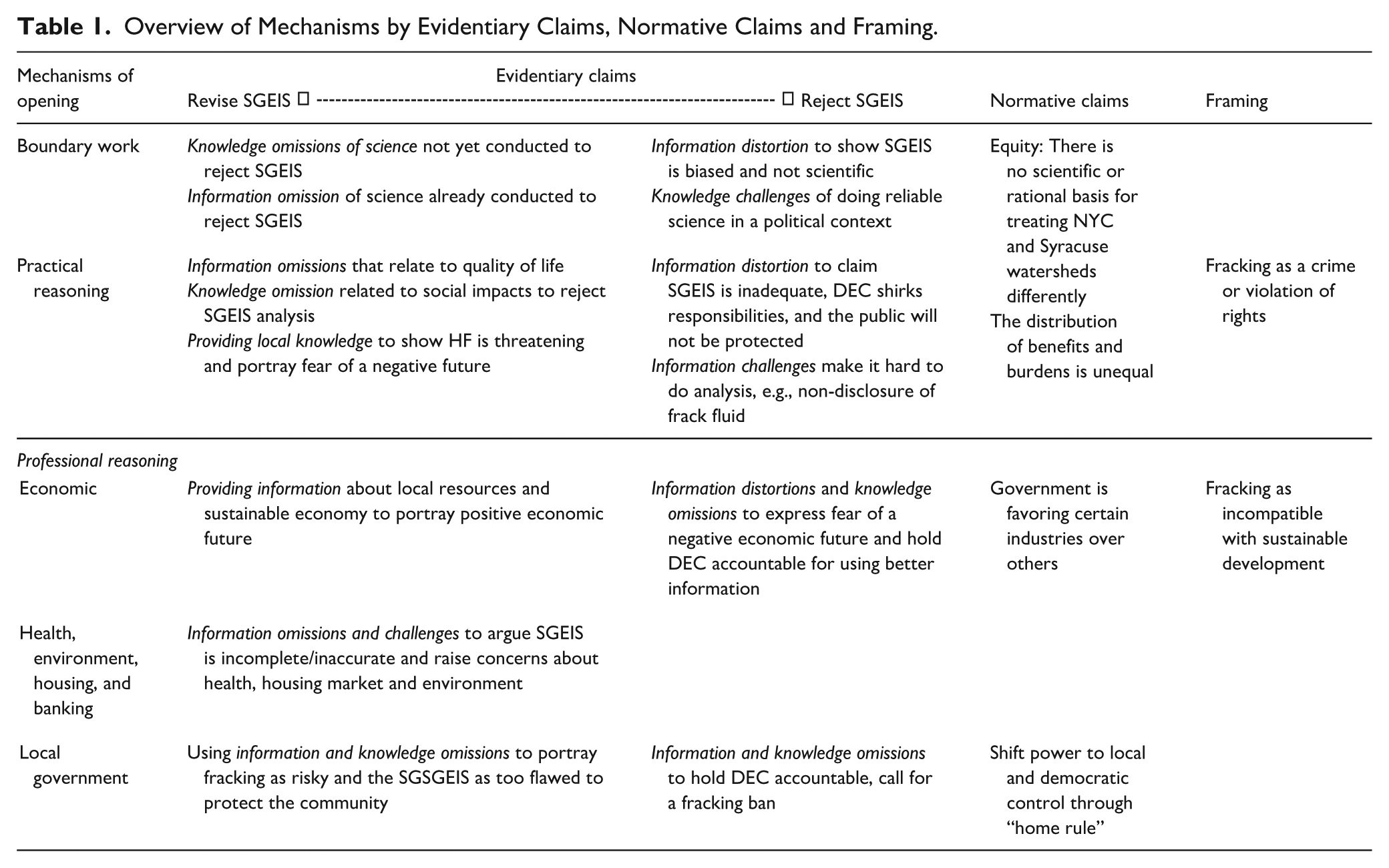
The following themes trace a range of arguments testifiers raised at the hearing in this context. As shown in Table 1, moving left to right across rows, arguments make either evidentiary claims to revise or reject the SGEIS, purely normative claims, or claims to reframe other arguments. All quotes are from the hearing transcript (TCCOG, 2011).
Overview of Mechanisms by Evidentiary Claims, Normative Claims and Framing.
Boundary Work
Several scientists provide testimony that criticize DEC for failing to use sound science, or the latest science, in its analysis of fracking. In doing so, they perform boundary work around what is and is not sound science and use this as the basis to pass judgment on the quality of the SGEIS analysis.
The speakers’ arguments are based on information and knowledge deficiencies that show how the SGEIS is flawed. First, some scientists identify serious knowledge omissions, such as a lack of analyses that to date have not been conducted. For example, one scientist discusses the toxicity of fracking, and how knowledge about it is missing from the report: “Governor Patterson was right to issue an executive order that created a moratorium until the environmental health risks of fracking can be fully analyzed. The draft SGEIS is not that analysis. Rather than assess the health impacts of fracking, using the protocols of public health science, the SGEIS simply denies that these impacts exist” (p. 32). Mirroring the scientists’ claims, residents and professional speakers also note omissions in scientific knowledge in the SGEIS, including a cumulative impact study, studies of alternatives to fracking, increases in seismic activity, and a public health impact study.
Second, scientists refer to information omissions: omissions of scientific information that already exists or is developing. For example, one speaker notes how the EIS omits recent studies, including his own, about greenhouse gas (GHG) emissions released through fracking activity. “Our work was completely ignored in the SGEIS. But so [were] seven other papers and reports that have come out in the last year. Instead, the SGEIS relies on [an] unpublished fact sheet on the website [of] the Chesapeake Gas Corporation from two years ago” (pp. 22–23). The quote links information omission with another deficiency to make his point: information distortion. Here, he argues that the SGEIS is based on biased and outdated information from a gas producer. Other scientists, residents and professionals also use information distortion to claim that the SGEIS is biased. For example, one resident, in addition to calling DEC’s actions “scientific fraud,” implicitly links this to industry capture when he says that the DEC will disregard information contrary to approving fracking:
. . .you have already heard some of the inaccuracies in the drafts SGEIS[.] [P]lain disregard of various studies and data contrary to the agenda of approving hydraulic fracturing amounts to scientific fraud. [A scientist] talked about that, it was ignored, . . .the Duke study which talked about [methane] migration to the wells. . .. The DEC decided to ignore 90 percent of the results and look at just nine wells in New York, and say[,] [‘]this is one active well in New York, it doesn’t have a methane problem, what’s the big deal[?’] They are ignoring all the statistically relevant data. . .
This is not good enough and needs to be redone (pp. 66–67, italics added).
Finally, speakers also note several knowledge challenges in doing reliable scientific analysis in a political context. For example, one speaker refers to the difficulty of balancing science and politics and argues that politics often suppresses scientific information, specifically referring to methane migration that contaminates water through non-disclosure of fracking fluids. In particular, he states:
The dogma is many deep layers of rock separate the fracked zone from aquifers, so it is impossible for fracking fluid or methane to migrate up that far. The supporting evidence is that supposedly no contamination has been proved to occur in 60 years of fracking. Not true. And even if it were accurate, not legally proved does not mean it never happened. Especially when legal resources heavily favor the corporation and the potential litigants are pressured to sign nondisclosure agreements. . .. . . .It is still more likely that if contamination did occur, it would not be detected for a long time and that when detected, fracking as the source, would be difficult to prove in court. How long did it take to prove tobacco affects health? (pp. 182–184, italics added).
Across these four aspects of boundary work, speakers negotiate the boundaries between science and politics, and raise a series of challenges at this boundary. One speaker simply says, “By the way, in the face of poor science some emotion may be appropriate” (TCCOG, 2011, p. 85). Another notes that if the report is not based on science, the only response is political: fund organizations that are fighting against fracking. While scientific boundary work can reorient decision making toward more scientific knowledge and information – which can be useful for decision making– these speakers avoid false dichotomies between scientific and normative bases of decision making, suggesting the need to find a better way to integrate scientific and normative reasoning.
Practical Reasoning
Several residents use practical reasoning to note flaws in the SGEIS. They employ logic to integrate various forms of information and knowledge, often local knowledge about local conditions or what was generally known about fracking at the time. Rather than shifting the boundaries between science and politics, these arguments are tied to shifting power toward the people and their democratic rights to decide what should happen in their community.
First, speakers identify information and knowledge omissions in the SGEIS analysis that show speakers’ concerns with the negative consequences for their quality of life. As one woman put it, “The revised SGEIS does not have any mention of my three-year-old son, the air he breathes and the water he drinks, bathes and swims in” (pp. 168–169). In doing so, residents engage in practical reasoning to show the report’s quality does not hold up to practical scrutiny. Further, they call on DEC to honor lived experience and practical reasoning as relevant for making public decisions.
Residents use knowledge omissions to reject the SGEIS analysis and to argue it is deficient. They refer to omissions in local knowledge about how fracking destroys lives and about social impacts, such as being forced into a position to sue one’s neighbors. One resident even calls these omissions criminally negligent. “DEC’s document is abysmal. There is so much missing, no health study, no cumulative impact study. No mention that extreme natural gas extraction has destroyed towns and people’s lives all across the nation. What makes you think it could be different here?” (pp. 82–83).
Second, residents provide local knowledge (learned from their own experience) to make several arguments against fracking. For example, they contend that fracking is a threat, building on local knowledge linked to other sources such as the occurrence of accidents in other states that led to water contamination, the large-scale usage of chemicals in the fracking process, and the threat to human and animal health. To illustrate, one resident states:
I’ve studied the watershed map for Six-Mile Creek, it’s big. Ithaca’s water comes from an area that includes about a third of [the town of] Caroline, two chunks of Dryden, part of Danby, and part of the town of Ithaca. I also looked at the map that shows gas leases in those areas, and saw that a great deal of land has been leased to the gas companies. Many experts have told us that the biggest environmental threat of water contamination is from human error that leads to surface spills. If drilling is allowed in Ithaca’s watershed, we know from Pennsylvania’s experience that accidents would [happen] – like overturned trucks, faulty valves on storage tanks and leaking open pits would carry contamination downhill to the nearest valley and creek (pp. 18–19).
Residents also provide local knowledge to portray the future, making claims about the negative transformation of their quality of life. This knowledge ranges from the decline in property values and the inability to sell developed property, to neighbors suing neighbors rather than gas companies for property damage, and to bankruptcy due to lawsuits against large corporations. The speakers conclude that these negative impacts will simply ruin and destroy towns.
Similar to the scientists doing scientific boundary work, these speakers made claims about information distortion and information challenges to reject the EIS analysis.
Third, several speakers from different backgrounds make two distinct normative claims about equity. The first raises the inequity of treating the NYC and Syracuse watersheds differently than other watersheds in the state. The second is about who will pay the costs and enjoy the benefits of fracking, noting a deep imbalance that will negatively affect the region. For example, one resident argues:
All New Yorkers deserve safe drinking water. Although major watersheds receive some protection, hundreds and thousands of New Yorkers have private wells and are not geographically close enough to use any water treatment facilities. If their water is contaminated, they will have no safe water. This issue must be addressed by the SGEIS. It is not reasonable to expose the Southern Tier and the Finger Lakes to the dangers of drilling when it has been ruled unsafe for other areas (pp. 156–157).
Other residents and local government officials raise concerns about the costs of fracking, such as environmental damage and higher taxes, and claim that rural residents will bear most of those costs while not seeing any (financial) benefits, such as funding for new public facilities.
Finally, activists frame fracking as a crime that robs residents of their health and economic prosperity or violates people’s rights where profit reigns over people. In one example, a documentary filmmaker offers a long list of reasons why fracking is a crime: “. . .Fracking is a crime since gas companies only treat a small fraction of their colossal waste while the bulk of it is run through sewage treatment plants that are not designed to process toxic waste, or it is illegally dumped or it is passed off as a safe alternative for snow removal and dust control for roads. . .. (p. 132).
Professional Reasoning
Testifiers who identify themselves as residents with professional identities (such as winemaker, food producer, or farmer as well as environmental and health professionals and local government officials) use evidence to make different claims according to the speaker’s background.
Economic Professionals
Economic professionals raise concerns about how fracking will impact the local economy. They link information and knowledge to political claims in three distinct but inter-related ways. First, they provide information in the form of local knowledge to portray the region as already thriving economically from sustainable agriculture. For instance, one speaker highlighted the economic value of the wine and grape industry: it “has an economic impact in the state of over $3.76 billion” (p. 142). They further argue that if these assets are protected (the natural basis supporting sustainable agriculture and sustainable agriculture itself), then the existing green economy could thrive in the future.
Second, these speakers criticize the SGEIS for information distortions and knowledge omissions related to its economic analysis and its bias in favor of the gas industry. This, they argue, represents DEC’s failure to faithfully implement its mission, which will not protect the area but transform it into an industrial zone with deeply negative consequences for existing businesses in sustainable agriculture. As a vineyard owner puts it, “Industrialization will ruin tourism and the wine industry” (p. 181). Further, in raising fears of a negative future, testifiers hold DEC accountable for its moral responsibility:
This will likely bankrupt not only the Finger Lakes, but possibly the whole state economy. How will that go over, Governor? Why not instead promote sustainable, local jobs? People can [live] without gas. They cannot [live] without clean water, clean air and safe food. As currently written, your SGEIS will not safeguard our future. You’re the Department of Environmental Conservation. What happened to your moral responsibility to the environment? (p. 144).
Third, a local activist and maple syrup business owner makes a normative claim about the government favoring one industry over another:
How is it that my small, struggling business which sustains families, preserves and enhances the landscape, generates tourism and educates the community is any less valuable than one with a track record of worker safety violations, environmental destruction and a history of deceit preying on landowners in order to gain access to their mineral rights[?] (p. 94).
Finally, speakers frame fracking as incompatible with sustainable economic development. For these speakers, the costs of fracking outweigh its benefits, elevating a trade-off between environmental values and gas drilling: “Why should we trade this green healthy economy for one that pollutes, that has a negative impact on our health and on our jobs?” (p. 51). These resident-professionals call to shift power away from governmental decision makers toward members of the public and democratic decision making. Importantly, this is based on arguments that governing agencies are not considering normative issues that are often organized out of “rational” decision making based on a narrow notion of evidence and reasoning.
Other Professionals
Other professional speakers highlight DEC’s inability to mitigate the potential threats of fracking and to protect local communities.
Health professionals point out information omissions raising health-related concerns and, in general, conclude the SGEIS is incomplete and inaccurate. For example, a physician and endocrinologist identifies several information omissions about the effects of fracking on human health, such as the endocrine and metabolic disruptions of exposure to toxins, and the effects on pregnancy, birth defects, and occupational health for industrial workers. He also refers to a lack of references to training of health care providers, management of patients exposed to pollutants from fracking, and the role of hospitals in mitigating adverse health effects.
Environmental professionals highlight the incompatibility between the estimated GHG emissions and the carbon emission reduction goals in the SGEIS, expressing fear of a negative future. Meanwhile, professionals from the mortgage industry refer to existing conflicts between fracking and long-standing mortgage regulations, which may negatively impact the market for residential homes. Realtors also refer to the lack of information about the impact of fracking on property values. Yet, they do not call for an outright fracking ban but ask DEC to be consistent with existing regulations.
Local Government
Finally, local governments use professional reasoning, based on their knowledge and expertise as public officials, to highlight DEC’s irresponsibility, holding it to account for not doing its job. Further, they refer to the inability of the SGEIS to mitigate potential threats and to protect local communities, therefore creating a very negative future.
In general, government officials’ arguments are based on information and knowledge omissions on a broad array of topics that include the lack of a socioeconomic analysis that quantifies negative impacts of drilling, full disclosure of chemicals used in fracking, impact assessments of health, water resources and truck traffic, an analysis of effects on rural landscapes and lifestyle, and knowledge on thresholds for sustaining human and natural environments without permanent damage, among others. Some omissions are distinct to local governments, such as the cost they bear and the lack of a plan to clean wastewater. For example, one town representative claims, “. . .local governments are already bearing a huge and very expensive burden in preparation for the possibility of high[-]volume hydrofracking. Responding to an issue of this magnitude requires time and money, but local governments, many are small, [and] along with the majority of its residents stand to benefit little to none” (p. 31).
Further, most speakers list information and knowledge omissions to indicate how flawed the SGEIS is and to call for a fracking ban because it is too risky. One member of a local gas drilling task force states:
Until the industry extracting and distributing unconventional gas resources uses and pays for a technology proven to be compatible with agriculture and tourism, [. . .and. . .] a technology proven to be without threat to public health, without threat to the region’s fresh water supply and without committing New York State to decades of greenhouse gas degradation. Until that time there is only one choice, get on with the serious business of building sustainable industries, protecting water, our most valuable resource [. . .] and ban fracking in New York State (pp. 126–128).
Finally, local governments call for home rule, which would empower local communities to make decisions on fracking independently of state policy. For example, one speaker says, “. . .until and unless a more benign technology is developed and required, fracking should not be permitted. . .. If a total ban can’t be achieved, the DEC should honor local home rule, as many other states currently do. Home rule would place the decision of whether to allow drilling at the local level. . ..” (pp. 16–17). These speakers provide professional knowledge about potential negative impacts of fracking by listing its threats and risks and by identifying information or knowledge gaps in the SGEIS.
Discussion
The implications of these results are twofold: first, participants used evidence and normative arguments to establish an alternative interpretation of fracking than the DEC’s, reframing fracking not as a solution to New York’s economic and energy needs but as an unacceptable risk to human health and the environment. Second, the public hearing became an arena in which participants – both citizens and organized public interest groups – could dispute DEC’s evidentiary claims about the environmental impacts of fracking and express alternative evidentiary claims, for instance stemming from science, local knowledge, or normative reasoning about democratic participation in environmental decision making. It is the use of the public hearing in this instance that transformed what could be a routine procedure into a vibrant “technological zone” (Barry, 2012) for challenging the normative basis of regulatory analyses, thus holding bureaucratic agencies to account in the moment (Bovens, 2010). A major takeaway from this analysis is that normative and factual claims become integrated – through boundary work, practical reasoning, and professional reasoning – in a way that makes visible the limiting assumptions an agency places on administrative decisions and why they are problematic. These three mechanisms of opening, in this case, politicized the hearing, challenging the DEC’s use of discretion. By juxtaposing an agency’s limiting assumptions with these forms of reasoning, testifiers provide an alternative interpretation of an issue, marking it as non-routine and in need of greater scrutiny (see also Jewell & Bero, 2007).
Our analysis informs two debates in the literature on public hearings. First, although answering whether public hearings influence agency decision making is an important question (e.g., Adams, 2004; Chess & Purcell, 1999; Cole & Caputo, 1984), our results suggest that we need to better understand what happens in public hearings as a process of holding to account (e.g., Buttny, 2019; Jewell & Bero, 2007). This study contributes by showing what arguments were presented in this public hearing and how they were constructed to refute the evidentiary and normative claims of a public agency and to propose alternative interpretations.
Second, and closely related, is that our findings suggest public hearings can function as an accountability mechanism for citizens and organized public interest groups (Almer & Koontz, 2004; Golden, 1998; Gormley, 1986). Yet, this is not a foundational or essential feature of public hearings per se, but a political accomplishment. Public hearings, then, will not always serve as public accountability mechanisms; the conditions must be right for this to happen. The mechanisms we identified are the means by which citizens and organized public interest groups hold public agencies accountable for their analyses in public hearings, which involves politicizing the issues so they receive greater scrutiny: by challenging the limiting assumptions agencies place on administrative decision making, making those visible, and contrasting them with other forms of reasoning. The mechanisms are the means by which hearings can be opened (Couch & Kroll-Smith, 1997; Eden, 1996; Epstein et al., 2014; van Eeten, 1999) rather than staying closed, symbolic, or performative (Lennon, 2014; Pearce, 2014). Thus, achieving public accountability through public hearings takes particular effort on the part of participants. This suggests not (only) that public accountability can take place when there are non-routine matters at stake (such as fracking), but when participants articulate that a matter is non-routine and thus deserves heightened public scrutiny.
These findings are consistent with the hearing literature that observes that opening can occur when agencies fail in some way such as sidelining normative issues (e.g., Almer & Koontz, 2004; Chess & Purcell, 1999) or when citizens and organized groups make concerted efforts to influence hearings through organized action (Checkoway, 1981; Gormley, 1986). What we add is a deeper understanding of the mechanisms by which this occurs and how normative and factual claims become integrated to open hearings in particular ways. In the fracking case, we saw that scientific boundary work involved avoiding false dichotomies between scientific and normative bases of decision making and negotiating – not denying – the messy boundaries between science and politics. Practical reasoning was presented to emphasize knowledge of local conditions and to shift power toward the people and their democratic rights to decide what should happen in their community. Testifiers used professional reasoning to raise negative impacts for different sectors, including the economy, public health, the environment, and local government, and to shift attention toward local decision making.
We expect these mechanisms of opening – boundary work, practical reasoning, and professional reasoning – will transfer to a variety of administrative hearings at different levels of government and across a variety of policy issues when participants seek to challenge the limiting assumptions public agencies place on administrative decisions. It seems likely that we might see similar testimony on a range of environmental issues, but also in other policy areas. For example, testimony about regulating cannabis, enforcing abortion bans, or eliminating gender affirming health care may involve knowledge-intensive conflicts and raise normative questions on which there are deep disagreements. Testifiers at hearings on cannabis may raise a range of evidentiary and normative claims to create more or less strict regulations or to prioritize certain values over others, such as whether veteran-owned or minority-owned businesses should be given priority for licensing cannabis shops. Medical researchers may draw boundaries around good science to weigh in on factual issues such as effects on brain development, while others may engage in practical reasoning to express concerns about impacts on children or to raise purely normative issues about allowing mind-altering substances to be sold near schools. Medical professionals may alert people to health impacts of sustained use, or economists may highlight positive economic impacts and even crime reduction effects. These mechanisms would serve to scrutinize agency’s limiting assumptions on administrative decisions and make them visible, thus holding an agency to account for its use of discretion. From a qualitative, interpretive perspective, particular features of the mechanisms of politicization may have variations. For instance, the cannabis case may not involve efforts to shift decision making authority away from agencies to citizens or the public. Other cases can be useful for extending the theory to elaborate the conditions under which such shifts might be more likely.
These diverse possibilities raise a normative question about whether and when politicization of public hearings is desirable. In contemporary US society and elsewhere, many issues have become politicized, suggesting this is a pressing concern. Whether politicization is desirable may depend on specific circumstances and thus must be assessed in context. Even so, certain principles can serve as guides. Key considerations include whether politicization of hearings raises criticisms of agency behavior that are well founded in evidence and normative reasoning about effectiveness, efficiency and equity – the three pillars of public administration (Frederickson, 1980), especially if they cause considerable harm or injury. On the other hand, politicization may not be desirable when it masks harms, unjustly protects “rents” or benefits for powerful actors at the expense of others, and so on. This normative question is complex and is an important area of future research in its own right.
Conclusion
This analysis shows that testifiers present a range of evidence not only to inform administrative decision making but also to contest the evidentiary and normative claims DEC made in its proposed rules on fracking. They offered alternative evidence and alternative interpretations of DEC’s evidence, based on their normative claims about the inappropriateness of fracking as a form of energy production in New York. We identified several mechanisms through which participants criticized DEC’s evidentiary and normative bases for decision making and offered alternatives: boundary work, practical reasoning, and professional reasoning. Both boundary work and professional reasoning involve articulating information and knowledge omissions to claim agency analyses were inadequate. They also involve articulating information distortions and knowledge challenges/omissions to reject the agency analyses as non-scientific or as an inappropriate use of centralized power, respectively. In contrast, practical reasoning, among other things, integrated information based on local knowledge of residents’ experiences with practical reasoning about the risks of fracking (as something threatening) to reject DEC’s analyses. In addition, all these mechanisms raise purely normative questions about fairness and question the legitimacy of agency rules and the pending decision to allow fracking.
Future research could examine, across a range of cases, whether politicization of public hearings explains different degrees to which citizens and organized public interest groups use hearings to hold agencies accountable, or if these are overridden by other factors. It could also examine how different types of evidence shape the process of holding public agencies to account or how public agencies use the evidence presented in public hearings. Given that prior research suggests that hearings may be more influential in the environmental field (Chess & Purcell, 1999; Gormley, 1986), it is important to ask these questions across policy domains where other knowledge intensive conflicts might occur.
Supplemental Material
sj-docx-1-aas-10.1177_00953997251409159 – Supplemental material for Political Interpretation of Evidence in Contested Agency Hearings: The Politicization of Hydraulic Fracturing in New York
Supplemental material, sj-docx-1-aas-10.1177_00953997251409159 for Political Interpretation of Evidence in Contested Agency Hearings: The Politicization of Hydraulic Fracturing in New York by Jennifer Dodge, Mila Gascó-Hernandez and Ju-Ying Yang in Administration & Society
Supplemental Material
sj-docx-2-aas-10.1177_00953997251409159 – Supplemental material for Political Interpretation of Evidence in Contested Agency Hearings: The Politicization of Hydraulic Fracturing in New York
Supplemental material, sj-docx-2-aas-10.1177_00953997251409159 for Political Interpretation of Evidence in Contested Agency Hearings: The Politicization of Hydraulic Fracturing in New York by Jennifer Dodge, Mila Gascó-Hernandez and Ju-Ying Yang in Administration & Society
Supplemental Material
sj-docx-3-aas-10.1177_00953997251409159 – Supplemental material for Political Interpretation of Evidence in Contested Agency Hearings: The Politicization of Hydraulic Fracturing in New York
Supplemental material, sj-docx-3-aas-10.1177_00953997251409159 for Political Interpretation of Evidence in Contested Agency Hearings: The Politicization of Hydraulic Fracturing in New York by Jennifer Dodge, Mila Gascó-Hernandez and Ju-Ying Yang in Administration & Society
Footnotes

Funding
The authors disclosed receipt of the following financial support for the research authorship, and/or publication of this article: This research was supported by the Faculty Research Awards Program at the University at Albany.
Declaration of Conflicting Interests
The authors declared no potential conflicts of interest with respect to the research, authorship, and/or publication of this article.
Data Availability Statement
The hearing transcript is publicly available at the New York State Department of Environmental Conservation.
Supplemental Material
Supplemental material for this article is available online.
Notes
Author Biographies
References
Supplementary Material
Please find the following supplemental material available below.
For Open Access articles published under a Creative Commons License, all supplemental material carries the same license as the article it is associated with.
For non-Open Access articles published, all supplemental material carries a non-exclusive license, and permission requests for re-use of supplemental material or any part of supplemental material shall be sent directly to the copyright owner as specified in the copyright notice associated with the article.
