






Abstract
What does a more trust-based governance reform look like in practice? This qualitative, exploratory study contributes to a relational view of reform design and implementation. Findings from documents and semi-structured interviews with municipal managers were analyzed using a theoretically developed framework for maintaining and building organizational trust through governance reform. The studied trust reform had an open design, and managers were given high organizational autonomy. The analysis shows that a trust reform paradoxically needs to be built with trust, with a combination of local organizational autonomy, increased clarity in the design specifications from central authorities, and/or organizational support and guidance.
Keywords
Introduction
As governments worldwide struggle with excessive regulations and reporting requirements as well as siloed organizational structures that can hinder collaboration across disciplines and sectors (Fukuyama, 2012; OECD, 2020), the field of public administration has taken a relational turn (Bartels & Turnbull, 2020; Boztepe et al., 2024). Meanwhile, gaining “a deeper understanding of the interface between uncertainty and trust is needed” (Schilke et al., 2026, p. 359) and building and maintaining internal and external trust is of global relevance (Fukuyama, 1995; Rothstein, 2005).
Public reform attempts have been directed toward establishing trust-based internal mechanisms through increasing local autonomy (and trusting in local actors’ ability to make sound judgments). In this study, we explore some of the organizational dynamics within a trust-based and process-oriented governance reform aimed at increasing both organizational and professional autonomy (Johnsen & Svare, 2024a).
Organizational trust can reduce complexity (Luhmann, 2005), enhance decision-making, collaborative processes, and efficiency and innovation in the public sector (Elster, 2007; Möllering, 2006; Nyhan, 2000; Rousseau et al., 1998). Internal organizational trust can also have a positive impact on external trust building with other organizations and citizens (Hasche et al., 2021). Besides organizational trust (Bentzen, 2018), studies have shown that increasing autonomy depends on factors such as local organizational capacity (Fukuyama, 2012) and specific reform capabilities (Moen & Kjekshus, 2026).
In Scandinavian countries, so-called trust reforms have been launched as a counter response to New Public Management (NPM), which in some countries has resulted in extensive control arrangements that can affect the internal motivation of employees and the production of services (Bentzen, 2021, 2022; Berg, 2005; Grand, 2010; Schilke & Cook, 2013). The Scandinavian focus on trust-based reform design and the introduction of trust-based governance and management (TBM) has resulted in various experiments intended to improve public governance and maintain internal and external trust (Bentzen & Winsvold, 2025; Peters, 2021). This study contributes to these efforts by exploring how reform design and local organizational processes can influence organizational trust.
Specifically, we examine the design and implementation of a municipal governance reform seeking to combine reform and organizational trust within home-based services in Oslo municipality, exploring how it was translated into practice (Czarniawska-Joerges & Sevón, 2013; Sahlin & Wedlin, 2017) in three geographical districts. We examine how reform design can impact the conditions for reform work and highlight the local tensions between autonomy and specifications that local managers need to navigate when central authorities launch a vague reform.
This study is relevant beyond the Scandinavian context as it increases knowledge on relational and post-NPM reform attempts related to the New Public Governance (NPG)-paradigm (Osborne, 2006; Torfing & Triantafillou, 2013). In a sense, the Scandinavian reforms represent a live laboratory for such reform efforts, on which extensive research has been conducted. To our knowledge, no studies have explored how municipal managers have experienced the increased organizational autonomy that comes with the design and implementation of Norwegian trust reforms, in relation to the concept of organizational trust within organizations.
Although managers cannot instill trust by decree, research of another public reform suggests that they can cultivate a climate in which trust takes root by balancing openness with authority (Klemsdal & Kjekshus, 2021). This study elucidates how central authorities and local managers can contribute to cultivating (Möllering, 2006) organizational trust through open-ended reform. Specifically, it examines the following question: How do municipal managers navigate the tensions between specification and autonomy when implementing an ambiguous trust reform with an open design?
Scandinavian Trust Reforms
The Scandinavian countries have been described as possessing high “reform optimism” as well as “agile and adaptive” governments, resulting in layered reform models and hybrid public organizations (Christensen et al., 2024; Greve et al., 2020). Scandinavian trust reform initiatives over the last two decades can be described as a movement from a governmental regime based on NPM principles toward NPG, which places a stronger focus on relational trust (Bouckaert, 2012). This shift is intended to improve self-governance and self-leadership by increasing subordinates’ autonomy, delegating decision-making, and involving subordinates further in decision-making processes (T. Bentzen, 2018).
In practice, the Scandinavian trust reforms have been broad in terms of their scope, ambitions, and reform ideas and activities (Siverbo et al., 2024), making it difficult to evaluate them or compare outcomes. Breimo et al. (2025) found that in Norway, municipalities have interpreted and implemented trust in very different ways; some have decentralized decision-making to frontline workers or focused on cocreation with citizens, while others have introduced structural changes (e.g., flatter hierarchies) or stressed cultural change. The municipal trust reform that we studied was ambitious, in encompassing all the ways of working with trust and reform just mentioned. At least through 2024-25, Norwegian reform attempts have generated corrections in how governance and management is conducted rather than significant transformation (Johnsen & Svare, 2024b; Siverbo et al., 2024).
Much like Bentzen and Winsvold (2025) and Breimo et al. (2025), who studied Scandinavian attempts to combine trust (expressed as increased autonomy) and governance reform, we observed that the managers in our study needed to navigate organizational tensions. These tensions have been described as dilemmas (Breimo et al., 2025) and paradoxes (T. Ø. Bentzen & Winsvold, 2025; Slåtsveen et al., 2023) that governments and local organizational actors need capacity to navigate. As with other public reforms, local and strategic anchoring and sufficient time and resources are important for handling dilemmas and paradox (Bentzen & Bringselius, 2023; Breimo et al., 2025; Moen & Kjekshus, 2026). For trust reforms, the following specific reform capabilites seem to be central: capability to design, implement, translate and experiment (Moen & Kjekshus, 2026).
Focusing on Danish and Swedish reforms, Bentzen and Winsvold (2025) found that when trust is viewed as a normative concept, it can catalyze innovation and organizational change if it is related to an “integrative” approach. By connecting paradox theory with magical concepts (Pollitt & Hupe, 2009), the study suggested that an integrative approach implies that organizational actors manage to integrate paradoxes, such as finding a suitable balance between autonomy and control. By contrast, in a “defensive mode,” the actors cannot strike such a balance. Bentzen and Winsvold (2025) characterized the Norwegian trust reform initiatives they studied as defensive and the Danish reform as integrative.
Study Context: Home-Based Services in Oslo City
Norway is traditionally known for being a “high trust” country (Fukuyama, 2012) and like other Nordic countries, it traditionally scores relatively high on trust in the national government and public institutions (OECD, 2022). The Scandinavian working-life model cultivates high levels of trust by balancing codetermination and governance (Kjekshus, 2020). Co-workership (Andersson et al., 2021), transparency and openness, and strong, highly autonomous local governments are also typical of the Scandinavian countries (Bouckaert et al., 2017).
Like local governments elsewhere in Scandinavia, the Oslo municipality has relatively high autonomy (Bouckaert et al., 2017). Oslo is both the Norwegian capital and the largest municipality in the country. It is divided into 15 administrative districts, each with a locally elected district council responsible for a wide range of services, including schools, elderly care, and primary health services. Oslo municipality is the only Norwegian municipality organized by parliamentary system like the Norwegian government. We therefore use the concept “local autonomy” and “central authorities,” even if these consepts often are associated with central–local government relations.
There are, however, some nuances to the initial description of trust. A recent OECD (2022) study reported that Norway had the largest decrease in citizens’ trust in their national government of all OECD countries (OECD, 2022), and a Norwegian study found that trust within organizations varies among sectors, with organizational trust being especially low in the health and care sector (Drange et al., 2020). In home-based services, in which our study is situated, this lack of trust has been evinced in extensive monitoring and documentation of the work of front-line professionals (Vabø, 2024; Vallentin & Thygesen, 2017), stimulating a quest for more meaningful control-arrangements (Skov & Rosenberg-Hansen, 2024).
Norway has been known for being a pragmatic and “reluctant reformer.” Yet, reform optimism has increased over the last couple of decades (Christensen, 2005; Greve et al., 2020), and several local trust reforms have been attempted, in addition to a national trust reform launched by the government in 2021. Governing politicians launched the municipal trust reform in Oslo in 2015.
Two years later, in 2017, the Oslo city council introduced government and management by trust as a bearing concept (Citycouncil, 2015, 2017). Within home-based services, the city council presented a “trust-based model” as a new way of organizing services for elderly people living in their own homes. The model, which an alternative to the purchaser–provider model (PPM), relies on decisions made by self-governed interdisciplinary teams rather than in small separate units.
Employee empowerment and user involvement were important aspects of the “trust-based model,” with the provided services based on what service users considered important (Eide et al., 2018). Other central reform elements in the sector include introducing TBM and governance through distributing autonomy and decision-making to frontline professionals, ensuring that the services have sufficient resources, and encouraging caregivers to practice openness and dialog and to take measures to raise competence and anchoring (Citycouncil, 2015).
Norwegian reform processes are often characterized by bottom-up processes (Greve et al., 2020). The “trust-based model,” which was developed with the involvement of both employees and service users, can be described as an organizational, user-driven innovation in the municipal sector that is intended to identify new and better ways of organizing working tasks (Eide et al., 2019).
In developing this reform, Oslo politicians were inspired by Denmark, particularly Copenhagen, which has worked to de-bureaucratize and eliminate unnecessary controls (Bentzen, 2021; Vallentin & Thygesen, 2017). In addition to Copenhagen, the governing politicians and central authorities traveled to the Netherlands to learn from the Buurtzorg-model. The central authorities established a structure for the reform work with a central pilot program and follow-up evaluation (Eide et al., 2018) of the pilot. The competence unit in the municipality also offered some teaching in TBM. Other economic resources that granted by central authorities to support the trust reform in home-based services included increases in resources and competence for all types of professions in the 15 city districts (during the period 2015–2019) and in increase in managers (Schanche et al., 2022).
When the Oslo city council in Oslo guidelines for the reform in 2017, it introduced TBM and governance as bearing concepts, and framed trust as both a strategy and a new way of working. The stated objectives were to increase collaboration (between the citizens and the municipality, and within the municipality), bring attention to results, and the capacity to create better services for the citizens (Citycouncil, 2017).
Other objectives included decreasing so-called “stopwatch care,” which refers to the time pressure involved in professional care work (Byrådserklæring, 2019–2023), by replacing it with a new and more trust-based way of working that involves interprofessional collaboration (Eide et al., 2018, 2022). This in contrasts with the previous PPM-model, in which contracts managed providers’ operations and third-party payers were kept organizationally separate from service providers (Tynkkynen et al., 2013).
Theoretical Perspective on Cultivating Trust During Reform Work
Since there are dilemmas and paradoxes related to how to implement (top-down) organizational and management ideas and still ensure local autonomy, our findings are framed by the idea that, during reform work, central authorities or top managers can cultivate and foster organizational trust by striking a deliberate balance between autonomy, encouraging employee involvement and participation as well as issuing minimal specifications (Klemsdal & Kjekshus, 2021). By applying a multidimensional and dynamic view of organizational trust and public reform, we consider organizational trust and governance reform an open-ended and active phenomenon that develops continuously through processes and over time (Möllering, 2006; Schilke & Cook, 2013).
Reform Design
Public reform can be defined as “deliberate attempts to change the structures, processes, and/or cultures of public sector organizations with the object of getting them (in some sense) to run better” (Bouckaert & Pollitt, 2017, p. 2). Reform work is influenced by the historical and societal context, and the chosen reform design and reform strategies can affect both political and organizational trust (Klemsdal & Kjekshus, 2021; Stein et al., 2023). In addition, the local organizational capacity (Fukuyama, 2012) or—in this case—reform capability (Moen & Kjekshus, 2026) should be considered when organizational autonomy is delegated.
The municipal trust reform represents an example of how the field of organizational design, is influenced by new and more relational ways of working with design of the public sector (Boztepe et al., 2024). Design can offer a way to navigate organizational tensions (Striegler et al., 2025), and reform design is related to how the political and administrative leadership initiates, decides, and organizes the execution of reforms (Nygård & Blindheim, 2021). Since reform design includes the conditions for reform work, it encompasses choices of reform design (Nygård & Blindheim, 2021) and change design (Meyer & Stensaker, 2006).
This study is inspired by the framework of how to design public reforms for maintaining trust that Klemsdal and Kjekshus (2021) developed. They showed that managers can contribute to the maintenance and cultivation of organizational trust by balancing openness (involvement and participation of employees) and authority (minimal but critical specification and instructions). The framework suggests that a reform design with plans that are minimal rather than specified increases the potential for participation because it creates space for employees to engage during design and implementation. Openness through minimal specifications about organizational structure also allows managers to adapt to local needs and integrate relevant elements; a reform that is too specific decreases the space for local adaptation (Klemsdal, 2013; Klemsdal & Kjekshus, 2021).
The concept of “minimal critical specification design,” first outlined by Herbst (1993), implies the specification of a minimal set of criteria, a few critical points about what is to be done or created (Amble, 1970; Herbst, 1993). Experiences from another public reform in Norway (reform of the Norwegian Labor and Welfare Organization) suggest that these specifications should be constructive and minimal and should elaborate on how to implement the reform in practice and how to organize and secure both direction and a shared focus (Klemsdal & Kjekshus, 2021).
An Integrated Approach to Governance Reform
Since the Scandinavian governance and reform model is layered and hybrid, incorporating elements from neo-classical Weberian bureaucracy, NPM, and NPG (Bouckaert et al., 2017; Christensen et al., 2015; Vallentin, 2025), a trust reform can produce competing institutional logics (Håkansson, 2022) which requires an integrated approach to governance reform (Bentzen & Winsvold, 2025).
Rather than necessarily eliminating organizational tensions or paradoxes, the trust reforms often resurface old contradictions such as professional autonomy versus accountability, standardization versus professional judgment, professional discretion versus service equity, specialization versus coordination, central steering versus local flexibility, efficiency versus relational work, and trust versus control (T. Ø. Bentzen & Winsvold, 2025; Breimo et al., 2025; Edelenbos & Eshuis, 2012; Fimreite & Hagen, 2009).
These contradictions can result in critical organizational tensions that managers need to handle during the reform work. Managers balance tight ropes (Mintzberg, 2013) and their capability to handle tensions produced by an open, trust-based reform design (such as those between trust and control, autonomy and accountability, voluntary and forced reform, and top-down and bottom-up processes) can also affect the development of organizational trust and reform outcomes.
As with other organizational tensions or dilemmas, navigation of change is a frequently used concept (Striegler et al., 2025), and the search for a suitable balance point can be an ongoing process, depending on situational contingencies (Klemsdal & Kjekshus, 2021). Still, in relation to the paradoxes that we discuss between autonomy and specification and trust and control, it will in practice not be easy to strike the “perfect” balance. Li (2021) presents nine different thinking patterns in relation to paradox. Li interprets March’s “logic of appropriateness” (March et al., 2008)—that we are influenced by norms and values and not necessarily the choice that provides the largest utility — in relation to organizational tension or paradox suggests that there is not necessarily an optimal balancing point. Inspired by March Li also introduced the category “neither/nor,” emphasizing how, in practice, it can lead to the introduction of new terms, such as the March and Olsen phrase “organized anarchy” in relation to decision making.
Following the notions of balancing or navigating organizational change, we further develop the Klemsdal/Kjekshus framework. When analyzing the municipal trust reform, we use the concepts autonomy and design specification to explore the organizational tensions and paradox related to a governance reform attempting to “build trust with trust.” Figure 1 outlined a conceptual framework for analyzing the trust reform.
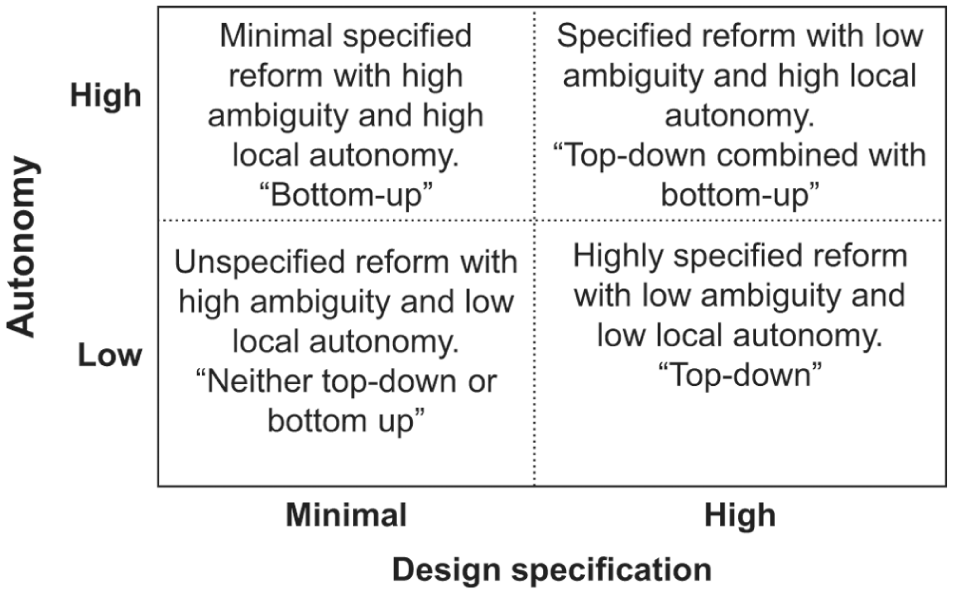
Conceptual framework for analyzing a trust reform.
Design specification is the degree of specification of the reform (Klemsdal & Kjekshus, 2021), while autonomy, viewed as an invitation to trust (Johnsen & Svare, 2024a), relates to the increase that municipal managers receive in organizational autonomy to design and implement the trust reform.
Creating a Space for Organizational Trust to Develop
In the public sector, local managers play a pivotal role in enabling the practical functions of trust (Oomsels et al., 2019). While trust is a multidimensional, cross-disciplinary concept, scholars agree both that trust can be defined as the willingness to be vulnerable “to the actions of another party” due to positive expectations and that risk/uncertainty and interdependency are necessary conditions for trust to develop (Mayer et al., 1995; Rousseau et al., 1998, Schilke et. al. 2026). Trust is, therefore, an active decision that implies a willingness to be vulnerable (Möllering, 2006; Vallentin, 2023).
Existing trust research has mainly focused on its relational, rather than institutional/structural, components (Bachmann & Inkpen, 2011; T. Ø. Bentzen, 2022). In this study, organizational trust includes both relational and institutional aspects, with an emphasis on the vertical trust relationship between central authorities and local managers and trust in the institutional reform arrangements. Relational trust develops through communication, social processes, and interactions between individuals or groups and can be influenced by the institutional context and trust-supporting structures. Institutional trust refers to formal, nonpersonal, and institutional structures, such as legal structure and practice, as well as how control is exercised (Bachmann & Inkpen, 2011; Bentzen, 2023).
Here, uncertainty is considered in relation to how public managers experienced the puzzle of facing a trust reform introduced by central authorities and governing politicians with little governance combined with a local scope of action, which allowed for significant local discretion and autonomy in the reform design and implementation. Governance is a task for both managers and central authorities, and we adopt the view that reform governance should take an organizational approach that is at once “at arm’s length” and “within arm’s reach” (Jacobsson et al., 2015). Such an orientation to governance presupposes regular dialog between the trustor (here, the central authority or top managers) and the trustee (top and middle managers or professionals).
Method
Data were collected in one narrative document study and in four semi-structured individual and group interviews (Tjora, 2017) conducted from January 2022 to September 2022 with a total of seven informants. Three interviews were tape-recorded and transcribed verbatim by the first author, and a professional transcriber completed one. The interviews were conducted in Norwegian and translated into English.
Due to the COVID-19 pandemic, the first two interviews were conducted via the Teams digital platform. The interviews lasted approximately 90 minutes, and the data were collected using an interview guide with open-ended questions (Alvesson & Kärreman, 2011), leaving room for the managers to elaborate on topics of their interest. The individual interviews contributed to increased richness and depth in the data, and the discussions in the group interviews provided fruitful reflections on the design and implementation of the trust reform. Transcripts of the interviews have 39,560 words.
The study included managers that had experience with designing and implementing a trust reform at either the operational or strategic level. The participants worked in one of three specified city districts in Oslo. The districts varied in sociodemographic characteristics, geographic location within the municipality, and to some extent in how they organized healthcare services.
We sent requests to participate in the study to eight city districts. Participants in the group interviews knew one another beforehand and worked together as a management team. We were not acquainted with the participants before the interviews. For information on the participants’ backgrounds, see Table 1 in the Appendix. To provide a deeper understanding of the background for and development of the reform, the data were supplemented with a study of relevant documents (see Table 2 in the Appendix).
Ethical Considerations
The study was approved by the Norwegian Agency for Shared Services in Education and Research (reference no. 455825) and the Regional Ethical Committee Norway (reference no. 359228). Participants received written information about the study before the interviews. All interviewees were informed that their participation was voluntary and that they could end their participation at any time without having to give an explanation. The data were safely stored in an external and dedicated space.
Coding and Analytical Approach
The analytical process was inspired by Thompson’s guide to abductive thematic analysis (Thompson, 2022) and continued throughout the interviews, familiarization with data, and reading of the interview transcripts. The interview records, which were transcribed by a professional, were checked against the original audio recording for accuracy. The data extract was sorted and coded through two phases of coding. Table 3 in the Appendix provides an example of the coding that the first author applied to a segment of the raw data.
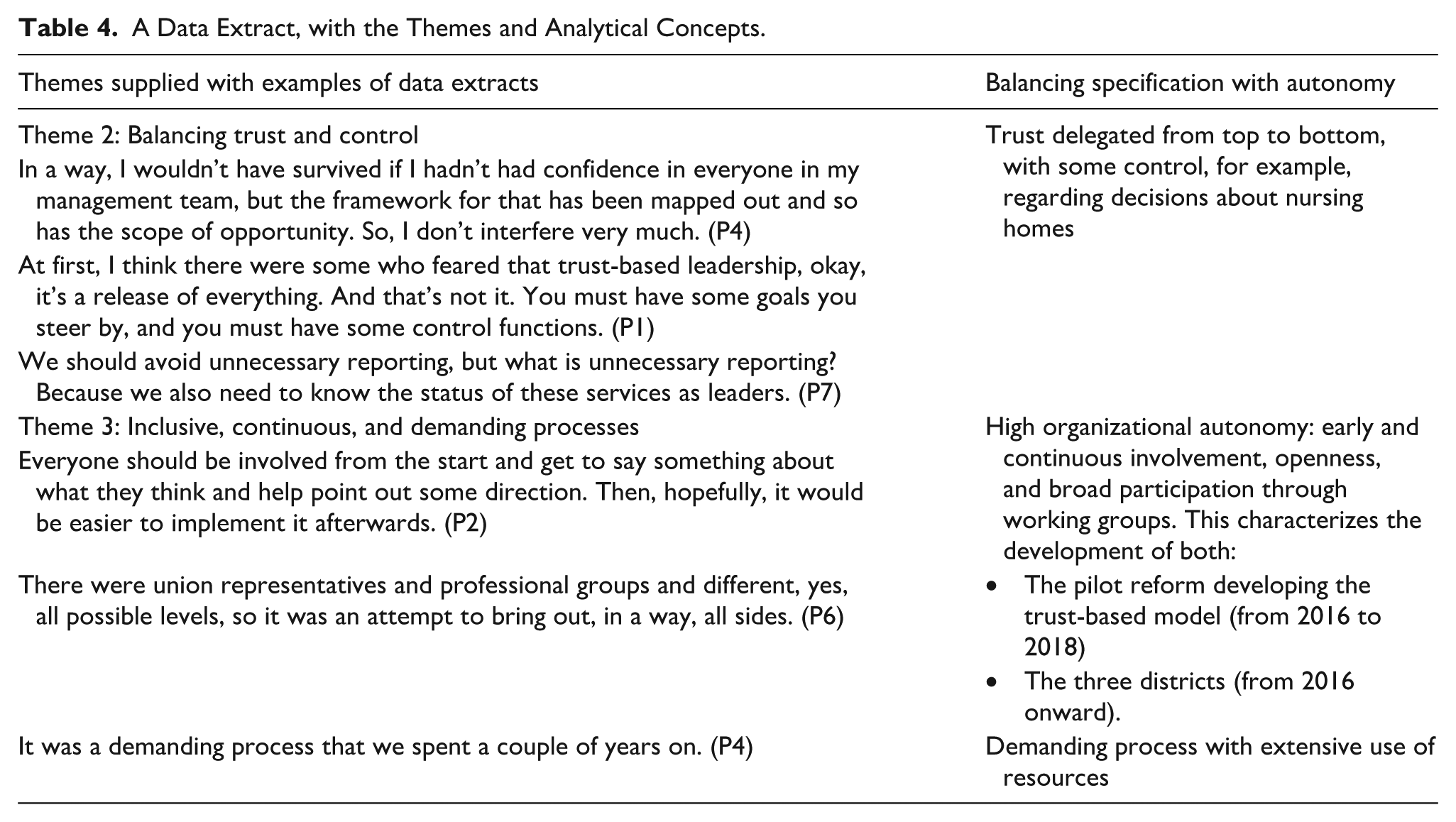
We considered various theoretical contributions during the process of developing themes and theorization—that is, when moving back and forth between the data and theoretical conceptualization (Timmermans & Tavory, 2012). Through analysis and the naming of codes, it became clear that the conceptual framework (Figure 1) helped elucidate the data about the design and implementation of the trust reform. The process of developing themes was supported by the concepts of specification and autonomy (see Table 4 in the Appendix) as well as in dialog with research on trust reforms that has evolved over time.
Analysis and Presentation of the Findings
Need for Specification and Support
When the trust reform was launched in 2015, the politicians and central authorities made a choice to govern the reform through an open and decentralized design. The design was materialized through the vague and overarching reform objectives leaving a substantial organizational autonomy for local actors to interpret the understanding of the objectives in their specific contexts. The guidelines for TBM and governance in 2017 from the central administration also emphasized that individual sectors and organizations should adapt the reform to their unique characteristics and that the work should take place locally (City council, 2017).
The design of the reform regarding home-based services started with a pilot reform in which four of the 15 city districts participated. This pilot was followed by evaluation research and resulted in the development of two versions of a trust model. In parallel, some city districts began to develop their own versions of the trust model. After the pilot, the city districts received a clear request in the appropriate letter to abolish the old purchaser–provider model (PPM) and organize the services in a new, more trust-based way, by establishing interprofessional teams consisting of occupational therapists, physiotherapists, nurses, healthcare workers, and administrative advisors (the former purchasers). In 2017, the central authorities presented some guides and specifications and ensured that experiences from the central pilot reform were evaluated and documented.
The participants in this study represented three different city districts, one of which participated in the central pilot. The managers representing the other two districts that participated in this study began working with the trust reform in 2016 and 2017—before the experiences from the central pilot had been documented and before receiving the request to replace the PPM- model with the new, trust-based way of working.
The early political signals in 2015 seemed to create some chaos and confusion, especially among the administrative advisors working in the former purchase office, who became insecure about their future roles in the organization. Some advisors chose to quit, forcing managers to spend resources on recruiting and building competencies. The quote below illustrates one manager’s experience of the reform’s starting point:
[T]his was politically decided, and [it] was launched as a side statement that the application offices were to be closed down, and it came as a bit of a surprise to everyone and also for the application office in the district, so there was a bit of an uproar, and then, there was more “meat on the bones” based on that; everyone was to go into a trust model. (P7)
When reflecting on the reform’s design and implementation, most managers expressed a vulnerability when facing sudden rupture in the established structures, and the need for more specifications regarding the reform’s direction and basis, along with specifications and organizational support during the design and implementation phases:
Why are we doing this? What are we going to achieve? And how appropriate is it that 15 districts solve this in different ways in the same municipality? And, still, you may not have received a complete answer as to what you want to achieve and why, other than listening, which is related to the word trust, rather than simply following orders. (P4) So, I can’t see that there has been any massive or moderate support for the method, framework, what it takes to create a good process, what it takes to create good leaders, what you look for, what you recruit for. . .There’s little in writing, and it’s a little problematic because if you have a theory, we are happy to employ it, but if you want as few solutions as possible for that theory, you should have some plans about how it will be carried out. (P7)
According to one manager, the employees would have more easily “gone in the same direction” if the politicians and central authorities had been clear from the start about what they wanted to achieve with the change. However, the findings provide some nuance: The managers who worked in the city district that participated in the central pilot reform did not express the same uncertainty at the beginning of the reform as those who had not participated in the pilot. This might be an indication of closer follow-up and hence less of an experience of uncertainty and vulnerability.
Balancing Tensions
The TBM and governance guidelines established/launched by the central authorities did, however specifically state that the initiated trust reform should make an impact on how performance-based measurement was practiced. Objectives for this new way of governing included reducing centralized control and detailed documentation and rather establishing a minimal number of clear goals to navigate by (City council, 2017). This guideline was, to some extent, presented by the central authorities as a clarification regarding what direction local managers should take when implementing TBM and governance. In practice, however, it was not easy to figure out how to translate, design, and implement general and vague objectives in the local context.
Receiving counterproductive governance directives was also seen as a challenge to TBM and governance implementation. During the first reform phases, one of the three city districts decided to delegate extensive autonomy (including responsibility for budget and personnel) to the professionals, but they soon reversed this decision since they saw a “substantial increase” in service production and costs, the need to maintain equivalent services, and several professionals being uncomfortable with the change. Based on this experience, one manager expressed their belief that the guidelines and clarifications should have come earlier than 2017:
So, the Oslo municipality clarified that the trust model should not only be about showing as much trust as possible but that you should also have trust and governance. Yes, so it was a clarification that was needed, and it was also a bit interesting that the purpose and the framework were not completely clear at the time. (P4)
The managers also reflected on the “right” balance between trust and control and what is defined as “unnecessary reporting” and the need to maintain some control and steering: “At the start, I think there were some who feared that trust-based management, okay, it’s a free flow of everything. And it’s certainly not that; you must have some goals that you manage according to [. . .], and you must have some control functions” (P2). The managers also reflected that such a subject must be continuously navigated over time and that it is also very dependent on the individual managers’ personality and experience. One manager also emphasized that trust is fundamental for succeeding with objectives such as co-creation, innovation, and prevention, emphasizing that trust cannot be a strategic goal; It’s a fundamental factor for us to do the other things.” (P7)
The managers in the three city districts chose somewhat different ways of organizing home care and healthcare services. Some teams would share a personnel manager and were delegated substantial responsibility. Still, there were some common organizational features that were employed, such as that the professionals were given responsibility for the service users in one specific geographical area and that all the managers chose to maintain central control over the distribution of stays at nursing homes through regular interprofessional meetings at the “system level.” System level implies that the decisions are taken by the top management in the city districts. The different solutions also indicated a higher level of local autonomy than previous organizational models.
Inclusive, Continuous, and Demanding Design and Implementation Processes
The managers seemed motivated to work in new ways, and as one highlighted, they had positive expectations regarding the change: “I think many had expectations that things would improve when you, in a way, could be more secure that the decisions that are made are according to the needs of and closer to the service users and residents” (P3). Another manager highlighted the benefits of more interprofessional interaction and working in ways that better suited current demands. Excluding the administrative advisors’ initial resistance, the managers’ overall impression was that the professionals working directly with service users also welcomed the change.
Employees, union representatives, and safety representatives were involved in developing the reform through working groups, and regular orientations were held for shop stewards and safety representatives. One manager discussed the importance of such early involvement: “Everyone should be involved from the start and be able to say something about what they’re thinking and help point out some direction in relation to that, hopefully being able to implement it [the reform] more easily afterwards” (P2).
The trust reform was developed through pilot programs and the testing of new organizational models in various geographical zones of the districts. In all three districts, the managers decided to design the reform as a project with a steering group, prioritize the use of internal managerial and employee resources, and assign a project manager to lead the reform development. Some managers received external support from service users during the design phase. Continuous development and learning from both their own and other districts’ experiences were also central during the reform work. As one manager stated, “We have to work all the time to get things in place and make things even better” (P2). Another similarly noted, “The most important thing for me is that I had backing from my boss that it was moving forward, but it would take some time, and we would let it take its time” (P1).
Some managers questioned whether they had spent too much time on the organizational process, expressing that it was initially challenging to know how much time they should dedicate to reform development: “It’s difficult. It’s a substantial process, and it’s not easy to know how to do it in the best possible way, if one should spend a long time or just ‘jump in.’ And still, some think that the process was too long, but it took some time to understand what it really meant for us” (P5). Generally, the managers experienced the reform development and implementation as time-consuming and, to some extent, demanding. One manager also emphasized that the reform work presupposes setting aside sufficient time and resources for implementation.
Further Development of the Trust Reform
The managers experienced several changes since the reform, such as increased flexibility in adjusting decisions concerning the level of care that service users received, more efficient use of time, and improved measures and time estimation for service. With these experiences as a backdrop, they decided to expand the reform into new areas, such as service-user and next-of-kin involvement, the management of interprofessional teams, digital tools for interprofessional cooperation, and cooperation with actors outside the district (e.g., hospitals).
The managers also drew attention to weaknesses related to the reform. Several of the service users still experience fragile transitions, and when it comes to cooperation with actors outside of the city district, the exclusion of these actors from the trust reform was mentioned as a possible challenge. One manager observed that when hospitals in the Oslo-region must cooperate with 15 different city districts with varying ways of organizing home-based services, they need to make sure that these differences do not “affect the service users.” This heterogeneity in organization, also makes it difficult to compare the city districts, with regards to the costs they spend on home-based services.
In summary, the managers experienced some organizational tensions during the design and implementation of the trust reform and often struggled to translate, design, and implement these general objectives within their local context. The managers seemed to share a general appreciation and ownership for the reform and experienced changes in the local practices within home-based services.
Discussion
Granting autonomy and increasing self-determination can be seen as expressions of trust (Johnsen & Svare, 2024a). However, as the experiences of managers in this study indicate, trust reform seems to presuppose some level of organizational trust and relies heavily on the establishment of relational and institutional trust amongst internal actors. The central authorities showed high relational trust in the local managers by deciding to introduce a reform with extensive room for local discretion and organizational autonomy, combined with few specifications. The findings also suggest, though, that increasing organizational autonomy can be viewed as a way for central authorities to protect themselves by not taking responsibility, if they do not make themselves vulnerable (Vallentin, 2025). From this vantage point, the reform creates substantial local uncertainty and vulnerability among local managers (Schilke et al., 2026).
Our findings therefore suggest that “building trust with trust” through governance reform implies that the local managers need to feel that they have “backing” from the central authorities, in the form of clarity in reform design combined with organizational support and guidance. This finding supports the need for a more relational and process-oriented approach to governance (Bartels & Turnbull, 2020; Boztepe et al., 2024) when central authorities launch a governance reform where trust is both a “strategy and way of working.” The central authorities mentioned several trust relations as key for the reform (City council, 2017). Still, besides focusing on the interactions through trust relations, local institutional trust in the design of the governance reform is also pivotal.
In pratice, the municipal trust reforms seem to represent a layered model for governance reform, since it attempts to combine different paradigms for governance (Christensen et al., 2015, 2024), such as performance-based measurement with a trust-based and distributed type of governance and leadership. Our study also supports that an open, trust-based reform design can produce organizational tensions, paradox and dilemmas that local managers must navigate within a context of competing institutional logics (Bentzen et al., 2025; Breimo et al., 2025; Håkansson, 2022). Faced with these tensions resulting from a lack of specifications, the managers chose to translate and adapt the reform to their local needs, which was also an important design criterion created by the central authorities.
Interestingly, as mentioned, the managers from the city district that participated in the central pilot program did not express the same degree of uncertainty as those who had not participated. The participants in the central pilot with responsibility to develop new and trust-based ways of working within home-based services received support in the form of workshops facilitated by the researchers who followed the pilot. The participants shared experiences of topics such as what it takes to succeed with a trust model and the concept of trust (Eide et al., 2018). This indicated minimal specification could be supplemented or replaced by tailored support from central authorities during the design and implementation phases.
Our findings support other studies showing that how reforms are designed and implemented can impact the reform outcome and organizational trust (Klemsdal & Kjekshus, 2021; Nygård & Blindheim, 2021; Stein et al., 2023). Within the context of home-based services, the trust reform design was somewhat paradoxical. On the one hand, it was “forced” and top-down rather than “voluntary” and incremental (Stein et al., 2023) since the central politicians launched the reform with a clear request to develop alternatives to the previous PPM-model. On the other hand, the reform also had bottom-up and “voluntary” elements as the central authorities granted relatively high autonomy by giving freedom and organizational autonomy regarding design and implementation with room for local adaptation. Through the lens of the conceptual framework in Figure 1, such a design of the reform plans and management of the implementation process can be characterized as minimal with regards to design specification and high in autonomy (1: “bottom-up”) – as shown in Figure 2.
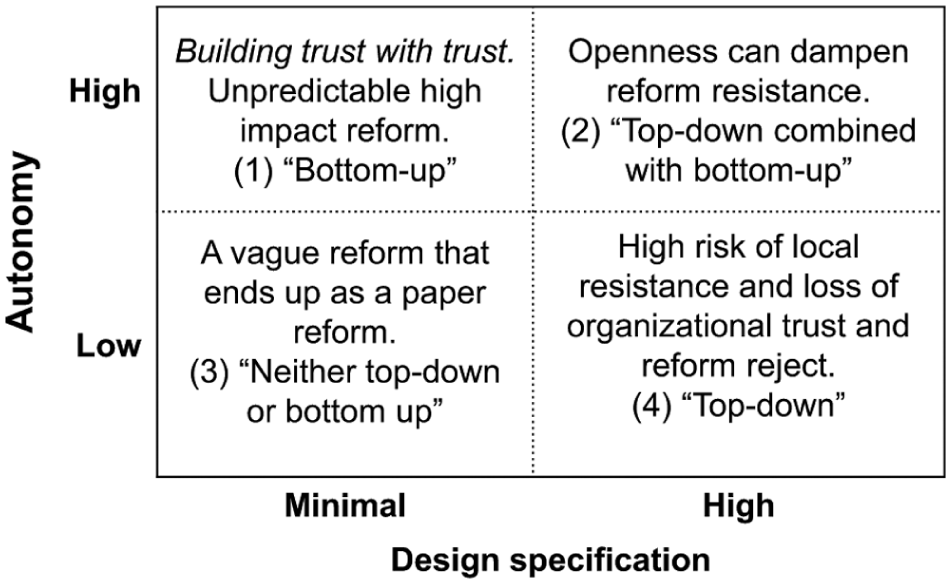
Conceptual framework for reform design.
The third and fourth design strategies shown in Figure 2 are not preferable, since both risk in their own ways risk jeopardizing organizational trust. The first strategy—bottom-up with minimal specifications—can create high organizational tensions and a vague and unpredictable reform as uncertainty in reform direction and content can create difficult conditions for high organizational autonomy (as well as participation and involvement) within local organizations. It can also create a risk that the reform is not developed as intended by the central authorities. If managers are insecure about the reform, this can create high organizational uncertainty, risking a loss of organizational trust. The second strategy—top-down combined with bottom-up—can result in a highly specified reform with low ambiguity and high local autonomy, with a substantial need to develop mutual understandings and organizational trust to enable change. Support with processes of broad involvement and participation can dampen local reform resistance.
The third strategy—neither top-down or bottom-up—can lead to an unspecified reform with high ambiguity and low local autonomy that typically ends up as a so-called paper reform. Finally, the fourth strategy—top-down—generally leads to a specified reform with low ambiguity and low autonomy. Such an approach carries a high risk of local resistance, loss in organizational trust, reform reject, change fatigue, and change cynicism (Amundsen & Kongsvik, 2008; Stensaker & Sverdrup, 2023).
The two combinations (1 and 2) that involve broad involvement and participation require local reform capability, minimal specifications, and/or tailored support from central authorities. These conditions indicate that a “semi-open” design is to be preferred. Still, the reform design should be flexible, and sensitive to the local readiness and capacity for organizational autonomy and organizational trust. In the context of home-based services, city districts that struggle with low levels of organizational trust and/or have had negative experiences with planned change projects are likely to exhibit a higher need for broad involvement and participation to build organizational trust and confidence in the project.
The reform design was open, relational, and defined by relatively high participation and involvement. The findings further suggest that the change design for developing the new, trust-based way of working was characterized by relatively inclusive and co-creational processes and built on pilot reforms and broad participation. Such processes suit the traditional Scandinavian and Norwegian models of cooperation between employees, managers, and union representatives (Gustavsen, 2011). Still as emphasized, “building trust with trust” requires some level of organizational autonomy combined with minimal specifications. Even if the municipal trust reform studied here was launched by the central authorities, and its design can be categorized as so-called bottom-up, the initial reform resistance or uncertainty that some managers experienced seem to be related to ambiguity in the design of the reform.
These findings support the notion that organizational tensions or paradoxes need to be continuously navigated and balanced. For the trust reform studied here, the “both –and” approach, such as attempts to integrate trust and control, when they are viewed as complementary rather than opposites, and the “neither–nor” approach (Li, 2021) are especially relevant. In relation to our study, to build and maintain organizational trust, neither pure trust-based (with total autonomy and no specifications) nor pure control-based (with low autonomy and high specification) governance regime seems fruitful. We find that the managers struggled somewhat with finding a suitable balance point between these two types of governance.
To further develop a collective competence on trust-based reform-design, we suggest that the following concepts should be explored further: “semi-open design,” “trust-supportive governance,” and “reflexive and active trust or autonomy.” The concepts of reflexive trust and autonomy emphasize the need to continuously reflect over and give meaning to these normative concepts in the local organizational contexts, in a critical, dynamic, tailored and active sense (Möllering, 2006). In future reform initiatives, independent of issue, the trust-based design with the right level of support and guidance along the way, might give way for new more efficient change-processes and translation of overarching political ideas. These concepts can represent new terms to be used in relation to trust-based approaches to governance reform.
We show that not only public managers can have a central role in facilitating the functional roles of trust (Oomsels et al., 2019) but also local politicians and central authorities. The managers’ support for the reform at the time of the interviews seem to represent a signal of confidence in the vertical trust relationship between local managers and central authorities. At the same time, several managers expressed lower initial confidence, which could have been increased with support, guidance, and higher specification in the form of more precise and earlier instructions.
The managers chose to work with the reform gradually by testing and learning from their own and others’ experiences, and they later expanded the reform to new areas and developed it further. Learning from experience and being open to adjusting and modifying a reform are important elements of reform work (Christensen et al., 2015), and the managers expressed that the work was continuous and did not have an endpoint. Aligning with research showing the significant time and resources required for reform work (Bentzen, 2018; Christensen et al., 2015), the managers experienced the reform processes as time-consuming and, to some extent, demanding.
While this study took place in one specific municipal context, which must be considered when attempting to generalize the findings, its contributions are relevant to other contexts and studies that explore post-NPM governance reform. In particular, this study underscores how managers can facilitate organizational trust during design and implementation through early and minimal specifications and support to maintain organizational trust and highlights the importance of not only relational trust but also the impact of institutional trust in reform design.
When launching an open-ended trust reform, it is vital that the central authorities establish a mutual understanding of trust (Vallentin, 2025). The responsibility also lies with the initiating authorities to make sure that the intentions for launching the reform are understood by all parties, including a plan on how it is to be developed in practice. The managers also express a need for clarity in how central authorities understand and interpret central reform ideas, such as TBM. For a trust reform to contribute to the development of organizational trust, the central authority must also accept increased vulnerability (Vallentin, 2025). If not, the trust reforms risk producing vulnerability on behalf of the reform’s receivers, who, in this study, are local managers and professionals.
Future research could examine how the local context influences the need for more hands-on and trust-supporting governance (Bentzen, 2018; Jacobsson et al., 2015), through specification, guidance and support, as well as to what extent the context influences or is influenced by organizational trust and the handling of various paradoxes or dilemmas. Such a study could be carried out by following a reform initiative from its inception and surveying the perspectives of central authorities, local politicians, managers, professionals and service users.
Limitations of the Study
Our study was conducted approximately four to five years after the reform’s implementation and thus represented the managers’ experiences during only one period. Collecting the data after the reform had been designed and implemented likely also likely affected the managers’ perceptions, and their opinions about and experiences with the reform may have been somewhat different in the beginning phases of reform implementation. Moreover, the data do not indicate the degree to which the changes that the managers experienced resulted from the trust reform or other parallel changes. There is also a risk that the managers that we recruited had more positive experiences with the reform than the average manager because of their interest in participating in the study.
Conclusion
In this article, we explored how municipal managers experienced the navigation of tensions between autonomy and specification related to designing and implementing a local governance reform launched from “the top” with an open, trust-based and bottom-up design. This study of trust-based reform designs within three city districts, and how it was understood by the managers attempting to translate its implications, shows how a lack of specification from central management can influence the local reform processes, as well as on the outcome of it. The reform design can also influence the development of organizational trust amongst managers and professionals. By combining perspectives on organizational trust with reform design, we develop an understanding on how organizational actors on multiple levels in the municipal structure try to find a balance between autonomy and specification. The findings also support the understanding that organizational autonomy can represent both a threat and an enabler of trust. Based on the empirical findings, we show that a trust reform paradoxically should be built with trust, through central authorities’ delegation of power combined with offering of support and guidance as well as predictability by increased clarity in the reform design.
Supplemental Material
sj-docx-1-aas-10.1177_00953997261459593 – Supplemental material for Building Trust With Trust? A Qualitative, Explorative Study of Implementing a Trust Reform in a Norwegian Municipality
Supplemental material, sj-docx-1-aas-10.1177_00953997261459593 for Building Trust With Trust? A Qualitative, Explorative Study of Implementing a Trust Reform in a Norwegian Municipality by Helga Wallin Moen and Lars Erik Kjekshus in Administration & Society
Footnotes
Appendix
A Data Extract, with the Themes and Analytical Concepts.
| Themes supplied with examples of data extracts | Balancing specification with autonomy |
|---|---|
| Theme 2: Balancing trust and control | Trust delegated from top to bottom, with some control, for example, regarding decisions about nursing homes |
| In a way, I wouldn’t have survived if I hadn’t had confidence in everyone in my management team, but the framework for that has been mapped out and so has the scope of opportunity. So, I don’t interfere very much. (P4) | |
| At first, I think there were some who feared that trust-based leadership, okay, it’s a release of everything. And that’s not it. You must have some goals you steer by, and you must have some control functions. (P1) | |
| We should avoid unnecessary reporting, but what is unnecessary reporting? Because we also need to know the status of these services as leaders. (P7) | |
| Theme 3: Inclusive, continuous, and demanding processes | High organizational autonomy: early and continuous involvement, openness, and broad participation through working groups. This characterizes the development of both: |
| Everyone should be involved from the start and get to say something about what they think and help point out some direction. Then, hopefully, it would be easier to implement it afterwards. (P2) | |
| There were union representatives and professional groups and different, yes, all possible levels, so it was an attempt to bring out, in a way, all sides. (P6) | • The pilot reform developing the trust-based model (from 2016 to 2018) |
| • The three districts (from 2016 onward). | |
| It was a demanding process that we spent a couple of years on. (P4) | Demanding process with extensive use of resources |
Acknowledgements
We would like to thank the research group Leadership and Institutional Values–Work in Practice (LIVAP), the editor, and the reviewers for their valuable and constructive feedback. We also thank the participants in this study who prioritised participation despite a challenging time for the services because of the COVID-19 pandemic.

Funding
The authors received no financial support for the research, authorship, and/or publication of this article.
Declaration of Conflicting Interests
The authors declared no potential conflicts of interest with respect to the research, authorship, and/or publication of this article.
Data Availability Statement
Data sharing not applicable to this article as no datasets were generated or analyzed during the current study.
Comment With Regards to Data Sharing and Availiability
The participants of this study did not give written consent for their data to be shared publicly, so due to the sensitive nature of the research supporting data are not available.
Supplemental Material
Supplemental material for this article is available online.
Author Biographies
References
Supplementary Material
Please find the following supplemental material available below.
For Open Access articles published under a Creative Commons License, all supplemental material carries the same license as the article it is associated with.
For non-Open Access articles published, all supplemental material carries a non-exclusive license, and permission requests for re-use of supplemental material or any part of supplemental material shall be sent directly to the copyright owner as specified in the copyright notice associated with the article.
