






Abstract
Intersectionality is increasingly adopted in public administration research. Yet, existing applications tend to narrow identity to static demographic characteristics and overlook how the administrative state itself generates, activates, and shapes identities. We address this gap with a theoretical framework that maps identity generation across macro-, meso-, and micro-levels of analysis. Our framework expands the inventory of identities relevant to intersectionality research in public administration to include those produced by political, societal, and organizational processes, and it advances the concept of “dyadic intersectionality” to capture the simultaneous interplay of bureaucratic and client identities during administrative encounters.
Introduction
Research on intersectionality is increasingly common in public administration due to the growing concerns about social equity across virtually all aspects of administrative encounters including access to public services, policy design, implementation, coproduction, public evaluation, and outcomes (Breslin et al., 2017; Hankivsky & Cormier, 2011; Meier, 2018; S. K. Portillo et al., 2022; Simien, 2007). Intersectionality refers to the analytical insight that social categories such as race, gender, and class do not operate independently but intersect with systems of power to shape individuals’ lived experiences of privilege and marginalization (Collins, 1990; K. W. Crenshaw, 1989). Unlike traditional approaches that focus on a singular identity, an intersectional approach recognizes the nuanced nature through which identities intersect, are socially constructed, and are imbued with power, with varying degrees of privilege and/or marginalization attached to each identity that affect one’s standing in society (Collins, 1990; K. W. Crenshaw, 1989). Indeed, an intersectional approach emphasizes that each person has cross-cutting identities that jointly generate distinctive ways in which they experience the world, differently from people of any other identity combinations (K. Crenshaw, 1991; Hancock, 2007; Jordan-Zachery, 2007; Simien, 2007). If scholars are to take seriously the claim that social equity serves as a pillar of public administration (Frederickson, 1990), then an intersectional perspective is essential to understand the distributional consequences of bureaucracy and the Lasswellian concept of who gets what, when, and how.
Understanding intersectional identities in public administration is theoretically, practically, and normatively important, as public bureaucracies serve as significant loci of power with control over the allocation of political goods (Lipsky, 2010), socialize individuals on their role within society (Soss et al., 2011), provide feedback on how government functions (Moynihan & Soss, 2014), and ultimately are institutions that can be leveraged toward equity or sustaining oppression (Stivers et al., 2023). Bureaucracies are, in this sense, among the most potent institutional sources of identity generation. Unlike private organizations, public bureaucracies exercise coercive authority granted by the state, hold effective monopolies over the provision of public services, and carry legal mandates that give their categorical decisions binding consequences, which makes the identities they generate qualitatively different from those produced in other organizational contexts. Given these functions, framework for understanding intersectionality requires attention to the specific mechanisms through which government bureaucracies shape identity.
Despite an increased adoption of intersectionality in public administration research, we argue that current treatments of intersectionality are insufficient, incomplete, and obfuscate the range of identities relevant to the field: they tend to narrowly operationalize identity around static demographic characteristics (see Anthias, 2002; Bose, 2012; Doan & Portillo, 2016; Nash, 2008; S. K. Portillo et al., 2022), leaving blind spots into how the mechanization of the administrative state creates, shapes, and reinforces identity. This article develops a layered and integrated framework to better understand intersectional identity formation in public administration.
We adopt the micro-, meso-, and macro-level definitions commonly used in the field (Aguinis et al., 2011; Doan & Portillo, 2019; Donmanige et al., 2024; Jilke et al., 2019; Ray, 2019; Stets, 2021; Thatcher et al., 2023; Wang & Polillo, 2016) as an architecture to organize our framework. The macro-level focuses on grand societal schemes such as culture, norms, state design, and social constructions that unify a society, governance system, or regime (North, 1990; Roberts, 2020a). These forces operate at the broadest level, exerting power and influence over organizations (Ragins & Sundstrom, 1989). Here our framework examines how political institutions, social constructions, and merit systems generate identities through state design and political discourse. The meso-level focuses on the study of organizations. It encompasses both formal and informal organizational arrangements such as work teams, networks, and other similar entities (Jilke et al., 2019). At this level, we analyze how bureaucratic organizations generate identities through human resource management, socialization, and administrative labeling for both bureaucrats and clients. The micro-level encompasses the study of an individual’s attributes, cognitions, and behaviors (Grimmelikhuijsen et al., 2016; Simon, 1947). We argue that macro- and meso-generated identities converge at the micro-level, where we advance the concept of dyadic intersectionality to account for the simultaneous interplay of bureaucratic and client identities during administrative encounters.
Our framework makes important contributions to the literature. First, we theorize bureaucratic processes as mechanisms of identity generation. Institutions do not merely sort individuals according to pre-existing identities but actively produce new identities with important consequences. We contend that macro-level political and societal processes and meso-level bureaucratic processes generate identities that are distinct from, and intersect with, conventional demographic identities such as race, gender, and class. In doing so, we expand the inventory of identities available for intersectionality research in public administration. Furthermore, we draw a deliberate distinction between bureaucratic actors and the public as subjects of identity generation, which is highly relevant to, and necessary for, the field of public administration. Unlike earlier approaches that tend to focus on either client intersectionality and outcomes (e.g., Assouline & Gilad, 2022; Butz & Gaynor, 2022) or bureaucratic intersectionality and workplace experience (e.g., An et al., 2024; Hamidullah & Riccucci, 2017; Lewis & Emidy, 2022; Nelson & Piatak, 2019; Yu, 2022), dyadic intersectionality positions the bureaucrat-client interface as the central mechanism through which identities converge and come to life during the implementation process (see Turner, 2010).
The remainder of the article proceeds as follows. First, we review the concept of intersectionality and its application in public administration research, identifying key shortcomings in much contemporary scholarship. Second, we present our layered and integrated framework, articulating the specific mechanisms of identity generation at the macro-, meso-, and micro-levels of analysis, as well as the concept of dyadic intersectionality. Finally, we discuss the framework’s implications for future research and the practical pursuit of social equity in public administration.
Intersectionality and Its Application in Public Administration
Intersectionality highlights the limitations in analyzing singular, unitary identities when exploring societal issues such as racism, sexism, and other forms of inequality (K. Crenshaw, 1991; K. W. Crenshaw, 1989). It emphasizes that each person has cross-cutting identities that jointly generate distinctive ways in which they experience the world, differently from people of any other identity combinations (K. Crenshaw, 1991; Hancock, 2007; Jordan-Zachery, 2007; Simien, 2007). In her foundational work on Black women’s experiences while filing discrimination claims, Crenshaw contends that legal remedies were inefficient in that they only recognized bias in terms of race or gender, but not the combination of the two. This work highlighted a central problem in the study of identity—adopting a singular lens obscures the power structures that Black women must navigate within society (K. Crenshaw, 1991).
Intersectionality is sometimes misconstrued as simply holding multiple identities; however, the theory originated to explain how societal structures imbue identities with power (K. W. Crenshaw, 1989; Kwon & Archer, 2022; Settles, 2006; Simien & Clawson, 2004; Zinn & Dill, 1996). Power lies at the heart of intersectionality: power structures arise from culture, political institutions, the law, organizations, and interpersonal relationships, each of which generates systemic privileges or disadvantages (Bell, 1976, 1980; Blessett, 2020; K. Crenshaw et al., 1995; Solorzano & Bernal, 2001). Not surprisingly, much of this work emphasizes how identities create disadvantage, how they permeate every aspect of a person’s life, and create a “matrix of domination” that fragments these individuals from privileged groups in society (Collins, 1990).
These ideas have found support in a large literature. For instance, early studies show that Black women with strong racial identification were more likely to support Black Feminist movements as they sympathize with their doubly jeopardized and disadvantaged situations (Lansing & Baxter, 1983; Wilcox, 1990). More recent empirical studies suggest that race and gender interactively modify individual policy attitudes (Harnois, 2014; Philpot & Walton, 2007; Reingold & Smith, 2012; Simien & Clawson, 2004). Beyond the original Black Feminist tradition of intersectionality, the intersectional lens has been applied to age, attractiveness, body type, caste, citizenship, education, ethnicity, immigration status, income, sexual orientation, occupation, physical ability, among other individual identities (Gopaldas, 2013; see Diggs, 2022 for a review). Although these studies are concerned with individual conditions that result from discrimination and/or contribute to further inequalities, these conditions are ultimately structural—embedded within the fabric of society.
Such structural underpinnings are precisely what make public administration a critical site for intersectionality research. Bureaucracies are not merely implementors of policy but powerful institutions that translate the political will of the state into lived experience of citizens (Lipsky, 2010; Soss et al., 2011). Therefore, they serve as one of society’s most consequential mechanisms for distributing power, allocating resources, and defining the terms under which individuals interact with the state. They function as vehicles through which structural inequalities are both enforced and obscured (Ray et al., 2023). Given this capacity, the study of intersectionality in public administration must grapple not only with the demographic identities that individuals carry into bureaucratic encounters, but also with the administrative processes that generate, activate, and shape those identities.
Recent work on intersectionality in public administration can be sorted broadly across two streams of literature. The first focuses on client intersectionality and how certain identities map onto experiences with the administrative state (Mostowska & Dębska, 2020; Trochmann, 2021). As two recent examples, Butz and Gaynor (2022) find that transgender women of color are more likely to experience discrimination when interacting with social welfare offices and avoid seeking such benefits. Assouline and Gilad (2022), examining state incapacity benefits in Israel, report that applicants’ multiple identities—ethnic group, gender, and work history—jointly determine how program officers categorize them.
The second stream probes bureaucrats’ intersectionality and its relationship to work-group performance and outcomes (Barboza-Wilkes et al., 2023; Feeney & Camarena, 2019; Frenkel & Wasserman, 2020; Gaynor & Blessett, 2021). For example, Hamidullah and Riccucci (2017) examine the intersection of gender and race, exploring how women of color in the US federal bureaucracy perceive fairness in work-life balance programs. Compared to white women, they report lower levels of satisfaction. Nelson and Piatak (2019) study federal employees and find that women from racially underrepresented groups are less likely to hold supervisory positions and feel less included in the workplace. Yu (2022) finds that women of color in federal law enforcement are more likely to report sex-based discrimination compared to white women. In another study of federal employees, Lewis and Emidy (2022) report that the gap in organizational justice perceptions between LGBT and heterosexual employees are shaped by other stigmatized statuses, including being a woman, being a person of color, having a disability, being in an early career stage, and holding a lower-level position. Together, these two streams of research demonstrate that intersectionality is a productive lens for understanding inequality in public administration. Yet as we argue in the following section, both streams share common limitations that constrain their theoretical reach.
Incorporating Intersectionality in Public Administration: Missed Opportunities
Our review of intersectionality studies in public administration reveals two shortcomings, which fail to leverage the power of intersectionality theory for a better understanding of administrative encounters. First, studies tend to focus on demographic attributes, as illustrated by the research just reviewed that predominantly operationalizes intersectionality through race, gender, sexual orientation, and other sociodemographic characteristics (e.g., Butz & Gaynor, 2022; Hamidullah & Riccucci, 2017; Lewis & Emidy, 2022; Nelson & Piatak, 2019; Yu, 2022). Even though these studies often include a variety of organizational factors such as structure, occupation level, role adoption, tenure, and program participation, such factors are often relegated to control variables rather than explicit mechanisms of identity formation. We believe that this misaligns with the original conceptualization of identity and intersectionality that deals with the interplay among higher-level institutional structures, organizational processes, and demographic identities (e.g., Ray, 2019).
Wang and Polillo (2016) provide a useful parallel by analyzing how power operates across levels of analysis. They contend that most scholarship implicitly frames power either as a macro phenomenon or as a micro parameter of interpersonal exchange relations and small group dynamics. What this leaves unexplored is the meso-level architecture of organizations, where power is formalized into positions and ranks, depersonalized through rules and procedures, and diversified across multiple sources of control. In their view, organizations mediate and transform powers, giving them distinctive properties that cannot be reduced to either level alone. This insight has direct implications for our framework: when intersectionality research in public administration treats organizational factors as control variables rather than as mechanisms that actively shape power and identity, it obscures the precise level where much of the administrative state’s power is exercised. An expanded inventory of identities that accounts for meso-level organizational processes is necessary to capture how power is generated, filtered, and enacted within the specific institutional contexts of public administration.
Indeed, one of the defining characteristics of intersectionality research is that “the subject of analysis belongs to multiple dimensions of social life and categories of analysis” (McCall, 2005, p. 1772). When disproportionately focusing on demographic identities, intersectional approaches may neglect a subset of relevant identities that become salient as a function of societal, environmental, or bureaucratic mechanisms. Accounting for these features helps address a common concern amongst critics that intersectionality work tends to treat identity as static and adopts an ahistorical approach that divorces identity from the history, context, relationships, and communities that generate them (Anthias, 2002; Bose, 2012; Doan & Portillo, 2016; Nash, 2008; S. K. Portillo et al., 2022). This reality has been acknowledged by social identity scholars for decades (e.g., Tajfel & Turner, 1979). As Albert et al. (1998) note: One’s identity, or self-definition, is a product of social interaction grounded in specific contexts as specific times such that one’s sense of self-in-organization is emergent and somewhat fluid. Thus, the process of identification is crucial because the nature of identity and the extent of identification are not determined by the preexisting nature of the person or organization. Individuals, groups, and the organization mutually shape one another over time and become comingled: Each level of analysis is neither static nor discrete, neither independent nor autonomous (pp. 213–214)
S. K. Portillo et al. (2022, p. 91) make a similar argument, acknowledging that “identity is not something that is static to an individual but happens within interactions and social constructs. This means that identity is not just individual, but also contextual and cultural.”
In short, social identity theory emphasizes identity salience and how relevant identities are (de)activated across different social contexts (Ashforth & Johnson, 2014; Hogg, 2006; Hogg & Terry, 2000; Taksa et al., 2015). Although some maintain that intersectionality and social identity theory are at odds—with critics suggesting that social identity theory’s emphasis on fluidity assumes that identities are easily manipulable and downplays structural issues of oppression and power (Taksa et al., 2015), another body of work seeks to synthesize these two approaches (see Ehrenreich, 2002; Holvino, 2010). What emerges is an approach to intersectionality where “differences such as race, gender, class, ethnicity, nationality, and sexuality coexist and are experienced simultaneously, [but] the importance or salience of specific differences at moments varies depending on the social context.” (Holvino, 2012, p. 174).
In line with our pursuits, this perspective motivates an expansion of identities that includes processes that manifest at higher levels, such as those referred to as “organizational identities” (Albert and Whetten 1985) as well as those formed through broader societal constructs and cultural environments (Wang & Polillo, 2016). As we elaborate below, these sources of power are contextual, generate distinct identities, and interact with commonly explored social categories.
It is important to note that we do not suggest that traditionally explored identities, such as race/ethnicity, gender, or class, are trivial. To the contrary, these demographic characteristics are often the most central and enduring cleavages within society because they are the most visible and likely to trigger immediate categorization (Harrison et al., 1998; Mohammed & Angell, 2004). As S. K. Portillo et al. (2022) remind us, however, “where and when someone is experiencing their identity are important contextual factors that shape how identity is understood by the individual and cultures. Understandings of identity have been evolving for centuries, shaped by both the individual and their surrounding environments. . . identity is positional—dependent on the institutions, time period, and communities an individual engages with” (p. 26). As a result, scholars may miss relevant variation by only considering general demographic indicators in their conceptualizations of identity and intersectionality.
The second gap we identify concerns the narrow treatment of bureaucratic intersectionality. Extant work is primarily interested in how bureaucrats’ intersecting identities affect work outcomes, leaving questions about intersectionality and implementation understudied (see Baumgartner et al., 2021; Dwidar, 2021; Fay et al., 2020 for recent exceptions). Scholarship on street-level bureaucracy and implementation highlights the importance of frontline workers’ discretion on the distribution of rewards and/or punishment (Lipsky, 2010; Maynard-Moody & Musheno, 2003; Pressman & Wildavsky, 1984). Moreover, bureaucratic personnel are products of their broader societal, political, and administrative backdrop, which shapes the degree to which they identify as “agents of the state” or “representative allies” in their interactions with the public (Brodkin, 2011; Watkins-Hayes, 2011). Such a focus necessitates a more granular analysis of bureaucratic intersectionality, for identifying both how different identities inform behavior and, in turn, how behavior shapes public experiences. This nexus between the bureaucracy and public can be viewed as central to understanding what combination of bureaucratic and client identities come to the forefront of administrative encounters.
A Layered and Integrated Approach to Identity and Intersectionality in Public Administration
Research increasingly leverages micro-, meso-, macro- approaches to questions of identity and bureaucracy. For instance, Ray (2019) extends the framework to the study of race and ethnicity with the introduction of racialized organizations, which explicitly address how racial hierarchies are filtered, reinforced, and proliferated through organizations. Thatcher et al. (2023) pursue goals akin to those of Ray but focus on how societal, organizational, interpersonal, and individual mechanisms act as distinct sources of power generation that imbue identities with meaning. The authors note that “to ascertain the impact of multiple identity intersections, we must first understand the underlying structures that imbue certain identities with power or disadvantage and link distinct combinations of identity to specific outcomes . . .” (Thatcher et al., 2023, p. 711).
These works collectively channel the original conceptualizations of intersectionality that are concerned with how identities are imbued with meaning and power through legal, cultural, political, and social institutions. However, they are somewhat indirect in articulating the specific bureaucratic mechanisms through which these power structures are sustained, dampened, or moderated. Ray et al. (2023) move closer to this goal by explaining how and why bureaucracy serves as an effective vehicle through which power structures are enforced and laundered, focusing on racialized burdens—the experiences of learning, compliance, and psychological costs that reproduce inequality within administrative encounters. How such processes create a feedback loop that informs one’s sense of self and generates identities serves as a fruitful extension of the interface between bureaucracy and identity. Together, these works provide a foundation for a fluid, dynamic, and comprehensive study of how the administrative state perpetuates oppressive systems and exploitation through bureaucratic implementation. Yet, though these pieces are valuable for understanding how intersectionality relates to policy outcomes, scant attention has been given to how these mechanisms act as sources of identity generation themselves, which motivates our proposed framework.
Moreover, even as prior research has commonly employed the multi-level framework, there are methodological concerns surrounding its application to intersectionality. When reviewing the broader diversity literature, Marfelt (2016) argues that the division of intersectional analysis into separate macro, meso, and micro levels may risk treating these levels as incommensurable. Thus, he proposes a grounded, action-oriented methodology that makes levels peripheral to the analysis. While Marfelt’s concern about rigid compartmentalization is well-taken, we believe that the institutional specificity of public administration warrants a level-based theoretical framework.
Public administration is defined by a hierarchical institutional architecture from statecraft to organizational implementation to street-level encounters that maps meaningfully onto levels of analysis. At the same time, our framework shares several commitments with Marfelt’s approach: we view identity formation as a dynamic process rather than a static classification; we attend to the mechanisms through which identities are generated and imbued with power rather than taking identity categories as given; and we seek to expand the range of identities deemed relevant for intersectional inquiry. Where we diverge is that the theoretical framework we propose, as distinct from a methodology, benefits from specifying the institutional sites where identity generation mechanisms primarily take place, so that scholars can connect empirical observations to the structural features of the administrative state.
The meso-level identities we discuss are mired by some overlap with those at the macro-level. As Thatcher et al. (2023) argue, societal powers at the broadest level trickle down through organizations that act as the repositories and reproducers of higher-level power structures, creating interconnectedness in power structures across all levels of analysis (see also Amis et al., 2020). However, the filtration from macro- to meso-level is not purely deterministic. The logic of this relationship can be represented by an analogy of a rain barrel. In this analogy, the rain barrel serves as the meso-level (i.e., organization), and the rain itself represents the macro-level. A rainstorm (macro-level) operates with indifference, pouring down rain over everything below it. A rain barrel (meso-level) filters and gathers rain from the storm. Just as all the rain from the storm does not filter through the rain barrel, all macro-level characteristics do not necessarily filter down to the meso-level—only a subset of the larger choice set is operative within the organizational context. In other words, the key distinction between macro- and meso-level identities is that macro-level identities are pervasive and encompassing, whereas meso-level identities are relevant, generated, and sustained within a particular context. In our framework, the levels are not self-contained analytical compartments but connected sites within a single process of identity production, with each level both shaped by and feeding back into the others.
Subsequent sections of the manuscript will unpack the components of our framework in greater detail. First, though, we briefly review the framework’s structure of our framework (see Figure 1). It framework begins with the macro-level at the top, which generates political-administrative identities through political, cultural, and societal processes. Drawing on the rain barrel analogy, we use vertical lines to demonstrate the pervasive influence of the macro-level that “rains down” on every structure and process with indifference. Note that this articulates a direct path linking the macro-level to both the bureaucrat and client boxes since all individuals, as participants in society, are impacted by broader political, cultural, and societal contexts. Next, we depict a filter that connects the macro-level to the meso-level where organizational identities are generated. As discussed earlier, not all macro-level identities are equally relevant within an organization, and this filtration process represents how certain aspects of the broader context become salient within specific organizational settings due to various idiosyncratic factors. At this level, both bureaucrats and clients bring their macro-level identities to the organization, and at the same time, organizational processes give rise to meso-level identities. Finally, an arrow extends down from the meso-level box into dyadic intersectionality at the micro-level, where individual interactions between bureaucratic actors and members of the public take place.
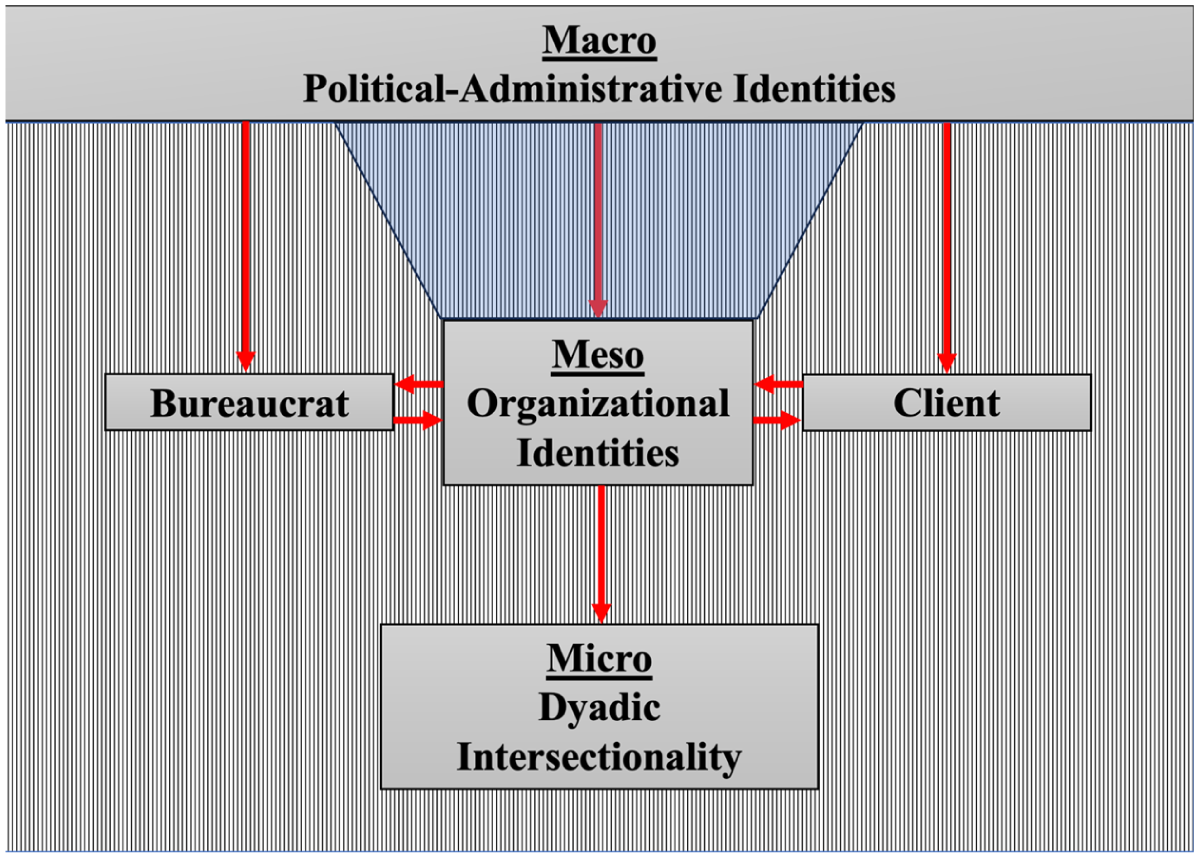
A layered and integrated framework of identity and intersectionality in public administration.
Macro-Level: Political-Administrative Identities Given by Societal and Political Processes
The macro-level focuses on statecraft and the overarching design and architecture of the state (North, 1990; Roberts, 2020a). These processes define the public, bureaucracy, law, and culture—all of which influence the construction of identity. First, every system of governance defines the “public” that governments serve, which shapes questions of group membership, the allocation of state resources, and national inclusion (Ray, 2019). These mechanisms play a critical role in affecting how individuals understand their own identities. The use of the term “public” instead of “citizen” in the previous sentence is intentional, as the former encompasses a wider range of legal and pejorative categories, including citizens, residents, aliens, undocumented, and illegal persons (see Roberts, 2020b). Moreover, it illustrates how the language governments use to describe individuals has significant downstream effects on how people come to view themselves and their positions within society. For instance, when individuals are confronted with terms like “alien” to describe their legal status, it can convey a sense of exclusion, feelings of insignificance, and second-class membership in society, leading to the internalization of such identities (Stacciarini et al., 2015).
This discussion of the “public” also encompasses systemic theories such as Critical Race Theory (CRT), Critical Legal Studies (CLS), and Feminist Theory, which articulate how societies use legal, religious, and political authority to bifurcate society (Bell, 1976, 1980; K. Crenshaw et al., 1995). These perspectives converge around the idea that history, laws, and institutions reinforce and perpetuate inequalities. In turn, they define social identities as credentials that constantly loom in the background, shaping how one interacts with, and is treated within society (e.g., Acker, 1990; Ray, 2019; Stivers, 1995). These forces are also consequential for the bureaucrats as they define a zone of acceptability around a social group’s aspirations, professional goals, and managerial behavior (e.g., Stivers, 1995).
It is at this macro-level that categories such as race, gender, or sexuality take on their form as identities imbued with power, privilege, and marginalization. Power at this level operates as a force that shapes large-scale social formations and outcomes (Wang & Polillo, 2016). It originates from political institutions, legal systems, and culture, and channels through them to define group membership, distribute disadvantage/privilege, and set the foundational parameters within which organizations and individuals operate. The mechanisms we discuss below—merit systems, social constructions, and political rhetoric—are expressions of such macro-level power, operating with broad reach and indifference to specific organizational contexts.
Merit systems have long constituted a foundational institution of public administration. Since the Pendleton Act of 1883 established the federal merit system and displaced the patronage-based spoils system, merit has served as the organizing principle of the U.S. civil service, shaping recruitment, promotion, and compensation across federal, state, and local governments (Kaufman, 1969; van Riper, 1958). Moreover, leading textbooks in public administration devote entire chapters to merit as a defining feature of the field (Berman et al., 2021; Guy & Sowa, 2022). Merit systems determine not just bureaucratic structure, but what type of work is valued, how work is evaluated, and ultimately who qualifies to become a bureaucrat and on what terms (G. A. Brewer et al., 2022; Ingraham, 2006).
Critics point to merit systems as sources of occupational segregation, reflecting the values and competencies of the privileged (Castilla, 2008; S. Portillo et al., 2020). This often occurs at the expense of the marginalized who face additional barriers due to their intersecting identities and expectations to perform invisible or uncompensated labor (Chordiya & Hubbell, 2023; Guy & Newman, 2004). As such, merit systems can create distinct career tracks that shape individuals’ job roles and organizational realities. Although we also will discuss organizational mechanisms of identity formation at the meso-level, it is at the macro-level where merit systems set the foundational parameters that impact organizational structures and practices within a nation-state. In this sense, merit systems exemplify what Wang and Polillo (2016) describe as macro-level causal forces that leave imprints on the forms and power relations within organizations: they determine who enters the bureaucracy and under what terms, thereby helping shape the meso-level processes that follow.
Social construction is particularly consequential for public administration because it operates upstream of policy: the categories that agencies use to assess need, determine eligibility, and allocate resources do not emerge neutrally but reflect politically and culturally constructed images of which groups deserve public goods and which warrant stigma or exclusion (Schneider & Ingram, 1993; Soss et al., 2011). These macro-level constructions define how bureaucrats come to understand the populations they serve, shaping agency design, program priorities, and resource allocation before any individual encounter takes place (Béland et al., 2022). In consequence, social constructions often produce caricatures about social groups that tie into perceptions of how they interact with public services. An example comes from the literature on social welfare and how political discourse and media representations construct a biased view of minority groups seeking benefits as “deviants” (Hancock, 2007; Schneider & Ingram, 1993; Soss et al., 2011).
Macro social constructions have significant implications for identity formation, as they directly inform individuals how they are viewed by the society and affect how they internalize the constructed identity. Moreover, this further influences state designs that can perpetuate stigmatization and marginalization. They also set the stage for individual experiences across levels of analysis: even without interactions with specific public programs or bureaucratic institutions, societal narratives and political rhetoric still contribute to their sense of self and how these heuristics evoke images from both members of the public and bureaucrats alike.
Another source of social construction comes from political discourse and how it generates images of the bureaucracy (Goodsell & Murray, 1995; Marvel, 2016). The literature on bureaucrat bashing illustrates how politicians often portray bureaucrats negatively, shifting blame and scapegoating them to secure electoral prospects (Hall, 2002). In contrast, labels such as “public servant” are intentionally used to frame government work in a positive light (e.g., A. McCrea et al., 2025). Recent work examining the rhetoric of the Trump administration reveals how such narratives can alienate current and prospective government employees (Moynihan & Roberts, 2021). Political rhetoric consequently shapes the identities imposed upon and internalized by bureaucrats (e.g., Moynihan & Roberts, 2021; Terry, 1997). The repercussions of this rhetoric contribute to the perpetuation of widespread anti-public sector biases or “bureauphobia” (Del Pino et al., 2016; Marvel, 2016; Van de Walle, 2004; Vigoda-Gadot et al., 2010). These biases create sources of tension that can impede effective service delivery.
Meso-Level: Organizational Identities Given by Bureaucratic Processes
Organizations at the meso-level do not simply transmit macro-level power downward. Instead, they mediate and transform them (Wang & Polillo, 2016). For public administration, this means that bureaucracies serve as active sites where power is perpetuated and creates what Albert and Whetten (1985) describe as “organizational identities,” which are “central, distinctive and enduring” (p. 265) statements of values that define how organizational members view themselves in relation to their organization. While this definition helps to anchor our discussion of bureaucratic identities, our definition of meso-level identities is more expansive theoretically. We treat bureaucracy not only as a context for members’ identity formation, but as an active mechanism that generates identities for clientele—the individuals, groups, and communities that bureaucracies classify, label, regulate, and serve. This outward-facing dimension is absent from conventional treatments of organizational identity, and recognizing both sources enables the concept of dyadic intersectionality that subsequent sections develop.
Bureaucratic Identities Generated at the Meso-Level
The first mechanism for understanding bureaucratic identities is human resource management (HRM) which formally defines personnel policies and governs workplace interactions (Berman et al., 2021; Donmanige et al., 2024). Virtually all organizations provide some form of socialization which instills a set of norms that align with organizational goals. It is through this process that organizations map larger macro-level designs and directives into tangible expectations for organizational group members. Often, this socialization process creates an environment and culture that emphasize and encourage loyalty and commitment to the organization (see Moyson et al., 2017). As a result, it leads to administrative decisions that prioritize organizational objectives over individual interests (Barnard, 1938; Romzek, 1990; Simon, 1947). The strength of organizational socialization may vary and can be significant in certain professions such as policing, where effective socialization prompt officers to lean toward their professional identity and weaken their role adherence to social origins (e.g., Wilkins & Williams, 2008, 2009).
Besides socialization, personnel practice is another facet of HRM that can reinforce existing social hierarchies and power dynamics within the bureaucracy (e.g., Ray, 2019). It formalizes power relationships into organizational practices and creates what Wang and Polillo (2016) describe as “stable expectations about the scope of their duties, the structure of rewards, and the schedule of promotions” (p. 53), each of which carries implications for which identities become salient in the workplace. Organizations may also leverage personnel policies to address disparities and foster a more equitable and inclusive workplace, change the definition of “merit” to ameliorate systematic disadvantages (e.g., Chordiya & Hubbell, 2023), and/or adopt diversity programs (Donmanige et al., 2024; Riccucci & Van Ryzin, 2017; Sabharwal, 2014; Thatcher et al., 2023). “Managing for diversity” encourages identity expression and values differences beyond simple conformity to organizational expectations. In public organizations, bureaucrats from traditionally underrepresented groups may feel empowered to advocate for their own group in decision making (e.g., Meier & Nigro, 1976; Selden, 1997).
At the same time, exposure to diversity can also prompt changes in behavior amongst bureaucrats who do not hold a particular identity or lived experience (Atkins & Wilkins, 2013; Li, 2021, 2024; Meier & McCrea, 2022). In the long run, diversity management practices may transform organizational culture, leading to updated role expectations for members. This could potentially lead to a congruence between organizational socialization and diverse identity expression rather than positioning them at odds with each other (e.g., Lim, 2006; Romzek & Hendricks, 1982). Relatedly, “critical mass” highlights a key meso-level condition—the size of minority groups in the bureaucracy. Representative bureaucracy scholars commonly treat critical mass as an enabling condition for minority members to feel sufficiently empowered to adopt a “representative role” (see Meier & Xu, 2022), rather than view themselves as a “token” (Kanter, 1977).
While human resource practices impose formal rules, informal group dynamics also emerge from interpersonal interactions between bureaucrats. These informal dynamics are often influenced by power differentials linked to individual bureaucrats’ demographics, such as race and gender, which are rooted in broader societal constructions (Esmiol et al., 2012). The bureaucracy may either implicitly allow these power differences to persist or actively address them through personnel policies aimed to correct disparities (Pratto et al., 2013). In either case, informal interpersonal dynamics play a significant role in shaping bureaucratic identities. Public administration research on policing offers a clear illustration. Headley (2022) finds through qualitative interviews with frontline officers that informal group dynamics within departments generate competing pressures on officers of color: peer culture pulls toward “arms-length” professional identification with the organization, while shared personal identities with community members pull toward empathetic, representative behavior. These competing pressures are not formal policy but are what determine which identity the officer brings to the encounter.
Clientele Identities Generated at the Meso-Level
Although the direct interactions between the public and bureaucracy occur at the micro-level, it is important to recognize that meso-level bureaucratic practices can indirectly activate client identities. One prominent example is symbolic representation, which provides a theoretical logic that representative public agencies, reflective of the demographic composition of the public they serve, are associated with higher trust and perceived fairness (Riccucci & Van Ryzin, 2017). This increased trust and legitimacy can facilitate cooperation and compliance from the public, contributing to improved outcomes in administrative encounters even without direct actions taken by bureaucrats (Gade & Wilkins, 2012; Riccucci et al., 2014, 2016, 2018; Theobald & Haider-Markel, 2009; Wang, 2025). That is, the mere presence of a representative bureaucracy changes how the public engages with said bureaucracy
It is not accurate, though, to assume that this symbolization happens in a vacuum. Recent work by Headley et al. (2021) finds that whether desired outcomes of symbolization are realized depends on the public’s past experiences with the institution. Previous negative interactions may render the presence of a symbolically representation agency ineffective. Indeed, institutional memories with the state and policy feedback shape how the public perceives and positions themselves in bureaucratic encounters. These experiences can shape what a client chooses to emphasize or diminish when interacting with the administrative state. In other words, the mere presence of a bureaucracy reflective of one’s own social origins alone, does not translate into improved processes.
Another relevant administrative process is labeling. Attaching labels to clients is a way through which bureaucracies assess need and triage resources. Although it is necessary for effective public service delivery, the labeling process places individuals on specific tracks, which in turn shapes their opportunities, perceptions of their social status, and sense of self. Public schools, as government-run bureaucratic organizations, offer a clear illustration. When school administrators label a student as a “good student,” it may result in their assignment to talented and gifted classes—a bureaucratic decision with material consequences for minority students (Nicholson-Crotty et al., 2016). Moreover, the internalization of such administrative labels can further bolster the student’s sense of self and confidence over time (Thomson, 2012).
It is important to note that what distinguishes administrative labeling as a meso-level process from social construction as a macro-level process is the pervasiveness of the identity. A macro-level social construction is activated by virtue of existing within a particular society, whereas a meso-level label is borne out of idiosyncratic organizational processes. In this sense, a socially constructed identity such as race affects every interaction across every social institution, while an administrative label is only relevant within a defined organizational context which gives that identity meaning and dictates how the bureaucracy treats one in possession of a label. This distinction also stems from the nature of power at each level. Macro-level social constructions are forces that shape large-scale social formations and outcomes (Wang & Polillo, 2016; also see Schneider & Ingram, 1993). By, meso-level labeling derives its power from the specific organizational context in which they operate: it is enforceable through bureaucratic authority and carries material consequences only within the institutional boundaries that give it meaning.
Micro-Level: Interaction and Dyadic Intersectionality in Administrative Encounters
Consistent with Ray (2019), we conceptualize the micro-level around attitudinal and behavioral constructs of the individual. This level centers around stereotypes and in-group favoritism, with conflict occurring over direct social interactions, exclusion, and unequal treatment. In other words, it is an inherently interpersonal and dyadic level of analysis. We argue that no identity is truly micro but rather a manifestation of higher order macro- and/or meso-level identities that both bureaucrats and clients bring to every administrative interaction (see also Inkeles, 1969; Stets, 2021). Such an orientation toward levels of analysis and identity allows scholars to better articulate the downstream effects of power on administrative design and understand how higher-level structures impact individuals’ conceptualization of self (see Delgado & Stefancic, 2000; Riccucci, 2022).
Rather than articulating specific sources of identity generation as we did in earlier sections, we focus instead on describing the process of how and which identities come into salience. We define this process as dyadic intersectionality, which refers to the simultaneous activation and interplay of both bureaucratic and client identities during administrative encounters. It is particularly relevant to public administration because the bureaucrat-client interface is the central mechanism through which policy is implemented. It is the venue where macro- and meso-level identities converge in a concrete interaction with material consequences. At the micro-level, power is fundamentally relational and manifests through dyadic relationships (Wang & Polillo, 2016). In administrative encounters, bureaucrats exercise discretionary authority over the distribution of public goods and services, while clients typically occupy positions of resource dependence (Lipsky, 2010). This relational power dynamic shapes the identities that become operative in a given encounter: bureaucrats’ discretionary authority allows them to determine which client attributes are relevant, while clients’ dependence on bureaucratic outcomes may lead them to strategically emphasize or suppress certain identities.
In this section we identity two primary mechanisms through which dyadic intersectionality occurs: the processes of social categorization and bureaucratic role adoption. Social categorization describes a classification process where individuals sort people into “ingroups” (i.e., those sharing similar identities) or “outgroups” (i.e., those who do not belong to the same social category) (Tajfel & Turner, 1979). Although social categorization most frequently occurs over indicators that are visible on the surface such as race, ethnicity, and gender (Harrison et al., 1998; Mohammed & Angell, 2004), in our framework social categorization encompasses more than demographic indicators and extends to categorization born out of the administrative process.
Take the experience of first-generation college students, for example. Regardless of demographic backgrounds, individuals who are first-gen may categorize others with the same experience as their ingroups due to shared challenges navigating the admissions process, overcoming financial hurdles, and adapting to new academic environments. Bureaucrats who were first-generation college students themselves might be more empathetic and offer additional support to clients facing similar obstacles, recognizing the unique difficulties involved. Even as they function as agents of the state in their professional roles, their personal journeys make them aware of how discretion can be employed to positively impact others in similar situations. On the other hand, social categorization may also create divisions if experiences vary based on factors such as field of study and institutions attended, attaching distinct identities within the group of first-gen graduates. Thus, in-group categorization, despite its manifestation at the individual level, can be based on identities generated by higher-level institutional processes. These social categorizations should be considered alongside other important demographic indicators as they generate potentially useful within-group variation.
One of the most useful frameworks in understanding bureaucratic role adoption is proposed by Maynard-Moody and Musheno (2003) who distinguish between a state-agent narrative and a citizen-agent narrative. The state-agent narrative “focuses on how they (bureaucrats) apply the state’s laws, rules, and procedures to the cases they handle” while the citizen-agent narrative concerns “the judgments that street-level workers make about the identities and moral character of the people encountered and the workers’ assessment of how these people react during encounters” (p. 9). Insofar as these distinctions generate differences in identity expression, one can think of the former as an example of a bureaucrat viewing themselves as an “agent of the state” versus the latter, a “representative ally” (see Brodkin, 2011; Kennedy, 2013; Watkins-Hayes, 2011; Webeck & Lee, 2022). Depending on which of these narratives a bureaucrat adopts, it helps to explain their engagement with clients and the identities which they deem as relevant for themselves and by consequence, what they view as important identities within clients. Scholars’ articulation on role adoption should be informed by context and the identification of specific job-related factors.
In sum, though no identity originates purely at the micro-level, the micro-level encounter is where the power embedded in macro- and meso-level identities is ultimately enacted. It is in these moments of discretionary judgment and social categorization that the full weight of higher-level power structures becomes tangible for both bureaucrats and clients—making dyadic intersectionality the site where the consequences of identity generation across all levels are most directly felt.
Concluding Thoughts: Applications to Research, Methodological Considerations, and a Practical Tool for Social Equity
Expanding the Inventory of Identities in Intersectionality
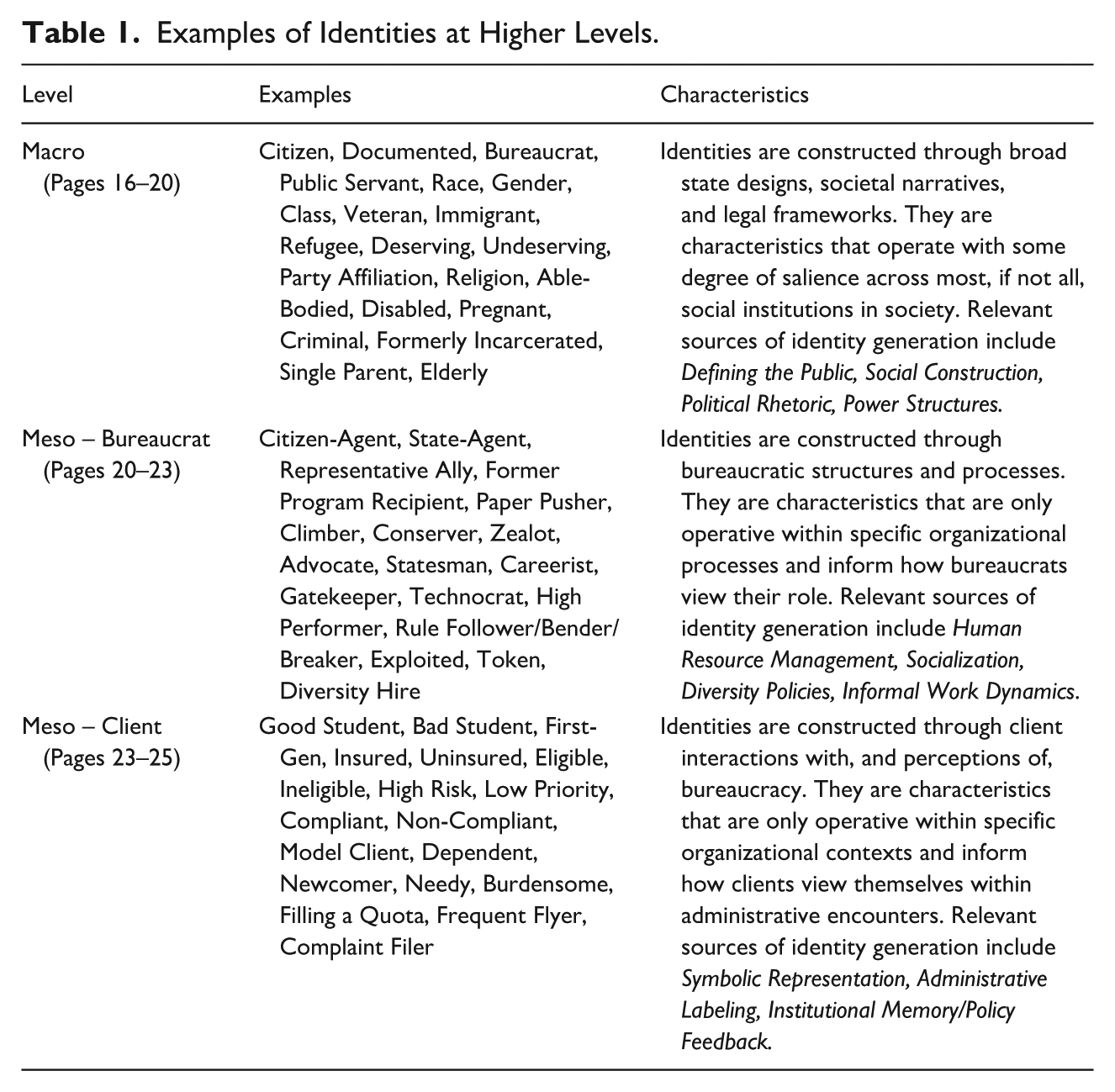
Our framework centers bureaucracy as one of the key institutions for understanding power, oppression, and identity formation and expression within society. Through this approach, we situate salient and visible identities such as race or gender alongside “hidden” identities borne out of political and administrative processes that are often overlooked in the discussion of identity. One of our central contributions, then, is to expand the inventory of identities relevant to intersectionality research in public administration. To illustrate this expanded range of identities, we provide examples in Table 1 that can stimulate ideas to apply in more explicit policy contexts.
Examples of Identities at Higher Levels.
In our view, a framework that accounts for levels of analysis helps navigate some of the inherent ambiguity and complexity that define identity-based research. The theory of representative bureaucracy is one domain that the framework clearly may enrich. Applications of representative bureaucracy tend to be limited to a narrow set of identities that are often divorced from the larger political and bureaucratic environment where representation occurs. By its nature, all representation work is intersectional: all bureaucrats adhere to some type of identity, yet this variation is often elusive in empirical applications. Watkins-Hayes (2011) and A. M. McCrea’s (2021) show, however, that, despite congruence between demographic identities, the realities of organizational structure and process effectively crowd out any representative behavior. Both authors allude to how such structuring shapes both the bureaucratic and client roles during policy implementation, making inquiries into identity generation a fruitful extension of the theory.
Incorporating insights about higher-level identity generation and dyadic intersectionality into current research can enhance our understanding of what the theory is trying to capture: the link between shared values and outcomes. Although demographic characteristics certainly are salient, they are imperfect and incomplete proxies of values and behavior (Headley et al., 2021). Even as scholars model intersectional identities such as race, gender, and/or sexuality as dimensions of concordance, it is worth asking if these are the most relevant identities for congruence and the conditions under which they are the most relevant. Moreover, as increasing attention is given to mixed scholarly results (see Meier & Xu, 2022), greater attention to a more expansive inventory of “hidden” identities may be fruitful in sorting out inconsistent empirical findings.
Implications for Research Design
The discussion here provides a new lens to view intersectionality that is consistent with the scope of identities relevant to public administration. Our attention to levels of analysis allows scholars to connect an identity to specific macro- or meso-level processes that generate the identity, helping inform scholars on the identities their scholarship might emphasize, the power is embedded within those identities, and whether and how the identities intersect with each other. Consistent with original thinkers in the field, this pursuit centers intersectionality as a system-level phenomenon that operates through structures of power. Public bureaucratic institutions exhibit immense power to carry out political will, and should have greater prominence within intersectionality research. Our goal is to provide a framework that can help scholars organize their thoughts around these concepts and find ways to apply the approach to more specific research questions.
We now turn to the implications of our theoretical architecture for research design. Although developing a methodology to be employed goes beyond the scope of this conceptual discussion, we suggest how the framework might reflect established approaches to intersectionality. We organize this discussion around a widely adopted typology—the anti-categorical, intra-categorical, and inter-categorical approaches (see McCall, 2005; Breslin et al., 2017)—and show how each can be enriched by attending to the identity generation mechanisms and levels of analysis our framework articulates.
The anti-categorical approach questions “the completeness of the set of groups that constitute a category” and challenges fixed boundaries (McCall, 2005, p. 1778). For example, gender is not limited to male and female but includes transgender, non-binary, and other forms of expression. This approach often relies on qualitative methods, such as ethnography, genealogy, and deconstruction, to understand identities and their intersections. A central aim of this approach is to articulate the power dynamics that allow socially dominant groups to define categories and give them meaning (Breslin et al., 2017). A fruitful extension would be linking these distinct identities to specific bureaucratic mechanisms and administrative processes that reflect their underlying power within society.
Nisar (2018), for instance, explores how the Khawaja Sira, a group of gender-nonconforming individuals are “identified as ‘not-normal’. . . meticulously categorized, disciplined, and governed in formal and informal institutions and spaces throughout their lives” (Nisar, 2022, p. 2). Through these accounts, one can observe how identities constructed at the macro-level are moderated, tempered, and shaped by the mechanizations of bureaucracy and citizen-state relationships. Tracing categories back to their generative mechanisms, whether through macro processes that define group membership or meso processes that assign administrative status, allows researchers to ask not only whether a given category is complete but which level of the administrative state produces and enforces the boundaries being challenged. In doing so, it offers a structural path to deconstruction.
The intra-categorical approach focuses on “a single social group at a neglected point of intersection” (McCall, 2005, p. 1780). In our framework, this involves examining how identities that emerge from less visible macro- and meso-level processes are shaped by specific contexts. For example, researchers often explore intersectionality within a doubly marginalized group such as black women or black transmen. While these identities are imbued with disadvantage, variation in meso-level factors such as administrative labeling can serve as distinct sources of power. Accounting for this additional variation within a single social group is an interesting empirical question that enriches scholars’ understanding on the direction and strength of bureaucratic mechanisms as they relate to other sources of identity within society. For instance, comparing differences in educational outcomes between Black students labeled as “gifted” versus those labeled as “remedial” (see Nicholson-Crotty et al., 2016) or comparing minoritized bureaucrats who are stereotyped as lazy/inefficient with those stereotyped as motivated/effective (see Dinhof et al., 2023) are examples of how this approach could be leveraged in mixed methods designs.
Finally, the inter-categorical approach is inherently comparative, focusing on multiple groups simultaneously. This approach lends itself to common quantitative methods such as interaction terms and subgroup analysis which can explore intersections across gender (e.g., male, female), social class (e.g., lower, middle, upper), and race (e.g., white, black) (Block et al., 2023). Depending on the structure of one’s data, this approach can also be used to explore dyadic intersectionality, examining how the intersecting identities of both bureaucrats and clients affect administrative encounters. Researchers can treat macro-level political-administrative identities and meso-level organizational identities as additional axes in analysis. This can be particularly promising for resolving the inconsistent empirical findings in representative bureaucracy literature, where demographic proxies sometimes fail to capture the variation in organizational identities that our framework identifies as critical. For example, consider a dataset that contains individual-level demographic data for both a bureaucrat and client (e.g., Guul, 2018; Vinopal, 2018). Then, assume there is variation on a particular characteristic that generates/activates meso-level identities for both the bureaucrat and client such as insurance status in a healthcare context (A. M. McCrea, 2021) or administrative labeling in an education context (Thomson, 2012).
If one is interested in conducting quantitative analyses through this approach, there are several important considerations. First, one might recognize that there will likely need to be some concessions made in order to yield interpretable estimates. This is a necessity; otherwise levels of collinearity and subgroup sample size can become an intractable problem (Breslin et al., 2017; Meier, 2018). Moreover, it is unlikely one can specify a parsimonious model if they are including a distinct macro- or meso-level identity for both the bureaucrat and client. Selecting variables that can simultaneously capture a process of identity activation for both the bureaucrat and client should be preferred as it would be costly to move into computationally taxing techniques such as four-way interactions. Second, supplementing this approach with qualitative and ethnographic techniques might be encouraged, since a mixed-methods design allows one to use the qualitative findings to inform both which identities are salient and the selection of variables, yielding richer insights on conceptualizations of identity than can be accomplished through simplistic dummy variables.
A Practical Tool for Advancing Social Equity
In contextualizing identities across levels of analysis, our framework is designed to foster a more comprehensive understanding of distributional inequities in administrative phenomena. The spirit of our argument is inspired by Jilke et al.'s (2019) statement on methodological accountability: . . . a micro-level study is more valuable if it is accountable to the implications its findings have for what we can expect to observe at the meso- or macro-level. At the same time, meso- or macro-level studies are more helpful if they state expectations of individual-level behavior that stem from meso- or macro-level observations. Accountability should therefore provoke consideration and articulation of how findings derived from research at one level can be leveraged to inform studies at different levels and/or how these findings can be used to better understand phenomenon corresponding to other levels. Accountability should ultimately help foster integration across levels of analysis by resolving conflicting evidence (p. 246).
By applying the concept of methodological accountability to the study of identity and intersectionality in public administration, our framework serves as a theoretical and practical instrument to promote social equity. Specifically, it allows one to name and categorize a diverse range of identities that contribute to inequalities in policy outcomes, identify the appropriate mechanism(s) and level(s) of analysis that give rise to these inequalities, and transform this understanding into actionable interventions and meaningful reforms. Moreover, our framework can be used as a reflective practice among public administrators, encouraging them to consider how their own identities and those of the clients they serve intersect within broader systemic contexts. A heightened awareness may lead to more empathetic and positive interactions in administrative encounters, improving service delivery and public trust in government institutions.
In conclusion, the applied aspect of our framework aligns well with a field that seeks to enhance administrative systems to be more effective, responsive, and equitable. Our framework invites scholars and practitioners in public administration to embrace complexity, foster accountability across multiple levels of analysis, and commit to actionable changes that benefits all members of the public and advance the pursuit of social equity in administrative state.
Even though we believe this framework advances the study of identity and intersectionality in public administration, we acknowledge several limitations that merit attention. First, our framework is theoretical and has not yet been subjected to empirical validation. Although we have outlined methodological implications in the preceding section, future research should apply the framework to specific policy domains and administrative contexts to assess its explanatory utility. Second, while we use levels of analysis as an organizing architecture, the boundaries between macro-, meso-, and micro-levels are not always sharply delineated. As our rain barrel analogy suggests, the filtration of macro-level forces into organizational contexts is neither exhaustive nor deterministic, and scholars should be attentive to identity generation processes that span or blur these boundaries.
A related challenge is that the framework does not assume, ex ante, which level is most consequential for a given identity in a particular context. That determination will depend on the policy domain, organizational type, and the specific identities under investigation. Empirical work will be needed to develop such mid-range propositions. Last, our framework is primarily developed within the context of U.S. public administration. Governance systems with distinct institutional architectures, such as parliamentary systems, multi-level governance in the European Union, or administrative structures in the Global South, may require adaptation of the specific mechanisms we identify while retaining the broader logic of multi-level identity generation. Nonetheless, the essence of our organizing principles provides a foundation for expansion, revision, and critique.
Footnotes

Funding
The authors received no financial support for the research, authorship, and/or publication of this article.
Declaration of Conflicting Interests
The authors declared no potential conflicts of interest with respect to the research, authorship, and/or publication of this article.
Data Availability Statement
Data sharing not applicable to this article as no datasets were generated or analyzed during the current study.