







Abstract
Sociopolitical development theory asserts that critical social analysis informs prosocial behaviors. We suggest that one aspect of Black adolescents’ critical social analysis development is an oppression analysis, in which Black adolescents consider (1) the importance of race to they are, (2) their personal feelings about their racial group, and (3) the experience of oppression for minority groups. The current study examined oppression analysis as a latent construct among a sample of 265 Black male adolescents in Grades 7 to 10 from three suburban districts in the Midwestern United States. Structural equation modeling revealed that received parental racial pride messages, but not school-based discrimination experiences, predicted Black male adolescents’ oppression analysis. An oppression analysis and school-based discrimination had direct effects on prosocial behaviors. Racial pride messages had an indirect effect on prosocial behaviors through oppression analysis. In addition, an oppression analysis had an indirect effect on prosocial behaviors through social-emotional skills. This research offers insight into the role of Black boys’ critical social analysis among individual and contextual factors in facilitating positive developmental outcomes.
Keywords
There is significant media, research, and policy attention focused on the development of Black boys and young men. Much of this work highlights personal and environmental factors associated with their elevated risk status and underachievement in various life domains. A smaller body of work labors to understand and promote individual, family, school, community, and workplace characteristics and processes that support Black boys and young men to realize their fullest potential (Howard, 2014). These latter efforts are consistent with a more general scholarly movement toward a focus on the positive development of youth (Lerner, 2006). A central objective of the present study was to illuminate individual and contextual factors associated with prosocial behavior among Black adolescent boys. Prosocial behaviors such as sharing, helping, and cooperating among Black youth are understudied, yet a vital area of inquiry relevant to personal, community, and societal well-being.
The present study was guided by sociopolitical development theory (SPD; Watts & Flanagan, 2007; Watts & Guessous, 2006). Through this theoretical framework, oppression analysis and social-emotional skills were examined as proximal predictors of prosocial behaviors among Black adolescent boys in Grades 7 to 10. SPD theory is anchored in liberation psychology and developmental psychology perspectives, with a focus on advancing human rights and social equality. SPD considers the individual and contextual factors through which youth gain an understanding of inequality and become involved in personal and/or collective behaviors that promote meaningful community and societal change (see Figure 1). Despite the potential utility of SPD theory, fairly few studies have systematically examined its tenets (Hope & Jagers, 2014; Watts & Guessous, 2006), particularly with regard to delineating the components of social analysis. Below we identify and elaborate on an oppression analysis as a type of social analysis in the context of SPD, to include its role among family (i.e., racial pride socialization messages), school (i.e., school-based discrimination experiences), and individual (i.e., social-emotional skills) factors in fostering prosocial behaviors among Black adolescent boys.
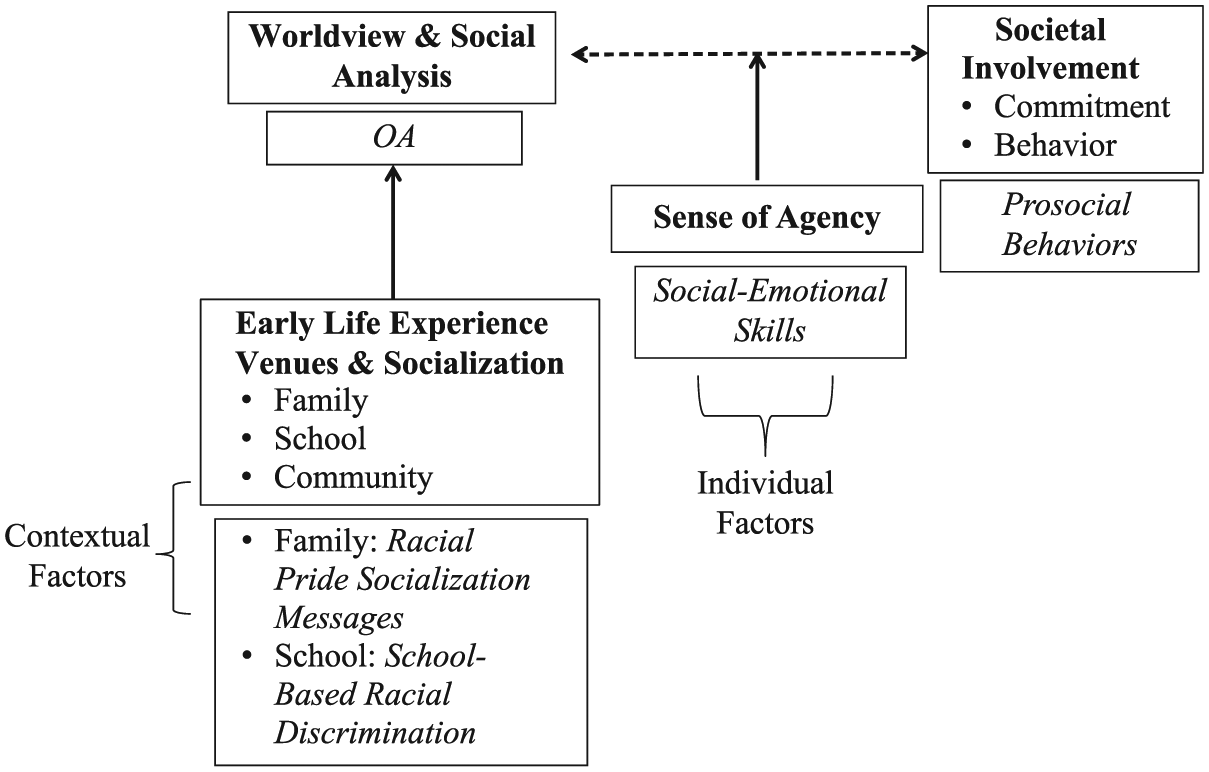
The oppression analysis (OA) presented within the larger sociopolitical development model (SPD).
Oppression Analysis: Racial Ideology, Centrality, and Private Regard
At its core, the SPD model asserts that critical social analysis informs civic behaviors. Critical social analysis is a pivotal aspect of SPD and refers to an evolving understanding of how economic, political, and cultural systems shape and sustain society. With specific attention to oppression and injustice, the ways in which societal institutions and processes influence an individual’s personal, family, and community statuses and experiences are analyzed (see Watts, Diemer, & Voight, 2011; Watts & Guessous, 2006; Watts, Williams, & Jagers, 2003). Awareness and understanding of structural oppression and its various manifestations can be important factors in shaping adolescents’ social perceptions and civic behaviors during a developmental period marked by increases in social perspective taking (Van der Graaff et al., 2014), identity exploration (Phinney, 1992), and reasoning about social groups (Flanagan, 2004). Among adolescents, critical social analysis has been conceptualized in terms of belief in the world as a just and fair place (Watts & Guessous, 2006), mistrust of political systems (Hope & Jagers, 2014), and other ideas about systemic causes for social inequities (Watts et al., 2011). Although understanding youth’s critiques of oppression within larger sociopolitical systems are apt, youth’s critiques of oppression in relation to group status and identity may also play an important role in shaping their civic behavior. Such a critique may be particularly relevant for Black youth whose understanding of themselves as racial group members is often intimately tied to their understanding of oppression and structural barriers (Tatum, 1997). Thus, Black youth’s understanding of oppression may be manifested in their developing racial identity and ideologies and as such should be an important consideration in understanding their sociopolitical development (Hope & Jagers, 2014; Kirshner & Ginwright, 2012).
Racial identity is appropriately understood as being a multidimensional phenomenon. We used the Multidimensional Model of Racial Identity (Sellers, Smith, Shelton, Rowley, & Chavous, 1998) to identify and describe an oppression analysis as a form of critical social analysis via racial identity components. The multidimensional model of racial identity proposes that centrality, salience, regard (public and private), and ideology (assimilation, humanism, nationalism, and oppressed minority ideology) are four key dimensions of Black racial identity. Racial centrality, racial private regard, and the oppressed minority ideology were focal dimensions for the present study as we hypothesized that these components might be germane to a developing social awareness of the importance of racial group membership and the experience of oppression among Black adolescent boys. Racial centrality refers to how important an individual’s racial group is to one’s sense of self. Racial regard is an evaluative dimension that encompasses both private regard and public regard; private regard reflects the positive or negative evaluation of one’s racial group. Finally, an oppressed minority ideology connects the struggle of African Americans to the exploitation and marginalization of various other racial/ethnic groups (Sellers et al., 1998).
An oppressed minority ideology is a central aspect of the oppression analysis because it implies an understanding that race has been used in U.S. society to justify the cultural and sociopolitical domination and economic exploitation of people of color. As Black adolescents develop conceptions of what it means to be Black, these conceptions are often coupled with experiences of differential treatment based on race (Tatum, 1997). As conceptions of race and social groups become more salient for Black youth, they may extend their own experiences of differential treatment to the social experiences of other marginalized groups. The presence of an oppressed minority ideology among Black youth is beneficial as it leads to the acknowledgement of shared oppression with other racial minority groups. Such an ideology allows adolescents of color to organize around shared oppression experiences and be less susceptible to mainstream cultural dominance. There has been relatively little focus on the oppressed minority ideology, particularly in adolescent samples. However, the oppressed minority ideology may be particularly relevant for Black male adolescents’ SPD and oppression analysis as Black males have oppression-related experiences (e.g., discrimination, negative treatment in schools and communities) at elevated rates in comparison to other groups (e.g., Chavous, Rivas-Drake, Smalls, Griffin, & Cogburn, 2008; Swanson, Cunningham, & Spencer, 2003). Thus, Black adolescent males may be more likely to detect the differential treatment of other marginalized groups and incorporate this awareness into their own conceptions of identity.
We expected other components of racial identity, such as racial centrality and private racial regard, to cohere with the oppressed minority ideology as an oppression analysis construct among Black adolescent males. Racial centrality contributes to an oppression analysis as it affirms that being Black or African American is critical to one’s self-concept. Private racial regard might make one more likely to examine the condition of Blacks in a larger context of social position and justice given one’s sense of belonging or lack thereof toward the Black community. Research indicates positive associations between an oppressed minority ideology, racial centrality, and racial regard among adolescents (Sellers et al., 1998; Smalls, White, Chavous, & Sellers, 2007; White-Johnson, 2012). However, these components have never been examined as a latent construct, which may be reflective of a developing social analysis lens in which a Black male adolescent begins to connect the importance and affirmation of his identity as part of a marginalized group with the common oppression experiences of members of other minority groups.
Oppression Analysis and Prosocial Behavior
Awareness and critical understanding of oppression in relation to self and community may be a key determinant in fostering prosocial behaviors among marginalized groups (e.g., Black adolescent males). Prosocial behavior is a form of civic behavior that is defined as a voluntary action intended to benefit another individual or groups of individuals and includes behaviors such as offering to help, share with, care for, and cooperate with others (Mussen & Eisenberg, 2001). Among young Black males, prosocial behaviors may also represent an important element of social change strategy in which caring for and cooperating with others challenges antisocial narratives of young Black males (Rowley et al., 2014) and empowers Black male youth to become leaders among their social groups and communities. To date, studies that included an oppressed minority ideology, racial regard, and racial centrality among adolescents have focused on academic outcomes (Sellers et al., 1998; Smalls et al., 2007), yet there is some evidence that aspects of racial identity are also associated with prosocial behaviors of Black adolescents and adults. For example, previous work has identified racial regard as a contributor to prosocial behavior of Black college students, such that higher private regard was associated with more involvement in the Black community (White-Johnson, 2012) and intended social involvement among adolescents of color (Watts & Guessous, 2006). Given these findings, it may be that the proposed latent oppression analysis construct would be a positive predictor of Black boys’ prosocial behaviors.
Social-Emotional Skills and Prosocial Behaviors
The SPD model posits that political efficacy moderates the relationship between critical analysis and civic engagement (Watts & Flanagan, 2007; Watts & Guessous, 2006). Political efficacy refers to an individual’s confidence in his or her capacity to act socially and politically and represents a sense of agency to invoke social change. However, a more generalized application of SPD to prosocial development might highlight adolescents’ social ability and efficacy as the mechanism by which critical social analysis translates to prosocial behavior. In the current study, we conceptualize adolescents’ social efficacy as adolescents’ perceptions of their social-emotional skills. We investigate self-reported social-emotional skills as a potential mediator of the relationship between oppressed minority analysis and prosocial behaviors. This seemed appropriate given that social-emotional competencies (i.e., empathy, self-control, assertion, and cooperation) contribute to one’s healthy social functioning in family, school, community, and work settings (Weissberg, Durlak, Domitrovich, & Gullotta, 2015).
The majority of studies examine social-emotional skills within the context of schools, particularly in relation to peer and teacher interactions. For instance, socially competent children tend to cooperate and make friends easily and are therefore well-liked by teachers and peers (Coie, Dodge, & Kupersmidt, 1990). With regard to Black youth, higher reports of empathy are positively related to prosocial behavior (McMahon, Wernsman, & Parnes, 2006; Nguyen, Clark, & Belgrave, 2011), stress resilience (Magnus, Cowen, Wyman, Fagen, & Work, 1999), and moral reasoning (Humphries & Jagers, 2009; Humphries, Parker, & Jagers, 2000). Investigations into prosocial behaviors among Black youth specifically yield gender differences that distinguish social-emotional skills such as high empathy (McMahon et al., 2006) and emotional self-control (Belgrave, Nguyen, Johnson, & Hood, 2011) as important predictors for Black male adolescents’ prosocial behavior, specifically. Although this body of work demonstrates direct links between social-emotional skills and prosocial behavior among Black adolescent males, it does not consider how racial identity might be relevant to this relationship. As described earlier, racial identity is a potentially important contributor to Black youth’s prosocial behaviors (Watts & Guessous, 2006; White-Johnson, 2012), particularly combined as an oppression analysis. However, social-emotional skills may be an individual characteristic through which an oppression analysis manifests itself into prosocial behaviors. Thus, we examined whether an oppression analysis was associated with Black adolescent boys’ perceptions of their social-emotional skills and whether such skills mediated the relationship between their oppression analysis and prosocial behaviors.
Family and School Experiences Associated With an Oppression Analysis
A final consideration in this study was to illuminate family and school factors that might support prosocial behaviors through their influence on Black adolescent males’ oppression analysis and social-emotional skills. Several studies have pointed to aspects of family (Padilla-Walker, Dyer, Yorgason, Fraser, & Coyne, 2015) and school contexts (Wentzel, 2015) that support positive social development. Given the focus on an oppression analysis, we investigated the potential contributions of parental racial socialization messages and school experiences of discrimination.
Parental racial socialization refers to the ways in which parents communicate to their children about being members of their racial group and can be understood as a mechanism for promoting positive development of Black youth (Evans et al., 2012). Racial socialization has also been referred to as an example of “group ways” that racially/culturally distinct groups employ to help guide the civic development of their young people (Flanagan, Martínez, & Cumsille, 2011). Several types of parental racial socialization messages have been identified (e.g., messages about racial pride, racial discrimination, mistrust of other racial groups, racial group equality/egalitarianism; Hughes et al., 2006). We focused on racial pride messages as they instill in adolescents the belief that being Black is a positive and important aspect of one’s identity and, thus, may be influential in helping youth develop ideas about the salience of racial group status in addition to instilling affiliation with their racial group. Additionally, Black parents often give racial pride messages in the form of sharing about African American history in which they emphasize the milestones of the first African Americans to achieve in the face of oppression and differential treatment across a variety of domains. Thus, racial pride messages may also make oppression a salient feature of the Black experience.
There is some evidence to suggest that racial pride messages may be a precursor to an oppression analysis. For example, in a qualitative study of high-achieving Black youth, some Black youth attributed their parents’ messages about racial pride (e.g., knowing Black history and the resilience of Black people in the face of adversity and discrimination) to positive feelings about their racial group and ultimately a development of critical race consciousness, particularly around issues of racial discrimination (Andrews, 2009). Additionally, racial pride messages have consequences for racial centrality such that racial centrality was highest among Black adolescents who had received high positive racial socialization messages (which reflected high racial pride; Neblett, Smalls, Ford, Nguyen, & Sellers, 2008). Although the racial socialization literature typically finds that racial pride messages are more often given to Black girls at higher rates than Black boys, studies find that racial pride messages are effective for a number of psychosocial outcomes for Black boys (see Hughes et al., 2006, for a review). We assume that racial pride messages will be associated positively with an oppression analysis among Black adolescent boys.
With regard to schools, there is considerable agreement that schools are important contexts for prosocial and other forms of civic behavior development (Flanagan et al., 2011; Wentzel, 2014). However, the school context may also foster experiences that highlight the salience of race, perpetuate racial stereotypes, and promote social exclusion based on race (Rosenbloom & Way, 2004). Black adolescents, in particular, report elevated rates of racial discrimination experiences within schools from both peers and teachers (Fisher, Wallace, & Fenton, 2000; Greene, Way, & Pahl, 2006), with Black boys typically reporting more racial discrimination from peers and teachers in comparison to girls (Chavous et al., 2008; Swanson et al., 2003). Although Black adolescents’ school experiences with racial discrimination have a variety of detrimental effects on psychological distress, behavioral problems, and academic achievement (e.g., Wong, Eccles, & Sammeroff, 2003), one’s own racial discrimination experiences may also prompt critical consciousness about racial discrimination toward minorities in the larger society (Worrell, 2012). In amother qualitative study of Black student achievement, an awareness of racial discrimination facilitated critical consciousness among Black youth and motivated some youth to be engaged in their school environment to combat negative beliefs about African Americans in schools (Andrews, 2012). Thus, we expect that experiences of school-based racial discrimination would foster Black male adolescents’ analysis of oppression and unfair treatment in addition to engagement in prosocial behavior in schools.
The Current Study
The current study sought to examine the existence and role of an oppression analysis as an application of SPD to the development of Black male adolescents’ prosocial behaviors. As such, we investigated an oppression analysis in the context of parental racial pride socialization messages, school-based racial discrimination experiences, individual perceptions of social skills, and prosocial behavioral outcomes among Black adolescent boys in Grades 7 to 10. We sought to examine this model within a sample of Black male adolescents to contribute to the work on the positive youth development of Black males in light of the expansive literature on the risks and deficits of this group (see Noguera, 2003, for an example). Given several studies that have noted the variation in outcomes for Black males according to the racial composition of their educational contexts (e.g., Voight, Geller, & Nation, 2014; Wentzel, Filisetti, & Looney, 2007), we also explored the viability of these constructs with Black adolescent boys from predominately Black and predominately White school settings.
Method
Participants
Participants in this study were 265 Black male adolescents in Grades 7 to 10 from three suburban schools districts in the Midwestern United States. At the time of this study, 28.3% of the males were in the 7th grade (n = 75), 25.7% were in 8th grade (n = 68), 35.8% were in 9th grade (n = 95), and 1.1% were in the 10th grade (n = 3). There were missing grade level data for 24 students (9.1% of the sample). Students ranged in age from 12 to 17 years (M = 13.74, SD = 1.77). Students were recruited from three middle schools and four high schools across three school districts in a Midwestern metropolitan area. The school districts differed in terms of their racial and socioeconomic composition. School District 1 served a predominately Black population (65.7% African American; 28.1% White; U.S. Census Bureau, 2010) from low- and working-income backgrounds. School District 2 served a predominately White (76.5% White; 9.4% African American; U.S. Census Bureau, 2010) working-class population. Finally, School District 3 served a predominately White (79.3% White, 8.7% African American; U.S. Census Bureau, 2010) middle- and upper-middle income population.
Procedure
This study protocol was approved by both the institutional review board at the University of Michigan and the administrators for each of the three participating school districts. Participants were recruited at their schools during the 2010-2011 and 2011-2012 academic years. Recruitment fliers were distributed during students’ lunch period and also mailed to participants’ homes and distributed at parent meetings. Parents consented and students assented prior to survey administration. Surveys took 45 minutes to complete and were administered during participants’ class period, lunch hour, or after school. Students were compensated for their participation with a $20 Visa gift card.
Measures
Perceived Family Income
Students were asked to report their perceived family income by reporting on two items: “My family has __ money compared with the rest of the kids at my school” and “My family has __ money compared with the rest of the kids in my neighborhood” (r = .47, p < .001). Students responded to each item on 5-point scale (1 = a lot less, 2 = a little less, 3 = the same amount of, 4 = a little more, 5 = a lot more). The mean of the two items was used as a composite variable for perceived family income, with higher scores indicating higher perceived income in comparison with peers.
School-Based Racial Discrimination
Students reported on the frequency with which they experienced school-based racial discrimination across seven items (α = .92). The school-based racial discrimination questionnaire was adapted from an established scale (Eccles, Wong, & Peck, 2006; Wong et al., 2003). Students were given the prompt: “At school how often do you feel . . .” followed by seven instances of racial discrimination that may occur at school. Several example items are as follows: “Teachers call on you less often than they call on other kids because you are Black” and “That you get in fights with some kids because you are Black.” Students reported on the frequency of these experiences using a 5-point scale ranging from 1 (never) to 5 (almost every day). A mean score was computed across the seven items, with higher scores indicating more frequent experiences with school-based racial discrimination.
Racial Pride Socialization Messages
Students’ self-report of the frequency with which they received racial pride socialization messages was measured using the Racial Pride subscale of the Racial Socialization Questionnaire–Teen (Lesane-Brown, Scottham, Nguyen, & Sellers, 2006). The Racial Pride subscale (α = .68) consists of four items (0 = never, 1 = once or twice, 2 = more than twice) measuring the extent to which students receive messages emphasizing pride in being Black and the importance of knowing Black history (e.g., “Told you that you should be proud to be Black”). A mean score was computed across the items of the subscale, with higher scores indicating higher frequency of receiving racial pride messages from parents.
Oppression Analysis
Components of students’ oppression analysis were measured using subscales from the Multidimensional Inventory of Black Identity–Teen–Short Form (Scottham, Sellers, & Nguyen, 2008). Students reported on the extent to which they endorsed statements representing each component of oppression analysis (private regard, racial centrality, and minority ideology) on a 5-point scale from 1 (really disagree) to 5 (really agree). The Private Regard subscale consisted of three items (α = .74; e.g., “I am proud to be Black”). The Racial Centrality subscale consisted of three items (α = .52; e.g., “If I were to describe myself to someone, one of the first things that I would say is that I’m Black”). The Minority Ideology subscale consisted of three items (α = .56; e.g., “People of all minority groups should stick together and fight discrimination”). A mean score was computed across the items for each subscale, with higher scores indicating a higher endorsement of that oppression analysis component.
Social-Emotional Skills
Students’ self-report of their social-emotional skills was measured using four subscales from the Social Skills Rating System (Grades 7-12; Gresham & Elliot, 1990). Students indicated the frequency with which they engaged in behaviors that represented assertion (e.g., “I make friends easily,” 10 items, α = .76), cooperation (e.g., “I ask before using other peoples’ things,” 10 items, α = .82), empathy (e.g., “I try to understand how my friends feel when they are angry, upset, or sad,” 10 items, α = .82), and self-control (e.g., “I control my temper when people are angry with me,” 9 items, α = .73) on a 3-point scale of 0 = never, 1 = sometimes, and 2 = very often. A mean score was computed across all social skills subscales, with higher scores indicating higher frequency of social skill behavior.
Prosocial Behaviors
Students’ frequency of prosocial behaviors was measured with a nine-item scale developed by the Developmental Studies Center (Solomon, Battistich, Watson, Schaps, & Lewis, 2000). Students indicated the frequency with which they engaged in each behavior on a 5-point scale ranging from 1 (never) to 5 (more than 10 times). Sample items include “comforted someone who was hurt or feeling sad,” “helped a classmate with homework,” and “donated money, toys, clothes, or other things to a charity or someone in need.” A mean score was computed across all items with, higher scores indicating higher frequency of prosocial behavior (α = .79).
Results
Descriptive Statistics and Correlations
Means, standard deviations, and correlations of the study variables are presented in Table 1. Age was related to minority ideology such that older adolescent boys reported higher endorsement in minority ideology. School district racial demographic was significantly related to a number of key study variables such that Black adolescent boys in the predominately Black school district reported perceiving higher family income than their neighborhood and school peers. Additionally, Black adolescent boys in the predominately Black school districts reported receiving fewer racial pride messages and reported lower private regard, racial centrality, and minority ideology than Black adolescent boys in predominately White school districts. Perceived family income was not significantly related to any of the proposed oppressed minority ideology components, social-emotional skill, or prosocial behaviors. Black adolescent boys’ more frequent reports of school-based racial discrimination experiences were related to higher racial centrality and more frequent prosocial behaviors. Black adolescent boys’ more frequent reports of parents’ racial pride messages were significantly related to higher reports of private regard, racial centrality, minority ideology, more frequent displays of social-emotional skills, and more frequent reports of prosocial behavior. Private regard, racial centrality, and minority ideology were all positively and significantly related with each other. Higher reports of private regard and minority ideology (but not racial centrality) were related to more frequent displays of social-emotional skills and prosocial behaviors.
Means, Standard Deviations, and Intercorrelations for Study Variables.
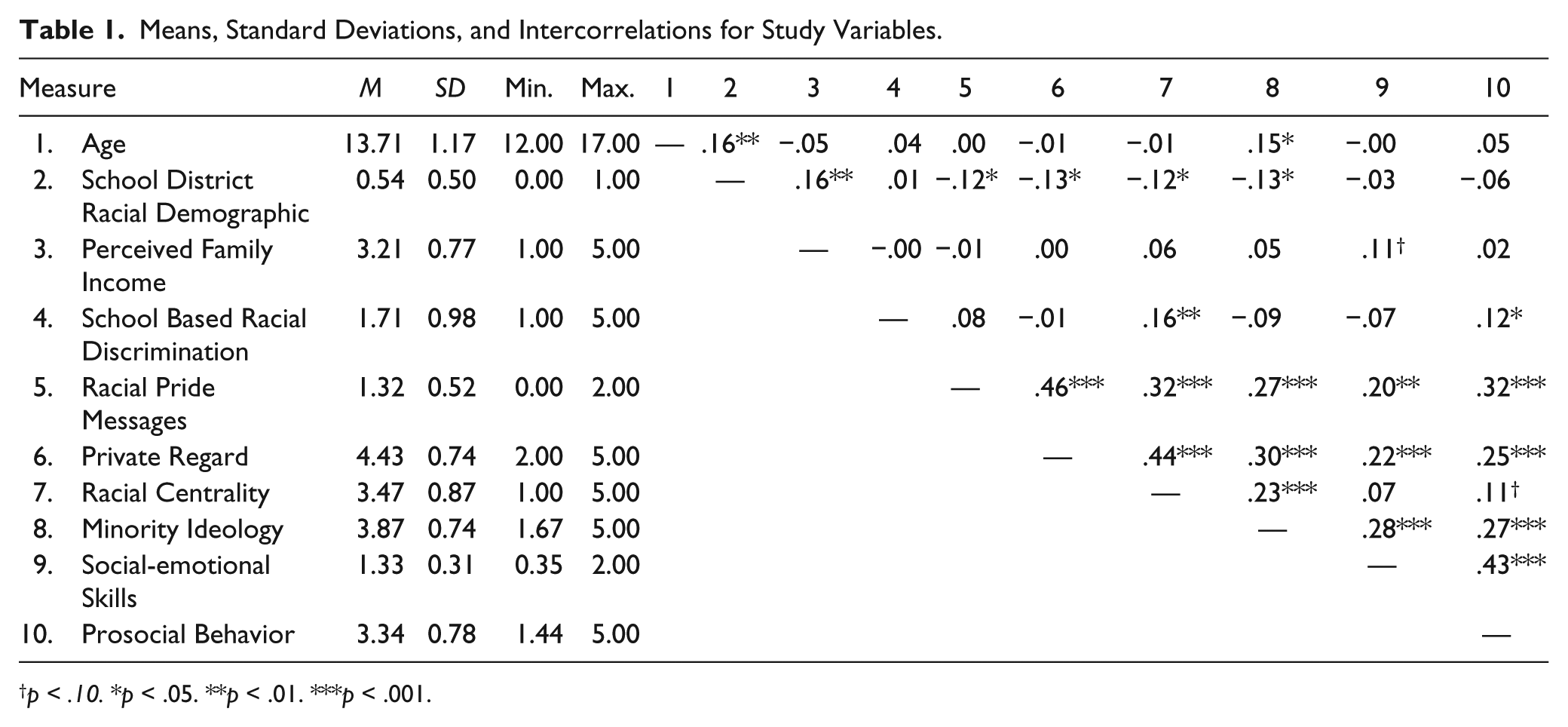
†p < .10. *p < .05. **p < .01. ***p < .001.
Structural Equation Model of Oppression Analysis in a Sociopolitical Development Theory
To examine the validity of the oppression analysis as a latent construct within a larger application of SPD, we conducted a structural equation model (SEM) in SPSS AMOS 22.0 (Arbuckle, 2013) using private regard, racial centrality, and minority ideology as indicators of an oppression analysis. The SEM examined Black adolescent boys’ perceptions of school-based racial discrimination and racial pride socialization messages as predictors of an oppression analysis orientation and an oppression analysis as a predictor of social-emotional skills and prosocial behaviors; school-based discrimination was also examined as a predictor of prosocial behaviors (see Figure 2).
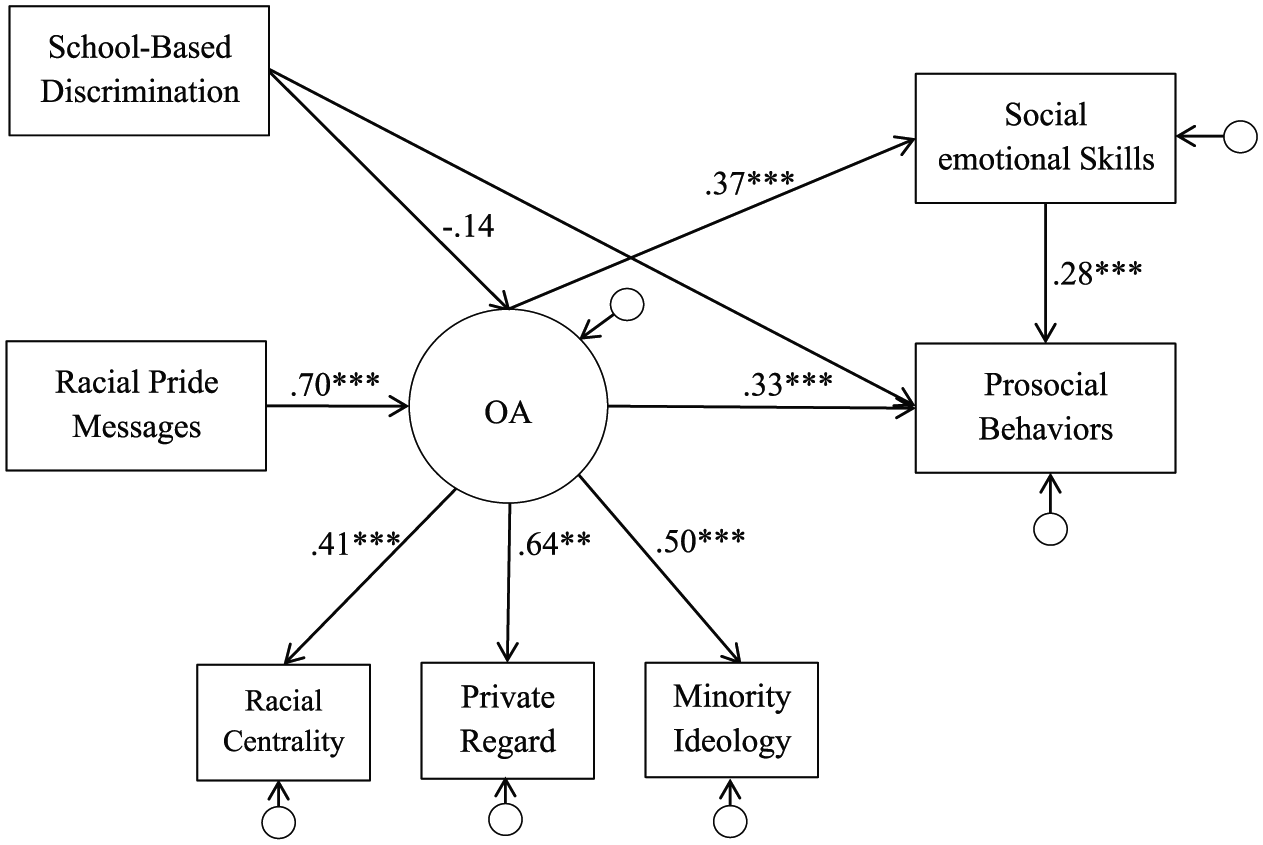
Structural model of sociopolitical development including an oppression analysis (OA) with social skills as a mediator for Black adolescent boys’ prosocial behaviors.
Preliminary analyses revealed no significant relations with the outcome variables of interest and Black male adolescents’ age or perceived family income, and thus, these variables were not used in further analyses. The proposed SEM yielded an adequate model fit, χ2(25) = 19.83, p = .031, comparative fit index = .97, root mean square error of approximation = .06. Within the SEM, Black male adolescents’ experience with school-based racial discrimination was not significantly related to an oppression analysis orientation. However, Black male adolescents’ reports of more frequent racial pride messages from parents had a positive significant direct effect on their oppression analysis. Oppression analysis had a significant direct effect on Black male adolescents’ social-emotional skills and prosocial behaviors. Additionally, there was a positive significant effect of experiences with school-based racial discrimination on Black male adolescents’ prosocial behavior such that more frequent experiences with school-based racial discrimination were related to more frequent displays of prosocial behaviors. Social skills had a significant direct effect on prosocial behaviors such that more frequent displays of social-emotional skills were related to more frequent reports of prosocial behaviors. In addition to direct effects, there were significant indirect effects on Black adolescent boys’ social-emotional skills such that the impact of racial pride messages (β = .26, p < .05) were partially mediated by oppression analysis. Additionally, school-based discrimination experiences did not have an indirect effect on Black male adolescents’ social-emotional skills (β = −.06, p > .05) or prosocial behavior (β = −.05, p > .05) via an oppression analysis.
The total R2 value for predicting the oppression analysis latent variable was .51, signifying that Black male adolescents’ reports of school-based racial discrimination and their parents’ racial pride messages explained approximately 51% of the variance of Black male adolescents’ oppression analysis. The total R2 value for predicting social-emotional skills was .14, indicating that oppression analysis explained approximately 14% of the variance of Black male adolescents’ social-emotional skills. Finally, the total R2 value for predicting Black male adolescents’ prosocial behaviors was .31, signifying that model predictors of an oppression analysis, school-based discrimination, and social-emotional skills explained approximately 31% of the variance of Black male adolescents’ prosocial behaviors.
District-Type Multigroup Analysis
To assess whether the proposed SPD model of prosocial behavior differed across school district racial demographic type (e.g., predominately Black vs. predominately White), we conducted a multigroup analysis comparing Black males who attended schools in a predominately Black school district with Black males who attended schools in a predominately White school district. Multigroup analyses by school district racial composition type indicated that the proposed sociopolitical development model was invariant, Δχ2(4) = 3.75, p = .551, across school district type.
Discussion
This study examined predictors of prosocial behaviors among Black adolescent boys through an application of the sociopolitical development model (SPD; Watts et al., 2003; Watts & Guessous, 2006). There is limited research on such desirable outcomes among Black boys, and this study sought to help fill that void in the literature. This effort included advancing the notion of an oppression analysis as a form of a racialized critical social analysis and investigating the role of racial pride messages and school-based discrimination in promoting an oppression analysis and subsequent prosocial behaviors. Additionally, the study investigated social-emotional skills as an intervening variable in the association between an oppression analysis and prosocial behaviors. The use of a structural equation model allowed for the specification and examination of various propositions of the SPD model. In doing so, we generated findings that shed light on the prosocial behaviors of Black boys and provided some support for the SPD model. Overall, the data fit the model for Black adolescent boys in both predominately Black and predominately White school settings. Below, we first discuss findings from this investigation before turning to directions for future scholarship on prosocial development among Black boys and young men.
Critical social analysis is a pivotal component of the SPD model that refers to grasping the ways in which systemic policies and practices intersect with individual/group behavior and how these processes cause and sustain asymmetric social relationships. This study drew on current theorizing and research on Black racial identity (Sellers et al., 1998) to formulate an oppression analysis, a latent construct composed of beliefs that Blacks share an oppression experience with other people of color, the importance of race in one’s own identity, and a positive perception of belongingness to one’s own racial group (Blacks). We construed such an analysis to reflect an emerging understanding of the ways in which race has been used as a mechanism to create and sustain White privilege. Data from this investigation offered some initial support for the viability of this proposed construct among a diverse sample of Black adolescent boys. Although perceived family income was unrelated to their school experiences or individual characteristics, the racial composition of their school district mattered for Black adolescent boys in several ways. Specifically, bivariate analyses revealed associations between racial composition of the school district community and all three components of oppression analysis and racial pride socialization messages, suggesting that Black adolescent boys in a predominately Black school district had lower private regard, racial centrality, and minority ideology and received fewer racial pride messages from parents. These findings are in opposition to the work on neighborhood racial composition and adolescent racial identity, which suggest higher racial centrality and no relation between neighborhood racial composition and positive in-group feelings (e.g., private regard) for Black youth in predominately Black neighborhoods (Stevenson & Arrington, 2009). It may be that within predominately Black schools there is little discussion of race as a salient topic, even in the form of encouragement of racial pride and belongingness given that there is a lower likelihood of intergroup interactions. However, it should be noted that when Black adolescent boys did receive more frequent racial pride messages from their parents, they did endorse being Black as being more salient to their identity, that they felt positivity and connection toward being Black, and that they believed that Black people had similar oppression experiences to other minorities. These findings suggest that when race is discussed with Black boys, these discussions may foster more of an awareness and understanding of race. Additionally, older boys were more inclined toward higher minority ideology, suggesting that there might be underlying sociocognitive components, particularly around group perspective-taking, that may contribute to an understanding of the Black experience of oppression as being comparable to the experience of other minority groups. It will be important to further explore the meaning of context and individual difference in the development of racial identity and ideologies as they inform the development of critical race consciousness among youth of color.
We asserted that being aware that oppression is also experienced by other racial/ethnic groups, together with perceived importance of one’s racial identity and a positive regard for one’s own racial group, would be associated with prosocial behaviors. Our findings support that these components cohere into an oppression analysis orientation and that this orientation has positive consequences for prosocial behaviors via social skills, across Black adolescent boys in both predominately Black and predominately White school districts. At one level, social-emotional skills such as cooperation and empathy and prosocial behaviors such as helping, sharing, and comforting others represent desirable youth outcomes for all children and youth (Wentzel et al., 2007). Yet, in an oppressive social system, such behaviors can reflect compliance and perpetuation of prevailing social inequities. However, when coupled with the identity-based system critique implied in an oppression analysis, it may be that social-emotional skills and prosocial behaviors represent the type of normative interpersonal expectations and competencies that are essential for youth to organize and enact forms of collective action in schools and communities. The finding that school-based discrimination increased, rather than decreased, prosocial behaviors lends some support to this contention. As such, future work should examine how oppression analysis and development of social skills and prosocial behaviors relate to more specific civic engagement behaviors such as identifying points of change within schools and communities and organizing with others to enact those changes. Furthermore, methods that foster the connection between Black adolescent males’ experiences, developing critical analysis, social competencies, and civic engagement inclinations, such as youth participatory action research methods, should be used to further delineate the developmental process of an oppression analysis.
We must also note that this study made a substantial adaptation to the SPD model, examining social efficacy in the form of social-emotional skills as a mediator to the social analysis-social involvement relation rather than political efficacy beliefs as a moderator to this relation. It seemed reasonable to assume that social-emotional skills, operationalized as school-based cooperation, empathy, self-control, and assertion, would enhance the prospects of an oppression analysis by contributing to sharing and helping behaviors specifically because these skills allow youth to affiliate with others. Additionally, it was important to examine social efficacy in our application rather than political efficacy due to the social nature of our outcome of interest: prosocial behaviors. As such, we found that for Black adolescent boys in our sample social-emotional skills mediated the relationship between an oppression analysis and prosocial behaviors, distinguishing these skills as important in translating an oppression analysis into prosocial behaviors.
This study offered some evidence of family and school experiences that help foster an oppression analysis. With regard to family, we highlighted racial pride socialization messages that emphasize the importance of feeling good about being a part of and knowing the history of one’s racial group. It follows that young men would interpret parents’ messages emphasizing racial accomplishments and pride in being Black as fortifying them against existing racialized oppression. This may then result in greater attention to and consciousness of inequitable treatment based on race or other social markers. Our study did not, however, yield the expected relationship between school-based discrimination and oppression analysis. Yet, the experience of school discrimination did contribute to greater prosocial behaviors. In this instance, young men appear to respond to negative treatment in school with greater helping and sharing, despite the expectation that school-based racial discrimination might encourage Black male adolescents to disengage with their social environments. It will be important to replicate and further contextualize this finding, and future work should explore where and with whom these behaviors occur and what type of resilience-building experiences Black adolescent boys draw from to cope with and ultimately translate their negative race-related experiences into prosocial behaviors.
Study Limitations
This study contributes to the relatively thin body of literature on the prosocial behavior development of Black boys. However, it was limited in several ways. For example, we opted to develop an oppression analysis as a latent construct composed of ideology, centrality, and private regard and investigated how it contributed to boys’ prosocial behavior. It might have been equally viable to consider other racial ideology dimensions to examine the relative contributions to prosocial behaviors of participating boys. Additionally, this investigation was limited to a focus on Black boys’ prosocial behaviors, which are consistent with the notion of personally responsible citizenship (Westheimer & Kahne, 2004). As such, including other forms of civic behaviors or types of problem behaviors would have allowed insights into the broader applicability of the SPD model. Furthermore, the study relied solely on boys’ self-reports. While self-reports are likely the best sources of information about individuals’ own thoughts and feelings, it would have been useful to include multiple perspectives (e.g., caregivers, teachers, siblings, classmates) on boys’ social behaviors.
Implications for Future Basic and Applied Research
Despite its acknowledged limitations, the present study suggests some directions for basic and applied research on the sociopolitical development of Black adolescent boys. Priorities for basic research include examining the developmental trajectory of an oppression analysis and its correlates for both boys and girls. This study suggests that young Black boys’ understanding of the minority experience of oppression increases over time. Attention to developmental processes may help shed light on how youth grapple with the realization that many social groups experience exploitation and disenfranchisement. Such developing conceptions of common experiences of oppression may prompt youth to devise strategies and engage in behaviors, such as Black nationalism, that seek to bring about concrete changes at the local and societal levels. A person-centered approach might be integral to illuminating this connection (Rowley, Chavous, & Cooke, 2003). Furthermore, exploring the intersections of critical social analysis, justification of the sociopolitical and economic systems, and the development of various forms of civic engagement behaviors might also be a profitable line of inquiry.
Family socialization experiences might be an important consideration in efforts to unpack and map racialized social analysis among adolescents (Evans et al., 2012). The literature on racial pride socialization messages is fairly thin, especially with regard to whether and in what ways such messages inform the racial ideology and critical consciousness beliefs of youth. It would be informative to examine how daily events might inform and/or be informed by such messages. In addition, research is needed to identify what parent characteristics and practices might be associated with the frequency and timing of delivered and received racial pride socialization messages.
There has been fairly limited attention to the consideration of racial, gender, or socioeconomic inequities in content or evaluation designs for school-based or out-of-school positive youth development programs. Such topics may be particularly relevant in the context of increasingly popular social-emotional learning programs, which attempt to promote both social skills and critical analysis development (Jagers, Harris, & Skoog, 2015). Youth organizing efforts represent fertile contexts to promote social-emotional skill and social action through the interrogation of inequality issues (Kirshner & Ginwright, 2012). As discussed earlier, such work could benefit from attention to whether and in what ways methods such as youth participatory action research foster critical social analysis, social efficacy, and action at the individual and group levels. Additionally, research on school climate should illuminate what specific aspects of the regular schooling experience contribute to the perception of discrimination or fairness within the school context. Other research has implied that academic content and processes might warrant inspection as well (Diemer, Hsieh, & Pan, 2009; Geller, Doykos, Craven, Bess, & Nation, 2014; Hope & Jagers, 2014). However, there remains a need to connect these contextual factors with civic analysis, motivation for engagement, and various forms of prosocial and civic engagement behaviors.
Prosocial behavior of Black adolescent boys is an important, yet understudied area of inquiry. Such behaviors have implications for personal growth and development and are vital to the processes and outcomes associated with improving economic, political, and cultural well-being in marginalized communities. This study suggests that issues of identity and social-emotional skills can be key considerations in understanding and promoting prosocial development.
Footnotes
Declaration of Conflicting Interests
The authors declared no conflicts of interest with respect to the research, authorship, and/or publication of this article.
Funding
The authors disclosed receipt of the following financial support for the research, authorship, and/or publication of this article: This research was supported by National Science Foundation Grant BCS0820309.