







Abstract
In spite of the recent popularity of “going natural” among Black Caribbean women of African descent, the wearing of natural hair by these women continues to be a contentious issue in the English-speaking Caribbean. As such, social networking sites (SNS) may provide supportive environments within which some Black Caribbean female emerging adults can explore their hair identity narratives as they embark on their “natural hair journey.” By employing a qualitative case study research design, we found that among the 12 participants of the study, SNS provide an informative and supportive environment for exploration of Black-hair identity for these women. Findings revealed a number of themes that emerged from the narratives of the participants. Most important, that hair provided a means for hair identity self-expression and individual self-classification for Black Caribbean women. SNS also facilitated an online sisterhood, opportunities for personal exploration, and exposure to online models who embraced their natural hair. Study implications, limitations, and recommendations for future research are discussed.
Head hair presentation across cultures, beyond being “an enduring symbol of female beauty” (Bankhead & Johnson, 2014, p. 92), can be very much a part of women’s identity; communicating their political beliefs, social awareness, and kinship. There is an important relationship between hair and identity for women, and this is especially the case for Black women, whose identities seem to be very closely interwoven with the extent to which they change, style, and wear their hair (T. A. Johnson & Bankhead, 2014; Peane, 2017). In recent times, there has been an upsurge in the number of Black women who have been letting their hair return to its natural state (a process that is commonly referred to as “going natural”), and sharing these hair experiences online (Ellington, 2014, 2015; T. A. Johnson & Bankhead, 2014).
With the explosion of the World Wide Web and ever-present social networking sites (SNS), the natural hair of Black women has featured prominently within Black online communities. It is important to understand this “going natural” phenomenon in the Caribbean, as research to date has centered largely on the African American experience (Ellington, 2014, 2015; T. A. Johnson & Bankhead, 2014). Thus, this article will be broadly organized in such a way that, an overview of the perception of Black natural hair, Blackness, and associated identity domains for Caribbean women will be presented first. This is followed by factors associated with the shift to the discussion of natural hair issues online. Then we discuss the intersection of Black Hair Identity and the use of online SNS by Black Caribbean women in their going natural hair journeys. Our research presents findings from focus groups conducted with Black Caribbean emerging adult women exploring their experiences of going natural using social media networks.
Black Natural Hair
Hair void of any chemical or thermal treatment is known as natural hair (Ellis-Hervey et al., 2016), referring to the hair that grows out of one’s scalp in its organic state and the characteristics of the original follicles are maintained. From the late 1800s onwards Black women have and continue to alter their virgin natural hair (possibly to conform to societal expectations), through permanent and semipermanent chemical and thermal treatments (A. G. Johnson et al., 2017; Rooks, 1996), which is often referred to as processed hair (Barnett, 2016).
For decades, Black women have been bombarded by societal beauty standards, largely informed by Eurocentric images, thereby being exposed to surreptitious messages that their natural hair is unattractive and not good enough (Thomas, 2013). Many have processed their hair to acquire straight, long flowing tresses (Awad et al., 2015; Henderson, 2015) that blow in the breeze (Caldwell, 2003). To understand this behavior, it is important to note that although most of the population of the English-speaking Caribbean are Black (i.e., descendants of West Africans who were enslaved; Lituchy et al., 2017), many Caribbean countries are past colonies of European nations. Thus, hair grooming practices and the wearing of hair adornments that emulated the White colonial masters were encouraged (Thompson, 2009). Thompson (2008) noted that “ . . . field slaves often hid their hair, whereas house slaves had to wear wigs similar to their slave owners” (p. 6).
Although times are changing, Black Caribbean women face challenges when wearing their natural hair as there are lingering artifacts of the colonial era that are still ingrained in different facets of the Caribbean psyche (Hickling & Hutchinson, 1999). There have been instances in the English-speaking Caribbean where the wearing of natural hair by employees and Black tourists has been viewed as inappropriate and unprofessional. For example, in Barbados in 1986, a hotel employee was dismissed from her job due to wearing her hair in braids (Sealy, 2015). Additionally, feminist Audre Lorde (1990) in the book, “Is your hair still political?” shared her experience of being denied entry to Virgin Gorda (an island of the British Virgin Islands in the Caribbean), when seeking to spend the Christmas vacation there. She was informed that wearing her natural hair (in dreadlocks) prohibited her from entering the country. More recently, in January 2015 the Royal Barbados Police Force revised their dress-code policy by placing restrictions on the wearing of natural hairstyles by policewomen and enforcing a ban on wearing dreadlocks (Bradshaw, 2015). This mandate was closely followed by an outcry against a principal of a secondary school in Barbados, who allegedly expressed disapproval of natural hairstyles worn by female students (Martindale, 2015). Although anecdotal, these are some examples that demonstrate the challenges that Black women and girls face when wearing their natural hair in mainstream Caribbean society. The discrimination of Black Caribbean women wearing their natural hair can be traced to the region’s history as it has been argued that due to the Trans-Atlantic trafficking and the enslavement of Africans, Black natural hair has consistently been denigrated (Joseph-Salisbury & Connelly, 2018). As a result of the colonial history of the region, Black Caribbean women have experienced the devaluation of their Black phenotypes in favor of Eurocentric attributes (Cepal, 2019; Gordien, 2011).
Blackness and Associated Identity Domains for Caribbean Women
Schwartz et al. (2013) note that there are many domains of identity that can include but are not limited to political affiliation, sexual orientation, family relationships, among others, and hence, identifying as Black is but one identity domain. According to Niblett (2018), citing the work of noted Caribbean scholars Rhoda Reddock and Sir Hilary Beckles, the use of “Black” to describe members of the English-speaking Caribbean has its genesis from a shared African lineage. However, despite this shared ancestry, Norwood (2018) notes a wide variation in physical attributes among people who self-define as being Black. For example, among Black people, differences exist in shades of skin tone, hair texture, the shape of the nostrils, size of lips, and body proportions.
Identifying as Black, therefore, can be considered as being one aspect of the overall identity of many Caribbean people. It should be noted however that the identity of Black Caribbean women is a psychosocial construct that is still best understood and expressed by Black Caribbean women themselves. This social constructivist view (toward the interrogation of the meaning of identity) is in keeping with Neo-Eriksonian schools of thought (McAdams, 2001). For example, McAdams (2001) notes the importance of “narrative identity;” a life story that evolves is consistently reconstructed and internalized to provide an individual with a sense of purpose (McAdams & McLean, 2013) as they interact within their social environment.
In the Caribbean, there are numerous social opportunities within which Black Caribbean women can interact to celebrate and reaffirm their Black identity. The culture that has emerged in the English-speaking Caribbean in celebration of “Blackness” and characterized by numerous annual festivities, literary works (Sealey, 2017), political movements, and ongoing sociopolitical linkages with nations of the African continent (Ministry of Tourism, 2019). Like the United States, Black History Month is observed in many Caribbean countries. For example, in Trinidad and Tobago during the month of November (Ome, 2018) and in Barbados and Jamaica in February (Brown-Glaude, 2007; Sealey, 2017). This annual period of observation began in the United States and was adopted in the Caribbean because of its role in highlighting the global contributions of Black people throughout history (Sealey, 2017) and helping solidify a universal Black identity across the African diaspora.
Research suggests that one label used to represent an identity domain associated with one’s ethnic lineage is Ethnic and Racial Identity (ERI; Umaña-Taylor et al., 2014). ERI can be defined as a multidimensional construct that encompasses the beliefs, attitudes, and personal meanings that individuals have about their ethnic/racial group memberships. ERI is an aspect of an individual’s overall identity narrative that develops within the wider socioenvironmental context (Seaton & Gilbert, 2011; Umaña-Taylor et al., 2014). As such, it is possible that Black Caribbean women’s ERI is associated with their African lineage and shared experiences within the Caribbean context.
Hair is a salient feature of one’s ethnicity and racial membership and it is, for this reason, that hair functions as a “key ethnic signifier” (Mercer, 1987, p. 36). As noted by Chapman (2007), hair is one of “the many components of the multiple identities that are imbedded in Black women” (p. 68). For Black people, hair is deeply symbolic, having spiritual and religious meanings, playing an essential sociocultural role, and, at other times, serving as a mode of personal self-expression (Banks, 2000; T. A. Johnson & Bankhead, 2014). Msweli and Gwayi (2019) noted, “Hair is a personal thing, [sic] it is an extension of a person’s personality and if you are denied that, then you are denied the true essence of who you are” (p. 14). Also, Harrison and Sinclair (2003) contend that hair is a tool for identity construction, as it can be manipulated in accordance with fashion trends and cultural norms. Moreover, T. A. Johnson and Bankhead (2014) note that hair plays an intricate role in the identity of Black women, and Lukate (2019) found that even hair textures and styles contribute to the development of women’s identity. Oyedemi (2016) makes the point that the use of hair extensions for most Black women contributes to the “erasure of their natural hair identity” (p. 544). As a counternarrative, T. A. Johnson and Bankhead (2014) emphasize the importance of developing “positive natural hair identity” (p. 99), which can be instilled in women and girls by teaching them self-acceptance of their natural hair.
Historically, Black people’s hair has been “devalued as the most visible stigma of blackness, second only to skin” (Mercer, 1987, p. 35). The devaluation of the natural hair of Black women in the English-speaking Caribbean persists to this day in schools and businesses as Black natural hair is considered unattractive, difficult to manage, unprofessional, and overall inferior to Caucasian-like hair (e.g., Bradshaw, 2015; Cavanagh, 2019; Martindale, 2015; Sealy, 2015). Nevertheless, there is a rising trend of going natural among Black Caribbean women. This natural hair movement has a strong presence online, whereby hairstyles, grooming behaviors, and lifestyle changes are discussed (Bardzell, 2010).
Shifting the Natural Hair Discourse Online
The push to go online may be attributed in part to the perpetuation of stereotypes about what Black beauty is—stereotypes that are demonstrated via traditional media outlets (Perkins, 1996). Thus, within the Caribbean context, Black women who wear their natural hair may risk metaphorically becoming invisible in society. That is, not being accepted, being dismissed, or being overlooked. Offline agents of socialization (family, friends) and traditional media (magazines, television), as noted by Bryant (2013), may have created an environment of uncertainty, rejection, and aversion for Black women as a result of the dominant focus on Eurocentric ideals of beauty. Thus, a sense of being rejected and living in unsupportive offline spaces may lead some Black Caribbean women who wear their natural hair to seek out places where they may feel that they are accepted and valued.
No group is arguably more adept at navigating the world of SNS than young people between the ages of 18 and 24 years (Holmgren & Coyne, 2017), which is a group known as emerging adults (Arnett, 2000). During this period, the exploration and interrogation of one’s identity and worldview are paramount and can occur through social interactions in both offline and online environments (Jules et al., 2017). The interactions with others online can provide emerging adults with approval, feedback (Jules et al, 2019), and support (Ellington, 2015). Thus, being a part of social groups with common interests can reduce feelings of alienation (Chickering & Reisser, 1993) and by extension shape identity development (Klimstra & van Doeselaar, 2017).
Research conducted outside of the Caribbean suggests that social media serve as a sanctuary from the day-to-day racial and gender microaggressions that Black women could experience, thereby potentially acting as a haven in which identity affirmation can take place (Lee, 2015). The Digital Age has broken traditional barriers to communication, in that, digital advancements have given birth to SNS. Some examples of these sites include Facebook, Twitter, Instagram, YouTube, Snapchat, and TikTok. SNS, such as those previously mentioned, have the potential to provide opportunities for people to form social contacts and develop personal online content that can be viewed and traversed by others (Ellison & boyd, 2013). Although SNS vary vastly, they have several common features. For example, people can share comments and impart messages privately or publicly; some allow for photo or video-sharing, live broadcasting, streaming, as well as instant messaging. SNS can be general or used to serve special interest groups. Ellison (2007) notes that some sites “are designed with specific ethnic, religious, sexual orientation, political, or other identity-driven categories in mind” (p. 214). Gill (2015) notes that Black women by using SNS can access online communities that provide an invaluable source of information regarding their natural-hair concerns. For example, YouTube is one of, if not, the most widely used SNS platform by women of African heritage to obtain support for wearing their hair in its natural form (Ellington, 2014, 2015; Jackson, 2017; Neil & Mbilishaka, 2019).
Engaging in online social networks can provide beneficial support in many ways (i.e., informational or emotional) as well as serve to promote a sense of empowerment, community, and belonging (Bock et al., 2013; Brown, 2018; Lefebvre & Bornkessel, 2013; Napolitano et al., 2013). In addition, the key features of SNS (i.e., accessibility, availability, and anonymity) allow users to effectively and actively acquire information from relationships with others, as well as provide emotional support to and receive feedback from online contacts (Versey, 2014). Thus, Black women can now engage in interactive online reciprocal relationships, obtaining, sharing, and creating knowledge as it pertains to wearing their natural hair (Gill, 2015).
The Intersection of Black Hair Identity and SNS
Research on ERI suggests that changes in one’s perceptions of self vary across the developmental lifespan (Umaña-Taylor et al., 2014). Emerging adulthood, the developmental period that follows adolescence (Arnett, 2000), is a time when individuals expand their focus on exploratory processes that infuse ERI with a sense of personal meaning (Seaton & Gilbert, 2011; Umaña-Taylor et al., 2014). Furthermore, emerging adults start to consider the intersections among their many important identity domains. Therefore, ERI can be understood in how it intersects with other realms of the individuals’ life (e.g., gender identity, political identity, national identity, career identity). Umaña-Taylor et al. (2014) indicate that ERI for emerging adults is complex. Emerging adults are deeply engaged in the exploration of multiple identities, and the requisite intersections among them (Arnett, 2000). Therefore, emerging adults may explore the characteristics of their hair identity online in their ongoing identity development.
Many Black women are identifying themselves as naturalistas, denoting that they choose to wear their hair natural and unprocessed (Brown, 2018). The decision that Black women make to go natural is not taken lightly because the going natural process can involve a significant investment in finances, time, and dedication to hair care regimens, in the transition from hair that is processed, back to hair in its natural state. Therefore, these Black women are going natural by embarking upon a “natural hair journey.” The utilization of SNS is arguably critical to the success of this journey of Black Caribbean women. This is because, there is an interconnectedness between an individual’s online and offline environments (Jules et al., 2017, 2019). When discussing natural hair concerns via this online-offline bridge it is likely to build and strengthen personal hair maintenance and grooming behaviors, such as the adoption of natural hair practices in one’s daily life (Ellington, 2014, 2015; Gill, 2015; Jackson, 2017; Neil & Mbilishaka, 2019).
Within online contexts specifically, opportunities for personal identity exploration via SNS have been found in the psychological literature (DeHaan et al., 2013; Ellington, 2014, 2015; Jules et al., 2019; Manago et al., 2008; Thomas, 2013). For example, Ellington (2014, 2015) notes that the interactions that occur via these SNS may facilitate greater self-agency, whereby one can express personal views, interests, and hair-based activities online, and allow Black women to explore and celebrate their virgin hair. Hence, many SNS attract homogenous groups, such as women of African descent, who are interested in going natural. Some of these women have gained prominence on SNS, as they share media and discuss issues related to natural hair. Furthermore, the online documentation of Black women’s going natural hair journeys has been presented as displaying “act [s] of self-awareness” (Thomas, 2013; p. 1), and self-acceptance and being who one is as a person (Ellington, 2015). Personal exploration is a key characteristic of emerging adulthood (Arnett, 2000) and is critical to the personal understanding of ERI (Seaton & Gilbert, 2011; Umaña-Taylor et al., 2014) and by extension one’s hair identity.
Purpose of the Present Study
Based on the literature reviewed, there may be unexplored facets regarding the construct of hair identity of Black Caribbean women, who have chosen to revert to their natural hair. This unchartered territory cannot be fully captured by exploring the accounts of Black women from countries outside of the Caribbean. Furthermore, the impact that SNS have on the perceptions that these women have about their hair is an underresearched area that warrants further exploration. Therefore, based on a qualitative methodological approach utilizing a case study design with focus groups, the objectives of the current study were as follows: (a) to explore the personal meanings of hair with a sample of Black Caribbean emerging adult women, to better understand their hair identity narratives, (b) to explore what these women have learned about what it means to go natural from their interactions on SNS; and (c) to capture how SNS have contributed to their going natural hair journey.
Method
Sample
Participants were 12 Black women, emerging adults, ages 18 to 24 years (M = 21.23, SD = 1.48), who attended a university in Barbados. All self-identified racially as Black, and by ethnic background, they identified as being Caribbean. The participants were all of African descent and resided in an English-speaking Caribbean country. Seven were from Barbados, two were from St. Lucia, and one was from each of the following countries: (a) Trinidad and Tobago, (b) St. Vincent and the Grenadines, and (c) Antigua and Barbuda. The participants were single (and one indicated that she was the mother of a female child). All participants had the educational level equivalent to that of high school graduates and were pursuing undergraduate studies.
The inclusion criteria for the study were that participants had to (a) be in the process of reverting to their natural hair, having experienced a period during which they chemically or thermally altered the structure of their virgin hair; (b) have an active SNS user account; and (c) be engaged in going natural using SNS during the past two years. One week was allocated for recruitment, during which 12 respondents, who all met the inclusion criteria volunteered to participate in the study.
Measures
Demographics and Social Media Activity Questionnaire
Participants completed a self-report questionnaire. It was used to collect information about their age, ethnic and racial background, nationality, number of children, marital status, educational level, hair status, preferred SNS, and social media activity.
Interview protocol
The focus group interview guide was developed based on a review of the aforementioned psychological literature on hair, identity, and going natural. The guide was not prescriptive and allowed for further probing of any areas of interest related to the study. The two researchers independently created a number of questions, then met, and vetted the questions to select those most appropriate for use in the interview protocol. The final questions were as follows: (a) What does your hair mean to you? (b) What have you learned about what it means to “go natural” from your interactions on SNS? And, (c) How have SNS contributed to your going natural hair journey?
Research Design
A qualitative exploratory case study research design was employed to investigate the objectives of the current research. A case study is “an empirical inquiry that investigates a contemporary phenomenon (the case) in depth and within its real-life context, especially when the boundaries between phenomenon and context may not be clearly evident” (Yin, 2014, p. 18). This research design was deemed appropriate as there is little understanding of how female Black emerging adults articulate the personal meanings of their hair and what it means to go natural in a Digital Era within the Caribbean context.
Procedures
A non-probability sampling procedure was used to recruit undergraduate students from a residential university campus located in Barbados. Recruitment of students to participate in the study was conducted via the posting of e-notices on the Moodle learning management system. The notices outlined the inclusion criteria of the prospective participants as well as information to contact the researchers of the study on Black women students who wear their hair natural.
Approval to conduct the study was obtained from the institutional review board of the participating university. Data collection was conducted in two stages. Participants first completed a brief questionnaire and then engaged in a semistructured focus group interview. During the interview, participants were asked questions related to their use of and experience with, SNS to explore and discuss their natural hair journeys. Yin (2014) supports the use of focus groups as a data collection method when using an exploratory case study design. Twelve students volunteered to participate in the study and to accommodate participants’ availability two focus groups were conducted. This decision was also supported by Yin (2014), who further notes that to obtain the views of a larger group, participants could be assigned to smaller focus groups.
The participants were placed in two groups of six and asked a number of open-ended questions, and their responses were audiotaped. They were informed that they had the right to choose not to respond to any or all of the questions asked. Signed informed consent was obtained from all participants, with the understanding that they could withdraw from the study at any point in time.
The focus group interviews took place in a private conference room and were guided by a semistructured interview schedule. To ensure researcher neutrality an intermittent member-checking process was employed, which involved the interviewers sharing summaries of the focus group participants’ discussions throughout the focus group interviews, as a way of seeking confirmation and clarification of their views and opinions. This approach was important so as to ensure that the information to be reported represented the views of the participants (Morgan et al., 1998). Each of the focus group interviews lasted approximately 75 minutes. None of the participants reported having any adverse reactions to the focus group interviews, and they were not compensated for taking part in the study. The transcriptions of the audio recordings were reviewed for accuracy by the interviewers, who were both Black Caribbean women, one with chemically processed hair and one with natural hair.
Data Analytic Approach
Focus group interviews were transcribed in full and analyzed using a three-level categorization system, which included the following: (a) low-level text-based categories; (b) mid-level themes; and (c) high-level theoretical constructs (Auerbach & Silverstein, 2003). Connections between the concerns of the participants and the research objectives of the study were taken into consideration. The three-tiered analysis framework was used to provide the abstract bridge between the objectives of the study and the responses of the participants. Researchers created a codebook after reading and rereading the transcripts. Each line of the transcriptions was labeled according to the ideas conveyed. Repeating ideas shared by the participants of the two focus groups were then organized into larger groups that expressed a common theme (Auerbach & Silverstein, 2003). The researchers engaged in revisions and refinements of the themes together and by random spot-checking the themes from excerpts of the transcripts, an agreement was obtained; such that, a consensus was achieved between the researchers with respect to the representativeness of the emergent themes.
Results
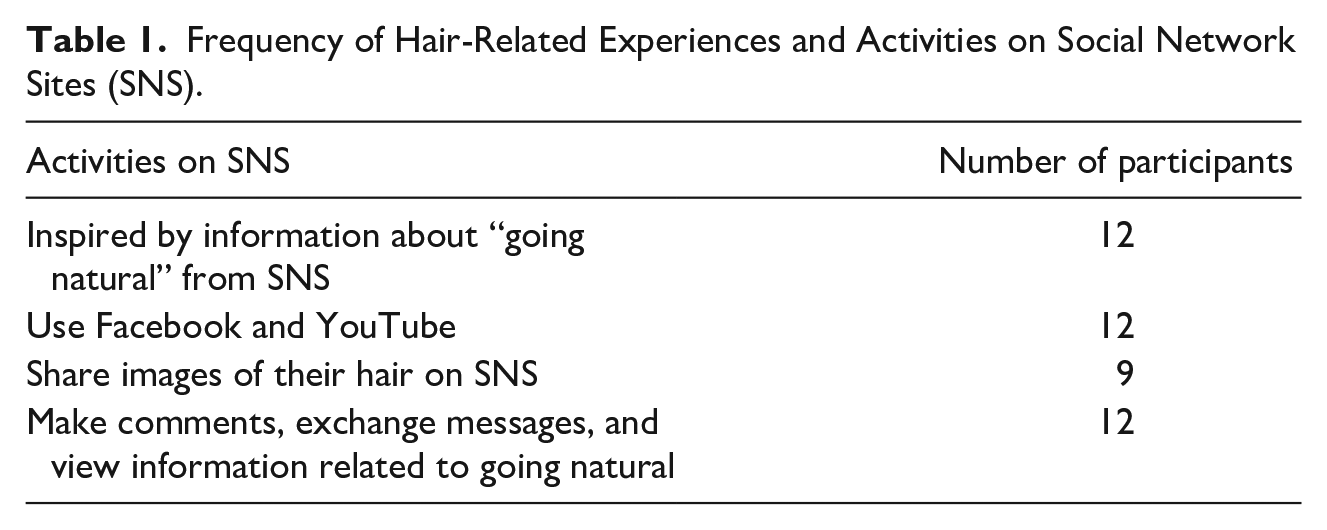
Participants’ experiences of hair-related activities on SNS is presented in Table 1. All of the participants reported having been inspired by information about going natural from SNS. In this sample, the most frequently visited SNS were Facebook and YouTube. The majority of the participants (9) reported having shared images of their hair on SNS, while all 12 participants reported making comments, exchanging messages, and viewing information related to going natural.
Frequency of Hair-Related Experiences and Activities on Social Network Sites (SNS).
Eight themes emerged from the focus group discussions and reflected the participants’ perception of SNS regarding their hair identity narratives as Black Caribbean, emerging adult women. They included (a) self-expression and hair identity, (b) individual self-classification, (c) psychosocial struggle, (d) ethnic identity affirmation, (e) opportunities for personal exploration, (f) accessible communication, (g) exposure to online models, and (h) online social bonds.
The themes of (a) hair identity self-expression and (b) individual self-classification emerged as a representation of what having natural hair meant to the participants. Hair identity self-expression captured how participants demonstrated to the world (through their hair) their thoughts, feelings, and ideas. In addition, the themes (c) psychosocial struggle and (d) ethnic identity affirmation emerged to describe the meaning of the going natural process for these women. The psychosocial struggle denotes the ongoing discourse among the Black Caribbean, emerging adult women with self, and with those external to the self, regarding the merits of wearing one’s natural hair in Caribbean society. Ethnic identity affirmation represents the adoption of the stance that one’s hair is a salient feature that serves to openly demonstrate one’s connection with one’s ethnic lineage.
The four other themes that emerged: (e) opportunities for personal exploration, (f) accessible communication, (g) exposure to online models, and (h) online social bonds, are all processes facilitated by the online social media platforms used by these women.
Theme 5, opportunities for personal exploration, encapsulated the participants’ use of SNS that provided direct and indirect opportunities for the participants to explore natural hair practices. Theme 6, accessible communication, is related to the ease with which SNS enabled individuals to communicate with others, regardless of time, space, and familiarity with each other. Theme 7, exposure to online models, addressed how the presentation of media content (i.e., blogs, video clips, and vlogs) on SNS provided real-life direct models who shared their own going natural hair stories and demonstrated natural hair care routines. Online social bonds, Theme 8, refers to the usefulness of SNS to provide a space where emerging adult women were able to connect and maintain contact through sharing of information that they have a common interest in.
Similar themes were evident in each focus group. Discussions were dominated by conversations about hair used as a tool of self-expression, representing one’s inner being, and providing an opportunity to associate with a particular ethnic and racial group. In addition, group members placed much emphasis on SNS providing opportunities for their own personal exploration and stressed the importance of viewing online models in their going natural process. Each theme is illustrated by examples of direct quotes from the transcripts. The codes “FG1” and “FG2” were utilized to indicate whether participants were members of Focus Groups 1 or 2, respectively (see Table 2). Pseudonyms were also assigned to each participant to ensure confidentiality and to denote the contribution from each participant.
Frequency of Focus Group (FG) Discussion Themes Based on Responses From Each Group.
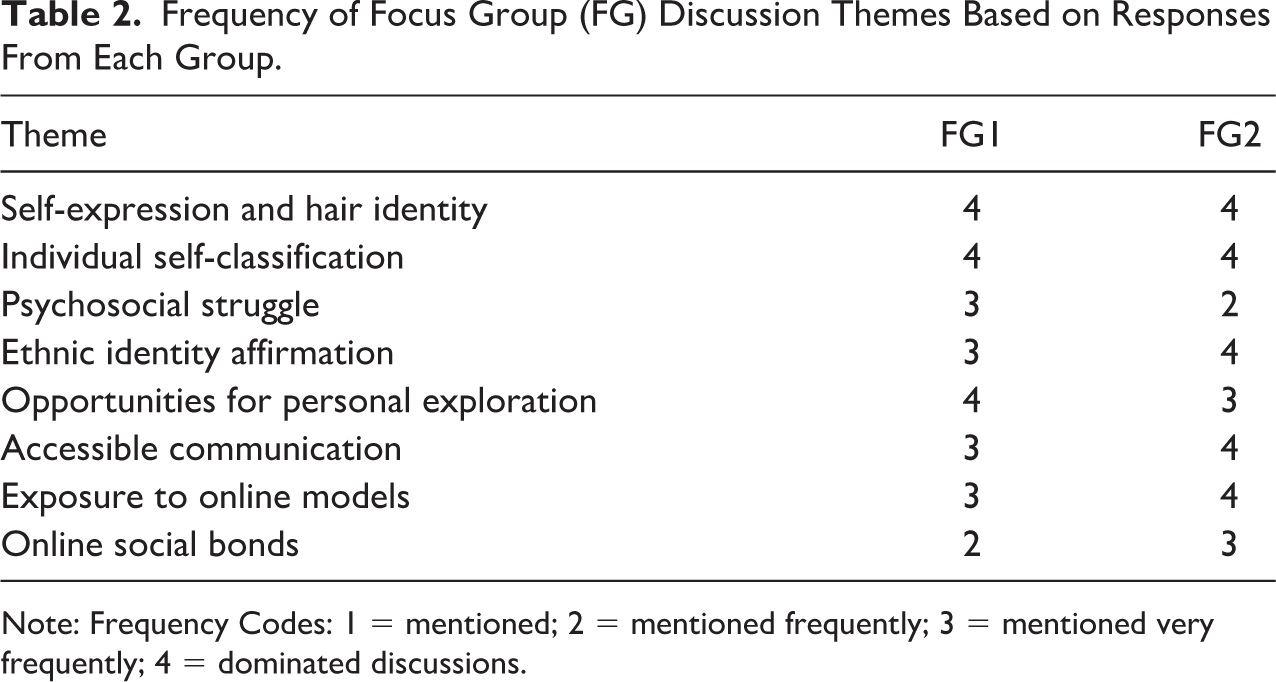
Note: Frequency Codes: 1 = mentioned; 2 = mentioned frequently; 3 = mentioned very frequently; 4 = dominated discussions.
Meanings of One’s Natural Hair
Hair identity self-expression
Most of the women shared that their natural hair enabled them to outwardly express their inner being to the world around them and is a part of who they are as a person. Imani (FG1) stated, “your body is what you walk around with every day, so you want it to be very representative of what you are inside.” Nahla (FG2) said, I believe my hair is a part of me . . ., and that everybody is unique. And I believe that one of my unique features is my hair and my hair allows me to express myself . . ., based on how I treat my hair, which is . . ., a part of what people see every day, then that is also portraying who I am. And you know that is saying something about me as an individual.
For these Black Caribbean women wearing their hair natural allowed them to express who they were in various ways. For example, Imani (FG1) noted, “to me if I did not have my hair the way it was, I would be a different person.” Shanice (FG1) spoke to the versatility of natural hair and the numerous hairstyles used to express herself: “One week you’re wearing braids, the next day you’re doing twists . . ., and [the] next you can wear an Afro. So, with natural hair, you could do a lot.” This view was further supported by Leanne (FG2), who mentioned that natural hair is “very versatile and it can change.” Leanne went on to note that her natural hair, “portrays me as an individual because that’s who I am. Change is always a part of me, and so I can be a very versatile person as well.”
Individual self-classification
Some of the women shared that natural hair, for them, indicated they were a member of the Black community in the Caribbean. For example, Danielle (FG1) said, “The more kinky your hair is, not in a bad way, but the more, I don’t want to say the more Black you are, but the more you will be able to associate yourself with that [Black] group.” Marissa shared, “As I was just saying, my natural hair keeps me Black” (FG2). It was also mentioned by yet another participant, Saffron (FG2) that wearing her hair natural provided a way to identify with a particular community. Saffron noted, It’s not a bad thing [as you are] using different pieces of yourself to associate yourself with a specific community. . . . It’s like, we are using our hair to link us to a particular community, but also separate us from another community.
Lessons Learnt on SNS: What It Means to Go Natural
The psychosocial struggle
The participants shared that the online natural hair community provided them with a safe space in which to cope with the psychosocial struggle that they experienced between themselves and societal expectations when going natural. Sienna (FG1) reported, “When people see me, they see my hair and so sometimes the way you carry yourself, people judge you according to that.” Moreover, the participants alluded to “good hair” versus natural hair. For example, Nicole (FG1) stated, “I think that people still have in their head that natural hair is not as good as . . . hair that has chemical; straightened hair.” Christina (FG2) shared: Especially with us coming from this colonial background. You know better hair is the European hair, White hair. So, to say, oh “to make your hair better” is like you’re telling us to make your hair [straight] not so Black.
Ethnic identity affirmation
Natural hairstyling served to distinguish these women from any other ethnicity, as Christina (FG2) stated, “When you look at, say an Indian person. Not only from their . . ., complexion, you could not only read from that, that they’re Indian but also from their hair.” Moreover, Nahla, (FG2) shared that her natural hair meant, “Being more connected with your ‘Africanness,’ your Blackness because hair is a tool of ethnic demarcation.” While Danielle (FG1) made the point that, “As an Afro-Caribbean person . . ., my hair keeps me Black. . . . In terms of keeping—keeping my locks, I want to associate myself with my kinky hair brothers and sisters.” On SNS, participants also learned that the act of going natural in itself serves to affirm their natural hair identity. Imani (FG1) shared her reaction to a Black female who had straightened her hair, “she straightened her hair and I make a joke, that’s how she looks White.” Thereby Imani had associated a Black woman with straightened hair with appearing “White.”
The Contributions of SNS to the Going Natural Hair Journey
Opportunities for personal exploration
Through providing direct access to articles, vlogs, and blogs, women can actively seek information about how to wash, nourish, and style their natural hair. For example, Saffron (FG2) shared, Sometimes I’ll go on YouTube—if I am looking for a hairstyle. . . . I find that now my hair is natural hair, I spend a ton of my time reading [online]—and found a lot of natural treatments that I can try to help enhance my natural hair.
However, SNS also provided unsolicited (but relevant) exposure to hair-related online media. The participants reported many instances of indirect access to information, namely, receiving news updates from SNS based on their personal browsing history. For example, Zara (FG2) shared, “it’s [going natural] like, it’s like everywhere [on SNS] like everywhere you go like you see that even in the corner [of the screen]” unsolicited exposure is based on the participants’ patterns of media selection. Therefore, material related to “going natural” and caring for natural hair automatically links to participants’ homepages. Sienna (FG1) shared, “they [going natural hair journeys] show up in my feed because of who [I] follow . . ., and on YouTube. [You see] hair journey, hair journey, hair journey.”
Exposure to online models
Participants actively solicited information and tutorials on SNS. These women spoke glowingly of the many vlogs and blogs covering natural hair journeys, which provided detailed accounts of women who have transitioned from chemically treated hair to natural hair. Ashley described the hair journey of others online as “inspirational” (FG1), while Nicole (FG1) spoke of them as being “encouraging.” Marissa (FG2) also noted, Honestly though sometimes the hair journeys could be encouraging cause when I first was going back natural watching like the different progress [of others on SNS]. . . . My hair was short in the beginning and that was a struggle for me too, . . . [so] seeing persons’ journeys was kind of encouraging for me.
Other participants indicated that the information they obtained on SNS led them to care for and style their natural hair in different ways. Leanne (FG2) said, “Different things I would have changed about my hair care routine. I watch their routine [on YouTube].” Shanice (FG1) indicated, “this [hair style] was influenced by one of my YouTube persons that I watch. She did it!”
Accessible communication
Christina (FG2) reported the ease by which they could communicate with others and access current information as to “what is trending” online about natural hair. Shanice (FG1) pointed out the following: For example, now Facebook has this thing, you can [phone] call. So, like, in terms of communicating with persons overseas and . . . I like to read the news, news updates. And I find [that] social media have a lot of news updates so communication and news [about wearing your natural hair].
The following was, also, mentioned by yet another participant, Ashley (FG1): I think, like for the past year everything [shown on SNS] is about going natural . . . everybody want[s] to be on that bandwagon. It’s trending now, natural hair is like, it’s kind of a big thing, well it’s becoming a big thing.
Online social bonds
SNS were reported as facilitating online interconnectedness and belongingness among peers as they were able to join, follow, and ultimately, bond with SNS groups. Imani (FG1) referred to the online connections formed as, “a big natural hair community.” The long-term familiarity between SNS friends was depicted by the narrative of Saffron (FG2): I was like “Oh! She hair natural”—like if I know the person, like on Facebook, I was like ‘Oh! This girl cuts her hair too. . . . And because I remember when it was Christmas . . . another [online] friend of mine went natural. [Now] they’re like two of them that went natural, so I said I am [also] and they like “Eh, you’re natural now?”
Zara (FG2) used the term “sisterhood” to refer to the relationships forged online between Black Caribbean women with similar hair interests in the SNS community. Leanne (FG2) shared, “And maybe if . . . the [hair] texture on that site is, um, closer to my hair I would probably stick to that site.” SNS also allowed individuals to endorse the online behaviors of peers through “liking,” and “tagging.” Christina (FG2) reported, “she put it up and tagged me, she does put up pictures of me and tag me in them.” Other activities that the participants engaged in on SNS included sharing and following the posts of online peers. For example, Nicole (FG1) stated that “If I see something that’s interesting. I would share it.” Danielle (FG1) noted, “there are some groups on Facebook like African groups if you join they post stuff during the week. . . . I follow these groups.”
An Overall View of Hair Identity via SNS
The diagram above (see Figure 1) emerged from the findings and illustrates the themes that represented the hair-identity-related narratives of the sample. It depicts the nature of the online social interactions that these women have reported and the important role that the SNS environment plays in creating their hair identity narratives.
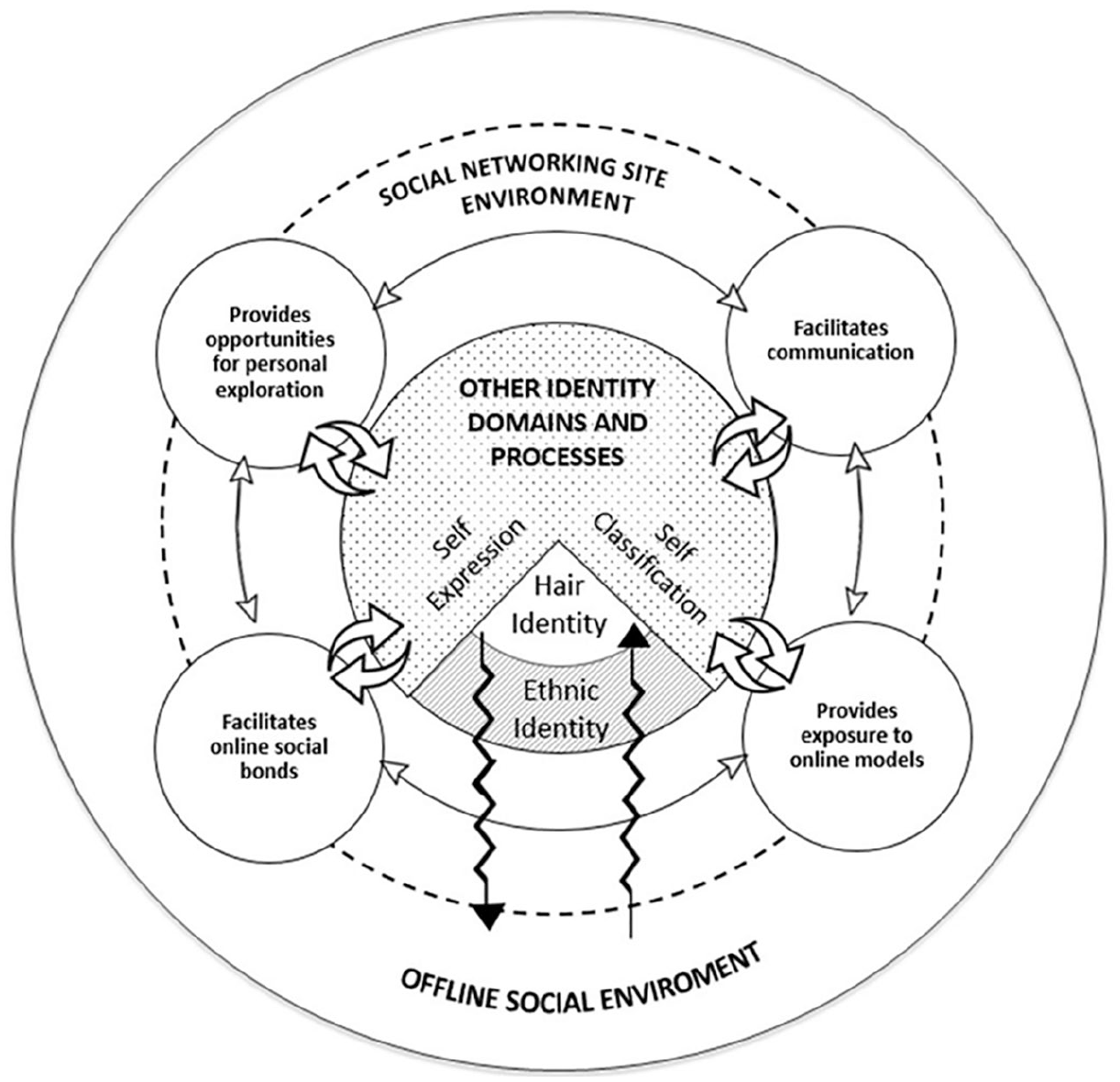
Diagram depicting the online psychosocial hair identity-related narratives of Black Caribbean emerging adult women.
The outermost circle of Figure 1 represents the boundary of the wider societal environment within which the emerging adult lives and all social activities occur (e.g., selecting and accessing SNS platforms). The inner perforated circle represents the permeable nature of the SNS environment to offline personal experiences and socially transmitted information. Despite its permeability, the SNS environment is conceptualized as a distinct space, as media content specific only to the virtual space can be created, observed, and shared. The four smaller circles embedded in the boundary of the SNS environment indicate the presence of online peer groups as well as depict the social outcomes that are derived from the interactions with these groups.
Double-headed arrows connect these four circles to represent the interrelated nature of the social process outcomes. These four peer clusters are diagrammatically positioned to span both social environments because they represent real people in offline contexts and who (like the emerging adult) also use SNS platforms. The innermost circle represents the individual (i.e., the emerging adult), and given the context of the study “hair identity” is of focus.
Four sets of cycling arrows are used to depict the interrelationship between identity construction and the psychosocial process outcomes. Jagged arrows represent the cognitive ebb and flow that is characteristic of processes involved in resolving the psychological struggle, which occurs as a result of conflicting information about natural hair.
A section of the innermost circle depicts both hair identity and ethnic identity. Hair identity is subsumed under ethnic identity and is represented at a more specific level of abstraction given that Black Caribbean women in the sample view their hair as being a tool of ethnic demarcation. Women in the study also reported that their hair identity facilitates self-expression and self-classification.
Discussion
The purpose of this study was to explore the personal meaning of natural hair for a sample of Black Caribbean women emerging adults, in an effort to better understand their hair identity narratives. Overall, the themes indicated that the emerging adults in the study actively used SNS to explore and exchange their lived experiences with others while engaged in the going natural hair process. These exchanges also occurred within their wider offline face-to-face social environment, which further helped shape their hair identity narratives. Online exchanges describing the Black Caribbean emerging adult women’s natural hair journeys were facilitated by the features of SNS (e.g., sharing, liking, commenting). It was also found that the SNS provided opportunities for personal exploration, communication, and exposure to online models as well as facilitated online social bonds. In the paragraphs to follow, we discuss, with reference to Figure 1, the emergent themes of the study and their interrelationships within the context of the extant literature reviewed.
As shown in the diagram of the findings, the hair identity narratives of the women provided an impetus for the overt expression of their selfhood through the wearing of their natural hair. Therefore, the wearing of their natural hair allowed these Black Caribbean emerging adult women to outwardly express themselves as well as self-categorize as being part of a specific racial group. As shown in the diagram, the participants’ self-expression and self-classification reflected processes that occurred as a result of their hair identity narratives. Such processes as noted by Bankhead and Johnson (2014) can occur across all other identity domains unique to the individual (domains such as gender identity, political identity, or, as in this case, hair identity). Hair identity, therefore, is but one of many identity domains.
Respondents also indicated that the going natural process can be considered a “struggle.” This view is supported by recent evidence in the Caribbean, highlighting the discrimination against women who wear their hair natural (Bradshaw, 2015; Cavanagh, 2019; Martindale, 2015; Sealy, 2015). The notion that the hair transitioning process is a “psychosocial struggle” by the participants of the study suggests that these emerging adults are battling against unfavorable collective societal attitudes and expectations as they strive to create their natural hair narratives. Bryant (2013) notes that the societal attitudes about natural hair were largely negative and unsupportive within the Caribbean context because there is a preference for hair that is altered and styled to appear more European. These ideals reflect biased notions that have been passed down through generations. In keeping with the diagram (i.e., Figure 1) presented, the jagged arrows represent the ongoing cognitive cycling that is characteristic of processes involved in resolving one’s personal “psychosocial struggle.” Therefore, these Black Caribbean emerging adults not only have to confront information that flows from the offline environment inward but also that which flows outward from one’s personal cognitive space as one defies the status quo within the Caribbean.
Participants shared that SNS provided a space where they could discuss and explore alternative meanings of natural hair, and in doing so, be able to address the offline challenges that they experienced within the Caribbean context. By using SNS, these women were better able to counteract the effects of the presiding negative attitudes characteristic of the offline world as they develop their hair identities. An individual’s hair identity narratives, at any given time, are critical in determining what decisions are made about which media will be selected, interacted with, and applied in everyday life. An understanding of identity appears to come about through experimentation and working in an ebb and flow fashion psychologically in order to resolve the expectations of society with one’s personal views.
Participants from their discussions online reported that “going natural” is a way that they could acknowledge their African identity. Moreover, they would have found a place in a virtual community that allowed them to query aspects of themselves, as well as impart their personal natural hair experiences through the posting of information, interacting via liking, sharing, and commenting. Once immersed in the online environment, these women “open the door” for unsolicited exposure based on their previous patterns of media selection. This type of targeted online content delivery may serve to strengthen a supportive environment and arguably keeps the transitioning to natural hair at the forefront of participants’ minds.
A major finding of the study was that the wearing of natural hair for the sample of women served to affirm their ethnic identity. The participants develop their sense of self by acknowledging that their natural hair was deeply connected to their selfhood—that is, as diasporic Africans. For example, it was found that going natural is an acknowledgment of one’s Blackness and African ancestral origin and hair can be a “tool of ethnic demarcation” (Nalah, FG2). It is in this way that hair can act to affirm one’s ethnic identity and signifies the close relationship between hair and ethnic/racial identity (Umaña-Taylor et al., 2014) for these women. Their hair, thus, has personal meaning to their authentic self, which is the defining characteristic of the psychological concept of hair identity.
SNS are critical to knowledge creation as they provide a platform for users to publicly explore their individuality (DeHaan et al., 2013; Jules et al., 2019; Manago et al., 2008). These sites also allow users to create and post content from their personal lives (Ellison & boyd, 2013). For example, common experiences within natural hair communities on SNS could emerge through group photo sharing and live video streaming. Interrelationships can therefore be formed between the offline and online worlds of Black Caribbean emerging adult women. The interrelationships between these social worlds are supported in the literature (Jules et al., 2017, 2019).
It was found that the social environment of SNS facilitates four psychosocial processes that contribute to the “going natural” hair journey for the participants of the study. As shown in the diagram, these social outcomes include (a) opportunities for personal exploration (i.e., direct and indirect opportunities to explore natural hair practices); (b) communication with others regardless of time, space, familiarity; (c) exposure to online models (i.e., real-life direct models who share their own going natural hair stories and who can demonstrate natural hair care routines); and, (d) the facilitation of online social bonds which speak to the ability of SNS to provide a space where Black Caribbean emerging adult women can connect with each other and maintain contact through information sharing.
The four social outcomes are peer-based and span online and offline social environments. It was found that the online interactions that participants had with others in SNS communities were integral to the maintenance of discussions about natural hair, and were arguably critical to their natural hair identity narratives. The association between identity development and peers is supported in the literature (Klimstra & van Doeselaar, 2017).
Women can learn about going natural processes from online models. The participants consistently reported that SNS provided them with the opportunity to observe models and learn different ways to care for and style their natural hair. Therefore, these models can help shape new cognitions about natural hair. SNS further supported online interconnectedness among these women as they formed bonds based on their common hair experiences. These social interactions seemed to facilitate open communication, thereby creating an “online sisterhood” of similar others, who provided support and feedback on natural hair practices and care. Hence, SNS appeared to engender a sense of belongingness for these women and may have served to counteract the negative offline experiences that they may have encountered when wearing their natural hair. SNS allowed these women to showcase their natural selves and hair grooming practices online. The affirming feedback from their “online sisters” assisted in strengthening their own natural hair-esteem as this feedback appeared to encourage self-acceptance.
Limitations
Given the qualitative nature of the study, there are some limitations. The narratives shared were drawn from a small sample of female Black Caribbean emerging adults. Focus group interviews were used, and hence participants may have demonstrated social desirability and engaged in impression management in their responses. Hence, the findings should not be misconstrued as representing the experiences of all Black Caribbean women. Ultimately, how one views the importance of natural hair and how it is experienced by each individual are uniquely self-defined. Therefore, caution must be exercised in generalizing these findings. Moreover, other physical characteristics, such as facial features and skin tone, were not explored in the study. These characteristics for some Black women may also influence their decision to go natural. Furthermore, the retrospective design of this study could also pose some limitations concerning the generalizability of the findings. We relied on the transcripts verbatim; therefore, emotions often conveyed by verbal inflections during the discussions were not accounted for in the analysis of the data. The analysis of verbal inflections could have provided more information about the strength of the impact of some of the interactions and experiences that the emerging adults had on SNS. The nature of the focus group discussions centered around two predominant SNS (i.e., Facebook and YouTube), which may have restricted the applicability of the findings to other social media platforms.
Implications and Future Research
Despite these possible limitations, our study provides support for the role that SNS can play for some Black Caribbean emerging adult women in the development of their hair identity when “going natural.” The findings are case-specific. Although conclusions can only be drawn as it relates to the participants in this study, they do provide some insight into the realities of Black Caribbean, emerging adult women as they reconstruct their hair identity narratives through the process of going natural. To this end, it is important that other researchers replicate and extend this study to determine the generalizability of the themes identified. There is the possibility that other themes could emerge, resulting in a more comprehensive understanding of hair identity and going natural.
Future research should explore the use of SNS among adolescents, as the current study focused on a single demographic (i.e., emerging adulthood). The identity exploration experiences of adolescents may be qualitatively different from that of emerging adults. Moreover, the current study, using a qualitative research design, has identified factors that indicate the supportive role that SNS play in the going natural hair journey of some Black Caribbean women. Quantitative approaches to this topic could also be used to develop a valid and reliable assessment tool that can systematically investigate the themes that have emerged. Such an instrument would help test the interrelationships between these online psychosocial outcomes on SNS and the constructs of ERI and hair identity. In addition, an exploration of the effects of collective identity (transmitted through the provision of positive images and models) for natural hair acceptance on SNS may form the basis of future scholarship.
Conclusion
SNS may provide emerging adult, Black Caribbean women of African descent online spaces that allow for personal exploration of their natural hair. More specifically, these women may be afforded the opportunity to explore aspects of their ethnic/racial identity and come to a greater understanding of their hair identity. Using SNS Black Caribbean, emerging, adult women can gain direct access to and interact with information about going natural. SNS allow these emerging adults to access online “sisters” who can serve as models and reinforce the importance of personal natural hair acceptance.
Footnotes
Authors’ Note
Portions of these findings were presented as a paper at the 2016 Caribbean Regional Conference of Psychology, Port-au-Prince, Haiti.
Declaration of Conflicting Interests
The author(s) declared no potential conflicts of interest with respect to the research, authorship, and/or publication of this article.
Funding
The author(s) received no financial support for the research, authorship, and/or publication of this article.
