







Abstract
This study explored how student engagement was related to perceived teacher autonomy support and self-determination skill expression among 145 Grades 9 through 12 African American high school students. First, we examined differences between male and female students’ engagement, perceived teacher autonomy support, and self-determination skill expression. Results indicated that male and female students did not report significant differences in the extent to which they were engaged in class, perceived their teachers as supporting their autonomy, and expressed indicators of self-determination. Second, regression analysis indicated that perceived teacher autonomy support and self-determination skill expression were significant, positive predictors of students’ engagement in class. An additional mediation model demonstrated that self-determination skill expression mediated the relationship between perceived teacher autonomy support and student engagement. Strategies for supporting African American high school students’ autonomy and self-determination skill expression are provided, as well as limitations and directions for future research.
Considering the varied definitions of the term “self-determination,” Wehmeyer (2004) conducted a comprehensive review of its conceptualization and concluded that the essence of this construct entails an individual “acting based on one’s own mind or free will, without external compulsion” (p. 340). Specific to students’ education, self-determination is conceptualized as both a motivation related construct through self-determination theory (SDT; Ryan & Deci, 2000) and a behavioral construct through casual agency theory (CAT; Wehmeyer, 2004). SDT assumes that all students possess an internal or self-directed motivational drive that contributes to their adaptive school functioning. Students feeling a sense of autonomy, competence, and belongingness (referred to as basic psychological needs) is critical to fostering their internal motivational drive; hence, teachers’ use of autonomy supportive classroom practices is one way to cultivate students’ internal motivation in the classroom environment (Reeve, 2013; Ryan & Deci, 2000). CAT focuses on students’ capacity to act out of their own volition, initiate and direct their own actions, and pursue self-selected goals (Wehmeyer, 2004), representing behavioral manifestations of one’s self-determination. According to Shogren et al. (2016), students are more equipped to exhibit these behaviors when they develop and utilize key skills: (a) setting and attaining self-selected goals (goal setting and attainment); (b) making choices, decisions, and problem solving on their own (choice/decision making and problem solving); (c) advocating for themselves and expressing their preferences (self-advocacy and expressing preferences); (d) knowing their strengths, weaknesses, interests, and so on. (self-awareness); (e) regulating their own behaviors (self-regulation); and (f) believing they are capable of reaching desired outcomes (self-efficacy).
Research linking various indicators of self-determination to desired student outcomes can help broaden the mechanisms by which African American students are supported in school. Student engagement, for example, is one academic outcome that researchers and educators should attend to in this line of research, given that student engagement is a key predictor of school completion (Archambault et al., 2009; Fall & Roberts, 2012). Student engagement refers to the magnitude of students’ active participation and involvement in both the academic and social aspects of school (Fredricks et al., 2004). As a multidimensional construct, the prevalent three-component model includes a behavioral (e.g., demonstrating appropriate conduct, effort, and academic involvement), affective (e.g., possessing positive attitudes about various aspects of schools), and cognitive dimension (e.g., using self-regulation learning techniques; Fredricks et al., 2004). Higher levels of behavioral, affective, and cognitive engagement are positively associated with desired academic outcomes, including standardized test scores, grade point averages (GPAs), school attendance, and school completion (Lam et al., 2012; Reeve, 2013; Reeve & Tseng, 2011).
Student engagement has been found to be significantly associated with school success and completion among African American students (Wang & Peck, 2013); yet, African American students have reported lower levels of school engagement when compared with their White peers (Yazzie-Mintz, 2010). Limited engagement in school may be especially problematic for African American adolescents, as high school students have reported lower levels of student engagement compared to elementary and middle school students (Marks, 2000). Unlike students’ demographic backgrounds, student engagement is identified as a malleable construct that can be enhanced or thwarted by contextual and environmental processes (Fredricks et al., 2004). For example, as a key component of SDT, seminal research has established that perceived teacher autonomy support contributes to students’ engagement in school (Hafen et al., 2012; Reeve, 2013; Reeve et al., 2004; Skinner et al., 2008).
Though more research related to SDT has focused on general education students, much of the research related to CAT has been limited to students with disabilities (Shogren et al., 2019). Consequently, few studies have linked general education students’ collective expression of self-determination skills to their engagement in school. Additional research focused on general education students’ self-determination skill expression is warranted, in light of ongoing calls to support all students’ self-determination and personal agency in school (Shogren et al., 2016), including African American pupils (Bush & Bush, 2018; Lozenski, 2017).
Despite different conceptualizations of self-determination among school-age youth, few studies have simultaneously examined the extent to which perceived teacher autonomy support (a key component of SDT) and students’ self-determination skill expression (a key component of CAT) predict students’ engagement in school among a sample of all African American students. Furthermore, research has long established that high school males are less likely to report being engaged in school compared with their female peers (Lam et al., 2012). However, few studies have compared African American high school male and female students’ expression of multiple self-determination skills and their perception of teacher autonomy support. Taken together, the purpose of this study was to examine (a) differences between African American male and female high school students’ engagement in school, perceived teacher autonomy support, and self-determination skill expression and (b) the extent to which perceived teacher autonomy support and self-determination skill expression predicted their engagement in school.
Self-Determination and African American Students
We do not seek to absolve educators and policymakers from addressing systemic inequalities in the U.S. education system by examining self-determination among African American youth. Indeed, in a recent study, Parker, Amabile, et al. (2020) found that racist and biased school-level practices may have an impact on African American high school students’ self-determination in school. Some participants noted that schools served as a barrier to their goal attainment by restricting their access to the rigorous courses they desired to take to be prepared for college. Participants expressed that school counselors did not appreciate their full potential and advanced classes were often filled with White students while students who are minoritized were enrolled in regular courses. Other participants explained that they rarely advocated for themselves and expressed their preferences because they were afraid of being punished for exhibiting these two self-determination skills in school. When asked why this was the case, participants noted that teachers often perceived them as disrespectful due to how they communicated their needs and wants instead of understanding that students were frustrated as a result of not feeling heard. Recognizing the ongoing inequities in U.S. schools, our position is grounded in the belief that the empowerment of African American students at a group and individual level should occur in conjunction with the necessary quest to address structural barriers to their success (Bush & Bush, 2018; K. L. Williams et al., 2020).
Our emphasis on African American students’ self-determination is a response to calls for sustained and increased focus on this variable (and related constructs such as personal agency) among African American people, in general, and students, in particular (Karenga, 1989; Shogren et al., 2018). For example, Kwanzaa, created in 1966 by Dr. Mauluna Karenga, is an historical and cultural-specific holiday that is intended to empower African American individuals and persons of African descent. One of the seven principles of Kwanzaa is Kujichagulia, or self-determination, which emphasizes the importance of African American individuals defining, creating, and speaking for themselves. The idea of this particular principle is that African American individuals and persons of African descent can demonstrate self-determination by operating according to their own interests and making their own unique contributions to human history (Karenga, 1989).
Specific to school-age youth, Lozenski (2017) argued that more attention should be geared towards cultivating African American students’ self-determination in school because the U.S. education system has never responded to the needs of African American pupils. The goal then is to empower these students to execute greater control over their academic outcomes, while advocates from various fields of study/practice continue to push for the system to change. In a similar vein, Bush and Bush (2018) indicated that it is important to focus on African American male students’ sense of agency alongside systemic barriers to their success in school (e.g., racism), as it is critical to acknowledge “the agency that we [African American individuals] bring to the world stage” (Bush & Bush, 2018, p. 11). As a key aspect of self-determination (Wehmeyer, 2004), agency is defined as “acting or exerting influence or power in a given situation” (Mitra, 2004, p. 655).
Thus, cultural markers of African American students’ identity (i.e., self-determination as emphasized in Kwanzaa) and ideas described by Bush and Bush (2018) and Lozenski (2017) raise two essential questions: “How can African American students’ self-determination be cultivated in school” and “Why should we focus on supporting African American students’ self-determination in school?” By reviewing the literature on self-determination applied in educational contexts and highlighting current gaps in the research, we hope to extend the conversation in this area of inquiry.
Self-Determination in Educational Contexts
Perceived teacher autonomy support
Perceived teacher autonomy support is rooted in SDT. As a motivational construct, SDT assumes that all students possess an internal and self-directed drive, independent of environmental influences, that provides a motivational foundation for their engagement in class, adaptive school functioning, and subsequent achievement (Reeve, 2013; Ryan & Deci, 2000). Drawing from basic needs theory, a subtheory of SDT, students are more likely to experience this internal drive to engage in a specified task when three basic psychological needs are met: the need for autonomy, the need for belonging/relatedness, and the need for competence (Reeve, 2013; Ryan & Deci, 2000, 2009). Though satisfaction of all needs have been found to predict students’ engagement in school (e.g., Connell et al., 1994, 1995; Fall & Roberts, 2012), research has overwhelmingly highlighted the importance of cultivating students’ sense of autonomy in school.
Autonomy supportive learning environments describe school and classroom settings that facilitate students’ experience of autonomy. Autonomy is experienced when an individual’s actions are perceived as (a) initiated and controlled by oneself rather than external forces, (b) situated in the freedom to engage in a behavior rather than it being forced, and (c) selected and executed out of interest or personal importance (Patall et al., 2013; Reeve, 2016). According to Reeve’s (2006) dialectical framework within SDT, students’ sense of autonomy is fostered by an interactive process between the student and classroom teacher. To this end, students enter the classroom with inner motivational resources (e.g., psychological needs, interests, values, preferences, and goals) and teachers nurture or suppress students’ inner motivational resources by creating motivational supportive classrooms through instructional strategies and activities.
Consequently, autonomy supportive instructional strategies are a group of distinct yet interrelated empirically supported instructional practices that have been found to promote students’ sense of autonomy and academic engagement when utilized by classroom teachers. Five empirically validated practices include the following: (a) allowing self-initiation/choice or providing a meaningful rationale when choice is constrained; (b) presenting students with interesting, enjoyable, and moderately challenging material; (c) demonstrating flexibility rather than control; (d) identifying the value and importance of a task/lesson/behavior; and (e) listening to and accepting students’ negative feelings as a valid reaction to requested tasks (Jang et al., 2012; Patall et al., 2013; Reeve et al., 2004). These strategies are believed to promote students’ sense of autonomy and self-determination by cultivating their internal motivation to engage in academic tasks out of their own volition.
Several studies have demonstrated that students were more likely to report or exhibit indicators of academic engagement (e.g., using self-regulated learning strategies, being an active participant during classroom instruction, and viewing academic courses as relevant and valuable) when teachers incorporated multiple autonomy supportive instructional practices in the classroom (Alivernini & Lucidi, 2011; Jang et al., 2012; Patall et al., 2013; Reeve et al., 2004; Vansteenkiste et al., 2012). Despite the promise of teacher autonomy support, few studies have examined the extent to which teachers and students contribute to their engagement in school using self-determination related theories as the guiding framework. Such research is warranted, to inform intervention efforts focused on comprehensive support for school-age youth. Consequently, CAT could address this limitation given its focus on student-level variables.
Self-determination skill expression
Initially introduced in the early 1990s, CAT “defines self-determined actions by three essential characteristics . . . ” (Shogren et al., 2018, p. 11). First, volitional action consists of self-initiation and autonomy, which involves individuals making intentional choices based on their own preferences. Second, agentic action involves self-direction and “pathways thinking,” characterized by one regulating their progress towards their goals and addressing challenges that may pose as barriers to achieving goals. Third, action-control beliefs reflect an understanding of the relationship between one’s actions, the means involved to pursue such actions, and the outcomes experienced as a result of the actions. Action-control beliefs, then, lead individuals to believe they have the capacity to reach their goals and they persist when faced with challenges (Shogren et al., 2018). As key scholars in this area of research have emphasized the need to extend the application of CAT to general education students, this conceptualization of self-determination has been validated among culturally diverse students with and without disabilities (including African American adolescents) in recent years (e.g., see Shogren et al., 2018).
At a more nuanced level, Shogren et al. (2016) and Wehmeyer (1997) asserted that self-determined actions and beliefs emerge when individuals develop and utilize key “self-determination skills.” These skills include the following: (a) choice and decision making, (b) expressing preferences, (c) problem solving, (d) setting and attaining goals, (e) self-awareness and self-knowledge, (f) self-regulation, (g) self-advocacy, and (h) self-efficacy (Shogren et al., 2016; Wehmeyer, 1997). Researchers also indicate that students can exhibit self-determined actions and skills in the school context through their active involvement in their educational pursuits (e.g., communicating their goals to teachers and school counselors; Washington et al., 2012). As such, the application of CAT has focused on helping students develop and use these skills through structured interventions and cultivating students’ capacity to contribute to their educational outcomes through active involvement in transitional planning (planning for postsecondary endeavors; e.g., Burke et al., 2018; Wehmeyer et al., 2012; Wehmeyer et al., 2013).
Studies focused on students’ use of self-determination skills suggest a link between these variables and students experiencing school and postschool success (Lee et al., 2008; Petcu et al., 2017; Shogren et al., 2012, 2017). Because most of these studies have focused on students with disabilities, researchers have called for more research that seeks to understand how all students’ collective use of various self-determination skills may promote their achievement and success in school (Shogren et al., 2016). Researchers have especially highlighted a need to examine these constructs among culturally diverse students, considering their unique and varied life experiences (Wehmeyer et al., 2011). In response to such calls, research primarily focused on African American students with and without disabilities has begun to emerge in the literature (e.g., Parker, Amabile, et al., 2020; Parker, Garnes, et al., 2020). Such research has entailed (a) studies examining the link between African American students’ use of various self-determination skills, their involvement in their educational pursuits, and their school and post-school outcomes (Banks, 2014; Parker, Garnes, et al., 2020; Washington et al., 2012) and (b) studies that seek to understand factors that may promote or hinder African American high school students’ expression of various self-determination skills (Parker, Amabile, et al., 2020).
In relation to student outcomes, for example, Washington et al. (2012) examined the impact of students’ self-determination skill use and involvement in their educational planning among a sample of predominantly African American high school students with and without disabilities (32 of the 39 participants were African American). Washington et al. found that students who were on-track to graduate from high school (e.g., the students had higher grades and fewer absences from school) reported greater use of multiple self-determination skills compared with students who were at-risk of not graduating. Banks (2014) and Parker and Wilkins (2018) utilized a qualitative case study design to understand African American males’ experiences with employing various self-determination skills in school. Banks (2014) focused on three African American males who had a documented disability and who were enrolled in college, whereas Parker and Wilkins focused on three African American ninth-grade males without disabilities. The three participants in Banks’ (2014) study indicated that setting goals, advocating for themselves, solving problems, and making choices/decisions helped them graduate from high school and later attend college. Parker and Wilkins (2018) found that the students’ affective, cognitive, and behavioral engagement were influenced by their self-awareness (e.g., knowing their interests and preferences), self-regulation (e.g., use of study skills), and preference expression (e.g., communicating their needs and wants to teachers).
Finally, Parker, Garnes, et al. (2020) conducted focused group interviews with a predominantly African American high school student sample (N = 24) to understand the participants’ school experiences relative to their use of multiple self-determination skills. In addition to probing about factors that facilitated or thwarted their expression of self-determination skills, Parker, Garnes, et al. (2020) asked the participants to describe how each self-determination skill contributed to their success in school. The students believed that using multiple self-determination skills contributed to their engagement in school (e.g., staying on task, paying attention, completing work, and studying) by fostering their sense of independence (e.g., giving them the capacity to complete their schoolwork independently), facilitating their motivation to succeed, helping them receive support from teachers, and prompting them to prioritize how they spent their own time, with the goal of striving to attain academic achievement.
Together, the aforementioned studies suggest that African American high school students’ self-determination skill expression is associated with their engagement in school. Nevertheless, additional research examining these variables among a larger number of students is warranted given the small sample size in studies to date. Considering that students indicated a link between their engagement in school and use of multiple self-determination skills in the qualitative studies conducted by Banks (2014), Parker and Wilkins (2018), and Parker, Garnes, et al. (2020), quantitative research can expand these studies by determining whether the findings are generalizable to other students.
Gender Differences
Despite the decline in high school dropout rates among Black/African American students from 2006 to 2018, Black students continue to drop out of high school at higher rates than their White peers, with Black male students being even more likely to drop out of high school compared with Black female students (National Center for Education Statistics, 2019). In a similar vein, Yazzie-Mintz (2010) found that African American high school students were less likely to report being engaged in school; and Lam et al. (2012) found that male students across various racial/ethnic groups were less likely to be engaged in school. These findings suggest that African American males are at a heightened risk of school dropout and being less engaged in school (Lam et al., 2012; National Center for Education Statistics, 2019; Yazzie-Mintz, 2010). Hence, closely examining their school experiences might also help educators identify how to best support this vulnerable group of students. For example, it is well established that the implementation of autonomy supportive instructional practices is associated with increased student engagement and desired academic outcomes among male and female students from diverse racial/ethnic backgrounds (Alivernini & Lucidi, 2011; Jang et al., 2012; Patall et al., 2013; Reeve et al., 2004; Vansteenkiste et al., 2012). However, inconsistent findings regarding male and female students’ perceptions of classroom autonomy support have been reported in the literature. Some researchers have not found a significant difference in perceived autonomy support between male and female students (e.g., Jang et al., 2012; Patall et al., 2013), whereas other researchers have found differences between these two groups of students (Connell et al., 1995; Vansteenkiste et al., 2012).
Though few studies have examined differences between male and female high school students’ self-determination skill development and use, one study conducted by Cavendish (2016) suggests that male high school students may report lower levels of self-determination compared with their female peers. Cavendish (2016) examined the role of gender, race/ethnicity, and disability category in relation to high school students’ self-determination and their perceptions of school and family support. Among the 190 students who participated in this study, all students had a disability, 9% of the sample were White, 62% were Latinx, and 27% were Black. Cavendish (2016) found that male students reported significantly lower levels of self-determination relative to their female peers. Still, because Cavendish included students with disabilities only and most of these participants identified as Latinx, it is unclear whether differences between male and female students’ expression of self-determination skills would also be observed among African American high school students without disabilities.
Purpose of the Study
The purpose of the present study was to address the gaps in the literature to date. SDT and CAT represent two core conceptualizations of self-determination relative to students’ educational experiences, yet few studies have examined key indicators of both frameworks together. More specific to the current study, few studies have examined perceived teacher autonomy support (a key aspect of SDT) and student self-determination skill expression (a key aspect of CAT) in relation to student engagement. Such research is needed, considering that student engagement is a key predictor of African American students’ success and achievement (Wang & Peck, 2013) and research suggests that both factors are linked to students’ engagement in school (Reeve et al., 2004; Washington et al., 2012).
Despite calls for researchers to take a closer examination of students’ experiences based on their demographic characteristics, few studies in this area of research have primarily focused on African American students (especially those without disabilities) and differences between male and female students. Specifically focusing on the experiences of African American high school male and female students is critical, considering that African American high school students have been found to be less likely to be engaged in school compared with their White peers and this is especially true for high school males (Yazzie-Mintz, 2010).
Finally, most research pertaining to CAT has been limited to students with disabilities, whereas most research pertaining to SDT has focused on general education students (Shogren et al., 2016; Shogren et al., 2019). Though CAT researchers have recently begun to explore the implications of SDT among students with disabilities to broaden their educational support, few studies have examined the implications of CAT among students without disabilities. Based on these gaps, the purpose of this study was to investigate the following questions:
Is there a difference between African American high school male and female students on perceived teacher autonomy support, self-determination skill expression, and students’ classroom engagement?
To what extent does African American high school students’ perceived teacher autonomy support and self-determination skill expression predict their engagement in class? Specifically, is teacher autonomy support linked indirectly to student engagement through a direct relationship with self-determination skill expression?
We hypothesized that male students would report lower levels of perceived teacher autonomy support, self-determination skill expression, and student engagement compared with female students. We also expected that perceived teacher autonomy support and students’ self-determination skill expression would be positively associated with student engagement. We did not develop a hypothesis for the subquestion related to whether self-determination skill expression served as a mediator between teacher autonomy support and student engagement, given that this question was exploratory in nature.
Method
Participants and Setting
Participants were 145 African American (62.8% females, 37.2% males) 9th- through 12th-grade students from a combined middle and high school, located in a suburban community in a Mid-Atlantic state. Out of the total sample, 29% were in the 9th grade, 24.1% were in the 10th grade, 20% were in the 11th grade, and 26.9% were in the 12th grade. The students ranged in age from 14 to 19 years, with a mean age of 16.08 years (SD = 1.26). The participants’ GPA ranged from 0.46 to 4.15, with a mean GPA of 2.75 (SD = 0.69). Finally, approximately 80.7% of the participants desired to pursue a postsecondary education (n = 117) after graduation; 6.9% desired to join the military (n = 10); 5.5% desired to join the workforce; 6.2% reported having other goals (e.g., being a pro-athlete); and one participant reported a desire to stay at home with little indication of having other plans (0.7%). Our research team did not collect information about participants’ socioeconomic status, given that this information was not readily available.
To provide a context for this study, the student body population of this school was obtained from the state’s Department of Education website and the U.S. News & World Report (2021). The school served 474 6th-grade through 12th-grade students, with a teacher to student ratio of 16:1. Approximately 57% of the students were female, 58.4% of the student body population were identified as economically disadvantaged, and 5% of the students were identified as having a disability. Regarding race/ethnicity, 91.7% were African American, 7.2% were Hispanic, and 1.1% of students were from other racial/ethnic backgrounds (multiracial, White, and American Indian). At the end of the 2019 school year, 90% and 91% of the student population demonstrated proficiency in math and reading, respectively. Finally, the school maintained a 100% graduation rate since 2016, with 98.9% of students graduating in 2015.
Measures
We obtained information about each students’ grade level, GPA, identification as male or female, race/ethnicity, age, and disability status through existing school records. The remaining data were collected through self-report survey instruments. In particular, students completed the Student Self-Determination Survey (SS-DS; Washington et al., 2012), Learning Climate Questionnaire (LCQ; G. C. Williams & Deci, 1996), and scales from the Engagement versus Disaffection with Learning measure (Skinner et al., 2009), and Motivated Strategies for Learning Questionnaire (MSLQ; Harackiewicz et al., 2000; Pintrich & De Groot, 1990; Pintrich et al., 1993) to measure their self-determination, perceived teacher autonomy support, and student engagement, respectively.
Self-determination skill expression
We used the SS-DS to examine the extent of the participants’ self-determination skill use. Washington et al. (2012) developed the SS-DS after conducting a literature review on student self-determination and their involvement in educational processes, indicating their applied use of self-determination skills in school. Washington and colleagues developed two versions of the SS-DS wherein one version was designed for special education students and the other version was designed for general education students. We used the version the researchers designed for general education students given that most of our participants did not have a disability, students with disabilities were included in general education classrooms fully, and all students were enrolled in honors or advanced placement classes. The SS-DS is comprised of 21 items. The first eight items focus on the extent to which students are involved in activities associated with their individual 4-year education plans (e.g., Have you initiated a meeting with a guidance counselor about graduation requirements?). Items 9 through 17 focus on the extent to which students report using various self-determination skills/strategies (e.g., How often do you speak up for yourself [self-advocacy]?). Finally, Items 18 through 20 focus on students’ attitudes about making personal decisions and choices on their own (e.g., Do you like when your parent makes choices for you?). The last item is an open-ended question that requires students to identify their postschool goals.
Response categories for Items 1 to 4 range from 1 (no) to 2 (yes); Items 5 to 8 range from 1 (never) to 4 (daily); Items 9 to 17 range from 1 (never) to 4 (all of the time); and Items 18 to 20 range from 1 (no) to 3 (yes). Washington et al. (2012) included item 21 as an open-ended question that required students to identify their post-graduation goals. We asked students about their postschool goals as well. However, we requested this information through a forced-choice item format with five response options given that our study included a larger number of students (more than 145 vs. 39) compared with the Washington et al. (2012) study. Specifically, students were asked to check one box representing their post-school goals: (a) postsecondary education, (b) military, (c) employment, (d) stay at home, and (e) other (please describe). Furthermore, the students in the current study completed the survey in a large group format rather than completing the survey during an individual interview as executed by Washington et al. (2012). Because we utilized information from Question 21 to describe the group of research participants (see the description of students’ postschool goals in the participant and setting section), the forced-choice format facilitated a more efficient data analysis process. Washington and colleagues did not report how they obtained an alpha with the inclusion of an open-ended item; hence, we examined students’ responses from Items 1 to 20 for our main analysis. A total score was calculated by adding the ratings for all items, with higher scores suggesting higher levels of students’ self-determination.
According to Washington et al. (2012), the initial development of the SS-DS scores yielded high internal consistency, with a Cronbach’s α of .82 using all 21 items. The SS-DS also demonstrated predictive validity. As expected, high achieving general education students (the students had a 3.0 or higher, passed state exams, and had an absentee rate of less than 10% of total days enrolled) reported higher scores on this measure compared to special education students who were more likely to struggle in school (Washington et al., 2012). Given the modifications made for this study (using Items 1-20 only), we ran an exploratory factor analysis using principal axis factor extraction to ensure its factor structure. The extraction was set to one factor based on parallel and scree plot analyses (Cattell, 1966), and results indicated that all 20 items fitted a one-factor solution. We also ran a Cronbach’s alpha test based on our participants’ responses to the items we retained. In the present study, Cronbach’s α for Items 1 through 20 was .70.
Perceived teacher autonomy support
To assess students’ perceptions of teacher-provided autonomy support, participants completed the six-item short version of LCQ. The LCQ was designed to measure students’ perceptions of autonomy support from their instructors (G. C. Williams & Deci, 1996). The LCQ can be used to assess students’ perceptions of a single classroom or their experiences with several instructors. Because we were interested in the students’ general perceptions of their classroom environments, we adapted the measure to assess students; perceptions of classroom autonomy support from multiple teachers (e.g., I feel my teachers provide me choices and options). All six items were measured with a 7-point Likert-type scale (1 = strongly disagree to 7 = strongly agree), wherein students reported the extent in which they agreed with each item. A total score was calculated by adding the ratings for all items, with higher total scores representing a higher level of perceived teacher autonomy support. In previous research examining secondary students’ perceived teacher autonomy support, the LCQ scores showed strong reliability across multiple waves of data collection (α = .87-.92; Reeve, 2013). In the present study, Cronbach’s alpha for the adapted version of the LCQ was .81. The LCQ showed predictive validity in previous research, wherein students who reported higher scores on this measure reported higher levels of engagement in class as expected (e.g., Matos et al., 2018). We ran an exploratory factor analysis using principal axis factor extraction to ensure its factor structure. The extraction was set to one factor based on parallel and scree plot analyses (Cattell, 1966), and results indicated that all six items fitted a one-factor solution.
Student engagement
Because student engagement is operationalized as a single, multifaceted construct, and because we adapted the scales to fit our study aims (see the description below), we assessed student engagement as a unifactorial variable to generate one score representing each participant’s engagement in class. Specifically, we combined the items from the emotional engagement (five items) and behavioral engagement (five items) subscales from the Engagement versus Disaffection with Learning measure (Skinner et al., 2009) with four items assessing indicators of cognitive engagement from the MSLQ (see Harackiewicz et al., 2000; Pintrich & De Groot, 1990; Pintrich et al., 1993; Senko & Miles, 2008). As described by Skinner et al. (2009), the behavioral engagement and emotional engagement items are intended to assess indicators of these two aspects of student engagement (e.g., I pay attention in class [behavioral engagement]; class is fun [emotional engagement]). The four items we retained from the MSLQ were established to measure students’ use of “deeper” learning strategies (e.g., When I study, I try to explain the key concepts in my own words; I try to connect the ideas I am reading with what I already know), which aligns with the conceptualization of cognitive engagement as strategic, intentional learning. All items were measured with a 5-point Likert-type scale (1 = strongly disagree to 5 = strongly agree), wherein students reported the extent in which they agreed with each item. A total score was calculated by adding the ratings for all items, with higher total scores representing higher levels of student engagement.
We ran an exploratory factor analysis using principal axis factor extraction to ensure its factor structure. The extraction was set to one factor based on parallel and scree plot analyses (Cattell, 1966), and results indicated that all 14 items fitted a one-factor solution. We adapted all items measuring the three aspects of student engagement to be consistent with our use of the LCQ, the measure of perceived teacher autonomy support. Specifically, we adapted the 14 items we retained from the Engagement versus Disaffection with Learning measure and from the MSLQ to assess the participants’ behavioral, cognitive, and emotional engagement across multiple classes (e.g., I pay attention in my classes vs. I pay attention in class; my classes are fun vs. class is fun). In the current study, Cronbach’s α for the combined items was .83.
In previous research with secondary students (see Reeve, 2013) the behavioral engagement (α = .86) and emotional engagement scales both showed acceptable internal consistency (α = .90) of the scores. The student self-report version of these two scales demonstrated moderate correlation with the respective teacher-report version (e.g., r = .32 and .37 for behavioral engagement; r = .24 and .30 for emotional engagement) in prior research, providing evidence for convergent validity (Skinner et al., 2009). Matos et al. (2018) assessed cognitive engagement using the four items we retained. The scale showed acceptable internal consistency (α = .81 and .82) of the scores in the Matos et al. (2018) study. Furthermore, prior research established the predictive validity for the items used in this study, as students who reported greater use of the cognitive strategies had higher course grades and endorsed having higher levels of intrinsic and mastery goals (Harackiewicz et al., 2000; Pintrich et al., 1993; Senko & Miles, 2008).
Context and Procedures
All students were recruited from a public school academy located in a Mid-Atlantic state. The school was established in the early 1990s as a partnership between the school district and local businesses in the community, to give students who are at risk of failure in school due to socioeconomic factors a chance to succeed. Students across the city are selected to attend the school through a competitive and selective process, wherein parents and students must demonstrate their commitment to adhering to the school’s mission and requirements (e.g., participating in extended learning time outside of the typical school day). With a goal of providing a holistic education, school personnel focus on life skill development (e.g., etiquette, conflict resolution) and college and career readiness.
We selected the school through a convenience and purposive sampling process, because school personnel previously collaborated with faculty at a local university (the faculty facilitated the connection between school personnel and our research team), and members of the administrative team were interested in gathering specific information about students’ learning experiences relative to the school and classroom climate. The school also had a positive reputation in the community for contributing to minority students’ success, which aligned with our desire to focus on African American students’ experiences from a strengths-based perspective.
Data collection for the current study occurred at a single time point (fall 2018) within a larger study examining African American high school students’ experiences with self-determination skill development and use. At the beginning of the 2018-2019 school year, the three high school English teachers assisted with participant recruitment through distributing a consent form explaining the purpose of the study. Incentives were provided for the return of signed parent consent forms and completion of survey packets (e.g., inclusion in drawings for a $10 gift card to a local retail store). All students who returned the consent form indicating whether they could participate or not were eligible to receive a gift card. Furthermore, the first class from each grade level that returned 80% of their signed consent forms received a pizza party. Because participants completed their surveys during their English class, all students in the class received a snack at the time of data collection (participants and nonparticipants). These incentives may have contributed to the high response rate for informed consent. A total of 224 consent forms were distributed, 184 students agreed to participate (participation rate = 82%), and 40 parents/students declined consent (18%). At the time of data collection, 11 of the students who agreed to participate were absent from school, with the majority of these students attending a school-sponsored field trip.
In accordance with the policies of our university’s institutional review board (IRB), we informed students that the purpose of the surveys was to understand their current school experiences, their responses would be kept confidential, and participation was completely voluntary. Completion of all measures took approximately 20 minutes. All measures were presented in the same order.
Data Management and Data Analytic Plan
A total of 173 participants were originally included in this study. However, 12 of the cases had missing data on one or more variables. Given that less than 10% of data were missing, we removed those cases from data analysis. Given the focus of the present study (African American students without disabilities), we also excluded data from sixteen students who were not African American or who had an identified disability, which resulted in the final sample of 145 (no outliers were observed when we evaluated the statistical assumptions for independent sample t tests). All data analyses were conducted using the SPSS software. We used an alpha level of .05 to determine statistical significance. An a priori power analysis using G*Power (Faul et al., 2007) based on a medium effect size for independent sample t tests indicated 102 participants would be adequate for this study. We also determined using G*Power that 68 participants would be required for linear multiple regression analyses to examine mediation with a medium effect size.
We ran a series of independent sample t tests to answer the first research question by comparing male and female student responses on perceived teacher autonomy support, self-determination skill expression, and student engagement. Bivariate correlations were calculated to examine the relationships between the two variables of interest (perceived teacher autonomy support and self-determination skill expression) and student engagement. We then used multiple regression to examine the extent to which the two variables of interest predicted student engagement among the entire student sample. For the mediation model, we used the PROCESS tool (Hayes, 2017) in SPSS to examine the indirect effect from perceived teacher autonomy support to student engagement through student self-determination skill expression.
Results
Descriptive Statistics
Table 1 presents mean, standard deviations, skewness, kurtosis, and Pearson product-moment correlations among all continuous variables. All intercorrelations between the three variables were statistically significant (p < .001) and ranged from .32 to .45, all yielding moderate, positive relationships: (a) self-determination skill expression and perceived teacher autonomy support = .32, (b) self-determination skill expression and student engagement = .43, and (c) perceived teacher autonomy support and student engagement = .45.
Means, Standard Deviations, Skewness, Kurtosis, and Intercorrelations Among Predictor and Outcome Variables (N = 145).
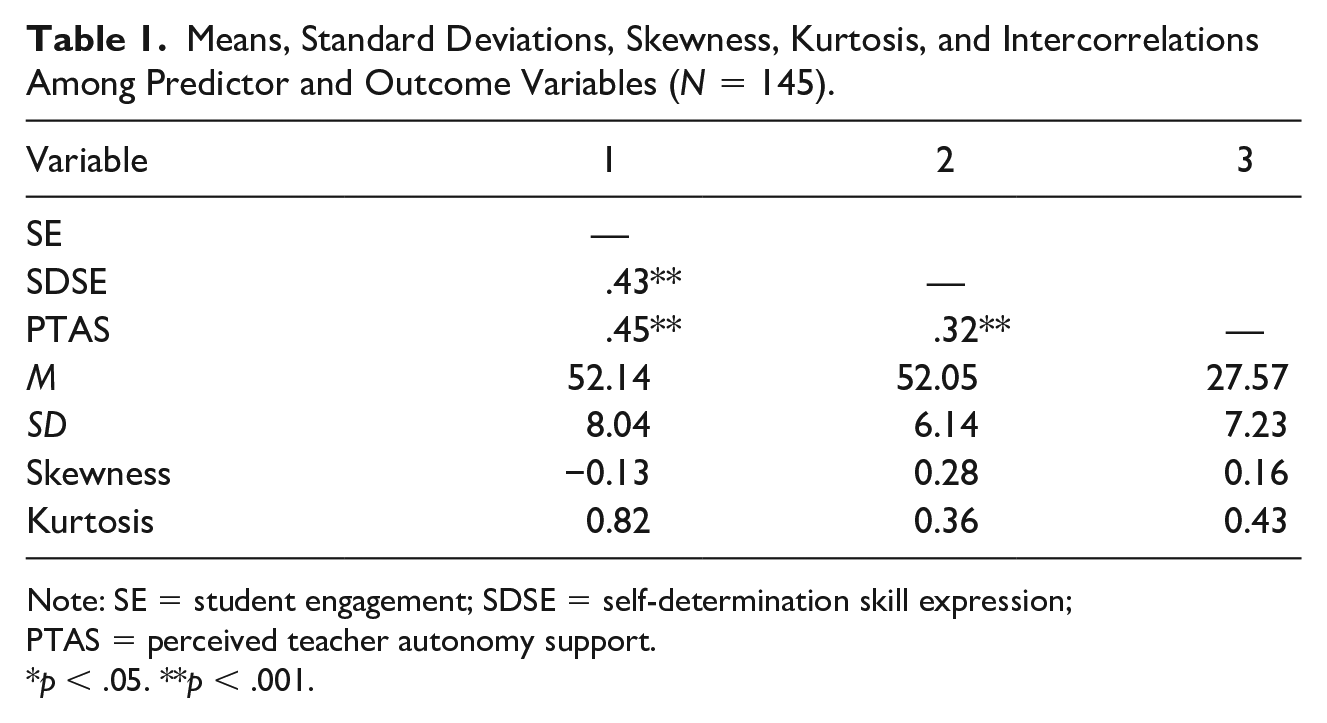
Note: SE = student engagement; SDSE = self-determination skill expression; PTAS = perceived teacher autonomy support.
p < .05. **p < .001.
Gender Differences on Major Variables
Three independent sample t tests were conducted on the major variables of student engagement, self-determination, and teacher autonomy support based on sex, male and female. All statistical assumptions (e.g., independent observations, normal distributions, homogeneity, no outliers) for independent sample t tests were met. Table 2 presents the results of the independent t tests. For all three analyses, there was no significant difference between male students: student engagement, t(143) = .84, p = .31; self-determination skill expression, t(143) = 1.02, p = .38; perceived teacher autonomy support, t(143) = 1.2, p = .05.
Summary of Independent t Tests of Major Variables by Gender.
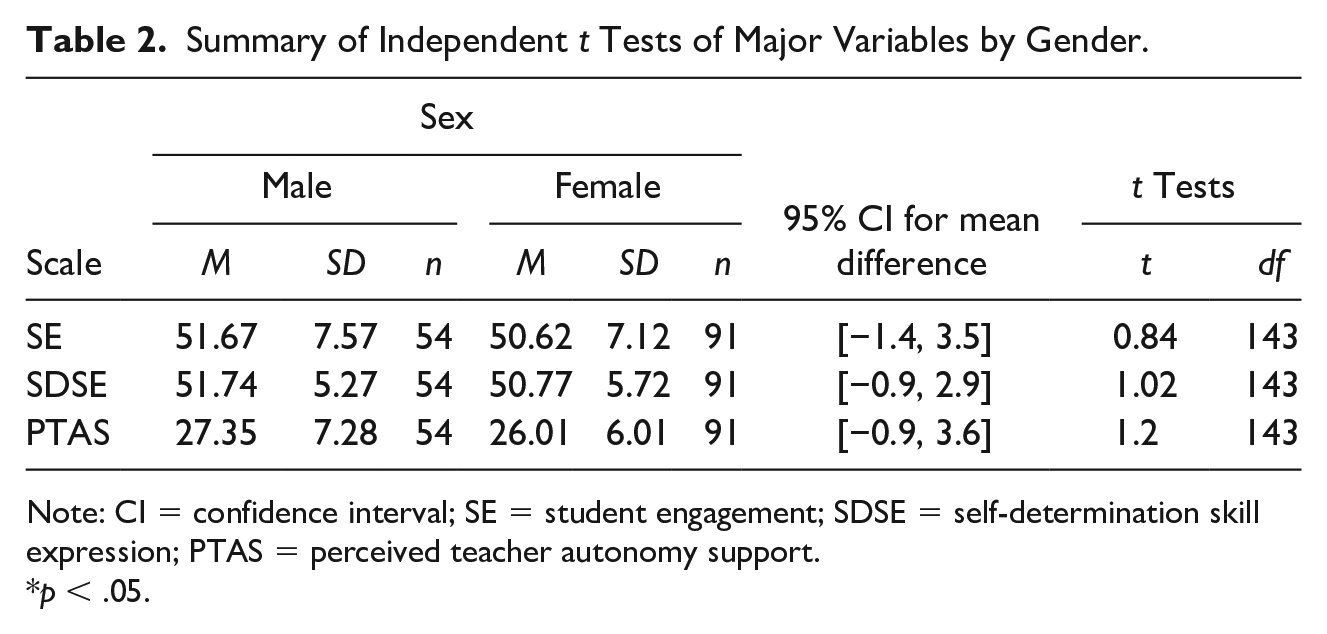
Note: CI = confidence interval; SE = student engagement; SDSE = self-determination skill expression; PTAS = perceived teacher autonomy support.
p < .05.
Predictors of Student Engagement
The results from the regression analysis predicting the outcome variable (student engagement) from the two predictors, self-determination skill expression and perceived teacher autonomy support, are shown in Table 3. All assumptions of multicollinearity, homoscedasticity, and normality were met. The two predictors accounted for 30% of the variance in student engagement, F(2, 142) = 30.05, p < .001, R2 = .30). Students who had higher levels of self-determination skill expression showed higher levels of student engagement, b = .42, t(142) = 4.29, β = .32, p < .001, sr2 = .12. In addition, students who had higher levels of perceived teacher autonomy support showed higher levels of student engagement, b = .40, t(142) = 4.78, β = .35, p < .001, sr2 = .14.
Summary of Multiple Regression Analysis on Student Engagement.
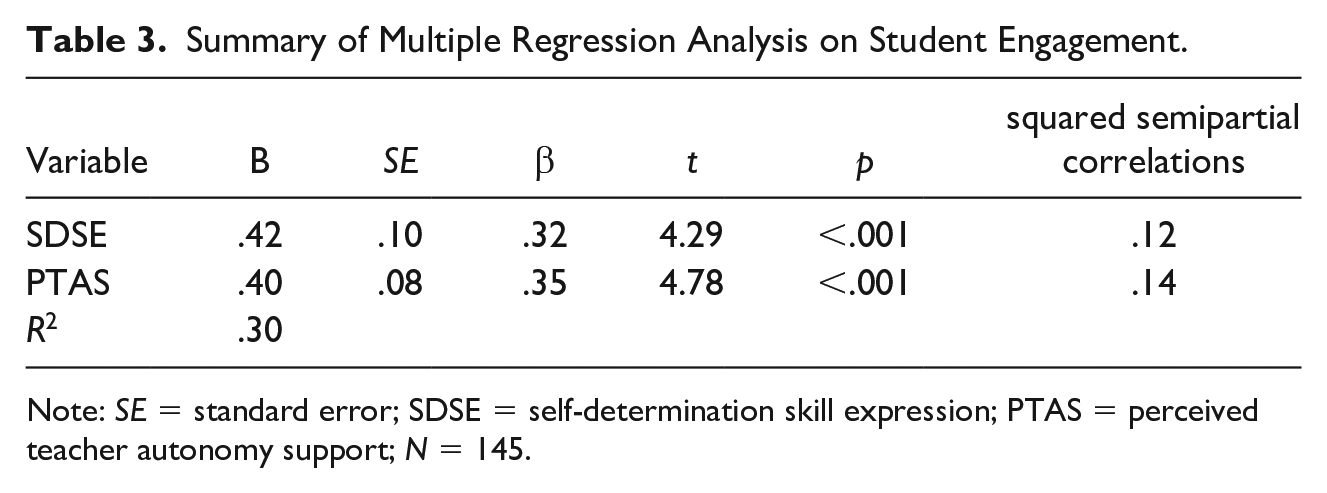
Note: SE = standard error; SDSE = self-determination skill expression; PTAS = perceived teacher autonomy support; N = 145.
Self-Determination Skill Expression as Mediator
We used the PROCESS tool (Hayes, 2017) to test whether student self-determination skill expression operated as a mediator between teacher autonomy support and student engagement. Effect sizes are provided for direct (R2; Fairchild et al., 2009; Hayes, 2017) and indirect (Hayes, 2017; Preacher & Kelley, 2011) effects. We found that all paths were statistically significant. The total effect model indicated that the association between perceived teacher autonomy support and student engagement was statistically significant, F(1, 143) = 37.17 (b = .51, β = .45, p < .001), with a medium effect size (R2 = .21). In the first path, we examined the relationship between perceived teacher autonomy support and student self-determination skill expression (path a). The relationship between these two variables was significant, (b = .26, β = .32, p < .001), with a small effect size (R2 = .10). We then found that student self-determination skill expression was significantly associated with student engagement (path b) when controlling for perceived teacher autonomy support (b = .42, β = .32, p < .001), with a medium effect size (R2 = .30). Next, we found that perceived teacher autonomy support showed a significant decrease in its relationship with student engagement (path c’) when student self-determination was held constant (b = .40, β = .35, p < .001). Thus, perceived teacher autonomy support was associated with an increase in student self-determination skill expression which was in turn associated with increased student engagement. Overall, there was a statistically significant indirect effect from perceived teacher autonomy support to student engagement (path c) through student self-determination skill expression (b = .11, 95% confidence interval [0.04, 0.20]), with a small effect size (β = .10). See Figure 1 for the mediation model.
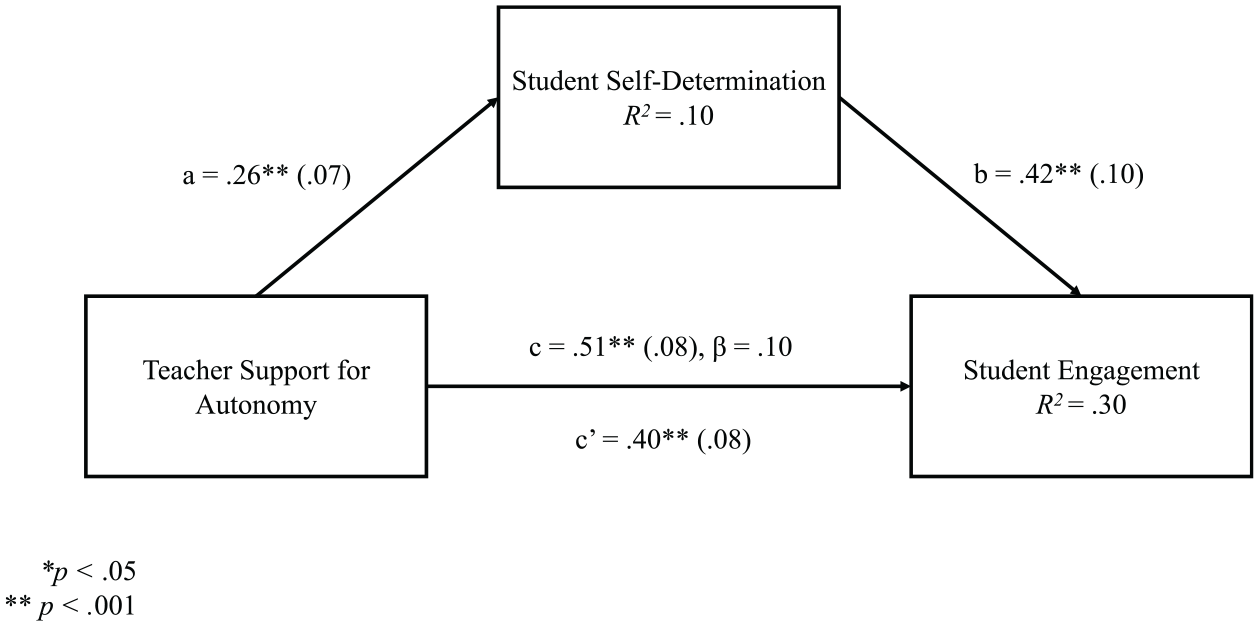
Mediating effect of self-determination on the relationship between teacher support for autonomy and student engagement based on participant (n = 145) reports.
Discussion
This study investigated student self-determination skill expression, perceived teacher autonomy support, and student engagement among 145 African American high school students without disabilities. We hypothesized that male students would report lower levels of perceived teacher autonomy support, self-determination skill expression, and student engagement compared with female students. Next, we hypothesized that perceived teacher autonomy support and students’ self-determination skill expression would be positively associated with student engagement. We expected that perceived teacher autonomy support and students’ self-determination skill expression would be positively associated with student engagement, as informed by prior research (Alivernini & Lucidi, 2011; Jang et al., 2012; Patall et al., 2013; Reeve et al., 2004; Vansteenkiste et al., 2012; Washington et al., 2012). We did not develop a hypothesis for the mediation model given that the question informing that particular analysis was exploratory in nature. For hypothesis one, we did not find significant differences between male and female students on perceived teacher autonomy support, self-determination skill expression, and student engagement. Regarding the second hypothesis, our analysis indicated that perceived teacher autonomy support and self-determination skill expression were significantly and positively associated with students’ engagement in class. Hence, both variables were significant predictors of student engagement.
Differences Between Male and Female Students
Hypothesis 1 was not supported. We did not find significant differences between male and female participants on student engagement, self-determination skill expression, and perceived teacher autonomy support. Our findings could be explained by key contextual factors related to the school’s characteristics. Specifically, Weiss et al. (2010) found that students were more likely to be engaged in school when they were enrolled in smaller schools. As the school is a small secondary school (only 474 students were enrolled in the school at the time of the study), the school-size may explain why male and female students reported similar levels of engagement in class. In a similar vein, the low teacher to student ratio (16:1 per the U.S. News & World Report, 2021) may have been facilitative of similar levels of perceived teacher autonomy support between male and female students by creating an environment that permitted teachers to get to know their students and be more responsive to each student’s needs and wants. For example, in follow-up interviews conducted with 16 participants across all grade levels, anecdotal accounts indicated several students noted that teachers were often encouraging, they were available to help students when needed, and they developed positive relationships with their students. As such, the teachers’ commitment to student support could have contributed to male and female students reporting similar levels of perceived teacher autonomy support.
Unlike Cavendish (2016), we did not find significant differences between male and female students’ self-determination. Such findings may be explained by key differences in the research designs. Cavendish (2016) utilized the Arc’s Self-Determination Scale (Wehmeyer & Kelchner, 1995), another established measure of self-determination, to assess students’ experiences in her study. Furthermore, all participants in the Cavendish (2016) study were high school students with disabilities, whereas our study excluded students with disabilities. Finally, most of the students who participated in the Cavendish study were Latinx, whereas our study included only African American students. Considering the differences between the two research designs, and the lack of detail outlining the presumed explanation for the observed differences between male and female students in the Cavendish study, there are number of competing explanations for the inconsistent findings between our study and that of Cavendish (2016).
Finally, the overall school climate and commitment to student success could also explain the lack of differences observed between male and female students’ self-determination. During the follow-up interviews we conducted with a select group of students, anecdotal descriptions indicated that several participants commented on school-based support they received such as school personnel providing resources related to their postsecondary endeavors and being exposed to messages of encouragement throughout the school. For example, at the time of data collection, the 11th- and 12th-grade students were preparing to visit a local university for a 1-day field trip to learn more about applying for and attending college.
Although we did not collect information about teacher demographics, we noted that most of the administrators and key support personnel (e.g., the high school counselor) were African American men and women. Although educator demographics are not the sole determinant of student success, research has indicated that Black/African American educators may be uniquely positioned to facilitate African American students’ success, because they “often deeply understand Black students’ situations and their needs” (Milner, 2006, p. 93). Hence, it is also possible that the male students were just as determined as their female peers because they were immersed in a school climate that understood their needs as African American pupils. Future research could further explore the relationship between male and female students’ self-determination and their interaction with culturally diverse educators.
Predictors of Student Engagement
Consistent with previous research (Reeve, 2013) and our hypothesis, we found that perceived teacher autonomy support predicted the participants’ engagement in school. We also found that the participants’ expression of multiple self-determination skills, including involvement in educational planning and decision making, predicted their engagement in school. Regarding the latter, this finding supports qualitative research that examined the interaction between African American high school students’ self-determination skill expression and indicators of their engagement in school (Parker, Garnes, et al., 2020; Parker & Wilkins, 2018). In particular, African American high school students who participated in the aforementioned studies indicated that self-determination skills were useful for helping students stay focused in school and completing their work (behavioral engagement), use deeper level study strategies to understand course material (cognitive engagement), and maintain positive feelings about class requirements (emotional engagement). Because we examined the relationship between students’ self-determination skill expression and student engagement using a unifactorial scale, future research could further delineate the extent to which students’ self-determination skill expression is associated with each aspect of student engagement (this was not the focus of the current study).
Mediation Model
We also found evidence of a mediation effect from teacher autonomy support to student engagement through self-determination skill expression. This finding supports Reeve’s (2006) dialectical framework within SDT. The basis of the dialectical framework is that teachers can promote students’ engagement in class by responding to students’ “inner motivational resources” (e.g., psychological needs [need for autonomy, confidence, and belongingness] and personal interests, values, preferences, and goals) through supportive classroom practices (Reeve, 2006). Specifically, students may be more engaged in the classroom environment when they are permitted to make choices, to engage in tasks that are viewed as valuable and interesting, and to have a voice in the class environment by articulating their opinions, wants, and needs (Reeve, 2006). These actions represent key self-determination skills (Shogren et al., 2016) and opportunities that are fostered by autonomy supportive instructional practices (G. C. Williams & Deci, 1996). Indeed, the results of the mediation model showed that students’ perceptions of teacher autonomy support facilitated their expression of self-determination skills, which was, in turn, associated with increased student engagement. Few studies have examined perceived teacher autonomy support in conjunction with student self-determination skill expression among general education students. Thus, the results of our mediation model shows that attending to African American high school students’ self-determination skill expression and subsequent engagement in class, without examining teachers’ classroom practices, may result in a limited understanding of their classroom experiences.
Limitations
This study provides important information regarding key predictors of student engagement among a predominately African American high school sample, but the findings should be interpreted within the limitations of the study. First, we recruited the participants for this study through convenience sampling given the school’s previous partnership with a local university and the principal’s willingness to examine the students’ school experiences as part of their existing focus on school climate. Second, the participants only included students from one small public academy school that receives state and private funding. Together, the results of the present study may not reflect the experiences of most African American high school students, especially students who attend under resourced and larger schools. Furthermore, reliance on student self-report alone is subject to many biases, including the possibility that research participants primarily endorsed items that depicted them in a positive light. In a similar vein, all measures were presented in the same order during survey completion, which may have resulted in an order effect. Finally, with little available data on the divergent validity for the measures we utilized, another limitation of this study may include incomplete measurement of the constructs of interest.
Implications for Practice
Because perceived teacher autonomy support was related to students’ self-determination, and, as a byproduct, students’ engagement in class, teachers’ implementation of autonomy supportive instructional practices may be critical for fostering both variables at the classroom level. Reeve (2004) found that teachers who received training on how to support students’ sense of autonomy displayed more autonomy supportive practices compared with teachers who did not receive such training. Thus, when providing professional development for classroom teachers, facilitators should highlight different approaches for supporting student autonomy/self-determination in the classroom. First, teachers could utilize formative assessments to gauge students’ perceptions about class content and instruction (e.g., prompting students to write their suggestions on index cards or completing a weekly reaction sheet to provide anonymous feedback). Teachers could also frame assignments as an opportunity for personal growth and offer explanations about why specific assignments are required to promote student buy-in. Because choice/decision making is a critical aspect of autonomy support and self-determination, facilitators can encourage teachers to allow students to choose how to execute different classroom assignments (when permissible). Finally, teachers should affirm students’ negative reactions to class content, display patience when such reactions occur, and help students problem solve about how to address their concerns (Reeve, 2006, 2016).
Classroom autonomy support largely entails teachers considering students’ perspectives and point of view by giving them a voice in the classroom. Nevertheless, research shows that African American youth are likely to feel unheard by classroom teachers; their perspectives may not be taken into account; and they may be viewed as disrespectful and receive undue punishment for sharing their reactions to classroom content (Allen, 2017; Howard, 2008; Parker, Amabile, et al., 2020). Thus, educators should be particularly mindful of their biases and reactions to African American high school students when applying autonomy supportive practices in the classroom.
Future Research
Future research could replicate this study with African American high school students who are enrolled in larger or less diverse school settings to identify key contextual considerations that may be overlooked. For example, researchers could examine factors such as school size, teacher demographics, and school funding to identify unique and shared experiences among African American high school students. Furthermore, researchers could use other methods of data collection (e.g., teacher and parent ratings) to triangulate and validate youth self-reports. Finally, the current study could inform intervention research that seeks to examine the impact of teacher autonomy support, under controlled or semicontrolled conditions, on African American high school students’ self-determination and engagement in class.
Footnotes
Acknowledgements
We would like to express our sincere gratitude to the adolescents, teachers, and school administrators who participated in and assisted us with this research project.
Declaration of Conflicting Interests
The author(s) declared no potential conflicts of interest with respect to the research, authorship, and/or publication of this article.
Funding
The author(s) disclosed receipt of the following financial support for the research, authorship, and/or publication of this article: William & Mary Pre-Tenure Research Funds.
