







Abstract
In the current qualitative study, we draw upon the colorist-historical trauma framework and misogynoir theory to explore Black college women’s peer-based messages of skin tone bias in school settings. We analyzed individual interview data from 26 ethnically diverse Black women (18–22 years) with consensual qualitative research methods to explore their beliefs and perspectives on their peers’ colorist messages in K-16 education. We focused on three main themes from the women’s narratives, including the critical role of school racial context, the harmful nature of colorist comments from Black men and boys, and the affirming nature of counternarratives from Black girlfriends. Consistent with past studies, peers’ colorist messages reinforced racialized social hierarchies and Eurocentric notions of beauty by privileging lighter-toned women compared to darker-toned women. The young women described how colorist messages from peers contributed to body surveillance and physical insecurities during childhood, and how they cultivated personal and collective counternarratives on beauty and self-worth in adulthood. Authors discuss colorism as a form of trauma among Black women and girls, with particular attention to identity development.
Colorism 1 was first coined by poet and activist Alice Walker (1982) and refers to the “prejudicial or preferential treatment of same-race people based solely on their skin color.” Colorism is a global manifestation of White supremacy that largely stems from the European legacy of colonialism and imperialism and affords greater privileges to people of color with lighter skin (Crutchfield et al., 2020; Dixon & Telles, 2017; Reece, 2019). In the United States, colorism is closely tied to the plantation-based enslavement of African Americans. For instance, White enslavers offered preferential treatment for African laborers who possessed more Eurocentric features (lighter skin tones, straighter and looser hair patterns, and narrower noses; Keith, 2009). In the current study, we draw on the colorist-historical trauma framework (Ortega-Williams et al., 2019) to explore colorism as a specific manifestation of misogynoir (i.e., prejudicial beliefs, biases, or behaviors rooted in anti-Blackness and misogyny that contribute to harm and/or violence against Black women and girls; Bailey, 2021). We consider the school-based experiences of ethnically diverse Black 2 women and use Bailey’s (2021) articulation of misogynoir to account for the unique implications of colorism as a racialized gendered construct that harms Black women’s wellbeing and self-image (Hall & Crutchfield, 2018; Uzogara, 2019).
Guiding Framework: Colorism as Historical Trauma
Ortega-Williams et al.’s (2019) colorist-historical trauma framework (CHTF) provides a useful lens to understand the ongoing socioemotional, political, and economic influence of colorism on Black populations in the US. Dating back to the emergence of lighter-toned and White-appearing Black enslaved people that resulted from the sexual assault and rape of Black women (Willingham, 2018), different laws and social customs materialized that privileged lighter-toned Black people in the country. While lighter-toned Black people also experienced persistent racial violence in the US (Aslakson, 2012), they had access to more educational and economic resources and social capital compared to their darker-toned counterparts (Aslakson, 2012; Keith & Monroe, 2016). The CHTF highlights the contemporary legacy of colorism by building on Brave Heart’s (1998) framework of historical trauma (HT), which includes four main tenets: 1. HT involves group-level trauma through intentional exploitation and cultural disruption of a community for the benefit of another racial group; 2. HT causes harm intergenerationally due to the unresolved grief and loss from a community’s initial subjugation and ongoing experiences of systemic violence; 3. HT is a negative social determinant of health, resulting in psychological, spiritual, physical, and behavioral health disparities; and 4. HT is transmitted intergenerationally to those who did not experience the initial massive group trauma, but still endure current-day related injustices.
Thus, we consider CHTF a relevant conceptual model to explore the ongoing implications of colorism as a form of historical trauma among Black populations. We use CHTF to contextualize Black women’s experiences of and responses to colorism in school-based settings, particularly in relation to racialized peer norms and their identity development. Specifically, we interrogate how colorism is a contemporary manifestation of misogynoir and explore how Black women internalize and/or subvert biased skin tone messages from peers in K-16 3 school settings.
School Contexts and Colorism against Black Women and Girls
Current research on Black youth and young adults’ schooling experiences suggests that students’ racialized experiences with peers play a key role in their sense of belonging and school adjustment (Butler-Barnes et al., 2019; Byrd & Hope, 2020). Recently, scholars have identified colorism as a more specific form of gendered and racialized discrimination that Black women and girls experience in educational settings (Carter Andrews et al., 2019; Leath, Jerald, et al., 2021; McGee et al., 2016; Rosario et al., 2021). Relatedly, more researchers have highlighted how colorism has influenced Black women and girls’ experiences in school contexts, including their social status, perceived attractiveness (to others and to themselves), as well as their acts of resistance to colorist messages and experiences (Brown et al., 2021; Crutchfield et al., 2022; Hall, 2017; Wilder, 2010). Consistent with Ortega-Williams et al.’s (2019) colorist-historical trauma framework, this body of work reveals the temporal and generational continuity of colorism as a form of collective trauma, as well as colorism as a negative social determinant of health for Black women and girls.
For instance, Abrams et al. (2020) found that African American girls (ages 12–16) perceived colorist stereotypes of the past (i.e., associate negativity with darkness and to equate goodness with lightness; Wilder and Cain, 2011, p. 586) as communally held beliefs today. In the study, while girls expressed bias against darker-toned peers in general (boys and girls), they offered substantially more comments on skin tone and physical attributes on female peers compared to male peers (gendered colorism; Hill, 2002; Hunter, 2007). Additionally, the girls made positive and negative attributions along a “color continuum” (Abrams et al., 2020, p. 181), in that individuals on the far end of the continuum were considered most unappealing, but this was only the case for peers who were deemed too dark rather than too light. While some of the girls considered darker-toned peers attractive because they “had swag” or “good hair,” (Abrams et al., 2020, p. 182) the adolescents generally reported colorist biases similar to those found among studies with Black women (e.g., Hall, 2017) and consistent with the historical notion of colorism as a form of racial stratification (Ryabov, 2013).
Moreover, scholars have found evidence that colorism is a source of emotional and psychological distress for Black women and girls (Alexander & Carter, 2022; Hall, 2017; Wilder, 2010), and that individuals may extend their skin tone bias and physical attributions of attractiveness to their perceptions of peers’ intelligence, competence, and social acceptability (Abrams et al., 2020; Stephens & Few, 2007; Williams & Davidson, 2009). Hunter (2016) described this phenomenon as the halo/horn effect, referring to how a positive or negative impression in one area (e.g., skin tone) can influence others’ assumptions in another area (e.g., behavior). For example, in addition to general skin tone bias against darker-toned peers, Abrams et al. (2020) also found that African American adolescent girls consistently associated darker-toned peers with less favorable personality and behavioral traits, such as being “loud, hood, and obnoxious” (p. 186). While the girls associated some negative personality traits with lighter-toned skin (i.e., being “conceited” and “arrogant” (Abrams et al., 2020, p. 186)), these negative behavioral descriptions still mapped on to perceiving peers with lighter skin tones as more attractive and appealing. In light of the enduring nature of colorism and its psychological effects on Black women and girls; body image beliefs and self-esteem (Keith & Monroe, 2016; Townsend et al., 2010; Watson et al., 2019), it is necessary to consider how they negotiate colorism and skin tone bias from peers.
Colorism and Identity Development Among Black Women and Girls
Black children exhibit preferences for lighter and medium skin tones as early as kindergarten (Adams et al., 2016; Crutchfield et al., 2022), and Black girls may be exposed to colorist messages from peers as early as elementary school. In addition to student preferences for lighter-toned skin, findings have indicated that youth begin assigning negative stereotypes to peers with darker skin tones by seven years old (Williams & Davidson, 2009). However, a scoping review by Adams et al. (2016) noted that results from previous studies on skin tone bias were not always consistent (i.e., some Black children indicated a preference for darker brown skin tones compared to lighter brown skin tones; Porter, 1991), and that researchers did not always make a clear distinction between skin tone bias and racial bias more broadly (e.g., Kurtz-Costes et al., 2011). Still, evidence suggests that Black girls’ peer-based experiences of colorism begin early, and several scholars have considered how skin tone bias informs identity development during adolescence and emerging adulthood (Blake et al., 2017; Brown et al., 2021; Mathews & Johnson, 2015; Rosario et al., 2021; Ryabov, 2013).
For example, scholars have documented the negative influence of colorist messages on Black girls’ self-esteem and self-concept during adolescence (Abrams et al., 2020; Breland-Noble, 2013; McGee, 2016; Wilder & Cain, 2011), particularly regarding how peers’ messages of skin tone bias contribute to harmful body surveillance and self-objectification among Black girls (i.e., constant concerns or preoccupation with how one’s body appears to others; Stanton et al., 2022). According to objectification theory, adolescent girls increasingly recognize the sexual objectification and evaluation of their bodies by others and may consequently internalize others’ perspectives on their physical appearance and attractiveness (Watson et al., 2019). This personal surveillance and internalization of others’ perceptions of their bodies can contribute to self-objectification among young girls, including harmful beliefs that their physical appearance determines self-worth and value (Townsend et al., 2010; Watson et al., 2019). Often, racialized and gendered stereotypes that objectify Black girls and women are steeped in colorist messaging and have negative consequences for Black girls when internalized.
For instance, Townsend et al. (2010) found that endorsement of stereotypic imagery and colorist beliefs (i.e., Jezebel as lighter-skinned and attractive Black woman; Mammy as a darker-skinned, heavy, and sex-less Black woman) was related positively to the rejection of Afrocentric beauty standards and sexual risk taking among Black girls (ages 10–15). Within the study, many of the adolescent girls who endorsed colorist beliefs did not possess the type of physical characteristics that were consistent with Eurocentric and hegemonic standards of beauty of beauty (e.g., lighter skin tones and straight hair), and may have consequently, judged their personal appearance more harshly. The researchers suggested that the girls might have been more willing to engage in riskier sexual behaviors to be seen as attractive and desirable. On the other hand, Rosario et al. (2021) found that Black girls also resist colorist ideologies by rejecting pejorative evaluations from others and adopting beliefs that affirm and value their developing sense of self. In their qualitative study with Black girls from 9th to 12th grade, several participants noted that they “did not aspire to or desire proximity to whiteness” (Rosario et al., 2021, p. 525), and the girls discussed how their personal pride and self-love about their skin tone and physical appearance was directly related to positive school experiences with peers and teachers in the all-girls, majority Black school. Thus, while some studies suggest that experiences of skin tone bias and colorism directly translated to lower self-esteem or riskier behaviors among Black girls (Townsend et al., 2010; Wilder & Cain, 2011), other scholars have found that Black adolescent girls understood the ways that colorist ideologies shaped their experiences and directly engaged and denounced colorist beliefs and behaviors as White feminine beauty standards and anti-Black racism (Rogers et al., 2021; Rosario et al., 2021).
In addition, several scholars have considered the ongoing developmental implications of colorism, by exploring Black young adult women’s reflections on colorism from girlhood into adulthood (Brown et al., 2021; Hall & Crutchfield, 2018; Landor & McNeil Smith, 2019). For instance, Mathews and Johnson (2015) found that although darker-toned Black women (ages 18–23) reported more experiences of skin tone bias compared to lighter-toned women, and lighter-toned Black women reported feeling more valued in their social relationships compared to darker-toned women, there were no differences in self-esteem among women in the sample. In addition, most of the darker-toned Black women indicated that they would not change their skin tone if given the opportunity, highlighting Black women’s agency in refusing to internalize hegemonic and colorist beauty standards. Similarly, Brown et al. (2021) found that while Black college women (ages 20–35) recognized colorism as a shared racialized experience, women noted how “there are stark differences in the experiences of Black women who are called names for being lighter skinned compared to the abuse darker skin Black women endure” (p. 10). Within the study, the women suggested that navigating colorist messages involved both internal and external identity work, because they had to intentionally process and reject their own internalized colorist beliefs (e.g., lighter skin is prettier), while also recognizing that individuals in society often reify colorist systems by responding differently to Black women based on their phenotypic proximity to whiteness (i.e., access to intimate relationships; Stephens & Thomas, 2012 and social status positioning; Collins, 2000). They also discussed the various forms of resistance they used to challenge the colorist messages they received from family members and peers, such as having conversations with others about their problematic statements and engaging in Black feminist research to deepen their understanding of colorism as a global form of white supremacy.
The Current Study
In all, prior scholars have documented the nuances of how colorist messages from peers can play a role in Black women and girls’ self-image and identity development (Hamilton et al., 2009; Hunter, 2007; Stephens & Thomas, 2012). In addition to extolling the negative social and psychological effects, this work demonstrates the multifaceted nature of Black women and girl’s internalization and/or resistance to colorist messages (Abrams et al., 2020; Brown et al., 2021; Hall & Crutchfield, 2018). While more scholars are beginning to interrogate how ethnicity influences Black women’s experiences of colorism (Wilder, 2010; Wilder & Cain, 2011), extant literature predominantly focuses on African American women and girls’ experiences (Adams et al., 2016; Hall, 2017; Hannon et al., 2013). Research on colorism must be understood within the context of Black women and girls’ various racial, ethnic, and cultural experiences, and include a principal focus on the multiplicative ways they respond to colorist messages (Rosario et al., 2021). In the current study, we add to extant literature by analyzing interview data from a sample of ethnically diverse Black college women. We use CHTF to situate the young women’s contemporary experiences in schools within the broader history of colorism as a form of gendered and racialized trauma, particularly in relation to the material benefits that lighter-toned skin affords Black women in the anti-Black and patriarchal context of the US (Mathews & Johnson, 2015; Stephens & Few, 2007; Uzogara, 2019). Additionally, we consider how self-reported skin tone shade plays a role in their exposure to and responses to colorism from peers.
Method
The Black Women Socialization Study involved semi-structured interview data from 50 Black women at two PWIs. The first university was a PWI in the Midwest (n = 21) and the second university was a PWI in the Southeast (n = 29). The primary investigator (PI) added a few questions to the interview protocol after the first wave of data collection, including specific questions about colorism. Thus, the current sample included data from Black women at the second university who discussed colorist messages from peers. At the time of data collection, the Southeastern university had an undergraduate enrollment of around 12,000 students; Black students comprised five percent of the population.
Participants
Summary of Participant Demographic Characteristics (N = 26).
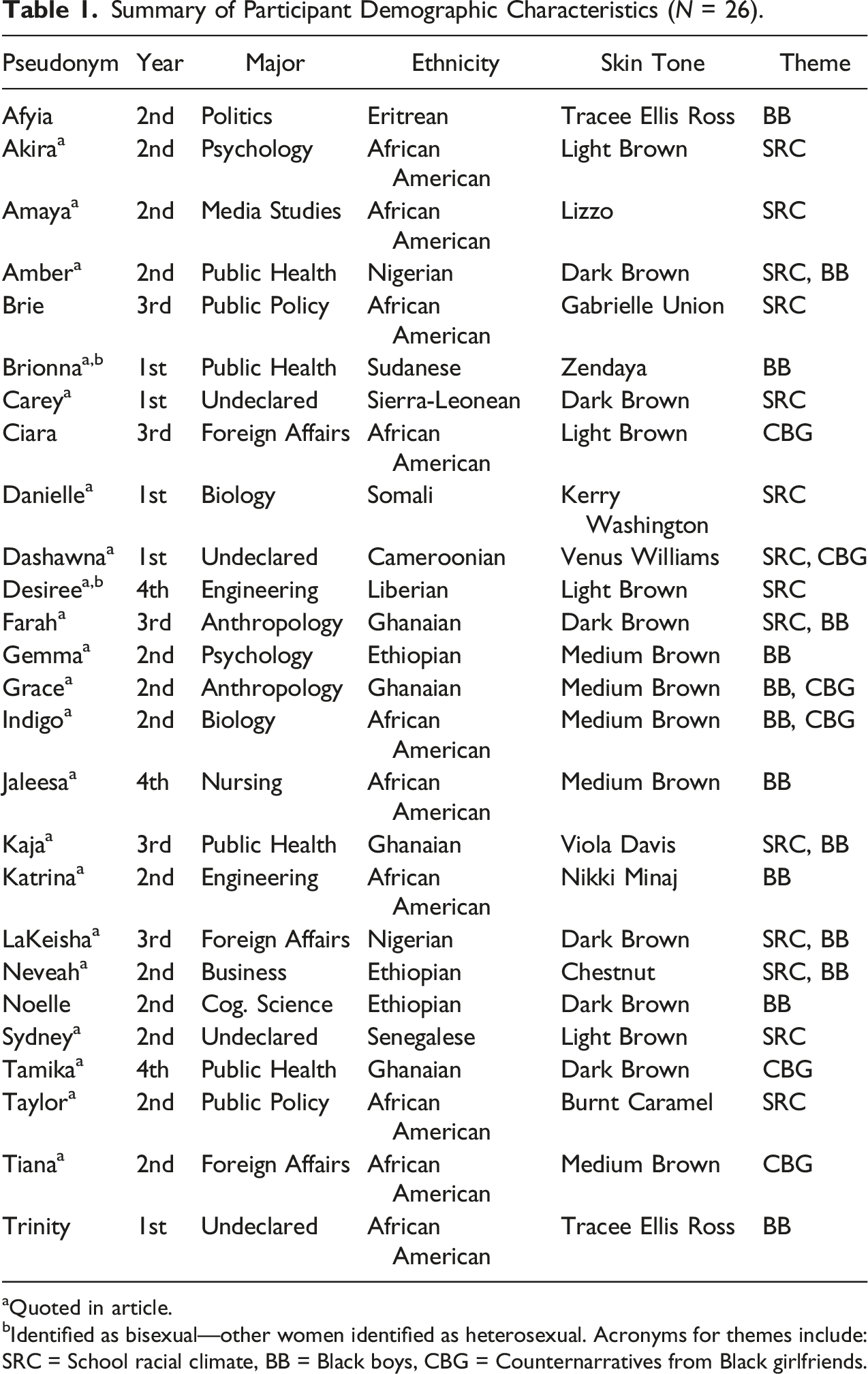
aQuoted in article.
bIdentified as bisexual—other women identified as heterosexual. Acronyms for themes include: SRC = School racial climate, BB = Black boys, CBG = Counternarratives from Black girlfriends.
Procedures
After receiving university IRB approval at the second institution, the PI sent weekly emails to student organizations with Black members (Black student organizations, religious student organizations, resource center for LGBTQ + students, and leadership organizations) until we scheduled the target number of participants for interviews. Students who identified as Black women were eligible for participation, and interested students sent an email to the PI to schedule a time for an interview. The research team consisted of the PI, who is a Black woman, and another Black woman graduate student, who was trained in semi-structured interview techniques. We conducted interviews in public locations that allowed for private conversations (i.e., conference room). Before each interview, participants completed an informed consent form and a demographic survey. The audio-recorded interviews lasted between 45-90 minutes (M = 70 minutes), and the women received $20 for study participation. The PI determined that the study had reached meaning saturation (i.e., point at which no further nuances, or insights can be found based on the current interview protocol; Hennink et al., 2016) after interviewing 29 women at the second institution.
Measures
Demographic Survey
Before each interview, the participants completed a demographic survey that included a range of questions, such as age, year in college, country of birth, ethnicity, skin tone, gender, sexual orientation, relationship status, ability status, indices of social class status (i.e., first-generation status, family household income, parents’ highest level of education, and self-reported social class), racial composition of their home neighborhood and high school, household configuration, and college major.
Interview Protocol
The interviews included a standardized set of questions on the race and gender socialization messages that participants received during childhood and adolescence from peers, family members, teachers, and social media related to their identity as a Black girl and woman. To develop the interview protocol, the PI reviewed literature on race and gender socialization processes (Carter Andrews et al., 2019; Wilder, 2010) and common stereotypes of Black women (Ashley, 2014; Townsend et al., 2010) to compile a list of questions. These questions were then pilot tested with a group of Black female graduate students (N = 5) whose research focused on race and gender identity development and Black girlhood. Through a series of informal group discussions, the PI modified the questions for clarity and coherence. For instance, one of the pilot interviewees suggested changing the original question, “What does your Black woman identity mean to you” to “What words or characteristics would you use to describe yourself as a Black woman?”
The final interview protocol included two main sections; the first section focused on the women’s race and gender socialization experiences and the second section focused on their media consumption and awareness of stereotypes about Black women. The first portion included questions such as, “I’d like you to tell me a story about an important positive experience in your life that related to your identity as a Black girl.” and “How important is your identity as a Black woman to your overall self-concept?” In addition, we asked a series of questions about the messages they received from family members, peers and teachers at school, and their religious communities about their identities as Black girls and women. In relation to the current study, we asked questions including, “During K-12, did you receive messages about colorism from peers at your school” and “Have you received any colorist messages at your university?” We provided a standard definition of colorism to all women in the study (i.e., colorism refers to prejudice or discrimination against individuals with a dark skin tone, typically, but not always, among people of the same ethnic or racial group). Based on their responses, interviewers probed about significant experiences with questions such as, “What did you think about these messages” and “Do you think your skin tone affected how others perceived you?”
Scholar Positionality Statement
It is critical that scholars recognize the intentional and subjective choices we make during the data collection and analysis process (Merriam, 2009). Thus, we offer further insight on the knowledge, assumptions, and positionality of each contributing author. The lead author and PI is a biracial Black woman from a working-class background. She is an assistant professor with over nine years of research on the identity development processes of Black girls and women. She has a light-brown skin tone, similar to the Black woman songstress, Alicia Keys. The second author is a Black, Ghanaian American woman and 1.5-generation immigrant from a working-class background. She is a PhD candidate with five years of research on the individual psychology of gendered colorism. She has a dark brown skin tone, similar to the Kenyan Mexican actress, Lupita Nyong’o. The third author is a Jamaican-born US- raised woman from a lower, middle-class background. Her research focuses on Black feminisms in the Caribbean and Latin America. She has a dark brown skin tone, similar to the Black British screenwriter, Michaela Coel. The fourth author is a Black Ethiopian American woman and first-generation American from a middle-class background. She is a fourth-year undergraduate student with research interests that lie at the intersection of the mental health and educational experiences of underrepresented youth. She has a medium brown skin tone, similar to the Black woman songstress, Jennifer Hudson. Collectively, we hoped to illuminate the various ways that Black women and girls embody and communicate resistance to racialized and gendered forms of oppression at both the individual and community level. In the current study, that involved addressing the developmental implications of colorism within school settings.
Coding Analysis
We used consensual qualitative research (CQR) methods 5 as described by Hill (2012) to analyze the interview data. CQR is an iterative and reflexive coding approach that entails reaching a consensus among coding team members on the meaning of participants’ experiences. We used verbatim excerpts from participants to stay close to the data, as well as a variety of reliability techniques (i.e., multiple primary coders, an auditor, and reflexive note-taking) to ensure that our findings closely reflected the young women’s perspectives. Below, we describe the multiple steps we used to code and analyze the data, including (a) coding preparation, (b) codebook development, (c) coder training, and (d) measures of reliability.
Coding Preparation
To prepare the data for coding, the first three authors read the transcripts and highlighted statements that addressed the research question: What messages on skin tone and colorism did the women receive from peers in school contexts? The lead author reviewed all 26 transcripts, and each student co-author reviewed 12–13 transcripts each. After individually compiling all portions of the transcripts that referenced colorism in school contexts, we reviewed each statement as a group to reach a consensus on final excerpts for coding. We maintained a running log of inclusion and exclusion criteria (e.g., include statements on colorism from K-16; exclude statements that focused on messages from teachers unless it involved a peer interaction). The PI uploaded the final excerpts into a master excel file for coding. This master excel file included five columns (participant ID, pseudonym, code excerpt, notes, and theme).
Codebook Development
To develop the codebook, the PI enlisted the assistance of a colleague who specialized in Black adolescents’ school-based experiences, to serve as an external auditor. We independently reviewed all excerpts and created a list of broad domains from the narratives (e.g., messages from Black boys, beliefs about how colorism influenced dating options, positive messages from Black girls, comments from teachers, colorist experiences based on school racial composition, and ethnic socialization at home influencing girls’ perceptions). We collapsed these into the three main themes of the paper (i.e., the role of school racial context, comments from Black boys, and counternarratives from Black girlfriends), based on our predominant focus on peer-based messages in school settings. We then reviewed the themes and consulted available literature on colorism (e.g., Abrams et al., 2020; Maxwell et al., 2015; Wilder & Cain, 2011) in a series of meetings to determine if we missed or overlooked particular narratives in the data.
Coder Training
The coding team included the PI and two Black female undergraduate students with an interest in Black women’s beliefs around beauty and body image. To train the coders, the PI reviewed the original study objectives and assigned reading chapters on CQR (Hill, 2012) and colorism (Abrams et al., 2020; Keith & Monroe, 2016; Ortega-Williams et al., 2019) to familiarize the student coders with the conceptual framework and analysis approach. Then, we discussed our potential biases in relation to the aims of the study and personal experiences. For instance, we discussed our perceptions of our skin tones and experiences with colorism in family and school contexts. In addition to empirical research and personal experiences, stories in the media informed our conversations, such as actress Zendaya discussing the privilege of her skin tone and her success in Hollywood (Danielle, 2020). The PI and one student coder considered themselves “light to medium toned,” and the second student coder described herself as “medium to dark toned.” We had all received messages on skin tone from peers, and we considered colorist messages a harmful phenomenon. We were all heterosexual during adolescence, and we had all felt the desire to be seen as “pretty” by boys during that time. We also discussed how—during adolescence and emerging adulthood—we had considered colorism a “Black people issue,” and failed to recognize it as a form of historical trauma and byproduct of Eurocentrism and White supremacy. After one month of reading and conceptual discussions in weekly, one-hour sessions, the students read the master Excel file to familiarize themselves with the data.
Coding Reliability
After the coding training meetings, the PI assigned the two Black female undergraduate students specific practice excerpts in the master Excel file. To establish intercoder reliability (i.e., numerical measure of the agreement between different coders regarding how the same data should be coded; O’Connor & Joffe, 2020), we assigned codes to a small set of shared excerpts (ICR1 = .82). We then coded a second set of excerpts independently and completed a second intercoder reliability check to assess coder drift (i.e., extent to which coders become less reliable over time; Bartholomew et al., 2000; ICR2 = .76). After establishing that we were still using the coding scheme consistently, we independently coded the remaining excerpts.
Throughout this process, the coding team kept individual memos to record our thoughts about the participants’ experiences and reflect on our biases. We engaged in a series of dialogs about these individual memos during and after the coding process as a measure of ongoing reflexivity. For instance, the PI heard that she “looked like Pocahontas,” in school on numerous occasions from boys; this was supposed to be a compliment, but it made her self-conscious about getting darker during the summertime or cutting her hair. The darker-toned student coder discussed how familiar some of the harmful messages from boys felt as she read through the data, since she had received several similar comments herself (e.g., “you’re pretty for a dark-skinned girl”). We discussed our differing positionalities in relation to colorism based on our skin tones, as well as how our beliefs about these types of messages shifted during emerging adulthood.
Results
We identified three central themes regarding Black women’s experiences with colorist messages from peers in school-based contexts. First, the women’s narratives suggested that school racial context, and the racial composition of the student body specifically, played a critical role in the nature of the prejudicial messages that they received about their skin tone from peers. Second, the young women described how Black men and boys’ colorist messages influenced their personal beliefs about their physical attractiveness and dating possibilities. Third, some women discussed how Black girlfriends offered affirmative counternarratives that challenged peers’ colorist messages about skin tone and beauty. We used pseudonyms for all names and locations, and the women reported their personal skin tone descriptions. Below, we provide definitions and excerpts for each theme.
“I was Never Told I was too Dark, Until I Went to School”: Colorism in School Contexts
Predominantly Black and Racially Diverse Schools
Fourteen women in the study (54%) discussed their beliefs about how the school racial context and the racial composition of the student body informed the colorist messages they received from peers. In particular, their narratives highlighted the ways in which they learned about race and the varied meanings attached to skin tone within school contexts. For instance, Amaya, a second-year African American woman whose skin tone was similar to Lizzo (a Black woman actress with medium-toned brown skin), stated the following: Before I knew the different shades of being a Black person, I just assumed someone who was lighter than me wasn’t Black. It wasn’t until my mom told me like, “No, we come in all shades.” I had to have that lesson because I hurt my one friend's feelings when I was in kindergarten because I was like, “Oh, you're not Black, but she’s Black.” Because my other friend, she was darker than me.
Amaya, who attended predominantly Black schools for K-12, described how her mom quickly corrected her early belief that only dark-skinned individuals were Black. Similarly, Akira, a second-year, African American woman with light brown skin, who also attended predominantly Black schools for K-12, stated, “We kind of…noticed like light skin and dark skin. People would notice skin tone, but [we did not] necessarily assign any value to it. But we were all mostly Black in my school, so…” In both cases, same race peers surrounded the young women; yet, they had differential early understandings of racial group membership in relation to skin tone. While Amaya did not perceive light-toned individuals as Black, Akira knew that she was a light-toned African American girl and did not think her peers attached specific meanings to skin tone.
In general, several women believed that they had fewer issues with colorism because they attended predominantly Black or racially diverse schools with more students of color for K-12, highlighting how racial pluralism played a role in their social experiences with peers. For example, Neveah, a second-year Ethiopian woman with chestnut brown skin, stated: I've always been surrounded by a majority of [racial] minorities, to be honest. So, my first time feeling like a minority at school was here at this university. I never really felt like a minority, so I never really had colorism issues within myself. I saw it with other people, especially with social media. But it never was really a factor for me at school.
Similarly, LaKeisha, a third-year Nigerian woman with a dark brown skin who attended a majority Black high school, reflected on the following: Sure, there's colorism within the Black community, and there are certain stigmas within the Black community, as well. And I think that some Black people still have those internalized products of racist stereotypes and things like that. But I just had more of a freedom to understand what Blackness means and what it means to me personally, because of the environments that I grew up in, like at school, where I could see Blackness is different things to different people.
According to Neveah and LaKeisha, their immersion within predominantly Black and racially diverse schools limited their exposure to and understanding of colorism during childhood. Neveah stated that colorism occurred more frequently in the online spaces that she frequented rather than her school settings, and while LaKeisha was aware that “colorism exists in the Black community,” she suggested that this was only one facet of her broader social experiences with Black peers in her school settings.
Conversely, some women in predominantly Black or racially diverse schools did not perceive the same type of intra- or inter-racial cohesion and noted the colorist messages they received from same race peers or other students of color. Farah, a third-year Ghanaian woman with a dark brown skin, shared the following: I guess I wasn't the right type of Black because they would make fun of my culture and my heritage. I had a little bit of an accent. They made fun of that. They'd be like, “You're so dark, you're this, you're that.” Just typical Black insults…like burnt and African bootie scratcher, things like that. In my head, I was thinking that White people would be mean to me this way. I didn't think Black people were going to be mean. I didn't know there was a difference between my Black and their Black, or my dark brown skin and their toasty almond skin. Didn't know it was a problem. But, yeah, I got that it was a problem.
In Farah’s case, the prejudicial remarks (i.e., “African bootie scratcher”) from other Black students about her darker skin tone and her ancestral origins caught her off guard. Her experience highlighted how African American students at her school demarcated a difference in their racial positioning as Black people in the US based on perceived ethnic, national, and linguistic differences (i.e., “I had a bit of an accent”). While most of our sample (62%) were women from Black immigrant families, few discussed how their ethnic and cultural background affected the colorist messages they received. Finally, Taylor, a second-year Nigerian woman who said her skin was, “browned caramel – like perfectly crisp toast,” described how the racial diversity at her school did not guarantee a protective school context. Well, I feel like that wasn’t really an issue in my school within the Black community. But with my Southeast Asian friends or whatever, they’d always be like, “Oh my god, I’m darker than you. I’m Blacker than you or whatever.” And it’s like, “Don’t give yourself such an honor. Chill.” Or it would be like, somebody making a comment like, “Oh my god, I’m getting darker. That’s so bad.” And I would just never really think about it…”
Taylor observed more encounters with colorism from other students of color rather than Black peers, and she stated that she did not spend much time thinking about these comments during adolescence. Her excerpt also drew attention to the intersections between colorism, white supremacy, and anti-Blackness within different racialized communities, as the history of racialization within the US often privileges (certain) Asian Americans above African Americans in terms of access to economic, social, and political privilege (e.g., Chopra, 2021).
Predominantly White Schools
Most of the women in the study who attended predominantly White schools in K-12, described how colorism was a core part of the negative race-related messages they received from peers. As one of the few or only Black students in their classrooms or in the broader school community, some of the women described their struggles to develop positive self-esteem regarding their skin tone, particularly during childhood and adolescence. Kaja, a third-year Ghanaian woman with a brown skin tone like Viola Davis (a Black woman actress with a dark-toned brown skin), recalled the following: It was in fifth grade. It’s sad because I went to a mostly White school, but this situation wasn’t even with a White person – it was a Black male. We were in fifth grade and every day, he felt the need to call me out on being so dark. He would literally call me dark chocolate every single day. Being the talkative child that I was, I’d say something in class, and he’d be like, “Why don’t you shut up with your dark chocolate self?” So for me to hear stuff from him like, “Oh you're dark chocolate...if they turn off the lights, we can't see you,” or “I’m gonna slap you so hard that you're just going to be brown,” just made me really sad. For a long time, I even contemplated using skin-lightening creams. There was nothing that made me feel good about being dark skinned.
Similarly, Carey, a first year Sierra-Leonean woman with a dark brown skin tone, shared: I would say that I always struggled with accepting myself and being comfortable in my skin. Growing up, I hated my hair and sometimes I would hate my skin color. I would think that being White would be easier because kids made it so hard to fit in. In elementary school, I struggled with self-esteem and self-confidence. In middle school, there were more Black people in my classes so seeing more people who looked like me helped me normalize my skin tone and my hair texture. In elementary, I was trying to fit in and make friends with the White kids and being Black made me stand out too much.
Kaja and Carey described their skin tones as dark brown, and both women struggled with self-acceptance during their elementary school years due to being one of the few Black students in their schools. Yet, Kaja described a salient bullying experience with colorism from a Black male student in her school, which seemed to exacerbate her sense of racial difference and undermined her self-acceptance. Carey’s excerpt focused on the positive shift that she experienced in her self-image after moving from a majority White elementary school to a middle school with more Black students, highlighting the importance of the broader school environment in how some Black girls experienced dissatisfaction with their skin color and internalized colorist beliefs. In general, many of the predominantly White school racial context excerpts focused on social comparisons between Black girls in the school. For instance, Dashawna, a first-year Cameroonian woman who said her skin tone was like Venus Williams (a Black woman professional tennis player with medium to dark-toned brown skin), stated: In school, it was mainly my peers, and just placing, like, if I was in a setting with another Black girl, placing the one with whiter skin tone as higher or like, characterizing her as, “Oh, the pretty girl.” And I would never be characterized as that. And was constantly not just the only Black female in the room, but the only Black person that I knew. Like the high school I went to was even more predominantly white than [this university].
In some cases, the women received positive comments on their skin tone, but peers’ comments still involved colorism and communicated adherence to white feminine beauty standards. Danielle, a first-year Somalian woman with a skin tone like Kerry Washington (a Black woman actress with medium-toned brown skin), shared: In high school actually. It was like, “Oh, man, you have such pretty skin, what do you do?” And I'm like, “I don't do anything. I just put on lotion and I'm done.” Some people would go as far as like, bleaching creams and stuff, which is kind of sad to see. My [Indian] friend did it because her father was like, “Oh, you’ve got to look pretty.” So it’s just really sad because you’re damaging your skin and it’s really bad for your health. It’s like the West Africa and East Africa kind of divide. Like, “Oh, you guys have lighter skin and prettier hair.” I'm just like, “Lighter skin maybe, but pretty hair is not really a thing.”
While Dashawna noted that she was often considered the ‘uglier' Black girl among her peers because she was darker toned, Danielle received compliments on her beauty based on her skin tone. Still, the underlying message in both cases was that Danielle was pretty because she was lighter than other Black girls in the school, and Dashawna was not pretty because she was not - two sides of the same colorist coin. In addition, Danielle talked about what she termed the “West Africa and East Africa” divide, referring to the notion that East African women are prettier due to their lighter skin tones and looser hair curl patterns. Her reflection highlighted the global nature of colorism and internalized White supremacy, as she mentioned the socialization that her Indian friend received from her father on lighter skin being prettier than darker skin. Overall, the women offered a range of perspectives on how their school racial contexts and peer interactions factored into their experiences with colorism. While excerpts in the first theme focused on the women’s broad reflections about race and skin tone in school settings, narratives in the second theme highlighted the intersections between skin tones, socially constructed beauty norms, and dating dynamics—with a specific focus on the harmful nature of colorist messages from Black men and boys.
“It’s Not a Preference – It’s Colorism”: Black Men and Boys, Attractiveness, and Dating
Regarding the second theme, 14 women (54%) documented the myriad ways in which their bodies were commodified and objectified by Black men and boys, based on their skin tone. Skin tone seemed to play a significant role in the types of messages that the women received about their perceived attractiveness, and the messages generally reflected young men and boys’ accommodation to misogynoiristic ideologies and standards of beauty that favor lighter skinned women and girls. The majority (92%) of the women in the sample were heterosexual and had romantic interests in the Black boys and young men in their school and university settings. Thus, colorist experiences from Black boys during adolescence and early adulthood made it more challenging for some of the darker-toned women in our sample to feel physically attractive and find suitable dating partners to explore their interests and desires. Neveah, a second-year Ethiopian woman with a chestnut brown skin tone, said the following: I think as Black girls, we recognize how much Black guys tend to go for other races compared to their own race. And when you start seeing, at first you're like, “What's wrong with me? Why are you constantly going for White girls?” There was a time when I believed, “Oh, White girls are where it's at. White girl this. White girl that.” So you're like, “What's the difference?” Sometimes, it’s just the melanin – our skin tone. Then I got to the point where I realized...when a Black guy says that Black girls are too loud, too this, too that, too ghetto...it’s really that they’re not at peace with who they are.
Neveah described the self-objectification and emotional distress that she experienced in trying to make sense of Black boys’ general disinterest in Black girls such as herself. While she initially believed that something might be wrong with her, she discussed how her perspective shifted over time as she recognized the underlying misogynoir (i.e., “when a Black guy says that Black girls are too loud, too this, too that, too ghetto...it’s really that they’re not at peace with who they are”).
As it pertained to self-image, some of the women reported that they thought it would be “easier to be White,” and engaged in behaviors to try to keep from getting darker (e.g., staying out of the sun during summer). Their excerpts revealed that some Black girls internalize colorist messages about their alleged unattractiveness, particularly when they witness differential and partial treatment from boys against darker-toned girls. Grace, a second-year Ghanaian woman with medium brown skin, stated, “I was sort of an ugly kid. I feel like a lot of guys weren’t interested in dark-skinned girls. One of my friends was half-Black and she got male attention. But me and my other darker friend...we did not.” Yet, the extent to which the young women felt affected by such messaging seemed to vary. For instance, Jaleesa, a fourth-year African American woman with a medium brown skin tone, shared her thoughts on the colorism that she perceived in school: I knew Whiter was better for some reason and that it was prettier. That’s what I got from other people...from TV shows and movies. The girls who were lighter skinned or had long hair or European attributes...they would be valued. Valued by most of society…the White guys…the Black guys…the White girls and Black girls. I just didn’t see where I fit in because I don't have long hair. I’m medium brown with brown eyes. I didn’t really feel super special or desired. But my focus at that time wasn't really being desired.
While Jaleesa described her awareness of lighter skin as more desirable—even to some Black girls—she also noted that her focus in school did not center on boys’ and their dating and sexual desires. Lakeisha, a third-year Nigerian woman with a darker brown skin tone, said: I remember this one time where one of my friends liked this guy in my class and she was upset because she thought that he liked me. I was never even interested in the guy, but when they found out that they both liked each other, the guy was basically telling her that he never liked me because I was darker and have a big nose and because I have big lips. I was like, “First off, I was never even checking for this guy. Why did he feel the need to insult me?” And even though I didn't care about him, it still stuck with me because he was saying traits about me that he associated with ugliness. Even though I never liked him…it impacted how I viewed myself and what I thought was desirable.
Jaleesa and Lakeisha stated that while they experienced colorist messages in their school environments from adolescent boys, they were generally impartial to boys’ physical and sexual objectification, as well as their biased remarks about girls’ skin tone. While Lakeisha was not romantically interested in the boy at her school, the fact that he chose to unnecessarily insult her looks to impress one of her ‘friends' remained with her. There were a few other examples where Black boys comparatively objectified Black girls during the adolescent period. Amber, a second-year Nigerian woman with a dark brown skin tone, reflected: I think it was sixth grade when the first Black guy came to my school, and I was like, “Oh, my gosh! Now there’s someone else,” right? We were really cool and became friends and whatnot. Then we both started to like each other and kind of had a little middle school thing, right? But I remember overhearing him talk to his friends about how he met some girl at the beach one day, and it was special because she was light-skinned, and that was the first time that I'd ever encountered the color issue. I wouldn’t say that it hurt me. It was just kind of like, “Oh, that's weird,” because that was the first time I was made aware of like, “Not only are you a Black woman, but you’re a darker-skinned Black woman, and what does that mean?”
While Amber still had a “middle school thing” with the boy at her school, his conversation with his friends urged her to think about the meanings that her peers might attach to her skin tone in relation to her perceived attractiveness. In both cases, the boys leaned into colorist ideologies to justify their dating preferences - even if (as in Amber's case) they had a preexisting friendship or relationship with our participant. Later in her interview, she stated, “You hear guys saying like, ‘Oh, she’s that light-skinned girl’.” But you never hear, “Oh, that dark-skinned girl. You never hear it with the same energy.”
On the other hand, most of the young women in the sample with lighter skin tones noted the higher social status and privileges they received due to young men and boys’ colorist beliefs. Sydney, a second-year Senegalese woman with light brown skin had a similar understanding, “The majority of us were Black and Hispanic. I feel like the people who were considered the prettiest were always the girls who had really light skin, really soft curly hair, things like that. So there was definitely some colorism.” Similarly, Brionna, a first-year Sudanese woman who described herself as having a skin tone similar to Zendaya’s (a biracial Black woman actress with lighter-toned brown skin), shared: Oh, I hate it. I’m light-skinned, so technically I'm luckier, but I don’t like the fact that with boys especially, all the Black guys are like, “You’re light-skinned, so come on, let’s go.” It’s extremely colorist. You know that Chris Brown lyric where he said, “I only like Black girls with the good hair.” Basically, meaning multi-racial girls. I feel like a lot of the guys at my school were like that, where they were like, “We prefer the light skins with the good hair.” And I’m always like, “That’s not a preference, it's just colorism.”
In the same way as Brionna, several of the women in the sample recognized how skin tone bias afforded lighter-toned Black girls and women higher ratings of attractiveness from many of the Black men and boys in their school. While Brionna was one of the “Black girls with the good hair,” that peers, celebrities, and broader society seemed to idealize, she called out the tendency among some Black boys to frame girls’ skin tone as a preference, rather than a form of prejudicial bias. Likewise, Katrina, a second-year African American woman who said her skin tone was like Nikki Minaj (a Black woman rapper with a light-tone brown skin), articulated: In middle school – I had braces and crusty braids. I didn’t have boobs yet. It was that mixture of being awkward and going through puberty and still being a kid. When it came to high school, there was this one Black guy who was also in the advanced classes with me and he was so mean to me! Later on, when I was in undergrad, he tried to hit me up and flirt with me, and I was like, “No. Keep that same energy from high school!” And I’m not sure if it was because he was dark-skinned and it was more his self-hatred…like he was going through some stuff and he threw that back on me. But it’d always be snarky comments about how I looked and it was a weird, confusing space to be in.
In reflecting on her experiences with a darker-toned Black boy at her school, Katrina suggested that the young man’s hurtful comments about her physical features might have corresponded to his own internalization of colorist beliefs about skin tone and attractiveness. Her excerpt highlighted the long-term impact of his words, and her personal resistance to his sexual advances later in adulthood. Finally, while the lighter-toned women described more dating opportunities with Black men and boys than some of the darker-toned women, some of their experiences involved colorism and sexual objectification. Gemma, a second-year Ethiopian woman with a medium brown skin tone, described a conversation with an Ethiopian guy at her university: He was just like, “You've probably f*cked a lot of guys.” I was just like, “No, and that's really weird that you thought that. Why would you even think that?” and he said, “With those braids and your skin type, you probably did,” and I was just like, “What?”
The young man tried to cast Gemma as a “Jezebel,” which refers to a hypersexual stereotype of Black women, in which a generally light-tone Black woman with long hair is portrayed as sexually aggressive and insatiable. Gemma’s response demonstrated her refusal to believe that her skin tone and hair choices mapped onto her sexual proclivities, and she questioned the young man’s audacity to draw those types of connections. Despite the pervasiveness of colorist messages from Black men and boys during adolescence, many of the women in our sample were uniformly rejecting colorist ideologies in evaluating their own identities by emerging adulthood.
“I Talk to my Friends About it”: Affirmative Counternarratives from Black (Girl)friends
Finally, six women (23%) discussed how Black girlfriends bolstered their self-esteem by denouncing harmful, colorist messages from peers. We drew upon Davis’s (2019) use of the word “sistahs” to highlight how other Black women and girls supported the women in the study in managing the ubiquity of colorism. Their excerpts foregrounded Black women’s friendship as a viable context to explore how Black women challenge and call out colorism at the group level. In many cases, the young women talked about how their sistahs helped them work through their own self-image issues around skin tone. Indigo, a second-year African American woman with medium brown skin, shared, “With the complexion aspect and the hair aspect, I’m working on that. I think me and my friends, we do feel as though we’re undesirable for the majority of people...but we’re working on that.” Similarly, Desiree, a fourth-year Liberian woman with a light brown skin tone, discussed prior conversations with her Black, female roommates: I’ve been talking to my friends at this university who are kind of insecure. Why does it seem like if you’re dark skinned, you’re just not...in the dating sphere? I'm desirable here, but I think it might be something about this majority White culture. So it’s like...what’s going on here and why? I feel like I have to be happy all the time to avoid being put into that angry, Black woman category. I’ve told my girlfriends that I feel dismissed - like I’m not really here and guys aren’t really interested in what I'm talking about.
Desiree’s words echoed other women in the sample who were cognizant of how skin tone bias factored into others’ beliefs about their behaviors (i.e., needing to appear friendly). She also questioned her perceived desirability in the PWI context, as she pondered whether something about the majority White culture (perhaps fetishization of Black women) played a role in men’s new interest in her. She vented her concerns about how colorism factored into her social desirability on campus, which was true for other women, as well. Dashawna, a first-year Cameroonian woman with a brown skin tone similar to Venus Williams (a Black woman professional tennis player with a medium to dark-tone skin), said: We were just reassuring each other when it comes to relationships and the O.J. Simpson effect. The O.J. Simpson effect is that Black males see White females as the ultimate ideal of beauty, and being in a relationship with a White female is better than being in a relationship with a Black female. We were laughing about it...and reassuring each other that we are beautiful, and we will be loved one day, whether or not guys at this point in our life realize it or not. We talked about colorism. We talked about being seen as intimidating and aggressive and talked about experiences that we had in high school. We talked about how we’ve had Black males say, “Oh, I want a light-skinned or mixed female with really loose curls or colored eyes.” It felt good to know that I wasn't alone in the experiences that I went through, and the reassurance from other girls was great.
Dashawna captured the importance of Black female friends in helping the women in the study reject colorist messages from others. In addition to talking, laughing, and commiserating over their prior experiences, they also provided one another with reassurance that they were beautiful in their own skin. The value of Black women’s friendships with one another is a critically understudied area in extant literature, particularly concerning how Black women lift one another up to navigate experiences of misogynoir and encourage positive self-esteem. In sum, as Tiana, a second-year Ethiopian woman with a medium brown skin tone, shared: I think a lot has happened recently within the past decade or so. Like the natural hair movement. Now, more and more people are seeing Black women for who we truly are…and I'm talking more within the Black community at least. I feel like there's a lot of prejudice within our own community, like with colorism, but I feel like with Black women especially, we’re not against each other. We’re watching out for each other.
Discussion
The purpose of the current study was to explore Black women’s peer-based messages of skin tone bias. To do so, we relied on the perspectives of ethnically diverse Black women to consider peer-based messages of colorism in K-16 school settings. Guided by Ortega-Williams et al.’s (2019) colorist-historical trauma framework (CHTF) and Bailey’s (2021) theory of misogynoir, we provide additional evidence on the mental and emotional harm of colorism (Abrams et al., 2020; Crutchfield et al., 2020; Ward & Robinson-Wood, 2016), particularly on the long-term influence of colorist messages on Black women’s self-esteem and body image perceptions from early childhood and into emerging adulthood. Our findings corroborate prior investigations, where scholars have considered the social and material consequences of colorism in school settings and peer relationships (Breland-Noble, 2013; Rosario et al., 2021).
Specifically, Black women with darker skin tones described more negative social experiences due to others’ skin tone bias, including experiences with peer bullying and constraints with dating during adolescence than did women with lighter skin tones. While women with lighter skin tones experienced less overt bullying due to skin tone bias, several discussed experiences of sexual objectification and ‘backhand’ compliments (i.e., being prettier than a darker-skinned girl in the classroom) that were also steeped in colorist ideologies. Finally, the young women’s narratives revealed the various ways that they resisted colorism from peers, both internally and collectively, and the ways that this resistance changed and solidified over time as they grew more confident in identifying skin tone bias (Abrams et al., 2020; Coard et al., 2001; Davis Tribble et al., 2019; Townsend et al., 2010; Wilder, 2010).
School Racial Contexts, Colorism, and Peer Social Norms
As more scholars address the relational aspects of school racial contexts, such as peer social norms (Rivas-Drake et al., 2019), it is important to consider the intersectional raced and gendered realities of Black girls (Davis Tribble et al., 2019; Rosario et al., 2021; Ward & Robinson-Wood, 2016). Several studies highlighted the positive influences of same-race peer networks on Black student achievement and racial identity in K-12 schools and higher education (Gilkes, 2019; Leath, et al., 2021; Rivas-Drake et al., 2019), while a few investigations documented the challenges of same-race peer networks for Black students in predominantly White schools, as well (Carter Andrews et al., 2019; Leath, Quiles, et al., 2022). Similarly, we found that while some women felt less affected by colorism because they were surrounded by other Black students in K-12 who offered a diversity of looks, personalities, and friendship opportunities, other women described how same-race peers were the primary perpetrators of colorist messages in their settings. Still, we were unable to disentangle the interplay between colorism as a gendered and racialized phenomenon, from general negative race-related events for the women who were one of the only students from their racial background in their classroom or school. Specifically, the women who attended predominantly White schools for K-12 and discussed messages of skin tone bias from White peers, all self-reported medium brown or darker skin tones. Thus, it is unclear if Black girls with light skin tones faced the same disparaging treatment as a function of White peers’ racism, or if this was reserved for medium and dark-tone Black girls in the classroom.
Like prior research (Abrams et al., 2020; Carter Andrews et al., 2019; Hunter, 2016), we found that the most consistent messaging that women received from peers, regardless of school racial context, involved lighter-toned individuals as more physically attractive and desirable. Several of the dark-tone women asserted that peers in their schools described them as ugly, unattractive, and less appealing because of their skin tone. These socialization messages of darker-toned Black women as physically unattractive and lighter-toned Black women as physically desirable are common manifestations of colorism (Hall, 2017; Harvey et al., 2005; Hunter, 2007; Maxwell et al., 2015). Still, the young women’s exposure to and meaning-making around these messages seemed to differ based on skin tone socialization practices in family contexts and the women’s self-evaluation. Specifically, some of the women mentioned that colorism felt like less of an issue when it arose in school settings because they had received numerous messages from parents or other family members about the beauty and value of their skin tone and racial identity. These findings demonstrate the significant role of gendered racial socialization within Black families (Boyd-Franklin, 2003; Wilder & Cain, 2011), especially concerning how Black caregivers can prepare Black girls with the power of language and positive self-awareness to question biased messages about their skin tone. Still, there is a dearth of empirical research on how colorism operates within Black families, particularly in relation to how colorism is continued or contested across ethnic, social class, and geographic lines.
Calling Black Men and Boys into Conversations on Colorism
By drawing on the colorist-historical trauma framework as a conceptual lens, we were able to situate our findings on the women’s experiences of colorism from Black men and boys within the racist and patriarchal history of the US, wherein individuals privilege Eurocentric features (i.e., lighter skin tones, looser hair textures, and thinner body shapes) and value the objectification of women’s bodies as a symbol of power and worth (Watson et al., 2019). In line with this, over half the women in the sample described how Black male peers communicated their sense of attraction and desire for White women and girls, and to a lesser extent, lighter-toned Black women and girls, than medium and darker-toned Black women and girls. This was true for women across school racial contexts, although the influence of such messages on the women’s dating opportunities varied based on the racial composition of the student body.
Our findings also add to scholarship on the normality of Black men and boys’ sexualization of Black women and girls’ bodies, revealing how some Black men and boys perpetuate misogynoir by reinforcing the types of colorist messages that are common in broader society (Abrams et al., 2020; Carter Andrews et al., 2019). While we recognize that Black men and boys also encounter harm from colorism (Hall, 2015; Hill, 2002), the women’s stories spotlight the historical and contemporary trauma of colorism as an acute form of sexual objectification and ethno-cultural betrayal trauma (i.e., within-group violence in the form of physical, sexual, and emotional abuse in ethnic minority populations; Gomez, 2019a) against Black women and girls. Specifically, the women described how colorist messages from Black boys and men disrupted their sense of intraracial solidarity trust and connection (Gomez, 2019b).
Regarding how the young women navigated colorist messages from Black men and boys in educational settings, we found that some of them challenged their same-race peers to think about the implications of their words. Specifically, they rejected the notion that preferring to date only lighter-toned Black women was a ‘preference,’ and instead, called out the undergirding misogynoir and internalized skin tone bias in such statements. Several women talked about the harmful effects of hearing such messages during adolescence, when they were still formulating their beliefs about their own perceived physical attractiveness and self-worth and relied heavily on feedback from peers and friends (Capodilupo & Kim, 2014). Since most of the women in our sample were heterosexual and interested in dating boys from their same racial background during adolescence, Black girls in predominantly White school K-12 settings had fewer dating options compared to girls in majority Black schools.
Thus, our findings support extant literature highlighting the negative effects of appearance-related commentary on Black adolescent girls’ attitudes on body satisfaction (Abrams et al., 2020), physical and sexual attractiveness (Stephens & Few, 2007; Stephens & Thomas, 2012) and self-esteem (Breland-Noble, 2013). By college, many of the women felt more confident about their skin tone and body image, but the limited Black male dating pool at their universities still presented a challenge for those who were starting to think more seriously about dating, marriage, and future children with men and boys who shared their racial background. Overall, our findings suggest that it is important for parents, educators, and scholars to bring Black men and boys into conversations on colorism as a form of misogynoir. Doing so has the potential to address a source of intraracial conflict among Black students (Henderson et al., 2020), and cultivate better understandings of sexual objectification, male privilege, and internalized misogynoir among Black men and boys (Gomez, 2020).
Challenging the Legacy of Colorism through Collective Solidarity
By emerging adulthood, most of the women in our study noted their personal satisfaction with their skin tone and the derisive nature of colorist messages, although their narratives suggested that the journey to such a positive self-regard was more difficult for some of the women in the sample than others. For several, the ability to reject others’ colorist messages about their perceived attractiveness and self-worth relied on internalizing affirming messages from other friends, family members, or social media. Thus, our results suggest that helping Black girls develop an oppositional gaze (i.e., refers to how people in subordinate positions resist the dominant images and messages that communicate their devalued status in society; Hooks, 1992; Jacobs, 2016) can equip them with the skills to push back against stereotypical notions of Black girlhood. Additionally, our findings build on related literature demonstrating the power of Black women and girls “talking back” when they encounter colorism as a form of misogynoir (Abrams et al., 2020; Breland-Noble, 2013; Rosario et al., 2021; Stephens & Few, 2007). By emerging adulthood, many women in the study considered colorism a hegemonic feminine beauty ideal (Avery et al., 2021), and rejected skin tone as a viable marker of their beauty or self-worth (Watson et al., 2019; Wilder & Cain, 2011). Our findings situate Black women and girls as important purveyors of cultural knowledge and highlight their commitment to undoing the intergenerational trauma of colorism, especially within themselves.
The women’s narratives also demonstrate how they drew upon friendships with other Black women and girls, specifically, as a cultural protective factor to diminish the deleterious influence of colorist messages. While Black women may have less structural power than other social groups due to systemic inequalities, they can exercise individual power through their speech acts (Davis, 2018) and in collective solidarity with one another (Leath, Mims, et al., 2022). Specifically, Black women and girls engage in communicative practices of resistance to process and challenge their shared experiences with racialized and gendered bias and discrimination (Houston & Kramarae, 1991; Scott, 2013; Ward & Robinson-Wood, 2016). In our study, this included confronting individuals who made negative comments about their skin tone and combatting feelings of ostracization by connecting with other Black women who could empathize with their experiences. Given that individuals’ social locations create vastly different perspectives of social realities (Scott, 2013), support from other Black women and girls offered a necessary counterspace (i.e., formal or informal spaces that allow bonding between individuals who share similar cultural backgrounds and/or experiences; Solórzano & Villalpando, 1998) to express concerns and frustrations about their experiences with colorism. These findings offer an important direction for empirical research in thinking about how Black women and girls resist the manifestations of misogynoir through personal reflection and communal affirmation.
Limitations
Despite the strengths of the current study, there are several limitations worth noting. First, the overall goal of the Black Women Socialization Study was to garner in-depth information on Black women’s gendered racialized experiences; thus, our interview protocol included a range of questions on participants’ positive and negative experiences as Black girls and women across family, school, religious, and community contexts. Yet, we only asked a few specific questions about colorism, which may have limited the responses that we captured. Although we sought to explore how the women’s ethnic identities and cultural experiences played a unique role in their experiences with colorism, this was not a representative theme in the current sample. This may have been due to inadequate interviewer probing on the intersections of colorism, ethnicity, and culture, or may reflect the ubiquitous nature of colorism as a form of misogynoir for Black women. Still, we join the call from Abrams et al. (2020) to extend literature on the implications of colorism in Black populations by interrogating multiple individual-level social identities (e.g., sexual orientation, gender, social class, and/or national identities).
Second, we did not collect systematic racial data on the girls’ K-16 school settings. The demographic survey included a single item on their K-12 settings (i.e., “What was the racial composition (% Black) of the high school from which you graduated?”), and we had information on the racial demographics of their university setting. While many women offered specific statements about their classroom environments and school settings (e.g., “I was in classes with mostly White kids” or “Everyone around me looked like me”), we could not provide consistent, systematic data on the racial composition of each woman’s K-12 settings. Yet, given our findings on the varied role of school racial context in women’s experiences, as well as prior evidence that school racial context affects the salience and implications of skin tone bias (Blake et al., 2017; Harvey et al., 2005), it is important that scholars continue to examine the consequences of colorism as a product of context.
Third, we recognize the subjective nature of how individuals perceive skin tone—who is light and who is dark? While Black women’s personal understanding of their skin tone lend insight into their perspectives and experiences of colorism, scholars highlight the importance of developing ecologically valid and reliable ways to measure colorism (Harvey et al., 2017). Whilst not the goal of the current study, diverse forms of measurement will build on prior studies (Hersch, 2006; Hunter, 2007; Kerr, 2007; Maxwell et al., 2015; Uzogara, 2019) and allow researchers to assess the degree to which skin tone variation and colorism influence domains such as self-concept and self-objectification, dating and marriage prospects, and social mobility opportunities. In addition, we sent out the recruitment flyer to a variety of student organizations and affinity groups and we did not collect information about how the participants heard about the study or why they were interested in participating. Thus, we cannot determine whether the women who participated felt a stronger sense of connection to their Black woman identity than women who heard about the study and chose not to participate.
Scholarly and Practical Implications
Colorism is a gendered and racialized social construct, that is, more or less salient for some Black women compared to others. Although we asked the women to self-report their ethnicity and skin tone, we did not inquire about other individual-level factors (i.e., body size, hair texture, and other phenotypic characteristics) that may have shaped their exposure to and personal beliefs about colorism. We can complicate our empirical investigations of colorism by considering how the salience and centrality of Black women’s gendered racial identity beliefs, in conjunction with their phenotypic features, inform their awareness and negotiation of colorism in day-to-day contexts. While many scholars have focused on these topics independently, more researchers are beginning to consider the associations between these constructs (Avery et al., 2021; Carter Andrews et al., 2019). Moving forward, scholars should continue to broaden our empirical understandings of body politics and beauty standards by investigating the intersections of body size, skin tone, and hair in Black women’s personal evaluations.
For instance, several the young women described the ideal Black woman as “light skinned with a coke bottle shape and long, straight hair,”thus, drawing connections between skin tone, body shape, and hair texture. Scholars should expand available evidence on the historical trauma of Black women’s physical and sexual objectification by examining parallel concepts to colorism, such as featurism (i.e., prejudice against Afrocentric features and preference of Eurocentric features) and texturism (i.e., discrimination faced by those with coarser and more Afro-textured hair; Smith, 2022). For example, how would a young Black woman with GloRilla’s complexion (a light-tone Black woman rapper) and fuller African features be viewed or treated, in comparison to someone like Amara La Negra (an Afro-Latina Dominican singer and actress) with a darker-toned complexion, but with more European features?
Finally, our findings indicate that colorism can be a highly sensitive and relevant issue for Black women and girls within educational settings. As more scholars document the mental health consequences for Black women and girls who internalize colorist beliefs (Crutchfield et al., 2022), it is important to consider how school counselors and mental health clinicians can recognize, address, and disrupt the psychological and emotional distress caused by this form of misogynoir. In line with prior studies (Crutchfield et al., 2020; Napoleón, 2021), we suggest that school counselors and mental health clinicians should create physical and relational spaces for Black girls to discuss colorism as a form of historical and contemporary trauma. These spaces might prioritize artistic and creative forms of community healing, such as spoken word poetry, journaling, mindfulness sessions, and group affirmations. Considering our results on how Black men and boys perpetuate colorism, we also suggest that school counselors and mental health specialists should invest in specific workshops and group sessions where they can engage in discussions about racial power and privilege and the harmful relational dynamics of colorism. However, before initiating this type of healing work with Black women and girls, we suggest that counselors and clinicians work to understand their own biases and experiences with/of colorism, as well as the limits of their therapeutic training (Goode-Cross and Grim, 2014).
Conclusion and Future Directions
In all, our findings add to previous literature on colorism as a racialized and gendered social hierarchy that informs Black women and girls’ identity beliefs (Falconer & Neville, 2000; Rogers et al., 2021; Rosario et al., 2021; Stanton et al., 2022) and operates in schools (Hannon et al., 2013; Hunter, 2016; Keith & Monroe, 2016), dating and marriage dynamics (Hamilton et al., 2009; Stephens & Few, 2007; Stephens & Thomas, 2012), social, healthcare, and political economies (Hunter, 2007; Landor & McNeil Smith, 2019; Mathews & Johnson, 2015), as well as the criminal justice system (Blake et al., 2017). In the current study, we detail how Black women in college came to understand and navigate their social positioning in school based on their peers’ messages about perceived attractiveness and desirability. Our investigation furthers our understanding of the various nuances of schools as racial contexts, particularly in relation to some Black men and boys’ investment in Eurocentric beauty ideals, and Black women and girls’ resistance to hegemonic and colorist messages from others. The findings demonstrate that as educators and school mental health professionals think about ways to support Black women and girls’ wellbeing and positive self-image, they should invest in curriculum and social programming that address colorism as a specific and common form of misogynoir. Future research is needed to investigate how (and why) Black adolescents’ beliefs about colorism change over time, and furthermore, how to address the ongoing effects of colorism as a form of historical trauma through community-based and healing-focused interventions.
Footnotes
Declaration of Conflicting Interests
The author(s) declared no potential conflicts of interest with respect to the research, authorship, and/or publication of this article.
Funding
The author(s) received no financial support for the research, authorship, and/or publication of this article.
Informed Consent
All authors agreed with the content and gave explicit consent to submit and that they obtained consent from the responsible authorities at the institution where the work has been carried out before the work is submitted.
