







Abstract
Black women may adhere to the Superwoman Schema (SWS), which may be associated with psychological distress in particular contexts. Emotion regulation may be an important factor in understanding the relationship between SWS and psychological distress. In this cross-sectional study of 167 college Black women, we examined the relationship between dimensions of SWS and psychological distress. We also investigated if two aspects of emotion regulation, expressive suppression, and cognitive reappraisal, mediated these relationships. Findings indicated that all dimensions of SWS were positively associated with psychological distress. Expressive suppression mediated these relationships for all dimensions except for an obligation to suppress emotions and an obligation to help others. However, the intense motivation to succeed, despite limited resources, was positively associated with cognitive reappraisal, which was inversely associated with psychological distress. Findings underscore the complex nature of the Superwoman Schema and highlight the importance of understanding and addressing emotional regulation strategies in clinical settings to support Black women’s mental well-being effectively.
To navigate systems of oppression some Black women may internalize Superwoman Schema 1 (Allen et al., 2019; Volpe et al., 2024a; Woods-Giscombé, 2010). Defined as an obligation to present an image of strength, resistance to being vulnerable, an obligation to suppress emotions, an intense motivation to succeed, despite limited resources, and an obligation to help others, the Superwoman Schema is a complex gendered racialized role expectation for Black women (Woods-Giscombé, 2010, 2018; Woods-Giscombé et al., 2019). In the extant literature, some dimensions of the Superwoman Schema are positively associated with depression, anxiety, emotional eating, poor self-rated health, and perceived stress (Erving et al., 2024; Leath et al., 2022; Nelson et al., 2024a; Platt & Fanning, 2023; Volpe et al., 2024b; Woods-Giscombé et al., 2019). Paradoxically, other dimensions are inversely associated with allostatic load, anxiety, and psychological distress, as well as increased resilience, flourishing, and self-efficacy (Allen et al., 2019; Leath et al., 2022; Nelson et al., 2024a; Perez et al., 2023; Watson-Singleton et al., 2024). Because the Superwoman Schema has been conceptualized as both an asset and a liability in the lives of Black women (Woods-Giscombé, 2010, 2018), it is important to explore factors that may elucidate these relationships.
For example, internalizing dimensions of Superwoman Schema might be facilitated by “wearing the mask” or concealing one’s true thoughts and feelings, which is akin to emotional regulation. However, to our knowledge, there are no published studies that have examined the possible relationship between all dimensions of the Superwoman Schema, emotion regulation, and psychological distress. Notably, Abrams et al. (2019) found that self-silencing mediated the relationship between an obligation to exude strength and depression in a sample of Black women (Abrams et al., 2019). However, in that study, only one dimension of the Superwoman Schema was explored using the Stereotypical Roles for Black Women Scale (SRBWS; Thomas et al., 2004), which is a different measure. Thus, the current study is among the first to explore the relationship between all dimensions of Superwoman Schema, emotion regulation, and psychological distress.
While the Superwoman Schema may be both helpful and harmful, additional research is needed to understand which dimensions might be linked to adaptive and maladaptive emotional regulation strategies, as little research has been done to directly examine these relationships (Thomas et al., 2022). To address this gap, we addressed two questions in the current study: (a) What is the relationship between Superwoman Schema dimensions and psychological distress and (b) Do emotion regulation strategies explain these relationships?
Superwoman Schema and Psychological Distress
The Superwoman Schema (SWS) is a conceptual framework that comprehensively describes the cognitive, behavioral, and affective components of the Strong Black Woman and Superwoman role (Woods-Giscombé, 2010, 2018; Woods-Giscombé et al., 2019). The dimensions of SWS emerged from a qualitative study with 48 African American women who described its characteristics and identified perceived assets (e.g., self-preservation and survival) and liabilities (e.g., the embodiment of stress; Woods-Giscombé, 2010). Moreover, the “both/and” nature of this phenomenon is considered nuanced and complex in the lives of Black women (Abrams et al., 2014; Allen et al., 2019; Nelson et al., 2016, 2020, 2024, 2024b; Watson & Hunter, 2016; Woods-Giscombé, 2010). Indeed, Black women’s adherence to the Superwoman Schema has been posited as a response to daily life stressors at the intersection of racism and sexism (Woods-Giscombé, 2010, 2018). That is, as a stress-coping strategy, some Black women may endorse dimensions of the Superwoman Schema to navigate oppression (Allen et al., 2019; Woods-Giscombé, 2010; Woods-Giscombé et al., 2016).
For instance, recently published studies have supported the “both/and” nature of Superwoman Schema. Some dimensions of Superwoman Schema have been associated with beneficial and detrimental health outcomes (Allen et al., 2019; Erving et al., 2024; Leath et al., 2022; Nelson et al., 2024a; Perez et al., 2023; Perkins et al., 2023; Platt & Fanning, 2023; Volpe et al., 2024a; Watson-Singleton et al., 2024; Woods-Giscombé et al., 2019). For example, in a sample of 739 African American women, Woods-Giscombé et al. (2019) found significant positive relationships between all dimensions of the Superwoman Schema (i.e., an obligation to present an image of strength, an obligation to suppress emotions, resistance to being vulnerable, an intense motivation to succeed, despite limited resources, and an obligation to help others) and depression, emotional eating, perceived stress, and poor sleep. Similarly, in a sample of 185 Black women, Platt and Fanning (2023) found that all dimensions of the Superwoman Schema were positively associated with perceived stress. Interestingly, there was an inverse association between age and all dimensions of Superwoman Schema.
Recent studies investigating the relationship between dimensions of SWS and physical and mental health outcomes have further highlighted the complex nature of this phenomenon. For example, in a sample of 447 Black women, Leath et al. (2022) found positive associations between an obligation to suppress emotion, resistance to being vulnerable, an obligation to help others, and anxiety. Yet, Leath et al. (2022) also found an inverse relationship between an intense motivation to succeed, despite limited resources and anxiety. Likewise, Perez et al. (2023) examined the relationship between John Henryism (i.e., high-effort coping), Superwoman Schema, and physical and mental health outcomes in a sample of 208 African American women. The authors found that the SWS dimensions of an obligation to present an image of strength and emotion suppression were associated with hypertension. However, there was an inverse relationship between an intense motivation to succeed and hypertension. Furthermore, in the exploration of mental health outcomes, the authors found the SWS dimensions of emotion suppression, an intense motivation to succeed, and an obligation to help others were associated with decreased psychological distress. Perez et al.’s (2023) finding differs from outcomes from previous research where researchers examined Superwoman Schema as a single construct and found positive relationships with psychological distress (Knighton et al., 2022; Watson-Singleton, 2017) and emotional eating (Volpe et al., 2024a, 2024b).
Building upon previous research investigating the paradoxical nature of the Superwoman Schema, Nelson et al., 2024a investigated the relationship between SWS dimensions and positive (i.e., resilience) and negative (i.e., depression) outcomes in a sample of 271 self-identified Black women. The authors also investigated the mediating role of social isolation and gendered racial centrality to explain these relationships. Findings demonstrated that an obligation to help others was directly associated with depression. Additionally, there were indirect effects of an obligation to suppress emotions, resistance to being vulnerable, and an obligation to help others on depression through social isolation. Conversely, both an obligation to present an image of strength and an intense motivation to succeed, despite limited resources were positively associated with resilience. Yet, an obligation to suppress emotions and resistance to being vulnerable were negatively associated with resilience (Nelson et al., 2024a). Taken together, it is critical to understand how specific dimensions of SWS are associated with psychological distress and what factors might explain the nature of these relationships. One important factor is emotion regulation strategies, which are often implicated in the operation of this phenomenon.
Conceptual Framework: Black Feminist Thought and Emotion Regulation Theory
Stereotypes of Black women, such as “Mammy,” “Sapphire,” and “Jezebel” are deeply ingrained within U.S. culture (Stephens & Phillips, 2003; Thomas et al., 2004; West, 2004). These stereotypes function to normalize and perpetuate interlocking systems of oppression and social injustice against Black women (Collins, 2000). In response, Black feminist scholars have proposed that Superwoman Schema is an alternative (Collins, 2000; Harris-Perry, 2011). While some Black women view Superwoman Schema positively, others deem it restrictive and yet another stereotype (Beauboeuf-Lafontant, 2009; Collins, 2000; Harris-Perry, 2011). Research suggests that Superwoman Schema might be in response to gendered racialized oppression and both empowering and problematic (Nelson et al., 2024a; Allen et al., 2019; Volpe et al., 2024a, 2024b).
Emotion regulation is an individual process involving the regulation of emotions or situations eliciting emotions in response to environmental demands (Gross, 1998). Adaptive emotional regulation is based on emotional awareness (e.g., I am aware of my emotions and the context in which they are occurring), goals (e.g., I need to enhance or diminish the size or intensity of my emotional experience), and strategies (e.g., I need to do something to achieve my goal; Gross & Jazaieri, 2014). Certain strategies such as cognitive reappraisal (i.e., changing my thinking about a situation to change its emotional impact) are generally thought to be adaptive and inversely related to psychological distress (Aldao et al., 2010; Aldao & Nolen-Hoeksema, 2012). Conversely, strategies such as expressive suppression (i.e., inhibiting my emotional response) are positively associated with mental health disorders (Aldao et al., 2010; Aldao & Nolen-Hoeksema, 2012). Nonetheless, in Gross’s (2015) extended process model of emotion regulation, he posited that emotional regulation is iterative and context dependent. That is, an emotion regulation strategy can be intrinsic/intrapersonal (i.e., self-regulation) or extrinsic/interpersonal (i.e., other-oriented regulation; Gross & Jazaieri, 2014) and adaptive or maladaptive depending on the context (Aldao et al., 2014; Gross & Jazaieri, 2014).
Emotion Regulation and Black Women
We wear the mask that grins and lies. It hides our cheeks and shades our eyes. This debt we pay to human guile; with torn and bleeding hearts we smile, and mouth with myriad subtleties. Why should the world be over-wise, in counting all our tears and sighs? Nay, let them only see us, while we wear the mask. (Dunbar, 1913)
Historically, emotion regulation in the form of what Dunbar (1913) refers to as “wearing the mask” was considered necessary for the survival of enslaved Black people in the United States (Alexander, 2023; Jones, 1982). For enslaved Black people, masking their emotions in the presence of their slave owners was integral to their survival. As the consequences of expressing negative emotions included being sold or having one’s family sold (Jones, 1982), enslaved Black women often guarded their thoughts, feelings, and emotions to prevent harm to themselves and their families. In the modern era, “wearing the mask” can be strategically useful and an act of resistance (Alexander, 2023; Jones, 1982; Shorter-Gooden, 2004). That is, masking may divert negative attention or counter negative stereotypes of Black women. As a form of resistance, concealing one’s true feelings might function as a “performativity of subversion—not just to cater to the desires of Whites, but to practice a strategic volition of intent” (Alexander, 2023, p. 59). Accordingly, its connection to Superwoman Schema may be relevant.
In her seminal work, Behind the Mask of the Strong Black Woman: Voice and the Embodiment of a Costly Performance, Beauboeuf-Lafontant (2009) described how the discourse of strength underscores the strong Black Woman or Superwoman, which is manifested via the wearing of a mask. Beauboeuf-Lafontant described wearing the mask as “burying deeply felt, but strength-discrepant emotions within themselves” (p. 77) and “requiring silences within and between Black women” (p. 79). Consequently, the wearing of the mask is a form of self-silencing that may render the appearance of being strong, which may be both adaptive and detrimental (Abrams et al., 2019; Nelson et al., 2024a). Thus, it is plausible that wearing the mask and self-silencing are akin to the emotion regulation strategy of expressive suppression utilized by Black women to navigate oppression.
In the extant literature, Harrington and colleagues (2010) investigated the relationship between trauma exposure and binge eating via internalization of Superwoman Schema, emotion regulation difficulties, self-silencing, and psychological eating. Findings revealed that the internalization of the Superwoman Schema, emotion regulation difficulties, and psychological eating mediated the relationship between trauma and binge eating (Harrington et al., 2010). Likewise, Abrams et al. (2019) examined the indirect effect of two dimensions of self-silencing (i.e., silencing the self and externalized self-perception) on the relationship between the obligation to manifest strength and symptoms of depression. Findings indicated that the obligation to manifest strength predicted self-silencing and externalized self-perceptions (Abrams et al., 2019). Thus, the potential mediating role of emotion regulation is relevant given the salience of emotion regulation in the internalization of Superwoman Schema (Abrams et al., 2014, 2019; Harrington et al., 2010). However, while previous research has implicated self-silencing and emotion regulation inhibition/difficulties as mediators of Superwoman Schema and psychological distress, in these studies, Superwoman Schema was measured as a single construct. Further, it was not explored as both an asset and a vulnerability (Woods-Giscombé, 2010). Thus, it is unclear which dimensions are associated with adaptive and maladaptive emotion regulation and its impact on psychological distress.
The Current Study
In recent studies, the SWS dimensions of an obligation to present an image of strength and an intense motivation to succeed, despite limited resources have been associated with positive outcomes (Leath et al., 2022; Nelson et al., 2024a; Perez et al., 2023). Conversely, an obligation to suppress emotions, resistance to vulnerability, and an obligation to help others have been associated with negative outcomes (Leath et al., 2022; Nelson et al., 2024a; Perez et al., 2023; Woods-Giscombé et al., 2019). However, it remains unclear what factors might explain these varied relationships. To address these gaps, we investigated the relationship between Superwoman Schema and psychological distress. We also examined two forms of emotion regulation (i.e., expressive suppression and cognitive reappraisal), generally thought to be maladaptive and adaptive as mediators. We predicted that three of the five Superwoman Schema dimensions (an obligation to suppress emotions, resistance to being vulnerable, and an obligation to help others) would have a direct effect (associated with increased) on psychological distress (Nelson et al., 2024a). In regard to indirect effects, we also expected that expressive suppression would mediate the relationships between (a) an obligation to suppress emotions, (b) resistance to being vulnerable, and (c) an obligation to help others) and psychological distress (Abrams et al., 2019). We also predicted that two of the Superwoman Schema dimensions (an obligation to present an image of strength and an intense motivation to succeed, despite limited resources) would have an inverse direct effect on psychological distress. However, cognitive reappraisal was expected to mediate the relationships between these two Superwoman Schema dimensions (an obligation to present an image of strength and an intense motivation to succeed, despite limited resources) and psychological distress.
Method
Participants
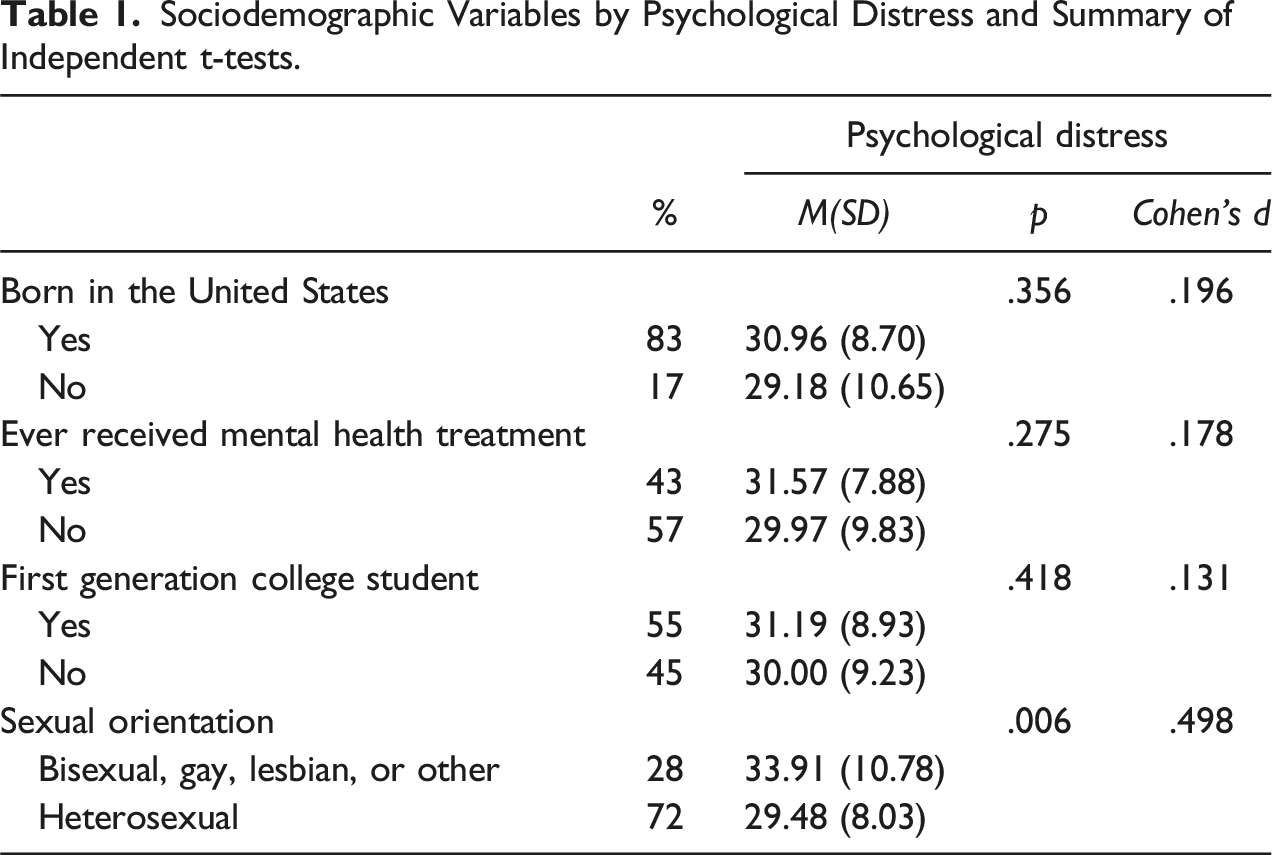
The sample included 167 self-identified Black college women between the ages of 18–54 with a mean age of 22 (SD = 5.83). About 83% of participants reported being born in the United States (U.S.) and 17% of participants reported being born outside of the U.S. About 55% of participants were first-generation college students. Most participants self-identified as heterosexual (72%) and 28% identified as lesbian, gay, bisexual, or other. About 43% of participants reported receiving counseling or therapy for a mental health condition. Nearly 44% of participants were first-year or second-year students, 45% were third and fourth-year students and 11% were fifth-year, post-baccalaureate, or graduate students.
Measures
Superwoman Schema
Superwoman Schema was measured using the Giscombé Superwoman Schema Questionnaire (G-SWS-Q; Woods-Giscombé et al., 2019). The G-SWS-Q is comprised of 35 items and was designed to assess adherence to the five distinct characteristics of the Superwoman Schema, including an obligation to present an image of strength, an obligation to suppress emotions, resistance to vulnerability, an intense motivation to succeed despite limited resources, and an obligation to help others among African American women (Woods-Giscombé, 2010; Woods-Giscombé et al., 2019). Sample items include, “I have to be strong” (an obligation to present an image of strength); “My tears are a sign of weakness” (an obligation to suppress emotions); “Asking for help is difficult for me” (resistance to being vulnerable); “I am a perfectionist” (an intense motivation to succeed, despite limited resources); and “I feel obligated to take care of others” (an obligation to help others; Woods-Giscombé et al., 2019). Items are answered on a 4-point Likert-type scale (0 = this is not true for me, 1 = this is true for me rarely, 2 = this is true for me sometimes; and 3 = this is true for me all the time). The G-SWS-Q is scored by summing across items that comprise the subscales. Higher scores reflect greater identification with the distinct characteristics of the Superwoman Schema.
Woods-Giscombé et al. (2019) used confirmatory factor analysis (CFA) to develop the G-SWS-Q; results indicated a good model fit for the 5 factors (comparative fit index = .97; root mean square error of approximation = .06). In a recent study, Bivariate Pearson correlations indicated significant positive associations between the John Henryism Active Coping Scale (James et al., 1983) and an obligation to present an image of strength and an intense motivation to succeed (Perez et al., 2023). The internal consistency coefficients for an obligation to present an image of strength, an obligation to suppress emotions, resistance to vulnerability, an intense motivation to succeed despite limited resources, and an obligation to help others were reported as .70, .85, .86, .72, and .87, respectively (Woods-Giscombé et al., 2019). The Cronbach’s alpha for the current study was .74 for an obligation to present an image of strength, .83 for an obligation to suppress emotions, .84 for resistance to being vulnerable, .74 for an intense motivation to succeed, despite limited resources, and .84 for an obligation to help others.
Emotion Regulation
Emotion regulation was measured using the Emotion Regulation Questionnaire (ERQ; Gross & John, 2003). The ERQ is comprised of ten items and was designed to measure the propensity to regulate emotions using two strategies: cognitive reappraisal and expressive suppression. Sample items include, “I control my emotions by changing the way I think about the situation I’m in” (cognitive reappraisal) and “I control my emotions by not expressing them” (expressive suppression; Gross & John, 2003). The items are answered on a seven-point non-descriptive Likert-type scale ranging from 1 = strongly disagree to 7 = strongly agree. The measure is scored by adding items that correspond to each subscale. Higher subscale scores indicate more utilization of cognitive reappraisal and expressive suppression.
Gross and John (2003) used exploratory and confirmatory factor analyses to develop the ERQ. Results for an orthogonal model (i.e., two factors) indicated a good model fit (no specific values provided). Convergent validity and discriminant validity were established using regression analyses. Regarding convergent validity, ERQ subscales were examined as predictors of the Multidimensional Coping Inventory (COPE; Carver et al., 1989) subscales of reinterpretation and venting. Findings indicated that cognitive reappraisal was a significant predictor of coping via reinterpretation (ß = .43) and expressive suppression was a significant predictor of coping via venting (ß = −.43; Gross & John, 2003). Concerning discriminative validity, ERQ subscales were examined as predictors of the Big-Five Personality Inventory (BFI; John et al., 1991). Findings indicated that cognitive reappraisal significantly predicted neuroticism (ß = −.20). Expressive suppression significantly predicted extraversion (ß = −.41), openness (ß = −.18)., agreeableness (ß = −.11), and conscientiousness (ß = −.14). The ERQ has been previously used with African Americans (e.g., Melka et al., 2011; Riley et al., 2021). Gross and John (2003) reported internal consistency coefficients for the cognitive reappraisal and expressive suppression subscales as .80 and .75, respectively. The Cronbach’s alpha for the current study was .85 for cognitive reappraisal and .74 for expressive suppression.
Psychological Distress
The Kessler Psychological Distress Scale (K-10; Kessler et al., 2002) was used to assess general psychological distress. The K-10 is comprised of ten items and is a unidimensional construct designed to measure symptoms of distress in the past thirty days among adults. Sample items include, “During the last 30 days, about how often did you feel nervous” and “During the last 30 days, about how often did you feel nervous?” (Kessler et al., 2002). The items are answered on a 5-point Likert-type scale (1 = none of the time, 2 = a little of the time, 3 = some of the time, 4 = most of the time, and 5 = all of the time). The measure is scored by adding all ten items. High scores indicate that one is experiencing clinically significant symptoms of psychological distress.
The K-10 was validated using exploratory factor analyses and item response analyses with a large sample of United States adults. Concerning convergent validity, Andrews and Slade (2001) found a significant association (r = .5) between the K-10 and the 12-item General Health Questionnaire (GHQ-12; Goldberg, 1972), a widely used measure of psychological distress. Regarding discriminant validity, there was a significant negative association (r = −.6) between the K-10 and Short Form Health Survey-12 (SF-12; Ware et al., 1996), a measure of the impact of health on life. Kessler et al. (2002) reported a Cronbach alpha coefficient of. 93 for the K-10. The K-10 has been previously used with Black populations (e.g., Ametaj et al., 2024; Kessler et al., 2002). The Cronbach’s alpha for the current study was .91.
Demographics
Participants completed a demographic questionnaire that included information on the following variables: age (measured continuously), class year (i.e., first year, second year, third year, fourth year, fifth year or post-baccalaureate, and graduate student), first-generation status (i.e., yes/no), United States nationality (i.e., yes/no), receipt of mental health treatment (i.e., counseling, therapy; yes/no), and sexual orientation (i.e., heterosexual and bisexual, gay, lesbian, and other combined).
Procedure
The institutional review board of the authors’ institution approved all described research. Participants were recruited through the department of psychology’s human research pool at a public university minority-serving institution and through an email announcement sent to the listserv owner or contact person of the college’s multicultural or African American/Black student centers, African American student/faculty groups, and African American Studies programs. The e-mail asked recipients to forward our recruitment e-mail to their listservs. Only participants who attended the public university were invited to complete the online web-based survey in Qualtrics after providing their institutional email, which provided them with the email and a separate link to the study site. After reviewing the informed consent, participants were instructed to affirm consent by clicking a button that advanced them to the next page containing the survey. The survey included the measures and a demographic questionnaire. All measures were presented in the same order across data collection. As an incentive participants received a $10 Amazon electronic gift card upon study completion. Data was collected as a part of a larger study on Black women’s mental health help-seeking (Nelson et al., 2024b). We used a separate incentive database to avoid linking participants’ provided emails to receive the incentive with their submitted survey. The estimated length of time to complete the survey was 14.6 minutes.
Data Analytic Approach
The characteristics of the study participants were described using descriptive statistics (i.e., mean, standard deviation, and percentage). All subscales were examined for reliability, skewness, kurtosis, outliers, missing values, and multicollinearity before conducting primary analyses. Bivariate Pearson’s correlations were examined to investigate the relationships among the variables of interest, including age which was measured as a continuous variable. Independent samples t-tests were used to determine statistically significant differences in psychological distress by sociodemographic variables (i.e., nationality, mental health treatment, first-generation, and sexual orientation). Any statistically significant differences in psychological distress by sociodemographic variables were controlled for in subsequent analyses. The patterns of missing data were analyzed using the Missing Value Analysis (MVA) module in SPSS 29.0 to determine if variables were Missing Completely at Random (MCAR). Little’s (1998) MCAR chi-square test was used to determine if the data were MCAR. A nonsignificant p value indicates that data are MCAR and missing values and are ignorable. Finally, we conducted ten separate mediation analyses with psychological distress as the outcome variable, all dimensions of the Superwoman Schema as the predictor variables, and emotion regulation as the mediators (i.e., expressive suppression and cognitive reappraisal). For all analyses, we used 5000 bootstrap estimates. Preliminary analyses were conducted in SPSS Version 29.0; all mediation analyses were conducted using PROCESS Macro Version 4.2 (Hayes, 2017) Model 4 in SPSS Version 29.0.
Results
Preliminary Analyses
We examined predictors and outcomes for skewness, kurtosis, outliers, missing values, and multicollinearity. All predictors and outcomes were in the acceptable range for skewness and kurtosis. We identified a few outliers (range of 1–5) for some predictors (i.e., obligation to present an image of strength, an obligation to suppress emotions, resistance to vulnerability, an intense motivation to succeed, despite limited resources) and one of the mediators, expressive suppression. Mahalanobis distance for each case on the predictors and outcomes indicated that one case was a potential multivariate outlier. Given the use of bootstrapping in PROCESS Models (2017), we retained all data. Missing data was only present for age (9.6%), first-generation status (7.2%), U.S. nationality (7.2%), and sexual orientation (8.4%). We examined patterns of missing data for our predictors and outcomes by sociodemographic variables and did not detect significant differences. Additionally, Little’s (1998) MCAR chi-square test, χ2 (8) = 6.66, p = .573 was not significant. Finally, the inspection of variance inflation factors indicated no presence of multicollinearity (Kim, 2019).
Sociodemographic Variables by Psychological Distress and Summary of Independent t-tests.
Summary of Means, Standard Deviations, Correlations, and Reliability for Study Variables.
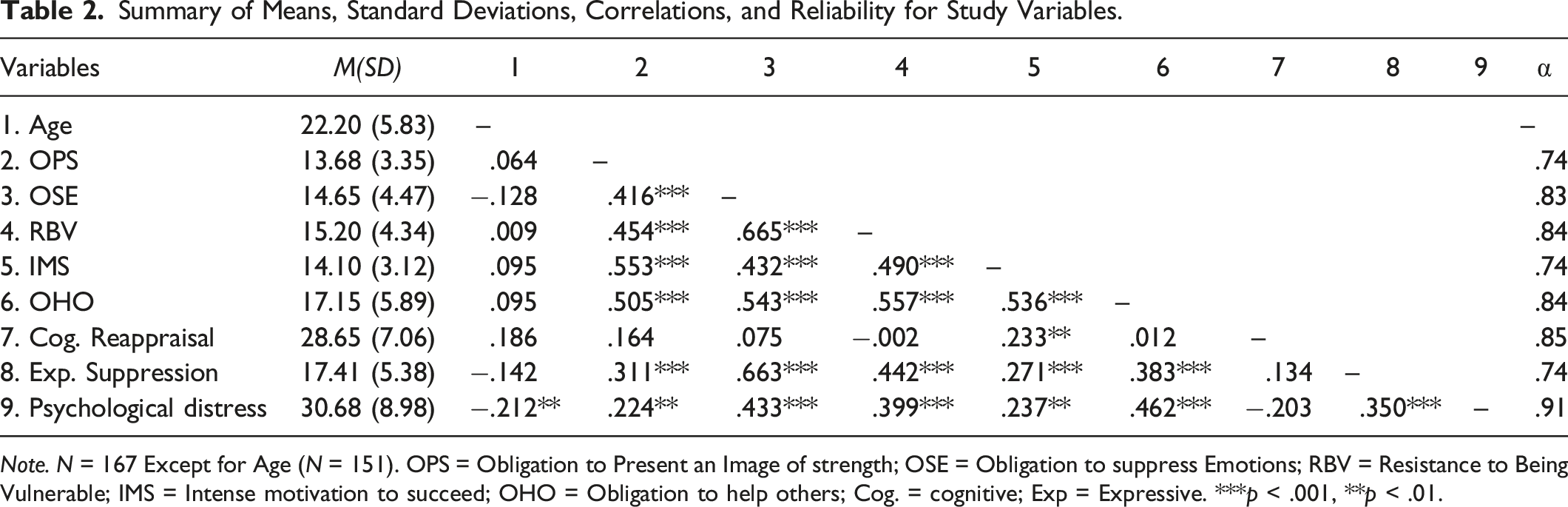
Note. N = 167 Except for Age (N = 151). OPS = Obligation to Present an Image of strength; OSE = Obligation to suppress Emotions; RBV = Resistance to Being Vulnerable; IMS = Intense motivation to succeed; OHO = Obligation to help others; Cog. = cognitive; Exp = Expressive. ***p < .001, **p < .01.
Primary Analyses
We conducted 10 separate mediation analyses with psychological distress as the outcome variable, with an analysis run for each of the 5 dimensions of the Superwoman Schema as the predictor variables, using one of the two emotion regulation as the mediators (i.e., expressive suppression and cognitive reappraisal). For all analyses, N = 151 and we used 5000 bootstrap estimates. Age and sexual orientation (coded as a binary variable) were used as covariates for all analyses. All assumptions for mediated analyses using PROCESS Model 4 (Hayes, 2017) were met.
Expressive Suppression as a Mediator
The Mediating Role of Expressive Suppression on SWS Dimensions and Psychological Distress.
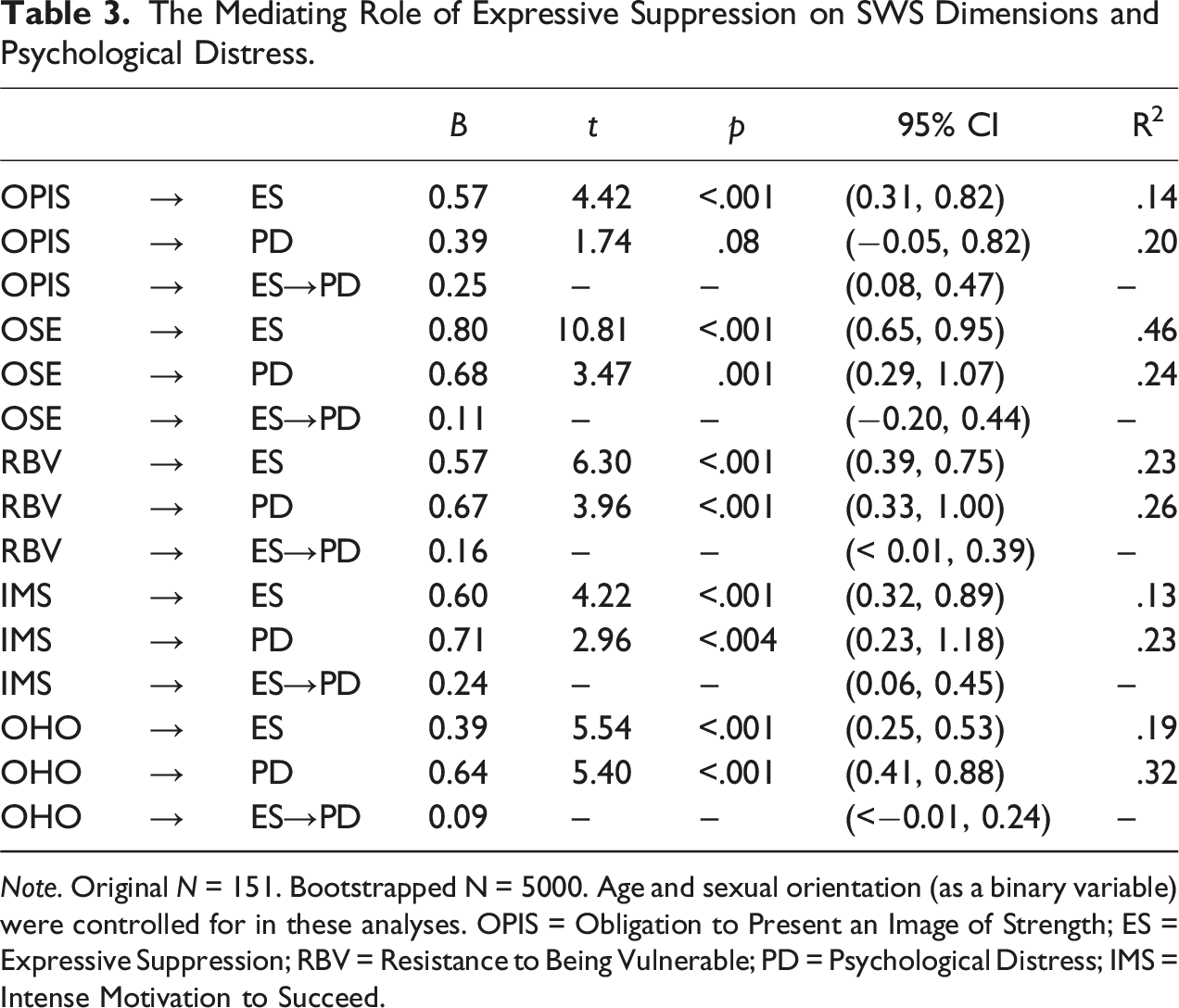
Note. Original N = 151. Bootstrapped N = 5000. Age and sexual orientation (as a binary variable) were controlled for in these analyses. OPIS = Obligation to Present an Image of Strength; ES = Expressive Suppression; RBV = Resistance to Being Vulnerable; PD = Psychological Distress; IMS = Intense Motivation to Succeed.
Obligation to Present Image of Strength
Expressive suppression was a significant mediator between an obligation to present an image of strength and psychological distress, Indirect Effect (ab) = .25, 95% CI: 0.08, 0.47. The R2 for the model (including covariates) was .20, F(4, 145) = 8.89, p < .001.
Obligation to Suppress Emotions
There was no significant indirect effect of the obligation to suppress emotions via expressive suppression on psychological distress, Indirect Effect (ab) = 0.11, 95% CI: −0.20, 0.44. The R2 for the model (including covariates) was .24, F(4, 145) = 11.64, p < .001.
Resistance to Vulnerability
Expressive suppression was a significant mediator between resistance to vulnerability and psychological distress, Indirect Effect (ab) = 0.16, 95%CI: < 0.01, 0.39. The R2 for the model (including covariates) was .26, F(4, 145) = 12.76, p < .001.
Intense Motivation to Succeed
Expressive suppression was a significant mediator between intense motivation to succeed despite limited resources and psychological distress, Indirect Effect (ab) = 0.24, 0.06, 0.45. The R2 for the model (including covariates) was .23, F(4, 145) = 10.64, p < .001.
Obligation to Help Others
There were no significant indirect effects of the obligation to help others via expressive suppression on psychological distress, Indirect Effect (ab) = 0.09, <−0.01, 0.24. The R2 for the model (including covariates) was .32, F(4, 145) = 16.85, p < .001.
Cognitive Reappraisal as a Mediator
The Mediating Role of Cognitive Reappraisal on SWS Dimensions and Psychological Distress.
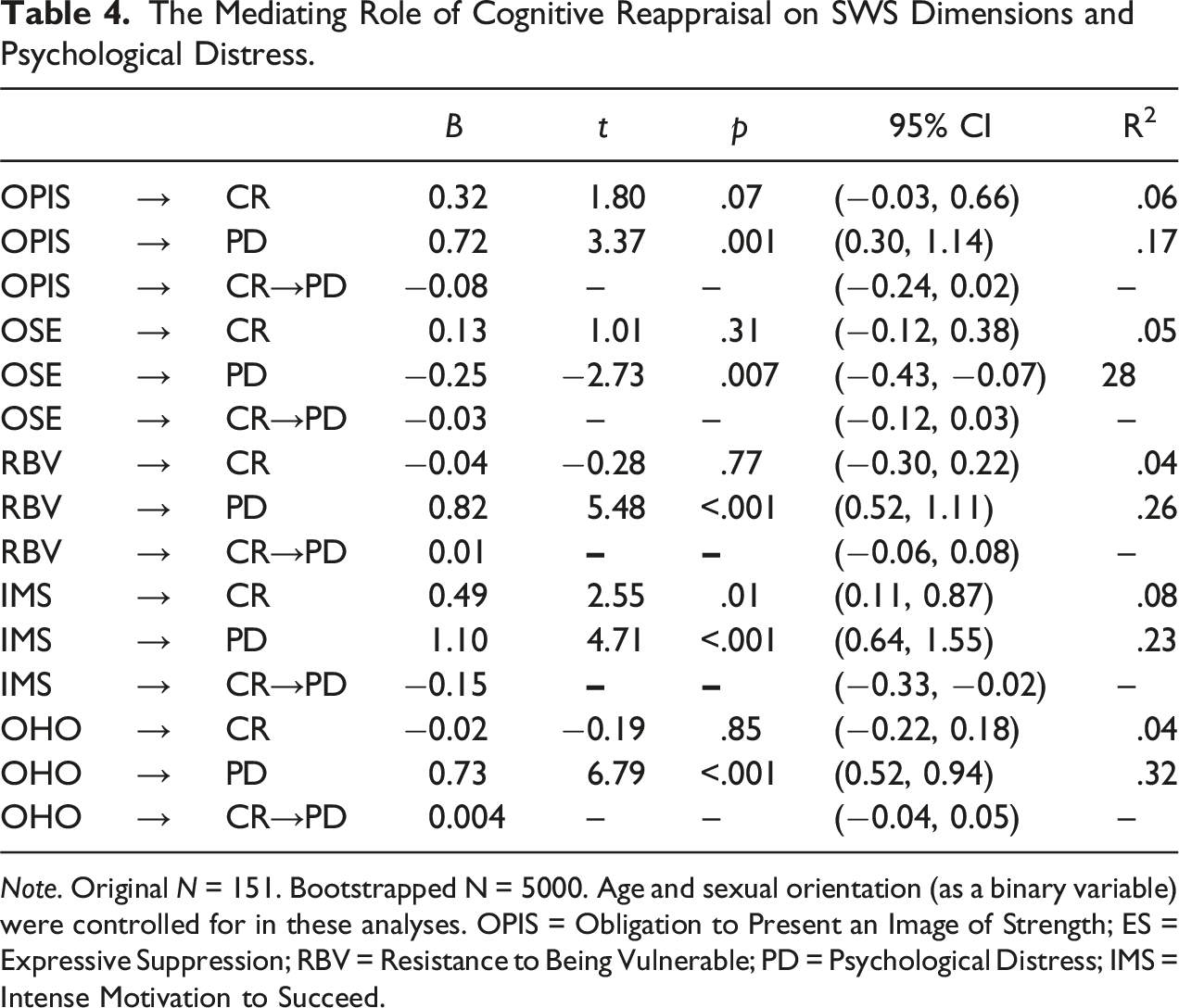
Note. Original N = 151. Bootstrapped N = 5000. Age and sexual orientation (as a binary variable) were controlled for in these analyses. OPIS = Obligation to Present an Image of Strength; ES = Expressive Suppression; RBV = Resistance to Being Vulnerable; PD = Psychological Distress; IMS = Intense Motivation to Succeed.
Obligation to Present Image of Strength
There was no significant indirect effect of an obligation to present an image of strength via cognitive reappraisal on psychological distress, Indirect Effect (ab) = −0.08, 95% CI: −0.23, 0.02. The R2 for the model (including covariates) was .17, F(4, 145) = 7.66, p < .001.
Obligation to Suppress Emotions
There was no significant indirect effect of an obligation to suppress emotions via cognitive reappraisal on psychological distress, Indirect Effect (ab) = −0.03, 95% CI: −0.12, 0.03. The R2 for the model (including covariates) was .28, F(4, 145) = 13.85, p < .001.
Resistance to Vulnerability
There was no significant indirect effect of resistance to vulnerability via cognitive reappraisal on psychological distress, Indirect Effect (ab) = 0.01, 95% CI: −0.06, 0.08. The R2 for the model (including covariates) was .26, F(4,145) = 12.90, p < .001.
Intense Motivation to Succeed
Cognitive reappraisal was a significant mediator between an intense motivation to succeed, despite limited resources, and psychological distress, Indirect Effect (ab) = −.15, 95% CI: −0.32, −0.02. The R2 for the model (including covariates) was .23, F(4, 145) = 10.83, p < .001.
Obligation to Help Others
There was no significant indirect for the obligation to help others via cognitive reappraisal on psychological distress, Indirect Effect (ab) = <0.01, 95% CI: −0.04, 0.05. The R2 for the model (including covariates) was .32, F(4, 145) = 17.41, p < .001.
Discussion
The purpose of this study was to investigate if two emotion regulation strategies, cognitive reappraisal, and expressive suppression, explained the relationship between specific Superwoman Schema dimensions and psychological distress in Black women. We predicted that three dimensions of Superwoman Schema would be positively associated with psychological distress and that two dimensions of Superwoman Schema would be negatively associated with psychological distress. We also predicted that expressive suppression would mediate the relationships between (a) an obligation to suppress emotions, (b) resistance to being vulnerable, and (c) an obligation to help others) and psychological distress. We also predicted that cognitive reappraisal would mediate the relationships between these two Superwoman Schema dimensions (an obligation to present an image of strength and an intense motivation to succeed, despite limited resources) and psychological distress. Contrary to our expectations and findings from Perez et al. (2023), our correlation matrix revealed that all dimensions of the Superwoman Schema were significant predictors of psychological distress. Additionally, all dimensions of the Superwoman Schema were positively associated with expressive suppression, which is generally considered a maladaptive emotion regulation strategy. Overall, expressive suppression fully mediated the relationship between the Superwoman Schema dimension of an obligation to present an image of strength and psychological distress. Additionally, expressive suppression partially mediated the relationship between the Superwoman Schema dimensions of resistance to vulnerability, and an intense motivation to succeed, despite limited resources, and psychological distress. Conversely, we found that the intense motivation to succeed, despite limited resources, was positively associated with cognitive reappraisal, an adaptive emotion regulation strategy. Cognitive reappraisal partially mediated the relationship between an intense motivation to succeed, despite limited resources, and decreased psychological distress. However, we did not observe a significant finding for the obligation to present an image of strength.
The current study is one of the first to explore adaptive and maladaptive emotion regulation strategies (i.e., expressive suppression and cognitive reappraisal) as mediators of the relationship between dimensions of Superwoman Schema and psychological distress. Contrary to previous research by Perez et al. (2023), who found that an obligation to suppress emotion, resistance to being vulnerable, and an obligation to help others were associated with decreased psychological distress, and Erving et al. (2024) who found that an obligation to present an image of strength was associated with better self-rated health for women who reported their income as low, we found positive associations for all Superwoman Schema dimensions. One possible reason might be differences in sample composition regarding age and geographic region. In Perez and colleagues’ (2023) study, the sample included a diverse community sample of Black women in the Bay area with an average age of 41. The sample in Erving et al.’s (2024) study included Black women in Georgia with an average age of 38; whereas the sample in the current study included Black college women with an average age of 22 in the northeast region of the United States. Notably, in the current study, age was inversely associated with an obligation to suppress emotions, expressive suppression, and psychological distress and a positive predictor of cognitive reappraisal. These findings suggest that over time, Black women may be less likely to adhere to dimensions of the Superwoman Schema, which may lead to decreased psychological distress. Future research should study dimensions of Superwoman Schema longitudinally among younger women and investigate if adherence to Superwoman Schema decreases over time. Future studies should also investigate additional moderators of the relationship between Superwoman Schema and health outcomes within diverse groups of Black women, including sexually minoritized Black women, elder Black women, and those from varying geographic regions and socioeconomic backgrounds.
Notwithstanding, our findings extend previous research by Abrams et al. (2019) by suggesting that emotion regulation may mediate the relationship between dimensions of Superwoman Schema and psychological distress. In addition to an obligation to present an image of strength, the resistance to being vulnerable, and the intense motivation to succeed, despite limited resources) are associated with psychological distress due to expressive suppression. Given that Black women are socialized to be strong in response to gendered racialized oppression (Shorter-Gooden, 2004; Volpe et al., 2024a, 2024b), they may rely on expressive suppression in specific contexts (Abrams et al., 2019; Perez et al., 2023). Expressive suppression is important as the effectiveness of an emotion regulation strategy varies depending on the context (Aldao & Nolen-Hoeksema, 2012). For example, some Black women may inhibit their emotional response to counter negative stereotypes and prevent harm in hostile spaces (Beauboeuf-Lafontant, 2009; Corbin et al., 2018; Shorter-Gooden, 2004). Therefore, it is important to investigate how Black women use expressive suppression and how this may help or hinder mental health and help-seeking in certain contexts. Despite favorable attitudes toward mental health and the benefits of treatment, help-seeking for mental health conditions is challenging as a result of the Superwoman Schema (Nelson et al., 2020, 2024b).
Despite findings supporting the detrimental effects of the Superwoman Schema on psychological distress and expressive suppression in this sample, it seems to be both an asset and a liability (Allen et al., 2019; Davis & Jones, 2021; Nelson et al., 2024a; Watson-Singleton et al., 2024; Woods-Giscombé et al., 2019). The current study provides evidence to support this paradox, as some dimensions (i.e., an obligation to present an image of strength and the intense motivation to succeed, despite limited resources) were associated with cognitive reappraisal, an adaptive emotion regulation strategy. Specifically, there was a significant indirect negative effect between an intense motivation to succeed, despite limited resources, and psychological distress mediated by cognitive reappraisal.
Findings also support research by Leath and colleagues (2022) who found that an intense motivation to succeed, despite limited resources was associated with decreased anxiety as well as Watson-Singleton et al. (2024) who found that an intense motivation to succeed and the obligation to present an image of strength was associated with flourishing. Therefore, for some Black women, an intense motivation to succeed, despite limited resources may be psychologically distressing, while for others, it may also serve as a protective factor against negative mental health outcomes via cognitive reappraisal. For example, Black college women facing pressure to succeed may use cognitive reappraisal to reinterpret goal attainment delays as inherent to the process, rather than a personal failing. This reframing could lead to diminished psychological distress. Future research should investigate whether the internalization of an intense motivation to succeed, despite limited resources, is connected to other adaptive emotion regulation strategies such as acceptance or problem-solving and whether adherence might be protective among Black women.
Practice Implications
We recommend that clinicians take a curious approach when inquiring about the role of Superwoman Schema and understanding the context in which it manifests. For example, clinicians might want to consider how campus climate, gendered racism, and heteronormativity contribute to Black college women’s internalization of Superwoman Schema. Research has shown that campus racial tension is a significant predictor of stress and that participants who endorse Superwoman Schema are more likely to perceive campus racial tension and experience distress (Shahid et al., 2018). For example, Shahid and colleagues (2018) have suggested that the internalization of Superwoman Schema might be in response to racial tension, which results in increased stress. More recently, findings have indicated that increased gendered racial microaggressions are associated with increased adherence to the Superwoman Schema (Volpe et al., 2024a, 2024b). Taken together, clinicians working with a diverse group of Black college women should inquire about their experiences of oppression and the extent to which they adhere to dimensions of the Superwoman Schema, as a coping mechanism, in this specific context.
Recently, there has been a growing emphasis on destigmatizing mental illness and promoting mental health treatment (e.g., Boris Lawson Henson Foundation, Loveland Therapy Fund, Therapy for Black Girls) among Black people, particularly, Black women (Narendorf et al., 2018; Nelson et al., 2022). As more Black women enter therapy, understanding the impact of Superwoman Schema on interpersonal relationships will be useful for case conceptualization, treatment planning, and clinical work. For example, some Black women may redefine or abandon the Superwoman Schema (Abrams et al., 2014; Jones et al., 2021; Nelson et al., 2016; Watson & Hunter, 2016; Woods-Giscombé, 2010). This may be more pronounced in certain relationships, such as with a trusted friend, partner, or family member. For example, married Black women and Black women who are aware and reflective about Superwoman Schema have discussed “letting go of strength” in their relationships with their partners (Nelson et al., 2016). Some college Black women have also problematized the gendered racialized expectations of Superwoman Schema, while others are on a journey to acquire these characteristics (Nelson et al., 2016). Thus, clinicians should be aware of how Black women make sense of this phenomenon.
Finally, it might be helpful for clinicians to consider the implications of presenting Superwoman Schema to their clients or patients as a stereotype. In the authors’ anecdotal communications with Black women—as participants of research, in classes, clinical settings, and conferences—some Black women have expressed concern about pathologizing Black women’s internalization of Superwoman Schema. Given the salience of Black women’s identification with Superwoman Schema, we must seriously consider these perspectives and question how this conceptualization might influence our clinical work and scholarship. For example, what might Black women in therapy hear when Superwoman Schema—whether implicitly or explicitly—is conceptualized as a stereotype? How might this potentially impact the therapeutic relationship? To be clear, we do not suggest that clinicians ignore or minimize the detrimental effects of the internalization of Superwoman Schema for some Black women. Rather, we propose exercising cultural humility (i.e., openness, curiosity, and willingness) in exploring Superwoman Schema (Patallo, 2019). As Superwoman Schema is currently being embraced, redefined, and critiqued by Black women (Nelson et al., 2016; Watson & Hunter, 2016), a deeper understanding of this culturally salient phenomenon may result in increased rapport, better communication, and increased treatment engagement in clinical settings (Nelson et al., 2023).
Limitations
Despite its strengths, the current study has several limitations. First, the convenience sample of Black college women limits the generalizability of the findings to Black women outside of this sociodemographic profile. Second, self-report data on psychological distress, emotion regulation, and Superwoman Schema dimensions are susceptible to overreporting or underreporting. Third, the sequence of questions in this study (i.e., order effects) can influence participants’ responses. The fourth limitation of the study is the cross-sectional design. As such, the results should be interpreted cautiously. Finally, the focus on two emotion regulation strategies (expressive suppression and cognitive reappraisal) is limited in scope and may not adequately capture the breadth of adaptive and maladaptive emotion regulation strategies used by Black women. Although these are two well-known strategies, it is important to understand how Black women utilize a wider range of strategies to navigate the specific contexts of gendered racism and daily life stressors (Jones et al., 2022; Nelson et al., 2023).
Future Research
Over half of the participants in this sample identified as first-generation college students, and nearly 30% identified as sexual minoritized Black women. While a recent study by Platt and Fanning (2023) did not find significant differences in Superwoman Schema endorsements among Black sexual minoritized women and their heterosexual counterparts, the unique experiences of triple marginalization due to race, gender, and sexuality, cannot be disregarded. Hence, researchers should explore how Black college women might adhere to the Superwoman Schema to navigate oppression at the intersection of race, class, gender, and sexuality. Researchers have found that Black sexual minoritized women experience disproportionate mental health challenges due to oppression (Calabrese et al., 2015). As such, longitudinal studies are needed to examine the dimensions of the Superwoman Schema in diverse groups of Black women in terms of age, sexual orientation, and nationality. Future qualitative and quantitative studies should explore additional emotion regulation strategies, such as problem-solving, situational avoidance, seeking social support, mindfulness, and acceptance-based strategies (Aldao et al., 2014; Gross & Jazaieri, 2014). Investigating a variety of emotion regulation strategies may be clinically important to informing mental health interventions and culturally tailoring messaging for this population.
Conclusion
In her essay “The Transformation of Silence into Language and Action,” Audre Lorde (2007) reflected on self-silencing. She insisted that her silence did not protect her and asked us to contemplate: “What are the words you do not yet have? What do you need to say? What are the tyrannies you swallow day by day and attempt to make your own, until you will sicken and die of them still in silence” (Lorde, 2007, p. 41)? Silence does not always protect Black women. Indeed, silence may contribute to the psychological distress caused by the Superwoman Schema in response to oppression. Clinicians should explore how Black women may engage in self-silencing with their partners, family members, and in contexts where power differentials influence interpersonal dynamics within therapeutic settings. Further, clinicians and scholars should also be aware of the adaptive and maladaptive emotion regulation strategies associated with adherence to dimensions of the Superwoman Schema.
In sum, these considerations hold significant implications for the field of Black psychology. A deeper understanding of emotion regulation strategies in unique contexts can shed further light on how Black women navigate oppression and maintain their mental health. As such, practitioners in Black psychology must investigate these nuances. This understanding can inform the development of novel interventions that address the strengths and limitations associated with Superwoman Schema. Moreover, a nuanced and contextualized approach that is mindful of how Superwoman Schema might be helpful and harmful is essential for providing effective mental health care to Black women.
Footnotes
Declaration of conflicting interests
The author(s) declared no potential conflicts of interest with respect to the research, authorship, and/or publication of this article.
Funding
The author(s) received no financial support for the research, authorship, and/or publication of this article.
