







Abstract
Though riots themselves have often been studied, scholars know little about their short-term effects. This article considers the five-year period following Pittsburgh’s April 1968 riots, which allows scholars to see a moment of possibility not as evident in the long term. The riots ushered in opportunity for reform by making an abstract sense of crisis acute. They influenced change in local government, soured already strained police–community relations, hurt black business districts, and exacerbated racial tensions. Pittsburgh’s black community still made some incremental progress. But overall, local power structures persisted as budget concerns and an increasingly polarized community prevented sweeping changes to improve racial disparities. The Pittsburgh case bears similarity to national trends and reveals both the possibilities and limitations of this type of protest.
In the week following Martin Luther King, Jr.’s assassination in April 1968, black Pittsburghers, like their counterparts in 124 other cities across the nation, took to the streets. They were met by thousands of National Guardsmen called in to restore order. Despite the tense situation, there was minimal loss of life and little use of firearms. Pittsburgh’s riots were a relatively mild case in national and historical context, yet they acted as a trigger for significant reactions at the local level. 1
Most studies of the sixties riots focus on their causes or distant consequences. Missing are assessments of their short-term impacts. Pittsburgh’s experience reveals that riots ushered in significant opportunities for reform by making an abstract sense of crisis acute. Because local actors did not take full advantage of that moment of possibility, it is less apparent from a long-term perspective. 2 In the immediate aftermath, both black and white leaders worked to create structural change that would address black grievances. Most of these efforts fell short. Local government tried to respond to black needs and simultaneously allay white fears, ultimately stretching its dwindling resources too thin. The police had shown restraint during the riots that could have improved relations with the black community, but racially divergent beliefs about the proper limits of police power prevented that. Business leaders put forth programs to promote black business and offer employment. Their successes were not enough to overcome prevailing demographic and economic trends. Citizens responded with a stronger emphasis on neighborhood organizing, but social divisions limited their reach. Behind all of these efforts, the riots called more attention to race, leading to increased tensions in everyday interactions that stifled cooperative efforts for change. The window of opportunity opened by the Pittsburgh riots was soon shut by economic realities and heightened racial polarization. 3 Officials and residents in other riot-torn cities faced similar dilemmas and constraints.
The first few years after the riots provided opportunities for addressing pressing issues, but they also stimulated counterforces that undermined those efforts. Authorities called for immediate action to address the issues underlying violent protest, and residents expected quick results. Moreover, local governments enjoyed a relatively short period during which new program initiatives were fiscally feasible. Urban economic conditions after the early seventies, affected most notably by deindustrialization, high inflation, population decline, shifting priorities in federal funding allocations, and widespread reverberations of the energy crisis, precluded cities struggling for solvency from directing resources toward ameliorating racial, class, and urban–suburban disparities. The choices made in the late sixties and early seventies therefore became that much more important.
Existing studies have begun to reveal the transformative power of riots in the late sixties. James Button and Dennis Gale have shown that riots spurred new programs and temporarily increased social spending at the federal level, most visibly in the Model Cities program. 4 Local context, though, was much more decisive. 5 Quantitative studies suggest that riots encouraged more city government spending or a shift in allocations, mostly increasing funding for public safety rather than housing or employment training. 6 Black residents generally touted a comprehensive approach while whites supported greater police power. 7 Residents’ views of how to handle riot areas were only one symptom of a growing racial divide. Blacks organized with new energy, crossed major political thresholds, and made economic gains in the years immediately following riots. Meanwhile, urban resources shrank overall as riots exacerbated declines in property values and population. 8
Pittsburgh’s riots, like those in other cities, created a “period of turmoil” that marks an important watershed. 9 The upheaval of the riots brought existing problems into stark relief in a city where the power structure had long prided itself on seemingly peaceful race relations. Pittsburgh’s black community made incremental progress in the postriot years, but ultimately local power structures persisted as budget concerns and social divisions prevented sweeping change.
“Pittsburgh Is Different”: The Racial Landscape Leading Up to the Riots
Pittsburgh’s postwar black population was small compared to those of other northern cities, composing about 20 percent of residents in 1970. Historian Laurence Glasco has argued that in addition to racial discrimination, Pittsburgh blacks suffered the economic burden of the declining steel industry and a geographic separation that diminished their political strength. Local chapters of the Urban League, the NAACP, churches, and the Pittsburgh Courier helped provide an institutional base for black protest. During World War II the Courier launched the “Double V” campaign, fighting for democracy at home and abroad. In the late 1940s, black Pittsburghers peacefully desegregated downtown department stores and the Highland Park swimming pool. Their continued activism has been laid out in the work of Glasco, Joe Trotter and Jared Day, and Michael Snow. 10 White and black Pittsburghers had divergent opinions on the city’s racial situation well before April 1968.
By the 1960s, the largest black populations resided in the Hill District adjacent to downtown, Homewood-Brushton in the East End, and Manchester on the North Side. The Hill District had served as home to a succession of ethnic groups, with black migrants becoming the majority in the 1940s. Homewood-Brushton and Manchester witnessed later population shifts. Despite their dispersal, blacks experienced increasing residential segregation and blatant discrimination at local establishments. Police brutality complaints were frequent. Resentment lingered over a 1950s urban renewal program that displaced Lower Hill District residents and replaced their housing with a sports arena and upscale hotel. By 1968 there was widespread dissatisfaction among Pittsburgh’s black community. 11
Despite these conditions, white observers saw little potential for racial disorder. Monsignor Charles Owen Rice, a longtime labor activist and friend of the black community, asserted, “Pittsburgh is different. No riots are likely.” He reasoned that the small, dispersed black population followed pragmatic leaders who found sympathy at city hall. 12 Police inspector John P. Kelly explained that to mobilize supplementary Tactical Unit capabilities, “all hell would have to break loose . . . something like the riots in Watts . . . and we don’t expect that ever to happen here.” 13 Indeed, some whites saw blacks as “cooperative, middle-class minded, non-militant, [and] docile.” 14
In stark contrast, the Courier signaled increasing black unrest. Columnist Carl Morris noted that black high school students involved in scuffles in the fall of 1967 were “rehearsing street guerrilla warfare in preparation for a major riot,” and a Burn Day for the city was rumored to be set for May 1968. 15 One month before Pittsburgh’s riots broke out, an editorial warned, “The time to act is now. Tomorrow may be too late.” 16 However, even the Courier thought the tide of black militancy had found a limited audience: “With the exception of a few young extremists, black people here are ignoring the call to riot. They are planning another kind of disturbance—riots at the polls and greater involvement in the black business community.” 17 Aware of these simmering tensions, officials attempted to keep sensitive situations from spreading, and police met secretly with Hill District merchants, warning them to prepare for possible riots by reinforcing windows and installing sturdier locks. 18
Space permits only a brief outline of the events of Pittsburgh’s riots. On Friday, April 5, the day after Martin Luther King, Jr.’s assassination, groups began roaming through the Hill District. They smashed windows and looted shops along Fifth and Centre Avenues; firebombs followed. People on the street stoned responding police cars. Officials initially thought the night’s events were just a temporary problem, but disorder persisted for several days, spreading to the neighborhoods of Homewood and Manchester. 19 Mayor Joseph Barr called in the National Guard. Parts of the city shut down as bars and liquor stores closed their doors, the Port Authority curtailed bus routes, and authorities enforced a general curfew. The situation was serious enough that the federal government stood poised to deploy regular army units as they had done in Washington, D.C., Baltimore, and Chicago. 20
Pittsburgh officials faced crucial decisions about what level of force to use. Some police and merchants advocated using maximum force to quell the disorder, while public safety director David Craig and Morton Coleman of the mayor’s office opposed such measures. Restraint prevailed, and Pittsburgh emerged from the riots with only one fatality, in marked contrast to riots elsewhere. 21 But even as business and bus service resumed on Wednesday, April 10, the disorder had taken its toll, both physically and psychologically. Ruins of burned-out buildings smoldered, while Pittsburghers looked for explanations and pondered how to prevent future disturbances.
“Salvation of This City”: Local Government Responses
As the secondary literature suggests, local governments played a crucial role in the response to urban riots. 22 The swiftness and character of their actions sent clear signals to black communities about whether riots had paved the way for reform. Many black citizens viewed riots as an extension of civil rights activism and a conspicuous demand for attention. Some white, liberal elites in government and the private sector shared these views. Most whites instead saw disorders as senseless criminal activity. 23 City officials had to navigate these racially divergent, competing interpretations of riots in framing their response, while at the same time managing dwindling resources.
In Pittsburgh, a variety of civil rights leaders tried to leverage the riots to obtain more resources and political power. 24 Racial complaints, as in black neighborhoods nationwide, were many. Pittsburgh’s Democratic machine allotted blacks a presence on city council, yet these at-large representatives lacked rapport with constituents. 25 There were the requisite dilemmas of housing, city services, access to jobs, and police–community relations. Meanwhile, excessive police overtime costs during and after the riots joined with inflation and increased spending to precipitate an unprecedented financial crisis. 26
Like his counterparts elsewhere, Mayor Barr formed a task force to investigate the disorder, receive testimony, and plot a course for action. The members were mostly city administrators, and when all three black appointees refused to serve, the panel ended up “lily white.” The task force offered city officials a safe political solution. It provided a visible forum for the airing of grievances and suggestions for action, but ultimately effected little actual change. 27
Testimony before the task force presented the riots as a moment of epiphany that paved the way for change. William Rodd, executive director of the Neighborhood Centers Association, and Richard Ridenour, coordinator of the North Side Community Action Program, explained, “No longer can white Pittsburgh deceive itself that it is less bigoted, less racist, less despicable in its treatment of black men and women than any other city in the country.” 28 Worse disorder loomed unless the city faced the following facts:
The extent, depth and manifestations of bigotry and racism in every strata of Pittsburgh’s white society
The ugly reality of life in the ghetto; the rotten schools; the squalid housing; the inadequate services; the lack of decent jobs.
The desperation, the anger, the hatred, and the courage of black youth who are resolved that things will be different, or they will die.
The growing solidarity of the black community in its determination to run its own affairs and to participate fully in decisions of the larger community which affect it. 29
The remedies for this dire situation were greater black political power, a more responsive school system, more black businesses, and new priorities for local foundations. Rodd and Ridenour saw nothing less than the “salvation of this city, and of its citizens” at stake; their testimony was dubbed a rallying point for the scattered movement of citizens’ groups pushing for change. 30
The city’s actual response, stretched between competing objectives and finite resources, did not live up to Rodd and Ridenour’s vision. The task force issued a set of recommendations recognizing that affected neighborhoods needed immediate improvements in housing and employment conditions, but bolstering law enforcement was the top priority. The mayor made two appropriations requests that reflected the tension between greater assistance to the black community and law-and-order objectives: the transfer of one million dollars in state redevelopment funding to the Hill District Recovery Program and the addition of 190 police officers. Half of the new police would form special units well suited to respond to future disorder. 31 Black leaders’ success reducing bonds for arrested rioters was likewise tempered by the passage of a stricter disorderly conduct law. 32
Pittsburgh’s spending priorities also showed a bifurcated approach. The 1969 budget significantly increased appropriations for public works and parks and recreation alongside public safety, despite financial woes. Both the Office of Youth Work Coordination and the Commission on Human Relations received temporary staff increases. Police employment figures show a similar trend. A force of just over 1,600 in the mid-sixties rose to a peak of 1,853 in 1969, before dropping down to around 1,500 in the mid-seventies. 33
These limited and disparate policy adjustments disappointed many residents who had hoped for more creative responses. Given the poor state of relations between police and the black community, administration support of police action discouraged many black residents even as it appeased white voters. The city’s strategy was “containment” rather than “cure.” While the “Recovery Program” might at best return the Hill District back to its preriot state, there were no provisions whatsoever for Homewood-Brushton and Manchester. When a city hall attaché was asked when those areas might receive attention, he replied, “After the next riot.” 34
The aftermath of urban riots coincided with significant power shifts in local governments across the nation. In cities with larger black populations, apprehensions about racial disorder and the consolidation of black political power helped secure victory for a new wave of black elected officials. 35 Pittsburgh voters, both white and black, turned against machine politics, feeling that “the city’s finances are shambles . . . the public high schools are daily battlegrounds . . . racial tensions appear to be growing steadily worse and . . . the city government appears to have run out of initiative to cope with it all.” 36 As a result, residents were open to new, uncorrupted leadership that would put the city back on track in a turbulent time.
Pete Flaherty’s election as mayor in 1969 signaled this shift as he capitalized on public disillusionment. Blacks in particular criticized the Democratic machine in the wake of the riots. When city council increased penalties for disorderly conduct, civil rights groups threatened ballot box reprisals. And after the Black Construction Coalition demonstrations in 1969, the NAACP disavowed its support for the city’s administration.
37
Black Pittsburghers were not alone in their discontent. In recognition of disgruntled white ethnics, Flaherty promised more citizen influence, neighborhood improvements, and less wasteful government spending.
38
A Flaherty campaign ad highlighted the following ideals, conscious of both constituencies:
I believe that attitudes, particularly in the black-white relationships, must stabilize. . . . That we need more public hearings and less “closed door government.” . . . That the problems of public housing, employment, and education are interrelated. . . . That school busing is not a satisfactory solution to blacks or whites. . . . That we place high priority on building up the best schools we can get right in the black neighborhoods, and give the black people more of a voice in the curriculum, teachings, and books. . . . That the most difficult problem of all is hard core unemployment.
39
Flaherty cast himself as “nobody’s boy” and sought support from both blacks and whites. His Democratic machine opponent, Harry Kramer, offended some black audiences and was held accountable for the misdeeds of earlier administrations. An independent black mayoral candidate, David Hall, drew limited support. In light of the competition and a general frustration with machine politics, even those who did not support Flaherty outright found him better than the alternative. He easily won the primary and general elections, with significant help from black voters. 40
Flaherty’s record as mayor was mixed at best as he nodded toward black voters while generally catering to the majority white electorate. He greatly increased the number of black appointees in city government and revised civil service tests while still opposing school integration. He directed federal urban redevelopment funds to neighborhoods, yet in doing so he seemed to favor white areas. Services everywhere lagged as he sought to cut expenditures, which he did partly by shifting federal revenue sharing funds away from antipoverty programs and toward public safety. He put a stop to patronage and corruption but ultimately was not well received in the black community. In the mayoral primary of 1973, his opponent carried all of the predominantly black wards. 41
Flaherty benefited from rising neighborhood power, a national trend that was accelerated in divergent directions by civil disorder. 42 For some Pittsburghers, neighborhood identification had historically played a more important role than racial identification. During the sixties, ACTION-Housing had employed organizers to channel these allegiances and help residents with planning. Toward the end of the decade these existing neighborhood organizations evolved into different forms, and completely new organizations emerged as race became more salient. In the words of one city official, “After that riot, period, groups began to talk about issues. They were activated and they had some leaders.” 43
In December 1969, the Pittsburgh Neighborhood Alliance united sixty local groups but soon showed the strain of competing objectives. The left flank of the coalition included “the militant, the racial minorities, and the activists”; the right encompassed “white ethnics who were opposed to busing, school integration, and minority preferences.” Efforts at consensus failed, and some groups eventually dropped out. Those that remained were often at odds along racial lines. Regardless, neighborhood groups had captured the attention of local government and the business community. In 1972 alone, mayoral aides attended over nine hundred community meetings. 44
Flaherty’s administration set starkly different priorities than had reigned previously. In late 1968, Mayor Barr had justified increased social spending: “How can you measure in immediate returns the dollars and cents value of programs which offer employment, training and recreational opportunities? We could have permitted thousands of disadvantaged youngsters to roam the City streets seeking outlets for their energy—and probably picked up the costs in increased police surveillance and protection.” He added, “This budget clearly illustrates that there is a price of peace and a price for progress. And both come high these days.” 45 Even the Flaherty administration devoted some resources to recreation facilities, planning pools in Homewood and Manchester, lighting parks, and converting play areas into basketball courts and tot lots. 46 In general, though, Flaherty took the opposite stance: “Many groups will say the City Government should do more. . . . Most of our residents are people with modest incomes. They shouldn’t be called upon to pay for social service programs that are now the responsibility of Federal, State and County Governments. The City simply does not have the necessary revenue to assume such programs. It would be a mistake to open the door even on a partial basis. Such programs will expand and grow more costly each year.” 47
Though the city made some small concessions, local government failed to fulfill the promises it issued in the days following the riots. Attempting to appease both black and white voters while pursuing both ameliorative and security goals, Pittsburgh officials diffused the limited resources at their disposal. As a result, the adjustments made exemplify the “mimetic reform” described by historian Michael B. Katz and parallel the response in many other cities. 48
“A Built-In Resistance”: Law and Order after the Riots
In the wake of urban riots, law enforcement became an even larger issue dividing citizens along racial lines. The restraint shown by Pittsburgh police during the riots demonstrated the possibilities for improved community relations, but divergent beliefs about the limits of police power prevented meaningful reform. Whites who felt threatened by racial disorder alongside everyday crime generally supported a tough stand by police. Many black residents also hoped for better police protection but saw the tense relationship between the community and police as a hurdle to their safety. In the short term, law enforcement was strongly influenced by, and in turn exacerbated, a growing racial divide.
The Pittsburgh police, like those in many other cities, had a history of corruption and faced criticism in the late fifties and early sixties for scandals such as protecting local numbers racketeers. Changes recommended decades earlier had never been implemented. There was only a tenth-grade educational requirement for the force, no psychological testing, and minimal training in place. Compounding these problems, it was still nearly impossible to fire a police officer. Public safety director David Craig, appointed in 1965, was still trying to overhaul the department when the riots broke out. Craig’s philosophy resembled that of New York mayor John Lindsay and others who sought to make police more accountable and build relationships with black community leaders, even those who were more militant. City hall felt he was an effective appointee because of his sensitivity, but many officers faulted him for the same quality. Craig had already come into conflict with the Fraternal Order of Police (FOP) over several issues in earlier years, and morale on the force was low. 49
Dissatisfied with April’s events and the city’s response, Pittsburgh’s FOP composed its own incendiary report on the riots. A meeting of over five hundred officers, more than a quarter of the force, had mandated the investigation. The report decried equipment shortages and lambasted Craig’s decisions (Figure 1). He seemed overly sensitive to minority rights at the expense of police and the larger community. His relationships with certain black leaders were especially suspect: “We do not . . . believe that yielding and conceding to a lawless group that represents less than 1% of the black community is the way to rectify the situation. It is not only wrong to the vast majority of God-fearing responsible black people, but revolting to those of us who are hamstrung in our efforts to do something about it. Who could blame the 99% if in the future they were to go the other way? After all, the narcotics- and alcohol-sodden radical gets results at the Director’s office.” 50
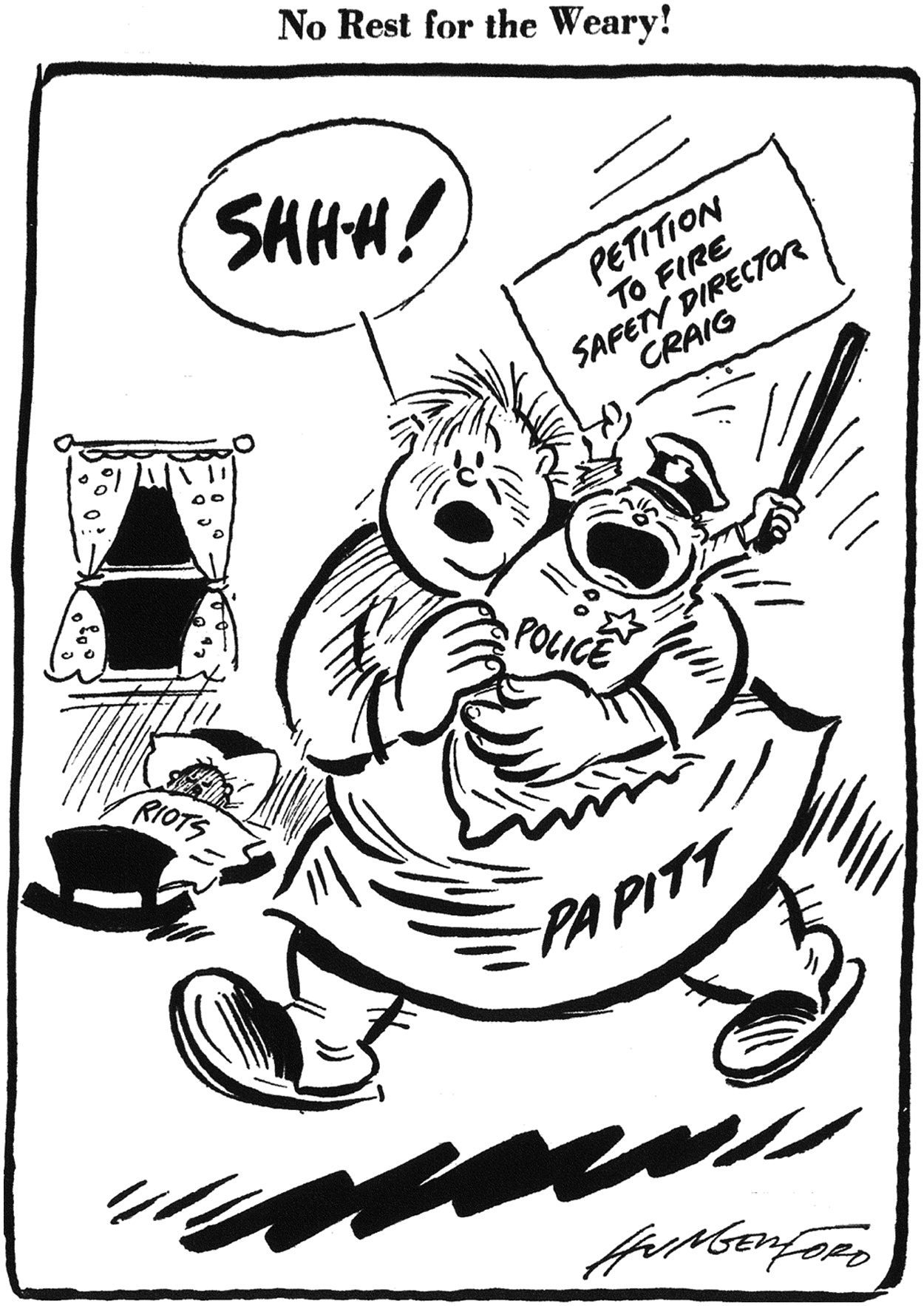
Cartoonist Cy Hungerford illustrates the tension between police discontent with public safety director David Craig and fears about continued racial unrest.
Police criticism of Craig came to a head over his decision to allow black youths clad in red vests to patrol Homewood during the riots, urging their peers to “keep the cool.” These efforts mirrored those of counterrioters in Chicago, Washington, D.C., and elsewhere. 51 As Morton Coleman recalled, “[O]ther cities had tried it, and [we] thought it would be a good idea, first of all to get young people working with the police, and two, then if they decided to loot they would be wearing these orange jackets, but the police hated it.” 52 The FOP saw Craig as a maverick pushing his own agenda. Even more troubling to the rank and file, the youth involved seemed to be known troublemakers and criminals who were glorified by the media. 53
The FOP dismissed socioeconomic explanations for the outbreak of riots, pointing out that blacks who did not riot were just as poor. “Social problems” should not be allowed to interfere with “proper tactical decisions.” 54 Following this line of logic, the report also criticized attempts to improve police–community relations, particularly by the force’s highest-ranking black officer, commander William Moore. During the riots, Moore’s rapport with more militant black leaders seemed a liability rather than an advantage; many white police were embarrassed by his “obvious reluctance to take action against the hoodlum element.” Once police action commenced, community relations had “little or no value.” 55 Instead, the report prodded procurement of better equipment, including a helicopter. It supported an increased “show of force (all aspects)” in the future, while still criticizing shoot-to-kill directives and lauding police restraint during the riots. 56 This call for a greater use of force would help fuel noticeably different police demeanor in the Black Construction Coalition protests a year later. 57
The indignant attitude of the FOP report reflected an already strained relationship with the larger community; tensions would only rise in the next few years. Nationally, complaints about police had grown in prominence throughout the decade. Incidents of alleged brutality sparked riots in many cities, and some minorities demanded the right to police their own community. The Community Relations Division of the Pittsburgh police had begun building relationships with black activists in the late fifties and early sixties, and those communication links may have helped restrain the level of violence during the riots. A police trial board had also existed for years but functioned so poorly that Craig tried to impose civilian review. Generally there seemed a “built-in resistance to anything innovative” within the force, which paralleled the complacency and paranoia affecting many rank-and-file urban police by this time. 58
The riots precipitated a further deterioration of police–community relations. Dissatisfaction over the handling of the riots lingered as police criticized the Red Vests while residents decried the use of K-9 units and chemical mace. High-profile cases where police allegedly beat an upstanding black youth and later shot two men outside of the Black Power Center in Homewood only added to community furor. 59 This mounting tension also led to an assault on a high-ranking white officer at city hall. On August 22, 1968, assistant police superintendent John Kelly was attacked by what one newspaper called a “mob of screaming Negro militants” numbering twenty-five to thirty. He had been attending a meeting of Homewood residents, city leaders, and Port Authority Transit officials concerning recent robberies of bus drivers. Kelly and his assailants argued over whether or not he issued shoot-to-kill orders during the riots. A brief physical altercation ensued before others present could break it up. 60
Throughout this period, the roving tactical force unit commanded by James Slusser was particularly troublesome, embodying a militaristic approach to law enforcement. Slusser made things worse by making inflammatory public comments. Alienation and distrust within black neighborhoods grew. One resident worried that the helicopters the police department hoped to purchase would not be used to catch petty thieves but rather outfitted with bulletproof plating, infrared lights, and machine guns. Pittsburgh only reflected a larger national trend of the militarization of local police forces in response to the threat of urban riots. 61
This tension with the police in general and animosity toward Slusser’s unit in particular exploded during demonstrations by the Black Construction Coalition in August 1969. Civil rights groups were picketing partially completed Three Rivers Stadium to demand construction jobs for black men. They were now missing a crucial ally, though, because David Craig had resigned from his post in May. Slusser’s tactical force arrived as protestors blocked a bridge. Rocks soon flew at the officers, who retaliated with clubs. Injuries occurred on both sides, and hundreds were arrested. Construction stopped while prolonged negotiations began. 62
Within months, Mayor Flaherty disbanded the troublesome tactical force and fired Slusser, but relations continued to fester, with dramatic displays on both sides. In 1970 the force gestured toward racial balance by transferring four black officers to the North Side in exchange for four white officers to East Liberty. An epidemic of “blue flu” occurred in response, as hundreds of police officers protested this concession to “hoodlums” by staying home from work. When an officer shot and killed a Homewood man mistaken for an escaped murderer in 1971, residents marched in protest and met with the mayor. 63
As in most other cities, efforts to increase civilian control over police became another sticking point. 64 Pittsburgh’s police trial board system was so ineffective that supervisors hesitated to use it. Reformers therefore pushed to transfer authority over trial board appointments from the police department to the mayor’s office. 65 In line with a general trend toward professionalization, the police increased training, but it was hard to guarantee results. Perceptions of police remained especially negative among black residents. Citizen complaints peaked in 1971 and 1972, and almost 70 percent of those complaints were from blacks. Still, city officials remained noncommittal toward greater community control. 66
Meanwhile, black police officers organized, forming the Guardians in 1968. The few blacks on the force faced dismal chances of promotion, and black women fared even worse. After the riots, the Guardians requested more black police hires in the name of better community relations. Black and female representation on the force actually declined, though, as retirements coincided with a hiring freeze in the early seventies. In 1975, the group joined with the National Organization for Women and the NAACP to sue the Pittsburgh police. The courts eventually imposed affirmative hiring policies and other remedies. 67
In part, police likely felt threatened by blacks demanding access to working-class jobs. Yet the increasingly hostile relationship between police and community also resulted from lingering police frustration over the April 1968 riots. Police discipline during the riots that allowed the city to escape with few casualties did not necessarily serve as a model for subsequent behavior. As in many other cities, the riots helped polarize relations between an indignant force and community residents and exemplified a larger racial split. 68
A Chance to Rebuild? Effects on Black Business and the Allegheny Conference
As historians Lizabeth Cohen and Alison Isenberg have pointed out, some black residents saw property destruction during riots as a means to expel exploitative white merchants. Their absence would clear the slate for more black ownership and control. 69 In this sense, riots created an opportunity for the physical and economic reconstruction of business districts in black neighborhoods. Efforts were made toward this goal, but they were stymied by increasing segregation, divided opinion within the black community, and the changing economic climate.
Pittsburgh’s riots altered the racial contours of small businesses. Douglas King, whose family owned B&M Restaurant on Centre Avenue in the Hill District, recalled the area as “one of the most integrated business sections,” with black and white businesses “side by side” before the riots. 70 In 1965, 38 percent of Hill District proprietors were white. These white merchants had relatively high annual gross figures and could extend more credit to their customers. Most nonwhite merchants, on the other hand, “conduct[ed] small and low volume types of business.” 71 At least in the initial stages, property destruction during the riots was “highly selective.” Signs were posted on “protected,” or black-owned, establishments, as was the case in Newark, Washington, D.C., and elsewhere. Some thought it useless to try and save any white businesses. 72 But when Slutzky’s Market was threatened with firebombing, neighbors intervened, pleading, “You can’t do that to Maurice [Slutzky]; he’s with the community.” Slutzky’s suffered smashed windows and lost merchandise, but the store survived intact and soon reopened. 73
Calls for an all-black Hill in the wake of the riots clashed with economic realities and neighborhood ties. State representative K. Leroy Irvis and others criticized merchants who had not reinvested their profits in the neighborhood. 74 Others took a different view. One resident explained, “By saying [we] did not want white business to return to the neighborhood, these people were reaching a very hasty conclusion. . . . How are these so-called leaders to replace the business that has gone. . . . They do not speak for me.” 75 Mary Barnett, a Slutzky’s customer, told the owner, “Sure, I’d like you to stay. . . . I’ve dealt with you and with your father before you.” 76 A more gradual transition would likely have occurred anyway. Freedom House, a nonprofit black organization, had been in negotiations to buy Mainway Supermarket before it burned down during the riots. 77
After the riots, most white establishments left black neighborhoods for good. One hundred white Hill District merchants had met in April to discuss their future. Only ten wanted to return to their ravaged stores; the remainder said they had gotten the message implicit in the past few days of destruction. Even those who intended to stay would do so only if the city provided adequate protection. Business had already been declining, but the riots acted as a death knell. Burglaries continued to plague merchants, while the perception of increased street crime deterred customers. 78 Irvis had seen Hill District businesses beginning to decline in the mid-sixties, then “the riot destroyed it entirely. In one fell blow, the ’68 riots wiped the whole neighborhood out.” 79 A similar picture appears in Homewood. Seven businesses, most owned by whites, left the neighborhood between early 1967 and mid-1968. Other establishments transitioned to new management, usually passing from white hands to black in the process. Riots in other cities also permanently shuttered many white-owned businesses. 80
White merchants’ mass departure brought hard times for remaining business owners. King explained the hardship simply: “Business makes business . . . the riots distorted that.” After patronage declined in the wake of the riots, King was forced to close his restaurant at night. When he made this adjustment, though, his store was repeatedly burglarized. In the end, he decided he had to keep the restaurant open at night, even if it was unprofitable, just to protect the establishment. He closed the restaurant for good in 1975 and took a job with county government. 81 Maude Hawkins, owner of the Hill District’s Hawkins Sausage Company, wrote to the Bureau of Minority Business in 1975 requesting assistance in reorganizing her struggling business. She needed help because of “burning and looting of stores handling 60% of Hawkins Sausage in 1968,” and “plant losses incurred through burglary and damages, 7 times in 18 months beginning 5-69 through 11-71. Losses not covered by insurance because of plant location.” 82 Compounding these problems, many white merchants had closed their businesses but retained their property, limiting black ownership rates and control. 83
There were some efforts to recover from this dire situation. The riots fueled new priorities for the Allegheny Conference on Community Development, a coalition of business leaders that had earlier cooperated with local government to produce the physical transformation of the Pittsburgh Renaissance. Historian Sherie Mershon has shown that personnel shifts within the conference combined with the increasing power of blacks and neighborhood-based organizations to challenge the existing progrowth coalition and foreshadow a shift in focus. With growing concern about the racial situation in Pittsburgh and the new leadership of Robert Pease, the conference was devoted to “social renaissance” by early 1968. It hoped to alleviate the “corrosive” influences of unemployment, crime, inadequate housing, and social isolation in the city’s poorest neighborhoods. This agenda was in place prior to April, but the riots added gravity to the situation. 84
Pease began arranging meetings to jumpstart programs. On one such occasion in 1968, a group of black leaders wanted face time with conference officials, yet insisted on meeting in the Hill District in a back room at the Loendi Club. Pease had to rent Ford station wagons to transport several CEOs to the meeting, as they usually traveled in stretch limousines driven by chauffeurs. The initial atmosphere was tense, but Pease felt the black leaders realized that the conference leaders were not “pushovers,” and the conference leaders realized the extent of the problems facing the black community. Meetings like this laid the foundation for continuing relationships. 85
As in Watts, Detroit, and other cities, the riots gave new impetus to improving black employment prospects and promoting black capitalism (Figure 2). 86 The conference arranged for corporate representatives to call other companies and ask them to pledge 10 percent of their new hires to minorities. A parallel cooperative effort with the National Alliance of Businessmen found jobs for twenty thousand people over five years, with the highest retention rate among major metropolitan areas. The Minority Entrepreneur Program loaned $13 million to over two hundred organizations with a reasonable success rate. 87 In addition to private business aid, the riots also drew greater assistance from the Small Business Administration. While Pittsburgh received relatively few loans in earlier years, after 1968 its level of minority business loans rose well above the national average and remained so throughout the early seventies. Loan values displayed a similar trend. 88
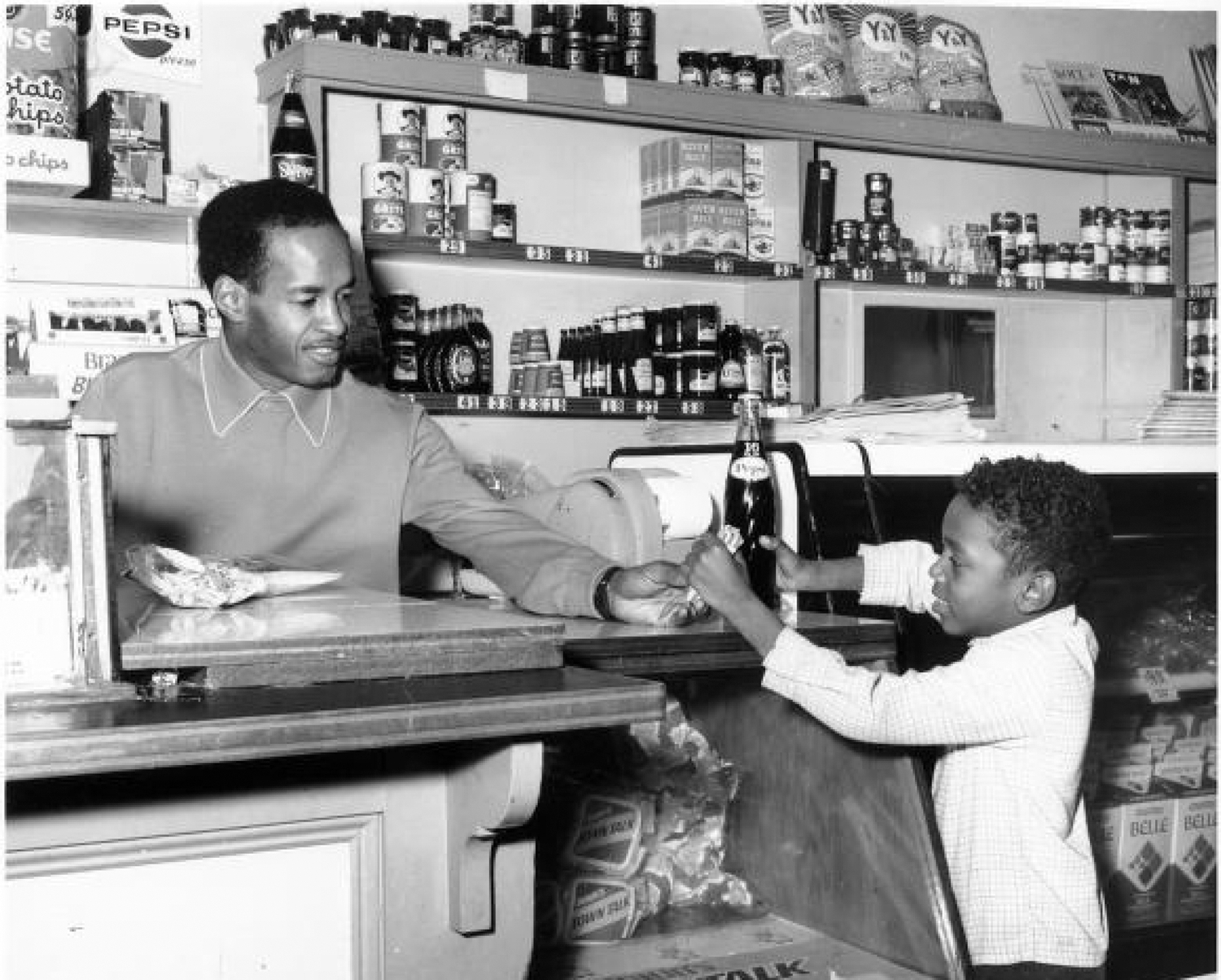
The Allegheny Conference on Community Development provided increased support to black businesses in the wake of Pittsburgh’s riots. Pictured here are Herman Stubblefield and William Webb III at a neighborhood grocery store.
The successes, though, were accompanied by many failures. Business owners encountered difficulty recovering damages from the riots and securing insurance in redlined areas such as the Hill District. As elsewhere, whites increasingly avoided black neighborhoods altogether. Combined with a decreased population, increased crime, and the continued rise of suburban shopping centers, the business climate was less than ideal for merchants trying to stick it out in black neighborhoods. 89 In 1978, the Phoenix Hill Shopping Center brought a large grocery store to the neighborhood and replaced some destroyed businesses. The center, which struggled with its own delays, stood out as the sole commercial development project in a black neighborhood to come to fruition in the past decade; others languished because of funding problems. Even that success was short-lived, as the grocery store lasted less than five years. 90 Many of the businesses assisted by the Allegheny Conference survived at least a decade, but the overall number of black-owned businesses in Pittsburgh actually declined between 1972 and 1977. 91 Meanwhile, rising unemployment was magnified among black residents. Ultimately, recovery in black business districts in Pittsburgh and elsewhere was excruciatingly slow and incomplete. 92
“You Can’t Be Personal Friends”: Racial Polarization Takes Hold
The transition in local government, tense relations between the police and the community, and efforts to nurture black business districts all occurred against a backdrop of greater racial polarization. Observers like William Rodd had hoped that the riots would alert white Pittsburghers to the dangers of both personal and institutional racism. From his perspective, the disorder highlighted the very need for greater understanding and cooperation. Generally, though, the disruption of the riots and the city’s negligible response only heightened racial divides. Increased racial animosity in Pittsburghers’ everyday lives undermined cooperative efforts for change.
Douglas King, a Hill District restaurant owner, recalled that previously “white people, black people, everybody came to the Hill for a good time and there was no problem with it. Once this riot started, there became this animosity against white people coming to the Hill. . . . There was just a reversal of the good harmony that existed before.” 93 Frieda Shapira, a white woman active with the Urban League, Job Corps, and other organizations, had similar recollections. Black and white students had previously been friends, but “after these riots, we can’t do this anymore because leaders on both the black and white side, said, ‘You can’t be personal friends.’ It was such a disheartening thing to see. . . . Here were groups who had been and were getting along very well . . . the riots, instead of liberating and bringing people together, in this case, tore people apart.” 94 The mayor’s task force also noted increased racial tensions that jeopardized aid to the poor. 95 Pittsburgh’s Human Relations Commission had been dealing “neighborhood-wide eruptions” of racial issues since April, particularly in interactions with police and schools. 96 This changing racial climate coincided with widespread perceptions of increased street crime both locally and nationally. These perceptions contributed to fear among many whites that further segregated urban neighborhoods. 97
School policy decisions became another conspicuous arena of racial conflict. White suburban migration over the previous two decades had increased the proportion of black students in the system from 17.5 percent to 36.7 percent. Meanwhile, public discontent with the school board had grown rampant. Black members were added to the board in both 1968 and 1969 to bring their representation to one-third. Nonetheless, protests at board meetings became a regular occurrence, with demands concerning the treatment of black students high on the list. Even after the board conceded to protestors by instituting public hearings, meetings sometimes required police protection. 98
At school, students waged their own battles. One such confrontation between black and white students left Oliver High School’s cafeteria in “shambles” and sent three students to the hospital. Mayor Pete Flaherty remembered, “A lot of my time . . . was working with the schools to keep down the intense problems that seemed to arise racially.” Commenting on such violence, William Rodd wondered, “In the face of all these incredibly myopic and callous responses to the determined and legitimate demands of Pittsburgh’s black community, is it surprising that anger grows; that among young blacks—faced as they are with the institutionalized white racism of school administrators, the police and other public agencies—this rage occasionally triggers misdirected violence?” Racial tensions in the schools continued as desegregation became a major battleground in the 1970s. 99
One side of increased racial tensions was driven by white resistance. 100 In the wake of the riots, increased safety concerns, a new focus on neighborhood organizing, and the successful defeat of the Democratic machine energized many whites. As elsewhere, the riots put some residents on the defensive. 101 Suburban men were seen giving shooting lessons to their families to deal with any intruders. 102 Others criticized law enforcement’s restraint during the disorder, feeling a more brutal response was warranted. 103 A forum held in the suburb of Mt. Lebanon aimed to examine racial attitudes but instead revealed the persistence of housing and employment discrimination. Only one black family lived there, and even they did not own their home. During the forum, an audience member denounced one of the speakers as a “Jew!” 104
Morton Coleman, who worked with the poverty program under the Barr administration, recalled that white ethnic resentment had been building during the sixties in response to programs that prioritized black communities. The riots contributed to a “more polarized society” made even worse by efforts to integrate the schools. White flight and population movement out of the Hill accelerated. Meanwhile, white participation in antipoverty and Model Cities programs grew increasingly contentious; some predominantly white neighborhoods dropped out entirely. 105 When Monsignor Charles Owen Rice, an activist Catholic priest based in Homewood, offered moral and financial support to local black leaders, some members of his flock were outraged. Rice seemed to be on the wrong side, helping “hoodlums” who made exaggerated claims of police brutality at a time when these whites felt unsafe walking the streets. 106
Like those in most other cities, the riots also boosted black solidarity and organization. These efforts often benefited from greater access to government or private funding. 107 Black Pittsburghers gained visibility as a result of the riots, and there were indications of increasing unity and organization under fresh leadership. 108 Bouie Haden told the mayor’s task force that there was “an emergence of new leaders. And things are changing so rapidly in the black neighborhood that the black man in a black neighborhood that’s considered a leader today may not be a leader tomorrow.” 109 More traditional organizations like the Urban League increasingly seemed out of touch with sentiment on the street, and some previously established black leaders that tried to tap into “the local drive for fraternity, brotherhood, and blackness” after the riots were seen as opportunists. 110
Black groups active in the wake of the riots pursued wide-ranging and sometimes overlapping or contradictory goals. In the summer of 1967, Haden had founded the United Movement for Progress, an organization of the “young and militant” that focused on jobs and low-cost housing in Homewood. After the riots, the group gained a higher profile, publishing a weekly newspaper titled Thrust that celebrated black power and decried birth control efforts as genocide. 111 Meanwhile, Homewood’s Holy Cross Episcopal Church, under Rev. Canon Julius Carter, united seventy-four community organizations in Forever Action Together in the summer of 1968. The federation initially pursued two major investments: redeveloping the former Vilsack-Ray market into the cooperative Home Supermarket and managing nearby housing that had been rehabilitated by ACTION-Housing. It grew increasingly critical of police actions in Homewood and called for white patrolmen to be replaced with black officers. 112 In the Hill District, Clyde Jackson “traded in his dashiki for a business suit” to help the newly formed United Black Front embark on economic development programs. The group attempted to purchase property in the Hill and set up black businesses with the assistance of small business loans. Within a few years, United Black Front was offering employment, housing, and education services and had established a Community Food Mart and a nail factory with state funding. 113 The work of these groups dovetailed with many others, ranging from Nate Smith’s work with black construction workers to beautification programs like Operation Better Block.
The resurgent efforts of black organizations and recurring attempts at economic revitalization offered hope and tangible improvements for some residents. 114 In other ways, though, the political and economic forces converging on black neighborhoods seemed intractable. The very multitude of black groups working in parallel decreased the leverage of any one group and hindered unified efforts at rebuilding. 115 Four years after the riots, Clyde Jackson urged the governor to declare the Hill District an official disaster area, a designation that would guarantee additional funding. The burst of black organizational activity was ultimately not enough to overcome long-term trends of decreasing population and housing units in both Homewood and the Hill District. 116
The riots could have served as a wake-up call to the volatility and gravity of the racial situation in Pittsburgh. Instead, they further polarized white and black communities. April’s dramatic display reinforced racially divergent views of how the city should allocate its resources. In turn, these different views drove a wedge between many whites and blacks in their everyday encounters and prevented them from working together on shared goals like neighborhood improvement.
Conclusion
Pittsburgh’s week of disorder initially forced a public reassessment of the state of black Pittsburgh. A possibility for meaningful change presented itself as officials paused to investigate and citizens organized in new ways. This moment quickly escaped. The riots contributed to Flaherty’s election, soured already strained police–community relations, damaged struggling black business districts, and exacerbated racial tensions. Local power structures persisted as budget concerns and an increasingly polarized community prevented sweeping changes to improve racial disparities. Though black organizations proliferated, their successes were often temporary or highly localized. A newspaper assessment written five years after the riots found, “Some promises have been fulfilled, many not. Decent housing, steady jobs, new life for decaying low-income communities remain the crucial, unanswered ones.” 117
On one hand, the riots succeeded in producing political will for more substantive change among certain sectors of the Pittsburgh population: the black community, white liberals, parts of the Barr administration, and much of the business community involved with the Allegheny Conference. On the other, the riots provoked the opposite reaction among many white ethnics, the police force, and a Flaherty administration catering to the neighborhoods. Even among the former groups, agreement on the means of change was elusive. Timing tipped the scales further toward the latter groups. By the late sixties and early seventies, growth in the national economy had slowed significantly and inflation was on the rise. Pittsburgh was hit especially hard. The local economy had already begun shifting away from heavy industry, and as deindustrialization became more apparent in the following years and population loss continued, funding opportunities and job prospects declined. 118
In the broader sense, Pittsburgh’s experience in the late sixties and early seventies highlights the ways that civil disorders acted as a prism for a number of preexisting trends in American society. Riots refocused some energies while accelerating other transitions. Pessimism generated by racial disturbances expedited population movement from city neighborhoods to the suburbs, a migration that was predominantly white but also included significant numbers of the black middle class. This migration hardened residential segregation and class stratification in metropolitan areas. 119 Meanwhile, responding to riots revealed class divisions among whites. Many elites with connections to government or business made at least cursory efforts to improve opportunities for black residents. Working- and lower-middle-class white residents remaining in the cities, though, felt trapped in a zero-sum game and increasingly organized along neighborhood lines to stake claims on remaining municipal resources. In a closely related development, the eruption of riots close to home suddenly presented an immediate threat to many observers, lending greater currency to an emerging discourse of law and order and contributing to the growing conservatism of some whites. Black perceptions that riots ultimately gained few concessions from the white establishment gave greater sway to evolving notions of black power. Well into the seventies, black communities drew on those ideas whether consolidating a political base, supporting black capitalism, or working to change school curriculums. Overall, the protest embedded in the urban riots of the sixties had the unintended consequences of undermining racial cooperation and the economic viability of many urban neighborhoods.
Footnotes
Acknowledgements
I thank Edward Muller, Jared Day, Laurence Glasco, Rob Ruck, Joe Trotter, Joel Tarr, Liann Tsoukas, and my peer reviewers for their comments and suggestions on earlier versions of this work. Laurence Glasco generously shared excerpts of his interviews with K. Leroy Irvis. I also received valuable feedback from presenting portions of this work at the Pittsburgh Roundtable, the Pennsylvania Historical Association, the Oral History Association, and a joint graduate student conference among the University of Pittsburgh, Carnegie Mellon University, York University, and the University of Toronto.
Declaration of Conflicting Interests
The author declared no potential conflicts of interest with respect to the research, authorship, and/or publication of this article.
Funding
The author received no financial support for the research, authorship, and/or publication of this article.