







Abstract
In the projects of the artist Theaster Gates, social change and transformation is strongly tied to an actual rebuilding and reactivation of vacant architectures across the South Side of Chicago. Opposed to Richard Florida’s analysis of the artist’s role in the processes of gentrification, in Gates’s model, the artist does not upvalue property in a decaying place only to then become victim to the outcome of this valorization, but the artist is a conscious and acting part in the very process himself with a designated long-term goal. Gates started acquiring abandoned houses at South Dorchester Avenue in Chicago’s Grand Crossing area in 2006, and since then included them into an artist-activated ecology. He inserts architectural remainders into works of art that travel around the world, and when sold to collectors, he reinvests the profits into the reconstruction of the buildings and acquisition of further ones. Especially through an involvement and practical reworking and repurposing of architectural structures, Gates is performing a break from a passive emotional attachment to a nostalgic image of the spaces of non-lived memory that is a prevailing trend in photography at the moment as in the works of Yves Marchand and Romain Meffre for example. Gates’s active placemaking includes the investment into the materiality and poetics of space, communal dinners, performances, film screenings and an artist residency program with a focus on sustainable site-specific projects. In Dorchester Projects, Gates’s interests in a history of making, as well as the history of the city cumulate, but despite historical preferentiality, the places have a distinct atmosphere of nowness. He links his artistic practice and social agendas with architectural and aesthetic issues. Gates’s recycling, or also upcycling, an “investment into the care of things” and the permanence of built places is testifying to his interest “to move back and forth between the real, the gestural, and the economic,” all contributing to his “art of staying.”
Keywords
My Kinds of People
It couldn’t have been more perfect. On my four-day visit to Chicago in early 2012, I was able, after long email conversations with the curator, to secure a spot for one of the dinners that artist Theaster Gates was hosting at his Dorchester Projects for the SMART Museum’s exhibition Feast: Radical Hospitality in Contemporary Art. 1 Gates had bought and refurbished an abandoned house, which he turned into a hybrid of archive, soul food kitchen and community meeting spot, hosting dinners, discussions, concerts, artists’ talks, and education events. The dinners for Feast were themed evenings for a crowd composed of “curated guests and members of the public”: 2 art professionals, collectors, artist’s assistants, community leaders, musicians, chefs, friends, and family. But it turned out that the journey there seemed to reveal more about what Gates actually does in Chicago than attending the dinner itself.
After having visited the actual exhibition during the afternoon on the campus of the University of Chicago, I turned to my printed-out map, where 6916 S. Dorchester Avenue was marked. While walking and searching for the address, I was astonished to find that this was actually a really nice neighborhood—nothing like the numerous articles that had been written on Gates in the past few months had described. Around 54th Street, I started to wonder whether I was actually following the directions since the number decreased instead of increased. And after twenty minutes of walking I had to come to the conclusion that the red dot on my map was actually not 6916 S. Dorchester, but 5300. It was fifteen minutes before the dinner was supposed to start, and I was at the other end of the road without any clue how far it could be or how to get there in time. So I started walking hastily, almost running in the opposite direction. And despite having spent several years living in the United States—even in the epicenter of automobile-based urban space—my European naïveté in the strong belief that one has to be able to walk down one street in a reasonable amount of time, once again betrayed me.
Rushing South on Dorchester, the neighborhood changed drastically, it became slightly more run-down; everything looked a bit duller because of more empty lots in between the houses and the whole neighborhood seemed increasingly less populated, a church here and there offered islands of livelihood. At East 65th Street my hectic running and rushing came to an abrupt halt since S. Dorchester apparently ended here under a rail bridge. There was no one on the street and the sun was setting. I was incredibly late for something that I had wanted to attend so much and my distress grew more considerable every second. I heard some rumbling coming from a garage behind me, a little bit off the road where I saw an elderly gentleman trying to open the garage door apparently to put his car inside. I approached him desperately, and after having explained to him my unfortunate and self-inflicted situation, showing him the wrong map, he kindly offered to take me to the artist’s house that he had heard about. The gentleman used to be a bus driver before retirement and explained it is hard to get to the neighborhood nowadays when some bus lines are discontinued. He also said that I was lucky that he picked me up since around here, there are only his “kinds of people,” and I understood what he meant. We arrived at Dorchester Projects, a house I knew only from images; one that stood out against the other buildings with its exterior consisting of unpainted wood in different shades. I thanked my savior many times and knocked on the high wooden gate. I heard live music, and a warm light and the smell of food guided my way inside. I was welcomed and seated at a long wooden banquet-style table between a powerful Chicago collector and Gates’s studio assistant, who managed the pottery program. A beautiful Japanese-style ceramic bowl was placed in front of me with shrimp and grits, red wine was poured into my glass and Gates and his musicians performed in the breaks between the different courses of the dinner (Figure 1).
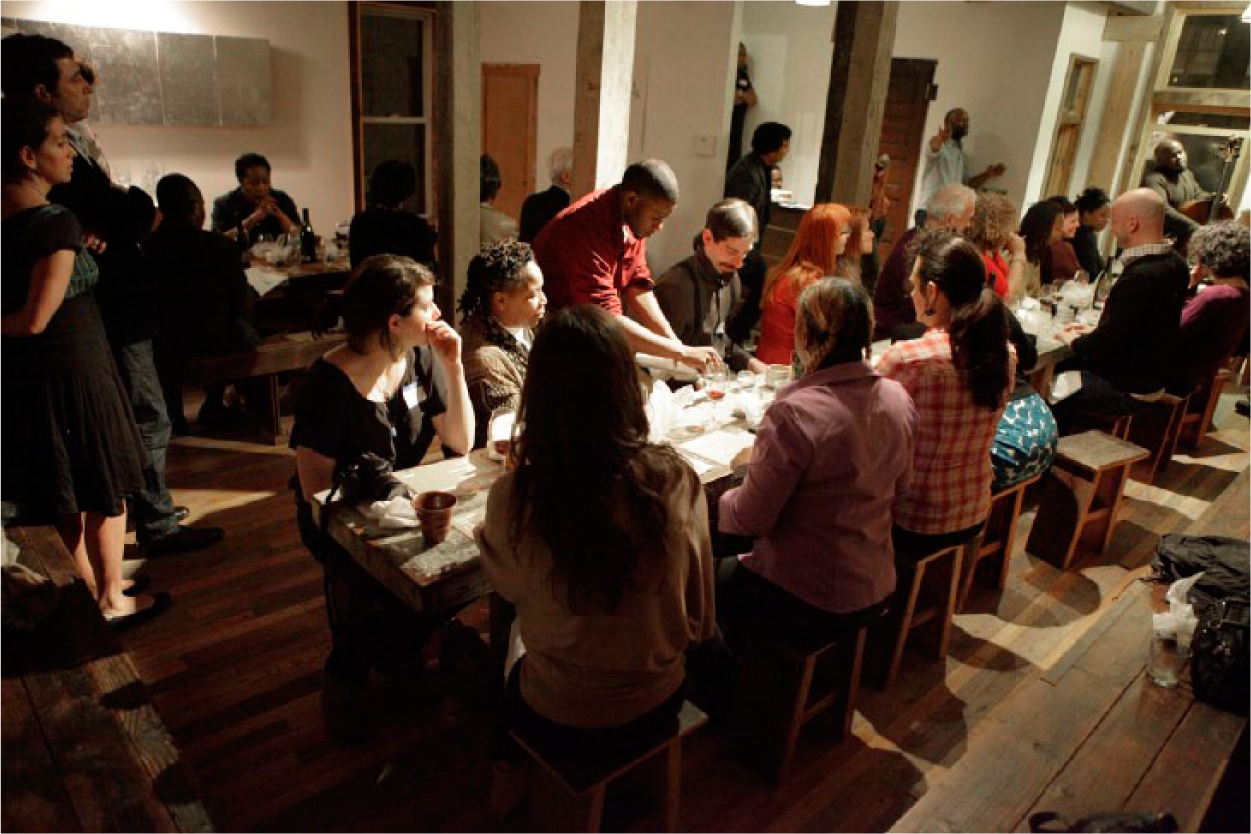
Dinner at Dorchester Projects during Feast: The Art of Radical Hospitality at the Smart Museum Chicago, 2012.
Despite the cozy atmosphere in this astonishingly beautiful space, it was the songs that pulled me into a very different kind of mesmerization. The mix of gospel, spoken-word performance and improvisation strengthened the feeling that one was here to watch and be astonished, a guest only who is welcomed and pulled in by this eclectic mix of cues, but who, at the same time is defined as outsider, not of feeling, but maybe of experience. And Gates himself states that he is “not here to redeem anything, but here to make things present again.” 3 Though he decidedly does not talk about race too much, with all the many different parts of his larger project coming together, he is doing exactly that. In this article though, I will focus on his rebuilding efforts in Chicago and how this project can be a model for artist-led change in underresourced neighborhoods.
Theaster Gates’s Dorchester Projects
Chicago’s urban history is a highly complicated one, and a prime example of the deep entanglements between racial politics and capitalism throughout the twentieth and twenty-first century in the United States. The detailed scholarly accounts of the city’s urban history are numerous and highly insightful. 4 These fine-grained sociological and historical urban studies mainly focus on the fundamental role of city politics, development, and urban planning informed by structural racial politics in shaping living conditions and lives in general. Theaster Gates on the other hand, insists that his art projects should not be seen as generalizing models to counter this complicated and diverse history of city planning. His endeavors should rather be treated as artistic interventions, as creative suggestions of how we can think places in a different way, while not endeavoring to deliver the perfect model for artist-led change in the postindustrial city. The artist is decidedly placing himself right in the middle of a history of artistic engagements with the city, its structures and its architecture, performance, community engagement, a history of labor relations, as well as an object-based artistic practice, all which make up Gates’s very own circular economy. But his projects do have a very real grounding in matter-of-fact conditions and rational conceptual thinking. Gates’s rebuilding projects and his art objects are always deeply steeped in a certain aestheticized vein of the emotional and of the imaginary; thus, their criticality is hard to detect and might even be overlooked at times. His approach has lately started to receive criticism, mainly from Europe, for lacking a certain kind of antagonism. 5 In the heated debate around relational aesthetics, Claire Bishop postulated that art must maintain autonomy, as well as a certain degree of unreadability in order to shelter the artistic imagination from adaptation and co-option by political or economic power to impose a false consensus upon it. 6 Social change and transformation in Gates’s projects is strongly tied to an actual rebuilding, a reactivating of what could be termed found architecture. In 2009, right after the real-estate bubble burst, Theaster Gates bought a two-story clapboard bungalow at 6916 S. Dorchester Avenue in the Grand Crossings neighborhood on Chicago’s South Side: the very heart of the city’s black belt. And what started out as merely a quest for a studio space for his artistic practice as a ceramicist, turned into the starting point for an entrepreneurial hub for art practice and creativity, education and conversation, urban renewal, and how far one is willing to take this engagement (Figure 2).
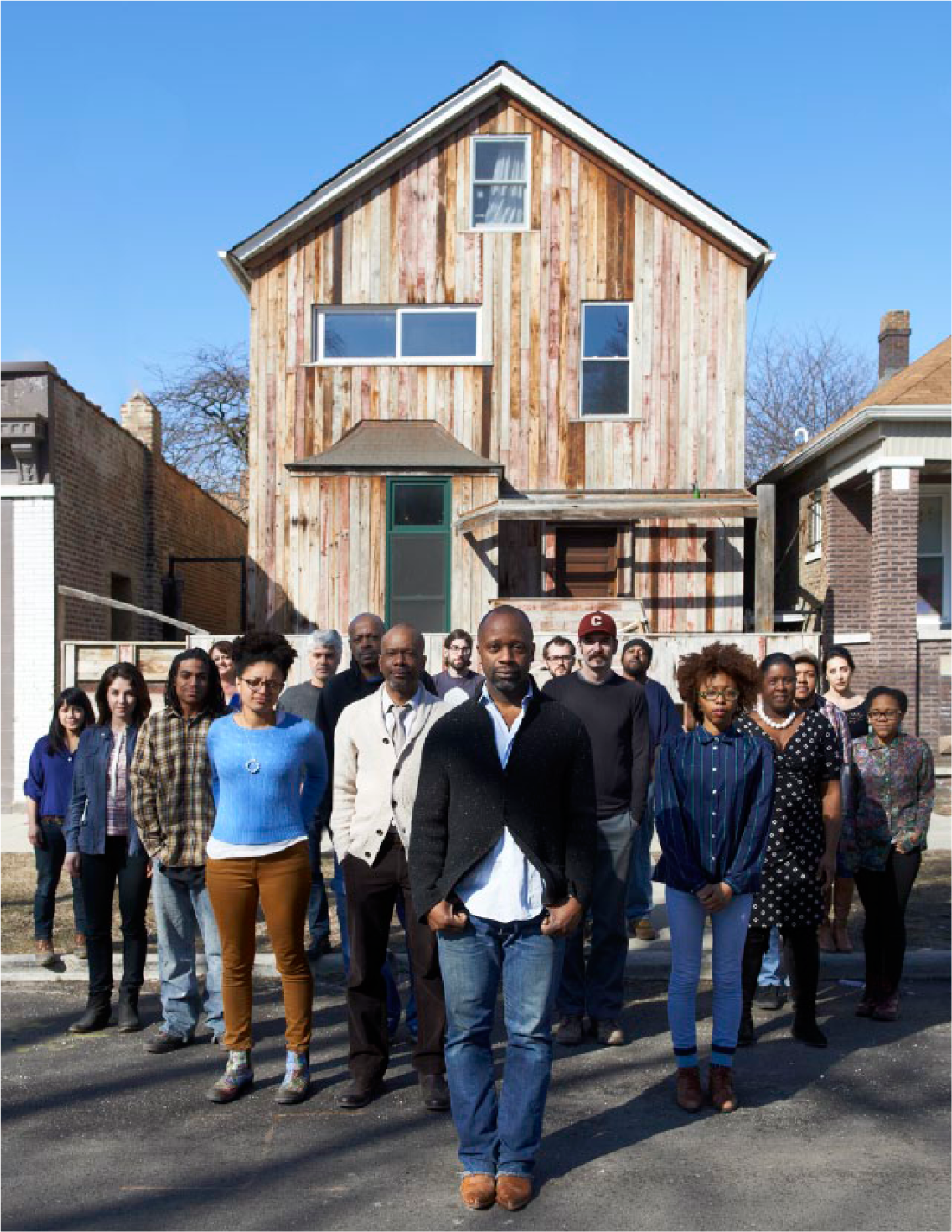
Theaster Gates with assistants, collaborators and volunteers in front of Dorchester Projects.
Gates reconstructed and transformed this first cheaply bought building close to his own home (a closed down candy store just down the street that he had aquired in 2006) completely. He moved to the neighborhood because it was close to the University of Chicago campus where he had started a job as an arts programmer. In order to achieve a functional reconstruction of the house, Gates did not simply buy new materials, but he employed used materials with a history such as wooden floorboards from the closed down Wrigley’s chewing gum factory or a closed-down bowling ally, inserting the place with a distinct local history of the city, and of labor. Most of this reusing of materials for the reconstruction of this initial building was necessary, simply because of a shortage of funds. But simultaneously, it also taps perfectly into the recycle and reuse aesthetic commercially propagated for sophisticated urban living today, as well as the archeological turn in contemporary art. 7 Gates’s use of salvaged materials renders it on the one hand more accessible, yet also more vulnerable for critique. 8 But it is not only contemporary luxury interiors that reflect on simple, material-conscious reuses of space. A new vein of public interest architecture, as well as conscious material-recycling projects, is turning more and more toward reconstructing and reusing existing structures, instead of building entirely new ones. 9 Unlike public interest architects—who develop sustainable and affordable design for public use and architectural projects that simply reuse materials for new constructions—the Ruin Academy of Taipei approaches this complex issue differently. As their starting point for reflection, they take the ruins of the third-generation city—the ruins of the industrial city. 10 Founded by Finnish architect Marco Casagrande, the Ruin Academy as an urban think tank might be thinking in a similar vein as Gates, who, not surprisingly, also has a degree in urban planning. Casagrande might be best known for his expansion of the theory of urban acupuncture, a term first introduced by Spanish architect and urban planer Manuel de Sola Morales, referring to small, but catalytic, interventions in urban space to revive the organism of a city. 11 But Gates not only builds upon the ruins of the industrial city with reused materials but through this process of inserting materials with a history into his buildings, he establishes an intrinsic connection between the material world, the places in it, and our cultural imagination and presence.
The affective attachment toward place is established instantly through the highly stylized and aestheticized look of the buildings on South Dorchester that is created through used materials, wood in different colors, shelves in the style of ware boards for pottery now housing books, vinyl records, and ceramic bowls. The effect is a feeling of complete emotional security through the haptic and surface feel of the interior. Wood, naturally a less-intimidating organic material that can be shaped by hand with the appropriate tools, is not only a multi-purpose material, but also a material frequently used in sculpture, a material that carries within it the traces of its own age. One gets the feeling that through touching the house and the things in it—and one has the urge to touch everything inside Dorchester Projects to make sure it is real—a connection to the place is established (Figure 3). An interior that is also housing archival collections of the redundant sixty thousand glass lantern slides of the art history department of the University of Chicago, a soul record archive of eight thousand volumes acquired from Dr. Wax, a closed-down record shop, as well as fourteen thousand volumes of art and architectural books from the likewise closed-down Prairie Avenue Book Shop, adding symbolic and imaginative value to the house through these archival collections. 12 Gates calls his recycling, upcycling, and collecting an “investment into the care of things,” testifying to his attempt “to move back and forth between the real, the gestural, and the economic.” 13 Through a reworking and repurposing of architectural structures, the artist is performing a break from a purely passive emotional attachment to a nostalgic image of the abandoned urban spaces of nonlived memory. In this, Gates adds his own twist to a renewed interest in visual culture at the moment, breaking away from the many projects centering around decaying urban space with Yves Marchand and Romain Meffre and their haunting images of the ruins of Detroit or Jim Jarmusch’s 2013 film Only Lovers Left Alive as the most prominent examples. 14 With his rebuilding efforts, Gates instead follows what Bruno Latour describes as a shift from architecture as a matter of fact to architecture as a matter of concern. 15 As matters of fact, architectural structures are bound to methods, rules, and systems, and they can be seen as objects. But seen as matters of concern, these very same architectural structures enter into socially embedded networks, where the outcome of architectural processes are much more important than the mere objects of architecture. 16 Gates is pairing function with fiction, commenting, “I leverage artistic moments to effect real change.” 17 Artistic moments that are grounded in a very real social and racial history of the city of Chicago, and that are constantly returning to it, might give Gates’s work its romantic notion by building on ruins and fragments of the past with a sincere mission to introduce this past, or fragments of it, in the now. An important vehicle in the artist’s circular economy of creating value and investment is also his art objects, which are often created from materials sourced out of the reconstructed buildings. For his architectural rebuilding efforts, Gates is standing in the artistic traditions of Robert Smithson or Gordon Matta-Clark together with the anarchitecture group. 18 While Matta-Clark’s building cuts mainly critiqued capitalist modes of accumulation as exemplified in inflexible architecture, Smithson’s essay “A Tour of the Monuments of Passaic, New Jersey” (1967) emotionally describes the impact of city planning’s spatial conditions and urban sprawl on the environment and on men. But today Gates employs the dreams of the 1960s that are accumulated in his archives of soul records, architectual books and JET magazine in order to insert moments of hope for the disenlusionment of the present. Gates is pragmatic, and just like Matta-Clark and Carol Goodden founded the conceptual restaurant FOOD predominantly to serve themselves and their artist friends and colleagues, Gates’s Dorchester Project is not only dwelling in memories for the future, but sets out to actually do something. From the original house at 6916 S. Dorchester Avenue, it has significantly grown over the past years and is still expanding. The original building is now the Archive House, then there is the beautifully rebuilt Black Cinema House for screenings and film making workshops just across the street, and a planned artist housing collaborative which will host artist studio spaces as well as mixed-income housing in a former housing project at 1450 East 70th Street, a few blocks from Dorchester. To manage these projects, Gates has set up the Rebuilt Foundation 19 as a not-for-profit, which in this form can also apply for municipal and federal housing grants for Dorchester and his other endeavors in St. Louis and Omaha. For an artist in residency program at Dorchester, Gates often chooses artists of color that are concerned with environmental issues. A sustainable lifestyle, especially the one that has become trendy in the urban metropolis over the past years, is often hard to distinguish from upscale consumerism, especially for people in neighborhoods like Grand Crossings. But through having artists teach classes on urban gardening or related issues, Gates draws the necessary connection between ecological awareness and issues of race and class—just one important example of how he affects change. 20 While I am focusing here on his rebuilding projects in Chicago, his work needs also to be discussed in the entirety of his rebuilding efforts, community engagement, object-based artistic practice, musical performances and the ethical impact of the discursive interactions and the social work they perform. The background from which we have to read his projects is one of socially engaged art and artistic collaborations, 21 but certainly also from the perspective of Warholian business art. Socially engaged art has a long history, but especially in the past twenty years it has gained more recognition. Analyzing contemporary artistic practices, curator Okwui Enwezor points out that they are often born in times of social and economic crisis, and he states, “Such crisis often forces reappraisals of conditions of production, reevaluation of the nature of artistic work, and reconfiguration of the position of the artist in relation to economic, social, and political institutions.” 22 What makes Gates’s practice stand out, is not only its timeliness in time of crisis, but its manifold iteration. His practice also incorporates the many different aspects of art production today, not shying away from putting to work art market desires, the art industry, and the financial gain and the freedom that comes with it. Instead of producing art works aimed to expose the relentless rule of capitalism today and its effect on art and artists, Gates, as maybe the ultimate trickster figure, uses these mechanisms and channels their outcome accordingly.
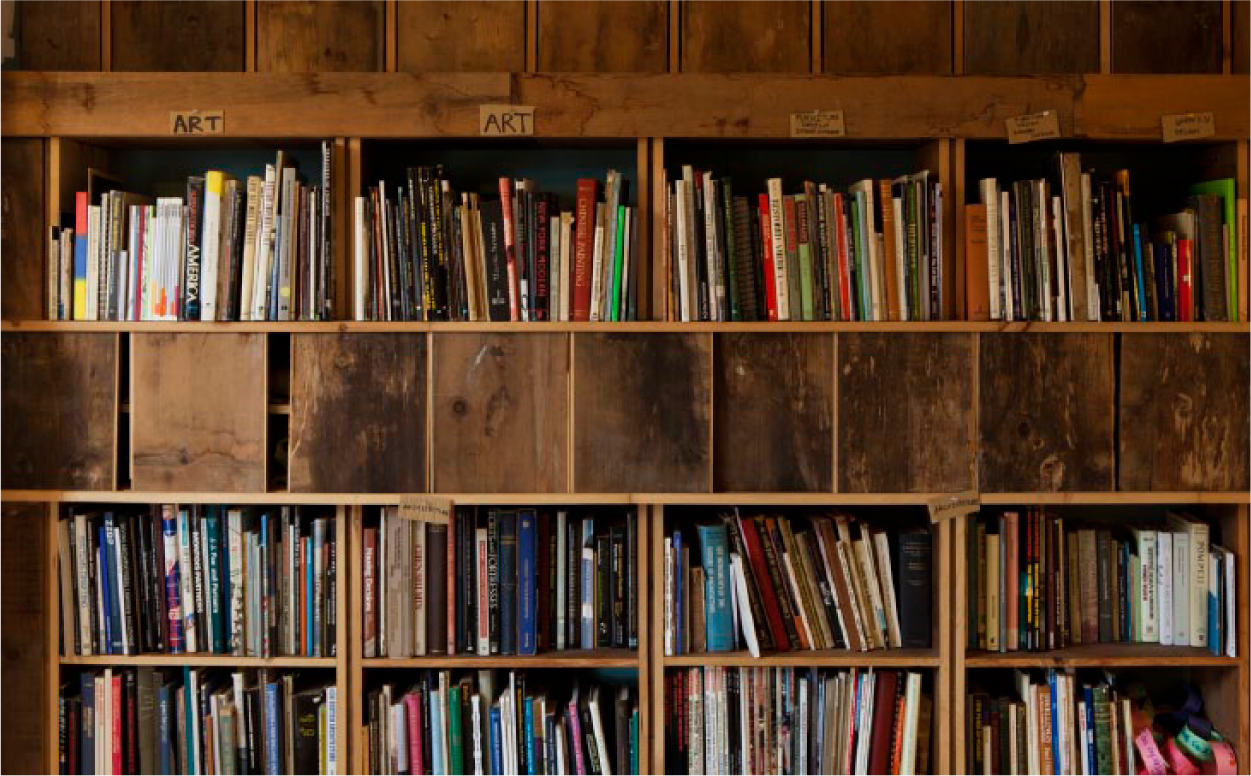
Inside the Archive House at Dorchester Projects.
Market
The art world is a place that can be perceived as purely market driven, even though many of its denizens would adamantly argue the opposite. 23 The boom of the art market for contemporary art starting in the 1980s, with just a few short irruptions from time to time, is a constant upward movement with more participants entering it day by day. The volume of money and thus investment into art has considerably changed with the changes of 1989 and the following globalization of capitalism. If there have been a handful of art lovers and connoisseurs in a very small, and nowadays often romanticized, art world before the 1980s, art and its scene have nowadays become the ultimate playground for the super-rich. 24 And artists, galleries, private collectors, and curators support a highly functioning microcosmic system. 25 Gates’s acknowledgment of the entanglement, rather than detachment, from the economies ruling the art world, is important for his own system of investment and reinvestment to inhabit the asymmetrical social sphere of the real world. His escalating rise to a new American art star and the figurehead for social practice is complicated since it seems contradictory on first view. But he treats money as circulating entity in and through the artwork, his fame as also circulating in the artwork, which he eventually redirects for other means.
Gates’s own centrality to the making of his works tapped into a renewed interest in the “live” in contemporary art, into a demand for the artist to be present. Through this reevaluation of the “live,” Gates was able to establish an economy of an active performative exchange between his object-based works on the one hand, and his long-term socially engaged placemaking and reconstruction projects like Dorchester Projects on the other. His gospel performances function as a kind of mediator in between the two endeavors, creating and strengthening, but also shaking up and disturbing the value chain that the artist established between the sale of art objects and the reinvestment of that money into the refurbishing of houses in Chicago. His extended object-based artistic practice employs materials often stemming from the ruins of postindustrial urban decay, rendering his art objects a distinct formal vocabulary. For many of his objects, Gates taps into the violent racial history of the United States only too willingly; presenting “loaded, racialised, enigmatic, fetishistic, seductive objects, for sale,” 26 like shoeshine stand sculptures or assemblages composed out of fire hoses sourced from 1960s Birmingham, Alabama. These art objects are immensely popular with private collectors, as well as American museums, allowing Gates to create his own value chain: “So I sold that thing, and it paid for a lot of the restoration. And that allowed me to start reimagine this not as a one-off thing, but as a way of creating a new model of artist-inspired development.” 27 But it is not the art objects or the live experiences that are central to Gates’s work, but rather the kind of social relations that his work establishes and also that it works upon. Gates employs discarded, already abandoned, and given-up materials and structures of an existing world in order to imagine a world as it could be, as well as to produce objects that are tokens for this process. But the objects are merely parts of an ecology that taps into a very contemporary desire toward an engagement with urban space. An engagement also with black history as a kind of redemption for collectors to buy. But Gates does more than that. In addition to treating the site as physical and architectural space, he conflates it with social, historical, and cultural space. This happens not only through an artistic engagement of his musical performances, the incorporation of archives into the building or the cooking events, but also through an incorporation of art market desires into this very process itself. Thus, one could argue against the common idealistic perception of his work as being socially engaged and standing in the vein of similar projects like Rick Lowe’s Project Row House in Houston or Watts Housing Projects of the artist Edgar Arceneaux. 28 Their projects have dealt much more with social realities and needs of the people in the specific neighborhoods and have not been established under the primary motivation of it being a pure art project like Gates’s. Also the investment chain through art objects that Gates established is not given with their projects. But maybe Gates’s engagement is more realistic in terms of an active and profitable incorporation of possibilities, not letting opportunities that the art market creates pass him by. Through its multilayered processes, Gates considers the real world that these projects have to subordinate themselves to and forgoes their marginalization as social projects by rendering them aesthetic ones. The subversive gesture is that he is not ignoring the market value of his object-based art works and pretending the building projects in Chicago are purely socially motivated (isolating his object-based practice), but he actively incorporates the processes of money-making through the art industry into the value chain that is established by him. When the art market is championing certain kinds of art objects and is indeed structured around running an economy of demand from the super-rich and dealer-mediated supply from a few artist-superstars, why should Gates not participate and extract his piece? 29 In The New Spirit of Capitalism, Luc Boltanski and Eve Chiapello state that capitalism in fact has no clearly defined program, so no political or social project except for the production, circulation, and accumulation of capital. Thus, capitalism is able to adapt to, and eventually integrates, also critical political and social projects. That way also new ways of dissent can enter the current logic of ever-growing capitalism. 30 Gates, aware of this logic and also aware of his own project and the means he has to employ to realize it, ironically comments: “I wouldn’t consider myself actually a relational practitioner, just a straight up capitalist.” 31
Utopia
In this vein, the well-known dangers of artist-driven redevelopment like gentrification have to be considered as well. The difference with Gates’s project though is that it is not merely artist-driven but artist-led. Gates expanded his rebuilding efforts significantly over the past years, buying more abandoned buildings in close proximity to Dorchester Projects, and transforming them to house artist studios, gallery space, a cinema, or also combined living and working spaces for artists, as well as low-income families. But Gates comments also on the challenges of his Chicago project:
It required that I become knowledgeable about how systems work in the city. What the strategies of reinvestment and redevelopment are. It meant that I had to get to know a different group of people than my peer group. And that’s the part that makes it a little bit harder. We all know that artists are most often the first step to change in a place, but what we haven’t caught is that we as artists can sometimes reap the benefits of having done this.
32
Gates is very well aware of his position as an artist, what he can achieve through his creative works. But he is also mindful of the well-known tale of urban gentrification that is usually the outcome of processes of up-valuing deprived inner-city neighborhoods. Through his standing in the Chicago artist community he wants to use the problems that artists encounter to find affordable places to live and work, and further employ this disadvantage to effect change in deprived neighborhoods. Through this, he is inserting creative potential back into the neighborhoods and is allowing other artists to have spaces to unfold. The outcome of these processes cannot be estimated at this point, but they might be able to resist purely economic motivations of otherwise authoritative city planning strategies decided by officials at the drawing table. Gates, as trained urban planner and someone who has worked with authorities in Chicago for a while, is very well aware that through art one might be able to achieve certain things that one might not be able to achieve in other sectors. He is looking at the city as a system composed out of multiple ecologies that are connected. And recalling Marco Casagrande’s model of urban acupuncture, these interconnections might only be put to work through directed interventions and processes, for which Gates is trying to establish a model here. Because the diverse roles of the artist as urban planner, developer, creative person, community organizer are so multiple and far-reaching, more things can actually happen than if only one role is embraced. As an artist-entrepreneur, Gates oscillates between the problems and advantages that his status provides him. But because he always speaks and acts from the removed position of an artist, he can step out of the field directly and change things more readily than as a social worker. As artist, he is furthermore adding a speculative use to these places for future developments and transformations. The word project in Dorchester Projects already suggests temporariness, something of a distinct now-ness. At the same time South Dorchester Avenue, the actual real place in Chicago at its current state, is a constitutional element for his approach.
Scholar Miranda Joseph convincingly showed how the myth of community is the basis of social hierarchies of race, gender, class, nation, and sexuality—hierarchies that are required by capitalism in order to function. As a supposed opposition to alienation caused by global capitalism, community is often called upon as index of the good life, of a selfless belonging. Joseph argues that a notion like community is established through the performativity of production, in order to grasp connections between individuals that would seem disconnected. Community in capitalism is, in her eyes, only a kind of supplement to it—it is supposed to make up for what capitalism robs us of. 33 What is highly interesting in Gates’s practice now, is how he moves back and forth between the romantic notion of community, that Joseph describes and that art collectors desire to see in his projects—and through which he extracts funding in a straight-up capitalist way—and, on the other hand, his own critical distance to it. While he certainly invokes past notions of a black community (and the past is when the idea of community would still work for Joseph as well), in the now, he makes clear that he is no “community do-gooder,” but simply wants to be “a good neighbor.” 34 With this, he takes a stance against the Grand Crossings neighborhood being perceived as a purely run-down black neighborhood—he is certainly portraying it as a black space of the past that he is paying homage to, the black past of community organizing and Civil Rights—but he is eventually opening it up for a different future. Memory is his gateway to communication and creating dialogue. Gates is thus not involved in community-building as solidification, but rather opening it up to good neighborliness, with all the tasks, but also with the distance and possible diversification that comes with it—in that way also recognizing differences within a mythically homogeneous “black community.” Gates emphasizes the “art of staying,” 35 while his neighbors are astonished that he would not move into a more upscale neighborhood, now that he has made it—of exactly not leaving “the ‘hood.’” 36
In Spaces of Hope, David Harvey describes how philosopher and social theorist Roberto Unger deems the exploration of liberatory alternatives in the vein of Henri Lefebvre important. In this way, utopianism is avoided and importance is given to alternatives that should come from critical and practical engagements with existing questions. So the practitioner should only be interested in the next step and not in a universalizing principle of transformation. 37 Gates is doing no less. He is working very much with the current situation, and from here he plots the next steps. In this way, Gates deals with what is already there—the history and situatedness of a place—and from there he starts to construct his fiction around it. This is important to recognize when looking at Dorchester Projects in the vein of utopia. Utopia, always thought from the standpoint of now, crucially recognizes what is not included in dominant discussions, what is neglected and what is missing. And against a perhaps common misunderstanding, utopia has to be seen as ambivalence, as irritation instead of a homeland or privileged political space; it is, instead a deconstruction of any fictitious unity of history and man. 38 Gates presents a model here, and at the same time avoids lapsing into “kitsch,” as he employs a very specific distancing mechanism. His artistic efforts don’t congeal the dominant and established systems. He is also not falling back on the reliable strategy of merely a subaltern critique of the present system. But he is manufacturing and eventually selling this very critique to a demanding and desiring market in order to insert its financial gains back into the process itself in order to offer something concrete as a real alternative for the now. Certainly this is not a long-term model that would be able to offer “real change”—change and disruption of the whole political and financial system of global capitalism—something that Marina Vishmidt in her eloquent and important critique of Gates’s work demands from social practice art. 39 But instead of merely offering a harsh critique of global capitalism by exposing, again and again, its mechanisms only to then take up the museum exhibition opportunity financed by the people who can actually only afford being philanthropists by immensely profiting from this very system, Gates is an artist to openly engage the often-contradictory art world in his projects from the beginning.
But unlike artistic experiments of the 1960s and 1970s with investment, speculations, and money as material, 40 Gates is not interested in breaking open a supposedly self-referential art world or questioning his own relationship toward it, rendering the investment itself the piece of art. Instead, having certainly overcome the dichotomy between art and life that was still being negotiated in the 1960s, Gates lately moved one step further and blatantly offered shares for sale in order to realize a real-life endeavor. 41 The vacant Stony Island Savings Bank located at 6760 South Stony Island Avenue in Chicago’s Grand Crossings neighborhood, a neoclassical building from the 1910s, was facing demolition in 2012. Just days before its actual demolition Gates was able to talk Chicago’s major Rahm Emanuel, who was visiting Dorchester Projects with his family, into halting it and selling him the bank for a symbolical price. The only stipulation was that Gates had to come up with a plan and financial means to revive the building. A restaurant with culinary training, artists’ studios, exhibition spaces or the archive for the extensive book collection of John H. Johnson, the founder of Jet and Ebony magazine, that was entrusted to Gates a while ago by the archive’s heirs, are just a few of the possible future usages. In order to make these endeavors reality, Gates created and sold 100 bank bonds engraved on pieces of the bank’s marble flooring for $5,000 each (Figure 4). This token, this investment into art, further expands the artist’s relationship with his collectors. But not through artworks that, after they have left the studio or gallery become highly speculative objects, often out of reach and control of the artist. Rather, these shares are contractual investments in a real place, or better, the idea of and the trust in a place yet to be. Gates does not use money as an abstract factor to reflect upon and question it per se, but he simply puts it to work to effect real-world change. And one could certainly argue that the artist is being used to polish the image of the city while politicians shuffle out of responsibility, 42 but Theaster Gates is not interested in only looking at and pointing out the wrongs of the bigger system. We all see the wrongs and are often speechless in face of the overwhelming task to want to fix this. Theaster Gates figured out his specific way to tackle this task on a small level with the means that are at his hand, significantly expanding the vocabulary of socially engaged art.
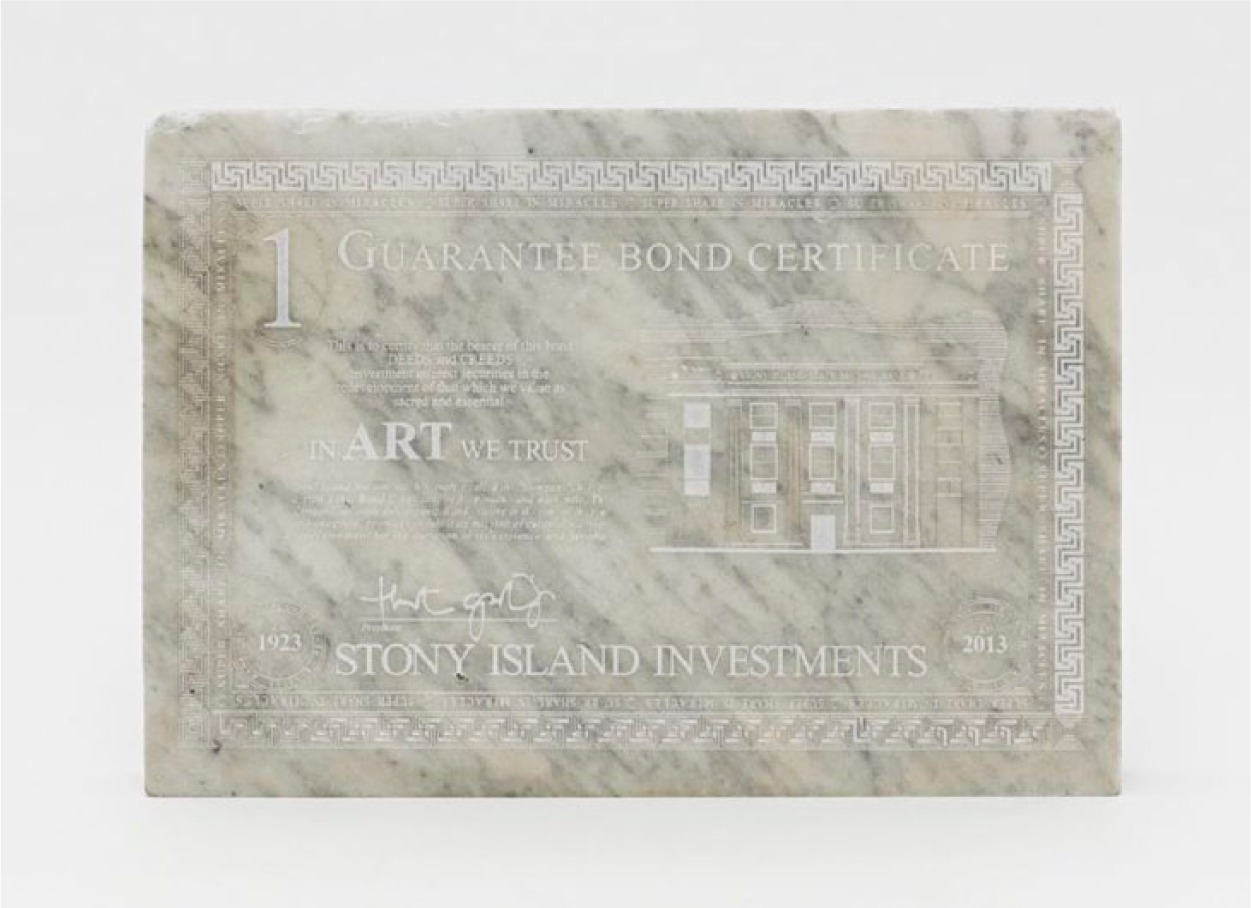
Theaster Gates, Bank Bond (2013), edition of hundred, marble.
Conclusion
In The Production of Space, Henri Lefebvre describes the city and its buildings as “theatres of memory” as well as “theatres of prophecy.” 43 The dream-like feeling steeped with nostalgia, archives, and reused materials that comes up in many of Theaster Gates’s constructions is an almost uncanny realization of this. One is never certain in Gates’s places, whether they are real or whether they are merely stages—highly functional and all-encompassing ones, nevertheless stages. Are we players in a piece, are we participating in staging relationships that in real-life might not exist, like during his dinners, are we in a place that is surreal for us to be in and as soon as we leave it we have to get into a car to leave the neighborhood and return to “our kinds of peoples”? This dialectic between social conflict, its aestheticization and value-generating potential as employed by Gates in his circular economy is often being mediated by gospel music. The musical performances during the dinners function as gesture of hospitality, of comfort, as well as ultimate reminder of an American past that’s never past. If Gates’s places are indeed stages, they are stages of a provisional theatre, a theatre that lives from spontaneous moments of sincere engagement, that lives from what the participants spill in at this very moment, a stage where we can see and meet ourselves as wishful participants.
Footnotes
Author’s Note
This research is part of a PhD dissertation at the Free University of Berlin.
Declaration of Conflicting Interests
The author declared no potential conflicts of interest with respect to the research, authorship, and/or publication of this article.
Funding
The author disclosed receipt of the following financial support for the research, authorship, and/or publication of this article: I would like to thank the Terra Foundation for American Art for their generous support of my research.