







Abstract
In the early nineteenth century, the (obsolete) Portuguese urban fortifications were frequently ruined and suffering from a gradual desertion around them. With the emergence of patrimonial concerns, those defensive structures began being considered as historical and cultural monuments. As a result, the isolation of these monuments became a common practice that often created public green areas (gardens and parks) framing monuments, giving them a picturesque image. The consequences of these rehabilitation actions on urban fortifications in Portugal are analyzed here, focusing particularly on those that created new public green spaces within and around urban areas. In fact, the shape of several Portuguese cities was conditioned by those interventions: not only were breathing areas conceived in the middle of dense urban masses, allowing their fruition by local populations, but also some ancient urban belts associated with former defensive needs were recovered by those interventions.
Prologue
With a few exceptions such as the Romantic writer Almeida Garrett (1799–1854), voices defending architectural heritage were generally concerned with exceptional monuments throughout most of the nineteenth century, 1 ignoring the patrimonial values associated with urban settlements. 2 Among the urban intervention practices at that time, made according to the exiguous economic possibilities of Portugal, were hygienist operations and modernizing actions in urban cores. Closely associated with progress, these actions usually consisted of the demolition of ancient buildings, replacing them with new ones and giving the old construction materials another use. The demolition of groups of buildings also allowed the opening of large avenues and squares, the construction of new public and residential buildings, the planting of gardens, the creation of road and railroad accessibilities, the integration of sanitary infrastructures, and the “liberation” of major architectural monuments—not forgetting also the increase of speculative interests from the real estate industry.
These hygienist operations, partially inherited from the Enlightenment’s urban plans, were part of the ambitious plans for the regularization and renovation of ancient urban cores, attempting to provide them with modern infrastructures. The most significant plan of this kind was applied in Paris between 1852 and 1870, according to the ideals of Baron Georges-Eugène Haussmann (1809–1891). As for obsolete fortified urban structures, systematic demolition frequently happened, mostly due to modern demands. The demolition of the bastioned wall of Vienna is the best-known case, originating the Ringstraße, an impressive urban belt around the old urban core that received a radial road and new public buildings.
In Portugal, as in other European countries, several gaps in ancient urban tissues were produced by the gradual desertion of some walled spaces, due to the migration of their populations to other places with better living conditions (health needs, communications and accessibilities, growth conditions and socioeconomic demands). The walled urban cores increasingly abandoned became partial islands of degradation without functionality. This was motivated by a long process of obsolescence of these medieval and modern fortifications.
First Attempts in Creating Public Green Spaces Associated with Ancient Urban Fortifications
The abandoned castle of the Moors (castelo dos Mouros) in Sintra was acquired by the Portuguese consort, King Ferdinand II (1816–1885) in 1838, at an auction in which the fortification was included along with the sixteenth-century convent of Our Lady of Pena (convento de Nossa Senhora da Pena) and its surrounding land (Figure 1). Since the Middle Ages this medieval fortification had become progressively an abandoned space, due to the migration of former dwellers to the village of Sintra, located at the foot of the mountain where the castle is sited. Ferdinand II was committed by the purchase contract not only to make repairs to the former convent, but also to ensure the conservation of the ancient fortification. 3 Ferdinand of Saxe-Coburg and Gotha came from a Germanic culture strongly influenced by the Romantic Movement, reflected in his passion for arts, culture, history and national heritage. Enthusiast of picturesque ambiences, Ferdinand II included in the construction program for his new castellated palace in Sintra an ambitious landscaping project, where the ruined medieval fortification would be the assured highlight of the palatial park.
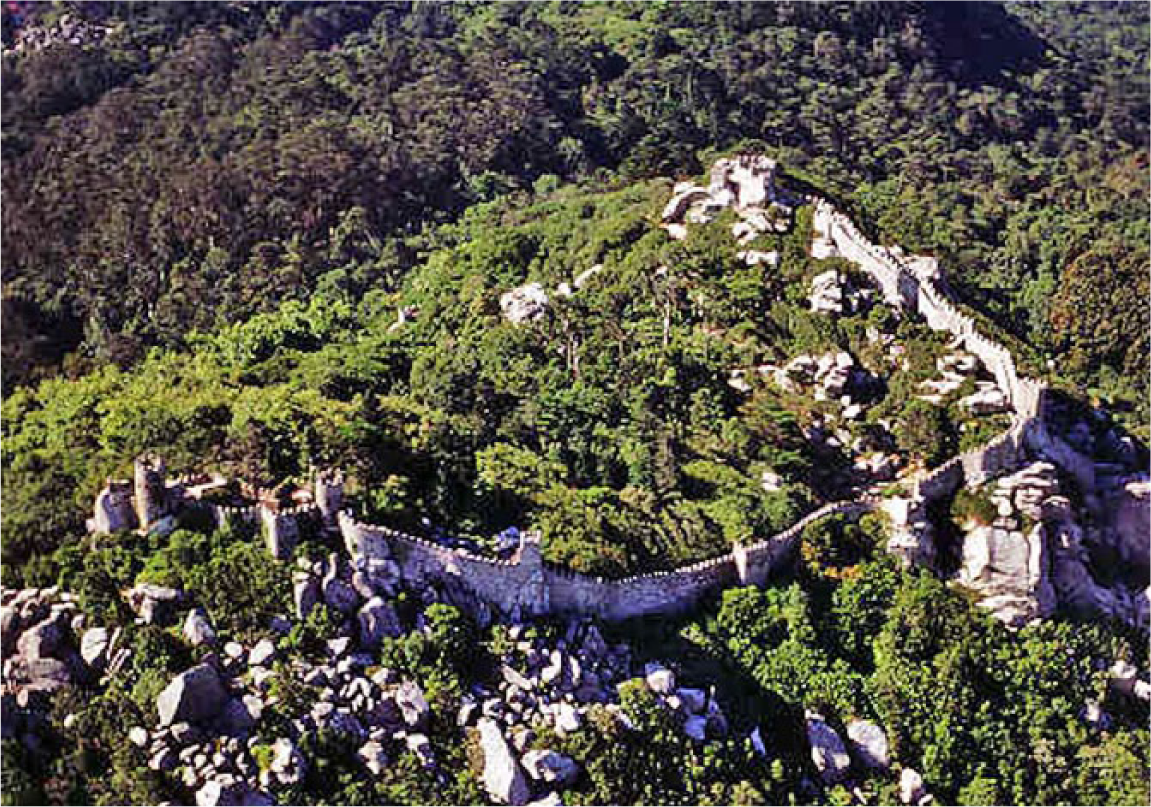
Note: Castle of the Moors in Sintra (source: Instituto para a Habitação e a Reabilitação Urbana, collection of DGEMN).
The Romantics were fascinated by the infinite splendor of Nature and its sublime landscapes of mountains, lakes, and forests, especially if adorned (in symbiotic complementarity) with ruins of ancient architectural structures, such as medieval castles, for instance. These picturesque sceneries intended to capture Nature’s perfection, where bucolic ancient ruins were melancholically marking the inexorable passage of time. Germanic and British Romantics were particularly attracted by these hedonistic feelings, and that is why several old and new castellated buildings underwent landscaping projects to frame them inside green spaces such as parks. The Germanic area was largely predisposed to these themes, having numerous fortifications surrounded by luxuriant forests, as can be seen for instance in the castellated palaces of Wartburg (Eisenach), Neuschwanstein (Hohenschwangau), Rheinstein (Trechtingshausen), Stolzenfels (Koblenz), Hohenzollern (Hechingen), or Reinhardsbrunn (Friedrichroda), the last belonging to Duke Ernst I (1784–1844) of Saxe-Coburg and Gotha, uncle of the Portuguese King Ferdinand II.
Ferdinand II made an (poorly documented) intervention to the ruined castle of the Moors in Sintra during the 1850s, which was to have been restricted to consolidation and rebuilding of missing battlements and parts of the defensive wall. 4 The Portuguese king had no interest in restoring the castle using inventive models, nor in losing the fortified structure due to its natural degradation. Because of these issues, one could say that the action taken was guided by an intention to stop the natural degenerative process and repair the defensive wall, towers, and the small chapel located within the walled area (probably the only built structures still standing inside the fortification). His purpose would have been to conceive a romantic green space where the old castle would contribute to establish a picturesque and hedonistic space. The placement of footpaths and profuse vegetation inside (and around) the walled area, where buildings were standing before, would contribute to the sublimation of this space, emphasizing the impression of a gradual return to Nature of the old fortified area. Despite the castle of the Moors no longer being part of the urban area, it is however located in the huge park covering the mountain and embracing the village of Sintra.
Similar measures to convert abandoned walled areas into green spaces were tested and implemented subsequently in some other instances, such as the walled areas of Évora, Santarém and Tomar. The ancient royal vegetable garden of Évora was transformed into a Romantic public garden between 1863 and 1879 by the Italian architect-scenographer Giuseppe Cinatti (1808–1879), installed in a space with the remains of the medieval city wall. Several scenic mock ruins (Ruínas Fingidas) were integrated using a defensive tower and reusing architectural structures from old convents and palaces that had been demolished. This garden became a privileged space for leisure and bucolic contemplation.
In Santarém, the abandoned space of the ancient citadel became a garden called Sun Gates (Portas do Sol) from 1896 onwards, after its conversion into a green urban space with a privileged sight over the Tagus River and its valley. As for Tomar, the walled area of the Templar castle, whose population had moved gradually to the new urban core near the Nabão River, began being gardened by monks of the adjacent convent of Christ (convento de Cristo), as part of its monastic enclosure. With the acquisition of the former convent in the middle of the nineteenth century by António Bernardo da Costa Cabral (1803–1889), Count of Tomar, this walled space underwent several interventions in order to improve the garden, especially from 1898 onwards. 5
Therefore, converting urban gaps in abandoned walled areas to be green spaces for public enjoyment was an option taken in several cases in Portugal, either as urban gardens or as parks located within cities’ peripheries. In some cases, when castles were surrounded by ancient urban tissues morphologically very dense, these new gardens became open spaces allowing the breathing and conviviality of local populations.
The nineteenth-century patrimonial interventions on architectural monuments usually considered them as unique museological elements that should be “released” from their surrounding urban tissue, individualizing and thus valuing them. As a result, some urban operations were taken trying to isolate architectural monuments by demolishing built structures added to them over time, and even the surrounding minor architecture. These operations were intended to monumentalize the major architectural structures by giving them an urban emphasis. 6 Concerning the fortified structures, several examples of this practice can be found throughout Europe, mainly the isolation of fortified gates as remains from vanished fortifications, as for instance the Soprana Gate in Genoa, the Palatina Gate in Turin, the San Donato Gate in Bologna, the Serrans Gate in Valencia, the Westgate in Canterbury, the Amsterdamse Gate in Haarlem, or the Brussels Gate in Mechelen, several of them in the middle of lawns. Such demolitions around fortified structures were, however, fairly rare in Portugal during the nineteenth century; unlike religious and palatial architecture, fortifications began being regarded very slowly as architectural heritage, especially the medieval ones. Only at the end of the nineteenth century did the appreciation of urban settlements as patrimonial heritage begin to acquire some relevance.
The municipalities, which often promoted the most destructive practices of urban intervention in ancient cores, began receiving severe criticisms from several patrimonial defenders. The latter accused the former of causing massive destructions within ancient urban tissues, in the name of supposed progress. 7 Placing value on urban cores as patrimonial heritage began acquiring more relevance in Portugal towards the end of the nineteenth century, with the publication of the book O Culto da Arte em Portugal by José Ramalho Ortigão (1836–1915). As part of the neogarrettian movement, which restored the Romantic cult for traditional and ethnographic ideals found in the works of Almeida Garrett, Ramalho Ortigão referred to the problems of the preservation of ancient urban settlements, criticizing the modernizing and hygienist actions in cities through substantial demolitions. According to Ramalho Ortigão, the ancient cores should be preserved not only for their value as testimonies of the past, but also because they could provide significant economic benefits from tourism. 8
The criticisms defending the preservation of urban cores were also made in other European countries from the second quarter of the nineteenth century. 9 John Ruskin (1819–1900) defended in his works The Seven Lamps of Architecture (published in 1849) and The Stones of Venice (published between 1851 and 1853) that spaces around monuments should be preserved because they were contextualizing them, facilitating their understanding and perception. Due to their proper identities and characteristics as repositories of physical and memorial contributions of several generations of inhabitants, the urban heritage should be unconditionally preserved, from the humble house to the most valuable architectural monument. In his work Der Städtebau nach Seinen Künstlerischen Grundsätzen from 1889, Camillo Sitte (1843–1903) recognized old cities as architectural monuments transmitting knowledge and memories and should, therefore, be preserved. Sitte also criticized the demolition of defensive walls, absurdly leaving their fortified gates as isolated monuments. 10 Among others, Max Dvořák (1874–1921) also defended the urban settlements against their destruction or modification without reasonable justification, because they would have important patrimonial values. In fact, even “façadist” operations of beautification were criticized by Dvořák, who pleaded that when new, constructions should be simple, functional, and respectful of local traditions.
The changing of the Portuguese people’s mindset regarding patrimonial questions, provided by the First Portuguese Republic (Primeira República) instituted in 1910, allowed the implementation of several civic participations that contributed to educate populations about the preservation of urban cores and natural landscapes. The Law of the Portuguese Cultural Heritage 11 (Lei de Bases do Património Cultural Português), enacted in 1911, provided for the expropriation of monuments and their surroundings, based on the public interest. It was also attempted to define specific urban rules for areas involving classified buildings, in order to protect them. 12
However, it was only in 1924 that the protected areas around monuments were legally established, 13 forbidding new structures (non ædificandi areas) or simply getting a special protection. Defined by a radius of fifty meters around classified monuments, these protected areas had special rules intending to prevent the modernization of these urban areas from an image level (kinds of “old-fangled” and picturesque features that were attempted to be preserved). Property owners inside protected areas were also required to comply with determined stipulations. The preservation of the surrounding frame of monuments was generally based on aesthetic assumptions, encouraging more and more the Portuguese people acquiring knowledge and becoming concerned about landscaping values—in some aspects anticipating the Athens Charter for the Restoration of Historic Monuments of 1931. The Portuguese legislation recognized the importance that areas around architectural monuments increasingly began acquiring.
The Isolation of Architectural Monuments and the Creation of Public Green Spaces
Under the dictatorial regime of New State (Estado Novo), from 1933 onwards, the law establishing the rule of fifty-meter radius around architectural monuments was reiterated. 14 However, it was also established that the General Bureau for the National Buildings and Monuments 15 (Direcção-Geral dos Edifícios e Monumentos Nacionais—DGEMN) and the National Board of Education (Junta Nacional de Educação) could also propose larger protected areas for monuments whenever the previous rule was considered inadequate. During the 1930s, the DGEMN carried out several gardening and arborisation operations in empty spaces around and inside some fortifications that had undergone patrimonial interventions towards the end of the nineteenth century and the beginning of the twentieth century, as for instance in the fortifications of Tomar, Feira (Santa Maria da Feira), and Leiria.
In Santa Maria da Feira, between 1920 and 1921, the Surveillance Commission for the Safeguarding and Conservation of the Castle of Feira (Commissão de Vigilância pela Guarda e Conservação do Castello da Feira) took the initiative of establishing a protected area around the castle in order to preserve its natural frame. 16 This was the first known case in Portugal where a special zone of patrimonial protection around a military monument was established. In the following two decades, this fortified structure and its surrounding area continued to be the object of several patrimonial interventions.
Concerning the intervention made to the fortification of Leiria, whose population also abandoned the walled area to establish themselves near the Lis River, after his first proposal to restore the castle, 17 the Swiss-born architect Ernst Korrodi (1870–1944) realized that it was impossible to restore it based on the remains and insufficiently reliable documentation. Due to that, the operations performed by him in the 1910s and 1920s attempted to value the ruined structure as a “dead monument” containing an aesthetic capable of evoking hedonistic feelings. 18 This was achieved with an arboreal integration of the monument and the introduction of pedestrian paths for visual contemplation and enjoyment. 19
Besides some approach to the prerogatives of Romantic landscaping, the intervention made by Korrodi was partially influenced by the philological ideas of Camillo Boito (1836–1914) and also by the thoughts of the Society for the Protection of Ancient Buildings (SPAB). The SPAB was founded in 1877 by William Morris (1834–1896) among others, and its goal was to protect monuments and to promote preventive conservation values, condemning strongly the arbitrary restorations in ancient buildings. This movement had an enormous influence over patrimonial actions, especially in the United Kingdom: for instance, the castles of Caergwrle and Llawhaden (Pembrokeshire) became ruins, and the option taken was to preserve them by consolidating the ruins, applying a conservative maintenance and composing the space around them. That way the structures were turned into picturesque ruins within gardens with green lawns, giving the remains an attractive and respectful romantic ambient where the ancient testimonies would have the main importance.
Returning to Portugal, the ideological policy of the Estado Novo credited a major role to national monuments, which would represent a huge symbolic load related to the patriotic Portuguese identity. Under the motto “material restoration, moral restoration, national restoration” (restauração material, restauração moral, restauração nacional), 20 classified medieval monuments became clearly favoured in the interventions made by DGEMN, since they were considered testimonies of national origins and were revealing emblematic events of the national history. 21 That allowed an easy retention of ideological collective messages given by the strongly nationalist regime. 22
The appropriation of medieval fortifications as patriotic national symbols was highly potentiated during the Estado Novo, which converted them into guardians of the Portuguese people, territory, and national spirit. Medieval fortifications—and also, in a certain way, the modern ones—were thereby recognized as privileged testimonies of the national formation, and the Estado Novo regime considered that it was its obligation to revert the degraded condition of them.
In addition to the fortified structures, their surrounding spatial context began being a target for patrimonial interventions conducted by the DGEMN. As Miguel Tomé says, the surroundings of fortifications were perceived as their formal and functional extension, being part of their ancient defensive system. Besides releasing the defensive monuments from the amalgam of “spurious structures” that were hiding them, the demolition of those built structures around fortifications intended to assume the purpose of recovering their supposed original spatial frame. These interventions generally consisted of the creation of a vast green space surrounding the fortified monuments, intending to recover their ancient defensive devezas (an open and empty space around fortifications, like a meadow).
After the interventions, the fortifications became thus substantially isolated from their contiguous urban mass. Consequently, gardens and public urban or semiurban parks were formed around and inside the fortified monuments, which were frequently surrounded by peripheral paths. In addition to the reframing of ancient fortifications, these new green spaces were also playgrounds and leisure spaces for local populations, becoming often breathing areas inside dense urban tissues. Generally, masses of trees and footpaths located around fortifications were carefully studied in order to take advantage of the best visual approaches of the monuments, allowing an outside contemplation and giving a better visual perception of them. More than mere objects artificially musealized, the ancient fortifications standing dominantly in green spaces carefully disposed around them produced a huge visual impact on the (urban and rural) landscape.
The vast program of patrimonial interventions carried out on Portuguese ancient fortifications in the end of the 1930s and in the 1940s included broader concerns with the surroundings of military monuments. For instance, in the bulletin Boletim da DGEMN dedicated to the intervention in the castle of Lanhoso (Póvoa de Lanhoso), mostly carried out between 1938 and 1939, the problems associated with the surroundings of medieval fortifications were specifically mentioned here, as well as the crucial need for recomposing a “supposed” natural frame in connection with inherent picturesque values. This was achieved by making an aesthetic reshuffle of vegetation and ground, complemented with the construction of better accesses to the old fortifications in order to facilitate visits by the public. 23
Much more significant was the intervention made to the castle of St. George in Lisbon, carried out between 1939 and 1947 for the celebrations of the Double Centenary of the Foundation and Restoration of the Independence of Portugal (Duplo Centenário da Fundação e da Restauração da Independência de Portugal) and for the commemoration of the 8th Centenary of the Conquest of Lisbon (Oitavo Centenário da Tomada de Lisboa) (Figure 2). The Portuguese dictator António de Oliveira Salazar (1889–1970) and his minister of Public Works and Communications (Obras Públicas e Comunicações), Duarte José Pacheco (1900–1943), expressed both the symbolic importance of the castle of St. George as a “sacred spiritual acropolis of the Portuguese nation,” by analogy with the Acropolis of Athens dominating the urban landscape of the Greek capital. The intervention carried out to this castle was conditioned by the desire to provide a monument with strong visual impact standing out on the urban landscape of the Portuguese capital.
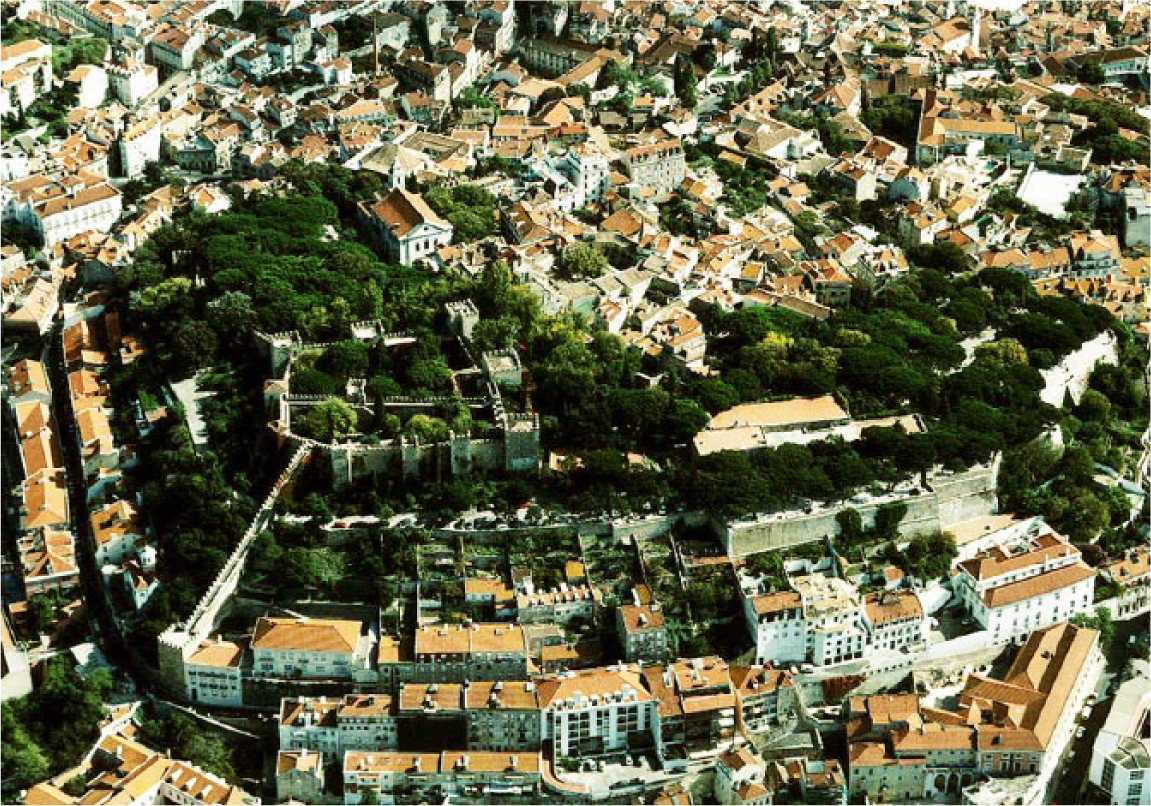
Note: Castle of St. George in Lisbon (source: Instituto para a Habitação e a Reabilitação Urbana, collection of DGEMN).
The initial operation carried out directly on the medieval fortification was the demolition of buildings and other structures considered “parasitic,” releasing thus the old castle. That was followed by its restoration, producing a haughty silhouette that could be recognized immediately as an imposing medieval fortification from when Lisbon was conquered from the Moors by the first Portuguese king. The recomposition of the area around the castle was established, thereby allowing its perception from other parts of Lisbon. Once again the organization of a green space allowing an isolated appearance of the castle of St. George was intended by the intervention. The castle rose in a visually dominating mode over the ancient core of Lisbon. 24
Significantly, a document from 1940 by Augusto Frazão Etur, sent to the DGEMN’s director for Monuments, Baltazar da Silva Castro (1891–1967), dealt with the problem of the natural frame of hills with castles. 25 In this document, Augusto Etur proposed the maintenance of the preexisting natural vegetation along with a judicious arboreal composition, the construction of earth retaining walls made with stone and rough-looking battlements, and the introduction of paths with Roman pavement around the fortification, allowing for its visual contemplation. 26 Despite trees, bushes, and other vegetation planted in 1944, in reality the landscaping project for the castle’s garden/park, conceived by Gonçalo Ribeiro Telles and José Pulido Garcia, was not consistently implemented before 1959.
The coeval intervention carried out in Guimarães followed several assumptions similar to the ones taken in Lisbon. Once again, the symbolic importance attributed to Guimarães as the birthplace of the Portuguese nation was intimately connected to the castle of St. Mamede, traditionally considered the place where was born the first Portuguese king, Afonso I Henriques (1109–1185). Near it was the chapel of St. Michael, where Afonso Henriques was supposedly baptized, and the palace of the Dukes of Braganza (paço dos Duques de Bragança), directly related with the royal dynasty that regained the Portuguese independency from Spain in the seventeenth century. These three monuments were placed next to each other in the upper part of Guimarães, which was gradually abandoned by its population in favour of the lower part of the city.
From the middle of the 1950s onwards, Rogério Azevedo (1898–1983) and António Viana Barreto 27 (1924–2012) projected an immense green park for the area around these three architectural monuments, complementing the restorations carried out on them. The park consisted of an immense lawn crossed by footpaths and punctuated by arboreal volumes that monumentalized the classified buildings and enabled the creation of privileged perspectives for their contemplation. 28 According to José Ferrão, the demolition of the remaining residential buildings and the gardening of this space, besides associating these three national monuments as a single monumental set, created also the isolation of this space from the urban tissue of Guimarães, recovering and thereby reestablishing the symbolism associated with sacred hills. 29
The third and most emblematic vertex related to the double centenary celebrations was the intervention performed in Vila Viçosa. The demolishing operations of buildings added to the defensive city wall and the restoration of fortified structures were followed by the recomposition of the surrounding area of the fortification (formed by the fifteenth century “artillerist castle” and the medieval city wall around the oldest part of Vila Viçosa). While inside the walled area a green space isolating the artillerist castle from the intramural urban core was created, the space outside the city wall was transformed into a park with a vast lawn delimited by a path around the fortification. Carried out between the late 1930s and the early 1940s, the operations intending to redefine the local image were focused on the medieval fortification, but implied also a partial reconfiguration of the existing urban space.
As mentioned by Nuno Portas, the new urban spatial structure for Vila Viçosa proposed to connect its fortified complex, the complex constituted by the palace of the Dukes of Braganza (palácio dos Duques de Bragança) and convent of St. Augustine (convento de Sto. Agostinho)—the House of Braganza’s pantheon—and the town’s main square containing the Town Hall and the parish church. This was achieved by demolishing several blocks of buildings, producing two main results: the expansion of the main square into the new garden around the city wall, allowing a visual perspective scenically favoring the fortification through its monumentalization, and the introduction of a new avenue connecting the palace’s square and the main square. 30
Despite having eventually some influences from similar actions taken since the nineteenth century, these operations isolating monuments can be compared to others made during the Italian dictatorial regime of Benito Andrea Mussolini (1883–1945), which had been in many aspects a model for the Portuguese Estado Novo, including the patrimonial panorama. For instance, the regulatory plan for Rome presupposed the opening of large urban roads (as Via della Conciliazione) and the demolition of urban quarters considered as lugubrious (as the old Borghi quarters). These practices, known as sventramento, implied also archaeological excavations and demolition of modest buildings attached to ancient structures considered as architectural heritage, in order to monumentalize them.
As for Portugal, a number of other interventions in fortified structures created green parks and other public spaces, recomposing scenically the landscape around defensive structures. Particularly from the beginning of the 1940s until the beginning of the 1960s, buildings added to defensive walls were demolished, followed by the restoration of fortified structures and recomposition of their nearby surroundings according to formulas usually based in the introduction of green spaces. This can be observed in parts of the city walls of Oporto, Trancoso, Beja, Évora and Lagos, as well as in the castles of Chaves and Ourém, and on the hill where the fortification of Santiago in Palmela stands. 31
Nevertheless, even when some huge interventions in areas around fortifications were carried out intending to transform them into green spaces, the majority of the proposed interventions in Portugal were minimalistic actions—especially those where fortifications were far from urban settlements. These minimalist interventions tried to preserve the existing natural frame by performing minimum compositions on vegetation and paths, as happened in interventions carried out at the fortifications of Castro Laboreiro, Numão, and Moreira de Rei, among others. This kind of intervention was most probably influenced by SPAB’s precepts, namely, with the disagreement with restoration and the supporting of conservation through consolidation, continuous maintenance, and recomposition of surrounding areas of monuments, by turning them into romantic and picturesque green spaces with gardens and lawns respecting the architectural remains.
Beautification Plans, Improvement Plans and Safeguarding Plans (Planos de Embelezamento, Planos de Melhoramento, and Planos de Salvaguarda)
As happened with other architectural monuments, the patrimonial interventions carried out at fortifications were also extended to their surroundings, trying to scenically frame and monumentalize these classified buildings. The operations performed in spaces around ancient fortifications generally consisted in their isolation from other buildings through demolishing actions and recomposition of green spaces, emphasizing their uniqueness and creating privileged perspectives of them. The impossibility of demolishing all the nearby buildings, along with the progressive recognition of relations between fortified structures and their surrounding urban environment, began changing to options that respect the common architecture. The minor architecture began being also recognized as heritage, because it composed the surrounding area of military monuments by giving scale, visual relations, and framing and contextualizing them.
Only from 1945 onwards, after the end of most of the major restoration interventions connected to the double centenary celebrations, the first proposals for the definition of Special Areas of Protection (Zonas Especiais de Protecção—ZEP) established around architectural and archaeological monuments began appearing. This was possible because of the experience acquired after the recognition of connections between monuments and their surroundings, due to the interventions previously made. 32 The ZEP began being generally applied as a complement to the vast interventions carried out to architectural monuments, intending to protect their picturesque surroundings that were contextualizing and, at the same time, favoring predetermined views and perspectives of them. 33
Although in several cases an effective safeguarding of monuments’ surroundings existed, demolishing operations of structures around monuments were frequent when financial means were available. Nevertheless, demolishing operations of ancient urban settlements with hygienist objectives or for isolation of architectural monuments began to be increasingly criticized, including inside the DGEMN itself. In fact, Raul Lino da Silva (1879–1974) was one of the DGEMN’s leading voices that criticized those operations. 34 On the other hand, the protection of urban sets of significant dimension surrounding architectural monuments increased the consciousness of the importance of minor architecture as depository of picturesque and aesthetic values, along with the eminent historic values. Ancient buildings could ensure authenticity to the antiquity of urban cores, contextualizing the architectural monuments by introducing intimate connections between singular monuments and their surrounding minor architecture and public spaces. These three elements started to be observed as hinged structures, which, when read together could enable the understanding of several of their characteristics: their historic stratification level, urban morphology, construction techniques, implantations, and alignments, among others. 35
The respect for landscapes as cultural heritage needing to be preserved also assumed importance. The patrimonial interests evolved from individual protection of architectural monuments to collective protection of urban complexes around monuments or parts of cities, and later to urban cores, including entire towns. A significant change happened in the patrimonial policy of the Estado Novo during the period when Eduardo de Arantes e Oliveira (1907–1982) was minister of the Public Works, between 1954 and 1967. The concept of heritage was definitely extended to popular architecture and to landscaping context (urban, rural, and natural). 36
The beautification plans in urban settlements were the first where urban cores were assumed as heritage. The patrimonial objectives of these plans, such as the ones carried out in the walled towns of Óbidos, Évoramonte, Guimarães, and Miranda do Douro, were focused on the preservation of the environmental urban character through interventions performed in public spaces, as well as the appreciation of architectural elements considered as typical and characterizing public space (façades, portals, balconies, eaves, etc.). 37 In the middle of the 1950s, beautification plans in Portugal began evolving to improvement plans, denoting progress concerning the patrimonial concepts and procedures of patrimonial safeguarding. More than mere cosmetic operations in public space, the improvement plans were not based on specific interventions in key points—generally around architectural monuments or in squares and other delimited spaces—nor in stylistic depuration of façades. Instead, these plans were included in urban plans of a larger scale that effectively introduced significant improvements in urban infrastructures and intervened spaces.
One of the main objectives of these operations was to provide the inhabitants of intervened urban settlements with better conditions appropriate for contemporary living demands; this was visible in the supply of better infrastructures (sanitation, electricity, telecommunications, and water supply). In addition, the requalification of public spaces was achieved with de-densification operations through the demolition of some specific built structures and with the rehabilitation of monuments and some private buildings. For the implementation of improvement plans, walled cities with image unity and urban integrity but also with picturesque features for touristic purposes were generally chosen, such as the plans carried out in Valença, Bragança, Marvão, Almeida (Figure 3), and Monsaraz.
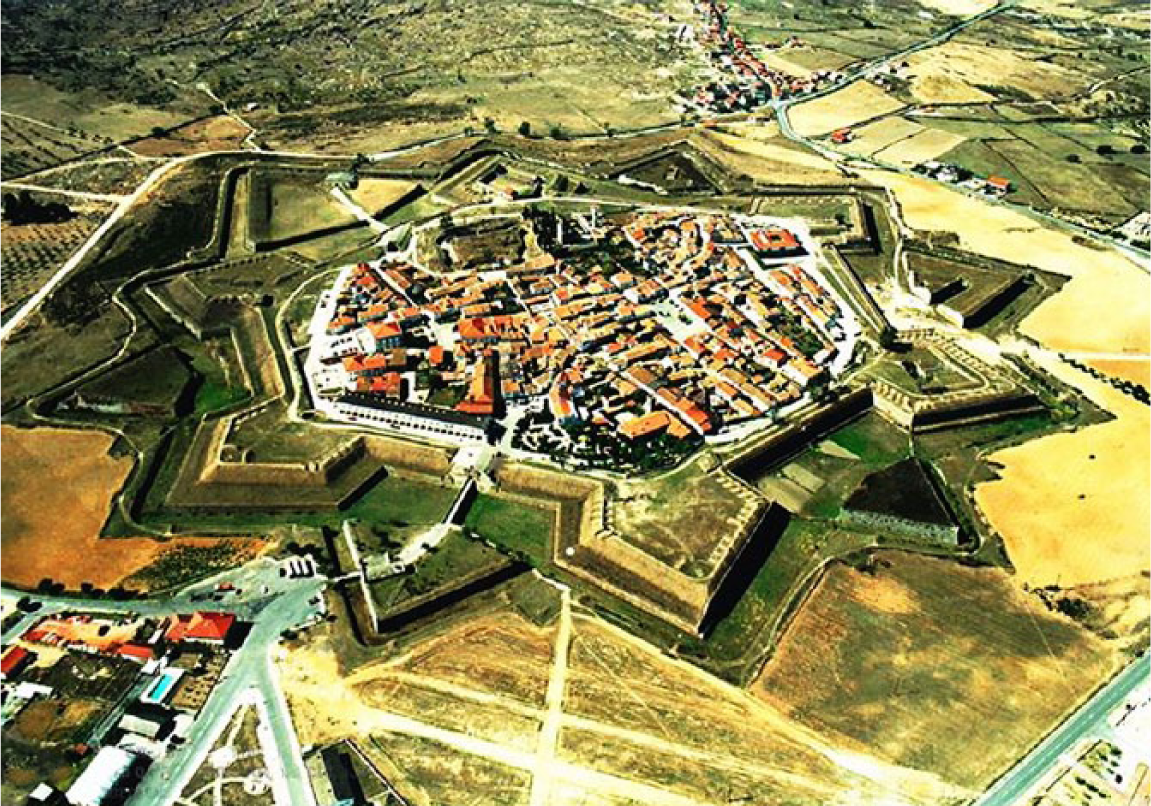
Note: Fortress of Almeida (source: Instituto para a Habitação e a Reabilitação Urbana, collection of DGEMN).
This kind of urban intervention can once again be affiliated to European planning movements, this time closely connected to some precepts of Gustavo Giovannoni (1873–1947). As can be seen in his book Vecchie Città ed Edilizia Nuova published in 1931, Giovannoni claimed that cities reflected its own inhabitants through their history, ambitions, character, artistic qualities, memories and, due to that, their own identity. That is why “minor architecture” could not be considered indifferently as a mere picturesque frame of architectural monuments, but as a monumental urban set. Being living monuments, their preservation would only be possible with their continuous use by people. To do that, diversified and compatible functions and lifestyles should be reestablished or introduced in preexisting urban settlements.
Refusing massive demolitions of old buildings, Giovannoni developed a model of surgical demolitions of dissonant elements (“parasitic” structures, ruined buildings, etc.) in the urban tissue, calling it diradamento. This allowed the creation of small breathing spaces (gardens, squares) in dense ancient quarters, as well as the introduction of new public buildings and infrastructures, improving local hygienic conditions. The morphologic homogeneity of ancient urban cores, such as building heights, colors, architectural languages, materials, shapes, and so forth, would be regulated by established measures. If necessary, reintegration of façades could be made to achieve their pristine image, avoiding nevertheless revivals in new buildings. The ancient urban cores would be confined and separated from new urban areas where, in many cases, the old defensive walls became the border between both.
In Portugal, the intervention carried out in the fortified city of Valença presented another distinct problem related with urban bastioned walls: the complexity of their safeguard was different from the medieval walled cities. Several urban walled defenses had already lost their strategic and functional importance in the Middle Ages. Because of that, city walls were frequently abandoned, fell into ruins, were dismantled, or were obstructed by buildings occupying the ancient devezas. This way, the patrimonial interventions were generally composed of demolitions in order to clear portions of the defensive walls, being completed with partial reconstructions whenever needed and the gardening of the surrounding ground to allow an allusion to the ancient devezas. However, that abandonment did not happen with bastioned walls built in strategic locations where their functionality was maintained, in some cases until the nineteenth century. The maintenance of the military easement included not only fortified structures, but also all the field of fire (the open area around the fortification). That fact contributed to maintaining the whole area free from other constructions. 38
According to Miguel Tomé, the difficulty of safeguarding this heritage was not related to its restoration or reconstruction, but with the subsequent maintenance and conservation of the physical integrity of these enormous defensive complexes, constituted by bastioned walls with large surrounding spaces. 39 Consequently, the modus operandi followed by the DGEMN consisted in interventions in the intramural urban core, along with interventions in the fortified monument and in the landscaping component framing it. In addition to the restorations and improvement actions in defensive structures (bastioned walls, bulwarks, ditches, ravelins, tenailles, hornworks, and others), excavations were also carried out intending to reconstitute the configuration of the surrounding ground exterior to the bastioned wall—the ancient field of fire, including slopes, scarps, and glacis, among others.
Despite the inevitability of cleaning undesirable vegetation in the former field of fire, part of this vegetation was needed to assure the stability of the soil and of the defensive structures made with it. This fact allowed keeping these vast areas as green spaces free from construction. The maintenance and protection of green spaces with large dimension represented indeed a serious problem, which sometimes resulted in neglect due to the lack of funds. 40
The gardening of these spaces was frequently complemented with other actions: the construction of peripheral paths around defensive walls allowing privileged views over the monuments, and the expropriation and demolition of buildings added over time in the interior side of defensive walls, clearing them and allowing the incorporation of an intramural peripheral path punctuated by gardened spaces (especially in ancient bulwarks).
Epilogue
From the beginning, patrimonial interventions on the Portuguese architectural heritage of defensive nature often generated the creation of urban and semiurban green spaces (gardens and parks). This was achieved by occupying and reformulating abandoned areas formerly belonging to fortified structures, by demolishing buildings added to fortifications throughout the ages or by taking advantage of empty fields previously imposed by military easements. Besides having partially recovered ancient devezas and fields of fire—and, through these, turning visible again one of the most important urban belts marking an important stage of the city’s evolution—these interventions modified the urban morphology of some Portuguese cities. This was done by allowing the creation of green spaces for breathing and relief inside dense urban tissues, by acting aesthetically on monuments and city landscapes, and by generating cultural centers of leisure allowing for the conviviality between local communities.
The following two decades after the fall of the dictatorial regime (in 1974) witnessed a slow decline in interventions on the architectural heritage; however, the beginning of the new millennium marked a huge increase of interventions on ancient fortifications through the Program for the Recovery of Castles (Programa de Recuperação de Castelos) promoted between 2000 and 2006 by the Portuguese Institute of the Architectural Heritage (Instituto Português do Património Arquitectónico—IPPAR). This program had several goals, some of them continuing previous actions, namely consolidation, recovering and rehabilitation of ancient fortifications, valorization through their revitalization for society’s leisure, and study and promotion of this heritage. The assignment of new functions to military monuments allowed their reintegration in the contemporary social life, thanks to a more consistent use that ensured their future operativity while they were functioning as catalysts of urban regeneration. 41
The walled spaces continue to be converted into open spaces frequently gardened, some of them complementing cultural functions (museological or expositive) or even hotel functions. These new green spaces for leisure can periodically be used for cultural events (theatre, music, expositions, recreations, etc.) through the insertion of permanent or temporary supporting structures, which influence the perception of these fortified spaces. Even spaces around military monuments continue to receive interventions, most of them by the creation of gardened parks with lawns, trees, and other kind of vegetation.
Footnotes
Declaration of Conflicting Interests
The author declared no potential conflicts of interest with respect to the research, authorship, and/or publication of this article.
Funding
The author received a grant from the Foundation for the Science and the Technology (Ph.D. grant nr. SFRH/BD/21695/2005) for the research containing this article.