







Abstract
The Chicago suburb of Naperville, Illinois, today has over one hundred forty thousand residents and is considered a “boomburb” because of its double-digit percentage growth over several decades. How did it reach this point? Explanations of urban growth—including the Chicago School and political economy perspectives; categories of suburbs, like boomburbs and edge cities; and narratives within Naperville itself—highlight different mechanisms at work. This study considers the factors that influenced Naperville’s growth and how each narrative fits the suburb’s development. The implications for future studies of suburban growth include the unpredictability of growth as it is happening, recognizing the limits of categorizing suburbs, undertaking comparative studies of suburbs across types or within regions, and not relying heavily on analyses of suburban outliers and unusual cases (like Naperville).
Naperville, Illinois, in 1955 looked like many other post–World War II suburbs: some signs of postwar residential construction in a small community founded in 1831, railroad connections to the still-growing city of Chicago, and efforts by local officials to plan for future growth. 1 Yet, by 2000, Naperville had experienced double-digit growth for multiple decades, the only such rapidly growing large suburb of over one hundred thousand residents outside the South and West (fifty-four total) to earn the designation of “boomburb.” 2 Its 2010 population was one hundred forty-two thousand, making it the fifth-largest city in Illinois. In addition to a growing population and square mileage, Naperville is also known for numerous white-collar businesses and jobs within its city limits, particularly along Interstate 88. Thus, some have labeled Naperville an “edge city” (one of over two hundred in the United States) or a “technoburb.” 3 A high quality of life accompanied the large population and numerous jobs: Naperville has a thriving downtown with national retail stores, an oft-visited Riverwalk along the west branch of the DuPage River, high-performing schools, a median household income of just over $108,000, and low crime and poverty rates. These factors helped the city finish in the top three of Money’s top places to live in 2005, 2006, and 2008. 4
How exactly did Naperville reach this point? Would observers in the early 1950s been able to predict Naperville’s growth based on what they knew then? Why did Naperville achieve this status while other nearby suburbs, others in the Chicago region, and many suburbs in the United States did not? This study looks at five explanations or narratives for Naperville’s growth: two general theories of urban growth within urban sociology, human ecology, and political economy; two explanations based on two different categories for suburban types in which Naperville is often placed; and the narrative of growth proposed by some Naperville leaders about their own community.
To better understand Naperville’s growth and development, I first look at Naperville’s status in 1955 as a relatively small community and then explore key factors since then that have significantly altered the suburb and contributed to its rapid growth. The study concludes with a discussion of how these scholarly and internal narratives help explain Naperville’s growth and how scholars of suburbia can better examine causal factors behind suburban growth.
Explanations for Suburban Growth
Suburban growth in the United States has been steady since the early 1900s. In 1910, 7.1 percent of Americans lived in suburbs, while in 2000, 50 percent called the suburbs home. 5 This growth has drawn the attention of numerous scholars seeking to uncover the mechanisms behind it and both the old and new communities shaped by suburbanization.
Sociologists at the University of Chicago in the 1920s were some of the first to systematically study urban growth. The approach of the Chicago School became known as urban ecology or human ecology. Borrowing from ecological understanding of organisms, the underlying principle for urban ecology is the competition for space and resources. 6 Given the scarcity of land in an urban area, those with money can afford the higher prices near the center of the city, while those with fewer resources are pushed toward the edges. Succession is the process by which inner zones expand to outer zones through invasion. Thus, when land or building prices become too steep in the central business district, development spreads out though the suburban development and leads to increased pressure for central cities to provide services. 7
The Chicago School approach was famously expressed in a diagram of a city with a central business district surrounded by concentric circles marking different zones of development. 8 Within the next few decades, several other urbanists riffed on that original model, making room for sectors along transportation corridors or multiple nodes with development surrounding each node. 9 Suburbanization was viewed as the result of centrifugal drift, outward growth from urban centers, as well as decentralization and deconcentration, the relative rapid growth of suburban rings and decreasing densities in cities. 10 However, by the 1960s, more scholars argued the ecological view did not fit all cities outside of Chicago and that the perspective no longer fit a growing interest in explaining inequality and social conflict. 11
In contrast to competition for space, the political economy view argues political and business leaders have the ability to place and construct developments where they can make money. Urban development is the result of a political decision-making process, and studying development involves asking, “Who creates cities?” 12 Though not ordered in concentric rings, urban and suburban development is not random or haphazard as it is organized around maximizing profits. In addition to actions by politicians and those connected to them, developments are often the result of the “FIRE” industries—finance, insurance, and real estate—which profit or benefit from development. Those with economic and political means are able to dictate what kinds of developments are built and where they are constructed.
Scholars following this perspective have often focused on urban “growth machines” made up of political and business leaders and supported by other civic leaders. 13 These machines rarely question the assumption that development, especially the claims of jobs created by growth, is an unmitigated good. The growth machine promotes a sense of “we feeling” in the community and conducts booster activities. The growth machine uses local funds and federal funds, manipulating “government resources to serve the exchange interests of local elites, sometimes at the expense of one another and often at the expense of local citizens.” 14 Growth machines have been present throughout U.S. history as cities competed for universities, cultural institutions, and transportation. Places, including suburban locales, then become stratified as local governments can offer certain goods, like a higher quality of life and lower taxes, accessible only by well-resourced actors. 15
While these two theories in urban sociology broadly explain urban and suburban growth, scholars have developed suburban types to help differentiate between the thousands of American suburbs. The categories cover the wide range of American suburbs, from “ethnoburbs” with sizeable minority populations to industrial suburbs to gated communities to working-class suburbs. 16 Naperville’s growth after 1970 led to its designation as a boomburb. A boomburb is a suburb with a population over one hundred thousand, has had double-digit growth rates each decade since 1970, and is not the primary city in the metropolitan region. Of the fifty-four boomburbs based on 2000 Census data, Naperville, Illinois, is the only one not in the South or West. 17
Lang and LeFurgy argue boomburbs developed for multiple reasons. Such growth was not preordained; many of them were small communities before World War II, giving little indication of their future growth. Online histories suggest the four forces that later led to growth include “highways, defense industries, water, and annexation.” Additionally, Lang and LeFurgy add the importance of new innovations, including air conditioning and tract housing, as well as broader population shifts to metropolitan areas in the South and West. 18
Naperville has also been described as an edge city. The emphasis in defining an edge city is not just its explosive growth; it is defined by large amounts of office and retail space and the jobs that come with it. An edge city has five features: more than five million square feet of office space, more than six hundred thousand square feet of retail space, “more jobs than bedrooms,” that it “is perceived by the population as one place,” and that it “was nothing like ‘city’ as recently as thirty years ago.” 19 In other words, edge cities combine the office and retail space of large cities with the suburban lifestyle, reintegrating home and work in a way that early suburbs tried to pull apart by providing spaces for homes away from the city.
Garreau suggests edge cities tended to form at the intersection of major roads after World War II as office and retail firms set up to take advantage of automobile access. These conglomerations built around major intersections could occur in three different settings: “uptowns,” where edge cities emerged from older communities that predate the car; “boomers” located at major highway intersections and often built around a shopping mall; and “greenfields” that got their start with one developer who wanted to do something big. Garreau notes that because uptowns have established buildings and grids, “they have layers of development,” including the new office and retail spaces. 20
Additionally, internal understandings of a community can shape outcomes. These collective understandings are very important; when important developments or events are up for discussion, local leaders and residents often draw upon the established “character” of the community and use it as an influential factor in their decision making. 21 Thus, it is not just objective details that matter; the collective understanding and memories regarding a community are still influential even if they are not necessarily valid in a causal sense. Suburbs as described by urban ecology, political economy, and suburban types may have shared traits, but community-specific characters as understood by local leaders and residents lead to unique outcomes.
All together, these five explanations suggest multiple factors could be at work in the growth of suburbs and, more specifically, in Naperville: competition for land as a city and metropolitan area expanded; the actions of politically and economically connected leaders seeking growth and profits; the importance of more recent changes, like highways and house-building techniques; demographic shifts to new metropolitan areas within the United States; the locations of key intersections and highways; and internal narratives and understandings that shape subsequent decisions. Each perspective favors particular mechanisms for suburban growth, but how does this compare to how local leaders in Naperville describe their own community’s growth and success? My archival and interview research within three suburbs in DuPage County, Illinois—Naperville, Wheaton, and West Chicago—suggests local leaders are likely to attribute the success to positive decisions made within the community. When asked, Naperville leaders tended to emphasize the city’s actions in prompting its own growth.
I next quickly look at Naperville’s state of development in 1955 at the beginning of post–World War II suburban growth and then examine the key events that prompted its explosive growth into the early twenty-first century.
Naperville’s Growth as of 1955
Naperville has a longer history than many Chicago suburbs, due to its founding in 1831 as one of the first communities in soon-to-be-formed DuPage County (see Table 1). 22 Although most of the suburb’s growth occurred after World War II, Naperville’s date of founding sets it apart from suburbs established in later waves of suburban development that did not have decades of history to draw upon. 23
Influential Moments in the History of Naperville, Illinois.
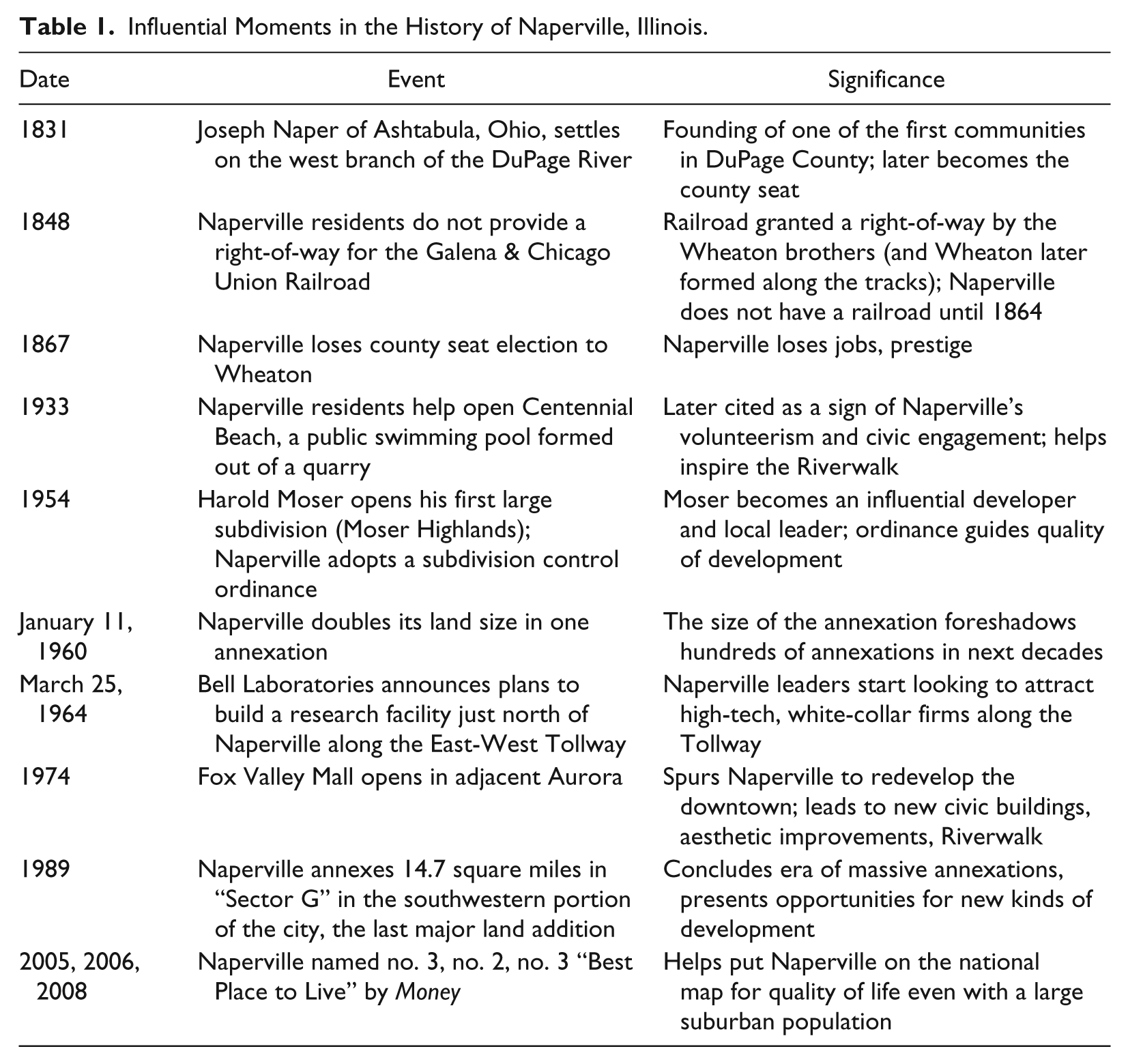
Naperville was the first county seat in DuPage County. However, it ran into some trouble in the next few decades. Naperville initially turned down the first railroad line out of Chicago in the late 1840s because it had a plank road to the city. 24 The railroad leaders then went north to the Wheaton brothers, who granted a right-of-way to the same railroad and later helped found a community bearing their name along that line. 25 Naperville lost the county seat to Wheaton in the 1860s after two countywide votes, 26 a raid by Wheaton men on the Naperville courthouse, 27 and a multiyear court case. While Naperville secured a railroad line in 1864, not having the railroad for over a decade plus losing the government offices affected perceptions of Naperville both inside and outside the community. 28 More positively, Naperville became a college town in 1870: the presence of the railroad plus an offer to financially support new buildings helped lure Plainfield College (later North Western College and then North Central College) from nearby Plainfield. 29
In 1939, Naperville was said to have about six thousand people; twenty-one miles of paved streets; and a number of strong businesses, including Kroehler Manufacturing Company, Naperville Nurseries, DuPage Boiler Works, and Nichols Publishing Company; and local businesses did not have to include their addresses in advertisements. 30 By 1950, the city had 7,013 residents and did not border any other municipalities in southwestern DuPage County. What indicators might there have been around this time that Naperville would increase in size fourteen-fold over the next sixty years?
To start, there was plenty of open land available for development. Naperville’s downtown is in the northeast quadrant of the community today, and there was much space to the south and west before encountering another community. A 1968 editorial in the local newspaper noted the open land: “The remark was made last week, half in jest, that Naperville might not stop until it gets to Plainfield if this firm gets going and keeps on. We didn’t laugh. The half-jest could prove to become the case. Naperville today is a scant half-mile from two neighboring villages, Lisle to the east and Warrenville to the north. But Plainfield lies nearly 10 miles to the south.” 31 With this open land, some development was taking place. A local lumber yard owner from Naperville named Harold Moser built twenty-five houses and then sixty houses in the late 1940s and early 1950s before completing his first full subdivision in 1954, Moser Highlands, on the southeast edge of town. 32 When he died in 2001, some said Moser, dubbed “Mr. Naperville,” developed or built one third to one half of Naperville’s home lots and that he and his wife had donated millions of dollars to public projects as well as hundreds of acres of land to the suburb. 33
Another set of actions suggesting potential suburban growth involved decisions made by the local government. A Plan Commission was created by local ordinance in 1947, a planning prospectus was published in 1951, and the city’s engineer finished the community’s first comprehensive plan in 1958. 34 Such action was not terribly unusual; professionalized planning was emerging in numerous suburban communities. However, local government also adopted a subdivision control ordinance in June 1954 that asked builders within and just outside city limits to contribute to the construction of streets, sewers, curbs, and gutters. 35 While this ordinance proved unpopular with builders and developers and led to a court case, it helped the municipal government spread the costs of the new developments and also ensured some quality standards. 36 The subdivision control ordinance was updated numerous times and in 1971 included a provision that developers had to donate land or a cash equivalent to the city, again leading to a court case between builders and the city that was settled in the city’s favor. 37
There were also hints of a highway to be built near Naperville, part of an emerging system of tollways around Chicago, though it was unclear what path the highway would follow. The East-West Tollway (now Interstate 88) intended to connect Chicago and eastern Iowa, provide a needed bypass for the larger suburb of Aurora (50,600 residents in 1950), and be the Illinois section of a larger transcontinental highway in coordination with turnpike projects in Pennsylvania, Ohio, and Indiana. 38 Naperville residents had thoughts on the planned highway. One 1945 letter to the editor of the Naperville Sun noted that the proposed path for the highway was to follow Butterfield Road through DuPage County. This route would miss Naperville by several miles to the north and could “tend to stunt [Naperville’s] further development as a well-balanced community. 39 Others were not so pleased about tollways compared to toll-free highways, and a April 1955 public debate in Naperville featured the leader of the Illinois Toll Highway Commission and the leader of a large citizen’s group that opposed toll roads. 40
Overall, Naperville looked like many post–World War II suburbs in 1955: it was experiencing some growth as the population increased from 3,830 in 1920 to 5,272 in 1940 to 7,013 in 1950, it had available land nearby, highways were under construction in the region, and both local government and local builders were engaged with some development.
Naperville’s Actual Development after 1955
The pre-1955 indicators regarding Naperville’s possibilities were not inconsequential, but there were also multiple events after 1955 that strongly influenced Naperville’s growth and development. Both the urban ecology and political economy perspectives have something to contribute: Naperville’s growth coincided with increasing growth in western DuPage County after World War II (while earlier suburban growth occurred on the eastern part of the county closer to Chicago; Elmhurst, for example, had over twenty-one thousand residents in 1950), but the actions of businesses, decisions made by local leaders, and a new highway were also influential.
Given the surrounding open land, Naperville annexed liberally. On January 11, 1960, the Naperville City Council approved adding 1,596 acres to the city, roughly doubling its size. Most of the annexed land was north of the city with just over one thousand acres in six farms on the north side. 41 By early 1970, Naperville had grown to about 5,230 acres, with 2,961 acres of developed land and the rest, roughly 43 percent of the total acreage of the city, awaiting development. 42
Annexation was not solely for the purpose of residential development. The large 1960 annexation cut off plans by DuPage County to build a large sewage treatment plant outside Naperville. 43 In 1966, the city annexed 210 acres of the Burlington Railroad industrial park, and eventually, the full 590-acre park was brought within city limits. 44 Local narratives also suggested Naperville’s annexations helped ensure Naperville would control the quality and quantity of development on new land through the subdivision control ordinance, which was enforced and updated over the years. 45 For example, Naperville first attempted annexation across the East-West Tollway in 1963 to extend the jurisdiction of Naperville’s subdivision control ordinance rather than to attract companies to locate on the newly acquired land. 46
Not all annexations were automatically approved: when Levitt and Sons approached the city in 1968 to annex a small 8-acre portion for model homes and later annex 750 acres, the approval was held up by the Plan Commission, which worried about folding new areas into the city, 47 and expanding south beyond 75th Street into Will County was not yet an option. 48 It was not until December 1973 that the city and Levitt came to an agreement regarding annexing the seven hundred–plus–acre parcel. 49 The flurry of large annexations, including 14.7 square miles in one swoop in 1989 on the southwest side of the city (Sector G), would not end until the early 2000s when there were no more large parcels to bring into the city. 50
In contrast, historical events from the 1830s to 1870s had less impact on Naperville. Losing the county seat and having a railroad line built later did not inhibit future growth. Indeed, a number of current Naperville leaders cited the late-arriving railroad as a plus today as the railroad does not bisect the downtown like a number of other Chicago suburbs. 51 While North Central College helped bolster the community’s reputation, the community has not identified as closely with the college as has nearby Wheaton with Wheaton College.
The new tollway built closer to Naperville ended up near Naperville’s northern border, south of Butterfield Road. 52 The East-West Tollway, stretching for twenty-eight miles from Maywood to Aurora, opened in late 1958. 53 At its opening, the highway had a limited number of full interchanges, and Naperville Road was the first full interchange west of Oak Brook. 54
The new nearby highway helped attract new residents but it also, more importantly, helped attract new businesses. While the city considered several industrial parks in the early 1960s, including one along the new tollway, 55 and Northern Illinois Gas broke ground for a new Naperville headquarters in the early 1960s at the intersection of the tollway and Illinois Route 59, 56 the most notable member of Naperville’s emerging high-tech business community arrived via announcement on March 25, 1964, when Bell Telephone Laboratories and Western Electric announced they would construct a new facility just north of Naperville and the Naperville Road interchange on the East-West Tollway. The new two hundred–acre facility would contain the company’s electronic switching division that was relocating from Holmdel, New Jersey, and have space for one thousand two hundred employees. 57 In 1976, the property was annexed to Naperville, 58 and the expanded facilities housed over six thousand one hundred workers by 1984. 59
The move of Bell Labs to Naperville helped kick off a wave of corporate relocations to the city. 60 In 1967, Amoco announced the building of a research facility, previously located in Whiting, Indiana, on the north side of the East-West Tollway, just west of the Bell Labs location. 61 The original property was annexed by Naperville in February 1967, and the first building opened in February 1969. 62 One journalist later said, “The growth of this bustling “Silicon Prairie” can be traced back several decades when the then-rural Naperville area attracted such major businesses as AT&T Bell Laboratories, the Amoco Research Center and Nalco Chemical Co.” 63 Current city leaders also believe in the importance of Bell Labs moving to Naperville as the relocation pushed Naperville down a path of research and development space. 64
In addition to the new highway, there were other important factors that prompted Bell Labs to choose Naperville over other suburbs. Several Bells Labs executives (with similar thoughts from Amoco executives several years later) cited the quality of life and the local services in Naperville. 65 There were also some connections between Western Electric and Naperville: the suburb was relatively close to the large Hawthorne Works in Cicero, 66 where dozens of Naperville residents worked, 67 and a North Central College alumni who lived in Naperville was president of the Hawthorne Works in the 1950s before becoming president of Western Electric at the time of the announced move to Naperville. 68 Historian Michael Ebner suggests an earlier influential factor also provided jobs as well as a shot in the arm to the community’s school system: the announcement of the construction of Argonne National Laboratory in Lemont, southeast of Naperville, in 1947. 69 Argonne’s research and science presence was later bolstered by the construction of Fermi National Accelerator Laboratory in the late 1960s and early 1970s just to the northwest of Naperville. 70
As Naperville’s population and land area increased, attention in the 1970s turned back to the suburb’s historic yet struggling downtown. In June 1972, the newly formed Central Business District Organization (CAN/DO) hired a former Naperville resident, of Brown/Heldt Associates in San Francisco, to produce a comprehensive downtown plan. 71 The final plan completed in July 1974 called for a downtown Civic Center, sidewalk improvements with a consistent theme throughout the downtown, a more pedestrian-friendly Jefferson Avenue, renovation of storefronts with more consistent signage, new parking locations, an improvement of Central Park, and a walking path along the river. Brown also completed separate studies for the Civic Center and Naper Settlement, a historic village to be laid out on the Martin-Mitchell property on the south side of the river that had been bequeathed to the city. 72 Part of the impetus for this plan was the choice by a developer to locate the new Fox Valley Mall in Aurora, opened in 1974 on the west side of Route 59, because it offered a better deal. 73 This choice had political fallout, becoming an issue in the 1975 mayoral campaign, where the incumbent was defeated. 74
The downtown walking path along the west branch of the DuPage River first suggested by Brown began gathering steam in the late 1970s. With a promise of some money from the city, residents and businesses motivated by the city’s sesquicentennial in 1981 donated time and materials to construct the Riverwalk. 75 Ground was broken in August 1980 at the intersection of Main and Jackson, and the first part of the Riverwalk was opened to the public on Labor Day 1981. 76 The impact of the completed Riverwalk for drawing people to downtown Naperville was immediate. 77 Over the years, the Riverwalk has been expanded from its original three acres to the west of downtown and following the DuPage River to the south. 78 Current leaders claim that the Riverwalk helps make Naperville’s downtown unique and was one of the critical elements that helped lead to the vibrant downtown of today. 79
Through its combination of pedestrian-friendly streets to grouping together of civic facilities to the construction of the Riverwalk to eventually attracting national chain stores and lively restaurants in the 1990s, the Naperville downtown is a destination for residents and people from throughout the Chicago region. Many profiles of Naperville admire the development of its downtown and the work from the 1970s and 1980s that helped it along. 80
Naperville Leaders on the Suburb’s Development
The factors discussed above, from land annexations to a location near the East-West Tollway to high-tech companies to a revitalized downtown, contributed to Naperville’s growth. But how do Naperville leaders themselves understand their city’s development?
As noted above, local leaders often highlight the community’s development of the Riverwalk and the downtown, but preceding these events is the crucial 1964 announcement by Bell Labs to locate in Naperville. Many local leaders see this announcement as a pivotal point in Naperville’s history and attribute the choice to the highway, the available land, the attractive nearby suburbs, and the presence of Argonne. Yet, one version of this suggests Naperville public officials convinced Bell Labs to relocate in Naperville rather than settle in other locations. This view was expressed by the president of the Naperville Development Partnership: “Naperville’s officials dubbed the area ‘the technology corridor’ and persuaded AT&T (now part of Lucent Technologies) to locate its headquarters there. . . . At that time, Naperville was considered pretty far out of the city. They could acquire a lot of land to create their center while being in close proximity to the airport." 81 Likewise, the former director of the Naper Settlement says, “That really began to change when the city really actively solicited high technology back, again as I said, into the ’60s and it was Rybicki as mayor, when he really actively worked to bring Bell Labs and Amoco to the I-88 corridor.” 82 Current mayor George Pradel, who has served in that position since 1995, grew up in Naperville and started as a Naperville police officer in 1966, had a similar explanation when asked why Bell Labs decided on Naperville: “Well, I think that Ken Small had a big process in that because he promoted it. It was his company and he was the mayor and he knew where the people were that all that land was and he sort of put the two together and then all of the amenities that we had out here, you know.” 83 Small was heavily involved with the move of Bell Labs to Naperville: Bell Labs brought him as an employee to the city in the mid-1960s to help get the new facility off the ground. In 1971, Small became the first mayor of Naperville “who wasn’t born in Naperville and who didn’t grow up within walking distance of the DuPage River.” 84 However, Small’s presence in Naperville and tenure as mayor was after Bell Labs made its announcement. Also, Chet Rybicki did not become mayor until 1975 and had little position to help bring Bell Labs to Naperville.
Naperville officials are likely not intentionally misrepresenting their community’s history. This may be a simple case of conflating past dates. Still, attributing the start of the high-tech and white-collar boom along the East-West Tollway to the actions of Naperville officials changes the narrative in a way that reflects positively on Naperville’s leaders. The efforts by Naperville to attract businesses to the tollway area really began after Bell Laboratories announced its move near the community and leaders realized the potential for development. Take this example one week after the 1964 announcement when the Naperville Sun picked up on the potential for further growth:
The plans are still in the nebulous stage, however, and we must keep in mind that it is still possible that the entire project could be dropped—and another site chosen—if the way is strewn with obstacles of one sort or another. Foremost in importance is the possibility that Bell Lab’s choice of the Naperville site will lead to many other firms following its lead. This is choice industry—clean, employing the kind of people that will fit right into the Naperville area, and attractive asset with its campus-like atmosphere. This is the kind of industry that every community hopes for—but few get. We must do everything to encourage and welcome Bell Lab—and nothing to discourage it.
85
By the early 1980s, Naperville was known for a pro-business attitude, which included zoning land for office park development in the 1970s, initially not offering incentives to companies (though this has been common practice in recent years), and trying to clear as much red tape as possible out of the development process. 86
Related to the story of Naperville encouraging Bell Labs is the argument that Naperville helped bring the East-West Tollway closer to the suburb (which then later helped influence Bell Labs). Historian Michael Ebner argues, “Residents of Naperville, appreciating the benefits of securing improved ties to Chicago, campaigned unabashedly to place the route of the East-West Tollway just north of its boundary.” 87 While recorded evidence for how much influence Naperville officials had in bringing the tollway and the Naperville Road interchange close to the city is limited, 88 in the late 1970s, Naperville leaders did successfully lobby to upgrade the Route 59 interchange to a full interchange. 89
At the same time, in addition to the active involvement of Naperville leaders in the growth and development of their own community, several Naperville leaders cited another factor outside of the community’s control: good fortune that initial developments occurred along the tollway. Peter Burchard, city manager from the early 1990s to the early 2000s, said, “Forget about trying to explain it . . . it can’t be explained in a formula. If anyone could describe how Naperville turned out the way it is in 2002, it ought to be able to be duplicated somewhere else.” In the end, Burchard says, “Naperville owes much to serendipity.” 90 The executive director of the Naperville Chamber of Commerce also suggested that luck played a role: “We got a little lucky,” Romine said. “Amoco and AT&T did it right. We took advantage of that luck by adopting in our zoning laws some of the good characteristics they showed were possible. You can do all the planning you want, but you’ve got to have luck too.” 91
However, Harold Moser, Naperville’s homegrown developer, did not see Naperville’s progress as simply luck. A 1987 interview revealed his views on the subject:
There is no luck involved in business decisions. . . . It doesn’t just happen. . . . Don’t think that the high-tech companies came here by accident. We had a good city government, good schools, a lot of churches. When any industry takes a look at locating, all of these things are studied and are part of the decision-making process. The environment of Naperville is conducive to families and that’s why the companies like it here. I just kept building the type of housing that was attractive to their employees.
92
What Moser suggests is that although Naperville may not have been specifically targeting companies like Bell Labs to relocate in Naperville, city officials had helped bring about the kind of community that would be attractive to companies.
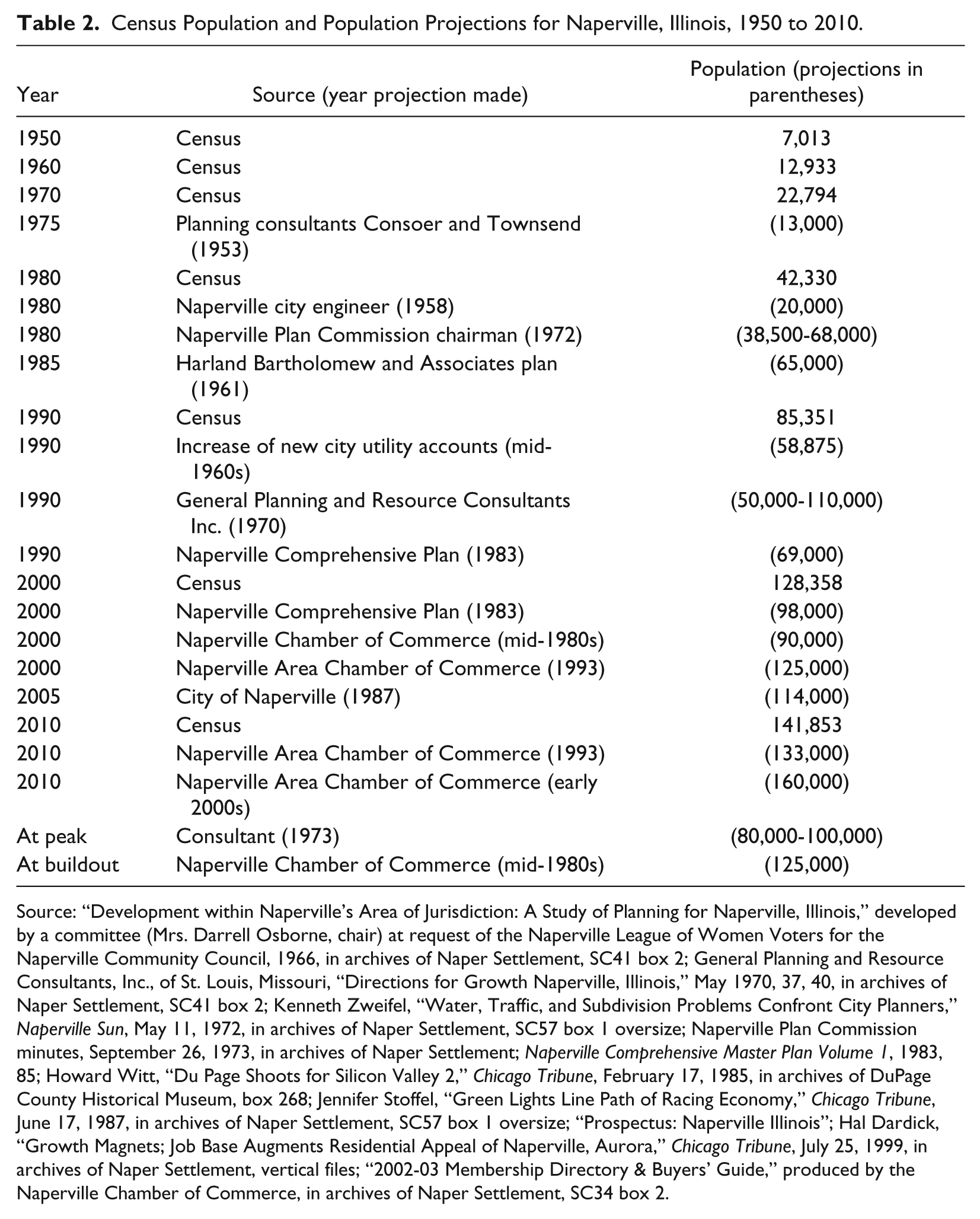
Some of the differences in local narratives regarding changes in Naperville might be related to the rapid growth of the city. Even as decisions were made to annex land and pursue residential and commercial development, population projections made after 1950 illustrate the difficulties local leader and professionals had in forecasting Naperville’s trajectory (see Table 2).
Census Population and Population Projections for Naperville, Illinois, 1950 to 2010.
Source: “Development within Naperville’s Area of Jurisdiction: A Study of Planning for Naperville, Illinois,” developed by a committee (Mrs. Darrell Osborne, chair) at request of the Naperville League of Women Voters for the Naperville Community Council, 1966, in archives of Naper Settlement, SC41 box 2; General Planning and Resource Consultants, Inc., of St. Louis, Missouri, “Directions for Growth Naperville, Illinois,” May 1970, 37, 40, in archives of Naper Settlement, SC41 box 2; Kenneth Zweifel, “Water, Traffic, and Subdivision Problems Confront City Planners,” Naperville Sun, May 11, 1972, in archives of Naper Settlement, SC57 box 1 oversize; Naperville Plan Commission minutes, September 26, 1973, in archives of Naper Settlement; Naperville Comprehensive Master Plan Volume 1, 1983, 85; Howard Witt, “Du Page Shoots for Silicon Valley 2,” Chicago Tribune, February 17, 1985, in archives of DuPage County Historical Museum, box 268; Jennifer Stoffel, “Green Lights Line Path of Racing Economy,” Chicago Tribune, June 17, 1987, in archives of Naper Settlement, SC57 box 1 oversize; “Prospectus: Naperville Illinois”; Hal Dardick, “Growth Magnets; Job Base Augments Residential Appeal of Naperville, Aurora,” Chicago Tribune, July 25, 1999, in archives of Naper Settlement, vertical files; “2002-03 Membership Directory & Buyers’ Guide,” produced by the Naperville Chamber of Commerce, in archives of Naper Settlement, SC34 box 2.
While several projections were close to the actual population, many are off by over 10 percent. These projections are not just shots in the dark: they were often made by planning experts or local leaders with close knowledge of current conditions. Yet, predicting the growth was difficult as conditions changed. As Naperville’s greenfield growth now slows due to a lack of available land, the narrative surrounding the suburb’s rapid growth period may change with more time and newer leaders and residents.
Discussion and Conclusion
Each of the five proposed explanations contributes to explaining Naperville’s development because they individually highlight important pieces. However, none on its own is able to explain the idiosyncrasies of Naperville. In other words, they speak to general patterns that might help scholars understand suburbs compared to cities or suburbs compared to other suburbs, but researchers could benefit from all of them to understand the particular and the general together as it plays out in suburbs. Naperville’s rapid growth is related to general suburban growth in the Chicago region, particular decisions including land annexations and efforts to attract more business, new technologies, and social change within Naperville. As one suburban scholar notes about Naperville, “it’s part hard work, part marketing, and part serendipity.” 93
Explaining Naperville’s change and growth includes examining population pressures within the Chicago region. The population spread outward from the city along new conduits, like tollways; old means, like railroads (Naperville has two of the busiest commuter rail stations in the whole Chicago region 94 ); 95 and in between, with growing numbers of local roads. Naperville was not the only suburb that grew; the most explosive growth in the last decade or so has expanded past Naperville to Aurora, a suburb ten miles farther west of Chicago that now has over fifty thousand more residents than Naperville, as well as in McHenry and Will Counties in the northwestern and southwestern sections of the Chicago region. Urban ecology can help explain why Naperville and surrounding communities grew, though why the population growth in the Chicago suburbs is not evenly distributed is less clear.
In contrast, the political economy approach emphasizes the actions of influential local leaders who made different choices in response to similar external pressures, such as suburban growth. This was particularly critical after World War II as communities made unique decisions regarding annexations, how land should be used, and whether to pursue particular businesses or industries. While Naperville in the early 1960s did not directly lobby for technology companies to come to town, policies previously enacted, such as a subdivision control ordinance to help defray the city’s costs, as well as small efforts at growth, such as pursuing an industrial park with the Burlington Railroad, helped ensure more orderly growth and lay a foundation for balanced development. When Bell Labs decided to come to Naperville, it was likely a pleasant surprise for the community. At the same time, once Bell Laboratories and Amoco moved in, city officials started a concentrated effort to bring more business to the tollway corridor. Naperville officials used the Bell Labs relocation and the Amoco relocation several years later, both on valuable land, as a base for a growing jobs sector on the north side of town. 96 This land along the tollway could have been used differently or controlled by other local governments, but Naperville saw an opportunity and pursued it.
Another option for suburban analysis, placing suburbs within a suburban type according to their status today, helps compare Naperville’s development to that of different kinds of suburbs. Some of the key characteristics of boomburbs—rapid growth over multiple decades due to highways, annexations, and other factors—are found in Naperville and set it apart from the experiences of most Chicago-area or American suburbs. Similarly, Naperville also has traits of an edge city, including lots of office space and jobs, with many of them located along major roads. These attributes can help place Naperville within the hundreds of Chicago suburbs, grouping it with the edge city Schaumburg area along I-90, as well as differentiating it from other kinds of suburbs, like inner-ring suburbs, such as Cicero, Oak Park, and Harvey. 97 But these types obscure the unique path traveled to reach that point and how the community might diverge from that type in the future. Alter one of the critical pieces in Naperville’s development—for example, relocate the East-West Tollway slightly farther north on the path of Butterfield Road—and the subsequent chain of events might have been very different, leading to an altered Naperville.
Even within these suburban types, suburbs may share certain characteristics, but communities also develop their own narratives regarding their successes and failures. Naperville’s decisions and narrative may seem normative within Naperville, but they contrast sharply with decisions and narratives within adjacent or nearby suburbs. In comparison, nearby Wheaton drew upon an established character as a conservative institution town, limiting its annexations compared to Naperville and pursuing less commercial and industrial development. West Chicago, a nearby industrial/working-class community, instead pursued industrial parks after World War II and tried to build around railroad heritage. 98 As outside forces changed (population pressures, new highways, etc.), leaders and residents in Naperville redefined the narrative about their own community as well as how they acquired these qualities as they shifted from small-town life to a rapidly growing suburb with a still-high quality of life.
These different explanations are reminders of the post hoc nature of suburban analysis: historical patterns in suburbs prompt causal explanations or categories that help explain perceived patterns. Generally, humans gravitate toward causal stories or explanations, whether this occurs in interpreting history, as part of religious experiences, in making meaning of life, or in developing scientific theories and paradigms. 99 However, this can lead to narrative fallacies when we force “a logical link” upon “sequences of fact.” 100 Similarly, this could lead to situations where “a compelling narrative fosters an illusion of inevitability.” 101 Thus, a “successful” suburb, whether measured by population growth or a high quality of life or a diversified tax base, appears as the product of a particular series of decisions or events that are then difficult to find or replicate elsewhere.
Given the difficulty of untangling particular causes of suburban growth, from different plausible broad theoretical and conceptual approaches to the possibility of narrative fallacies to the difficulties of making population projections, how can scholars better analyze and explain suburban growth? How can we limit narrative fallacies that find patterns where they are not present or avoid developing simpler causal theories when the situation is more complex?
Running experiments with suburbs to evaluate testable predictions will be difficult, 102 given the multidimensionality of suburbs, but here are several options for how suburban scholars might proceed. First, it is difficult to make predictions regarding the future of individual suburbs due to path dependency and contingency. Naperville thrived in terms of population and land size after World War II, and its growth has slowed recently due to less open land. However, growth could pick up again if leaders pursue denser development. Other suburbs have stagnated or lost ground (in terms of finances, population, quality of life, etc.) over time even as suburbs within the same region thrive. A few suburbs, like the near-to-Naperville unincorporated Weston, Illinois, which was wiped out by the construction of Fermi National Accelerator Laboratory, disappear entirely or are absorbed by other municipalities. Overarching theories of urban growth cannot be limited by particular locations (see the discussion in Judd and Simpson regarding developing urban theories using certain American cities as prototypes 103 ) and must leave room for varying future outcomes across suburbs.
Similarly, categorizing suburbs based on historical development patterns has both strengths and limitations. Suburbs may now be in one category, which has critical traits that separate it from another category, but this may change in the future. Also, the whole category might shift as conditions change. For example, defining a boomburb is time dependent, as it involves double-digit percentage growth from 1970 to 2000. New boomburbs will emerge as others drop out of the category, a feature Lang and LeFurgy recognize by highlighting “Baby Boomburbs.” 104 Suburban types need to be continually adjusted and refined.
A third way to improve post hoc suburban analysis is to conduct comparative studies of suburbs that can highlight the different paths they each travel and isolate key differences. This could involve adopting Mills’ methods of agreement or difference: examining cases with different starting points and similar outcomes or cases with a similar starting point and varied outcomes. 105 Suburbs near Naperville founded around the same time period and within a similar context experienced very different outcomes. 106 Or Naperville could be compared to suburbs of a similar type, like other edge cities—including Princeton, New Jersey; Gwinnet County outside of Atlanta; and Irvine, California—to explore their common threads and differences. 107
Another option for avoiding possible narrative fallacies is to limit our reliance on outlier suburbs to understand the suburbs as a whole. Certain suburbs are often cited in suburban studies, like Llewellyn Park, New Jersey; Levittown, New York; Columbia, Maryland; Tysons Corner, Virginia; or even Naperville, Illinois. These cases may each illustrate important suburban patterns yet may also reveal little about the majority of suburbs, which span a range of types and time periods. This does not mean closely studying unusual and intriguing individual suburbs is not useful. However, generalizing from idiosyncratic suburbs is a concern. Scholars need a wide range of individual cases that do or do not fit within current theories and suburban types (also making use of counterfactuals) to sharpen existing explanations.
In the end, drawing from a group of explanations of suburban growth helps one to better understand Naperville’s unusually rapid midwestern growth. At the same time, Naperville shows that making predictions regarding the growth of individual suburbs is difficult, as general theories offer some guidelines but the individual decisions and characters of suburbs can push development in certain directions. Having middle-range approaches to suburbs and studying clusters within the same suburban type or a set of suburbs within the same region to control for regional variation can help bridge the gap between studying suburbs as a whole and individual cases. Additionally, accounting for the internal narrative regarding growth can also help contribute to and illuminate explanations of suburban growth and change.
Footnotes
Declaration of Conflicting Interests
The author declared no potential conflicts of interest with respect to the research, authorship, and/or publication of this article.
Funding
The author disclosed receipt of the following financial support for the research, authorship, and/or publication of this article: This research was supported by an Institute for Scholarship in the Liberal Arts graduate research grant from the University of Notre Dame.