







Abstract
This article examines the history of Riga’s first gas factory as both a contributor to, and witness of, the Industrial Revolution in Riga. The factory became an important urban landmark in the rapidly growing city due to its sophisticated architecture as well as its central placement in the most picturesque recreational area of the city, namely, in the surroundings of the city canal greenery. This article aims to examine how the knowledge transfer is embodied in Riga’s first municipal gasworks, its transnationally developed planning phase, and its locally outstanding buildings, which gained significance by becoming a symbol of both technological and social progress in Riga.
Keywords
Despite being a strategically important port city of the Russian empire in the middle of the nineteenth century, Riga still maintained the status of a fortress. This changed in 1856, when Tsar Alexander II granted permission to demolish the fortification system, 1 resulting in building expansion outside the fortifications. This marked an important milestone in the city’s history. Catalyzed by the removal of the fortifications, Riga in the mid-19th century experienced the Industrial Revolution, the onset of modernization, and a rapid expansion of urbanization, which continued virtually unchecked until the First World War. The provision of high-quality public infrastructure can be considered one of the principal conditions for the economic growth, social welfare, and the overall development of the city. In the second half of the nineteenth century and at the beginning of the twentieth century, both the central water supply and the gas industry in Riga became a direct responsibility of the municipality, followed by the electricity supply at the beginning of the twentieth century. During the period from the 1860s to 1914, the municipality undertook various construction activities, thereby promoting the development of public infrastructure. On the eve of the World War I, overall development had reached a level in accordance with that of a modern metropolis.
The transfer of knowledge of the era was exquisitely embodied in public infrastructure and urban development projects, which were characterized and determined not only by a distinctive modernity but also by the criteria of efficiency and standardization. This article aims to examine how this knowledge transfer is embodied in Riga’s first municipal gasworks, its transnationally developed planning phase, and its locally outstanding buildings, which gained significance by becoming a symbol of both technological and social progress in Riga.
Transfer of Knowledge in Public Infrastructure Projects
The attraction of high-profile experts from all over the Europe proves that the municipality of Riga was genuinely interested in the execution of public utility projects at a high level of quality. For instance, at the end of the 19th century, while intending the construction of the first large-scale water tower, the municipality of Riga succeeded in engaging the prestigious Otto Intze (1843-1904), a renowned hydro-engineer from Aachen and the inventor of the so-called Intze Principle, which represents a certain engineering type of water tower, which gained popularity across Europe since the 1880s 2 ; at the turn of the nineteenth and twentieth centuries, while planning the third centralized water supply system for the city of Riga, an engineer from Mannheim, Oskar Smreker (1854-1935) was engaged, as previously he had planned several groundwater extraction systems in the cities of Europe and the Middle East 3 ; Oskar von Miller (1855-1934)—a widely recognized German engineer from Munich and the developer of the field of electrotechnology—was recruited to design the first central electric power plant of Riga. 4 The next stages of development were then handed over to elite local engineers and architects, such as Karl Felsko (1844-1918), August Hartmann (1849-1890), Wilhelm Bockslaff (1858-1945), Paul Mandelstam (1872-1941) and Reinhold Schmaeling (1840-1917), who took over the know-how of foreign experts and continued to work on similar projects in the future.
Since in the nineteenth century, industrial gas production was an entirely new technological process, the first gas factory of Riga is particularly apt as a case study to characterize the emergence of modern Riga. The production of coal gas was a new challenge to the city of Riga on its way to modernization. A transfer of knowledge from previously industrialized areas in Western Europe, along with advanced urban planning, was essential for an effective result.
Gas street lighting was first introduced in the streets of London in 1807, and soon after, also in the streets as well as public, commercial, and industrial buildings in other European cities (namely, Paris in 1813 and Berlin in 1826). In the first half of the nineteenth century, gas street lighting was introduced only in the most progressive cities, becoming more commonplace throughout Europe later in the century. In the beginning, the use of gas inside residential buildings was received only with concern, and spread more slowly. However, by the middle of the nineteenth century in the largest cities on the continent, the majority of urban residences were illuminated by gas lamps. 5
In the Russian Empire, this modern method began to be used in the 1840s, however, until the beginning of the twentieth century, gas lighting was introduced in only thirty-three cities of the Empire, including Riga in 1862 and Liepaja in 1884. 6 This number was quite small if compared with, for example, Germany, which at that time had gas factories in sixty-five different cities. 7 The development of the gas industry was promoted using various forms of capital—while in the United Kingdom it was supported and run mainly by private companies, the gas industry in German cities was fully managed by local authorities. 8 Following the German model, the Riga gas factory was originally conceived as a municipal enterprise. In 1861, Baltic German chemist Carl Schmidt (1822-1894) wrote in the magazine Baltische Monatsschrift that the experience of other cities has already proven that assigning gas production and water supply to private companies is not beneficial to society, because such companies only work for their personal interest and not toward the welfare of the public. Therefore, Riga City Administration found it preferable to keep these public utility sectors under their own supervision, since substantial profit could also be gained by offering quality service at low prices. 9 Schmidt also pointed out that the project for gas lighting in the inner city of Riga had already been developed in the 1840s, but did not receive the necessary approval and permission for implementation. Nevertheless, the execution of the idea became newly possible after the demolition of the fortifications. Schmidt believed that the introduction of gas lighting in Riga, following the model of both Germany and England, would bring benefits to society, so he supported the introduction of the new method in Riga in a timely manner. 10
Albeit in a very approximate manner, the gas works site was first mapped out in the redevelopment proposal for the area of fortifications designed by Riga’s city architect Johann Daniel Felsko (1813-1902) and Otto Dietze (1833-1890) in 1857. This significant urban development project was intended to be built in the territory of the former Jacobs’ ravelin, surrounded by the city canal. At that time, the closeness to the waterway was crucial, since it facilitated the transportation of materials: coal could be easily delivered from the port in barges. However, this could not have been the only reason for choosing this particular site.
In 1859, an agreement for the project of the gas factory was made with a civil engineer from Berlin, Adolf Kühnell, who was not only a generally recognized authority in the gas sector but also the technical director of the Berlin gas factory. 11 Moreover, he was well aware of the situation in Riga, because in 1842 he prepared the Riga inner city gas lighting project, which was never realized. 12 The construction work of the new project began in July 1861. 13
To ensure the efficiency of production, the European gas works were usually built outside the city center.
14
The 1860 building regulations on the territory of Riga’s former fortifications also prohibited the erection of industrial buildings inside the belt of boulevards.
15
However, the location of Riga’s first gas factory site remained the same—near other important public buildings, which were built inside the ring of boulevards that surrounded the old town, for example, Riga Polytechnic School (now University of Latvia; 1866, Gustav Hilbig [1822-1887]), German Theatre of Riga (now Latvian National Opera; 1860-1863, Ludwig Bohnstedt [1822-1885]), etc. The location of the first gas factory granted it a very special importance. Carl Schmidt expressed such a view in a press column intended for local readers already back in 1862, when talking about new buildings—the gas factory and its neighboring building, Reimer’s Ocular Health Clinic: Both of the buildings are important signs of the century, public monuments to the history of the culture of Riga, a glorification of the noble humanity of our Baltic metropolis and a testimony of the strong civic awareness of the historical Hansa city.
16
This also clearly demonstrates the main priorities of the era and complies with its “Zeitgeist.”
The first gas lanterns in the streets of Riga were lit in August 1862. 17 Nevertheless, soon it became clear that the location of the factory was poorly chosen, since gas consumption was increasing rapidly, but the extension of the factory within the ravelin was strictly limited. Already ten years after the first gas factory was put into operation, it could no longer provide gas in sufficient amounts to meet the rapidly growing demand, thus it became necessary to build another gas factory complex. The new gas works site was placed in the Moscow Suburb, near the railway hub. This choice was strategically far-sighted, since the railway provided convenient access to coal, which was constantly needed for gas production. In addition, the neighborhood’s relatively low building density allowed for the future expansion of the complex if needed. The project of the second gasworks was prepared by an engineer from Trier—Emil Kurgas (1818-1880), who since 1864 held the position of director of Riga’s Gas Office. 18 Unlike the first gas factory of Riga, the buildings in the second complex were designed in a more rational manner. The second gas factory operated up until the 1960s, while the first was already completely closed in 1907.
In summation, from the 1860s until World War I, the municipality of Riga expanded the development of the gas sector in several stages of construction, meeting the rapidly growing demand for gas, not only for lighting the streets of the city, but also most importantly for private consumption, namely, for lighting, heating, and engine operation in public, residential, and industrial buildings. 19 In total, one gas station and two manufacturing gas plants with six gas holders were built. 20 Some of these buildings have been preserved until today.
The Transformation of Riga: Choosing the Image of the New Gasworks
The first gas factory complex of Riga provides an ideal case study for assessing the technological and social transformation of the city through knowledge transfer and adaptation during the mid- to late-nineteenth-century, because it became an example of utility architecture and its integration in urban planning by adjusting its concepts to the given conditions in Riga. Moreover, from the typological point of view, the gas holder houses merit particular attention, since their significant size and architectural volume made them stand out from the other buildings. In the nineteenth century, the magnificent gas holders of European cities became aesthetically impressive urban landmarks, sometimes, in terms of size, even competing with cathedral buildings. 21 From the point of view of architectural heritage, these are exactly the structures from early gasworks which have remained to this day in many European cities.
The gasholder was the largest structure of a gasworks. 22 It was also the first industrial building type created as a result of laboratory experiments. 23 The gas-filled holder was a bell-shaped dome made of tin plates, which rose and shrank in the water reservoir depending on the amount of gas stored within the holder. 24 Gas holders were given their typical cylindrical shape already in 1815. In accordance with the engineering structure of the gas holders themselves, the gas holder houses typically had a concentric cylindrical or polygonal shape as well. A tendency to build so-called gasholder houses or architectonic shells as independent superstructures enveloping the gasholder from the outside spread in early nineteenth century Europe on the assumption that they lessened security risks inherent in the storage of flammable gas. This turned out to be largely incorrect, and no such superstructures emerged in Great Britain later on. However, this practice continued elsewhere in Europe where climatic conditions were more severe, for example, in places where cold weather could cause the freezing of water in the reservoirs or where heavy snowfalls could change the precisely calculated pressure on the gas stored in the holder. 25 Because of the previously stated reasons, the gas holders in Riga were also enclosed by such superstructures. Chemist Carl Schmidt had already explained the building preconditions to local society in 1862, when his article about gas lighting in Riga was published in the magazine Baltische Monatsschrift. This article clearly served the purpose of distributing knowledge prior to its implementation in practice. Schmidt pointed out that in England both the big and small gas holders were left completely uncovered, since even in wintertime the water in the reservoir could be heated solely by using the heat of the inflowing gas, while, in the harsher Northern climate, the water in the reservoir had to be heated using steam, which accordingly increased the operating costs and hence the product price. 26 The articles by Schmidt published in the 1860s in local periodicals contextualize this innovative technology of manufacturing gas and the knowledge related to it, clarifying its meaning in both the global and local contexts and engaging the local audience. Those articles very clearly demonstrate that the importance of knowledge transfer was generally acknowledged by the contracting authorities of the Riga gasworks. It is revealed in the subjects reviewed, as well as the form of expression used in these publications, which are distinctly oriented to an ordinary reader (a local taxpayer, home owner, or entrepreneur), his prejudices (insecurity caused by risk of explosion of gasworks and precedents of a sort from abroad), his wishes and desires (economy, comfort, luxury, and a modern design for the gas lamps used), and so on.
Because the factory buildings were of a utilitarian nature in the first place, the aesthetic aspects of their architectural design may have played a less important role in the thoughts of their creators. Nevertheless, the context of the urban surroundings also had to be taken into account when developing the project, since utilitarian buildings had to be integrated into the urban landscape with great caution in order to preserve, for example, picturesque surroundings. To keep construction costs low and avoid complaints by local residents, it was not advisable to erect gas factory buildings in the most luxurious areas of the city center; suburbs were to be preferred.
27
Despite such considerations, Riga’s first gas factory building stood in the very center, between the old town and the boulevard zone. Because of the central location, a sophisticated architectural solution (Figure 1) in harmony with the surroundings was attained. Carl Schmidt described the newly built gasworks in the following words in 1862: A tasteful castle-type construction with two imposing corner towers stands on the island of the former rampart ditch and is linked to the mainland with an elegant bridge . . . none of England’s gasworks could equal the beauty of Riga’s factory, which is a true adornment of the city.
28
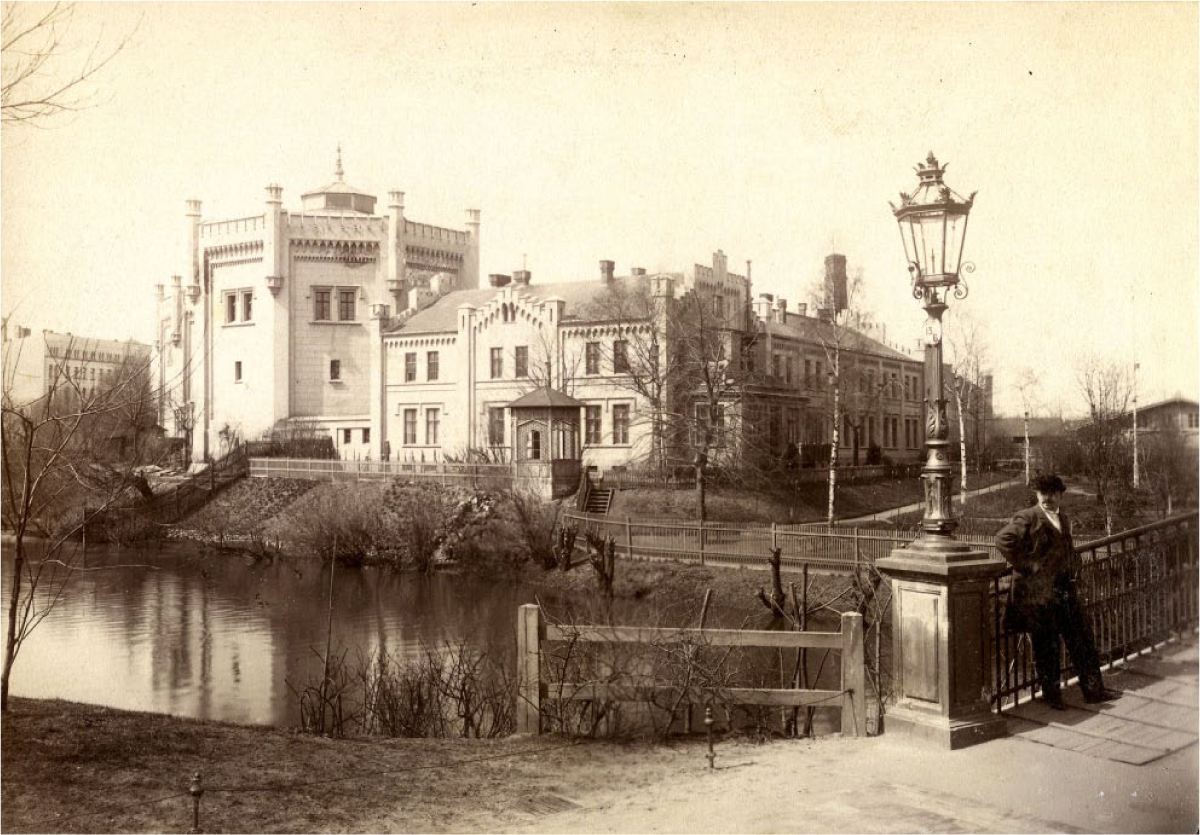
Riga’s first gasworks.
As outlined above, Schmidt emphasized the crucial need to employ the example of England for the purpose of technological progress; nevertheless, his words also clearly signaled that in Riga the experience of England would have to face modifications—not only because of the geographical and regional context but also due to the differences in the social consciousness. As mentioned above, it was outlined in his article that public utilities in Riga should be supervised by the municipality, which was rarely the case in England. In addition, in the case of private ownership, the choice of the site as well as the proposal for the architectural design would rarely reach beyond a pragmatic economic solution. However, in Riga, under municipal ownership it did so, insofar as aesthetic qualities proved to be no less important than the utilitarian function of certain industrial buildings. In the mid-nineteenth century, the municipality undertook the task of bringing modern lighting into the narrow streets of the old town as well as wide boulevards of newly built quarters of Riga, and into the theatres, schools, society houses, factories, workshops, and homes of Rigans. Holding a monopoly on the production of gas, the municipality was promising to ensure not only a good foundation for technological and economical progress in the city but also for social progress to its citizens in the near future. Since the act of building needed to precede the illumination of the city, so the architecture of the gasworks itself had to be presented as a promise for a brighter future for Riga.
The first gas factory complex of Riga formed a stylistically unified ensemble. The gasholders stood out in the cityscape of the center. The façades of buildings were accomplished in the Tudor version of Neo-Gothic style popular in Riga at the time. At first glance, only the two free-standing chimneys revealed the industrial function of the complex. In the second half of the nineteenth century, the Neo-Gothic style was rare in the industrial architecture of Riga; therefore, the gasworks and water pumping station (1861-1863, William Weir, Albert Schöne), which were erected in the 1860s, can be considered an exception. Such a choice was possibly inspired by the commissioner’s concept of social prestige.
The environmental context also influenced the choice of architectural style for the first gas works of Riga: in the late 1850s—early 1860s, the city canal greenery in the place of the former fortifications was designed as a landscape garden, creating a picturesque site according to English tradition. Including Gothic forms in such a composition had become a favorite method in the age of Romanticism. 29 The dynamic silhouette determined by the multiple functions of the gas works could also encourage an orientation toward medieval imagery. Tower-shaped volumes were necessary for the operation of the gas works, so it could seem a natural preference to choose the Tudor Neo-Gothic style, in which polygonal tower topped with battlement had become an almost indispensable element. 30
The Representation of the Riga Gasworks in Contemporary Writing and Imagery
The first gas works was a remarkable architectonic example not only in the context of Riga’s industrial architecture, but also in the context of the most significant public buildings, like their contemporaries—the guild houses that also were implemented in the Tudor Neo-Gothic style (Great Guild, 1853-1854, Heinrich Karl Scheel [1829-1909]; Small Guild, 1862-1866, Johann Daniel Felsko). It also matches with a well-known opinion, that, since when gasworks first began to be constructed, the production of gas for lighting was still considered dangerous, gas companies wanted to give their factories an image what would suggest a sense of security among the public. 31
When addressing the representational aspect, it is important to note that the perception of the architectural object depends also on the character of the surroundings: how well tended they are, how much aesthetic pleasure they provide, or how significant their historical value might be. 32 Thus, the impression made by an urban landmark is largely based on its location. Late nineteenth and early twentieth century postcards featured precisely these public utility buildings in Riga, which were not just architectonically expressive, but also had a picturesque background and cultivated surroundings, where both Rigans and tourists were accustomed to relax. However, those buildings which were located in entirely utilitarian or industrial environment were hardly ever photographed or reproduced in postcards during the time of their operation.
Until now, the representative role of these buildings has not been sufficiently appreciated. Still, their representative functions were revealed not only in the visual image of the architecture, but also in interaction with descriptive and illustrative publications in the local press, travel guides, and postcards series, and building illuminations that were provided for various celebrations in the city’s history. This shows that certain knowledge may be transferred by different media, providing interactive engagement with both local and guest audiences.
At the turn of the twentieth century, a vast number and great variety of postcards were dedicated to the city’s first gas factory by the city canal. More than fifty different postcards with the image of the first gas works from the early twentieth century were found in the course of the research that informs this article. These postcards include a vast range of summer landscapes with a house of swans, a swan couple, or sailors in the city canal, but also autumn and winter landscapes with frosted tree branches, ice skaters on the frozen canal, as well as moonlight nocturnes (Figure 2, 3). The representation of Riga’s gas factory in the postcards was significant in both quantitative and qualitative terms. The variety and number of postcards produced with views of this industrial building can be compared with those depicting exceptional public buildings like the House of the Blackheads in the Town Hall square, or the German Theatre near the canal. Visitors to Riga often chose to send postcards with views of the gas factory to their friends and relatives in Germany, England, France, Belgium, and other countries. One of the postcards, which was sent to England, specifically notes that this place is located in the new part of the city, which is very beautiful and well tended, while another postcard which traveled to France, states that this landscape scene was captured in the very center of the city. Comments written on the postcards by the hands of senders confirm that the image of the Riga gasworks was not only presented as a symbol of Riga as a modern metropolis, but that it was also perceived as such by the audience.
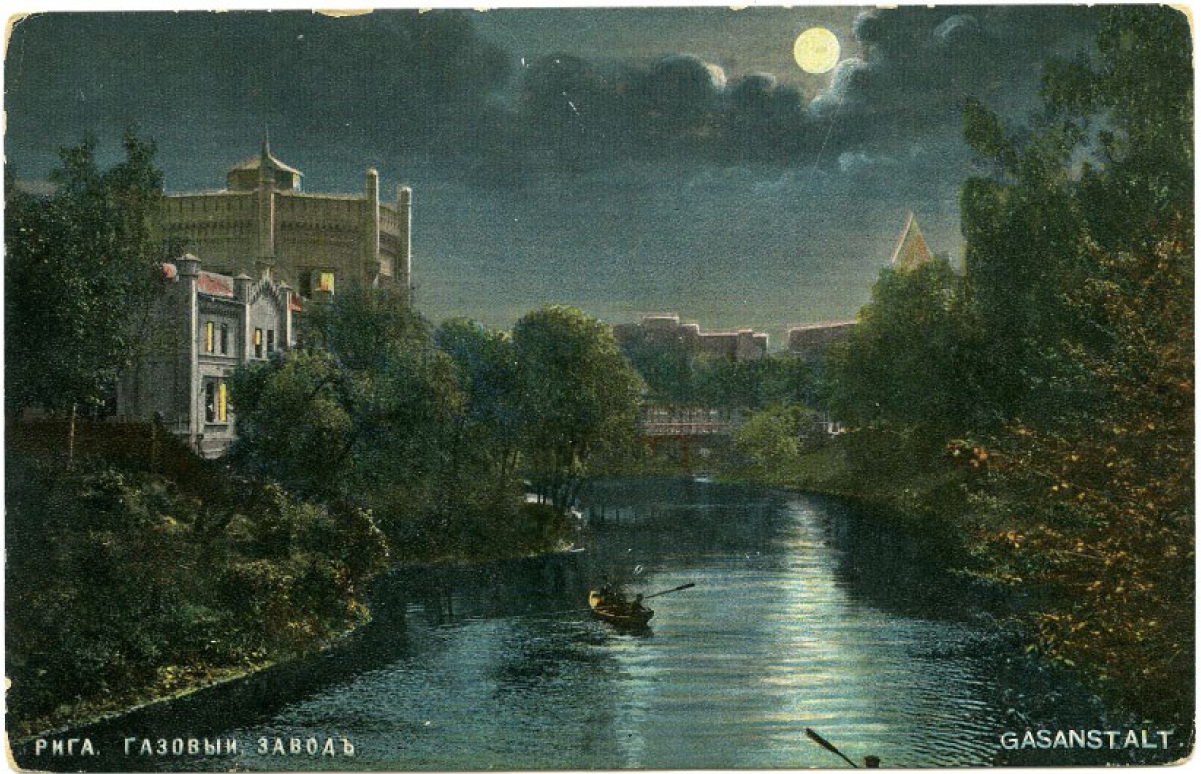
Riga’s first gasworks near the city canal.
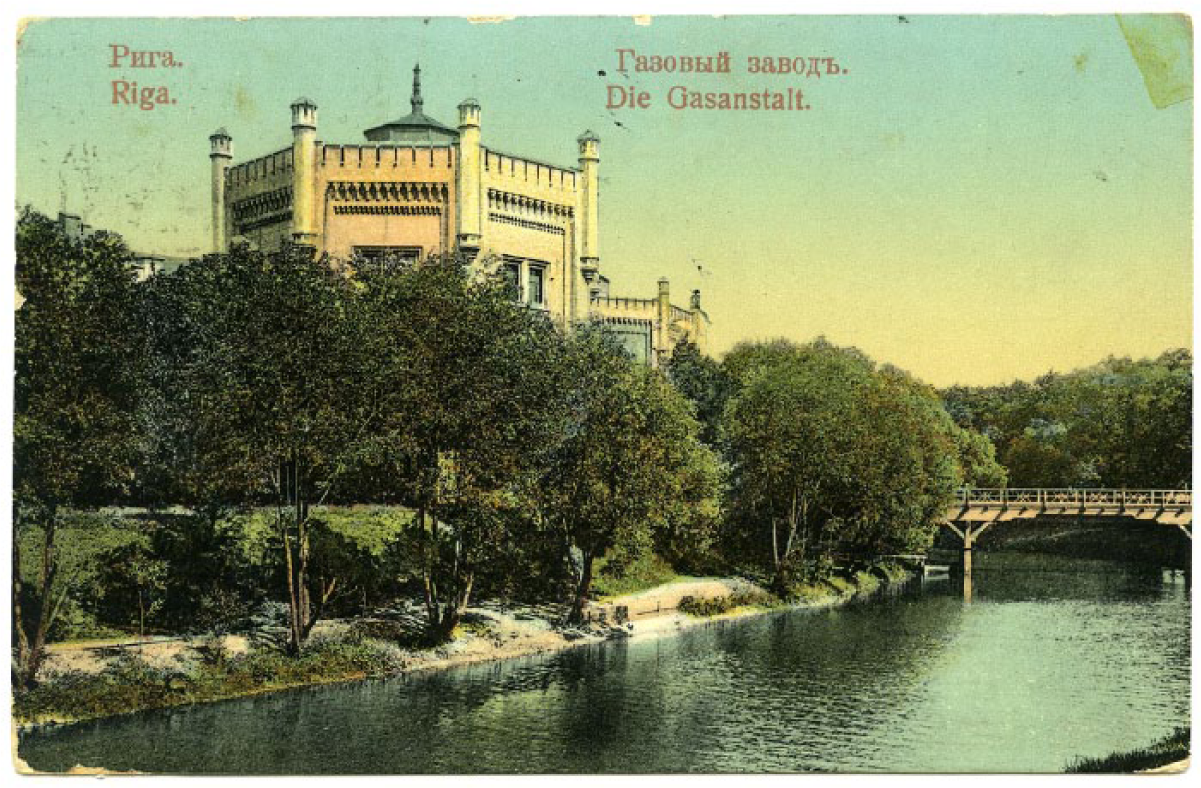
Riga’s first gasworks near the city canal.
Unlike other industrial buildings of the time, the gas factory was also included in albums and tourist guides of Riga around the turn of the twentieth century. One of them, published in 1899, states the following: The view of the buildings of the gas factory between the old town and the suburbs—in the park next to the canal—is one of the most beautiful in this city. The factory, which was built in 1862 and was designed by the head of the Berlin gas factory, Mister Kühnell, rises above the trees and the gracefully curved bridge, awarding the landscape with a very special attractiveness and charm. It is difficult to imagine that the octagonal buildings, which resemble a palace with battlements and towers, in fact house gas holders for the lighting of the city. The floating wooden cabin in the foreground of the picture has become a summer house for a swan couple. The left bank of the canal with benches, walking areas for adults, and playgrounds for children has become especially popular.
33
The Gas factory was often mentioned in the descriptions of events in various city celebrations, stating that “the gas factory in Basteiberg looks like a small castle or a tiny manor”
34
or saying that “the white gas towers illuminated by a bright light are reflected in the waters of the canal just like a castle from a fairy tale.”
35
The importance of the gas factory in the illuminations of the events of city celebrations was already expressed in documentation dating back to the 1860s; for example, the description of the Kaiser’s visit from June 1867 features this majestic writing, originally written in Latvian: the gas factory was tailored by the almighty fires of gas, different beams and stars and other colourful features, and from far away it looked almost like a rippling fire in the sea, which sparkles and jumps now here, then there—from one place to another. Countless large gas flames erupted alongside the canal, doubling up in the reflection of the water, and curious flocks of people queued and gathered around just to admire this peculiar firework, which truly was something worth seeing.
36
There is no doubt that the contemporaries of the first gas factory of Riga also viewed it as a symbol of technical progress. In the cultural historical novel “Riga” which was written in Latvian by the writer and publisher Augusts Deglavs (1862-1922) in 1912 regarding the events of the 1860s, the gas factory complex was described as just as avant-garde as the newly built railway station. The beginning of the book features an episode in a pub where people from the Latvian countryside tell each other about the new, bright paraffin oil lamps they have seen in the most luxurious manors, when all of a sudden a coachman from Riga interrupts the conversation: “That is no miracle, that is twaddle,” he said. “In Riga, that is where you see miracles. We have an invisible lamp oil, which burns, but which you cannot blow out. It only stops burning when you cover it with a hat.” The country man opened his mouth even wider. “So you can’t even see it?! What is it made of then?” “Its power is pulled out of coal,” explained the coachman. “Oh, brother, you should see that facility, that “gasanstalt.” What towers and machines it has! In Riga we do everything with machines, with machines only.”
37
As has already been pointed out, the operation of the first gas works of Riga was fully stopped in 1907 due to its central location and lack of compliance with sanitary requirements; additionally, the second gas factory had already taken over all of its operational duties several decades prior. 38 The historical and factual materials available on the first gas works confirm that in Riga even before the First World War, there were attempts to repurpose historically significant industrial buildings. Shortly after the first gasworks was closed for good in 1910 by orders of Riga municipality, Riga City Architect Reinhold Schmaeling prepared a conversion project for one gasholder house, to house premises for the needs of the City Archive. The project intended to make the external walls of the building thicker to create additional openings for windows and doors. To meet modern safety requirements, the reinforced concrete was planned to be used to construct four new stories in the building. All four stories were to be devoted to the storage of city archive holdings, while the first storey also facilitated an office for the archivist. Installation of central heating with a utility room in the basement was also planned for the building. The staircase was designed in the core of the building, with daylight passing through a glazed skylight. 39 Although the project was never realized, it can be considered an early attempt to repurpose a defunct industrial building in a modern way that would preserve architectural and cultural heritage from the middle of the nineteenth century. From today’s point of view, such an idea can be evaluated as truly innovative and an original example of its own time not only in the Baltic region, but also in a wider European context. It can be regarded as a unique form of knowledge generated in Riga in the early twentieth century, long before similar developments in the field or the redevelopment of gasworks sites would occur in other industrially developed parts of Europe facing deindustrialization. Nevertheless, this unique project was never implemented and only remains on paper.
During World War I, in 1915, together with the evacuation of industry to the inner territories of the Russian Empire, the functional core of both gas holders was disassembled and removed. After the war, this complex was transformed into the office of the gas company,
40
whereas the gas holders were left empty and neglected, and, as can be seen in photos from the 1930s, the facades gradually lost their initial appearance. At the end of the 1920s, several newspapers wrote about the repeated attempts of entrepreneurs and public organizations to offer the city various proposals for the reuse of both towers of the first gas factory complex, nevertheless, all of them were ultimately rejected.
41
In 1933, the decision was reached to demolish the towers and replace them with greenery, and the official periodicals informed readers that a commission of experts has come to a conclusion that fixing and remodeling the towers would not pay off and would result in unnecessary, irrational costs. (..) The architecture of the towers has a pseudo-gothic style, and the towers do not have any particular historic or aesthetic value.
42
Before the demolition, the local press described these buildings as culturally and historically important city landmarks, denying previous statement. The newspaper Sewodnja (Today) expressed the following opinion: The picturesque polygonal towers of the gas factory, located on the right bank of the beautiful city canal, near Basteiberg, are well-known to each and every resident of Riga. The medieval-like walls with battlements look particularly impressive surrounded by the greenery of spring or summer or in the silent autumn days, when they immerge in the golden, yellowing foliage. It is no wonder that they have always been featured in the collections of the best views of Riga. Now these beautiful buildings are destined to have the same fate as the water tower in Moscow Suburb—they will be demolished and the bricks will be used as a building material or to pave the sidewalks.
43
After the demolition of the towers, the newspaper Rigasche Rundschau wrote nostalgically: the gas factory, without which it’s hard to imagine the city, has now fallen. It has been destroyed with crowbars and explosives, and soon we will say—there it used to be! Our gas factory. As the most beautiful treasure of the city it has been pictured on countless postcards. Here we saw it hidden in rich foliage; there—in snow and frost. And with the picturesque towers rising above the trees, it was always equally representable. The gas factory with its castle-like towers! In fact, it is a delusion of taste, especially in this era of firm objectivity. But, so what? We all liked it, we, the residents of Riga, who for four or five generations have walked past it—either when rushing to work or slowly walking along the greenery.
44
The relevance of the early twentieth century postcards (even several decades after their production) in the communication and knowledge transfer is indicated by the fact that they were repeatedly mentioned in the periodicals regarding the demolition of the first gasworks in Riga.
In conclusion, although the first gas factory complex of Riga did not prove to be functionally sustainable, it can be regarded as an exemplary case study in the representation of ideas of social prestige in the architecture of communal service buildings, as well as a model of an urban landmark embodying technical achievement and knowledge transfer. It manifested both technological and social modernization, and it was perceived by society as a symbol of such progress—by contemporaries as well as future generations.
The municipality of Riga played a major role not only in the urban development and modernization of the city but also in the creation of its image at home and abroad. One important feature of this image is that the local actors orientated themselves toward “best practices” originating abroad, while also trying to adapt these to the conditions of Riga. This is shown by the sophisticated architectural and aesthetic solution arrived at in the design, as well as the central placement of the first gas factory of Riga in the most representative recreational area of the city. The employment of high-profile experts in other public utility projects carried out in the second half of the nineteenth century and at the beginning of the twentieth century, as well as investments in the quality of architectural design, also highlights the intentions of the municipality.
The architectural analysis of the buildings erected at the initiative of the municipality of Riga allows us to assume that, over the period considered, technical progress was perceived in relation to social progress, and that the municipality of Riga had undertaken the role of managing this relation.
Footnotes
Acknowledgements
The author is immensely grateful to cognitive science specialist Līva Raita, and historian and archivist Enija Rubina who provided insight and expertise that greatly assisted the research and improved the manuscript.
Declaration of Conflicting Interests
The author declared no potential conflicts of interest with respect to the research, authorship, and/or publication of this article.
Funding
The author disclosed receipt of the following financial support for the research, authorship, and/or publication of this article: This research was partially supported by the State Culture Capital Foundation (SCCF in Latvia), JSC Latvijas Gāze and the Hilbig Institute.