







Abstract
The introduction to this special section argues that the deconstruction of the city’s municipal social democracy was overdetermined by shifts in the global political economy toward increased income inequality and the depoliticization of national economic management. The city’s creditors forced it into an ideologically-motivated program of market discipline that cut its operating budget as the city’s economy financialized, defined by Greta Krippner as “the tendency for profit making in the economy to occur increasingly through financial channels rather than through productive activities.” The city’s leaders believed that their program would revive the city for the middle class. But financialization exacerbated income inequality. In 1970, the top 0.01 percent of earners made fifty times the average income; by 1998, that figure had increased to 250 times the average income. In 2013 Mayor Michael Bloomberg commented that: “If we could get every billionaire around the world to move here, it would be a godsend that would create a much bigger income gap,” which, he argued, was good for the whole city, because it would raise its tax base. The four articles of this section are part of a new and growing body of historical works about New York City since the 1970s that challenge the linear narratives of concepts such as neoliberalism, gentrification, public space, law and order, and resistance by reviewing how ordinary New Yorkers coped with declining infrastructure, services, standards of living, and increasing inequality.
It’s important to keep rich people in the city of New York. Because they have all the money. And they have the entrepreneurs and we want them to invest. And they have two or three houses they can fly the coop at any time and therefore I have to be very respectful of their comfort in a sense. So when people said: “Why are you fixing the roadbed on Park Avenue?” I said “because if we don’t fix it they’re gonna leave. They pay a lot of rent. And if they think they’re getting shafted and not attended to, and that all that we’re going to spend money on is the poor, then they’ll leave.”
Mayor Ed Koch’s explanation of the class bias in service delivery during his administration illustrates the key theme of this section: policies that promoted New York as a place for the wealthy. This was not necessarily his goal. Koch justified better service delivery to the rich to retain its tax base as a precondition to making the city a better place for the middle class. He did his best to deliver by rebuilding the South Bronx and other devastated areas with affordable housing, as Themis Chronopoulos’s article in this section illustrates.
Over time, Koch’s promise of a middle-class New York faded. In 2013, Mayor Michael Bloomberg summed up his policies designed to promote the city as a preserve of the rich, and dismissed concerns about income inequality and the increasingly rigid control of public space that he imposed: “If we could get every billionaire around the world to move here, it would be a godsend that would create a much bigger income gap,” which, he argued, was good for the whole city, because it would raise its tax base. 2
The shift from ideals of “socialism in one city” that predominated until the 1970s, to Koch’s idealized “middle class” New York, to Bloomberg’s twenty-first century vision of the city as a playground for the 1 percent, was overdetermined by a larger shift in the world political economy of the 1970s and 1980s, toward increased income inequality and the depoliticization of economic management to make it less democratic. 3
It is also important to remember that New York’s troubles did not begin in the 1970s. As Thomas Sugrue has demonstrated, the “urban crises” of the 1970s in cities across America resulted in part from the complex interplay of structural and contingent local forces set in motion long before. Deindustrialization began in some cities as early as the 1920s. Pressures for political conformity, structural racism, and actively discriminatory housing policies throughout the post–World War II period led to disinvestment in the urban core and subsidized racial segregation. These postwar policies created an urban crisis that curtailed revenues and services and created a cycle of decay that intensified population loss, raised crime rates, deepened poverty, ruined the built environment, and destroyed land values. 4
All of the long-term forces that Sugrue cites were to some degree present in New York City. A shrinking population and tax base, a consequence of federal housing policy subsidizing suburbanization, contributed to the city’s inability to service its debts by 1975. The city’s creditors forced it into austerity programs that cut its operating budget and capital spending in ways that cost far more than they saved, and long delayed its recovery. Because of inequalities in the distribution of benefits by the city government, New York’s wealthier citizens were partly exempted from paying the costs of cuts in city services. The burden of declining services fell most heavily on the rest of the city.
After 1960, the city’s population was increasingly young, of color, unemployed, and poor. A decade of democratic initiatives in the Lindsay and Beame administrations helped and appealed to many of these new New Yorkers. But by the mid-1970s, the wealthiest taxpayers, bargaining with various factions of the Democratic Party, took more direct control of the city budget for nearly a decade, a process that has happened often enough in the city’s history that the political scientist Martin Shefter has argued that it is cyclical.
5
As Joshua Freeman has observed, financial elites used the fiscal crisis to dictate their political and social vision:
In the recession and the budget crisis, financial leaders saw an opportunity to undo the past, to restructure New York along lines more to their liking than those drawn by decades of liberalism and labor action. They wanted less and less costly government, fiscal probity, and the de-socialization of services and protections for the working class and the poor. They also wanted humbled municipal unions that no longer would enable government workers to have superior benefits and a less intense pace of work than private-sector workers. The banks had not been able to effect such a program during the post–World War II years, a testament to the strength of labor and its allies. But as the city began sliding toward insolvency, they saw a greater need and a greater possibility of carrying out their financial and social agenda.
6
This market orientation was increasingly appealing to politicians of both parties. If the market made economic decisions that diminished their constituents’ standard of living, then they would not have to take responsibility for the decline. 7 Many New York politicians—Ed Koch is a good example—believed that markets would eventually create a New York City economy that was sustainable for the broad middle class.
Unfortunately, as Greta Krippner points out, market discipline did not make the economy more productive. Financialization, which Krippner defines as “the tendency for profit making in the economy to occur increasingly through financial channels rather than through productive activities,” proved one of the principal drivers of class inequity during the 1980s, especially as it became linked to the expanding residential real estate market described in this section by Benjamin Holtzman. 8 The process of financialization began when the Federal Reserve raised interest rates to unprecedented levels in the early 1980s—as high as 20 percent for the federal funds target rate to combat inflation, spiking unemployment and accelerating deindustrialization by making financial assets far more attractive than industrial properties. Financialization thus promoted credit expansion instead of the growth of production or wages, and increased income inequality. High interest rates attracted investors from around the world to the United States in general, and particularly to New York’s banking, insurance, and real estate sectors, inflating financial assets. 9
Financialization was particularly consequential for New York. Finance and real estate towered over the deteriorated industrial sector, providing a greater proportion of New York’s employment and tax receipts than ever. But there was a price. Finance capitalists, such as Secretary of the Treasury William Simon, who had profited from some of the New York City debt he later condemned, demanded deregulation and the reduction of public services and taxes that had limited income inequality before the 1980s. 10
In the bleakness of austerity, financialization appeared to be New York City’s salvation. 11 Although it brought temporary relief to the city’s budget after 1984, financialization exacerbated income inequality. In 1970, the top 0.01 percent of earners made fifty times the average income; by 1998, that figure had increased to 250 times the average income. 12 In minority neighborhoods, the lack of waged jobs, the decline of welfare, and the new emphasis on entrepreneurship manifested in the expansion of the informal economy, from unlicensed day care to more violent businesses, such as the marketing of cocaine. 13
The four articles that comprise this special section of the Journal of Urban History are part of a new and growing body of historical works about New York City since the 1970s that examine how New Yorkers coped with declining infrastructure, services, standards of living, and increasing inequality. 14 They challenge the linear narratives of concepts such as neoliberalism, gentrification, public space, law and order, and resistance.
Benjamin Holtzman in “‘I am Not Co-op!’ The Struggle over Middle-Class Housing in 1970s New York” shows the extent to which the middle class of New York City rejected homeownership prior to the 1980s. Beginning in the 1960s, real estate agents and building owners proposed the conversion of rental properties into co-ops. They argued that tenants would be able to control their destinies by owning their properties. At that time, the state regulated almost all of the properties proposed for conversion from rentals into co-ops. Tenants who benefited from these rent regulations opposed apartment conversions and the uncertainty that homeownership in a declining city entailed. Indeed, as they predicted, the proposed conversions resulted in a shift of costs and responsibilities from the city and landlords to residents and the inflation of the housing market.
As New York’s fortunes improved, an increasing number of tenants accepted these conversions, largely because landlords offered them heavily discounted insider prices. Existing middle-income apartment buyers benefited, since they could take advantage of rising real estate values and the easy availability of mortgage credit, eventually selling their property for a great profit. However, rising prices meant that many formerly affordable units ended up in the hands of upper-income individuals. This homeownership trend may have attracted affluent people from around the world to New York, but has also made it difficult for many middle-class people to remain in the city, because they are forced to pay much higher housing costs. While the number of rentals has remained stable since 1980, the number of owned units has increased by 52.1 percent (Figure 1), even as the population of the city has increased by nearly 20 percent.
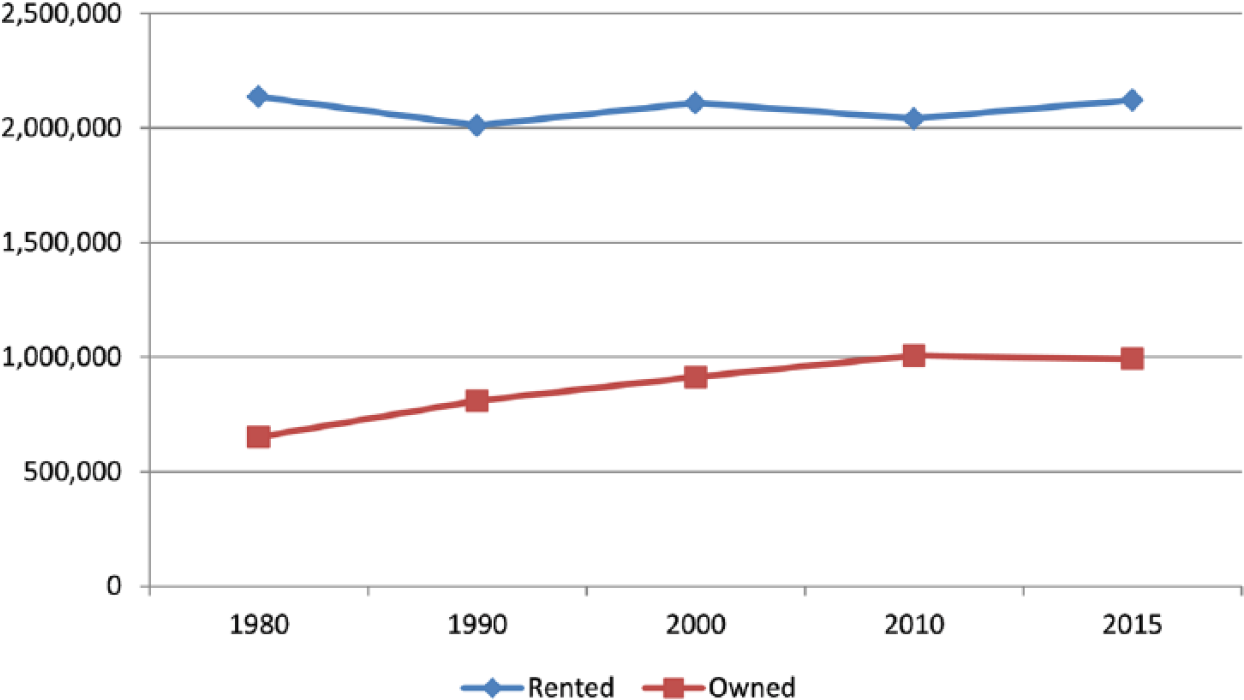
Number of rented and owned housing units in New York City, 1980-2015.
Holtzman’s article highlights the role of ordinary citizens in resisting conversions that primarily benefited landlords, and negotiating a change in the system that made conversions much more attractive for tenants. The scholarship on the growth of conservatism and the shift toward an increasingly commodified political economy after the 1960s in the United States has focused overwhelmingly on conservative politicians, free market advocates, and pro-market officials. Holtzman corrects this interpretation by demonstrating that conservatives were not the only actors in changing the housing market. He describes the successful resistance to the neoliberal homeownership program by tenants, who were able to delay for more than a decade the conversion of a large portion of the city’s housing market to individual homeownership until they received significantly better terms. 15
In “‘A Shelter Can Tip the Scales Sometimes’: Disinvestment, Gentrification, and the Neighborhood Politics of Homelessness in 1980s New York City,” Ariel Eisenberg discusses how various communities in New York resisted the city government’s efforts to open homeless shelters in their neighborhoods. 16 The “Not in My Backyard” (NIMBY) movements forced the city government to open such centers without neighborhood consultation and by surprise. Activists in low-income neighborhoods opposed shelters for reasons that were different from those of more affluent areas—arguing that the practice exacerbated economic inequality.
Residents of Harlem and East New York, who were fighting for neighborhood survival after the wounds inflicted by the austerity regime, argued that the city was disproportionately opening shelters in low-income areas that lacked the resources to deal with their possible negative effects. The city administration was not providing adequate services to their neighborhoods and they did not trust that this would be any different when it came to the needs of the homeless. Residents of the more affluent Upper West Side also opposed the opening of a shelter there, though their opposition had more to do with exclusivity and property values.
As Eisenberg shows, homelessness became increasingly a marker of racial difference as the 1980s progressed. As the total number of homeless people increased, homelessness declined among whites, but rose among people of color, especially black males. 17 This racialized image made it easier for Mayor Giuliani to intensify police control of homeless people in public space. 18 The removal of the homeless to shelters did not solve either their problems or the city’s: there are more homeless people in shelters in New York City today than ever before (Figure 2). 19 The police, however, were not the only agency ordering public space in the late-twentieth-century city.
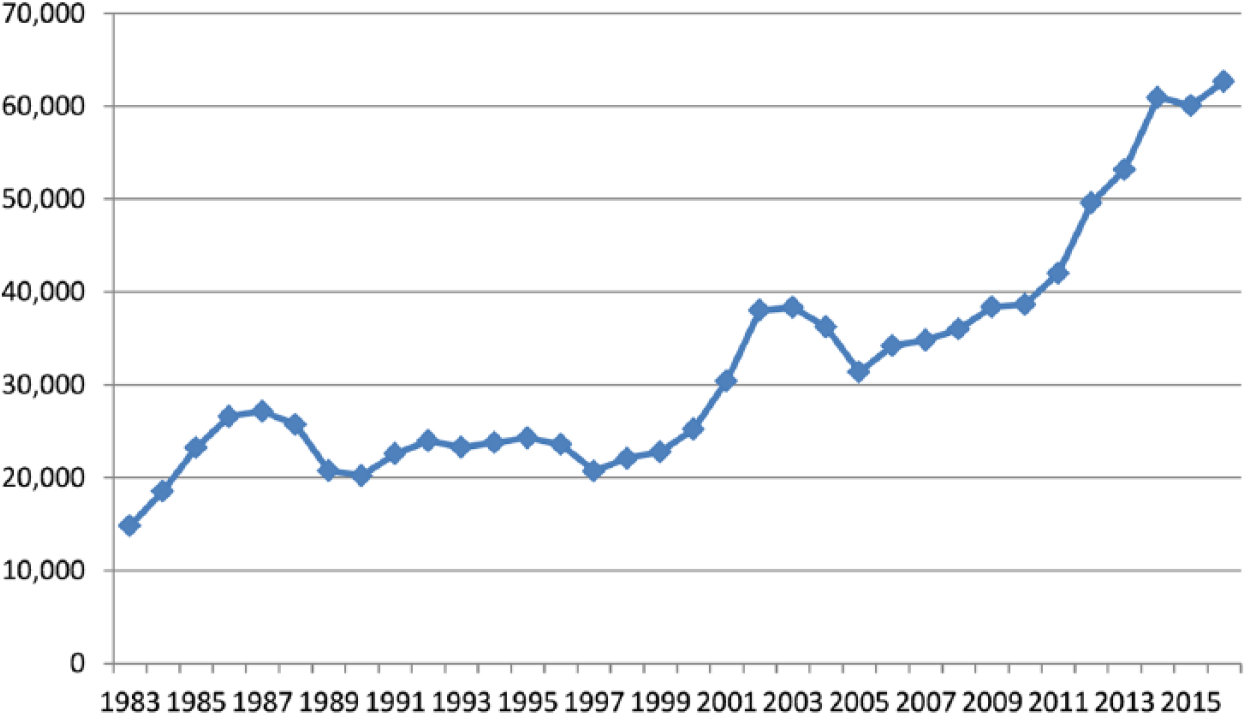
Number of homeless people in New York City shelters, 1983-2016.
Reiko Hillyer’s article, “The Guardian Angels: Law and Order and Citizen Policing in New York City,” looks at how poor people of color, often seen as the victims of the punitive turn in American society, responded to the decline in police services and the increase in crime that marked the 1970s and 1980s. The focus of the article is on the Guardian Angels, a group of working-class white, black, and Latino youths who began to patrol the subways in 1979 so that they could dissuade criminals from operating there. Hillyer problematizes the “law and order” narrative, which is usually viewed as a white conservative or neoconservative movement that criminalizes low-income populations of color. 20
Crime rates in New York City rose substantially in the mid-1960s and remained high (Figure 3) despite a series of city administrations that made crime-fighting their priority. During the 1970s fiscal crisis, the reduction of the police force by about one-third, partly through layoffs, and cuts in the capital budget, leaving police to work in stations, patrol cars, and with equipment that was often broken and seldom repaired, compromised morale and made law enforcement sporadic. Austerity at the New York Police Department (NYPD) came on top of previous revelations of widespread police corruption by the Knapp Commission in 1972, which also deteriorated both morale and public confidence in the department. Austerity and corruption problems worsened a situation where the legal underpinnings of public order maintenance had already been radically changed by the U.S. Supreme Court decision in Papachristou v. Jacksonville (1972), which invalidated most disorderly conduct statutes that had allowed police to arrest people on the basis of their status, rather than on the basis of an observed criminal act. 21
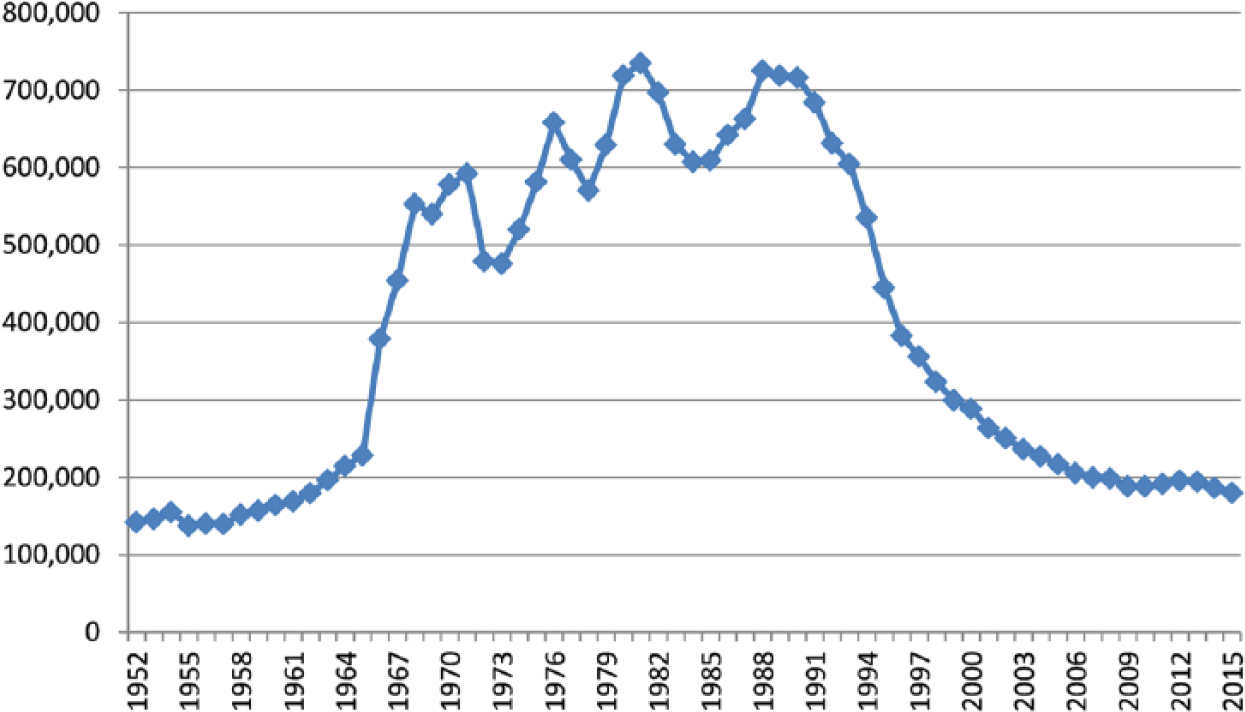
Total number of serious crimes known by the New York Police Department, 1952-2015.
The formation of the Guardian Angels represented a response to this perfect storm of police inefficiency, especially in low-income minority communities whose residents had suffered disproportionately from criminal activities and could not count on adequate police protection in light of the city’s service delivery priorities. 22 Hillyer recounts how the Guardian Angels appeared in force to regulate behavior and chase individuals out of the neighborhoods they were patrolling based on their appearance and status—actions that the Supreme Court had forbidden to the police. In Times Square, for example, the Guardian Angels used heavy-handed tactics against poor people in public space while getting praised by local businesspeople for keeping the area “clean.” Hillyer shows how austerity led ordinary citizens to lose faith in government institutions, seeming to justify conservative narratives about law and order, volunteerism, and even vigilantism.
Few areas have been affected as drastically by the urban crisis as the South Bronx. There are even fewer areas that have been as completely rebuilt and revived. In “The Rebuilding of the South Bronx after the Fiscal Crisis,” Themis Chronopoulos explores an important public policy accomplishment.
The rebuilding of the South Bronx defies linear narratives. The Koch Administration frequently employed public–private partnerships, which represent some of the most important features of urban neoliberalism. Community organizations that had been rebuilding areas in the South Bronx in the 1970s and the 1980s were required to conform to the requirements of the marketif they were to continue participating in urban development. However, the building of housing for low- and moderate-income people was also a way for Bronxites to mitigate the devastating action of both the long-term structural forces that disinvested in the Bronx and the cuts in fire department services that led to its incineration. 23 Despite the crucial role of private groups, housing units were built with public subsidies and regulated by government agencies. The city government promoted creative financing, often facilitated by nonprofit, nongovernment organizations managed by accomplished businesspeople. The city’s success in building housing for so many people performing low-paying but essential jobs has contributed to the making of a more vibrant urban economy, even if these same people are not necessarily the ones benefiting most from New York’s economic dynamism.
Long-term structural inequalities based on race and class, combined with the changes in the world system of political economy after 1970s, accelerated income and wealth inequality, and sundered the social and physical fabric of New York. The progenitors of austerity in the 1970s and 1980s arguably sacrificed thousands of lives for the good of New York’s bondholders, establishing what amounted toa temporary dictatorship of the city’s bourgeoisie, albeit with union workers’ money and participation. The four essays in this section demonstrate that the political and ideological victory of finance capital was, however, far from complete. Each author illustrates the complexity of citizen and governmental resistances and adaptations to neoliberalism. Those movements were as often conservative as progressive. They represent a sampling of ordinary New Yorkers’ successes and failures in renegotiating the social contract in a period of increasing inequality.
Footnotes
Declaration of Conflicting Interests
The authors declared no potential conflicts of interest with respect to the research, authorship, and/or publication of this article.
Funding
The authors received no financial support for the research, authorship, and/or publication of this article.