







Abstract
This article focuses on Major Gualberto Villarroel’s dictatorship in Bolivia (1943-1946), his murder, and the reanimation of his memory as a Bolivian national hero by the MNR party or Movimiento Nacionalista Revolucionario (Nationalist Revolutionary Movement). This nationalist party forged out of the crucible of the Chaco War, between Bolivia and Paraguay during 1932-1935, was an important factor in Bolivian politics throughout the twentieth century and initially came to power through an urban insurrection in April 1952. The article specifically uses the case of Gualberto Villarroel to explore why some national heroes are missing from the La Paz cemetery, how the MNR chose to commemorate the Revolution of 1952 and Villarroel’s martyrdom for the MNR in 1946, and how the MNR used those events to colonize urban space, to shape collective memory, and to silence popular historical actors. The MNR’s choice in making Villarroel a martyr required a revision of historical reality.
Introduction
The children’s illustrated Historia de Bolivia (2006), a publication conforming to the Educational Reforms of 2003, informs the reader that in 1943 Col. Gualberto Villarroel was among the “Militares who decided to destroy once and for all the traditional parties,” completing a “clean coup d’état without bloodshed” in an alliance with the nationalist MNR party (Movimiento Nacionalista Revolucionario, Nationalist Revolutionary Movement). 1 And yet, this children’s history also describes the “popular rebellion that took the streets of La Paz” on July 21, 1946, where among the dead that day was President Villarroel himself. He was “killed in his offices, thrown to the street, and subsequently hung from a lamppost on the Plaza Murillo. Hung ‘with a handful of collaborators’ accompanying him in the ‘infamy of hanging on the Plaza.’” 2 This view contrasts with the MNR’s portrayal of its martyr Gualberto Villarroel. For the MNR, “[t]he people venerated the lamppost where [Gualberto Villarroel] had been sacrificed, where a crown of red roses had been placed” to honor “those who had fallen in struggle for Bolivia’s economic independence.” 3 Despite a wide range of positive transformations, the children’s illustrated Historia de Bolivia (2006) acknowledges that, during Villarroel’s government, “social conflicts and protests were suffocated by the Police.” 4 By contrast, such was Villarroel’s status within the MNR Revolutionary lore that the party’s press organ La Nacion just three years after the 1952 Revolution’s triumph venerated Villarroel without any mention of the reasons for his demise. These two contrasting historical narratives underscore how politics and ideology embed memory, history, and power within national historical narratives. The MNR’s portrayal contrasts with the Illustrated Historia de Bolivia. If Villarroel’s overthrow was indeed a rebellion from below, how, and why did the MNR choose to highlight its association with him? Was Villarroel’s overthrow “a popular rebellion that took the streets of La Paz,” as the Historia de Bolivia presented, or was his regime a casualty of the “struggle for economic independence?” These competing visions are the questions that drive this article.
This article examines Bolivian national heroes as saints for the nation and uses Gualberto Villarroel—a martyred saint for the MNR—as a test case. Curiously, for such an important figure in MNR lore, Gualberto Villarroel is missing from La Paz Municipal Cemetery. In fact, his body resides in Cochabamba Municipal Cemetery, in contrast to the other divisive figures, such as Juan Bautista Saavedra (dictator, Liberal politician, leader of the Republican Party, later the Socialist Republican Party, also known as El cholo Saavedra) and Oscar Únzaga de la Vega (founder of the Falange Socialista Boliviana [FSB], Bolivian Socialist Phalanx). 5 Unlike these and other actors, the MNR reanimated Gualberto Villarroel’s body to work as a martyr for the Bolivian National Revolution of 1952 and the MNR mythology more broadly. Placing the Plaza Villarroel and the Monument to the 1952 Revolution in Miraflores neighborhood was a deliberate choice. It demonstrates how the MNR was looking to change how the nation was bound together.
Villarroel’s body is missing from the cemetery and its omission demonstrates an essential aspect of the cemetery’s nation-binding role: how the dead work to evoke affective ties and allegiance to the nation. In 1831, Liberator and Bolivian national hero Andres de Santa Cruz, created the structures of the new republican government. 6 Among the institutions of the nation he established was the Cementerio General de La Paz (La Paz General Cemetery): it was present at birth of the nation, it would bear witness to the nation’s heroes, and would memorialize the republican dead (See Figures 1 and 2). Those missing from the cemetery reveal as much as those memorialized. In this work for the nation, the dead, their memorials, and the processing of their mortal remains would remain bound to both Spanish and indigenous traditions and practices. 7 La Paz Cemetery would have the status of holy ground. This holy ground memorialized everyday people—high society and lowly pauper alike. 8 This holy ground also remained subject to the doctrines and dogma of the Church, as well as to the vagaries of urban property markets. It was, and remains, a city within a city: a precinct of the dead. 9
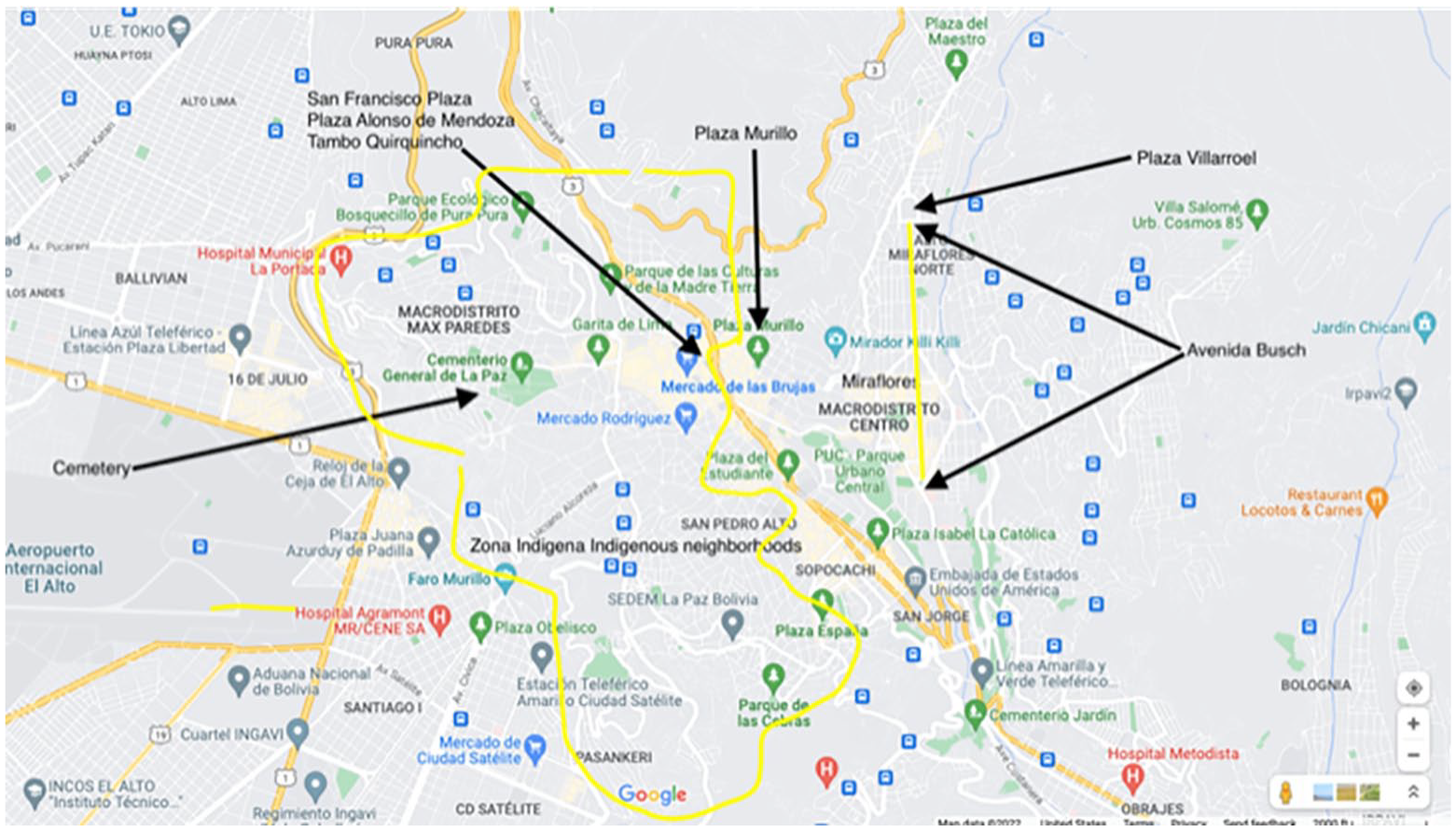
This map shows the indigenous neighborhoods outlined in yellow, the location of the Avenida Busch in relation to the indigenous neighborhoods, and the Plaza Murillo.
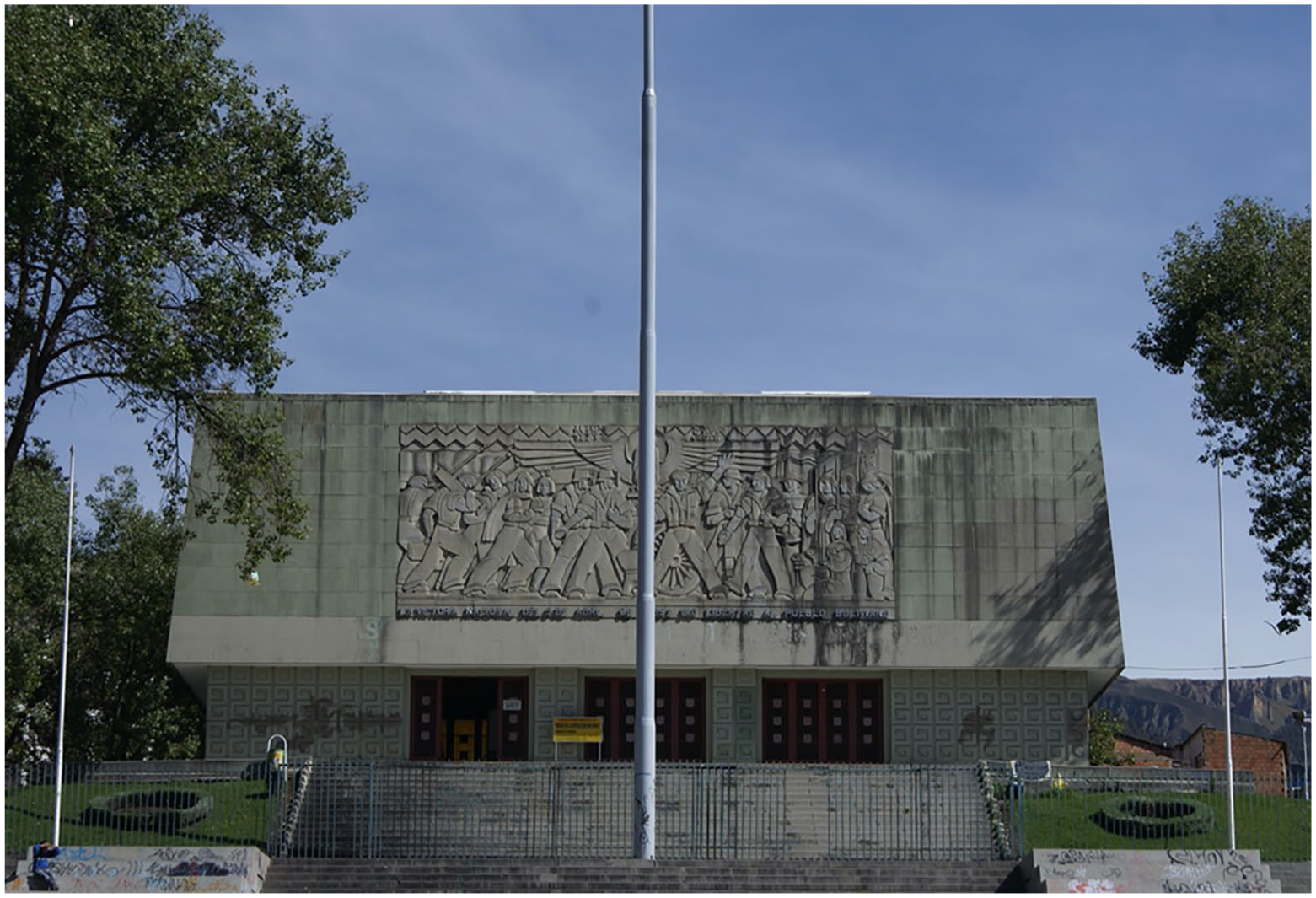
Monument to the Bolivian Revolution on the Plaza Villarroel.
The 1831 decree created a municipal cemetery, a new space where the dead did the work of nation-binding and signaled the emergence of the republic. Meanwhile, the past projected itself into the future in the social, economic, and political practices that shaped Bolivia in the republican era. Despite the end of the colonial regime, its logic and language remained embedded in the discourse and practices of the nation-state. The cemetery allows us to see cultural and religious practices in space and time. In the present, these layer upon one another in uneasy relationships that sometimes appear to visitors as a messy collection of monuments. The layers, I argue, present visitors with competing cultural practices, competing visions of the nation, and body politic. 10
Despite the syncretic nature of the La Paz cemetery from its beginning, it was born of a particularly secular moment in the establishment of the Bolivian nation-state—the independence struggles of Spanish America. Cemeteries are monuments to the human past, and a cemetery’s necrogeography, “the sum whole of the landscape and its contents,” as historian Thomas Laqueur calls it, enables us to analyze the cultural syncretism, the collection of beliefs visible in Bolivian mortuary culture, and the importance of national heroes or saints for the nation. The use of space in the precinct of the dead mirrors and distorts the nation. In many ways, it reflects contemporary urban reality: for example, the cemetery is ordered by “streets” and “avenues,” and different sectors house different groups of people. “Historical” and “elite” districts exist within the walls of the cemetery. Moreover, cemetery spaces are subject to forces like those governing the urban real estate market. As a result, one can think of La Paz cemetery space as both a construct of the present and a link to the past. Thinking in this way enables an “archeology” of mortuary practice and the role of mortal remains in Bolivian history. Taken together, the history of the cemetery, mortuary practices, necrogeography, and cemetery rules, help us understand how the dead work for the living. In Bolivia, the Catholic Church retained control of burials through the early 1930s, when the Military Socialists wrested control of counting, recording, taxing, and disposing of remains in the precinct of the dead. 11 This shift had implications for state- and institution-building and for the state’s ability to impart the ideology of the nation. It secularized burial and it employed technocratic, scientific, and specialized management of many areas of life including burial.
The La Paz cemetery mirrors society; thus unions, mutual aid societies, and other kinds of collective groups paid for memorials asserting their right to be buried there, as members of the city and nation. Elite families built elaborate chapels and mausolea, and these are the most exclusive and ostentatious type of commemoration. Most Bolivians did not have access to these elite burial practices, just as they lacked access to the vote or the opportunity to serve on city council. Yet they were able to claim representation in the nation through labor unions and collectives that maintained insurance funds for the burial of their members. The Society of Carpenters and Woodworkers, Mayo 1929 is one such collective catacomb (Figure 3). These catacombs serve to represent the worker in the cemetery and establish that, despite their lack of access to elite resources, in death they too belonged to the nation. Cenotaphs and war monuments comprise a third form of commemoration that which is granted through sacrifice to the nation: famous cenotaphs include those for the War of the Pacific, 1879; the War of the Acre, 1899-1905; and the Chaco War, 1932-35, as well as the Mausoleum to the Heroes of Liberty commemorating those who died during period of civil unrest, in opposition to the military dictatorships, and during the Bolivian Revolution, and it is a more recent addition to the cemetery. The MNR chose to build the Monument to the Bolivian Revolution of 1952 outside the cemetery, and this is puzzling given the importance of the revolution’s aims and goals. Even more peculiarly, other more painful and less glorious historical events are commemorated. These forms of commemoration—I would argue—demonstrate how moments of rupture have been deployed to bind Bolivians in the present. Several key themes emerge upon analysis of the cemetery and its monuments: the absent heroes, those present, and how the monuments within and outside the cemetery work to colonize and shape collective memory.
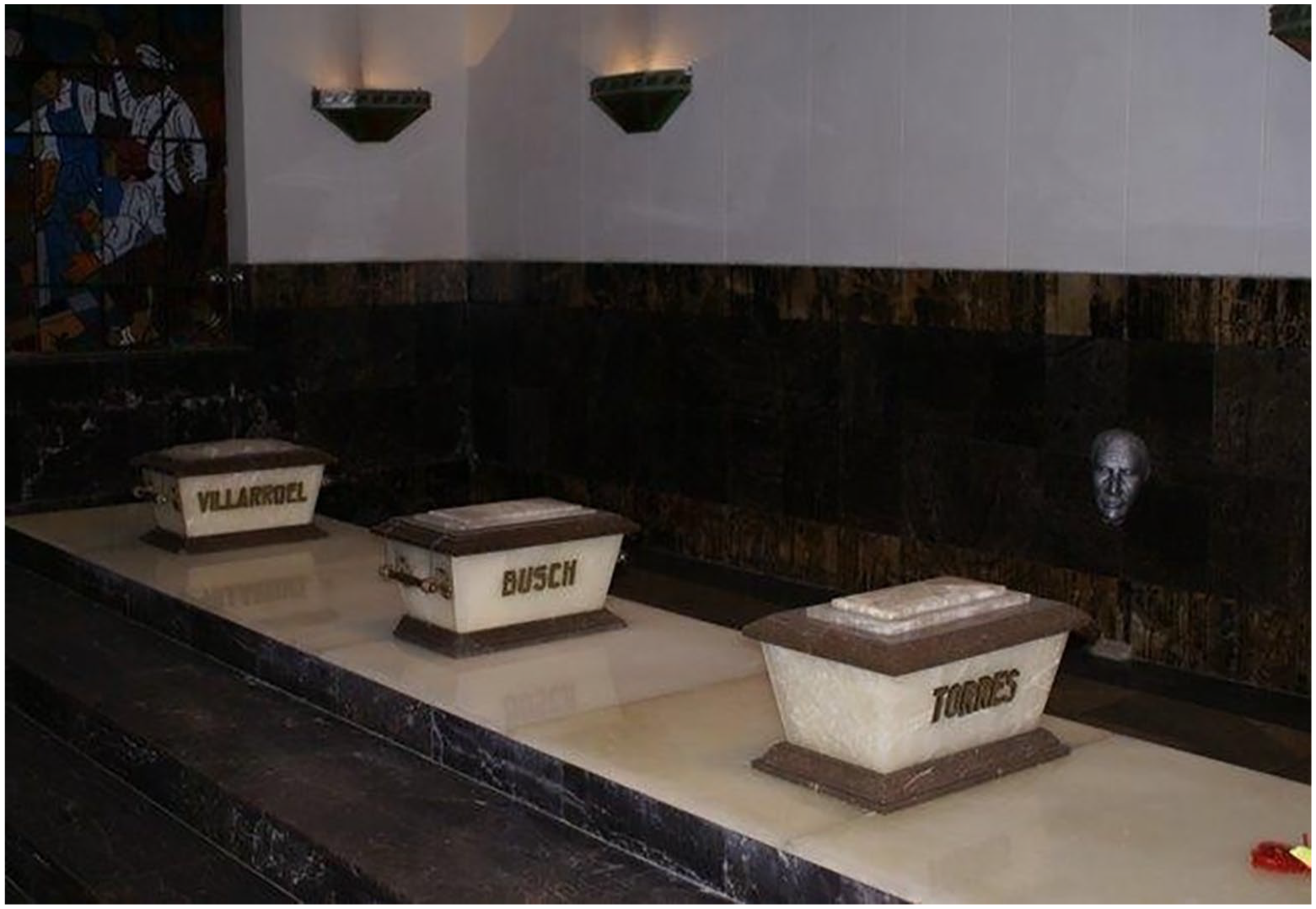
Three martyrs for the revolution, neither Busch nor Villarroel’s bodies reside in this Mausoleum located in the Monument to the Revolution crypts under the building Credit Carlos D. Mesa.
To make sense of this rich and complex nation-making tapestry, weaving together these notions of memory, history, and commemoration, this article focuses on two major concepts: the saints for the nation and the afterlives of the saints. 12 I call them saints for the nation because just as the Church used the special dead—saints—and their purported mortal remains, their places of dwelling, and the sites of their miracles as pilgrimage sites to bind believers to the larger Church, so too, do the saints for the nation ground us in the nation’s historical memory. The nation’s saints, their battle sites, tombs, monuments, and relics, create a similar pantheon. 13 In several ways, the nation-state grafted preexisting cultural and religious practices onto this new entity—the republic. 14 Using Gualberto Villarroel as a test case, we see how the MNR’s official narratives incorporated him as a martyr and gave him an afterlife; we also see how Bolivians themselves challenged that myth. Those challenges sedimented themselves within the official historical memory. Villarroel’s absence from the cemetery presents a concrete case to contrast with some of those who are present in that state-hallowed ground. More broadly, the essay examines how the Bolivian nation-state has used historical figures as avatars for political battles of the present. 15
These saints then can be employed to different ends and take on different meanings. As scholar Chris Moffat suggests, national heroes and their “ghosts” impinge upon the present no matter if they are employed as saints to emulate or as villains and witches to abhor. These ghosts, Moffat suggests, are not simply empty vessels, but they also demonstrate . . . what is clearly a malady of historicism, the present, drawing tactically from the past but in no way bound to it. To be haunted is to feel this progression falter. It suggests we are not always in charge of our relationship to the past and that the past, instead, may have designs on the present.
16
The saints’ afterlives escape the efforts to control the narrative in the present. They also demonstrate how and why counternarratives of the Bolivian nation emerge: Villarroel’s “hauntings,” as we shall see, are the effect of the afterlives. In Bolivia, Villarroel’s afterlives suggest sedimented layers of meaning that escaped the control of the MNR, but at the same time escape our own efforts toward historicism. One counternarrative to the entire weaving of Villarroel’s death into MNR lore is the location of his body. His wife, Elena Lopez, insisted on his burial in Cochabamba Cemetery. In addition, her fight for recognition of Villarroel’s heroism suggests another way in which the saint might escape the MNR’s control. This is how the dead talk back. From a ruling party perspective, Villarroel’s uncanny specter as ghost demonstrates that faltering progression and invites readers to parse the spaces between individual memory, collective memory, political power, and history. And parsing these aspects helps expose the elaborate infrastructure employed to create powerful fictions binding citizens to the nation.
The Chaco War Generation: Urbanization, War, Scars, and the Nation
Historian and sociologist Xavier Albo has stated that La Paz is the city of two faces: the creole and indigenous faces. 17 This aphorism also describes the geography and social geography of the city but fails to account for the importance of occupation in the spatial dynamics of the city. San Francisco, the main indigenous settlement, had a large church and a plaza. This indigenous settlement, similar to all the indigenous settlements within hundred years of the conquest, was a historical construction—a product of demographic collapse and the Columbian Exchange. The Spanish colonial regime reorganized and consolidated indigenous communities as the population dwindled. Thus, all La Paz’s indigenous settlements were the result of colonization. Spaniards often settled near or within pre-Columbian sites. For instance, Tambo Quirquincho, an indigenous lodging house and collection point for long-distance traders, was also the site of the Plaza Alonso de Mendoza, the first Spanish settlement in the valley. 18 After the Spaniards moved south and east across the Choqueyapu River to what would become Plaza de Armas or later Plaza Murillo, the city was truly divided between the Spanish central district of the city and the Santa Barbara, San Pedro, San Francisco, and San Sebastián indigenous neighborhoods. This geography established real and imaginary borders between La Paz and the extramuro (“outside the walls”) areas that remained indigenous. Prior to the 1930s, La Paz had twenty bridges that crossed this river to connect the Spanish old town and the indigenous parts of the city. By the late 1930s, a project to control flooding in La Paz included the channeling of the Choqueyapu under the city central districts. Throughout the first half of the twentieth century, La Paz attracted migrants from provincial cities and Aymara indigenous communities. These migrants tended to be from highland provincial towns, highland indigenous communities, and other cities. After the Chaco War, the pace of migration increased, attracting even more people from the rural Aymara communities of La Paz province. As the city grew, some of its infrastructure changed the physical appearance of the city, but not the way people described those who lived in the extramuro.
From 1900 to 1950, migration to the neighborhoods of La Paz west of Plaza Murillo expanded a geographical area elites defined as indigenous neighborhoods. 19 The areas of most growth were Challapampa, Villa Victoria, Pura Pura, and Achachicala, and these were also sites of the city’s industrial zones. These are due north of the Plaza Murillo. The west of San Francisco Plaza and Church and the south of Santa Barbara and San Sebastián came to house the many workshops, markets, tambos, and warehouses of the city. 20 In the area near Gran Poder, the Garita de Lima was an important geographic and social nexus in the heart of the indigenous neighborhoods; it contained several tambos, small shops, artisan workshops, and housing. It was also a central location for all the major rail lines in the area. In these areas, residential and commercial spaces intermingled. Some residents worked in several light industries such as factories that produced matches, cigarettes, condiments, and textiles, a bottling plant, and artisanal workshops. Thus, not all the people living and working in the zona indígena identified as such. Elites moved from the area around the Plaza Murillo to areas that became more fashionable: the Alameda (El Prado), Sopocachi southwest of the Spanish city center, and San Jorge south and west of the city center. The Plaza Murillo and central La Paz housed the city’s most important department stores, government buildings, convents, churches, and elite housing. 21 The city’s cemetery was in the indigenous neighborhoods not far from the light industry, train station, and Villa Victoria. Despite the attempts to divide the city between its Spanish and indigenous halves—reality often demonstrated just how intertwined the city’s districts remained. La Paz as an urban space was transformed through the Chaco War and in its aftermath.
The Chaco War with Paraguay shaped Bolivia’s historical and political trajectory from 1932 forward. The conflict affected every aspect of Bolivian society and marked an entire generation of its people. Historian Elizabeth Shesko has pointed out that for Bolivia, the casualty rates place the war on par with the American Civil War, 1860-1865, and the mobilization rates place it on par with countries engaged in World War I, 1914-1918. 22 For Bolivia, the effects of the Chaco War, its losses, and its legacy directly influenced the reformist and revolutionary movements of the post–Chaco War era. Bolivia’s collective memory is scarred from the realities and lessons Bolivians drew from the outcome of the Chaco War. The consensus that emerged among those of The Chaco War Generation were a series of lessons that accounted for Bolivia’s defeat in the Chaco War. These arguments were historical in nature and were based on three interrelated transformations. The reformists and revolutionaries pointed to the narrow base of Bolivia’s political legitimacy. Historian Herbert Klein estimated ten thousand voters in 1926, in a nation of three million. This was a brittle and narrow base of support in the Liberal Era, 1899-1920; very few could vote, and the system was controlled by a small, powerful minority who were disconnected from the realities of most Bolivians’ lives. Second, the fracturing of the system led Juan Bautista Saavedra, president from 1920 to 1925, to court new political actors and the “traditional parties” perceived this strategy as bringing political instability. Third, the military was unprepared to carry out such a war. This narrative helped the Chaco War Generation assess why Bolivia did so poorly in the war.
Thus, once the disconnected elites of the “traditional parties” drew Bolivia into war, and the military blundered and lost battle after battle, the root causes could be seen at once. Traditional political elites’ ineptitude and political meddling led to largely poor, indigenous, and mixed-race Bolivians dying in horrific circumstances. Moreover, the military hierarchy chose to avoid any kind of accounting for the Chaco War or for the needless deaths caused because of political and military ineptitude. Embedded within these arguments were the ideological battles over race, gender, citizenship, and national identity. The Chaco War Generation of which the MNR leadership and Col. Gualberto Villarroel were a part helped shape the Bolivian Revolution of 1952. As part of the Chaco War Generation, the MNR-Villarroel coalition would attempt to incorporate those previously excluded indigenous Bolivians into the political system as contributing members of the nation—the very same kind of people they witnessed die in the Chaco.
Gualberto Villarroel’s experiences on the front lines in the Chaco War and as a prisoner of war in Paraguay led to his political awakening, formation, and radicalization. Villarroel belonged to a secret reformist political lodge called Razon de Patria (RADEPA; For the Motherland or Fatherland) that emerged among the officer corps during the conflagration. 23 The civilians serving the Villarroel regime had also matured politically during the Chaco War and many of them were members of a nationalist party founded in 1941—Movimiento Nationalista Revolucionario (the Nationalist Revolutionary Movement) party. Several MNRistas served on the front lines and recalled the Chaco War as the crucible that forged their nationalist party. 24 The MNR saw themselves as defenders of the nation against the anti-nation elite, or rosca (nut/ring). 25 Gualberto Villarroel was a Bolivian Army Major and reformist military officer who the MNR helped bring to power in a coup in December 1943. Believing themselves to be defenders of the nation, the MNR served in Villarroel’s cabinet, and they helped to steer many of the signature policies of the regime, including rural and urban labor policy, indigenous rights legislation, and the right to organize unions.
By early 1946, the regime was found to have perpetrated brutal and shocking acts of political repression, including the assassination of other political elites. These actions meant that Villarroel’s regime had grown increasingly violent and unpopular. The root cause of the political repression was a precarious economic situation. In Bolivian history, precarity is long term and structural, integral to the largely agricultural and extractive resource economy that shackled the country into selling primary resources for all its history; it was also a significant constraint on Villarroel and his government’s actions.
26
His regime marked the continuation of a cycle of coups and countercoups as well as the emergence of leftist and reformist politicians and parties in Bolivia. Despite several positive social advances, Villarroel was overthrown in July 1946. The American Ambassador to Bolivia, Mr. Joseph Flack, must have been in a rush when he sent an undated telegram to the Secretary of State, advising him of a momentous situation in La Paz, Bolivia. The U.S. State Department logged the telegram as received on the evening of July 21, 1946. In the language of a diplomat but with the brevity of a tweet, it read as follows: Members [of the US] Embassy saw body [of] ex-President Villarroel hanging in Plaza Murillo, apparently killed about 2:30 today by revolutionary forces. Other members of Government, including some Cabinet Ministers reportedly killed. General situation apparently much calmer but still unsettled and sporadic. Shooting audible.
27
The day before, the MNR party members serving Gualberto Villarroel’s government had resigned their positions and Villarroel replaced them with military personnel. On July 21, 1946, Gualberto Villarroel lost his life after a coalition of protesting university students, teachers, members of the working classes, and elite political actors within Bolivia turned against the regime and overthrew it. 28
Gualberto Villarroel illustrates several important aspects of a martyr’s role in nation-building and nation-binding. Villarroel is a martyr for the MNR, a key part of MNR mythology, and a saint for the nation missing from the La Paz Municipal cemetery. In turn, the cemetery itself can serve as a lens to explore the paradox inherent in making Villarroel a martyr. The MNR reanimated Villarroel for its own ends and, in doing so, revealed a series of afterlives for him that demonstrate the historical disjuncture his reanimation was meant to mask. As a saint for the nation, Villarroel illuminates how myths and spaces of commemoration exclude some and include others based on how they measure up to martyrs. Indigenous Bolivians have repeatedly endured official erasure and disempowerment.
Commemoration sometimes hides more than it reveals of a nation’s history. We can see this in the commemorations to Villarroel and the Bolivian Revolution of 1952. In tying the MNR’s birth to the Chaco War and its leaders’ participation in the reform movements of the Military Socialists of 1930s and the Villarroel dictatorship in the 1940s, the MNR set the stage for Villarroel the martyr to reemerge as a positive force for Bolivia. That reanimation highlights the ambiguities in the MNR’s actual behavior and actions between 1943 and 1956. As a result, a larger characteristic of the MNR era was a promise to create something new that avoided the indigenous past and present.
As a revolutionary movement, the MNR’s role as a party and as state actor was to inculcate a specific nationalist feeling and ideology. Historian R. Matthew Gildner has demonstrated that nationalist activist-academic-intellectuals writing a “useful” national history chose Villarroel’s death and image as a defining moment of the nationalist ideology and its resource nationalism. 29 By 1955, his image as a martyr for economic nationalism was already embedded in MNR lore. The MNR styled itself a revolutionary movement and it sought to create a nationalist history that would ostensibly bring useful material to light to mold a national population able to overcome the anti-nation sentiment built up under the rosca. In this version of Bolivian history, the rosca had used the Bolivian state to divide and grind down the Bolivian masses. This anti-national elite then served to stifle Bolivia’s development and squeezed every resource out of the nation, leaving Bolivians with nothing. This telling of history demonstrated a need for an activist historical practice capable of overcoming this backward anti-modern Bolivian past. A past that did not reflect the true strength and power of the nation. Within the idea of a useful national past, Bolivian-ness and a focus on worker and peasant identities gave the MNR hope that it could circumvent the tricky question of indigeneity. Bolivia, several scholars have pointed out, struggled with creating a sufficiently strong state capable of imposing an effective national identity. Thus, the arranged marriage between Villarroel and the MNR shared a view of history with little regard for indigenous Bolivians and without a mestizo identity that adequately served as metonymic for Bolivian-ness. 30 Thus, belonging to the nation meant being Bolivian, an identity that would unify the populations previously excluded in concert with and led by the nationalist revolutionaries in power.
Politically, the MNR and RADEPA were a marriage of convenience as both reformist military officers and MNR adherents shared a similar view of the Chaco War and the ineptitude of the old political and economic elite. Villarroel and the MNR worked together despite friction within the alliance. Both wanted the rosca defeated, but the MNR used its position of power to create independent linkages to Bolivia’s labor movement and it also attempted similar linkages in the countryside. While the political goals of the MNR and RADEPA coincided, the MNR’s independence and survival enabled it to use Villarroel’s death for their own ends.
In the nationalist telling, José Manuel Pando, military officer, president (1899-1904), Liberal politician, and victor of the 1899 Civil War, shaped the ascent of the tin mining elite based in La Paz. Thus, the Liberal order served as a shorthand for a state apparatus unresponsive to Bolivia’s majorities. Gualberto Villarroel’s death allegedly peeled away the last bits of Liberal order as it was the rosca who were the intellectual authors of Villarroel’s demise. 31 Among the MNR’s perceived adversaries for control of Bolivia’s future were some of Bolivia’s economic elite whose wealth lay in mining tin: Simon I. Patiño, Mauricio Hoschschild, and Victor Aramayo. In the MNR’s view, these men were in control of Bolivia’s economic destiny and, as a so-called anti-nation elite, these men used their power to concentrate wealth in their own hands, wealth generated through the blood and sweat of Bolivians, and then, to add insult to injury, these men exported that wealth abroad. At the same time, the Bolivian state relied on mining and the revenue it raised, and also had few other resources to exploit to raise revenue.
While elements of the nationalist history were true, the actual situation was much more complex for Villarroel’s regime. The effects of inflation, foreign debt payments, the scramble for food aid, and post–world war economic shocks all combined to create harsh economic conditions and political challenges that underscored the situation in July 1946. During this period, the Villarroel government attempted to import grain from Argentina to meet demand and ultimately took a loan from the U.S. government to buy grain from the United States. During World War II, Bolivia sold its copper and tin at fixed prices as the burden of waging war. The United States would forget its promises to aid Latin America, in the ways it aided in the rebuilding of Europe in the form of the Marshall Plan. Politically, reformists, radicals, and nationalists across Latin America mobilized against the United States’ chauvinistic nationalism and many rejected the U.S. government’s brand of anti-communism. 32 In such an unstable context internationally, Bolivia’s internal dynamics also shaped its political transformations.
The 1952 Palace Coup and Villarroel as a Saint for the Nation
To understand why the MNR chose Villarroel as a martyr, one must understand the context shaping the Bolivian Revolution of 1952. What began as a palace coup became the catalyst that brought the MNR to power. April 1952 is a moment of rupture—the MNR leaders and Oscar Únzaga de la Vega, leader of the FSB, had negotiated a coup with elements of the military junta in power at the time. Únzaga de la Vega then not only declined to participate in the coup, but also secretly sent a messenger to El Alto to alert the military hierarchy there. The FSB and Únzaga de la Vega would later become leading figures in the opposition to the MNR until the 1964 coup that brought to power General Rene Barrientos, with whom the FSB would ally. The bulk of the fighting that brought the so-called National Revolution to power occurred between April 9 and 11, 1952, in the highland provinces of La Paz, Cochabamba, and Oruro. In the city of La Paz and in El Alto (still technically one entity until the 1980s), the fight was concentrated in several areas: the military bases in El Alto, Miraflores near the Estado Mayor (General Staff Headquarters), the Monoblok building, and the area surrounding the Universidad Mayor de San Andres (UMSA; Major University of San Andres) and Villa Victoria and the cemetery district, which are indigenous neighborhoods. See Figure 4
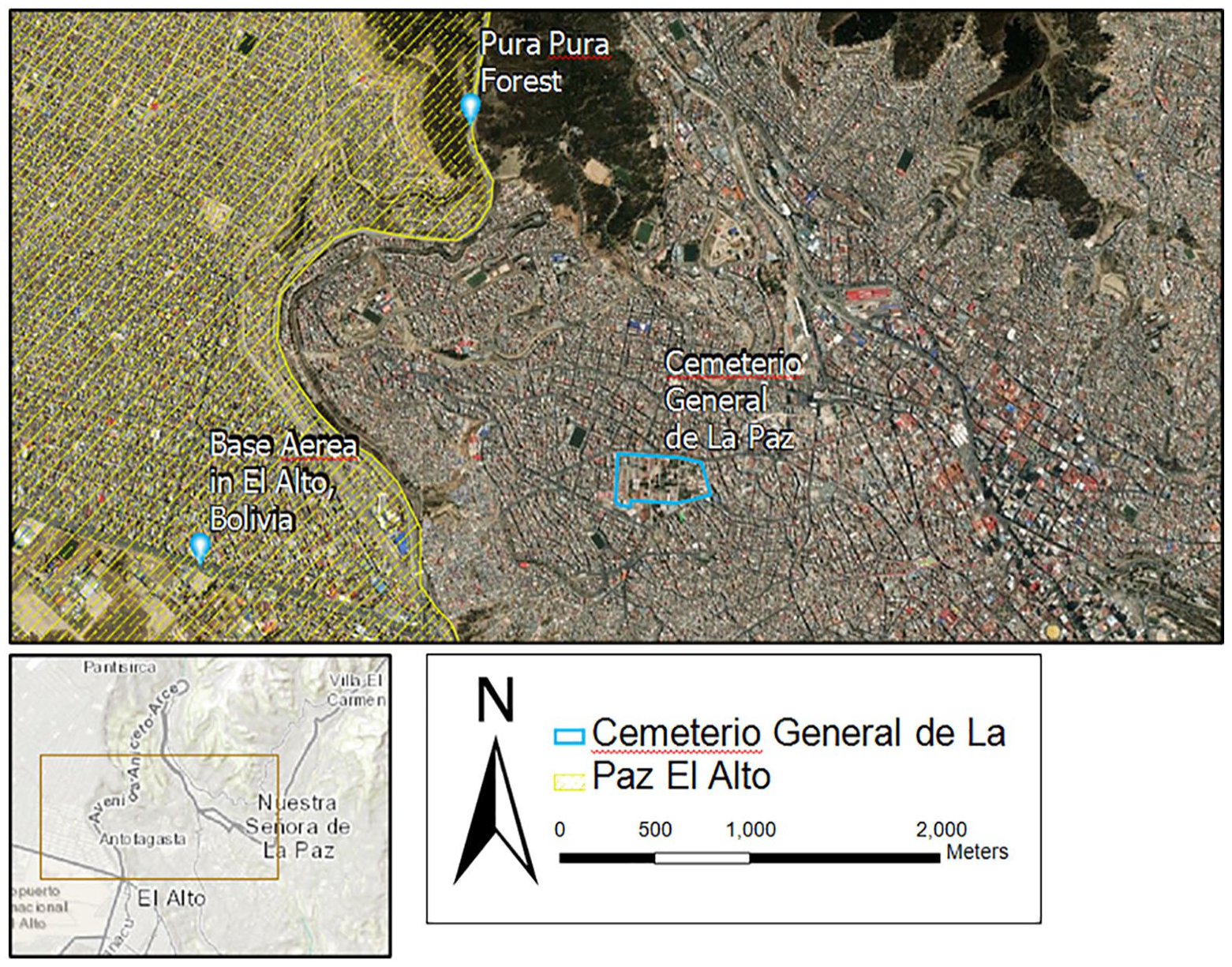
The image depicts the location of the La Paz General Cemetery, the military installations in El Alto (highlighted in yellow), and the Pura Pura Forest; all locations were significant to the battle that erupted on April 9, 1952 and concluded on April 11, 1952, ushering in the Bolivian Revolution of 1952.
The MNR’s ideology relied upon a nationalist agenda that hoped to use Bolivia’s mineral resources to develop its internal and external markets and to control a larger share of the mining rents for redistribution among its social and political bases. The Revolution enshrined universal suffrage, national control of subsoil rights, the 1953 Agrarian Reform, and educational reform in 1955. The MNR chose Villarroel as their martyr for several reasons: it enabled them to establish legitimate claim to authority for having participated in Villarroel’s government from 1943 to 1946, the populist agenda that the MNR helped create and enshrine gave them bona fide revolutionary and nationalist credentials, and the regimes that replaced Villarroel maintained power through repression and violence—all these factors helped make his adoption as a martyr easier.
For the MNR, the Villarroel whose actual body met a brutal end was long forgotten, but his corpse serves as a Christlike saint for the nation: Just as the Catholic faithful venerate Christ, so too do the MNRista faithful venerate Villarroel as their martyr and a saint for the nation. Simply put, the MNR could not build a nation devoid of race and class, but Villarroel’s sacrifice legitimated the MNR’s bone fides as revolutionaries and was a major reason for his reanimation. The Crucifixion of Jesus of Nazareth and the hanging of Gualberto Villarroel’s lifeless body from a lamppost on the Plaza Murillo were signaled as equivalent—especially since the revolution in 1952 occurred during the week of Easter; it began on Spy Wednesday and ended on Good Friday. For the MNR, the rosca elites unleashed a torrent too strong for Villarroel to resist. It is a narrative that could in several ways be used to the MNR’s own ends. The reality was more complex. Villarroel-MNR dictatorship lost control of the situation in Bolivia. These competing narratives and hauntings of the official story demonstrate how Villarroel’s reanimation fits a broader pattern of reformist political projects in Bolivia. In that sense, I argue that the MNR was most interested in an elite-directed use of the state’s resources for what they conceived was a more equitable share of the nation’s wealth for Bolivia’s poorest. Within Bolivia, a rich diversity of interests coalesced around the Bolivian Revolution, but the coalition was always an unstable one. Yet myths, once created, are difficult to control: The dead eventually talk back, exerting their own force on both the medium and the message.
In this sense, the events of 1946 and 1952 demonstrate the faltering of our relationship with the past; historicism is double-edged. In 1946, the military hierarchy, in refusing to back Villarroel, condemned the dictatorship to a quick and potentially bloody end. In 1946, and in the MNR’s subsequent deliberate rehabilitation of Villarroel, the MNR ignored certain elements of reality to create their own myth. Villarroel was brought down by a multiethnic and multi-class coalition, an MNR-style “national” coalition. In 1952, meanwhile, the residents of La Paz’s cemetery district and Villa Victoria areas that were integral to the MNR’s triumph were also ignored and relegated to a secondary plane. In addition, that April 1952 insurrection and victory in La Paz could also be construed as national, a multi-class and multiethnic coalition of Bolivian society cohered around the defense of La Paz. Yet it was not commemorated in this way. This remains a curious choice, given how closely the reality of the coalition resembled the nation the MNR was in effect looking to build. Located within what were known as the indigenous neighborhoods, the municipal cemetery and Villa Victoria neighborhoods defended against military attacks seeking to enter and access central La Paz from the Pura Pura Forest through well-known footpaths. The city’s defenders, couriers, and spies included Chaco War veterans, university students, Carabineros, miners, MNR adherents, middle-class high school students, and women of all classes. In fact, the fighting in the cemetery district and Villa Victoria could not be more clearly a moment to frame the coalition of miners, zona indígena neighborhood residents, Carabineros, and MNR adherents as a revolutionary and nationalist one. 33
In a similarly counterintuitive choice, the MNR invoked saint and martyr Gualberto Villarroel—his memory, body, and death—as proof of his worthiness. His martyrdom was used to create the National Revolution’s origin story: that he is one of the saints for the nation missing from the La Paz Cemetery. 34 The cemetery contains no formal recognition to the 1952 Revolution. In part, it seems that Villarroel became useful because the instability and violence wrought between 1946 and 1952 cast him as better than the regimes that came after him. 35 Villarroel’s case helps provide more insight into how historical figures are subsequently deployed as saints, especially those whose images escape official narratives undergo similar processes. Saints and the collective memory associated with them coalesce relatively quickly, and over time, they become safer to employ as saints for the nation. 36 Villarroel’s tragic death and the subsequent regimes’ use of repression, violence, and an unstable political and economic situation meant that the MNR could safely link themselves to Villarroel as a hero and visionary who fought for Bolivia’s economic freedom. Villarroel then became a servant of the MNR and its genesis. The MNR cultivated Villarroel’s heroic virtue, which served to rehabilitate his memory as the MNR’s martyr and his work on behalf of the MNR’s vision of national economic independence. Villarroel laid the foundation for the MNR’s own resource nationalism, which all eventually led to his canonization as a saint for Bolivia. Just like the MNR avoided the coalition of insurrectionist forces defending the cemetery district and Villa Victoria in April 1952 as a nationalist moment, even more surprising is the MNR’s reanimation of Villarroel as a martyr and saint rather than focusing on his demise and siding with the crowd, another multiethnic and cross-class alliance bringing down an increasingly unpopular dictatorship.
Something was clearly amiss: A veil was suspiciously placed over the exceedingly important contribution of the lower elements in the MNR’s triumph. Villarroel’s martyrdom helped the MNR achieve this reworking of history. The fact that the MNR benefited from and then carefully masked the roles of masses of miners, urban workers, army conscripts, and peasants is not all that surprising. Yet, examining how the state chose to commemorate the Revolution of 1952, we find very little commemoration by the Bolivian city, prefectural, or national governments’ entities in La Paz in the indigenous neighborhoods—areas defended by indigenous neighborhood residents and without whose contribution the revolution would not have succeeded. The cemetery contains no formal recognition of the fighting that occurred in and around it. The only commemoration that exists is not an obvious one: The Mausoleum to the Heroes of Liberty. 37 It is one of the more recent additions to the cemetery. 38 In a calculated manner, the monuments to the revolution are in a site far from where the National Revolution fed the landscape with the blood and sacrifice of a multiethnic and multi-class coalition. Thus, these missing monuments in the precinct of the dead—La Paz General Cemetery—illustrate how the dead are constitutive of society, and how commemoration serves to colonize memory and shape historical narratives.
The Monument to the Revolution and the Plaza Villarroel on which the monument resides serve as a form of spatial colonization in Miraflores. The MNR deliberately chose the site in Miraflores. The Monument was completed in 1956 and its interior murals were completed in 1964. The Plaza Villarroel sits far from the site of Villarroel’s execution. In addition, the Monument to the Bolivian Revolution of 1952 was built on a plaza east of the cemetery district and Villa Victoria, far from the fighting in those sectors of the indigenous neighborhoods. The positioning and naming of the monument was deliberate. The grid and general layout of Miraflores was designed by the eminent Bolivian architect Emilio Villanueva. Within his original plans, a Parisian-style avenue with a broad median would lead to a plaza. 39 At the time, Miraflores was a newly urbanizing neighborhood and was home to primarily middle-class people.
The boulevard’s median was designed to be lined with public art and monuments leading to a raised platform plaza, which provides a sweeping view of La Paz and the valley. The art celebrates Bolivia and the statues commemorate heroes. It is no accident that this boulevard was named Avenida Busch after the Military Socialist President German Busch Becerra. The avenue itself starts near the Plaza San Martin and the Monument to German Busch sits about halfway up the avenue (see Figures 5 and 6). The boulevard ends at the Plaza Villarroel and the Monument to the Bolivian Revolution of 1952 sits at the highest point (see Figures 7 and 8). The basement of the monument contains two cenotaphs, one to German Busch and one to Gualberto Villarroel. Neither man’s remains reside there. Juan Jose Torres, another MNR saint, was interred in 1984 (see Figure 9). The room itself is lined with busts of Bolivian national heroes from the colonial era onward. The monument and its location provide an order and a narrative that never existed in 1946 or 1952, but the story it tells is one of evolution toward the National Revolution of 1952. In keeping with the MNR’s revolutionary ideology, the layout of the avenue, the naming of the avenue, and placement of public art all emphasize the revolutionary preference for didactic spaces.
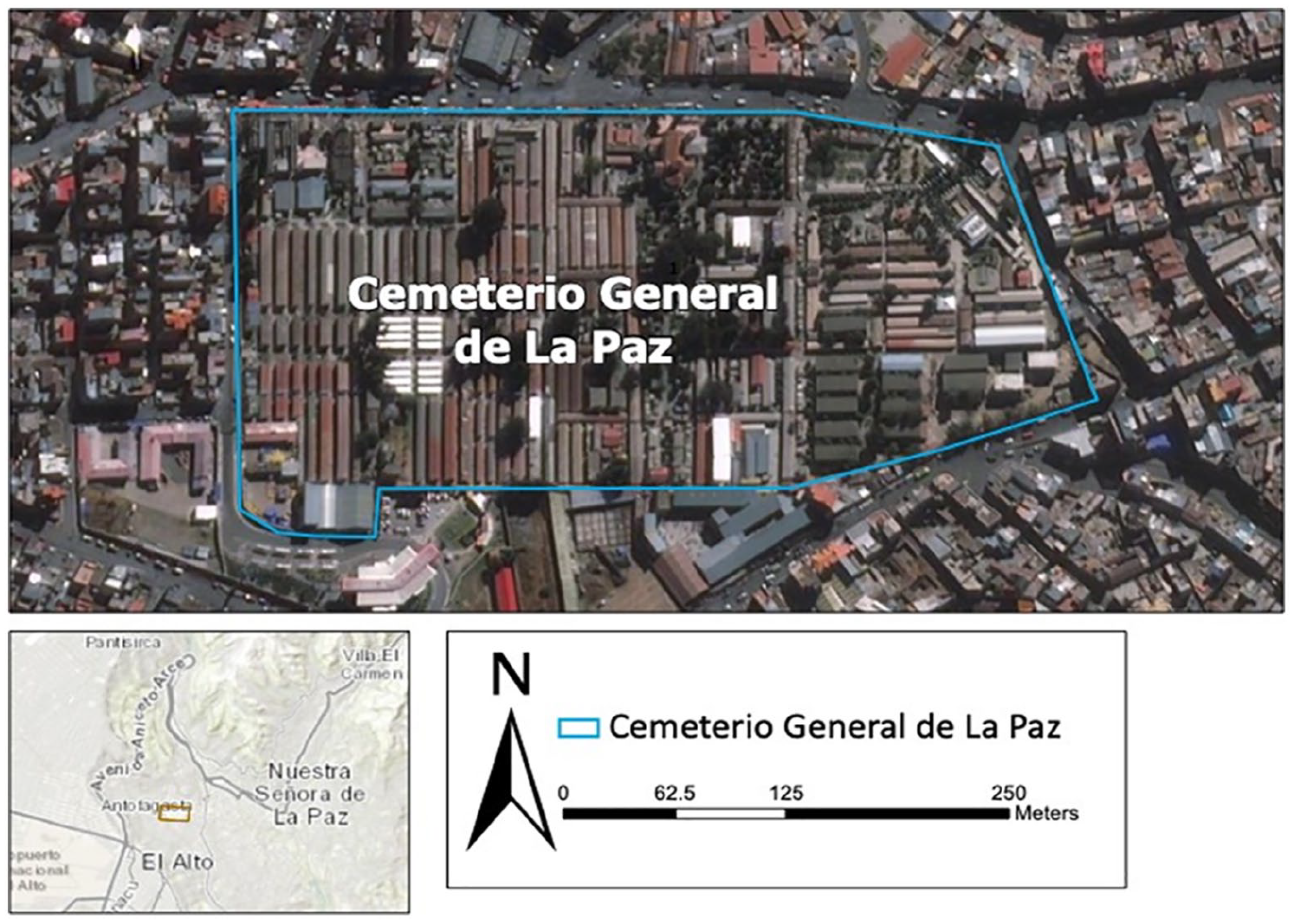
The La Paz General Cemetery.
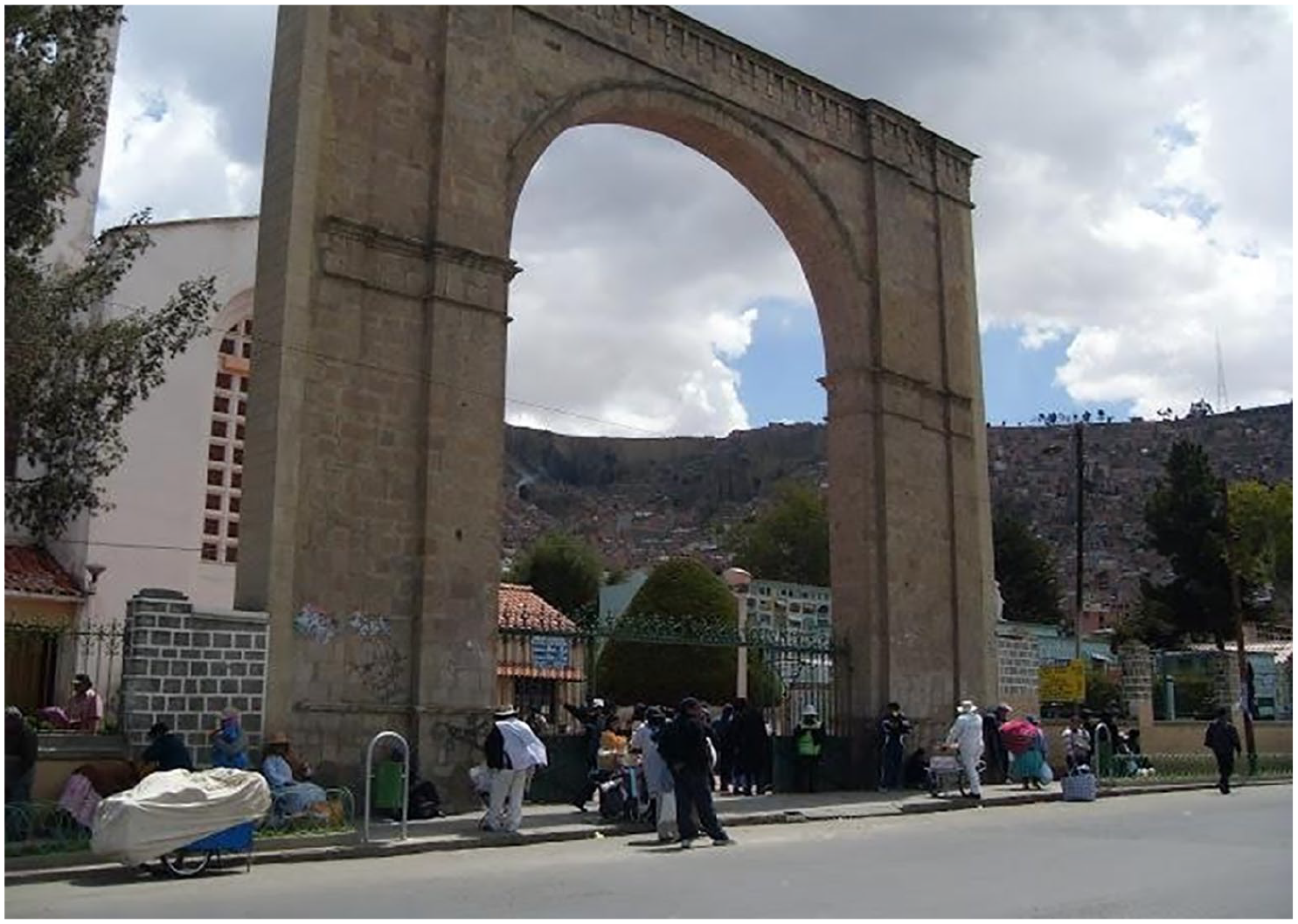
Roman arch currently used as the main entrance to the cemetery.
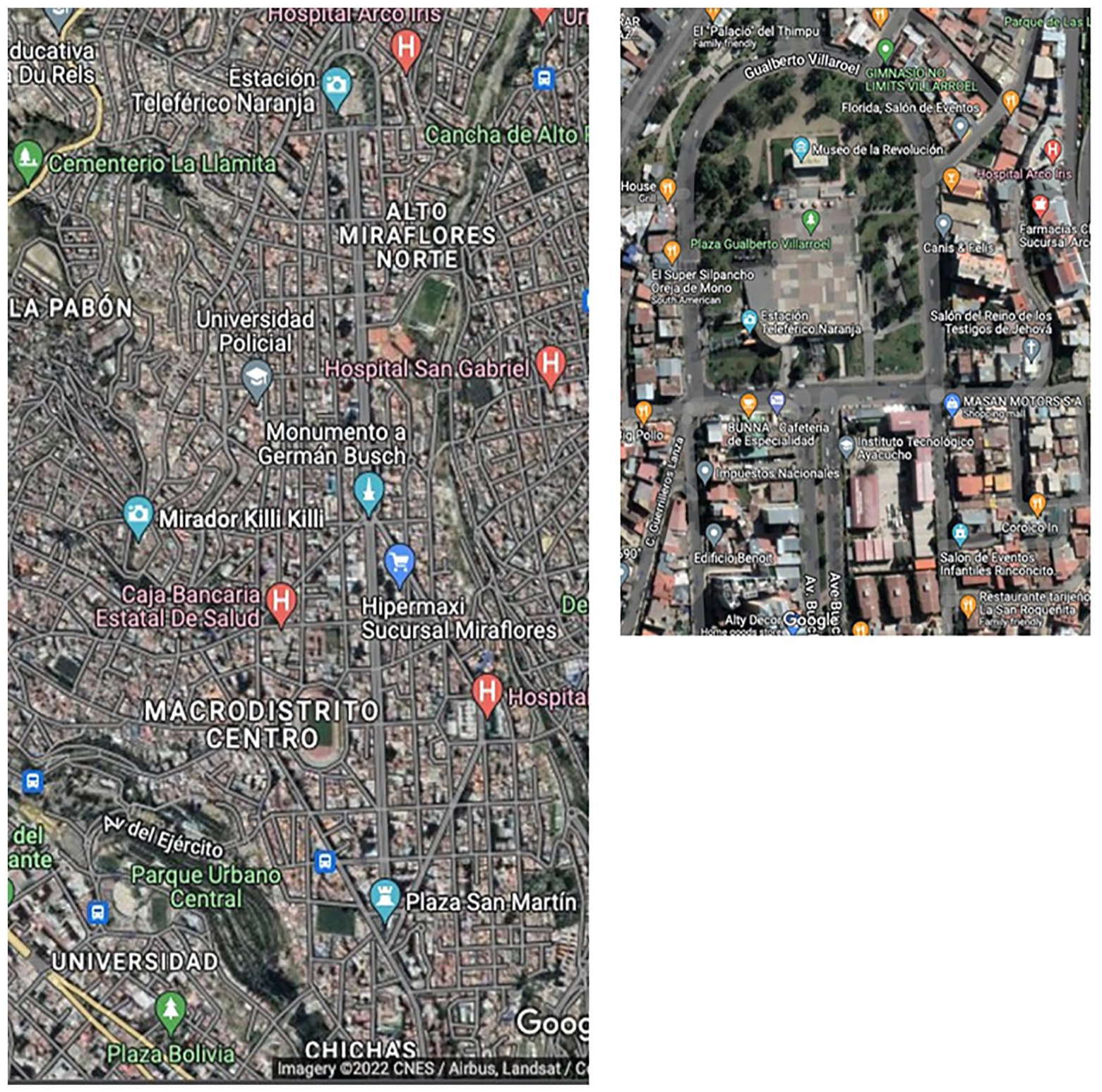
The map shows the Avenida Busch beginning at the Plaza San Martin leading to the monument to German Busch (left panel) and from there the avenue leads to the Plaza Villarroel (right panel) and the Monument to the Revolution of 1952 (right panel).
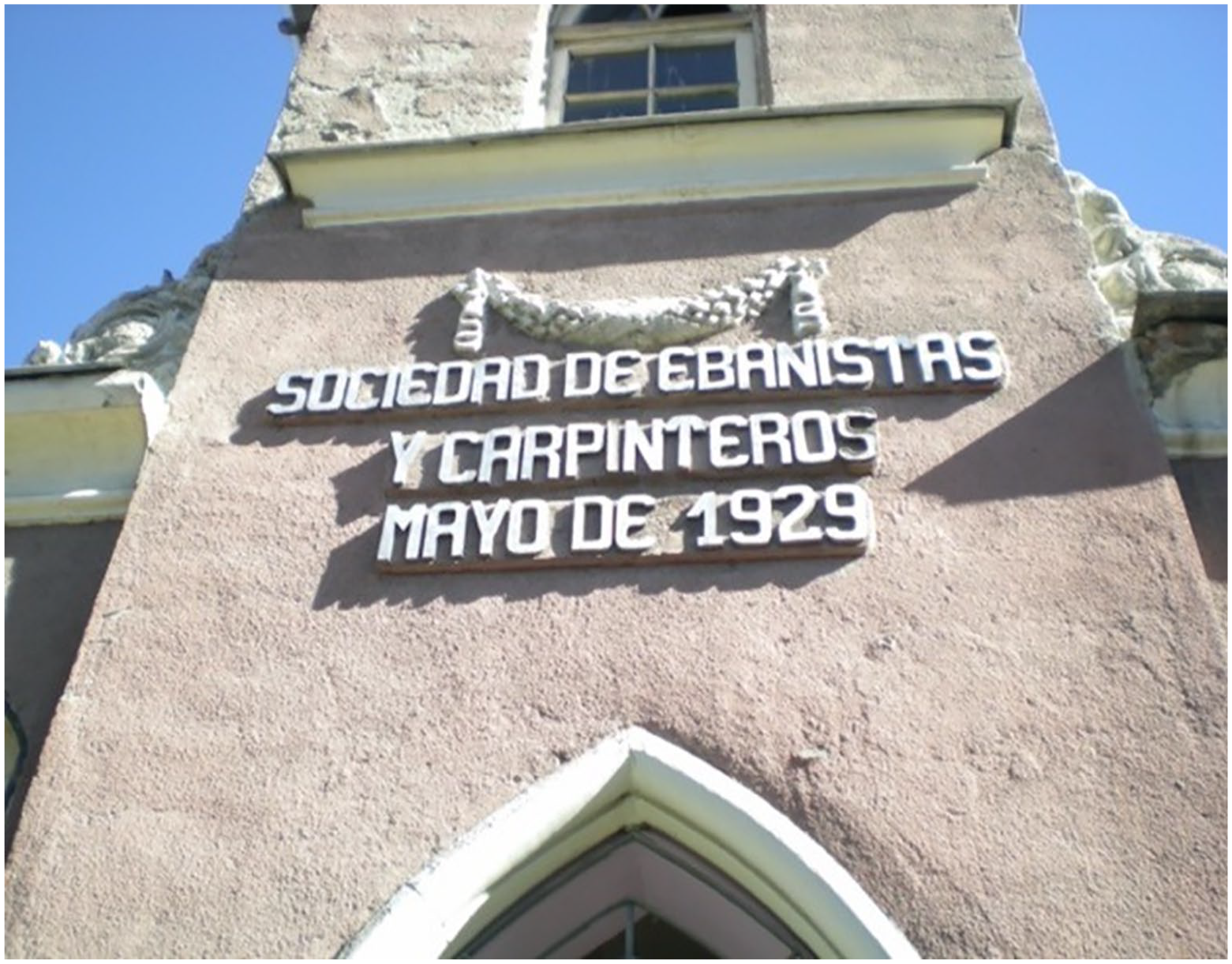
Catacombs of the society of carpenters and woodworkers, La Paz Cementerio General, Mayo 1929.
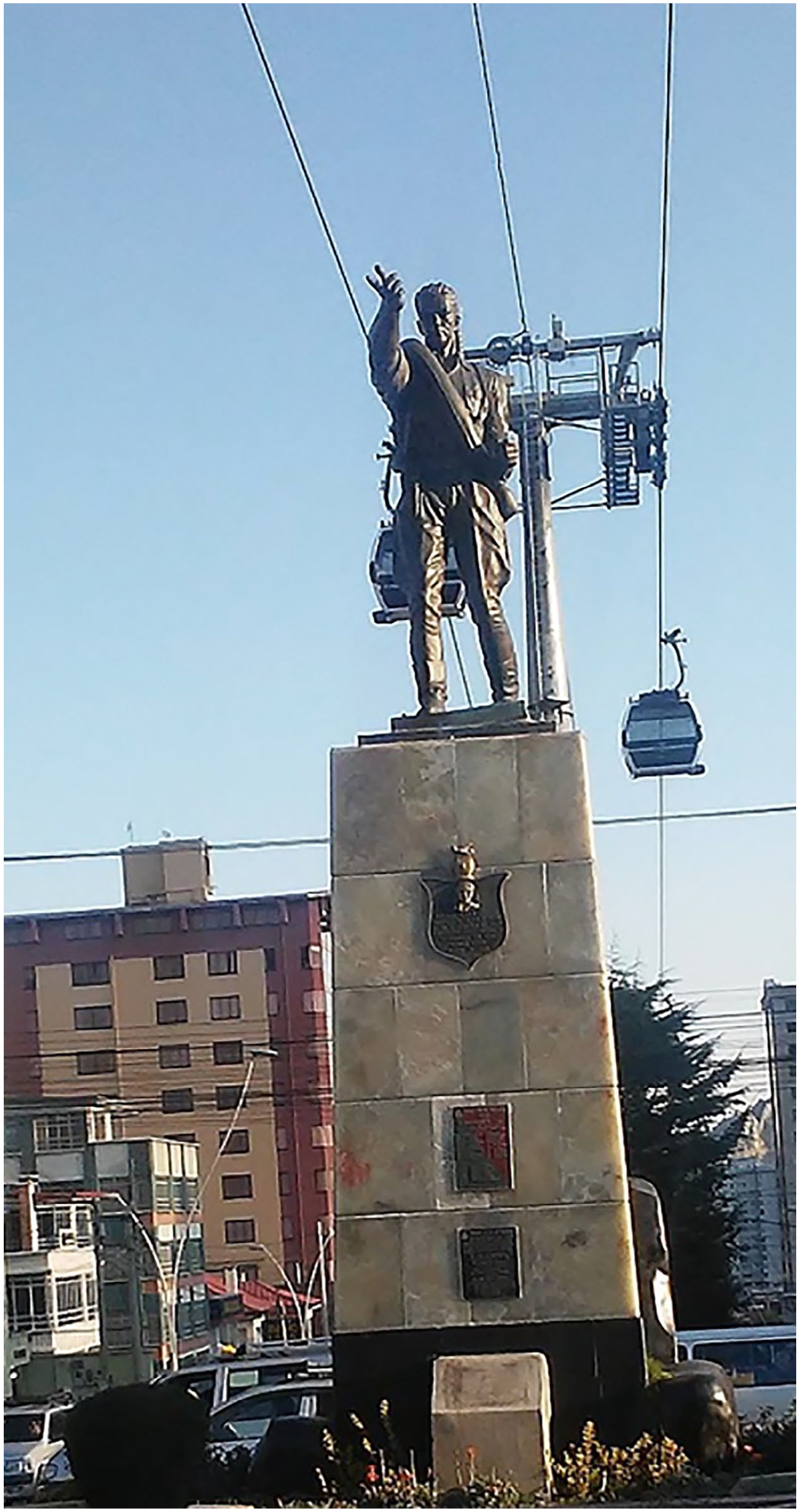
The monument to German Busch on the Avenida Busch.
Conclusion: The Echoes of Religion
Returning to the central questions that led to this exploration, was it a popular rebellion or was it a martyr’s sacrifice in the war for Bolivia’s economic independence, as the children’s illustrated Historia de Bolivia and the MNR, respectively, contended? A popular rebellion, one that had mobilized various political elites, some members of the working class, and university students, overthrowing an increasingly unpopular dictator was not a useful narrative for the MNR of Villarroel’s death. However, by 1955, the MNR myth is established that Villarroel was a victim of the rosca in the struggle for economic independence. For the MNR, there was no question that, just as the Military Socialist experiments were important, Villarroel’s regime was foundational to the MNR myth of its origins and evolution. In speaking for these dead, the MNR aimed to control history, but this essay highlights that speaking for the dead means shaping individual memory and helping to create collective memory. Myths often stand on sincere fictions laced with exercises of power. The idea of the sincere fiction highlights the issues of racial power and political control. A sincere fiction is a discourse that employs cultural common sense to address and solve societal problems, 40 for example, the notion that poverty is a personal and moral failing rather than conditioned by structural inequalities and social or cultural barriers. Sincere fictions help elites control historical narratives, and they are part of a larger complex of social and political discourses that makes the operation of power appear natural and normal. In this case, Gualberto Villarroel serves as the sincere fiction that he was a heroic sacrifice for economic nationalism. Villarroel presents a test case as a contested historical figure and one who is present in La Paz, but absent from the precinct of the dead. The echoes of religion are not accidental for the MNR. The reminder that Villarroel died not during Holy Week, but that the MNR started its revolution on a Spy Wednesday and due to the aid of many non-MNR actors came to power on a Good Friday is no accident, just like Villarroel’s rehabilitation and canonization is no accident. The placement of the Monument to the Revolution and the story that the Avenida Busch and Plaza Villarroel convey demonstrate the MNR’s mythmaking. The MNR projected a historical vision that was trying to create a new mestizo nationalism, or at least a Bolivian one in which indigeneity had been erased or sanitized. Thus, Gualberto Villarroel enables us to examine in one concrete case, the uses to which history is put, the ways in which the La Paz cemetery reinforces some narratives, and how national heroes missing from that cemetery help create historical memory.
Footnotes
Acknowledgements
This article is dedicated to Jimena, Greta, and Georgia. I would like to thank the Journal’s anonymous reviewers for their time, comments, and insights. I would like to thank all my colleagues, but most especially Patrick Eagan, Ray Hebert, Jim McNutt, and Robert W. Stern for their continuing support. I owe a debt of energy and gratitude to the students in the Historiography Sequence at Thomas More University, their enthusiasm, hunger for knowledge, and their local history theses, which enable me to fuse theory and practice as a teacher and scholar. The support of the Provost, Associate Provost, the Faculty Relations Committee, The Benedictine Library, and Faculty Development Fund at Thomas More University was crucial for some of the research and its presentation at The Rocky Mountain Conference on Latin American History. I wish to thank Elena McGrath, Robert W. Stern, and E. Gabrielle Kuenzli who took time to read and comment on the work in progress. I owe an enormous debt of gratitude to Elizabeth Shesko and Bonnie J. Erwin who read and commented on multiple versions of this work and helped improve its readability and arguments. All errors, omissions, and mistakes are mine.
Declaration of Conflicting Interests
The author(s) declared no potential conflicts of interest with respect to the research, authorship, and/or publication of this article.
Funding
The author(s) received no financial support for the research, authorship, and/or publication of this article.
