







Abstract
This article investigates how heat and humidity—as lived experiences in the summer—were negotiated through an analysis of various sites of coolness and heat, focusing on the period between the American occupation and high economic growth in postwar Tokyo. As the population of Tokyo grew from eight to eleven million between 1955 and 1965 and major infrastructure projects changed the urban landscape, the study shows how coping mechanisms for dealing with the heat and humidity were characterized, on one hand, by heat avoidance strategies that manifested themselves in a search for coolness in nonurban environments, in the home, and in shades created by new urban assemblages. Yet the article also demonstrates that the dictates of employment bore witness to paradoxical heat-inducing practices embodied in the not-so-cool clothes men and women wore, revealing the extent to which social and sexual norms inhibited the realization of individual corporeal coolness. As mechanical cooling made inroads into urban life, a shift from a passive to an active strategy of combating the summer emerged, resulting in inhabitants increasingly choosing not to leave the capital but to stay in it. Despite resistance to artificial coolness at home, where heat avoidance strategies had been largely successful, the article finds that the air conditioner managed to establish itself first in the workplace, and then eventually in the home, as the needs of middle-class urban families living in more western-style apartment blocks made themselves felt.
Over the past one hundred years, Tokyo’s temperature has risen by 7°F, significantly more than in small- and medium-sized cities in the country. Much of the responsibility for this increase has been attributed to the heat island effect. An increase in the number of paved roads, concrete buildings, and other dense infrastructure—combined with a decrease in the number of trees, vegetation, and bodies of water—has been blamed for absorbing heat and reducing natural cooling. Partly because of this shift in the urban ecosystem, there is arguably no season in Tokyo that is more thermally uncomfortable than the summer, as reflected in the high proportion of inhabitants who seek refuge in air-conditioned spaces, which are among the most extensive in the world. Foreign visitors planning to visit Tokyo in the summer are advised to avoid the sweltering heat and humidity of July and August, when temperatures can soar to uncomfortable highs averaging over 86°F and 80-percent humidity. 1 Guidebooks that make a conscious effort not to discourage tourists from visiting in these months tend to stay silent about outdoor activities during the day, instead recommending visits to evening events such as street fairs and fireworks, or otherwise directing them to excursions outside the capital altogether, to cooler climes such as the seaside or the mountains, including hikes up Mount Fuji. Drawing on research conducted into the weather by historians and anthropologists, this article answers the question of how Tokyo residents negotiated heat and humidity as a lived experience in the twentieth century. 2 It shows that there was a significant shift from enduring the summer to escaping it; attributes this change in behavior to a complex set of environmental, political, economic, and cultural factors; and emphasizes the importance of understanding the search for coolness in gendered terms.
“When You Empty Your Mind, Even Fire Feels Cool”
In the prewar era, complaints about heat and humidity were rare—it was considered important to face or endure the summer. Exposure to the summer sun was a good thing—avoiding it unnecessarily was considered bad for “corporeal vitality.” 3 For those who were serious about facing the hot and humid summer day, preparations began with an early rise. Morning exercise before temperatures climbed was seen as effective in preparing the body for the day ahead: hotter body temperatures helped make the climatic conditions feel cooler. A hot bath at the end of the day worked on similar principles: it not only helped wash away the sweat and dirt but also made the body’s encounter with the evening air feel more pleasant. Thermal conservatives condemned the overreliance on electric fans, refrigerators, or even ice columns, because the coolness they produced was not the same as natural breeze, and because they prevented the body from cultivating the kind of toughness that would see it through the summer, a point that was emphasized in relation to children. 4 Equally important to surviving the Tokyo summer was nurturing the right mindset. Looking at Mount Fuji (which was still visible from many areas of Tokyo), admiring the gardens, and imagining places of coolness were standard mental practices that made the summer bearable, even enjoyable. Losing oneself in work, reading, or prayer also helped distract the mind from the heat and humidity. The cultivation of mental strength for the summer was summed up in the popular poetry of Yosa Buson, who taught that “when you empty your mind, even fire feels cool.”
Early and unsuccessful efforts to challenge this attitude of thermal endurance came from women, whose moves to wear lighter clothing caused controversy. By the turn of the century, middle-class women began to adopt western clothing. Compared to the heat-trapping properties of the sashes (obi) that were part of wearing the kimono, western dress was seen as both practical and more economical, a point that applied equally to children, whose welfare women were also concerned about. 5 For the educator Misumi Suzuko, the sight of children wearing koshihimo and katahimo—straps used to prevent kimonos from falling down—seemed cruel, especially in the summer. 6 They weighed heavily on the children’s bodies and could easily unravel as soon as the children began to move or play, making them a nuisance. Remembering her experience of visiting Karuizawa, a popular summer resort developed by Westerners, Misumi envied how western children moved freely in their clothes. Feeling sorry for her daughter, who was restricted by long sleeves and sashes, Misumi decided to dress her child in western clothes to relieve her of unnecessary thermal suffering. Such moves toward thermal emancipation were not welcomed. Even among women who continued to wear kimonos in the summer, the public was quick to criticize female tendencies to give in to the heat and to show flesh. On the eve of the summer of 1915, the Yomiuri Shimbun, a major newspaper, admonished young women to dress up properly and instructed them not to expose their breasts to fellow passengers on trains. 7 It was also important for women to wear appropriate colors. Whether wearing wafuku (Japanese-style clothes) or yōfuku (western-style dress), Hirato Nobuko urged young women and their guardians to avoid bright colors that might be too much for men. 8 As late as 1935, she reminded women to make sure to wear muted colors and appropriate clothing to prevent unwanted advances from the opposite sex.
Such strong thermal norms of endurance shaped disbelief about residents who chose to escape the Tokyo summer for cooler climates. Some of the criticism stemmed from a mixture of suspicion and envy of the practice of summering (hisho) that Westerners had introduced to the country. Thanks in part to the development of railroads, hisho sparked a boom in retreats to places far away from Tokyo beginning in the late 1880s, as mountain villas and seaside resorts sprang up around post stations like Nikkō, Ikaho, Hakone, and Enoshima. 9 In public discourse, escaping the heat—the literal meaning of hisho—could only be justified if time spent in milder climates was used productively. Doing nothing—sleeping, eating, and drinking mindlessly—was wasteful. Looking to the West, Ōkuma Shigenobu, a prominent elder statesman of the Meiji era, argued that students, teachers, and civil servants should spend their summer vacations “cultivating” themselves by studying the flora and fauna, as well as the history, geography, geology, and marine life of the mountains and seas they visited. 10 There was also criticism of wealthy women who spent their time at resorts doing nothing more than escaping the heat of the city. Writing in a women’s magazine, Mochizuki Miyoko told readers how their European counterparts flocked to the Swiss alps and used time there wisely to develop relationships with other members of high society and to improve themselves through reading, study, and work. 11
The criticism of the escapists was also based on the consensus that staying in Tokyo during the hot months was not necessarily unbearable, especially in a Japanese house designed for the summer and, in the case of Tokyo, built along an east-west axis to invite the summer winds moving from the South to the North to pass through. Complaints by western visitors in the winter about the poor insulation of the Japanese house overlooked the fact that its draughtiness was a strength in the summer, when the air flowing through the dwelling cooled the occupants’ bodies. 12 To achieve indoor coolness, the floor was raised to reduce the impact of refracted sunlight from heating the living areas, while the wooden verandas (engawa) that formed the perimeter of the house—as well as the eaves that protruded from the roof—combined to prevent sunlight from penetrating and burning the tatami-floored interior. Depending on the climatic conditions, adjustments were made to the house itself. Blinds (sudare and yoshizu) could be erected to keep out the sun and the exterior doors/walls could be rolled back to expose the engawa to the breeze. Inside the house itself, rectangular panels (fusuma) and partitions (shōji), both of which created privacy and warmth during colder periods, could either be pushed aside along the railings or removed entirely to create more “airways,” an arrangement referred to as natsuzashiki. For the well-to-do, the home could also be customized by changing the decoration. Hanging scrolls (kakemono), decorative objects, picture frames, vases, and flowers could be updated with images, calligraphy, animals, and plants appropriate for the summer, the visual consumption of which helped to create a cooler mindset (Figure 1). 13
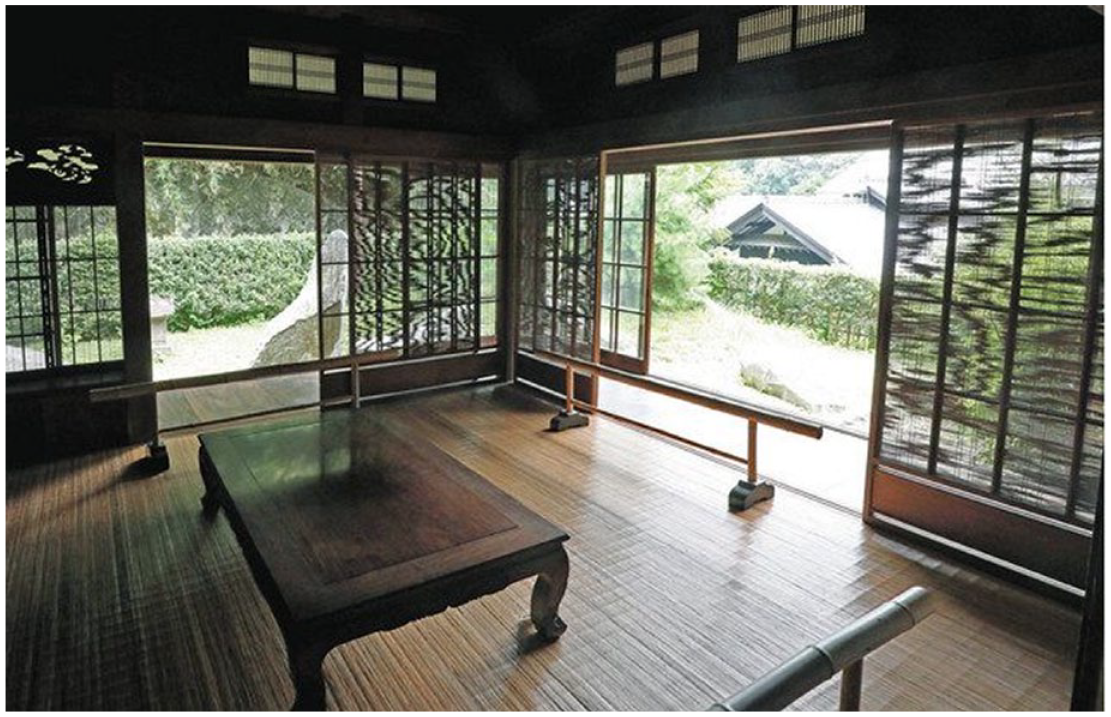
A reconstruction of a traditional Japanese house (minka) laid out in summer style (natsuzashiki) at the Japan Open-air Folk House Museum. (Tokyo Shimbun, accessed December 20, 2023, https://www.tokyo-np.co.jp/article/199044) (Reproduced with permission from Tokyo Shimbun).
Much of the construction of domestic coolness, it must be emphasized, depended heavily on female labor. Servants and housewives were responsible not only for removing the partitions and changing the kakemono but also for replacing tobacco trays, ashtrays, futon seats (zabuton), tea and snack sets, and cups and plates for the summer. Women were also expected to prepare for the return of husbands and fathers from business by sprinkling water in the streets and gardens, a practice called uchimizu. They were also responsible for providing clean and cool yukata—lighter kimonos—for men to change into. The men would then wait for meals to be served while sitting on the engawa in the cool breeze and admiring the gardens. It was also considered hospitable to offer similar services to visitors who were provided with a wet towel (oshibori), offered a bath, and given a yukata—practices that survived into the postwar era. Needless to say, the quality of housing, the number of alterations, and the amount of female labor were far from affordable: commoners living in tenements in the low-lying (shitamachi) areas of Tokyo had less access to such luxuries. Disturbing levels of infant mortality in Tokyo and Osaka during the summer testified to the largely silent heat struggles suffered by the weak and impoverished living in cramped and squalid conditions.
The Threat to Coolness
In the prewar period, the Japanese house was largely insulated from the forces of Westernization, which had a greater impact in the public sphere, resulting in what Edward Seidenstecker called “the double life.” 14 Beginning in the 1920s, however, fears began to surface that the turn to western housing—called “cultural housing” (bunka jūtaku) because of its perceived superiority—might jeopardize domestic coolness. Prioritizing functionality and privacy, western-inspired architects had set out to create a multitude of self-contained rooms that had the unfortunate result of reducing contact with the outside air, with the engawa often eliminated, which further worsened ventilation. In his critique of this development, Mori Unosuke, a little-known architect, complained that too many houses were being built for winter, and he urged his colleagues to resist the temptation to create too many rooms and to install windows on either side of each room to create airways. 15 One pioneering architect who tried to heed such a call was Fujii Kōji, who is credited with being the first modern architect to consider the impact of climate. In building his own house in Kyoto, Fujii was sensitive to western influences, paying attention to reducing noise, creating functional divisions, and increasing privacy. One major problem Fujii faced was the living room, which was completely cut off from the outside world. To address the severe lack of cross-ventilation, Fujii decided to install wind conduits that invited the air into the inner sanctum of the house by raising the surrounding rooms twelve inches higher than the living room so that the mouths of the wind conduits could be placed in the space between them. As Jin Baek has pointed out, if the house had “been planned in the traditional manner,” devices such as wind conduits would have been unnecessary, since the walls and partitions “could all have been opened to facilitate cross-ventilation.” 16
Unlike the Japanese home, it was an open secret that western-style buildings lacked the architectural means to tame the heat and humidity. When Bruno Taut, the German architect who lived in Japan after fleeing the Nazi regime, visited a governor’s office, he noticed that the building was completely unprepared for the summer. Although it boasted a spacious office with high windows and balcony doors, it was built in European style with thick massive walls and without any draught. The European windows had no eaves and there were stone tiles on the big balcony . . . The blazing sky dazzled us and the tiles of the balcony heated the air which entered the room. The cloudy sun seemed to burn more than ever. Its diffused rays penetrated everywhere. There were no cool shadows; the heat and light blazed intolerably.
17
At the time of Taut’s stay in Japan in the mid-1930s, mechanical cooling was beginning to take hold. As in the United States, air conditioners had first been installed in factories producing food, pharmaceuticals, cotton, matches, weapons, prints, and photographs where the goal was to manipulate stable climatic conditions to prevent either spoilage or combustion of goods. 18 Mechanical cooling was then extended to theaters, cinemas, department stores, and offices, most of which were concentrated in Tokyo. Civil engineers applauded such moves, arguing that because Japan’s climate was “inferior” to that of the West, technological interventions were needed to help Tokyo overcome its climatic disadvantage and become more like Berlin, Chicago, London, or Paris. Temperatures in the range of 60°F to 78°F and humidity levels between 62 and 95 percent were touted as ideal for the Japanese body, not only to improve health—climate control promised a more hygienic environment—but also to optimize levels of productivity. 19 Not content with installing them in buildings, one author went so far as to argue that the introduction of “room coolers” in the home would also prevent people from wasting money on expensive trips to summer resorts, which in turn would save businesses from having to shut down during the summer. 20 A 1935 meeting of the Society of Electricity that was convened to discuss air conditioning criticized prevailing notions of thermal endurance. 21 Scoffing at traditional ideas of mental coolness, the organizer of the discussions declared that it was wrong to force people to endure the heat and humidity: it was a perfectly natural human desire to want heat in the winter and coolness in the summer. To improve both health and productivity, he argued that it was necessary to transform the harsh summer and winter into a pleasant spring and fall.
Much of this early movement toward mechanical cooling was halted by war. Not only did conflict prevent the importation of American climate control technology, but belligerence also pushed thermal norms to their extremes. When the nation entered into full-scale war with Chiang Kai-shek’s China in July 1937, imperial subjects were quick to show thermal solidarity with the troops fighting in Manchuria. 22 Workplaces, fed a steady stream of reports of brave soldiers sweating for their country, instituted fines for employees who complained about the heat, while neighborhoods across the country took it upon themselves to organize radio calisthenics in corporeal support for the war, making complaints about the heat or humidity a highly unpatriotic utterance. When the country later went to war with the United States, twenty thousand residents of Asakusa—mostly elderly men, women, and children—poured into the streets of Tokyo in the early morning to participate in a mass radio calisthenics event, heating up their bodies in preparation for work and reaffirming the strength of the district’s thermal solidarity with the front. Instead of allowing the children to retreat to the mountains or the seaside, the Ministry of Education forced them to sweat it out at home. They were made to express their gratitude to the soldiers during the summer break by doing housework and working in factories, workshops, and farms where labor was scarce. 23 There were, of course, limits to endurance. Exposure to particularly uncomfortable levels of heat and humidity prompted the authorities to encourage people to dress down, which was also a reflection of dire material circumstances. In general, however, imperial subjects were asked to brave the heat and humidity for the sake of the nation, as if enduring the summer would lead to victory (Figure 2).
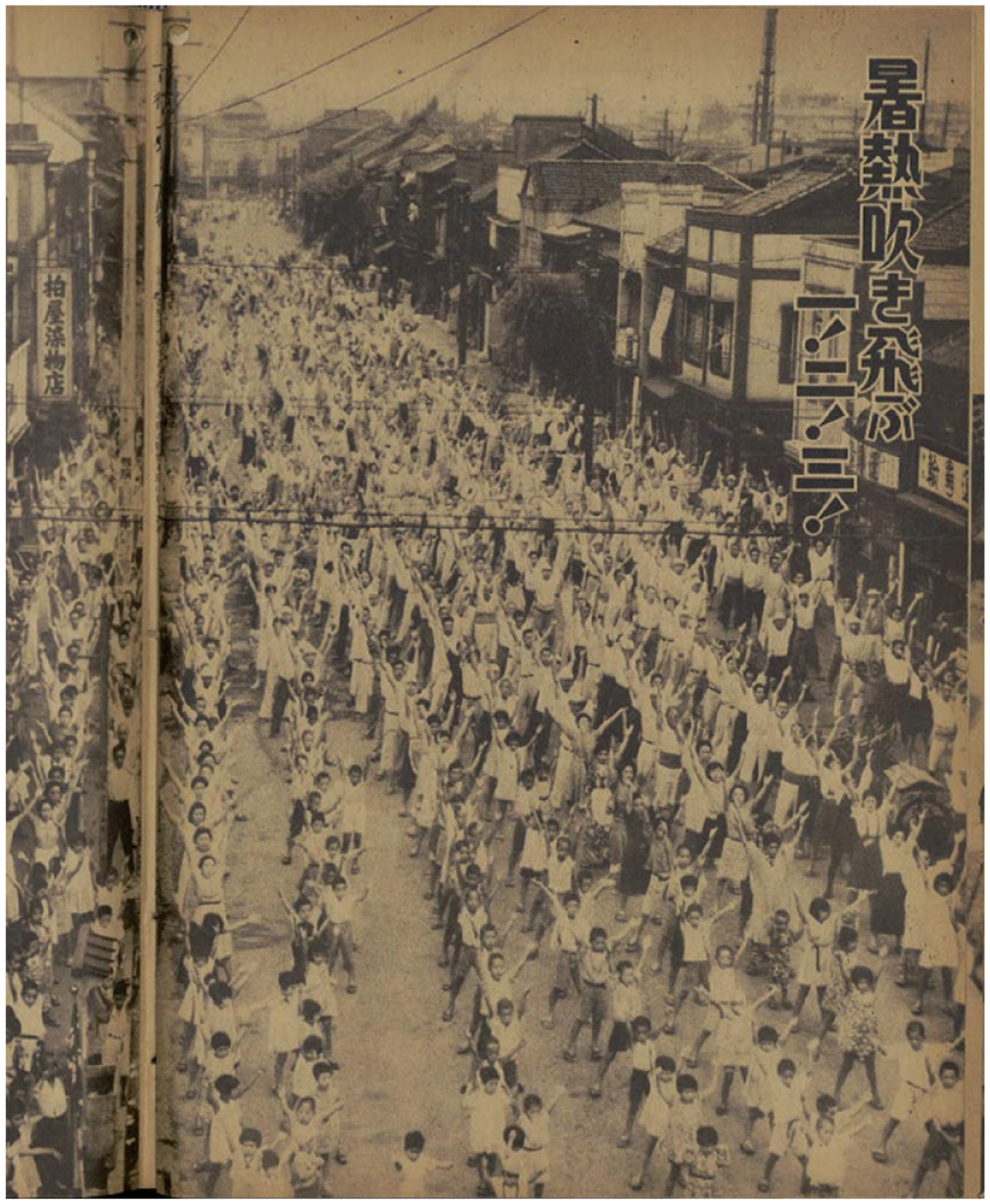
Senior men, children, and women on the streets of Asakusa showing thermal solidarity with the troops in the early morning. (“Shonetsu fukitobu 1!2!3!,”Shashin shūhō 231 [July, 1942], 4).
The Liberalization of Thermal Norms
After the war, it was no longer considered unpatriotic to complain about the heat and humidity. As the country entered the high-growth period of the late 1950s, thermal norms loosened, and people became less concerned about braving the summer. There was also less condescension toward fellow Tokyo residents who fled the metropolis for cooler climes. With cheap public transportation linking Tokyo to the countryside, the majority could now enjoy retreats, however temporary, to the sea and the mountains. Newspapers eagerly reported from train stations and seaside towns on the waves of pleasure-seekers who piled into packed cars to seek rural coolness in places like Bōso in Chiba, Shōnan in Kanagawa, and Izu in Shizuoka. 24 It was not surprising that they did so. As early as 1952, a study showed that compared with rural parts, temperatures in the heart of Tokyo could be between three to five degrees higher. 25 Commentors, however, were quick to point out the irony of the mass exodus’s failure to achieve its thermal goal: crowded resorts, buses, and trains (which did not have air conditioning) did the opposite of cooling down the bodies of a new generation of leisure seekers. 26
In Tokyo itself, media reports of residents blatantly trying to escape the heat and humidity no longer invited thermal criticism. Most audacious of all were reports of “coolness hunters” hopping from one air-conditioned space to another, from the café to the movie theater to the department store, managing to stay a few hours in each. From one hunter’s point of view, the department store was the best deal. He could stay almost indefinitely without having to part with cash, which was not possible at either the coffee shop or the cinema, where coolness had to be bought with a ticket or drink. 27 Department stores often grumbled about these free riders. Less deliberate sights of heat avoidance involved Tokyoites seeking shelter from the scorching sun under bridges, expressways, and the valley between tall buildings. Embankments and underground walkways also served as cool urban assemblages, thanks to the breeze from rivers and artificial lakes. Such practices demonstrate the extent to which changes in the urban ecosystem—not just the liberalization of thermal norms—affected behavior.
Such behavior is also evidence that mechanical cooling was still rare in the 1950s, and the western-style buildings that intensified the experience of heat and humidity tested anew the strength of thermal masculinities. In 1955, the Asahi Shimbun, reporting from various ministries in the government district of Kasumigaseki, focused on scenes of sweltering civil servants. 28 Even the western-style Prime Minister’s Residence suffered because the architect, Frank Lloyd Wright, had failed to take the summer heat and humidity into account, subjecting staff to work in “stove-like” conditions. Bureaucrats took turns running errands to buy ice and to dousing themselves in cold water. Efforts to expose themselves to the air also included rearranging their desks to face the windows. Exposure to the type of intensified heat and humidity resulted in workers resorting to either changing their shirts several times during the day or stripping down to their undershirts. Such concentrated levels of heat were contrasted with the coolness enjoyed by the American occupation. At the General Headquarters, the Supreme Commander for the Allied Powers (GHQ), housed in the Daiichi Insurance Company Building, air conditioning helped stabilize room temperatures to 80°F.
Compared with the sweltering conditions in which men had to work, women were not only less exposed to the full force of the intensified heat and humidity but also seemed better able to cope with the changes in the urban ecosystem. As one business magazine noted, it had been customary for women to wear an outer garment in public at the height of summer—putting on a brave face as sweat ruined their make-up—but now, it pointed out, women were wearing nylon blouses that exposed their arms and skin. 29 Shimamura Fusano, a fashion designer, urged women to emulate French and American women. While acknowledging that it would be a step too far to copy American women who stripped down to their bras, Shimamura encouraged them to “use their privilege as women” to embrace dresses that were “flamboyant and cool”—at least at home. 30 Fully aware of the potential backlash dresses that revealed women’s bare backs might provoke, however, Shimamura was careful to advise Yomiuri Shimbun readers to wear a bolero-style outer garment when entertaining guests or shopping. Such concessions to the male gaze proved to be insufficient. Men hid their jealousy toward women’s thermal self-emancipation behind sarcastic predictions that, at current rates, women would be half-naked within a year. 31 In a newspaper editorial, a columnist feigned disinterest in the display of more female flesh by pointing out that, with the recent proliferation of nude photos, he no longer blinked at “half-naked women in the blazing sun,” implying that women were being too liberal with their “cool” summer looks. 32 “Wearfare” erupted.
Not content with defending their own summer fashions, women went on the offensive, suggesting that the problem lay with the men themselves who seemed wedded to wearing suits, a sartorial style born in the very different climate of northern Europe. In the women’s pages of the Yomiuri Shimbun, women took “salarymen” to task for their stubbornness in continuing to wear jackets in the summer, complaining that their “sweaty” appearance increased public “feelings of thermal discomfort” (atsugurushisa). 33 Pointing to the immediate postwar period, when it was perfectly acceptable for men to show up at work wearing only an undershirt, they charged that the recent moves to dress up contradicted the importance the economy placed on rationalization, the logic of which called for lighter clothing that was not only suitable for summer but also comfortable for work. In a rather startling move, the women recommended that office workers not only discard their ties and jackets but also replace their shirts with Hawaiian aloha shirts, explaining how the silk fabrics as well as the increased air circulation that was made possible by untucking the Aloha shirts “doubled coolness.” Realizing the radical nature of their suggestions, the women also accepted the wearing of dress shirts cut at the waist and applauded efforts of manufacturers to introduce shirts with breast pockets (to hold stationery) that would make it easier for men to remove their jackets. Men were outraged, pointing to the removal of ties as the only realistic concession office workers would be willing to accept. In a Yomiuri editorial printed a year later, the male commentator scoffed at recommendations to switch to Hawaiian aloha shirts. They might be acceptable in the home and at resorts but smacked as “disrespectful” in more formal settings such as meetings, he charged, and their appropriation by young delinquents was cited as another reason for rejection. 34
Mechanical Cooling and Productivity
Such a spirited defense of male sartorial pride had little to say about the impact of heat and humidity on productivity. In a revival of prewar arguments about mechanical cooling, Tsuji Jirō, an influential civil engineer, argued for the installation of climate control at work, which was becoming standard in offices in advanced cities like New York. 35 A Tokyo native, Tsuji, was aware that air conditioning was making great inroads in theaters, cinemas, fine restaurants, and department stores. He was, however, dismissive of the introduction of coolness technology into these public places, expressing unease that air conditioning in these largely entertainment venues was creating unproductive consumers—a veiled reference to coolness hunters who were parasitic on the economy. In Tsuji’s view, air conditioning could be put to better use in factories and offices of corporations that were contributing to Japan’s export-led growth, which would be accelerated by mechanical cooling that increased worker productivity. As it turned out, the spread of air conditioning in the workplace in the 1960s was aided by a combination of legal changes that made companies responsible for the health of their employees working in buildings, and the need to maintain climatic conditions in which expensive precision instruments—which were more susceptible to the heat, humidity, and pollution than human bodies—could operate. The office was no longer a place for manual administrative work—it was becoming “more like factories” where workers needed to share the same space and work with electronic calculators and tabulators that needed a cool environment to function, a trend that would continue with the rise of computers. 36 It also meant that male office workers could continue to work in their jackets and ties.
In contrast to the slowness with which western influences affected housing in prewar Tokyo, the destruction wrought by aerial bombing on the capital’s housing stock accelerated movement toward the construction of western-style homes. Concrete apartment blocks and concrete block housing were favored as an immediate solution to the housing crisis because of their ease of construction. 37 However, due to poor ventilation, concrete structures worsened the thermal experience of residents in the summer, especially at night, because the thick walls, while reducing noise, trapped too much heat. In the 1960s, when mass social housing (danchi) offered the expanding middle class a modern home, the preference for concrete continued, while the desire of nuclear families for more functionality and privacy led to moves away from a small number of rooms doubling as living, dining, or sleeping places. Crucially, because the increase in the number of separate rooms required the construction of extra walls and permanent doors, natural coolness was further traded for privacy, laying the foundations for the mass demand for air conditioning.
Such developments were a cause of anxiety for Hoshino Yoshiro and Tsurumi Kensuke, an architect and social thinker, who in 1966 blamed residents’ desire for “room coolers” on the upheaval in Tokyo’s urban ecosystem. 38 Before the violent change in the living environment, they explained, Edo (Tokyo’s old name) was a more “ecological” city: it had large moats filled with abundant water; rivers were not dammed; waterways stretched in all directions; and trees were ubiquitous. The breezes that wound their way through the urban jungle were cooler, thanks to the rivers and trees in their path. Now they were replaced by roofs and streets that intensified rather than mitigated the summer sun’s impact, depriving the breeze of any source of coolness as it traveled through the “urban desert.” In making such criticisms, Hoshino and Tsurumi adopted a romantic view of the traditional Japanese wooden house, which used mud walls, tatami mats, and paper as materials to tame the heat. Their affection for the tatami mats was particularly pronounced: not only did they serve as a measure of the size of rooms but also they served as the basis for the transformation of rooms themselves. Placing a dining table (shokutaku) on them changed the space into a dining room (shokudō); placing cushions (zabuton) transformed the space into a drawing room (kyakuma); placing study desks transformed space into a study room (shosai); and placing futons transformed the space into a bedroom (shinshitsu). For Hoshino and Tsurumi, tatami mats were the key to coexisting with the summer, serving as the perfect material on which to welcome the winds—following interaction with the rivers and the trees—to cool domestic spaces. 39 The authors charged that Japanese homes were increasingly pushing away the summer in favor of mechanically produced coolness, the effectiveness of which could only be maximized by cutting off direct contact with the outside environment (Figure 3).
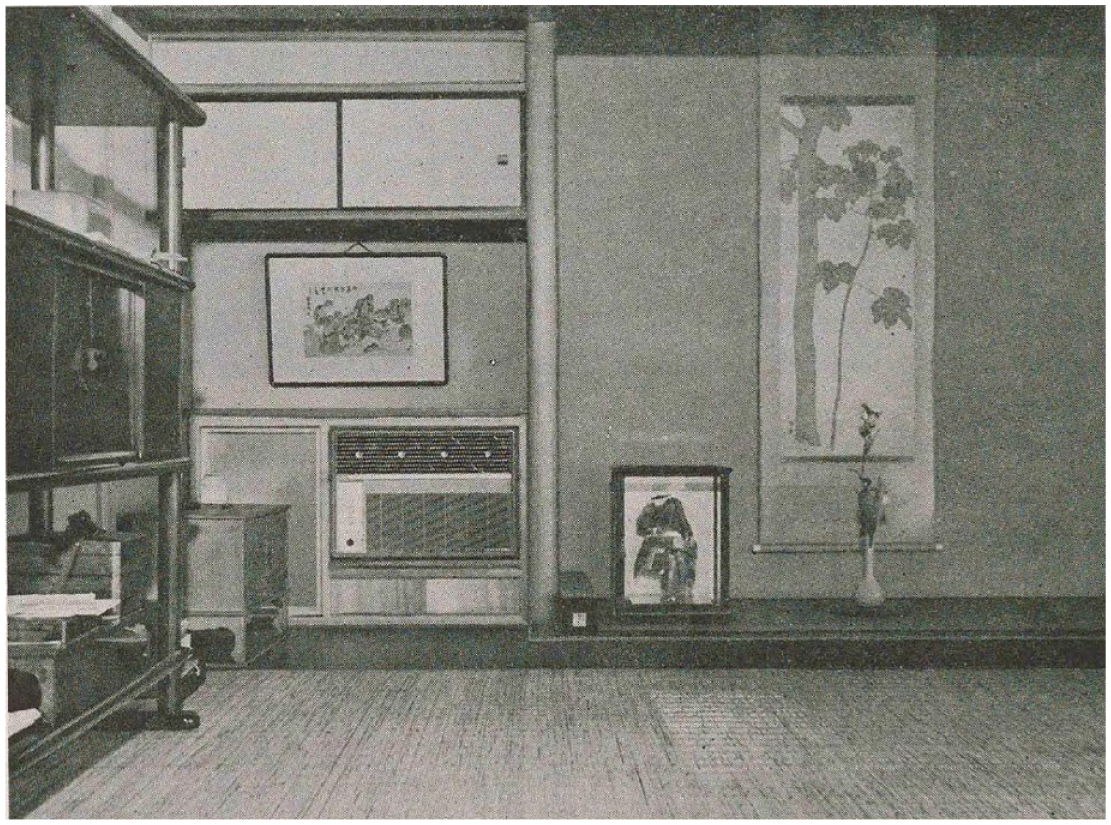
An early example of a “room cooler” placed in a Japanese-style room co-existing with traditional decoration such as a hanging roll (kakemono) to the right (Asahi shimbun ed., Shōhin no chishiki: jidōsha kara tsuri dōgu made (Tokyo: Asahi shimbun sha, 1962, 154).
Conclusion
In her work on “heatscapes” of New York City in the pre-air-conditioning era, Kara Schlichting alerts us to the social and racial inequalities of hot summer. 40 Impoverished communities and ethnic minorities living in tenements were more exposed to the heat island effect, had more difficulty accessing natural coolness in places like Central Park and Battery Park, and suffered mostly in silence—in contrast to the very public distress of white middle-class communities that newspapers dramatized. Compared to New York City, the example of Tokyo shows that despite the social inequalities inherent in the urban heat experience, public displays of suffering were muted. Summer was about living with the heat and humidity, and a cool frame of mind was seen as important to the proper negotiation of thermal discomfort. Criticism of fleeing Tokyo for cooler climes or expressions of thermal solidarity with troops fighting in wars were reflections of this attitude of endurance, much of it highly gendered. Changes in this way of directly confronting the summer become noticeable in the period of high growth. A combination of the exacerbation of the heat island effect and the rise of western-style buildings and housing—which intensified thermal experiences—took its toll on traditional thermal norms, which had been consistently criticized by women who functioned as advocates of thermal emancipation. Such a shift in thinking was also driven by the economic imperative to increase the productivity of factories, offices, and homes, all of which increasingly adopted mechanical cooling as a technological solution to the heat and humidity. As a result, escaping the Tokyo summer became an acceptable behavior.
Footnotes
Acknowledgements
The author would like to thank all those who took an interest and provided constructive criticism. He would also like to thank Dorothee Brantz for suggesting the project to him at the beginning of his sabbatical, Avi Sharma for offering him space in the special section, and Kara Murphy Schlichting for her feedback.
Author’s Note
Japanese names will be written with surnames first, unless they appear in English publications. An earlier version of this article was presented at the 17th International Conference of the European Association for Japanese Studies (EAJS), held in Ghent on August 20, 2023.
Declaration of Conflicting Interests
The author(s) declared no potential conflicts of interest with respect to the research, authorship, and/or publication of this article.
Funding
The author(s) received no financial support for the research, authorship, and/or publication of this article.