







Abstract
This article considers the twentieth- and twenty-first-century reinterpretation and reconfiguration of Suzhou’s canals in light of their use as a means of transport and flood control, and as a source of pollution. Throughout the Maoist period (1949-1976), the regime considered canals to be anachronistic impediments to urban renewal and filled in many urban waterways to create modern streets, industrial land, and fall-out shelters. Remaining canals were exploited for a variety of uses, including drains for pollutants as the city industrialized. In the Reform Era, from 1978 onwards, environmental protection mandates, fines for polluting paper mills and chemical plants, and the diversion of industrial and population growth to new sites restored Suzhou’s canals and public gardens as tourism and recreation assets. The archaic origin and historicity of the city’s canals, which previously inspired their destruction, now impels their refurbishment and validation as essential infrastructure of the modern city.
In his celebrated novella The Gourmet, Suzhou writer Lu Wenfu explores the political and cultural valences of his hometown, a place long synonymous with elite leisure and luxury, metamorphosing into a revolutionary socialist city in the years following Liberation (the founding of the People’s Republic of China [PRC] on October 1, 1949). One subplot involves the rickshaw puller A’er, who, having learned that his exploitative line of work is unsuitable for a liberated man, is frustrated by his inability to secure the New Society’s dream job, industrial worker. Hungry but not bemoaning his bad luck, he finds work registering jobless people to serve as laborers on state projects in exchange for unemployment relief: The work was dredging the small canals in Suzhou, strenuous but useful. The old society had left us with a lot of scum, so we had to clean the canal water and make this Venice of the East live up to its name. Making this paradise more beautiful was one aspect of revolution. When A’er heard that this was also revolutionary work, he willingly went every day to dredge the canals and carry stones. It was much harder than pulling a rickshaw and he got only three catties of rice a day.
1
The new government did indeed hire the unemployed for public works projects, including long-delayed dredging of the city’s canals. 2 Lu artfully highlights the dual significance of Suzhou’s canals as material infrastructure essential for transportation, flood control, and daily life, and as an ideologically fraught component of the historic cityscape and urban environment.
Given Suzhou’s then almost 2,500-year history (the city was founded in 514 BCE), the canals, particularly the smaller arteries that branch off the main waterways, were not the only element of the historic built environment viewed as inimical to efficient transport and modernity itself. Suzhou’s city wall, like the canals of ancient construction and amply modified and refurbished over time, was also perceived as an anachronistic impediment to urban renewal. One 1956 urban planning document opined, “It certainly has historical value yet in the present it has no political, economic, or, above all, defense purpose. On the contrary, in terms of transportation and cultural life it certainly acts as a barrier.” Two years later, the wall was demolished, except for two sections preserved as historic monuments. 3
Although similarly viewed as outmoded hindrances to the circulation of people and goods and as a reactionary presence whose existence retarded the advent of revolutionary utopia by bolstering the specter of the feudal past, the city’s canals were not removed wholesale. They were too extensive and, even if sometimes unappreciated, fundamental to the developing modern city. They had also been synonymous with the city for millennia. These waterways, not the famous sites, scenic vistas, or classical gardens—all of which have been celebrated in literature and painting for over a millennium—were the source of the comparison to Venice. Coined by early modern-era European visitors, this sobriquet was universally known, such that A’er cites it as he reflects on the revolutionary imperative to renew the canals.
This article examines the repudiation for much of the twentieth century of Suzhou’s inner city canal grid as an obsolete encumbrance to urban modernization and its reevaluation and rehabilitation as essential infrastructure and public good toward the century’s end. The water of the city’s canals was transmogrified from a fundamental, indeed, ubiquitous element of the cityscape—a resource for transportation, scenic beauty, and washing, swimming, fishing, and other daily needs, including being illicitly but often employed as a sewer—into an object of modernist voluntarism and will. Suzhou’s canals and the waters within continued to serve these self-same purposes. Nonetheless, their significance and valuation changed markedly.
Under late Qing (1901-1911) and Republican era (1912-1949), urban modernization and then, subsequent to Liberation, Maoist revolutionary reconstruction, Suzhou’s historic infrastructure, and the very water within it were increasingly disparaged as superannuated and inappropriate for the speed and volume of movement necessary for contemporary industry and twentieth-century urbanity. Canals, the dominant mode of transport for goods and people during the city’s two and half millennia of existence, were rejected in favor of land-based roadways and rail, the paradigmatically modern modes of transportation and symbols of civilizational advance. During the Maoist period (1949-1976) in particular, water, like all natural resources, was viewed as material ripe for human exploitation. Under Maoist voluntarism, nature, like society itself, was subject to the heroically bold efforts of the masses to create a revolutionary world. 4 The destructive results of this conquest to the historic city and its environment became undeniably clear in the late 1970s, as the direction and aim of political-economic development and societal values were in flux at the onset of the Reform Era (1978-2015). The significance of the canal system and the natural environment shifted once again, as the city’s historic patrimony, theretofore rejected as “ancient” hence “feudal,” was transvalued as “ancient” hence valuable, a resource for Suzhou’s rejuvenation as a modern city built on tourism, industry, and commerce.
Like Venice, Suzhou is an urban marvel: out of the inchoate, marshy amalgam of Jiangsu Province, to the east of Lake Tai (one of China’s largest freshwater lakes), rises a city that is both fixed land and flowing liquid. The greater Suzhou area includes more than 20,000 rivers, creeks, canals, and ditches and more than 400 shallows lakes with branching streams. Suzhou also sits along the Grand Canal, which beginning in the late thirteenth century linked Hangzhou, with which it is paired in the universally known saying, “Above is Heaven, Below are Suzhou and Hangzhou,” to Beijing, some 1,200 miles away. Or rather, Suzhou begat the Grand Canal: the oldest section dates back to 496 BCE, when King Fuchai of Wu ordered the construction of canals from his capital city (Suzhou) north to stimulate trade and facilitate the shipment of supplies for his military adventures. 5
The paludal environment was prone to destructive floods, powerful typhoons, and droughts, yet the marriage between land and water proved favorable: over the centuries, the city grew populous and wealthy through trade and agriculture, especially the production of rice and silk. By the eighth century CE, the cityscape, intercut by waterways, was itself celebrated: a Tang-dynasty poem by Du Xunhe advises a friend traveling to Suzhou: When you come to Suzhou, you will see, people’s houses pillowed along the canals, In this ancient capital vacant land is scarce, there are many bridges over the narrow water allies [canals] Night markets sell water chestnuts and lotus roots; in the spring boats are laden with luxurious silks I know that under the wakeful moon, fisherman’s songs will accompany thoughts of home.
6
The canals, like the rest of the city, were transformed over time as main channels and small arteries were added and removed. By the early seventeenth century, there were almost 52 miles of waterways within the city wall. By the early nineteenth century, when Suzhou had become one of the richest and most populous cities in the world, the population ranged between 700,000 and perhaps a million people; changes in land use had reduced the course of urban inner-city canals to approximately 35 miles in length. 7 Figure 1 shows a map of the city, drawn in 1921. The canals are indicated by darker, broader lines than the roads. The canal grid divides the city and suburbs into large quadrants.
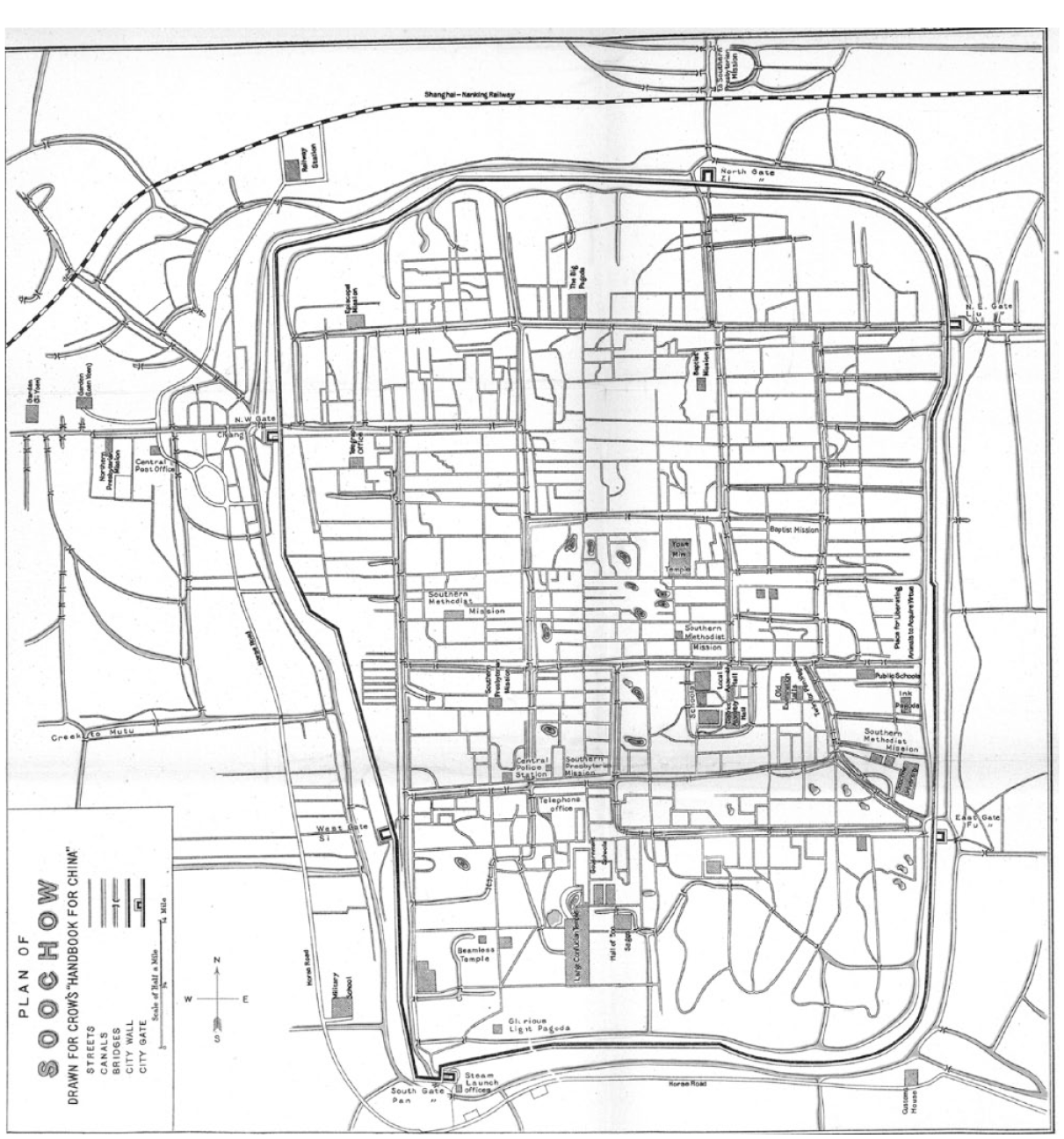
Plan of Suzhou.
Roads to Modernity
Criticisms about the state of Suzhou’s canals had likely been voiced since shortly after these waterways came into use. To an extent, such concerns were perennial, reflecting the seasonal rise and fall in water level throughout the year. A long-time American missionary resident of the city remarked in 1899 that the waterways were less than appealing: When the waters are high and fresh, boating is a pleasant mode of travelling for a family, but when the water turns green and then black, and melon rinds and garbage float on the surface, and the boats get jammed for a couple of hours amidst odors, not from “Araby the blest.”
8
During the late imperial period, complaints about siltation, navigability, and the otherwise deplorable state of public works might provoke state authorities, with local elite support, to finance periodic, if overdue, dredging. In the early twentieth century, however, as people learned of urban conditions and planning practices in Europe and the United States, and in neighboring semi-colonial Shanghai, Suzhou local boosters concluded that city canals, especially the narrow branch routes, were obsolete and ought to be filled in and replaced by streets.
This reevaluation of the canals’ place in the modernizing city was galvanized by the late Qing local self-government movement, one of a slate of reforms collectively known as the New Policies that attempted to reform all aspects of government and reconstitute the empire as a constitutional monarchy—an aim forestalled by the 1911 Xinhai Revolution, which established a republic in 1912. Self-government aimed to provide elite citizens oversight over local affairs so as to bind the populace to the state, and enable the government to tap local enthusiasms and capital for economic growth and urban modernization.
Self-government advocates championed a normative city design that was structured, after the fashion of foreign metropolises, around streets, not canals: It is essential to remake our nation’s streets so that they are no longer narrow and crooked. If one enters a country to find the streets in disarray, that is proof that the . . . country’s administration is corrupt and useless. Every aspect of the relative progress of a nation’s people from barbarism to civilization is related to transportation. . . . Once one correctly implements road administration, it should be like the arteries and veins of the human body that bring blood flowing throughout. Wherever it is stagnant, trouble arises.
9
Self-government evangelists nonetheless praised the public mindedness of constructing major canals.
10
Yet it is striking how little they discussed these urban hallmarks. They mainly referred to smaller arterial, secondary channels and ditches, not the broad courses of the Grand Canal or other major arteries. These, too, were components of transport infrastructure, yet they were secondary to roads: Canals and ditches, when stagnant, build up silt and filth. Not does this only harm public health, when water overflows its proper channel, it wreaks havoc by soaking and immersing the adjacent urban environment [including streets, as they were often adjacent], affecting road administration.
11
Road cleanliness required ready drainage, which could be provided by canals. Thus, the “cleanliness of streets depends on whether channels are open or blocked.” 12
The primacy of roads over canals in contemporary estimations of urban infrastructure and civilizational progress is reflected in a 1924 Suzhou dispatch in Shanghai’s North-China Herald, China’s English-language newspaper of record. Beginning with a discussion of Suzhou’s city wall, “Another Picturesque Relic of the Old China in Absolute Disrepair,” the report then considered the decrepit canals: Another carriage road is planned straight south through the western part of the city, by filling in a little used canal. Fifteen years ago this canal was dredged, but since the city canals are chiefly used as a dumping place for all refuse, this canal was soon again blocked at many points, and in the present low state of the water, its fragrance ascends to high heaven, and its waters in colour and consistency remind one of printer’s ink. Filling in this canal for a “horse road” [a wide macadam street] will be a municipal gain, not a loss.
13
The Suzhou municipal government’s ambitious 1927 urban planning scheme, prepared during a brief period when the provincial government provided funds to transform Suzhou into a modern showcase, reflected similar views. The relative importance of roads and canals was expressed pellucidly by their treatment in the document itself: “Roadways” were the subject of the initial policy section, “canals” the second. The former consisted of a detailed 35-page discussion, with technical drawings, of improvements. The latter merited only three pages bereft of details. “Plan under preparation,” it read. 14
Regarded as more effective than water transport, streets were universally accessible and beneficial to the populace in ways that canals were not. Upon leaving the house, one could enter and exit a street at will. Passage on a road allowed one to partake of the air and light it brought in down to the streetscape and dispersed along its course, which promoted individual and overall societal health. 15 Streets were indispensable as both practical infrastructure and symbol of Republican values such as respect for the individual and mass participation in politics, society, and culture. Thus, in 1929, the Guomindang party newspaper Central Daily News approvingly noted that the modernizing municipal government was going gangbusters on road construction, the most significant aspect of urban development. 16 From 1911 to 1949, six channels, amounting to a length of 5 km, were filled in, mainly to build streets. 17
According to the city’s municipal planners, in the past, “water transportation was not inferior to that of streets.” 18 Yet that fabled time was no more. Canals had been appropriated for the construction of buildings; once wide channels were narrow, freely flowing movement was restricted. Municipal engineers advised that through neglect the system was now unsanitary and inadequate for flood control or transportation needs.
The lamentable state of the canals complemented the failings of Suzhou’s streets: overwhelmingly narrow, roads were inconvenient for pedestrians and even more problematic for transporting merchandise. City planners concluded that some canals should be renovated to facilitate water transport and that others should be buried to improve streets. 19 Straitened finances, changes in local government, and increasing conflict with Japan prevented Suzhou authorities from realizing their 1927 blueprint for modernization. 20 Nonetheless, urban renewal proceeded piecemeal. In February 1937, a reporter praised current evidence of civic progress. Road building pressed forward: “Soochow [Suzhou] is soon to have arteries of traffic extending north to south and east, to west along several parallel street [sic].” Liquid circulation of people and goods was insufficient. Urban lifeblood was more invigorating if it flowed through the city by land, through streets. 21
Post-Liberation
The founding of the PRC heralded profound changes across all aspects of Chinese society. The new regime pursued modernist development as a fundamental aspect of remaking society and invested unprecedented money and effort in city planning and urban renewal. Water control became a central pillar of the new state’s national development schemes. A prominent hydrologist noted that despite being central to “Our nation’s culture and economic development,” before Liberation water resources were neglected due to “the long-term oppression of imperialism, feudalism, and bureaucratic capitalism.” 22 The new Party-State spared no effort or expense in marshaling water to realize ambitious developmental aims. At the national level, during the four decades following 1949, China built some 80,000 reservoirs and dams. 23
Established a month after the founding of the new state, the new municipal water control bureau expanded on Republican-era efforts, aided by the nascent regime’s promotion of rapid economic development and the revolutionary enthusiasms of the populace. It oversaw more than 25 miles of canals that remained within the city wall in the wake of Republican-era urban renewal projects. Emphasizing urban flood prevention and water control, the authority undertook “the long needed dredging of Soochow’s canals [which] has met with the approval of the city’s 500,000 residents.” 24 By fall 1952, it had dredged some 9.5 miles of two dozen canals and continued dredging projects through the eve of the Great Leap Forward. 25
These initiatives did not signal a retreat from the Republican-era prioritization of streets. Throughout the Maoist era, road construction remained the sine qua non of urban modernization. As before, narrower arterial ways were often deemed unnecessary, given the perceived advantages of roads. Canal renovation therefore proceeded in synchronization with the burial of canals to create new tracts of urban land. China Monthly Review, a propaganda digest for foreign readers, reported in 1953 “small silted up creeks and canals, which are unnavigable, have been filled in with earth cleaned out in dredging the canals.” 26
Socialist construction projects and Maoist era political campaigns, with their mercurial ideological shifts and skirmishes, transformed government and quotidian life. Throughout these changes, Suzhou’s canals remained central to the existence of many Suzhou denizens. Located, often literally, just outside doors or windows, the waterways were fundamental to the urban environment and residents’ daily routines. People got around via canals or watched boat traffic from their houses or the canal bank. Most city homes lacked piped purified drinking water and sewerage. Wells were the primary source of potable water, with the canals being a secondary one. Decades after first mooting the possibility, Suzhou successfully constructed its first water treatment plant in 1950. Through the late 1970s, many people’s drinking water was brought from Lake Tai to the city by boat, and 60 percent of people continued to place their chamber pots outside for the collection of night soil. As late as 1982, half the population in the old city relied on wells, although this was down to 10 percent by 1985, due to the expansion of piped water service. Urban residents used the canals as their kitchen sinks. As one woman recalled, “In the ’50s and ’60s we could wash rice in the canals. . . . It was very clean—almost like running water. There were no free markets then, the population was smaller, and there was no industrial pollution.” 27 Nostalgia may have burnished this positive assessment of the water quality, yet many sources attest to the clarity and seeming cleanliness of canal water during this period. Pollution from industrial and population use, along with diminished water flow due to filling in canals harmed water quality, and experts attest that canal water has not been an acceptable source of potable water since the early twentieth century, at least. Nonetheless, some residents relied on canals for drinking water until the latter part of the century. A 1957 public health campaign thus taught methods for sanitizing water from wells and canals alike. 28 Proximity and the complexities of securing potable water and disposing of wastewater undoubtedly made many Suzhou people connoisseurs of the water lapping the banks outside their homes.
Maoist utopian striving politicized both water control and water itself. The state exhorted the populace to boldly transform society, and people, in hundreds of millions, enthusiastically responded. Struggles to reconstruct the natural and material-built environments to create economic prosperity and social well-being for all were presented as extensions of the nation’s struggles against domestic reactionary forces and foreign imperialists. 29 The people of Suzhou were thus mobilized to participate in periodic campaigns against “capitalist roaders,” rightists and others, or components of the cityscape or the natural world.
On March 3, 1958, the nation was informed that it would soon make a “Great Leap Forward” in the creation of communism. The campaign mandated the creation of rural and urban people’s communes and inducements to spur hyper-paced industrialization, enormous increases in grain production, and large-scale irrigation and other capital construction projects. In June, a corollary action urged people to “Exterminate the Four Pests,” that is, rats, flies, mosquitoes, and sparrows—sparrows were targeted for consuming excessive amounts of grain. In Suzhou, the directive to exterminate mosquitoes focused on filling in dead-ends and other canal areas of still or slow moving water that could serve as breeding grounds. The Great Leap generated enormous enthusiasm among the urban citizenry, who used bricks and other materials from the demolition of the city wall (announced by municipal authorities on March 30) to construct “backyard furnaces” that would theoretically allow the populace to melt down household iron items and produce “steel” for industrialization (this failed—the resulting metal was worthless). Given the febrile atmosphere, well over 100,000 people (more than a fifth of the city’s population), including cadres, all urban military units, workers, students and teachers, doctors and nurses, as well as other residents, rallied to fill in canals. After five days of non-stop labor, the citizenry had surpassed their quota, with twelve canals filled completely. During the course of 1958, 7,462 m (4.64 miles) of canals were filled. 30
This popular action anticipated the Urban Reconstruction Bureau’s 1959 City Plan, which foresaw reducing the network of urban waterways further, leaving a grid of three east-west and three north-south canals that would extend swards of greenspace throughout the city. This renewal scheme aspired to remove water from the visible environment, seemingly overlooking that the city existed in a region imbued with plentiful, often all too plentiful, water. This plan represented a new articulation of the longstanding vision of urban redevelopment as one focused on plentiful land, in which land-based roads and industrial plants were engines of prosperity, and water was a relatively minor component of the environment. 31
It is therefore somewhat ironic that much of the rapid industrialization of the city, most of which occurred after the inauguration of the Great Leap Forward, exploited the plentiful water resources offered by the city’s canals, urban moat, Grand Canal, and other major area arteries. On the eve of Liberation, Suzhou only had 13 factories that employed a hundred people or more, with handicrafts accounting for more than 95 percent of industry. Overcoming the perceived dearth of industrial plants would allow the city to shed its shameful reputation as a benighted “consumption city” or a “‘sleeping scenic city,’ revolving around the spendings [sic] of retired officials, landlords and wealthy city-dwellers . . . [and redeem itself by transforming] into a commercial and light industry center in Kiangsu [Jiangsu] province.” 32 During the Cultural Revolution (1966-1976), Big-character posters decried that before Liberation pagodas had outnumbered smokestacks, reflecting the prevalence of feudal tradition over modern economism among city residents. Happily, factory smokestacks now outnumbered Buddhist pagodas, highlighting the spread of socialist, industrial production-oriented mentalité among the populace. 33 More than 500 new factories were founded, many of which made use of Suzhou’s abundant water resources. 34
The proliferation of industry after 1958 may have rehabilitated Suzhou’s reputation as a modern “production city.” However, the significance of the city’s water as a resource for industry and the canals as a transportation network had not provoked reevaluation of the city’s infrastructure and its modernizing potential. Rather, the city’s canals continued to be requisitioned as a ready source of new urban land. During the Cultural Revolution, the practice of filling canals and leveling the ground for various purposes was exacerbated by the suspension of land regulation as disorder overtook much of the nation. In addition, broiling tensions with the Soviet Union, China’s erstwhile socialist mentor, led to the widespread appropriation of the canals for civil defense.
Rivalry for leadership of the socialist world and enmity between the Chinese and Russian leadership had led to the deterioration of relations during the later 1950s, culminating in an open rift in 1960. Ideological tensions helped spark border conflicts, including skirmishes and small-scale warfare in the late 1960s. Soviet troops massed along the border in 1968 and an undeclared military conflict occurred March-September 1969 on the borders of Manchuria and Xinjiang. The resulting war fever moved the Soviets to consider carrying out a pre-emptive nuclear attack to obviate the Chinese nuclear threat (the PRC exploded an atom bomb in 1964 and a hydrogen bomb in 1967, triggering Soviet paranoia about China’s intentions). Chinese awareness of the plan led the state to orchestrate the creation of air-raid shelters throughout the country.
In Suzhou, the construction of bomb shelters began in 1969 and lasted until 1972. The Municipal Civil Defense Office and the Urban Reconstruction Bureau turned to the canals, the optimal source for new urban land in a built-up city, despite the land seizures contravening water resource regulations. The Canal Transformation Project appropriated portions of canals to construct air-raid shelters. Built to accommodate large numbers of people in case of nuclear attack, shelter systems could be extensive and individual shelters cavernous. Shelters in some cities reportedly included factories, shops, hospitals, and/or theaters (Beijing’s shelters ostensibly had room for 80 percent of the city’s population of 5 million).
The shelters were materializations of two of Mao’s recent slogans calling for popular vigilance in the face of military tensions with the USSR and the United States: “Prepare for War and Natural Disasters” (Beizhan, beihuang) and “Dig tunnels deep, store food, and never seek hegemony” (Shenwadong, guangjiliang, buchengba). As with previous campaigns, Mao’s personal leadership helped mobilize large contingents of local people of all ages, ranging, in the case of Beijing, from nine-year-old Young Pioneers to mature adults in their 50s. 35
My present research has not uncovered details regarding facilities inside the Suzhou shelters. Per their purpose, some were large: one shelter occupied 0.28 miles in length of appropriated canal and had an area of 371 acres, while another claimed a 0.6-mile length of canal and covered 494 acres. The city planner and academic Chen Yong calculates that in the period from Liberation to the conclusion of Suzhou’s Air-Raid Shelter Construction campaign in 1972, twenty-three sections of canal of more than 10 miles in length were filled and leveled to make new urban land for a variety of purposes. Another source states that some 5 miles of canal were filled in 1970 alone, mainly for the construction of shelters and factories, and that 12 miles of canals had been filled from 1949 to 2000 to build roads and other infrastructure as part of Party-led efforts to alter the environment and reconstruct the city as a showcase of revolutionary socialist, modern urbanism. 36
The political currents that prompted mass mobilization on canal-focused projects also influenced the career and general life prospects of urban planning personnel. Technological and scientific expertise was variously celebrated or denigrated, and specialists were fostered or rejected in favor of personnel deemed sufficiently Maoist. This turbulence was especially pronounced in May 1968, when some Suzhou water control specialists were dispatched to May Seventh Cadre schools—Cultural Revolution-era labor camps that prescribed an exacting regimen of agricultural labor and study of Mao Zedong Thought to “re-educate” officials in proper socialist thought. The effects were particularly pronounced just beyond the city itself: only two of the personnel staffing the Suzhou area Agricultural Water Authority were retained when the rest were all sent away for “re-education.” 37
“A Vicious Motive, Despicable Tricks”
The fraught status of the canals as artifacts symbolizing the poverty and backwardness of the pre-modern city—and the Party’s variegated success in effecting modernist transformation after 1949—featured prominently in one of the oddest political campaigns of the Cultural Revolution, the nationwide denunciation in early 1974 of Michelangelo Antonioni’s 1972 documentary film Chung Kuo—Cina (China). The Italian auteur, a committed leftist, had traveled to China in 1972 at the invitation of Zhou Enlai, who gave him carte blanche to travel and film as he pleased. Stopping in Beijing, Lin County (Henan), Suzhou, Nanjing, and Shanghai over five weeks, Antonioni created a humane cinéma vérité portrait of China, some two decades after Liberation. The footage observed daily life as revealed in public streets, restaurants, theaters, schools, agricultural fields, and, yes, the urban canals of Suzhou. Televised in Italy on RAI and in the United States on ABC in early 1973, and exhibited internationally at festivals, Chung Kuo—Cina would not be shown publicly in China until 2004, when it was screened for a select audience of 800 people at the Beijing Film Academy. 38 Rather than being hailed as the masterpiece it is, in 1974, the documentary was castigated as banal and replete with “reactionary scenes” that distort the “new China beyond recognition.” According to the People’s Daily, the CCP’s party organ, Antonioni had used “his visit for unspeakable purposes; by underhand and utterly despicable means he hunted specifically for material that could be used to slander and attack China.” Throughout the country, the populace, which had no opportunity to view the film, was enjoined to condemn “the film’s counter-revolutionary nature,” because “[i]t wants people to believe that today’s socialist new China is almost the same as the semi-feudal, semi-colonial, old China of the past.” 39
The Suzhou section opens with close shots of an influx into the city of a phalanx of commercial ships, large and small, transporting vegetables and other goods along a broad waterway and then shots of the hubbub of markets, shops, and streets. The narrator remarks, “We arrive in Suzhou almost by chance, and discover a city of remarkable beauty covered with a patchwork of canals not too different from the remote times when they were constructed. Of course, Suzhou reminds us of Venice.” The scene then shifts to the city’s dense network of characteristically whitewashed, black roof-tiled, low houses set flush with the canals or recessed slightly along the banks, where people gather to talk, play, and observe the foreign observers. The film closely tracks the aesthetics and human activity of the waterways: floating along in the gully between houses, boats large and small wend through the city, while people squat at the water’s edge in contemplation or at work. Residents, mostly women, wash clothing in the canal water; others prepare foodstuffs, including a basket of rice, which is deftly dipped into the water, swirled, taken out, and drained, leaving the grains rinsed. The voice-over notes that when Marco Polo arrived, he was struck by the advanced state of civilization. The film shows vibrant water traffic and tall arched bridges stretching over the canals that allow the fleet of boats to pass unimpeded underneath, even two at the same time. The commentary intones, “Today it’s a city of industry, commerce and laborious life,” before the shot lingers on a revolutionary red banner wishing Mao Zedong long life and then the scene moves on to the Classical gardens, former redoubts of the elite that now “please the eyes of the generation that has separated from the aristocratic life.” 40
The People’s Daily charged that the film “describes Soochow as showing ‘little difference from what it was at the time of its distant origin.’” This accusation was demonstrably false, as the script posited admiringly (if incorrectly) that the canal network, not the city as a whole, closely resembled its original state. (Significant portions of the canal system had been in constant use for centuries, while others had been constructed or demolished willy-nilly.) In addition, the narration characterized present-day Suzhou as a site of industry and commerce, where people labor and conduct their lives. This confirmation of the city’s modern economic vitality and vibrant working class could be regarded as acknowledgment of the attainments of CCP rule. These blandishments were judged to be inadequate. The documentary’s fulsome attention to the historicity of the city, including its canals, drew the ire of an unsigned journalist, who decried the film’s failure to “reflect the new things, new spirit and new face of our great motherland.” Antiquated infrastructure, even if economically vibrant, central to the present-day life of the masses, and a monument to the skill of countless laborers past, “negates the tremendous achievements China has made on all fronts of socialist construction.” 41
These purported slights prompted a furious response from “Nei Jiao,” an official in the Suzhou Municipal Urban Reconstruction Bureau. His jeremiad, “Lies Cannot Cover up Hard Facts: Denouncing the Slander and Distortion of Antonioni’s Anti-China film on Suzhou’s City Construction,” was broadcast as an eight-minute story on the 12:30 p.m. Jiangsu Provincial Radio news broadcast, February 12, 1974. Comrade Nei Jiao berated Antonioni for selecting Suzhou scenes that “deliberately shunned such objects as wide boulevards, big bridges, tidy housing areas, and modern steamers, shooting only small alleys, small bridges, shabby shacks, and sampans.” As an urban planning official, Nei Jiao knew well that since 1949 there had been substantial investment in maintaining, improving, and reducing the canal network. 42 His commentary emphasized the last point exclusively. Urban canals were inferior to improved roads and bridges as modern industrial infrastructure and as symbols of societal progress. His criticism of Antonioni’s ostensible commitment to featuring “sampans” instead of steamers likewise reflected Urban Reconstruction Bureau policy. Nei Jiao may have overseen the building of wharves and warehouses to accommodate larger ships at city port facilities along major waterways, such as the Grand Canal. Since Liberation, local and national authorities had expended much effort and enormous outlays on the Grand Canal and other waterways to improve the long-distance transport of goods and people. Yet the boats (some rather sizeable) shown traversing the urban canal system in Antonioni’s film were not the equal of large passenger or freight steamers as vehicles of economic development and modern leisure. The offense-inducing “shabby shacks” were the city’s common housing stock of whitewashed buildings, many of which did not have the benefit of piped municipal water or sewerage—hence residents’ use of canal water for washing. More modern housing with piped, municipally treated water and sewers did exist, although not along the canals in the old city.
For Nei Jiao and many others, Antonioni’s aesthetic and historical appreciation for Suzhou’s network of canals and his curiosity regarding the lives of the common people residing along on the canal banks constituted an offensive betrayal: Antonioni had failed to exhibit interest in the appropriate, paradigmatically modern components of the contemporary city. Nei Jiao concluded his riposte by recommending that the proper index of material progress in Suzhou since Liberation was: scores of mines and industrial enterprises each having more than 1,000 workers, plus more than 400 factories each having 100 or more workers . . . Antonioni’s lies cannot cover up these facts . . . the slander of these “anti-China clowns” cannot harm new China at all.
43
Post-Mao Reevaluation
By the end of the 1970s, there was recognition that three decades of overweening confidence in the transformative capacity of revolution to reshape nature and society had fostered myopic arrogance. Many of the industrial enterprises and other achievements of revolutionary development were now subject to reevaluation. Politically inspired projects that necessitated the destruction of canals and the construction of hundreds of factories had proceeded with no consideration of possible environmental repercussions. The effects were now plain to all.
Municipal officials now recognized that the air-raid shelter campaign in particular had greatly diminished the area available to retain water, thereby harming harmed the city’s capacity to resist flooding. Given the area’s hydrology, precariously high water and floods were irregular but expected events—as were low water and drought. Damage to the water system also contributed to pollution. In the early 1980s, more than 12 of the 23 miles of extant canals within the old city required rechanneling due to the construction of air-raid shelters, serious silting, or burial. 44 The removal of asphalt and other paving materials allowed the reconnection of channels with the existing grid. Many of the public works projects that had been heralded a few years previous as testaments of the masses revolutionary fervor were undone by the masses themselves. The municipal government marshaled corps of residents to carry out canal renewal work. By 1983, the city had re-dug and dredged almost 19 miles of canals. 45
Mao’s death in September 1976 made it possible to reconsider the aims and results of revolutionary approaches to urban modernization. The degradation of Suzhou’s air, water, and built environment by decades of Maoist development was so stark that it drew comment from the national press. In December 1979, Beijing’s Guangming Daily newspaper published an exposé detailing that on a canal journey around the city: . . . we clearly saw waste-water spewing, as from the mouth of a canon, from the outlets of hundreds of factories directly into the canal. The stream of polluted water did not pause day or night. In a small space of the city, some 28 square km, every day some 140,000 tons of industrial effluent and 30,000 tons of domestic sewage poured forth, and about a third of it entered the inner city canals [the network within the limits of the former city wall].
The same industrial plants had also befouled the city’s air. Haze from the more than 900 smokestacks of the city’s factories obscured landmarks like the Ming dynasty Northern Temple Pagoda [the site of a pagoda for 1700 years], a totem of the city.
The Guangming Daily story described the situation after the city had put remedial measures in place. Revolution-fueled modernizing enthusiasms aside, the lamentable state of the city’s water was partly an outcome of to lack of environmental oversight: the Municipal Revolutionary Committee established a small working group to rein in pollution in 1972, but the city’s Environmental Protection Department was not founded officially until July 1979. It, along with recently inaugurated like departments throughout the country, mandated regulations that checked untrammeled pollution which, in turn, induced general societal reconsideration of the exploitation of water, one of the city’s key elements. 46 In March 1979, the city government imposed stringent mandates on twenty industrial plants to reduce air and water pollution. In total, 319 enterprises, some 68 per cent of the more than 600 factories within the city, faced new regulation intended to remedy the city’s catastrophic pollution. 47
One extreme polluter was the Huasheng Paper Mill, one of the slate of factories that had sprouted in the city since the late 1950s, taking advantage of the water resources conveniently provided by the canal grid. The mill discharged 35,000 tons of fiber-polluted “black effluent” per day into the Jiangnan transport canal, the section of the trans regional Grand Canal on which the city sits, from which it flowed into the inner-city canal system. For centuries, this waterway was a celebrated “Golden Canal,” one of the most scenic segments of the Hangzhou to Beijing route. The paper mill was blamed for turning the previously golden, sweet water inky black and smelly. The Environmental Bureau determined that this pollution was not only deleterious to industry, agriculture, and the city population, it also negatively affected the city’s classical gardens and other celebrated scenic treasures, which were beginning to be reevaluated as sites for mass tourism, domestic and foreign. The city announced that the paper mill would pay the then significant fine of 63,000 yuan per month until the discharge was reduced by 30 per cent. This level of regulation could not redress the extremity of the crisis, but it was a beginning for pollution controls. Regulation of this single factory became a paradigm for the recovery of water resources, initiating awareness of the significance of the canal system and water itself as essential elements of daily life and as assets for a new mode of urban development. 48
When the 1980 National Urban Planning Conference convened in Beijing to consider possible trajectories for city planning, delegates first passed judgment on previous policy. They declared that the pursuit of extreme leftist politics had idolized production while mistakenly neglecting the people’s livelihood. In fact, the utopian yearnings of the Maoist period had made urban planning and public works projects, as a whole, politically suspect undertakings akin to “practicing revisionism” (i.e., anti-revolutionary activity in sympathy with capitalists, the USSR, and other enemies). In many cities, including Suzhou, drinking water was unclean, running water and sewerage were missing from much of the housing stock, and the average urban space for city residents was less than in the initial years following Liberation. Suzhou featured prominently in discussions as an example of the imbalance “between the ‘bone’ and the ‘flesh’ of cities”: In the garden city of Suzhou Municipality, paper mills are built on the upper reaches of rivers [which may refer to rivers or other waterways], chemical industrial plants on the perimeter of the city, and printing and dyeing mills in the downtown areas. Numerous smokestacks and water towers are seen everywhere in the smog-shrouded city. Beautiful Suzhou has now been badly polluted.
“Left-deviationist ideas” had transformed urban beautification into “bourgeois sentimentalism,” leading to the despoliation of historical sites, green space, and scenic spots—tags that applied to aspects of the city’s canal grid. 49 The industries mentioned were all profligate consumers of water for manufacture and significant sources of water pollution. Residents living near one dye works were familiar with current production runs, even if they did not work there: industrial run-off into the canals made it clear that one day the factory was producing red cloth, followed a few days later by, perhaps, bolts of green.
These political labels and the recriminations against ideological errors may seem excessively dogmatic. However, they did accurately reflect the strength of the disavowal of Maoist urban modernization among many municipal officials. The destruction inflicted on Suzhou’s unique historical urban patrimony by Maoist urban construction served as a national case study of the noxious effects of “left-deviationist ideas.” Indeed, as the violence and general social disorder inflicted by the Cultural Revolution were repudiated in late 1976, the press denounced the malign influence of extremists in Suzhou and Shanghai as bringing about the pervasive destruction to the city and its people. 50
Restoring the canal system and rehabilitating water quality served several corollary objectives, such as improving the city’s capacity to absorb run-off and thus weather floods and improve general water control, restoring a key facet of the city’s storied urbanity and beauty, and improving the quality of life for residents in the historic city. In addition, this restoration work was conjoined to another newly prominent policy objective, restoring the Classical scholar gardens and the aesthetic beauty of the historic city as resources for the development of tourism. The importance of and linkage between the two were exemplified in May 1981: eleven severely polluted canals were dredged to rid them of “blackened water [which] has a [negative] influence of the city’s appearance and people’s health”—work that involved more than 28,000 laborers. Fifteen resident companies of soldiers participated, “sparing no effort to gather and remove” refuse from the water to, as the PLA Daily put it, “renovate gardens to beautiful the old city.” 51
World-famous exemplars of “Chinese Gardens,” Suzhou’s Classical scholar gardens (or, more properly southern Jiangnan gardens) were celebrated for centuries in the philosophy and literature of China’s literati as distillations of the natural world. In many gardens, water is present, whether in the form of ponds within the garden or as canals outside, which can, through artfully placed windows and other manipulations of space, be “borrowed” to become a component of the garden’s scenic view. As the eminent garden scholar and architect, Chen Congzhou put it, “The waters follow the hills, and the hills are brought to life by the waters.” 52 Through the interplay of plants, water, rocks, and architecture, these compact urban spaces create illusory vistas of mountains and rivers, expansive vistas in which the interplay of water and land reveal the movement of primordial energies (qi) through nature. 53
Suzhou’s canals and gardens were linked by not only propinquity and their current disrepair; both had similarly been denounced as reactionary anachronisms and obstacles to progress. Suzhou’s gardens had been a focus for tourism since the late imperial period; the advent of the railroad in 1906, which connected the city to Shanghai, then soon thereafter Nanjing and beyond, made them the focus of modern mass tourism. Revolutionary disdain for the scholarly and business elite who had designed and inhabited them made gardens periodic targets for criticism and/or destruction after Liberation. Yet the same gardens were praised simultaneously as artifacts attesting to the skill and labor of artisans and other members of the laboring masses. This interpretation likely saved some properties from obliteration during the high tide of Maoist politics, although political machinations, along with changes in land use, reduced to their number from 142 in the early years of Liberation to forty-six (half of which were significantly damaged) in 1982. 54
As local and national officials contemplated possible new courses of urban development, they increasingly emphasized the potential economic importance of the city’s gardens, canals, and overall historic patrimony. Like fellow “scenic cities” Hangzhou and Guilin, Suzhou was endowed with a unique store of extant historical cultural sites and natural beauty that could be leveraged for the further development of popular and elite tourism. In the early 1980s, the central state’s financial resources remained somewhat modest; it was therefore especially important that cities exploit their particular advantages to facilitate urban renewal in a self-sufficient manner. The Party counseled that it was necessary to tap local resources, whether expert consultants or urban residents, who could be mobilized to participate in voluntary labor to realize planning goals. 55 These considerations propelled a series of consequential government initiatives. In 1981, Beijing designated Suzhou a “Scenic Tourist City” and in 1982 a “Historical Cultural Capital,” prompting the creation of an overarching plan to protect the historic city and establish new areas for future industrial and population growth. In 1986, the State Council cemented these efforts by approving a comprehensive city plan that aimed to completely protect Suzhou’s ancient appearance while simultaneously constructing modern new areas. 56
Water control authorities therefore continued to concentrate on reviving the integrity of the inner-city canal system and reducing industrial and household pollution. Repeatedly, officials emphasized that redressing the severe water pollution in the canals inside and surrounding the city served two interlinked goals: (1) improving residents’ lifestyle and health and (2) protecting and bolstering the touristic appeal of the scholar gardens and the historic city as a whole. 57 Protecting the gardens thus advanced public health and environmental goals by forcing the reduction of water and air pollution. Water quality improved through continued regulation, increased capacity to treat wastewater, and, in some cases, decisions to shift to the production of alternate products or to close a factory. Smokestacks were removed for polluting the air and because towers visible from within the garden destroyed the effect of the most ingenious and successful garden design. By the mid-1990s, more than 130 factories were removed from the old city, improving the quality of both water and air. 58
Considering the significance of water for the city’s past and future, Zhou Xiaodong, of the Municipal Urban Construction Bureau, noted in 1995 that “Suzhou’s water is what makes it famous” and that “national leaders are demanding we treat and prevent pollution.” 59 Pollution controls and restoration notwithstanding, Suzhou’s canals were for perhaps a third of the year open, stinking sewers. The cause was a new western channel of the Grand Canal, completed in 1990, which allows ships to bypass the inner city. Previously, up to a thousand vessels, largely barges and tugs, had passed through the city every hour at peak times. The new channel removed the ship traffic and the water, noise, and air pollution that they created from the city interior, yet it also diminished greatly the inflow of water from the Grand Canal, which had flushed the city’s internal waterways. 60 The government’s costly efforts at remediation are beyond the scope of this article, but improved water monitoring and treatment, along with the introduction of outside water piped directly into the city’s canals have ameliorated the situation, although water exchange between the inner-city canal system and outside waterways is largely closed and controlled. 61 Crucial for our analysis, the new by-pass channel contributed to the obsolescence of the urban canals as routes for industry and commerce. Yet city canals have continued to serve an important economic purpose. As national and local leaders charted in the early 1980s, they have been a key component in the effort to make the Classical gardens and the entire historic city a flourishing tourist destination. The almost 13 million tourists (11.3 million domestic and 1.6 million foreign) that Suzhou attracted in 2016 is evidence of the astonishing success of that policy and its cumulative economic impact. 62
Conclusion
For many city residents, Suzhou’s canals are perhaps most important as greenspace and as a fundamental element in the city’s sense of place. The canals are no longer key circuits for the circulation for goods and people, but continue to provide basic economic infrastructure. The Grand Canal and other waterways remain key thoroughfares for commercial transport. 63 The inner city canal network can still serve as a vector for the transport of goods and people, although land-based roadways, the hallmark of urban improvement since the late Qing, have displaced them (sometimes literally) as the main routes of economic development and social life. During the course of the twentieth century, the value of the city’s canals for contemporary life was transformed twice. Late Qing self-government advocates propounded the superiority of city streets over canals as circuits of urban circulation and as evidence of public mindedness and the efficacy of government. The identification of civic improvement with road construction grew even stronger during the Republican era: water-based transportation within the city, especially along smaller, arterial canals, was disfavored as outmoded and land-based streets were promoted as the roads to Suzhou’s future.
After Liberation, the preference for land-based development continued in more extreme form under CCP revolutionary approaches to urban construction. Water and all other natural resources were, like society and political consciousness, subject to the confident utopian voluntarism of Maoist striving, which encouraged the implementation of ideologically based popularly constructed public works projects without consideration of their environmental consequences. This plundering of the historical canal system was reversed following Mao’s death, when the degradation of the city’s water and diminished water control capacity were identified as the consequences of Maoist developmental strategies. The search for a different urban political economy precipitated a reevaluation of the city’s historic builtscape and historicity, which were now regarded as advantageous for Suzhou’s urban development. The canals, already redeemed as a key for redressing urban pollution and water control concerns, now emerged as a resource for the development of tourism as an economic mainstay. Refurbished, Suzhou’s canals again serve as vectors for economic development, albeit in a different mode: their archaic origin and historicity, which previously inspired their destruction, now impels their refurbishment and validation as essential infrastructure of the modern city.
Footnotes
Declaration of Conflicting Interests
The author(s) declared no potential conflicts of interest with respect to the research, authorship, and/or publication of this article.
Funding
The author(s) received no financial support for the research, authorship, and/or publication of this article.